RESEARCH PAPER

Effects of Dietary Grape Seed Procyanidins on Reproductive Performance of Female Rabbits and Growth Performance of Offspring under Heat Stress

  • LI Qi ,
  • LIANG Hui ,
  • LONG Runze ,
  • LIU Xuyang ,
  • WU Yingjie ,
  • LIU Ning ,
  • QIN Yinghe , *
Expand
  • State Key Laboratory of Animal Nutrition and Feeding, College of Animal Science and Technology, China Agricultural University, Beijing 100193, China
* professor, E-mail:

Received date: 2023-06-09

  Online published: 2023-12-11

Abstract

The aim of this study was to investigate the effects of grape seed procyanidins (GSP) on reproductive performance of female rabbits and growth performance of offspring under heat stress condition. Experiment 1: to study the effects of GSP supplementation during pregnancy on reproductive performance of female rabbits and growth performance of offspring under heat stress, two hundred and forty-eight primiparous female rabbits generated from Elco multiline cross system with similar body weight and condition were selected and randomly divided into 4 groups with 62 replicates per group and 1 rabbit per replicate. From the start of the trial until the delivery of female rabbits, female rabbits in the four groups were fed experimental diets which supplemented with 0 (control group), 200, 300 and 400 mg/kg GSP based on the basal diet, respectively; from delivery on day 37 of the trial to weaning of offspring at 35 days of age, female rabbits in the four groups were fed the basal diet. The pre-experimental period lasted for 7 days, and the experimental period lasted for 72 days. Experiment 2: to investigate the effects of GSP supplementation in different stages of pregnancy on reproductive performance of female rabbits and growth performance of offspring under heat stress condition, one hundred and twenty-six primiparous female rabbits generated from Elco multiline cross system with similar body weight and condition were selected and randomly divided into 3 groups, they were control group, early gestation group and mid-late pregnancy group, with 42 replicates per group and 1 rabbit per replicate. Female rabbits in the early gestation group and mid-late pregnancy group were fed the experiment which supplemented with 300 mg/kg GSP based on the basal diet at days 1 to 12 of pregnancy and days 13 to 30 of pregnancy, respectively, and fed the basal diet at other time; female rabbits in the control group were fed the basal diet during the whole experiment period. The pre-experimental period lasted for 7 days, and the experimental period lasted for 72 days. The results of experiment 1 showed as follows: compared with the control group, the 300 mg/kg GSP supplementation during pregnancy significantly increased the litter size, live litter size and litter weight born alive (P<0.05), and significantly increased the No. of kits per litter and litter weight at 7 days age, the litter weight at 14 days age, and the No. of kits per litter and litter weight at 21 days age of offspring (P<0.05); compared with the control group, the 300 mg/kg GSP supplementation during pregnancy significantly increased the activities of superoxide dismutase (SOD) and catalase (CAT) in serum of female rabbits on the 6th day of estrus synchronization (P<0.05), and significantly reduced the content of malondialdehyde (MDA) in serum (P<0.05). In addition, at the 15th day of pregnancy, compared with the control group, the 400 mg/kg GSP supplementation during pregnancy significantly increased the content of progesterone in serum of female rabbits (P<0.05), and the 200 mg/kg GSP supplementation during pregnancy significantly reduced the content of MDA in serum (P<0.05), furthermore, the 300, 400 mg/kg GSP supplementation during pregnancy significantly reduced the content of tumor necrosis factor-α (TNF-α) in serum (P<0.05); there were no significant differences in the contents of interleukin-10 (IL-10), immunoglobulin G (IgG), immunoglobulin A (IgA) and immunoglobulin M (IgM) in serum among the groups (P>0.05). The results of experiment 2 showed as follows: compared with the control group, the 300 mg/kg GSP supplementation in the mid-late stage of pregnancy significantly increased the live litter size, total litter weight, litter weight born alive and average weight of kits born alive (P<0.05), and significantly increased the No. of kits per litter at 21 days of age and weaning (35 days of age), the litter weight at 14 days of age and weaning (P<0.05). In summary, under heat stress condition, the supplementation of 300 mg/kg GSP in the diet can significantly improve the reproductive performance of female rabbits and the growth performance of offspring. Furthermore, the supplementation of 300 mg/kg GSP in the diet in mid-late stage of pregnancy (days 13 to 30 of pregnancy) showed similarly improvement effect.

Cite this article

LI Qi , LIANG Hui , LONG Runze , LIU Xuyang , WU Yingjie , LIU Ning , QIN Yinghe . Effects of Dietary Grape Seed Procyanidins on Reproductive Performance of Female Rabbits and Growth Performance of Offspring under Heat Stress[J]. Chinese Journal of Animal Nutrition, 2023 , 35(12) : 7988 -8000 . DOI: 10.12418/CJAN2023.724

随着全球变暖和畜禽养殖集约化模式的发展,热应激已逐渐成为现代畜禽饲养管理中共同关注的重点问题。家兔是恒温动物,正常体温为38.5~39.3 ℃,体表被毛,耐寒不耐热,对温度变化敏感,其养殖适宜温度为15~25 ℃,上限温度低于30 ℃。夏季高温天气易使家兔产生热应激反应,不利于家兔的繁殖和生长,影响家兔养殖效益和家兔产业的长远发展。葡萄籽原花青素(grape seed procyanidins,GSP)是从葡萄籽中提取的天然物质,可直接添加到畜禽饲粮中,具有促进畜禽生长、提高饲料转化率的作用[1]。葡萄籽提取物中富含酚类和黄酮类化合物,这些物质具有抗氧化作用,肉兔饲粮中添加GSP可显著提高背最长肌、肝脏组织以及血清中总抗氧化能力(total antioxidant capacity,T-AOC)和超氧化物歧化酶(superoxide diamutase,SOD)、谷胱甘肽过氧化物酶(glutathione peroxidase,GSH-Px)的活性,显著降低丙二醛(malondialdehyde,MDA)的含量,提高肉兔的抗氧化能力[2]。研究表明,饲粮中添加300 mg/kg GSP能提高家兔胴体重量并显著提高血清T-AOC[3]。此外,饲粮中添加200 mg/kg GSP可显著提高生长育肥猪背最长肌中蛋白质含量,降低总胆固醇(TC)、甘油三酯(TG)和低密度脂蛋白胆固醇(LDL-C)含量,改善脂肪酸组成,并可提高抗氧化性能[4]。此外,GSP能通过提高SOD、GSH-Px活性和谷胱甘肽(GSH)含量,降低肠黏膜中MDA含量以及降低肠道通透性来改善大鼠断奶腹泻[5]。另有研究表明,40 mg/kg GSP可以通过增加断奶仔猪肝脏中与抗氧化相关基因[GSH-PxSOD和过氧化氢酶(catalase,CAT)]的表达降低血清、肝脏和肌肉中MDA含量,提高断奶仔猪的生长性能[6]。此外,在家兔上的研究表明,饲粮中添加0.5%、1.0%或1.5%的葡萄籽提取物均可改善高温环境下家兔的生产性能和抗氧化能力[3],表明GSP可能具有缓解热应激的潜在作用。但目前关于GSP缓解家兔热应激进而改善繁殖性能的研究较少。基于此,本试验在夏季热应激条件下,通过在母兔饲粮中添加不同水平GSP,研究其对母兔繁殖性能及其后代仔兔生长性能的影响,以期为GSP在生产实践中的应用提供理论依据。

1 材料与方法

1.1 试验材料

本试验所用GSP为粉状制剂,其主要成分为原花青素,原花青素的含量≥95%。

1.2 试验设计

1.2.1 妊娠全期饲粮添加GSP对母兔繁殖性能及其仔兔生长性能的影响

选用体重、体况相近的伊高乐配套系初产母兔248只,随机分成4组,每组62个重复,每个重复1只母兔。饲养试验于2022年6月至2022年9月在山东汇富农牧发展有限公司进行,试验期为79 d,其中预试期7 d,正试期72 d。试验正式开始后加光7 d将光照时间由12 h延长至16 h,光照强度为80 lx,且各组开始饲喂在基础饲粮中分别添加0(对照组)、200、300、400 mg/kg GSP的试验饲粮,此时记为第1天;在试验第37天母兔分娩至仔兔35日龄断奶时,各组均饲喂基础饲粮。

1.2.2 不同妊娠阶段饲粮添加GSP对母兔繁殖性能及其仔兔生长性能的影响

选取体重、体况相近的伊高乐配套系初产母兔126只,随机分为3组(每组42个重复,每个重复1只母兔),分别为对照组、妊娠前期组和妊娠中后期组。饲养试验于2022年6月至2022年9月在山东汇富农牧发展有限公司进行,试验期为79 d,其中预试期7 d,正试期72 d。对照组在整个试验期均饲喂基础饲粮,妊娠前期组在妊娠第1~12天饲喂添加300 mg/kg GSP的饲粮,在试验期内其他时间饲喂基础饲粮;妊娠中后期组在妊娠第13~30天饲喂添加300 mg/kg GSP的饲粮,在试验期内其他时间饲喂基础饲粮。

1.3 试验饲粮与饲养管理

参照De Blas等[7]推荐的家兔饲养标准,结合当地饲料资源设计基础饲粮配方,并制成颗粒料。基础饲粮组成及营养水平见表1。所有试验母兔饲养于同一兔舍中,保持试验环境相同。试验期间妊娠期母兔每天饲喂2次(09:00和16:00),自由采食和饮水。试验期间保持兔舍干净整洁,饲养管理根据生产实际来执行,日常监测兔舍温度和湿度,保持空气流通。本试验中母兔采用49 d繁殖模式,在母兔分娩后第11天加光同期发情处理,产后18 d进行第2批次人工授精。母兔产仔后进行仔兔寄养,使每只母兔所带产仔数基本相同(7只)。仔兔断奶(35日龄)前均与母兔合笼饲养,仔兔21日龄左右开始逐渐采食母兔饲粮。
表1 基础饲粮组成及营养水平(风干基础)

Table 1 Composition and nutrient levels of the basal diet (air-dry basis) %

原料Ingredients 含量Content 营养水平Nutrient levels2) 含量Content
玉米Corn 14.00 消化能DE/(MJ/kg) 9.28
麸皮Wheat bran 7.60 干物质DM 91.50
次粉Wheat middling 4.00 粗蛋白质CP 18.69
羊草草粉Chinese wildrye powder 6.00 粗脂肪EE 3.37
花生壳Peanut shell 5.00 粗纤维CF 16.13
大豆油Soybean oil 0.50 中性洗涤纤维NDF 37.74
豆粕Soybean meal 10.00 酸性洗涤纤维ADF 21.23
白杆粉Picea meyeri powder 5.00 酸性洗涤木质素ADL 5.60
黑啤酒槽Dark brewer grain 15.00 粗灰分Ash 8.72
麦芽根Malt root 8.50 食盐NaCl 0.45
棕榈粕Palm kernel meal 5.00 钙Ca 1.12
花生秧粉Peanut powder 7.00 总磷TP 0.77
稻壳粉Rice shell powder 7.30 赖氨酸Lys 0.92
预混料Premix1) 5.10 蛋氨酸Met 0.44
合计Total 100.00 苏氨酸Thr 0.62

1)预混料为每千克饲粮提供 The premix provided the following per kg of the diet:Fe 70 mg,Cu 20 mg,Zn 70 mg,Mn 10 mg,Co 0.15 mg,I 0.2 mg,Se 0.25 mg,VA 10 000 IU,VD 900 IU,VE 50 mg,VK2 2 mg,硫胺素 thiamine 2 mg,核黄素 riboflavin 6 mg,泛酸 pantothenic acid 50 mg,吡哆醇 pyridoxine 2 mg,VB12 0.02 mg,烟酸 nicotinic acid 50 mg,叶酸 folic acid 44 mg,胆碱 choline 1 000 mg,生物素 biotin 0.2 mg。

2)消化能、赖氨酸、蛋氨酸、苏氨酸为计算值,其余为实测值。DE, Lys, Met and Thr were calculated values, while the others were measured values.

1.4 指标测定

1.4.1 基础饲粮营养水平测定

饲粮中干物质(DM)、粗脂肪(EE)、粗蛋白质(CP)、粗灰分(Ash)、粗纤维(CF)、中性洗涤纤维(NDF)、酸性洗涤纤维(ADF)和酸性洗涤木质素(ADL)含量分别参照GB/T 6435—2014、GB/T 6433—2006、GB/T 6432—2018、GB/T 6438—2007、GB/T 6434—2022、GB/T 20806—2022、NY/T 1459—2022和GB/T 20805—2006的方法测定;食盐(NaCl)含量根据GB/T 6439—1992的硫氰酸盐反滴定法测定;钙(Ca)含量根据GB/T 6436—2018的高锰酸钾法测定;总磷(TP)含量根据GB/T 6437—2018的钼黄比色法测定。消化能(DE)、赖氨酸(Lys)、蛋氨酸(Met)、苏氨酸(Thr)含量参照文献[8]中的家兔常用饲料成分数据计算。

1.4.2 兔舍环境的温湿度指数(temperature-humidity index,THI)

利用温湿度记录仪测量兔舍内的温度和相对湿度,将温湿度记录仪布置在兔舍内3个点,使其均匀分布,每隔0.5 h记录1次舍内的温度和相对湿度,直至试验结束。根据记录数据,选择10:00、14:00和18:00的温度和相对湿度计算THI[9],具体计算公式如下:
THI=db℃-(0.31-0.31RH)×(db℃-14.4)。
式中:RH表示相对湿度;db℃表示干球温度。
当THI<27.8时,认为此时的母兔未遭受热应激;当27.8≤THI<28.9时,认为此时的母兔遭受轻度热应激;当28.9≤THI<30.0时,认为此时的母兔遭受重度热应激;当THI≥30.0时,认为此时的母兔遭受极度热应激。

1.4.3 母兔繁殖性能的测定

根据试验的时间进度,记录相关的繁殖数据。配种当天做好配种记录,配种后15 d进行摸胎,记录妊娠母兔数并计算受胎率。在母兔分娩后记录窝产仔数、窝产仔重、窝产活仔数、窝产活仔重和死胎数等数据,根据记录的数据计算产仔率。
受胎率(%)=(妊娠母兔数/配种母兔数)×100;
产仔率(%)=(产仔母兔数/妊娠母兔数)×100。

1.4.4 仔兔生长性能的测定

在仔兔的7、14、21日龄,记录窝仔数和窝重,35日龄断奶时记录断奶窝仔数和窝重。

1.4.5 母兔血液样品的采集与指标测定

在母兔同期发情第6天和妊娠第15天08:00,从每组中随机挑选6只母兔,于耳部采集5 mL左右血液,3 000 r/min离心5 min收集血清,收集到的血清用于检测性激素[雌二醇(estradiol,E2)和孕酮(progesterone,P)]、抗氧化指标(SOD、GSH-Px、MAD、CAT、T-AOC)、免疫球蛋白[免疫球蛋白G(immunoglobulin G,IgG)、免疫球蛋白A(immunoglobulin A,IgA)、免疫球蛋白M(immunoglobulin M,IgM)]及细胞因子[白细胞介素-6(interleukin-6,IL-6)、白细胞介素-10(interleukin-10,IL-10)、肿瘤坏死因子-α(tumor necrosis factor-α,TNF-α)]的含量或活性。上述指标测定所用试剂盒均购于北方生物技术研究所。

1.5 数据统计与分析

数据采用SPSS 26.0软件进行相应分析。数据结果用“平均值±标准误”表示,试验数据采用SPSS 26.0统计软件进行单因素方差分析(one-way ANOVA),采用LSD法进行多重比较。受胎率和产仔率用SPSS 26.0中的卡方检验进行组间比较。P<0.05表示差异显著。

2 结果与分析

2.1 妊娠全期饲粮添加GSP对热应激母兔繁殖性能及其仔兔生长性能的影响

2.1.1 兔舍温湿度情况
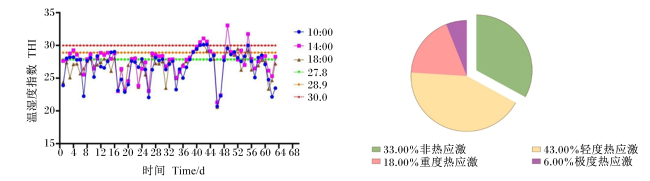
图1所示,兔舍内环境达到轻度热应激的天数占43%(14:00,THI≥27.8),达到重度热应激的天数占18%(14:00,THI≥28.9),达到极度热应激的天数占6%(14:00,THI≥30.0),即试验期间达到热应激的天数占试验天数的67%,达到了热应激的试验条件。
图1 试验期间兔舍温湿度指数统计图(试验1)

Fig.1 THI statistical chart of rabbit house during experimental time (experiment 1)

2.1.2 妊娠全期饲粮添加GSP对热应激母兔繁殖性能的影响

表2可知,与对照组相比,饲粮中添加200、300、400 mg/kg GSP具有改善母兔受胎率和产仔率的作用,但无统计学差异(P>0.05);在窝产仔数方面,添加200、300、400 mg/kg GSP组较对照组分别提高了1.28[(9.84±0.44)只vs.(8.56±0.47)只]、1.38[(9.94±0.49)只vs.(8.56±0.47)只]和0.35只[(8.91±0.44)只vs.(8.56±0.47)只],其中添加300 mg/kg GSP组的窝产仔数较对照组显著增高(P<0.05);在窝产活仔数方面,添加200、300、400 mg/kg GSP组较对照组分别提高了2.09[(8.87±0.51)只vs.(6.78±0.68)只]、2.25[(9.03±0.55)只vs.(6.78±0.68)只]和0.93只[(7.71±0.57)只vs.(6.78±0.68)只],其中添加200、300 mg/kg GSP组较对照组显著增高(P<0.05);与对照组相比,饲粮中添加200、300 mg/kg GSP显著提高了初生活仔窝重(P<0.05),但对初生总窝重和初生活仔均重无显著影响(P>0.05)。
表2 妊娠全期饲粮添加GSP对热应激母兔繁殖性能的影响

Table 2 Effects of GSP supplementation during pregnancy on reproductive performance of female rabbits under heat stress

项目
Items
饲粮中葡萄籽原花青素添加水平
Dietary GSP supplemental levels/(mg/kg)
P
P-value
0 200 300 400
母兔只数No. of does/只 62 62 62 62
受胎率Conception rate/% 84.62 87.27 92.31 92.72 0.198
产仔率Farrowing rate/% 76.39 75.00 77.27 88.77 0.050
窝产仔数Litter size/只 8.56±0.47a 9.84±0.44ab 9.94±0.49b 8.91±0.44ab 0.042
窝产活仔数Live litter size/只 6.78±0.68a 8.87±0.51b 9.03±0.55b 7.71±0.57ab 0.031
窝产死胎数No. of kits born dead/只 1.78±0.44 0.97±0.41 0.91±0.26 1.20±0.30 0.315
初生总窝重Total litter weight/g 554.19±24.79 593.71±20.17 599.72±25.60 552.36±20.27 0.388
初生活仔窝重
Litter weight born alive/g
446.86±41.04a 548.68±27.64b 553.84±29.22b 492.80±30.38ab 0.038
初生活仔均重
Average weight of kits born alive/g
68.72±2.01 63.62±2.08 63.72±2.13 68.03±2.31 0.209

同行数据肩标无字母或相同字母表示差异不显著(P>0.05),不同小写字母表示差异显著(P<0.05)。下表同。

In the same row, values with no letter or the same letter superscripts mean no significant difference (P>0.05), while with different small letter superscripts mean significant difference (P<0.05). The same as below.

2.1.3 妊娠全期饲粮添加GSP对热应激母兔后代仔兔生长性能的影响

表3可知,与对照组相比,GSP处理改善了仔兔7、14、21和35日龄时的窝仔数、窝重和均重。其中,与对照组相比,母兔饲粮中添加300 mg/kg GSP显著提高了仔兔7日龄窝仔数和窝重、14日龄窝重以及21日龄窝仔数和窝重(P<0.05)。
表3 妊娠全期饲粮添加GSP对热应激母兔后代仔兔生长性能的影响

Table 3 Effects of GSP supplementation during pregnancy on growth performance of offspring of female rabbits under heat stress

项目
Items
饲粮中葡萄籽原花青素添加水平
Dietary GSP supplemental levels/(mg/kg)
P
P-value
0 200 300 400
7日龄7 days of age
窝仔数No. of kits per litter/只 6.41±0.12a 6.56±0.13ac 6.94±0.06b 6.74±0.09bc 0.005
窝重Litter weight/g 701.71±34.20a 725.25±20.74ab 773.29±18.23b 740.48±18.25ab 0.039
均重Average weight/g 109.01±4.40 110.71±2.95 111.44±2.52 109.78±1.96 0.946
14日龄14 days of age
窝仔数No. of kits per litter/只 6.30±0.38 6.50±0.20 6.90±0.09 6.70±0.14 0.307
窝重Litter weight/g 1 227.60±33.26a 1 289.30±70.83ab 1 404.00±29.63b 1 352.30±23.04b 0.038
均重Average weight/g 208.29±8.53 190.21±6.10 203.74±4.54 202.87±6.10 0.249
21日龄21 days of age
窝仔数No. of kits per litter/只 5.40±0.52a 6.10±0.28ab 6.60±0.22b 6.20±0.33ab 0.022
窝重Litter weight/g 1 555.50±137.61a 1 635.20±102.63a 1 948.80±63.33b 1 786.70±83.64ab 0.044
均重Average weight/g 296.14±18.94 268.55±13.65 296.43±7.60 290.19±7.56 0.382
35日龄35 days of age
窝仔数No. of kits per litter/只 5.50±0.31 5.60±0.30 5.90±0.23 6.00±0.26 0.539
窝重Litter weight/g 3 532.70±310.48 3 818.50±244.26 4 131.40±144.92 4 136.00±181.23 0.321
均重Average weight/g 637.81±35.58 682.19±26.22 667.49±15.43 691.63±19.36 0.143

2.1.4 妊娠全期饲粮添加GSP对热应激母兔发情第6天血清中性激素和抗氧化指标的影响

表4可知,同期发情第6天时,与对照组相比,饲粮中添加200、300、400 mg/kg GSP 对母兔血清中E2含量无显著影响(P>0.05);饲粮中添加200、300 mg/kg GSP显著降低了母兔血清中P含量(P<0.05);饲粮中添加300 mg/kg GSP显著提高了母兔血清中SOD和CAT活性(P<0.05),并显著降低了血清中MDA含量(P<0.05),但对血清中GSH-Px活性和T-AOC无显著影响(P>0.05)。
表4 妊娠全期饲粮添加GSP对热应激母兔发情第6天血清中性激素和抗氧化指标的影响

Table 4 Effects of GSP supplementation during pregnancy on serum sex hormones and antioxidant indexes on the 6th day of estrus of female rabbits under heat stress

项目
Items
饲粮中葡萄籽原花青素添加水平
Dietary GSP supplemental levels/(mg/kg)
P
P-value
0 200 300 400
雌二醇E2/(pg/mL) 18.49±2.29 17.61±2.80 19.63±2.22 19.81±3.22 0.926
孕酮P/(ng/mL) 0.51±0.07a 0.31±0.04b 0.23±0.02b 0.44±0.07ab 0.035
超氧化物歧化酶SOD/(U/mL) 82.74±2.33a 81.20±2.50a 89.81±2.06b 85.94±2.46ab 0.042
丙二醛MDA/(nmol/mL) 4.21±0.13a 4.14±0.08ab 3.79±0.14b 4.18±0.16ab 0.033
谷胱甘肽过氧化物酶
GSH-Px/(U/mL)
1 069.55±23.77 1 055.94±21.93 1 101.18±17.27 1 076.31±18.46 0.479
总抗氧化能力T-AOC/(U/mL) 12.10±0.17 12.10±0.32 12.66±0.21 12.74±0.32 0.190
过氧化氢酶CAT/(U/mL) 9.33±0.21ab 9.10±0.21a 10.04±0.15b 9.58±0.28ab 0.034

2.1.5 妊娠全期饲粮添加GSP对热应激母兔妊娠第15天血清中性激素和抗氧化指标的影响

表5可知,妊娠第15天时,与对照组相比,饲粮中添加200、300、400 mg/kg GSP 对母兔血清中E2含量无显著影响(P>0.05);饲粮中添加400 mg/kg GSP显著升高了母兔血清中P含量(P<0.05);饲粮中添加200 mg/kg GSP显著降低了母兔血清中MDA含量(P<0.05)。各组母兔血清中SOD、CAT、GSH-Px活性与T-AOC无显著差异(P>0.05)。
表5 妊娠全期饲粮添加GSP对热应激母兔妊娠第15天血清中性激素和抗氧化指标的影响

Table 5 Effects of GSP supplementation during pregnancy on serum sex hormones and antioxidant indexes on the 15th day of pregnancy of female rabbits under heat stress

项目
Items
饲粮中葡萄籽原花青素添加水平
Dietary GSP supplemental levels/(mg/kg)
P
P-value
0 200 300 400
雌二醇E2/(pg/mL) 20.90±0.77 16.17±1.49 19.46±2.32 18.34±1.90 0.251
孕酮P/(ng/mL) 1.21±0.37a 2.11±0.26ab 1.72±0.57ab 2.81±0.41b 0.024
超氧化物歧化酶SOD/(U/mL) 82.88±1.16 84.02±0.96 82.47±1.10 80.48±1.06 0.141
丙二醛MDA/(nmol/mL) 4.42±0.09a 4.20±0.04b 4.36±0.07ab 4.52±0.08a 0.026
谷胱甘肽过氧化物酶
GSH-Px/(U/mL)
1 066.26±17.69 1 083.79±14.21 1 037.23±12.12 1 075.91±17.80 0.195
总抗氧化能力T-AOC/(U/mL) 12.19±0.18 12.47±0.14 12.22±0.17 12.21±0.13 0.556
过氧化氢酶CAT/(U/mL) 9.02±0.10 9.37±0.11 8.96±0.13 9.14±0.17 0.161

2.1.6 妊娠全期饲粮添加GSP对热应激母兔妊娠第15天血清中免疫指标的影响

表6可知,妊娠第15天时,母兔血清中IL-6和IL-10含量各组之间均无显著差异(P>0.05);饲粮中添加300、400 mg/kg GSP的母兔血清中TNF-α含量较对照组显著降低(P<0.05);饲粮中添加400 mg/kg GSP的母兔血清中IgG含量较对照组显著降低(P<0.05);母兔血清中IgA和IgM含量各组之间均无显著差异(P>0.05)。
表6 妊娠全期饲粮添加GSP对热应激母兔妊娠第15天血清中免疫指标的影响

Table 6 Effects of GSP supplementation during pregnancy on serum immune indexes on the 15th day of pregnancy of female rabbits under heat stress

项目
Items
饲粮中葡萄籽原花青素添加水平
Dietary GSP supplemental levels/(mg/kg)
P
P-value
0 200 300 400
白细胞介素-6 IL-6/(pg/mL) 1.22±0.25 1.00±0.19 0.99±0.16 0.89±0.16 0.675
肿瘤坏死因子-α TNF-α/(pg/mL) 3.97±0.46a 3.46±0.53ab 2.61±0.48b 2.20±0.30b 0.044
白细胞介素-10 IL-10/(pg/mL) 1.95±0.30 2.61±0.35 2.30±0.45 2.22±0.29 0.677
免疫球蛋白G IgG/(g/L) 7.97±0.08a 8.17±0.14a 7.94±0.12ab 7.57±0.15b 0.018
免疫球蛋白A IgA/(g/L) 0.80±0.07 0.80±0.01 0.80±0.02 0.78±0.01 0.692
免疫球蛋白M IgM/(g/L) 0.68±0.01 0.70±0.01 0.67±0.01 0.66±0.01 0.087

2.2 不同妊娠阶段饲粮添加GSP对热应激母兔繁殖性能及其仔兔生长性能的影响

2.2.1 兔舍温湿度情况
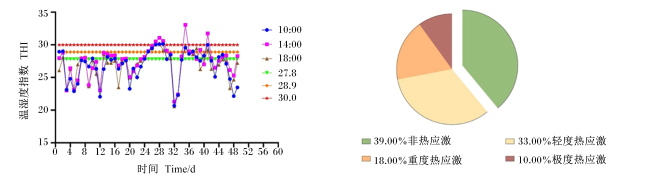
图2所示,在试验期间,兔舍内环境达到轻度热应激的天数占33%(14:00,THI≥27.8),达到重度热应激的天数占18%(14:00,THI≥28.9),达到极度热应激的天数占10%(14:00,THI≥30.0),即试验期间达到热应激的天数占试验天数的61%,达到热应激的试验条件。
图2 试验期间兔舍温湿度指数统计图(试验2)

Fig.2 THI statistical chart of rabbit house during experimental time (experiment 2)

2.2.2 不同妊娠阶段饲粮添加GSP对热应激母兔繁殖性能的影响

表7可知,在母兔饲粮中添加300 mg/kg GSP,分别在妊娠前期(第1~12天)和妊娠中后期(第13~30天)饲喂,与对照组相比,在母兔窝产活仔数、初生总窝重、初生活仔窝重、初生活仔均重方面,妊娠中后期组均显著增高(P<0.05);各组母兔受胎率、产仔率、窝产仔数、窝产死胎数均无显著差异(P>0.05)。
表7 不同妊娠阶段饲粮添加GSP对热应激母兔繁殖性能的影响

Table 7 Effects of GSP supplementation in different stages of pregnancy on reproductive performance of female rabbits under heat stress

项目
Items
对照组
Control
group
妊娠前期组
Early gestation
group
妊娠后期组
Mid-late
pregnancy group
P
P-value
母兔只数No. of does/只 42 42 42
受胎率Conception rate/% 83.33 85.71 88.10 0.597
产仔率Farrowing rate/% 71.43 74.33 82.08 0.173
窝产仔数Litter size/只 7.45±0.33 7.43±0.44 7.72±0.35 0.824
窝产活仔数Live litter size/只 6.32±0.20a 6.67±0.51ab 7.32±0.30b 0.045
窝产死胎数No. of kits born dead/只 1.14±0.45 0.76±0.40 0.40±0.22 0.341
初生总窝重Total litter weight/g 410.05±14.87a 453.67±36.89ab 498.76±22.98b 0.017
初生活仔窝重Litter weight born alive/g 368.64±17.60a 415.86±41.81ab 478.80±22.54b 0.024
初生活仔均重Average weight of kits born alive/g 56.10±3.31a 58.99±4.35ab 65.94±2.42b 0.039

2.2.3 不同妊娠阶段饲粮添加GSP对热应激母兔后代仔兔生长性能的影响

表8可知,在仔兔7日龄窝仔数、窝重、均重方面,妊娠前期组和妊娠中后期组均较对照组表现良好,但均无显著差异(P>0.05);在仔兔各日龄的窝仔数上,妊娠前期组和妊娠中后期组均优于对照组,其中妊娠中后期组21和35日龄窝仔数显著高于对照组(P<0.05);在仔兔14和35日龄窝重上,妊娠中后期组显著高于对照组(P<0.05)。
表8 不同妊娠阶段饲粮添加GSP对热应激母兔后代仔兔生长性能的影响

Table 8 Effects of GSP supplementation in different stages of pregnancy on growth performance of offspring of female rabbits under heat stress

项目
Items
对照组
Control
group
妊娠前期组
Early gestation
group
妊娠后期组
Mid-late
pregnancy group
P
P-value
7日龄7 days of age
窝仔数No. of kits per litter/只 6.51±0.22 6.70±0.21 6.80±0.13 0.547
窝重Litter weight/g 606.40±17.26 687.81±30.17 689.52±40.03 0.109
均重Average weight/g 93.69±2.17 102.71±3.21 100.93±4.75 0.181
14日龄14 days of age
窝仔数No. of kits per litter/只 5.90±0.31 6.52±0.22 6.61±0.22 0.133
窝重Litter weight/g 1 233.30±94.69a 1 379.44±38.24ab 1 469.42±76.80b 0.032
均重Average weight/g 208.93±9.86 214.28±8.73 223.68±10.70 0.566
21日龄21 days of age
窝仔数No. of kits per litter/只 5.71±0.30a 6.20±0.29ab 6.50±0.22b 0.048
窝重Litter weight/g 1 375.90±89.77 1 498.80±31.95 1 623.30±118.66 0.157
均重Average weight/g 241.47±8.70 246.27±11.61 253.63±22.15 0.852
35日龄35 days of age
窝仔数No. of kits per litter/只 5.51±0.27a 6.00±0.33ab 6.42±0.22b 0.030
窝重Litter weight/g 3 318.90±212.32a 3 649.52±251.75ab 4 116.60±195.02b 0.017
均重Average weight/g 606.20±34.71 604.98±13.40 644.77±23.81 0.465

3 讨论

3.1 妊娠全期饲粮添加GSP对热应激母兔繁殖性能及其仔兔生长性能的影响

高温环境是环境应激中最重要的一种应激因素,特别是在炎热的夏季,热应激严重制约着畜牧业的高质量发展。热应激通常会减少畜禽的采食量,导致能量负平衡、机体状况下降、卵巢功能不足、产卵率下降、死胎数增加以及泌乳能力下降等。有研究发现,GSP作为抗氧化剂可以缓解热应激对家兔的不利影响,提高养殖效益[10]。本试验结果表明,在窝产仔数方面,添加200、300、400 mg/kg GSP组较对照组的窝产仔数分别提高1.28、1.38和0.35只,其中添加300 mg/kg GSP组与对照组相比,窝产仔数提高效果显著,并且添加200、300mg/kgGSP组的窝产活仔数较对照组显著增高了2.09和2.25只,这在实际生产中能极大增加兔厂养殖效益。热应激会导致妊娠期间胎盘的重量减少,降低母体-胎儿营养交换的效率,导致胎儿营养不足,进而引发其死亡,因此母兔遭受热应激越严重,其所产生的死胎数就可能越多[11]。在本试验中发现,饲粮中添加300 mg/kg GSP显著提高了母兔的窝产仔数和窝产活仔数,表明饲粮中添加GSP能够改善夏季热应激所造成的母兔死胎数多、易流产等问题。
热应激对母畜影响可能是长期的,妊娠期遭受热应激不仅会影响怀孕母体的健康,损害其哺乳和再繁殖能力,同时也会对其后代正常生长发育和代谢以及健康造成损害。研究发现,多酚可以到达怀孕大鼠的胎儿和胎盘中,可以通过母体的摄入对后代产生代谢效应[12]。在高脂肪饮食组的哺乳大鼠饮食中添加25 mg/kg BW GSP可保护其后代免受氧化应激、高血压等炎症反应[13]。本试验中,通过测定后代仔兔的窝仔数、窝重和均重发现,母兔妊娠期间饲喂添加GSP的饲粮能够影响仔兔的生长发育。本试验结果表明,与对照组相比,饲粮中添加300 mg/kg GSP能显著提高仔兔7日龄的窝仔数和窝重、14日龄窝重以及21日龄窝仔数和窝重,表明了有益的后代效应。

3.2 妊娠全期饲粮添加GSP对热应激母兔血清中性激素和抗氧化指标的影响

生殖类固醇激素的代谢情况反映了性腺活动规律。在哺乳动物中,E2和P具有调控雌性动物生殖行为的作用,P可与雌激素共同作用而刺激排卵。Trout等[14]的研究发现,热应激会导致发情周期第11~21天母牛血清中E2含量降低;同样,Bridges等[15]发现,在41 ℃下培养的牛卵泡细胞,其分泌的E2显著降低。叶黄细胞类固醇生成最终产生P,这是动物建立和维持妊娠的关键。Wolfenson等[16]的研究显示,夏季奶牛血浆中P含量显著低于冬季,同时黄体化鞘细胞比黄体化颗粒细胞更容易受到热应激的影响。而Hill等[17]研究发现,在发情期持续性的高温环境会显著提高血液中黄体生成素(luteinizing hormone,LH)和P含量,影响母羊的发情行为。本试验结果显示,同期发情第6天时,与对照组相比,饲粮中添加200、300和400 mg/kg GSP对母兔血清中E2含量没有产生显著影响;饲粮中添加200、300 mg/kg GSP显著降低了母兔血清中P含量;在妊娠第15天时,饲粮中添加400 mg/kg GSP后母兔血清中P含量较对照组显著升高。推测原因可能是葡萄籽原花青素作为一种生物类黄酮,可以缓解热应激引起的母兔机体生殖类固醇激素生成量的降低,促进母兔卵泡的发育和促进发情。
在正常机体活动中,动物机体是一个完整、和谐的动态平衡系统,其体内自由基的产生与消亡处于平衡状态。但热应激会引起母兔机体的氧化应激,导致机体内的氧化-抗氧化平衡被打破。SOD、GSH-Px、CAT和T-AOC是衡量机体抗氧化能力的重要指标。GSP的化学结构中含有10个酚羟基,可以通过自由基介导的反应保护生物分子(如蛋白质、核酸、多不饱和脂肪酸和糖)免受氧化损伤,阻断自由基的链式反应,表明了GSP极强的抗氧化功能[18]。在本试验中发现,饲粮中添加300 mg/kg GSP显著提高了热应激下母兔同期发情第6天时血清中SOD和CAT活性,显著降低了血清在MDA含量,这说明GSP可以一定程度地缓解热应激引起的氧化应激,提高母兔机体抗氧化能力。MDA是衡量脂质氧化损伤的重要指标,动物在遭受热应激后,机体会产生大量的活性氧(reactive oxygen species,ROS),导致机体脂质过氧化,产生大量的MDA[19]。本研究结果显示,饲粮中添加200 mg/kg GSP显著降低了热应激母兔妊娠第15天时血清中MDA含量,而其他抗氧化指标3个添加GSP组则与对照组无显著差异,这可能与机体自身的抵抗力相关,在遭遇热应激之后,母兔体内的抗氧化体系被激活,增加了抗氧化酶的活性。

3.3 妊娠全期饲粮添加GSP对热应激母兔血清中免疫指标的影响

来自各种芳香植物的酚类化合物已被证明具有增强免疫力的作用。由于酚类化合物具有对前列腺素和一氧化氮的抑制作用,可以减少炎症过程,因此它们的抗炎功能引起了人们的兴趣,这是在畜牧养殖中使用酚类化合物作为饲料添加剂的主要原因之一。虽然验证过程很复杂,但细胞因子如白细胞介素、趋化因子、干扰素和免疫细胞分泌的肿瘤坏死因子是炎症反应的关键介质。GSP对免疫功能的基本作用模式是提高免疫球蛋白和细胞因子含量,增加吞噬作用,并促进干扰素-γ(interferon-γ,IFN-γ)的释放。研究显示,给蛋鸡饲喂富含原花青素的松树皮(20 mg/kg)后,外周血单核细胞(PBMC)中的Th1型细胞因子(如IFN-γ)mRNA表达水平升高,Th2型细胞因子(如IL-6)mRNA表达水平降低,PBMC的增殖也明显升高[20]。在饲喂富含多酚的葡萄籽和葡萄渣提取物的饲粮后,猪十二指肠黏膜中的炎性介质核因子-κB(nuclear factor-κB,NF-κB)和核因子E2相关因子2(nuclear factor-E2-related factor 2,Nrf2)的基因表达水平明显降低,降低了肠道疾病的风险[21]。红酒多酚能刺激先天和适应性免疫反应,对白细胞介素-12(interleukin-12,IL-12)、IFN-γ和IL-10等细胞因子以及免疫球蛋白的释放产生影响[22]。有研究表明,在复发性结肠炎大鼠模型中,灌胃给予不同剂量的GSP后,大鼠结肠组织中白细胞介素-1β(interleukin-1β,IL-1β)和IL-6含量显著降低,白细胞介素-4(interleukin-4,IL-4)和IL-10含量显著升高,表明GSP可降低促炎因子的表达,同时提高抗炎因子的表达[23]。本研究发现,饲粮中添加300、400 mg/kg GSP后热应激母兔妊娠第15天血清中TNF-α含量较对照组均显著降低,血清中IL-10含量各添加GSP组虽与对照组无统计学差异,但有一定的改善作用,表明GSP具有一定的抗炎能力,能抑制热应激导致的促炎因子的反应性升高,动态调节炎症细胞因子网络,从而控制体内炎症水平,调节动物机体免疫功能[24-25]

3.4 不同妊娠阶段饲粮添加GSP对热应激母兔繁殖性能及其仔兔生长性能的影响

为进一步探究GSP对热应激条件下母兔繁殖性能产生影响的具体妊娠阶段,同时考虑饲料成本,本试验设计了在不同妊娠阶段饲粮中添加300 mg/kg GSP进行研究。子宫内胎儿的热调节受限于胎儿代谢热的产生和母体-后代传热。与母体的胎儿热交换主要通过胎儿-胎盘循环发生,约占胎儿总热量损失的85%,其余通过胎儿膜、羊水和子宫壁进行交换[26]。因此,母体自身温度的变化会影响胎儿的温度。母兔妊娠中后期的热应激与胎儿快速生长时期相吻合,胎儿通过胎盘吸收营养,胎儿体重增长受到近50%的限制[27]。有研究表明,胎儿各器官的生物统计学差异出现在妊娠中后期[28],热应激时妊娠后期胎盘重量会降低,减少胎盘血流量,进一步限制胎儿在子宫内的生长发育。从本试验结果来看,妊娠中后期组母兔的窝产活仔数、初生总窝重、初生活仔窝重及初生活仔均重均显著高于对照组,这表明在妊娠中后期饲粮中添加GSP能降低热应激对母兔妊娠期的负面影响,对胎儿生长有一定的积极作用。
母体子宫内热应激会对胎儿产生长期且严重的负面影响,妊娠中后期遭受热应激的胎儿出生体重较轻,同时其代谢和免疫功能受损,这些后代不良的动物可能是由于不同发育时期的温度影响、母体乳腺发育和母乳合成能力的不足引起的[29]。因此,产前热应激对妊娠母兔造成的影响制约着夏季兔产业的发展。本试验继续追踪了后代仔兔的生长,从仔兔出生后每7 d记录1次仔兔的窝仔数、窝重。在前14 d各组间的仔兔窝仔数均无显著差异,妊娠中后期组14日龄的仔兔窝重显著高于对照组,妊娠中后期组21日龄和断奶(35日龄)时窝仔数均显著高于对照组,且断奶时的仔兔窝重也显著高于对照组。这表明在妊娠中后期饲粮中添加GSP可以降低热应激对母兔机体的负面影响,提高胎盘效率,间接影响其后代的生长,提高后代的健康水平。

4 结论

母兔饲粮中添加300 mg/kg的GSP能改善热应激母兔的繁殖性能及其仔兔的生长性能;在热应激母兔妊娠早期(第1~12天)和中后期(妊娠第13~30天)饲粮中添加300 mg/kg GSP能改善母兔的繁殖性能及其仔兔的生长性能,且在妊娠中后期饲粮中添加即具有明显改善效果。
[1]
LI W H, YAO R Y, XIE L X, et al. Dietary supplementation of grape seed tannin extract stimulated testis development,changed fatty acid profiles and increased testis antioxidant capacity in pre-puberty hu lambs[J]. Theriogenology, 2021, 172:160-168.

DOI

[2]
汪水平, 杨大盛, 李艳莎, 等. 葡萄籽提取物原花青素对肉兔抗氧化功能、脂质含量及血清代谢产物浓度的影响[J]. 中国粮油学报, 2014, 29(10):72-76,82.

WANG S P, YANG D S, LI Y S, et al. The effects of grape seed proanthocyanidin extracts on antioxidan function,lipid content and serum concentrations of metabolites of meat rabbit[J]. Journal of the Chinese Cereals and Oils Association, 2014, 29(10):72-76,82. (in Chinese)

[3]
HASSAN F A, MAHROSE K M, BASYONY M M. Effects of grape seed extract as a natural antioxidant on growth performance,carcass characteristics and antioxidant status of rabbits during heat stress[J]. Archives of Animal Nutrition, 2016, 70(2):141-154.

DOI

[4]
张悦, 任勇, 邓超, 等. 葡萄籽原花青素对生长育肥猪肉品质、抗氧化性能和脂肪酸组成的影响[J]. 中国畜牧杂志, 2022, 58(5):221-228.

ZHANG Y, REN Y, DENG C, et al. Effects of grape seed procyanidins on meat quality,antioxidant properties and fatty acid composition of growing-finishing pigs[J]. Chinese Journal of Animal Science, 2022, 58(5):221-228. (in Chinese)

[5]
SONG P X, ZHANG R J, WANG X X, et al. Dietary grape-seed procyanidins decreased postweaning diarrhea by modulating intestinal permeability and suppressing oxidative stress in rats[J]. Journal of Agricultural and Food Chemistry, 2011, 59(11):6227-6232.

DOI PMID

[6]
FANG L Y, LI M Y, ZHAO L, et al. Dietary grape seed procyanidins suppressed weaning stress by improving antioxidant enzyme activity and mRNA expression in weanling piglets[J]. Journal of Animal Physiology and Animal Nutrition, 2020, 104(4):1178-1185.

DOI PMID

[7]
DE BLAS C, WISEMAN J. Nutrition of the Rabbit[M]. 2nd ed.Cambridge, MA:CABI, 2010:657-666.

[8]
李福昌. 家兔营养[M]. 北京: 中国农业出版社, 2009:167-170.

LI F C. Nutrition of the rabbit[M]. Beijing: China Agriculture Press, 2009:167-170. (in Chinese)

[9]
MARAI I F M, HABEEB A A M, GAD A E. Rabbits’productive,reproductive and physiological performance traits as affected by heat stress:a review[J]. Livestock Production Science, 2002, 78(2):71-90.

DOI

[10]
HASSAN F A, MAHROSE K H, BASYONY M M, et al. Influence of grape seeds powder as a natural antioxidant on growth performance,antioxidant status and carcass characteristics of rabbits under hot conditions[C]//The 7th International Conference On Rabbit Production In Hot Climate.Marsa alam,Red Sea,Egypt:[s.n.],2014:395-412.

[11]
杨丁凡, 楼鹏, 张然, 等. 环境热应激对家畜胎盘和胎儿影响的研究进展[J]. 中国草食动物科学, 2020, 40(5):56-60.

YANG D F, LOU P, ZHANG R, et al. Research progress on the effect of environmental heat stress on placental function and fetal growth in livestock[J]. China Herbivore Science, 2020, 40(5):56-60. (in Chinese)

[12]
AROLA-ARNAL A, OMS-OLIU G, CRESCENTI A, et al. Distribution of grape seed flavanols and their metabolites in pregnant rats and their fetuses[J]. Molecular Nutrition&Food Research, 2013, 57(10):1741-1752.

[13]
DEL BAS J M, CRESCENTI A, AROLA-ARNAL A, et al. Grape seed procyanidin supplementation to rats fed a high-fat diet during pregnancy and lactation increases the body fat content and modulates the inflammatory response and the adipose tissue metabolism of the male offspring in youth[J]. International Journal of Obesity, 2015, 39(1):7-15.

DOI PMID

[14]
TROUT J P, MCDOWELL L R, HANSEN P J. Characteristics of the estrous cycle and antioxidant status of lactating Holstein cows exposed to heat stress[J]. Journal of Dairy Science, 1998, 81(5):1244-1250.

PMID

[15]
BRIDGES P J, BRUSIE M A, FORTUNE J E. Elevated temperature (heat stress) in vitro reduces androstenedione and estradiol and increases progesterone secretion by follicular cells from bovine dominant follicles[J]. Domestic Animal Endocrinology, 2005, 29(3):508-522.

DOI

[16]
WOLFENSON D, SONEGO H, BLOCH A, et al. Seasonal differences in progesterone production by luteinized bovine thecal and granulosa cells[J]. Domestic Animal Endocrinology, 2002, 22(2):81-90.

DOI PMID

[17]
HILL T G, ALLISTON C W. Effects of thermal stress on plasma concentrations of luteinizing hormone,progesterone,prolactin and testosterone in the cycling ewe[J]. Theriogenology, 1981, 15(2):201-209.

DOI

[18]
KANNER J, FRANKEL E, GRANIT R, et al. Natural antioxidants in grapes and wines[J]. Journal of Agricultural and Food Chemistry, 1994, 42(1):64-69.

DOI

[19]
LIN H, DECUYPERE E, BUYSE J. Acute heat stress induces oxidative stress in broiler chickens[J]. Comparative Biochemistry and Physiology Part A:Molecular & Integrative Physiology, 2006, 144(1):11-17.

[20]
PARK I J, CHA S Y, KANG M, et al. Effect of proanthocyanidin-rich extract from Pinus radiata bark on immune response of specific-pathogen-free white Leghorn chickens[J]. Poultry Science, 2011, 90(5):977-982.

DOI

[21]
GESSNER D K, FIESEL A, MOST E, et al. Supplementation of a grape seed and grape marc meal extract decreases activities of the oxidative stress-responsive transcription factors NF-κB and Nrf2 in the duodenal mucosa of pigs[J]. Acta Veterinaria Scandinavica, 2013, 55(1):18.

DOI

[22]
MAGRONE T, CANDORE G, CARUSO C, et al. Polyphenols from red wine modulate immune responsiveness:biological and clinical significance[J]. Current Pharmaceutical Design, 2008, 14(26):2733-2748.

DOI

[23]
王艳红, 葛斌, 杨社华, 等. 葡萄籽原花青素对复发性结肠炎大鼠结肠组织中细胞因子的影响[J]. 中国医院药学杂志, 2015, 35(16):1453-1456.

WANG Y H, GE B, YANG S H, et al. Effects of proanthocyanidins from grape seeds on levels of cytokines in colon tissues of rats with recurrent colitis[J]. Chinese Journal of Hospital Pharmacy, 2015, 35(16):1453-1456. (in Chinese)

[24]
WU S S, YANO S, HISANAGA A, et al. Polyphenols from Lonicera caerulea L. berry attenuate experimental nonalcoholic steatohepatitis by inhibiting proinflammatory cytokines productions and lipid peroxidation[J]. Molecular Nutrition & Food Research, 2017, 61(4):1600858.

[25]
WU S S, YANO S, CHEN J H, et al. Polyphenols from Lonicera caerulea L. berry inhibit LPS-induced inflammation through dual modulation of inflammatory and antioxidant mediators[J]. Journal of Agricultural and Food Chemistry, 2017, 65(25):5133-5141.

DOI

[26]
REGNAULT T R H, GALAN H L, PARKER T A, et al. Placental development in normal and compromised pregnancies—a review[J]. Placenta, 2002, 23(Suppl A):S119-S129.

[27]
COLLIER R J, DOELGER S G, HEAD H H, et al. Effects of heat stress during pregnancy on maternal hormone concentrations,calf birth weight and postpartum milk yield of Holstein cows[J]. Journal of Animal Science, 1982, 54(2):309-319.

DOI

[28]
BARBERA A, JONES O W 3RD, ZERBE G O, et al. Early ultrasonographic detection of fetal growth retardation in an ovine model of placental insufficiency[J]. American Journal of Obstetrics and Gynecology, 1995, 173(4):1071-1074.

PMID

[29]
DADO-SENN B, LAPORTA J, DAHL G E. Carry over effects of late-gestational heat stress on dairy cattle progeny[J]. Theriogenology, 2020, 154:17-23.

DOI

Outlines

/