RESEARCH PAPER

Effects of Dietary Crude Protein Levels on Secretion Performance in Muskrats

  • MA Ruyue , 1 ,
  • FANG Yuanjing 1 ,
  • WANG Ying 1 ,
  • YANG Qinlin 2 ,
  • ZENG Dejun 2 ,
  • JIE Hang , 2, * ,
  • SONG Daijun , 1, *
Expand
  • 1 College of Animal Science and Technology, Southwest University, Chongqing 400716, China
  • 2 Chongqing Institute of Medicinal Plant Cultivation, Chongqing 408435, China
* ZHAN Hang, associate professor, E-mail: ;
SONG Daijun, associate professor, E-mail:

Received date: 2023-06-12

  Online published: 2023-12-11

Abstract

To investigate the effects of different CP levels on the secretion performance of muskrats, 60 one-year-old muskrats were randomly divided into 5 groups (6 replicates per group, 1 male and 1 female muskrat per replicate, only male muskrats were sampled), fed diets with CP levels of 16%, 18%, 20%, 22% and 24%, for a pre-feeding period of 10 days and a trial period of 73 days. The results showed as follows: 1) on the 12th day of the experiment, the fragrance production of muskrat in 22% group was the highest, and the fragrance production of muskrat in 24% group was the lowest, and it was significantly lower than that in 18%, 20% and 22% groups (P<0.05). On the 36th and 63rd day of the experiment, the fragrance production of muskrat in 22% group was significantly higher than that in other groups (P<0.05), but there was no significant difference among other groups (P>0.05). With the increase of dietary CP level, the total fragrance production of muskrats in 18% and 20% groups was increased, and the total fragrance production of muskrats in 22% group was the highest, and significantly higher than that in other groups (P<0.05). When dietary CP level was further increased to 24%, the total fragrance production of muskrats began to decrease and was lower than that in other experimental groups, but the difference was not significant (P>0.05). 2) There was no significant difference in moisture content of fragrance liquid between groups (P>0.05), but the content of cyclopentadecanone in fragrance liquid in 22% group was significantly higher than that in other groups (P<0.05), the lowest content was in 24% group. 3) The contents of blood testosterone and estradiol showed an upward trend with increasing dietary CP level, and the contents of testosterone and estradiol in 20%, 22% and 24% groups were significantly higher than those in 16% group (P<0.05). 4) The serum urea nitrogen (UN) content in 16% group was the lowest and significantly lower than that in other groups (P<0.05), and the serum UN content in 22% group was the highest, and significantly higher than that in 20% group (P<0.05). The serum total protein (TP) content in 24% group was the lowest, which was significantly lower than that in other groups (P<0.05); serum albumin (ALB) content in 16% group was the lowest, and significantly lower than that in other groups (P<0.05), and significantly higher than that in 16% and 24% groups (P<0.05). These results indicate that the dietary CP levels affect the secretion performance of muskrats. Muskrats have the highest scent production, better quality of muskrat fragrance when dietary CP level is 22%.

Cite this article

MA Ruyue , FANG Yuanjing , WANG Ying , YANG Qinlin , ZENG Dejun , JIE Hang , SONG Daijun . Effects of Dietary Crude Protein Levels on Secretion Performance in Muskrats[J]. Chinese Journal of Animal Nutrition, 2023 , 35(12) : 8001 -8012 . DOI: 10.12418/CJAN2023.725

麝香是繁殖期成熟雄性鹿科动物香囊中的干燥分泌物,具有开窍醒神、活血通经、消肿止痛的功效[1]。但由于猎杀、栖息地被破坏等原因,野生麝科动物数量不断减少,加之人工养殖难度大,导致我国天然麝香资源极为缺乏。研究表明,麝鼠香与麝香成分[2]及功效[3]相似,且麝鼠的适应能力较强、养殖成本低、周期短、饲料来源广泛,是一种很好的麝香替代品。
麝鼠的香腺组织季节性发育,受激素水平和饲粮营养水平影响。饲料营养水平能够影响动物的生长发育以及生产性能,饲料摄入不足会影响动物机体对养分的分解代谢,导致动物代谢营养不足甚至患病,进而损害动物生产性能[4]。粗蛋白质(CP)作为饲料中重要的营养物质,是生物体主要组成部分,能够调节动物机体代谢,并向性腺轴提供调节信号[5],饲粮CP水平的高低对于畜禽的免疫性能[6-7]、生产性能[8-9]等起重要作用。研究表明,动物的泌香性能会受到营养因素,特别是饲粮CP水平的影响[10]。目前针对饲粮CP水平对麝鼠泌香性能影响的研究较少,且关于麝鼠泌香机理的研究还不够深入。因此,本试验旨在探究饲粮CP水平对麝鼠泌香性能影响的规律及其机理,为麝鼠的规范而高效地养殖提供参考资料。

1 材料与方法

1.1 试验设计及饲养管理

试验采用单因子设计,选取进入繁殖期、1周岁、体重为(938±86) g的麝鼠(购自河北省辛集市中国麝鼠养殖基地)60只,雌雄各占1/2,随机分为5组,每组6个重复。麝鼠在繁殖期对饲粮CP的需要量较高,每100 g干物质中需含20 g左右CP[11],故5个组饲喂CP水平分别为16%、18%、20%、22%、24%的5种饲粮,其他营养成分基本一致。饲粮组成及营养水平见表1
表1 饲粮组成及营养水平(风干基础)

Table 1 Composition and nutrient levels of diets (air-dry basis) %

项目
Items
16%组
16% group
18%组
18% group
20%组
20% group
22%组
22% group
24%组
24% group
原料Ingredients
苜蓿草粉Alfalfa powder 60.00 60.00 60.00 60.00 60.00
玉米Corn 26.40 21.00 16.00 11.50 6.60
豆粕Soybean meal 7.00 11.90 16.10 18.60 22.30
鱼粉Fish meal 0.50 1.00 1.80 3.80 5.00
山楂酵母Hawthorn yeast 2.50 2.50 2.50 2.50 2.50
石粉Limestone 0.30 0.30 0.30 0.30 0.30
食盐NaCl 0.30 0.30 0.30 0.30 0.30
矿物元素预混料Mineral premix1) 2.00 2.00 2.00 2.00 2.00
维生素预混料Vitamin premix2) 1.00 1.00 1.00 1.00 1.00
合计Total 100.00 100.00 100.00 100.00 100.00
营养水平Nutrient levels3)
水分Moisture 10.76 10.30 11.16 10.82 10.62
总能Gross energy/(MJ/kg) 14.92 15.15 14.98 15.08 15.31
粗蛋白质Crude protein 15.73 18.16 19.85 22.46 23.77
粗脂肪Ether extract 1.93 1.92 1.87 1.95 1.85
粗纤维Crude fiber 14.59 15.28 14.24 15.36 15.03
钙Calcium 1.81 1.84 1.91 1.96 1.99
磷Phosphorus 0.40 0.43 0.46 0.51 0.55

1) 矿物元素预混料为每千克饲粮提供 The mineral premix provided the following per kg of diets: Fe 16 mg,Cu 8 mg,Zn 5 mg,Mn 10 mg,I 8.5 mg,Co 0.10 mg,Se 0.20 mg。

2)维生素预混料为每千克饲粮提供 The vitamin premix provided the following per kg of diets: VA 95 000 IU, VD 35 000 IU, VE 200 IU, VK 15 mg, VB1 8 mg, VB2 25 mg, VB6 15 mg, VB12 2 mg, VC 35 mg, 生物素 biotin 0.8 mg,叶酸 folic acid 5 mg, 烟酸 nicotinic acid 125 mg, 泛酸钙 calcium pantothenate 35 mg, 蛋氨酸 methionine 80 mg, 赖氨酸 lysine 60 mg, 色氨酸 tryptophan 70 mg, 苏氨酸 threonine 50 mg。

3)总能为计算值[12],其余为实测值。Gross energy was a calculated value[12], while the others were measured values.

每个重复1雌1雄同舍饲养,雄性麝鼠产香时处于发情期,1雌1雄同舍饲养是麝鼠养殖的常规操作,实际生产中只有雄性麝鼠产麝鼠香,试验仅对雄性麝鼠取样(n=6)。自由采食,保证充足饮水,其他饲养管理条件保持一致。预试期10 d,逐步替换试验饲粮,正试期73 d,分别在第12、36、63天进行3次取香,测定泌香量以及香液品质。饲养结束后在乙醚罐里对麝香鼠进行麻醉,待麝香鼠麻醉后将其处死,将麝香鼠尸体放在操作台上,打开其胸腔,用含有乙二胺四乙酸(EDTA)的一次性真空采血管(2 mL)进行心脏采血,放于-20 ℃冰箱待运回检测血清生化指标及血液激素含量。

1.2 测定指标及方法

1.2.1 饲粮营养组成测定

按照GB/T 6435—2014[13]测定样品中水分含量并计算其干物质含量。按照GB/T 6432—2018[14]测定样品中氮含量并计算其CP含量。按照GB/T 6433—2006[15]测定样品中粗脂肪的含量。按照GB/T 6434—2006[16]测定样品中粗纤维含量。按照GB/T 6436—2018[17]测定样品中钙的含量。按照GB/T 6437—2018[18]测定样品中磷的含量。

1.2.2 泌香量

在取香前对玻璃容器进行消毒称重并标记,并将已经标记并称重的玻璃容器放在麝香鼠香腺下端5 cm左右处,找到位于麝鼠下腹的香腺,用右手拇指及食指从香囊腺的头部逐渐向尾部稍用力按摩挤压,让香液自然流出滴入玻璃器皿中,直到香腺变软变小无香液滴出为止,取香后对香液和玻璃容器称重,前后差即为麝鼠泌香量。测重后用封口膜包裹好放置在-20 ℃冰箱,待运回检测香液成分。

1.2.3 香液水分含量

用已经烘干至恒重的玻璃器皿称取适量香液,香液和容器总重为W,在105 ℃的烘箱里烘90 min直至恒重,此时样品加香液重量为W1,香液水分含量计算公式如下:
香液水分含量(%)=[(W-W1)/W]×100。

1.2.4 香液麝香酮和环十五烷酮含量

使用气相色谱仪(岛津GC-2010)测定香液中麝香酮和环十五烷酮的含量。称取麝香酮标准品19.31 mg,用无水乙醇溶解,并定容至10 mL,得到浓度为1.931 mg/mL的麝香酮标准品溶液。减重法称取环十五酮标准品19.31 mg,用无水乙醇溶解,并定容至10 mL,得到浓度为1.931 mg/mL的环十五烷酮标准品溶液。称取麝香鼠香液样品约0.2 g,精密加入无水乙醇2 mL,涡旋5 min,超声振荡10 min,用0.22 μm滤膜过滤,取续滤液即得样品液。
色谱柱:Agilent HP-5(30 m×0.25 mm×0.25 μm),载气为氮气,进样口温度为250 ℃,分流比为3∶1,升温程序为初温190 ℃,保持17 min,以20 ℃/min升温至250 ℃,保持5 min,平衡时间为3 min,FID检测器温度为280 ℃,进样量为1 μL。分别进样空白溶液、对照品溶液和麝香溶液得到色谱图。
精密吸取不同体积的麝香酮、环十五烷酮标准品溶液于5 mL容量瓶中,加无水乙醇定容,得到浓度为13.517~579.300 μg/mL的麝香酮、环十五烷酮系列对照品溶液,色谱仪测定,以各峰面积(y)为纵坐标,浓度(x,μg/min)为横坐标,绘制标准曲线。以同样方法制备麝香鼠香液样品的溶液,色谱仪进行分析测定,将峰面积带入线性方程计算香液中麝香酮和环十五烷酮的含量。

1.2.5 血液性激素含量及血清生化指标

测定血液中睾酮(T)和雌二醇(E2)的含量,测定血清中尿素氮(UN)、总蛋白(TP)、白蛋白(ALB)含量,按照试剂盒说明书操作步骤进行,试剂盒购自重庆芃光生物科技有限公司。

1.3 数据处理与分析方法

试验数据使用SPSS 25.0软件进行one-way ANOVA方差分析,组间差异采用Duncan氏法进行多重比较,试验结果用“平均值±标准差”表示。P<0.05为差异显著,0.05<P<0.10表示组间存在差异显著的趋势。

2 结果

2.1 饲粮不同CP水平对麝鼠泌香性能的影响

2.1.1 饲粮不同CP水平对麝鼠泌香量的影响
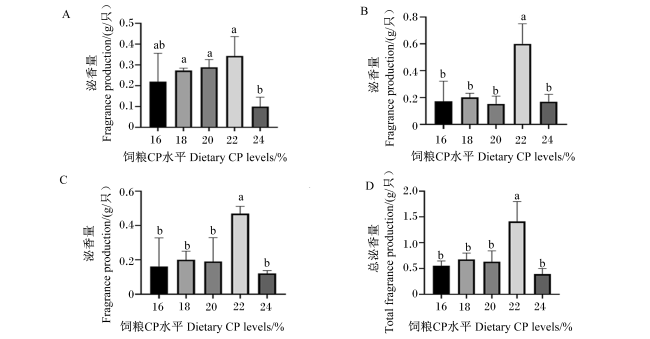
图1可知,试验第12天取香时,在一定范围内,泌香量随着饲粮CP水平提高逐渐增加,其中22%组泌香量最高,但饲粮CP水平进一步提高到24%时,泌香量下降,且显著低于18%、20%、22%组(P<0.05); 试验第36、63天取香时,22%组泌香量显著高于其他组(P<0.05),其他各组间差异不显著(P>0.05)。随着饲粮CP水平的提高,总泌香量有上升趋势,当饲粮CP水平为22%时,总泌香量达到最高,显著高于其他组(P<0.05);而饲粮CP水平进一步提高到24%时,总泌香量开始下降且低于其他组,但差异不显著(P>0.05)。
图1 饲粮不同CP水平对麝鼠泌香量的影响

A: 试验第1~12天泌香量;B:试验第13~36天泌香量;C:试验第37~63天泌香量;D:3次总泌香量。数据柱形标注不同小写字母表示差异显著(P<0.05)。图5图6图7同。

Fig.1 Effects of different dietary CP levels on fragrance production in muskrat

A: fragrance production during days 1 to 12 of experiment; B: fragrance production during days 13 to 36 of experiment; C: fragrance production during days 37 to 63 of experiment; D: 3 times of total fragrance production. Value columns with different small letters mean significant difference (P<0.05). The same as Fig.5, Fig.6 and Fig.7.

2.1.2 饲粮不同CP水平对麝鼠香液品质的影响

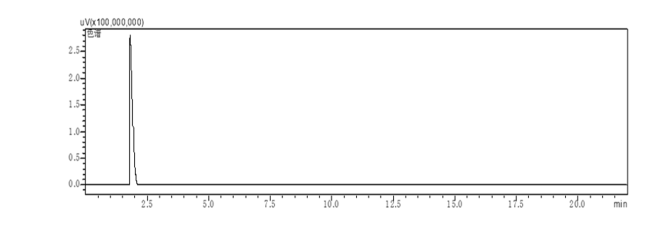
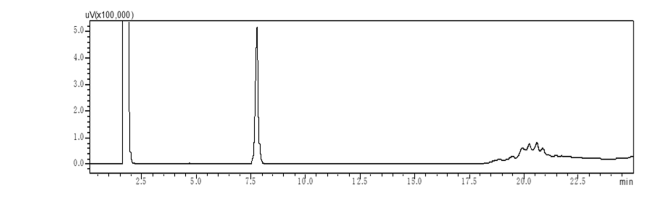
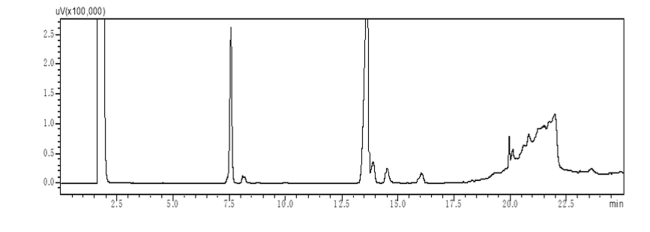
环十五烷酮标准溶液线性回归方程为:y=5 528.8x-13 128,相关系数(r)为0.999 7。将麝鼠香液的峰面积代入方程式计算麝鼠香液中环十五烷酮的含量。图2~图4为相关色谱图。
图2 空白溶液色谱图

Fig.2 Chromatogram of control solution

图3 环十五烷酮标准液色谱图

Fig.3 Chromatogram of standard liquid of cyclopentadecanone

图4 麝鼠香液色谱图

Fig.4 Chromatogram of fragrance liquid in muskrat

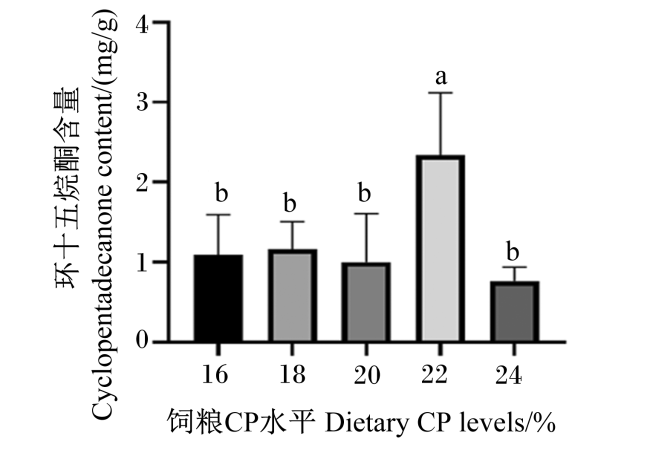
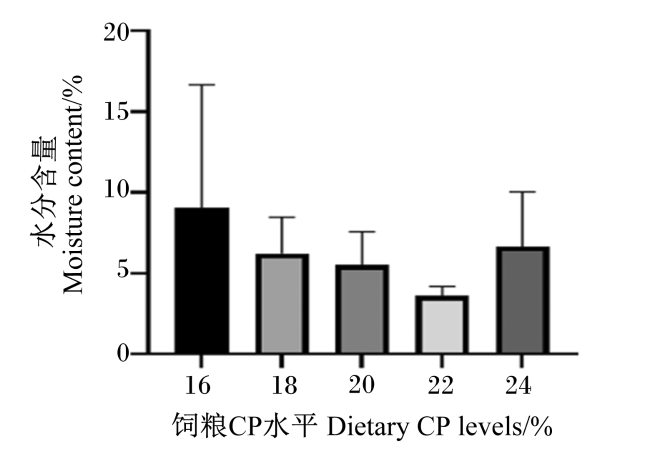
图5可知,22%组香液中环十五烷酮含量显著高于其他组(P<0.05),24%组香液中环十五烷酮含量最低。由图6可知,各组香液水分含量差异不显著(P>0.05)。本次试验发现,麝鼠香中并不含有麝香酮。
图5 麝鼠香液中环十五烷酮的含量

Fig.5 Cyclopentadecanone content of fragrance liquid in muskrat

图6 麝鼠香液中水分含量

Fig.6 Moisture content of fragrance liquid in muskrat

2.2 饲粮不同CP水平对麝鼠血清生化指标的影响

表2可知,16%组血清UN含量最低且显著低于其他组(P<0.05),22%组血清UN的含量最高,显著高于20%组(P<0.05),高于18%和24%组,但无显著差异(P>0.05);血清TP含量各组间差异不显著(P<0.05);16%组血清ALB含量最低且显著低于其他组(P<0.05),20%组含量最高,且显著高于16%和24%组(P<0.05)。
表2 饲粮不同CP水平对麝鼠血清生化指标的影响

Table 2 Effects of different dietary CP levels on serum biochemical indexes in muskrat mg/mL

项目
Items
16%组
16% group
18%组
18% group
20%组
20% group
22%组
22% group
24%组
24% group
P
P-value
尿素氮UN 0.080±0.010c 0.111±0.020ab 0.097±0.010b 0.126±0.010a 0.119±0.020ab 0.021
总蛋白TP 56.616±6.640 58.912±2.600 63.668±8.870 58.210±7.130 50.489±2.380 0.201
白蛋白ALB 27.439±5.280c 30.989±5.440ab 38.447±3.260a 35.798±3.800ab 28.082±2.050b 0.042

同行数据肩标不同小写字母表示差异显著(P<0.05),相同字母或无字母表示差异不显著(P>0.05)。

In the same row, values with different small letter superscripts mean significant difference (P<0.05), while with the same or no letter superscripts mean no significant difference (P>0.05).

2.3 饲粮不同CP水平对麝鼠血液性激素含量的影响

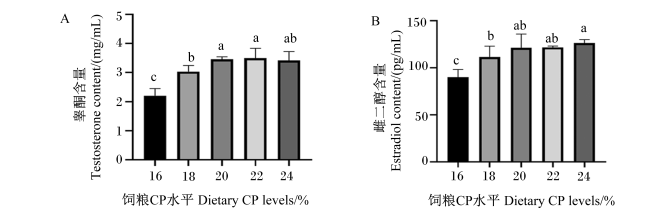
图7可知,16%组血液T和E2的含量都显著低于其他组(P>0.05)。18%组血液T的含量显著低于20%和22%组(P<0.05),低于24%组,但差异不显著(P>0.05),20%组略高于24%组,但差异不显著(P>0.05)。18%组血液E2的含量显著低于24%组(P<0.05),略低于20%和22%组,但差异不显著(P>0.05),20%组略低于24%组,但差异不显著(P>0.05)。
图7 饲粮不同CP水平对麝鼠血液性激素含量的影响

Fig.7 Effects of different dietary CP levels on blood sex hormone contents in muskrat

3 讨论

3.1 饲粮不同CP水平对麝鼠泌香性能的影响

作为特种经济动物,麝鼠泌香性能是其十分重要的经济指标。程世国等[19]研究表明,麝香分泌量可能与饲粮中朊水平有关,进一步研究发现高能量、粗阮和氨基酸水平组麝香量显著高于中水平组和低水平组[20]。由此可见,要获得较高的麝香量,饲粮中必须含有较高的能量、粗阮和可利用氨基酸。程建国等[21]研究发现,在保持相同青绿多汁饲料和精饲料饲喂比例的情况下,提高精饲料CP水平,使其摄入更多的蛋白质,可以更大程度地满足雄麝的生理需要,促进麝香的分泌,提高其泌香量。但如果饲粮CP满足生产需要后,再增加饲粮中CP水平反而蛋白质生物学价值呈递减趋势[22]。本试验结果与这些研究结果一致,随着饲粮CP水平的增加,麝鼠的泌香量也随之增加;但饲粮CP水平进一步增加时,麝鼠泌香量反而下降,甚至低于最低CP水平组。这可能与麝香中含有极其丰富的蛋白质[23]有关,泌香期大量蛋白质在香腺细胞中合成,饲粮中所提供的CP可直接用来合成初香液,也可能参与初香的熟化过程[24],故在一定范围内,随着饲粮CP水平的增加,麝鼠泌香量也随之增加。因此,饲粮中的CP可以通过影响香液合成过程进而影响麝鼠泌香量。
关于麝鼠香是否含有麝香酮,前人的研究结果不尽相同,王树岐等[25]、金顺丹等[26]研究发现,麝鼠香囊中含有麝香酮,随后李宝唐等[27]、陈建新等[28]、刘科峰等[29]陆续发现,麝鼠香液含有麝香酮等物质,但牟峻等[30]认为麝鼠香液中检测到的麝香酮即3-甲基-环十五烷酮,是和麝香酮具有相同分子质量的异构体十六烷,孙菲菲等[2]研究也证实了这一观点,其通过比对麝香酮对照品发现麝鼠香中并没有麝香酮成分,推测可能误把环十五烷酮认为是麝香酮。本试验结果与之一致,在麝鼠香液中并未检测出麝香酮,但检测出了环十五烷酮,且随着饲粮CP水平的增加,麝鼠泌香量以及香液中环十五烷酮的含量也增加,但当饲粮CP水平过高泌香性能反而会下降。

3.2 饲粮不同CP水平对麝鼠血清生化指标的影响

血清生化指标是反映动物健康状况和营养状况的重要指标[31]。目前麝鼠血液指标也只有对野外麝鼠血清生化指标的测定[32],所以测定麝鼠血清生化指标对于填补该项研究的空缺极为重要,本试验测定的蛋白质代谢相关指标有血清UN、TP和ALB含量。UN是肝脏代谢产物,可以用于评估氨基酸利用效率。通常,动物血液中UN含量是稳定在一定范围内,UN含量高说明其对饲粮蛋白质的利用率较低[33]、饲料中的蛋白质被氧化代谢或是饲粮氨基酸不平衡[34],这可能是因为高CP水平饲粮使肝脏、肾脏超负荷而导致血清UN含量升高;UN含量低则表明饲粮中的蛋白质能够被有效利用了,或者饲粮氨基酸比较平衡。研究表明,血清UN含量随着饲粮CP水平的增加而增加[35-36],本试验结果与前人结果一致。TP是动物机体蛋白质的组成成分,可以反映动物对蛋白质的吸收情况。TP代表ALB和球蛋白的总和,其测量值表示血液中蛋白质的总量,可作为蛋白质代谢指标进行研究,在一定程度上能够反映动物机体对饲粮蛋白质的消化吸收利用程度,当血清TP含量升高,说明蛋白质利用率增加,其对饲粮利用能力越强。有研究表明,血浆蛋白能够保证血浆胶体渗透压维持在一定的水平,同时能够对代谢物、营养物质、金属离子进行运输,并为机体提供蛋白质[37],蛋白质摄入量不足可引起血清ALB含量下降[38]。官丽辉等[39]研究发现,随着饲粮CP水平的提高,血清TP和ALB含量先上升后下降。本试验结果与之一致,随着饲粮CP水平增加,血清TP以及ALB含量先增加后减少,20%和22%组麝鼠血清中TP和ALB含量较高,说明这2组麝鼠饲粮蛋白质的代谢利用率较高。这与饲粮不同CP水平对麝鼠泌香性能的影响结果基本一致。故可以通过调节麝鼠饲粮CP水平来提高其饲粮蛋白质的代谢利用率,从而改善麝鼠的泌香性能。

3.3 饲粮不同CP水平对麝鼠血液性激素含量的影响

性激素在麝香形成过程中起着重要作用,麝香分泌早期其成分主要由性激素决定[40],且研究表明,香腺细胞是性激素的靶细胞,所以麝鼠泌香性能受到血液性激素含量的调控[41]。雄激素和雌激素是麝鼠性激素中非常重要的2类激素。雄激素能够调节动物生长发育和生理反应[42-43],也可以调节麝鼠香腺的发育和功能[44-45],麝鼠季节性繁殖,它的香腺与睾丸发育变化同步[46],雄激素受体在香腺组织中强烈表达[47],进而调控香腺和睾丸的发育或萎缩[48-49]。目前国内外在蛋白质对动物血液性激素影响上的研究相对较少,主要观点是饲粮中的多肽以及氨基酸代谢进入体内后为合成激素提供前体物质。此外,控制促性腺激素释放激素释放的神经元对营养状态的变化非常敏感[50],故也有可能是饲粮中蛋白质直接参与下丘脑-垂体-睾丸轴调节。促性腺激素由下丘脑分泌,作用于垂体,产生卵泡刺激素和黄体生成素,进而促进T的生成,T通过与靶细胞上受体结合来调控细胞的转录翻译和增殖分化过程以及发挥作用[51],进而影响雄性生殖器官的发育、精子的生成和调节促性腺激素的分泌[52-53]。雌激素中E2的生物活性最强,是它的主要功能形式,与T相同,E2也是通过与其受体结合发挥作用。在一定条件下T可以转化为E2,其能够反馈调节下丘脑和垂体分泌促性腺激素。通过本试验发现,麝鼠血液中T和E2的含量随着饲粮CP水平的增加而增加,证实饲粮中的蛋白质可以调节性腺轴的活动,麝鼠泌香性能受到性激素的调控,性激素的分泌受到性腺轴的调节,所以饲粮CP可以通过影响性腺轴调节从而调节性激素的分泌,进而间接影响麝鼠的泌香量及香液品质。

4 结论

本试验条件下,饲粮的CP水平会影响麝鼠的泌香性能,麝鼠的泌香量与其血液中性激素含量结果趋势基本一致,饲粮中的CP可以通过调节性激素的分泌量进而影响麝鼠的泌香量,且当饲粮CP水平为22%时,麝鼠泌香量最高且品质较好。
[1]
国家药典委员会. 中华人民共和国药典[M]. 北京: 中国医药科技出版社, 2020.

Chinese Pharmacopoeia Commission. Pharmacopoeia of the People’s Republic of China[M]. Beijing: China Medical Science Press, 2020. (in Chinese)

[2]
孙菲菲, 张振凌, 梁迪, 等. GC-MS联用技术分析麝鼠香和麝香化学成分差异[J]. 天然产物研究与开发, 2021, 33(10):1643-1648,1712.

SUN F F, ZHANG Z L, LIANG D, et al. GC-MS analysis of the differences in the chemical components of muskrat and musk[J]. Natural Product Research and Development, 2021, 33(10):1643-1648,1712. (in Chinese)

[3]
陈心智, 邱智东, 张永和, 等. 麝鼠香与麝香抗炎及镇痛作用的比较研究[J]. 吉林大学学报(医学版), 2005, 31(3):414-416.

CHEN X Z, QIU Z D, ZHANG Y H, et al. Comparison of anti-inflammation and analgesia between muskrat and moschus[J]. Journal of Jilin University(Medicine Edition), 2005, 31(3):414-416. (in Chinese)

[4]
CHAN D L. Nutritional support of the critically ill small animal patient[J]. The Veterinary Clinics of North America:Small Animal Practice, 2020, 50(6):1411-1422.

DOI

[5]
POLKOWSKA J, KREJCI P, SNOCHOWSKI M. The long-term effect of low protein diet on the somatostatin hypothalamic neuronal system and the pituitary growth hormone cells in growing ewe[J]. Experimental and Clinical Endocrinology & Diabetes, 1996, 104(1):59-66.

[6]
董佳琦, 金三俊, 汪晶晶, 等. 蛋白质营养水平对畜禽免疫作用的影响[J]. 黑龙江畜牧兽医, 2017(9):80-82.

DONG J Q, JIN S J, WANG J J, et al. The effect of protein nutrition level on the immune function of livestock and poultry[J]. Heilongjiang Animal Science and Veterinary Medicine, 2017(9):80-82. (in Chinese)

[7]
冯蕾, 张宇, 张子叶, 等. 低蛋白日粮添加蛋氨酸、赖氨酸、亮氨酸和异亮氨酸对大鼠生长性能和血液生化指标的影响[J]. 饲料研究, 2021, 44(22):96-102.

FENG L, ZHANG Y, ZHANG Z Y, et al. Effect of adding methionine,lysine,leucine and isoleucine to low-protein diets on growth performance and blood biochemical indices of rats[J]. Feed Research, 2021, 44(22):96-102. (in Chinese)

[8]
DA NÓBREGA I P T, DE PAULA REIS M, MORILLO F A H, et al. Dynamics of growth and egg traits in three dietary balanced protein scenarios applied for laying hens[J]. Animals, 2022, 12(11):1371.

DOI

[9]
WANG X G, XU T W, ZHANG X L, et al. Effects of dietary protein levels on growth performance,carcass traits,serum metabolites,and meat composition of Tibetan sheep during the cold season on the Qinghai-Tibetan Plateau[J]. Animals, 2020, 10(5):801.

DOI

[10]
曹静, 蒋纯海, 贾宝林. 饲料营养对原麝麝香总产量的影响[C]// 低碳经济与科学发展——吉林省第六届科学技术学术年会论文集, 长春: 吉林大学出版社, 2010:401-402.

CAO J, JIANG C H, JIA B L. The effect of feed nutrition on the total yield of musk musk[C]// Low Carbon Economy and Scientific Development-Proceedings of the 6th Jilin Provincial Science and Technology Academic Annual Conference, Changchun: Jilin University Press, 2010:401-402. (in Chinese)

[11]
冯小鹿. 麝鼠营养代谢的需求特点与能量平衡[J]. 当代畜禽养殖业, 2012(10):48-49.

FENG X L. Characteristics of nutritional metabolism requirements and energy balance in muskrats[J]. Modern Animal Husbandry, 2012(10):48-49. (in Chinese)

[12]
中国农业科学院北京畜牧兽医研究所,动物营养学国家重点实验室、中国饲料数据库情报网中心,国家农业科学数据中心 (动物科学). 中国饲料成分及营养价值表 (2022年第33版) 制订说明[J]. 中国饲料, 2022(23):109-119.

Beijing Institute of Animal Husbandry and Veterinary Medicine,Chinese Academy of Agricultural Sciences,State Key Laboratory of Animal Nutrition,China Feed Database Information Network Center,National Agricultural Science Data Center (Animal Science). Introduction of tales of feed composition and nutritive valecs in China (2022 thirty-third edition)[J]. China Feed, 2022(23):109-119. (in Chinese)

[13]
中华人民共和国国家质量监督检验检疫总局, 中国国家标准化管理委员会. 饲料中水分的测定:GB/T 6435—2014[S]. 北京: 中国标准出版社, 2015:16.

General Administration of Quality Supervision,Inspection and Quarantine of the People's Republic of China, Standardization Administration of the People’s Republic of China. Determination of moisture in feedstuffs:GB/T 6435—2014[S]. Beijing: Standards Press of China, 2015:16. (in Chinese)

[14]
中华人民共和国国家市场监督管理总局, 中国国家标准化管理委员会. 饲料中粗蛋白的测定凯氏定氮法:GB/T 6432—2018[S]. 北京: 中国标准出版社, 2018:8.

State Administration for Market Regulation, Standardization Administration of the People’s Republic of China. Determination of crude protein in feeds-Kjeldahl method:GB/T 6432—2018[S]. Beijing: Standards Press of China, 2018:8. (in Chinese)

[15]
中华人民共和国国家质量监督检验检疫总局, 中国国家标准化管理委员会. 饲料中粗脂肪的测定:GB/T 6433—2006[S]. 北京: 中国标准出版社, 2006:12.

General Administration of Quality Supervision,Inspection and Quarantine of the People’s Republic of China, Standardization Administration of the People’s Republic of China. Determinaiion of crude fat in feeds:GB/T 6433—2006[S]. Beijing: Standards Press of China, 2006:12. (in Chinese)

[16]
中华人民共和国国家质量监督检验检疫总局, 中国国家标准化管理委员会. 饲料中粗纤维的含量测定过滤法:GB/T 6434—2006[S]. 北京: 中国标准出版社, 2006:16.

General Administration of Quality Supervision,Inspection and Quarantine of the People’s Republic of China, Standardization Administration of the People’s Republic of China. Feeding stuffs―determination of crude fiber content method with intermediate filtration:GB/T 6434—2006[S]. Beijing: Standards Press of China, 2006:16. (in Chinese)

[17]
中华人民共和国国家市场监督管理总局, 中国国家标准化管理委员会. 饲料中钙的测定:GB/T 6436—2018[S]. 北京: 中国标准出版社, 2018:12.

State Administration for Market Regulation, Standardization Administration of the People’s Republic of China. Determination of calcium in feeds:GB/T 6436—2018[S]. Beijing: Standards Press of China, 2018:12. (in Chinese)

[18]
中华人民共和国国家市场监督管理总局, 中国国家标准化管理委员会. 饲料中总磷的测定分光光度法:GB/T 6437—2018[S]. 北京: 中国标准出版社, 2018:8.

State Administration for Market Regulation, Standardization Administration of the People’s Republic of China. Determination of phosphorus in feeds-Spectrophotometry:GB/T 6437—2018[S]. Beijing: Standards Press of China, 2018:8. (in Chinese)

[19]
程世国, 蔡泽贵, 宁茂, 等. 麝的营养需要量试验 (第一报)——育成雄麝的粗朊需要量试验[J]. 西南民族学院学报(畜牧兽医版), 1982, 8(1):8-17.

CHENG S G, CAI Z G, NING M, et al. Nutrient requirement test of musk deer (first report)-crude protein requirement test for growing male musk deer[J]. Journal of Southwest Minzu University(Natural Science Edition), 1982, 8(1):8-17. (in Chinese)

[20]
程世国, 马黎, 邹真慧, 等. 饲粮能量、粗朊和氨基酸水平对林麝麝香产量的影响[J]. 西南民族学院学报(自然科学版), 1992, 18(1):91-95.

CHENG S G, MA L, ZOU Z H, et al. Effects of different levels of energy, crude protein and amino acid diet on musk output of musk deer[J]. Journal of Southwest University for Nationalities(Natural Science Edition), 1992, 18(1):91-95. (in Chinese)

[21]
程建国, 罗燕, 乔美萍, 等. 影响林麝泌香量的因素[J]. 特产研究, 2002, 24(3):15-18.

CHENG J G, LUO Y, QIAO M P, et al. The factors affecting musk secretion quantity in Moschus berezovskii[J]. Special Wild Economic Animal and Plant Research, 2002, 24(3):15-18. (in Chinese)

[22]
金顺丹, 陈玉山, 曹家银. 麝鼠育成期饲粮蛋白质适宜营养水平的研究[J]. 特产研究, 1991, 13(4):4-6.

JIN S D, CHEN Y S, CAO J Y. A study on the suitable nutrient levels of protein in the diet of muskrat during the growing period[J]. Special Wild Economic Animal and Plant Research, 1991, 13(4):4-6. (in Chinese)

[23]
ZHANG T X, JIN W J, YANG S, et al. Study of compositions of musks in different types secreted by forest musk deer (Moschus berezovskii)[J]. PLoS One, 2021, 16(3):e0245677.

DOI

[24]
毕书增, 张治国, 贾林征, 等. 麝泌香盛期后麝香腺囊的显微与超微结构和麝香分泌研究[J]. 兽类学报, 1987, 7(2):96-99.

BI S Z, ZHANG Z G, JIA L Z, et al. Studies on microscopic structure and ultrastructure of musk glandular sac of Moschus and on musk secretion after vigorous period[J]. Acta Theriologica Sinica, 1987, 7(2):96-99. (in Chinese)

[25]
王树岐, 金顺丹, 张惠祥, 等. 麝鼠香囊中某些化学成分的质谱分析[J]. 药学学报, 1984, 19(9):710-711.

WANG S Q, JIN S D, ZHANG H X, et al. Mass spectrography analysis on the components of a substance obtained from male musk-rat[J]. Acta Pharmaceutica Sinica, 1984, 19(9):710-711. (in Chinese)

[26]
金顺丹, 潘久如, 吕春莲, 等. 麝鼠香囊中麝香酮的分离与鉴定[J]. 中草药, 1985, 16(5):6-7.

JIN S D, PAN J R, LYU C L, et al. Isolation and identification of muscone from muskrat sachet[J]. Chinese Traditional and Herbal Drugs, 1985, 16(5):6-7. (in Chinese)

[27]
李宝唐, 李长胜, 孙风俊, 等. 麝鼠香化学成分的研究[J]. 中国药学杂志, 1994, 29(7):396-397.

LI B T, LI C S, SUN F J, et al. Determination of chemical composition of muskrat musk[J]. Chinese Pharmaceutical Journal, 1994, 29(7):396-397. (in Chinese)

[28]
陈建新, 刘志强, 宋凤瑞, 等. 麝鼠香化学成分的色谱-质谱分析[J]. 分析化学, 1998, 26(9):1142-1145.

CHEN J X, LIU Z Q, SONG F R, et al. Analysis of chemical constitutes in lipid from musk-rat musk by gas chromatography/mass spectrometry[J]. Chinese Journal of Analytieal Chemistry, 1998, 26(9):1142-1145. (in Chinese)

[29]
刘科峰, 李卓, 张慧丽, 等. 麝鼠香化学成分及药理作用研究[J]. 长春中医药大学学报, 2008, 24(2):157-157.

LIU K F, LI Z, ZHANG H L, et al. Study on the chemical constituents and pharmacological effects of muskrat fragrance[J]. Journal of Changchun University of Traditional Chinese Medicine, 2008, 24(2):157-157. (in Chinese)

[30]
牟峻, 于艳秋, 杨英华, 等. 麝鼠泌香期有效成分大环酮类化合物的分析与研究[J]. 现代商检科技, 1999, 9(3):41-43,45.

MOU J, YU Y Q, YANG Y H, et al. Analysis and study on macrocyclic ketones of active ingredient in muskrat secretion period[J]. Modern Commodity Inspection Science and Technique, 1999, 9(3):41-43,45. (in Chinese)

[31]
PAMBU-GOLLAH R, CRONJE P B, CASEY N H. An evaluation of the use of blood metabolite concentrations as indicators of nutritional status in free-ranging indigenous goats[J]. South African Journal of Animal Science, 2000, 30(2):115-120.

[32]
AHLERS A A, MITCHELL M A, SCHOOLEY R L, et al. Hematologic and blood chemistry reference values for free-ranging muskrats (Ondatra zibethicus)[J]. Journal of Wildlife Diseases, 2011, 47(3):685-689.

PMID

[33]
BRODERICK G A, CLAYTON M K. A statistical evaluation of animal and nutritional factors influencing concentrations of milk urea nitrogen[J]. Journal of Dairy Science, 1997, 80(11):2964-2971.

PMID

[34]
ESKILDSEN M, KROGH U, SØRENSEN M T, et al. Effect of reduced dietary protein level on energy metabolism,sow body composition and metabolites in plasma,milk and urine from gestating and lactating organic sows during temperate winter conditions[J]. Livestock Science, 2020, 240:104088.

DOI

[35]
ZHOU H, CHEN D W, MAO X B, et al. Evaluation of standardized ileal digestible lysine requirement for 8-20 kg pigs fed low crude protein diets[J]. Animal Science Journal, 2019, 90(2):237-246.

DOI

[36]
ZHU W, XU W, WEI C C, et al. Effects of decreasing dietary crude protein level on growth performance,nutrient digestion,serum metabolites,and nitrogen utilization in growing goat kids (Capra hircus)[J]. Animals, 2020, 10(1):151.

DOI

[37]
崔虎, 张铁涛, 张志强, 等. 饲粮蛋白质水平对冬毛期蓝狐生长性能、营养物质消化代谢及血清生化指标的影响[J]. 动物营养学报, 2011, 23(12):2217-2224.

CUI H, ZHANG T T, ZHANG Z Q, et al. Effects of dietary protein level on growth performance,nutrient digestion and metabolism,and serum biochemical indices of blue foxes during the winter hair period[J]. Chinese Journal of Animal Nutrition, 2011, 23(12):2217-2224. (in Chinese)

[38]
杨宇衡, 王之盛, 蔡义民, 等. 氨化银合欢对南江黄羊生长性能和血液指标的影响[J]. 畜牧兽医学报, 2010, 41(7):835-841.

YANG Y H, WANG Z S, CAI Y M, et al. Effect of urea treated Leucaena leucocephala leaf meal on growth performance and blood parameters of growing Nanjiang goat[J]. Acta Veterinaria et Zootechnica Sinica, 2010, 41(7):835-841. (in Chinese)

[39]
官丽辉, 刘海斌, 吴占福, 等. 日粮不同蛋白水平对塞北乌骨鸡血液生化指标、血清免疫指标及屠宰性能的影响[J]. 中国兽医学报, 2017, 37(4):721-727.

GUAN L H, LIU H B, WU Z F, et al. Effects of different dietary protein on serum biochemical,immunity indexes and slaughter performance of Saibei silky[J]. Chinese Journal of Veterinary Science, 2017, 37(4):721-727. (in Chinese)

[40]
FAN M Y, ZHANG M S, SHI M H, et al. Sex hormones play roles in determining musk composition during the early stages of musk secretion by musk deer (Moschus berezovskii)[J]. Endocrine Journal, 2018, 65(11):1111-1120.

DOI PMID

[41]
LI Q, WENG J, ZHANG H, et al. Immunohistochemical evidence:testicular and scented glandular androgen synthesis in muskrats (Ondatra zibethicus) during the breeding season[J]. European Journal of Histochemistry, 2011, 55(4):e32.

DOI

[42]
SMITH R E, TAYLOR C R, RAO N A, et al. Immunohistochemical identification of androgen receptors in human lacrimal glands[J]. Current Eye Research, 1999, 18(4):300-309.

PMID

[43]
YASUI M, KAWAHARA T, TAKAMOTO D, et al. Distribution of androgen receptor expression in the urinary bladder[J]. International Journal of Urology, 2019, 26(2):305-306.

DOI PMID

[44]
LU L, ZHANG H L, LV N, et al. Immunolocalization of androgen receptor,aromatase cytochrome P450,estrogen receptor alpha and estrogen receptor beta proteins during the breeding season in scent glands of muskrats (Ondatra zibethicus)[J]. Zoological Science, 2011, 28(10):727-732.

DOI

[45]
ZHANG Y, ZHAO X F, MAN X, et al. Effect of muscone on anti-apoptotic ability of muskrat prostate primary cells[J]. American Journal of Physiology.Regulatory,Integrative and Comparative Physiology, 2022, 323(4):R571-R580.

[46]
ZHANG T X, PENG D, QI L, et al. Musk gland seasonal development and musk secretion are regulated by the testis in muskrat (Ondatra zibethicus)[J]. Biological Research, 2017, 50(1):10.

DOI PMID

[47]
LU L, LIU S Q, LI Q L, et al. Seasonal expression of androgen receptor in scented gland of muskrat (Ondatra zibethicus)[J]. General and Comparative Endocrinology, 2014, 204:1-7.

DOI PMID

[48]
AL-OMARI R, SHIDAIFAT F, DARDAKA M. Castration induced changes in dog prostate gland associated with diminished activin and activin receptor expression[J]. Life Sciences, 2005, 77(22):2752-2759.

DOI

[49]
MURASHIMA A, KISHIGAMI S, THOMSON A, et al. Androgens and mammalian male reproductive tract development[J]. Biochimica et Biophysica Acta, 2015, 1849(2):163-170.

DOI PMID

[50]
CARON E, CIOFI P, PREVOT V, et al. Alteration in neonatal nutrition causes perturbations in hypothalamic neural circuits controlling reproductive function[J]. Journal of Neuroscience, 2012, 32(33):11486-11494.

DOI PMID

[51]
ZHANG Q X, ZHANG X Y, ZHANG Z M, et al. Identification of testosterone-/androgen receptor-regulated genes in mouse Sertoli cells[J]. Asian Journal of Andrology, 2012, 14(2):294-300.

DOI

[52]
SINGH P, ANJUM S, SRIVASTAVA R K, et al. Central and peripheral neuropeptide RFRP-3:a bridge linking reproduction,nutrition,and stress response[J]. Frontiers in Neuroendocrinology, 2022, 65:100979.

DOI

[53]
AJUOGU P K, AL-AQBI M A, HART R A, et al. The effect of dietary protein intake on factors associated with male infertility:a systematic literature review and Meta-analysis of animal clinical trials in rats[J]. Nutrition and Health, 2020, 26(1):53-64.

DOI

Outlines

/