RESEARCH PAPER

Isolation, Identification and Probiotic Characteristics of Lactic Acid Bacteria Derived from Kunming Dog

  • LI Jiqin , 1 ,
  • ZHAN Limei 1, * ,
  • ZI Shaoping 1 ,
  • MEI Huiyou 1 ,
  • GAO Yanhang 1 ,
  • XU Hu 2 ,
  • XU Le 1 ,
  • BAO Guoying 1 ,
  • LI Jie , 2, ** ,
  • CAO Zhenhui , 1, **
Expand
  • 1 Collage of Animal Science and Technology, Yunnan Agricultural University, Kunming 650201, China
  • 2 Kunming Police Dog Base of the Ministry of Public Security, Kunming 650204, China
** LI Jie, associate researcher, E-mail: ;
CAO Zhenhui, professor, E-mail:

* Contributed equally

Received date: 2023-06-25

  Online published: 2023-12-11

Abstract

This study aimed to isolate canine-derived lactic acid bacteria, which would provide a basis for the development of canine microecological preparations. Using fresh feces of Kunming dog as the source of strain isolation, and lactic acid bacteria were isolated and purified using MRS agar supplemented with calcium carbonate. A total of 21 strains of lactic acid bacteria were identified based on 16S rRNA sequencing. Their antibiotic sensitivity, antagonistic activity, gastrointestinal tolerance, adhesion ability and anti-inflammatory ability were determined and evaluated. The probiotic characteristics between different strains were compared comprehensively. The results showed that seven strains with good antibiotic sensitivity, bacteriostatic activity and gastrointestinal fluid tolerance were isolated and screened from the fresh feces of Kunming dogs, and MKLQ3807-13, MKLQ3807-35, MKLQ4704-19, MKLQ4704-30, MKLQ4704-49 and MKCH1884-30 were Lactobacillus reuteri and MKCH1884-43 was Lactobacillus gasseri. MKLQ3807-13, MKLQ3807-35, MKLQ4704-19, MKLQ4704-30 and MKCH1884-43 had strong adhesion ability to intestinal epithelial cells HT-29. MKLQ3807-13 and MKCH1884-43 could significantly decrease the relative expression level of proinflammatory gene interleukin-8 (IL-8) in tumor necrosis factor-alpha (TNF-α)-induced HT-29 cells, and had good self-aggregation ability and hydrophobicity. In conclusion, the two lactic acid bacteria strains MKLQ3807-13 and MKCH1884-43 have excellent probiotic properties, which can lay a foundation for the development of microecological preparations for police dogs.

Cite this article

LI Jiqin , ZHAN Limei , ZI Shaoping , MEI Huiyou , GAO Yanhang , XU Hu , XU Le , BAO Guoying , LI Jie , CAO Zhenhui . Isolation, Identification and Probiotic Characteristics of Lactic Acid Bacteria Derived from Kunming Dog[J]. Chinese Journal of Animal Nutrition, 2023 , 35(12) : 8133 -8147 . DOI: 10.12418/CJAN2023.736

我国于2020年7月在饲料端全面禁止添加抗生素,研究开发安全、高效和环境友好的饲用抗生素替代品是动物科学领域的重要研究方向[1]。益生菌能够清除胃肠道内的病原微生物,改变宿主肠道内的菌群比例和丰度,促进微生物的平衡,提高动物的健康水平,是最具有前景的饲用抗生素替代品之一[2]。乳酸菌(lactic acid bacteria,LAB)是指能利用碳水化合物发酵产生大量乳酸的革兰氏阳性菌的总称,是目前益生菌中应用最早和最广泛的微生物[3]
昆明犬是我国公安部昆明警犬基地自主培育的国产工作犬,2007年被中国国家畜禽遗传委员会审定为新品种,其具有嗅觉灵敏、驰骋持久、机警灵活、猎取欲强、易于训练、适应性强、扑咬凶猛和忠实主人等警用性能[4-5],在护卫搜捕、安保维稳、治安防范、消防搜救及反恐等重要任务中发挥其独特作用[6]。课题组前期将警用性能优良的昆明犬幼公犬的外祖母作为菌源供体,制备粪菌移植(FMT)菌液,灌胃至昆明犬幼公犬,结果表明昆明犬幼公犬的肠道中优势菌属为乳杆菌属(Lactobacillus)、V4(Unspecified_S24_7)、消化链球菌属(Peptostreptococcus)、鲸杆菌属(Cetobacterium),FMT可改善昆明犬幼公犬肠道环境和菌群结构,促进有益菌的生长和定植,抑制有害菌的生长,维护机体健康,增加昆明犬幼公犬的胆量、敏感度、兴奋性、注意力、衔取及占有欲、抛物追逐占有欲望、气味搜索及嗅觉能力,提高其警用性能[7]。犬是杂食性动物,警犬饲粮中通常采用优质的碳水化合物、动物蛋白质和动物脂肪,以满足其训练中的营养需求[8-9]。乳酸菌可附着于动物肠黏膜表面,改善肠道结构,提高消化酶活性,促进蛋白质等有机物的消化吸收,从而提高其对饲粮的代谢及利用率,在肠道中发挥良好的益生作用[10-12]。基于此,本研究从昆明犬粪便中分离乳酸菌并进行益生特性研究,以期为促进昆明犬肠道健康、提高警用性能的专用益生菌制剂研发奠定基础。

1 材料与方法

1.1 试验材料

1.1.1 指示菌株和参考菌株

福氏志贺氏菌(Shigella flexneri)CMCC(B)51592购自广东环凯生物技术有限公司;大肠杆菌(Escherichiia coli)CMCC44825、鼠伤寒沙门氏菌(Salmonella typhimurium)CMCC(B)50115和鼠李糖乳杆菌GG(Lactobacillus rhamnosus GG,LGG)为云南农业大学益生菌课题组保藏。

1.1.2 细胞系

肠上皮细胞HT-29购自中国科学院昆明动物研究所。

1.2 试验方法

1.2.1 样品采集

样品采自公安部昆明警犬基地,年龄4~5岁、体重30~35 kg、体表光滑、无皮肤病、体型外貌评分85分以上[13]、体况良好的3头昆明犬公犬(芯片号分别为8053807、8054704、8051884)的新鲜粪便。将新鲜粪便样品用无菌勺快速装入含30%无菌甘油的离心管,使样品被甘油完全包裹,置于采样箱,冰浴状态下带回实验室,-80 ℃保存备用。

1.2.2 乳酸菌的分离纯化

将保存于30%甘油的粪便样品均质后梯度稀释,按1%比例接种到含0.1%抗坏血酸的MRS肉汤培养基中,37 ℃下培养24 h,富集后将培养液梯度稀释接种于1%碳酸钙-MRS琼脂培养基上,37 ℃培养48 h,挑取形态不同并有明显溶钙圈的单菌落,纯化3次后保存备用[14]

1.2.3 乳酸菌鉴定

采用16S rRNA分子生物学[15]鉴定方法,用细菌基因组DNA提取试剂盒(目录号:DP302)提取菌株基因组DNA,使用通用引物27F(5'-AGAGTTTGATCMTGGCTCAG-3')和1492R(5'-GGTTACCTTGTTACGACTT-3')进行PCR扩增,将扩增产物进行琼脂糖凝胶电泳检验[16],对扩增成功的产物进行测序,测序结果用NCBI的BLAST进行同源性比对,对分离所得菌株进行鉴定。

1.2.4 乳酸菌的益生特性研究

1.2.4.1 抗生素敏感性试验

采用滤纸片扩散法[17]检测乳酸菌的抗生素敏感性,试验用抗生素的种类、药敏纸片含药量及抑菌圈直径判定标准参照Charteris等[18],具体见表1
表1 试验用抗生素的种类、药敏纸片含药量及抑菌圈直径判定标准

Table 1 Types of antibiotics used in the test, content of drug sensitive paper and determination standard of inhibition circle diameter

项目
Items
药敏纸片含药量
Drug content of drug
sensitive paper/(μg/片)
抑菌圈直径判定标准
Determination standard of inhibition circle diameter/mm
敏感
Sensitivity (S)
中度敏感
Moderate sensitivity (I)
耐药
Resistant (R)
阿莫西林Amoxicillin 20 ≥21 19~20 ≤18
青霉素G Penicillin G 10 ≥28 20~27 ≤19
庆大霉素Gentamicin 10 ≥13 ≤12
头孢噻吩Cephalothin 30 ≥18 15~17 ≤14
诺氟沙星Norfloxacin 10 ≥19 14~18 ≤13
头孢噻肟Cefotaxime 30 ≥23 15~22 ≤14
卡那霉素Kanamycin 30 ≥18 14~17 ≤13
万古霉素Vancomycin 30 ≥17 15~16 ≤14
氨苄西林Ampicillin 10 ≥16 13~15 ≤12

1.2.4.2 对主要肠道致病菌的抑制试验

采用牛津杯打孔扩散法[19]研究菌株的无菌上清液(pH调整至6.2)对大肠杆菌、鼠伤寒沙门氏菌和福氏志贺氏菌的抑制作用,并与参考菌株LGG比较。

1.2.4.3 耐模拟胃液、肠液能力试验

参照Jensen等[20]和龙仲敏[21]的方法进行耐模拟胃液、肠液能力试验,将乳酸菌接种至模拟胃液(pH=2.0)和模拟肠液中,置于37 ℃恒温箱中培养0和3 h,取1 mL菌悬液逐级稀释,平板计数,计算存活率。
存活率(%)=(3 h活菌数/0 h活菌数)×100。

1.2.4.4 黏附试验

参照Fonseca等[22]的试验方法对具有优良的抗生素敏感性、胃肠道耐受性和对肠道致病菌具有抑制作用的乳酸菌进行HT-29细胞黏附试验。将分离菌株和参考菌株LGG活化后,37 ℃培养16 h,4 ℃、5 000 r/min离心10 min收集菌体,用磷酸盐缓冲溶液(PBS)洗涤3次后,用RPMI-1640培养基重悬菌体,将菌悬液的A600调整至所需要的浓度(1×10⁸ CFU/mL),按2×108 CFU/孔将分离菌株和参考菌株LGG分别接种到含有HT-29细胞(106个细胞/孔)的6孔细胞培养板中,37 ℃、5% CO2培养箱中培养1 h,PBS清洗3次除去未黏附细胞的菌体,加入1mL含0.1%TritonX-100的PBS作用30 min,10倍倍比稀释涂布于MRS平板上,以平板计数法计算乳酸菌数量,根据下列公式计算黏附指数:
黏附指数=黏附的细菌数/细胞数。

1.2.5 肿瘤坏死因子-α(TNF-α)诱导的HT-29细胞白细胞介素-8(IL-8)基因相对表达量的测定

将HT-29细胞按1.5×10⁶个细胞/孔接种到6孔细胞培养板[23],待细胞汇合率达到80%,弃去原培养基,RPMI-1640培养基清洗3次,对照(CON)组加入2 mL RPMI-1640培养基继续培养19 h;TNF-α组加入2 mL RPMI-1640培养基继续培养16 h,添加TNF-α(终浓度为50 ng/mL)诱导3 h;乳酸菌组加入2 mL含有分离菌株108 CFU/mL乳酸菌的RPMI-1640培养基共同孵育16 h,添加TNF-α(终浓度为50 ng/mL)诱导3 h,采用Trizol法提取细胞总RNA,合成cDNA后以β-肌动蛋白(β-actin)为内参基因,采用实时荧光定量PCR(qRT-PCR)技术[24]检测IL-8 基因相对表达量。qRT-PCR反应体系为20 μL,包括10 μL 2×SuperReal PreMix Plus,10 μmol/L 正向和反向引物各0.6 μL,2.0 μL cDNA,6.8 μL RNase-Free ddH2O。反应条件:95 ℃预变性30 s,95 ℃变性5 s,60 ℃变性30 s,循环40次。反应程序结束后采用2-△△Ct法进行相对定量分析。qRT-PCR引物序列如表2所示。
表2 qRT-PCR引物序列

Table 2 Primer sequence of qRT-PCR

基因
Genes
引物序列
Primer sequence (5'—3')
产物大小
Product size/bp
GenBank序列号
GenBank accession number
β-肌动蛋白β-actin F:TTGTTACAGGAAGTCCCTTGCC
R:ATGCTATCACCTCCCCTGTGTG
101 NM_001101.5
白细胞介素-8 IL-8 F:GAATGGGTTTGCTAGAATGTGATA
R:CAGACTAGGGTTGCCAGATTTAAC
129 NM_001354840.3

1.2.6 自聚集能力和表面疏水性测定

参考王朝等[25]的方法并略作改动。将菌液以1%的接种量接入无菌MRS液体培养基中培养24 h。4 ℃、5 000 r/min离心10 min收集菌体,用PBS清洗2次,再重新悬浮于PBS中,测定其在600 nm处的吸光度(OD)值,并调整菌悬液的OD值,使其范围在0.25±0.05,然后将初始OD记录为A0。吸取4 mL菌悬液移入EP管中,37 ℃静置20 h后,取3 mL上清液加入另一比色皿中,测定OD600 nm,记为At。按以下公式计算自聚集率。重复进行3次独立试验,取平均值。
自聚集率(%)=[(A0-At)/A0]×100。
按上述方法制备细菌悬液,将1 mL二甲苯添加到3 mL细菌悬浮液中,在涡旋振荡器振荡混匀,37 ℃下静置1 h取水相,测水相的OD600 nm记为A。用以下公式计算菌株的疏水率。独立试验重复3次,取平均值。
疏水率(%)=[(A0-A)/A0]×100。
细菌对于自聚集能力和表面疏水性的划分标准为,自聚集率在16%~35%为低自聚集能力,在36%~50%为中等自聚集能力,在51%以上为高自聚集能力;疏水率在20%以下为非疏水,在21%~50%为中度疏水,在51%以上为高度疏水[26]

1.3 数据统计与分析

采用SPSS 25.0软件对试验数据进行单因素方差分析(one-way ANOVA),采用Duncan氏法进行多重比较。试验数据均以平均值±标准差表示,P<0.05表示差异显著。

2 结果与分析

2.1 乳酸菌的分离和鉴定

2.1.1 乳酸菌的分离

采集昆明警犬基地培育定型的昆明犬8053807、8054704和8051884的新鲜粪便,接种于MRS+碳酸钙选择性培养基,根据透明圈大小分离得到21株菌株,昆明犬8053807粪便样品中分离得到5株、昆明犬8054704粪便样品中分离得到6株、昆明犬8051884粪便样品中分离得到10株。微生物产生的乳酸能够溶解菌落周围的碳酸钙形成透明圈,透明圈越大产酸能力越强,表明21株菌株相对于其他菌株有较强的产酸能力。分离出的菌株编号如表3所示。
表3 昆明犬粪便分离出的菌株编号

Table 3 Strain number isolated from Kunming dog feces

犬编号Dog number 菌株编号Strain number
8053807 MKLQ3807-2、MKLQ3807-13、MKLQ3807-20、MKLQ3807-33、MKLQ3807-35
8054704 MKLQ4704-19、MKLQ4704-25、MKLQ4704-27、MKLQ4704-30、MKLQ4704-42、MKLQ4704-49
8051884 MKCH1884-11、MKCH1884-14、MKCH1884-21、MKCH1884-30、MKCH1884-40、MKCH1884-43、
MKCH1884-50、MKCH1884-59、MKCH1884-65、MKCH1884-82

2.1.2 乳酸菌16S rRNA序列分析

表4所示,MKLQ4704-30与罗伊氏乳杆菌(Lactobacillus reuteri)的同源性为100.00%;MKCH1884-30和MKCH1884-82与罗伊氏乳杆菌的同源性均为99.86%;MKLQ3807-33与阴道黏液乳杆菌(Limosilactobacillus vaginalis)的同源性为100.00%;MKCH1884-43与格氏乳杆菌(Lactobacillus gasseri)的同源性为99.93%;其余16株菌株与罗伊氏乳杆菌的同源性均为99.93%。
表4 乳酸菌16S rRNA序列同源性比对分析

Table 4 Homology comparison analysis of 16S rRNA sequence in lactic acid bacteria

菌株编号
Strain number
菌名
Strain name
拉丁文名
Latin name
覆盖率
Coverage/%
同源性
Homology/%
登录号
Accession No.
MKLQ3807-2 罗伊氏乳杆菌 Lactobacillus reuteri 99 99.93 MT510521.1
MKLQ3807-13 罗伊氏乳杆菌 Lactobacillus reuteri 98 99.93 MT658629.1
MKLQ3807-20 罗伊氏乳杆菌 Lactobacillus reuteri 98 99.93 MT463438.1
MKLQ3807-33 阴道黏液乳杆菌 Limosilactobacillus vaginalis 97 100.00 ON974800.1
MKLQ3807-35 罗伊氏乳杆菌 Lactobacillus reuteri 98 99.93 ON974794.1
MKLQ4704-19 罗伊氏乳杆菌 Lactobacillus reuteri 98 99.93 ON974361.1
MKLQ4704-25 罗伊氏乳杆菌 Lactobacillus reuteri 98 99.93 ON974361.1
MKLQ4704-27 罗伊氏乳杆菌 Lactobacillus reuteri 99 99.93 CP041676.1
MKLQ4704-30 罗伊氏乳杆菌 Lactobacillus reuteri 98 100.00 MT658629.1
MKLQ4704-42 罗伊氏乳杆菌 Lactobacillus reuteri 99 99.93 MT510521.1
MKLQ4704-49 罗伊氏乳杆菌 Lactobacillus reuteri 99 99.93 ON974794.1
MKCH1884-11 罗伊氏乳杆菌 Lactobacillus reuteri 98 99.93 MT510521.1
MKCH1884-14 罗伊氏乳杆菌 Lactobacillus reuteri 98 99.93 ON974361.1
MKCH1884-21 罗伊氏乳杆菌 Lactobacillus reuteri 98 99.93 ON974794.1
MKCH1884-30 罗伊氏乳杆菌 Lactobacillus reuteri 98 99.86 MT510521.1
MKCH1884-40 罗伊氏乳杆菌 Lactobacillus reuteri 99 99.93 MT658629.1
MKCH1884-43 格氏乳杆菌 Lactobacillus gasseri 99 99.93 KM056281.1
MKCH1884-50 罗伊氏乳杆菌 Lactobacillus reuteri 98 99.93 MT658629.1
MKCH1884-59 罗伊氏乳杆菌 Lactobacillus reuteri 99 99.93 ON974361.1
MKCH1884-65 罗伊氏乳杆菌 Lactobacillus reuteri 98 99.93 MW674532.1
MKCH1884-82 罗伊氏乳杆菌 Lactobacillus reuteri 98 99.86 ON974794.1

2.2 乳酸菌的益生特性研究

2.2.1 乳酸菌的抗生素敏感性

表5可知,21株乳酸菌均对阿莫西林、头孢噻吩敏感,诺氟沙星、卡那霉素和万古霉素耐药;除MKLQ3807-13、MKLQ4704-19和MKCH1884-30对庆大霉素中度敏感,其余18株菌均对庆大霉素耐药;MKLQ3807-2、MKLQ3807-20、MKLQ3807-33、MKLQ4704-25、MKLQ4704-42、MKCH1884-21、MKCH1884-43、MKCH1884-50、MKCH1884-59、MKCH1884-65和MKCH1884-82对青霉素G中度敏感,其余10株菌对青霉素G敏感;MKLQ4704-42、MKCH1884-14、MKCH1884-40和MKCH1884-59对头孢噻肟中度敏感,其余17株菌对头孢噻肟敏感;除MKCH1884-11对氨苄西林中度敏感,其余20株菌均对氨苄西林敏感。
表5 乳酸菌对抗生素的抑菌圈直径

Table 5 Inhibition zone diameter of antibiotic against lactic acid bacteriamm

菌株
Strains
阿莫西林
Amoxicillin
青霉素G
Penicillin G
庆大霉素
Gentamicin
头孢噻吩
Cephalothin
诺氟沙星
Norfloxacin
头孢噻肟
Cefotaxime
卡那霉素
Kanamycin
万古霉素
Vancomycin
氨苄西林
Ampicillin
MKLQ3807-2 26.73±0.31
(S)
25.64±2.57
(I)
9.49±0.46
(R)
23.39±1.65
(S)
-
(R)
26.91±0.98
(S)
-
(R)
-
(R)
20.11±2.25
(S)
MKLQ3807-13 27.86±0.75
(S)
33.02±1.32
(S)
13.70±0.98
(S)
27.08±0.80
(S)
-
(R)
25.86±1.40
(S)
-
(R)
-
(R)
22.91±0.80
(S)
MKLQ3807-20 24.48±1.09
(S)
23.35±0.55
(I)
8.60±0.70
(R)
21.08±1.85
(S)
-
(R)
26.16±2.74
(S)
-
(R)
11.00±1.42
(R)
17.33±8.49
(S)
MKLQ3807-33 24.43±0.07
(S)
25.58±1.75
(I)
7.72±0.65
(R)
24.49±1.74
(S)
-
(R)
25.05±1.47
(S)
-
(R)
-
(R)
20.68±1.89
(S)
MKLQ3807-35 27.29±0.89
(S)
36.09±1.03
(S)
11.50±0.56
(R)
28.06±1.07
(S)
-
(R)
25.13±4.27
(S)
-
(R)
-
(R)
23.65±1.75
(S)
MKLQ4704-19 26.92±1.54
(S)
36.29±0.13
(S)
15.99±0.51
(S)
30.46±0.86
(S)
5.69±2.68
(R)
26.96±1.73
(S)
3.66±5.17
(R)
7.49±0.27
(R)
23.28±1.24
(S)
MKLQ4704-25 22.60±1.90
(S)
26.95±2.03
(I)
-
(R)
27.82±2.67
(S)
-
(R)
28.35±2.20
(S)
-
(R)
-
(R)
21.47±4.80
(S)
MKLQ4704-27 26.63±2.32
(S)
37.40±0.45
(S)
11.13±6.65
(R)
30.94±0.42
(S)
-
(R)
25.64±2.77
(S)
6.98±9.87
(R)
-
(R)
23.39±1.66
(S)
MKLQ4704-30 29.30±1.04
(S)
35.95±5.96
(S)
3.39±4.79
(R)
29.68±7.37
(S)
-
(R)
26.59±5.97
(S)
-
(R)
-
(R)
22.69±2.56
(S)
MKLQ4704-42 24.37±1.57
(S)
24.12±3.83
(I)
8.05±0.49
(R)
20.66±2.49
(S)
-
(R)
21.70±1.32
(I)
-
(R)
-
(R)
19.65±0.74
(S)
MKLQ4704-49 26.71±2.49
(S)
35.96±2.28
(S)
7.53±0.06
(R)
29.95±0.70
(S)
7.44±0.71
(R)
28.64±4.97
(S)
6.65±0.19
(R)
3.22±4.55
(R)
25.39±3.08
(S)
MKCH1884-11 23.85±7.15
(S)
30.27±1.56
(S)
-
(R)
27.63±2.31
(S)
-
(R)
26.55±1.02
(S)
-
(R)
-
(R)
15.94±5.60
(I)
MKCH1884-14 28.84±0.89
(S)
30.11±3.65
(S)
-
(R)
25.55±5.15
(S)
-
(R)
22.57±3.95
(I)
-
(R)
-
(R)
21.18±7.52
(S)
MKCH1884-21 24.62±0.62
(S)
25.32±2.28
(I)
8.25±0.94
(R)
25.78±1.85
(S)
-
(R)
28.43±1.99
(S)
-
(R)
-
(R)
21.40±1.16
(S)
MKCH1884-30 26.81±1.45
(S)
31.69±1.44
(S)
13.05±0.90
(S)
26.47±1.75
(S)
-
(R)
31.03±0.55
(S)
-
(R)
-
(R)
19.49±1.23
(S)
MKCH1884-40 28.30±1.62
(S)
29.26±2.80
(S)
10.06±0.49
(R)
22.65±4.08
(S)
-
(R)
22.63±3.80
(I)
-
(R)
--
(R)
22.25±1.01
(S)
MKCH1884-43 22.72±1.92
(S)
20.63±1.11
(I)
7.62±0.23
(R)
20.18±3.01
(S)
-
(R)
23.68±0.39
(S)
-
(R)
-
(R)
19.18±0.36
(S)
MKCH1884-50 24.09±1.73
(S)
22.50±1.89
(I)
8.10±0.41
(R)
20.07±6.43
(S)
-
(R)
25.38±2.00
(S)
-
(R)
-
(R)
21.34±1.60
(S)
MKCH1884-59 27.26±1.64
(S)
25.21±2.04
(I)
8.48±0.59
(R)
25.28±2.71
(S)
-
(R)
22.78±6.32
(I)
-
(R)
-
(R)
24.40±1.50
(S)
MKCH1884-65 23.12±0.25
(S)
23.05±3.44
(I)
7.73±0.59
(R)
25.05±0.25
(S)
2.33±4.03
(R)
27.33±1.78
(S)
-
(R)
-
(R)
21.34±4.08
(S)
MKCH1884-82 25.41±1.64
(S)
24.61±1.28
(I)
8.62±0.39
(R)
25.31±0.61
(S)
-
(R)
28.46±0.58
(S)
-
(R)
-
(R)
32.29±2.90
(S)

S表示敏感,I表示中度敏感,R表示耐药,-表示无抑菌圈。

S indicates sensitivity, I indicates moderate sensitivity, R indicates resistance, - indicates no inhibition zone.

2.2.2 乳酸菌对肠道主要致病菌的抑菌性能

表6可知,21株乳酸菌均对大肠杆菌、福氏志贺氏菌和鼠伤寒沙门氏菌有抑制作用。21株乳酸菌对鼠伤寒沙门氏菌和福氏志贺氏菌的抑制作用与参考菌株LGG相近;MKCH1884-50和MKCH1884-65对大肠杆菌的抑制作用强于参考菌株LGG,其余19株乳酸菌对大肠杆菌的抑制作用与参考菌株LGG相近。
表6 乳酸菌对3种指示菌的抑菌性能

Table 6 Bacteriostatic performance of lactic acid bacteria against three indicator bacteria

菌株
Strains
指示菌Indicator bacteria
大肠杆菌
Escherichia coli
福氏志贺氏菌
Shigella flexneri
鼠伤寒沙门氏菌
Salmonella typhimurium
对照CON - - -
鼠李糖乳杆菌GG LGG + + +
MKLQ3807-2 + + +
MKLQ3807-13 + + +
MKLQ3807-20 + + +
MKLQ3807-33 + + +
MKLQ3807-35 + + +
MKLQ4704-19 + + +
MKLQ4704-25 + + +
MKLQ4704-27 + + +
MKLQ4704-30 + + +
MKLQ4704-42 + + +
MKLQ4704-49 + + +
MKCH1884-11 + + +
MKCH1884-14 + + +
MKCH1884-21 + + +
MKCH1884-30 + + +
MKCH1884-40 + + +
MKCH1884-43 + + +
MKCH1884-50 ++ + +
MKCH1884-59 + + +
MKCH1884-65 ++ + +
MKCH1884-82 + + +

“-”表示无抑菌作用;“+”表示抑菌圈直径5~10 mm;“++”表示抑菌圈直径11~17 mm。

“-”indicates no bacteriostatic effect; “+” indicates that the diameter of antibacterial zone is 5 to 10 mm; “++” indicates that the diameter of antibacterial zone is 11 to 17 mm.

2.2.3 乳酸菌胃肠道耐受性

表7可知,与0 h相比,21株乳酸菌经模拟胃液(pH=2)处理3 h后,7株乳酸菌存活率小于85.00%(73.54%~84.84%),其余14株存活率大于85.00%(86.92%~99.60%),分别为MKLQ3807-13、MKLQ3807-33、MKLQ3807-35、MKLQ4704-19、MKLQ4704-25、MKLQ4704-30、MKLQ4704-49、MKCH1884-11、MKCH1884-14、MKCH1884-21、MKCH1884-30、MKCH1884-40、MKCH1884-43和MKCH1884-59。选取乳酸菌存活率大于85.00%的14株菌株接种到不同胆盐浓度的MRS肉汤培养基中,结果如表8所示:与0 h相比,14株乳酸菌经模拟肠液处理3 h后,MKCH1884-21和MKLQ4704-25存活率小于85.00%,分别是24.36%和44.02%,其余12株乳酸菌存活率均大于85.00%(87.41%~99.42%),分别为MKLQ3807-13、MKLQ3807-33、MKLQ3807-35、MKLQ4704-19、MKLQ4704-30、MKLQ4704-49、MKCH1884-11、MKCH1884-14、MKCH1884-30、MKCH1884-40、MKCH1884-43和MKCH1884-59。
表7 乳酸菌模拟胃液耐受性

Table 7 Lactic acid bacteria simulate gastric fluid tolerance (n=3)

菌株
Strains
活菌数Viable count/[lg(CFU/mL)] 存活率
Survival rate/%
0 h 3 h
MKLQ3807-2 7.61±0.04 6.08±0.13 79.89
MKLQ3807-13 7.43±0.06 6.51±0.03 87.62
MKLQ3807-20 7.52±0.09 5.53±0.08 73.54
MKLQ3807-33 7.33±0.02 7.26±0.12 99.05
MKLQ3807-35 7.30±0.05 6.66±0.33 91.23
MKLQ4704-19 7.53±0.14 7.50±0.06 99.60
MKLQ4704-25 7.24±0.07 6.37±0.03 87.98
MKLQ4704-27 7.66±0.11 5.79±0.03 75.59
MKLQ4704-30 7.59±0.08 7.12±0.18 93.81
MKLQ4704-42 7.51±0.07 6.34±0.08 84.42
MKLQ4704-49 7.72±0.02 7.61±0.09 98.58
MKCH1884-11 6.69±0.10 6.58±0.03 98.36
MKCH1884-14 6.45±0.08 6.33±0.01 98.14
MKCH1884-21 7.30±0.57 6.75±0.08 92.47
MKCH1884-30 7.40±0.04 6.63±0.08 89.59
MKCH1884-40 6.96±0.12 6.81±0.07 97.84
MKCH1884-43 7.41±0.02 7.18±0.03 96.90
MKCH1884-50 7.39±0.03 6.27±0.03 84.84
MKCH1884-59 7.34±0.03 6.38±0.06 86.92
MKCH1884-65 7.65±0.10 6.34±0.02 82.88
MKCH1884-82 7.45±0.04 6.11±0.03 82.01
表8 乳酸菌模拟肠液耐受性

Table 8 Lactic acid bacteria simulate intestinal fluid tolerance (n=3)

菌株
Strains
活菌数Viable count/[lg(CFU/mL)] 存活率
Survival rate/%
0 h 3 h
MKLQ3807-13 6.52±0.04 6.41±0.11 98.31
MKLQ3807-33 6.88±0.10 6.84±0.07 99.42
MKLQ3807-35 7.00±0.03 6.83±0.03 97.57
MKLQ4704-19 6.12±0.04 5.95±0.02 97.22
MKLQ4704-25 6.52±0.06 2.87±2.48 44.02
MKLQ4704-30 6.48±0.04 6.43±0.04 99.23
MKLQ4704-49 7.07±0.09 6.18±0.04 87.41
MKCH1884-11 6.90±0.02 6.83±0.05 98.99
MKCH1884-14 7.09±0.06 6.50±0.09 91.68
MKCH1884-21 5.46±0.09 1.33±2.31 24.36
MKCH1884-30 6.32±0.00 6.05±0.04 95.73
MKCH1884-40 7.26±0.04 6.91±0.03 95.18
MKCH1884-43 6.59±0.06 6.31±0.00 95.75
MKCH1884-59 6.58±0.04 6.04±0.04 91.79

2.2.4 乳酸菌的肠道细胞黏附性

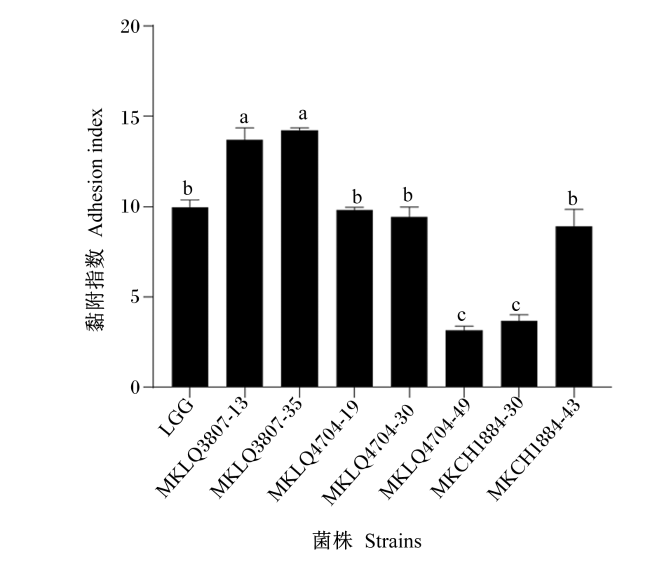
根据肠道主要致病菌抑制试验、抗生素敏感试验以及胃肠道耐受试验结果,筛选出MKLQ3807-13、MKLQ3807-35、MKLQ4704-19、MKLQ4704-30、MKLQ4704-49、MKCH1884-30和MKCH1884-43进行肠上皮细胞黏附试验,结果如图1所示,与参考菌株LGG相比,MKLQ3807-13和MKLQ3807-35对HT-29细胞的黏附指数显著增加(P<0.05),MKLQ4704-19、MKLQ4704-30和MKCH1884-43对HT-29细胞的黏附指数无显著影响(P>0.05),MKLQ4704-49和MKCH1884-30对HT-29细胞的黏附指数显著降低(P<0.05)。
图1 不同乳酸菌对HT-29细胞的黏附性

不同字母表示差异显著(P<0.05)。下图同。

Fig.1 Adhesion of different lactic acid bacteria to HT-29 cells (n=3)

Different letters mean significant difference (P<0.05). The same as below.

2.2.5 乳酸菌对TNF-α诱导的HT-29细胞IL-8基因相对表达量的影响
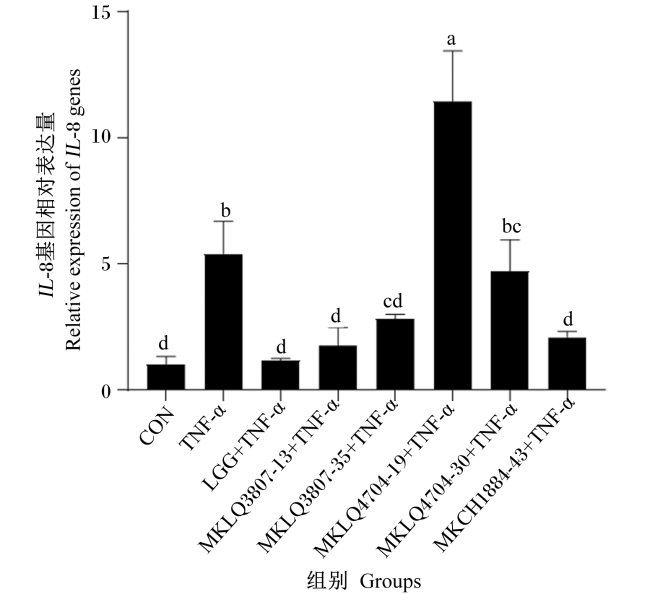
图2可知,与CON组相比,TNF-α组HT-29细胞IL-8基因相对表达量显著增加(P<0.05);与TNF-α组相比,MKLQ3807-13、MKLQ3807-35、MKCH1884-43和参考菌株LGG组HT-29细胞IL-8基因相对表达量显著下降(P<0.05),MKLQ4704-19组IL-8基因相对表达量显著增加(P<0.05),MKLQ4704-30组IL-8基因相对表达量无显著差异(P>0.05);与LGG组相比,MKLQ3807-13、MKLQ3807-35和MKCH1884-43组HT-29细胞IL-8基因相对表达量无显著差异(P>0.05),但MKLQ3807-13和MKCH1884-43组能更好地降低HT-29细胞IL-8基因相对表达量。因此,选择菌株MKLQ3807-13和MKCH1884-43进行后续试验。
图2 不同乳酸菌对TNF-α诱导的肠上皮细胞IL-8基因相对表达量的影响

Fig.2 Effects of different lactic acid bacteria on IL-8 gene relative expression level in intestinal epithelial cells induced by TNF-α (n=3)

2.2.6 自聚集能力和表面疏水性

表9可知,与MKCH1884-43相比,MKLQ3807-13的自聚集率和疏水率分别提高14.21%和4.59%;参照吴雨晗等[26]的标准,MKLQ3807-13属于高自聚集和高度疏水,MKCH1884-43属于中等自聚集和中度疏水,表明这2株乳杆菌均具有一定的黏附能力。
表9 菌株自聚集能力和表面疏水性

Table 9 Self-aggregation ability and surface hydrophobicity of strains (n=3) %

菌株Strains 自聚集率Self-aggregation rate 疏水率Hydrophobicity rate
MKLQ3807-13 62.23±5.07 54.00±1.10
MKCH1884-43 48.02±1.68 49.41±0.82

3 讨论

研究表明,与畜禽[27-28]相同,犬肠道微生物也以厚壁菌门(Firmicutes)、变形菌门(Proteobacteria)、梭杆菌门(Fusobacteria)、拟杆菌门(Bacteroidetes)和放线菌门(Actinobacteria)为主[29],肠道微生物可以识别和分泌化学物质,通过肠-脑轴影响神经递质的分泌,从而影响神经发育、认知和行为[30-31]。Honneffer等[32]研究了犬胃肠道微生物群和代谢组的变化,结果表明健康犬的十二指肠、回肠、结肠和直肠都有乳酸菌存在;且乳杆菌属丰度与昆明幼犬调引表现、物品注意力、持物衔取咬合、搜索能力等警用性能呈正相关[7]
本研究从昆明犬新鲜粪便样品中分离得到21株产酸能力较强的乳酸菌,19株为罗伊氏乳杆菌、1株为阴道黏液乳杆菌、1株为格氏乳杆菌。其中罗伊氏乳杆菌是一种天然定植在哺乳动物肠道的益生菌,其在维持动物健康和免疫调节等方面有重要作用[33];而格氏乳杆菌也是常见的肠道益生菌之一,它可以减少肠道黏蛋白对霍乱沙门氏菌的黏附,从而减少急性腹泻的持续时间[34-35]。益生菌候选菌株应对大多数临床常用抗生素敏感,以控制耐药基因在菌株水平上的转移,降低耐药菌株和超级细菌的出现,是乳酸菌应用的首要安全问题[36]。本研究分离得到的21株乳酸菌均对诺氟沙星(喹诺酮类抗生素)、卡那霉素和万古霉素耐药,对青霉素G、氨苄西林、阿莫西林(β-内酰胺类抗生素)、头孢噻肟和头孢噻吩(头孢菌素类抗生素)敏感或中度敏感;除MKLQ3807-13、MKLQ4704-19和MKCH1884-30外,其余18株菌均对庆大霉素(氨基糖苷类抗生素)耐药。不同菌株对抗生素的敏感性不同,分析产生这种结果的原因可能是不同菌株携带的天然耐药基因不同。研究发现,肠道微生物可以通过自发突变或肠道内耐药基因携带位点在质粒上的其他微生物水平转移来获得耐药基因,产生抗生素耐药[37-38]。有研究表明,乳杆菌对万古霉素、氨基糖苷类和喹诺酮类抗生素的耐药性属于固有耐药,依靠自身耐药基因而具有对某类抗生素的抗性,一般不会在菌株水平发生转移[39]。因此,从昆明犬新鲜粪便分离获得的罗伊氏乳杆菌、阴道黏液乳杆菌和格氏乳杆菌除对个别抗生素固有耐药外,均对其他抗生素敏感或中度敏感,安全性较高。
乳酸菌在进入动物体内后,会产生一种或多种抑菌物质,抑制有害菌群的繁殖,进而减少动物胃肠道中有害菌的数量,维持肠道微生态系统的平衡[40]。本研究中21株菌培养上清液均对福氏志贺氏菌和鼠伤寒沙门氏菌有相同的抑制作用,对大肠杆菌有不同程度的抑制作用,其中MKCH1884-50和MKCH1884-65对大肠杆菌的抑制作用较强。李婷等[41]从小型巴马猪粪便中分离得到1株罗伊氏乳杆菌GL001,对其进行抑菌试验,发现罗伊氏乳杆菌GL001对大肠杆菌和金黄色葡萄球菌均有较好的抑制作用。Garcia-Gutierrez等[42]研究发现,从人乳中分离得到的格氏乳杆菌LM19可产生多种细菌素,抑制致病菌的生长。菌株对致病菌的抑制程度不同,可能与菌株本身产生的抑菌成分有关,乳酸菌能利用碳水化合物进行发酵产生有机酸、细菌素和短链脂肪酸等抗菌物质,关于菌株产生的代谢产物对3种指示菌的抑制效果有待进一步研究。
乳酸菌对消化道环境的耐受性是其作为益生菌菌株的前提,乳酸菌进入消化道后,需要耐受胃内的强酸性环境和肠道内的高胆盐环境,才能在肠道内存活并定植,发挥其生理作用[43]。全海志[44]从犬直肠内容物和粪便中分离得到1株瑞士乳酸杆菌和1株棒状乳酸杆菌,将2株肠道乳酸菌在MRS肉汤(pH=3.0)中培养2 h,存活率均达到70%以上。Coman等[45]从5只法国斗牛犬粪便里分离出3株罗伊氏乳杆菌和2株约氏乳杆菌,对5株菌进行了胆汁酸耐受性测定,结果表明菌株对胃酸和胰液均表现出良好的耐受性。本研究与前人研究结果相似,MKLQ3807-33、MKLQ4704-30、MKLQ3807-13和MKCH1884-43等12株菌具有较高的存活率,表明其有较强的胃肠道耐受性,具备在肠道定植的基本条件,能以活菌的形式进入胃肠道并发挥其益生作用。
乳酸菌对肠上皮细胞的黏附是实现菌株在肠道内定植的基础,也是评价乳酸菌能否成为优势菌和充分发挥益生菌功能的关键。乳酸菌与宿主上皮的黏附可以延长菌株在宿主体内发挥益生效应的时间[46]。Coconnier等[47]研究表明,细胞系HT-29是研究肠道微生物、益生菌及代谢物免疫调节功能的理想体外模型。Jang等[48]从犬粪便里筛选出益生特性较好的双歧杆菌CACC517、乳酸片球菌CACC537、植物乳杆菌CACC558和副干酪乳杆菌CACC566,测定了菌株对人结肠癌细胞系HT-29的黏附能力,发现CACC537、CACC558和CACC566表现出较好的黏附能力。乳酸菌可通过定植抗力,产生细菌素及增强肠道屏障与病原菌竞争上皮细胞受体,抑制和取代病原菌黏附于肠上皮细胞从而促进抗炎细胞因子白细胞介素-2(IL-2)和白细胞介素-4(IL-4)等的表达,抑制促炎细胞因子白细胞介素-6(IL-6)和IL-8等的表达[49-50]。Kim等[51]研究表明,从人乳中分离出来的罗伊氏乳杆菌LM1071对HT-29细胞的黏附能力显著强于参考菌株LGG,可抑制白细胞介素-1β(IL-1β)诱导的HT-29细胞中促炎细胞因子IL-6、TNF-αIL-4的mRNA表达。本研究结果显示,罗伊氏乳杆菌MKLQ3807-13和MKLQ3807-35对HT-29细胞具有较强的黏附能力,罗伊氏乳杆菌MKLQ3807-13和格氏乳杆菌MKCH1884-43预处理可显著降低TNF-α诱导的HT-29细胞IL-8的基因相对表达量,表明罗伊氏乳杆菌MKLQ3807-13和格氏乳杆菌MKCH1884-43具有肠上皮细胞免疫调节作用。
益生菌黏附在上皮细胞或肠黏膜表面且能增殖到一定数量是发挥益生作用的前提,联合国粮农组织/世界卫生组织(FAO/WHO)将黏附能力作为筛选益生菌的重要标准之一[52]。乳酸菌的自聚集能力和表面疏水性与黏附能力呈正相关[53],二者有助于其在肠道的定植并防止致病菌的黏附[54]。研究发现,具有高自聚集能力和表面疏水性的乳酸菌具有更好的细胞黏附能力[55-56]。本研究中,罗伊氏乳杆菌MKLQ3807-13和格氏乳杆菌MKCH1884-43具有较好的自聚集能力和表面疏水性,同时其在HT-29细胞进行黏附试验中也具有较强的黏附性,与前人研究结果一致,说明罗伊氏乳杆菌MKLQ3807-13和格氏乳杆菌MKCH1884-43具有较强的黏附能力,保证其在肠道定植的可能性,从而竞争性抑制病原菌的定植。由此可见,本研究从健康昆明犬粪便中筛选出的罗伊氏乳杆菌MKLQ3807-13和格氏乳杆菌MKCH1884-43具有作为饲用益生菌的潜力,可进一步对这2株乳酸菌进行全基因组测序和小鼠试验,从分子和动物水平评价其安全性,并开展饲喂昆明犬试验,检测其对警犬肠道健康和警用性能的促进作用及其作用机制。

4 结论

本研究从昆明犬新鲜粪便中分离得到产酸能力强、对抗生素敏感和抗菌力强的乳酸菌MKLQ3807-13、MKCH1884-43、MKLQ3807-2和MKLQ4704-19等21株菌;可以耐受低pH和高胆盐环境的乳酸菌有MKLQ3807-13、MKCH1884-43、MKLQ3807-33和MKLQ4704-30等12株菌;对肠上皮细胞具有较强的黏附能力的乳酸菌有MKLQ3807-13、MKCH1884-43、MKLQ3807-35、MKLQ4704-19和MKLQ4704-30;可显著降低TNF-α诱导的HT-29细胞IL-8基因相对表达量的乳酸菌有MKLQ3807-13和MKCH1884-43,且这2株乳酸菌有较好的自聚集力和表面疏水性,其益生效果最佳,可为警犬专用益生菌制剂的开发提供参考菌种。
[1]
何江波, 姚志芳, 吴国芳, 等. 乳酸菌制剂益生特性及在畜牧业中的应用研究进展[J]. 家畜生态学报, 2020, 41(8):85-89.

HE J B, YAO Z F, WU G F, et al. Research progress on probiotic characteristics of lactic acid bacteria preparation and its application in animal husbandry[J]. Acta Ecologiae Animalis Domastici, 2020, 41(8):85-89. (in Chinese)

[2]
潘东斌, 孙冬岩, 孙笑非, 等. 益生菌在家禽生产中的应用研究进展[J]. 饲料研究, 2022, 45(24):122-126.

PAN D B, SUN D Y, SUN X F, et al. Research on application of probiotics in poultry production[J]. Feed Research, 2022, 45(24):122-126. (in Chinese)

[3]
焦时阳, 王晓彤, 侯玉新, 等. 柿子醋醪中优良乳酸菌的筛选及其耐受性和功能性分析[J]. 食品工业科技, 2023, 44(8):161-169.

JIAO S Y, WANG X T, HOU Y X, et al. Screening of superior lactic acid bacteria in persimmon vinegar broth and analysis of its tolerance and function[J]. Science and Technology of Food Industry, 2023, 44(8):161-169. (in Chinese)

[4]
黎立光, 强京宁, 宋兴国, 等. 昆明犬的研究综述[J]. 中国工作犬业, 2007(1):13-15.

LI L G, QIANG J N, SONG X G, et al. Review on the research of Kunming dog[J]. China Working Dog, 2007(1):13-15. (in Chinese)

[5]
LI J X, HUANG Q G, WANG S Z, et al. Behavioral evidence for the origin of Chinese Kunming dog[J]. Current Zoology, 2021, 67(4):469-471.

DOI

[6]
彭建国. 中国本土犬系列介绍1昆明犬[J]. 中国工作犬业, 2020(5):58-60.

PENG J G. Chinese native dog series introduction 1 Kunming dog[J]. China Working Dog, 2020(5):58-60. (in Chinese)

[7]
杜津京. 粪菌移植对昆明犬生长、警用性能和肠道菌群结构的影响[D]. 硕士学位论文. 昆明: 云南农业大学, 2021.

DU J J. Effects of fecal bacteria transplantation on growth,police performance and intestinal microbiota structure of Kunming dogs[D]. Master’s Thesis. Kunming: Yunnan Agricultural University, 2021. (in Chinese)

[8]
BOSCH G, VERVOORT J J M, HENDRIKS W H. In vitro digestibility and fermentability of selected insects for dog foods[J]. Animal Feed Science and Technology, 2016, 221(Part A):174-184.

DOI

[9]
黎立光, 徐虎, 李杰, 等. 工作犬体能训练理论与方法[M]. 昆明: 云南科技出版社, 2022:89-104.

LI L G, XU H, LI J, et al. Theories and methods of working dog training[M]. Kunming: Yunnan Science and Technology Press, 2022:89-104. (in Chinese)

[10]
HORACKOVA S, VESELA K, KLOJDOVA I, et al. Bile salt hydrolase activity,growth characteristics and surface properties in Lactobacillus acidophilus[J]. European Food Research and Technology, 2020, 246(8):1627-1636.

DOI

[11]
张炎达, 潘慧青, 李珠金. 家禽无抗养殖中饲用乳酸菌应用研究进展[J]. 中国家禽, 2018, 40(11):41-46.

ZHANG Y D, PAN H Q, LI Z J. Research advances on application of feed Lactobacillus in antibiotic-free breeding in poultry[J]. China Poultry, 2018, 40(11):41-46. (in Chinese)

[12]
POORBAGHI S L, GHEISARI H, DADRAS H, et al. Effects of simple and microencapsulated Lactobacillus acidophilus with or without inulin on the broiler meat quality infected by avian influenza virus (H9N2)[J]. Probiotics and Antimicrobial Proteins, 2016, 8(4):221-228.

DOI

[13]
公安部警犬繁育工作管理委员会. 警犬种犬标准与等级评定办法(公刑[2022)[S]. 北京: 公安部刑侦局, 2022.

Police Dog Breeding Management Committee of the Ministry of Public Security. Standard and grading method for police dog breeds (public punishment[2022])[S]. Beijing: Criminal Investigation Bureau of the Ministry of Public Security, 2022. (in Chinese)

[14]
邹建华, 叶朋飞, 毕润, 等. 散养茶花鸡源乳酸菌分离鉴定及益生特性研究[J]. 云南农业大学学报(自然科学), 2018, 33(4):647-654.

ZOU J H, YE P F, BI R, et al. Isolation and identification of lactic acid bacteria from fee range Chahua chickens and their probiotic properties[J]. Journal of Yunnan Agricultural University(Natural Science), 2018, 33(4):647-654. (in Chinese)

[15]
KIM P I, JUNG M Y, CHANG Y H, et al. Probiotic properties of Lactobacillus and Bifidobacterium strains isolated from porcine gastrointestinal tract[J]. Applied Microbiology and Biotechnology, 2007, 74(5):1103-1111.

DOI

[16]
LIU W J, CHEN M X, DUO L N, et al. Characterization of potentially probiotic lactic acid bacteria and bifidobacteria isolated from human colostrum[J]. Journal of Dairy Science, 2020, 103(5):4013-4025.

DOI PMID

[17]
刘爱瑜, 田军, 赵心念, 等. 育肥绵羊胃肠道乳酸菌的分离鉴定及部分体外益生特性评价[J]. 动物营养学报, 2022, 34(12):8149-8160.

DOI

LIU A Y, TIAN J, ZHAO X N, et al. Isolation,identification and partial in vitro probiotic characteristics evaluation of lactic acid bacteria in gastrointestinal tract of fattening sheep[J]. Chinese Journal of Animal Nutrition, 2022, 34(12):8149-8160. (in Chinese)

[18]
CHARTERIS W P, KELLY P M, MORELLI L, et al. Antibiotic susceptibility of potentially probiotic Lactobacillus species[J]. Journal of Food Protection, 1998, 61(12):1636-1643.

DOI

[19]
REUBEN R C, ROY P C, SARKAR S L, et al. Isolation,characterization,and assessment of lactic acid bacteria toward their selection as poultry probiotics[J]. BMC Microbiology, 2019, 19(1):253.

DOI

[20]
JENSEN H, GRIMMER S, NATERSTAD K, et al. In vitro testing of commercial and potential probiotic lactic acid bacteria[J]. International Journal of Food Microbiology, 2012, 153(1/2):216-222.

DOI

[21]
龙仲敏. 鸡源益生菌的筛选及穿梭载体的构建[D]. 硕士学位论文. 南宁: 广西大学, 2020.

LONG Z M. Screening of chicken probiotics and cloning and construction of shuttle vector[D]. Master’s Thesis. Nanning: Guangxi University, 2020. (in Chinese)

[22]
FONSECA H C, DE SOUSA MELO D, RAMOS C L, et al. Probiotic properties of lactobacilli and their ability to inhibit the adhesion of enteropathogenic bacteria to Caco-2 and HT-29 cells[J]. Probiotics and Antimicrobial Proteins, 2021, 13(1):102-112.

DOI

[23]
于涛, 姜晓冰, 李磊, 等. 市售酸奶中乳酸菌耐药性及耐药基因的检测[J]. 食品科学, 2016, 37(11):131-136.

DOI

YU T, JIANG X B, LI L, et al. Antimicrobial resistance and resistance genes in lactic acid bacteria isolated from commercial yogurt[J]. Food Science, 2016, 37(11):131-136. (in Chinese)

DOI

[24]
叶朋飞, 罗程, 黄丝艳, 等. 乳酸菌发酵云参酵素的工艺优化及其功能研究[J]. 云南农业大学学报(自然科学), 2019, 34(5):896-905.

YE P F, LUO C, HUANG S Y, et al. Optimization and functional study on Codonoposis bulleyana forrest ex diels ferment with lactic acid bacteria[J]. Journal of Yunnan Agricultural University(Natural Science), 2019, 34(5):896-905. (in Chinese)

[25]
王朝, 冉旋, 雷江英, 等. 牦牛源产细菌素屎肠球菌的分离鉴定和益生特性[J]. 微生物学通报, 2023, 50(8):3454-3466.

WANG C, RAN X, LEI J Y, et al. Isolation,identification,and probiotic properties of bacteriocin-producing Enterococcus faecium from yak[J]. Microbiology China, 2023, 50(8):3454-3466. (in Chinese)

[26]
吴雨晗, 吴婷, 涂健, 等. 一株安庆六白猪源乳酸菌的分离鉴定及生物特性研究[J]. 动物营养学报, 2022, 34(8):5415-5425.

DOI

WU Y H, WU T, TU J, et al. Isolation,identification and biological characteristics of a lactic acid bacteria from Anqing Liubai pigs[J]. Chinese Journal of Animal Nutrition, 2022, 34(8):5415-5425. (in Chinese)

[27]
LIU H B, HOU C L, LI N, et al. Microbial and metabolic alterations in gut microbiota of sows during pregnancy and lactation[J]. The FASEB Journal, 2019, 33(3):4490-4501.

DOI

[28]
WEI S, MORRISON M, YU Z. Bacterial census of poultry intestinal microbiome[J]. Poultry Science, 2013, 92(3):671-683.

DOI PMID

[29]
PILLA R, SUCHODOLSKI J S. The role of the canine gut microbiome and metabolome in health and gastrointestinal disease[J]. Frontiers in Veterinary Science, 2019, 6:498.

DOI PMID

[30]
JAMESON K G, HSIAO E Y. Linking the gut microbiota to a brain neurotransmitter[J]. Trends in Neurosciences, 2018, 41(7):413-414.

DOI PMID

[31]
BABULAS V, FACTOR-LITVAK P, GOETZ R, et al. Prenatal exposure to maternal genital and reproductive infections and adult schizophrenia[J]. The American Journal of Psychiatry, 2006, 163(5):927-929.

DOI

[32]
HONNEFFER J B, STEINER J M, LIDBURY J A, et al. Variation of the microbiota and metabolome along the canine gastrointestinal tract[J]. Metabolomics, 2017, 13(3):26.

DOI

[33]
吴胜男, 胡胜兰, 蒋宗勇, 等. 罗伊氏乳杆菌调节肠黏膜屏障功能的作用及机制[J]. 动物营养学报, 2021, 33(9):4861-4869.

DOI

WU S N, HU S L, JIANG Z Y, et al. Role and mechanism of Lactobacillus reuteri in regulating intestinal mucosal barrier function[J]. Chinese Journal of Animal Nutrition, 2021, 33(9):4861-4869. (in Chinese)

[34]
SELLE K, KLAENHAMMER T R. Genomic and phenotypic evidence for probiotic influences of Lactobacillus gasseri on human health[J]. FEMS Microbiology Reviews, 2013, 37(6):915-935.

DOI

[35]
MARGREITER M, LUDL K, PHLEPS W, et al. Therapeutic value of a Lactobacillus gasseri and Bifidobacterium longum fixed bacterium combination in acute diarrhea:a randomized,double-blind,controlled clinical trial[J]. International Journal of Clinical Pharmacology and Therapeutics, 2006, 44(5):207-215.

DOI

[36]
GUO H L, PAN L, LI L N, et al. Characterization of antibiotic resistance genes from Lactobacillus isolated from traditional dairy products[J]. Journal of Food Science, 2017, 82(3):724-730.

DOI

[37]
LIU C, ZHANG Z Y, DONG K, et al. Antibiotic resistance of probiotic strains of lactic acid bacteria isolated from marketed foods and drugs[J]. Biomedical and Environmental Sciences, 2009, 22(5):401-412.

DOI PMID

[38]
KAEWNOPPARAT S, DANGMANEE N, KAEWNOPPARAT N, et al. In vitro probiotic properties of Lactobacillus fermentum SK5 isolated from vagina of a healthy woman[J]. Anaerobe, 2013, 22:6-13.

DOI

[39]
王炜哲, 翟征远, 郝彦玲. 市售酸奶中发酵剂乳酸菌的耐药性及耐药基因研究进展[J]. 中国乳品工业, 2022, 50(2):34-37.

WANG W Z, ZHAI Z Y, HAO Y L. Antibiotic resistance and resistance genes in lactic acid bacteria isolated from commercial yogurt[J]. China Dairy Industry, 2022, 50(2):34-37. (in Chinese)

[40]
胡爱心, 刘金松, 许英蕾, 等. 乳酸菌抑菌作用机制的研究进展[J]. 动物营养学报, 2021, 33(12):6690-6698.

DOI

HU A X, LIU J S, XU Y L, et al. Research progress in antibacterial mechanism of lactic acid bacteria[J]. Chinese Journal of Animal Nutrition, 2021, 33(12):6690-6698. (in Chinese)

[41]
李婷, 汤继浪, 盛宣博, 等. 猪源罗伊氏乳杆菌GL001的分离与益生特性研究[J]. 畜牧与兽医, 2022, 54(7):47-53.

LI T, TANG J L, SHENG X B, et al. Isolation and characterization of Lactobacillus reuteri from pigs[J]. Animal Husbandry & Veterinary Medicine, 2022, 54(7):47-53. (in Chinese)

[42]
GARCIA-GUTIERREZ E, O’CONNOR P M, COLQUHOUN I J, et al. Production of multiple bacteriocins,including the novel bacteriocin gassericin M,by Lactobacillus gasseri LM19,a strain isolated from human milk[J]. Applied Microbiology and Biotechnology, 2020, 104(9):3869-3884.

DOI

[43]
田芮佼. 云南传统发酵食品中乳酸菌的分离鉴定及益生特性研究[D]. 硕士学位论文. 昆明: 云南农业大学, 2015.

TIAN R J. Isolation and identification of lactic acid bacteria in traditional fermented foods in Yunnan and study on probiotic properties[D]. Master’s Thesis. Kunming: Yunnan Agricultural University, 2015. (in Chinese)

[44]
全海志. 犬源乳酸菌的分离鉴定及生化特性研究[D]. 硕士学位论文. 延吉: 延边大学, 2003.

QUAN H Z. The isolation,identification and research of biological property of Lactobacillus from the canine[D]. Master’s Thesis. Yanji: Yanbian University, 2003. (in Chinese)

[45]
COMAN M M, VERDENELLI M C, CECCHINI C, et al. Probiotic characterization of Lactobacillus isolates from canine faeces[J]. Journal of Applied Microbiology, 2019, 126(4):1245-1256.

DOI

[46]
张俊, 赵保堂, 杨富民. 副干酪乳杆菌的益生特性及其应用研究进展[J]. 包装与食品机械, 2019, 37(4):47-52.

ZHANG J, ZHAO B T, YANG F M. Review on the probiotic characteristics and application of Lactobacillus paracasei[J]. Packaging and Food Machinery, 2019, 37(4):47-52. (in Chinese)

[47]
COCONNIER M H, KLAENHAMMER T R, KERNÉIS S, et al. Protein-mediated adhesion of Lactobacillus acidophilus BG2FO4 on human enterocyte and mucus-secreting cell lines in culture[J]. Applied and Environmental Microbiology, 1992, 58(6):2034-2039.

DOI

[48]
JANG H J, SON S, KIM J A, et al. Characterization and functional test of canine probiotics[J]. Frontiers in Microbiology, 2021, 12:625562.

DOI

[49]
DENG K, CHEN T T, WU Q L, et al. In vitro and in vivo examination of anticolonization of pathogens by Lactobacillus paracasei FJ861111.1[J]. Journal of Dairy Science, 2015, 98(10):6759-6766.

DOI

[50]
BRON P A, KLEEREBEZEM M, BRUMMER R J, et al. Can probiotics modulate human disease by impacting intestinal barrier function?[J]. British Journal of Nutrition, 2017, 117(1):93-107.

DOI

[51]
KIM T R, CHOI K S, JI Y, et al. Anti-inflammatory effects of Lactobacillus reuteri LM1071 via MAP kinase pathway in IL-1β-induced HT-29 cells[J]. Journal of Animal Science and Technology, 2020, 62(6):864-874.

DOI

[52]
王然. 唾液乳杆菌FDB86粘附肠道上皮细胞机制[D]. 博士学位论文. 北京: 中国农业大学, 2015.

WANG R. Adhesive mechanism of Lactobacillus salivarius FDB86 to intestinal epithelial cells[D]. Ph.D.Thesis. Beijing: China Agricultural University, 2015. (in Chinese)

[53]
COLLADO M C, MERILUOTO J, SALMINEN S. Adhesion and aggregation properties of probiotic and pathogen strains[J]. European Food Research and Technology, 2008, 226(5):1065-1073.

DOI

[54]
AARTI C, KHUSRO A, VARGHESE R, et al. In vitro studies on probiotic and antioxidant properties of Lactobacillus brevis strain LAP2 isolated from Hentak,a fermented fish product of North-East India[J]. LWT, 2017, 86:438-446.

DOI

[55]
宋雨心, 王文骞, 张园, 等. 黏附与聚集、抗肿瘤及抗菌特性乳杆菌的筛选[J]. 中国预防兽医学报, 2018, 40(11):986-991.

SONG Y X, WANG W Q, ZHANG Y, et al. Screening of the probiotics with adhesion and aggregation,anti-tumor and anti-pathogenic bacteria properties[J]. Chinese Journal of Preventive Veterinary Medicine, 2018, 40(11):986-991. (in Chinese)

[56]
DE SOUZA B M S, BORGONOVI T F, CASAROTTI S N, et al. Lactobacillus casei and Lactobacillus fermentum strains isolated from mozzarella cheese:probiotic potential,safety,acidifying kinetic parameters and viability under gastrointestinal tract conditions[J]. Probiotics and Antimicrobial Proteins, 2019, 11(2):382-396.

DOI

Outlines

/