REVIEW

Effects of Stocking Density on Animal Production

  • ZUO Quan , 1, 2, 3 ,
  • YANG Kailun 1 ,
  • YANG Hongjian 2 ,
  • DENG Xiande , 3, 4, *
Expand
  • 1 College of Animal Science, Xinjing Agricultural University, Urumqi 830052, China
  • 2 College of Animal Science and Technology, China Agricultural University, Beijing 100193, China
  • 3 Academy of Agricultural Planning and Engineering, Ministry of Agriculture and Rural Affairs, Beijing 100125, China
  • 4 Key Laboratory for Agricultural Facility Structure Design and Intelligent Construction, Ministry of Agriculture and Rural Affairs, Beijing 100125, China
* professor, E-mail:

Received date: 2023-07-13

  Online published: 2024-01-12

Abstract

Stocking density is a crucial environmental factor in livestock and poultry production, serving as a key indicator for assessing animal welfare. Excessive stocking density has the potential to alter both the housing environment and animal behavior, ultimately exerting a detrimental impact on the homeostasis of animals, this negative influence manifests through various channels, such as disruptions in hormone secretion, antioxidant capacity, animal behavior, nutrition metabolism, and intestinal function. These disruptions stem from the heightened stress response in animals might cause an increased incidence of animal diseases and a decline in production performance. This article primarily summarizes the effects of stocking density on animal production performance and health status from three aspects: housing environment, animal behavior and stress response. The objective is to provide scientific evidence for the rational design and utilization of livestock and poultry housing and facilities to facilitate the high-quality development of animal farming.

Cite this article

ZUO Quan , YANG Kailun , YANG Hongjian , DENG Xiande . Effects of Stocking Density on Animal Production[J]. Chinese Journal of Animal Nutrition, 2024 , 36(1) : 141 -150 . DOI: 10.12418/CJAN2024.014

目前,我国畜牧业正向着集约化和规模化迅速发展,但动物健康与食品安全等问题也日益凸显。为了追求养殖效益,畜禽养殖企业往往采取高密度工厂化的生产管理模式。然而,养殖密度与畜禽生产的经济效益并不完全呈正相关,反而高饲养密度对动物的健康产生了不利的影响。国内外关于动物饲养密度的研究甚多,认为高饲养密度会导致温湿度、空气质量、地面卫生、采食饮水和运动空间等因素向着不利于动物健康的方向发展[1]。通常来说,饲养密度会影响舍饲环境和动物行为,从而引起动物的应激反应,最终影响动物生产性能(图1)。饲养密度的研究主要集中在猪和家禽等,本文通过阐明饲养密度对动物生产性能和健康状况的影响,讨论其可能的影响机制,为今后动物的饲养密度研究和应用提供参考。
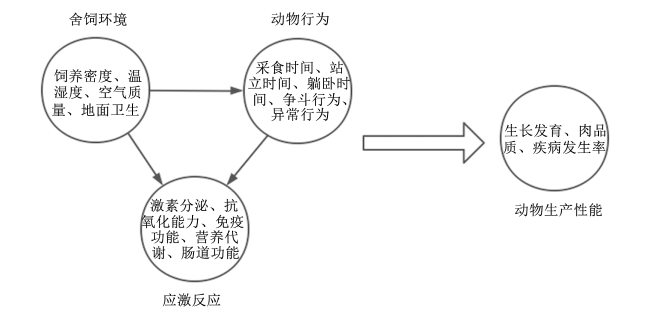
图1 饲养密度影响动物生产的因素

Fig.1 Factors affecting animal production duo to stocking density

1 饲养密度对舍饲环境质量的影响

研究表明,随着饲养密度的增大(6.0、4.5、3.6、3.0、2.0 m2/头),冬季肉牛舍中二氧化碳(CO2)和氨气(NH3)浓度呈上升趋势,有害气体浓度与家畜数量呈正相关,并建议每头牛(180~280 kg)适宜占地面积为3.6 m2[2]。CO2主要来源于动物的呼吸,若猪舍内通风不良,饲养密度过大,CO2浓度急剧升高,会造成猪只缺氧,诱发CO2慢性中毒,表现为精神不振,食欲、生产力和免疫力下降,导致发病率升高[3]。NH3主要来源于粪尿的分解,其对家禽的危害主要包括:刺激眼睛和鼻子黏膜,增加呼吸道患病几率,降低生产性能[4]。高浓度的NH3还会导致肉鸡肝病和小肠黏膜损伤[5-6]。有害气体富集严重影响动物的生长和健康,因此高饲养密度条件下应注意通风设计的合理性。
孙作为[1]研究发现,高饲养密度(公鸡16只/m2或母鸡18只/m2)肉鸡的垫料含水量、脚垫损伤评分、步态评分均显著高于低饲养密度(公鸡10只/m2或母鸡12只/m2)。Shepherd等[7]报道,垫料潮湿可能是引起肉鸡脚垫皮炎的关键因素。动物的体表清洁度可以间接判断圈舍受污染程度,也是评价动物福利的重要指标。Fu等[8]研究表明,高饲养密度(0.8 m2/头)育肥猪的体表清洁度评分极显著低于低饲养密度(1.2和1.6 m2/头)。另外,Sevi等[9]研究发现,高饲养密度(1.0和1.5 m2/只)泌乳母羊的羊舍空气中总微生物和大肠杆菌的浓度均显著高于低饲养密度(2.0 m2/只)。以上研究表明,高饲养密度会引起舍饲环境卫生质量下降,进而损害动物的健康与福利。

2 饲养密度对动物行为的影响

饲养密度过大,会相应地减少动物的活动空间和采食空间,导致动物一些正常的行为习惯受到抑制。研究表明,随着饲养密度的增大(1.13、0.90、0.75、0.64、0.56 m2/头),育肥猪采食和躺卧时间显著减少,站立时间和争斗行为显著增多[10]。群居猪的争斗行为会造成皮肤损伤,可能对猪只的福利、生产力和健康产生负面的影响[11]。Vermeer等[12]研究发现,饲养密度从1.0 m2/头增加到0.8 m2/头时,育肥猪(116 kg)的前躯、中躯和后躯部皮肤病变评分均显著增加。当饲养密度高至一定范围后,采食时间、采食频率以及采食量都会有降低的趋势,表明饲养密度过高会影响猪群的生长性能[13]。然而,在保持猪只占有饲槽相同的情况下,随着饲养密度的增大(0.9、0.7、0.5 m2/头),饲养密度为0.5 m2/头时生长猪躺卧时间显著减少,采食时间和争斗行为显著增加。当猪被饲养在拥挤的环境时,会出现过量的喂食器被占用,这是资源利用不均衡的现象,通常造成饲料浪费和猪只不对称生长[14]。另外,过高的饲养密度(0.5和0.7 m2/头)会限制生长猪在指定地点排便的能力,从而导致猪圈污染,推荐生长猪的饲养密度为0.9 m2/头[15]
高饲养密度条件下,鸡的行为变化主要表现为行动减少和骚动增加。较高的骚动频率会造成胴体划痕增多,导致福利状况和胴体品质下降[16]。王长平等[17]研究发现,随着饲养密度的增大(15、30只/m2),育成期蛋鸡啄羽行为发生的次数显著增加,趴卧、饮水和站立行为也逐渐增加,与运动和需要空间的采食、修饰、觅食和走动行为却逐渐减少。李文嘉等[18]研究指出,高饲养密度条件下,肉鸡活动量减少,从而引发其腿部疾病,甚至会导致骨骼发育畸形。
于晓青等[19]研究了饲养密度对湖羊公羔(4月龄)行为的影响,结果显示,随着饲养密度的增大(2.00、1.00、0.67 m2/只),湖羊的采食时间没有变化,饲养密度为0.67 m2/只时湖羊的躺卧时间显著减少,站立时间显著增加。也有研究发现,随着饲养密度的增大(6.0、4.5、3.6、3.0、2.0 m2/头),牛的站立行为(含打斗)显著增多[2]。长时间站在水泥地面上的奶牛,蹄叶炎的发病率较高[20]。所以,饲养密度增大可能影响奶牛牛蹄健康。

3 饲养密度对动物机体应激反应的影响

应激指机体对外界或内部的各种异常刺激所产生的非特异性应答反应的总和[21]。刺激动物产生应激反应的应激源众多,随着饲养密度的增大,动物所面临心理、环境方面的刺激增多,机体的应激反应随之加强。

3.1 对动物机体激素分泌的影响

当动物受到刺激时会导致机体肾上腺髓质及皮质机能亢进,促使儿茶酚胺类激素(CA)和肾上腺皮质激素(GC)合成和释放增加,从多方面调整机体适应性和抵抗应激刺激的能力[22]。在应激情况下,促肾上腺皮质激素(ACTH)的分泌几乎完全受控于促肾上腺皮质激素释放激素(CRH),且完全不受GC负反馈抑制的影响,导致ACTH和GC的分泌量迅速达到很高的水平[23]。而肾上腺髓质激素会受自身的反馈调节,可能会出现阶段性的差异。在家禽上,Li等[24]研究发现,与低饲养密度(6.25和12.50只/m2)相比,高饲养密度(18.75只/m2)肉鸡血清中皮质醇(COR)浓度显著升高。卢营杰[25]研究发现,随着饲养密度的增大(6、10、14只/m2),肉鸡(1~42日龄)血清中COR浓度没有显著变化。在生长猪上,王锁荣等[26]研究发现,与低饲养密度(0.65 m2/头)相比,高饲养密度(0.38和0.48 m2/头)生长猪血清中COR浓度显著升高,但肾上腺素和去甲肾上腺素浓度变化不显著。应激激素增多会使动物的代谢速率上升,导致动物生长性能下降,并且对肉品质产生负面影响[27-28]。此外,过高的饲养密度会引起动物机体多种激素分泌紊乱。Li等[24]研究发现,与低饲养密度(6.25和12.50只/m2)相比,高饲养密度(18.75只/m2)显著降低了肉鸡胫骨生长板中甲状旁腺激素相关蛋白表达,且高饲养密度的肉鸡血清中胰岛素样生长因子-1(IGF-1)和甲状腺激素(T4)浓度显著低于低饲养密度,进而影响肉鸡骨骼和肌肉发育。

3.2 对动物机体抗氧化能力的影响

自由基是机体正常或异常代谢的产物,在正常生理状态下自由基不断生成,也不断被清除。自由基对免疫细胞的杀菌作用非常重要,其过量产生与炎症有关[29]。动物机体具有广泛的抗氧化防御体系,避免过量的自由基对机体造成损伤。伍源等[30]研究发现,随着饲养密度的增大(14、20只/m2),肉鸡血浆总抗氧化能力(T-AOC)显著降低,而超氧化物歧化酶(SOD)活性和蛋白质羰基(PCO)含量显著升高。肖克权[31]研究表明,夏季随着饲养密度的增大(1.52、1.14、0.91、0.76 m2/头),0.76 m2/头组生长猪血清T-AOC及SOD、过氧化氢酶(CAT)活性显著降低,丙二醛(MDA)含量显著升高。这说明高饲养密度会使动物机体的氧化应激反应加强,导致机体中自由基增多,抗氧化物质减少。另外,在应激条件下机体会产生适应性反应,使部分抗氧化酶活性代偿性增强。例如:当机体发生氧化应激时,自由基产量增加,并激活核转录因子-κB(nuclear transcription factor-κB,NF-κB)和激活蛋白-1(activator protein-1,AP-1),增加SOD活性来抵抗细胞损伤[32]。体内常见的自由基包括超氧阴离子、羟基自由基和氢过氧自由基。它们化学性质非常活泼,可以引起其他自由基的生成,对机体产生危害。如生成脂质过氧化物,与蛋白质、核酸和糖类发生交联,引起生物膜变性,致使组织破坏和老化[33]。细胞的生物膜功能被破坏,会损伤蛋白质、核酸等生物大分子,造成机体代谢功能紊乱[34]

3.3 对动物机体免疫功能的影响

动物机体长时间地应对或对抗刺激可导致其严重的免疫功能紊乱和生理失调[35]。当肉鸡饲养密度增大到15和20只/m2时,免疫器官(胸腺、法氏囊和脾脏)组织病理学改变可能导致肉鸡免疫反应下降[36]。随着饲养密度的增大(13、23只/m2),蛋鸡血液、脾脏和盲肠扁桃体中T淋巴细胞(特别是γδT细胞)数量降低,淋巴细胞与白细胞比值升高[37]。与低饲养密度(10只/m2)相比,高饲养密度(16只/m2)会显著降低肉鸡血清免疫球蛋白A(IgA)、抗炎因子白细胞介素-10(IL-10)和肠黏膜分泌型免疫球蛋白A(sIgA)含量,显著提高血清促炎因子白细胞介素-6(IL-6)、肿瘤坏死因子-α(TNF-α)、白细胞介素-1β(IL-1β)含量[38]。这与肖克权[31]在夏季生长猪上的研究结果相似,说明高饲养密度条件下动物机体炎症水平升高且免疫功能降低。但也有一些研究认为,动物处于一定的应激状态时,糖皮质激素会促进免疫球蛋白的产生,使动物的免疫水平升高[39]。于晓青等[19]研究结果显示,高饲养密度(0.67 m2/只)的湖羊公羔血清中球蛋白、免疫球蛋白G(IgG)和IgA含量均显著高于低饲养密度(2.00和1.00 m2/只)。李永振等[40]研究发现,设置玩具能显著降低育肥猪(1.05 m2/头)血清中IgG和炎性细胞因子含量,降低饲养密度(1.35 m2/头)也有相同的趋势。低剂量的糖皮质激素能刺激动物机体免疫应答,而大剂量的糖皮质激素则抑制机体免疫应答[41]。高饲养密度条件下,血清免疫球蛋白含量增多,可能说明动物处于应激反应时间较短。当应激过度或持续时间过长时,就会引起免疫功能下降,诱发多种疾病,甚至造成死亡。Jang等[42]研究发现,随着饲养密度的增大(0.96、0.80、0.69 m2/头),生长育肥猪(30.25 kg)在第3和6周血清中IgG和IgA含量没有显著变化,在第10和14周饲养密度为0.69 m2/头时血清中IgG含量显著低于其他饲养密度,也符合这一结论。

3.4 对动物机体营养物质代谢的影响

在仔猪上,周凯[43]研究发现,随着饲养密度的增大(0.91、0.55 m2/头),仔猪血清中丝氨酸、蛋氨酸和精氨酸含量显著下降。高饲养密度影响仔猪氨基酸、脂肪酸和核苷酸代谢,这可能与高饲养密度引起的仔猪肝脏氧化应激有关[44]。在家禽上,El-Garhy[45]研究发现,与正常饲养密度(10只/m2)相比,高饲养密度(16只/m2)的肉鸡血浆总蛋白、白蛋白、球蛋白、胆固醇和甘油三酯含量显著降低。李文嘉等[18]研究发现,肉鸡的饲养密度为15只/m2时,血清钙含量显著高于饲养密度为18只/m2时。饲养密度影响动物机体营养物质代谢可能与高饲养密度条件下动物采食不足、肠道功能受损有一定关系。然而,Jeong等[46]研究发现,随着饲养密度的增大(7.5、15.0只/m2),肉鸡(1~35日龄)采食量显著降低,但高饲养密度显著增加了肉鸡血清中总胆固醇、高密度脂蛋白胆固醇、总蛋白、白蛋白和球蛋白含量,降低了血清中葡萄糖含量。Selye[35]针对应激提出了3种不同的递进状态:惊恐反应的出现、机体抵抗及尝试恢复平衡、严重失衡(营养不良状况加剧的衰竭阶段)。高饲养密度条件下,动物血清中营养物质含量减少,可能说明动物生理机能受到了较为严重的影响。

3.5 对动物肠道功能的影响

消化道是动物接受环境刺激(营养物质、毒素和微生物)的主要场所,其免疫系统的组成包括物理屏障、化学屏障、微生物屏障和免疫屏障[47]。长期处于高饲养密度环境,会对动物的肠道免疫系统产生负面影响,同时也显著影响肠道的结构和功能。肠道菌群与宿主的营养物质吸收、生长发育和免疫功能具有密切关系[48]。高新磊等[49]研究发现,饲养密度为15.5只/m2时肉鸡盲肠中未培养细菌-f-瘤胃球菌科相对丰度显著高于饲养密度为20.3只/m2时,肠粪杆菌属相对丰度显著高于饲养密度为17.9、20.3只/m2时。乳酸菌是肠道中的益生菌,可改善和促进肠道的正常蠕动,同时对肠道黏膜屏障具有一定的保护作用。Mhh等[50]研究指出,饲养密度为13只/m2时肉鸡粪便和盲肠中乳酸菌计数均显著低于饲养密度为10只/m2时。Desoky[51]研究发现,饲养密度为12只/m2时肉鸡回肠和盲肠的细菌总数以及大肠杆菌、沙门氏菌和梭菌计数均显著高于饲养密度为10只/m2时。另外,刘砚涵等[52]研究表明,饲养密度为12只/m2时北京鸭肠道黏膜中蔗糖酶、糜蛋白酶和碱性磷酸酶等消化酶活性均显著低于饲养密度为4只/m2时。邱凌云[53]研究报道,随着饲养密度的增大(506、338 cm2/只),蛋鸡十二指肠的隐窝深度和回肠的绒毛高度/隐窝深度显著降低,回肠的物理屏障黏蛋白-1(MUC-1)基因表达量显著上升。刘玮等[54]研究结果证实,饲养密度为375 cm2/只时蛋鸡空肠的绒毛高度/隐窝深度较饲养密度为470、625 cm2/只时有降低的趋势。曾兴宇等[55]研究结果表明,饲养密度为0.33 m2/头时仔猪空肠黏膜中黏蛋白-2(MUC-2)含量显著低于饲养密度为0.67和1.00 m2/头时,饲养密度为0.33和0.67 m2/头时回肠黏膜中与炎症有关的骨髓分化因子88(Myd88)和Toll样受体4(TLR4)基因表达量显著高于饲养密度为1.00 m2/头时。

4 饲养密度对动物生长发育、肉品质和疾病发生率的影响

4.1 对动物生长发育的影响

诸多研究表明,饲养密度对动物生长性能有着明显的影响(表1)。在生长猪上,肖克权[31]研究表明,夏季随着饲养密度的增大(1.52、1.14、0.91、0.76 m2/头),生长猪(25 kg)平均日采食量(ADFI)和平均日增重(ADG)呈线性降低,饲养密度为0.76 m2/头时料重比(F/G)显著高于其他饲养密度;冬季随着饲养密度的增大(0.91、0.76、0.61、0.51 m2/头),生长猪(26 kg)ADFI呈线性降低,饲养密度为0.61 m2/头时ADG显著高于饲养密度为0.91和0.51 m2/头时,F/G显著低于饲养密度为0.91、0.76和0.51 m2/头时。在家禽上,Sevim等[56]研究发现,随着饲养密度的增大(12、18只/m2),试验第24~42天和第1~42天肉鸡的体增重和ADFI显著降低,但F/G差异不显著。Eratalar等[57]研究指出,北京鸭胴体重量、大腿肉和胸肉重量随着饲养密度的增大(3、5、7只/m2)而下降,导致大腿肉和胸部肉的重量和比例下降。饲养密度的提高降低了心脏重量,但积极改善了肝脏和鸭胗的比例。在肉羊上,于晓青等[19]将4月龄湖羊公羔随机分为3个饲养密度(2.00、1.00、0.67 m2/只)组,试验结果表明,饲养密度为2.00、1.00 m2/只组总增重和ADG均显著高于饲养密度为0.67m2/只组,3组之间的ADFI差异不显著。邓先德等[58]研究发现,冬季随着饲养密度的增大(1.75、1.40、1.05、0.70 m2/只),饲养密度为1.05 m2/只时的湖羊公羊(6月龄)ADG显著高于其他饲养密度,F/G显著低于其他饲养密度。以上结果可以看出,过高的饲养密度会导致动物生长性能下降。当环境温度较低时,饲养密度也不宜过低。当饲养密度过低且舍内温度较低时,动物的维持净能会明显增加,竞争性采食效果减弱,进而导致生长性能下降[59]。因此,在畜禽舍建设时应综合考虑各方面因素。
表1 饲养密度对动物生长性能的影响

Table 1 Effects of stocking density on growth performance of animal

动物种类
Animal species
推荐饲养密度
Recommended
stocking density
平均日采食量
ADFI/(g/d)
平均日增重
ADG/(g/d)
料重比
F/G
参考文献
References
生长猪Growing pig 0.91 m2/头 提高 不显著 下降 肖克权[31]
生长猪Growing pig 0.61 m2/头 不显著 提高 下降 肖克权[31]
肉鸡Broiler 12只/m2 提高 提高 不显著 Sevim等[56]
公羔羊Male lamb 1 m2/只 不显著 提高 下降 于晓青等[19]
公羊Ram 1.05 m2/只 提高 提高 下降 邓先德等[58]

4.2 对动物肉品质的影响

饲养密度对畜禽产品质量有一定的影响。李建慧等[60]研究发现,在肉鸡生产中,与低饲养密度(12只/m2)相比,高饲养密度(16只/m2)显著降低了肉鸡(7~42日龄)胸肌pH,显著提高了胸肌滴水损失;极显著降低了腿肌pH,显著提高了腿肌脂肪含量。郭建凤等[61]研究了不同饲养密度对试验猪肉质性状的影响,结果表明,饲养密度为0.5 m2/头时育肥猪背最长肌失水率及肉色亮度(L*)、黄度(b*)值显著高于饲养密度为0.7、0.9 m2/只时,建议宰前猪只在待宰舍的适宜饲养密度为0.7 m2/头。Jang等[42]研究表明,随着饲养密度的增大(0.96、0.80、0.69 m2/头),育肥猪背最长肌pH(宰后24 h)呈线性降低,剪切力呈线性升高,建议育肥猪饲养密度应大于0.80 m2/头。也有研究认为,饲养密度对肉品质影响较小。Goo等[62]研究指出,饲养密度(15.2、20.2、25.3、30.4只/m2)对肉鸡(1~28日龄)胸肌肉色、pH、持水力、硫代巴比妥酸反应物质含量均无显著影响。吴荷群等[63]研究发现,随着饲养密度的增大(1.4、1.05、0.7、0.35 m2/只),断奶羔羊背最长肌肉色、pH、大理石纹、剪切力均无显著差异。饲养密度不同对动物的运动总量、行为学表现和应激程度有一定影响,可能造成能量物质在体内的分布和沉积上的差异,进而影响肌肉品质。试验结果不同,可能与饲养密度控制水平和试验时间长短有很大关系。

4.3 对动物疾病发生率的影响

环境疾病是由环境因素造成的各种疾病和病症的统称,高密度饲养对环境疾病的发生率有一定的影响。高密度饲养增加了猪只患呼吸道疾病和营养不良的机率[64];长时期的拥挤应激会诱发猪只胃溃疡等疾病[65]。周凯[43]研究发现,随着饲养密度的增大,仔猪腹泻率有上升的趋势,其中高饲养密度(0.55 m2/头)组与对照组(饲养密度为0.91 m2/头)相比差异显著,腹泻率较对照组上升了34.9%。腿部疾病是影响家禽生产的重要因素,饲养密度过大,家禽容易患腿部疾病,造成行走障碍。Singh等[66]报道,随着饲养密度的增大,肉鸡的脚和跗关节损伤增多,进而步态评分较差。Sanotra等[67]报道,随着饲养密度的增大,肉鸡胫骨软骨发育不良(TD)的发生率增加,当饲养密度超过30只/m2时,严重TD发病率达到27%。肉鸡腿疾会产生较高的死亡率、淘汰率以及软腿症所诱发的胸部囊肿[17]。赵芙蓉等[68]研究发现,以铁丝网为笼底材料,高饲养密度(17.25只/m2)组公鸡胸囊肿的发病率达34.09%,显著高于中饲养密度(14.12只/m2)和低饲养密度(10.98只/m2)组。

5 小结与展望

综上所述,饲养密度过低不仅会造成畜舍设施资源的浪费,而且不利于冬季畜舍温度的保持,进而会影响到养殖企业的经济效益和动物生产性能的发挥。饲养密度过高则会损害动物的健康和福利,一方面,高饲养密度可能引起舍饲环境温湿度和有害气体浓度升高,使地面和垫料卫生污浊,从而降低动物的生产性能和免疫力,并增加一些环境性疾病发生的风险;另一方面,高饲养密度会引起动物争斗行为和异常行为的发生,使动物的福利恶化,并造成生产损失。从动物生理稳态方面来看,高饲养密度对动物机体的激素分泌、抗氧化能力、免疫功能、营养物质代谢和肠道功能均会产生不利的影响。综上研究结果,仔猪饲养密度0.67~1.00 m2/头、生长猪饲养密度0.61~0.91 m2/头、育肥猪饲养密度0.80~1.35 m2/头、肉鸡饲养密度10~14只/m2(714~1 000 cm2/只)、蛋鸡饲养密度19.8~21.3只/m2(470~504 cm2/只)为宜。
随着我国人口的增长,土地资源的开发程度越来越高,养殖行业可以利用的土地也越来越少。如何通过智能化设施装备改善饲养环境,如何通过设施条件的改善提高动物的生产能力,是未来畜牧工程研究的重点。

致谢

感谢农业农村部规划设计研究院吴启超博士对本论文写作思路所提的宝贵意见。

[1]
孙作为. 饲养密度和饲粮营养影响肉鸡生长、胴体组成及腿部健康的研究[D]. 博士学位论文. 北京: 中国农业大学, 2013.

SUN Z W. Study on effects of different stocking densities and dietary nutrition on growth performance,carcass composition and leg health status of separate-sex reared broilers[D]. Ph.D.Thesis. Beijing: China Agricultural University, 2013. (in Chinese)

[2]
陈昭辉, 刘玉欢, 吴中红, 等. 饲养密度对饲养环境及肉牛生产性能的影响[J]. 农业工程学报, 2017, 33(19):229-235.

CHEN Z H, LIU Y H, WU Z H, et al. Effect of stocking density on breeding environment and production performance of beef cattle[J]. Transactions of the Chinese Society of Agricultural Engineering, 2017, 33(19):229-235. (in Chinese)

[3]
黄藏宇, 李永明, 徐子伟. 舍内气态及气载有害物质对猪群健康的影响及其控制技术[J]. 家畜生态学报, 2012, 33(2):80-84.

HUANG C Y, LI Y M, XU Z W. Effect of piggery air and airbone harmful substances on health of pig community and its controlling technology[J]. Acta Ecologiae Animalis Domastici, 2012, 33(2):80-84. (in Chinese)

[4]
KRISTENSEN H H, WATHES C M. Ammonia and poultry welfare:a review[J]. World’s Poultry Science Journal, 2000, 56(3):235-245.

DOI

[5]
ZHANG J Z, LI C, TANG X F, et al. High concentrations of atmospheric ammonia induce alterations in the hepatic proteome of broilers (Gallus gallus):an iTRAQ-based quantitative proteomic analysis[J]. PloS One, 2015, 10(4):e0123596.

DOI

[6]
ZHANG J Z, LI C, TANG X F, et al. Proteome changes in the small intestinal mucosa of broilers (Gallus gallus) induced by high concentrations of atmospheric ammonia[J]. Proteome Science, 2015, 13:9.

DOI PMID

[7]
SHEPHERD E M, FAIRCHILD B D. Footpad dermatitis in poultry[J]. Poultry Science, 2010, 89(10):2043-2051.

DOI PMID

[8]
FU L L, LI H Z, LIANG T T, et al. Stocking density affects welfare indicators of growing pigs of different group sizes after regrouping[J]. Applied Animal Behaviour Science, 2016, 174:42-50.

DOI

[9]
SEVI A, MASSA S, ANNICCHIARICO G, et al. Effect of stocking density on ewes’ milk yield,udder health and microenvironment[J]. Journal of Dairy Research, 1999, 66(4):489-499.

DOI

[10]
周明, 张永云, 罗忠宝, 等. 饲养密度对猪行为表现和福利水平的影响[J]. 黑龙江畜牧兽医, 2015(3):93-95.

ZHOU M, ZHANG Y Y, LUO Z B, et al. The effect of stocking density on the behavior and welfare level of pigs[J]. Heilongjiang Animal Science and Veterinary Medicine, 2015(3):93-95. (in Chinese)

[11]
ANGARITA B K, CANTET R J C, WURTZ K E, et al. Estimation of indirect social genetic effects for skin lesion count in group-housed pigs by quantifying behavioral interactions[J]. Journal of Animal Science, 2019, 97(9):3658-3668.

DOI

[12]
VERMEER H M, DIRX-KUIJKEN N C P M M, BRACKE M B M. Exploration feeding and higher space allocation improve welfare of growing-finishing pigs[J]. Animals, 2017, 7(5):36.

DOI

[13]
李雪. 饲养密度对生长猪生长性能、血清指标和免疫功能的影响[D]. 硕士学位论文. 长沙: 湖南农业大学, 2018.

LI X. Effects of stocking density on growth performance,serum parameters and immune function of growing pigs[D]. Master’s Thesis. Changsha: Hunan Agricultural University, 2018. (in Chinese)

[14]
LI Y Z, WANG C Y, HUANG S W, et al. Space allowance determination by considering its coeffect with toy provision on production performance,behavior and physiology for grouped growing pigs[J]. Livestock Science, 2021, 243:104389.

DOI

[15]
ZENG Y Q, WANG H, RUAN R D, et al. Effect of stocking density on behavior and pen cleanliness of grouped growing pigs[J]. Agriculture, 2022, 12(3):418.

DOI

[16]
袁艳枝, 魏凤仙, 王琳燚, 等. 肉鸡饲养密度研究进展[J]. 中国家禽, 2020, 42(6):96-101.

YUAN Y Z, WEI F X, WANG L Y, et al. Research progress on stocking density of broilers[J]. China Poultry, 2020, 42(6):96-101. (in Chinese)

[17]
王长平, 韦春波. 饲养密度对育成期蛋鸡啄羽和其它行为的影响[J]. 中国家禽, 2017, 39(4):61-63.

WANG C P, WEI C B. The effect of stocking density on feather pecking and other behaviors of laying hens during the growing period[J]. China Poultry, 2017, 39(4):61-63. (in Chinese)

[18]
李文嘉, 徐彬, 马慧慧, 等. 饲养密度和硫辛酸对肉鸡血清指标、行为及骨骼发育的影响[J]. 动物营养学报, 2021, 33(1):236-247.

DOI

LI W J, XU B, MA H H, et al. Effects of stocking density and alpha-lipoic acid on serum indexes,behavior and bone development of broilers[J]. Chinese Journal of Animal Nutrition, 2021, 33(1):236-247. (in Chinese)

[19]
于晓青, 孟繁星, 李鹏, 等. 不同饲养密度对湖羊生长性能、行为及血液生理生化指标的影响[J]. 畜牧与兽医, 2020, 52(11):42-47.

YU X Q, MENG F X, LI P, et al. Effects of different stocking densities on growth performance,behaviors,and blood physiological and biochemical indexes in Hu sheep[J]. Animal Husbandry&Veterinary Medicine, 2020, 52(11):42-47. (in Chinese)

[20]
GALINDO F, BROOM D M, JACKSON P G. A note on possible link between behaviour and the occurrence of lameness in dairy cows[J]. Applied Animal Behaviour Science, 2000, 67(4):335-341.

PMID

[21]
BOONSTRA R. Reality as the leading cause of stress:rethinking the impact of chronic stress in nature[J]. Functional Ecology, 2013, 27(1):11-23.

DOI

[22]
韦宝玲, 杨静. 应激激素在肝衰竭中的临床意义综述[J]. 世界最新医学信息文摘, 2018, 18(38):95-97.

WEI B L, YANG J. Review of the clinical significance of stress hormones in liver failure[J]. World Latest Medicine Information, 2018, 18(38):95-97. (in Chinese)

[23]
杨秀平, 肖向红, 李大鹏. 动物生理学[M]. 3版. 北京: 高等教育出版社, 2016:343.

YANG X P, XIAO X H, LI D P. Animal physiology[M]. 3rd ed. Beijing: Higher Education Press, 2016:343 (in Chinese)

[24]
LI X M, ZHANG M H, LIU S M, et al. Effects of stocking density on growth performance,growth regulatory factors,and endocrine hormones in broilers under appropriate environments[J]. Poultry Science, 2019, 98(12):6611-6617.

DOI

[25]
卢营杰. 笼具尺寸和饲养密度对肉鸡生产性能、免疫应激与福利状况的影响[D]. 硕士学位论文. 晋中: 山西农业大学, 2016.

LU Y J. Influence of stocking density and cage size on growth performance,immune stress and animal welfare of broilers[D]. Master’s Thesis. Jinzhong: Shanxi Agricultural University, 2016. (in Chinese)

[26]
王锁荣, 黄小国. 维生素水平和不同饲养密度对生长猪生长性能、营养物质消化率和血液特性的影响[J]. 中国饲料, 2020(10):17-20.

WANG S R, HUANG X G. Effects of vitamin levels and different feeding densities on growth performance,nutrient digestibility and blood characteristics in growing pigs[J]. China Feed, 2020(10):17-20. (in Chinese)

[27]
WEAVER S A, AHERNE F X, MEANEY M J, et al. Neonatal handling permanently alters hypothalamic-pituitary- adrenal axis function,behaviour,and body weight in boars[J]. Journal of Endocrinology, 2000, 164(3):349-359.

DOI

[28]
NIJDAM E, DELEZIE E, LAMBOOIJ E, et al. Comparison of bruises and mortality,stress parameters,and meat quality in manually and mechanically caught broilers[J]. Poultry Science, 2005, 84(3):467-474.

DOI

[29]
VICTOR V M, ROCHA M, DE LA FUENTE M. Immune cells:free radicals and antioxidants in sepsis[J]. International Immunopharmacology, 2004, 4(3):327-347.

DOI

[30]
伍源, 秦鑫, 董元洋, 等. 饲粮蛋氨酸水平对高密度饲养肉鸡生长性能、抗氧化及抗应激能力的影响[J]. 中国畜牧兽医, 2022, 49(3):913-923.

DOI

WU Y, QIN X, DONG Y Y, et al. Effects of dietary methionine on growth performance,antioxidant capacity and stress tolerance of broilers under high-density feeding[J]. China Animal Husbandry & Veterinary Medicine, 2022, 49(3):913-923. (in Chinese)

[31]
肖克权. 冬夏季饲养密度对猪舍环境及生长猪生长性能和血清生化指标的影响[D]. 硕士学位论文. 长沙: 湖南农业大学, 2020.

XIAO K Q. Effects of stocking density on rearing environment and growth performance,serum biochemistry indices of growing pigs in summer and winter[D]. Master’s Thesis. Changsha: Hunan Agricultural University, 2020. (in Chinese)

[32]
VASILAKI A, MCARDLE F, IWANEJKO L M, et al. Adaptive responses of mouse skeletal muscle to contractile activity:the effect of age[J]. Mechanisms of Ageing and Development, 2006, 127(11):830-839.

DOI

[33]
邹思湘. 动物生物化学[M]. 5版. 北京: 中国农业出版社, 2012:152.

ZOU S X. Animal biochemistry[M]. 5th ed. Beijing: China Agriculture Press, 2012:152 (in Chinese)

[34]
FANG Y J, CHIU C H, CHANG Y Y, et al. Taurine ameliorates alcoholic steatohepatitis via enhancing self-antioxidant capacity and alcohol metabolism[J]. Food Research International, 2011, 44(9):3105-3110.

DOI

[35]
SELYE H. The evolution of the stress concept.Stress and cardiovascular disease[J]. The American Journal of Cardiology, 1970, 26(3):289-299.

DOI

[36]
YANAI T, ABO-SAMAHA M I, EL-KAZAZ S E, et al. Effect of stocking density on productive performance,behaviour,and histopathology of the lymphoid organs in broiler chickens[J]. European Poultry Science, 2018, 82:247.

[37]
HOFMANN T, SCHMUCKER S, GRASHORN M, et al. Short- and long-term consequences of stocking density during rearing on the immune system and welfare of laying hens[J]. Poultry Science, 2021, 100(8):101243.

DOI

[38]
饶盛达. 不同维生素组合和饲养密度对肉鸡生产性能、健康和肉品质的影响研究[D]. 硕士学位论文. 雅安: 四川农业大学, 2015.

RAO S D. Effects of different vitamin premixes and stocking density on performance,health,and meat quality of broilers[D]. Master’s Thesis. Ya’an: Sichuan Agricultural University, 2015. (in Chinese)

[39]
GRAYSON J, DOOLEY N J, KOSKI I R, et al. Immunoglobulin production induced in vitro by glucocorticoid hormones:T cell-dependent stimulation of immunoglobulin production without B cell proliferation in cultures of human peripheral blood lymphocytes[J]. The Journal of Clinical Investigation, 1982, 68(6):1539-1547.

DOI

[40]
李永振, 王朝元, 黄仕伟, 等. 饲养密度和玩具对育肥猪生产性能、行为和生理指标的影响[J]. 农业工程学报, 2021, 37(12):191-198.

LI Y Z, WANG C Y, HUANG S W, et al. Effects of stocking density and toy provision on production performance,behavior and physiological indexes of finishing pigs[J]. Transactions of the Chinese Society of Agricultural Engineering, 2021, 37(12):191-198. (in Chinese)

[41]
杨汉春. 动物免疫学[M]. 3版. 北京: 中国农业大学出版社, 2020:185.

YANG H C. Animal immunology[M]. 3rd ed. Beijing: China Agricultural University Press, 2020:185 (in Chinese)

[42]
JANG J C, JIN X H, HONG J S, et al. Effects of different space allowances on growth performance,blood profile and pork quality in a grow-to-finish production system[J]. Asian-Australasian Journal of Animal Sciences, 2017, 30(12):1796-1802.

DOI

[43]
周凯. 饲养密度对猪生长性能和胰腺功能的影响[D]. 硕士学位论文. 长春: 中国科学院东北地理与农业生态研究所, 2019.

ZHOU K. Effects of stocking density on growth performance and pancreas function in pigs[D]. Master’s Thesis. Changchun: Northeast Institute of Geography and Agroecology,Chinese Academy of Sciences, 2019. (in Chinese)

[44]
鲍彤彤. 饲养密度对猪氧化应激及营养物质代谢的影响[D]. 硕士学位论文. 长春: 中国科学院东北地理与农业生态研究所, 2021.

BAO T T. Effects of stocking density on oxidative stress and nutrition metabolism of pigs[D]. Master’s Thesis. Changchun: Northeast Institute of Geography and Agroecology,Chinese Academy of Sciences, 2021. (in Chinese)

[45]
EL-GARHY O H. Effect of stocking density,dietary vitamin D3 and probiotic supplementation on carcass traits and blood parameters of broiler chickens[J]. Annals of Agricultural Science Moshtohor, 2021(2):51-60.

[46]
JEONG S B, KIM Y B, LEE J W, et al. Role of dietary gamma-aminobutyric acid in broiler chickens raised under high stocking density[J]. Animal Nutrition, 2020, 6(3):293-304.

DOI

[47]
姚军虎, 靳纯嘏. 反刍动物消化道免疫屏障及免疫激活调控养分代谢的机制[J]. 动物营养学报, 2023, 35(7):4081-4091.

DOI

YAO J H, JIN C G. Mechanism of digestive tract immune barrier and immune activation regulating nutrient metabolism in ruminants[J]. Chinese Journal of Animal Nutrition, 2023, 35(7):4081-4091. (in Chinese)

DOI

[48]
LOCK J Y, CABONI M, STRANDWITZ P, et al. An in vitro intestinal model captures immunomodulatory properties of the microbiota in inflammation[J]. Gut Microbes, 2022, 14(1):2039002.

DOI

[49]
高新磊, 龚建刚, 李丽华, 等. 古典音乐对不同饲养密度下肉鸡屠宰性能和肠道发育的影响[J]. 动物营养学报, 2023, 35(5):2969-2980.

DOI

GAO X L, GONG J G, LI L H, et al. Effects of classical music on slaughter performance and intestinal development of broiler chickens with different stocking densities[J]. Chinese Journal of Animal Nutrition, 2023, 35(5):2969-2980. (in Chinese)

DOI

[50]
MHH A, ELMENAWEY M A, AFIFY M A, et al. The impact of high stocking density and Saccharomyces cerevisiae boulardii on productive performance,intestinal microbiota and gut integrity of broiler chickens[J]. International Journal of Veterinary Science, 2019, 8(4):362-370.

[51]
DESOKY A A. Growth performance and immune response of broiler chickens reared under high stocking density and vitamin E supplementation[J]. Egyptian Poultry Science Journal, 2018, 38(2):607-620.

[52]
刘砚涵, 李祎宇, 冯献程, 等. 饲养密度对北京鸭黏膜免疫、消化功能及血液抗氧化能力的影响[J]. 中国家禽, 2018, 40(16):39-42.

LIU Y H, LI Y Y, FENG X C, et al. Effects of stocking density on mucosal immune,digestive function and serum antioxidant capacity of Pekin duck[J]. China Poultry, 2018, 40(16):39-42. (in Chinese)

[53]
邱凌云. 饲养密度和饲粮添加25-羟基维生素D3对蛋鸡生产性能、蛋品质和肠道健康的影响[D]. 硕士学位论文. 雅安: 四川农业大学, 2019.

QIU L Y. Effect of stocking density and dietary 25-OH-D3 supplementation on production performance,egg quality and intestinal health of laying hens[D]. Master’s Thesis. Ya’an: Sichuan Agricultural University, 2019. (in Chinese)

[54]
刘玮, 韩海霞, 李大鹏, 等. 饲养密度对蛋鸡生产性能、蛋品质、血清指标和肠道组织形态的影响[J]. 动物营养学报, 2022, 34(11):7002-7012.

DOI

LIU W, HAN H X, LI D P, et al. Effects of stocking density on laying performance,egg quality,serum parameters and intestinal morphology of laying hens[J]. Chinese Journal of Animal Nutrition, 2022, 34(11):7002-7012. (in Chinese)

DOI

[55]
曾兴宇, 吴宇梁, 李雪, 等. 饲养密度和栏舍面积对仔猪生长性能、肠道健康和免疫功能的影响[J/OL]. 动物营养学报:1-10[2023-07-19]. http://kns.cnki.net/kcms/detail/11.5461.S.20230703.1708.034.html.

ZENG X Y, WU Y L, LI X, et al. Effects of stocking density and floor area on growth performance,intestinal health and immune function of piglets[J/OL]. Chinese Journal of Animal Nutrition:1-10[2023-07-19]. http://kns.cnki.net/kcms/detail/11.5461.S.20230703.1708.034.html.

[56]
SEVIM Ö, AHSAN U, TATLI O, et al. Effect of high stocking density and dietary nano-zinc on growth performance,carcass yield,meat quality,feathering score,and footpad dermatitis in broiler chickens[J]. Livestock Science, 2021, 253:104727.

DOI

[57]
ERATALAR S A, OKUR N, YAMAN A. The effects of stocking density on slaughter performance and some meat quality parameters of Pekin ducks[J]. Archives Animal Breeding, 2022, 65(2):199-206.

DOI PMID

[58]
邓先德, 宋魁, 付秀珍, 等. 冬季不同饲养密度对湖羊育成公羊生长发育和舍内CO2、NH3浓度的影响[J]. 中国畜牧兽医, 2017, 44(10):2923-2930.

DOI

DENG X D, SONG K, FU X Z, et al. Effects of different stocking density on growth and development and CO2,NH3 concentration of Hu rams in winter[J]. China Animal Husbandry & Veterinary Medicine, 2017, 44(10):2923-2930. (in Chinese)

[59]
SCHMOLKE S A, LI Y Z, GONYOU H W. Effects of group size on social behavior following regrouping of growing-finishing pigs[J]. Applied Animal Behaviour Science, 2004, 88(1/2):27-38.

DOI

[60]
李建慧, 苗志强, 杨玉, 等. 不同饲养方式和饲养密度对肉鸡生长性能及肉品质的影响[J]. 动物营养学报, 2015, 27(2):569-577.

LI J H, MIAO Z Q, YANG Y, et al. Effects of different rearing system and stocking density on growth performance and meat quality of broilers[J]. Chinese Journal of Animal Nutrition, 2015, 27(2):569-577. (in Chinese)

[61]
郭建凤, 王彦平, 蔺海朝, 等. 宰前静养密度对试验猪肉质性状及血液生化指标影响[J]. 畜牧兽医科学(电子版), 2019(3):9-11.

GUO J F, WANG Y P, LIN H C, et al. Effects of preslaughter resting density on quality traits and blood biochemical indices of pork[J]. Graziery Veterinary Sciences (Electronic Version), 2019(3):9-11. (in Chinese)

[62]
GOO D, KIM J H, CHOI H S, et al. Effect of stocking density and sex on growth performance,meat quality,and intestinal barrier function in broiler chickens[J]. Poultry Science, 2019, 98(3):1153-1160.

DOI

[63]
吴荷群, 陈文武, 王磊, 等. 规模化养羊舍饲环境及工程设施与羊肉品质关系的研究[J]. 中国草食动物科学, 2014, 34(3):76-77.

WU H Q, CHEN W W, WANG L, et al. Study on the relationship between feeding environment,engineering facilities and mutton quality in large-scale sheep sheds[J]. China Herbivore Science, 2014, 34(3):76-77. (in Chinese)

[64]
何良伟. 猪群饲养密度对育肥猪健康生长的影响[J]. 湖南畜牧兽医, 2015(5):30-31.

HE L W. Effects of pig herd density on healthy growth of finishing pigs[J]. Hunan Journal of Animal Science & Veterinary Medicine, 2015(5):30-31. (in Chinese)

[65]
梅小凤. 猪胃溃疡发病原因与防治[J]. 畜牧兽医科学(电子版), 2021(17):55-56.

MEI X F. Causes and control of swine gastric ulcer[J]. Graziery Veterinary Sciences(Electronic Version), 2021(17):55-56. (in Chinese)

[66]
SINGH K D, PRAMANIK P S, KUMAR S, et al. Impact of stocking density on gait score and mortality in broiler chickens[J]. The Pharma Innovation Journal, 2021, 10(S6):210-214.

[67]
SANOTRA G S, LAWSON L G, VESTERGAARD K S, et al. Influence of stocking density on tonic immobility,lameness,and tibial dyschondroplasia in broilers[J]. Journal of Applied Animal Welfare Science, 2001, 4(1):71-87.

DOI

[68]
赵芙蓉, 李保明, 耿爱莲, 等. 笼底材料、密度和性别组群对肉鸡胸囊肿发生及胸肌成分的影响[J]. 农业工程学报, 2006, 22(12):168-171.

ZHAO F R, LI B M, GENG A L, et al. Effects of floor material,stocking density and sex management on breast blister incidence and breast muscle composition of broilers[J]. Transactions of the Chinese Society of Agricultural Engineering, 2006, 22(12):168-171. (in Chinese)

Outlines

/