RESEARCH PAPER

Pollution Situation Analysis of 3 Mycotoxins in Poultry Compound Feeds from South China

  • ZENG Rui , 1, 2, 3, 4 ,
  • CHEN Peirong 1, 2, 3, 4 ,
  • WANG Qiongshan 5 ,
  • WANG Fuhua 1, 2, 3, 4 ,
  • ZHAO Yarong , 1, 2, 3, 4, *
Expand
  • 1 Institute of Quality Standard and Monitoring Technology for Agro-Products of Guangdong Academy of Agricultural Sciences, Guangzhou 510640, China
  • 2 Laboratory of Quality and Safety Risk Assessment for Agro-Product (Guangzhou), Ministry of Agriculture and Rural Affairs, Guangzhou 510640, China
  • 3 Key Laboratory of Testing and Evaluation for Agro-Product Safety and Quality, Ministry of Agriculture and Rural Affairs, Guangzhou 510640, China
  • 4 Guangdong Provincial Key Laboratory of Quality & Safety Risk Assessment for Agro-Products, Guangzhou 510640, China
  • 5 Guangdong Food and Drug Vocational College, Guangzhou 510520, China
* assistant professor, E-mail:

Received date: 2023-08-07

  Online published: 2024-01-12

Abstract

The aim of this study was to provide data support for the risk assessment of mycotoxins by analyzing the contamination of sterigmatocystin (STC), ochratoxin A (OTA) and zearalenone (ZEA) in poultry compound feeds from South China. A total of 232 poultry compound feeds were collected from South China (Guangdong Province, Hainan Province, Guangxi Zhuang Autonomous Region). The samples were extracted with methanol containing 20% water. After salted out with sodium chloride and anhydrous magnesium sulfate, 2-propylaminoethylamine (PSA) and C18 were added to adsorb impurities. The supernatant was filtrated and analyzed by high performance liquid chromatography-tandem mass spectrometry (HPLC-MS/MS). Accurate quantification was achieved by matrix-matched calibration curves. Chi-square test and nonparametric test were utilized to compare the detection rate and contaminant concentration of STC, OTA and ZEA in poultry compound feeds from different regions. The results showed that good linear relationships were obtained in respective linear ranges and the correlation coefficients were greater than 0.99. The limit of detection ranged from 0.02 to 0.18 μg/kg and the limit of quantification ranged from 0.07 to 0.59 μg/kg, respectively. Recoveries of 3 mycotoxins at low, medium and high spiked levels were ranged from 83.0% to 98.9%. Precisions were ranged from 0.8% to 8.2%, with intra-day precision and inter-day precision less than 20%. Among 232 poultry compound feed samples, ZEA had the highest detection rate (100.0%), followed by STC (70.3%) and OTA (22.0%). The STC detection rate of sample from Hainan Provine was significantly higher than that from other regions (P<0.05). In conclusion, the method developed in this experiment is simple, sensitivity and suitable for the simultaneous detection and analysis of mycotoxins in feeds. Although the overall contamination level is low, the mycotoxins pollution of feed in South China is widespread, that should be pay attention to.

Cite this article

ZENG Rui , CHEN Peirong , WANG Qiongshan , WANG Fuhua , ZHAO Yarong . Pollution Situation Analysis of 3 Mycotoxins in Poultry Compound Feeds from South China[J]. Chinese Journal of Animal Nutrition, 2024 , 36(1) : 672 -680 . DOI: 10.12418/CJAN2024.060

真菌毒素是由真菌产生的次级代谢产物,可产生毒性作用,并通过食物链进入人体,严重威胁动物和人类的健康。据报道,饲料中常见的真菌毒素有玉米赤霉烯酮[1](zearalenone,ZEA)、赭曲霉毒素A[2](ochratoxin A,OTA)、柄曲霉素[3](sterigmatocystin,STC)、黄曲霉毒素[4](aflatoxins,AFs)和脱氧雪腐镰刀菌烯醇等[5](deoxynivalenol,DON)。各类真菌毒素对动物有不同的毒性,ZEA对动物的影响主要表现在生殖方面,包括雌激素含量增加、阴道炎和乳房增大[6];OTA会诱发肉鸡、猪等动物内脏组织产生氧化应激,对动物肝脏、肾脏及免疫器官有毒害作用[7-8];STC会造成发育中大鼠的神经性破坏[9];泌乳奶牛长期接触AFs可引起食欲不振、运动失调、毛皮粗糙、肝脏功能损害、免疫抑制,增加对疾病的敏感性[10];DON会导致动物拒食、腹泻、生殖问题[11-12]。因此,管控真菌毒素成为近年来全球饲料工业的一项首要任务。
国内外调查发现,稻谷[13]、玉米、小麦[14]普遍受到STC污染,而这些粮食均是重要饲料原料,因此饲料存在被STC污染的潜在隐患。但目前研究集中于饲料中AFs、ZEA等真菌毒素,缺少STC的相关报道[15]。我国仅有少量真菌毒素制定了在饲料中的限量标准,《饲料卫生标准》(GB 13078—2017)[16]中规定了饲料中ZEA、OTA、黄曲霉毒素B1(AFB1)、DON等真菌毒素的限量标准,缺少STC的限量标准。现行《饲料中赭曲霉毒素A的测定 免疫亲和柱净化-高效液相色谱法》(GB/T 30957—2014)[17]和《饲料中玉米赤霉烯酮的测定 免疫亲和柱净化-高效液相色谱法》(GB/T 28716—2012)等[18]检测方法标准,采用柱层析方法净化样品,前处理操作复杂、成本高昂。我国华南地区饲料中真菌毒素污染情况鲜有报道,缺乏相关监测数据,饲料质量安全存在风险隐患。
本试验采用经过验证的高效液相色谱串联质谱(high performance liquid chromatography-tandem mass spectrometry,HPLC-MS/MS)技术,分析我国华南地区家禽配合饲料中ZEA、OTA和STC的含量,分析其污染水平和分布特征,旨在为饲料中真菌毒素风险评估提供数据支撑,为相关标准、政策法规制修订提供参考依据,保障我国饲料质量安全。

1 材料与方法

1.1 试验材料

从华南地区的饲料生产企业和养殖场共采集了232份家禽配合饲料样品,其中海南省20份、广东省52份、广西壮族自治区160份,将样品磨粉后于4 ℃储存,储存时间不超过7 d。

1.2 主要试剂和仪器

STC标准品:纯度≥99.0%,购自美国Sigma-Aldrich公司;OTA、ZEA标准品:纯度≥99.0%,购自上海安谱实验科技股份有限公司;乙腈和甲醇:液相色谱(LC)级,购自美国Merck公司;甲酸和甲酸铵:纯度≥99.0%,购自美国Sigma-Aldrich公司;N-丙基乙二胺(PSA):购自上海安谱科学仪器有限公司;C18吸附剂:购自天津博纳艾杰尔公司。
HPLC-MS/MS联用系统:高效液相色谱仪(LC-30AD),带电喷雾离子源三重四级杆质谱仪(LCMS-8060),日本岛津公司;Milli-Q去离子水发生器(A10 System):美国Millipore 公司;电子分析天平(AL204):上海梅特勒托利多公司;高速多功能粉碎机(运邦帮YB-600A):永康市速锋工贸有限公司;高速离心机(H2050R):湖南湘仪实验室仪器开发有限公司;超声仪(HU20500B):天津恒奥科技发展有限公司;高速涡旋仪(QL-866):海门其林贝尔仪器制造有限公司。

1.3 试验方法

1.3.1 标准溶液配制

取一定量的STC、OTA、ZEA标准品,用乙腈充分溶解,定容至10 mL棕色容量瓶,分别配制成浓度为50 mg/L的标准溶液,-20 ℃保存。

1.3.2 样品处理方法

将5.00 g样品和20 mL提取溶剂(甲醇∶水=80∶20,体积比)加入50 mL离心管中,涡旋萃取30 min后,超声提取30 min,加入1 g NaCl和4 g无水MgSO4,涡旋1 min,以4 500 r/min的转速离心5 min。吸取2 mL上清液转移到装有150 mg PSA和150 mg C18吸附剂的离心管中。再涡旋1 min并以4 500 r/min的转速离心5 min,取1 mL上清液,过0.22 μm滤膜,采用HPLC-MS/MS联用系统进行分析。

1.3.3 HPLC-MS/MS分析

色谱条件:日本岛津公司Shim-pack XR-ODS Ⅲ色谱柱(75 mm×2.0 mm,1.6 μm);柱温40 ℃,流速0.4 μL/min。流动相A:0.02%甲酸水(体积分数)+2 mmol/L甲酸铵;流动相B:乙腈;进样量:2 μL。梯度洗脱程序:0~0.5 min,10% B;0.5~5.0 min,10%~95% B;5.0~7.0 min,95% B;7.0~7.1 min 95%~10% B;7.1~9.5 min,10% B。
质谱条件:质谱检测采用正离子模式;离子源:电喷雾离子源;检测方式:多反应监测;脱溶剂温度:250 ℃,加热块温度:400 ℃,雾化气流速:3 L/min;干燥气流速和加热气流速:10 L/min。质谱参数如表1所示。
表1 检测3种真菌毒素的质谱参数

Table 1 Parameters of MS for detection of 3 mycotoxins

真菌毒素
Mycotoxins
母离子
质荷比
Precursor ion
m/z
加合离子
Adduct ion
产物离子
质荷比
Product ion
m/z
驻留时间
Dwell
time/ms
Q1预偏
置电压
Q1 pre bias/V
碰撞能量
Collision
energy/eV
Q3预偏置电压
Q3 pre bias/V
柄曲霉素
STC
324.90 [M+H]+ 310.00* 100 -30 -25 -22
281.00 100 -30 -36 -22
赭曲霉毒素A
OTA
404.00 [M+H]+ 239.00* 100 -28 -25 -26
221.00 100 -27 -34 -27
玉米赤霉烯酮
ZEA
317.10 [M-H]- 131.05* 63 30 30 12
175.10 63 14 24 11

*表示定量离子对。

* indicates quantitative ion pair.

1.3.4 方法学验证

1.3.4.1 标准曲线、检出限(limit of detection,LOD)和定量限(limit of quantitation,LOQ)

称取空白样品(未受真菌毒素污染的配合饲料样品),按照上述样品处理方法提取,保留上清液。准确移取一定体积STC、OTA、ZEA标准溶液,用上清液稀释,最终配成STC浓度依次为0.5、1.0、2.5、5.0、10.0、25.0 μg/L,OTA浓度依次为1.0、2.0、5.0、10.0、20.0、50.0 μg/L,ZEA浓度依次为2.0、4.0、10.0、20.0、40.0、100.0 μg/L的基质标准溶液。以HPLC-MS/MS的峰面积为纵坐标(y)、以基质标样浓度为横坐标(x,μg/L)绘制标准曲线。以3倍信噪比和10倍信噪比分别作为方法的LOD和LOQ。

1.3.4.2 准确度和精密度

通过加标样品的回收率和相对标准偏差(relative standard deviation,RSD)来评估方法的准确度和精密度。空白样品分别添加5、10、20 μg/kg的STC标准溶液,10、20、40 μg/kg的OTA标准溶液,20、40、80 μg/kg的ZEA标准溶液,室温放置1 h以上,每隔15 min搅拌1次,按照样品处理方法进行处理,采用HPLC-MS/MS分析。每个样品5个平行,计算加标样品的回收率和相对标准偏差。以连续3 d添加3个不同浓度的峰面积相对标准偏差计算日间差;以同一天添加3个不同浓度连续重复3次的峰面积相对标准偏差计算日内差。

1.4 数据统计分析

采用Excel 2013和SPSS 22.0软件包进行统计学处理。样品中真菌毒素含量低于LOD时,判定为“未检出”;计算真菌毒素含量平均值和统计分析时,未检出数据比例>60%时,以LOD替代;未检出数据比例≤60%,以1/2LOD替代[19];介于LOD和LOQ的数据以数值统计[20]。采用卡方检验比较不同省份家禽配合饲料真菌毒素检出率,采用非参数检验比较不同省份家禽配合饲料污染水平。

2 结果与分析

2.1 方法验证结果

2.1.1 标准曲线、LOD和LOQ

表2可知,3种真菌毒素在对应浓度范围内线性关系良好,相关系数均大于0.998,LOD和LOQ分别为0.02~0.18 μg/kg和0.07~0.59 μg/kg,证明本方法具有良好的定性和定量分析能力。
表2 3种真菌毒素的线性范围、线性方程、相关系数、检出限和定量限

Table 2 Linear range, linear equation, correlation coefficient, LOD and LOQ of 3 mycotoxins

真菌毒素
Mycotoxins
线性范围
Linear range/
(μg/L)
线性方程
Linear
equation
相关系数
Correlation
coefficient
检出限
LOD/
(μg/kg)
定量限
LOQ/
(μg/kg)
柄曲霉素STC 0.5~25.0 y=247 628x-29 020 0.998 6 0.02 0.07
赭曲霉毒素A OTA 1.0~50.0 y=155 478x-59 413 0.999 4 0.18 0.59
玉米赤霉烯酮ZEA 2.0~100.0 y=28 107x+11 166 0.999 1 0.10 0.34

2.1.2 准确度和精密度

表3可知,加标样品的回收率在83.0%~98.9%,精密度(用相对标准偏差表示)为0.8%~8.2%,日间差和日内差均<20%,表明方法准确度和精密度良好,满足日常检测要求[21]
表3 3种真菌毒素在饲料中的回收率、日间差和日内差

Table 3 Recovery, intra-day precision and inter-day precision of 3 mycotoxins in feed

真菌毒素
Mycotoxins
加标水平
Spiked
level/(μg/kg)
回收率
Recovery/%
相对标
准偏差
RSD/%
日间差
Intra-day
precision/%
日内差
Inter-day
precision/%
柄曲霉素
STC
5 95.2 8.2 10.5 8.7
10 98.9 0.8 9.4 5.7
20 83.9 6.0 5.9 14.9
赭曲霉毒素A
OTA
10 86.9 2.2 10.1 9.2
20 85.0 4.2 6.0 6.1
40 83.0 2.0 6.3 16.2
玉米赤霉烯酮
ZEA
20 87.1 5.0 10.9 8.3
40 84.1 5.1 9.3 10.6
80 97.8 5.9 9.2 19.1

2.2 华南地区家禽配合饲料中真菌毒素含量分析

2.2.1 真菌毒素的总体污染情况

本研究调查的232份华南地区家禽配合饲料样品中,所有样品均存在不同程度的真菌毒素污染,总污染率达到100%。如表4所示,3种真菌毒素均有检出,其中ZEA检出率最高(100.0%),其次为STC(70.3%)、OTA(22.0%)。目前,我国在饲料中仅有少量真菌毒素制定了限量标准。根据《饲料卫生标准》(GB 13078—2017)规定,配合饲料中ZEA限量为500 μg/kg,OTA限量为100 μg/kg。国内外尚未制定饲料中STC的限量标准,参考杨曙明等[22]推荐的配合饲料中STC允许量为80 μg/kg。本次调查,污染样品的3种真菌毒素含量均在限量标准范围内,表明华南地区家禽配合饲料中真菌毒素的整体污染情况较轻、风险较低,但ZEA和STC检出率较高,污染较为普遍,仍存在一定质量安全风险。
表4 家禽配合饲料中3种真菌毒素的总体污染情况

Table 4 Overall contamination of 3 mycotoxins in poultry compound feeds

真菌毒素
Mycotoxins
检出率
Detection
rate/%
平均值
Mean/
(μg/kg)
最小值
Minimum/
(μg/kg)
最大值
Maximum/
(μg/kg)
超标率
Over-limit
rate/%
柄曲霉素STC 70.3 0.11 ND 2.16 0.0
赭曲霉毒素A OTA 22.0 0.24 ND 1.55 0.0
玉米赤霉烯酮ZEA 100.0 8.59 1.00 53.61 0.0

ND表示未检出。

ND indicates not detected.

2.2.2 真菌毒素的混合污染情况

图1所示,232份受污染的家禽配合饲料样品中,25.4%只受1种真菌毒素污染,57.3%受到2种真菌毒素污染,17.2%受到3种真菌毒素污染,表明家禽配合饲料中真菌毒素混合污染情况较为普遍。
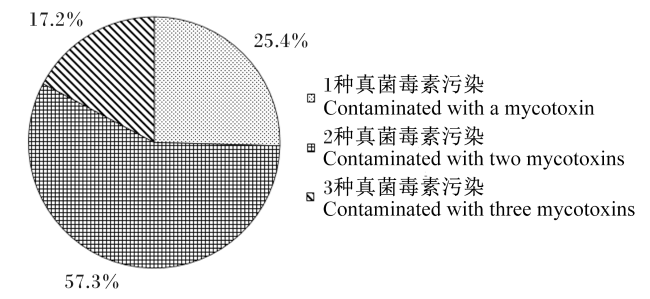
图1 家禽配合饲料中3种真菌毒素的混合污染情况

Fig.1 Co-occurrence of 3 mycotoxins in poultry compound feeds

2.2.3 不同省份真菌毒素的污染水平比较

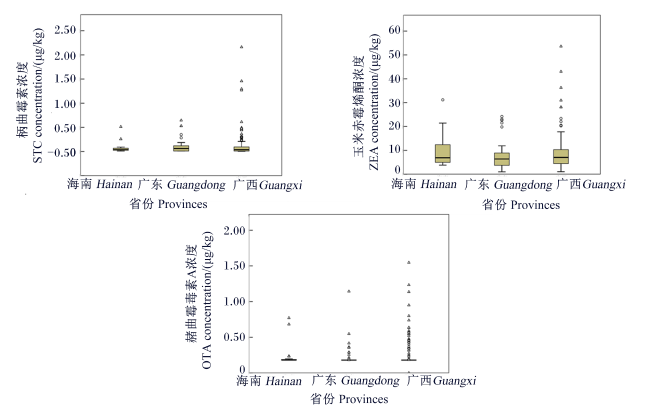
分别采用卡方检验和非参数检验分析不同省份家禽配合饲料中的真菌毒素检出率(表5)和污染浓度(图2)。
表5 不同省份家禽配合饲料中3种真菌毒素的检出率

Table 5 Detection rate of 3 mycotoxins in poultry compound feeds from different provinces

省份
Provinces
样品数量
Sample No./个
检出率Detection rate/%
柄曲霉素STC 赭曲霉毒素A OTA 玉米赤霉烯酮ZEA
海南Hainan 20 90.0a 25.0 100.0
广东Guangdong 52 71.2b 21.2 100.0
广西Guangxi 160 67.5b 21.9 100.0

同列数据肩标相同字母或无字母表示差异不显著(P>0.05),不同小写字母表示差异显著(P<0.05)。

In the same column, values with the same letter or no letter superscripts mean no significant difference (P>0.05), while with different small letter superscripts mean significant difference (P<0.05).

图2 不同省份家禽配合饲料中3种真菌毒素的污染浓度

不同省份数据柱上无字母标注表示差异不显著(P>0.05)。

Fig.2 Contaminant concentration of 3 mycotoxins in poultry compound feeds from different provinces

Data columns of different provinces without letter mean no significant difference (P>0.05).

所有家禽配合饲料中均检出ZEA,各地区检出率并无显著差异(P>0.05),污染浓度也未表现出显著差异(P>0.05);OTA的污染情况相对较轻,检出率和污染浓度未表现出显著的地区差异(P>0.05);STC在海南省样品中污染最为普遍,检出率显著高于其他地区(P<0.05),但污染浓度并未表现出显著的地区差异(P>0.05)。

3 讨论

3.1 检测方法比较

目前国内针对饲料中ZEA和OTA的调查[23-25]大多仍采用国家标准GB/T 30957—2014和GB/T 28716—2012,标准检测方法利用免疫亲和柱净化饲料样品,操作繁琐、成本昂贵;每项方法只能检测1种真菌毒素;ZEA和OTA的LOQ分别为10和5 μg/kg。本研究中利用QuEChERS(快速样品前处理技术)对样品进行前处理,简化步骤;采用HPLC-MS/MS技术同时检测3种真菌毒素,ZEA、OTA和STC的LOQ分别为0.59、0.34和0.07 μg/kg,灵敏度更高。

3.2 华南地区家禽配合饲料中真菌毒素污染情况

ZEA主要由禾谷镰刀菌(F. graminearum)产生。本研究采集的232份家禽配合饲料样品均检出ZEA,平均浓度为8.59 μg/kg,最高浓度为53.61 μg/kg,污染水平均在国家限量标准之下。Ma等[26]在2016—2017年检测了我国的559份全价配合饲料样品,其中557份(99.6%)样品检出ZEA,最高浓度达到1 109.7 μg/kg,远超过我国限量标准。2018年,陈红霞[27]调查了我国广东省109份配合饲料,其中95份(87.2%)受到ZEA污染,最高浓度为500.0 μg/kg,刚好达到国家限量值。雷元培等[23]在2019—2020年检测了我国710份全价配合饲料,所有样品均检出ZEA,超标率为6.1%。张勇等[24]在2021年调查了我国274份配合饲料,其中270份(98.5%)样品检出ZEA,最高浓度达到了2 603.04 μg/kg。本研究中ZEA检出率与以上研究结果基本一致,但平均浓度均低于相关报道,表明我国配合饲料中ZEA污染范围普遍。
OTA主要由赭曲霉(A. ochraceus)和曲霉(P. verrucosum)产生。本研究发现51份家禽配合饲料样品受到OTA污染,平均浓度为0.24 μg/kg,最高浓度为1.55 μg/kg。陈明山等[28]调查了我国广东省2019—2020年的120份水产饲料样品,其中19份(15.8%)样品中OTA浓度范围为4.46~481 μg/kg,超标率为3.33%。陈红霞[27]调查的109份饲料中,26份(23.9%)样品受到OTA污染。Twaru z ̇ek等[29]在2015—2020年间检测了波兰662份饲料样品,发现其中453份(68.4%)样品被OTA污染,最高浓度为118 μg/kg。本研究中OTA的检出率与国内相关研究相仿,但污染水平各异,因此仍需进一步扩大监测调查范围,以保证数据能如实反映我国饲料OTA污染情况。
STC主要由杂色曲霉(Aspergillus versicolor)产生。本研究发现163份家禽配合饲料样品受到STC污染,平均浓度为0.11 μg/kg,最高浓度为2.16 μg/kg,污染范围广,但污染水平不高。目前相关研究集中于天然牧草中STC污染情况,缺乏针对饲料STC污染情况的报道。STC在牧草中的检出率非常高,Nichea等[30]对2011和2014年天然牧草中STC的检出率分别为90%和60%。Nomura等[31]调查了日本861份配合饲料STC污染情况,STC检出率为43%,平均浓度为0.97 μg/kg,最高浓度为9.1 μg/kg。Arroyo-Manzanares等[32]调查了西班牙228份饲料样品,STC检出率仅为2.19%,平均浓度为104 μg/kg,最高浓度为308 μg/kg。

3.3 不同地区家禽配合饲料真菌毒素污染差异

本研究中不同地区家禽配合饲料真菌毒素污染水平并无显著差异,但海南省的STC检出率显著高于广东省和广西壮族自治区。Rodrigues等[33]从2009年开始连续3年调查了欧洲、美国、亚洲的饲料原料和成品饲料样品,结果发现不同年份、不同地区的真菌毒素发生趋势不同,其中不同地区饲料的真菌毒素发生趋势与该地区主要饲料原料的真菌毒素发生趋势一致。范楷等[34]调查了长三角农产品真菌毒素污染状况,结果发现真菌毒素污染水平与地区温湿度有一定相关性。因此,饲料原料和饲料所处环境的温湿度是导致地区真菌毒素污染水平差异的可能原因。

4 结论

本试验建立了饲料中3种真菌毒素的HPLC-MS/MS检测方法,与现行国家标准方法相比具有操作简单、覆盖范围广等优点。方法学验证结果表明该方法灵敏、准确,能够满足样品检测要求,为饲料真菌毒素污染检测提供了一种高效的检测方式。使用该方法对我国华南地区家禽配合饲料样品中STC、ZEA、OTA含量进行检测,结果显示,真菌毒素总体污染水平较低,STC、ZEA的检出率较高,混合污染情况普遍,并且呈现出一定的地区差异,后续工作因应扩大监测地区和毒素种类,全面反映饲料中真菌毒素实际污染情况。
[1]
MAHATO D K, DEVI S, PANDHI S, et al. Occurrence,impact on agriculture,human health,and management strategies of zearalenone in food and feed:a review[J]. Toxins, 2021, 13(2):92.

DOI

[2]
胡向腾. 莆田市鸡用饲料中霉菌毒素的调查及复合型解毒剂的应用[D]. 硕士学位论文. 福州: 福建农林大学, 2020.

HU X T. Investigation on mycotoxins and the application of compound antidote in chicken feed in Putian city[D]. Master’s Thesis. Fuzhou: Fujian Agriculture and Forestry University, 2020. (in Chinese)

[3]
VIEGAS C, NURME J, PIECKOVÁ E, et al. Sterigmatocystin in foodstuffs and feed:aspects to consider[J]. Mycology, 2020, 11(2):91-104.

DOI

[4]
NAKAVUMA J L, KIRABO A, BOGERE P, et al. Awareness of mycotoxins and occurrence of aflatoxins in poultry feeds and feed ingredients in selected regions of Uganda[J]. International Journal of Food Contamination, 2020, 7(1):1.

DOI

[5]
PARK J, CHANG H, KIM D, et al. Long-term occurrence of deoxynivalenol in feed and feed raw materials with a special focus on South Korea[J]. Toxins, 2018, 10(3):127.

DOI

[6]
YANG S H, GONG P, PAN J W, et al. Pediococcus pentosaceus xy46 can absorb zearalenone and alleviate its toxicity to the reproductive systems of male mice[J]. Microorganisms, 2019, 7(8):266.

DOI

[7]
李宣延, 吴孝杰. 猪饲料中赭曲霉毒素A的危害及防控措施[J]. 农村经济与科技, 2020, 31(11):81-83.

LI X Y, WU X J. Harm and control measures of ochratoxin A in pig feed[J]. Rural Economy and Science-Technology, 2020, 31(11):81-83. (in Chinese)

[8]
岳珂, 徐婷婷, 曹芹芹, 等. 赭曲霉毒素A对肉鸡毒性作用的研究进展[J]. 畜牧与饲料科学, 2021, 42(3):47-52.

YUE K, XU T T, CAO Q Q, et al. Research advances of the toxicity of ochratoxin a on broiler chickens[J]. Animal Husbandry and Feed Science, 2021, 42(3):47-52. (in Chinese)

[9]
TAKASHIMA K, NAKAJIMA K, SHIMIZU S, et al. Disruption of postnatal neurogenesis and adult-stage suppression of synaptic plasticity in the hippocampal dentate gyrus after developmental exposure to sterigmatocystin in rats[J]. Toxicology Letters, 2021, 349:69-83.

DOI PMID

[10]
王新慧, 许宏扬, 刘沛尧, 等. 黄曲霉毒素B1对奶牛的危害及防控研究进展[J]. 中国奶牛, 2021(9):44-47.

WANG X H, XU H Y, LIU P Y, et al. Research progress on the harm of aflatoxin B1 to dairy cows and control measures[J]. China Dairy Cattle, 2021(9):44-47. (in Chinese)

[11]
LI J B, BAI Y S, MA K D, et al. Dihydroartemisinin alleviates deoxynivalenol induced liver apoptosis and inflammation in piglets[J]. Ecotoxicology and Environmental Safety, 2022, 241:113811.

DOI

[12]
TOUTOUNCHI N S, BRABER S, LAND B V, et al. Deoxynivalenol exposure during pregnancy has adverse effects on placental structure and immunity in mice model[J]. Reproductive Toxicology, 2022, 112:109-118.

DOI PMID

[13]
MO H G J, PIETRI A, MACDONALD S J, et al. Survey on sterigmatocystin in food[J]. EFSA Supporting Publications, 2015, 12(3):774 E.

[14]
田禾菁, 刘秀梅. 中国粮食中杂色曲霉素污染状况调查及分析[J]. 卫生研究, 2004, 33(5):606-608.

TIAN H J, LIU X M. Survey and analysis on sterigmatocystin contaminated in grains in China[J]. Journal of Hygiene Research, 2004, 33(5):606-608. (in Chinese)

[15]
GOLGE O, KABAK B. Occurrence of deoxynivalenol and zearalenone in cereals and cereal products from Turkey[J]. Food Control, 2020, 110:106982.

DOI

[16]
中华人民共和国国家质量监督检验检疫总局, 中国国家标准化管理委员会. 饲料卫生标准:GB 13078—2017[S]. 北京: 中国标准出版社, 2018.

General Administration of Quality Supervision,Inspection and Quarantine of the People’s Republic of China, Standardization Administration of the People’s Republic of China. Hygienical standard for feeds:GB 13078—2017[S]. Beijing: Standards Press of China, 2018. (in Chinese)

[17]
中华人民共和国国家质量监督检验检疫总局, 中国国家标准化管理委员会. 饲料中赭曲霉毒素A的测定免疫亲和柱净化-高效液相色谱法:GB/T 30957—2014[S]. 北京: 中国标准出版社, 2015.

General Administration of Quality Supervision,Inspection and Quarantine of the People’s Republic of China, Standardization Administration of the People’s Republic of China. Determination of ochratoxin A in feeds—high performance liquid chromatography with immunoaffinity column clean-up:GB/T 30957—2014[S]. Beijing: Standards Press of China, 2015. (in Chinese)

[18]
中华人民共和国国家质量监督检验检疫总局, 中国国家标准化管理委员会. 饲料中玉米赤霉烯酮的测定免疫亲和柱净化-高效液相色谱法:GB/T 28716—2012[S]. 北京: 中国标准出版社, 2013.

General Administration of Quality Supervision,Inspection and Quarantine of the People’s Republic of China, Standardization Administration of the People’s Republic of China. Determination of zearalenone in feed—high performance liquid chromatographic method with immunoaffinity column clean-up:GB/T 28716—2012[S]. Beijing: Standards Press of China, 2013. (in Chinese)

[19]
王绪卿, 吴永宁, 陈君石. 食品污染监测低水平数据处理问题[J]. 中华预防医学杂志, 2002, 36(4):278-279.

WANG X Q, WU Y N, CHEN J S. Low-level data processing problems in food contamination monitoring[J]. Chinese Journal of Preventive Medicine, 2002, 36(4):278-279. (in Chinese)

[20]
宫春波, 王朝霞, 孙月琳, 等. 食品安全风险监测数据统计处理常见问题探讨[J]. 中国食品卫生杂志, 2013, 25(6):575-578.

GONG C B, WANG C X, SUN Y L, et al. Application of statistic analysis processing on food safety risk surveillance data[J]. Chinese Journal of Food Hygiene, 2013, 25(6):575-578. (in Chinese)

[21]
The Commission of the European Communities. Commission regulation (EC) No 401/2006 of 23 February 2006 laying down the methods of sampling and analysis for the official control of the levels of mycotoxins in foodstuffs[J]. Official Journal of the European Union, 2006, 70:12-34.

[22]
杨曙明, 张辉. 饲料中有毒有害物质的控制与测定[M]. 北京: 北京农业大学出版社, 1994:78.

YANG S M, ZHANG H. Control and determination of toxic and hazardous substances in feed[M]. Beijing: Beijing Agricultural University Press, 1994:78. (in Chinese)

[23]
雷元培, 周建川, 郑文革, 等. 2019—2020年中国饲料原料和饲料中霉菌毒素污染调查报告[J]. 饲料工业, 2022, 43(20):59-64.

LEI Y P, ZHOU J C, LIU Z Y, et al. A survey report on the mycotoxin contamination of compound feed and its raw materials of China in 2019—2020[J]. Feed Industry, 2022, 43(20):59-64. (in Chinese)

[24]
张勇, 杨玉林, 齐莎日娜, 等. 2021年国内饲料和饲料原料中霉菌毒素污染状况调查[J]. 饲料工业, 2022, 43(15):55-58.

ZHANG Y, YANG Y L, QI S R N, et al. A survey on the mycotoxin contamination of domestic feed and raw materials in 2021[J]. Feed Industry, 2022, 43(15):55-58. (in Chinese)

[25]
黄志伟, 刘利晓, 李洪波, 等. 16种植物性饲料原料中黄曲霉毒素B1、T-2毒素、赭曲霉毒素A、伏马毒素 (B1+B2) 污染调查检测及控制建议[J]. 畜牧与饲料科学, 2021, 42(1):19-23.

HUANG Z W, LIU L X, LI H B, et al. Pollution status investigation of aflatoxin B1,T-2 toxin,ochratoxin A and fumonisins (B1+B2) in 16 kinds of plant origin feed raw materials and control suggestions[J]. Animal Husbandry and Feed Science, 2021, 42(1):19-23. (in Chinese)

[26]
MA R, ZHANG L, LIU M, et al. Individual and combined occurrence of mycotoxins in feed ingredients and complete feeds in China[J]. Toxins, 2018, 10(3):113.

DOI

[27]
陈红霞. 广东省饲料霉菌毒素污染状况调查[D]. 硕士学位论文. 广州: 华南农业大学, 2019.

CHEN H X. Investigation on mycotoxin contamination of feed in Guangdong province[D]. Master’s Thesis. Guangzhou: South China Agricultural University, 2019. (in Chinese)

[28]
陈明山, 曹涛, 杨晓夏, 等. 广东省水产饲料中真菌毒素的地域和季节性分布特征[J]. 江西水产科技, 2020(5):36-39.

CHEN M S, CAO T, YANG X X, et al. The mycotoxin distribution characteristics of aquatic feed in Guangdong province[J]. Jiangxi Fishery Sciences and Technology, 2020,(5):36-39.

[29]
TWARUŻEK M, SKRZYDLEWSKI P, KOSICKI R, et al. Mycotoxins survey in feed materials and feedingstuffs in years 2015—2020[J]. Toxicon, 2021, 202:27-39.

DOI

[30]
NICHEA M J, PALACIOS S A, CHIACCHIERA S M, et al. Presence of multiple mycotoxins and other fungal metabolites in native grasses from a wetland ecosystem in Argentina intended for grazing cattle[J]. Toxins, 2015, 7(8):3309-3329.

DOI PMID

[31]
NOMURA M, AOYAMA K, ISHIBASHI T. Sterigmatocystin and aflatoxin B1 contamination of corn,soybean meal,and formula feed in Japan[J]. Mycotoxin Research, 2018, 34(1):21-27.

DOI

[32]
ARROYO-MANZANARES N, RODRÍGUEZ-ESTÉVEZ V, ARENAS-FERNÁNDEZ P, et al. Occurrence of mycotoxins in swine feeding from Spain[J]. Toxins, 2019, 11(6):342.

DOI

[33]
RODRIGUES I, NAEHRER K. A three-year survey on the worldwide occurrence of mycotoxins in feedstuffs and feed[J]. Toxins, 2012, 4(9):663-675.

DOI PMID

[34]
范楷, 祭芳, 徐剑宏, 等. 长三角地区市场常见农产品中40种真菌毒素的污染状况和特征分析[J]. 中国农业科学, 2021, 54(13):2870-2884.

DOI

FAN K, JI F, XU J H, et al. Natural occurrence and characteristic analysis of 40 mycotoxins in agro-products from Yangtze delta region[J]. Scientia Agricultura Sinica, 2021, 54(13):2870-2884. (in Chinese)

DOI

Outlines

/