RESEARCH PAPER

Effects of Fermented Corn Cob on Growth Performance, Rumen Fermentation Parameters and Microflora of Beef Cattle

  • LIU Yisha , 1, 2 ,
  • ZHANG Qiaoe , 1, * ,
  • XU Chi 3 ,
  • WU Xianhua 3 ,
  • LI Tao 3 ,
  • LIANG Xiaojun 4
Expand
  • 1 College of Agriculture, Ningxia University, Yinchuan 750021, China
  • 2 State Key Laboratory of Animal Nutrition, Institute of Animal Science, Chinese Academy of Agricultural Sciences, Beijing 100193, China
  • 3 Ningxia Dabeinong Science and Technology Industrial Co., Ltd., Yinchuan 750200, China
  • 4 Institute of Animal Science, Ningxia Academy of Agriculture and Forestry Sciences, Yinchuan 750002, China
* professor, E-mail:

Received date: 2023-08-31

  Online published: 2024-02-01

Abstract

This study aimed to evaluate the effects of fermented corn cob on growth performance, rumen fermentation parameters and microflora of beef cattle. Sixty healthy Simmental crossbred cattle with 13-months of age and similar weight [(395±32) kg] were selected and randomly divided into 3 groups, with 20 replicates per group and 1 cattle per replicate. Cattle in control group were fed the total mixed ration without fermented corn cob, cattle in test group 1 were fed the total mixed ration with 10% fermented corn cob, and cattle in test group 2 were fed the total mixed ration with 20% fermented corn cob. The adaption period lasted for 7 d, and the formal trial period lasted for 93 d. The results showed as follows: 1) the average daily feed intake and average daily weight gain in the test groups 1 and 2 were significantly higher than those in the control group (P<0.05), while the feed/gain ratio in the test groups 1 and 2 was significantly lower than that in the control group (P<0.05). 2) The rumen fluid ammoniacal nitrogen (NH3-N) concentration in the test groups 1 and 2 was significantly increased compared with the control group (P<0.05), and the rumen fluid microbial protein (MCP) concentration in the test group 2 was significantly increased compared with the control group and test group 1 (P<0.05); rumen fluid pH was not significantly different among all groups (P>0.05); the rumen fluid total volatile fatty acid (TVFA) concentration in the two test groups was significantly lower than that in the control group (P<0.05), while the molar percentages of acetate, propionate, valerate and acetate/propionate ratio in rumen fluid were not significantly different (P>0.05); the molar percentage of butyrate in rumen fluid in the two test groups was significantly lower than that in the control group (P<0.05), while the molar percentages of isobutyrate and isovalerate were significantly higher than those in the control group (P<0.05).3) At the phylum level, The main dominant phyla in the three groups were Bacteroidetes and Firmicutes. The relative abundance of Bacteroidetes in the test groups 1 and 2 was significantly higher than that in the control group (P<0.05), and the relative abundance of Firmicutes in the test group 2 was significantly higher than that in the control group (P<0.05). At the genus level, the main dominant genera in the three groups were Prevotella and unidentified Bacteroidales. The relative abundance of unidentified Prevotellaceae in the test groups 1 and 2 was significantly higher than that in the control group (P<0.05), and the test group 1 was significantly higher than the test group 2 (P<0.05); the relative abundances of Ruminococcus and Methanobrevibacter in the control group was significantly higher than those in the test group 1 and 2 (P<0.05); the relative abundances of unclassified Clostridiales and unidentified Lachnospiraceae in the test group 2 were significantly lower than those in the control group and test group 1 (P<0.05). In conclusion, fermented corn cob supplementation in the diet can improve the growth performance and rumen fermentation environment of beef cattle, and affect the rumen microflora composition at phylum and genus levels.

Cite this article

LIU Yisha , ZHANG Qiaoe , XU Chi , WU Xianhua , LI Tao , LIANG Xiaojun . Effects of Fermented Corn Cob on Growth Performance, Rumen Fermentation Parameters and Microflora of Beef Cattle[J]. Chinese Journal of Animal Nutrition, 2024 , 36(2) : 1039 -1049 . DOI: 10.12418/CJAN2024.094

反刍动物瘤胃内定植了多种多样的微生物,包括细菌、古菌和真菌以及原虫等。这些微生物参与饲料消化,且其互作维持着瘤胃发酵环境的稳定,对反刍动物机体的生理机能具有重要的意义[1]。玉米经脱穗处理后的玉米芯为常见农副产品,其成分主要是大量的木质素及纤维素、葡萄糖和淀粉等[2]。由于玉米芯较高的木质素含量,其经干燥、粉碎处理后在反刍动物瘤胃内仍不易消化吸收,且适口性较差,常出现挑食、剩料等问题,极大影响了玉米芯作为粗饲料的利用率。
发酵处理是目前改善饲料品质的常用方式。该处理能够降解抗营养因子、破坏木质纤维结构,进而改善饲料原料适口性,提升饲料营养价值。此外,发酵工艺中引入的益生菌能够促进反刍动物瘤胃健康,改善瘤胃微生态环境[3]。李元新等[4]研究显示,用发酵苹果渣饲料饲喂肉牛能够显著提高肉牛的平均日增重,极显著降低料重比;极显著提高血清中的生长激素(GH)、白细胞介素-6(IL-6)含量;显著降低血清中白蛋白、尿素氮含量。彭忠利等[5]研究发现,在肉牛饲粮中添加以玉米黄浆液、喷浆玉米纤维、酱糟和木薯渣等食品工业废弃物为原料的发酵饲料能够提高肉牛的采食量、平均日增重及粗纤维消化率。Rodrigues等[6]和Dagaew等[7]的研究也获得了与上述研究一致结果。张国玉等[8]研究发现,添加发酵番茄皮渣能改善饲粮的适口性,显著提高新疆褐牛的平均日增重。侯鹏霞等[9]研究发现,在肉牛饲粮中添加发酵枸杞枝条能够提高育肥期肉牛的平均日增重及血清免疫球蛋白含量。本试验在西门塔尔杂交牛饲粮中添加不同水平发酵玉米芯,旨在探究发酵玉米芯对肉牛生长性能、瘤胃发酵参数的影响,并运用高通量测序技术测定其对瘤胃菌群结构和多样性的影响,为发酵玉米芯在反刍动物生产中的应用提供科学依据。

1 材料与方法

1.1 发酵玉米芯的制作

发酵玉米芯的底物由50%玉米芯、40%马铃薯渣、8%甜菜丝和2%复合菌混合糖蜜组成;发酵菌液由乳酸菌、酿酒酵母(Saccharomyces cerevisiae)、枯草芽孢杆菌(Bacillus subtilis)等十几种微生物制成。制作流程为:将未经处理的玉米穗轴用去皮机将玉米皮和玉米芯剥离后粉碎至5 mm的颗粒状,马铃薯渣和甜菜丝作为载体加入混合均匀,将发酵菌液于糖蜜中活化处理后均匀喷洒于发酵底物中,随后装窖。在填充前,将有机酸均匀地喷洒在窖池以防止玉米芯霉变,并保证发酵期内的新鲜度。在加工装窖过程中,每8 h喷洒1次有机酸,封窖前在顶层喷洒有机酸覆盖玉米芯后封窖保存。发酵温度为35~38 ℃,发酵15 d后开窖并进行裹包存放。使用MP2000-X裹包机(ORKEL,挪威)和裹包膜进行裹包处理,配电机功率为55 kW,捆包直径×宽度为115 cm×120 cm,捆包体积为1.25 m3。玉米芯发酵前后常规营养成分比较见表1
表1 玉米芯发酵前后常规营养成分比较

Table 1 Comparison of conventional nutrient composition of corn cobs before and after fermentation%

项目 Items 玉米芯 Corn cob 发酵玉米芯 Fermented corn cob
粗脂肪 EE 9.65±0.31a 8.12±0.17b
粗蛋白质 CP 4.47±0.07a 9.94±0.17b
粗灰分 Ash 4.32±0.11a 2.91±0.04b
中性洗涤纤维 NDF 73.34±0.04a 59.70±0.09b
酸性洗涤纤维 ADF 42.22±0.07a 30.16±1.14b

同行数据肩标无字母或相同字母表示差异不显著(P>0.05),不同字母表示差异显著(P<0.05)。下表同。

In the same column, values with no letter of the same letter superscripts mean no significant difference (P>0.05), while with different letter superscripts mean significant difference (P<0.05). The same as below.

1.2 试验时间与地点

饲养试验于2022年6—9月在宁夏壹泰牧业有限公司进行。

1.3 试验动物与试验设计

选用60头13月龄、体重(395±32) kg的健康西门塔尔杂交牛作为试验动物,将其随机分为3组,每组20个重复,每个重复1头牛,以单栏模式饲养。对照组饲喂不添加发酵玉米芯的全混合日粮(TMR),试验1组饲喂添加10%发酵玉米芯的全混合日粮,试验2组饲喂添加20%发酵玉米芯的全混合日粮。根据NASEM(2016)肉牛饲养标准配制全混合日粮,3组饲粮营养水平基本一致,饲粮组成及营养水平见表2。采用小型饲料混合机将饲粮混合均匀后饲喂,试验牛只全天自由活动、自由采食和饮水。试验共持续100 d,其中预试期7 d,正试期93 d。
表2 饲粮组成及营养水平(干物质基础)

Table 2 Composition and nutrient levels of diets (DM basis)%

项目
Items
对照组
Control group
试验1组
Test group 1
试验2组
Test group 2
原料 Ingredients
压片玉米 Flaked corn 32.91 30.84 30.34
膨化尿素 Expanded urea 0.58 0.54 0.54
豆粕 Soybean meal 5.28 7.18 7.08
玉米干酒糟及其可溶物 Corn DDGS 8.66 7.83 7.03
棉籽粕 Cottonseed meal 6.13 5.55 5.32
食盐 NaCl 0.56 0.54 0.54
小苏打 NaHCO3 1.11 1.08 1.08
预混料 Premix1) 0.56 0.54 0.55
玉米青贮 Corn silage 26.65 23.86 14.56
稻草 Rice straw 17.56 11.36 11.36
发酵玉米芯 Fermented corn cob 10.67 21.60
合计 Total 100.00 100.00 100.00
营养水平 Nutrient levels2)
综合净能 NEmf/(MJ/kg) 6.92 7.05 7.10
粗蛋白质 CP 10.67 10.84 10.62
粗脂肪 EE 2.77 2.92 2.89
中性洗涤纤维 NDF 37.60 34.25 33.44
酸性洗涤纤维 ADF 33.01 30.57 30.76
钙 Ca 0.37 0.39 0.45
总磷 TP 0.27 0.27 0.30

1)每千克预混料含有 Contained the following per kg of the premix:VA 810 000 IU,VD3 130 000 IU,VE 2 000 IU,Cu 2 g,Mn 7.2 g,Zn 10.3 g,I 30 mg,Se 28 mg,Co 31 mg。

2)综合净能参考NASEM(2016)计算,其余为实测值。NEmf is calculated by reference to NASEM(2016), while the others were measured values.

1.4 样品采集

在饲养试验结束当天,从每组随机选取10头试验牛,晨饲前从口腔采集瘤胃液。首先将试验牛只赶入防疫通道保定栏内,以牛鼻钳和粗麻绳固定头部后,用胃管式采样器采集瘤胃液,瘤胃液取出后弃去最初50 mL(避免唾液影响),经4层纱布过滤后立即使用便携式pH酸度计(TPS公司,澳大利亚)测定pH,然后分装到10支5 mL无菌冻存管中,投入液氮罐内冷冻,迅速带回实验室置于-80 ℃冰箱内保存,用于微生物DNA提取和瘤胃挥发性脂肪酸及发酵参数的测定。

1.5 测定指标与方法

1.5.1 主要营养成分测定

干物质(DM)含量参考GB/T 6435—2014[10]测定,粗蛋白质(CP)含量参考GB/T 6432—2018[11]测定,粗脂肪(EE)含量参考GB/T 6433—2006[12]测定,中性洗涤纤维(NDF)含量参照GB/T 20806—2006[13]测定;酸性洗涤纤维(ADF)含量参考NY/T 1459—2007[14]测定;钙(Ca)含量参考GB/T 6436—2018[15]测定,总磷(TP)含量参考GB/T 6437—2018[16]测定。

1.5.2 生长性能测定

每天07:00和17:00进行饲喂,于晨饲前收集前1天的剩料并称量记录,用于计算试验期内各组的平均日采食量。试验牛只于试验正式开始前1天空腹测定初始体重,在正试期第93天试验结束后空腹测定终末体重,计算各组的平均日增重和料重比。

1.5.3 瘤胃发酵参数测定

瘤胃液氨态氮(NH3-N)浓度按照冯宗慈等[17]的方法测定,微生物蛋白(MCP)浓度采用差速离心法(考马斯亮蓝法),参照徐晓锋等[18]的操作测定。利用气相色谱仪(7890A,Agilent,美国)测定瘤胃液各VFA的浓度,计算总挥发性脂肪酸(TVFA)的浓度以及各VFA的摩尔百分比。

1.5.4 瘤胃微生物多样性测定

采用OMEGA Soil DNA Kit (M5635-02,Omega Bio-Tek,美国)试剂盒提取瘤胃液DNA。对抽提完成的DNA进行0.8%琼脂糖凝胶电泳判断分子大小,利用Nanodrop对DNA进行定量。30个微生物DNA样本通过Illumina公司的MiSeq PE-300平台进行测序(由上海拜谱生物医药科技有限公司完成),对高通量测序数据进行分析。

1.6 数据统计与分析

利用SPSS 19.0软件进行单因素方差分析,并采用Duncan氏法进行多重比较,数据均以平均值±标准差表示。以P<0.05表示差异显著。

2 结果

2.1 发酵玉米芯对肉牛生长性能的影响

表3可知,试验1、2组的平均日增重和平均日采食量显著高于对照组(P<0.05),同时试验2组还显著高于试验1组(P<0.05);试验1、2组料重比显著低于对照组(P<0.05),同时试验2组还显著低于试验1组(P<0.05)。
表3 发酵玉米芯对肉牛生长性能的影响

Table 3 Effects of fermented corn cob on growth performance of beef cattle

项目
Items
对照组
Control group
试验1组
Test group 1
试验2组
Test group 2
P
P-value
初始体重 IBW/kg 419.95±29.37 425.75±24.33 429.10±12.61 0.456
终末体重 FBW/kg 558.05±42.59 556.10±33.04 571.25±37.77 0.396
平均日增重 ADG/(kg/d) 1.50±0.31c 1.55±0.35b 1.68±0.31a 0.032
平均日采食量 ADFI/(kg/d) 9.90±0.18c 9.99±0.14b 10.24±0.11a 0.019
料重比 F/G 7.21±1.64a 6.60±2.35b 6.42±1.38c 0.022

2.2 发酵玉米芯对肉牛瘤胃发酵参数的影响

表4可知,肉牛饲喂发酵玉米芯后瘤胃液pH无显著变化;2个试验组瘤胃液总VFA浓度均显著低于对照组(P<0.05);各组之间瘤胃液乙酸、丙酸、戊酸摩尔百分比及乙酸/丙酸值无显著差异(P>0.05);2个试验组瘤胃液丁酸摩尔百分比显著低于对照组(P<0.05),而异丁酸和异戊酸摩尔百分比均显著高于对照组(P<0.05);瘤胃液NH3-N浓度以试验1组最高,试验2组次之,对照组最低,组间差异显著(P<0.05);试验2组瘤胃液MCP浓度显著高于对照组和试验1组(P<0.05)。
表4 发酵玉米芯对肉牛瘤胃发酵参数的影响

Table 4 Effects of fermented corn cob on rumen fermentation parameters of beef cattle

项目
Items
对照组
Control group
试验1组
Test group 1
试验2组
Test group 2
P
P-value
pH 6.81±0.08 6.70±0.12 6.75±0.09 0.342
总挥发性脂肪酸 TVFA/(mmol/L) 75.72±7.06a 46.72±2.23b 45.87±5.55b 0.001
各挥发性脂肪酸摩尔百分比Molar percentage of each VFA/%
乙酸 Acetate 62.40±0.02 63.82±0.03 64.33±0.03 0.353
丙酸 Propionate 18.02±0.01 18.93±0.02 19.14±0.04 0.620
丁酸 Butyrate 15.73±0.03a 12.51±0.02b 11.90±0.01b 0.003
戊酸 Valerate 1.32±0.01 1.26±0.02 1.15±0.01 0.338
异丁酸 Isobutyrate 0.82±0.03b 1.24±0.02a 1.29±0.02a 0.001
异戊酸 Isovalerate 1.70±0.04b 2.25±0.04a 2.28±0.04a 0.012
乙酸/丙酸 A/P 3.48±0.24 3.39±0.42 3.49±0.80 0.923
氨态氮 NH3-N/(mg/dL) 9.09±1.93c 13.70±1.79a 12.20±1.83b 0.001
微生物蛋白 MCP/(mg/mL) 1.95±0.36b 1.76±0.38c 2.34±0.26a 0.002

2.3 发酵玉米芯对肉牛瘤胃菌群多样性的影响

2.3.1 Venn图

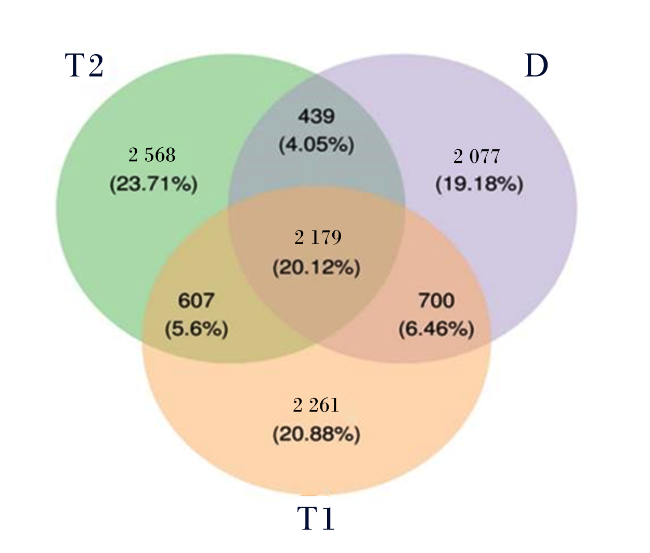
Illumina MiSeq测序后,将30个瘤胃液样品中获得的序列进行操作分类单元(OTUs)聚类,剔除稀有OTUs后,对样品进行OTUs统计。由图1可知,对照组共获得了5 395个OTUs,试验1组共获得了5 747个OTUs,试验2组共获得了5 793个OTUs,3组共有OTUs为2 179个,对照组特有OTUs为2 077个,试验1组特有OTUs为2 261个,试验2组特有OTUs为2 568个。上述结果说明3组肉牛瘤胃菌群组成存在差异。
图1 Venn图

D:对照组;T1:试验1组;T2:试验2组。下图同。

Fig.1 Venn graph

D: control group; T1: test group 1; T2: test group 2. The same as below.

2.3.2 α多样性分析

表5可知,3组肉牛瘤胃菌群的Shannon指数、Simpson指数、Ace指数和Chao指数差异均不显著(P>0.05)。
表5 瘤胃菌群α多样性指数
项目
Items
对照组
Control group
试验1组
Test group 1
试验2组
Test group 2
P
P-value
Shannon指数 Shannon index 8.62±0.82 8.63±0.80 8.66±1.15 0.412
Simpson指数 Simpson index 0.99±0.01 0.99±0.01 0.99±0.03 0.464
Ace指数 Ace index 1 318.81±74.64 1 296.47±58.69 1 323.88±42.80 0.782
Chao指数 Chao index 1 771.48±325.69 1 800.70±342.12 1 727.16±373.55 0.473

Table 5 α diversity indexes of rumen microflora of beef cattle

2.3.3 β多样性分析

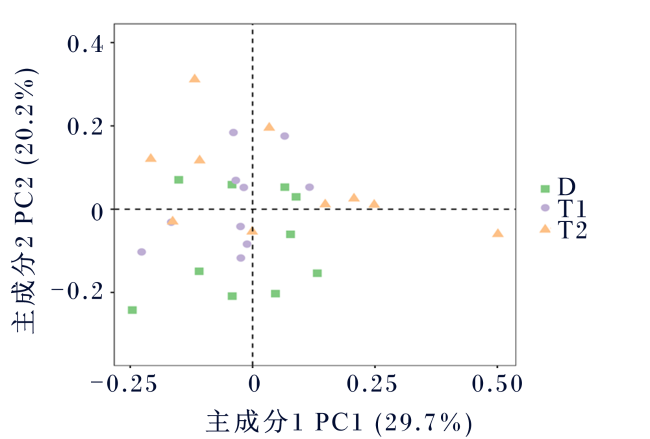
β多样性分析是通过对3组肉牛瘤胃菌群的物种多样性进行比较分析,探索3组样品间菌群组成的相似性或差异性。主坐标分析(PCoA)可显示每个样品间的差异,物种组成越大,各样品之间的距离越远。由图2可知,主成分1贡献率为29.7%,主成分2贡献率为20.2%,试验2组与对照组样品距离较远,说明这2组菌群多样性差异较大。
图2 PCoA图

Fig.2 PCoA graph

2.4 发酵玉米芯对肉牛瘤胃菌群结构的影响

本试验的30个样品经过比对共得到25个门,47个纲,80个目,111个科,204个属的细菌。
表6可知,在门水平上,3组均由拟杆菌门(Bacteroidetes)、厚壁菌门(Firmicutes)、软壁菌门(Tenericutes)、浮霉菌门(Planctomycetes)、广古菌门(Euryarchaeota)以及其他相对丰度<1%的菌门组成。3组中Bacteroidetes均为第一优势菌门,试验1、2组Bacteroidetes的相对丰度显著高于对照组(P<0.05);第二优势菌门为Firmicutes,试验2组Firmicutes的相对丰度显著低于对照组(P<0.05);另外,试验2组Euryarchaeota的相对丰度显著低于对照组(P<0.05);其他菌门的相对丰度3组间差异不显著(P>0.05)。
表6 发酵玉米芯对肉牛瘤胃菌群门水平上(相对丰度>1%)组成的影响

Table 6 Effects of fermented corn cob on rumen microflora composition at phylum level (relative abundance>1%) of beef cattle

项目
Items
对照组
Control group
试验1组
Test group 1
试验2组
Test group 2
P
P-value
拟杆菌门 Bacteroidetes 62.84±15.44b 73.28±13.24a 79.98±9.50a 0.022
厚壁菌门 Firmicutes 27.96±13.48a 20.15±10.81a 13.09±8.14b 0.020
软壁菌门 Tenericutes 3.00±1.80 2.14±1.68 3.43±1.58 0.360
浮霉菌门 Planctomycetes 2.57±2.27 2.46±1.71 1.90±3.10 0.489
广古菌门 Euryarchaeota 1.89±1.64a 0.56±0.57b 0.30±0.20c 0.003
表7可知,在属水平上,对照组的优势菌属依次为普雷沃氏菌属(Prevotella)、拟杆菌目未鉴定属(unidentified Bacteroidales)、梭菌目未鉴定属(unidentified Clostridiales)、拟杆菌目S24-7未鉴定属(unidentified Bacteroidales S24-7)、普雷沃氏菌科未鉴定属(unidentified Prevotellaceae)、瘤胃球菌属(Ruminococcus);试验1组的优势菌属依次为unidentified Bacteroidales、Prevotella、unidentified Bacteroidales S24-7、unidentified Prevotellaceae、拟杆菌目RF16未鉴定属(unidentified Bacteroidales RF16)、unidentified Clostridiales;试验2组的优势菌属依次为unidentified Bacteroidales、Prevotella、unidentified Bacteroidales S24-7、拟杆菌目BS11未鉴定属(unidentified Bacteroidales BS11)、unidentified Bacteroidales RF16、unidentified Clostridiales。3组的优势菌属相对丰度均在5%以上。试验1、2组unidentified Prevotellaceae的相对丰度显著高于对照组(P<0.05),同时试验1组还显著高于试验2组(P<0.05);对照组Ruminococcus和甲烷短杆菌属(Methanobrevibacter)的相对丰度显著高于试验1、2组(P<0.05);试验2组的梭菌目未分类属(unclassified Clostridiales)和毛螺菌科未鉴定属(unidentified Lachnospiraceae)的相对丰度显著低于对照组和试验1组(P<0.05)。
表7 发酵玉米芯对肉牛瘤胃菌群属水平上(相对丰度>1%)组成的影响

Table 7 Effects of fermented corn cob on rumen microflora composition at genus level (relative abundance>1%) of beef cattle

项目
Items
对照组
Control group
试验1组
Test group 1
试验2组
Test group 2
P
P-value
普雷沃氏菌属
Prevotella
20.64±7.88 15.80±5.20 19.51±12.95 0.483
拟杆菌目未鉴定属
Unidentified Bacteroidales
16.39±7.78 21.99±7.39 21.99±10.62 0.270
梭菌目未鉴定属
Unidentified Clostridiales
9.96±4.51 7.38±3.55 6.46±5.39 0.223
拟杆菌目S24-7未鉴定属
Unidentified Bacteroidales S24-7
8.36±5.14 9.68±4.34 12.63±9.31 0.351
普雷沃氏菌科未鉴定属
Unidentified Prevotellaceae
5.68±2.27c 8.08±2.20a 6.04±1.81b 0.036
瘤胃球菌属
Ruminococcus
5.32±3.92a 1.87±1.15b 0.89±0.69c 0.001
拟杆菌目RF16未鉴定属
Unidentified Bacteroidales RF16
4.44±5.03 7.85±3.00 7.56±0.84 0.229
拟杆菌目BS11未鉴定属
Unidentified Bacteroidales BS11
4.29±2.95 4.72±4.55 7.56±5.43 0.218
小梨形菌科未鉴定属
Unidentified Pirellulaceae
2.57±2.27 2.14±1.70 3.43±3.10 0.490
柔膜菌纲RF39未鉴定属
Unidentified Mollicutes RF39
2.28±1.56 2.05±1.44 1.63±1.40 0.605
甲烷短杆菌属
Methanobrevibacter
1.88±1.63a 0.56±0.57b 0.31±0.20c 0.003
瘤胃球菌科未鉴定属
Unidentified Ruminococcaceae
1.87±1.12 2.17±1.36 1.06±0.57 0.075
梭菌目未分类属
Unclassified Clostridiales
1.75±0.86a 1.71±1.23a 0.75±0.51b 0.034
毛螺菌科未鉴定属
Unidentified Lachnospiraceae
1.23±0.64a 0.95±0.70a 0.43±0.30b 0.014
丁酸弧菌属
Butyrivibrio
1.21±0.76 1.19±0.77 0.67±0.53 0.171
帕拉普氏菌科未鉴定属
Unidentified Paraprevotellaceae
1.11±0.31 1.69±0.81 1.41±0.50 0.102
帕拉普氏菌科CF231属
Paraprevotellaceae CF231
1.00±0.47 1.16±0.36 1.12±0.35 0.662

3 讨论

3.1 发酵玉米芯对肉牛生长性能的影响

肉牛的生长性能在养殖中最为重要,其主要指标为采食量、日增重、料重比。本试验中,与对照组相比,试验1、2组的平均日采食量和平均日增重显著升高,料重比显著降低。这与赵凯强等[19]在肉牛饲粮中添加发酵玉米芯能够显著提高肉牛平均日增重和平均日采食量的结果一致。肉牛平均日增重升高可能和发酵玉米芯中的枯草芽孢杆菌所产生的酶类促进了饲料营养成分的分解,进而提高了饲料消化率和肉牛的育肥效果有关;此外,乳酸菌在发酵过程中所产生的乳酸能够降低动物肠道pH,同时其产生的维生素、酶和氨基酸等营养物质[20]可能也与饲料效率的提高有关。

3.2 发酵玉米芯对肉牛瘤胃发酵参数的影响

反刍动物的瘤胃发酵情况与瘤胃微生物区系直接相关,而这些微生物仅在特定的pH范围内生长和活动,因此瘤胃液pH的维持对于反刍动物的正常生理功能至关重要。一般而言,瘤胃液通常为酸性,pH为5.5~7.5,而本试验各组牛只的瘤胃液pH维持在6.75~6.81,表明发酵玉米芯未带来酸中毒风险。
VFA是反刍动物瘤胃中碳水化合物发酵的主要产物,是能量来源的重要渠道,包括乙酸、丙酸和丁酸等。乙酸、丙酸和丁酸在反刍动物瘤胃内占总挥发性脂肪酸的95%左右。本研究中,2个试验组瘤胃液丁酸摩尔百分比显著低于对照组,与Foley等[21]得出的发酵饲料能够抑制瘤胃发酵及VFA产生的结论一致,其原因可能是发酵对玉米芯纤维的分解限制了瘤胃丁酸的主要来源,减少了纤维降解菌生长所需的底物。
NH3-N主要为瘤胃微生物生长提供氮源。Norrapoke等[22]研究发现,发酵木薯渣饲喂婆罗门杂交肉牛能够显著增加瘤胃液NH3-N浓度与MCP的合成。Devant等[23]、Van Dung等[24]和Ghorbani等[25]证明,随着饲粮中蛋白质水平的提高,瘤胃液中NH3-N浓度增加。本试验中,试验1、2组瘤胃液NH3-N浓度显著高于对照组,这与上述研究结果一致,表明玉米芯经过发酵处理后,其蛋白质具有更高的利用效率。
MCP是反刍动物小肠氨基酸主要的来源,添加益生菌可显著提高瘤胃液MCP浓度。本试验中,试验2组瘤胃液MCP浓度显著高于对照组和试验1组,说明发酵玉米芯能够提高瘤胃内MCP产量。

3.3 发酵玉米芯对肉牛瘤胃菌群的影响

反刍动物的瘤胃微生物群落复杂多样,由多种细菌、真菌原生动物和古细菌等组成[26]。ACE指数和Chao指数能够反映瘤胃菌群的丰富度,Simpson指数越小,Shannon指数越大,说明瘤胃菌群的多样性越大。本研究中,各组的ACE指数、Chao指数、Simpson指数和Shannon指数均无显著差异,表明饲粮里添加发酵玉米芯对肉牛瘤胃菌群多样性无显著影响。
刘垚等[27]研究发现,在西门塔尔杂交牛瘤胃菌群中,门水平上的优势菌群有Bacteroidetes和Firmicutes,这与本试验结果相同。本试验中,各组肉牛瘤胃菌群中的优势菌门均为Bacteroidetes,且其相对丰度随发酵玉米芯添加水平的增加而增加,这和王锦等[28]和李茂龙等[29]得出的饲喂发酵饲料或益生菌会提高反刍动物生长性能与瘤胃菌群中Bacteroidetes相对丰度的结果一致。
Prevotella是瘤胃中最主要的蛋白质降解菌之一,它不仅能够降解瘤胃中的蛋白质和淀粉,还能够发酵糖和氨基酸[30]。本试验中,Prevotella在各组肉牛瘤胃菌群中均为优势菌属,与前人研究结果[31]一致;此外,试验1、2组unidentified Prevotellaceae的相对丰度显著高于对照组。郭威等[32]发现,饲喂发酵玉米秸秆的绵羊瘤胃中Prevotella相对丰度更高,这与本试验结果。
Ruminococcus是动物胃肠道内重要的纤维分解菌,能够产生大量纤维素酶、半纤维素酶以及木聚糖酶,消化粗饲料中的纤维素和半纤维素。本试验中,3组肉牛瘤胃菌群中都含有Ruminococcus,对照组Ruminococcus的相对丰度显著高于试验1、2组,提示发酵处理降低了玉米芯的纤维水平,且发酵过程中引入的其他纤维分解菌可能导致Ruminococcus因底物竞争而被抑制。而拟杆菌目的一些未鉴定属的相对丰度随着发酵玉米芯添加水平的增加有升高趋势,可能是随着发酵玉米芯添加水平的增加,底物含量及成分的差异刺激了拟杆菌属的生长。上述结果表明发酵玉米芯可能引起了瘤胃菌群组成结构的改变。

4 结论

① 发酵玉米芯能提高肉牛的平均日增重和平均日采食量,提高饲料效率。本试验条件下,以肉牛全混合日粮中添加20%发酵玉米芯时效果最佳。
② 发酵玉米芯能够改善肉牛瘤胃发酵环境,提升瘤胃液NH3-N和MCP浓度,并影响瘤胃菌群在门水平和属水平上的组成。
[1]
BI Y L, ZENG S Q, ZHANG R, et al. Effects of dietary energy levels on rumen bacterial community composition in Holstein heifers under the same forage to concentrate ratio condition[J]. BMC Microbiology, 2018, 18(1):69.

DOI PMID

[2]
王雪, 寇蛟龙, 张珣, 等. 玉米芯发酵全混合饲料的制作及营养成分分析[J]. 中国畜牧杂志, 2019, 55(6):96-99.

WANG X, KOU J L, ZHANG X, et al. Production and nutrient analysis of corn kernel-fermented total mixed feed[J]. Chinese Journal of Animal Science, 2019, 55(6):96-99. (in Chinese)

[3]
姚志芳, 冯宇哲, 王磊, 等. 酵母菌和乳酸菌在生物发酵饲料中的应用研究进展[J]. 饲料研究, 2020, 43(10):154-158.

YAO Z F, FENG Y Z, WANG L, et al. Application and research progress of yeast and lactic acid bacteria on bio-fermented feed[J]. Feed Research, 2020, 43(10):154-158. (in Chinese)

[4]
李元新, 陈伯祥, 赵子惠, 等. 发酵苹果渣饲料对肉牛生产性能和血清生化指标的影响[J]. 饲料研究, 2020, 43(11):13-15.

LI Y X, CHEN B X, ZHAO Z H, et al. Effect of fermented apple residue feed on production performance and serum biochemical index of beef cattle[J]. Feed Research, 2020, 43(11):13-15. (in Chinese)

[5]
彭忠利, 郭春华, 严锦秀, 等. 发酵饲料对育肥肉牛生产性能、养分消化率和肉质的影响[J]. 黑龙江畜牧兽医, 2013(23):67-70.

PENG Z L, GUO C H, YAN J X, et al. Effects of fermented feed on productive performance and nutrient digestibility and meat quality in fattening beef cattle[J]. Heilongjiang Animal Science and Veterinary Medicine, 2013(23):67-70. (in Chinese)

[6]
RODRIGUES A A, REIS S S, DA CUNHA CASTRO D C, et al. Yeast-fermented cassava as a protein source in cattle feed:systematic review and meta-analysis[J]. Tropical Animal Health and Production, 2023, 55(2):67.

DOI

[7]
DAGAEW G, WONGTANGTINTHARN S, SUNTARA C, et al. Feed utilization efficiency and ruminal metabolites in beef cattle fed with cassava pulp fermented yeast waste replacement soybean meal[J]. Scientific Reports, 2022, 12(1):16090.

DOI PMID

[8]
张国玉, 柴娟, 李新民, 等. 番茄皮渣发酵饲料的制备及养牛试验[J]. 贵州畜牧兽医, 2022, 46(4):22-24.

ZHANG G Y, CHAI J, LI X M, et al. Preparation of tomato skin residue fermented feed and cattle raising test[J]. Guizhou Journal of Animal Husbandry & Veterinary Medicine, 2022, 46(4):22-24. (in Chinese)

[9]
侯鹏霞, 王建东, 安魏, 等. 枸杞枝条发酵饲料对肉牛育肥效果及免疫性能的影响[J]. 中国饲料, 2022(11):123-127.

HOU P X, WANG J D, AN W, et al. Effect of Lycium barbarum branches bermented feed on fattening effect and immune performance of beef cattle[J]. China Feed, 2022(11):123-127. (in Chinese)

[10]
中华人民共和国国家质量监督检验检疫总局, 中国国家标准化管理委员会. 饲料中水分的测定:GB/T 6435—2014[S]. 北京: 中国标准出版社, 2015.

General Administration of Quality Supervision,Inspection and Quarantine of the People’s Republic of China, Standardization Administration of the People’s Republic of China. Determination of moisture in feedstuffs:GB/T 6435—2014[S]. Beijing: Standards Press of China, 2015. (in Chinese)

[11]
中华人民共和国国家市场监督管理总局, 中国国家标准化管理委员会. 饲料中粗蛋白的测定凯氏定氮法:GB/T 6432—2018[S]. 北京: 中国标准出版社, 2018.

State Administration for Market Regulation, Standardization Administration of the People’s Republic of China. Determination of crude protein in feeds-Kjeldahl method:GB/T 6432—2018[S]. Beijing: Standards Press of China, 2018. (in Chinese)

[12]
中华人民共和国国家质量监督检验检疫总局, 中国国家标准化管理委员会. 饲料中粗脂肪的测定:GB/T 6433—2006[S]. 北京: 中国标准出版社, 2006.

General Administration of Quality Supervision,Inspection and Quarantine of the People’s Republic of China, Standardization Administration of the People’s Republic of China. Determination of crude fat in feeds:GB/T 6433—2006[S]. Beijing: Standards Press of China, 2006. (in Chinese)

[13]
中华人民共和国国家质量监督检验检疫总局, 中国国家标准化管理委员会. 饲料中中性洗涤纤维 (NDF) 的测定:GB/T 20806—2006[S]. 北京: 中国标准出版社, 2007.

General Administration of Quality Supervision,Inspection and Quarantine of the People’s Republic of China, Standardization Administration of the People’s Republic of China. Determination of neutral detergent fiber in feedstuffs:GB/T 20806—2006[S]. Beijing: Standards Press of China, 2007. (in Chinese)

[14]
中华人民共和国农业部. 饲料中酸性洗涤纤维的测定:NY/T 1459—2007[S]. 北京: 农业出版社, 2008.

The Ministry of Agriculture of the People’s Republic of China. Determination of acid detergent fiber in feedstuff (ADF):NY/T 1459—2007[S]. Beijing: Agricultural Publishing House, 2008. (in Chinese)

[15]
中华人民共和国国家市场监督管理总局, 中国国家标准化管理委员会. 饲料中钙的测定:GB/T 6436—2018[S]. 北京: 中国标准出版社, 2018.

State Administration for Market Regulation, Standardization Administration of the People’s Republic of China. Determination of calcium in feeds:GB/T 6436—2018[S]. Beijing: Standards Press of China, 2018. (in Chinese)

[16]
中华人民共和国国家市场监督管理总局, 中国国家标准化管理委员会. 饲料中总磷的测定分光光度法:GB/T 6437—2018[S]. 北京: 中国标准出版社, 2018.

State Administration for Market Regulation, Standardization Administration of the People’s Republic of China. Determination of phosphorus in feeds-spectrophotometry:GB/T 6437—2018[S]. Beijing: Standards Press of China, 2018. (in Chinese)

[17]
冯宗慈, 高民. 通过比色测定瘤胃液氨氮含量方法的改进[J]. 畜牧与饲料科学, 2010, 31(6/7):37.

FENG Z C, GAO M. An improved method for determination of ammonia nitrogen content in gastric juice of tumor by colorimetry[J]. Animal Husbandry and Feed Science, 2010, 31(6/7):37. (in Chinese)

[18]
徐晓锋, 张力莉. 奶牛营养代谢与研究方法[M]. 银川: 宁夏人民出版社, 2016:201-202.

XU X F, ZHANG L L. Nutrition metabolism and study methods of dairy cattle[M]. Yinchuan: Ningxia People’s Publishing House, 2016:201-202. (in Chinese)

[19]
赵凯强, 高燕程, 车育彦, 等. 发酵玉米芯饲料的制作及对肉牛生产性能的影响[J]. 饲料博览, 2022(2):1-5.

ZHAO K Q, GAO Y C, CHE Y Y, et al. Production of fermented corncob feed and its effect on production performance of beef cattle[J]. Feed Review, 2022(2):1-5. (in Chinese)

[20]
李常瑞. 日粮中添加复合菌剂对绵羊瘤胃微生物区系及发酵功能的影响[D].硕士学位论文. 呼和浩特: 内蒙古农业大学, 2017.

LI C R. Effect of complex probiotics preparation supplement in diet on the microflora and rumen fermentation function in sheep[D].Master’s Thesis. Hohhot: Inner Mongolia Agricultural University, 2017. (in Chinese)

[21]
FOLEY P A, KENNY D A, CALLAN J J, et al. Effect of DL-malic acid supplementation on feed intake,methane emission,and rumen fermentation in beef cattle[J]. Journal of Animal Science, 2009, 87(3):1048-1057.

DOI

[22]
NORRAPOKE T, PONGJONGMIT T, FOIKLANG S. Effect of urea and molasses fermented cassava pulp on rumen fermentation,microbial population and microbial protein synthesis in beef cattle[J]. Journal of Applied Animal Research, 2022, 50(1):187-191.

DOI

[23]
DEVANT M, FERRET A, CALSAMIGLIA S, et al. Effect of nitrogen source in high-concentrate,low-protein beef cattle diets on microbial fermentation studied in vivo and in vitro[J]. Journal of Animal Science, 2001, 79(7):1944-1953.

DOI

[24]
VAN DUNG D, SHANG W W, YAO W. Effect of crude protein levels in concentrate and concentrate levels in diet on in vitro fermentation[J]. Asian-Australasian Journal of Animal Sciences, 2014, 27(6):797-805.

DOI

[25]
GHORBANI B, GHOORCHI T, AMANLOU H, et al. Effects of using monensin and different levels of crude protein on milk production,blood metabolites and digestion of dairy cows[J]. Asian-Australasian Journal of Animal Sciences, 2011, 24(1):65-72.

DOI

[26]
占今舜, 邬彩霞, 刘明美, 等. 饲粮添加苜蓿黄酮对奶牛瘤胃菌群的影响[J]. 草业学报, 2017, 26(7):82-89.

DOI

ZHAN J S, WU C X, LIU M M, et al. Effects of alfalfa flavonoids as dietary additives on bacterial flora in the rumen of dairy cows[J]. Acta Prataculturae Sinica, 2017, 26(7):82-89. (in Chinese)

[27]
刘垚, 姜菲, 彭忠利, 等. 白酒糟和发酵白酒糟对西门塔尔杂交牛瘤胃发酵参数和微生物区系的影响[J]. 中国饲料, 2022(11):111-122.

LIU Y, JIANG F, PENG Z L, et al. Effects of distiller’s grains and fermented distiller’s grains on rumen fermentation parameters and microflora of Simmental hybrid cattle[J]. China Feed, 2022(11):111-122. (in Chinese)

[28]
王锦, 张连全, 王文亮, 等. 柠条发酵饲料对宁夏滩羊生长性能及瘤胃微生物区系的影响[J]. 动物营养学报, 2023, 35(2):1035-1045.

DOI

WANG J, ZHANG L Q, WANG W L, et al. Effects of caragana fermented feed on growth performance and rumen flora of Ningxia Tan sheep[J]. Chinese Journal of Animal Nutrition, 2023, 35(2):1035-1045. (in Chinese)

DOI

[29]
AVGUSTIN G, WALLACE R J, FLINT H J. Phenotypic diversity among ruminal isolates of Prevotella ruminicola:proposal of Prevotella brevis sp. nov.,Prevotella bryantii sp. nov.,and Prevotella albensis sp. nov. and redefinition of Prevotella ruminicola[J]. International Journal of Systematic Bacteriology, 1997, 47(2):284-288.

DOI

[30]
曾钰, 高彦华, 彭忠利, 等. 饲粮中添加酵母培养物对舍饲牦牛瘤胃发酵参数及微生物区系的影响[J]. 动物营养学报, 2020, 32(4):1721-1733.

DOI

ZENG Y, GAO Y H, PENG Z L, et al. Effects of yeast culture supplementation in diets on rumen fermentation parameters and microflora of house-feeding yak[J]. Chinese Journal of Animal Nutrition, 2020, 32(4):1721-1733. (in Chinese)

[31]
李岚捷, 成述儒, 刁其玉, 等. 不同NFC/NDF水平饲粮对犊牛瘤胃发酵参数和微生物区系多样性的影响[J]. 畜牧兽医学报, 2017, 48(12):2347-2357.

LI L J, CHENG S R, DIAO Q Y, et al. Effects of diets with different NFC/NDF levels on the rumen fermentation parameters and bacterial community in male calves[J]. Acta Veterinaria et Zootechnica Sinica, 2017, 48(12):2347-2357. (in Chinese)

[32]
郭威, 郭晓军, 周贤, 等. 复合菌剂发酵玉米秸秆对绵羊瘤胃液细菌多样性的影响[J]. 畜牧兽医学报, 2018, 49(4):736-745.

GUO W, GUO X J, ZHOU X, et al. Effect of corn stalk fermented by complex bacterial on rumen bacteria diversity in sheep[J]. Acta Veterinaria et Zootechnica Sinica, 2018, 49(4):736-745. (in Chinese)

Outlines

/