RESEARCH PAPER

Effects of Clostridium butyricum on Growth Performance, Intestine Health and Antioxidant Capacity of Arbor Acres Broilers

  • WANG Simeng , 1 ,
  • NIE Cunxi , 1, * ,
  • JI Linbao 2 ,
  • SHEN Jiakun 2 ,
  • WANG Pei 2 ,
  • ZHANG Lian 2 ,
  • ZHANG Xin 2
Expand
  • 1 College of Animal Science and Technology, Shihezi University, Shihezi 832003, China
  • 2 State Key Laboratory of Animal Nutrition, College of Animal Science and Technology, China Agricultural University, Beijing 100193, China
* associate professor, E-mail:

Received date: 2023-08-24

  Online published: 2024-02-01

Abstract

This experiment was conducted to study the effects of dietary Clostridium butyricum on growth performance, intestine health and antioxidant capacity of Arbor Acres (AA) broilers. A total of 120 AA broilers of 1-day-old were randomly divided into 2 groups with 6 replicates per group and 10 broilers per replicate. Chickens in the control group were fed a basal diet, and those in Clostridium butyricum group were fed the basal diet supplemented with 0.5% Clostridium butyricum (live bacteria number was 2.88×10⁹ CFU/g). The experiment lasted for 42 days. The results showed as follows: 1) compared with the control group, the body weight of broilers at 42 days of age and the average daily gain from 22 to 42 days of age and 1 to 42 days of age in Clostridium butyricum group were significantly or extremely significantly increased (P<0.05 or P<0.01), and the ratio of feed to gain from 22 to 42 days of age was significantly decreased (P<0.05). 2) Compared with the control group, the villus height in duodenum of broilers in Clostridium butyricum group was extremely significantly increased (P<0.01), the crypt depth in ileum was significantly decreased (P<0.05), and the villus height to crypt depth ratio in ileum and duodenum was significantly or extremely significantly increased (P<0.05 or P<0.01). 3) Compared with the control group, the serum total superoxide dismutase (T-SOD) activity of broilers in Clostridium butyricum group was significantly increased (P<0.05), and the serum malondialdehyde (MDA) content was extremely significantly decreased (P<0.01); the total antioxidant capacity (T-AOC) in jejunum and T-SOD activity in ileum in Clostridium butyricum group were extremely significantly increased (P<0.01), and the MDA content in ileum was extremely significantly decreased (P<0.01). 4) Compared with the control group, the mRNA relative expression levels of nuclear factor E2-related factor 2 (Nrf2), catalase (CAT) and heme oxygenase-1 (HO-1) in jejunum of broilers in Clostridium butyricum group were significantly increased (P<0.05), but there were no significant differences in the mRNA expression levels of superoxide dismutase (SOD) and glutathione peroxidase (GSH-Px) in jejunum (P>0.05); there were no significant differences in mRNA relative expression of occludin, interleukin-6 (IL-6), interleukin-10 (IL-10) and interleukin-1β (IL-1β) in Clostridium butyricum group (P>0.05). In conclusion, dietary Clostridium butyricum can improve the intestinal morphology and structure and antioxidant capacity of broilers, thereby improving their growth performance.

Cite this article

WANG Simeng , NIE Cunxi , JI Linbao , SHEN Jiakun , WANG Pei , ZHANG Lian , ZHANG Xin . Effects of Clostridium butyricum on Growth Performance, Intestine Health and Antioxidant Capacity of Arbor Acres Broilers[J]. Chinese Journal of Animal Nutrition, 2024 , 36(2) : 897 -907 . DOI: 10.12418/CJAN2024.082

在畜牧业中,抗生素的过量使用可能对动物肠道菌群造成损害,导致肠道菌群失衡,进而影响动物的消化吸收和免疫功能[1]。因此,减少或替代抗生素在养殖生产中的应用已成为畜禽养殖业亟待解决的问题[2]。我国不仅对抗生素在畜禽养殖中的应用加强了监管力度,而且广泛关注对抗生素替代品的研发工作。
作为一种生态友好且益于人类和动物健康的抗生素替代品,丁酸梭菌(Clostridium butyricum)不仅有助于肠道菌群的稳定,而且可以增强免疫力[3-4],这类抗生素替代品的开发因此受到了广泛关注。丁酸梭菌具有优良的特性,如产生芽孢、耐酸、耐胆盐及耐高温等[5],使其成为理想的饲料添加剂。研究表明,在饲粮中添加丁酸梭菌可以降低肉鸡盲肠中大肠杆菌、沙门氏菌数量,促进肉鸡肠道有益菌群繁殖[6]。尽管丁酸梭菌在养殖业中有着广泛的应用,但在家禽生产方面的研究还相对较少。因此,本研究旨在揭示饲粮添加丁酸梭菌对爱拔益加(AA)肉鸡生长性能、肠道健康和抗氧化能力的影响,以期提供科学、高效的抗生素替代方案及为肉鸡无抗养殖的实际应用提供一定的指导作用。

1 材料与方法

1.1 试验材料

本试验采用丁酸梭菌(SLZX19-05,CN113583915B)作为试验菌株,由农业农村部饲料工业中心分离保存。丁酸梭菌的活菌数为2.88×10⁹ CFU/g,菌株于-80 ℃低温冰箱中保存,使用前需解冻并于平板培养基中接种。
试验主要仪器包括:SPM-9500J3型原子力显微镜(日本岛津),KD-BLⅣ型包埋机(浙江省金华市科迪仪器设备有限公司),HM315型轮转式切片机(美国赛默飞),KD-THⅡ型摊烤片机(浙江省金华市科迪仪器设备有限公司),XI71型荧光显微镜(日本奥林巴斯)。

1.2 试验设计

选取1日龄AA肉仔鸡120只,随机分为2组,每组6个重复,每个重复10只,重复之间体重无显著差异(P>0.05)。对照组饲喂基础饲粮,基础饲粮为参照NRC(1994)营养需要配制的粉状配合饲料;丁酸梭菌组饲喂在基础饲粮中添加0.5%丁酸梭菌的饲粮。饲粮组成及营养水平见表1。试验期42 d,分为1~21日龄和22~42日龄2个阶段。
表1 饲粮组成及营养水平(风干基础)

Table 1 Composition and nutrient levels of diets (air-dry basis)%

项目
Items
1~21日龄 1 to 21 days of age 22~42日龄 22 to 42 days of age
对照组
Control group
丁酸梭菌组
Clostridium
butyricum group
对照组
Control group
丁酸梭菌组
Clostridium
butyricum group
原料 Ingredients
玉米 Corn 58.15 57.80 60.20 59.85
豆粕 Soybean meal 26.66 26.51 24.56 24.41
玉米蛋白粉 Corn gluten meal 5.00 5.00 4.00 4.00
鱼粉 Fish meal 3.00 3.00 3.00 3.00
丁酸梭菌 Clostridium butyrium 0.50 0.50
麦芽糊精 Maltodextrin 2.00 2.00 2.00 2.00
大豆油 Soybean oil 1.76 1.76 3.30 3.30
磷酸氢钙 CaHPO4 1.08 1.08 1.03 1.03
石粉 Limestone 1.22 1.22 1.01 1.01
氯化钠 NaCl 0.30 0.30 0.30 0.30
预混料 Premix1) 0.50 0.50 0.50 0.50
赖氨酸 Lys 0.13 0.13 0.02 0.02
蛋氨酸 Met 0.19 0.19 0.08 0.08
苏氨酸 Thr 0.01 0.01
合计 Total 100.00 100.00 100.00 100.00
营养水平 Nutrient levels2)
代谢能 ME/(MJ/kg) 12.54 12.54 12.96 12.96
粗蛋白质 CP 21.50 21.50 20.00 20.00
钙 Ca 1.00 1.00 0.90 0.90
总磷 TP 0.68 0.68 0.65 0.65
有效磷 AP 0.17 0.17 0.16 0.16
赖氨酸 Lys 1.15 1.15 1.00 1.00
蛋氨酸 Met 0.57 0.57 0.44 0.44
蛋氨酸+胱氨酸 Met+Cys 0.91 0.91 0.76 0.76
苏氨酸 Thr 0.81 0.81 0.75 0.75
色氨酸 Trp 0.22 0.22 0.21 0.21

1)预混料为每千克饲粮提供 The premix provided the following per kilogram of diets:VA 9 800 IU,VD 2 780 IU,VE 22 mg,VK3 2.2 mg,硫胺素 thiamine 1.65 mg,核黄素 riboflavin 6.6 mg,吡哆醇 pyridoxine 3.3 mg,钴胺素 cobalamin 17.6 μg,烟酸 nicotinic acid 22 mg,泛酸 pantothenic acid 13.2 mg,叶酸 folic acid 0.33 mg,生物素 biotin 88 μg,氯化胆碱 choline chloride 500 mg,Fe (as iron) 48 mg,Zn (as zinc sulfate) 96.6 mg,Mn (as manganese sulfate) 101.76 mg,Cu (as copper sulfate) 10 mg,Se (as sodium selenite) 0.05 mg,I (as potassium iodide) 0.96 mg,Co (as cobalt) 0.3 mg。

2)代谢能为计算值,其余为实测值。ME was a calculated value, while the others were measured values.

1.3 饲养管理

试验前对鸡舍进行冲洗消毒,净化通风后开始使用。试验鸡采用笼养,自由采食和饮水。光照24 h/d,温度第1周保持37 ℃,后面每周降3 ℃,直到27 ℃为止。试验鸡的鸡舍卫生管理、饲养管理及免疫规章均按照AA肉鸡饲养方法进行。

1.4 样品采集与指标测定

1.4.1 样品采集

试验结束时,每个重复随机选取2只鸡,翅静脉采血,3 000 r/min离心15 min,取上清液于-20 ℃保存,用于血清抗氧化指标的测定;试验鸡采血后屠宰,采集1~2 cm十二指肠、空肠、回肠及其内容物迅速放入2 mL无菌EP管中,于-80 ℃保存;并采集2~3 cm的肠段放入装有甲醛溶液的50 mL离心管中备用。

1.4.2 生长性能测定

饲养期间以重复为单位记录鸡的喂料量、剩余料量、初始体重和终末体重,计算试验鸡各阶段的平均日增重(ADG)、平均日采食量(ADFI)和料重比(F/G),计算公式为:
平均日增重=(终末体重-初始体重)/(试验天数×肉鸡只数);
平均日采食量=总耗料量/(试验天数×肉鸡只数);
料重比=平均日采食量/平均日增重。

1.4.3 肠道形态结构测定

将十二指肠、空肠和回肠样品用0.9%生理盐水冲洗后于组织固定液中固定24 h,制作石蜡切片,采用苏木精-伊红(HE)染色后进行镜检,测定绒毛高度和隐窝深度,并计算绒隐比(绒毛高度/隐窝深度)。

1.4.4 抗氧化能力测定

称取0.1 g解冻的样品,加入0.9 mL预冷的缓冲液,在冰浴条件下进行匀浆,然后于4 ℃、3 000 r/min离心10 min,取上清液。采用试剂盒测定血清和肠道总超氧化物歧化酶(total superoxide dismutase,T-SOD)、过氧化氢酶(catalase,CAT)和谷胱甘肽过氧化物酶(glutathione peroxidase,GPS-Px)活性以及总抗氧化能力(total antioxidant capacity,T-AOC)和丙二醛(MDA)含量,试剂盒由南京建成生物工程研究所提供,测定方法按照试剂盒说明书进行。

1.4.5 空肠抗氧化和炎症相关基因表达量测定

根据RNA提取试剂盒说明,从每组各取4个空肠样本,从空肠组织中提取总RNA[7]。采用分光光度计对RNA浓度进行测定,当260~280 nm处吸光度值在1.8~2.2,说明提取的RNA质量较好。使用TB Green® Premix Ex TaqTM Ⅱ进行逆转录,扩增总体积为10 μL,其中包括0.4 μL上游引物、0.4 μL下游引物、1.0 μL cDNA、5.0 μL TB Green® Premix Ex TaqTM Ⅱ和3.2 μL焦碳酸二乙酯(DEPC)水。实时荧光定量PCR程序如下:95 ℃变性30 s,95 ℃变性5 s,然后60 ℃退火和延伸20 s,40个循环。目标基因和参考基因(β-肌动蛋白)的引物序列见表2,目标基因的mRNA相对表达量采用2-ΔΔCt方法进行计算。
表2 实时荧光定量PCR引物序列

Table 2 Primer sequences for real-time fluorescent quantitative PCR

基因
Genes
登录号
Accession number
引物序列
Primer sequences (5'—3')
产物长度
Product length/bp
β-肌动蛋白
β-actin
NM_205518.2 F:TTGGTATGGGCCAGAAAGAC
R:ACATACATGGCTGGGGTGTT
268
核因子E2相关因子2
Nrf2
NM_001396905.1 F:CCACCCTAAAGCTCCATTCA
R:TTCTTGCCTCTCCTGCGTAT
216
血红素氧合酶-1
HO-1
NM_205344.2 F:CATGCCTACACCCGCTATTT
R:ATCTCAAGGGCATTCATTCG
179
超氧化物歧化酶
SOD
NM_205064.2 F:CTTCAATCCTGAAGGCAAGC
R:CCCAGGTCATCACTTTTTGC
189
过氧化氢酶
CAT
NM_001031215.2 F:TCCATCCTTCATCCATAGCC
R:CCATTCATATGGCGAAATCC
159
谷胱甘肽过氧化物酶
GSH-Px
NM_001277853.3 F:ATGTTCGAGAAGTGCGAGGT
R:TGCAGTTTGATGGTCTCGAA
236
闭合蛋白
Occludin
NM_205128.1 F:CTGCTCTGCCTCATCTGCTTCTTC
R:CCATCCGCCACGTTCTTCACC
143
白细胞介素-6
IL-6
NM_204628.2 F:GAGGTTGGGCTGGAGGAGGAG
R:TCTCGCACACGGTGAACTTCTTG
130
白细胞介素-10
IL-10
NM_001004414.4 F:GCTGTCACCGCTTCTTCACCTG
R:GGCTTTGTAGATCCCGTTCTCATCC
98
白细胞介素-1β
IL-1β
NM_204524.2 F:CACTGGGCATCAAGGGCTACAAG
R:GTCCAGGCGGTAGAAGATGAAGC
140

1.5 数据统计分析

试验数据采用SPSS 20.0软件进行组间t检验分析,结果数据用“平均值±标准差”表示,P<0.05为差异显著,P<0.01为差异极显著。

2 结果与分析

2.1 丁酸梭菌对肉鸡生长性能的影响

丁酸梭菌对肉鸡生长性能的影响见表3。与对照组相比,丁酸梭菌组肉鸡42日龄体重以及22~42日龄和1~42日龄平均日增重显著或极显著提高(P<0.05或P<0.01),22~42日龄料重比显著降低(P<0.05);饲粮添加丁酸梭菌对肉鸡平均日采食量无显著影响(P>0.05)。由此可见,饲粮添加丁酸梭菌可以提高肉鸡生长性能,特别是对生长后期提高作用更加明显。
表3 丁酸梭菌对肉鸡生长性能的影响

Table 3 Effects of Clostridium butyricum on growth performance of broilers

项目
Items
日龄
Days of age
对照组
Control group
丁酸梭菌组
Clostridium butyricum group
P
P-value


体重 BW/g
1 45.48±0.53 45.20±0.51 0.70
21 533.54±13.85 532.82±12.55 0.96
42 1 506.16±34.87b 1 615.44±29.65a 0.02


平均日采食量 ADFI/(g/d)
1~21 29.79±1.27 29.95±2.20 0.88
22~42 108.95±3.31 105.10±2.73 0.41
1~42 112.81±4.37 110.30±4.04 0.90


平均日增重 ADG/(g/d)
1~21 23.24±0.65 23.22±0.87 0.98
22~42 46.31±1.34B 51.55±1.23A <0.01
1~42 35.85±1.02b 38.38±0.98a 0.03


料重比 F/G
1~21 1.29±0.08 1.30±1.02 0.97
22~42 1.98±0.13a 1.63±0.76b 0.04
1~42 1.77±0.09 1.73±0.03 0.34

同行数据肩标无字母表示差异不显著(P>0.05),不同小写字母表示差异显著(P<0.05),不同大写字母表示差异极显著(P<0.01)。下表同。

In the same row, values with no letter superscripts mean no significant difference (P>0.05), while with different small letter superscripts mean significant difference (P<0.05), and with different capital letter superscripts mean extremely significant difference (P<0.01). The same as below.

2.2 丁酸梭菌对肉鸡肠道形态结构的影响

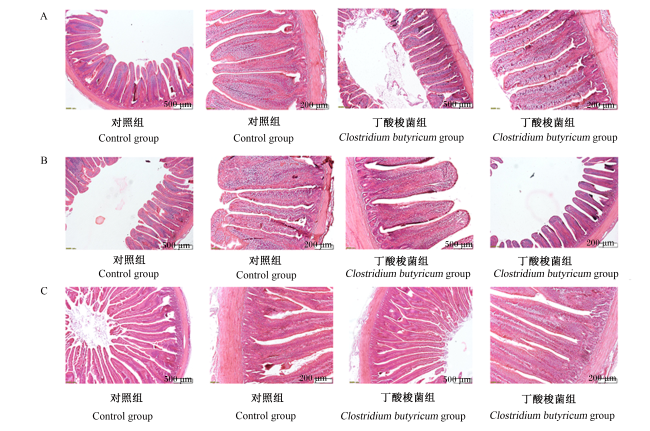
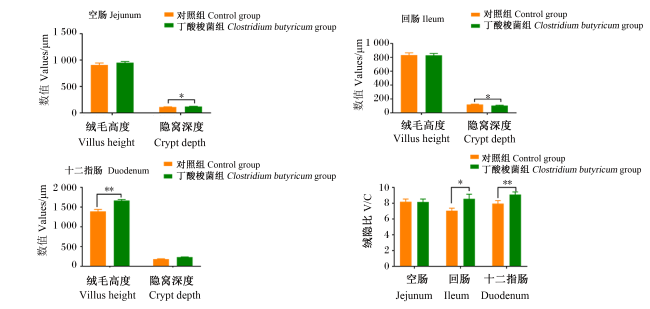
丁酸梭菌对肉鸡肠道形态结构的影响如图1图2所示。无论是对照组还是丁酸梭菌组肉鸡,其肠道各肠段绒毛结构均较为完整,没有观察到明显的脱落或损伤,绒毛密度也没有明显变化。与对照组相比,丁酸梭菌组肉鸡十二指肠绒毛高度极显著提高(P<0.01),回肠隐窝深度显著降低(P<0.05),回肠和十二指肠绒隐比显著或极显著提高(P<0.05或P<0.01)。结果表明,饲粮添加丁酸梭菌能够改善肉鸡肠道形态结构。
图1 丁酸梭菌对肉鸡肠道形态结构的影响

A:空肠 jejunum;B:回肠 ileum;C:十二指肠 duodenum。

Fig.1 Effects of Clostridium butyricum on intestinal morphology and structure of broilers

图2 丁酸梭菌对肉鸡肠道形态结构的影响

*表示差异显著(P<0.05),**表示差异极显著(P<0.01)。下图同。

Fig.2 Effects of Clostridium butyricum on intestinal morphology and structure of broilers

* mean significant difference (P<0.05), and ** mean extremely significant difference (P<0.01). The same as below.

2.3 丁酸梭菌对肉鸡抗氧化能力的影响

丁酸梭菌对肉鸡血清抗氧化指标的影响见表4。与对照组相比,丁酸梭菌组肉鸡血清T-SOD活性显著提高(P<0.05),血清MDA含量极显著降低(P<0.01),其他血清抗氧化指标无显著差异(P>0.05)。丁酸梭菌对肉鸡肠道抗氧化指标的影响见表5。与对照组相比,丁酸梭菌组肉鸡空肠T-AOC和回肠T-SOD活性极显著提高(P<0.01),回肠MDA含量极显著降低(P<0.01)。结果表明,饲粮添加丁酸梭菌能够提高肉鸡抗氧化能力。
表4 丁酸梭菌对肉鸡血清抗氧化指标的影响

Table 4 Effects of Clostridium butyricum on serum antioxidant indices of broilers

项目
Items
对照组
Control group
丁酸梭菌组
Clostridium butyricum group
P
P-value
丙二醛 MDA/(nmol/mL) 8.90±0.28A 7.60±0.25B <0.01
过氧化氢酶 CAT/(U/mL) 80.60±2.20 79.70±2.60 0.79
总超氧化物歧化酶 T-SOD/(U/mL) 2.70±0.17b 2.90±0.16a 0.03
总抗氧化能力 T-AOC/(U/mL) 3.00±0.41 2.90±0.22 0.85
谷胱甘肽过氧化物酶 GSH-Px/(U/mL) 270.40±43.70 314.50±22.10 0.38
表5 丁酸梭菌对肉鸡肠道抗氧化指标的影响

Table 5 Effects of Clostridium butyricum on intestinal antioxidant indices of broilers

项目
Items
对照组
Control group
丁酸梭菌组
Clostridium butyricum group
P
P-value


空肠
Jejunum
丙二醛 MDA/(nmol/mL) 12.80±0.83 13.00±1.09 0.89
过氧化氢酶 CAT/(U/mL) 2.47±0.31 2.96±0.27 0.25
总超氧化物歧化酶 T-SOD/(U/mL) 112.50±3.90 103.00±4.40 0.12
总抗氧化能力 T-AOC/(U/mL) 6.60±0.18B 7.90±0.29A <0.01
谷胱甘肽过氧化物酶 GSH-Px/(U/mL) 915.50±47.40 1 042.00±73.20 0.15


回肠
Ileum
丙二醛 MDA/(nmol/mL) 14.70±0.59A 10.70±0.95B <0.01
过氧化氢酶 CAT/(U/mL) 28.30±1.57 29.93±1.77 0.52
总超氧化物歧化酶 T-SOD/(U/mL) 55.70±3.54B 76.20±2.68A <0.01
总抗氧化能力 T-AOC/(U/mL) 4.15±0.41 3.45±0.31 0.18
谷胱甘肽过氧化物酶 GSH-Px/(U/mL) 587.80±20.60 658.50±27.00 0.05
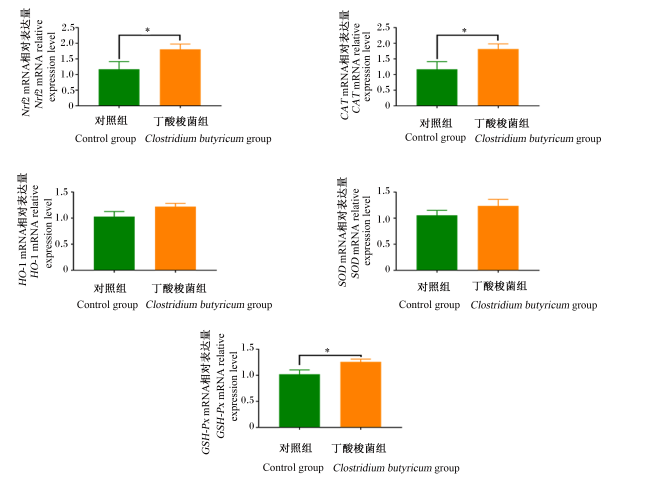
丁酸梭菌对肉鸡空肠抗氧化相关基因表达的影响如图3所示。与对照组相比,丁酸梭菌组肉鸡空肠中核因子E2相关因子2(Nrf2)、CAT和血红素氧合酶-1(HO-1)的mRNA相对表达量显著提高(P<0.05),空肠中超氧化物歧化酶(SOD)和GSH-Px的mRNA相对表达量无显著差异(P>0.05)。
图3 丁酸梭菌对肉鸡空肠抗氧化相关基因表达的影响

Fig.3 Effects of Clostridium butyricum on expression of genes related to jejunal antioxidant of broilers

2.4 丁酸梭菌对肉鸡空肠炎症相关基因表达的影响

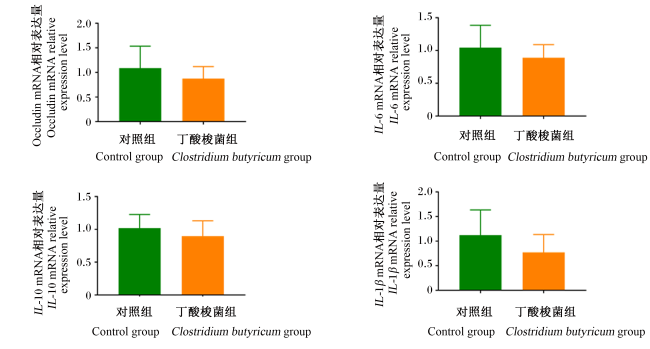
丁酸梭菌对肉鸡空肠炎症相关基因表达的影响如图4所示。与对照组相比,丁酸梭菌组肉鸡空肠中闭合蛋白(occludin)、白细胞介素-6(IL-6)、白细胞介素-10(IL-10)和白细胞介素-1β(IL-1β)的mRNA相对表达量均无显著差异(P>0.05)。结果表明,饲粮添加丁酸梭菌对肉鸡空肠炎症相关基因表达没有显著影响。
图4 丁酸梭菌对肉鸡空肠炎症相关基因表达的影响

Fig.4 Effects of Clostridium butyricum on expression of genes related to jejunal inflammation of broilers

3 讨论

3.1 丁酸梭菌对肉鸡生长性能的影响

丁酸梭菌能够促进益生菌的生成,减少疾病的产生,从而维护宿主健康[8];丁酸梭菌还能够显著改善畜禽的生产和饲喂效率,其在肠黏膜中合成的丁酸能够刺激肠黏膜的增生,提高胃肠的消化能力[9]。本试验结果表明,饲粮添加丁酸梭菌能够提高肉鸡42日龄体重以及22~42日龄和1~42日龄平均日增重,降低22~42日龄料重比。研究表明,饲粮添加250 mg/kg丁酸梭菌对鹅的生长发育、肠道抗氧化能力和肠道微生物组成均有积极影响[10]。饲粮添加1×109 CFU/kg丁酸梭菌能够改善AA肉鸡生长性能和平均日增重[11]。这主要是因为丁酸梭菌能够产生淀粉酶、蛋白酶和纤维素酶等,提高有益菌群在肠道中的定植,进一步促进养分的吸收和利用,从而提高了肉鸡的生长发育速度[12]。也有研究表明,在饲粮中添加丁酸梭菌后,肉鸡的生长发育没有变化[13]。这可能是由于饲粮类型、肉鸡品种和生长阶段以及添加剂量不同等原因造成的。

3.2 丁酸梭菌对肉鸡肠道形态结构的影响

肠道组织形态是评价肠道健康的重要依据,绒毛高度、隐窝深度和绒隐比反映了机体对营养物质消化和吸收的效率,是衡量肠道功能的重要指标。农斯伟等[14]研究发现,饲粮添加丁酸梭菌有提高广西黎村黄鸡十二指肠、空肠和回肠绒毛高度的趋势,显著降低空肠隐窝深度,并显著提高空肠和回肠绒隐比。李莹等[12]研究表明,饲粮添加丁酸梭菌能够显著提高白羽肉鸡十二指肠绒毛高度和绒隐比,显著降低其隐窝深度,并显著提高回肠绒毛高度和绒隐比。本试验结果表明,饲粮添加丁酸梭菌显著提高了肉鸡十二指肠绒毛高以及回肠和十二指肠绒隐比,并显著降低了回肠隐窝深度。这说明丁酸梭菌能够通过促进肉鸡肠道的发育,保持肠道健康。

3.3 丁酸梭菌对肉鸡抗氧化能力的影响

氧化应激是一种普遍存在于生物体中表现为机体活性氧(ROS)升高的现象,能够引起脂质、蛋白质及DNA等的破坏[15-16]。研究发现,饲粮添加丁酸梭菌能够显著提高蛋鸡血清T-AOC,降低血清和回肠MDA含量,并提高血清和回肠T-SOD活性[17]。研究还发现,在仔猪饲粮添加丁酸梭菌能够降低机体的氧化压力,并使其氧化还原达到均衡状态[18]。本试验结果表明,饲粮添加丁酸梭菌显著提高肉鸡血清T-SOD活性、空肠T-AOC和回肠T-SOD活性,显著降低血清和回肠MDA含量。前人的研究结果也证实了这一结论,在獭兔饲粮中添加1.0×10⁵ CFU/g的丁酸梭菌,能够改善肠道形态结构和抗氧化状态[19];饲粮添加5×108 CFU/g丁酸梭菌可以提高肉鸡血清T-SOD活性和T-AOC,降低血清MDA含量[20]

3.4 丁酸梭菌对肉鸡空肠抗氧化和炎症相关基因表达的影响

在氧化应激反应中,Nrf2作为一个关键的转录因子,能够激活下游途径的抗氧化蛋白,包括HO-1和还原型烟酰胺腺嘌呤二核苷酸(磷酸)[NAD(P)H],以及刺激具有抗氧化特性蛋白的产生来控制细胞的氧化应激[21]。肠道黏膜屏障作为免疫系统的第一道防线,对维持肠道免疫系统的稳定十分重要[22]。肠道黏膜屏障受损会使肠道菌群发生迁移,从而引发炎症[23]。occludin作为肠道上皮细胞之间紧密连接的结构蛋白,不仅能够反映肠道的炎症程度,而且在肠道黏膜愈合过程中起着至关重要的作用[24-25]。丁酸梭菌可调控肠黏膜微生态及pH,在维持肠黏膜结构及功能方面发挥着重要功能[9]。本研究发现,饲粮添加丁酸梭菌可以显著提高肉鸡空肠中Nrf2、CATHO-1的mRNA相对表达量,提高肠道的抗氧化能力,这与以前的研究结果[26]一致。研究表明,丁酸梭菌能够激活Nrf2信号通路,提高Nrf2、HO-1、SODCAT的表达量[27]。不过,丁酸梭菌对空肠中SODGSH-Px的mRNA相对表达量无显著影响,这可能是因为Nrf2路径对SODGSH-Px的调控机制较为复杂,或者需要更长时间才能观察到丁酸梭菌的影响。尽管如此,本试验结果仍然突显了丁酸梭菌对肉鸡肠道抗氧化能力的积极效果,且可能是通过激活Nrf2路径,进一步增强Nrf2、CATHO-1的表达实现的。
IL-6和IL-10可以反映机体炎症水平,炎症的发生和IL-6的产生会改变许多器官的功能,并导致整个循环系统许多化学反应的发生,包括转铁蛋白、纤维蛋白和白蛋白水平的降低[28]。在免疫反应的急性阶段,IL-10通过降低促炎症细胞因子水平和促进组织修复来保护宿主免受组织损伤,从而限制促炎症反应[29]。在一些物种中,IL-10已被证明是控制宿主防御期间肠道平衡的最有力的抗炎细胞因子之一[30]。本研究发现,饲粮添加丁酸梭菌对肉鸡空肠occludin、IL-6、IL-10和IL-1β mRNA相对表达量均无显著影响,这可能与生长阶段和添加的丁酸梭菌数量有关。

4 结论

① 饲粮添加丁酸梭菌能够提高肉鸡生长性能,特别是对生长后期提高作用更加明显。
② 饲粮添加丁酸梭菌可以改善肉鸡肠道形态结构。
③ 饲粮添加丁酸梭菌可以提高血清T-SOD活性,降低血清MDA含量,并通过Nrf2信号通路提高肠道抗氧化能力。
[1]
李彬, 苟清碧, 古长松, 等. 复合植物精油对麻黄肉鸡生长性能、肠道发育以及肉品质的影响[J]. 中国畜牧杂志, 2021, 57(11):199-204,208.

LI B, GOU Q B, GU C S, et al. Effects of plant essential oil on growth performance,intestinal development and meat quality of Mahuang broilers[J]. Chinese Journal of Animal Science, 201, 57(11):199-204,208. (in Chinese)

[2]
顾芳, 胡平, 蔡德敏, 等. 畜禽健康养殖中抗生素应用及其替代品研究进展[J]. 动物营养学报, 2023, 35(10):6247-6256.

DOI

GU F, HU P, CAI D M, et al. Advances in application of antibiotics and their substitutes in healthy animal husbandry[J]. Chinese Journal of Animal Nutrition, 2023, 35(10):6247-6256. (in Chinese)

DOI

[3]
FU J, WANG T H, XIAO X, et al. Clostricdium butyricum ZJU-F1 benefits the intestinal barrier function and immune response associated with its modulation of gut microbiota in weaned piglets[J]. Cells, 2021, 10(3):527.

DOI

[4]
YE X X, LI K Y, LI Y F, et al. The effects of Clostridium butyricum on Ira rabbit growth performance,cecal microbiota and plasma metabolome[J]. Frontiers in Microbiology, 2022, 13:974337.

DOI

[5]
付子贤, 肖英平, 杨彩梅, 等. 育雏期饲喂丁酸梭菌对育肥期番鸭生长性能、屠宰性能、肉品质和肌肉中氨基酸含量的影响[J]. 动物营养学报, 2023, 35(11):7174-7182.

DOI

FU Z X, XIAO Y P, YANG C M, et al. Effects of feeding Clostridium butyricum in brooding period on growth performance,slaughter performance,meat quality and muscle amino acid contents of muscovy ducks in fattening period[J]. Chinese Journal of Animal Nutrition, 2023, 35(11):7174-7182. (in Chinese)

[6]
周奕含. 丁酸梭菌对肉仔鸡生长性能、免疫机能及血液生理生化指标的影响[J]. 饲料研究, 2021, 44(7):55-59.

ZHOU Y H. Effect of Clostridium butyricum on growth performance,immune function and serum physiological and biochemical indexes of broilers[J]. Feed Research, 2021, 44(7):55-59. (in Chinese)

[7]
ZHAO X, DING X, YANG Z B, et al. Effects of Clostridium butyricum on breast muscle lipid metabolism of broilers[J]. Italian Journal of Animal Science, 2018, 17(4):1010-1020.

DOI

[8]
黄潇航, 张龙, 胡奇林, 等. 丁酸梭菌作为饲料添加剂在动物养殖与疾病防控中的应用进展[J]. 中国饲料, 2020(15):12-17.

HUANG X H, ZHANG L, HU Q L, et al. Application progress of Clostridium butyricum as feed additive in disease control of animal breeding[J]. China Feed, 2020(15):12-17. (in Chinese)

[9]
王宗伟, 付建中, 李洪涛, 等. 丁酸梭菌对肠道屏障的影响机制及其在畜禽养殖中应用的研究进展[J]. 动物营养学报, 2022, 34(6):3519-3528.

DOI

WANG Z W, FU J Z, LI H T, et al. Research progress on mechanism of Clostridium butyricum affecting intestinal barrier and its application in livestock and poultry breeding[J]. Chinese Journal of Animal Nutrition, 2022, 34(6):3519-3528. (in Chinese)

[10]
YU J, DONG B, ZHAO M M, et al. Dietary Clostridium butyricum and Bacillus subtilis promote goose growth by improving intestinal structure and function,antioxidative capacity and microbial composition[J]. Animals, 2021, 11(11):3174.

DOI

[11]
ZHANG B K, YANG X, GUO Y M, et al. Effects of dietary lipids and Clostridium butyricum on the performance and the digestive tract of broiler chickens[J]. Archives of Animal Nutrition, 2011, 65(4):329-339.

DOI

[12]
李莹, 张庆华, 钟丽娟, 等. 丁酸梭菌对白羽肉鸡生长性能、免疫功能和肠道健康的影响[J]. 动物营养学报, 2023, 35(8):5023-5035.

DOI

LI Y, ZHANG Q H, ZHONG L J, et al. Effects of Clostridium butyricum on growth performance,immune function and intestine health of white-feathered broilers[J]. Chinese Journal of Animal Nutrition, 2023, 35(8):5023-5035. (in Chinese)

[13]
HAN J F, WANG Y W, SONG D, et al. Effects of Clostridium butyricum and Lactobacillus plantarum on growth performance,immune function and volatile fatty acid level of caecal digesta in broilers[J]. Food and Agricultural Immunology, 2018, 29(1):797-807.

DOI

[14]
农斯伟, 沈水宝, 韦晓芳, 等. 丁酸梭菌和枯草芽孢杆菌对广西黎村黄鸡生长性能、肠道形态及盲肠微生物区系的影响[J]. 饲料工业, 2021, 42(3):19-24.

NONG S W, SHEN S B, WEI X F, et al. Effects of Clostridium butyricum and Bacillus subtilis on the growth performance,intestinal morphology and cecal microflora of Guangxi Licun yellow chickens[J]. Feed Industry, 2021, 42(3):19-24. (in Chinese)

[15]
SCHIEBER M, CHANDEL N S. ROS function in redox signaling and oxidative stress[J]. Current Biology, 2014, 24(10):R453-R462.

DOI

[16]
张慧, 李婷婷, 张铭宸, 等. 基于氧化应激探讨热量限制及其模拟物改善心血管疾病的研究进展[J]. 生命科学, 2023, 35(10):1267-1278.

ZHANG H, LI T T, ZHANG M C, et al. Research progress on roles of caloric restriction and its mimics in improving cardiovascular diseases based on oxidative stress[J]. Chinese Bulletin of Life Sciences, 2023, 35(10):1267-1278. (in Chinese)

[17]
ZHAN H Q, DONG X Y, LI L L, et al. Effects of dietary supplementation with Clostridium butyricum on laying performance,egg quality,serum parameters,and cecal microflora of laying hens in the late phase of production[J]. Poultry Science, 2019, 98(2):896-903.

DOI

[18]
杨晓伟. 丁酸梭菌对仔猪生长性能、肠道菌群、抗氧化功能和免疫功能的影响[J]. 饲料研究, 2020, 43(5):44-48.

YANG X W. Effect of Clostridium butyricum on growth performance,intestinal flora,antioxidant function and immune function of piglets[J]. Feed Research, 2019, 43(5):44-48. (in Chinese)

[19]
LIU L, ZENG D, YANG M Y, et al. Probiotic Clostridium butyricum improves the growth performance,immune function,and gut microbiota of weaning rex rabbits[J]. Probiotics and Antimicrobial Proteins, 2019, 11(4):1278-1292.

DOI

[20]
LI Z, LONG L B, JIN X, et al. Effects of Clostridium butyricum on growth performance, meat quality, and intestinal health of broilers[J]. Frontiers in Veterinary Science, 2023, 10:1107798.

DOI

[21]
ZHANG Z H, QU J, ZHENG C, et al. Nrf2 antioxidant pathway suppresses numb-mediated epithelial-mesenchymal transition during pulmonary fibrosis[J]. Cell Death & Disease, 2018, 9(2):83.

[22]
王涛, 田欣蕾, 张迪, 等. 益生菌调节肠道黏膜免疫研究进展[J]. 中国兽医学报, 2022, 42(12):2578-2584.

WANG T, TIAN X L, ZHANG D, et al. Research progress in probiotic bacteria modulating intestinal mucosal immunity[J]. Chinese Journal of Veterinary Medicine, 2019, 42(12):2578-2584. (in Chinese)

[23]
RAMOS G P, PAPADAKIS K A. Mechanisms of disease:inflammatory bowel diseases[J]. Mayo Clinic Proceedings, 2019, 94(1):155-165.

DOI

[24]
CHELAKKOT C, GHIM J, RYU S H. Mechanisms regulating intestinal barrier integrity and its pathological implications[J]. Experimental & Molecular Medicine, 2018, 50(8):1-9.

[25]
SLIFER Z M, BLIKSLAGER A T. The integral role of tight junction proteins in the repair of injured intestinal epithelium[J]. International Journal of Molecular Sciences, 2020, 21(3):972.

DOI

[26]
DOU C X, SHANG Z Y, QIAO J Y, et al. Clostridium butyricum protects IPEC-J2 cells from ETEC K88-induced oxidative damage by activating the Nrf2/ARE signaling pathway[J]. Oxidative Medicine and Cellular Longevity, 2021, 2021:4464002.

[27]
ZUO S, ZOU W, WU R M, et al. Icariin alleviates IL-1β-induced matrix degradation by activating the Nrf2/ARE pathway in human chondrocytes[J]. Drug Design,Development and Therapy, 2019, 13:3949-3961.

DOI

[28]
潘建科, 罗斌, 郭达, 等. 龙鳖胶囊对膝骨关节炎大鼠IL-1β、IL-6、IL-10水平的影响[J]. 中华中医药杂志, 2015, 30(5):1675-1679.

PAN J K, LUO B, GUO D, et al. Effects of Longbie capsule on serum IL-1β,IL-6 and IL-10 of rats with knee osteoarthritis[J]. Chinese Journal of Traditional Chinese Medicine, 2015, 30(5):1675-1679. (in Chinese)

[29]
鲁叶弘, 付强, 曾定尹. 血管外膜炎症大鼠核转录因子NF-κB、白介素-6、白介素-10的表达及通心络的干预研究[J]. 中国医药导报, 2011, 8(16):27-28.

LU Y H, FU Q, ZENG D Y. Vascular adventitia inflammation rat nuclear transcription factors NF-κB,interleukin-6,interleuldn-10 expression and Tongxinluo’s intervention study[J]. China Medical Herald, 2011, 8(16):27-28. (in Chinese)

[30]
HAYASHI A, SATO T, KAMADA N, et al. A single strain of Clostridium butyricum induces intestinal IL-10-producing macrophages to suppress acute experimental colitis in mice[J]. Cell Host & Microbe, 2013, 13(6):711-722.

Outlines

/