RESEARCH PAPER

Effects of Stevia Chlorogenic Acid on Performance, Egg Quality, Plasma Biochemical Indexes and Intestinal Morphology of Laying Hens during Late Laying Period

  • ZHANG Shan , 1 ,
  • XIAO Yunqi 1 ,
  • CHEN Ao 2 ,
  • SHI Shourong , 1, *
Expand
  • 1 Jiangsu Institute of Poultry Science, Yangzhou 225125, China
  • 2 Jiangxi Agricultural University, Nanchang 330045, China
* professor, E-mail:

Received date: 2023-09-11

  Online published: 2024-02-01

Abstract

The aim of this experiment was to study the effects of Stevia chlorogenic acid on performance, egg quality, plasma biochemical indexes and intestinal morphology of laying hens during late laying period. One hundred and ninety-two 63-week-old Hailan brown laying hens with similar body weight and laying rate were selected and randomly divided into 2 groups with 8 replicates in each group and 12 hens in each replicate. Laying hens in the control group were fed a basal diet, while the others in the Stevia chlorogenic acid group were fed the basal diet supplemented with 100 g/t Stevia chlorogenic acid. The adaptation period was 1 week, and the formal period was 12 weeks. The results showed as follows: 1) compared with the control group, the laying rate, egg mass and daily feed intake of laying hens during late laying period of Stevia chlorogenic acid group were significantly increased (P<0.05), and the feed to egg ratio and broken and abnormal egg rate were significantly decreased (P<0.05). 2) Compared with the control group, the yolk color of laying hens during late laying period of Stevia chlorogenic acid group was significantly increased (P<0.05), and the other egg quality indexes were no significant difference (P>0.05). 3) Compared with the control group, the plasma uric acid content of laying hens during late laying period of Stevia chlorogenic acid group was significantly increased (P<0.05), the plasma alkaline phosphatase activity showed an increased trend (P=0.099), and the other plasma biochemical indexes were no significant difference (P>0.05). 4) Compared with the control group, the ileal villus height of Stevia chlorogenic acid group was significantly increased (P<0.05), and the duodenal and jejunal villus height, crypt depth and villus height/crypt depth were no significant difference (P>0.05). In conclusion, dietary 100 g/t Stevia chlorogenic acid can effectively improve the performance, yolk color and ileal morphology of laying hens during late laying period under the conditions of this experiment.

Cite this article

ZHANG Shan , XIAO Yunqi , CHEN Ao , SHI Shourong . Effects of Stevia Chlorogenic Acid on Performance, Egg Quality, Plasma Biochemical Indexes and Intestinal Morphology of Laying Hens during Late Laying Period[J]. Chinese Journal of Animal Nutrition, 2024 , 36(2) : 946 -955 . DOI: 10.12418/CJAN2024.086

蛋鸡的饲养周期延长,从传统意义上的72周生产周期延长至100周,这导致产蛋后期持续的时间更久[1]。然而,产蛋后期蛋鸡生理功能衰退,主要问题包括生殖系统衰退、肠道功能紊乱、抗氧化能力和免疫力降低等,从而导致蛋鸡的产蛋性能下降、蛋壳逐渐变薄、破损率逐渐增加等[2-3]。因此,提高产蛋后期蛋鸡的产蛋率、改善蛋品质等是蛋鸡养殖业的研究热点,也是科学难题。绿原酸类化合物在中药材和食物中分布广泛,是植物体在有氧呼吸过程中经莽草酸途径产生的一种酚酸类化合物,具有抗氧化、免疫调节、抗菌和抗病毒等作用,在医药、化工和食品等领域已被广泛应用[4-7]。绿原酸类化合物包括绿原酸、隐绿原酸、新绿原酸、异绿原酸A、异绿原酸B、异绿原酸C等[8]。近年来,绿原酸类化合物作为饲料添加剂已应用于断奶仔猪[9-12]、鱼[13]、鼠[14-15]、肉鸡[16-19]、产蛋初期蛋鸡[20]等,可有效改善畜禽生产性能、提高免疫力。
大多研究中试验材料所用的绿原酸类化合物来自杜仲[16]、金银花[21]等植物,或直接使用纯品绿原酸单体[11]。甜叶菊是多年生草本植物,在我国种植范围广,主要用于生产甜味剂——甜菊糖苷,是世界第三大甜味来源[22-23]。而甜叶菊绿原酸类是甜叶菊提取甜菊糖苷之后的副产物,可同富含绿原酸类物质的杜仲、金银花、绿咖啡豆等相媲美,可大幅填补饲用绿原酸市场空白,实现甜叶菊资源的综合利用[22]。因此,本试验旨在研究甜叶菊绿原酸对产蛋后期蛋鸡生产性能、蛋品质、血浆生化指标和肠道组织形态的影响,为甜叶菊绿原酸在产蛋后期蛋鸡中应用提供参考依据。

1 材料与方法

1.1 试验材料

试验材料为甜叶菊绿原酸(含绿原酸13.7%,含绿原酸及其类似物43.3%),棕褐色粉末状。

1.2 试验设计与饲粮

选取192只体重、产蛋率均相近的63周龄海兰褐蛋鸡,随机分为2个组,每组8个重复,每个重复12只鸡。对照组饲喂基础饲粮,甜叶菊绿原酸组饲喂在基础饲粮中添加100 g/t甜叶菊绿原酸(以绿原酸计为13.7 g/t,以绿原酸及其类似物计为43.3 g/t)的试验饲粮。预试期1周,正试期12周。基础饲粮参考NRC(1994)、《鸡饲养标准》(NY/T 33—2004)和《海兰褐蛋鸡饲养手册》,选用玉米、豆粕、麦麸等配制而成。基础饲粮组成及营养水平见表1,其中总能使用全自动氧弹量热仪(Parr公司,美国)测定,粗蛋白质(GB/T 6432—2018)、干物质(GB/T 6435—2014)、总磷(GB/T 6437—2002)含量分别参考相应国标法测定。
表1 基础饲粮组成及营养水平(风干基础)

Table 1 Composition and nutrient levels of the basal diet (air-dry basis)%

项目 Items 含量 Content
原料 Ingredients
玉米 Cron 57.48
豆粕 Soybean meal (43%) 23.00
麦麸 Wheat bran 8.00
石粉 Limestone 9.50
磷酸氢钙 CaHPO4 1.30
蛋氨酸 Met (99%) 0.10
氯化钠 NaCl 0.30
氯化胆碱 Choline chloride (70%) 0.09
多维 Multi-vitamin1) 0.03
多矿 Multi-mineral2) 0.20
合计 Total 100.00
营养水平 Nutrient levels3)
总能 GE/(MJ/kg) 13.96
干物质 DM 88.37
粗蛋白质 CP 15.58
钙 Ca 3.88
总磷 TP 0.56
赖氨酸 Lys 0.73
蛋氨酸 Met 0.34

1)多维为每千克饲粮提供 Multi-vitamin provided per kilogram of the diet:VA 13 500 IU,VB1 3 mg,VB2 7.5 mg,VB6 6 mg,VB12 0.024 mg,VD3 3 900 IU,VE 30 IU,VK3 4.8 mg,叶酸 folic acid 1.5 mg,生物素 biotin 0.18 mg,烟酸 niacin 45 mg,泛酸钙 calcium pantothenate 18 mg。

2)多矿为每千克饲粮提供 Multi-mineral provided per kilogram of the diet:Fe 144 mg,Mn 120 mg,Zn 144 mg,Cu 20 mg,Co 1 mg,I 0.96 mg,Se 0.7 mg。

3)总能、粗蛋白质、干物质、总磷为测定值,其余营养水平为计算值。GE, CP, DM and TP were measured values, while the other nutrient levels were calculated values.

1.3 饲养管理

本试验在江苏省家禽科学研究所仪征试验基地开展。试验采用阶梯式单笼饲养,采用乳头式自动饮水器饮水,每天饲喂2次(08:00、15:00),试验期间鸡自由饮水和采食,每天光照16 h。试验期内每天观察并记录鸡群健康状况及死淘鸡数,按江苏省家禽科学研究所仪征试验基地的常规程序进行饲养管理。

1.4 测定指标和方法

1.4.1 生产性能

试验期内每天准确记录产蛋数、蛋重和破畸蛋数,每周称1次剩余料重,以重复为单位计算产蛋率、平均蛋重、产蛋量、平均日采食量、料蛋比和破畸率。计算公式如下:
产蛋率(%)=100×总产蛋数/(鸡只数×试验天数);
平均蛋重(g)=总蛋重/总产蛋数;
产蛋量(g/d)=平均蛋重×产蛋率;
平均日采食量(g)=总耗料量/(鸡只数×试验天数);
料蛋比=总耗料量/总蛋重;
破畸率(%)=100×破畸蛋数/总蛋数。

1.4.2 蛋品质

试验结束后,每个重复随机选择3枚鸡蛋用于蛋品质检测。用蛋品质测定仪(MINOLTA公司,日本)检测蛋黄颜色、蛋白高度和哈氏单位;用电子数显卡尺(广陆数字测控股份有限公司)测量鸡蛋纵径和横径,用于计算蛋形指数;用蛋壳强度测定仪(ORKA公司,以色列)检测蛋壳强度;用蛋壳厚度测定仪(ORKA公司,以色列)检测蛋壳厚度;称量蛋重、蛋黄重、蛋壳重并记录,用于计算蛋黄比重、蛋白比重和蛋壳比重。相关指标计算公式如下:
蛋形指数=纵径/横径;
蛋黄比重(%)=100×蛋黄重/蛋重;
蛋白比重(%)=100×(蛋重-蛋黄重-蛋壳重)/蛋重;
蛋壳比重(%)=100×蛋壳重/蛋重。

1.4.3 血浆生化指标

试验结束后,每个重复随机选择1只试验鸡进行采血,翅静脉采血并置于乙二胺四乙酸(EDTA)抗凝管中,3 000 r/min离心10 min,收集血浆用于检测血浆生化指标:总蛋白(TP)、白蛋白(ALB)、葡萄糖(GLU)、尿酸(UA)、总胆固醇(TC)、甘油三酯(TG)、高密度脂蛋白(HDL)、低密度脂蛋白(LDL)活性和碱性磷酸酶(ALP)活性,使用全自动生化分析仪(UniCel DxC 800 Synchron,Beckman Coulter,美国)进行测定,试剂盒采购于美康生物科技股份有限公司。

1.4.4 肠道形态结构

将采血后的试验鸡屠宰并迅速剪取十二指肠、空肠、回肠肠段各1 cm左右,用10%甲醛溶液固定保存,用于制作石蜡切片,然后用苏木精-伊红染色,在荧光显微镜(DM4000B,Leica Microsystems,Wetzlar,德国)下测量绒毛高度和隐窝深度,每个样品各测10根绒毛高度及对应的隐窝深度,测量后统计其平均值,并发计算绒毛高度/隐窝深度(villous height/crypt depth,V/C)。

1.5 数据统计分析

试验数据用Excel 2013进行整理,并利用SPSS 20.0软件进行统计分析。采用t检验分析各指标间差异显著性,结果均用平均值±标准误(mean±SE)表示,P<0.05表示差异显著,0.05≤P<0.10表示有显著趋势。

2 结果

2.1 甜叶菊绿原酸对产蛋后期蛋鸡生产性能的影响

表2可知,与对照组相比,甜叶菊绿原酸组产蛋后期蛋鸡的产蛋率、产蛋量和平均日采食量显著增加(P<0.05),料蛋比和破畸率显著降低(P<0.05)。
表2 甜叶菊绿原酸对产蛋后期蛋鸡生产性能的影响

Table 2 Effects of Stevia chlorogenic acid on performance of laying hens during late laying period

项目
Items
对照组
Control group
甜叶菊绿原酸组
Stevia chlorogenic acid group
P
P-value
产蛋率 Laying rate/% 87.93±0.98b 92.53±0.95a 0.004
平均蛋重 Average egg weight/g 63.21±0.30 62.47±0.35 0.142
产蛋量 Egg mass/(g/d) 55.17±0.82b 58.61±0.29a 0.003
平均日采食量 Average daily feed intake/g 129.13±0.47b 130.61±0.31a 0.031
料蛋比 Feed/egg 2.34±0.03a 2.22±0.01b 0.005
破畸率 Broken and abnormal egg rate/% 2.31±0.71a 0.55±0.08b 0.044

同行数据肩标不同小写字母表示差异显著(P<0.05),无字母表示差异不显著(P>0.05)。下表同。

In the same row, values with different small letter superscripts mean significant difference (P<0.05), while with no letter superscripts mean no significant difference (P>0.05). The same as below.

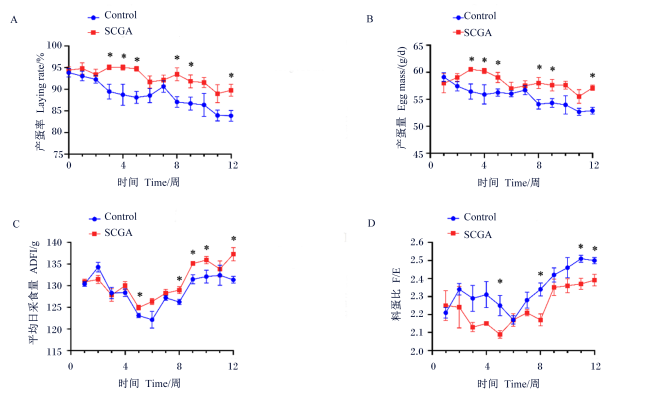
图1可知,通过监测每周生产性能的变化,发现饲粮中添加100 g/t甜菊叶绿原酸可使产蛋后期蛋鸡的产蛋率下降缓慢且维持在较高水平,而对照组蛋鸡随着时间变化产蛋率下降相对较快。
图1 甜叶菊绿原酸对产蛋后期蛋鸡每周生产性能的影响

Control:对照组;SCGA:甜叶菊绿原酸组。*表示与对照组相比差异显著(P<0.05)。

Fig.1 Effects of Stevia chlorogenic acid on weekly performance of laying hens during late laying period

Control: control group; SCGA: Stevia chlorogenic acid group. * indicated significant difference compared with the control group (P<0.05).

2.2 甜叶菊绿原酸对产蛋后期蛋鸡蛋品质的影响

表3可知,与对照组相比,甜叶菊绿原酸组产蛋后期蛋鸡的蛋黄颜色显著增加(P<0.05),其他蛋品质指标无显著差异(P>0.05)。
表3 甜叶菊绿原酸对产蛋后期蛋鸡蛋品质的影响

Table 3 Effects of Stevia chlorogenic acid on egg quality of laying hens during late laying period

项目
Items
对照组
Control group
甜叶菊绿原酸组
Stevia chlorogenic acid group
P
P-value
蛋黄颜色 Yolk color 6.33±0.29b 7.46±0.18a 0.005
蛋形指数 Egg shape index 1.30±0.01 1.30±0.01 0.803
蛋壳强度 Eggshell strength/(kg/cm2) 3.06±0.17 3.26±0.11 0.334
蛋黄比重 Yolk percentage/% 27.15±0.44 27.19±0.15 0.940
蛋白比重 Albumen percentage/% 63.67±0.48 63.14±0.31 0.387
蛋壳比重 Eggshell percentage/% 9.18±0.16 9.21±0.25 0.920
蛋壳厚度 Eggshell thickness/mm 0.34±0.01 0.35±0.01 0.499
蛋白高度 Albumen height/mm 6.51±0.14 6.14±0.25 0.220
哈氏单位 Haugh unit 72.92±1.50 70.11±2.20 0.310

2.3 甜叶菊绿原酸对产蛋后期蛋鸡血浆生化指标的影响

表4可知,与对照组相比,甜叶菊绿原酸组产蛋后期蛋鸡血浆UA含量显著增加(P<0.05),血浆ALP活性有增加的趋势(P=0.099),其他血浆生化指标(TP、ALB、GLU、TC、TG、HDL、LDL含量)无显著差异(P>0.05)。
表4 甜叶菊绿原酸对产蛋后期蛋鸡血浆生化指标的影响

Table 4 Effects of Stevia chlorogenic acid on plasma biochemical indexes of laying hens during late laying period

项目
Items
对照组
Control group
甜叶菊绿原酸组
Stevia chlorogenic acid group
P
P-value
总蛋白 TP/(g/L) 54.78±1.17 55.89±1.24 0.524
白蛋白 ALB/(g/L) 20.48±0.36 19.95±0.37 0.324
葡萄糖 GLU/(mmol/L) 11.74±0.27 11.67±0.59 0.910
尿酸 UA/(μmol/L) 271.57±7.92b 341.13±22.08a 0.016
总胆固醇 TC/(mmol/L) 2.76±0.28 3.20±0.21 0.228
甘油三酯 TG/(mmol/L) 13.76±1.81 16.39±1.66 0.303
高密度脂蛋白 HDL/(mmol/L) 0.94±0.07 1.01±0.01 0.338
低密度脂蛋白 LDL/(mmol/L) 1.62±0.20 1.91±0.14 0.258
碱性磷酸酶 ALP/(U/L) 240.43±42.88 340.38±36.86 0.099

2.4 甜叶菊绿原酸对产蛋后期蛋鸡肠道形态结构的影响

表5可知,与对照组相比,甜叶菊绿原酸组产蛋后期蛋鸡回肠绒毛高度显著增加(P<0.05),十二指肠、空肠绒毛高度、隐窝深度和V/C无显著差异(P>0.05)。
表5 甜叶菊绿原酸对产蛋后期蛋鸡肠道形态结构的影响

Table 5 Effects of Stevia chlorogenic acid on intestinal morphology of laying hens during late laying period

项目
Items
对照组
Control group
甜叶菊绿原酸组
Stevia chlorogenic acid group
P
P-value
十二指肠 Duodenum
绒毛高度 Villus height/μm 1774.79±12.04 1712.89±63.13 0.365
隐窝深度 Crypt depth/μm 257.04±25.21 248.79±14.49 0.774
绒毛高度/隐窝深度 V/C 7.35±0.70 7.04±0.44 0.702
空肠 Jejunum
绒毛高度 Villus height/μm 1421.76±164.73 1327.00±76.31 0.613
隐窝深度 Crypt depth/μm 236.63±37.51 210.69±25.04 0.574
绒毛高度/隐窝深度 V/C 6.50±0.64 6.72±0.63 0.808
回肠 Ileum
绒毛高度 Villus height/μm 434.75±41.03b 602.96±46.99a 0.020
隐窝深度 Crypt depth/μm 110.97±16.30 113.48±7.32 0.891
绒毛高度/隐窝深度 V/C 4.74±0.39 5.38±0.41 0.279

3 讨论

3.1 甜叶菊绿原酸对产蛋后期蛋鸡生产性能的影响

蛋鸡的生产性能受诸多因素影响,例如遗传、健康状况、日龄、饲养管理、营养水平等[24]。产蛋高峰期结束后,蛋鸡的产蛋率、蛋品质等会随着蛋鸡日龄的增加而降低[25]。任永生[26]研究发现,饲粮中添加50~200 g/t杜仲叶提取物(有效成分绿原酸含量≥5%;以绿原酸计为2.5~10.0 g/t)对产蛋后期(62~74周龄)海兰褐蛋鸡的产蛋率、采食量、料蛋比无显著影响,但对平均蛋重具有显著影响。Xie等[21]研究发现,饲粮中添加0.1%金银花提取物(有效成分绿原酸含量为2.2%;以绿原酸计为22 g/t)可显著降低52~64周龄罗曼粉壳蛋鸡的畸形蛋率。康克浪等[27]研究发现,饲粮中添加6~18 g/kg杜仲叶粉(有效成分绿原酸含量≥3.5%;以绿原酸计为210~630 g/t)可不同程度改善42~53周龄罗曼蛋鸡生产性能,对于产蛋率下降有明显的减缓作用。不同植物来源的绿原酸对产蛋后期蛋鸡的影响不尽相同,可能与有效成分绿原酸的含量有关,但总体随着以绿原酸计的添加量增加,其改善效果更好。本试验中,饲粮中添加100 g/t甜菊叶绿原酸(以绿原酸计为13.7 g/t,以绿原酸及其类似物计为43.3 g/t)即可改善产蛋后期蛋鸡的产蛋率、产蛋量、平均日采食量,并降低产蛋后期蛋鸡的料蛋比和破畸率。本试验中以绿原酸计的添加量并不高,但甜叶菊绿原酸可缓解产蛋后期蛋鸡产蛋率快速下降问题,使后期产蛋率下降缓慢且维持在较高水平。究其原因,可能是甜叶菊绿原酸类物质含量丰富,除绿原酸外还含有较多绿原酸类似物,如异绿原酸,由于异绿原酸的生物活性更高,甜叶菊绿原酸可能具有更强的生物功效[28-30]

3.2 甜叶菊绿原酸对产蛋后期蛋鸡蛋品质的影响

蛋品质是商品蛋鸡生产效益评价的一项重要指标,伴随蛋鸡周龄的增长,蛋品质随产蛋率的下降而下降。蛋黄颜色是消费者对鸡蛋品质的直观感受,大部分人更偏好于蛋黄颜色较深的鸡蛋,这也就决定了市场的需求[31-32]。在本试验中,饲粮中添加100 g/t甜菊叶绿原酸可显著增加产蛋后期蛋鸡的蛋黄颜色,与康克浪等[27]研究结果一致,可能是通过抑制蛋黄中类胡萝卜素的氧化,从而增加蛋黄颜色[21]。任永生[26]、蔡国鹤[33]研究表明,饲粮中添加杜仲叶绿原酸对海兰褐蛋鸡鸡蛋的蛋形指数、蛋壳强度、哈氏单位、蛋壳厚度等蛋品质无显著影响。Xie等[21]、张瑞仙[34]研究表明,饲粮中添加金银花绿原酸对罗曼粉壳蛋鸡鸡蛋的哈氏单位、蛋壳强度、蛋壳厚度无显著影响。本试验结果表明,饲粮中添加100 g/t甜菊叶绿原酸对鸡蛋的蛋形指数、哈氏单位、蛋壳强度、蛋壳厚度无不良影响,与上述研究结果一致。但也有文献报道,饲粮中添加1%杜仲素(有效成分绿原酸含量≥5%;以绿原酸计为500 g/t)可以增加25~33周龄芦花鸡鸡蛋的蛋黄比例和哈氏单位[35]。究其原因,可能是植物提取物的绿原酸来源不同、添加剂量不同,以及蛋鸡的品种、年龄不完全相同,所以对蛋品质的影响也不完全一致。

3.3 甜叶菊绿原酸对产蛋后期蛋鸡血浆生化指标的影响

血浆生化指标也是疾病诊断和检测的指标之一,其变化能反映机体的健康情况[36]。TP、ALB含量主要反映蛋白质合成利用情况,在正常范围内,TP含量升高说明动物机体的蛋白质代谢旺盛,营养状况良好[37]。GLU可以反映动物机体的能量代谢情况,为组织和细胞的生理过程提供能量[38]。TC、TG、HDL和LDL主要反映机体的脂代谢情况,ALP是体内消化代谢的关键酶,提高血液中ALP活性有助于提高动物的消化吸收[9,39]。本试验条件下,饲粮中添加100 g/t甜叶菊绿原酸对产蛋后期蛋鸡的血浆TP、ALB、GLU、TC、TG、HDL和LDL含量均无显著影响,但有增加血浆ALP活性的趋势,说明甜叶菊绿原酸有利于产蛋后期蛋鸡的消化吸收。
UA是蛋白质以及核酸的代谢产物,在家禽体内含量较高;此外,它也是一种小分子抗氧化剂,在鸡的血浆和组织中广泛存在,能够有效清除血浆中约67%的自由基,在机体内的抗氧化系统中占有重要地位,同时UA的免疫促进功能可以增强机体抵御疾病的能力,其在鸡体内含量在100~900 μmol/L变化[40-42]。本试验条件下,饲粮中添加100 g/t甜菊叶绿原酸增加了产蛋后期蛋鸡血浆UA含量,且增加后的UA含量在鸡的UA生理浓度范围内,有利于清除血浆中的自由基含量。健康鸡的血浆中与大分子蛋白质结合的UA约有107 μmol/L,其余UA以游离型UA存在[43]。当血浆UA含量升高时,结合UA含量不变,游离UA含量升高[43],这也就解释了本试验条件下血浆UA含量升高,而未影响血浆TP含量的变化。因此,在生理浓度范围内,蛋鸡体内UA含量适当升高可能有助于蛋鸡的健康生长。

3.4 甜叶菊绿原酸对产蛋后期蛋鸡肠道形态结构的影响

肠道是动物体内消化和吸收营养物质的重要功能器官,其结构和功能完整与机体健康生长密切相关[44]。肠道绒毛高度的增加有助于增强消化系统的消化吸收能力,进而有助于动物的健康生长[45]。V/C增加能够综合反映小肠的功能状态,说明肠黏膜的结构完整性良好,有利于增强消化吸收能力[46]。植物源绿原酸对蛋鸡肠道形态结构影响的研究较少。有文献报道,饲粮中添加300 mg/kg杜仲提取物(有效成分绿原酸含量≥5.0%;以绿原酸计为15 g/t)可以提高黄羽肉鸡1~21日龄、22~50日龄2个阶段的十二指肠的绒毛高度[19]。徐明涛等[12]研究表明,饲粮中添加250 mg/kg杜仲叶提取物(有效成分绿原酸含量≥5.0%;以绿原酸计为12.5 g/t)能增加断奶仔猪十二指肠、空肠和回肠的绒毛高度。本试验与上述研究对肠道组织形态的结果类似,饲粮中添加100 g/t甜叶菊绿原酸可以显著提高产蛋后期蛋鸡的回肠绒毛高度,说明添加甜叶菊绿原酸在一定程度上改善了回肠组织形态,有助于增加产蛋后期蛋鸡的消化吸收能力。结合平均日采食量增加的结果,进一步说明甜叶菊绿原酸通过增加产蛋后期蛋鸡的消化吸收促进营养物质摄入,从而增加产蛋率。

4 结论

本试验条件下,饲粮中添加100 g/t甜叶菊绿原酸能有效改善产蛋后期蛋鸡的生产性能,增加蛋黄颜色,改善回肠组织形态。
[1]
BAIN M M, NYS Y, DUNN I C. Increasing persistency in lay and stabilising egg quality in longer laying cycles.What are the challenges?[J]. British Poultry Science, 2016, 57(3):330-338.

DOI

[2]
车凤霞. 产蛋后期蛋鸡的生理特点及饲养管理[J]. 养殖技术顾问, 2014(8):13.

CHE F X. Physiological characteristics and feeding management of laying hens in the late laying period[J]. Technical Advisor for Animal Husbandry, 2016(8):13. (in Chinese)

[3]
刘兵. 日粮硒和DHA改善产蛋后期蛋鸡肉蛋品质的效果和机制研究[D].博士学位论文. 无锡: 江南大学, 2021.

LIU B. Effects and mechanism of dietary selenium and DHA on improving the quality of meat and egg from aged laying hens[D].Ph.D.Thesis. Wuxi: Jiangnan University, 2021. (in Chinese)

[4]
白盼盼, 张晨, 徐美利, 等. 绿原酸类化合物的生物活性及其在畜牧生产中的应用[J]. 饲料研究, 2022, 45(6):127-130.

BAI P P, ZHANG C, XU M L, et al. Biological function of chlorogenic acid compounds and its application in animal husbandry production[J]. Feed Research, 2022, 45(6):127-130. (in Chinese)

[5]
BAGDAS D, GUL Z, MEADE J A, et al. Pharmacologic overview of chlorogenic acid and its metabolites in chronic pain and inflammation[J]. Current Neuropharmacology, 2020, 18(3):216-228.

DOI

[6]
SANTANA-GÁLVEZ J, CISNEROS-ZEVALLOS L, JACOBO-VELÁZQUEZ D A. Chlorogenic acid:recent advances on its dual role as a food additive and a nutraceutical against metabolic syndrome[J]. Molecules, 2017, 22(3):358.

DOI

[7]
JASSIM S A A, NAJI M A. Novel antiviral agents:a medicinal plant perspective[J]. Journal of Applied Microbiology, 2003, 95(3):412-427.

DOI

[8]
UPADHYAY R, MOHAN RAO L J. An outlook on chlorogenic acids-occurrence,chemistry,technology,and biological activities[J]. Critical Reviews in Food Science and Nutrition, 2013, 53(9):968-984.

DOI

[9]
CHEN J L, LI Y, YU B, et al. Dietary chlorogenic acid improves growth performance of weaned pigs through maintaining antioxidant capacity and intestinal digestion and absorption function[J]. Journal of Animal Science, 2018, 96(3):1108-1118.

DOI PMID

[10]
CHEN J L, YU B, CHEN D W, et al. Chlorogenic acid improves intestinal barrier functions by suppressing mucosa inflammation and improving antioxidant capacity in weaned pigs[J]. The Journal of Nutritional Biochemistry, 2018, 59:84-92.

DOI

[11]
ZHANG Y, WANG Y, CHEN D W, et al. Dietary chlorogenic acid supplementation affects gut morphology,antioxidant capacity and intestinal selected bacterial populations in weaned piglets[J]. Food & Function, 2018, 9(9):4968-4978.

[12]
徐明涛, 冯蕾, 陈鹏, 等. 杜仲叶提取物对三元杂交断奶仔猪小肠内ghrelin表达的影响[J]. 中国兽医学报, 2018, 38(10):1994-2000.

XU M T, FENG L, CHEN P, et al. Effects of Eucommia ulmoides leaves extract on ghrelin expression in small intestine of Duroc×Large White×Landrace weaning piglets[J]. Chinese Journal of Veterinary Science, 2018, 38(10):1994-2000. (in Chinese)

[13]
李乃顺, 冷向军, 李小勤, 等. 绿原酸对草鱼鱼种生长、非特异性免疫和肉质的影响[J]. 水生生物学报, 2014, 38(4):619-626.

LI N S, LENG X J, LI X Q, et al. The effects of chlorogenic acid on the growth,non-specific immune index and the meat quality of juvenile grass carp (Ctenopharyngodon idellus)[J]. Acta Hydrobiologica Sinica, 2014, 38(4):619-626. (in Chinese)

[14]
PENG B J, ZHU Q, ZHONG Y L, et al. Chlorogenic acid maintains glucose homeostasis through modulating the expression of SGLT-1,GLUT-2,and PLG in different intestinal segments of Sprague-Dawley rats fed a high-fat diet[J]. Biomedical and Environmental Sciences, 2015, 28(12):894-903.

[15]
OHKAWARA T, TAKEDA H, NISHIHIRA J. Protective effect of chlorogenic acid on the inflammatory damage of pancreas and lung in mice with L-arginine-induced pancreatitis[J]. Life Sciences, 2017, 190:91-96.

DOI

[16]
丁浩轩, 黄林, 章亦武, 等. 杜仲提取物对黄羽肉鸡抗氧化及免疫功能的影响[J]. 中国畜牧杂志, 2020, 56(9):187-191.

DING H X, HUANG L, ZHANG Y W, et al. Effects of Eucommia ulmoides extract on antioxidant and immune function of yellow feather broilers[J]. Chinese Journal of Animal Science, 2020, 56(9):187-191. (in Chinese)

[17]
LIU H W, LI X M, ZHANG K, et al. Integrated multi-omics reveals the beneficial role of chlorogenic acid in improving the growth performance and immune function of immunologically stressed broilers[J]. Animal Nutrition, 2023, 14:383-402.

DOI PMID

[18]
ZHANG K, LI X M, ZHAO J S, et al. Protective effects of chlorogenic acid on the meat quality of oxidatively stressed broilers revealed by integrated metabolomics and antioxidant analysis[J]. Food & Function, 2022, 13(4):2238-2252.

[19]
黄林, 丁浩轩, 冯杰. 杜仲提取物对黄羽肉鸡生长性能及养分消化利用的影响[J]. 中国畜牧杂志, 2020, 56(7):144-149.

HUANG L, DING H X, FENG J. Effects of Eucommia ulmoides Oliv. extract on growth performance and nutrient digestion and utilization of yellow feather broilers[J]. Chinese Journal of Animal Science, 2020, 56(7):144-149. (in Chinese)

[20]
吴丽飞, 史自强, 赵鹏宇, 等. 甜叶菊异绿原酸盐对产蛋初期蛋鸡产蛋性能、血液免疫指标及脂质代谢指标的影响[J]. 饲料工业, 2023, 44(2):25-29.

WU L F, SHI Z Q, ZHAO P Y, et al. Effects of stevia isochlorogenic salt on laying performance,blood immune index and lipid metabolism index at the early stage of lying for laying hens[J]. Feed Industry, 2023, 44(2):25-29. (in Chinese)

[21]
XIE T, BAI S P, ZHANG K Y, et al. Effects of Lonicera confusa and Astragali Radix extracts supplementation on egg production performance,egg quality,sensory evaluation,and antioxidative parameters of laying hens during the late laying period[J]. Poultry Science, 2019, 98(10):4838-4847.

DOI

[22]
徐美利, 李云聪, 徐亚超, 等. 不同产地甜叶菊绿原酸类成分含量分析及质量评价[J]. 中国食品添加剂, 2021, 32(4):6-11.

XU M L, LI Y C, XU Y C, et al. Analysis and quality evaluation of chlorogenic acids in stevia from different habitats[J]. China Food Additives, 2021, 32(4):6-11. (in Chinese)

[23]
LEMUS-MONDACA R, VEGA-GÁLVEZ A, ZURA-BRAVO L, et al. Stevia rebaudiana Bertoni,source of a high-potency natural sweetener:a comprehensive review on the biochemical,nutritional and functional aspects[J]. Food Chemistry, 2012, 132(3):1121-1132.

DOI

[24]
VLČKOVÁ J, TŮMOVÁ E, MÍKOVÁ K, et al. Changes in the quality of eggs during storage depending on the housing system and the age of hens[J]. Poultry Science, 2019, 98(11):6187-6193.

DOI PMID

[25]
LIU Y, LI Y, LIU H N, et al. Effect of quercetin on performance and egg quality during the late laying period of hens[J]. British Poultry Science, 2013, 54(4):510-514.

DOI PMID

[26]
任永生. 格氏碱、绿原酸及植物精油对鸡蛋品质的调控技术研究[D].硕士学位论文. 泰安: 山东农业大学, 2017.

REN Y S. Study on the regulation of egg quality by betaine,chlorogenic acid and plant essential oil[D].Master’s Thesis. Tai’an: Shandong Agricultural University, 2017. (in Chinese)

[27]
康克浪, 陈继发, 曲湘勇, 等. 杜仲叶对蛋鸡生产性能、蛋品质和经济效益的影响[J]. 中国家禽, 2018, 40(2):20-24.

KANG K L, CHEN J F, QU X Y, et al. Effect of Eucommia ulmoides leaf on production performance,egg quality and economic benefit of laying hens[J]. China Poultry, 2018, 40(2):20-24. (in Chinese)

[28]
熊云霞, 肖昊, 刘帅, 等. 甜叶菊废渣在畜禽饲料中的综合应用及其作用机制研究进展[J]. 中国畜牧杂志, 2022, 58(6):7-11.

XIONG Y X, XIAO H, LIU S, et al. Research progress on comprehensive utilization,and the underlying mechanisms of Stevia rebaudiana residue in livestock and poultry feed[J]. Chinese Journal of Animal Science, 2022, 58(6):7-11. (in Chinese)

[29]
李云聪, 牛志平, 徐美利, 等. 甜叶菊与其他植物中绿原酸类成分对比分析[J]. 中国食品添加剂, 2021, 32(1):1-6.

LI Y C, NIU Z P, XU M L, et al. Comparative analysis of chlorogenic acids in stevia and other plants[J]. China Food Additives, 2021, 32(1):1-6. (in Chinese)

[30]
宋丹萍, 张珊, 宋志刚, 等. 绿原酸及其异构体功能比较、结构修饰及在动物上应用的研究进展[J]. 中国畜牧杂志, 2023, 59(1):10-19.

SONG D P, ZHANG S, SONG Z G, et al. Research progress on the structural and functional comparison,structural modification of chlorogenic acid and its isomers and application in animals[J]. Chinese Journal of Animal Science, 2023, 59(1):10-19. (in Chinese)

[31]
王怀禹. 影响蛋黄颜色的因素及调控措施[J]. 畜禽业, 2008(10):42-43.

WANG H Y. Factors affecting egg yolk color and regulatory measures[J]. Livestock and Poultry Industry, 2008(10):42-43. (in Chinese)

[32]
ROBERTS J R. Factors affecting egg internal quality and egg shell quality in laying hens[J]. The Journal of Poultry Science, 2004, 41(3):161-177.

DOI

[33]
蔡国鹤. 杜仲叶与益生素对蛋鸡脂肪代谢影响的比较研究[D].硕士学位论文. 杨凌: 西北农林科技大学, 2015.

CAI G H. Comparative study on the effects of Eucommia leaf and probiotics on lipid metabolism of laying hens[D].Master’s Thesis. Yangling: Northwest A&F University, 2015. (in Chinese)

[34]
张瑞仙. 杜仲叶、金银花对蛋鸡生产性能、免疫力、胆固醇代谢及蛋品质的影响[D].硕士学位论文. 重庆: 西南大学, 2012.

ZHANG R X. Effects of Eucommia ulmides Oliv leaves,honeysuckle on production performance,immunity,cholesterol metabolism and egg quality of hens[D].Master’s Thesis. Chongqing: Southwest University, 2012. (in Chinese)

[35]
张琳杰, 彭胜, 张昌伟, 等. 日粮中添加杜仲素对鸡蛋品质的影响[J]. 广东农业科学, 2013, 40(17):113-114,132.

ZHANG L J, PENG S, ZHANG C W, et al. Effects of Eucommin in diet on egg’s quality[J]. Guangdong Agricultural Sciences, 2013, 40(17):113-114,132. (in Chinese)

[36]
杨敏馨, 寇涛, 张莉莉, 等. 高剂量二甲基甘氨酸钠对肉鸡生产性能、血常规和血液生理生化指标的影响[J]. 食品科学, 2015, 36(9):185-189.

DOI

YANG M X, KOU T, ZHANG L L, et al. Effect of high-dose N,N-dimethylglycine sodium on growth performance,hematological parameters and blood physiobiochemical indices of broilers[J]. Food Science, 2015, 36(9):185-189. (in Chinese)

DOI

[37]
GRISONI M L, UZU G, LARBIER M, et al. Effect of dietary lysine level on lipogenesis in broilers[J]. Reproduction,Nutrition,Development, 1991, 31(6):683-690.

DOI

[38]
王海堂, 亓爱杰, 李孟孟, 等. 黑水虻幼虫粉对9-18周龄蛋鸡生长性能和血清生化指标的影响[J]. 中国家禽, 2021, 43(2):55-60.

WANG H T, QI A J, LI M M, et al. Effects of black soldier fly larvae meal on growth performance and serum biochemical indexes of layer chickens at 9 to 18 weeks of age[J]. China Poultry, 2021, 43(2):55-60. (in Chinese)

[39]
吴兆鹏, 曾练强, 李雨虹, 等. 饲粮添加构树枝叶粉对马岗鹅生长性能、屠宰性能及血清生化指标的影响[J]. 中国家禽, 2021, 43(12):44-49.

WU Z P, ZENG L Q, LI Y H, et al. Effects of dietary Broussonetia papyrifera twig leaves on growth performance,slaughter performance and serum biochemical indexes of Magang goose[J]. China Poultry, 2021, 43(12):44-49. (in Chinese)

[40]
SIMIC M G, JOVANOVIC S V. Antioxidation mechanisms of uric acid[J]. Journal of the American Chemical Society, 1989, 111(15):5778-5782.

DOI

[41]
BECKER B F. Towards the physiological function of uric acid[J]. Free Radical Biology & Medicine, 1993, 14(6):615-631.

DOI

[42]
王讯, 马恒东, 赵玲. 鸡体内尿酸生物学功能的研究进展[J]. 动物医学进展, 2005, 26(3):41-43.

WANG X, MA H D, ZHAO L. Biological function of uric acid in poultry[J]. Progress in Veterinary Medicine, 2005, 26(3):41-43. (in Chinese)

[43]
黎晓敏, 邓茂先, 李前勇, 等. 鸡尿酸盐沉积临床病理学实验研究[J]. 中国兽医学报, 1998, 18(1):49-51.

LI X M, DENG M X, LI Q Y, et al. Experimental study on clinical pathology of urate deposition in chickens[J]. Chinese Journal of Veterinary Science, 1998, 18(1):49-51. (in Chinese)

[44]
PAIVA D, WALK C, MCELROY A. Dietary calcium,phosphorus,and phytase effects on bird performance,intestinal morphology,mineral digestibility,and bone ash during a natural necrotic enteritis episode[J]. Poultry Science, 2014, 93(11):2752-2762.

DOI

[45]
THOMAS D V, RAVINDRAN V. Effect of cereal type on the performance,gastrointestinal tract development and intestinal morphology of the newly hatched broiler chick[J]. The Journal of Poultry Science, 2008, 45(1):46-50.

DOI

[46]
EWTUSHIK A L, BERTOLO R F P, BALL R O. Intestinal development of early-weaned piglets receiving diets supplemented with selected amino acids or polyamines[J]. Canadian Journal of Animal Science, 2000, 80(4):653-662.

DOI

Outlines

/