REVIEW

Research Progress of Plant Tannins Regulating Greenhouse Gas Emissions in Ruminants

  • WANG Ying ,
  • LI Liuxue ,
  • ZHAO Yuchao ,
  • JIANG Linshu , *
Expand
  • Key Laboratory of Dairy Cow Nutrition, College of Animal Science and Technology, Beijing University of Agriculture, Beijing 102206, China
*professor, E-mail:

Received date: 2023-09-04

  Online published: 2024-03-13

Abstract

In recent years, greenhouse gas emissions in livestock and poultry production have aroused widespread concern around the world. Rumen fermentation of ruminants produces a large amount of methane, and nitrous oxide (N2O) is produced in the process of excrement stacking, which aggravates the greenhouse effect. Therefore, the production and regulation of rumen methane and N2O have become a hot topic in scientific research. Plant tannins are water-soluble polyphenols with high molecular weight and widely exist in the plant kingdom. A large number of in vivo and in vitro experiments have shown that plant tannins can reduce methane production and nitrogen emission. The effect of tannin is affected by many factors, such as tannin content, structure, plant source, animal species, physiological state and diet, and there are still controversies on the effect of nutrient digestibility and animal performance. This paper introduced the generation and regulation of greenhouse gases in ruminants, reviewed the regulation of plant tannins on greenhouse gas emissions, and provided a new idea for the application of plant tannins in ruminants.

Cite this article

WANG Ying , LI Liuxue , ZHAO Yuchao , JIANG Linshu . Research Progress of Plant Tannins Regulating Greenhouse Gas Emissions in Ruminants[J]. Chinese Journal of Animal Nutrition, 2024 , 36(3) : 1413 -1425 . DOI: 10.12418/CJAN2024.125

温室效应造成的全球气候变化问题已经引起了国际社会的广泛关注,温室气体的大量排放是加剧温室效应的直接原因[1-2]。农业系统是温室气体排放的重要来源,约占排放总量的30%,其中畜牧业是农业温室气体排放的重要来源,占全球总人为排放量的14.5%[3-4]。二氧化碳(CO2)、甲烷(CH4)和氧化亚氮(N2O)是农业系统中动物产生的3种主要温室气体[5],除CO2这一最重要的温室气体之外,排放量占比相对较小的CH4和N2O也逐渐受到科学家的关注,其增温潜势分别是CO2的25倍和298倍[6]。CH4的产生也代表着反刍动物的能量损失,占总摄入能量的2%~12%[7],而反刍动物排泄物生成N2O的过程也造成了氮素的损失[8]。因此,有效抑制反刍动物生产中温室气体的生成,一方面有利于减少温室气体排放,减缓温室效应;另一方面有利于减少饲料能量和蛋白质损失,提高饲料效率。
大量研究表明,植物次级代谢物可以调节瘤胃发酵,抑制CH4排放,而单宁广泛存在于植物界中,是植物次级代谢物中的研究热点[9-10]。同时,单宁在瘤胃中可与饲料蛋白质结合,减少其在瘤胃中的降解,提高反刍动物蛋白质利用率,从而降低N2O排放[11]。据此,本文对植物单宁调控反刍动物温室气体排放进行综述,以期为进一步研究和开发植物单宁作为瘤胃CH4和排泄物N2O排放的抑制剂提供参考。

1 反刍动物温室气体的生成

1.1 瘤胃CH4的生成
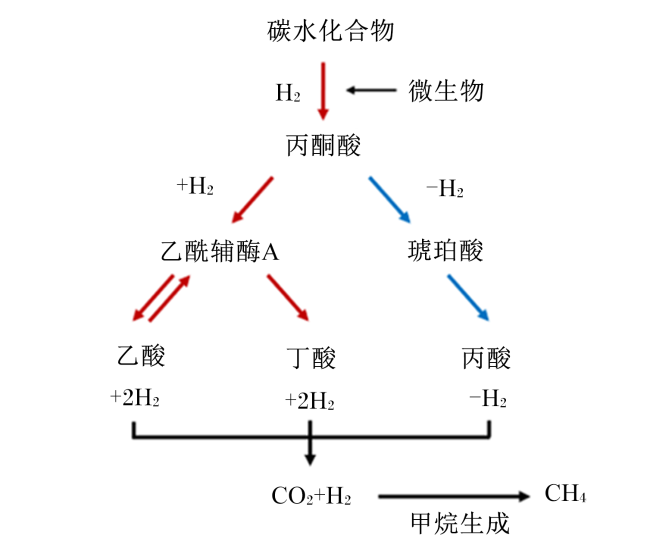
反刍动物产生的CH4主要来自瘤胃发酵。瘤胃内CH4的产生与瘤胃内微生物的组成密切相关,主要的产甲烷菌属有甲烷短杆菌属(Methanobrevibacter)、甲烷微菌属(Methanomicrobium)、甲烷球形菌属(Methanosphaera)以及甲烷杆菌属(Methanobacterium)等[12-13]。饲粮进入瘤胃后,碳水化合物在微生物厌氧发酵的作用下降解为挥发性脂肪酸(volatile fatty acids,VFA)、CO2和氢气(H2)等代谢产物,CO2和H2在产甲烷菌的作用下生成CH4[14-15];同时,VFA中乙酸和丁酸的生成会释放H2,H2分压增加会抑制NADH脱氢酶的功能,进而影响瘤胃发酵,CH4的合成可以避免H2累积,是瘤胃代谢的必要过程,但此过程也造成了能量的损失[16];而丙酸的生成过程则可以利用H2,减少CH4生成[17](图1)。关于瘤胃CH4调控的研究已有诸多报道。从调控机理上来看,一是减少H2生成量或调控H2代谢;二是抑制产甲烷菌的数量和活性[14]。此外,瘤胃CH4的生成还受原虫的影响,产甲烷菌附着在原虫的表面,并依靠原虫体表的汁液生长,而原虫表面的产甲烷菌则能将氢去除,从而有利于原虫的生长。因而,原虫的数量影响产甲烷菌的生长,从而影响瘤胃中CH4的产量[18]。Ma等[19]证实,桑叶黄酮提取物有效抑制了饲喂高粗料饲粮母羊瘤胃CH4生成,瘤胃产甲烷菌与原虫数量的减少有助于减少CH4生成量。
图1 反刍动物瘤胃CH4的生成

H2:氢气 hydrogen;CO2:二氧化碳 carbon dioxide;CH4:甲烷 methane:+:生成 production;-:消耗 consumption。

Fig.1 Production of rumen CH4 in ruminants[14-15]

1.2 排泄物N2O的生成

饲料中的氮在反刍动物体内的转化效率低于30%,超过70%的氮主要以粪氮和尿氮的形式排出体外[8]。粪尿中含氮化合物排放造成的环境污染反过来也会影响动物的生长性能和产品品质[20]。反刍动物排泄的粪尿中的氮不仅可以转化为氨气(NH3),而且还与土壤中的微生物相互作用,经过硝化与反硝化作用生成N2O[21](图2)。硝化作用是好氧过程,铵离子(NH4+)经过氧化生成硝酸根离子(NO3-),最终生成N2O;而反硝化作用是将NO3-还原为氮气(N2)的厌氧过程,中间产物包括N2O[22-23]。反刍动物排泄氮中尿氮占60%~80%,粪氮占20%~40%。粪便中的氮主要以有机氮的形式存在,不易挥发,而尿液中的氮主要以尿素的形式存在,能够迅速被土壤微生物分解成NO3-进而生成N2O[24]。尿氮中50%~90%为易分解的尿素,是影响N2O生成的最主要成分[24]。因此,降低N2O的生成,从动物营养角度看,一方面可以通过减少饲粮氮的摄入,直接降低排泄物N2O排放量;另一方面可以调控粪氮和尿氮的比例,如改变饲粮和利用植物添加剂等,提高粪氮比例,降低尿氮比例或降低尿素含量,间接降低N2O排放。
图2 反刍动物排泄物来源的N2O的生成

NH4+:铵离子 ammonium ion;NH3:氨气 ammonia gas;NH2OH:羟胺 hydroxylamine;NO2-:亚硝酸根离子 nitrite ion;NO3-O3-:硝酸根离子 nitrate ion;N2:氮气 nitrogen gas;N2O:氧化亚氮 nitrous oxide;NO:氧化亚氮 nitric oxide;➝:硝化 nitration; :反硝化 denitrification。

Fig.2 Production of excreta-derived N2O in ruminants[20-21]

2 植物单宁概述

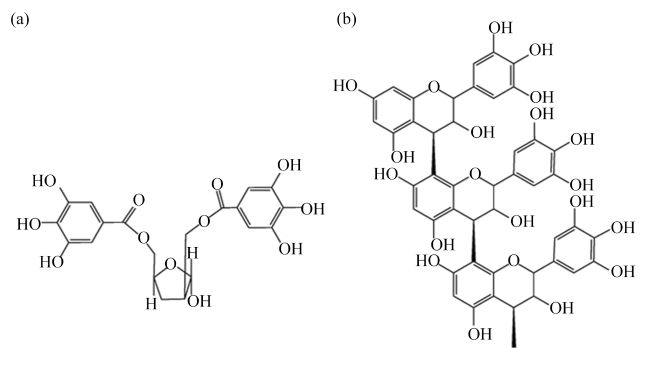
单宁又称多酚或鞣质,是高分子质量的水溶性的多酚类化合物,广泛分布于大多数植物的树皮、木材、水果、叶子、花和根中[15]。植物中的单宁通常以水解单宁(hydrolyzed tannin,HT)和缩合单宁(condensed tannin,CT)2种形式存在[9](图3)。HT是由若干没食子酸或鞣花酸分子酯化形成的由多元醇(包括糖类和酚类)组成的核心分子;与HT不同的是,CT是由多个黄烷-3-醇(如儿茶素)或者没食子儿茶素缩合而成,没有多元醇核心[25]。长期以来,植物单宁被认为是抗营养因子,有降低动物采食量、影响营养物质消化等不利作用[26]。但近年来研究发现,饲粮中添加适量植物单宁在反刍动物过瘤胃蛋白保护、改善瘤胃发酵、提高饲料氮利用效率、提高生产性能、减少CH4排放和降低氮排放等方面具有一定的积极作用[27]。植物单宁在反刍动物生产中的应用效果,取决于单宁添加量、结构、植物来源以及动物种类、生理状态和饲粮组成等因素。
图3 水解单宁(a)和缩合单宁(b)的结构

Fig.3 Structures of hydrolyzed tannin (a) and condensed tannin (b)[9]

3 植物单宁对反刍动物温室气体排放的调控作用

3.1 植物单宁对CH4生成的调控

3.1.1 体内试验的相关研究

表1列出了不同植物来源的单宁在反刍动物体内抑制CH4排放的研究结果,可以看出目前研究多集中于CT,而对HT的研究相对较少,可能是因为HT被瘤胃微生物降解后对反刍动物有一定毒性[28]。虽然植物单宁被认为是抗营养因子,作为CH4抑制剂,可能会降低动物采食量和瘤胃内纤维消化率,但一些研究表明适量添加植物单宁并不会对反刍动物采食量和生产性能造成负面影响。Alves等[29]报道,在奶牛饲粮中添加120 g/d的金合欢单宁提取物显著降低了CH4的产量,且不会对采食量和生产性能造成负面影响。同样,Zhang等[30]的研究表明,在绵羊饲粮中添加30和60 g/kg DM的五倍子单宁提取物,CH4产量分别减少了37.6%和36.4%,且不影响生产性能和营养物质表观消化率。
表1 植物单宁调控瘤胃CH4生成的体内试验研究

Table 1 In vivo test studies of plant tannins regulating rumen CH4 production

单宁类型
Types of
tannins
来源
Sources
试验动物
Experimental
animals
添加量
Additive
dosage
饲粮组成
Diet
composition
CH4产量
CH4 production
瘤胃发酵/生产性能
Rumen fermentation/
performance
参考文献
Reference
CT 黑荆 奶牛 120 g/d 非洲粟+玉米粉+豆粕 32%↓ DMI、产奶量和乳成分= [29]
HT 五倍子 绵羊 15、30和
60 g/kg DM
麦麸+玉米 30和60 g/kg
DM 组:↓
生产性能、营养物质表观消
化率=
[30]
CT
HT
含羞草和黑儿茶
板栗和刺云实
羔羊 40 g/kg DM 精饲料 - 各组:乙酸、丙酸、戊酸和A∶P=;
含羞草和黑儿茶组:产甲烷菌数量↓;
含羞草组:丁酸浓度↑;板栗组和
刺云实组:原虫数量↓;板栗组:
TVFA浓度↑,异丁酸、异戊酸浓度↓
[11]
HT
HT+CT
栗子
栗子+白坚木(1∶1)
肉牛 0.25%和
1.5%DM
苜蓿青贮+
大麦青贮(1∶1)
= DMI、BW和ADG=,原虫数量=,
乙酸、丙酸和TVFA浓度=
[36]
CT 白坚木 肉牛 1%和2%DM 大麦青贮∶大麦粒
(70∶30)+
豆粕+玉米蛋白粉
= TVFA、乙酸、丙酸、NH3
度和粗蛋白质消化率↓,DM、
ADF和ADF消化率=
[37]
HT+CT 含羞草 2.8和
5.6 g/kg DM
干草+玉米+
豆粕
随单宁添加量
的增加而线性↓
采食量=,A∶P↓ [38]
CT 无花树果和
番石榴树
羔羊 1.0%、1.5%和
2.0% DM
小麦秸秆+
燕麦干草
随单宁添加量的
增加而线性↓
采食量=,DM、OM、CP、EE、
NDF和ADF消化率=,BW↑
[49]
CT 白坚木+栗子
(2∶1)
奶牛 0.45%和
1.8% DM
TMR(精粗比
46∶54)
0.45% DM组:30%↓;
1.8% DM组:48%↓
产奶量= [50]
CT 金合欢 绵羊 30、40和
50 g/kg DM
干草+
颗粒饲粮
51%~60%↓ 采食量、增重=,DM、OM、CP、EE、
NDF和ADF消化率=
[51]
CT 白坚木 母牛 1、2、3和
4% DM
象草 随单宁添加
量的增加而线性↓
4% DM组:DMI、OMI和NDFI↓;1%、
2%和3%DM组:TVFA、乙酸浓度=,
采食量、营养物质消化率=;3%、
4%DM组:丙酸浓度↑
[52]

CT:缩合单宁 condensed tannin;HT:水解单宁 hydrolyzed tannin;DM:干物质 dry matter;OM:有机物 organic matter;CP:粗蛋白质 crude protein;EE:粗脂肪 ether extract;NDF:中性洗涤纤维 neutral detergent fiber;ADF:酸性洗涤纤维 acid detergent fiber;BW:体重 body weight;ADG:平均日增重average daily gain;DMI:干物质采食量 dry matter intake;OMI:有机物采食量 organic matter intake;NDFI:中性洗涤纤维采食量 neutral detergent fiber intake;TMR:全混合日粮 total mixed ration;TVFA:总挥发性脂肪酸 total volatile fatty acids;A∶P:乙酸∶丙酸 acetic acid∶propionic acid;↑:升高 increased;↓:下降 decreased;=:无影响 no effect;-:未报道 unreported。下表同 the same as below。

单宁对瘤胃CH4生成的抑制作用存在着多重机制。一般认为,瘤胃CH4产量的线性降低可能与瘤胃部分产甲烷菌属的生长或活性被单宁抑制有关。在羔羊饲粮中分别添加4%的CT和HT,产甲烷菌的丰度均有类似的下降,验证了单宁对产甲烷菌的抑制作用[11]。此外,由于部分与氢转运相关的细菌附着在原虫表面,单宁还可以通过抑制瘤胃原虫的数量,从而间接影响CH4的生成[31]。研究表明,瘤胃纤维消化与CH4产生之间存在相关联系,单宁降低瘤胃CH4排放的作用通常是中性洗涤纤维(NDF)降解减少的结果,反过来又导致乙酸合成的减少,最终导致产甲烷菌的电子供体可用性降低,这可能是由于单宁的高分子质量和多酚性质使其与微生物酶或细胞壁形成复合物,从而导致对产甲烷菌和纤维素溶解的抑制[5,32-33]。De Oliveira等[34]比较了饲喂含有不同单宁的饲粮对山羊的影响,发现高单宁含量组瘤胃NDF降解率更低,推测单宁可以抑制瘤胃纤维降解。Tavendale等[35]指出,单宁对CH4生成的抑制作用,一是通过直接抑制产甲烷菌的数量,二是间接抑制饲料消化率,减少H2生成量来减少CH4产量。同样,Salami等[11]也发现,单宁抑制了羔羊瘤胃中原虫的丰度,并抑制了纤维杆菌和产甲烷菌的数量。由此可见,单宁可以通过直接抑制产甲烷菌的丰度和间接减少纤维消化来减少H2的产生,也可以通过调节原虫种群,降低纤维降解率,进而降低瘤胃CH4产量。
但也有一些研究表明,反刍动物饲粮中添加单宁并未降低CH4的产量,且会降低营养物质消化率。Tavendale等[36]的研究表明,在肉牛饲粮中添加1.5% DM的HT或HT与CT混合物,与对照组相比,瘤胃CH4产量并无显著下降。Beauchemin等[37]的研究表明,在肉牛饲粮中分别添加1%和2% DM的白坚木单宁提取物,瘤胃CH4产量并无显著下降,而粗蛋白质消化率分别下降了5%和15%。此外,单宁的调控作用受到单宁添加量的影响。在山羊饲粮中分别添加2.8和5.6 g/kg DM的含羞草单宁,CH4产量均显著降低,而高水平组的营养物质消化率则比对照组和低水平组低[38]。Min等[39]报道,饲粮中单宁添加量在2.2%~4.0% DM时,能够有效降低CH4排放,且不影响绵羊的生产性能。荟萃分析结果显示,随着饲粮单宁含量的增加,反刍动物CH4排放量下降的幅度减小[40]。有关单宁抑制反刍动物瘤胃CH4排放的效果未来仍需要大量体内试验进行筛选验证,选出理想的单宁来源和添加量。

3.1.2 体外试验的相关研究

体外产气试验是筛选潜在的CH4抑制剂普遍采用的方法。体外研究表明,单宁具有降低CH4产量的活性,一方面直接通过抑制产甲烷菌活性来降低CH4产量,另一方面间接通过瘤胃发酵(如VFA)或微生物群(如原虫、厚壁菌门和拟杆菌门)变化来降低CH4产量[40-43]表2总结了不同植物来源的单宁在体外试验中对CH4生成抑制效应的研究结果。例如,用五倍子单宁提取物进行体外培养,会通过降低奶牛瘤胃液中总原虫和总产甲烷菌的数量降低CH4产量[41]。尽管体外试验得到了很多积极的CH4抑制效果,但不同植物来源的单宁在作用模式上存在明显差别。Choi等[44]通过对5种红海藻单宁提取物的体外培养发现,补充红海藻提取物可以改变与丙酸生产相关的原虫群落,导致丙酸生成加速,同时,产甲烷菌的相对丰度降低,CH4产量减少。Battelli等[45]观察到在48 h的发酵过程中,白坚木单宁和栗子单宁都显著减少了CH4的产生,而有关原虫和产甲烷菌的数量并没有显著变化。体外研究的结果进一步表明产甲烷菌的丰度并不总是与CH4产量呈正相关,单宁对瘤胃发酵与瘤胃微生物的作用模式是多样的,很难用一种机理去解释。因此,需要针对不同植物来源单宁的结构特性,采用分子生物学手段,进一步研究不同饲粮下的CH4生成与产甲烷菌、原虫和其他微生物的关系,从微生态角度理解植物单宁种类或结构影响CH4产生的机理。
表2 植物单宁调控瘤胃CH4生成的体外试验研究

Table 2 In vitro test studies of plant tannins regulating rumen CH4 production

单宁类型
Types of
tannins
来源
Source
添加量
Additive
dosage
发酵底物
Fermentation
substrate
CH4产量
CH4 production
瘤胃微生物
Rumen
microorganism
瘤胃发酵
Rumen
fermentation
参考文献
Reference
HT 五倍子 20、
50 g/kg DM
玉米青贮+精饲料
(1∶1)
总原虫、总产
甲烷菌数量↓
50 g/kg DM组:TVFA、乙酸、异戊酸
浓度↓,丙酸浓度↑;20 g/kg DM组:
乙酸浓度↓,丙酸浓度↑
[41]
CT 5种红海藻 0.25 mg/mL 提摩西干
草+精饲料
24和
36 h时↓
总细菌数量= 扁叉节藻组和江篱藻组:
总产甲烷菌数量↓
[44]
CT,HT 白坚木,
栗子
2%、4%、
6%、8% DM
草甸干草+苜蓿
干草+豌豆种
子+精饲料
0~48 h时随单宁
添加量的增加而↓
总原虫、总古菌数量=;
产甲烷菌数量-
乙酸、丙酸和丁酸占TVFA
的百分比=
[45]
CT,HT 白坚木,
栗子
20、50 g/kg DM CT;
10 g/kg DM CT+
10 g/kg DM HT;
10 g/kg DM CT+
10 g/kg DM HT
苜蓿青贮 ↓,且组合添加效果
大于单独添加
总产甲烷菌、
厌氧真菌数量↓
TVFA浓度↓,丙酸浓度↑ [47]
CT 三叶草 1.6%~
2.4% DM
三叶草花和叶 - 丙酸、丁酸浓度↓,
乙酸:丁酸↑
[53]
CT 白坚木 0.05%和
0.07%
小麦牧草 - - [54]
CT 葡萄籽 0.2%、0.4%、
0.8% DM
象草+玉米+米
糠+豆粕+椰子
饼粉等
- 0.2%、0.4%、0.8% DM组:
丙酸浓度↑,异丁酸浓度线性↓,
异戊酸浓度线性↑;0.4%、0.8% DM
组:A:P↓,TVFA浓度↓
[55]
CT 山竹果皮 10、20和30 mg CT/
500 mg DM
干草 - 总产气量以及TVFA、乙酸、丙酸、
丁酸和异戊酸浓度随单宁添加
量的增加呈线性↓
[56]
尽管体内研究往往难以重复单宁抑制体外瘤胃CH4排放的显著效果,但体外试验作为筛选有效的单宁的经典手段仍不容忽视。一方面,植物来源的单宁在抑制CH4效应上,受到植物营养成分、收获期等影响。Gemeda等[46]用19种含单宁植物进行体外产气试验,发现植物中粗灰分、粗脂肪、非纤维性碳水化合物、粗蛋白质含量与CH4产量呈负相关;该研究还发现,沙拉地榆干草中单宁含量随着成熟度的提高而减少,因此抑制CH4排放的能力也不同。另一方面,可以从单宁测定入手,来预测含单宁植物CH4抑制效应。Bhatta等[42]的结果表明,总单宁含量与产甲烷古菌数量呈负相关,而产甲烷古菌数量与CH4产量呈正相关。
虽然HT可能在动物体内引发毒性反应,但也有体外试验表明HT抑制CH4排放的能力并不比CT差。Jayanegara等[43]指出,HT比CT具有更强的抑制CH4生成的效果,这可能与HT沉淀蛋白质能力较强有关,并且他们认为CT主要通过降低纤维消化率来减少CH4生成,而HT主要通过抑制产甲烷菌数量和活性来减少CH4生成,对饲粮消化率的影响更小。研究报道,单独添加CT或与HT联用,不同浓度的CT均可降低CH4的产量,且二者联用降低效果大于单独添加[47]。Bhatta等[42]通过体外产气试验发现,CT与HT联用组的CH4产量明显低于只添加HT组的CH4产量。因此,除了较为广泛的CT外,也需要开展HT的研究或者2种单宁组合效应的研究,同时探索单宁添加量的“阈值”,并采取合适的方法降低单宁的毒性。动物的种类是影响单宁效果的因素之一,但往往被忽视。Bueno等[48]比较了来源于金合欢的CT对奶牛、肉牛、水牛、绵羊和山羊5种动物瘤胃液体外发酵CH4产量的影响,发现CT对体形较大的反刍动物的抑制效果要比体形小的更明显。由此可见,单一物种的体外研究结果并不能直接套用到另一物种上,体外筛选单宁时,有必要建立多物种人工瘤胃发酵的体外筛选模式,进而在各种反刍动物中进行广泛的体内试验来反复验证。

3.2 植物单宁对N2O生成的调控

粪氮主要是有机氮,不易挥发;而尿氮主要成分为易降解的尿素,并通过硝化和反硝化生成N2O,占草牧系统N2O排放量的60%[57]。因此,可以考虑通过减少尿氮排泄来减少反刍动物N2O生成。单宁可以与蛋白质结合形成单宁-蛋白质复合物,减少蛋白质在瘤胃中的降解,使氨基酸在皱胃和后部消化道消化吸收,提高氮的利用率,从而改变氮排泄[58]。此外,粪便中的单宁-蛋白质复合物更能够“抵抗”土壤的降解作用,因为含复合物的粪便的矿物质化作用受到抑制,且要比不含复合物的粪便分解速度更慢,由此可降低N2O生成[59]
表3总结了单宁调控反刍动物氮排泄与N2O生成的研究结果。
表3 植物单宁调控反刍动物氮排泄与排泄物N2O生成的试验研究

Table 3 Experimental studies of plant tannins regulating nitrogen excretion and excreta-derived N2O production in ruminants

单宁类型
Types of
tannins
来源 Source 试验动物
Experimental
animals
添加量
Additive
dosage
饲粮组成
Diet
composition
氮排泄与N2O排放
Nitrogen excretion and
N2O emissions
生产性能
Performance
参考文献
Reference
CT 无花果+番石榴
(70∶30)
羔羊 1%、1.5%和
2% DM
小麦+燕麦+
精饲料
1.5% DM组:FN↑;1.5%和
2% DM组:UN线性↓,
氮排泄量线性↓
BW↑,DMI=,DM、OM、CP、
EE、NDF和ADF消化率=
[49]
HT 栗子、单宁酸 肉牛 单宁酸:1.5% DM
栗子单宁:2% DM
苜蓿青贮+
大麦青贮
FN↑,UN线性↓ DMI=,OM、NDF、ADF和
总能表观消化率=
[58]
CT 胡枝子 肉牛 胡枝子干草
替代50%、100%的
百慕大草
百慕大草 尿液N2O↓,粪便N2O↓ - [77]
CT+HT 白坚木+板栗
(2∶1)
奶牛 0.45%、
1.8% DM
紫花苜蓿青贮+玉米
青贮+玉米+菜籽粕+大豆
UN线性↓ 产奶量=,DMI、
BW线性↑
[61]
CT 黑荆 肉牛 25 g/kg DM 大麦+DDGS N2O= - [69]
CT 金合欢 绵羊 0.14%、0.29%、
0.43% DM
黑麦草+玉米
粉+豆粕
FN↑,UN=,
尿液N2O↑,粪便N2O=
DMI=,OMI= [70]
CT 金合欢 奶牛 0.15%、0.30%、
0.45% DM
TMR UN线性↓,FN= DMI、BW、产奶量、乳成分= [71]
CT 含羞草 绵羊 26.2、52.4和
78.6 g/kg DM
含羞草+玉米+
豆粕
FN↑,UN线性↓ DMI↓,DM消化率呈二次↑ [72]
CT 杨梅、金合欢 奶牛 3% DM 紫花苜蓿+野麦+
玉米+精饲料
金合欢组:FN↑;
杨梅组:UN↓
DMI、产奶量、乳成分= [73]
HT 没食子酸 肉牛 15.2 g/kg DM TMR FN=,UN=,尿液N2O↓ ADG= [68]
HT 单宁酸 肉牛 16.9 g/kg DM TMR FN↑,UN↓,尿液N2O↓ - [74]

N2O:氧化亚氮 nitrous oxide;FN:粪氮 fecal nitrogen;UN:尿氮 urinary nitrogen。

Pathak等[49]研究发现,在羔羊饲粮中添加无花果单宁和番石榴单宁混合物显著影响了氮的利用和氮沉积,与对照组相比,饲喂单宁组的氮沉积率显著提高,且饲喂含CT饲粮的羔羊尿氮排泄量显著降低,粪氮与尿氮的比值提高。同样,在绵羊饲粮中添加板栗和含羞草单宁可以提高绵羊氮利用的潜力,减少了尿氮排泄并增加了粪氮的排泄[60]。Aboagye等[58]的研究表明,栗子单宁和单宁酸可将肉牛氮排泄从尿液转移到粪便,且不会影响生产性能。同样,白坚木和栗子单宁提取物混合物可以减少奶牛尿氮排泄,且不影响其产奶量[61]。由此看见,单宁在降低反刍动物尿氮排泄方面具有积极的效果,然而,这些研究人员并没有测定反刍动物排泄物的N2O排放,其降低N2O排放的效果仍需进一步验证。
反刍动物采食富含CT的饲粮时,超过50%的CT未能被消化而随粪便排出体外[62-63]。因此,除了通过减少尿中尿素的排泄来减少N2O的排放外,在农田土壤中施用含有CT的反刍动物粪便来减少N2O的排放,为降低N2O排放提供了另一思路。Misselbrook等[64]报道,奶牛采食百脉根单宁,其粪便中检测到单宁且具有生物活性,粪便中的单宁显著降低了牛舍以及土壤中产生的NH3。在奶牛饲粮中添加栗子单宁提取物,粪便中脲酶活性和粪氮排泄量均降低[65]。此外,土壤中施用富含白坚木单宁的山羊粪便,土壤N2O的排放量可降低80%~92%[66]
当前,只有少部分研究测定了单宁对反刍动物排泄物N2O排放的影响。体外研究表明,4种不同浓度的CT和HT均降低了N2O的累积排放速率和通量速率,对N2O的排放产生了显著的抑制效果,因此,CT和HT都可以通过抑制氨的分解和调控微生物来调节与硝化和反硝化相关的N2O排放[6]。Van Cleef等[67]证明,单宁与蛋白质结合抑制了宿主酶的消化作用和肠道对氨基酸的吸收,在32 d内有效减少了土壤中N2O的排放。Bao等[68]发现,在肉牛饲粮中添加没食子酸可降低肉牛尿液N2O排放,而尿氮排泄或尿素排泄不受影响,这主要是由于没食子酸代谢物如邻苯三酚和间苯二酚的排泄可能抑制了N2O的产生过程。此外,也有部分研究报道了不一致的结果,例如,在肉牛饲粮中补充黑荆单宁并不影响粪便N2O的排放[69]。De Souza等[70]则观察到金合欢单宁提取物提高了绵羊排泄物的N2O排放。这些研究表明单宁对反刍动物氮利用和N2O排放的影响可能因单宁来源、浓度、分子结构和剂量不同而存在很大差异。综上可知,植物单宁在减少反刍动物排泄物N2O排放方面具有良好的潜力。虽然植物单宁在减少氮排放方面显示出良好的潜力,但与其相关的N2O生成的调控因子仍未知,未来应进一步探究植物单宁对N2O生成调控的机制,提高氮利用效率,减少N2O的排放。

4 小结与展望

综合体内和体外试验的大量研究结果,可以看出植物单宁具有明显抑制反刍动物CH4生成和N2O排放的作用,但由于作用的效果受到单宁来源、动物因素和单宁添加量等多方面的影响,导致结果仍存在较大的差异,尤其是在降低饲粮营养成分消化率和影响生产性能方面。未来需要建立有序的研究流程,如体外试验筛选潜在的单宁提取物,应用单宁测定、结构分析和体外产气等方法,建立单宁含量、活性、结构和分子质量与CH4产量或氮排泄量之间的相关关系;体内试验综合考虑动物和饲粮因素,分析对采食量和瘤胃发酵的影响,并开展长期体内试验,分析对动物生产性能、动物健康、产品品质和CH4或N2O排放的长期影响。
[1]
SARI N F, RAY P, RYMER C, et al. Garlic and its bioactive compounds:implications for methane emissions and ruminant nutrition[J]. Animals, 2022, 12(21):2998.

DOI

[2]
UGBOGU E A, ELGHANDOUR M M M Y, IKPEAZU V O, et al. The potential impacts of dietary plant natural products on the sustainable mitigation of methane emission from livestock farming[J]. Journal of Cleaner Production, 2019, 213:915-925.

DOI

[3]
KRISTIANSEN S, PAINTER J, SHEA M. Animal agriculture and climate change in the US and UK elite media:volume,responsibilities,causes and solutions[J]. Environmental Communication, 2021, 15(2):153-172.

DOI

[4]
BEKELE W, GUINGUINA A, ZEGEYE A, et al. Contemporary methods of measuring and estimating methane emission from ruminants[J]. Methane, 2022, 1(2):82-95.

DOI

[5]
CARDOSO-GUTIERREZ E, ARANDA-AGUIRRE E, ROBLES-JIMENEZ L E, et al. Effect of tannins from tropical plants on methane production from ruminants:a systematic review[J]. Veterinary and Animal Science, 2021, 14:100214.

DOI

[6]
MIN B R, WILLIS W, CASEY K, et al. Condensed and hydrolyzable tannins for reducing methane and nitrous oxide emissions in dairy manure-a laboratory incubation study[J]. Animals, 2022, 12(20):2876.

DOI

[7]
JOHNSON K A, JOHNSON D E. Methane emissions from cattle[J]. Journal of Animal Science, 1995, 73(8):2483-2492.

DOI PMID

[8]
DE MELO COELHO L, DE FIGUEIREDO BRITO L, MESSANA J D, et al. Effects of rumen undegradable protein sources on nitrous oxide,methane and ammonia emission from the manure of feedlot-finished cattle[J]. Scientific Reports, 2022, 12(1):9166.

DOI

[9]
KU-VERA J C, JIMÉNEZ-OCAMPO R, VALENCIA-SALAZAR S S, et al. Role of secondary plant metabolites on enteric methane mitigation in ruminants[J]. Frontiers in Veterinary Science, 2020, 7:584.

DOI

[10]
HUYEN N T, FRYGANAS C, UITTENBOGAARD G, et al. Structural features of condensed tannins affect in vitro ruminal methane production and fermentation characteristics[J]. The Journal of Agricultural Science, 2016, 154(8):1474-1487.

DOI

[11]
SALAMI S A, VALENTI B, BELLA M, et al. Characterisation of the ruminal fermentation and microbiome in lambs supplemented with hydrolysable and condensed tannins[J]. FEMS Microbiology Ecology, 2018, 94(5):fiy061.

[12]
YANAGITA K, KAMAGATA Y, KAWAHARASAKI M, et al. Phylogenetic analysis of methanogens in sheep rumen ecosystem and detection of Methanomicrobium mobile by fluorescence in situ hybridization[J]. Bioscience,Biotechnology,and Biochemistry, 2000, 64(8):1737-1742.

DOI

[13]
WANG K, XIONG B H, ZHAO X. Could propionate formation be used to reduce enteric methane emission in ruminants?[J]. The Science of the Total Environment, 2023, 855:158867.

DOI

[14]
MORGAVI D P, FORANO E, MARTIN C, et al. Microbial ecosystem and methanogenesis in ruminants[J]. Animal, 2010, 4(7):1024-1036.

DOI PMID

[15]
MIN B R, SOLAIMAN S, WALDRIP H M, et al. Dietary mitigation of enteric methane emissions from ruminants:a review of plant tannin mitigation options[J]. Animal Nutrition, 2020, 6(3):231-246.

DOI

[16]
PALANGI V, LACKNER M. Management of enteric methane emissions in ruminants using feed additives:a review[J]. Animals, 2022, 12(24):3452.

DOI

[17]
PALANGI V, MACIT M, NADAROGLU H, et al. Effects of green-synthesized CuO and ZnO nanoparticles on ruminal mitigation of methane emission to the enhancement of the cleaner environment[J/OL]. Biomass Conversion and Biorefinery:1-9[2023-09-01]. https://doi.org/10.1007/s13399-022-02775-9.DOI:10.1007/s13399-022-02775-9.

[18]
赵玉华, 杨瑞红, 王加启. 瘤胃微生物甲烷生成的机理与调控[J]. 微生物学杂志, 2005, 25(5):68-73.

ZHAO Y H, YANG R H, WANG J Q. Methane production mechanism and regulation of rumen microbes[J]. Journal of Microbiology, 2005, 25(5):68-73. (in Chinese)

[19]
MA T, CHEN D D, TU Y, et al. Dietary supplementation with mulberry leaf flavonoids inhibits methanogenesis in sheep[J]. Animal Science Journal, 2017, 88(1):72-78.

DOI PMID

[20]
TAN P, LIU H, ZHAO J, et al. Amino acids metabolism by rumen microorganisms:nutrition and ecology strategies to reduce nitrogen emissions from the inside to the outside[J]. Science of the Total Environment, 2021, 800:149596.

DOI

[21]
WALDRIP H M, TODD R W, PARKER D B, et al. Nitrous oxide emissions from open-lot cattle feedyards:a review[J]. Journal of Environmental Quality, 2016, 45(6):1797-1811.

DOI

[22]
LAUGHLIN R J, RÜTTING T, MÜLLER C, et al. Effect of acetate on soil respiration,N2O emissions and gross N transformations related to fungi and bacteria in a grassland soil[J]. Applied Soil Ecology, 2009, 42(1):25-30.

DOI

[23]
TSUTSUI H, FUJIWARA T, MATSUKAWA K, et al. Nitrous oxide emission mechanisms during intermittently aerated composting of cattle manure[J]. Bioresource Technology, 2013, 141:205-211.

DOI PMID

[24]
DIJKSTRA J, OENEMA O, VAN GROENIGEN J W, et al. Diet effects on urine composition of cattle and N2O emissions[J]. Animal, 2013, 7(Suppl 2):292-302.

DOI

[25]
RIRA M, MORGAVI D P, POPOVA M, et al. Microbial colonisation of tannin-rich tropical plants:interplay between degradability,methane production and tannin disappearance in the rumen[J]. Animal, 2022, 16(8):100589.

DOI

[26]
MAKKAR H P S, FRANCIS G, BECKER K. Bioactivity of phytochemicals in some lesser-known plants and their effects and potential applications in livestock and aquaculture production systems[J]. Animal, 2007, 1(9):1371-1391.

DOI PMID

[27]
BESHARATI M, MAGGIOLINO A, PALANGI V, et al. Tannin in ruminant nutrition:review[J]. Molecules, 2022, 27(23):8273.

DOI

[28]
IBRAHIM S L, HASSEN A. Effects of graded levels of mimosa (Acacia mearnsii) tannin purified with organic solvents on gas,methane,and in vitro organic matter digestibility of Eragrostis curvula hay[J]. Animals, 2022, 12(5):562.

DOI

[29]
ALVES T P, DALL-ORSOLETTA A C, RIBEIRO-FILHO H M N. The effects of supplementing Acacia mearnsii tannin extract on dairy cow dry matter intake,milk production,and methane emission in a tropical pasture[J]. Tropical Animal Health and Production, 2017, 49(8):1663-1668.

DOI

[30]
ZHANG F Y, LI B H, BAN Z B, et al. Evaluation of origanum oil,hydrolysable tannins and tea saponin in mitigating ruminant methane:in vitro and in vivo methods[J]. Journal of Animal Physiology and Animal Nutrition, 2021, 105(4):630-638.

DOI

[31]
ANIMUT G, PUCHALA R, GOETSCH A L, et al. Methane emission by goats consuming diets with different levels of condensed tannins from lespedeza[J]. Animal Feed Science and Technology, 2008, 144(3/4):212-227.

DOI

[32]
TAPIO I, SNELLING T J, STROZZI F, et al. The ruminal microbiome associated with methane emissions from ruminant livestock[J]. Journal of Animal Science and Biotechnology, 2017, 8:7.

DOI PMID

[33]
MANNELLI F, DAGHIO M, ALVES S P, et al. Effects of chestnut tannin extract,vescalagin and gallic acid on the dimethyl acetals profile and microbial community composition in rumen liquor:an in vitro study[J]. Microorganisms, 2019, 7(7):202.

DOI

[34]
DE OLIVEIRA S G, BERCHIELLI T T, PEDREIRA M D S, et al. Effect of tannin levels in sorghum silage and concentrate supplementation on apparent digestibility and methane emission in beef cattle[J]. Animal Feed Science and Technology, 2007, 135(3/4):236-248.

DOI

[35]
TAVENDALE M H, MEAGHER L P, PACHECO D, et al. Methane production from in vitro rumen incubations with Lotus pedunculatus and Medicago sativa,and effects of extractable condensed tannin fractions on methanogenesis[J]. Animal Feed Science and Technology, 2005, 123/124(Part 1):403-419.

DOI

[36]
ABOAGYE I A, OBA M, CASTILLO A R, et al. Effects of hydrolyzable tannin with or without condensed tannin on methane emissions,nitrogen use,and performance of beef cattle fed a high-forage diet[J]. Journal of Animal Science, 2018, 96(12):5276-5286.

[37]
BEAUCHEMIN K A, MCGINN S M, MARTINEZ T F, et al. Use of condensed tannin extract from quebracho trees to reduce methane emissions from cattle[J]. Journal of Animal Science, 2007, 85(8):1990-1996.

DOI PMID

[38]
BHATTA R, ENISHI O, YABUMOTO Y, et al. Methane reduction and energy partitioning in goats fed two concentrations of tannin from Mimosa spp.[J]. The Journal of Agricultural Science, 2013, 151(1):119-128.

DOI

[39]
MIN B R, BARRY T N, ATTWOOD G T, et al. The effect of condensed tannins on the nutrition and health of ruminants fed fresh temperate forages:a review[J]. Animal Feed Science and Technology, 2003, 106(1/4):3-19.

DOI

[40]
JAYANEGARA A, LEIBER F, KREUZER M. Meta-analysis of the relationship between dietary tannin level and methane formation in ruminants from in vivo and in vitro experiments[J]. Journal of Animal Physiology and Animal Nutrition, 2012, 96(3):365-375.

DOI

[41]
CHEN L, BAO X Y, GUO G, et al. Evaluation of gallnut tannin and Lactobacillus plantarum as natural modifiers for alfalfa silage:ensiling characteristics,in vitro ruminal methane production,fermentation profile and microbiota[J]. Journal of Applied Microbiology, 2022, 132(2):907-918.

DOI

[42]
BHATTA R, UYENO Y, TAJIMA K, et al. Difference in the nature of tannins on in vitro ruminal methane and volatile fatty acid production and on methanogenic archaea and protozoal populations[J]. Journal of Dairy Science, 2009, 92(11):5512-5522.

DOI

[43]
JAYANEGARA A, GOEL G, MAKKAR H P S, et al. Divergence between purified hydrolysable and condensed tannin effects on methane emission,rumen fermentation and microbial population in vitro[J]. Animal Feed Science and Technology, 2015, 209:60-68.

DOI

[44]
CHOI Y, LEE S J, KIM H S, et al. Red seaweed extracts reduce methane production by altering rumen fermentation and microbial composition in vitro[J]. Frontiers in Veterinary Science, 2022, 9:985824.

DOI

[45]
BATTELLI M, COLOMBINI S, PARMA P, et al. In vitro effects of different levels of quebracho and chestnut tannins on rumen methane production,fermentation parameters,and microbiota[J]. Frontiers in Veterinary Science, 2023, 10:1178288.

DOI

[46]
GEMEDA B S, HASSEN A. Effect of tannin and species variation on in vitro digestibility,gas,and methane production of tropical browse plants[J]. Asian-Australasian Journal of Animal Sciences, 2015, 28(2):188-199.

DOI

[47]
CHEN L, BAO X Y, GUO G, et al. Effects of hydrolysable tannin with or without condensed tannin on alfalfa silage fermentation characteristics and in vitro ruminal methane production,fermentation patterns,and microbiota[J]. Animals, 2021, 11(7):1967.

DOI

[48]
BUENO I C S, BRANDI R A, FRANZOLIN R, et al. In vitro methane production and tolerance to condensed tannins in five ruminant species[J]. Animal Feed Science and Technology, 2015, 205:1-9.

DOI

[49]
PATHAK A K, DUTTA N, PATTANAIK A K, et al. Effect of condensed tannins from Ficus infectoria and Psidium guajava leaf meal mixture on nutrient metabolism,methane emission and performance of lambs[J]. Asian-Australasian Journal of Animal Sciences, 2017, 30(12):1702-1710.

DOI

[50]
DUVAL B D, AGUERRE M, WATTIAUX M, et al. Potential for reducing on-farm greenhouse gas and ammonia emissions from dairy cows with prolonged dietary tannin additions[J]. Water,Air,& Soil Pollution, 2016, 227(9):329.

[51]
NGÁMBI J W, SELAPA M J, BROWN D, et al. The effect of varying levels of purified condensed tannins on performance,blood profile,meat quality and methane emission in male Bapedi sheep fed grass hay and pellet-based diet[J]. Tropical Animal Health and Production, 2022, 54(5):263.

DOI

[52]
PIÑEIRO-VÁZQUEZ A T, JIMÉNEZ-FERRER G, ALAYON-GAMBOA J A, et al. Effects of quebracho tannin extract on intake,digestibility,rumen fermentation,and methane production in crossbred heifers fed low-quality tropical grass[J]. Tropical Animal Health and Production, 2018, 50(1):29-36.

DOI

[53]
ROLDAN M B, COUSINS G, MUETZEL S, et al. Condensed tannins in white clover (Trifolium repens) foliar tissues expressing the transcription factor TaMYB14-1 bind to forage protein and reduce ammonia and methane emissions in vitro[J]. Frontiers in Plant Science, 2021, 12:777354.

DOI

[54]
MIN B R, PINCHAK W E, HUME M E, et al. Effects of condensed tannins supplementation on animal performance,phylogenetic microbial changes,and in vitro methane emissions in steers grazing winter wheat[J]. Animals, 2021, 11(8):2391.

DOI

[55]
THANH L P, KHA P T T, LOOR J J, et al. Grape seed tannin extract and polyunsaturated fatty acids affect in vitro ruminal fermentation and methane production[J]. Journal of Animal Science, 2022, 100(3):skac039.

DOI

[56]
PAENGKOUM P, PHONMUN T, LIANG J B, et al. Molecular weight,protein binding affinity and methane mitigation of condensed tannins from mangosteen-peel (Garcinia mangostana L)[J]. Asian-Australasian Journal of Animal Sciences, 2015, 28(10):1442-1448.

DOI

[57]
DE KLEIN C A M, LEDGARD S F. Nitrous oxide emissions from New Zealand agriculture-key sources and mitigation strategies[J]. Nutrient Cycling in Agroecosystems, 2005, 72(1):77-85.

DOI

[58]
ABOAGYE I A, OBA M, KOENIG K M, et al. Use of gallic acid and hydrolyzable tannins to reduce methane emission and nitrogen excretion in beef cattle fed a diet containing alfalfa silage[J]. Journal of Animal Science, 2019, 97(5):2230-2244.

DOI

[59]
MUTABARUKA R, HAIRIAH K, CADISCH G. Microbial degradation of hydrolysable and condensed tannin polyphenol-protein complexes in soils from different land-use histories[J]. Soil Biology and Biochemistry, 2007, 39(7):1479-1492.

DOI

[60]
DEAVILLE E R, GIVENS D I, MUELLER-HARVEY I. Chestnut and mimosa tannin silages:effects in sheep differ for apparent digestibility,nitrogen utilisation and losses[J]. Animal Feed Science and Technology, 2010, 157(3/4):129-138.

DOI

[61]
AGUERRE M J, DUVAL B, POWELL J M, et al. Effects of feeding a quebracho-chestnut tannin extract on lactating cow performance and nitrogen utilization efficiency[J]. Journal of Dairy Science, 2020, 103(3):2264-2271.

DOI PMID

[62]
PEREZ-MALDONADO R A, NORTON B W. The effects of condensed tannins from Desmodium intortum and Calliandra calothyrsus on protein and carbohydrate digestion in sheep and goats[J]. British Journal of Nutrition, 1996, 76(4):515-533.

DOI

[63]
TERRILL T H, WAGHORN G C, WOOLLEY D J, et al. Assay and digestion of 14C-labelled condensed tannins in the gastrointestinal tract of sheep[J]. British Journal of Nutrition, 1994, 72(3):467-477.

DOI

[64]
MISSELBROOK T H, POWELL J M, BRODERICK G A, et al. Dietary manipulation in dairy cattle:laboratory experiments to assess the influence on ammonia emissions[J]. Journal of Dairy Science, 2005, 88(5):1765-1777.

DOI

[65]
POWELL J M, AGUERRE M J, WATTIAUX M A. Tannin extracts abate ammonia emissions from simulated dairy barn floors[J]. Journal of Environmental Quality, 2011, 40(3):907-914.

DOI PMID

[66]
INGOLD M, WACHENDORF C, BUERKERT A. Net-mineralization of organic matter and greenhouse gas emissions from quebracho tannin-enriched manure applied to acidic and alkaline Soils[J]. Journal of Plant Nutrition and Soil Science, 2021, 184(5):530-542.

DOI

[67]
VAN CLEEF F O S, DUBEUX J C B,Jr, CIRIACO F M, et al. Inclusion of a tannin-rich legume in the diet of beef steers reduces greenhouse gas emissions from their excreta[J]. Scientific Reports, 2022, 12(1):14220.

DOI PMID

[68]
BAO Y, ZHOU K, ZHAO G Y. Nitrous oxide emissions from the urine of beef cattle as regulated by dietary crude protein and gallic acid[J]. Journal of Animal Science, 2018, 96(9):3699-3711.

DOI

[69]
HAO X Y, BENKE M B, LI C L, et al. Nitrogen transformations and greenhouse gas emissions during composting of manure from cattle fed diets containing corn dried distillers grains with solubles and condensed tannins[J]. Animal Feed Science and Technology, 2011, 166/167:539-549.

DOI

[70]
DE SOUZA M N, BAYER C, LASSALAS M, et al. Effects of ground corn and Acacia mearnsii tannin extract supplementation on nitrogen excretion and nitrous oxide emissions from sheep[J]. Livestock Science, 2021, 246:104458.

DOI

[71]
OLIVEIRA L N, PEREIRA M A N, OLIVEIRA C D S, et al. Effect of low dietary concentrations of Acacia mearnsii tannin extract on chewing,ruminal fermentation,digestibility,nitrogen partition,and performance of dairy cows[J]. Journal of Dairy Science, 2023, 106(5):3203-3216.

DOI

[72]
DA SILVA AGUIAR F, BEZERRA L R, CORDÃO M A, et al. Effects of increasing levels of total tannins on intake,digestibility,and balance of nitrogen,water,and energy in hair lambs[J]. Animals, 2023, 13(15):2497.

DOI

[73]
ZHANG J, XU X F, CAO Z J, et al. Effect of different tannin sources on nutrient intake,digestibility,performance,nitrogen utilization,and blood parameters in dairy cows[J]. Animals, 2019, 9(8):507.

DOI

[74]
ZHOU K, BAO Y, ZHAO G Y. Effects of dietary crude protein and tannic acid on nitrogen excretion,urinary nitrogenous composition and urine nitrous oxide emissions in beef cattle[J]. Journal of Animal Physiology and Animal Nutrition, 2019, 103(6):1675-1683.

DOI

Outlines

/