REVIEW

Advances in Modification of Saccharomyces cerevisiae and Its Application in Animal Production

  • LIU Zhen , 1 ,
  • XIA Bing 1 ,
  • DONG Yanjun 2 ,
  • LIU Ming , 1, *
Expand
  • 1 Animal Science and Technology College, Beijing University of Agriculture, Beijing 102206, China
  • 2 Beijing China-Agri Hongke Bio-Technology Co., Ltd., Beijing 100226, China
*professor, E-mail:

Received date: 2023-10-15

  Online published: 2024-03-13

Abstract

Saccharomyces cerevisiae is a frequently utilized yeast in feed production. Improving fermentation efficiency through genetic modification of Saccharomyces cerevisiae is a hot topic in current research. Saccharomyces cerevisiae and its derivatives could provide high-quality feed protein, improve feed digestibility, suppress inflammatory response, and maintain intestinal homeostasis, which widely used as feedstuff or feed additives for promoting livestock and poultry breeding health. This review outlines the specific gene editing principles in Saccharomyces cerevisiae and the application of gene editing and synthetic biology in the modification of Saccharomyces cerevisiae. We discuss the progression in the impact of Saccharomyces cerevisiae on improving feed digestibility, modulating immunity and regulating intestinal microbiota. The review further summarizes fields for application and future research of Saccharomyces cerevisiae in animal production. It provides an essential theoretical foundation and data support for industrial application of husbandry, and sustainable development of livestock and poultry for health breeding practices in China.

Cite this article

LIU Zhen , XIA Bing , DONG Yanjun , LIU Ming . Advances in Modification of Saccharomyces cerevisiae and Its Application in Animal Production[J]. Chinese Journal of Animal Nutrition, 2024 , 36(3) : 1473 -1483 . DOI: 10.12418/CJAN2024.130

人类利用酿酒酵母(Saccharomyces cerevisiae)进行发酵、酿造和烘焙的历史非常悠久[1]。酿酒酵母是一种“通常被认为是安全的”食品级出芽酵母,在发酵食品(面包和馒头)、饮料(如啤酒、葡萄酒、白酒等)、生物燃料和生物制药方面已有广泛的应用[2-3]。还具备在动物生产上应用的潜力。酿酒酵母具有蛋白质含量高、细胞体积大等特点,被广泛用于单胃和反刍动物的饲料中,是酵母菌中应用范围最广的一类[4]
然而,尽管酿酒酵母在动物生产上的应用前景令人振奋,但也面临着一些挑战和不稳定因素。为了提高酿酒酵母的生长繁殖与代谢能力,生产更多单细胞蛋白、酶类等功能性物质,在酿酒酵母改造方面做出了诸多重要突破。近年来,随着基因编辑技术和合成生物学的飞速发展,在酿酒酵母的应用越来越深入,能够快速高效地改造酿酒酵母,提高酿酒酵母各方面的性能,如生长速度、代谢活力、活性氧耐受性等。

1 酿酒酵母的基本特征

酿酒酵母一般呈圆形、卵形或椭圆形,其宽度为2.5~10.0 μm,长度为4.5~21.0 μm。细胞无真菌丝并通过重复出芽繁殖,有些细胞发育为含1~4个孢子的子囊。与细菌细胞相比,酿酒酵母细胞较大,生长周期短、发酵能力强。酿酒酵母是兼性厌氧微生物,尽管它可以在微氧条件下生存,但氧气是维持酵母细胞活性的重要因素,在供氧不足的条件下,增殖减速,其代谢产物也会发生改变[4]。酿酒酵母生长的最适pH为4.5~7.0,但大多数情况下在pH为3.0的环境下仍能生长[4],最适生长温度为28~30 ℃,其次,酿酒酵母具有耐酸性强[5]、生长迅速、代谢繁殖快、易培养等优点,并且其基因组信息已知、遗传操作简便、具有真核生物对蛋白质翻译后加工和修饰的特性,早在1996年,酿酒酵母的全基因测序已全部完成,是第1个基因组测序完成的真核生物,酿酒酵母基因组总共大约编码6 100个基因,目前,已通过基因敲除技术完成96%己知基因的功能解析,也是第1个可用于外源基因表达的真核生物[6]

2 酿酒酵母改造的技术手段

随着酿酒酵母在饲料产业中的广泛应用,改造酿酒酵母已成为微生物领域热点研究课题之一[7]。基因工程技术可在分子水平上实现对基因的操作,将外源基因引入酿酒酵母,使这个基因能够在酿酒酵母细胞内复制、转录和翻译表达。张雅琦[8]通过基因工程技术构建了木糖异构途径的酿酒酵母,结合定向进化策略,最终在第30代进化菌中获得可利用木糖产乙醇的工程菌突变体,乙醇产量可达2.39 g/L。
在动物生产中应用的酿酒酵母改造中,涉及多种技术手段:如基因编辑技术、基因组合成和基因表达调控、代谢工程和蛋白质工程等,以及这些技术的组合使用,都可以改善酿酒酵母的生产性能。近年来,尤其是基因编辑技术和合成生物学的改造技术倍受重视。

2.1 基因编辑技术

基因编辑技术是对目标基因组位点利用酶(特别是核酸酶)进行特异性修饰,包括基因敲除、敲入、替换和有益的点突变[9]。酿酒酵母同源片段重组效率高,靶基因的敲入或敲除只需要合适的筛选标记和供体片段上下游40~60 bp的同源序列[10],因此,早期主要基于同源重组和筛选标记的基因编辑技术[11],但这种改造方法效率较低[12]。目前主要利用4种基因编辑技术对酿酒酵母进行改造:归巢核酸内切酶(MegNs)系统、1996年兴起的锌指核酸酶(ZFNs)系统、2009年出现的转录激活因子样效应物核酸酶(TALENs)系统和2013年之后飞速发展的成簇规律间隔短回文重复序列(CRISPR)相关的表达系统,这些技术的相继出现推进了基因功能的研究进程。由于CRISPR技术的迅猛发展,以及该基因编辑技术效率高、成本更低且可以同时定点改造酿酒酵母的多个基因[7],成为替代ZFNs和TALENs技术的一种有效的方案[13]
CRISPR/Cas系统由CRISPR阵列和Cas基因组成,是在细菌和古菌中发现的自适应防疫系统,可以保护宿主免受病毒外源侵袭,CRISPR/Cas系统的作用机理已经被研究的较为清晰,该系统抵御外来DNA入侵的过程主要分为3步:入侵适应阶段、表达阶段和干扰阶段[14]。根据Makarova等[15]的分类方法,可以把CRISPR/Cas系统分为2类、6种类型、17个亚型,该研究使用的CRISPR/Cas9系统属于第2类Ⅱ型,该系统可以通过特定的sgRNA特异性识别对应的DNA序列,介导Cas9蛋白进行切割,DNA双链被切开之后,Cas9可以引入特定的序列插入切割位点,对双链进行修复,从而进行基因突变、敲除和整合。2013年,Dicarlo等[16]研究团队运用CRISPR/Cas系统首次在酿酒酵母成功实现了高效的基因组编辑,实现了CAN1和ADE2基因的敲除,其编辑效率接近100%。由于CRISPR/Cas9系统比较简单,能便捷高效的对基因组进行定点编辑,因此该基因编辑技术在酿酒酵母中应用较为广泛[17-19]。例如,Ronda等[20]利用CRISPR/Cas系统在酿酒酵母中一次整合了3个长度为5.1~6.6 kb的胡萝卜素合成途径基因,3个基因同时整合的效率高达85%。Shi等[21]在酿酒酵母基因组整合多达18个拷贝的木糖利用和2,3-丁二醇(BDO)合成途径,实现木糖到BDO的高效转化等。

2.2 基于合成生物学的改造技术
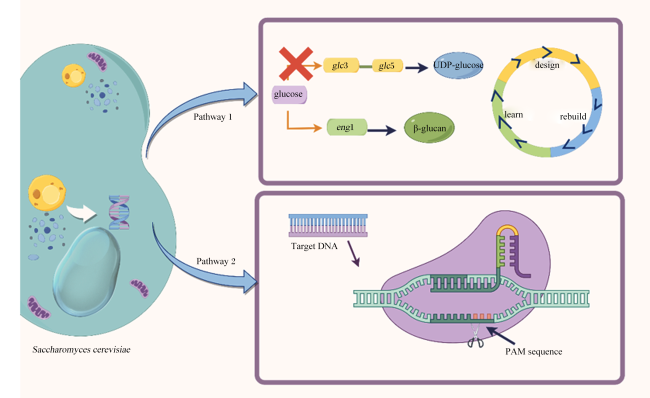
除基因编辑技术外,合成生物学在酿酒酵母的改造中应用也很广泛。合成生物学是交叉学科,融合了生物化学、生物医学和细胞生物学等多门学科,应用领域广泛,为酿酒酵母改造拓展了新的思路[22]。合成生物学包括代谢工程和基因工程。合成生物学提供了设计和优化新代谢通路的框架,通过模块化的方法,将生物体系分解为功能模块,然后重新组合这些模块以构建新的代谢路径[23]。此外,合成生物学还涉及到设计合适的调控元件,如启动子和终止子,采用人工构建和合成启动子的方法来调节基因表达,研究人员可以根据目标产物需求来选择相应的启动子[24-25],以确保每个模块在适当的时间和水平表达。
代谢工程是通过优化细胞遗传和调控过程改造酵母细胞的代谢通路,调整其产生目标代谢产物的能力,促进有益的代谢产物(抗生素或酶)的生产,或减少不利代谢产物的生成,还致力于加强细胞多底物利用的能力、改善菌株发酵性能和增强菌株的鲁棒性(如恶劣条件下的耐受性)[26]。Xu等[27]用胆固醇22-羟化酶构建薯蓣皂素(DSG)生物合成途径,筛选出了与DSG合成相关的细胞色素P450(CYP)与细胞色素P450还原酶(CPR)的最佳比例,提高DSG产量,同时削弱ERG6基因的表达,进一步增加DSG的合成并减少副产品形成。酿酒酵母常用的2种基因改造方式如图1
图1 酿酒酵母基因改造途径

glucose:葡萄糖;UDP-glucose:二磷酸尿苷-葡萄糖 uridine diphosphate-glucose;glc3和alg5:二磷酸尿苷-葡萄糖合成的关键基因 uridine diphosphate-a key gene for glucose synthesis;eng1:内切β-葡聚糖酶基因 endo-β-glucanase gene;β-glucan:β-葡聚糖;learn:学习;design:设计;rebuild:重建;Pathway 1:途径1;Pathway 2:途径2;PAM sequence:候选识别位点的毗邻基序 adjacent motifs of candidate recognition sites;Target DNA:目标DNA。

Fig.1 Pathways for genetic modification in Saccharomyces cerevisiae[28]

3 酿酒酵母改造的目的和用途

3.1 提高酿酒酵母发酵性能

相对于野生型酿酒酵母,经过基因编辑技术改造的酿酒酵母可发酵产生更多的乙醇和番茄红素。同时,改造后的酵母在发酵过程中能更有效地利用混合底物,并且表现出更强的耐高温和乙醇耐受性,通过这些性能的提高,在发酵过程中酿酒酵母的性能将会表现得更加突出。Ye等[29]研究发现,通过TALENs技术敲除乙醇脱氢酶基因之后,酿酒酵母的乙醇产量提高到14.6 g/L,比之前报道的乙醇产量比例提高了(52.4±5.3)%,且明显提高了酿酒酵母对乙醇的耐受性。孙玲等[30]利用CRISPR/Cas9基因编辑技术改造酿酒酵母,得到了多种甲羟戊酸途径改变的高拷贝菌株(14~40个拷贝),过量表达N-末端截短的关键酶基因,将酶活提高了17.3倍,能够更加高效地产生番茄红素。
在发酵过程中,混合底物中葡萄糖浓度较高时,葡萄糖会被优先利用,产生葡萄糖阻遏效应,即在有氧条件下酵母细胞也由有氧呼吸转变为无氧发酵产生大量乙醇,阻碍其他目标产物的生成[31]。因此,为了让酿酒酵母更加高效地产生目标产物,必须阻断细胞内葡萄糖阻遏效应,减少乙醇的通量。研究发现,核苷酸焦磷酸酶1(MTH1)基因编码葡萄糖感应相关的转录调控因子,参与抑制菌株的葡萄糖敏感性,当底物只有葡萄糖时,辅酶A转移酶(Ach1p)受到葡萄糖抑制而无法将线粒体中合成的乙酰辅酶A穿梭至胞质中,严重影响细胞的活性和生长,Oud等[32]通过删除MTH1基因的225 bp序列,增强了葡萄糖耐受性,使其能在以葡萄糖为唯一碳源的条件下生长。此外,在酿酒酵母中,MIG1和SNF1被视为葡萄糖阻遏效应的关键因素,对解除葡萄糖阻遏产生显著影响,当培养基中葡萄糖浓度较高时,转录因子MIG1会结合木糖代谢基因的启动子区域,从而阻碍这些基因的转录,抑制木糖的代谢。通过基因编辑技术靶向去除葡萄糖阻遏效应关键基因SNF1,是提高木糖利用时间、重塑代谢途径、减弱葡萄糖抑制效应、缩短发酵周期以及显著提升发酵效率的重要途经[33]
通过敲除手段进行遗传改造还可以明显提高酿酒酵母的耐热性。酵母的耐热性与转录因子丝氨酸-棕榈酰转移酶(stp23)有关,stp23在酿酒酵母的耐热性中发挥着广泛的作用,stp23可调节细胞中不饱和脂肪酸(ULA)含量,从而显著影响细胞的耐热性,且在45~55 ℃之间stp23的表达水平与耐热性呈负相关[34-35],通过敲除相关基因(Sin3pSrb2pMig1p)构建基因缺失株,改变转录调控网络来提高酿酒酵母的耐热性[36],通过各种遗传工具改造可以使酿酒酵母有效地应对高温、低pH和底物中存在的抑制性化合物[37-38]

3.2 提高酿酒酵母活性氧耐受性

酿酒酵母对一定量的活性氧具有耐受性[39],在发酵过程中高浓度活性氧的存在会影响发酵的稳定性和效率。Yap1转录因子是决定酿酒酵母活性氧耐受能力的主要因素,其需要与Ybp1结合来表达其功能,此外,Yap1和Ybp1结合是氧化应激的限速步骤,调节Ybp1的表达有助于改变酿酒酵母对活性氧的耐受性[40]。通过CRISPR基因编辑技术构造Ybp1高表达的菌株、优化培养条件和添加抗氧化剂可以提高酿酒酵母的活性氧耐受性[41]

3.3 生产功能性添加剂

通过基因编辑技术,酿酒酵母生产添加剂的产量有明显提高。酿酒酵母细胞外壁结构特点之一是含有β-葡聚糖,改造前最高产量为58.2 mg/g[42],通过CRISPR基因编辑技术,使酿酒酵母菌株进行基因重组,同时优化发酵工艺参数,使用CRISPR/Cas系统敲除该合成途径的关键基因glc3和alg5[43],切断UDP-葡萄糖的消耗途径,可使β-葡聚糖含量达到98.54 mg/g[28],而且还可以通过酿酒酵母本身的GLA系统,控制内切β-葡聚糖酶基因(eng1)表达,实现从头合成低分子质量的β-葡聚糖,使β-葡聚糖更容易溶解被动物利用[44]

4 酿酒酵母在动物生产中的应用

酿酒酵母作为优质的功能性与营养性饲料,被批准可以直接添加到动物饲粮中使用,在猪、畜禽和反刍动物中应用较为广泛,在其他动物中也有少数应用[45]。酿酒酵母作为饲料添加剂具有改善犬肠道菌群稳态、抑制肠道病原菌增殖[46]、提高犊牛饲料原料消化利用率和提高犊牛血液中总蛋白和葡萄糖含量等功能[47]。同时,酿酒酵母还可以增强饲料适口性,改善动物消化能力,提高动物生产性能[48]

4.1 在猪生产中的应用

在仔猪饲养中,饲粮中添加酿酒酵母可以作为抗生素替代物,提高断奶仔猪的生长性能和养分消化率。研究表明,在仔猪饲粮中添加1%的酿酒酵母,结果显示,该组的腹泻指数最低,能够有效缓解仔猪断奶后和运输的双重应激反应,可以显著提高断奶仔猪的生长性能[49]。Jiang等[50]在断奶仔猪的基础饲粮中添加3.00 g/kg酿酒酵母,试验第7天观察发现试验组断奶仔猪十二指肠和空肠的绒毛高度和绒毛高度与隐窝深度比率显著增加。除了提高生长性能、促进肠道发育,研究还发现,在仔猪饲粮中添加5.00 g/kg酿酒酵母还可调控仔猪肠道微生物组成,促进仔猪肠道有益菌的增殖,减少腹泻现象的发生,以提高仔猪消化率,提高仔猪的生长性能[51-52]
除仔猪外,酿酒酵母在生长育肥猪和母猪中也有一定的研究和应用。饲粮中添加酵母水解物可以提高生长育肥猪生长性能和营养物质消化率,调节肠道菌群平衡,提高机体免疫力。饲粮添加凝结芽孢杆菌和酵母水解产物,能够提高生长育肥猪的生长性能和营养物质消化率,使猪后肠有益菌数量增加,提高机体的免疫力[53]。在母猪的饲粮中添加5%的酿酒酵母,可以提高母猪的生长性能和繁殖性能,同时起到减缓妊娠应激反应[54]。对生产的母猪来说,饲粮中添加5.00 g/kg酿酒酵母可以提高仔猪的初生重,显著减少母猪产后奶水不足及产后感染的问题,减少母猪生殖道感染的比例,减轻母猪的产后应激反应[55]。相较而言,酿酒酵母在仔猪饲粮中的作用明显高于生长育肥猪和母猪。

4.2 在禽类动物生产中的应用

有大量的研究已经证实,在禽类的饲粮中添加酿酒酵母可以改善其生长性能,调节肠道菌群,提高机体的免疫功能。Zhen等[56]研究表明,在肉鸡的饲粮中添加0.8%~1.0%的酿酒酵母,能显著提高瘤胃球菌属(Ruminococcus)、丙酸杆菌科(Propionibacteriaceae)、双歧杆菌属(Bifidobacterium)的数量,从而改善肉鸡的肠道微生物组成结构。胡芳等[57]研究表明,在蛋鸡饲粮中适当添加酿酒酵母可以提高蛋鸡的采食量及饲料转化率,维持产蛋后期蛋鸡的产蛋率,还能够明显提高蛋重及蛋品质。Mcbain等[58]研究表明,天冬氨酸有抗疲劳、改善心肌收缩等作用。在蛋鸡的饲粮中加入0.6%和0.8%的酿酒酵母,显著提高了鸡蛋中天冬氨酸的含量,这表明添加酿酒酵母对功能性氨基酸的沉积有促进作用[59]。高文文等[60]以北京鸭为研究对象,在试验组饲粮中添加1.2 g/kg的酿酒酵母,结果表明可改善北京鸭的生产性能,同时提高北京鸭的免疫和抗氧化能力。

4.3 在反刍动物生产中的应用

酿酒酵母不仅在单胃动物生产上有很好的应用效果,在反刍动物生产上应用也很广泛。郭永清等[61]研究发现,在断奶肉犊牛的饲粮中添加酿酒酵母(1%和2%,按干物质计),均能够显著提升其干物质采食量、平均日增重(ADG)、饲料转化效率、瘤胃纤维素酶活性、瘤胃微生物蛋白水平、瘤胃丙酸与挥发性脂肪酸的浓度。Dann等[62]研究表明,在断奶肉犊牛的饲粮中添加14 g/d酿酒酵母能够提高ADG以及干物质和有机物的消化率。也有研究表明,在肉牛的饲粮中添加酿酒酵母30 g/(头·d),可以提高牛肉的嫩度和风味,降低背最长肌的滴水损失[63]
对于泌乳期的奶牛,在饲粮中添加酿酒酵母,可以提升奶牛产奶量,还可以降低其体重损失[64]。在夏季高温环境中,在泌乳期奶牛的饲粮中添加酿酒酵母,能够显著提高奶牛的产奶量及牛奶中乳蛋白和乳糖含量[65]。在巴西夏季奶牛饲粮中补充酵母培养物,能够降低奶牛的呼吸频率、直肠温度和皮肤温度,防止奶牛体温过高[66]
在饲粮中添加酿酒酵母不仅对奶牛和肉牛有积极效果,对肉羊的生产也有很好的养殖效果。Malekkhahi等[67]研究表明,在俾路支雄性肉羔羊的饲粮中添加2×10¹⁰ CFU/d的酿酒酵母可以显著提高饲粮中性洗涤纤维和粗蛋白质的消化率。有研究表明,在2月龄健康湖羊公羔的饲粮中添加1%酵母培养物,提高羔羊对粗饲料的利用率[68]。挑选装有瘤胃瘘管的健康萨能山羊为研究对象,在其饲粮中添加2%的酵母培养物,可以降低亚急性瘤胃酸中毒概率[69]。此外,添加10 g/d的酿酒酵母可提高育肥湖羊后期的生长性能和机体的健康程度[70]

4.4 在水产动物生产中的应用

酿酒酵母及其衍生物在水产动物的饲料中也能产生健康益处。Adeoye等[71]研究发现,在非洲鲶鱼饲料中添加3 g/kg的酿酒酵母,能对其生长发育起到促进作用。Hassaan等[72]在罗非鱼饲料中添加酿酒酵母15 g/kg,发现肝细胞和绒毛发生改变,酿酒酵母在其体内产生酵母核苷酸,从而达到改善肝脏功能的目的,同时还可以促进罗非鱼肝脏和肠道的恢复。
酿酒酵母在动物饲粮中的应用见表1
表1 酿酒酵母在动物饲粮中的应用

Table 1 Application of Saccharomyces cerevisiae in animal diets

动物种类
Animal species
添加量
Addition amount
作用
Function
参考文献
References
仔猪 Piglet 3.00~6.00 g/kg 增加仔猪小肠的吸收面积,缓解仔猪断奶后
应激反应,提高免疫力
[50,52,73]
育肥猪 Fattening pig 10% 提高育肥猪粗蛋白质、氨基酸和膳食纤维的消化率 [74]
母猪 Sow 5%~15% 提高母猪对饲粮中氨基酸、脂肪酸和糖类的利用率,提高
繁殖性能,加快产后母猪采食量的恢复,缩短断奶发情间隔
[75-76]
禽类 Poultry 0.8%~1.0% 提高禽类的生产性能和抗氧化能力 [58-59]
奶牛 Dairy cow 20 g/(头·d) 缓解奶牛热应激,提高热应激下奶牛采食量和
产奶量,增强抗氧化能力
[77]
肉牛 Beef cattle 150 g/d 提高肉牛干物质采食量、平均日增重、背膘厚度和
大理石纹等级,还可以提升抗氧化能力和免疫性能
[78-79]
水产动物
Aquatic animal
3~15 g/kg 促进鱼类的生长发育和肠道的发育,提高抗氧化性能 [71-72]

5 小结

随着畜牧业的不断发展以及发酵技术的不断提高,酿酒酵母在动物生产领域使用频率越来越高。酿酒酵母通过基因编辑技术改造,得到许多优势高产菌株,但改造技术仍有许多需改进的地方,例如,CRISPR/Cas系统存在sgRNA效率不稳定[80]、CRISPR基因编辑技术脱靶概率很高和多编辑效率低[81-82]等问题,阻碍酵母改造的发展。近些年,合成生物学技术的快速发展和国内养殖业蛋白质饲料资源短缺,微生物饲料蛋白质成为生物工程制造研发的重点领域。未来合成生物学和基因编辑技术的结合将在酿酒酵母改造方面研究的越来越深入,使酿酒酵母改造变得更快捷、高效,能更加有效地生产目标产品,实现畜牧业持续健康绿色的发展。
[1]
LITI G. The fascinating and secret wild life of the budding yeast S.cerevisiae[J]. ELife, 2015, 4:e05835.

DOI

[2]
PEREIRA R, WEI Y J, MOHAMED E, et al. Adaptive laboratory evolution of tolerance to dicarboxylic acids in Saccharomyces cerevisiae[J]. Metabolic Engineering, 2019, 56:130-141.

DOI

[3]
FLETCHER E, KRIVORUCHKO A, NIELSEN J. Industrial systems biology and its impact on synthetic biology of yeast cell factories[J]. Biotechnology and Bioengineering, 2016, 113(6):1164-1170.

DOI PMID

[4]
张弦, 章亭洲, 瞿明仁. 活性干酵母及酵母培养物在反刍动物中的研究进展与应用[J]. 动物营养学报, 2022, 34(1):20-29.

DOI

ZHANG X, ZHANG T Z, QU M R. Research progress and application of active dry yeast and yeast culture in ruminants[J]. Chinese journal of animal nutrition, 2022, 34(1):20-29. (in Chinese)

[5]
SONG J Y, PARK J S, KANG C D, et al. Introduction of a bacterial acetyl-CoA synthesis pathway improves lactic acid production in Saccharomyces cerevisiae[J]. Metabolic Engineering, 2016, 35:38-45.

DOI

[6]
黎鹏. 产烷基间苯二酚的酿酒酵母工程菌株的构建及代谢改造[D]. 硕士学位论文. 镇江: 江苏科技大学, 2019.

LI P. The construction and metabolic transformation of alkylresorcinol producing engineering Saccharomyces cerevisiae[D]. Master’s Thesis. Zhenjiang: Jiangsu University of Science and Technology, 2019. (in Chinese)

[7]
陈小玲, 廖东庆, 黄尚飞, 等. 利用CRISPR/Cas9 系统改造酿酒酵母的研究进展[J]. 生物技术通报, 2023, 39(8):148-158.

DOI

CHEN X L, LIAO D Q, HUANG S F, et al. Advances in CRISPR/Cas9 system modifying Saccharomyces cerevisiae[J]. Biotechnology Bulletin, 2023, 39(8):148-158. (in Chinese)

[8]
张雅琦. 利用木糖产乙醇酿酒酵母基因工程菌的构建及其代谢机制解析[D]. 硕士学位论文. 北京: 北京化工大学, 2022.

ZHANG Y Q. Construction of genetically engineered strain of Saccharomyces cerevisiae using xylose for ethanol production and analysis of its metabolic mechanism[D]. Master’s Thesis. Beijing: Beijing University of Chemical Technology, 2022. (in Chinese)

[9]
YANG Z L, BLENNER M. Genome editing systems across yeast species[J]. Current Opinion in Biotechnology, 2020, 66:255-266.

DOI PMID

[10]
WANG X, WANG Z, DA SILVA N A. G418 selection and stability of cloned genes integrated at chromosomal delta sequences of Saccharomyces cerevisiae[J]. Biotechnology and Bioengineering, 1996, 49(1):45-51.

DOI

[11]
李宏彪, 梁晓琳, 周景文. 酿酒酵母基因编辑技术研究进展[J]. 生物工程学报, 2021, 37(3):950-965.

LI H B, LIANG X L, ZHOU J W. Progress in gene editing technologies for Saccharomyces cerevisiae[J]. Chinese Journal of Biotechnology, 2021, 37(3):950-965. (in Chinese)

[12]
HSU P D, LANDER E S, ZHANG F. Development and applications of CRISPR-Cas9 for genome engineering[J]. Cell, 2014, 157(6):1262-1278.

DOI PMID

[13]
HWANG W Y, FU Y F, REYON D, et al. Efficient genome editing in zebrafish using a CRISPR-Cas system[J]. Nature Biotechnology, 2013, 31(3):227-229.

DOI PMID

[14]
SWARTS D C, MOSTERD C, VAN PASSEL M W J, et al. CRISPR interference directs strand specific spacer acquisition[J]. PLoS One, 2012, 7(4):e35888.

DOI

[15]
MAKAROVA K S, HAFT D H, BARRANGOU R, et al. Evolution and classification of the CRISPR-Cas systems[J]. Nature Reviews.Microbiology, 2011, 9(6):467-477.

[16]
DICARLO J E, NORVILLE J E, MALI P, et al. Genome engineering in Saccharomyces cerevisiae using CRISPR-Cas systems[J]. Nucleic Acids Research, 2013, 41(7):4336-4343.

DOI

[17]
MENG J, QIU Y, SHI S B. CRISPR/Cas9 systems for the development of Saccharomyces cerevisiae cell factories[J]. Frontiers in Bioengineering and Biotechnology, 2020, 8:94347.

[18]
YANG P Z, JIANG S Y, JIANG S W, et al. CRISPR-Cas9 approach constructed engineered Saccharomyces cerevisiae with the deletion of GPD2,FPS1,and ADH2 to enhance the production of ethanol[J]. Journal of Fungi, 2022, 8(7):703.

DOI

[19]
JACOBUS A P, BARRETO J A, DE BEM L S, et al. EasyGuide plasmids support in vivo assembly of gRNAs for CRISPR/Cas9 applications in Saccharomyces cerevisiae[J]. ACS Synthetic Biology, 2022, 11(11):3886-3891.

DOI

[20]
RONDA C, MAURY J, JAKOČIUNAS T, et al. CrEdit:CRISPR mediated multi-loci gene integration in Saccharomyces cerevisiae[J]. Microbial Cell Factories, 2015, 14:97.

DOI

[21]
SHI S B, LIANG Y Y, ZHANG M M, et al. A highly efficient single-step,markerless strategy for multi-copy chromosomal integration of large biochemical pathways in Saccharomyces cerevisiae[J]. Metabolic Engineering, 2016, 33:19-27.

DOI

[22]
阿茹娜, 郑婉颖, 俞如旺. 合成生物学及其应用研究概述[J]. 生物学教学, 2019, 44(10):5-8.

ARUNA, ZHENG W Y, YU R W. A brief review on synthetic biology and its application[J]. Biology Teaching, 2019, 44(10):5-8. (in Chinese)

[23]
RAMZI A B. Metabolic engineering and synthetic biology[J]. Advances in Experimental Medicine and Biology, 2018, 1102:81-95.

DOI PMID

[24]
BLAZECK J, GARG R, REED B, et al. Controlling promoter strength and regulation in Saccharomyces cerevisiae using synthetic hybrid promoters[J]. Biotechnology and Bioengineering, 2012, 109(11):2884-2895.

DOI

[25]
CURRAN K A, CROOK N C, KARIM A S, et al. Design of synthetic yeast promoters via tuning of nucleosome architecture[J]. Nature Communications, 2014, 5:4002.

DOI PMID

[26]
OSTERGAARD S, OLSSON L, NIELSEN J. Metabolic engineering of Saccharomyces cerevisiae[J]. Microbiology and Molecular Biology Reviews, 2000, 64(1):34-50.

DOI

[27]
XU L P, WANG D, CHEN J, et al. Metabolic engineering of Saccharomyces cerevisiae for gram-scale diosgenin production[J]. Metabolic Engineering, 2022, 70:115-128.

DOI

[28]
李茜. 代谢工程改造酿酒酵母高效合成β-葡聚糖[D]. 硕士学位论文. 无锡: 江南大学, 2022.

LI Q. Metabolic engineering of Saccharomyces cerevisiae to synthesize β-glucan efficiently[D]. Master’s Thesis. Wuxi: Jiangnan University, 2022. (in Chinese)

[29]
YE W, ZHANG W M, LIU T M, et al. Improvement of ethanol production in Saccharomyces cerevisiae by high-efficient disruption of the ADH2 gene using a novel recombinant TALEN vector[J]. Frontiers in Microbiology, 2016, 7:1067.

[30]
孙玲, 王均华, 蒋玮, 等. 高效合成番茄红素酿酒酵母菌株的构建[J]. 生物工程学报, 2020, 36(7):1334-1345.

SUN L, WANG J H, JIANG W, et al. Construction of a highly efficient synthetic lycopene engineered Saccharomyces cerevisiae[J]. Chinese Journal of Biotechnology, 2020, 36(7):1334-1345. (in Chinese)

[31]
KAYIKCI Ö, NIELSEN J. Glucose repression in Saccharomyces cerevisiae[J]. FEMS Yeast Research, 2015, 15(6):fov068.

DOI

[32]
OUD B, FLORES C L, GANCEDO C, et al. An internal deletion in MTH1 enables growth on glucose of pyruvate-decarboxylase negative,non-fermentative Saccharomyces cerevisiae[J]. Microbial Cell Factories, 2012, 11:131.

DOI

[33]
MAYER F V, HEATH R, UNDERWOOD E, et al. ADP regulates SNF1,the Saccharomyces cerevisiae homolog of AMP-activated protein kinase[J]. Cell Metabolism, 2011, 14(5):707-714.

DOI

[34]
LU Z L, WU Y L, CHEN Y, et al. Role of spt23 in Saccharomyces cerevisiae thermal tolerance[J]. Applied Microbiology and Biotechnology, 2022, 106(9/10):3691-3705.

DOI

[35]
WINGENDER E, CHEN X, FRICKE E, et al. The TRANSFAC system on gene expression regulation[J]. Nucleic Acids Research, 2001, 29(1):281-283.

PMID

[36]
GAN Y M, QI X N, LIN Y P, et al. A hierarchical transcriptional regulatory network required for long-term thermal stress tolerance in an industrial Saccharomyces cerevisiae strain[J]. Frontiers in Bioengineering and Biotechnology, 2021, 9:826238.

DOI

[37]
BORODINA I, NIELSEN J. Advances in metabolic engineering of yeast Saccharomyces cerevisiae for production of chemicals[J]. Biotechnology Journal, 2014, 9(5):609-620.

DOI

[38]
HONG K K, NIELSEN J. Metabolic engineering of Saccharomyces cerevisiae:a key cell factory platform for future biorefineries[J]. CMLS-Cellular and Molecular Life Sciences, 2012, 69(16):2671-2690.

DOI

[39]
CARRASCO P, QUEROL A, DEL OLMO M. Analysis of the stress resistance of commercial wine yeast strains[J]. Archives of Microbiology, 2001, 175(6):450-457.

PMID

[40]
GULSHAN K, LEE S S, MOYE-ROWLEY W S. Differential oxidant tolerance determined by the key transcription factor Yap1 is controlled by levels of the Yap1-binding protein,Ybp1[J]. Journal of Biological Chemistry, 2011, 286(39):34071-34081.

DOI

[41]
ZHAO F L, DU Y H, BAI P, et al. Enhancing Saccharomyces cerevisiae reactive oxygen species and ethanol stress tolerance for high-level production of protopanoxadiol[J]. Bioresource Technology, 2017, 227:308-316.

DOI

[42]
ZHOU X, HE J, WANG L L, et al. Metabolic engineering of Saccharomyces cerevisiae to improve glucan biosynthesis[J]. Journal of Microbiology and Biotechnology, 2019, 29(5):758-764.

DOI

[43]
FENG Y Y, YAO M D, WANG Y, et al. Advances in engineering UDP-sugar supply for recombinant biosynthesis of glycosides in microbes[J]. Biotechnology Advances, 2020, 41:107538.

DOI

[44]
GARFOOT A L, SHEN Q, WÜTHRICH M, et al. The Eng1 β-glucanase enhances histoplasma virulence by reducing β-glucan exposure[J]. mBio, 2016, 7(2):e01388-15.

[45]
丁斌, 邢爽, 刘露, 等. 酿酒酵母在动物生产中的应用研究进展[J]. 饲料研究, 2019, 42(7):114-116.

DING B, XING S, LIU L, et al. Research progress on application of Saccharomyces cerevisiae in animal production[J]. Feed Research, 2019, 42(7):114-116. (in Chinese)

[46]
VAN DEN ABBEELE P, DUYSBURGH C, RAKEBRANDT M, et al. Dried yeast cell walls high in beta-glucan and mannan-oligosaccharides positively affect microbial composition and activity in the canine gastrointestinal tract in vitro[J]. Journal of Animal Science, 2020, 98(6):skaa173.

DOI

[47]
孔义川. 酿酒酵母培养物对犊牛生长性能、血液生化和瘤胃发酵特性的影响[J]. 中国饲料, 2018(14):42-46.

KONG Y C. Effects of Saccharomyces cerevisiae culture on growth performance,blood biochemistry and rumen fermentation on in calf[J]. China Feed, 2018(14):42-46. (in Chinese)

[48]
GAYATHRI R, ARUNA T, MALAR S, et al. Efficacy of Saccharomyces cerevisiae CNCM I-3856 as an add-on therapy for irritable bowel syndrome[J]. International Journal of Colorectal Disease, 2020, 35(1):139-145.

DOI

[49]
ZHANG J, HU J, JIAO Y, et al. PSXVII-11 effect of supplementation with brewer yeast hydrolysate on growth performance,blood profile,fecal score,fecal microbial,and rectal temperature in weanling pigs challenged with lipopolysaccharide[J]. Journal of Animal Science, 2018, 96(Suppl.3):337-338.

[50]
JIANG Z Y, WEI S Y, WANG Z L, et al. Effects of different forms of yeast Saccharomyces cerevisiae on growth performance,intestinal development,and systemic immunity in early-weaned piglets[J]. Journal of Animal Science and Biotechnology, 2015, 6:47.

DOI

[51]
SHEN Y B, PIAO X S, KIM S W, et al. Effects of yeast culture supplementation on growth performance,intestinal health,and immune response of nursery pigs[J]. Journal of Animal Science, 2009, 87(8):2614-2624.

DOI

[52]
XING S, ZHANG B L, LIN M, et al. Effects of alanyl-glutamine supplementation on the small intestinal mucosa barrier in weaned piglets[J]. Asian-Australasian Journal of Animal Sciences, 2017, 30(2):236-245.

DOI PMID

[53]
FU R Q, CHEN D W, TIAN G, et al. Effect of dietary supplementation of Bacillus coagulans or yeast hydrolysates on growth performance,antioxidant activity,cytokines and intestinal microflora of growing-finishing pigs[J]. Animal Nutrition, 2019, 5(4):366-372.

DOI

[54]
刘丽, 刘倩. 酵母及其培养物在动物生产中的应用[J]. 上海畜牧兽医通讯, 2012(4):57-58.

LIU L, LIU Q. Application of yeasts and their cultures in animal production[J]. Shanghai Journal of Animal Husbandry and Veterinary Medicine, 2012(4):57-58. (in Chinese)

[55]
罗强, 李宁, 郑梓, 等. 酿酒酵母培养物对哺乳母猪繁殖性能的影响[J]. 家畜生态学报, 2021, 42(12):67-72.

LUO Q, LI N, ZHENG Z, et al. Effect of yeast culture on reproductive performance of lactating sows[J]. Acta Ecologae Animalis Domastici, 2021, 42(12):67-72. (in Chinese)

[56]
ZHEN Y G, ZHAO W, CHEN X, et al. Effects of yeast culture on broiler growth performance,nutrient digestibility and caecal microbiota[J]. South African Journal of Animal Science, 2019, 49(1):99-108.

DOI

[57]
胡芳, 项性龙, 刘建忠, 等. 酿酒酵母培养物对产蛋后期蛋鸡产蛋性能的影响研究[J]. 安徽农业科学, 2019, 47(12):111-114,126.

HU F, XIANG X L, LIU J Z, et al. Effect of saccharomyces cerevisiae culture on the laying performance of layers in late laying stage[J]. Journal of Anhui Agricultural Sciences, 2019, 47(12):111-114,126. (in Chinese)

[58]
MCBAIN C J, MAYER M L. N-methyl-D-aspartic acid receptor structure and function[J]. Physiological Reviews, 1994, 74(3):723-760.

PMID

[59]
陈脊宇, 何航, 王芬, 等. 酵母培养物对五黑鸡生产性能、蛋品质及血清生化指标的影响[J]. 动物营养学报, 2022, 34(4):2314-2323.

DOI

CHEN J Y, HE H, WANG F, et al. Effects of yeast culture on performance,egg quality and serum biochemical indices of Wuhei chickens[J]. Chinese Journal of Animal Nutrition, 2022, 34(4):2314-2323. (in Chinese)

[60]
高文文, 安柯颖, 李鹏, 等. 酿酒酵母菌对北京鸭生产性能、免疫和抗氧化功能的影响[J]. 中国畜牧杂志, 2022, 58(12):247-253.

GAO W W, AN K Y, LI P, et al. Effects of Saccharomyces cerevisiae on performance,immunity and antioxidant function of peking ducks[J]. Chinese Journal of Animal Science, 2022, 58(12):247-253. (in Chinese)

[61]
郭永清, 赵宇飞, 张小宇. 酵母培养物对断奶犊牛生长性能及瘤胃发酵的影响[J]. 饲料研究, 2019, 42(11):10-13.

GUO Y Q, ZHAO Y F, ZHANG X Y. Effect of yeast culture on growth performance and rumen fermentation of weaned calves[J]. Feed Research, 2019, 42(11):10-13. (in Chinese)

[62]
DANN H M, DRACKLEY J K, MCCOY G C, et al. Effects of yeast culture (Saccharomyces cerevisiae) on prepartum intake and postpartum intake and milk production of Jersey cows[J]. Journal of Dairy Science, 2000, 83(1):123-127.

PMID

[63]
杨顺然. 酵母培养物对肉牛生长性能、饲料效率和抗热应激能力的影响[D]. 硕士学位论文. 北京: 中国农业大学, 2023.

YANG S R. Effects of yeast culture on growth performance,feed efficiency,and heat stress resistance in beef cattle[D]. Master’s Thesis. Beijing: China Agricultural University, 2023. (in Chinese)

[64]
DANN H M, DRACKLEY J K, MCCOY G C, et al. Effects of yeast culture (Saccharomyces cerevisiae) on prepartum intake and postpartum intake and milk production of Jersey cows[J]. Journal of Dairy Science, 2000, 83(1):123-127.

PMID

[65]
POPPY G D, RABIEE A R, LEAN I J, et al. A meta-analysis of the effects of feeding yeast culture produced by anaerobic fermentation of Saccharomyces cerevisiae on milk production of lactating dairy cows[J]. Journal of Dairy Science, 2012, 95(10):6027-6041.

DOI

[66]
DIAS J D L, SILVA R B, FERNANDES T, et al. Yeast culture increased plasma niacin concentration,evaporative heat loss,and feed efficiency of dairy cows in a hot environment[J]. Journal of Dairy Science, 2018, 101(7):5924-5936.

DOI

[67]
MALEKKHAHI M, TAHMASBI A M, NASERIAN A A, et al. Effects of essential oils,yeast culture and malate on rumen fermentation,blood metabolites,growth performance and nutrient digestibility of Baluchi lambs fed high-concentrate diets[J]. Journal of Animal Physiology and Animal Nutrition, 2015, 99(2):221-229.

DOI

[68]
张娜娜, 王文盼, 李飞, 等. 饲粮酵母培养物水平对湖羊生长育肥性能和营养物质表观消化率的影响[J]. 家畜生态学报, 2023, 44(11):42-46.

ZHANG N N, WANG W P, LI F, et al. Effect of dietary yeast culture level on growth,fattening performance and apparent digestibility of nutrients in Hu sheep[J]. Journal of Domestic Animal Ecology, 2023, 44(11):42-46. (in Chinese)

[69]
任胜男, 金亚倩, 赵芳芳, 等. 酵母培养物对山羊亚急性瘤胃酸中毒体外发酵模型的调控作用[J]. 动物营养学报, 2020, 32(5):2263-2272.

DOI

REN S N, JIN Y Q, ZHAO F F, et al. Regulating effects of yeast culture on subacute ruminal acidosis fermentation model in vitro in goats[J]. Chinese Journal of Animal Nutrition, 2020, 32(5):2263-2272. (in Chinese)

[70]
赵国宏, 王世国, 王芬, 等. 饲粮添加不同水平酵母培养物对育肥湖羊生长性能、屠宰性能、内脏器官发育及肉品质的影响[J]. 动物营养学报, 2020, 32(5):2273-2281.

DOI

ZHAO G H, WANG S G, WANG F, et al. Effects of dietary different supplemental levels of yeast culture on growth performance,slaughter performance,visceral organ development and meat quality of fattening Hu sheep[J]. Chinese Journal of Animal Nutrition, 2020, 32(5):2273-2281. (in Chinese)

[71]
ADEOYE A A. OBASA S O, FAWOLE F J, et al. Dietary supplementation of autolysed yeast enhances growth,liver functionality and intestinal morphology in African catfish[J]. Aquaculture Nutrition, 2020, 26(3):772-780.

DOI

[72]
HASSAAN M S. MAHMOUD S A, JARMOLOWICZ S. Effects of dietary baker’s yeast extract on the growth,blood indices and histology of Nile tilapia (Oreochromis niloticus L.) fingerlings[J]. Aquaculture Nutrition, 2018, 24(6):1709-1717.

DOI

[73]
殷成港, 李习龙, 蒋显仁. 酵母水解物的生物学功能及其在猪生产中的应用[J]. 动物营养学报, 2022, 34(6):3435-3442.

DOI

YIN C G, LI X L, JIANG X R. Biological functions of yeast hydrolysate and its application in pig production[J]. Chinese Journal of Animal Nutrition, 2022, 34(6):3435-3442. (in Chinese)

DOI

[74]
BOONTIAM W, BUNCHASAK C, KIM Y Y, et al. Hydrolyzed yeast supplementation to newly weaned piglets:growth performance,gut health,and microbial fermentation[J]. Animals, 2022, 12(3):350.

DOI

[75]
ZHANG S H, WU Z H, HENG J H, et al. Combined yeast culture and organic selenium supplementation during late gestation and lactation improve preweaning piglet performance by enhancing the antioxidant capacity and milk content in nutrient-restricted sows[J]. Animal Nutrition, 2020, 6(2):160-167.

DOI PMID

[76]
XU J, LI Y, YANG Z, et al. Yeast probiotics shape the gut microbiome and improve the health of early-weaned piglets[J]. Front Microbiol, 2018, 9:2011.

DOI PMID

[77]
DESNOYERS M, DUVAUX-PONTER C, RIGALMA K, et al. Effect of concentrate percentage on ruminal pH and time-budget in dairy goats[J]. Animal, 2008, 2(12):1802-1808.

DOI PMID

[78]
WAGNER J J, ENGLE T E, BELKNAP C R, et al. Meta-analysis examining the effects of Saccharomyces cerevisiae fermentation products on feedlot performance and carcass traits1,2,3[J]. The Professional Animal Scientist, 2016, 32(2):172-182.

DOI

[79]
孙俊峰. 日粮添加不同水平的酵母培养物对肉牛屠宰性能的影响[J]. 畜牧兽医杂志, 2022, 41(5):47-48,51.

SUN J F. Effects of dietary supplementation of different levels of yeast culture on beef cattle slaughter performance[J]. Journal of Animal Science and Veterinary Medicine, 2022, 41(5):47-48,51. (in Chinese)

[80]
NIDHI S, ANAND U, OLEKSAK P, et al. Novel CRISPR-Cas systems:an updated review of the current achievements,applications,and future research perspectives[J]. International Journal of Molecular Sciences, 2021, 22(7):3327.

DOI

[81]
RAN F A, HSU P D, WRIGHT J, et al. Genome engineering using the CRISPR-Cas9 system[J]. Nature Protocols, 2013, 8(11):2281-2308.

DOI PMID

[82]
PATTANAYAK V, LIN S, GUILINGER J P, et al. High-throughput profiling of off-target DNA cleavage reveals RNA-programmed Cas9 nuclease specificity[J]. Nature Biotechnology, 2013, 31(9):839-843.

DOI PMID

Outlines

/