RESEARCH PAPER

Effects of Kelp Hydrolysate on Growth Performance, Meat Quality and Intestinal Morphology of Growing-Finishing Pigs

  • QU Yuankai , 1 ,
  • LI Mingtan 1 ,
  • ZANG Jianjun , 2, *
Expand
  • 1 Weihai Shidai Marine Biological Technology Co., Ltd., Weihai 264319, China
  • 2 College of Animal Science and Technology, China Agricultural University, Beijing 100193, China
*professor, E-mail:

Received date: 2023-09-22

  Online published: 2024-03-13

Abstract

This experiment was conducted to investigate the effects of kelp hydrolysate on growth performance, meat quality and intestinal health of growing-finishing pigs. A total of 200 growing-finishing pigs [(45.3±7.5) kg] were randomly divided into 5 groups (5 replicates per group and 8 pigs per replicate): the control group were fed a basal diet, and pigs in the experimental groups were fed the basal diet supplemented with 5, 10, 15 and 25 kg/t kelp hydrolysate, respectively. The experiment lasted for 84 days. The results showed as follows: compared with the control group, 1) dietary supplemented with 10 kg/t kelp hydrolysate significantly decreased the ratio of feed to gain in the whole period (P<0.05), and significantly increased the average daily gain on days 29 to 56 (P<0.05); 2) the supplementation of 15 kg/t kelp hydrolysate significantly increased the redness value of longissimus muscle of slaughter back (P<0.05); 3) adding 15 and 25 kg/t of kelp hydrolysate significantly increased the villus height of jejunum and ileum of finishing pigs (P<0.05). In conclusion, addition of kelp hydrolysate can improve pig growth performance, meat quality and intestinal morphology; based on the results of this experiment, adding 10 to 15 kg/t of kelp hydrolysate into the growing-finishing pig diet is suggested.

Cite this article

QU Yuankai , LI Mingtan , ZANG Jianjun . Effects of Kelp Hydrolysate on Growth Performance, Meat Quality and Intestinal Morphology of Growing-Finishing Pigs[J]. Chinese Journal of Animal Nutrition, 2024 , 36(3) : 1549 -1561 . DOI: 10.12418/CJAN2024.137

2020年全面禁抗以前,我国养殖业存在抗生素滥用的现象,长期不规范使用抗生素会对生猪造成诸如免疫机能下降等不利影响,也会污染环境[1]。社会对动物健康、畜产品质量安全和环境保护的关注日益增加,全面禁止在饲粮中添加抗生素的政策出台后,开发绿色健康的饲料添加剂显得尤为重要。海带粉是从海带中提取的天然产物,富含蛋白质、维生素、矿物质和多种生物活性化合物[2],它含有丰富的多糖类物质、褐藻酸和藻胶等成分,这些物质对畜禽的生长和健康有益[3]。海带粉还含有丰富的抗氧化物质,有助于提高动物的免疫力和抗氧化能力[4]。海带粉在猪饲粮中的应用可以提高生长性能和肉品质[5]。在家禽方面,海带粉的添加可改善蛋品质和抗氧化能力[6-7]
酶解海带粉在酶解的过程中海带细胞壁破裂而释放出更多营养物质与活性物质,不仅使胞内成分得到有效释放[8],而且在畜禽饲粮中具有更大的开发利用潜力。然而,目前关于酶解海带粉对生长育肥猪的生长性能、肉品质和肠道健康的影响还鲜有报道。因此,本试验旨在通过生长育肥猪无抗饲粮中添加不同水平酶解海带粉,探究其对生长育肥猪生长性能、肉品质和肠道健康的影响,以推荐其适宜添加量。

1 材料与方法

1.1 试验设计

选取200头杜×长×大三元杂交生长猪[(45.3±7.5) kg],按照完全随机区组试验设计原则分为5组,每组5个重复,每个重复8头猪,公母各占1/2。对照组饲喂不添加海带酶解物的基础饲粮(粉料),营养水平满足NRC(2012)推荐标准,基础饲粮组成及营养水平见表1。试验组饲喂在基础饲粮中分别添加5、10、15和25 kg/t海带酶解物(海藻寡糖≥80 g/kg,海藻多糖≥40 g/kg,甜菜碱≥800 mg/kg)的试验饲粮。试验期84 d。试验在国家饲料工程技术研究中心丰宁动物试验基地进行。舍内温度、湿度、二氧化碳和氨浓度自动控制,试验期间猪舍环境控制目标温度为24~26 ℃,群养猪栏(2.2 m× 2.5 m)为半漏粪地面,铸铁地板,不锈钢可调式料槽,乳头式饮水器。粉料饲喂,自由采食和饮水。
表1 基础饲粮组成及营养水平(风干基础)

Table 1 Composition and nutrient levels of basal diets (air-dry basis) %

项目 Items 50~75 kg 76~100 kg 101~120 kg
原料Ingredients
玉米 Corn 71.70 70.70 70.70
去皮豆粕 Dehulled soybean meal 16.00 14.00 12.00
小麦麸 Wheat bran 7.00 10.00 12.00
脂肪粉 Fat powder 1.50 1.50 1.50
石粉 Limestone 1.00 1.00 1.00
磷酸氢钙 CaHPO4 0.80 0.80 0.80
食盐 NaCl 0.40 0.40 0.40
氯化胆碱 Choline chloride 0.20 0.20 0.20
L-赖氨酸 L-Lys 0.38 0.38 0.38
DL-蛋氨酸 DL-Met 0.05 0.05 0.05
苏氨酸Threonine 0.12 0.12 0.12
色氨酸 Tryptophan 0.05 0.05 0.05
三氧化二铬 Cr2O3 0.30 0.30 0.30
预混料 Premix1) 0.50 0.50 0.50
合计 Total 100.00 100.00 100.00
营养水平Nutrient levels2)
代谢能 ME/(MJ/kg) 13.65 13.62 13.59
干物质 DM 84.15 84.20 84.17
粗蛋白质 CP 15.72 14.93 13.45
钙 Ca 0.67 0.62 0.59
总磷 TP 0.50 0.47 0.44

1)预混料为每千克饲粮提供 The premix provided the following per kg of diets:VA 8 000 IU,VB1 4 mg,VB2 3.6 mg,VB5 40 mg,VB6 4 mg,VB12 0.02 mg,VD3 3 000 IU,VE 20 IU,VK3 2 mg,生物素biotin 0.15 mg,叶酸 folic acid 1.0 mg,D-泛酸 D-pantothenic acid 11 mg,烟酸 nicotinic acid 10 mg,抗氧化剂 antioxidant 100 mg,Cu (as copper sulfate) 10 mg,Fe (as ferrous sulfate) 80 mg,Mn (as manganese sulfate) 80 mg,Zn (as zinc sulfate) 75 mg,I (as potassium iodide)0.40 mg,Se (as sodium selenite) 0.30 mg。

2)代谢能为计算值,其余指标均为实测值。ME was a calculated value, while the others were measured values.

1.2 饲粮营养成分测定

从配制好的试验饲粮中各取50 g样品,按照四分法再次取样后放于密封袋中,于-4 ℃冷库保存,在检测样品前使用高速粉碎机粉碎,过40目筛后于密封袋中保存待测。代谢能参考《中国猪营养需要》猪常用饲料营养价值计算[9];干物质、粗蛋白质、钙、总磷和铬含量测定分别按照GB/T 6435—2006、GB/T 6432—1994、GB/T 6436—2002、GB/T 6437—2002和GB/T 13088—2006方法[10-14]

1.3 生长性能测定

在试验第1、28、56和84天(前1天晚上空腹)早上喂料前分别称量生长育肥猪个体重、结料,计算平均日增重(ADG)、平均日采食量(ADFI)和料重比(F/G)。

1.4 营养物质表观消化率测定

营养物质表观消化率的测定采用三氧化二铬指示剂法,饲粮营养物质表观消化率计算公式如下:
饲粮营养物质表观消化率(%)=100×[1-(饲粮中铬含量×粪中营养物质含量)/(粪中铬含量×饲粮中营养物质含量)]。

1.5 血清免疫和抗氧化指标测定

试验结束时,屠宰前每栏选择1头猪(体重最接近该栏猪平均体重),前腔静脉空腹采血,3 000 r/min离心10 min,取上清液,分装后置于-20 ℃保存待检。使用酶联免疫吸附试剂盒检测血清样品中的免疫相关指标和抗氧化指标。

1.6 胴体性状和肉品质测定

试验结束时,每个重复选取1头试验猪电击至晕,放血屠宰。将猪劈半后,去除头、蹄、毛、尾和内脏,在屠宰流水线上记录热胴体重,依据活体重计算屠宰率。分别于左胴体肩部最厚处、最后肋处、腰荐椎结合处、第6~7肋和第10肋处测量背膘厚。测量背最长肌最后肋处横截面的长与宽,计算眼肌面积,测定胴体性状。胴体性状的测定参照《瘦肉型猪胴体性状测定技术规范》(NY/T 825—2004)[15]

眼肌面积(cm2)=0.7×眼肌长度(cm)×眼肌宽度(cm);

无脂瘦肉指数=50.767+(0.035×热胴体重)-(8.979×最后肋背膘厚)。

屠宰后45 min和24 h分别测定背最长肌的pH及肉色亮度(L*)、红度(a*)和黄度(b*)值;屠宰后在现场使用大理石纹评分卡和肉色标准评分卡对背最长肌进行评分;屠宰后24 h,分别测定背最长肌的滴水损失、烹饪损失。肌肉粗蛋白质含量采用凯氏定氮法测定;肌内脂肪含量采用索氏提取法[16]测定。

1.7 肠道形态测定

试验结束时,每个重复选取1头屠宰取样,取约3 cm空肠和回肠肠段用纯净水冲洗干净,放入载玻片制成切片,通过苏木精-伊红(HE)染色研究其绒毛高度和隐窝深度的变化。

1.8 肠道菌群及其代谢产物测定

试验结束时,每个重复选取1头屠宰取样,收集结肠食糜样品,放置于-80 ℃待检。乳酸含量采用乳酸试剂盒(乳酸测试盒A019-2,南京建成生物工程研究所)测定。挥发性脂肪酸含量测定方法如下:取1 g样品至于10 mL离心管中,加入0.1%盐酸(v/v)2 mL,置于冰上25 min,混合均匀后,15 000 r/min离心15 min,取上清液,使用0.22 μm滤膜过滤,注入气相色谱仪(Agilent HP 6890 series,美国)检测结道食糜中挥发性脂肪酸的含量。
肠道菌群测定和分析方法如下:使用DNA试剂盒(Omega Bio-tek,美国)提取样品中细菌的总DNA,利用NanoDrop2000超微量分光光度计检测DNA浓度和纯度。根据细菌通用引物515F(5' -GTGCCAGCMGCCGCGG-3')和907R(5'-CCGTCAATTCMTTTRAGTTT-3')对细菌V4~V5可变区的16S rRNA基因进行PCR扩增。根据97%的相似度对序列进行操作分类单元(OTU)聚类,分析肠道微生物组成。

1.9 数据统计分析

生长性能以重复(栏)为统计单位,肠道菌群、胴体性状和肉品质以个体为统计单位,采用SAS 9.2统计软件中一般线性模型(GLM)进行方差分析,同时以Tukey法做多重比较。结果用最小二乘法的平均值以及均值标准误表示,P<0.05为差异显著,0.05<P<0.10为差异有显著趋势。

2 结果与分析

2.1 海带酶解物对生长育肥猪生长性能的影响

表2可知,与对照组相比,饲粮中添加10 kg/t海带酶解物显著提高了试验第56天猪的体重(P=0.02),并有提高第84天出栏育肥猪体重的趋势(P=0.08)。与对照组相比,添加10 kg/t海带酶解物组生长育肥猪在试验第29~56天的平均日增重显著提高(P=0.04),生长育肥阶段全期料重比则显著降低(P=0.04)。此外,添加海带酶解物也有降低试验第1~28天料重比的趋势(P=0.08)。
表2 海带酶解物对生长育肥猪生长性能的影响

Table 2 Effects of kelp hydrolysate on growth performance of growing-finishing pigs

项目
Items
对照组
CON group
海带酶解物添加量
Supplementation amount of kelp hydrolysate/(kg/t)
SEM P
P-value
5 10 15 25
体重 Body weight/kg
第1天 Day 1 45.2 45.3 45.4 45.3 45.1 0.14 0.29
第28天 Day 28 71.3 72.7 74.2 72.4 71.5 0.78 0.10
第56天 Day 56 95.7b 98.8ab 101.1a 97.6ab 96.1b 1.01 0.02
第84天 Day 84 118.9 122.4 123.5 119.6 119.5 1.28 0.08
第1~28天 Days 1 to 28
平均日增重ADG/g 933 979 1 027 969 944 29.30 0.23
平均日采食量ADFI/g 2 462 2 412 2 522 2 434 2 399 73.70 0.78
料重比 F/G 2.64 2.45 2.46 2.52 2.53 0.05 0.08
第29~56天 Days 29 to 56
平均日增重ADG/g 873b 930ab 959a 900ab 879b 20.20 0.04
平均日采食量ADFI/g 2 936 3 021 3 039 2 879 2 837 71.20 0.25
料重比 F/G 3.37 3.25 3.19 3.21 3.22 0.08 0.48
第57~84天 Days 57 to 84
平均日增重 ADG/g 828 842 800 785 836 22.45 0.35
平均日采食量 ADFI/g 3 226 3 263 3 081 3 096 3 220 57.14 0.13
料重比 F/G 3.89 3.87 3.86 3.95 3.86 0.09 0.96
第1~84天 Days 1 to 84
平均日增重 ADG/g 878 917 928 884 886 16.02 0.15
平均日采食量 ADFI/g 2 874 2 899 2 881 2 803 2 818 52.69 0.65
料重比 F/G 3.27a 3.15ab 3.10b 3.17ab 3.17ab 0.03 0.04

同行数据肩标无字母或相同字母表示差异不显著(P>0.05),不同小写字母表示差异显著(P<0.05)。下表同。

In the same row, values with no letter or the same letter superscripts mean no significant difference (P>0.05), while with different small letter superscripts mean significant difference (P<0.05). The same as below.

2.2 海带酶解物对生长育肥猪胴体性状的影响

表3可知,与添加25 kg/t海带酶解物组相比,添加10 kg/t海带酶解物组育肥猪第6~7肋骨部脂肪厚度显著提高(P=0.02),但与对照组相比差异不显著(P>0.05)。各组间的胴体重、屠宰率、肩部脂肪厚度、最后肋部脂肪厚度、腰荐结合部脂肪厚度、第10肋骨部脂肪厚度、眼肌面积和无脂瘦肉指数均没有显著差异(P>0.05)。
表3 海带酶解物对生长育肥猪胴体性状的影响

Table 3 Effects of kelp hydrolysate on carcass quality of growing-finishing pigs

项目
Items
对照组
CON group
海带酶解物添加量
Supplementation amount of kelp hydrolysate/(kg/t)
SEM P
P-value
5 10 15 25
胴体重 Carcass weight/kg 86.6 88.6 89.9 85.3 86.7 1.49 0.23
屠宰率 Dressing percentage/% 71.4 71.5 71.7 72.4 71.0 0.51 0.44
肩部脂肪厚度
Shoulder fat thickness/mm
40.0 35.3 38.6 36.1 35.6 1.68 0.23
最后肋部脂肪厚度
The last rib fat thickness/mm
20.2 19.9 21.7 19.2 19.6 1.60 0.83
腰荐结合部脂肪厚度
Lumbosacral fat thickness/mm
15.7 12.8 15.2 13.9 11.6 1.31 0.16
第6~7肋骨部脂肪厚度
The 6th to 7th rib fat thickness/mm
29.2ab 29.9ab 31.3a 26.6ab 24.1b 1.64 0.02
第10肋骨部脂肪厚度
The 10th rib fat thickness/mm
22.7 20.1 22.9 21.0 18.9 1.82 0.45
眼肌面积 Loin eye area/cm2 4 406 5 081 4 918 4 726 4 815 268.00 0.49
无脂瘦肉指数 Fat-free lean index 50.3 50.6 50.0 50.5 50.5 0.55 0.94

2.3 海带酶解物对生长育肥猪肉品质的影响

表4可知,与对照组相比,添加15 kg/t海带酶解物显著提高了屠宰45 min后背最长肌的a*值(P=0.03)。各组间的胴体pH 45 min、pH 24 h、肉色评分、 L 45 m i n * b 45 m i n * L 24 h * a 24 h * b 24 h *、滴水损失、烹饪损失、大理石纹评分、肌内脂肪和肌肉粗蛋白质含量均没有显著差异(P>0.05)。
表4 海带酶解物对生长育肥猪肉品质的影响

Table 4 Effects of kelp hydrolysate on meat quality of growing-finishing pigs

项目
Items
对照组
CON group
海带酶解物添加量
Supplementation amount of kelp hydrolysate/(kg/t)
SEM P
P-value
5 10 15 25
pH 45 min 5.93 5.98 6.03 6.02 6.24 0.12 0.45
pH 24 h 5.73 5.74 5.78 5.74 5.79 0.04 0.67
肉色评分 Meat color score 3.08 3.17 2.83 3.17 2.83 0.25 0.77
45 min亮度 L 45 m i n * 46.80 46.82 47.02 47.21 48.26 1.38 0.94
45 min红度 a 45 m i n * 18.11b 18.06b 18.26ab 18.97a 17.86b 0.26 0.03
45 min黄度 b 45 m i n * -1.08 -1.01 -0.92 -0.88 -0.74 0.19 0.76
24 h亮度 L 24 h * 49.84 50.95 51.14 51.92 51.03 0.78 0.48
24 h红度 a 24 h * 17.96 17.63 17.64 17.93 17.57 0.32 0.87
24 h黄度 b 24 h * 1.62 0.99 1.84 3.16 2.54 0.92 0.52
滴水损失 Drip loss/% 2.57 2.42 2.08 2.40 2.43 0.35 0.89
烹饪损失 Cooking loss/% 28.69 29.37 26.38 29.45 28.13 1.65 0.65
大理石纹评分 Marbling score 2.25 2.92 3.08 2.42 2.58 0.32 0.36
肌内脂肪 Intramuscular fat/% 2.81 2.40 2.54 2.43 2.44 0.38 0.95
粗蛋白质 Crude protein/% 23.14 22.90 23.21 22.96 22.83 0.24 0.79

2.4 海带酶解物对生长育肥猪营养物质表观消化率的影响

表5可知,各组生长育肥猪的干物质、有机物、粗蛋白质、中性洗涤纤维和酸性洗涤纤维表观消化率均没有显著差异(P>0.05)。
表5 海带酶解物对生长育肥猪营养物质表观消化率的影响

Table 5 Effects of kelp hydrolysate on apparent digestibility of nutrients of growing-finishing pigs %

项目
Items
对照组
CON group
海带酶解物添加量
Supplementation amount of kelp hydrolysate/(kg/t)
SEM P
P-value
5 10 15 25
干物质 DM 81.29 80.21 81.29 80.69 80.71 0.49 0.50
有机物 OM 85.48 84.82 85.60 85.00 85.01 0.36 0.50
粗蛋白质 CP 77.70 75.84 77.75 77.47 77.43 0.66 0.27
中性洗涤纤维 NDF 40.77 38.14 42.60 37.06 40.11 2.59 0.59
酸性洗涤纤维 ADF 39.63 34.69 38.94 38.20 36.35 1.56 0.20

2.5 海带酶解物对生长育肥猪结肠食糜乳酸和挥发性脂肪酸含量的影响

表6可知,各组结肠食糜中的乳酸、乙酸、丙酸、甲酸、异丁酸、丁酸、异戊酸和戊酸的含量均没有显著差异(P>0.05)。
表6 海带酶解物对生长育肥猪结肠食糜乳酸和挥发性脂肪酸含量的影响

Table 6 Effects of kelp hydrolysate on lactic acid and volatile fatty acid contents in colon digesta of growing-finishing pigsmg/kg

项目
Items
对照组
CON group
海带酶解物添加量
Supplementation amount of kelp hydrolysate/(kg/t)
SEM P
P-value
5 10 15 25
乳酸 Lactic acid 57 55 73 58 61 11.5 0.83
乙酸 Acetic acid 3 626 3 876 3 497 3 477 3 253 240.1 0.48
丙酸 Propionic acid 2 100 2 034 1 926 2 028 1 863 156.7 0.83
甲酸 Formic acid 55 48 54 58 67 9.6 0.71
异丁酸 Isobutyric acid 224 227 226 229 230 16.9 0.99
丁酸 Butyric acid 1 148 1 166 1 094 1 204 1 006 119.8 0.80
异戊酸 Isovaleric acid 210 175 189 161 185 26.4 0.75
戊酸 Valeric acid 223 205 212 216 196 20.2 0.90
总挥发性脂肪酸 Total VFA 7 644 7 789 7 271 7 434 6 863 510.9 0.74

2.6 海带酶解物对生长育肥猪血清抗氧化和免疫指标的影响

表7可知,与对照组相比,饲粮中添加25 kg/t海带酶解物显著增加了血清中白细胞介素-6(IL-6)的含量(P=0.01);而各组间血清中总超氧化物歧化酶(T-SOD)、过氧化氢酶(CAT)、谷胱甘肽过氧化物酶(GSH-Px)活性及丙二醛(MDA)、白细胞介素-1β(IL-1β)、白细胞介素-10(IL-10)和肿瘤坏死因子-α(TNF-α)的含量及总抗氧化能力(T-AOC)均没有显著差异(P>0.05)。
表7 海带酶解物对生长育肥猪血清抗氧化和免疫指标的影响

Table 7 Effects of kelp hydrolysate on serum antioxidant and immune indexes of growing-finishing pigs

项目
Items
对照组
CON group
海带酶解物添加量
Supplementation amount of kelp hydrolysate/(kg/t)
SEM P
P-value
5 10 15 25
总超氧化物歧化酶T-SOD/(U/mL) 103.01 121.08 102.78 93.00 94.63 10.26 0.34
丙二醛MDA/(nmol/mL) 4.09 3.74 4.38 4.96 4.75 0.41 0.24
总抗氧化能力T-AOC/(mmol/L) 0.52 0.55 0.47 0.51 0.47 0.03 0.31
过氧化氢酶CAT/(U/mL) 4.97 4.46 3.61 4.81 5.16 0.85 0.21
谷胱甘肽过氧化物酶GSH-Px/(U/mL) 287.68 280.93 288.08 285.70 281.59 7.39 0.93
白细胞介素-1β IL-1β/(pg/mL) 16.88 19.21 24.14 20.91 20.30 2.53 0.39
白细胞介素-6 IL-6/(pg/mL) 165.60a 143.29ab 134.31ab 151.18ab 125.42b 7.35 0.01
白细胞介素-10 IL-10/(pg/mL) 30.63 36.96 35.53 36.27 37.41 2.98 0.52
肿瘤坏死因子-α TNF-α/(pg/mL) 69.83 82.24 79.42 80.77 83.13 5.78 0.51

2.7 海带酶解物对生长育肥猪肠道形态的影响

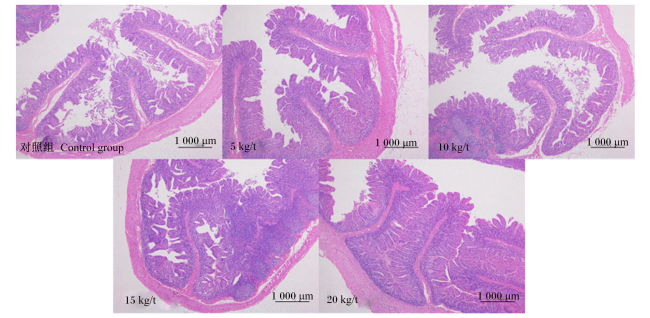
表8图1图2可知,与对照组相比,饲粮中添加15和25 kg/t海带酶解物组生长育肥猪空肠(P=0.02)和回肠(P=0.01)的绒毛高度均显著增加,但对隐窝深度、绒毛高度/隐窝深度的影响不显著(P>0.05)。
表8 海带酶解物对生长育肥猪肠道形态的影响

Table 8 Effects of kelp hydrolysate on intestine morphology of growing-finishing pigs

项目
Items
对照组
CON group
海带酶解物添加量
Supplementation amount of kelp hydrolysate/(kg/t)
SEM P
P-value
5 10 15 25
空肠 Jejunum
绒毛高度 Villus height/μm 487b 523ab 502ab 543a 557a 20.54 0.02
隐窝深度 Crypt depth/μm 204 189 195 212 207 10.65 0.65
绒毛高度/隐窝深度
Villus height/crypt depth 2.39 2.77 2.57 2.56 2.69 0.13 0.24
回肠 Ileum
绒毛高度 Villus height/μm 521b 503b 538ab 569a 583a 23.66 0.01
隐窝深度 Crypt depth/μm 232 215 254 243 222 14.64 0.43
绒毛高度/隐窝深度
Villus height/crypt depth
2.25 2.34 2.12 2.34 2.63 0.16 0.15
图1 海带酶解物对生长育肥猪空肠形态的影响

Fig.1 Effects of kelp hydrolysate on jejunum morphology of growing-finishing pigs

图2 海带酶解物对生长育肥猪回肠形态的影响

Fig.2 Effects of kelp hydrolysate on ileum morphology of growing-finishing pigs

2.8 海带酶解物对生长育肥猪结肠食糜微生物组成的影响

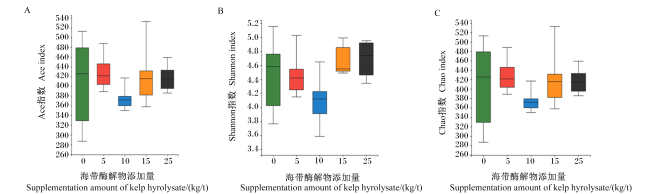
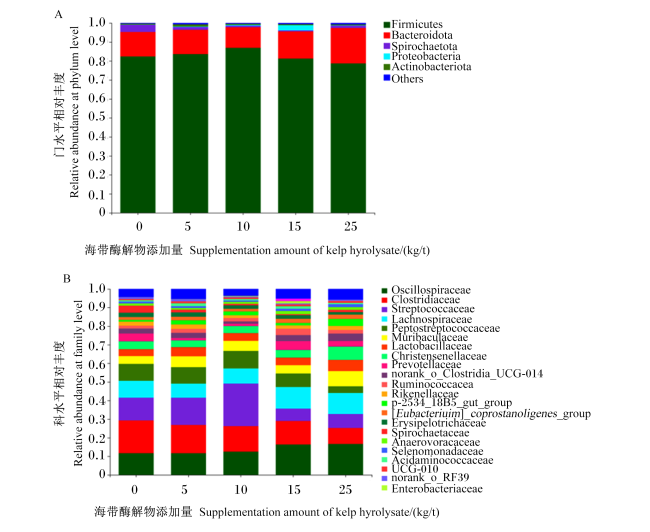
图3可知,各组间结肠食糜中微生物菌群的Ace指数、Shannon指数和Chao指数没有显著差异(P>0.05)。由图4可知,在门水平上,厚壁菌门和拟杆菌门是主要菌群,添加15 kg/t海带酶解物组厚壁菌门相对丰度高于其他组,拟杆菌门相对丰度低于其他组,但是差异不显著(P>0.05)。在科水平上,随着海带酶解物添加量的增加,颤螺旋菌科的相对丰度逐渐增加,而梭菌科、链球菌科、消化链球菌科的相对丰度逐渐降低,但是差异不显著(P>0.05)。
图3 海带酶解物对生长育肥猪结肠食糜菌群α多样性的影响

Fig.3 Effects of kelp hydrolysate on α diversity of colon chyme microflora of growing-finishing pigs

图4 生长育肥结肠食糜门与科水平菌群多样性的差异

Firmicutes:厚壁菌门;Bacteroidota:拟杆菌门;Spirochaetota:螺旋菌门;Proteobacteria:变形菌门;Actinobacteriota:放线菌门;Others:其他;Oscillospiraceae:颤螺旋菌科;Clostridiaceae:梭菌科;Streptococcaceae:链球菌科;Lachnospiraceae:毛螺旋菌科;Peptostreptococcaceae:消化链球菌科;Muribaculaceae:鼠杆菌科;Lactobacillaceae:乳酸杆菌科;Christensenellaceae:克里斯滕森菌科;Prevotellaceae:普雷沃氏菌科;norank_o_Clostridia_UCG-014:未分类梭状芽孢杆菌_UCG-014;Ruminococcacea:瘤胃球菌科;Rikenellaceae:理研菌科;[Eubacteriuim]_coprostanoligenes_group:产粪甾醇真细菌群;Erysipelotrichaceae:丹毒丝菌科;Spirochaetaceae:螺旋体科;Anaerovoracaceae:厌氧菌科;Selenomonadaceae:新月形单胞菌科;Acidaminococcaceae:氨基酸菌科;Enterobacteriaceae:肠杆菌科。

Fig.4 Differences in microflora diversity of colonic chyme at phyla and family levels of growing-finishing pigs

3 讨论

3.1 海带酶解物对生长育肥猪生长性能的影响

本研究结果发现,添加一定量的海带酶解物可提高生长育肥猪的平均日采食量和平均日增重,随着海带酶解物添加量从0增加至5、10、15、25 kg/t时,生长育肥猪的平均日增重呈现先升高后降低的变化趋势,这可能与海带中纤维和层黏胶蛋白含量丰富有关。适量的纤维和层黏胶蛋白有利于促进肠道微生物结构的优化,从而改善机体肠道健康[17];然而,当纤维含量偏高时,会降低饲粮中其他营养物质消化率,从而影响猪的生长性能[18]。海带富含碳水化合物、矿物质、蛋白质、维生素和功能性低聚糖[19]。有研究结果表明,饲粮中添加1%、2%、3%和4%的海藻均可提高肉鸡的体重、采食量、饲料利用率和肉品质[20]。这是由于海藻中富含功能性低聚糖,其可被宿主肠道微生物代谢生成短链脂肪酸,改善胃肠道消化环境和机体免疫功能,从而提高家禽的消化率、采食量和生长性能[21-22]。层黏胶蛋白是一种糖蛋白,支链富含低聚糖片段,通过改善机体胃肠道消化吸收能力提高营养物质消化率,对肉鸡的生长性能会产生积极影响[23]。另外,需要注意的是本研究随着生长育肥猪体重阶段的增加,其平均日增重略有降低,这可能与热应激有关,体重越大受热应激的影响程度也越大。夏季半封闭猪舍环境温度受舍外气温影响,本研究正值气温上升期间,猪体重增长的同时猪舍温度也在逐步升高,受热应激程度也相应加重。

3.2 海带酶解物对生长育肥猪肉品质的影响

决定猪肉品质的主要特征是pH、颜色和系水力[24]。宰后pH的变化是决定肉品质的重要因素,对肉的理化性状和保质期均有影响[25-26]。有研究发现,在饲粮中添加海藻会改变猪肉的大理石花纹、颜色和pH等胴体特征[27];褐藻含有丰富的天然抗氧化剂,如多糖和多酚,可以改善肉的颜色[5,28]。海带酶解物富含纤维寡糖和甜菜碱,均可以调节机体蛋白质、脂质和能量代谢水平,通过提高蛋白质合成效率,降低脂肪沉积,从而降低背膘厚,改善胴体组成[29-30]。然而,本研究结果表明,除了15 kg/t海带酶解物添加组背最长肌a*值显著提高外,生长育肥猪肌肉pH、胴体性状和肉品质均未受海带酶解物的影响,这可能与试验不同产品中多糖和多酚含量存在差异有关。另外,与添加25 kg/t海带酶解物组相比,添加10 kg/t海带酶解物组第6~7肋骨部脂肪厚度显著提高,而与对照组相比无统计学差异,结合生长性能结果看,添加10 kg/t海带酶解物组屠宰时的体重(84 d)高于其他组,所以其背膘厚的增加可能与体重较大有关。屠宰体重与对照组更接近的其他组(添加15 kg/t海带酶解物组和添加25 kg/t海带酶解物组)的各个部位背膘厚无显著差异,海带酶解物中的寡多糖和甜菜碱是否存在降低脂肪沉积的功效还有待进一步研究。

3.3 海带酶解物对生长育肥猪血清抗氧化和免疫指标的影响

来源于褐藻的提取物有抗氧化、抗菌和免疫调节活性[4]。饲粮中添加藻类多糖可通过调节相关因子信号通路提高肉仔鸡十二指肠抗氧化能力[31]。海带酶解物的抗氧化性可能来源于其中的酚类化合物,有研究认为褐藻中的酚类化合物可以保护身体免受环境或营养变化引起的氧化损伤[32],并促进动物的健康,提高生产力[33]。另外,海带中的海藻多糖也被证实具有抗氧化功能,在饲粮中添加海藻多糖可提高肉鸡肠道和肝脏抗氧化酶(T-SOD、CAT和GSH-Px)活性,降低MDA含量[34-35]。然而,本研究结果表明,海带酶解物对生长育肥猪血清抗氧化酶活性均没有显著影响,这可能是因为与试验动物品种及生长阶段有关,一方面,猪与家禽对应激反应的程度有所不同,另一方面仔猪等幼龄动物的消化和免疫系统发育不完善,肠道等组织易受氧化应激,而生长育肥猪各组织器官发育较成熟,对应激反应不太敏感,这可能是本试验结果海带酶解物对血清抗氧化指标没显著影响的原因。另外,本研究同样发现生长育肥猪饲粮中添加25 kg/t海带酶解物显著降低了血清中IL-6含量,而IL-6作为一种促炎细胞因子会加剧炎症反应。因此,生长育肥猪饲粮中添加海带酶解物在一定程度上缓解了机体炎症反应,改善了免疫功能。

3.4 海带酶解物对生长育肥猪肠道健康的影响

有研究发现,饲喂仔猪添加0.05%和0.15%海带粉的饲粮,可显著提高仔猪回肠绒毛高度[36]。本试验研究也表明,在生长育肥猪饲粮中添加海带酶解物能显著增加空肠和回肠的绒毛高度,对肠道形态具有改善功效,这与前人的研究结果[37]一致,海藻富含的羧基和硫酸盐多糖,如海藻酸盐、藻酸盐和岩藻酸盐都是对肠道健康有积极影响的益生元[38-41]。海带酶解物是由海带酶解后的产物干燥而成,其中的活性物质较酶解前海带粉中的含量更高,改善肠道健康的功能可能也会更明显。另外有报道,在仔猪饲粮中添加海带及其提取物通过增加有益菌活性,从而产生更多的短链脂肪酸,有助于改善肠道健康[42-44]。然而,本研究未发现海带酶解物对育肥猪肠道菌群以及短链脂肪酸含量有显著影响,这可能是由于生长育肥猪肠道菌群结构比较稳定,饲粮中外源添加海带酶解物不能明显改变胃肠道菌群结构及其代谢产物。

4 结论

① 在生长育肥猪饲粮中添加海带酶解物,可降低料重比,提高平均日增重,促进生长;提高背最长肌a*值和空肠和回肠绒毛高度,对猪肉品质和肠道形态具有一定的改善作用。
② 海带酶解物在生长育肥猪饲粮中的推荐添加量为10~15 kg/t。
[1]
顾芳, 胡平, 蔡德敏. 畜禽健康养殖中抗生素应用及其替代品研究进展[J]. 动物营养学报, 2023, 35(10):6247-6256.

DOI

GU F, HU P, CAI D M, et al. Advances in application of antibiotics and their substitutes in healthy animal husbandry[J]. Chinese Journal of Animal Nutrition, 2023, 35(10):6247-6256. (in Chinese)

DOI

[2]
YU L L, BROWNING J F, BURDETTE C Q, et al. Development of a kelp powder (Thallus laminariae) standard reference material[J]. Analytical and Bioanalytical Chemistry, 2018, 410(4):1265-1278.

DOI PMID

[3]
PEREIRA M, TALA F D, FERNÁNDEZ M, et al. Effects of kelp phenolic compounds on the feeding-associated mobility of the herbivore snail Tegula tridentata[J]. Marine Environmental Research, 2015, 112(Pt.B):40-47.

DOI

[4]
CHOJNACKA K, SAEID A, WITKOWSKA Z, et al. Biologically active compounds in seaweed extracts-the prospects for the application[J]. The Open Conference Proceedings Journal, 2012, 3:20-28.

DOI

[5]
RAJAURIA G, DRAPER J, MCDONNELL M, et al. Effect of dietary seaweed extracts, galactooligosaccharide and vitamin E supplementation on meat quality parameters in finisher pigs[J]. Innovative Food Science & Emerging Technologies, 2016, 37 Part B:269-275.

[6]
CHOI Y J, LEE S R, OH J W. Effects of dietary fermented seaweed and seaweed fusiforme on growth performance,carcass parameters and immunoglobulin concentration in broiler chicks[J]. Asian-Australasian Journal of Animal Sciences, 2014, 27(6):862-870.

DOI

[7]
KULSHRESHTHA G, RATHGEBER B, STRATTON G, et al. Feed supplementation with red seaweeds,Chondrus crispus and Sarcodiotheca gaudichaudii,affects performance,egg quality,and gut microbiota of layer hens[J]. Poultry Science, 2014, 93(12):2991-3001.

DOI

[8]
AZIZI N, NAJAFPOUR G, YOUNESI H. Acid pretreatment and enzymatic saccharification of brown seaweed for polyhydroxybutyrate (PHB) production using Cupriavidus necator[J]. International Journal of Biological Macromolecules, 2017, 101:1029-1040.

DOI

[9]
李德发. 中国猪营养需要[M]. 北京: 中国农业出版社, 2020.

LI D F. Nutritional requirements of Chinese pigs[M]. Beijing: China Agriculture Press, 2020. (in Chinese)

[10]
中华人民共和国国家质量监督检验检疫总局, 中国国家标准化管理委员会. 饲料中水分和其他挥发性物质含量的测定:GB/T 6435—2006[S]. 北京: 中国标准出版社, 2007.

General Administration of Quality Supervision,Inspection and Quarantine of the People’s Republic of China,National Standardization Administration of China. Determination of moisture and other volatile mater content in feeds:GB/T 6435—2006[S]. Beijing: Standards Press of China, 2007. (in Chinese)

[11]
国家技术监督局. 饲料中粗蛋白测定方法:GB/T 6432—1994[S]. 北京: 中国标准出版社, 1995.

The State Bureau of Quality and Technical Supervision. Method for the determination of crude protein in feedstuffs:GB/T 6432—1994[S]. Beijing: Standards Press of China, 1995. (in Chinese)

[12]
中华人民共和国国家质量监督检验检疫总局, 中国国家标准化管理委员会. 饲料中钙的测定:GB/T 6436—2002[S]. 北京: 中国标准出版社, 2007.

General Administration of Quality Supervision,Inspection and Quarantine of the People’s Republic of China,National Standardization Administration of China. Determination of calcium in feed:GB/T 6436—2002[S]. Beijing: Standards Press of China, 2007. (in Chinese)

[13]
中华人民共和国国家质量监督检验检疫总局. 饲料中总磷的测定:GB/T 6437—2002[S]. 北京: 中国标准出版社, 2002.

General Administration of Quality Supervision,Inspection and Quarantine of the People’s Republic of China. Determination of phosphorus in feed-Spectphotometry:GB/T 6437—2002[S]. Beijing: Standards Press of China, 2002. (in Chinese)

[14]
中华人民共和国国家质量监督检验检疫总局, 中国国家标准化管理委员会. 饲料中铬的测定:GB/T 13088—2006[S]. 北京: 中国标准出版社, 2006.

General Administration of Quality Supervision,Inspection and Quarantine of the People’s Republic of China,National Standardization Administration of China. Determination of chromium in feeds:GB/T 13088—2006[S]. Beijing: Standards Press of China, 2006. (in Chinese)

[15]
中华人民共和国农业部. 瘦肉型猪胴体性状测定技术规范:NY/T 825—2004[S]. 北京: 中国农业出版社, 2004.

Ministry of Agriculture of the PRC. Technical regulation for testing of carcass traits in lean-type pig:NY/T 825—2004 [S]. Beijing: China Agriculture Press, 2004. (in Chinese)

[16]
顾方, 刘世龙, 李红胜, 等. 低蛋白质饲粮中添加发酵菜籽粕对育肥猪生长性能和肉品质的影响[J]. 动物营养学报, 2023, 35(3):1489-1500.

DOI

GU F, LIU S L, LI H S, et al. Effects of low protein diet supplemented with-fermented canola meal on growth performance and meat quality of finishing pigs[J]. Chinese Journal of Animal Nutrition, 2023, 35(3):1489-1500. (in Chinese)

DOI

[17]
王绪霞, 张龙雨, 王磊, 等. 藤壶附着机理及其粘胶蛋白的研究进展[J]. 生物工程学报, 2022, 38(12):4449-4461.

WANG X X, ZHANG L Y, WANG L, et al. The adhesion mechanism of barnacle and its cement proteins:a review[J]. Chinese Journal of Biotechnology, 2022, 38(12):4449-4461. (in Chinese)

[18]
ZHAO J B, ZHANG S, XIE F, et al. Effects of inclusion level and adaptation period on nutrient digestibility and digestible energy of wheat bran in growing-finishing pigs[J]. Asian-Australasian Journal of Animal Sciences, 2018, 31(1):116-122.

DOI PMID

[19]
KULSHRESHTHA G, HINCKE M T, PRITHIVIRAJ B, et al. A review of the varied uses of macroalgae as dietary supplements in selected poultry with special reference to laying hen and broiler chickens[J]. Journal of Marine Science and Engineering, 2020, 8(7):536.

DOI

[20]
KUMAR A K. Effect of Sargassum wightii on growth,carcass and serum qualities of broiler chickens[J]. Open Access Journal of Veterinary Science & Research, 2018, 3(2):000156.

[21]
NASSAR M K, LYU S, ZENTEK J, et al. Dietary fiber content affects growth,body composition,and feed intake and their associations with a major growth locus in growing male chickens of an advanced intercross population[J]. Livestock Science, 2019, 227:135-142.

DOI

[22]
REZAEI M, TORSHIZI M A K, SHARIATMADARI F. Inclusion of processed rice hulls as insoluble fiber in the diet on performance and digestive traits of Japanese quails[J]. Journal of Animal Science Advances, 2014, 4(7):962-972.

DOI

[23]
SWEENEY T, MEREDITH H, VIGORS S, et al. Extracts of laminarin and laminarin/fucoidan from the marine macroalgal species Laminaria digitata improved growth rate and intestinal structure in young chicks,but does not influence Campylobacter jejuni colonisation[J]. Animal Feed Science and Technology, 2017, 232:71-79.

DOI

[24]
ROSENVOLD K, ANDERSEN H J. Factors of significance for pork quality-a review[J]. Meat Science, 2003, 64(3):219-237.

DOI PMID

[25]
BREWER M S, MCKEITH F K. Consumer-rated quality characteristics as related to purchase intent of fresh pork[J]. Journal of Food Science, 1999, 64(1):171-174.

DOI

[26]
JACOB R H, HOPKINS D L. Techniques to reduce the temperature of beef muscle early in the post mortem period-a review[J]. Animal Production Science, 2014, 54(4):482-493.

DOI

[27]
MORONEY N C, O’GRADY M N, ROBERTSON R C, et al. Influence of level and duration of feeding polysaccharide (laminarin and fucoidan) extracts from brown seaweed (Laminaria digitata) on quality indices of fresh pork[J]. Meat Science, 2015, 99:132-141.

DOI PMID

[28]
MORONEY N C, O’GRADY M N, O'DOHERTY J V, et al. Effect of a brown seaweed (Laminaria digitata) extract containing laminarin and fucoidan on the quality and shelf-life of fresh and cooked minced pork patties[J]. Meat Science, 2013, 94(3):304-311.

DOI PMID

[29]
LI F L, TANG Y, WEI L X, et al. Alginate oligosaccharide modulates immune response,fat metabolism,and the gut bacterial community in grass carp (Ctenopharyngodon idellus)[J]. Fish & Shellfish Immunology, 2022, 130:103-113.

[30]
黄其春. 甜菜碱对肥育猪脂肪代谢及其关键酶基因表达的影响与机理研究[D]. 博士学位论文. 杭州: 浙江大学, 2006.

HUANG Q C. Effects of betaine on lipid metabolism, gene expression of keyenzymes and approach to the mechanism in finishing pigs[D]. Ph.D.Thesis. Hangzhou: Zhejiang University, 2006. (in Chinese)

[31]
LIU W C, ZHU Y R, ZHAO Z H, et al. Effects of dietary supplementation of algae-derived polysaccharides on morphology,tight junctions,antioxidant capacity and immune response of duodenum in broilers under heat stress[J]. Animals, 2021, 11(8):2279.

DOI

[32]
LI Y J, FU X T, DUAN D L, et al. Extraction and identification of phlorotannins from the brown alga,Sargassum fusiforme (Harvey) setchell[J]. Marine Drugs, 2017, 15(2):49.

DOI

[33]
MICHALAK I, TIWARI R C, DHAWAN M, et al. Antioxidant effects of seaweeds and their active compounds on animal health and production—a review[J]. Veterinary Quarterly, 2022, 42(1):48-67.

DOI

[34]
GUO Y, BALASUBRAMANIAN B, ZHAO Z H, et al. Marine algal polysaccharides alleviate aflatoxin B1-induced bursa of fabricius injury by regulating redox and apoptotic signaling pathway in broilers[J]. Poultry Science, 2021, 100(2):844-857.

DOI PMID

[35]
LIU W C, ZHUANG D P, ZHAO Y, et al. Seaweed-derived polysaccharides attenuate heat stress-induced splenic oxidative stress and inflammatory response via regulating Nrf2 and NF-κB signaling pathways[J]. Marine Drugs, 2022, 20(6):358.

DOI

[36]
CHOI Y, HOSSEINDOUST A, GOEL A, et al. Effects of ecklonia cava as fucoidan-rich algae on growth performance,nutrient digestibility,intestinal morphology and caecal microflora in weanling pigs[J]. Asian-Australasian Journal of Animal Sciences, 2017, 30(1):64-70.

DOI

[37]
HEIM G, O’DOHERTY J V, O'SHEA C J, et al. Maternal supplementation of seaweed-derived polysaccharides improves intestinal health and immune status of suckling piglets[J]. Journal of Nutritional Science, 2015, 4:e27.

DOI

[38]
LIU J, YANG S Q, LI X T, et al. Alginate oligosaccharides:production,biological activities,and potential applications[J]. Comprehensive Reviews in Food Science and Food Safety, 2019, 18(6):1859-1881.

DOI

[39]
XING M C, CAO Q, WANG Y, et al. Advances in research on the bioactivity of alginate oligosaccharides[J]. Marine Drugs, 2020, 18(3):144.

DOI

[40]
WANG Y T, LI L L, YE C Q, et al. Alginate oligosaccharide improves lipid metabolism and inflammation by modulating gut microbiota in high-fat diet fed mice[J]. Applied Microbiology and Biotechnology, 2020, 104(8):3541-3554.

DOI PMID

[41]
WAN J, JIANG F, XU Q, et al. Alginic acid oligosaccharide accelerates weaned pig growth through regulating antioxidant capacity,immunity and intestinal development[J]. RSC Advances, 2016, 6:87026.

DOI

[42]
MUKHOPADHYA A, O’DOHERTY J V, SMITH A, et al. The microbiological and immunomodulatory effects of spray-dried versus wet dietary supplementation of seaweed extract in the pig gastrointestinal tract[J]. Journal of Animal Science, 2012, 90(Suppl.4):28-30.

DOI

[43]
MCDONNELL P, FIGAT S, O’DOHERTY J V. The effect of dietary laminarin and fucoidan in the diet of the weanling piglet on performance,selected faecal microbial populations and volatile fatty acid concentrations[J]. Animal, 2010, 4(4):579-585.

DOI

[44]
LYNCH M B, SWEENEY T, CALLAN J J, et al. The effect of dietary Laminaria-derived laminarin and fucoidan on nutrient digestibility, nitrogen utilisation,intestinal microflora and volatile fatty acid concentration in pigs[J]. Journal of the Science of Food and Agriculture, 2010, 90(3):430-437.

DOI

Outlines

/