RESEARCH PAPER

Effects of Low Energy Diet Supplemented with Emulsifier on Growth Performance, Serum Biochemical Indexes, Organ Development, Pancreatic Digestive Enzyme Activities and Cecal Microflora of Broilers

  • HU Xiyi , 1 ,
  • ZHANG Wei 2 ,
  • MA Ning 2 ,
  • PANG Nianlong 1 ,
  • LYU Shenjin , 1 ,
  • SUN Zuowei , 2
Expand
  • 1 College of Agriculture and Forestry Science, Linyi University, Linyi 276000, China
  • 2 Shandong Jiurui Agricultural Group Co., Ltd., Qingdao 266100, China
*LYU Shenjin, professor, E-mail: ;
SUN Zuowei, E-mail:

Received date: 2023-10-11

  Online published: 2024-04-15

Abstract

The aim of this study was to investigate the effects of low energy diet supplemented with emulsifier on growth performance, serum biochemical indexes, organ development, pancreatic digestive enzyme activities and cecal microflora of broilers. A total of 180 one-day-old Arbor Acres (AA) broilers with similar body weight were randomly divided into 3 groups with 6 replicates per group and 10 broilers per replicate. Broilers in the control group were fed a basal diet, broilers in the low energy group were fed a low energy diet (reduce 0.17 MJ/kg metabolic energy based on basal feed), and broilers in the emulsifier group were fed the low energy diet supplemented with 350 mg/kg emulsifier (the main component was polyethylene glycol glycerol castor ester). The experiment lasted for 21 days. The results showed that: 1) compared with the control group, the average body weight gain of broilers aged from 21 to 28 days of the low energy group was significantly decreased (P<0.05). 2) Compared with the control group, the serum urea nitrogen (UN) content of the low energy group was significantly decreased (P<0.05), and the serum globulin (GLB) content was significantly increased (P<0.05); the serum total protein (TP) and GLB contents of the emulsifier group were significantly increased (P<0.05). 3) Compared with the control group, the abdominal adipose index of low energy group and emulsifier group was significantly increased (P<0.05). 4) Compared with the control group, the pancreatic trypsin activity of the emulsifier group was significantly increased (P<0.05). 5) Compared with the low energy group, the liver triglyceride (TG) content of the emulsifier group was significantly decreased (P<0.05). 6) Compared with the low energy group, the cecal microbiota Shannon index, Observed_features index, Faith_pd index, and Chao1 index of the emulsifier group were significantly increased (P<0.05), and the cecal Chloroflexi relative abundance was significantly increased (P<0.05). In conclusion, the low energy diet supplemented with emulsifier has a certain positive impact on the growth performance of broilers, can increase the pancreatic trypsin activity, alleviate liver fat deposition, improve the diversity of cecal microflora and the relative abundance of Chloroflexi.

Cite this article

HU Xiyi , ZHANG Wei , MA Ning , PANG Nianlong , LYU Shenjin , SUN Zuowei . Effects of Low Energy Diet Supplemented with Emulsifier on Growth Performance, Serum Biochemical Indexes, Organ Development, Pancreatic Digestive Enzyme Activities and Cecal Microflora of Broilers[J]. Chinese Journal of Animal Nutrition, 2024 , 36(4) : 2318 -2330 . DOI: 10.12418/CJAN2024.200

随着养殖业集约化的快速发展,商品肉鸡生产周期短且对能量的需求高。油脂作为最有效的高能饲料原料被广泛使用,以满足肉鸡营养需求。油脂作为能量饲料对畜禽有着重要的营养价值和生物学功能[1]。在家禽饲粮中添加油脂可以改善其生长性能,减缓食物通过消化道的速度,并促进饲粮中其他脂溶性营养物质的吸收利用[2-4]。大量研究表明,在家禽饲粮中添加油脂可以提高饲粮的能量水平,改善家禽的生长性能,从而提高生产效率和经济效益[5-8]。但油脂添加仍然存在不足之处。家禽消化道非常短,容易出现油脂在进入肠道后得不到充分乳化的情况,再加上幼龄或老龄禽类自身胆汁酸和脂肪酶分泌不足,更不利于对油脂的消化利用,多余的脂肪还会引起畜禽腹泻[8-9]
天然或合成乳化剂,如胆盐、卵磷脂、硬脂酰乳酸钠、甘油硬脂酸酯、二酰基甘油、磷脂和山梨醇酯,可作为单一或混合形式的外源乳化剂应用于家禽饲粮中[10-14]。饲粮中添加乳化剂的主要作用是促进脂质的乳化,弥补家禽消化道中胆汁酸和脂肪酶的不足,提高家禽对油脂的利用率,减少油脂的浪费和油脂过量对动物机体造成的损害[15-18]
前期有研究发现,低能饲粮中添加乳化剂可改善肉鸡生长后期生长性能,而对于生长前期和生长中期生长性能没有影响[19]。在生长后期,肉鸡体重增长较快,需要从饲粮中获取更多的能量以维持生长需要。在饲粮配比中,生长后期饲粮中油脂占比高于生长前期。因此,本研究以爱拔益加(AA)肉鸡为试验对象,研究在降低基础饲粮代谢能的基础上添加乳化剂对肉鸡生长性能、血清生化指标、器官发育、胰腺消化酶活性和盲肠微生物区系的影响,旨在为乳化剂应用于肉鸡养殖业提供科学依据。

1 材料与方法

1.1 试验材料

试验用AA肉鸡购自济宁圣合禽业有限公司。乳化剂主要成分为聚乙二醇甘油蓖麻酸酯。

1.2 试验设计

选取180只21日龄体重相近的雄性AA肉鸡,随机分为3个组,每组6个重复,每个重复10只。对照组饲喂基础饲粮,低能组饲喂低能饲粮(基础饲粮基础上降低0.17 MJ/kg代谢能),乳化剂组在低能饲粮中添加乳化剂(350 mg/kg)。试验期21 d。

1.3 试验饲粮和饲养管理

试验鸡只采用网上平养模式,自由采食和饮水。鸡舍初始温度为34 ℃,随后每周降低2~3 ℃,直至降至24 ℃。每天24 h光照。通风和免疫等其他管理措施按AA肉鸡饲养管理手册执行。基础饲粮参照NRC(1994)肉鸡营养需求配制,低能饲粮在基础饲粮基础上降低0.17 MJ/kg代谢能,试验饲粮组成及营养水平见表1
表1 试验饲粮组成及营养水平(风干基础)

Table 1 Composition and nutrient levels of experimental diets (air-dry basis)%

项目
Items
基础饲粮
Basal diet
低能饲粮
Low energy
diet
原料 Ingredients
玉米 Corn 28.40 29.30
小麦 Wheat 10.00 10.00
面粉 Flour 15.00 15.00
豆粕 Soybean meal (46%) 32.35 32.21
棉籽粕 Cottonseed meal (46%) 3.00 3.00
豆油 Soybean oil 7.57 6.81
石粉 Limestone 1.28 1.28
L-赖氨酸硫酸盐
L-Lys·H2SO4 (70%)
0.50 0.50
DL-蛋氨酸
DL-Met (98%)
0.34 0.34
L-苏氨酸
L-Thr (98%)
0.19 0.19
缬氨酸 Val 0.12 0.12
氯化胆碱
Choline chloride (60%)
0.10 0.10
磷酸氢钙 CaHPO4 0.47 0.47
氯化钠 NaCl 0.23 0.23
维生素预混料
Vitamin premix1)
0.30 0.30
矿物元素预混料
Mineral premix2)
0.15 0.15
合计 Total 100.00 100.00
营养水平 Nutrient levels3)
代谢能
Metabolic energy/(MJ/kg)
13.60 13.43
粗蛋白质 Crude protein 22.50 22.50
粗脂肪 Ether extract 9.37 8.66
钙 Calcium 0.70 0.70
总磷 Total phosphorus 0.52 0.52
可消化赖氨酸 Digestible lysine 1.30 1.30
可消化蛋氨酸
Digestible methionine
0.66 0.66

1)维生素预混料为每千克饲粮提供 The vitamin premix provided the following per kilogram of diets:VA 8 000 IU,VD3 1 000 IU,VE 20 IU,VK3 0.5 mg,VB1 2 mg,VB2 9.60 mg,VB6 3.5 mg,VB12 10 μg,烟酸 niacin 35 mg,泛酸钙 calcium pantothenate 10 mg,叶酸 folic acid 0.55 mg,生物素 biotin 0.18 mg。

2)矿物元素预混料为每千克提供 The mineral premix provided the following per kilogram of diets:Fe 80 mg,Cu 8 mg,Mn 100 mg,Zn 80 mg,I 0.7 mg,Se 0.3 mg.

3)代谢能、可消化赖氨酸、可消化蛋氨酸为计算值,粗蛋白质、粗脂肪、钙和总磷为实测值。 Metabolic energy, digestible lysine and digestible methionine were calculated values, while crude protein, ether extract, calcium and total phosphorus were measured values.

1.4 样品采集与指标测定

1.4.1 饲粮营养水平

饲粮粗蛋白质、粗脂肪、钙和总磷含量测定方法分别参照GB/T 6432—2018、GB/T 6433—2006、GB/T 6436—2018、GB/T 6437—2018。

1.4.2 生长性能

分别于21、28、35和42日龄称重,计算21~28日龄、29~35日龄和36~42日龄各组肉鸡的平均体增重(ABWG)。统计21~42日龄采食量,计算21~42日龄平均采食量(AFI)和饲料转化率(FCR)。

1.4.3 血清生化指标

42日龄时,从每个重复随机选取与平均体重接近的1只试验鸡,采用真空采血管进行翅静脉采血,静置2 h后,以3 000 r/min离心10 min,分离血清,于-20 ℃保存。测定血清中总胆固醇(TCHO)、甘油三酯(TG)、白蛋白(ALB)、尿素氮(UN)、总蛋白(TP)和葡萄糖(GLU)含量,试剂盒均购自南京建成生物工程研究所。计算球蛋白(GLB)含量,计算公式如下:
GLB=TP-ALB。

1.4.4 器官指数

42日龄时,从每个重复随机选取1只试验鸡,屠宰解剖后,分离腹脂、脾脏、肝脏(无胆囊)、腺胃和肌胃(去除内容物及内金)称重,计算器官指数,计算公式如下:
器官指数(%)=100×器官鲜重(g)/宰前活重(g)。

1.4.5 肠道校正长度和指数

测量十二指肠、空肠和回肠的长度和重量(去除内容物),计算十二指肠、空肠和回肠校正长度和指数,计算公式如下:
肠道指数(%)=100×肠道重量(g)/宰前活重(g);
肠道校正长度(cm/kg)=肠道长度(cm)/宰前活重(kg)。

1.4.6 胰腺消化酶活性

分离胰腺,装于2 mL冻存管中,液氮速冻后-80 ℃冻存。采用南京建成生物工程研究试剂盒检测胰腺中胰蛋白酶、α-淀粉酶和脂肪酶活性,测定方法参照试剂盒说明书进行。

1.4.7 肝脏TG含量

分离肝脏,装于2 mL冻存管中,液氮速冻后-80 ℃冻存。采用南京建成生物工程研究试剂盒检测肝脏TG含量,测定方法参照试剂盒说明书进行。

1.4.8 盲肠微生物区系

无菌采集各组鸡盲肠内容物,液氮速冻后-80 ℃冻存,待测。由深圳微科盟科技集团有限公司进行16S rDNA测序。基于Illumina NovaSeq测序平台对V3~V4高变区进行双末端测序,以分析盲肠菌群丰富度和多样性。

1.5 数据处理与统计分析

数据采用SPSS 21.0软件进行单因素方差分析(one-way ANOVA),并采用Tukey法进行多重比较分析。结果以平均值±标准误表示,P<0.05为差异显著。

2 结果

2.1 低能饲粮中添加乳化剂对肉鸡生长性能的影响

表2可知,与对照组相比,低能组的肉鸡21~28日龄平均体增重显著降低(P<0.05),肉鸡21~42日龄平均体增重、平均采食量和饲料转化率没有显著差异(P>0.05)。与对照组相比,乳化剂组的肉鸡21~42日龄平均体增重、平均采食量和饲料转化率没有显著差异(P>0.05)。与低能组相比,乳化剂组的肉鸡21~28日龄平均体增重显著升高(P<0.05)。
表2 低能饲粮中添加乳化剂对肉鸡生长性能的影响

Table 2 Effects of low energy diet supplemented with emulsifier on growth performance of broilers

项目
Items
日龄
Days of age
对照组
Control group
低能组
Low energy group
乳化剂组
Emulsifier group
P
P-value
平均体增重
ABWG/(g/只)
21~28 513.92±9.13a 466.13±6.95b 536.50±16.61a 0.002
29~35 608.85±10.96 565.63±23.69 598.33±10.79 0.182
36~42 674.48±42.55 723.61±24.68 709.03±18.70 0.517
21~42 1 797.25±50.11 1 755.36±10.82 1 843.86±26.23 0.204
平均采食量 AFI/(g/只) 21~42 2 664.10±100.77 2 654.26±107.65 2 781.70±121.87 0.672
饲料转化率 FCR 21~42 1.48±0.02 1.51±0.05 1.51±0.04 0.868

同行数据肩标不同小写字母表示差异显著(P<0.05),相同或无字母表示差异不显著(P>0.05)。下表同。

In the same row, values with different small letter superscripts mean significant difference (P<0.05), while with the same or no letter superscripts mean no significant difference (P>0.05). The same as below.

2.2 低能饲粮中添加乳化剂对肉鸡器官指数的影响

表3可知,与对照组相比,低能组的腹脂指数显著升高(P<0.05),肌胃、腺胃、肝脏和脾脏指数没有显著差异(P>0.05)。与对照组相比,乳化剂组的腹脂指数显著升高(P<0.05),肌胃、腺胃、肝脏和脾脏指数没有显著差异(P>0.05)。与低能组相比,乳化剂组的腹脂、肌胃、腺胃、肝脏和脾脏指数没有显著差异(P>0.05)。
表3 低能饲粮中添加乳化剂对肉鸡器官指数的影响

Table 3 Effects of low energy diet supplemented with emulsifier on organ indexes of broilers%

项目
Items
对照组
Control group
低能组
Low energy group
乳化剂组
Emulsifier group
P
P-value
肌胃指数 Gizzard index 1.03±0.06 1.02±0.05 1.03±0.07 0.995
腺胃指数 Gland stomach index 0.36±0.02 0.32±0.02 0.32±0.01 0.225
肝脏指数 Liver index 2.00±0.11 2.10±0.10 1.85±0.12 0.299
腹脂指数 Abdominal adipose index 1.34±0.10b 1.66±0.11a 1.68±0.07a 0.038
脾脏指数 Spleen index 0.13±0.01 0.13±0.01 0.14±0.01 0.787

2.3 低能饲粮中添加乳化剂对肉鸡血清生化指标的影响

表4可知,与对照组相比,低能组的血清UN含量显著降低(P<0.05),血清GLB含量显著升高(P<0.05),血清TCHO、TG、ALB和TP含量没有显著差异(P>0.05)。与对照组相比,乳化剂组的血清TP和GLB含量显著升高(P<0.05),血清TCHO、TG、ALB和UN含量没有显著差异(P>0.05)。与低能组相比,乳化剂组的血清TCHO、TG、GLU、ALB、TP、UN和GLB含量没有显著差异(P>0.05)。
表4 低能饲粮中添加乳化剂对肉鸡血清生化指标的影响

Table 4 Effects of low energy diet supplemented with emulsifier on serum biochemical indexes of broilers

项目
Items
对照组
Control group
低能组
Low energy group
乳化剂组
Emulsifier group
P
P-value
总胆固醇 TCHO/(mmol/L) 3.39±0.12 3.50±0.09 3.53±0.16 0.730
甘油三酯 TG/(mmol/L) 0.66±0.07 0.63±0.07 0.63±0.09 0.959
葡萄糖 GLU/(mmol/L) 12.65±0.20 12.69±0.46 12.41±0.62 0.896
白蛋白 ALB/(g/L) 16.32±0.47 15.82±0.50 15.70±0.62 0.687
总蛋白 TP/(g/L) 22.66±0.94b 27.19±1.32ab 27.42±1.50a 0.027
尿素氮 UN/(mmol/L) 1.85±0.18a 1.09±0.19b 1.66±0.23ab 0.041
球蛋白 GLB/(g/L) 6.34±0.86b 11.36±1.56a 11.73±1.46a 0.017

2.4 低能饲粮中添加乳化剂对肉鸡肠道校正长度和指数的影响

表5可知,与对照组相比,低能组的肠道校正长度和指数没有显著差异(P>0.05)。与对照组相比,乳化剂组的肠道校正长度和指数没有显著差异(P>0.05)。与低能组相比,乳化剂组的肠道校正长度和指数没有显著差异(P>0.05)。
表5 低能饲粮中添加乳化剂对肉鸡肠道校正长度和指数的影响

Table 5 Effects of low energy diet supplemented with emulsifier on intestinal correction length and indexes of broilers

项目
Items
对照组
Control group
低能组
Low energy group
乳化剂组
Emulsifier group
P
P-value
十二指肠指数 Duodenal index/% 0.54±0.02 0.64±0.03 0.61±0.03 0.069
空肠指数 Jejunum index/% 0.98±0.07 1.12±0.04 1.00±0.05 0.168
回肠指数 Ileal index/% 0.76±0.05 0.83±0.04 0.76±0.04 0.398
十二指肠校正长度
Duodenal correction length/(cm/kg)
11.15±0.94 11.27±0.57 10.84±0.61 0.912
空肠校正长度
Jejunum correction length/(cm/kg)
29.48±2.21 26.18±1.64 24.94±1.68 0.232
回肠校正长度
Ileal correction length/(cm/kg)
28.70±2.03 25.57±1.52 23.56±1.83 0.157

2.5 低能饲粮中添加乳化剂对肉鸡肝脏TG含量的影响

表6可知,与对照组相比,低能组和乳化剂组的肝脏TG含量没有显著差异(P>0.05)。与低能组相比,乳化剂组的肝脏TG含量显著降低(P<0.05)。
表6 低能饲粮中添加乳化剂对肉鸡肝脏TG含量的影响

Table 6 Effects of low energy diet supplemented with emulsifier on liver TG content of broilersmmol/g prot

项目
Item
对照组
Control group
低能组
Low energy group
乳化剂组
Emulsifier group
P
P-value
甘油三酯 TG 0.06±0.01ab 0.08±0.01a 0.05±0.01b 0.022

2.6 低能饲粮中添加乳化剂对肉鸡胰腺消化酶活性的影响

表7可知,与对照组相比,低能组的胰腺中α-淀粉酶、胰蛋白酶和脂肪酶活性没有显著差异(P>0.05)。与对照组相比,乳化剂组的胰腺中胰蛋白酶活性显著升高(P<0.05),胰腺中α-淀粉酶和脂肪酶活性没有显著差异(P>0.05)。与低能组相比,乳化剂组的胰腺中α-淀粉酶、胰蛋白酶和脂肪酶活性没有显著差异(P>0.05)。
表7 低能饲粮中添加乳化剂对肉鸡胰腺消化酶活性的影响

Table 7 Effects of low energy diet supplemented with emulsifier on pancreatic digestive enzyme activities of broilers

项目
Items
对照组
Control group
低能组
Low energy group
乳化剂组
Emulsifier group
P
P-value
α-淀粉酶 α-amylase/(U/mg prot) 164.69±33.25 178.10±36.82 171.98±35.02 0.964
胰蛋白酶 Trypsin/(U/mg prot) 123.00±21.44b 158.22±11.36ab 214.89±33.33a 0.048
脂肪酶 Lipase/(U/g prot) 546.09±52.63 632.79±97.79 602.34±90.78 0.757

2.7 低能饲粮中添加乳化剂对肉鸡盲肠微生物区系的影响

2.7.1 低能饲粮中添加乳化剂对肉鸡盲肠微生物多样性的影响
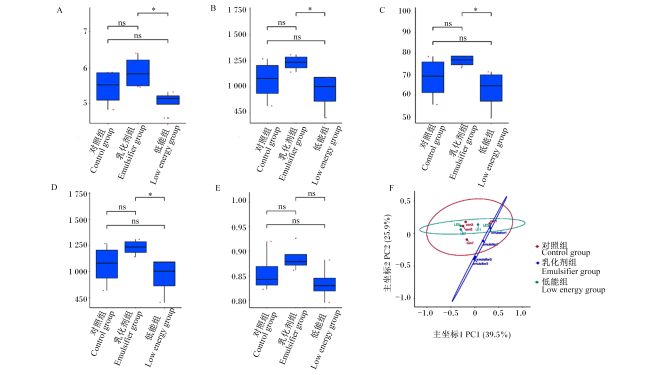
图1可知,与对照组相比,低能组和乳化剂组的盲肠菌群Shannon指数、Observed_features指数、Faith_pd指数、Chao1指数和Simpson指数没有显著差异(P>0.05);与低能组相比,乳化剂组的盲肠菌群Shannon指数、Observed_features指数、Faith_pd指数和Chao1指数显著升高(P<0.05),Simpson指数没有显著差异(P>0.05)。基于Bray-Curtis距离算法的主坐标分析(PCoA)显示,乳化剂组与对照组和低能组样品的分布存在明显分离,说明组间的微生物群落组成存在差异。
图1 低能饲粮中添加乳化剂对肉鸡盲肠微生物多样性的影响

A:Shannon指数;B:Observed_features指数;C:Faith_pd指数;D:Chao1指数;E:Simpson指数;F:beta多样性,基于Bray-Curtis距离的主坐标分析。*:差异显著(P<0.05);ns:差异不显著(P>0.05)。

Fig.1 Effects of low energy diet supplemented with emulsifier on cecal microbial diversity of broilers

A: Shannon index; B: Observed_features index; C: Faith_pd index; D: Chao1 index; E: Simpson index; F: beta diversity, PCoA based on Bray-Curtis distance. * significant difference (P<0.05); ns: no significant difference (P>0.05).

2.7.2 低能饲粮中添加乳化剂对肉鸡盲肠微生物门水平相对丰度的影响

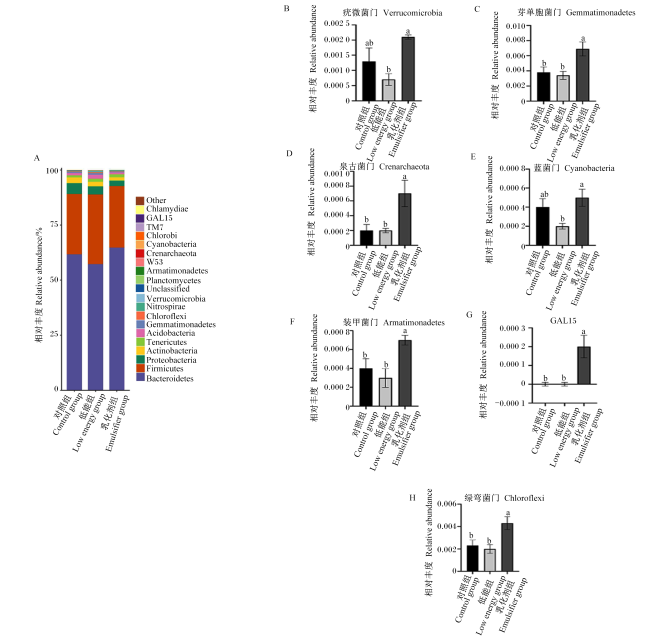
图2可知,42日龄肉鸡盲肠微生物在门水平主要的微生物菌群有拟杆菌门(Bacteroidetes)、厚壁菌门(Firmicutes)、变形菌门(Proteobacteria)、放线菌门(Actinobacteria)、软壁菌门(Tenericutes)和酸杆菌门(Acidobacteria)等。与对照组相比,乳化剂组的盲肠芽单胞菌门(Gemmatimonadetes)、泉古菌门(Crenarchaeota)、装甲菌门(Armatimonadetes)、GAL15和绿弯菌门(Chloroflexi)相对丰度显著升高(P<0.05);与低能组相比,乳化剂组的盲肠疣微菌门(Verrucomicrobia)、芽单胞菌门(Gemmatimonadetes)、泉古菌门、蓝菌门(Cyanobacteria)、装甲菌门、GAL15和绿弯菌门相对丰度显著升高(P<0.05)。
图2 低能饲粮中添加乳化剂对肉鸡盲肠微生物门水平相对丰度的影响

A:盲肠微生物门水平相对丰度前20门;B~H:盲肠微生物门水平相对丰度差异。

Other:其他;Chlamydiae:衣原体门;Chlorobi:绿菌门;Cyanobacteria:蓝藻门;Crenarchaeota:泉古菌门;Armatimonadetes:装甲菌门;Planctomycetes:浮霉菌门;Verrucomicrobia:疣微菌门;Nitrospirae:硝化螺旋菌门;Chloroflexi:绿弯菌门;Gemmatimonadetes:芽单胞菌门;Acidobacteria:酸杆菌门;Tenericutes:软壁菌门;Actinobacteria:放线菌门;Proteobacteria:变形菌门;Firmicutes:厚壁菌门;Bacteroidetes:拟杆菌门。

数据柱标相同小写字母表示差异不显著(P>0.05),不同小写字母表示差异显著(P<0.05)。下图同。

Fig.2 Effects of low energy diet supplemented with emulsifier on relative abundances of cecal microorganism at phylum level of broilers

A: top 20 relative abundance of cecal microorganism at phylum level; B to H: differences in relative abundance of cecal microorganism at phylum level.

Value columns with the same small letter mean no significant difference (P>0.05), while with different small letters mean significant difference (P<0.05). The same as below.

2.7.3 低能饲粮中添加乳化剂对肉鸡盲肠微生物属水平相对丰度的影响

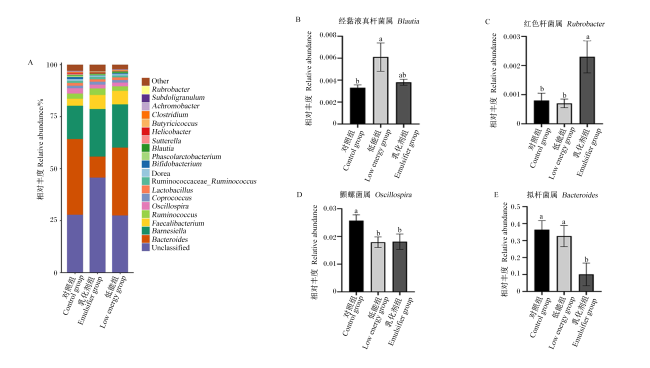
图3可知,42日龄肉鸡盲肠微生物在属水平主要的微生物菌群有拟杆菌属(Bacteroides)、巴恩斯氏菌属(Barnesiella)、粪杆菌属(Faecalibacterium)、瘤胃球菌属(Ruminococcus)、颤螺菌属(Oscillospira)、粪球菌属(Coprococcus)、乳杆菌属(Lactobacillus)和瘤胃球菌科_瘤胃球菌属(Ruminococcaceae_Ruminococcus)等。与对照组相比,低能组的盲肠经黏液真杆菌属(Blautia)相对丰度显著升高(P<0.05),乳化剂组的盲肠红色杆菌属(Rubrobacter)相对丰度显著升高(P<0.05);低能组和乳化剂组的盲肠颤螺菌属相对丰度显著降低(P<0.05)。与对照组和低能组相比,乳化剂组的盲肠拟杆菌属相对丰度显著降低(P<0.05)。
图3 低能饲粮中添加乳化剂对肉鸡盲肠微生物属水平相对丰度的影响

A:盲肠微生物属水平相对丰度前20门;B~H:盲肠微生物属水平相对丰度差异。Other:其他;Rubrobacter:红色杆菌属;Subdoligranulum:罕见小球菌属;Achromobacter:无色杆菌属;Clostridium:梭菌属;Butyricicoccus:丁酸球菌属;Helicobacter:螺杆菌属;Sutterella:萨特氏菌;Blautia:经黏液真杆菌属;Phascolarctobacterium:考拉杆菌属;Bifidobacterium:双歧杆菌属;Ruminococcaceae_Ruminococcus:瘤胃菌科_瘤胃球菌属;Lactobacillus:乳杆菌属;Coprococcus:粪球菌属;Oscillospira:颤螺菌属;Ruminococcus:瘤胃球菌属;Faecalibacterium:普拉梭菌;Barnesiella:巴恩斯氏菌属;Bacteroides:拟杆菌属;Unclassified:未分类。

Fig.3 Effects of low energy diet supplemented with emulsifier on relative abundance of cecal microorganism at genus level of broilers

A: top 20 relative abundance of cecal microorganism at genus level; B to H: differences in relative abundance of cecal microorganism at genus level.

3 讨论

3.1 低能饲粮中添加乳化剂对肉鸡生长性能的影响

研究发现,饲喂低能饲粮会降低肉鸡生长性能[14,20]。与对照组相比,低能饲粮会显著降低生长前期、生长中期、生长后期以及整个试验期的体增重[19]。在本研究中,饲喂低能饲粮降低21~28日龄平均体增重。在饲粮中添加溶血磷脂和溶血卵磷脂等乳化剂,可以弥补低能饲粮导致的生长性能的下降[21-23]。Upadhaya等[4]指出,低能饲粮中添加乳化剂显著增加体增重,降低饲料转化率。有研究指出,乳化剂对生长后期肉鸡的生长性能具有明显的改善作用,与低能组相比,添加乳化剂能够显著增加肉鸡生长后期(28~42日龄)的体增重[19]。本研究中,乳化剂组的肉鸡28~35日龄平均体增重高于低能组,但差异不显著。与上述研究结果存在差异的原因可能是低能饲粮中代谢能水平的降低仍能满足动物的生长需要。此外,本研究发现,肉鸡21~42日龄的平均采食量没有受到饲粮代谢能水平的影响。一些研究也报道了饲粮代谢能的减少并不影响采食量[13-14,24-25]。但也有研究指出,降低代谢能饲粮的肉仔鸡将消耗更多的饲料来弥补能量短缺[25]。家禽可以通过控制复杂且相互关联的神经和内分泌网络来调节采食量以维持营养状态[26]。结果的不一致可能与饲粮组成和代谢能水平降低相关[14,25]

3.2 低能饲粮中添加乳化剂对肉鸡血清生化指标的影响

在肉鸡上的研究发现,与对照组相比,低能饲粮对血清TP、UN、TG和GLU含量没有显著影响,低能饲粮中添加乳化剂同样对血清生化指标没有显著影响[4]。有关樱桃谷鸭的研究也发现相似的结果,添加乳化剂对血清TG、TCHO、高密度脂蛋白胆固醇、低密度脂蛋白胆固醇、极低密度脂蛋白胆固醇含量均无显著影响[27]。这与蛋鸭上的研究结果相一致,并且与乳化剂的添加剂量无关[9]。饲粮中添加乳化剂主要影响黄羽肉鸡在试验前期的血清TG和高密度脂蛋白含量,但对试验后期的血清TG、TCHO、高密度脂蛋白、低密度脂蛋白含量均无显著影响[28]。本研究发现,低能饲粮添加中乳化剂对血清GLU、TG、TCHO含量没有影响。结果存在差异的原因可能与动物品种、饲粮能量水平、饲喂时长有关。此外,本试验中发现,与对照组相比,低能饲粮中添加乳化剂提高了血清TP含量,说明乳化剂影响机体蛋白质代谢,值得进一步研究。

3.3 低能饲粮中添加乳化剂对肉鸡器官指数、胰腺消化酶活性和肠道发育的影响

前期已有研究探究低能饲粮中添加乳化剂对肝脏、脾脏、肌胃、腺胃和腹脂率的影响。Cho等[29]研究发现,低能饲粮中添加乳化剂对肉鸡TG、GLU含量和器官(肝脏、腹脂和肌胃)相对重量无显著影响。研究发现,低能饲粮对肉鸡肝脏、脾脏、腹脂和肌胃相对重量没有显著影响,低能饲粮中添加乳化剂同样对上述器官相对重量没有显著影响[4]。本研究发现,低能饲粮对肉鸡肝脏、脾脏、肌胃、腺胃指数没有显著影响,低能饲粮中添加乳化剂对上述器官指数亦没有显著影响。此外,本研究表明低能饲粮未对肠道发育造成影响,乳化剂的添加未见积极效果。这说明低能饲粮中代谢能的适度降低对相对器官重量未造成影响。饲粮代谢能水平仍能满足器官的正常发育,乳化剂提高了肉鸡的能量利用率,并不影响器官发育[4]。但在本研究中,低能饲粮显著增加了肉鸡腹脂指数,添加乳化剂未见改善作用。在相关研究中指出,与对照组相比,低能饲粮可降低腹脂率,添加乳化剂对腹脂率没有影响[19]。有关饲粮能量对腹脂率的影响,大多数研究结果发现,饲粮代谢能高增加脂肪沉积[30-31]。本研究发现,饲喂低能饲粮增加了肉鸡腹脂率,推测主要原因与饲粮能量水平降低相关。Chen等[32]研究发现,饲粮能量水平降低50 kcal/kg(1 kcal=4.184 kJ),腹脂率由1.42升高至1.52。这说明在饲粮能量水平降低幅度小的情况下,肉仔鸡用于维持生长所需的能量较少,更多的能量以腹脂的形式储存。
动物肠道对油脂的消化依赖胆汁酸的乳化作用和脂肪酶的催化,二者存在协同关系,外源乳化剂的添加可能通过参与该进程干预消化酶的分泌和活性。前人研究表明,饲粮中添加650 mg/kg乳化剂显著增加肉鸡十二指肠、空肠和回肠的脂肪酶活性[33]。胡玲[34]研究报道,在肉鸡前期、后期饲粮中分别添加265、400 mg/kg乳化剂能够提高十二指肠和空肠的脂肪酶活性。此外,无论基础饲粮和低能饲粮饲喂的黄羽肉鸡,十二指肠淀粉酶和糜蛋白酶活性均受到乳化剂添加影响而增强[28]。本研究中,与对照组相比,低能饲粮未影响胰腺消化酶活性,而乳化剂的添加显著提高胰腺中胰蛋白酶活性,推测乳化剂的添加提高了蛋白质的消化。溶血卵磷脂有降低肝脏TG含量的作用[35]。这与本研究的结果一致,本研究中,与低能组相比,乳化剂的添加降低了肝脏TG含量。脂肪在组织中主要以TG的形式存在。TG的一般合成部位是肝脏与脂肪组织,但是与哺乳动物不同的是,家禽的TG合成主要由肝脏完成[36]。本研究结果说明,低能饲粮中添加乳化剂能够降低肝脏TG的合成,缓解脂肪代谢异常。

3.4 低能饲粮中添加乳化剂对肉鸡盲肠微生物区系的影响

家禽肠道的特点是长度较短,食物在肠道中的消化时间都较短,但相对于小肠,盲肠内的消化时间更长[37]。盲肠是肉鸡重要的肠道部位,其中的微生物群参与调节宿主代谢和免疫调节,包括营养物质的消化吸收、维持能量平衡和机体免疫系统的发育[38]。盲肠是家禽肠道微生物活动的主要区域,可以衡量肉鸡肠道微生物丰度[39]。细菌种类丰富程度与肠道微生态的稳定性有关[40]。盲肠菌群丰富度越高,肉鸡生长性能越好[41]。因此,本试验分析了乳化剂对盲肠微生物区系的影响。前期有研究表明,蛋鸭饲粮中添加100、150、200 g/t乳化剂均对盲肠微生物α多样性和β多样性无显著差异[9]。在本研究中,与低能组相比,添加乳化剂提高了α多样性,表现在Shannon指数、Observed_features指数、Faith_pd指数和Chao1指数显著提高。此外,在本研究中,β多样性指数表明2组之间有很好的分离。总体而言,低能饲粮中添加乳化剂影响了盲肠微生物群落的多样性。大多数研究认为,α多样性较高的肠道菌群更有利于机体健康[42-43]。在肉鸡盲肠肠道菌群中,厚壁菌门、拟杆菌门和变形菌门是其优势菌门,其中厚壁菌门相对丰度最高[44-45]。本研究发现,在门水平上,盲肠厚壁菌门相对丰度最高,拟杆菌门次之,但各组之间差异不显著。绿弯菌门可以代谢碳水化合物(单、双以及多糖),产生短链脂肪酸(SCFAs)[46]。在本试验中,与对照组和低能组相比,乳化剂组的盲肠绿弯菌门相对丰度显著升高。红色杆菌属属于放线菌门,有研究发现,注射脂多糖(LPS)显著降低了空肠红色杆菌属相对丰度,提示该菌属可能与炎症反应相关[47]。本试验中,添加乳化剂增加了盲肠红色杆菌属相对丰度,有助于缓解炎症反应。

4 结论

低能饲粮中添加乳化剂对肉鸡生长性能存在一定的积极影响,提高胰腺中胰蛋白酶活性,缓解肝脏脂肪沉积,提高盲肠菌群多样性和绿弯菌门相对丰度。
[1]
江蕾. 饲用不同类型油脂对肉鸡生产性能、肉品质及脂质代谢的影响[D].硕士学位论文. 杭州: 浙江大学, 2022.

JING L. Effects of different types of oils on production performance, meat quality and lipid metabolism of broilers[D].Master’s Thesis. Hangzhou: Zhejiang University, 2022. (in Chinese)

[2]
AZMAN M A, KONAR V, SEVEN P T. Effects of different dietary fat sources on growth performances and carcass fatty acid composition of broiler chickens[J]. Ecole Nationale Vétérinaire de Toulouse, 2004(5):278-286.

[3]
FÉBEL H, MÉZES M, PÁLFY T, et al. Effect of dietary fatty acid pattern on growth, body fat composition and antioxidant parameters in broilers[J]. Journal of Animal Physiology & Animal Nutrition, 2010, 92(3):369-376.

[4]
UPADHAYA S D, PARK J W, PARK J H, et al. Efficacy of 1,3-diacylglycerol as a fat emulsifier in low-density diet for broilers[J]. Poultry Science, 2017, 96(6):1672-1678.

DOI PMID

[5]
PEEBLES E D, ZUMWALT C D, DOYLE S M, et al. Effects of dietary fat type and level on broiler breeder performance[J]. Poultry Science, 2000, 79(5):629-639.

PMID

[6]
MENG X, SLOMINSKI B A, GUENTER W. The effect of fat type, carbohydrase, and lipase addition on growth performance and nutrient utilization of young broilers fed wheat-based diets[J]. Poultry Science, 2004, 83(10):1718-1727.

DOI PMID

[7]
MEHDI N, ALI H, PARVIZ F. Influence of soybean oil on growth performance, carcass properties, abdominal fat deposition and humoral immune response in male broiler chickens[J]. Journal of Animal & Veterinary Advances, 2012, 6(11):1317-1322.

[8]
ZAMPIGA M, MELUZZI A, SIRRI F. Effect of dietary supplementation of lysophospholipids on productive performance, nutrient digestibility and carcass quality traits of broiler chickens[J]. Italian Journal of Animal Science, 2016, 15(3):521-528.

DOI

[9]
陈诗敏. 乳化剂对蛋鸭生产性能和脂肪代谢的影响[D].硕士学位论文. 南京: 南京农业大学, 2022.

CHEN S M. Effects of emulsifier on production performance and fat metabolism of laying duck[D].Master’s Thesis. Nanjing: Nanjing Agricultural University, 2022. (in Chinese)

[10]
SIYAL F, BABAZADEH D, WANG C, et al. Emulsifiers in the poultry industry[J]. World’s Poultry Science Journal, 2017, 73(3):611-620.

DOI

[11]
CHEN C, JUNG B, KIM W K. Effects of lysophospholipid on growth performance, carcass yield, intestinal development, and bone quality in broilers[J]. Poultry Science, 2019, 98(9):3902-3913.

DOI PMID

[12]
GE X K, WANG A A, YING Z X, et al. Effects of diets with different energy and bile acids levels on growth performance and lipid metabolism in broilers[J]. Poultry Science, 2019, 98:887-895.

DOI PMID

[13]
SALEH A A, AMBER K A, MOUSA M M, et al. A Mixture of exogenous emulsifiers increased the acceptance of broilers to low energy diets: growth performance, blood chemistry, and fatty acids traits[J]. Animals, 2020, 10(3):437.

DOI

[14]
WANG J, CHOI H, KIM W K. Effects of dietary energy level and 1,3-diacylglycerol on growth performance and carcass yield in broilers[J]. The Journal of Applied Poultry Research, 2020, 29(3):665-672.

DOI

[15]
ALLAHYARI-BAKE S, JAHANIAN R. Effects of dietary fat source and supplemental lysophosphatidylcholine on performance, immune responses, and ileal nutrient digestibility in broilers fed corn/soybean meal- or corn/wheat/soybean meal-based diets[J]. Poultry science, 2017, 96(5):1149-1158.

DOI

[16]
BOONTIAM W, JUNG B, KIM Y Y. Effects of lysophospholipid supplementation to lower nutrient diets on growth performance, intestinal morphology, and blood metabolites in broiler chickens[J]. Poultry Science, 2017, 96(3):593-601.

DOI PMID

[17]
ZHAO P Y, KIM I H. Effect of diets with different energy and lysophospholipids levels on performance, nutrient metabolism, and body composition in broilers[J]. Poultry Science, 2017, 96(5):1341-1347.

DOI PMID

[18]
BONTEMPO V, COMI M, JIANG X R, et al. Evaluation of a synthetic emulsifier product supplementation on broiler chicks[J]. Animal Feed Science and Technology, 2018, 240:157-164.

DOI

[19]
KO H, WANG J, CHIU J W, et al. Effects of metabolizable energy and emulsifier supplementation on growth performance, nutrient digestibility, body composition, and carcass yield in broilers[J]. Poultry Science, 2023, 102(4):102509.

DOI

[20]
LATHAM R E, WILLIAMS M, SMITH K, et al. Effect of β-mannanase inclusion on growth performance, ileal digestible energy, and intestinal viscosity of male broilers fed a reduced-energy diet[J]. Journal of Applied Poultry Research, 2016, 25(1):40-47.

DOI

[21]
MAJDOLHOSSEINI L, GHASEMI H A, HAJKHODADADI I, et al. Nutritional and physiological responses of broiler chickens to dietary supplementation with de-oiled soyabean lecithin at different metabolisable energy levels and various fat sources[J]. British Journal of Nutrition, 2019, 122(8):863-872.

DOI

[22]
HAETINGER V S, DALMORO Y K, GODOY G L, et al. Optimizing cost, growth performance and nutrient absorption with a bio-emulsifier based on lysophospholipids for broiler chickens[J]. Poultry Science, 2021, 100(4):101025.

DOI

[23]
NEMATI M, GHASEMI H A, HAJKHODADADI I, et al. De-oiled soy lecithin positively influenced growth performance, nutrient digestibility, histological intestinal alteration, and antioxidant status in turkeys fed with low energy diets[J]. British Poultry Science, 2021, 62(6):858-867.

DOI PMID

[24]
HU Y D, LAN D, ZHU Y, et al. Effect of diets with different energy and lipase levels on performance, digestibility and carcass trait in broilers[J]. Asian-Australasian Journal of Animal Sciences, 2018, 31:1275-1284.

DOI PMID

[25]
MASSUQUETTO A, PANISSON J C, SCHRAMM V G, et al. Effects of feed form and energy levels on growth performance, carcass yield and nutrient digestibility in broilers[J]. Animal, 2020, 14(6):1139-1146.

DOI PMID

[26]
RICHARDS M P, PROSZKOWIEC-WEGLARZ M. Mechanisms regulating feed intake, energy expenditure, and body weight in poultry[J]. Poultry Science, 2007, 86(7):1478-1490.

PMID

[27]
王源. 乳化剂对樱桃谷鸭生长性能、肠道形态和肉品质的影响[D].硕士学位论文. 哈尔滨: 东北农业大学, 2019.

WANG Y. Effects of emulsifiers on growth performance, intestinal morphology and meat quality of Cherry Valley ducks[D].Master’s Thesis.Haerbin:Northeast Agricultural University, 2019. (in Chinese)

[28]
赵媚. 乳化剂对黄羽肉鸡生长性能、养分消化率及脂质代谢的影响[D].硕士学位论文. 长沙: 湖南农业大学, 2023.

ZHAO M. Effects of emulsifier on growth performance, nutrient digestibility and lipid metabolism of yellow feathered broilers[D].Master’s Thesis. Changsha: Hunan Agricultural University, 2023. (in Chinese)

[29]
CHO J H, ZHAO P Y, KIM I H. Effects of emulsifier and multi-enzyme in different energy densitydiet on growth performance, blood profiles, and relative organ weight in broiler chickens[J]. Journal of Agricultural Science, 2012, 4(10):123-132.

[30]
ROSA P S, FARIA FILHO D E, DAHLKE F, et al. Effect of energy intake on performance and carcass composition of broiler chickens from two different genetic groups[J]. Brazilian Journal of Poultry Science, 2007(9):117-122.

[31]
EL-SENOUSEY H K, WANG W, WANG Y, et al. Dietary metabolizable energy responses in yellow-feathered broiler chickens from 29 to 56 d[J]. Journal of Applied Poultry Research, 2019, 28:974-981.

DOI

[32]
CHEN X, ZHANG G M, WANG W W, et al. Compound non-starch polysaccharide enzymes improve growth performance, slaughter performance, immune function, and apparent utilization rate of nutrients in broiler chickens fed a low-metabolizable energy diet[J]. Frontiers in Veterinary Science, 2023, 10:1162811.

DOI

[33]
张青青. 乳化剂对肉鸡养分利用率、生产性能和肉品质的影响[D].硕士学位论文. 泰安: 山东农业大学, 2010.

ZHANG Q Q. Effects of emulsifier on nutrients utilization, growth performance and meat quality in broilers[D].Master’s Thesis. Tai’an: Shandong Agricultural University, 2010. (in Chinese)

[34]
胡玲. 两种能量水平饲粮添加乳化剂对肉鸡生产性能及养分利用率的影响[D].硕士学位论文. 雅安: 四川农业大学, 2013.

HU L. Effects of emulsifier in two metabolizable energy diets on growth performance and nutrients availability in broilers[D].Master’s Thesis. Ya’an: Sichuan Agricultural University, 2013. (in Chinese)

[35]
杨丹丹. 溶血卵磷脂对肉仔鸡生产性能、脂类代谢及免疫性能的影响[D].硕士学位论文. 南京: 南京农业大学, 2008.

YANG D D. Effects of lysolecithin on growth performance, lipid metabolism and immune function in broiler chickens[D].Master’s Thesis. Nanjing: Nanjing Agricultural University, 2008. (in Chinese)

[36]
GRIFFIN H, ACAMOVIC F, GUO K, et al. Plasma lipoprotein metabolism in lean and in fat chickens produced by divergent selection for plasma very low density lipoprotein concentration[J]. Journal of Lipid Research, 1989, 30(8):1243.

PMID

[37]
HUGHES R J. Relationship between digesta transit time and apparent metabolisable energy value of wheat in chickens[J]. British Poultry Science, 2008, 49(6):716-720.

DOI PMID

[38]
LIU L, LI L, LI C, et al. Effects of Lactiplantibacillus plantarum LPJZ-658 supplementation on the production, meat quality, intestinal morphology, and cecal microbiota of broilers chickens[J]. Microorganisms, 2023, 11(6):1549.

DOI

[39]
BAURHOO B, PHILLIP L, RUIZ-FERIA C A. Effects of purified lignin and mannan oligosaccharides on intestinal integrity and microbial populations in the ceca and litter of broiler chickens[J]. Poultry Science, 2007 ;86(6):1070-1078.

[40]
CHATELIER E, NIELSEN T, QIN J, et al. Richness of human gut microbiome correlates with metabolic markers[J]. Nature, 2013, 500(7464):541-546.

DOI

[41]
STANLEY D, GEIER M S, DENMAN S E, et al. Identification of chicken intestinal microbiota correlated with the efficiency of energy extraction from feed[J]. Veterinary Microbiology, 2013, 164(1/2):85-92.

DOI

[42]
DONG X Y, AZZAM M M M, ZOU X T. Effects of dietary threonine supplementation on intestinal barrier function and gut microbiota of laying hens[J]. Poultry Science, 2017, 96(10):3654-3663.

DOI PMID

[43]
WANG H, LI S, FANG S, et al. Betaine improves intestinal functions by enhancing digestive enzymes, ameliorating intestinal morphology, and enriching intestinal microbiota in high-salt stressed rats[J]. Nutrients, 2018, 10(7):907.

DOI

[44]
王璇, 王丹丹, 年芳, 等. 不同淀粉源饲粮对肉仔鸡小肠消化酶活性、盲肠挥发性脂肪酸含量和微生物菌群的影响[J]. 动物营养学报, 2021, 33(1):285-296.

DOI

WANG X, WANG D D, NIAN F, et al. Effects of different starch source diets on small intestinal digestive enzyme activities, cecum volatile fatty acid contents and microbial community of broilers[J]. Chinese Journal of Animal Nutrition, 2021, 33(1):285-296. (in Chinese)

[45]
金瑶瑶, 徐彬, 王琳燚, 等. 酶解青蒿联合地衣芽孢杆菌对肉仔鸡生长性能和盲肠菌群的影响[J]. 动物营养学报, 2021, 33(7):3810-3820.

DOI

JIN Y Y, XU B, WANG L Y, et al. Effects of enzymatically treated Artemisia annua combined with Bacillus licheniformis on growth performance and cecal microbiota of broilers[J]. Chinese Journal of Animal Nutrition, 2021, 33(7):3810-3820. (in Chinese)

[46]
ALALAWY A I, GUO Z, ALMUTAIRI F M, et al. Explication of structural variations in the bacterial and archaeal community of anaerobic digestion sludges: an insight through metagenomics[J]. Journal of Environmental Chemical Engineering, 2021, 9(12):105910.

DOI

[47]
SUN L, GUO L, XU G, et al. Quercetin reduces inflammation and protects gut microbiota in broilers[J]. Molecules, 2022, 27(10):3269.

DOI

Outlines

/