RESEARCH PAPER

Effects of Supplementing Different Doses of Glycerol on Apparent Digestibility of Nutrients, Rumen Internal Environment, and Volatile Fatty Acids Absorption in Non-Pregnant Ewes

  • JIANG Baihui ,
  • NAN Ying ,
  • XIE Mengting ,
  • QI Xingdong ,
  • YE Cuifang ,
  • NUERLI Abulizi ,
  • ZHAO Zongsheng
Expand
  • College of Animal Science and Technology, Shihezi University, Shihezi 832003, China
*professor, E-mail:

Received date: 2023-10-10

  Online published: 2024-04-15

Abstract

This study was conducted to investigate the effects of supplementing different doses of glycerol on the apparent digestibility, rumen fermentation parameters, expression of genes related to volatile fatty acids (VFA)absorption in rumen epithelium, and rumen morphological structure in non-pregnant ewes. Forty healthy adult ewes of similar age and weight were randomly assigned to one of four groups: control, test group Ⅰ, test group Ⅱ, and test group Ⅲ, each group consisted of 10 replicates with one animal per replicate. The control group was fed a basic diet. In addition to the basic diet, the test groups were drenched daily with 1%, 7%, or 12% glycerol (dry matter basis, calculated based on an estimated daily dry matter intake of approximately 1.3 kg per ewe in each group, equating to glycerol drench volumes of 10, 70 and 120 mL, respectively; purity: 99.88%; calorific value: 18.1 MJ/kg). A pre-feeding period of 14 days was followed by a main feeding period of 60 days. The results showed as follows: 1) the neutral detergent fiber (NDF), acid detergent fiber (ADF), and ash apparent digestibility in test group Ⅱ were significantly higher than those in the control group (P<0.05), and the NDF and ADF apparent digestibility in test group Ⅱ were also significantly higher than those in test group Ⅰ (P<0.05), with no significant difference between the other groups (P>0.05). 2) In test group Ⅰ, the ruminal fluid pH was significantly lower than that in the control group and test group Ⅱ (P<0.05). Compared with the control group, the total volatile fatty acids (TVFA) content in the rumen was significantly higher in test group Ⅰ and test group Ⅲ (P<0.01), and significantly higher in test group Ⅱ (P<0.05). The contents of acetate and propionate in the control group were significantly different from those in test group Ⅰ and test group Ⅲ (P<0.01), and significantly different from test group Ⅱ (P<0.05). The butyrate content, the proportions of various VFAs, and the acetate to propionate ratio showed no significant differences among the groups (P>0.05). 3) With the increase in glycerol feeding, the expression of down-regulating adenoma carrier (DRA), Na+/H+ exchanger 3 (NHE3) and proton-pumping ATPase (vH+ ATPase) in the rumen epithelium increased first and then decreased. However, the expression of monocarboxylate transporter 1 (MCT1), monocarboxylate transporter 4 (MCT4) and sodium/potassium ATPase (Na+/K+ ATPase) in the ruminal epithelium gradually decreased. There was no significant difference in the relative expression of Na+/H+ exchanger 1 (NHE1) and Na+/H+ exchanger 2 (NHE2) among the groups (P>0.05). 4) The rumen papillae morphology was good in the control group, test groups Ⅰ and Ⅱ, but the keratin layer in test group Ⅲ was damaged. Compared with the control group, the papillae width in all test groups was significantly lower (P<0.01), and the height was significantly higher (P<0.05). The thickness of the keratin and granular layers in test groups Ⅱ and Ⅲ was significantly lower than that in the control group and test group Ⅰ (P<0.05). In conclusion, daily gavage of glycerol can improve nutrient apparent digestibility, improve rumen fermentation environment, promote the growth of stratum corneum of the rumen epithelium and granular layer, and promote the expression of some genes related to VFA absorption in rumen epithelium. Under the conditions of this experiment, 7% gavage of glycerol is more effective.[Chinese Journal of Animal Nutrition, 2024, 36(4):2541-2550]

Cite this article

JIANG Baihui , NAN Ying , XIE Mengting , QI Xingdong , YE Cuifang , NUERLI Abulizi , ZHAO Zongsheng . Effects of Supplementing Different Doses of Glycerol on Apparent Digestibility of Nutrients, Rumen Internal Environment, and Volatile Fatty Acids Absorption in Non-Pregnant Ewes[J]. Chinese Journal of Animal Nutrition, 2024 , 36(4) : 2541 -2550 . DOI: 10.12418/CJAN2024.218

空怀期,即母羊在哺乳期结束后进入的非繁殖期,是羊生产管理中一个容易被忽视但却至关重要的阶段。此阶段饲养的主要目的是使母羊群的膘情达到一致,以便于集中发情、集中配种和羔羊的统一管理。在此期间,母羊需要及时恢复机体状态并维持机体健康,从而为下一个繁殖周期做好准备。因此,正确的营养管理对于提高空怀期母羊的生产性能和繁殖效率至关重要。瘤胃是母羊体内的重要消化器官,里面含有大量微生物,这些微生物利用母羊食入饲料中的纤维素、淀粉等其他碳水化合物进行发酵,同时产生大量的挥发性脂肪酸(VFA),这些VFA会经母羊胃肠道上皮吸收进入母羊血液,再经血液循环为全身组织提供大量能量,对空怀期母羊的营养吸收以及机体能量供应具有直接影响。研究显示,瘤胃内所产生的VFA能够为反刍动物提供所需能量的70%~80%[1]。同时,VFA在维持反刍动物瘤胃内的酸碱平衡中扮演着重要的角色[2-3],它能够通过维持适宜的pH环境,从而促进微生物的生长和代谢,这对于母羊的消化功能至关重要。VFA还能够被当作碳源用于瘤胃内菌体蛋白的合成[4-6],从而为母羊提供优质的蛋白质来源。
甘油作为一种高能低廉的高产量副产品之一,早在20世纪60年代就有研究者将其作为一种高能饲料应用于反刍动物营养[7],此后几十年内陆续有学者开始对甘油在各种反刍动物营养中的应用做出探讨[8-10],而这在处于极易被忽视的母羊空怀期阶段的应用却鲜见报道。因此,本试验旨在深入研究甘油对空怀期母羊养分表观消化率、瘤胃发酵参数、VFA吸收及瘤胃形态结构的潜在影响,通过分析其作用机制,探讨如何在母羊饲养中科学地应用甘油,以优化瘤胃功能,提高能量利用效率。这一研究可能有望为空怀期母羊的饲养和管理提供有益的见解,为提高养羊业的效益提供新的策略和方向。

1 材料与方法

1.1 试验设计

随机选取40只健康、年龄相近、体重接近的成年空怀期母羊,平均分配到对照组、试验Ⅰ组、试验Ⅱ组和试验Ⅲ组,每组10个重复,每个重复1只。其中,对照组饲喂基础饲粮,试验组除饲喂基础饲粮外,每日晨饲前分别灌服1%、7%、12%的甘油(干物质占比,经估算每日每组各母羊平均干物质采食量约为1.3 kg,各组甘油灌服量分别为10、70、120 mL,甘油纯度:99.88%,燃烧能值:18.1 MJ/kg),预试期14 d,正试期60 d,正试期结束后进行屠宰试验。基础饲粮参照NRC(2007)[11]建议的成年母羊营养需要量进行配制,其组成及营养水平见表1
表1 基础饲粮组成及营养水平(干物质基础)

Table 1 Composition and nutrient levels of the basal diet (DM basis)%

项目 Items 含量 Content
原料 Ingredients
苜蓿干草 Alfalfa hay 40.0
苜蓿青贮 Alfalfa silage 35.0
玉米秸秆 Corn stover 5.0
豆粕 Soybean meal 7.9
玉米 Corn 8.5
小苏打 NaHCO3 1.5
预混料 Premix1) 1.0
氯化钠 NaCl 0.8
赖氨酸 Lys 0.3
合计 Total 100.0
营养水平 Nutrient levels2)
维持净能 NEm/(MJ/kg) 10.96
粗脂肪 EE 2.93
粗蛋白质 CP 16.62
粗灰分 Ash 8.82
中性洗涤纤维 NDF 44.94
酸性洗涤纤维 ADF 35.59

1) 每千克预混料含有 One kg of premix contained the following: VA 400 000 IU, VD 40 000 IU, VE 8 000 IU, Fe 3 600 mg, Zn 4 000 mg, Cu 4 000 mg, Mn 2 000 mg, Na 20 mg, Co 20 mg, I 40 mg。

2)维持净能为计算值,其余为实测值。NEm was a calculated value, while the others were measured values.

1.2 饲养管理

试验在新疆石河子大学动物科技学院试验站进行,试验羊栏舍饲养,自由采食,自由饮水,每日饲喂2次(10:00,20:00),剩料控制在5%~10%。

1.3 样品采集与测定

1.3.1 瘤胃发酵参数测定

于正试期最后1 d采集40只母羊瘤胃液,在晨饲前利用瘤胃插管采集各组母羊瘤胃液,弃去初始采集的50 mL瘤胃液,保留随后采集的50 mL瘤胃液。使用便携式pH计当场测定瘤胃液pH,做好数据记录,其余瘤胃液样本经4层纱布过滤,分装到10 mL离心管储存于-20 ℃冰箱,用于后续挥发性脂肪酸(VFA)和氨态氮含量的测定。其中,VFA含量测定采用王俊红等[12]的方法进行测定,氨态氮含量测定采用冯宗慈等[13]的方法进行测定。

1.3.2 养分表观消化率的测定

采用内源指示剂法,于正试期最后3 d进行饲粮和粪样的采集。使用部分收粪法对40只母羊粪便进行采集,于每天09:00给各组母羊套上自制收粪袋,至17:00进行粪便回收。将回收的粪便分为2份,一份取样100 g加入10 mL 10%硫酸固氮,存储于-20 ℃冰箱,以供后续粪便中粗蛋白质含量的测定;另一份取样200 g,置于65 ℃烘箱内烘干,再利用粉碎机进行粉碎制样,存储于-20 ℃冰箱,以供其余养分含量测定。饲粮和粪样中干物质、粗脂肪、粗蛋白质、粗灰分、中性洗涤纤维、酸性洗涤纤维含量按照GB/T 14924.9—2001[14]的方法进行检测,饲粮和粪样中盐酸不溶灰分含量按照GB/T 23742—2009[15]的方法进行测定,饲粮能量根据《中国饲料成分及营养价值表》[16]进行计算。养分表观消化率计算公式如下:
饲粮中某养分表观消化率(%)=100×(饲粮中指示剂含量/粪中指示剂含量)×(粪中养分含量/饲粮中养分含量)。

1.3.3 VFA吸收相关基因在瘤胃上皮的表达检测

于正试期结束第1天,各组内随机选取6只母羊进行屠宰,在瘤胃腹囊侧取约1 g瘤胃上皮组织,用4 ℃磷酸盐缓冲液(PBS)洗涤多次,置于液氮中保存;采样结束后第一时间转移至超低温冰箱(-80 ℃)保存,用于后续RNA提取。使用天根动物组织RNA快速提取试剂盒对屠宰取得的瘤胃上皮进行总RNA提取;然后对提取到的总RNA进行逆转录得到cDNA,反应体系为20 μL:dNTP Mix 4 μL、Primer Mix 2 μL、RNA Template 1 μL、5×RT Buffer 4 μL、DTT 2 μL、HiFiScript 1 μL、RNase-Free Water 6 μL,反应程序为:42 ℃孵育15 min,85 ℃孵育5 min,反应结束后,短暂离心,置于冰上冷却;最后利用cDNA进行实时荧光定量PCR,反应体系为20 μL:SYBR Green qPCR Master Mix 10 μL、Forward Primer 0.4 μL、Reverse Primer 0.4 μL cDNA 0.5 μL、RNase-Free Water 8.7 μL,反应程序为两步法:95 ℃ 5 min(预变性),95 ℃ 10 s(变性),55~60 ℃ 30 s(退火),循环数35。采用2-ΔΔCt的计算方法,以甘油醛-3-磷酸脱氢酶(GAPDH)为内参基因,计算目标基因的相对表达量,引物信息如表2所示。
表2 引物信息

Table 2 Primer information

基因名称
Gene names
引物序列
Primer sequence(5'—3')
登录号
Accession number
产物长度
Product length/bp
下调式腺瘤载体
DRA
F:AGAAGGAGACAGTGTGGCGG
R:GAACATTGGTGTTCGGGGTG
NM_ 001280717.1 144
单羧酸转运蛋白1
MCT1
F:CCTCAACCAGGCTTTCTTTATG
R:CACTTGCCCCCTTGTTTATCTC
XM_ 042252647.1 194
单羧酸转运蛋白4
MCT4
F:AGAGCCAAAACACTGGGGATAA
R:CGCCACACAGGATGAGGTAAGA
XM_ 042252148.1 160
Na+/H+ ATP酶
Na+/K+ ATPase
F:TAACAACGAACAAGGAGAGCG
R:GTTTCATCATTTATTCCAGAG
NM_ 001009796.1 81
Na+/H+交换蛋白1
NHE1
F: GGTTTCACTCCTTCCTCGCA
R: GCTGCTGGGACTCTTGCTAA
XM_004005085.1 132
Na+/H+交换蛋白2
NHE2
F:GTTGACGTGTTTGCTGGCAT
R:GATCACGCGG ATGTTGTGTG
XM_ 027967037.2 123
Na+/H+交换蛋白3
NHE3
F: CCCGGCAGGAGTACAAACAT
R: TTGGCGGACTTGAAGGACTC
XM_004017162.1 124
质子泵型ATP酶
vH+ ATPase
F:TTTTATTGAACAAGAAGCCAATGA
R:GATTCATCAAATTGGACATCTGAA
XM_ 004006972.4 182
甘油醛-3-磷酸脱氢酶
GAPDH
F:GGCGTGAACCACGAGAAGTA
R:GGCGTGGACAGTGGTCATAA
NM_ 001190390.1 141

1.3.4 胃肠道组织切片

屠宰羊数及取样时间同1.3.3,于瘤胃腹囊测取约2 cm2瘤胃上皮组织块,先用PBS小心冲洗,然后置于含有4%多聚甲醛的50 mL管内进行固定,24 h后进行换液,常温保存用于后续石蜡切片和苏木精-伊红(HE)染色;切片制作完成后利用Olympus BX53 Microscope进行观察,并测定乳头宽度、乳头高度、角质层厚度和颗粒层厚度。

1.4 数据统计分析

数据采用SPSS 25.0 软件进行单因素方差分析(one-way ANOVA),并利用LSD法进行多重比较,P<0.05为差异显著,P<0.01为差异极显著,结果以平均值±标准差表示。

2 结果

2.1 补饲不同剂量甘油对空怀期母羊养分表观消化率的影响

表3可知,试验Ⅱ组中性洗涤纤维与酸性洗涤纤维表观消化率显著高于对照组与试验Ⅰ组(P<0.05),其余各组之间无显著差异(P>0.05);试验Ⅱ组粗灰分表观消化率显著高于对照组(P<0.05),其余各组之间无显著差异(P>0.05);各组母羊的粗蛋白质及粗脂肪表观消化率无显著差异(P>0.05),但各试验组平均值均高于对照组。
表3 补饲不同剂量甘油对空怀期母羊养分表观消化率的影响

Table 3 Effects of supplementing different doses of glycerol on nutrient apparent digestibility in non-pregnant ewes%

项目
Items
对照组
Control group
试验Ⅰ组
Test group Ⅰ
试验Ⅱ组
Test group Ⅱ
试验Ⅲ组
Test group Ⅲ
粗蛋白质 CP 73.67±11.93 76.33±4.04 84.40±9.76 86.25±3.76
粗脂肪 EE 42.67±19.09 50.20±10.64 64.60±16.15 55.50±14.01
中性洗涤纤维 NDF 51.60±2.93b 60.82±4.11b 68.68±5.55a 63.14±12.26ab
酸性洗涤纤维 ADF 42.14±5.00b 52.53±3.90b 63.43±6.80a 55.26±15.44ab
粗灰分 Ash 35.00±19.47b 44.80±8.61ab 56.20±16.08a 49.00±9.31ab

同行数据肩标无字母或相同小写字母表示差异不显著(P>0.05),不同小写字母表示差异显著(P<0.05),不同大写字母表示差异极显著(P<0.01)。下表同。

In the same row, values with no letter or the same small letter superscripts mean no significant difference (P>0.05), while with different small letter superscripts mean significant difference (P<0.05), and with different capital letter superscripts mean significant difference (P<0.01). The same as below.

2.2 补饲不同剂量甘油对空怀期母羊瘤胃发酵参数的影响

表4可知,对照组pH与试验Ⅰ组差异极显著(P<0.01),与试验Ⅱ、Ⅲ组差异不显著(P>0.05),且试验组中瘤胃液pH低于对照组,各试验组中,试验Ⅰ组瘤胃液pH与试验Ⅱ组差异显著(P<0.05),其余差异不显著(P>0.05)。各组间瘤胃液氨态氮含量差异不显著(P>0.05)。对照组总挥发性脂肪酸(TVFA)含量与试验Ⅰ组、试验Ⅲ组差异极显著(P<0.01),与试验Ⅱ组差异显著(P<0.05);其中对照组乙酸、丙酸含量与试验Ⅰ组、试验Ⅲ组差异极显著(P<0.01),与试验Ⅱ组差异显著(P<0.05);丁酸含量、各VFA占比及乙酸/丙酸在各组之间差异不显著(P>0.05)。
表4 补饲不同剂量甘油对空怀期母羊瘤胃发酵参数的影响

Table 4 Effects of supplementing different doses of glycerol on rumen fermentation parameters in non-pregnant ewes

项目
Items
对照组
Control group
试验Ⅰ组
Test group Ⅰ
试验Ⅱ组
Test group Ⅱ
试验Ⅲ组
Test group Ⅲ
pH 7.03±0.16Aa 6.58±0.25Bb 6.90±0.13ABa 6.81±0.22ABab
氨态氮 NH3-N/(mg/dL) 3.05±0.75 3.38±0.66 3.29±0.93 3.31±1.03
总挥发性脂肪酸 TVFA/(μg/mL) 105.67±27.08Bb 174.99±23.25Aa 146.15±20.99ABa 163.59±18.89Aa
乙酸 Acetic acid/(μg/mL) 74.69±21.38Bb 127.66±25.60Aa 107.20±13.63ABa 122.02±20.15Aa
丙酸 Propionic acid/(μg/mL) 19.57±4.27Bb 30.22±2.19Aa 25.29±4.67ABa 27.16±1.31Aa
丁酸 Butyrate acid/(μg/mL) 10.98±1.56 9.95±3.04 9.26±1.44 8.96±1.95
乙酸占比 Acetic acid proportion/% 70.14±4.12 72.48±5.65 73.51±2.44 74.25±4.29
丙酸占比 Propionic acid proportion /% 18.88±2.67 17.57±3.12 17.23±1.03 16.78±2.34
丁酸占比 Butyrate acid proportion /% 10.98±1.56 9.95±3.04 9.26±1.44 8.96±1.95
乙酸/丙酸 Acetic acid/propionic acid 3.80±0.78 4.27±1.09 4.29±0.41 4.51±0.79

2.3 VFA吸收相关基因在空怀期母羊瘤胃上皮中的表达检测

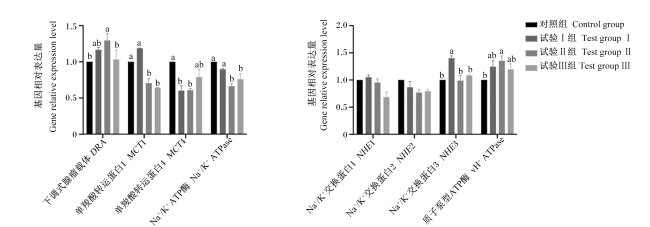
图1所示,随着甘油饲喂量的增加,下调式腺瘤载体(DRA)、Na+/H+交换蛋白3 (NHE3)和质子泵型ATP酶(vH+ ATPase)在瘤胃上皮中的表达先增后降,而单羧酸转运蛋白1(MCT1)、单羧酸转运蛋白4(MCT4)和Na+/H+ ATP酶(Na+/K+ ATPase)在瘤胃上皮中的表达有下降的趋势。Na+/H+交换蛋白1(NHE1)和Na+/H+交换蛋白2(NHE2)在各组之间相对表达量并无显著差异(P>0.05),但试验组平均值均低于对照组。
图1 补饲不同剂量甘油对空怀期母羊瘤胃上皮VFA吸收相关基因表达的影响

数据柱标注不同字母表示差异显著(P<0.05)。

Fig.1 Effects of supplementing different doses of glycerol on expression of VFA absorption-related genes in rumen epithelium in non-pregnant ewes

Data column marked with different letters indicated significant difference (P<0.05).

2.4 补饲不同剂量甘油对空怀期母羊瘤胃上皮结构的影响

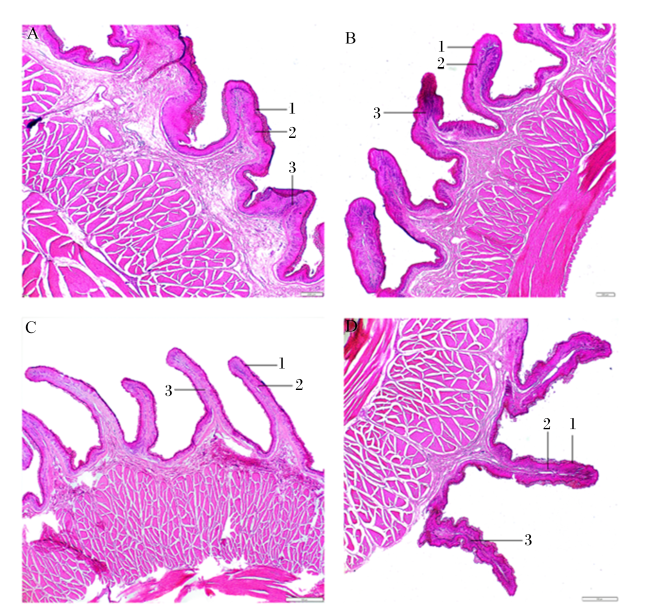
图2所示,对照组、试验Ⅰ组与试验Ⅱ组瘤胃乳头形态良好,试验Ⅲ组瘤胃角质层出现受损现象。由表5可知,与对照组相比,各试验组乳头宽度极显著低于对照组(P<0.01),乳头高度显著高于对照组(P<0.05);试验Ⅱ组、试验Ⅲ组角质层和颗粒层厚度与对照组、试验Ⅰ组显著差异(P<0.05)。
图2 补饲不同剂量甘油对空怀期母羊瘤胃上皮形态的影响

A、B、C、D分别为对照组、试验Ⅰ组、试验Ⅱ组、试验Ⅲ组,1、2、3分别为角质层、颗粒层、乳头。

Fig.2 Effects of supplementing different doses of glycerol on morphology of rumen epithelium in non-pregnant ewes (40×)

A, B, C and D represent the control group, test group Ⅰ, test group Ⅱ and test group Ⅲ, respectively. 1, 2 and 3 correspond to the stratum corneum, stratum granulosum, and papillae, respectively.

表5 补饲不同剂量甘油对空怀期母羊瘤胃上皮结构的影响

Table 5 Effects of supplementing different doses of glycerol on structure of rumen epithelium in non-pregnant ewes m

项目
Items
对照组
Control group
试验Ⅰ组
Test group Ⅰ
试验Ⅱ组
Test group Ⅱ
试验Ⅲ组
Test group Ⅲ
乳头宽度 Papillae width 440.70±57.45Aa 353.77±24.43Bb 221.58±13.23Cc 245.27±31.77Cc
乳头高度 Papillae height 1 062.20±165.48Cc 1 283.64±78.64BCb 1 385.63±142.11ABab 1 586.51±43.95Aa
角质层 Stratum corneum 46.31±8.21a 48.17±11.55a 32.95±5.12b 30.15±0.86b
颗粒层Stratum granulosum 82.16±20.90a 88.99±10.47a 57.26±10.17b 60.66±1.75b

3 讨论

3.1 补饲不同剂量甘油对空怀期母羊养分表观消化率的影响

养分表观消化率对评估空怀期母羊从饲料中摄取的养分含量多少以及母羊对各养分消化能力强弱具有重要意义,这有助于我们理解甘油对空怀期母羊养分摄入的影响和探究甘油如何对母羊消化系统产生作用。本研究中,试验Ⅱ组(甘油饲喂量7%)在酸性洗涤纤维、中性洗涤纤维表观消化率上显著高于其他组,这与Saleem等[17]以及Porcu等[18]研究结果一致,他们分别对哺乳早期的奶牛和配种时期的母羊进行甘油饲喂时得到了同样的结果,即甘油能够促进中性洗涤纤维与酸性洗涤纤维的消化率。但本研究与Shin等[19]以及Paiva等[20]在荷斯坦奶牛中的研究结果恰恰相反,前者在精料中添加甘油时发现奶牛中性洗涤纤维消化率下降,后者在饲粮中添加甘油发现奶牛纤维消化率并未得到改善,而对粗蛋白质和粗脂肪的消化率有所提升。在本研究中,各组粗蛋白质和粗脂肪表观消化率差异并不显著,但各试验组这二者消化率平均值都高于对照组,这可能是由于甘油添加方式和饲粮成分在各研究中存在差异所导致的。Saleem等[17]以及Porcu等[18]以及本研究中以饲喂为主要添加方式,而Shin等[19]以及Paiva等[20]以饲粮和精料中添加为主要方式。现对于甘油添加方式以及其所搭配的饲粮成分对消化率产生的不同影响之间的关系还需要更多研究来进行探索与验证,这有利于结合家畜各阶段营养需要特点来对甘油进行合理使用,以达到满足动物特定阶段的特殊营养需求。

3.2 补饲不同剂量甘油对空怀期母羊瘤胃发酵参数的影响

瘤胃发酵参数对于衡量母羊瘤胃功能具有关键作用。其中pH能够反映瘤胃液中的酸碱平衡程度,且适度的酸性环境有利于有益微生物的生长,促进纤维素和其他复杂碳水化合物的降解,有利于母羊对饲料的发酵。本研究条件下,各试验组补饲甘油后母羊pH普遍低于对照组,与Kijora等[8]报道的向瘤胃内注射甘油可以降低瘤胃内pH的研究结果相符,这可能是由于甘油的添加使得瘤胃内VFA含量增加,导致pH的降低。且由表3可知,在试验组内,随着甘油饲喂量的增加,母羊瘤胃pH呈上升趋势,这表明饲喂适当量的甘油能够有效调节瘤胃内pH,过量饲喂可能不利于瘤胃内环境的稳定。瘤胃内氨态氮的含量是评价瘤胃内环境的另一重要指标,它能够反映饲粮中蛋白质、氨基酸等养分在瘤胃内的消化代谢状态[21]。Lee等[22]在体外瘤胃发酵试验中发现,甘油组氨态氮含量显著低于其他组,但本研究结果显示,试验组与对照组差异不显著,这可能是由于体外与体内试验的差异性导致的。
VFA是瘤胃发酵参数的主要指标之一,它能够为反刍动物提供生长和生产提供绝大部分能量。在本研究中,各试验组总VFA含量显著高于对照组,与Gorka等[23]的研究结果相符,这也进一步证实瘤胃微生物能够以甘油为底物进行发酵产生VFA为母羊机体供能。在反刍动物瘤胃内乙酸、丙酸和丁酸约占总VFA的95%以上[24],其中乙酸、丁酸是乳脂和脂肪合成的主要来源,丙酸则是葡萄糖合成的主要来源[25]。Wang等[26]在给阉牛饲喂甘油后发现,丙酸含量增加导致VFA含量增加;Trabue等[27]在利用牛瘤胃液进行甘油体外发酵试验中发现,甘油能够增加丁酸含量,对乙酸和丙酸含量并无显著影响;De Andrade等[28]研究发现,在山羊饲粮中添加甘油,增加了瘤胃内的丙酸和乙酸含量。在不同的研究中,甘油对瘤胃内各VFA含量的影响各不相同。在本研究中,甘油显著提高了瘤胃内乙酸和丙酸的含量,对丁酸含量无显著影响,这与De Andrade等[28]的研究结果一致,与Trabue等[27]的研究结果却恰恰相反。这可能是由于所用试验动物不同,本研究与De Andrade等[28]所用试验动物均为羊,而Trabue等[27]所用试验动物为牛,牛、羊瘤胃体积差异较大,微生物组成与发酵特性可能有所不同,这些生理差异可能导致甘油对瘤胃中乙酸、丙酸、丁酸含量的不同影响。针对甘油在瘤胃中对VFA各组成比例的影响,部分研究显示甘油能够增加瘤胃中丙酸、丁酸比例,降低乙酸比例[29-30],而在本研究中,乙酸、丙酸、丁酸占比虽然在各组之间差异不显著,这可能是由于本研究中所喂饲粮纤维含量较低,而甘油经微生物发酵产生丙酸更易发生在高粗料饲粮中[31]。对于空怀期母羊而言,为使母羊及时恢复机体状态,让母羊群膘情达到一致,这对丙酸和丁酸的要求更高,因此寻找一个合适的饲粮精粗比以及针对母羊瘤胃内微生物结构和发酵方式来搭配甘油来使用,方能达到最佳的使用效果。

3.3 补饲不同剂量甘油对空怀期母羊瘤胃上皮VFA吸收相关基因表达的影响

瘤胃内生成的VFA有1/2以上被瘤胃上皮所吸收,且VFA在瘤胃上皮中的吸收受多个基因调控。在这些基因中,DRA主要涉及氯离子和碳酸氢根离子的转运,NHE1、NHE2和NHE3参与钠离子和氢离子的交换,vH+ ATPase参与质子的泵出,这些基因共同维持着细胞内酸碱平衡;MCT1和MCT4参与一氧化碳和其他单羧酸的转运;Na+/K+ ATPase调控钠和钾离子的浓度和分布,影响细胞膜电位和细胞内外离子浓度[32]。在本研究中,各试验组DRANHE3和VH+ ATPase基因相对表达量相比对照组有所增加,但MCT1、MCT4、Na+/K+ ATPase、NHE1和NHE2基因相对表达量相比对照组有所降低。DRA等基因的表达量增加可能意味着细胞内酸碱平衡和离子转运活动的增加,从而提高了VFA在瘤胃上皮中的吸收。相反,MCT1等基因的表达量降低可能反映了瘤胃上皮细胞对母羊瘤胃内增加的VFA吸收的调控,即限制过多VFA的进入,防止细胞酸中毒。瘤胃上皮细胞可能通过调整这些基因的表达来适应由甘油引起的母羊瘤胃内VFA含量的变化,这些改变可能影响着母羊的能量利用效率,需要进一步的研究来明确这些基因表达变化的生理影响和机制。

3.4 补饲不同剂量甘油对空怀期母羊瘤胃上皮结构的影响

研究显示,甘油进入瘤胃后45%被瘤胃上皮所吸收,25%被瘤胃微生物发酵生成VFA,其余在小肠被吸收利用[33],这表明甘油大部分在瘤胃内被消化吸收,且甘油在瘤胃内引起的VFA含量变化可能影响着瘤胃上皮组织[30]。在本研究中,随着甘油饲喂量的增加,乳头宽度逐渐减少而高度逐渐增加,这可能是由于甘油属于高能物质,而高能量水平有助于瘤胃乳头的生长[34]。瘤胃上皮角质层和颗粒层厚度随着甘油饲喂量的增加出现先增后减的趋势,且试验Ⅲ组角质层出现受损现象。这可能是由于甘油进入瘤胃发酵后,增加了瘤胃内丁酸的浓度,据研究显示,低浓度丁酸能够促进瘤胃上皮的生长,而高浓度丁酸则会促进瘤胃上皮细胞发生凋亡[35]。瘤胃上皮组织结构的变化影响着母羊对各养分的吸收能力,而过高的甘油剂量可能对母羊瘤胃上皮的完整性造成损坏,从而对母羊产生不利影响。因此,对甘油应用于空怀期母羊的饲喂剂量和饲喂周期还需要更多研究来精确,以防止过多饲喂对母羊机体造成不可逆的损伤。

4 结论

综上所述,每日额外灌服适量甘油能够提高空怀期母羊养分表观消化率,有效改善瘤胃发酵环境,促进瘤胃上皮角质层、颗粒层的生长以及部分VFA吸收相关基因在瘤胃上皮中的表达,且在试验条件下,7%灌服剂量效果最好。
[1]
BERGMAN E N. Energy contributions of volatile fatty acids from the gastrointestinal tract in various species[J]. Physiological Reviews, 1990, 70(2):567-590.

DOI PMID

[2]
李洪涛, 杨在宾, 杨维仁, 等. 不同日粮类型对杜泊羊瘤胃pH、氨态氮和挥发性脂肪酸浓度的影响[J]. 中国畜牧杂志, 2017, 53(3):67-72.

LI H T, YANG Z B, YANG W R, et al. Effects of different diet types on ruminal pH,NH3-N and VFA concentration of Dorper sheep[J]. Chinese Journal of Animal Science, 2017, 53(3):67-72. (in Chinese)

[3]
YOHE T T, DENNIS T S, VILLOT C, et al. Effects of milk replacer allowances and levels of starch in pelleted starter on nutrient digestibility,whole gastrointestinal tract fermentation,and pH around weaning[J]. Journal of Dairy Science, 2022, 105(8):6710-6723.

DOI

[4]
沈赞明, 陈杰, 任明强. 五肽胃泌素调节瘤胃微生物代谢的体外研究[J]. 南京农业大学学报, 2004, 27(1):85-88.

SHEN Z M, CHEN J, REN M Q. Effect of pentagastrin on ruminal microbial metabolism in vitro[J]. Journal of Nanjing Agricultural University, 2004, 27(1):85-88. (in Chinese)

[5]
AZIZI-SHOTORKHOFT A, ROUZBEHAN Y, FAZAELI H. The influence of the different carbohydrate sources on utilization efficiency of processed broiler litter in sheep[J]. Livestock Science, 2012, 148(3):249-254.

DOI

[6]
DE MENDONÇA LOPES A S, DE OLIVEIRA J S, DE LIMA CRUZ G F, et al. Effects of non-protein nitrogen on buffel grass fiber and ruminal bacterial composition in sheep[J]. Livestock Science, 2023, 272:105237.

DOI

[7]
GARTON G A, LOUGH A K, VIOQUE E. Glyceride hydrolysis and glycerol fermentation by sheep rumen contents[J]. Journal of General Microbiology, 1961, 25:215-225.

PMID

[8]
KIJORA C, BERGNER H, GÖTZ K P, et al. Research note:investigation on the metabolism of glycerol in the rumen of bulls[J]. Archiv Fur Tierernahrung, 1998, 51(4):341-348.

DOI

[9]
KERR B J, WEBER T E, DOZIER W A 3RD, et al. Digestible and metabolizable energy content of crude glycerin originating from different sources in nursery pigs[J]. Journal of Animal Science, 2009, 87(12):4042-4049.

DOI

[9]
ZACARONI O F, LOPES N M, DIAS JÚNIOR G S, et al. Complete replacement of corn grain with crude glycerin for dairy cows[J]. Livestock Science, 2022, 258:104893.

[11]
National Research Council. Nutrient requirements of small ruminants:sheep,goats,cervids,and new world camelids[M]. Washington: The National Academies Press, 2007.

[12]
王俊红, 高歌, 张圆圆, 等. 顶空-气相色谱法测定反刍动物瘤胃液中挥发性脂肪酸含量[J]. 浙江大学学报(农业与生命科学版), 2021, 47(5):667-672.

WANG J H, GAO G, ZHANG Y Y, et al. Determination of the volatile fatty acid contents in rumen fluid of ruminants by headspace-gas chromatograph method[J]. Journal of Zhejiang University(Agriculture & Life Sciences), 2021, 47(5):667-672. (in Chinese)

[13]
冯宗慈, 高民. 通过比色测定瘤胃液氨氮含量方法的改进[J]. 畜牧与饲料科学, 2010(6):37.

FENG Z C, GAO M. Improvement of the method for determining ammonia nitrogen content in ruminal fluid by colorimetry[J]. Animal Husbandry and Feed Science, 2010(6):37. (in Chinese)

[14]
中华人民共和国国家质量监督检验检疫总局. 实验动物配合饲料常规营养成分的测定: GB/T 14924.9—2001[S]. 北京: 中国标准出版社, 2002.

General Administration of Quaty Supervision. Inspection and Quaranine of the People’s Repubic of China. Laboratory animals-formula feeds-determinaton of routine nutrients: GB/T 14924.9—2001[S]. Bejing: Standards Press of China, 2002. (in Chinese)

[15]
中华人民共和国国家质量监督检验检疫总局, 中国国家标准化管理委员会. 饲料中盐酸不溶灰分的测定:GB/T 23742—2009[S]. 北京: 中国标准出版社, 2009.

General Administration of Quality Supervision,Inspection and Quarantine of the People’s Republic of China, Standardization Administration of the People’s Republic of China. Animal feeding stuffs-determination of ash insoluble in hydrochloric acid:GB/T 23742—2009[S]. Beijing: Standards Press of China, 2009. (in Chinese)

[16]
佚名. 中国饲料成分及营养价值表(2019年第30版)[J]. 中国饲料, 2019 (22): 111-116.

Anon. China feed composition and nutritional value table (30th edition 2019)[J]. China Feed, 2019(22): 111-116.(in Chineses)

[17]
SALEEM A M, ZANOUNY A I, SINGAR A M. Effect of glycerol supplementation during early lactation on milk yield,milk composition,nutrient digestibility and blood metabolites of dairy buffaloes[J]. Animal, 2018, 12(4):757-763.

DOI

[18]
PORCU C, MANCA C, CABIDDU A, et al. Effects of short-term administration of a glucogenic mixture at mating on feed intake,metabolism,milk yield and reproductive performance of lactating dairy ewes[J]. Animal Feed Science and Technology, 2018, 243:10-21.

DOI

[19]
SHIN J H, WANG D, KIM S C, et al. Effects of feeding crude glycerin on performance and ruminal kinetics of lactating Holstein cows fed corn silage-or cottonseed hull-based,low-fiber diets[J]. Journal of Dairy Science, 2012, 95(7):4006-4016.

DOI

[20]
PAIVA P G, VALLE T A D, JESUS E F, et al. Effects of crude glycerin on milk composition,nutrient digestibility and ruminal fermentation of dairy cows fed corn silage-based diets[J]. Animal Feed Science and Technology, 2016, 212:136-142.

DOI

[21]
付瑶, 郭江鹏, 王俊, 等. 补饲苜蓿干草对蒙贝利亚×荷斯坦杂交犊牛瘤胃内环境和胃肠道发育的影响[J]. 动物营养学报, 2023, 35(8):5182-5190.

DOI

FU Y, GUO J P, WANG J, et al. Effects of alfalfa hay supplementation on rumen internal environment and gastrointestinal development of Montbeliard×Holstein crossed calves[J]. Chinese Journal of Animal Nutrition, 2023, 35(8):5182-5190. (in Chinese)

DOI

[22]
LEE S Y, LEE S M, CHO Y B, et al. Glycerol as a feed supplement for ruminants:in vitro fermentation characteristics and methane production[J]. Animal Feed Science and Technology, 2011, 166/167:269-274.

DOI

[23]
GORKA P, KOWALSKI Z M, PIETRZAK P, et al. Effect of sodium butyrate supplementation in milk replacer and starter diet on rumen development in calves[J]. Journal of Physiology and Pharmacology:an Official Journal of the Polish Physiological Society, 2009, 60(Suppl.3):47-53.

[24]
习瓒娜, 高健, 王梦芝. 脂肪酸组合对体外瘤胃微生物发酵挥发性脂肪酸的影响[J]. 中国畜牧兽医, 2019, 46(10):2916-2926.

DOI

XI Z N, GAO J, WANG M Z. Effects of long-chain fatty acid combinations on volatile fatty acid in ruminal microorganism in vitro fermentation[J]. China Animal Husbandry & Veterinary Medicine, 2019, 46(10):2916-2926. (in Chinese)

[25]
王淑玲, 王后福, 盖叶顶, 等. 反刍动物生成VFA的研究进展[J]. 中国草食动物科学, 2019, 39(5):46-49.

WANG S L, WANG H F, GAI Y D, et al. Advances in research on the production of VFA by ruminants[J]. China Herbivore Science, 2019, 39(5):46-49. (in Chinese)

[26]
WANG C, LIU Q, YANG W Z, et al. Effects of glycerol on lactation performance,energy balance and metabolites in early lactation Holstein dairy cows[J]. Animal Feed Science and Technology, 2009, 151(1/2):12-20.

DOI

[27]
TRABUE S, SCOGGIN K, TJANDRAKUSUMA S, et al. Ruminal fermentation of propylene glycol and glycerol[J]. Journal of Agricultural and Food Chemistry, 2007, 55(17):7043-7051.

PMID

[28]
DE ANDRADE G P, DE CARVALHO F F R, BATISTA Â M V, et al. Evaluation of crude glycerin as a partial substitute of corn grain in growing diets for lambs[J]. Small Ruminant Research, 2018, 165:41-47.

DOI

[29]
REICHEL P, HYBSKÝ Š, KOVÁČ G, et al. Feeding glycerol to transition dairy cows:effects on rumen fluid,blood metabolites and lactation performance[J]. Slovenian Veterinary Research, 2006, 43:137-139.

[30]
BERNARD J K, WEST J W. Effects of feeding different amounts of supplemental glycerol on ruminal environment and digestibility of lactating dairy cows[J]. Journal of Dairy Science, 2013, 96(1):470-476.

DOI PMID

[31]
AVILA J S, CHAVES A V, HERNANDEZ-CALVA M, et al. Effects of replacing barley grain in feedlot diets with increasing levels of glycerol on in vitro fermentation and methane production[J]. Animal Feed Science and Technology, 2011, 166/167:265-268.

DOI

[32]
BEDFORD A, BECKETT L, HARTHAN L, et al. Ruminal volatile fatty acid absorption is affected by elevated ambient temperature[J]. Scientific Reports, 2020, 10(1):13092.

DOI PMID

[33]
WERNER OMAZIC A, KRONQVIST C, ZHONGYAN L, et al. The fate of glycerol entering the rumen of dairy cows and sheep[J]. Journal of Animal Physiology and Animal Nutrition, 2015, 99(2):258-264.

DOI PMID

[34]
卢劲晔, 沈赞明. 日粮能量水平对山羊个体和瘤胃上皮生长的影响[J]. 畜牧与兽医, 2014, 46(8):1-5.

LU J Y, SHEN Z M. Effects of dietary energy levels on growth and rumen epithelium in goats[J]. Animal Husbandry & Veterinary Medicine, 2014, 46(8):1-5. (in Chinese)

[35]
彭志鹏, 罗丹, 许超, 等. 丁酸对瘤胃上皮细胞生长和凋亡的影响[J]. 江西农业大学学报, 2018, 40(3):606-611.

PENG Z P, LUO D, XU C, et al. Effect of butyric acid on growth and apoptosis of rumen epithelial cells[J]. Acta Agriculturae Universitatis Jiangxiensis, 2018, 40(3):606-611. (in Chinese)

Outlines

/