REVIEW

Research Progress of Respiratory Quotient in Animal Respiratory Calorimetry

  • ZHANG Jianjian ,
  • WANG Li ,
  • ZHANG Sai ,
  • LI Ping , *
Expand
  • Lingnan Modern Agricultural Science and Technology Guangdong Laboratory Maoming Branch, Guangdong Key Laboratory of Animal Breeding and Nutrition, Key Laboratory of Animal Nutrition and Feed in South China, Ministry of Agriculture and Rural Affairs, State Key Laboratory of Swine and Poultry Breeding Industry, Institute of Animal Science, Guangdong Academy of Agricultural Sciences, Guangzhou 510640, China
* associate professor, E-mail:

Received date: 2023-11-23

  Online published: 2024-05-15

Abstract

Respiration quotient is an essential index in the process of animal respiration calorimetry, which can not only test the accuracy of respiration calorimetry device, but also verify the oxidation of nutrients in animal body. However, due to the detection equipment, diet type, animal species and environmental factors will have a certain impact on the respiratory quotient, affecting the accuracy of animal respiratory calorimetry. Therefore, this paper mainly introduces the definition, significance and calculation method of respiratory quotient, and expounds the influence of animals, environment, respiratory chamber and diets on respiratory quotient. At the same time, it summarizes the application of respiratory quotient in animal production, in order to provide a better reference for the application of respiratory quotient in the process of animal respiratory calorimetry.

Cite this article

ZHANG Jianjian , WANG Li , ZHANG Sai , LI Ping . Research Progress of Respiratory Quotient in Animal Respiratory Calorimetry[J]. Chinese Journal of Animal Nutrition, 2024 , 36(5) : 2872 -2885 . DOI: 10.12418/CJAN2024.247

动物通过采食饲粮获取各种营养物质,各营养物质在动物机体内经过复杂的生理生化过程转化为可被机体利用的能量,在此过程中产生的二氧化碳(CO2)以气体交换的形式排出体外。饲粮营养物质在动物体内一部分以蛋白质和脂肪沉积(代谢终产物以尿的形式排出),另一部分通过氧化的方式转化为维持生命活动和体温的热能。根据能量守恒定律,动物体内产生的能值、CO2和消耗的氧气(O2)与体外燃烧时相同,因此可以通过测定呼吸商(respiratory quotient,RQ)间接计算出动物机体内的产热量(heat production,HP)[1]。尽管RQ测定受各种因素的影响,如动物种类、环境条件和测定仪器等,但其测定和计算能量消耗简单,在确定畜禽能量需要的研究中具有重要的意义,因此,仍是一个不可忽视的重要指标。本文对RQ测定的意义及其计算方法、影响RQ测定的因素及其在畜禽呼吸测热中的应用进行综述。

1 RQ的定义、意义和测定/计算方法

间接测热法是目前国际上通用的计算动物产热的一种方法,主要为呼吸测热法。呼吸测热法是利用呼吸测热装置测定动物O2消耗量和CO2与甲烷(CH4)产生量,然后通过公式:HP(kJ)=16.175 3×O2(L)+5.020 8×CO2(L)-2.167 3×CH4(L)-5.987 3×尿氮(urine nitrogen,UN,g)进行计算,其中,家禽一般忽略CH4和UN的损失,故家禽使用HP(kJ)=16.175 3×O2(L)+5.020 8×CO2(L)计算[2]。理论上,RQ应以CO2和O2的摩尔(mol)比值表示,但因在同一温度和气压条件下,容积相等的不同气体分子数相等[3],所以通常用容积数(mL或L)进行计算,即:RQ=产生CO2的mol数/消耗O2的mol数=产生CO2的mL数/消耗O2的mL数。根据RQ结合氮沉积可以间接地推算出各个含能营养物质的分解量[4]。RQ是动物呼吸代谢试验的重要参考指标,同时受多种因素的影响,包括动物类型、饲粮、采食量、环境因子和测量方法等[5-6]。各营养物质在动物机体内的氧化及沉积模型如图1所示。
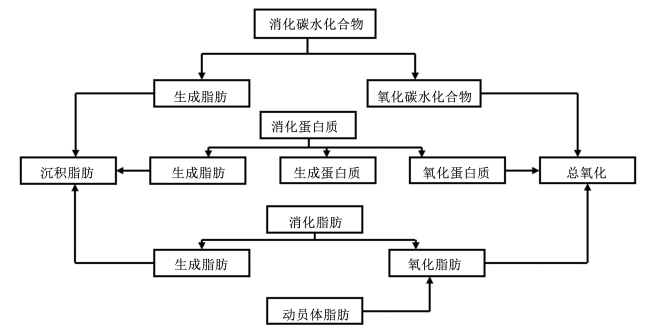
图1 营养物质氧化和沉积模型

Fig.1 Model of nutrient oxidation and retention[7]

2 影响RQ测定的因素

2.1 动物生理状态

2.1.1 体重及动物类型

动物体内的营养物质在不同的生理阶段代谢速率不同,一般而言,随着体重的增加,O2消耗量、CO2产生量和HP会增加,导致RQ产生变化[8]。李颖康等[9]研究育成期滩羊能量需要量发现,30 kg公羊的CO2产生量和O2消耗量显著低于42 kg公羊,RQ由0.89(30 kg)提高至0.92(42 kg)。杨华明等[10]研究发现,芦花鸡随着体重的增加O2消耗量和HP显著增加,但公鸡和母鸡的RQ均在0.87~0.88。Christensen等[11]研究27.5 kg的生长猪和82.5 kg的育肥猪,发现肥育猪的RQ(1.17)显著高于生长猪(1.02)。虽然Pedersen等[12]报道,随着体重的增加,RQ增大,但由于动物自身活动、检测条件以及外界环境等的不同,这种规律并不完全适用,部分动物呼吸代谢的研究结果见表1[1,10,13-19]。反刍动物消化道结构与单胃动物不同,在计算RQ时,必须扣除发酵产生的CO2后才是动物机体有氧氧化代谢的CO2产生量[4]
表1 部分动物呼吸代谢的研究结果

Table 1 Study results of respiratory metabolism in some animals

项目
Items
体重或日龄
Body weight or
days of age
O2消耗量
O2 consumption/
[L/(kg BW0.75·d)]
CO2产生量
CO2 production/[L/
(kg BW0.75·d)]
呼吸商
RQ
产热量
HP/[kJ/(kg BW0.75·d)]
参考文献
References
公鸡Roosters 0.067、0.186、0.459、
1.577、2.325 kg
35.45、39.43、51.83、
49.64、54.68
30.84、34.70、45.61、
43.68、48.12
0.87、0.88、0.88、
0.88、0.88
726.80、808.39、1 062.62、
1 017.72、1 121.05

[10]
母鸡Hens 0.067、0.232、0.615、
1.162、1.933 kg
35.45、61.08、53.87、
51.58、58.54
30.84、53.75、47.41、
45.39、51.52
0.87、0.88、0.88、
0.88、0.88
726.80、1 252.26、1 104.44、
1 057.49、1 200.19
蛋鸡Laying hens 20~28日龄、40~48日龄 26.32、26.22 25.73、25.87 0.98、0.99 554.96、555.00 [13]
母鸡Hens 20~28日龄、40~48日龄 31.35、31.41 31.34、31.41 0.99、1.00 670.24、670.62

牛Cattle
628、703 kg 51.0、53.7 51.7、52.9 1.01、0.99 1 072、1 121 [14]
703 kg 47.78 50.30 1.05 1 098.69 [15]

猪Pigs
30 kg 1.09 834.54 [16]
45.2 kg 32.64 35.16 1.07 680.89 [17]
187、194、208、228 kg 0.97、0.97、0.96、1.03 436.83、434.00、
417.92、522.37
[18]
肉羊(母) Ewes 30.31、36.32 kg 24.83、25.31 24.69、22.83 0.99、0.90 519.35、519.95 [19]
羊Sheep 62.3 kg 0.88、0.95、0.96 379.8、404.0、445.5 [1]

2.1.2 采食状态(采食/绝食)

动物在正常采食与绝食状态下所得的RQ不同。一般而言,动物在采食时的RQ和HP高于绝食。在绝食期间,动物动员自身储备的蛋白质和脂肪维持基本需求,绝食代谢与体内发生的许多代谢变化有关,绝食产热(fasting heat production,FHP)和RQ的变化是动物代谢的表型反应[20-23]。Chwalibog等[24]对20~40 kg生长猪研究发现,绝食24和48 h的RQ分别为0.84和0.81,表明空腹氧化主要是脂肪和蛋白质。此外,Liu等[17]研究发现,生长猪的HP、RQ和UN在绝食24 h时与绝食48 h时无显著差异,绝食24 h比绝食48 h更适合研究维持能量消耗的代谢成分。

2.2 检测设备与环境控制

2.2.1 环境因子

2.2.1.1 温度

环境条件是动物饲养的基础,主要包括温度、相对湿度、光照和有害气体等。温度是影响动物健康和生产性能的主要环境因素,不同动物适宜温度区不同,同一动物不同生理阶段适宜温度区也不相同,温度过高或过低对动物的采食量、饲料转化效率以及RQ等都有不同程度的影响[25]。韩蕊[26]对25.16 kg生长猪的研究发现,23和18 ℃时的RQ>1,13和8 ℃时的RQ<1,且8 ℃时的O2消耗量和CO2产生量显著高于23 ℃时,说明随着温度降低,动物机体代谢速率加快,呼吸作用加强,代谢产热增加,RQ有所降低。不同环境温度下机体代谢不同,因此,配制饲粮时应考虑环境温度对营养底物氧化比例的影响,合理配制饲粮。

2.2.1.2 相对湿度

相对湿度主要是通过机体的体热调节对动物的生产性能等产生影响,一般在适宜温度下,相对湿度过高或过低对动物的影响并不显著,但若在高温高湿、低温高湿等综合环境下,则会对动物健康产生严重影响。常用温湿指数(humidity-temperature index,THI)表示动物所处环境的温湿度,其计算方法为:
THI=(1.8Td+32)-(0.55-0.55RH/100)×(1.8Td-26);
或THI=0.72×(Td+Tw)+40.6。
式中:Td为干球温度(℃);Tw为湿球温度(℃);RH为相对湿度(%)。
THI≤74表示为适宜热环境水平,74<THI≤79表示为轻度热应激水平,79<THI≤83表示为中度热应激水平,THI>83表示为重度热应激水平[27-28]。而家禽的适宜热环境、轻度、中等和重度热应激水平分别为THI≤70、70<THI≤75、75<THI≤80和THI>80[29-30]。Yahav[31]研究发现,相对湿度为60%~75%时肉鸡的采食量和体增重显著高于相对湿度为40%~60%时,但相对湿度超过80%时将导致家禽生长性能降低。魏凤仙等[32]研究发现,相对湿度由60%升高至85%,肉鸡体重、平均日采食量和平均日增重均显著降低。闫方权[33]研究了泌乳中期奶牛在74.5≤THI≤82.6下的生产性能和能量利用等发现,在热应激条件下,随着饲粮能量水平的提高,热应激奶牛O2消耗量和CO2产生量分别由59.11和43.92 L/(kg BW0.75·d)增加至63.80和49.81 L/(kg BW0.75·d),RQ由0.74增加至0.78。

2.2.1.3 光照

在动物日常管理中,相较于温度、相对湿度等环境因素之外,光照常被忽略,但光照作为动物饲养环境的影响因素之一,会对动物的生物节律、活动状况以及生产性能产生重要影响。例如,猪区分黑暗和白天的光照强度阈值为40 lx;相对于光照强度,光周期对猪的影响更大,国际上推荐猪舍的最短光照时间为8 h,过长或过短的光照时间会造成猪生理和行为上的应激,导致异常行为增加,影响其健康和生产性能[34-35]。Li等[36]研究发现,蛋鸡的HP随光照强度的降低而降低。Gavrilov等[37]研究发现,煤山雀夜间以消耗脂肪为主,蛋白质或混合底物在白天被氧化,休息时能量消耗较低,RQ接近0.7,无光时的RQ小于有光时。杨华明等[10]研究发现,芦花鸡白天的O2消耗量和CO2产生量均高于夜间,不同代谢条件下的O2消耗量代谢率呈白天高夜间低的趋势。付蹇洋等[38]研究海兰褐蛋鸡维持净能需要量时发现,蛋鸡的FHP在有光照时为450 kJ/(kg BW0.75·d),在无光照时为379 kJ/(kg BW0.75·d),呈现明显的昼夜节律。Ning等[39]研究蛋鸡代谢能摄入水平对HP的影响同样发现,蛋鸡呈现出明显的昼夜节律[有光照时约为694 kJ/(kg BW0.75·d),无光照时约为533 kJ/(kg BW0.75·d)],在光照条件下动物处于活动状态,在黑暗条件下相对更加安静,说明光周期对动物的代谢、活动等均有不同程度的影响。Riveros等[40]研究发现,公鸡在无光照时,相较于在有光照时的活动减少了65%。

2.2.1.4 有害气体

动物饲养过程中产生的有害气体一般以氨气(NH3)、硫化氢(H2S)和CO2等为主。NH3和H2S主要来源于动物胃肠道内,尿素在脲酶催化下分解产生NH3,动物粪便、垫料以及饲粮残渣等分解产生H2S。CO2主要来源于动物呼吸、尿素分解以及粪便微生物降解等。陈聪[41]对生长猪在不同浓度NH3下的呼吸频率进行检测发现,随着NH3浓度的升高,生长猪的呼吸频率显著增加,对生长猪的健康造成严重影响。如果有害气体浓度升高,则呼吸室内O2含量相对不足,动物出现慢性缺氧、生产力下降等情况,所得RQ会有一定的误差[12]

2.2.2 呼吸室

呼吸测热装置主要包括呼吸面罩、呼吸头箱和呼吸室,其中呼吸室以密闭式、开路式和开闭式为主,目前开路式和密闭式2种呼吸室使用较为广泛,2种呼吸室测定RQ时各有优缺点。密闭式呼吸室是将被测动物置于密闭的装置中,在气泵的作用下不断地将定量的O2送入装置,根据送氧装置中O2的减少量计算得到动物在单位时间内的O2消耗量;CO2则由装置中的CO2吸收剂吸收,根据吸收剂前后的重量差计算出动物在单位时间内CO2的产生量,以此得到RQ。其优点是环境密闭不受外界气体干扰,O2的供应量精准可控,产生的CO2被化学试剂吸收,数据准确可靠;缺点是设备必须完全封闭,任何泄漏都会造成试验误差,操作繁琐,需要测量O2或CO2的全部体积。开路式呼吸室是将被测动物置于装置中,在负压作用下不断向其中通入空气,通过采集动物在一定时间内呼出气体,测定装置内呼出气体中O2和CO2的容积百分比。由于动物直接吸入空气,所以空气中O2和CO2的容积百分比不用另测。根据吸入和呼出气体中O2和CO2的差数,即可得到O2消耗量和CO2产生量,并以此计算RQ。与密闭式呼吸室相比,开路式呼吸室只需采集小样本,准确性取决于呼吸室、检测仪器,因此检测仪器必须定期检查。呼吸室对RQ的影响主要包含呼吸室的气密性、呼吸室内气体均匀度以及呼吸室体积与动物的匹配程度[42]

2.2.2.1 气密性

呼吸室气密性可通过酒精燃烧试验检查,通过在呼吸室中燃烧已知数量的酒精,测定呼吸室内CO2含量与O2消耗量并计算两者比例,将实际结果与理论值进行比较,计算CO2回收和O2消耗的比例及其RQ,则可验证呼吸室是否漏气[42]。在标准条件下,根据无水乙醇燃烧的反应式:CH3CH2OH+3O2=2CO2+3H2O,每燃烧1 mol无水乙醇生成2 mol CO2,消耗3 mol O2,RQ为2CO2/3O2=0.667[43]。需要注意的是,当呼吸室内O2含量低或供应不足时,则会导致乙醇燃烧不完全,根据2CH3CH2OH+5O2=2CO+2CO2+6H2O,此时RQ最低为2CO2/5O2=0.400,因此需要增加通风量或降低乙醇燃烧的剧烈程度,才能让乙醇充分燃烧。CO2回收率和O2消耗率计算公式如下:
CO2回收率(%)=CO2测定量(L)
100/乙醇消耗量(g)×0.973 1(L/g);
O2消耗率(%)=O2测定量(L)×100/
乙醇消耗量(g)×1.459 6(L/g)。
一般要求RQ为0.667(2CO2/3O2),CO2回收率和O2消耗率在99%~101%,如果回收不完全则RQ不准;若CO2回收率和O2消耗率不准确,RQ准确,则表明进气和排气管道可能出现泄漏,而气体分析仪可能良好[44]

2.2.2.2 气体均匀度

呼吸室内气体混合均匀度会对RQ产生影响,当动物进食或活动后呼出气体,动物头部附近气体中CO2含量高于其他位置,如果呼吸室内的气体混合不均匀,将造成同一时间不同位置的RQ之间差异较大,数据不稳定,因此,呼吸室内需要安装换气装置,且需采用多孔多位点进行气体采集。呼吸室体积与动物的匹配度也会对RQ产生影响,如果呼吸测热室过大,则会增加气体检测的误差,呼吸室内气体平衡时间延长等;如果过小,呼吸室内气体含量过大,对动物的健康造成影响。一般而言,猪和羊的呼吸室体积为4~5 m3,禽的呼吸室体积为0.4~0.5 m3,牛的呼吸室体积为30~ 40 m 3 [45]。此外,呼吸室内气体稳定所需时间可利用酒精燃烧试验通过测定CO2和O2含量进行估测,1 m3的呼吸室稳定时间为40 min左右,因此需要待呼吸室内气体稳定后再开始记录数据。

2.2.3 检测仪器

检测仪器主要包括气体流量仪、O2分析仪、CO2分析仪和温湿度传感器等,其中影响RQ的主要因素为气体流速和气体分析仪。气体流速会对RQ产生影响,如果气体流量仪参数设置过高,则呼吸室内换气速率快,导致呼吸室内气体与外界气体差异变小,造成CO2、O2等气体分析仪检测难度加大,RQ误差变大;反之,则呼吸室内CO2等气体含量增加,导致动物呼吸困难,不但会对动物的健康造成影响,而且得到的RQ也不具备参考意义,因此气体流速必须控制在合理范围内。一般而言,猪和羊的呼吸室的通气量为30~300 L/min,禽的呼吸室的通气量为3~30 L/min,牛的呼吸室的通气量为300~3 000 L/min[45]。气体分析仪的准确性、精确度、灵敏度和检测范围也会对RQ产生影响,不同动物、不同仪器生产厂家所要求的仪器精确度不同,应根据试验需求选择相应量程的分析仪器。例如,美国Sable中型动物呼吸测量系统的氧气分析仪精确度为0.1%,检测范围为0~100%,二氧化碳检测范围0~5%。常用的气体检测方法有化学法、气相色谱法、非分散红外(non-dispersion infrared,NDIR)法和容量滴定法。现多采用NDIR法,其原理是利用气体与红外线间所呈现的线性吸收关系,根据吸收值确定气体含量。试验开始前,需要进行气体回收率检测和气体分析仪校准,以确保气体分析仪的准确性。

2.3 饲粮及原料

不同组成饲粮在动物体内氧化时的O2消耗量和CO2产生量不同,RQ也不相同,这是由每种饲粮特定的化学结构和组成元素比例所决定的[46-47]。糖在体内被完全氧化分解时,1 mol葡萄糖需要消耗6 mol O2并产生6 mol CO2,RQ为1.000;蛋白质被氧化时,RQ为0.801[4];脂肪氧化所产生的CO2与消耗的O2的比例与糖类不同,由于脂肪是由脂肪酸组成的,所以不同脂肪酸组成的脂肪RQ也有一定的差异,常见脂肪酸的RQ见表2。由表可知,脂肪酸的RQ随双键数的增加而增加,随碳链长度的增加而减少,在0.691~0.762,平均为0.705[48]。不过,饲粮并不是由单一营养物质组成,因此,RQ一般处于0.705~1.000,为综合值[49]。Swick等[50]采用线性回归法评价饲粮营养成分对RQ的影响,发现饲粮中粗蛋白质和糖的含量与RQ呈负相关。
表2 常见脂肪酸的RQ

Table 2 RQ of common fatty acids[48]

项目
Items
脂肪酸与甘油
三酯比例
Ratios of fatty acid to
triglyceride
呼吸商(包括甘油
三酯部分)
RQ (including triglyceride
component)
呼吸商(仅含脂肪酸)
RQ (fatty acid only)
豆蔻酸酯Myristate 14∶0 0.708 7 0.700 0
十四碳烯酸Myristoleate 14∶1 0.725 8 0.717 9
棕榈酸Palmitate 16∶0 0.703 4 0.695 7
十六碳烯酸Palmitoleate 16∶1 0.718 3 0.711 1
十六碳二烯酸Hexadecadienoate 16∶2 0.733 8 0.727 3
十六碳三烯酸Hexadecatrienoate 16∶3 0.750 0 0.744 2
硬脂酸Stearate 18∶0 0.699 4 0.692 3
十八碳烯酸Octadecenoate 18∶1 0.712 5 0.705 8
亚油酸酯Linoleate 18∶2 0.726 1 0.720 0
亚麻酸Linolenate 18∶3 0.740 3 0.734 7
廿(烷)酸Arachidate 20∶0 0.696 1 0.689 7
二十碳烯酸Eicosenoate 20∶1 0.707 9 0.701 8
二十碳二烯酸Eicosadienoate 20∶2 0.720 0 0.714 3
二十碳三烯酸Eicosatrienoate 20∶3 0.732 6 0.727 2
花生四烯酸Arachidonate 20∶4 0.745 6 0.740 7
二十碳五烯酸Eicosapentaenoate 20∶5 0.759 0 0.754 7
山嵛酸Docosanoate 22∶0 0.693 5 0.687 5
芥酸酯Erucate 22∶1 0.704 1 0.698 4
二十二碳二烯酸Docosadienoate 22∶2 0.715 0 0.709 7
二十二碳五烯酸Docosapentaenoate 22∶5 0.750 0 0.745 8
二十二碳六烯酸Docosahexaenoate 22∶6 0.762 4 0.758 6
木蜡酸Lignocerate 24∶0 0.691 2 0.685 7
神经酸Nervonate 24∶1 0.700 9 0.695 7
测定RQ是目前较为直接地衡量进入动物机体后被氧化这部分营养物质成分相对含量的方法,不仅可以估测产生的总热量,而且结合尿氮排除试验可以推测某段时间内机体氧化供能的营养物质种类及比例[51]。当体蛋白质被氧化分解时,产生的氮从尿液中排出,根据尿液中氮的含量,可计算蛋白质的分解量,从而得到蛋白质呼吸商(respiratory quotient protein,RQp)。动物呼吸产生的总RQ减去RQp,可得到碳水化合物和脂肪呼吸商,即非蛋白质呼吸商(respiratory quotient non-protein,RQnp),而RQnp是估算非蛋白质代谢中糖和脂肪氧化的相对含量的依据。通过RQp和RQnp,可以估测在一定时间内体内糖、脂肪和蛋白质的氧化分解比例,由于蛋白质是唯一含氮的物质,脂肪由碳、氢和氧组成,通过碳氮平衡即可得到动物体内蛋白质和脂肪的沉积量[7,52]。计算公式如下:
1g葡萄糖+0.746 L O2=0.746 L CO2+
0.6 g H2O;
1g脂肪+2.029 L O2=1.430 L CO2+
1.09 g H2O;
1g蛋白质+0.966 L O2=0.782 L CO2+
0.45 g H2O;
蛋白质=6.25×UN;
1g UN+6.04 L O2=4.89 L CO2+
2.81 g H2O;
O2消耗量=0.746×葡萄糖+2.029×
脂肪+6.04×UN;
CO2产生量=0.746×葡萄糖+1.430×
脂肪+4.89×UN;
葡萄糖=4.55×CO2产生量-3.21×
O2消耗量-2.87×UN;
脂肪=1.67×O2消耗量-CO2产生量-
1.92×UN。
从公式⑥和⑦得出:RQnp=(CO2产生量-4.89×UN)/(O2消耗量-6.04×UN),因此,根据测得RQnp即可得到氧化的碳水化合物和脂肪的比例(表3)[53]。对于各种RQp,一般哺乳动物为0.800,鸟类为0.741[4]。综上所述,在测定RQ过程中,动物类型、行为状态、环境因子、检测装置、昼夜周期调节和光周期等许多因素都会引起其发生变异,除此之外,饲喂的次数和频率等也会对其产生影响[45-55]
表3 RQnp、O2消耗量及氧化产热

Table 3 RQnp, O2 consumption and oxidative heat production[53]

非蛋白质呼吸商
RQnp
O2消耗量比例
O2 consumption ratio/%
氧化产热比例
Oxidative heat production ratio/%
碳水化合物
Carbohydrate
脂肪
Fat
碳水化合物
Carbohydrate
脂肪
Fat
0.70 0.0 100.0 0.0 100.0
0.72 4.4 95.6 4.8 95.2
0.74 11.3 88.7 12.0 88.0
0.76 18.1 81.9 19.2 80.8
0.78 24.9 65.1 26.3 73.7
0.80 31.7 38.3 33.4 66.6
0.82 38.6 61.4 40.3 59.7
0.84 45.4 54.6 47.2 52.8
0.86 52.2 47.8 54.1 45.9
0.88 59.0 41.0 60.8 39.2
0.90 65.9 34.1 67.5 32.5
0.92 72.7 27.3 74.1 25.9
0.94 79.5 20.5 80.7 19.3
0.96 86.3 13.7 87.2 12.8
0.98 93.2 6.8 93.6 6.4
1.00 100.0 0.0 100.0 0.0

3 RQ在畜禽呼吸测热中的应用

当糖转化为热量时,RQ可能大于1,这是因为糖分子中有部分的氧原子,而这些氧在机体代谢过程中可参与氧化反应,减少从外界的摄入,因此RQ变大;反之,当机体代谢消耗脂肪时,RQ可能小于0.7,这是因为脂肪分子中氧所占比例小,需要从外界获取更多的氧,导致RQ变小[56]。但绝大多数情况下,RQ在0.7~1.0,如果RQ出现特别高或特别低时(检测仪器和环境因子等正常),说明动物的代谢出现异常,以下分别以葡萄糖、三棕榈酯和白蛋白为例,计算各自被氧化时的RQ:
C6H12O6+6O2→6H2O+6CO2,RQ=6/6=1;
2C3H5(O2C16H31)3+145O2→102CO2+
98H2O,RQ=102/145=0.703;
2C72H112N18C22S2+151O2→18CO(NH2)2+
126CO2+76H2O+2S2,RQ=126/151=0.834。
因此,RQ在动物呼吸代谢研究中,不但可以判断机体细胞呼吸的底物类型及推算各个含能营养物质的分解量,而且可以对呼吸测热装置及试验仪器准确性进行验证,加之计算简单,因此具有重要参考价值。表4列举了部分呼吸代谢研究中的RQ与HP[11,16,26,39,50,57-79]
表4 部分呼吸代谢研究中的RQ与HP

Table 4 RQ and HP in some respiratory metabolism studies

项目
Items
试验设计
Experiment design
呼吸商
RQ
产热量
HP/[kJ/(kg BW0.75·d)]
参考文献
references
肉鸡Broilers 1日龄肉公鸡饲喂小麦、高粱、高粱-
菜籽粕和小麦-豆粕饲粮
1.02、0.99、0.92、1.04 [50]
1日龄肉鸡饲喂小麦-豆粕和小麦-豆粕+豌豆饲粮 0.856、0.801 628、412 [57]
10~24日龄肉鸡饲喂小麦-豆粕、小麦-豆粕+糖酶、膨化
小麦-菜籽粕以及膨化小麦-菜籽粕+糖酶饲粮
1.03、1.01、1.01、1.02 821.14、817.05、846.38、812.86 [58]
14日龄肉公鸡饲喂玉米-豆粕饲粮,采食量分别为
25%、50%、75%和100%
0.73、0.84、0.85、0.97 569、850、792、939
15日龄肉公鸡饲喂玉米-豆粕、玉米-豆粕+30%未发酵豆粕、
玉米-豆粕+30%发酵豆粕、玉米、玉米+30%未发酵豆粕、玉米+
30%发酵豆粕、玉米-豆粕+30%棉籽粕、玉米-豆粕+
30%菜籽粕以及玉米-豆粕+30%干酒糟及其可溶物(DDGS)饲粮
0.93、0.88、0.89、1.01、0.97、
0.97、0.89、0.89、0.94
905、882、917、907、
942、1 013、986、
915、926
[59]
成年肉公鸡饲喂玉米+25%带皮豆粕和玉米+
25%去皮豆粕饲粮
0.96、0.97、0.97 560、563、563
14~17日龄、28~31日龄肉鸡饲喂玉米-豆粕+
20%玉米蛋白粉饲粮
1.03、0.96 986.45、950.77 [60]
20~23日龄肉鸡饲喂玉米-豆粕+标准氨基酸和
低剂量氨基酸饲粮
1.027、1.012 821.90、835.54 [61]
1.53 kg肉公鸡饲喂玉米-豆粕和玉米-豆粕+
30%玉米DDGS饲粮
1.02、1.05 949.79、1 013.91 [62]
25~28日龄肉鸡饲喂玉米-豆粕饲粮在采食和绝食条件下 1.00、0.73 787.55、450.75 [63]
32周龄芦花鸡饲喂玉米-豆粕饲粮在采食和绝食条件下 0.99、0.72 646.03、449.24
蛋鸡Laying hens 28周龄蛋鸡饲喂玉米-豆粕、玉米-豆粕+
20%玉米DDGS和玉米-豆粕+20%麦麸饲粮
1.02、0.96、0.94 617.65、663.70、580.36 [39]
29周龄蛋鸡饲喂玉米-豆粕饲粮在绝食条件下 0.72 391.03 [64]
32~62周龄蛋鸡饲喂玉米-豆粕和小麦-豆粕饲粮 0.955、0.967 539.46、547.34 [65]
36周龄蛋鸡饲喂玉米-豆粕和玉米-豆粕+
50%玉米饲粮
1.006、1.004 557.27、544.7 [66]
猪Pigs 1~5日龄、6~14日龄断奶仔猪饲喂小麦+40%
未发酵大麦和小麦+40%发酵大麦饲粮
0.79、0.78,0.91、0.89 499、497,536、552 [67]
1~9周龄仔猪基础饲粮+乳糖和基础饲粮+麦芽糖糊精 0.821、0.931 576.86、556.14 [68]
20 kg生长猪饲喂玉米-豆粕饲粮时,在低、高剩余采食量后 1.069、1.075 758.63、726.72 [69]
25 kg生长猪在温度为23、18、13、8 ℃饲喂玉米-
豆粕和玉米-豆粕+5%大豆油饲粮
1.05、1.04、0.96、0.95,
0.96、0.96、0.93、0.92
700.49、801.00、841.77、1 050.87,
680.67、727.42、802.79、1 009.14
[26]
25.6 kg生长猪饲喂小麦-豆粕+10%中性洗涤纤维
(NDF)和小麦-豆粕+14%NDF饲粮
1.153、1.171 838.65、857.09 [70]
27 kg猪饲喂玉米-豆粕饲粮,采食量分别为
20%、40%、60%、80%和100%
0.90、0.99、1.06、1.09、1.14 836.8、919.5、1 035.0、
1 190.0、1 388.0
[16]
31.1 kg生长猪饲喂玉米-豆粕、玉米-豆粕+5大豆油和玉米-
豆粕+10%大豆油饲粮,在采食和绝食条件下
1.06、1.04、1.01,0.81、
0.80、0.81
792.42、721.36、712.40,
507.58、502.80、499.22
[71]
22.5、60.0 kg猪饲喂大麦-豆粕+脱脂奶粉和玉米-
豆粕+脱脂奶粉饲粮
1.03、1.13 852、718
55、110 kg生长猪饲喂大麦-豆粕饲粮在高饲喂和
低饲喂水平下
1.13、1.14,1.00、1.05 693、634,597、525 [11]
40.0、82.5 kg生长猪饲喂玉米-豆粕和玉米-
豆粕+大豆油饲粮
1.03、1.17,0.96、1.10 812、704,824、642
80 kg育肥猪饲喂玉米-豆粕以及玉米-豆粕+5%、
10%和15%菌体蛋白粉饲粮
1.07、1.06、1.04、1.05 [72]
133 kg育肥猪饲喂小麦-大麦低脂和小麦-
大麦高脂饲粮
1.145、1.073 658.83、637.23 [73]
妊娠母猪早期(第39~61天)饲喂玉米+玉米淀粉+糖+20%、
40%、60%、80%、100%和120%异亮氨酸饲粮;晚期
(第89~109天)饲喂玉米+玉米淀粉+糖+60%、
80%、100%、140%、160%和180%异亮氨酸饲粮
1.05、1.10、1.01、1.06、
1.05、1.01,1.00、1.01、
0.98、0.97、0.99、0.95
578.68、569.04、589.93、575.47、
570.64、644.59,604.40、583.50、
633.34、580.29、567.43、594.76
[74]
牛Cattle 237 kg牛在采食和绝食条件下 0.92、0.76 616.4、422.2 [75]
399 kg牛饲喂青贮玉米+DDGS在自由
采食和限饲条件下
0.738、0.745 [76]
围产期奶牛饲喂低精料、高精料 1.06、1.07 917.67、984.67 [77]
产后5、13和42周奶牛饲喂玉米青贮在低代谢效率、
高代谢效率下
0.84、0.81,0.87、0.87,0.91、0.89 [78]
684.9 kg奶牛产前THI=60、76,产后THI=60、76 0.77、0.73,0.81、0.78 953.9、840.9,1225.6、944.2 [79]

4 小结

RQ作为动物呼吸测热过程中较易获取的一项重要指标,具有很大的参考价值。尽管在RQ测定过程中的O2消耗量和CO2产生量受到动物、饲粮、环境以及仪器设备等的影响,但其检测结果准确,计算简单,因此具有很高的参考意义,是动物能量代谢及呼吸代谢等试验中常用的数据,其中在饲料能值评定及呼吸代谢规律研究中具有极大的应用价值。
[1]
FERNÁNDEZ C, LÓPEZ M C, LACHICA M. Heat production determined by the RQ and CN methods,fasting heat production and effect of the energy intake on substrates oxidation of indigenous Manchega sheep[J]. Animal Feed Science and Technology, 2012, 178(1/2):115-119.

[2]
BAREKATAIN M R, NOBLET J, WU S B, et al. Effect of sorghum distillers dried grains with solubles and microbial enzymes on metabolizable and net energy values of broiler diets[J]. Poultry Science, 2014, 93(11):2793-2801.

DOI PMID

[3]
MCLEAN J A, TOBIN G. Animal and human calorimetry[M]. Cambridge: Cambridge University Press,1987.

[4]
杨嘉实, 冯仰廉. 畜禽能量代谢[M]. 北京: 中国农业出版社, 2004.

YANG J S, FENG Y L. Energy metabolism of livestock and poultry[M]. Beijing: China Agriculture Press, 2004. (in Chinese)

[5]
郭艳荣. 草原红牛生长及绝食代谢研究[D].硕士学位论文. 长春: 吉林农业大学, 2012.

GUO Y R. Study on growth and fasting metabolism of grassland red cattle[D].Master’s Thesis. Changchun: Jilin Agricultural University, 2012. (in Chinese)

[6]
DA SILVA TEOFILO G F, LIZANA R R, DE SOUZA CAMARGOS R, et al. Effect of feed restriction on the maintenance energy requirement of broiler breeders[J]. Animal Bioscience, 2022, 35(5):690-697.

[7]
CHWALIBOG A, JAKOBSEN K, HENCKEL S, et al. Estimation of quantitative oxidation and fat retention from carbohydrate,protein and fat in growing pigs[J]. Journal of Animal Physiology and Animal Nutrition, 1992, 68(3):123-135.

[8]
张晨阳. 不同体重阶段松辽黑猪生长代谢及绝食代谢的研究[D].硕士学位论文. 长春: 吉林农业大学, 2008.

ZHANG C Y. Studies on growing matabolism and fasting metabolism in Songliao Hei pigs at different live weight groups[D].Master’s Thesis. Changchun: Jilin Agricultural University, 2008. (in Chinese)

[9]
李颖康, 杨华明, 马青. 宁夏滩羊公羊育成期能量需要量和代谢规律的研究[C]// 2010年全国养羊生产与学术研讨会. 银川: 中国畜牧兽医学会, 2010:292-296.

LI Y K, YANG H M, MA Q. Study on energy requirement and metabolic regularity of Ningxia Tan ram at growing stage[C]// 2010 National Sheep Production and Academic Seminar. Yinchuan: Chinese Animal Husbandry and Veterinary Society, 2010:292-296. (in Chinese)

[10]
杨华明, 魏炳栋, 金香淑, 等. 芦花鸡生长期呼吸产热代谢特点的研究[J]. 吉林农业大学学报, 2013, 35(1):67-71.

YANG H M, WEI B D, JIN X S, et al. Study of metabolic characteristics of respiratory heat of barred Plymouth chicken at early growth stage[J]. Journal of Jilin Agricultural University, 2013, 35(1):67-71. (in Chinese)

[11]
CHRISTENSEN K, CHWALIBOG A, HENCKEL S, et al. Heat production in growing pigs calculated according to the RQ and CN methods[J]. Comparative Biochemistry and Physiology Part A:Physiology, 1988, 91(3):463-468.

PMID

[12]
PEDERSEN S, BLANES-VIDAL V, JOERGENSEN H, et al. Carbon dioxide production in animal houses:a literature review[J]. Agricultural Engineering International, 2008, 10:1-19.

[13]
WU S B, SWICK R A, NOBLET J, et al. Net energy prediction and energy efficiency of feed for broiler chickens[J]. Poultry Science, 2019, 98(3):1222-1234.

[14]
KENNEDY K M, BECKER F, HAMMON H M, et al. Differences in net fat oxidation,heat production,and liver mitochondrial DNA copy numbers between high and low feed-efficient dairy cows[J]. Journal of Dairy Science, 2021, 104(8):9287-9303.

[15]
PEREIRA A B D, UTSUMI S A, DORICH C D, et al. Integrating spot short-term measurements of carbon emissions and backward dietary energy partition calculations to estimate intake in lactating dairy cows fed ad libitum or restricted[J]. Journal of Dairy Science, 2015, 98(12):8913-8925.

DOI PMID

[16]
张桂凤. 生长猪豆粕净能推测方程的构建[D]. 博士学位论文. 北京: 中国农业大学, 2014.

ZHANG G F. Prediction equations for the net energy content of soybean meal in growing pigs[D]. Ph.D. Thesis. Beijing: China Agricultural University, 2014. (in Chinese)

[17]
LIU H, CHEN Y F, MING D X, et al. Integrative analysis of indirect calorimetry and metabolomics profiling reveals alterations in energy metabolism between fed and fasted pigs[J]. Journal of Animal Science and Biotechnology, 2018, 9:41.

DOI PMID

[18]
THEIL P K, JØRGENSEN H, JAKOBSEN K. Energy and protein metabolism in pregnant sows fed two levels of dietary protein[J]. Journal of Animal Physiology and Animal Nutrition, 2002, 86(11/12):399-413.

[19]
魏炳栋, 刁其玉, 陈群, 等. 饲喂水平对杂交肉羊(母)营养物质代谢及能量需要参数的影响[J]. 东北农业大学学报, 2017, 48(7):55-62.

WEI B D, DIAO Q Y, CHEN Q, et al. Effect of different feeding levels on substance and energy metabolism of crossbred ewes[J]. Journal of Northeast Agricultural University, 2017, 48(7):55-62. (in Chinese)

[20]
CHWALIBOG A, THORBEK G. Quantitative partition of protein,carbohydrate and fat pools in growing pigs[J]. Archiv für Tierernaehrung, 1995, 48(1/2):53-61.

[21]
MORO T, TINSLEY G, BIANCO A, et al. Effects of eight weeks of time-restricted feeding (16/8) on basal metabolism,maximal strength,body composition,inflammation,and cardiovascular risk factors in resistance-trained males[J]. Journal of Translational Medicine, 2016, 14(1):290.

[22]
ROBERTSON D G, RUEPP S U, STRYKER S A, et al. Metabolomic and transcriptomic changes induced by overnight (16 h) fasting in male and female Sprague-Dawley rats[J]. Chemical Research in Toxicology, 2011, 24(4):481-487.

DOI PMID

[23]
KRUEGER R, DERNO M, GOERS S, et al. Higher body fatness in intrauterine growth retarded juvenile pigs is associated with lower fat and higher carbohydrate oxidation during ad libitum and restricted feeding[J]. European Journal of Nutrition, 2014, 53(2):583-597.

DOI PMID

[24]
CHWALIBOG A, TAUSON A H, THORBEK G. Diurnal rhythm in heat production and oxidation of carbohydrate and fat in pigs during feeding,starvation and re-feeding[J]. Journal of Animal Physiology and Animal Nutrition, 2004, 88(7/8):266-274.

[25]
臧建军, 王军军. 猪健康高效养殖环境手册[M]. 北京: 中国农业出版社, 2021.

ZANG J J, WANG J J. Manual of healthy and efficient breeding environment for pigs[M]. Beijing: China Agriculture Press, 2021. (in Chinese)

[26]
韩蕊. 环境温度和饲粮能源结构对生长猪能量代谢及CO2排放量的影响[D]. 博士学位论文. 长春: 吉林农业大学, 2017.

HAN R. Effects of environmental temperature and dietary energy composition on energy metabolism and CO2 emission in growing pigs[D]. Ph.D. Thesis. Changchun: Jilin Agricultural University, 2017. (in Chinese)

[27]
LEE D, YOO D, KIM H, et al. Negative association between high temperature-humidity index and milk performance and quality in Korean dairy system:big data analysis[J]. Journal of Animal Science and Technology, 2023, 65(3):588-595.

[28]
MELLADO M, GAYTÁN L, MACÍAS-CRUZ U, et al. Effect of climate and insemination technique on reproductive performance of gilts and sows in a subtropical zone of Mexico[J]. Austral Journal of Veterinary Sciences, 2018, 50(1):27-34.

[29]
KIM D H, LEE Y K, KIM S H, et al. The impact of temperature and humidity on the performance and physiology of laying hens[J]. Animals, 2020, 11(1):56.

[30]
VIGODERIS R B, DA SILVA J M, Guiseline C, et al. Broilers thermal comfort and performance utilizing two different wood-burning heating systems[J]. Acta Scientiarum.Animal Sciences, 2018, 40(1):e39194.

[31]
YAHAV S. Relative humidity at moderate ambient temperatures:its effect on male broiler chickens and turkeys[J]. British Poultry Science, 2000, 41(1):94-100.

[32]
魏凤仙, 胡骁飞, 李绍钰, 等. 慢性湿度应激对肉仔鸡生产性能及血液生理生化指标的影响[J]. 河南农业科学, 2013(10):137-141.

WEI F X, HU X F, LI S Y, et al. Effects of chronic humidity stress on growth performance and blood parameters of broiler chickens[J]. Journal of Henan Agricultural Sciences, 2013(10):137-141. (in Chinese)

[33]
闫方权. 热应激奶牛日粮适宜净能需要量的研究[D].硕士学位论文. 雅安: 四川农业大学, 2015.

YAN F Q. Study on dietary optimum net energy level in dairy cows under heat stress[D].Master’s Thesis. Ya’an: Sichuan Agricultural University, 2015. (in Chinese)

[34]
KEMP B, DE GREEF-LAMMERS F J, VERSTEGEN M W A, et al. Some aspects of daily pattern in thermal demand of breeding boars[J]. Journal of Thermal Biology, 1990, 15(2):103-108.

[35]
ASCHOFF J, POHL H. Rhythmic variations in energy metabolism[J]. Federation Proceedings, 1970, 29(4):1541-1552.

PMID

[36]
LI Y, ITO T, NISHIBORI M, et al. Effects of environmental temperature on heat production associated with food intake and on abdominal temperature in laying hens[J]. British Poultry Science, 1992, 33(1):113-122.

PMID

[37]
GAVRILOV V V, MORGUNOVA G V. Diurnal rhythms of standard metabolic rate and respiratory quotient in the coal tit (Periparus Ater,Aves) during the autumn-winter period[J]. Moscow University Biological Sciences Bulletin, 2014, 69(4):184-188.

[38]
付蹇洋, 班志彬, 徐惠萍, 等. 海兰褐产蛋鸡维持净能需要量研究[J]. 中国畜牧杂志, 2023, 59(2):186-190,195.

FU J Y, BAN Z B, XU H P, et al. Study on net energy requirement of Hy-Line brown laying hens[J]. Chinese Journal of Animal Science, 2023, 59(2):186-190,195. (in Chinese)

[39]
NING D, YUAN J M, WANG Y W, et al. The net energy values of corn,dried distillers grains with solubles and wheat bran for laying hens using indirect calorimetry method[J]. Asian-Australasian Journal of Animal Sciences, 2014, 27(2):209-216.

[40]
RIVEROS R L, DE SOUSA CAMARGOS R, MACARI M, et al. Dynamic of heat production partitioning in rooster by indirect calorimetry[J]. Animal Bioscience, 2023, 36(1):75-83.

[41]
陈聪. 不同浓度氨气胁迫对生长猪呼吸功能的影响[D].硕士学位论文. 晋中: 山西农业大学, 2021.

CHEN C. Effects of different concentrations of ammonia stress on respiratory function of growing pigs[D].Master’s Thesis. Jinzhong: Shanxi Agricultural University, 2021. (in Chinese)

[42]
HEETKAMP M J W, ALFERINK S J J, ZANDSTRA T, et al. Design of climate respiration chambers,adjustable to the metabolic mass of subjects[M]// GERRITSW, LABUSSIÈREE. Indirect calorimetry techniques,computations and applications. Wageningen: Wageningen Academic Publishers, 2015:35-36.

[43]
NIENABER J A, DESHAZER J A, XIN H W, et al. Measuring energetics of biological processes[M]// NIENABERJ A, DESHAZERJ A, XINH W, et al. Livestock energetics and thermal environmental management.St. Joseph: American Society of Agricultural and Biological Engineers, 2009:73-112.

[44]
吕知谦. 生长猪常用高纤维饲料原料净能预测方程的构建[D]. 博士学位论文. 北京: 中国农业大学, 2021.

LYU Z Q. Net energy prediction of common high-fiber ingredients in growing pigs[D]. Ph.D. Thesis. Beijing: China Agricultural University, 2021. (in Chinese)

[45]
吉林省农业科学院. 开路式动物呼吸测热装置:CN201910472927.8[P].2019-05-31.

Jilin Academy of Agricultural Sciences. Open-circuit animal respiration calorimeter:CN201910472927.8[P].2019-05-31. (in Chinese)

[46]
MCGREGOR I S, LEE A M. Changes in respiratory quotient elicited in rats by a conditioned stimulus predicting food[J]. Physiology & Behavior, 1998, 63(2):227-232.

[47]
WIDMAIER E P, RAFF H, STRANG K T, et al. Vander’s human physiology:the mechanisms of body function[M]. 11th ed.Boston: McGraw-Hill, 2011.

[48]
PRICE E R, MAGER E M. Respiratory quotient:effects of fatty acid composition[J]. Journal of Experimental Zoology Part A:Ecological and Integrative Physiology, 2020, 333(9):613-618.

[49]
杨嘉实, 苏秀霞, 万伶俐, 等. 东北民猪不同生长阶段饥饿代谢的研究[J]. 养猪, 1989(2):3-5.

YANG J S, SU X X, WAN L L, et al. Study on hunger metabolism in different growth stages of northeast pigs[J]. Swine Production, 1989(2):3-5. (in Chinese)

[50]
SWICK R A, WU S B, ZUO J J, et al. Implications and development of a net energy system for broilers[J]. Animal Production Science, 2013, 53(11):1231-1237.

[51]
WISHNOFSKY M, BYRON C S. The respiratory quotient[J]. Archives of Internal Medicine, 1931, 48(3):470-477.

[52]
FERRANNINI E. The theoretical bases of indirect calorimetry:a review[J]. Metabolism, 1988, 37(3):287-301.

[53]
左明雪. 人体及动物生理学[M]. 4版. 北京: 高等教育出版社, 2015.

ZUO M X. Human and animal physiology[M]. 4th ed. Beijing: Higher Education Press, 2015. (in Chinese)

[54]
TICKLE P G, HUTCHINSON J R, CODD J R. Energy allocation and behaviour in the growing broiler chicken[J]. Scientific Reports, 2018, 8(1):4562.

DOI PMID

[55]
MACLEOD M G, JEWITT T R. Circadian variation in the heat production rate of the domestic fowl,Gallus domesticus:effects of limiting feeding to a single daily meal[J]. Comparative Biochemistry and Physiology Part A:Physiology, 1984, 78(4):687-690.

[56]
ELIA M, LIVESEY G. Theory and validity of indirect calorimetry during net lipid synthesis[J]. The American Journal of Clinical Nutrition, 1988, 47(4):591-607.

[57]
SHARMA N K, BAN Z B, CLASSEN H L, et al. Net energy,energy utilization,and nitrogen and energy balance affected by dietary pea supplementation in broilers[J]. Animal Nutrition, 2021, 7(2):506-511.

[58]
TOGHYANI M, WU S B, PÉREZ-MALDONADO R A, et al. Performance,nutrient utilization,and energy partitioning in broiler chickens offered high canola meal diets supplemented with multicomponent carbohydrase and mono-component protease[J]. Poultry Science, 2017, 96(11):3960-3972.

[59]
刘伟. 肉鸡饲料净能测定方法及其应用的研究[D]. 博士学位论文. 北京: 中国农业科学院, 2017.

LIU W. Determination method of feed net energy and its application for broilers[D]. Ph.D. Thesis. Beijing: Chinese Academy of Agricultural Sciences, 2017. (in Chinese)

[60]
徐莹. 玉米蛋白粉和玉米DDGS对肉鸡有效能比较研究[D].硕士学位论文. 延吉: 延边大学, 2021.

XU Y. Comparative study on the available energy of corn gluten meal and corn DDGS in broilers[D].Master’s Thesis. Yanji: Yanbian University, 2021. (in Chinese)

[61]
MCCAFFERTY K W, CHOCT M, MUSIGWA S, et al. Protease supplementation reduced the heat increment of feed and improved energy and nitrogen partitioning in broilers fed maize-based diets with supplemental phytase and xylanase[J]. Animal Nutrition, 2022, 10:19-25.

DOI PMID

[62]
班志彬, 杨华明, 于维, 等. 生长期肉鸡玉米和玉米干酒糟及其可溶物的代谢能和净能评定[J]. 动物营养学报, 2019, 31(2):792-800.

BAN Z B, YANG H M, YU W, et al. Evaluation of metabolizable energy and net energy of corn and corn distillers dried grains with soluble for growing broilers[J]. Chinese Journal of Animal Nutrition, 2019, 31(2):792-800. (in Chinese)

[63]
班志彬, 武斌, 张芳毓, 等. 不同鸡品种维持净能的需要量测定[J]. 动物营养学报, 2020, 32(5):2158-2163.

DOI

BAN Z B, WU B, ZHANG F Y, et al. Determination to net energy requirements for maintenance for different chicken breeds[J]. Chinese Journal of Animal Nutrition, 2020, 32(5):2158-2163. (in Chinese)

[64]
吴云彦. 褐壳蛋鸡产蛋高峰期能量需求动态预测模型的构建[D].硕士学位论文. 泰安: 山东农业大学, 2023.

WU Y Y. Establishment of the dynamic prediction model for energy requirement of brown-shell laying hens during peak production[D].Master’s Thesis. Tai’an: Shandong Agricultural University, 2023. (in Chinese)

[65]
BARZEGAR S, WU S B, NOBLET J, et al. Energy efficiency and net energy prediction of feed in laying hens[J]. Poultry Science, 2019, 98(11):5746-5758.

DOI PMID

[66]
刘伟. 蛋鸡玉米、豆粕、酶解豆粕和发酵豆粕代谢能值的测定[D].博士学位论文. 北京: 中国农业科学院, 2020.

LIU W. Apparent metabolizable energy of corn,soybean meal,enzyme-treated soybean meal,and fermented soybean meal for laying hens[D].Ph.D. Thesis. Beijing: Chinese Academy of Agricultural Sciences, 2020. (in Chinese)

[67]
BRUININX E M A M, BINNENDIJK G P, ZANDSTRA T, et al. Performance and energy metabolism in restrictively fed weanling pigs are not affected by feeding either fermented cereals or their end-products[J]. Journal of Animal Physiology and Animal Nutrition, 2010, 94(6):e355-e365.

[68]
CLOUARD C, LANNUZEL C, BOURGOT C L, et al. Lactose and digestible maltodextrin in milk replacers differently affect energy metabolism and substrate oxidation:a calorimetric study in piglets[J]. The Journal of Nutrition, 2020, 150(12):3114-3122.

[69]
LABUSSIÈRE E, DUBOIS S, GILBERT H, et al. Effect of inflammation stimulation on energy and nutrient utilization in piglets selected for low and high residual feed intake[J]. Animal, 2015, 9(10):1653-1661.

DOI PMID

[70]
QUEMENEUR K, MONTAGNE L, LE GALL M, et al. Relation between feeding behaviour and energy metabolism in pigs fed diets enriched in dietary fibre and wheat aleurone[J]. Animal, 2020, 14(3):508-519.

DOI PMID

[71]
LI E K, LV Z Q, LIU H, et al. Determination of net energy content of soybean oil fed to growing pigs using indirect calorimetry[J]. Animal Science Journal, 2018, 89(1):149-157.

DOI PMID

[72]
HELLWING A L F, TAUSON A H, KJOS N P, et al. Bacterial protein meal in diets for growing pigs:effects on protein and energy metabolism[J]. Animal, 2007, 1(1):45-54.

[73]
BATOREK-LUKAČ N, DUBOIS S, NOBLET J, et al. Effect of high dietary fat content on heat production and lipid and protein deposition in growing immunocastrated male pigs[J]. Animal,2016,10(12):1941-1948.

[74]
FRANCO D J, JOSEPHSON J K, MOEHN S, et al. Isoleucine requirement of pregnant sows[J]. Journal of Animal Science, 2013, 91(8):3859-3866.

DOI PMID

[75]
KIM D H, MCLEOD K R, KLOTZ J L, et al. Evaluation of a rapid determination of fasting heat production and respiratory quotient in Holstein steers using the washed rumen technique[J]. Journal of Animal Science, 2013, 91(9):4267-4276.

DOI PMID

[76]
ORTIZ-FRAGUADA M Y, RELLING A E. Evaluation of the association between plasma glucose-dependent insulinotropic polypeptide,respiratory quotient,and intramuscular fat deposition in feedlot cattle fed different levels of dry matter intake[J]. Translational Animal Science, 2022, 6(3):txac089.

[77]
SCHILDE M, SOOSTEN D V, FRAHM J, et al. Assessment of metabolic adaptations in periparturient dairy cows provided 3-nitrooxypropanol and varying concentrate proportions by using the greenfeed system for indirect calorimetry,biochemical blood parameters and ultrasonography of adipose tissues[J]. Dairy, 2022, 3(1):100-122.

[78]
DERNO M, NÜRNBERG G, KUHLA B. Characterizing the metabotype and its persistency in lactating Holstein cows:an approach toward metabolic efficiency measures[J]. Journal of Dairy Science, 2019, 102(7):6559-6570.

[79]
ESLAMIZAD M, LAMP O, DERNO M, et al. The control of short-term feed intake by metabolic oxidation in late-pregnant and early lactating dairy cows exposed to high ambient temperatures[J]. Physiology & Behavior, 2015, 145:64-70.

Outlines

/