RESEARCH PAPER

Effects of Isosorbide Nitrate on Methane Production, Rumen Fermentation Parameters and Nutrient Degradation Rates of Dairy Cows in Vitro Simulated Rumen Fermentation

  • FU Shuaiqi ,
  • DU Xingjie ,
  • YAO Zhaohui ,
  • WANG Shiwei ,
  • ZHANG Yan ,
  • HU Yehao ,
  • GAO Tengyun , *
Expand
  • Henan International Joint Laboratory of Nutrition Regulation and Ecological Raising of Domestic Animal, College of Animal Science and Technology, Henan Agricultural University, Zhengzhou 450002, China
* professor, E-mail:

Received date: 2023-12-08

  Online published: 2024-05-15

Abstract

The aim of this experiment was to investigate the effects of different levels of isosorbide dinitrate (ISDN) on methane production, rumen fermentation parameters and nutrient degradation rates of dairy cows in vitro simulated rumen fermentation. A one-way completely randomized experimental design was used, set up 2 parallel batches, and divided into 5 groups with 5 replicates per group. The ISDN supplemental levels in substrates of each group were 0 (group A, as control group), 0.1% (group B), 0.2% (group C), 0.4% (group D) and 0.6% (group E), respectively. The substrate in the experiment was total mixed ration (TMR), and the rumen fluid donors were five adult healthy Holstein bulls with similar body condition. At 24 and 48 h of fermentation, the methane production, rumen fermentation parameters and nutrient degradation rates were measured. The results showed as follows: 1) at 24 and 48 h of fermentation, the gas production methane production and methane proportion of group D and group E were significantly lower than those of group A (P<0.05). 2) At 24 h of fermentation, the rumen pH of group D and group E was significantly lower than that of group A (P<0.05). At 24 and 48 h of fermentation, there was no significant difference in rumen total volatile fatty acid (TVFA) concentration among all groups (P>0.05), but the rumen acetic acid proportion and acetic acid/propionic acid of group D and group E were significantly lower than those of group A (P<0.05), and the rumen propionic acid proportion was significantly higher than that of group A (P<0.05). 3) At 24 h of fermentation, the dry matter (DM), neutral detergent fiber (NDF) and acid detergent fiber (ANF) degradation rates of group E were significantly higher than that of group A (P<0.05), and the NDF degradation rate of group D was significantly lower than that of group A (P<0.05); at 48 h of fermentation, there were no significant differences in nutrient degradation rates among all groups (P>0.05). In summary, adding 0.4% ISDN can effectively reduce the methane production during in vitro simulated rumen fermentation, and has little impact on nutrient degradation rates.

Cite this article

FU Shuaiqi , DU Xingjie , YAO Zhaohui , WANG Shiwei , ZHANG Yan , HU Yehao , GAO Tengyun . Effects of Isosorbide Nitrate on Methane Production, Rumen Fermentation Parameters and Nutrient Degradation Rates of Dairy Cows in Vitro Simulated Rumen Fermentation[J]. Chinese Journal of Animal Nutrition, 2024 , 36(5) : 3061 -3069 . DOI: 10.12418/CJAN2024.263

随着全球气候日益增温,温室气体的排放逐渐受到重视。温室气体中所占比例最大的2种气体分别为二氧化碳(CO2)和甲烷(CH4),同时也是导致全球气候变暖的主要温室气体,其中CH4导致气候变暖的潜力是CO2的25倍[1-2]。畜牧业所产生的温室气体占人为总排放量的14.5%[3-4],其中反刍动物胃肠道和饲料生产每年所排放的温室气体分别占上述总排放量的39%和45%[5-7]。反刍动物的瘤胃中含有丰富的微生物,包括细菌、原虫和古菌等。饲料经瘤胃微生物发酵产生大量CO2和CH4,不仅会导致温室效应的加剧[8],还会造成饲料的浪费[9]。因此,寻找一种可以有效降低反刍动物CH4排放量的措施已刻不容缓。
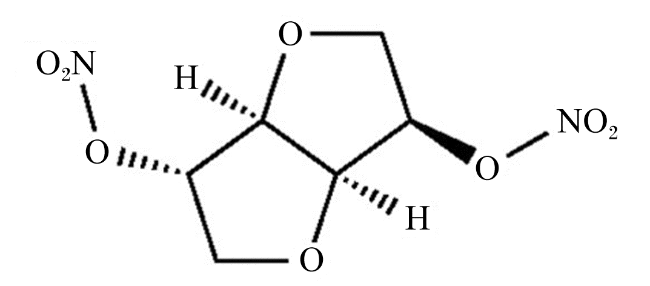
目前,减少反刍动物CH4排放的方法主要有3类:一是直接或间接影响产CH4菌的数量与活性来减少CH4的生成[10-12];二是通过影响氢气的产生或消耗,减少CH4合成的底物,从而减少CH4的生成[13];三是利用特异性抑制剂来影响CH4合成过程中酶的活性来减少CH4的生成,如3-硝基氧基丙醇(3-nitrooxypropanol,3-NOP)、溴氯甲烷(bromochloromethane,BCM)等[14]。研究表明,通过使用在任意位置被至少1个硝基氧基取代的有机分子作为活性化合物,可以减少反刍动物消化活动中产生的C H 4 [15],如3-NOP和硝酸异山梨酯(isosorbide dinitrate,ISDN),其分子中都含有硝基氧基基团。ISDN在目前实际应用中,主要用途是作为血管扩张剂[16],但其具有特殊的化学结构——含2个硝基氧基团,分子式为C6H8N2O8,分子结构如图1所示。因此,可以考虑使用ISDN作为反刍动物的CH4抑制剂。本试验通过体外模拟瘤胃发酵,研究ISDN对奶牛CH4产量、瘤胃发酵参数和营养物质降解率的影响,以期为ISDN在奶牛CH4减排实际生产和后续相关研究提供理论依据。
图1 硝酸异山梨酯分子结构

Fig.1 Molecular structure of isosorbide nitrate

1 材料与方法

1.1 试验材料

试验所用ISDN采购于河南省郑州市某公司,纯度≥99%。试验所用底物为全混合日粮(TMR),精粗比为2∶8,其组成及营养水平见表1,取自河南农业大学畜牧实验站,风干后粉碎过40目筛,装入自封袋室温保存备用。
表1 底物组成及营养水平(干物质基础)

Table 1 Composition and nutrient levels of the substrate (DM basis) %

原料Ingredients 含量Content 营养水平Nutrient levels2) 含量Content
玉米黄贮Yellow corn silage 64.00 粗蛋白质CP 11.58
麦秸Wheat straw 16.00 粗脂肪EE 3.44
玉米Corn 12.00 中性洗涤纤维NDF 53.18
玉米牙胚粕Corn germ meal 2.80 酸性洗涤纤维ADF 25.08
豆粕Soybean meal 3.70 钙Ca 1.80
石粉Limestone 0.20 磷P 0.70
磷酸氢钙CaHPO4 0.30
预混料Premix1) 1.00
合计Total 100.00

1)每千克预混料含 One kg of premix contained the following:Fe 280 mg,Zn 1 900 mg,Cu 350 mg,Mn 1 900 mg,I 28 mg,Co 28 mg,VA 240 000 IU,VD3 84 000 IU,VE 300 mg。

2)营养水平均为实测值。Nutrient levels were measured values.

1.2 试验设计

试验采用体外模拟瘤胃发酵的方法,以TMR作为发酵底物。采用单因素完全随机分组设计,设置2个平行批次,分为5组,每组5个重复。各组底物中ISDN添加水平分别为0(A组,作为对照组)、0.1%(B组)、0.2%(C组)、0.4%(D组)、0.6%(E组)。同时设置5个只添加人工瘤胃液的空白组,用来校正产气量。体外培养的时间设置为24和48 h,到达时间后放入冰水终止发酵,测量pH、产气量、CH4产量和瘤胃发酵参数等指标。

1.3 体外发酵

试验所用的瘤胃液取自河南农业大学畜牧实验站,选取5头体况相近的健康荷斯坦公牛,于晨饲前2 h通过瘤胃插管的方式采集瘤胃液,装入提前预热至39 ℃的保温壶中,迅速带回实验室进行下一步操作。在39 ℃水浴条件下,使用4层纱布将瘤胃液过滤,将过滤后的瘤胃液与人工唾液按照1∶2的比例混匀制成人工培养液,装入发酵瓶。体外培养的体系为150 mL,即瘤胃液50 mL和人工唾液100 mL。人工唾液参照Menke等[17]的方法配制。配制完成的人工唾液置于39 ℃的恒温水浴锅中加热保温,同时持续充入CO2,直到溶液颜色由淡蓝色转为无色方可使用。
试验开始的前1天,准确称量2.0 g底物和每组相对应的ISDN添加水平,装入已做好标记的发酵瓶中。第2天试验开始前60 min,将发酵瓶置于39 ℃的恒温培养箱预热,预热完成后准确装入150 mL人工培养液,在瓶口通5 s CO2,立即盖上橡胶塞和铝盖并用压盖钳压紧,再封上封口膜,使其达到严格的厌氧环境。将各组培养瓶在39 ℃的恒温培养箱中分别发酵24和48 h。发酵前期每隔1 h摇动发酵瓶1次,发酵6 h后,每隔2 h摇动发酵瓶1次[18]

1.4 测定指标与方法

1.4.1 发酵底物营养水平的测定

风干的发酵底物经105 ℃烘干3 h,测定干物质(DM)含量。粗脂肪(EE)和粗蛋白质(CP)含量的测定方法参考AOAC[19]。中性洗涤纤维(NDF)和酸性洗涤纤维(ADF)含量的测定方法参考Van Soest等[20]。钙(Ca)和磷(P)含量的测定方法参考GB/T 6436—2018和GB/T 6437—2018,分别采用乙二胺四乙酸二钠络合滴定法和分光光度法。

1.4.2 产气量与CH4产量的测定

在发酵时间到达24和48 h时,迅速取出发酵瓶,放入冰水中停止发酵,使用精密压力表(YGK-100,陕西美控电子科技有限公司)测定发酵瓶内气压,参考张黎杰等[21]的计算方法计算产气量,公式如下:
GP=P×(V-10)/(101.3×W)。
式中:GP为产气量(mL);P为精密压力表测定的发酵瓶内压强(kPa);V为发酵瓶的体积(mL);W为发酵底物质量(g)。
测定发酵瓶内压强后,用注射器收集瓶内全部气体,注入气体采样袋(MBT11,大连海得科技有限公司),通过气相色谱仪测定所采集气体的CH4产量[22]。根据产气量和CH4产量计算甲烷比例,计算公式如下:
甲烷比例(%)=(CH4产量/产气量)×100。

1.4.3 瘤胃发酵指标的测定

发酵瓶开盖后,将发酵液通过尼龙袋过滤至一次性纸杯中,使用便携式pH计测定发酵液pH;然后将发酵液分装至2个15 mL离心管中,放入-20 ℃保存,用于氨态氮(NH3-N)和挥发性脂肪酸(VFA)浓度的测定。采用苯酚次氯酸钠比色法测定NH3-N浓度[23],采用离子色谱法测定VFA浓度[24]

1.4.4 营养物质降解率的测定

使用尼龙袋分别过滤出每个发酵瓶中剩余的残渣,封口后经自来水反复冲洗直至水流清澈,剩余物即为未降解的饲料样品[25]。65 ℃烘干后测定DM、NDF和ADF含量。营养物质降解率的计算公式如下:
营养物质降解率(%)=[(降解前底物质量×
被测成分含量-降解后残渣质量×被测营养
成分含量)/(降解前底物质量×被测营养
成分含量)]×100。

1.5 数据统计分析

首先用Excel 2021对数据进行整理,然后使用SPSS 26.0软件进行单因素方差分析,采用Duncan氏法进行多重比较。试验结果以平均值和均值标准误(SEM)表示,以0.05<P<0.10作为有显著差异的趋势,以P<0.05作为显著性差异的判断标准。

2 结果

2.1 ISDN对奶牛体外发酵产气量和CH4产量的影响

表2所示,发酵24和48 h时,D组和E组的产气量和CH4产量显著低于A组(P<0.05),D组和E组的CH4比例显著低于A组、B组和C组(P<0.05),且E组的CH4比例显著低于D组(P<0.05)。
表2 ISDN对奶牛体外发酵产气量和CH4产量的影响

Table 2 Effects of ISDN on in vitro fermentation gas production and CH4 production of dairy cows

项目
Items
组别Groups SEM P
P-value
A B C D E
24 h
产气量GP/mL 154.80a 146.72ab 139.10b 122.74c 126.11c 2.75 <0.001
甲烷产量CH4 production/mL 2.22a 2.21a 2.20a 0.45b 0.10b 0.21 <0.001
甲烷比例CH4 proportion/% 1.43a 1.51a 1.54a 0.36b 0.08c 0.14 <0.001
48 h
产气量GP/mL 185.19b 198.80a 186.66b 162.00c 142.02d 4.29 <0.001
甲烷产量CH4 production/mL 2.71a 2.46ab 2.27b 1.33c 0.28d 0.19 <0.001
甲烷比例CH4 proportion/% 1.46a 1.24a 1.22a 0.82b 0.20c 0.10 <0.001

同行数据肩标不同小写字母表示差异显著(P<0.05),相同或无字母表示差异不显著(P>0.05)。下表同。

In the same row, values with different small letter superscripts mean significant difference (P<0.05), while with the same or no letter superscripts mean no significant difference (P>0.05). The same as below.

2.2 ISDN对奶牛体外瘤胃发酵参数的影响

表3所示,发酵24 h时,B组、D组、E组的瘤胃pH显著低于A组(P<0.05),但属于瘤胃pH正常波动范围;发酵48 h时,pH恢复正常,各组之间瘤胃pH差异不显著(P>0.05)。发酵48 h时,各组之间瘤胃NH3-N浓度差异不显著(P>0.05);发酵24 h时,随着ISDN添加水平的提高,瘤胃NH3-N浓度有升高趋势(P=0.076)。
表3 ISDN对奶牛体外瘤胃发酵参数的影响

Table 3 Effects of ISDN on in vitro rumen fermentation parameters of dairy cows

项目
Items
组别Groups SEM P
P-value
A B C D E
24 h
pH 6.38a 6.30bc 6.34ab 6.28bc 6.26c 0.01 0.017
氨态氮NH3-N/(mg/dL) 11.14 14.78 14.09 14.93 16.45 0.65 0.076
总挥发性脂肪酸TVFA/(mmol/L) 60.81 51.07 54.90 52.08 50.63 1.45 0.143
乙酸Acetic acid/% 60.79a 60.62a 58.97b 53.96c 52.68c 0.72 <0.001
丙酸Propionic acid/% 28.00b 28.45b 30.20a 29.71a 29.65a 0.22 0.001
丁酸Butyric acid/% 11.21c 10.93c 10.84c 16.33b 17.67a 0.62 <0.001
乙酸/丙酸Acetic acid /propionic acid 2.17a 2.13a 1.96b 1.82c 1.78c 0.04 <0.001
48 h
pH 6.28 6.20 6.24 6.20 6.22 0.01 0.314
氨态氮NH3-N/(mg/dL) 19.54 18.04 18.62 20.54 18.78 0.53 0.655
总挥发性脂肪酸TVFA/(mmol/L) 63.44 57.06 58.12 53.44 61.34 1.82 0.488
乙酸Acetic acid/% 66.03ab 67.17a 65.25b 61.38c 56.74d 0.81 <0.001
丙酸Propionic acid/% 27.69d 27.83d 29.58c 33.21b 37.94a 0.81 <0.001
丁酸Butyric acid/% 6.28 5.00 5.17 5.41 5.33 0.19 0.231
乙酸/丙酸Acetic acid/propionic acid 2.39a 2.42a 2.21b 1.85c 1.50d 0.07 <0.001
发酵24和48 h时,各组之间瘤胃总挥发性脂肪酸浓度差异不显著(P>0.05)。发酵24 h时,D组和E组的瘤胃乙酸比例和乙酸/丙酸显著低于A组、B组和C组(P<0.05),且C组的瘤胃乙酸比例和乙酸/丙酸显著低于A组和B组(P<0.05);C组、D组和E组的瘤胃丙酸比例显著高于A组和B组(P<0.05);D组和E组的瘤胃丁酸比例显著高于A组、B组和C组(P<0.05),且E组的瘤胃丁酸比例显著高于D组(P<0.05)。发酵48 h时,D组和E组的瘤胃乙酸比例和乙酸/丙酸显著低于A组、B组和C组(P<0.05),且E组的瘤胃乙酸比例和乙酸/丙酸显著低于D组(P<0.05);C组、D组和E组的瘤胃丙酸比例显著高于A组和B组(P<0.05),且E组的瘤胃丙酸比例显著高于D组(P<0.05)。

2.3 ISDN对奶牛体外发酵营养物质降解率的影响

表4所示,发酵24 h时,E组的DM降解率显著低于其他各组(P<0.05);D组和E组的NDF和ADF降解率显著低于A组(P<0.05);D组和E组的NDF降解率显著低于B组和C组(P<0.05)。发酵48 h时,各组之间DM、NDF和ADF降解率均无显著差异(P>0.05)。
表4 ISDN对奶牛体外发酵营养物质降解率的影响

Table 4 Effects of ISDN on in vitro fermentation nutrient degradation rates of dairy cows %

项目
Items
组别Groups SEM P
P-value
A B C D E
24 h
干物质降解率DM degradation rate 68.47a 67.77a 66.90a 64.92a 60.16b 0.77 <0.001
中性洗涤纤维降解率NDF degradation rate 55.40a 55.24a 54.57a 50.45b 47.62b 0.92 0.001
酸性洗涤纤维降解率ADF degradation rate 46.61a 44.82ab 44.51ab 39.57bc 36.61c 1.19 0.011
48 h
干物质降解率DM degradation rate 72.20 72.99 72.06 72.59 72.05 0.20 0.539
中性洗涤纤维降解率NDF degradation rate 61.62 64.35 64.04 64.50 62.97 0.41 0.119
酸性洗涤纤维降解率ADF degradation rate 50.39 54.72 54.35 55.13 53.01 0.65 0.102

3 讨论

3.1 ISDN对奶牛体外发酵产气量和CH4产量的影响

反刍动物瘤胃中含有丰富的微生物,包括细菌、真菌、原虫和古菌等。因此,相比于单胃动物,反刍动物对粗饲料中的纤维物质有很强的利用能力,可以更加合理的利用农业生产过程中所产生的秸秆废料等。但瘤胃微生物中丰富的产CH4菌利用饲料生成CH4,不仅浪费了饲料能量,还会加剧全球温室效应。研究表明,分子中任意位置至少1个基团被硝基氧基取代的有机分子可以有效降低反刍动物消化活动中的CH4产量[15],如常见的3-NOP。本试验所采用的ISDN也同样含有硝基氧基基团,因此对于CH4减排可能有一定作用。本试验结果也证实了这个假设,在DM基础上,添加0.4%的ISDN可以降低79.7%的CH4产量,添加0.6%的ISDN可以降低95.5%的CH4产量。当ISDN添加水平为0.1%和0.2%时,CH4产量与对照组差异不显著,但ISDN添加水平为0.4%时,CH4产量呈现悬崖式下降。在仅有添加水平1个变量的情况下,导致此现象的原因可能是因为0.2%到0.4%区间内存在一个作用阈值。与3-NOP相同,ISDN所含硝基氧基基团结构类似于甲基辅酶M[26],因此当ISDN添加量达到一定水平时,可以竞争性抑制甲基辅酶M与甲基辅酶M还原酶的活性结合位点,从而氧化甲基辅酶M还原酶,以达到抑制CH4生成的效果。因此,ISDN与在奶牛饲粮中添加3-NOP的研究结果相似[27-28],都有降低CH4产量的效果。但上述2个研究在奶牛TMR中添加3-NOP仅能降低30%左右的CH4排放量,低于本试验添加ISDN的CH4减排效果,这可能是因为本试验为实验室条件下的体外模拟瘤胃发酵,以及所用添加剂分子结构的差异所致。首先,相比于活体饲养试验,实验室内体外模拟瘤胃发酵更容易控制环境变量,同时也减少了诸多无关因素的影响。其次,3-NOP与ISDN的化学结构存在差异,但又同样都有硝基氧基基团。两者之间的相似性可能是能够抑制CH4产生的原因;同时两者之间的差异性或许是对CH4抑制程度不同的原因。ISDN在瘤胃发酵过程中抑制CH4生成的基理有待深入研究。
瘤胃发酵过程中会产生大量气体,产气量同样是瘤胃发酵状态的一个重要指标,它代表了饲料营养物质在瘤胃中的可利用价值[29]。产气量的高低反映出营养物质的降解程度,两者呈现高度的正相关[30]。本试验结果显示,随着ISDN添加水平的提高,产气量总体呈现下降趋势,同时DM降解率也呈现下降趋势,其原因可能是因为高水平的ISDN对瘤胃微生物活性产生一定抑制作用。与此同时,受到影响的还有产CH4[31],这也解释了瘤胃CH4产量下降的原因。活体试验表明,在泌乳期荷斯坦奶牛TMR中添加ISDN,未见奶牛有不良反应。通过高效液相色谱法对采集的牛奶进行检测,并未发现有ISDN及其代谢产物残留,说明ISDN可以被动物完全代谢,不会对人的健康造成影响。

3.2 ISDN对奶牛体外发酵参数的影响

研究表明,反刍动物瘤胃正常发酵的pH在5.5~7.0波动[32],而本试验各组的pH均在正常范围内波动。NH3-N在瘤胃发酵过程中作为微生物蛋白质代谢中间产物,为微生物合成蛋白质提供充足氮源,因此其浓度可以反映出瘤胃中利用蛋白质饲料生产微生物蛋白质的微生物活性及微生物蛋白质含量[33]。本试验结果中,ISDN添加水平对于NH3-N浓度无显著影响,但发酵24 h时随着ISDN添加水平的提高,NH3-N浓度有升高的趋势,这可能是由于ISDN对微生物活性的抑制作用降低了微生物合成蛋白质的效率,从而导致NH3-N的积累。
瘤胃中的VFA包含乙酸、丙酸、丁酸、异丁酸、戊酸和异戊酸[34],其中前3者为主要组成部分,占瘤胃中总挥发酸的95%以上。VFA是饲料中碳水化合物在瘤胃中厌氧发酵的产物,为反刍动物生产活动主要的能量来源[35]。本试验结果显示,ISDN添加水平对总挥发性脂肪酸浓度未产生显著影响,但会降低乙酸比例和乙酸/丙酸,同时提高丙酸比例。乙酸比例升高的原因可能与CH4生成受到抑制有关,因为CH4生产过程中会消耗瘤胃内的氢,当CH4生成受到抑制会导致氢的积累,从而引起乙酸比例降低[36]。丙酸在合成过程中会与CH4竞争氢,因此CH4合成受到抑制所引起的氢积累可能是丙酸比例升高的原因之一[10]

3.3 ISDN对奶牛体外发酵营养物质降解率的影响

张文璐等[30]研究发现,DM降解率与产气量呈现高度的相关性,且为正相关。DM降解率受到多种因素的影响,包括自身营养价值、是否使用添加剂及饲料的加工处理方式等。DM降解率越高,说明在相同发酵时间内对营养物质的利用能力更强[37]。反刍动物可以利用单胃动物难以消化的粗纤维,因此NDF和ADF降解率是评价粗饲料营养价值的重要指标,同时也可以作为饲料添加剂是否影响瘤胃正常降解粗纤维的条件之一。本试验结果显示,发酵24 h时,0.4%与0.6%的ISDN添加水平使DM、NDF和ADF降解率显著降低。研究发现,饲粮中添加3-NOP对DM降解率无显著影响[38-39],本试验结果与之不同的原因可能是两者之间的添加水平以及分子结构的差异所致。分子结构的不同对于微生物的影响也有所不同,同时较高浓度的ISDN对于微生物的活性可能有一定影响,其中包括产CH4菌和纤维分解菌等,因此会对CH4生成和营养物质降解产生抑制作用,具体作用机制仍需进一步研究。发酵48 h时,各组之间DM降解率不再有显著差异。而引起差异消失的原因可能是因为发酵底物只有2.0 g,经过长达48 h的发酵,即使微生物活性受到抑制,仍然可以将底物降解到相似水平,从而引起差异消失。我们将会在后续试验中增设发酵时间点,从而可以动态观察ISDN对降解率的影响。

4 结论

① ISDN作为CH4抑制剂添加在反刍动物饲粮中,可以减少CH4排放,且对瘤胃发酵参数不会造成影响,但过高的ISDN添加水平可能影响纤维和DM的降解率。
② 本试验条件下,添加0.4%的ISDN可以有效降低体外模拟瘤胃发酵过程中CH4产量,且对于营养物质降解率影响较小。
[1]
贾鹏, 董利锋, 屠焰, 等. 反刍动物瘤胃甲烷产生与排放的主要生物学特征[J]. 动物营养学报, 2022, 34(6):3411-3417.

DOI

JIA P, DONG L F, TU Y, et al. Main biological characteristics of methane production and emission in ruminants[J]. Chinese Journal of Animal Nutrition, 2022, 34(6):3411-3417. (in Chinese)

DOI

[2]
YANG G J, BERGQUIST R. Potential impact of climate change on schistosomiasis:a global assessment attempt[J]. Tropical Medicine and Infectious Disease, 2018, 3(4):117.

[3]
PATZ J A, FRUMKIN H, HOLLOWAY T, et al. Climate change:challenges and opportunities for global health[J]. JAMA, 2014, 312(15):1565-1580.

[4]
GERBER P J, STEINFELD H, HENDERSON B, et al. Tackling climate change through livestock:a global assessment of emissions and mitigation opportunities[M]. Rome: Food and Agriculture Organization of the United Nations, 2013:14-15.

[5]
HAQUE M N. Dietary manipulation:a sustainable way to mitigate methane emissions from ruminants[J]. Journal of Animal Science and Technology, 2018, 60(1):15.

[6]
RIPPLE W J, SMITH P, HABERL H, et al. Ruminants,climate change and climate policy[J]. Nature Climate Change, 2014, 4(1):2-5.

[7]
BEAUCHEMIN K A, UNGERFELD E M, ECKARD R J, et al. Review:fifty years of research on rumen methanogenesis:lessons learned and future challenges for mitigation[J]. Animal, 2020,14 (Suppl.1):s2-s16.

[8]
DE VISSCHER A, VAN CLEEMPUT O. Simulation model for gas diffusion and methane oxidation in landfill cover soils[J]. Waste Management, 2003, 23(7):581-591.

PMID

[9]
JOHNSON K A, JOHNSON D E. Methane emissions from cattle[J]. Journal of Animal Science, 1995, 73(8):2483-2492.

DOI PMID

[10]
LAN W, YANG C L. Ruminal methane production:associated microorganisms and the potential of applying hydrogen-utilizing bacteria for mitigation[J]. Science of the Total Environment, 2019, 654:1270-1283.

[11]
俎昊辰, 许静, 丛玉艳. 通过添加耗氢化合物调节瘤胃微生物实现甲烷减排[J]. 动物营养学报, 2019, 31(11):4968-4973.

ZU H C, XU J, CONG Y Y. Reducing rumen methane emission through regulating rumen microorganisms by adding hydrogen-consuming compounds[J]. Chinese Journal of Animal Nutrition, 2019, 31(11):4968-4973. (in Chinese)

[12]
JAYANEGARA A, WINA E, TAKAHASHI J. Meta-analysis on methane mitigating properties of saponin-rich sources in the rumen:influence of addition levels and plant sources[J]. Asian-Australasian Journal of Animal Sciences, 2014, 27(10):1426-1435.

[13]
MELLER R A, WENNER B A, ASHWORTH J, et al. Potential roles of nitrate and live yeast culture in suppressing methane emission and influencing ruminal fermentation,digestibility,and milk production in lactating Jersey cows[J]. Journal of Dairy Science, 2019, 102(7):6144-6156.

[14]
JEYANATHAN J, MARTIN C, MORGAVI D P. The use of direct-fed microbials for mitigation of ruminant methane emissions:a review[J]. Animal, 2014, 8(2):250-261.

[15]
ANDERSON R C, KRUEGER N A, STANTON T B, et al. Effects of select nitrocompounds on in vitro ruminal fermentation during conditions of limiting or excess added reductant[J]. Bioresource Technology, 2008, 99(18):8655-8661.

[16]
THYS D M, SIVAK G, KAPLAN J A. The role of isosorbide dinitrate in the treatment of perioperative hypertension[J]. American Heart Journal, 1985, 110(1 Pt 2):273-276.

PMID

[17]
MENKE K H, RAAB L, SALEWSKI A, et al. The estimation of the digestibility and metabolizable energy content of ruminant feedingstuffs from the gas production when they are incubated with rumen liquor in vitro[J]. The Journal of Agricultural Science, 1979, 93(1):217-222.

[18]
滕战伟, 陈秋楠, 王笑笑, 等. 不同来源多酚对奶牛瘤胃体外营养物质降解率和甲烷产量的影响[J]. 中国兽医学报, 2023, 43(10):2157-2161,2170.

TENG Z W, CHEN Q N, WANG X X, et al. Effects of polyphenols from different sources on in vitro ruminal nutrient degradation rate and methane production in dairy cows[J]. Chinese Journal of Veterinary Science, 2023, 43(10):2157-2161,2170. (in Chinese)

[19]
AOAC International. Official methods of analysis of AOAC international[M]. 16th ed. Arlington: AOAC International, 1995:382-383.

[20]
VAN SOEST P J, ROBERTSON J B, LEWIS B A. Methods for dietary fiber,neutral detergent fiber,and nonstarch polysaccharides in relation to animal nutrition[J]. Journal Dairy Science, 1991, 74(10):3583-3597.

[21]
张黎杰, 杨新露, 滕战伟, 等. 体外产气法评价花生秧粉碎粒度对奶牛瘤胃发酵效果的影响[J]. 中国饲料, 2023(7):153-157.

ZHANG L J, YANG X L, TENG Z W, et al. Effects of pulverized peanut vine size on rumen fermentation of dairy cows were evaluated by gas production method[J]. China Feed, 2023(7):153-157. (in Chinese)

[22]
孙凯佳. 堆积肉牛粪便的甲烷排放与米曲霉对肉牛胃肠道和粪便甲烷排放的影响及其机理[D]. 博士学位论文. 郑州: 河南农业大学, 2015.

SUN K J. The methane emissions from beef cattle manure during storage and the effects of Aspergillus oryzae on enteric and manure methane emission from beef cattle and its mechanism[D]. Ph.D.Thesis. Zhengzhou: Henan Agricultural University, 2015. (in Chinese)

[23]
BRODERICK G A, KANG J H. Automated simultaneous determination of ammonia and total amino acids in ruminal fluid and in vitro media[J]. Journal of Dairy Science, 1980, 63(1):64-75.

[24]
牟豪杰, 孟庆翔, 任丽萍, 等. 离子色谱法同时测定牛瘤胃液中乳酸和挥发性脂肪酸含量[J]. 理化检验(化学分册), 2009, 45(1):52-54.

MU H J, MENG Q X, REN L P, et al. Simultaneous determination of lactic acid and volatil fatty acids in ox rumen juice by ion chromatography[J]. Physical Testing and Chemical Analysis Part B:Chemical Analysis, 2009, 45(1):52-54. (in Chinese)

[25]
冯仰廉. 澳斯柯夫. 反刍家畜降解蛋白质的研究(一)用尼龙袋法测定几种中国精饲料在瘤胃中的降解率及该方法稳定性的研究[J]. 中国畜牧杂志, 1984, 20(5):4-7.

FENG Y L, ФRSKOV E R. Study on protein degradation in ruminant livestock (1) determination of the degradation rate of several Chinese concentrated feed in rumen by nylon bag method and study on the stability of this method[J]. Chinese Journal of Animal Science, 1984, 20(5):4-7. (in Chinese)

[26]
DUIN E C, WAGNER T, SHIMA S, et al. Mode of action uncovered for the specific reduction of methane emissions from ruminants by the small molecule 3-nitrooxypropanol[J]. Proceedings of the National Academy of Sciences of the United States of America, 2016, 113(22):6172-6177.

DOI PMID

[27]
HRISTOV A N, OH J, GIALLONGO F, et al. An inhibitor persistently decreased enteric methane emission from dairy cows with no negative effect on milk production[J]. Proceedings of the National Academy of Sciences of the United States of America, 2015, 112(34):10663-10668.

DOI PMID

[28]
LOPES J C, DE MATOS L F, HARPER M T, et al. Effect of 3-nitrooxypropanol on methane and hydrogen emissions,methane isotopic signature,and ruminal fermentation in dairy cows[J]. Journal of Dairy Science, 2016, 99(7):5335-5344.

[29]
冯肖然, 张春桃, 屠焰. 体外产气法评定玉米青贮、苜蓿、燕麦、花生秧的组合效应[J]. 饲料工业, 2023, 44(19):78-83.

FENG X R, ZHANG C T, TU Y. Evaluation of associative effects of corn silage,alfalfa hay,oat hay and peanut vine by in vitro gas production method[J]. Feed Industry, 2023, 44(19):78-83. (in Chinese)

[30]
张文璐, 李杰, 吕元勋. 体外产气法与尼龙袋法评定粗饲料干物质降解率的相关性分析[J]. 饲料工业, 2009, 30(7):30-32.

ZHANG W L, LI J, LYU Y X. Correlation analysis between vitro gas production and nylon bag technique for evaluating the degradation rate of roughage[J]. Feed Industry, 2009, 30(7):30-32. (in Chinese)

[31]
LIU Z H, WANG K, NAN X M, et al. Effects of combined addition of 3-nitrooxypropanol and vitamin B12 on methane and propionate production in dairy cows by in vitro-simulated fermentation[J]. Journal of Dairy Science, 2023, 106(1):219-232.

[32]
CHEN L, DONG Z H, LI J F, et al. Ensiling characteristics,in vitro rumen fermentation,microbial communities and aerobic stability of low-dry matter silages produced with sweet sorghum and alfalfa mixtures[J]. Journal of the Science of Food and Agriculture, 2019, 99(5):2140-2151.

[33]
WALLACE R J, ARTHAUD L, NEWBOLD C J. Influence of Yucca shidigera extract on ruminal ammonia concentrations and ruminal microorganisms[J]. Applied and Environmental Microbiology, 1994, 60(6):1762-1767.

[34]
STORM A C, KRISTENSEN N B, HANIGAN M D. A model of ruminal volatile fatty acid absorption kinetics and rumen epithelial blood flow in lactating Holstein cows[J]. Journal of Dairy Science, 2012, 95(6):2919-2934.

DOI PMID

[35]
FURET J P, FIRMESSE O, GOURMELON M, et al. Comparative assessment of human and farm animal faecal microbiota using real-time quantitative PCR[J]. FEMS Microbiology Ecology, 2009, 68(3):351-362.

[36]
MELGAR A, HARPER M T, OH J, et al. Effects of 3-nitrooxypropanol on rumen fermentation,lactational performance,and resumption of ovarian cyclicity in dairy cows[J]. Journal of Dairy Science, 2020, 103(1):410-432.

[37]
ZHANG S J, CHAUDHRY A S, RAMDANI D, et al. Chemical composition and in vitro fermentation characteristics of high sugar forage sorghum as an alternative to forage maize for silage making in Tarim Basin,China[J]. Journal of Integrative Agriculture, 2016, 15(1):175-182.

[38]
ALVAREZ-HESS P S, MOATE P J, WILLIAMS S R O, et al. Effect of combining wheat grain with nitrate,fat or 3-nitrooxypropanol on in vitro methane production[J]. Animal Feed Science and Technology, 2019, 256:114237.

[39]
ROMERO-PÉREZ A, OKINE E K, GUAN L L, et al. Effects of 3-nitrooxypropanol on methane production using the rumen simulation technique (Rusitec)[J]. Animal Feed Science and Technology, 2015, 209:98-109.

Outlines

/