RESEARCH PAPER

Effects of Enterococcus faecium F11.1G on Growth Performance, Nutrient Apparent Digestibility, Slaughter Performance, Rumen Fermentation and Rumen Microflora of Weaned Lambs

  • ZHU Zhenyu , 1 ,
  • YANG Cheng 1 ,
  • WANG Minggen 1 ,
  • E Guangxu 1 ,
  • LIU Junfeng 1 ,
  • LU Dong 1 ,
  • GUO Xuefeng , 1, 2, *
Expand
  • 1 College of Animal Science and Technology, Tarim University, Alar 843300, China
  • 2 Tarim Key Laboratory of Animal Husbandry Science and Technology Corps, Alar 843300, China
* professor, E-mail:

Received date: 2023-11-09

  Online published: 2024-05-15

Abstract

This experiment aimed to investigate the effects of adding Enterococcus Faecium F11.1G to the diet on the growth performance, apparent nutrient digestibility, slaughter performance, and rumen fermentation and rumen microflora of Karakul weaned lambs. Twenty healthy Karakul weaned lambs, 2 months old, with a body weight of (21.0±1.0) kg, were selected for the experiment. They were divided into a control group and an experimental group, with 10 lambs in each group. The control group was fed a basic diet, while the experimental group was fed the basic diet with 2.0 g per day per lamb of Enterococcus faecium F11.1G. The experiment lasted for 75 days, including a 15-day pre-trial period and a 60-day formal trial period. The initial body weight was recorded before morning feeding on the day 1 of the trial period, during days 45 to 52 of the formal trial period, the apparent digestibility of nutrients were determined. On the day 60 of the formal trial period, 5 animals from each group were selected for fasting weighing and slaughter to measure slaughter performance, rumen fermentation parameters, and rumen microbial flora. The results showed that the experimental group’s net weight gain and average daily gain (ADG) were significantly higher than those of the control group (P<0.01). The average daily feed intake (ADFI) was significantly higher than that of the control group (P<0.05), and the feed/gain (F/G) was significantly lower than that of the control group (P<0.01). The apparent digestibility of acid detergent fiber (ADF) in the experimental group was significantly higher than that in the control group (P<0.05). The live weight and carcass weight of the experimental group before slaughter were significantly higher than those of the control group (P<0.05). The liver index, rumen index, small intestine index, and large intestine index were significantly higher than those of the control group (P<0.05 or P<0.01), while the reticulum index was significantly lower than that of the control group (P<0.05). In terms of rumen fermentation indicators, the addition of Enterococcus faecium F11.1G significantly increased the concentration of acetate, butyrate, and the acetate/propionate in the rumen (P<0.05). In terms of rumen microbial flora, adding Enterococcus faecium F11.1G probiotics increased the number of rumen microbial OTUs and the relative abundance of Bacteroidetes, Firmicutes and Fibrobacteres, Rikenellaceae_RC9_gut_group was positively correlated with ADG, pH, the concentrations of ammonia nitrogen (NH3-N), acetate, butyrate, and acetate/propionate. In conclusion, adding 2.0 g of Enterococcus faecium F11.1G to the diet can improve the growth performance and ADF apparent digestibility of weaned lambs, improve rumen fermentation by increasing the concentration of acetate and butyrate in the rumen, increase the number of OTUs of rumen bacteria, and increase the abundance of Bacteroidota, Firmicutes, Fibrobacterota at the phylum level of rumen bacteria. The relative abundance of Rikenellaceae_RC9_gut_group is positively correlated with ADG and rumen fermentation parameters.

Cite this article

ZHU Zhenyu , YANG Cheng , WANG Minggen , E Guangxu , LIU Junfeng , LU Dong , GUO Xuefeng . Effects of Enterococcus faecium F11.1G on Growth Performance, Nutrient Apparent Digestibility, Slaughter Performance, Rumen Fermentation and Rumen Microflora of Weaned Lambs[J]. Chinese Journal of Animal Nutrition, 2024 , 36(5) : 3143 -3155 . DOI: 10.12418/CJAN2024.270

中华人民共和国农业农村部发布公告,于2020年7月1日起饲料企业要停止生产含有促生长类药物饲料添加剂(中药类除外)的商品饲料[1]。寻找抗生素替代品成为动物营养学者的研究热点,益生菌制剂因具有维持动物肠道健康[2]、改善动物的生长性能[3]等作用而被广泛关注。研究表明,反刍动物饲粮中添加益生菌可以提高干物质摄入量、纤维消化率和生长性能[4-5]。其中,屎肠球菌于2013年被列入中国农业部发布的《饲料添加剂品种目录(2013年)》[6]。胡良玉等[7]研究发现,奶牛饲粮中添加60 g/d屎肠球菌,可增加泌乳期乳蛋白含量和干物质泌乳量。Nocek等[8]在围产期的奶牛饲粮中添加5×109 CFU/d的复合微生态制剂(屎肠球菌和植物乳杆菌),显著提高了产犊后奶牛的采食量。前期课题组白天天等[9]通过体外发酵试验筛选出绵羊饲粮中屎肠球菌F11.1G最适添加量为1011 CFU/(d·只),相当于体内添加量为2.0 g/(d·只),此外,白天天等[10]在成年绵羊饲粮中添加屎肠球菌F11.1G,提高了营养物质表观消化率,但其是否能促进断奶羔羊胃肠道发育、改善瘤胃发酵和瘤胃微生物区系等仍需要进一步研究。因此,本试验在断奶羔羊饲粮中添加屎肠球菌F11.1G菌剂,探究屎肠球菌F11.1G对断奶羔羊生长性能、营养物质表观消化率、屠宰性能、瘤胃发酵和瘤胃微生物区系的影响,为屎肠球菌F11.1G在断奶羔羊上的应用提供科学依据。

1 材料与方法

1.1 试验菌株

本试验所用的屎肠球菌F11.1G为塔里木大学郭雪峰团队自主分离菌株,于中国典型培养物保藏中心保藏(保藏号:M 2020793),活菌数为1×10¹¹ CFU/g。

1.2 试验设计

试验选取20只健康、2月龄、体重(21.0±1.0) kg的卡拉库尔羊断奶羔羊公羔,按体重配对原则分为对照组和试验组,每组10只。对照组饲喂基础饲粮,试验组每只羊每天在基础饲粮中添加2.0 g屎肠球菌F11.1G菌剂。试验期75 d,其中预试期15 d,正试期60 d。

1.3 饲养管理及饲粮

试验于2023年3月5日至2023年5月20日在塔里木大学动物科学与技术学院动物试验站进行。预试前对试验动物剪毛、驱虫。试验动物单栏饲养,自由采食和饮水,每日09:00和20:00各饲喂1次。
参考《肉羊营养需要量》(NY/T 816—2021),并结合生产实际,按照日增重200 g/d配制基础饲粮,其组成及营养水平见表1
表1 基础饲粮组成及营养水平(风干基础)

Table 1 Composition and nutrient levels of the basal diet (air-dry basis) %

项目Items 含量Content
原料Ingredients
棉籽壳Cottonseed hull 35.00
苜蓿草粉Alfalfa meal 20.00
棉籽粕Cottonseed meal 8.50
小麦麸Wheat bran 9.50
玉米Corn 24.35
石粉Limestone 1.07
食盐NaCl 0.32
预混料Premix1) 1.26
合计Total 100.00
营养水平Nutrient levels2)
干物质DM 88.96
代谢能ME/(MJ/kg) 9.54
粗蛋白质CP 11.82
粗脂肪EE 6.08
中性洗涤纤维NDF 45.12
酸性洗涤纤维ADF 26.42

1)预混料为每千克饲粮提供 The premix provided the following per kg of the diet: VA 1 800 IU,VD3 600 IU,VE 30 mg,Fe 65 mg,Se 0.15 mg,I 0.6 mg,Cu 10 mg,Mn 28 mg,Zn 45 mg。

2)代谢能计算参考《肉羊营养需要量》(NY/T 816—2021),其余为实测值。ME was calculated according to the Nutritional Requirements of Meat Sheep (NY/T 816—2021), while the others were measured values.

1.4 测定指标及方法

1.4.1 生长性能

试验正试期第0(试验当天)和60天晨饲前对试验羊进行称重。每日晨饲前收集剩料并称重,计算平均日增重(ADG)、平均日采食量(ADFI)、料重比(F/G)。计算公式如下:
ADG=(终末体重-初始体重)/饲养天数;
ADFI(kg/d)=饲养期内总采食量/饲养天数;
F/G=ADFI/ADG。

1.4.2 营养物质表观消化率

饲粮和粪样中的水分、粗蛋白质(CP)、粗脂肪(EE)、酸性洗涤纤维(ADF)和中性洗涤纤维(NDF)含量分别按照GB/T 6435—2014[11]、GB/T 6432—2018[12]、GB/T 6433—2006[13]、Van Soest等[14]测定。采用盐酸不溶灰分法[15]测定营养物质表观消化率。计算公式如下:
某营养物质表观消化率(%)=[1-(AF2)/
(AF1)]×100。
式中:F1、F2分别代表饲粮中该营养物质所占比例及粪便中该营养物质所占比例;A1、A2分别代表饲粮中盐酸不溶灰分占比及粪便中盐酸不溶灰分占比。

1.4.3 屠宰性能

正试期第60天空腹称重后进行屠宰试验,宰前禁食24 h,禁水2 h。放血,剥离毛皮,去头、蹄、内脏(不包括肾脏和肾周脂),静置30 min后测定胴体重,计算屠宰率。背膘厚度、眼肌面积和GR值(胴体脂肪含量)参考Suzuki等[16]的方法测定。计算公式如下:
屠宰率(%)=(胴体重/宰前活重)×100。

1.4.4 器官指数

称取心脏、肝脏、脾脏、肺脏、肾脏、胰脏重,分离瘤胃、网胃、瓣胃、皱胃、小肠和大肠,清除内容物,沥干称重,参考Sun等[17]的方法计算器官指数。计算公式如下:
器官指数(%)=(器官重/宰前活重)×100。

1.4.5 瘤胃发酵参数

屠宰后,将瘤胃切开,每只羊采集瘤胃液50 mL,用4层灭菌纱布进行过滤。使用FE28 pH计测定瘤胃液pH,氨态氮(NH3-N)浓度参考冯宗慈等[18]比色法,用紫外分光光度计(T6新世纪紫外分光光度计,北京普析通用仪器有限公司)测定,挥发性脂肪酸(VFA)浓度采用高效液相色谱法[19],用U1-timate 3000型高效液相色谱仪(赛默飞世尔上海仪器有限公司)测定。

1.4.6 瘤胃微生物区系

屠宰后,取试验羊瘤胃内容物于2 mL冻存管中,送至北京诺禾致源科技股份有限公司进行瘤胃16S rRNA测序。
使用十六烷基三甲基溴化铵(CTAB)法提取瘤胃内容物样本的DNA,使用细菌通用引物314F(5'-CCTAYGGGRBGCASCAG-3')和806R(5'-GGACTACNNGGGTATCTAAT-3')扩增细菌16S rRNA基因V3~V4高变区域。PCR产物使用2%浓度的琼脂糖凝胶电泳检测合格后,对目的条带使用通用型DNA纯化回收试剂盒(TianGen)回收产物。使用NEB Next® UltraTM Ⅱ FS DNA PCR-free Library Prep Kit建库试剂盒(New England Biolabs)进行文库构建,经过Qubit和Q-PCR定量,合格后使用NovaSeq6000进行PE250上机测序。
对所有测序后数据作如下处理:测序结束后,双端数据拼接截去Barcode和引物序列后使用FLASH对每个样本的reads进行拼接,经flasp软件(V.0.23.1)进行数据过滤处理[20],将得到的Tags序列与物种注释数据库进行比对检测去除其中的嵌合体序列,得到最终的有效数据(Effective Tags)[21]。使用QIIME2软件(V.QIIME2-202006)中的DADA2模块对有效数据序列进行降噪,过滤掉丰度小于5的序列,获得ASVs(扩增序列变异)以及特征表。最后以样本中数据量最少的为标准对各样本的数据进行均一化处理。Venn图、瘤胃微生物门、属水平相对丰度柱状图及瘤胃优势菌属与ADG和瘤胃发酵参数相关性分析图在诺禾云平台(https://magic.novogene.com)进行绘制。

1.5 数据分析

瘤胃微生物门、属水平相对丰度使用SPSS 26.0软件进行非参数Mann-Whitney U检验,其他试验数据使用SPSS 26.0软件进行独立样本t检验,结果用平均值和均值标准误表示,以P<0.05表示差异显著,P>0.05表示差异不显著,P<0.01表示差异极显著。

2 结果与分析

2.1 屎肠球菌F11.1G菌剂对断奶羔羊生长性能和营养物质表观消化率的影响

表2可知,试验组净增重和ADG极显著高于对照组(P<0.01),ADFI显著高于对照组(P<0.05),F/C极显著低于对照组(P<0.01)。试验组ADF表观消化率显著高于对照组(P<0.05),其余各营养物质表观消化率差异不显著(P>0.05)。
表2 屎肠球菌F11.1G菌剂对断奶羔羊生长性能和营养物质表观消化率的影响

Table 2 Effects of Enterococcus faecium F11.1G on growth performance and apparent nutrient digestibility of weaned lambs

项目
Items
对照组
Control group
试验组
Experimental
group
SEM P
P-value
初始体重Initial weight/kg 21.06 22.58 0.659 0.296
净增重Net gain/kg 7.93B 13.10A 1.210 0.003
平均日增重ADG/(g/d) 132.2B 218.3A 20.170 0.003
平均日采食量ADFI/(kg/d) 1.293b 1.423a 0.344 0.034
料重比F/C 9.78A 6.52B 0.740 <0.001
干物质表观消化率DM apparent digestibility/% 56.29 56.55 0.870 0.898
粗蛋白质表观消化率CP apparent digestibility/% 65.56 67.01 2.050 0.764
粗脂肪表观消化率EE apparent digestibility/% 76.23 76.82 0.950 0.791
中性洗涤纤维表观消化率NDF apparent digestibility/% 54.40 54.92 1.550 0.890
酸性洗涤纤维表观消化率ADF apparent digestibility/% 42.15b 45.63a 0.950 0.048

同行数据肩标不同小写字母表示差异显著(P<0.05),不同大写字母表示差异极显著(P<0.01)。下表同。

In the same row, values with different small letter superscripts mean significant difference (P<0.05), and with different capital letter superscripts mean significant difference (P<0.01). The same as below.

2.2 屎肠球菌F11.1G菌剂对断奶羔羊屠宰性能的影响

表3可知,试验组宰前活重和胴体重均显著高于对照组(P<0.05),试验组屠宰率和对照组无显著差异(P>0.05);背膘厚度从对照组3.43 mm增加至试验组3.67 mm,但差异不显著(P>0.05);试验组和对照组GR值和眼肌面积差异不显著(P>0.05)。
表3 屎肠球菌F11.1G菌剂对断奶羔羊屠宰性能的影响

Table 3 Effects of Enterococcus faecium F11.1G on slaughter performance of weaned lambs

项目
Items
对照组
Control group
试验组
Experimental group
SEM P
P-value
宰前活重Live weight before slaughter/kg 29.00b 35.68a 1.809 0.043
胴体重Carcass weight/kg 13.43b 15.82a 0.640 0.039
屠宰率Dressing percentage/% 46.88 44.80 0.985 0.345
背膘厚度Backfat thickness/mm 3.43 3.67 0.439 0.815
GR值GR value/mm 4.45 4.09 0.239 0.518
眼肌面积Eye muscle area/cm2 14.39 13.61 0.639 0.600

2.3 屎肠球菌F11.1G菌剂对断奶羔羊器官指数的影响

表4可知,试验组心脏指数高于对照组(P>0.05);试验组肝脏指数显著高于对照组(P<0.05),2组间脾脏指数、肺脏指数、胰脏指数、肾脏指数均差异不显著(P>0.05)。与对照组相比,试验组瘤胃指数极显著升高(P<0.01),小肠指数、大肠指数显著升高(P<0.05),皱胃指数显著降低(P<0.05)。
表4 屎肠球菌F11.1G菌剂对断奶羔羊器官指数的影响

Table 4 Effects of Enterococcus faecium F11.1G on organ indexes of weaned lambs %

项目
Items
对照组
Control group
试验组
Experimental group
SEM P
P-value
心脏指数Heart index 0.61 0.62 0.008 0.382
肝脏指数Liver index 1.52b 1.69a 0.047 0.045
脾脏指数Spleen index 0.18 0.16 0.008 0.251
肺脏指数Lung index 1.60 1.41 0.073 0.225
胰脏指数Pancreas index 0.13 0.12 0.014 0.612
肾脏指数Kidney index 0.55 0.45 0.038 0.233
瘤胃指数Rumen index 1.63B 1.91A 0.068 0.006
网胃指数Reticulum index 0.32 0.34 0.012 0.451
瓣胃指数Omasum index 0.43 0.41 0.021 0.628
皱胃指数Abomasum index 0.56a 0.47b 0.057 0.020
小肠指数Small intestine index 1.51b 1.76a 0.067 0.043
大肠指数Large intestine index 2.29b 2.68a 0.097 0.017

2.4 屎肠球菌F11.1G菌剂对断奶羔羊瘤胃发酵参数的影响

表5可知,试验组乙酸、丁酸浓度和乙酸/丙酸均显著高于对照组(P<0.05),但试验组和对照组瘤胃pH及NH3-N、丙酸、戊酸、总挥发性脂肪酸浓度均无显著差异(P>0.05)。
表5 屎肠球菌F11.1G菌剂对断奶羔羊瘤胃发酵参数的影响

Table 5 Effects of Enterococcus faecium F11.1G on rumen fermentation parameters of weaned lambs

项目
Items
对照组
Control group
试验组
Experimental group
SEM P
P-value
pH 6.66 6.55 0.119 0.453
氨态氮NH3-N/(mg/dL) 8.66 9.45 0.537 0.056
乙酸Acetate/(mmol/L) 31.31b 38.84a 1.956 0.028
丙酸Propionate/(mmol/L) 13.00 13.85 0.326 0.228
丁酸Butyrate/(mmol/L) 2.33b 2.71a 0.096 0.021
戊酸Pentanoate/(mmol/L) 0.19 0.36 0.049 0.079
总挥发性脂肪酸TVFA/(mmol/L) 48.24 55.77 2.125 0.061
乙酸/丙酸Acetate/propionate 2.41b 2.80a 0.106 0.042

2.5 屎肠球菌F11.1G菌剂对断奶羔羊瘤胃微生物区系的影响

通过对16S rRNA基因的V3~V4区域进行测序,由表6可以看出,测序样品覆盖度>0.99,样品测定合理,试验组Chao1指数、Shannon指数和Simpson指数均高于对照组,但差异不显著(P>0.05)。
表6 屎肠球菌F11.1G菌剂对断奶羔羊瘤胃菌群α多样性的影响

Table 6 Effects of Enterococcus faecium F11.1G on alpha diversity of rumen bacteria of weaned lambs

项目
Items
对照组
Control group
试验组
Experimental group
SEM P
P-value
Chao1指数Chao1 index 983.9 1 117.7 64.91 0.358
Shannon指数Shannon index 7.66 8.30 0.288 0.321
Simpson指数Simpson index 0.98 0.99 0.006 0.429
覆盖度Goods_coverage >0.99
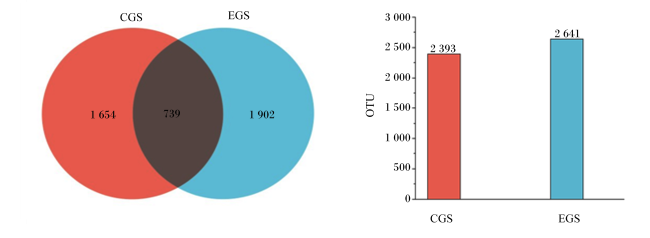
图1可知,2组共鉴别出4 295个操作分类单元(OTU),对照组有2 393个,试验组有2 641个,其中2组共有的OTU有739个。
图1 操作分类单元分布韦恩图和柱状图

CGS:对照组 control group; EG:试验组experimental group。下同图 the same as below。

Fig.1 Venn graph and bar graph of OTU distribution

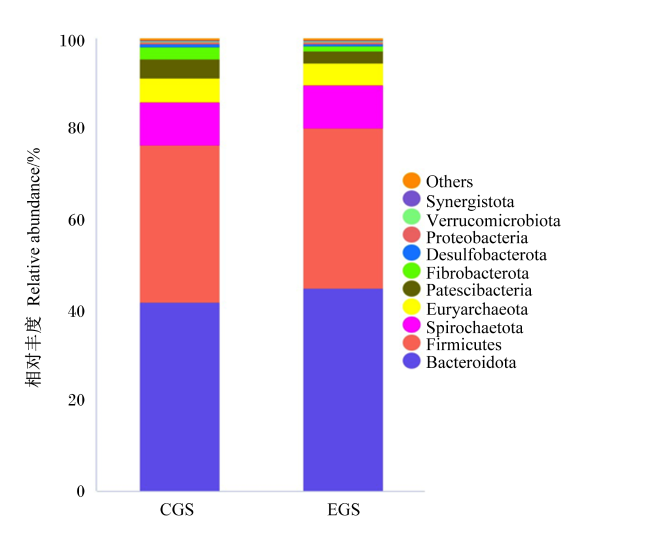
图2可知,绵羊瘤胃细菌门水平中优势菌门是拟杆菌门、厚壁菌门和螺旋菌门。添加屎肠球菌F11.1G菌剂后,对瘤胃细菌门水平总体影响均不显著(P>0.05),但拟杆菌门、厚壁菌门、纤维菌门相对丰度均有所增加。
图2 屎肠球菌F11.1G菌剂对断奶羔羊瘤胃细菌门水平组成的影响

Bacteroidota:拟杆菌门;Firmicutes:厚壁菌门;Spirochaetota:螺旋菌门;Euryarchaeota:真古菌门;Patescibacteria:帕特斯细菌门;Fibrobacterota:纤维菌门;Desulfobacterota:硫还原菌门;Proteobacteria:变形菌门;Verrucomicrobiota:疣微菌门;Synergistota:互养菌门;Others:其他。

Fig.2 Effects of Enterococcus faecium F11.1G on composition of rumen bacteria at phylum level of weaned lambs

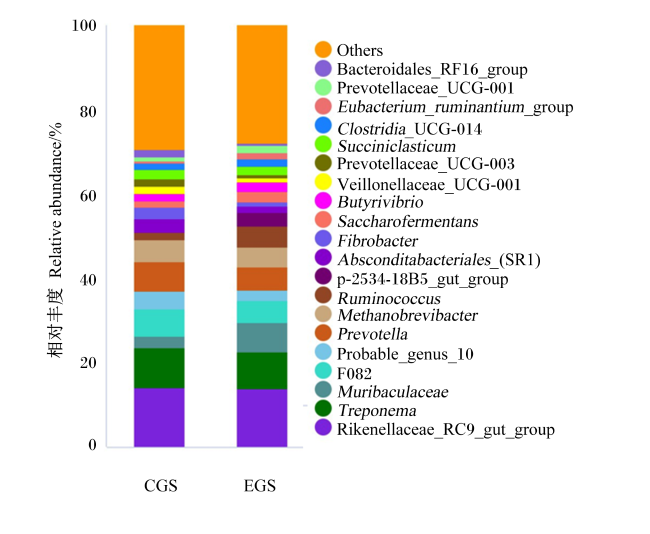
图3可知,绵羊瘤胃细菌属水平中优势菌属有理研菌科_RC9_肠道群、密螺旋体属、Muribaculaceae、F082、Probable_genus_1和普雷沃氏菌属,添加屎肠球菌F11.1G菌剂后,对瘤胃细菌属水平总体影响不显著(P>0.05),但密螺旋体属、Muribaculaceae和瘤胃球菌属相对丰度均有所增加,并且试验组羊只中出现了p-2534-18B5_gut_group。
图3 屎肠球菌F11.1G菌剂对断奶羔羊瘤胃细菌属水平组成的影响

Rikenellaceae_RC9_gut_group:理研菌科_RC9_肠道群;Treponema:密螺旋体属;Prevotella:普雷沃氏菌属;Methanobrevibacter:甲烷短杆菌属;Ruminococcus:瘤胃球菌属;Fibrobacter:纤维杆菌属;Saccharofermentans:产酸糖酵菌属;Butyrivibrio:丁酸弧菌属;Veillonellaceae_UCG-001:韦荣球菌科_UCG-001;Prevotellaceae_UCG-003:普雷沃氏菌科_UCG-003;Succiniclasticum:琥珀菌属;Clostridia_UCG-014:梭菌属_UCG-014;Eubacterium_ruminantium_group:反刍真杆菌群;Prevotellaceae_UCG-001:普雷沃氏菌科_UCG-001;Bacteroidales_RF16_group:拟杆菌目_RF16_群;Others:其他。

Fig.3 Effects of Enterococcus faecium F11.1G on composition of rumen bacteria at genus level of weaned lambs

2.6 瘤胃优势菌属相对丰度与ADG和瘤胃发酵参数相关性分析

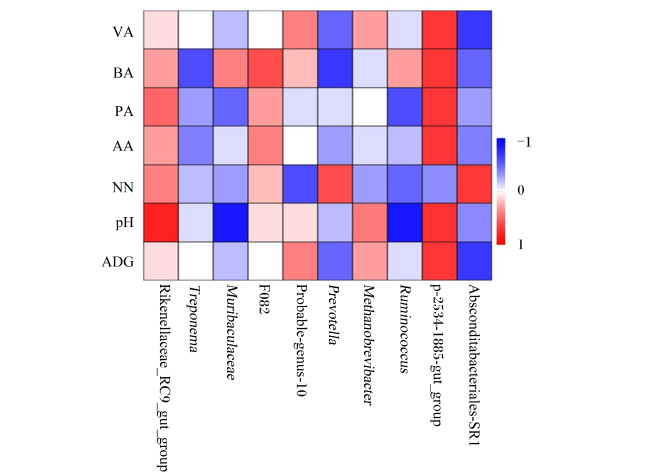
图4可知,瘤胃优势菌属相对丰度与ADG和瘤胃发酵参数呈现相关性。p-2534-18B5_gut_group相对丰度除了与NH3-N浓度呈负相关外,和ADG及乙酸、丙酸、丁酸、戊酸浓度呈正相关,F082相对丰度和NH3-N、乙酸、丙酸和丁酸浓度呈正相关,普雷沃氏菌属相对丰度和乙酸、丁酸浓度呈负相关。
图4 瘤胃优势菌属相对丰度与ADG和瘤胃发酵参数相关性分析

ADG:平均日增重 average daily gain;NN:氨态氮 ammoniacal nitrogen;AA:乙酸 acetate; PA:丙酸 propionate;BA:丁酸 butyrate;VA:戊酸 pentanoate;Rikenellaceae_RC9_gut_group:理研菌科_RC9_肠道群;Treponema:密螺旋体属;Prevotella:普雷沃氏菌属;Methanobrevibacter:甲烷短杆菌属;Ruminococcus:瘤胃球菌属。

Fig.4 Correlation analysis of ADG and rumen fermentation parameters with relative abundance of rumen dominant bacterial genera

3 讨论

3.1 屎肠球菌F11.1G菌剂对断奶羔羊生长性能和营养物质表观消化率的影响

家畜生长性能的高低直接影响养殖者的经济效益[22]。Khattab等[23]研究表明,给羔羊饲喂2.0 g枯草芽孢杆菌(1.0×10¹¹ CFU/kg)和干酪乳杆菌(1×1010 CFU/kg),可显著提高日增重以及饲料转化效率。白天天等[10]在绵羊饲粮中添加1011 CFU/(d·只)屎肠球菌F11.1G,绵羊的ADG从71.24 g/d提高至81.33 g/d,本研究试验组ADG显著升高,与上述结果一致,试验组ADFI显著提高,这可能是促进ADG提高的主要原因。另外,瘤胃中纤维降解菌群丰度增加,ADF表观消化率显著升高,也会影响羔羊的ADG,与Salazar等[24]在奶牛饲粮中添加70 mg/kg屎肠球菌PROB得到类似结果。F/G的大小反映饲料利用效率的高低[25]。研究发现,益生菌能通过调节肠道菌群降低F/G[26-27],本研究试验组F/G极显著低于对照组,可能与瘤胃中纤维降解相关菌群丰度增加具有一定相关性,这与Saleem等[28]在羔羊饲粮中添加地衣芽孢杆菌、枯草芽孢杆菌和植物乳杆菌的复合菌结果一致。
研究发现,屎肠球菌能够产生纤维素酶和羧化酶等,加快纤维素和多糖的分解,提高饲料的利用率[29-30]。本研究试验组的ADF表观消化率显著升高,与瘤胃纤维降解有关菌群丰度升高具有一定相关性,白天天等[10]在绵羊饲粮中添加屎肠球菌也得到类似结果。本试验添加屎肠球菌F11.1G菌剂后CP的表观消化率由65.56%提高到67.01%,但差异不显著,与此结果不同的是,Zhang等[31]在育肥猪饲粮中补充屎肠杆菌DSM7134显著提高了CP的消化率,这可能与动物消化道结构不同导致的蛋白质消化代谢差异有关。综上所述,在饲粮中添加屎肠球菌F11.1G菌剂,能增加断奶羔羊的采食量,通过提高瘤胃中纤维降解菌丰度,提高ADF表观消化率和羔羊的ADG,从而提高饲料报酬。

3.2 屎肠球菌F11.1G菌剂对断奶羔羊屠宰性能的影响

胴体重是评估肉类生产性能的指标,本试验中试验组宰前活重和胴体重均显著高于对照组。Lan等[32]在育肥鸡上饲喂屎肠球菌(SLB 120),发现从第21天到第35天,育肥鸡体重呈线性增加,屎肠球菌对断奶羔羊和育肥鸡增重的影响表现出一致的结果,原因可能是断奶羔羊的瘤胃功能尚未健全,对营养物质的消化机制与单胃动物相似。屠宰率、眼肌面积、背膘厚度和GR值是衡量家畜生长性能的参数[33-34]。本试验饲喂屎肠球菌F11.1G菌剂对断奶羔羊的屠宰率、背膘厚度、眼肌面积和GR值无显著影响,与刘俊斌等[35]在湖羊饲粮中添加枯草芽孢杆菌结果一致。结合本试验瘤胃指数、小肠指数和大肠指数,推测试验组屠宰率低于对照组的原因可能是屎肠球菌F11.1G菌剂对胃肠道发育的影响高于对胴体重的影响。综上所述,屎肠球菌F11.1G菌剂通过影响断奶羔羊的采食量、营养物质表观消化率及瘤胃VFA的产生,促进宰前活重和胴体重的增长。

3.3 屎肠球菌F11.1G菌剂对断奶羔羊器官发育的影响

本试验添加屎肠球菌F11.1G菌剂后,肝脏指数显著高于对照组,推测屎肠球菌F11.1G菌剂有可能通过调节肠道菌群,经肠肝轴作用于肝脏[36]。此外,也有研究表明,益生菌参与肠道营养物质的代谢,产生短链脂肪酸(SCFAs),可促进肝细胞的生长[37],本试验中瘤胃菌群结构改变和乙酸、丁酸浓度的增加,都可能是促进肝脏发育的原因。试验组和对照组心脏指数、脾脏指数、肺脏指数、胰脏指数、肾脏指数均未出现显著差异,与孙康等[38]在7~28日龄羔羊代乳粉中添加枯草芽孢杆菌的结果相同。
反刍动物复胃发育最直观的表现是胃室质量增加,其中瘤胃的发育是反刍动物成年后发挥生产性能的基础。本试验中,试验组瘤胃指数极显著高于对照组,这是因为屎肠球菌有助于瘤胃微生物的生长,尤其是纤维降解相关菌群,促进瘤胃中纤维降解产生VFA,增加反刍动物的能量供应。肠道参与消化吸收,储备肠道长度是肠道功能是否良好的决定因素[39]。试验组小肠指数和大肠指数均显著升高,其可能的原因是肠道菌群和肠道发酵模式发生变化,增加肠道能量等的供应。本试验中,试验组皱胃指数显著降低,可能与皱胃的发育时间在胃肠道的发育中较早有关,并且在本试验中添加屎肠球菌后对羔羊ADG的影响大于对皱胃增重的影响,因此皱胃指数降低。以上结果表明,屎肠球菌F11.1G菌剂能改善瘤胃微生物菌群结构和瘤胃发酵,进而促进断奶羔羊肝脏、瘤胃、小肠和大肠的发育。

3.4 屎肠球菌F11.1G菌剂对羔羊瘤胃发酵的影响

反刍动物主要依赖瘤胃发酵获取营养物质,瘤胃pH的高低影响瘤胃发酵效率和发酵模式,反映瘤胃内部环境和健康状况以及发酵程度。正常瘤胃pH为5.5~7.0[40],研究发现,瘤胃pH为6.2~7.0时,纤维降解相关菌群丰度较高[41],本试验添加屎肠球菌F11.1G菌剂,羔羊瘤胃pH由6.66降低至6.55,可能与瘤胃中乙酸的产生有关。Wang等[42]给荷斯坦奶牛犊牛提供复合益生菌(108 CFU/g植物乳杆菌、108 CFU/g乳酸片球菌、108 CFU/g戊糖片球菌和107 CFU/g枯草芽孢杆菌)和Zhang等[43]给奶牛提供枯草芽孢杆菌和植物乳杆菌,均对瘤胃液pH没有显著影响,与本试验结果一致。NH3-N是反刍动物的蛋白质合成和能量代谢过程中的中间产物[44],对于反刍动物的消化和营养摄取具有重要影响,NH3-N浓度过高可能会导致微生物群落失衡,对动物的健康产生不利影响,NH3-N浓度过低则会限制微生物的生长和代谢活动,影响反刍动物对于纤维素的消化能力。Wang等[42]给荷斯坦奶牛犊牛提供复合益生菌对瘤胃NH3-N浓度无显著影响。Pang等[45]通过体外发酵试验发现,添加屎肠球菌不会影响NH3-N浓度。本试验中,添加屎肠球菌F11.1G菌剂对NH3-N浓度没有显著影响,与以上研究结果一致。
VFA是微生物降解饲料的终产物,也是反刍动物能量的重要来源[46]。其中乙酸是长链脂肪酸合成的前体[47],丁酸有助于提高营养物质的吸收效率[48]。本试验添加屎肠球菌F11.1G菌剂对戊酸、总VFA浓度无显著影响,丁酸浓度显著升高,这是由于添加屎肠球菌F11.1G菌剂提高ADFI,增加了发酵底物,促进VFA的产生,与Zhu等[49]在奶牛的饲粮中添加酵母的结果一致。另外,本试验试验组乙酸浓度显著升高,与Al Ibrahim等[50]在奶牛饲粮中补充酵母后结果类似,但与Wang等[42]在荷斯坦犊牛中添加复合益生菌的研究呈现不同结果,我们猜测出现这种差异的原因可能与菌剂的种类、添加量和动物本身的差异有关。

3.5 屎肠球菌F11.1G菌剂对羔羊瘤胃微生物区系的影响

瘤胃作为反刍动物重要的消化器官,瘤胃中微生物的丰度及组成结构直接影响反刍动物对饲粮中营养物质的消化、吸收和利用,菌群结构的稳定对维持动物健康和提高生长性能意义重大。本试验中,试验组Chao1指数、Shannon指数和Simpson指数均高于对照组,此外,试验组OTU数量是2 641个,高于对照组的2 393个,以上结果均说明添加屎肠球菌能够提高瘤胃菌群丰度和多样性,与Mallo等[51]在仔猪饲粮中添加106 CFU/g屎肠球菌CECT 4515得到相似结果。
以往研究发现,厚壁菌门、拟杆菌门是羊瘤胃中丰度最高的2个菌门[52],它们共同作用以维持微生物群落的平衡。Fujisaka等[53]研究发现,厚壁菌门和拟杆菌门占总数的70%~90%,本试验中,厚壁菌门和拟杆菌门的相对丰度共占总细菌的75%左右,和上述报道一致。并且本试验添加屎肠球菌F11.1G菌剂后,拟杆菌门、厚壁菌门相对丰度均有所增加。此外,纤维菌门相对丰度增加,其能够促进瘤胃中纤维素的降解,这和本试验ADF表观消化率的提高具有一定的相关性。
普雷沃氏菌属、丁酸弧菌属和瘤胃球菌属的成员均属于纤维半纤维素降解优势菌种,因为它们包含更广的纤维相关酶谱,从而使其消化更多可用纤维[54-55]。本试验添加屎肠球菌F11.1G菌剂后,普雷沃氏菌属,密螺旋体属、Muribaculaceae、瘤胃球菌属、纤维杆菌属丰度有所增加,其中密螺旋体属、瘤胃球菌属、纤维杆菌属都是参与纤维素降解的重要菌属,能够将纤维素分解为可被瘤胃中其他菌群利用的简单糖类,并产生SCFAs,Muribaculaceae是健康个体中的主要微生物群,其通过发酵底物产生乙酸[56],此外,我们在试验组羊只中发现了p-2534-18B5_gut_group,属拟杆菌门,也和SCFAs的产生有关[57],以上报道与本试验添加屎肠球菌F11.1G菌剂提高了ADF表观消化率和乙酸、丁酸浓度的结果一致。

3.6 瘤胃优势菌属与ADG和瘤胃发酵参数相关性分析

瘤胃是一个复杂的生态系统,瘤胃菌群通常与瘤胃挥发性脂肪酸密切相关,微生物通过发酵产生SCFA等小分子物质被瘤胃吸收,促进瘤胃发育[52]。试验组羊只中出现的p-2534-18B5_gut_group除了与NH3-N浓度呈负相关外,和其余指标均呈正相关,试验组瘤胃中乙酸和丁酸浓度升高,增加瘤胃对营养物质的吸收,因此ADG增加,与Wang等[57]研究结果一致。F082相对丰度和NH3-N、乙酸、戊酸和丁酸浓度呈正相关,本试验中,试验组的F082相对丰度升高,这可能也是引起乙酸和丁酸浓度升高的原因。本试验中,普雷沃氏菌属相对丰度和乙酸、丁酸浓度呈负相关,普雷沃氏菌相对丰度降低,因此乙酸和丁酸浓度升高。然而,关于这些菌种对瘤胃发酵和生长性能具体的影响机制仍需要进一步研究。

4 结论

每只羊每天在基础饲粮中添加2.0 g屎肠球菌F11.1G菌剂可以提高断奶羔羊生长性能、ADF表观消化率,通过增加瘤胃中乙酸和丁酸浓度改善瘤胃发酵,提高瘤胃细菌OTU数目,增加瘤胃细菌门水平中拟杆菌门、厚壁菌门和纤维菌门相对丰度,并且理研菌科_RC9_肠道群相对丰度与ADG和瘤胃发酵参数呈正相关。
[1]
佚名. 中华人民共和国农业农村部公告第194号[J]. 浙江畜牧兽医, 2020(1):28.

Anon. Announcement No.194 of the Ministry of Agriculture and Rural Affairs of the People’s Republic of China[J]. Zhejiang Journal Animal Science and Veterinary Medicine, 2020(1):28. (in Chinese)

[2]
YAN F, POLK D B. Probiotics and probiotic-derived functional factors-mechanistic insights into applications for intestinal homeostasis[J]. Frontiers in Immunology, 2020, 11:1428.

DOI PMID

[3]
AL-SHAWI S G, DANG D S, YOUSIF A Y, et al. The potential use of probiotics to improve animal health,efficiency,and meat quality:a review[J]. Agriculture, 2020, 10(10):452.

[4]
KULKARNI N A, CHETHAN H S, SRIVASTAVA R, et al. Role of probiotics in ruminant nutrition as natural modulators of health and productivity of animals in tropical countries:an overview[J]. Tropical Animal Health and Production, 2022, 54(2):110.

[5]
REUBEN R C, ELGHANDOUR M M M Y, ALQAISI O, et al. Influence of microbial probiotics on ruminant health and nutrition:sources,mode of action and implications[J]. Journal of the Science of Food and Agriculture, 2022, 102(4):1319-1340.

[6]
LIU Z L, CHEN Y J, MENG Q L, et al. Progress in the application of Enterococcus faecium in animal husbandry[J]. Frontiers in Cellular and Infection Microbiology, 2023, 13:1168189.

[7]
胡良宇, 袁霞, 王梦芝, 等. 屎肠球菌制剂对泌乳中期奶牛泌乳性能和乳体细胞分类的影响[J]. 饲料工业, 2017, 38(9):55-60.

HU L Y, YUAN X, WANG M Z, et al. Effects of Enterococcus faecium preparation on lactation performance and classification of milk somatic cells in mid-lactation dairy cows[J]. Feed Industry, 2017, 38(9):55-60. (in Chinese)

[8]
NOCEK J E, KAUTZ W P, LEEDLE J A Z, et al. Direct-fed microbial supplementation on the performance of dairy cattle during the transition period[J]. Journal of Dairy Science, 2003, 86(1):331-335.

PMID

[9]
白天天, 崔浩然, 蒋辰宇, 等. 体外产气法比较不同活力屎肠球菌对绵羊瘤胃体外发酵的影响[J]. 动物营养学报, 2021, 33(11):6483-6491.

DOI

BAI T T, CUI H R, JIANG C Y, et al. Comparison of effects of Enterococcus faecium with different activities on rumen in vitro fermentation in sheep using in vitro gas production method[J]. Chinese Journal of Animal Nutrition, 2021, 33(11):6483-6491. (in Chinese)

[10]
白天天, 崔浩然, 赵林波, 等. 添加屎肠球菌、枯草芽孢杆菌及其复合菌对绵羊生长性能、养分表观消化率、瘤胃发酵指标和瘤胃微生物区系的影响[J]. 动物营养学报, 2022, 34(8):5190-5205.

DOI

BAI T T, CUI H R, ZHAO L B, et al. Effects of adding enterococcus faecalis,Bacillus subtilis and their compound bacteria on growth performance,nutrient apparent digestibility,rumen fermentation indexes and rumen microflora of sheep[J]. Chinese Journal of Animal Nutrition, 2022, 34(8):5190-5205. (in Chinese)

[11]
中华人民共和国国家质量监督检验检疫总局, 中国国家标准化管理委员会. 饲料中水分的测定:GB/T 6435—2014[S]. 北京: 中国标准出版社, 2015.

General Administration of Quality Supervision,Inspection and Quarantine of the People’s Republic of China, Standardization Administration of the People’s Republic of China. Determination of moisture in feedstuffs:GB/T 6435—2014[S]. Beijing: Standards Press of China, 2015. (in Chinese)

[12]
国家市场监督管理总局, 中国国家标准化管理委员会. 饲料中粗蛋白的测定凯氏定氮法:GB/T 6432—2018[S]. 北京: 中国标准出版社, 2018.

State Administration for Market Regulation, Standardization Administration of the People’s Republic of China. Determination of crude protein in feeds-Kjeldahl method:GB/T 6432—2018[S]. Beijing: Standards Press of China, 2018. (in Chinese)

[13]
中华人民共和国国家质量监督检验检疫总局, 中国国家标准化管理委员会. 饲料中粗脂肪的测定:GB/T 6433—2006[S]. 北京: 中国标准出版社, 2006.

General Administration of Quality Supervision,Inspection and Quarantine of the People’s Republic of China, Standardization Administration of the People’s Republic of China. Determinaiion of crude fat in feeds:GB/T 6433—2006[S]. Beijing: Standards Press of China, 2006. (in Chinese)

[14]
VAN SOEST P J, ROBERTSON J B, LEWIS B A. Methods for dietary fiber,neutral detergent fiber,and nonstarch polysaccharides in relation to animal nutrition[J]. Journal of Dairy Science, 1991, 74(10):3583-3597.

[15]
LEE C, HRISTOV A N. Short communication:evaluation of acid-insoluble ash and indigestible neutral detergent fiber as total-tract digestibility markers in dairy cows fed corn silage-based diets[J]. Journal of Dairy Science, 2013, 96(8):5295-5299.

[16]
SUZUKI K, KADOWAKI H, SHIBATA T, et al. Selection for daily gain,loin-eye area,backfat thickness and intramuscular fat based on desired gains over seven generations of Duroc pigs[J]. Livestock Production Science, 2005, 97(2/3):193-202.

[17]
SUN S A, LI B, WU M M, et al. Effect of dietary supplemental vitamin C and betaine on the growth performance,humoral immunity,immune organ index,and antioxidant status of broilers under heat stress[J]. Tropical Animal Health and Production, 2023, 55(2):96.

[18]
冯宗慈, 高民. 通过比色测定瘤胃液氨氮含量方法的改进[J]. 畜牧与饲料科学, 2010(6):37.

FENG Z C, GAO M. Improvement of colorimetric method for determination of ammonia nitrogen in rumen fluid[J]. Animal Husbandry and Feed Science, 2010, 31(6):37. (in Chinese)

[19]
苏利红, 曹雨莉, 李飞, 等. 高效液相色谱测定山羊瘤胃液挥发性脂肪酸条件优化的研究[J]. 动物医学进展, 2013, 34(8):61-65.

SU L H, CAO Y L, LI F, et al. Optimizing condition of high performance liquid chromatography for detecting volatile fatty acids in goat rumen fluid[J]. Progress in Veterinary Medicine, 2013, 34(8):61-65. (in Chinese)

[20]
MAGOČ T, SALZBERG S L. FLASH:fast length adjustment of short reads to improve genome assemblies[J]. Bioinformatics,2011,27(21):2957-2963.

[21]
EDGAR R C, HAAS B J, CLEMENTE J C, et al. UCHIME improves sensitivity and speed of chimera detection[J]. Bioinformatics, 2011, 27(16):2194-2200.

DOI PMID

[22]
FRIZZO L S, ZBRUN M V, SOTO L P, et al. Effects of probiotics on growth performance in young calves:a Meta-analysis of randomized controlled trials[J]. Animal Feed Science and Technology, 2011, 169(3/4):147-156.

[23]
KHATTAB I M, ABDEL-WAHED A M, KHATTAB A S, et al. Effect of dietary probiotics supplementation on intake and production performance of ewes fed Atriplex hay-based diet[J]. Livestock Science, 2020, 237:104065.

[24]
SALAZAR L F L, NERO L A, CAMPOS-GALVÃO M E M, et al. Effect of selected feed additives to improve growth and health of dairy calves[J]. PLoS One, 2019, 14(5):e0216066.

[25]
KENNY D A, FITZSIMONS C, WATERS S M, et al. Invited review:improving feed efficiency of beef cattle-the current state of the art and future challenges[J]. Animal, 2018, 12(9):1815-1826.

[26]
DAVISON C, MICHIE C, TACHTATZIS C, et al. Feed conversion ratio (FCR) and performance group estimation based on predicted feed intake for the optimisation of beef production[J]. Sensors, 2023, 23(10):4621.

[27]
HE Y, LIU X, DONG Y Y, et al. Enterococcus faecium PNC01 isolated from the intestinal mucosa of chicken as an alternative for antibiotics to reduce feed conversion rate in broiler chickens[J]. Microbial Cell Factories, 2021, 20(1):122.

[28]
SALEEM A M, ZANOUNY A I, SINGER A M. Growth performance,nutrients digestibility,and blood metabolites of lambs fed diets supplemented with probiotics during pre-and post-weaning period[J]. Asian-Australasian Journal of Animal Sciences, 2017, 30(4):523-530.

[29]
SHAO X F, XU B C, CHEN C G, et al. The function and mechanism of lactic acid bacteria in the reduction of toxic substances in food:a review[J]. Critical Reviews in Food Science and Nutrition, 2022, 62(21):5950-5963.

[30]
ZHAO J, SHAO T, CHEN S, et al. Characterization and identification of cellulase-producing Enterococcus species isolated from Tibetan yak (Bos grunniens) rumen and their application in various forage silages[J]. Journal of Applied Microbiology, 2021, 131(3):1102-1112.

[31]
ZHANG Z F, KIM I H. Effects of Enterococcus faecium DSM 7134 supplementation in different energy and crude protein density diets on ileal amino acid digestibility and intestinal shedding of lactobacilli and Escherichia coli in finishing pigs[J]. Animal Feed Science and Technology, 2015, 201:115-119.

[32]
LAN R X, LEE S I, KIM I H. Effects of Enterococcus faecium SLB 120 on growth performance,blood parameters,relative organ weight,breast muscle meat quality,excreta microbiota shedding,and noxious gas emission in broilers[J]. Poultry Science, 2017, 96(9):3246-3253.

[33]
WEN C L, YAN W, ZHENG J X, et al. Feed efficiency measures and their relationships with production and meat quality traits in slower growing broilers[J]. Poultry Science, 2018, 97(7):2356-2364.

DOI PMID

[34]
WANG H Y, WANG X Y, YAN D W, et al. Genome-wide association study identifying genetic variants associated with carcass backfat thickness,lean percentage and fat percentage in a four-way crossbred pig population using SLAF-seq technology[J]. BMC Genomics, 2022, 23(1):594.

[35]
刘俊斌, 宋淑珍, 张利平. 枯草芽孢杆菌对断奶湖羊生长性能、屠宰性能和肉品质的影响[J]. 动物营养学报, 2022, 34(5):3096-3106.

DOI

LIU J B, SONG S Z, ZHANG L P. Effects of Bacillus subtilis on growth performance,slaughter performance and meat quality of weaned Hu sheep[J]. Chinese Journal of Animal Nutrition, 2022, 34(5):3096-3106. (in Chinese)

[36]
ZHENG A J, LUO J J, MENG K, et al. Probiotic (Enterococcus faecium) induced responses of the hepatic proteome improves metabolic efficiency of broiler chickens (Gallus gallus)[J]. BMC Genomics, 2016, 17:89.

DOI PMID

[37]
MARKOWIAK-KOPEĆ P, ŚLIŻEWSKA K. The effect of probiotics on the production of short-chain fatty acids by human intestinal microbiome[J]. Nutrients,2020,12(4):1107.

[38]
孙康, 刘绘汇, 范慧玉, 等. 枯草芽孢杆菌对7-28日龄羔羊生长和器官发育及肌肉脂肪酸的影响[J]. 畜牧兽医学报, 2021, 52(9):2510-2521.

SUN K, LIU H H, FAN H Y, et al. Effects of Bacillus subtilis on growth performance,organs development and muscle fatty acids in 7-28 days old lambs[J]. Acta Veterinaria et Zootechnica Sinica, 2021, 52(9):2510-2521. (in Chinese)

[39]
WEAVER L T, AUSTIN S, COLE T J. Small intestinal length:a factor essential for gut adaptation[J]. Gut, 1991, 32(11):1321-1323.

[40]
JASMIN B H, BOSTON R C, MODESTO R B, et al. Perioperative ruminal pH changes in domestic sheep (Ovis aries) housed in a biomedical research setting[J]. Journal of the American Association for Laboratory Animal Science, 2011, 50(1):27-32.

PMID

[41]
薛丰, 王洪荣, 刘大程, 等. 瘤胃微生物区系的研究进展[J]. 畜牧与饲料科学, 2007, 28(2):31-33.

XUE F, WANG H R, LIU D C, et al. Advances of the rumen microbial ecosystem[J]. Animal Husbandry and Feed Science, 2007, 28(2):31-33. (in Chinese)

[42]
WANG H B, YU Z T, GAO Z B, et al. Effects of compound probiotics on growth performance,rumen fermentation,blood parameters,and health status of neonatal Holstein calves[J]. Journal of Dairy Science, 2022, 105(3):2190-2200.

[43]
ZHANG R, ZHOU M, TU Y, et al. Effect of oral administration of probiotics on growth performance,apparent nutrient digestibility and stress-related indicators in Holstein calves[J]. Journal of Animal Physiology and Animal Nutrition, 2016, 100(1):33-38.

[44]
FIRKINS J L, YU Z, MORRISON M. Ruminal nitrogen metabolism:perspectives for integration of microbiology and nutrition for dairy[J]. Journal of Dairy Science, 2007,90 (Suppl.1):E1-16.

[45]
PANG D G, YANG H J, CAO B B, et al. The beneficial effect of Enterococcus faecium on the in vitro ruminal fermentation rate and extent of three typical total mixed rations in northern China[J]. Livestock Science, 2014, 167:154-160.

[46]
LIU Q, WANG C, GUO G, et al. Effects of branched-chain volatile fatty acids supplementation on growth performance,ruminal fermentation,nutrient digestibility,hepatic lipid content and gene expression of dairy calves[J]. Animal Feed Science and Technology, 2018, 237:27-34.

[47]
LI M, ZHANG X J, AGRAWAL A, et al. Effect of acetate formation pathway and long chain fatty acid CoA-ligase on the free fatty acid production in E.coli expressing acy-ACP thioesterase from Ricinus communis[J]. Metabolic Engineering, 2012, 14(4):380-387.

[48]
LAARMAN A H, RUIZ-SANCHEZ A L, SUGINO T, et al. Effects of feeding a calf starter on molecular adaptations in the ruminal epithelium and liver of Holstein dairy calves[J]. Journal of Dairy Science, 2012, 95(5):2585-2594.

DOI PMID

[49]
ZHU W, WEI Z H, XU N N, et al. Effects of Saccharomyces cerevisiae fermentation products on performance and rumen fermentation and microbiota in dairy cows fed a diet containing low quality forage[J]. Journal of Animal Science and Biotechnology, 2017, 8:36.

[50]
AL IBRAHIM R M, KELLY A K, O’GRADY L, et al. The effect of body condition score at calving and supplementation with Saccharomyces cerevisiae on milk production,metabolic status,and rumen fermentation of dairy cows in early lactation[J]. Journal of Dairy Science, 2010, 93(11):5318-5328.

[51]
MALLO J J, RIOPEREZ J, HONRUBIA P. The addition of Enterococcus faecium to diet improves piglet’s intestinal microbiota and performance[J]. Livestock Science, 2010, 133(1/2/3):176-178.

[52]
ZHANG Y K, ZHANG X X, LI F D, et al. Characterization of the rumen microbiota and its relationship with residual feed intake in sheep[J]. Animal, 2021, 15(3):100161.

[53]
FUJISAKA S, WATANABE Y, TOBE K. The gut microbiome:a core regulator of metabolism[J]. The Journal of Endocrinology, 2023, 256(3):e220111.

[54]
EMERSON E L, WEIMER P J. Fermentation of model hemicelluloses by Prevotella strains and Butyrivibrio fibrisolvens in pure culture and in ruminal enrichment cultures[J]. Applied Microbiology and Biotechnology, 2017, 101(10):4269-4278.

[55]
TAKIZAWA S, ASANO R, FUKUDA Y, et al. Shifts in xylanases and the microbial community associated with xylan biodegradation during treatment with rumen fluid[J]. Microbial Biotechnology, 2022, 15(6):1729-1743.

[56]
FONDEVILA M, DEHORITY B A. Interactions between Fibrobacter succinogenes,Prevotella ruminicola,and Ruminococcus flavefaciens in the digestion of cellulose from forages[J]. Journal of Animal Science, 1996, 74(3):678-684.

[57]
WANG Z J, CHEN Y F, WANG W H, et al. Dietary supplementation with fine-grinding wheat bran improves lipid metabolism and inflammatory response via modulating the gut microbiota structure in pregnant sow[J]. Frontiers in Microbiology, 2022, 13:835950.

Outlines

/