RESEARCH PAPER

Mechanism of Action of Milkvetch Root in Enhancing Anti-Oxidative Stress in Rabbits Based on Network Pharmacology and Molecular Docking Technology

  • BAO Huyang ,
  • BO Xinyu ,
  • LIU Jinyao ,
  • REN Zhanjun ,
  • DONG Xianggui ,
  • WANG Shuhui , *
Expand
  • College of Animal Science and Technology, Northwest A&F University, Yangling 712100, China
* associate professor, E-mail:

Received date: 2023-11-17

  Online published: 2024-05-15

Abstract

The network pharmacology and molecular docking technology was used to explore the material basis of milkvetch root in anti-oxidative stress of rabbits and its mechanism of action. The traditional Chinese medicine systems pharmacology database and analysis platform (TCMSP) and other databases were used to collect milkvetch root active ingredients and related targets, and disease-related databases were used for potential targets of oxidative stress. The protein-protein interaction (PPI) network was constructed, and the gene ontology (GO) function and Kyoto encyclopedia of genes and genomes (KEGG) pathway were enrichment analysis. Finally, the top 3 core targets were selected to verify the docking activity of the core targets with the corresponding components by molecular docking using Autodock software. The results showed that there were 20 main active components of milkvetch root in enhancing anti-oxidative stress in rabbits and 470 potential targets. Among them, kaempferol, 9,10-dimethoxypterostilbene-3-O-β-D-glucoside and astraisoflavan-7-O-β-D-glucoside were the key active components of milkvetch root to inhibit oxidative stress in rabbits. There were 69 core targets, and the targets with the top 10 degree values were albumin (ALB), epidermal growth factor receptor (EGFR), insulin (INS), cysteinyl aspartate-specific proteinase 3 (CASP3), estrogen receptor 1 (ESR1), proto-oncogene (JUN), proto-oncogene tyrosine-protein kinase (SRC), cyclin D2 (CCND2), cyclin-dependent kinase 4 (CDK4) and cyclin-dependent kinase 2 (CDK2). The GO function and KEGG pathway enrichment analysis showed that the target effects encompassed 62 biological processes, 15 cellular components and 39 molecular functions, and were involved in metabolic pathways such as cancer signaling pathway, phosphatidylinositol 3 kinase-protein kinase B signaling pathway, viral carcinogenesis, mitogen-activated protein kinases signaling pathway. The molecular docking results showed that the binding energies of the core targets and the corresponding milkvetch root components were all less than 0 kJ/mol, indicating spontaneous binding of milkvetch root to core targets. In conclusion, the study screens the main components and action targets of milkvetch root to improve the anti-oxidative stress ability of rabbits, and explores its molecular regulatory mechanism, which provides a reference basis for the application of milkvetch root as an antioxidant functional feed additive.

Cite this article

BAO Huyang , BO Xinyu , LIU Jinyao , REN Zhanjun , DONG Xianggui , WANG Shuhui . Mechanism of Action of Milkvetch Root in Enhancing Anti-Oxidative Stress in Rabbits Based on Network Pharmacology and Molecular Docking Technology[J]. Chinese Journal of Animal Nutrition, 2024 , 36(5) : 3247 -3261 . DOI: 10.12418/CJAN2024.278

近年来,我国和欧洲国家的家兔生产不断增长,以满足日益增长的多样化消费需求[1]。但家兔易惊,对环境极度敏感,在气温变化、饲料变换、转群等应激因素下比猪、禽更易产生氧化应激(oxidative stress,OS)。断奶仔兔采食饲粮后肠道负担加重,易发生断奶应激反应,引起腹泻等疾病;高温引起的应激导致成年家兔繁殖机能下降6%~10%,饲料转化率降低8%~15%,死亡率增加9%~12%,平均日增重减少20%~25%,并对肉质和胴体性状产生了负面影响[2-5]。因此,氧化应激对家兔养殖行业造成巨大经济损失,是制约产业可持续发展的重要因素。然而,目前在生产中应用较多的抗氧化剂具有双重作用,即低剂量使用抗氧化剂可捕获自由基,而高剂量使用抗氧化剂具有促氧化作用,盲目使用抗氧化剂会加重氧化应激损伤[6-7]。开发绿色环保、安全有效的饲料添加剂成为迫切需要。随着中草药深入研究开发,低毒性、高效性、多样性的天然抗氧化剂具有广阔前景[8-9]
传统中草药黄芪(Astragalus membranaceus)被誉为“补药之长”,味甘,微温;有补气升阳、生津养血等功效[10-11]。黄芪在我国栽培历史最早可追溯至1812年[12-13],已实现区域规模化种植。汉代《神农本草经》将其列为上品,现代药理学认为黄芪具有增强细胞功能、加速细胞再生、降低炎症因子表达、减轻氧化应激损伤、抑制癌细胞增殖等作用[14-15]。饲粮中添加黄芪多糖可提高断奶仔兔血清免疫球蛋白含量,修复肠道黏膜组织破损,发挥黏膜免疫作用[16],提高獭兔背最长肌干物质含量,改良肌肉脂肪酸组成[17]。Luo等[18]研究发现,黄芪显著抑制柔红霉素诱导小鼠心肌细胞活性氧自由基(reactive oxygen species,ROS)生成和乳酸脱氢酶释放,减少细胞凋亡。黄芪作为饲料添加剂可改善动物应激并提高生产性能,但黄芪作用于家兔氧化应激的物质基础及作用机制尚不清楚。
网络药理学基于多学科从系统角度的分子水平阐述作用机制[19]。网络药理学与分子对接方法为构建基于组分配伍的现代中药提供了理论基础和技术支撑,同时也加速了药效物质的明确和中药药效的阐释[20]。与中药多成分、多靶点、协同作用等特点吻合[21]。因此,本研究应用网络药理学和分子对接方法,构建关系网络并富集分析,探究黄芪抑制家兔氧化应激的潜在机制,为黄芪在家兔生产中进一步开发和应用提供参考。

1 材料与方法

1.1 黄芪主要活性成分筛选及潜在靶点预测

本研究通过中药系统药理学数据库(traditional Chinese medicine systems pharmacology database and analysis platform,TCMSP, https://old.tcmsp-e.com/tcmsp.php)以黄芪为关键词检索,筛选黄芪口服生物利用度(oral bioavailability,OB)≥30%、药物相似性(drug-likeness,DL)≥0.18[22]的活性成分。从TCMSP数据库中收集黄芪活性成分的.mol 2结构式及分子名称,将分子名称输入公共化学数据库PubChem(https://pubchem.ncbi.nlm.nih.gov/)获得Canonical SMILES格式的分子表达式,把.mol 2结构式及Canonical SMILES格式的分子表达式导入PharmMapper数据库(http://www.lilab-ecust.cn/pharmmapper/)和SwissTargetPredicion数据库(http://www.swisstargetprediction.ch/),分别以norm fit>0.9和top15[23]为阈值收集活性成分靶点,合并后去除重复值,利用UniProt数据库(https://www.uniprot.org/)规范潜在靶点名称。将黄芪主要成分及潜在靶点导入Cytoscape 3.8.2软件构建活性成分-潜在靶点网络。

1.2 家兔氧化应激靶点收集

以“oxidative stress”为关键词,分别在GeneCards数据库(https://www.genecards.org/)、OMIM数据库(https://www.omim.org/)和TTD数据库(https://db.idrblab.net/ttd/)中搜索相关靶点,合并后去除重复值。

1.3 蛋白质-蛋白质相互作用(protein-protein interaction,PPI)网络构建及关键靶点筛选

使用Venny 2.1(https://bioinfogp.cnb.csic.es/tools/venny/)将黄芪活性成分靶点和家兔氧化应激相关靶点取交集。交集靶点上传STRING数据库(https://cn.string-db.org/),选择物种为“Oryctolagus cuniculus”,置信区间>0.400,隐藏游离节点,导出相应数据至Cytoscape 3.8.2软件可视化处理。利用Cytoscape 3.8.2软件中Centiscape2.2插件对得到的PPI网络进行拓扑分析,以大于介数中心度(betweenness centrality)、紧密中心性(closeness centrality)及度值(degree value)参数计算结果为条件,筛选核心靶点。

1.4 构建黄芪-氧化应激-靶点网络

利用1.3中得到的核心靶点、交集靶点及相应黄芪活性成分导入Cytoscape 3.8.2软件,构建网络。

1.5 基因本体(GO)功能和京都基因与基因组百科全书(KEGG)通路富集分析

将黄芪与家兔氧化应激核心靶点导入DAVID数据库(https://david.ncifcrf.gov/),设置物种为“Oryctolagus cuniculus”,以P<0.05为条件,对结果进行筛选分析。

1.6 分子对接验证

将1.4中关键靶点以度值从高到低排列,选取度值最高的3个关键靶点及其对应黄芪活性成分进行分子对接。使用Pymol 2.6软件和Autodock 1.5.7软件处理从TCMSP数据库中获得黄芪活性成分化学结构,PDB数据库获得蛋白质晶体结构,计算结合能并利用Pymol 2.6软件对结果进行可视化处理。

2 结果

2.1 黄芪活性成分及潜在靶点筛选结果

从TCMSP数据库中检索黄芪获得87个活性成分。以OB≥30%和DL≥0.18为条件进一步检索获得20个活性成分(表1),主要包括黄酮类如山奈酚、毛蕊异黄酮、刺芒柄花、黄芪紫檀烷等,皂苷类如常春藤皂苷元。
表1 黄芪中20个活性成分信息

Table 1 Information of twenty active ingredients in milkvetch root

编号
No.
TCMSP数据库编号
TCMSP database No.
化合物名称
Chemical compound name
AM1 MOL000211 白桦脂酸Mairin
AM2 MOL000239 华良姜素Jaranol
AM3 MOL000296 常春藤皂苷元Hederagenin
AM4 MOL000033 (3S,8S,9S,10R,13R,14S,17R)-10,13-二甲基-17-[(2R,5S)-5-丙-2-基辛烷-
2-基]-2,3,4,7,8,9,11,12,14,15,16,17-十二氢-1H-环戊二烯[a]-3-羟基菲
(3S,8S,9S,10R,13R,14S,17R)-10,13-dimethyl-17-[(2R,5S)-5-propan-2-
yloctan-2-yl]-2,3,4,7,8,9,11,12,14,15,16,17-dodecahydro-1H-
cyclopenta[a]phenanthren-3-ol
AM5 MOL000354 异鼠李素Isorhamnetin
AM6 MOL000371 3,9-二-O-甲基尼森香豌豆紫檀酚3,9-di-O-methylnissolin
AM7 MOL000374 5'-羟基异微凸剑叶莎醇-2',5'-二-O-葡萄糖苷
5'-hydroxyiso-muronulatol-2',5'-di-O-glucoside
AM8 MOL000378 7-O-甲基异微凸剑叶莎醇7-O-methylisomucronulatol
AM9 MOL000379 9,10-二甲氧基紫檀-3-O-β-D-葡萄糖苷
9,10-dimethoxypterocarpan-3-O-β-D-glucoside
AM10 MOL000380 (6aR,11aR)-9,10-二甲氧基-6a,11a-二氢-6H-苯并吡喃
[3,2-c]-3-醇(6aR,11aR)-9,10-dimethoxy-6a,
11a-dihydro-6H-benzofurano[3,2-c]chromen-3-ol
AM11 MOL000387 联苯双酯Bifendate
AM12 MOL000392 刺芒柄花Formononetin
AM13 MOL000398 二氢异黄酮Isoflavanone
AM14 MOL000417 毛蕊异黄酮Calycosin
AM15 MOL000422 山奈酚Kaempferol
AM16 MOL000433 叶酸Folic acid
AM17 MOL000438 黄芪紫檀烷Astraisoflavan-7-O-β-D-glucoside
AM18 MOL000439 异微凸剑叶莎醇-7,2'-二-O-葡糖苷
Isomucronulatol-7,2'-di-O-glucosiole
AM19 MOL000442 1,7-二羟基-3,9-二甲氧基紫檀烯
1,7-dihydroxy-3,9-dimethoxy pterocarpan
AM20 MOL000098 槲皮素Quercetin

2.2 黄芪抑制家兔氧化应激靶点分析

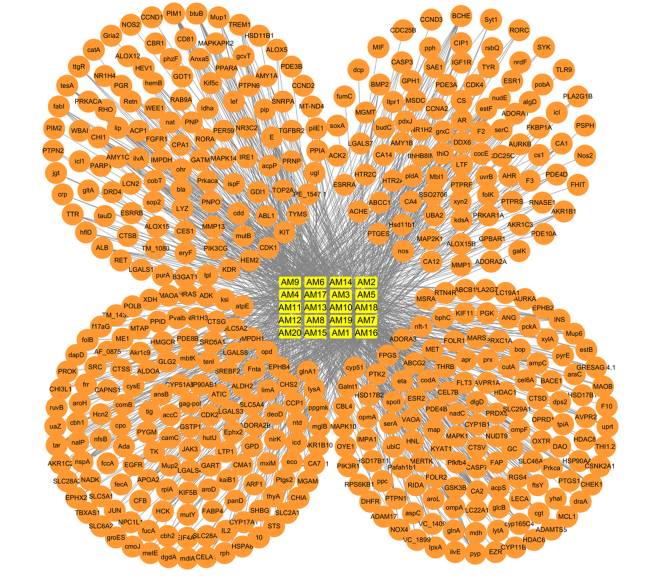
通过PharmMapper数据库和SwissTargetPredicion数据库分别得到黄芪活性成分靶点1 162、274个,经过UniProt数据库规范靶点名称,合并去除重复值后,得到相关靶点470个。使用Cytoscape 3.8.2软件构建活性成分-潜在靶点网络,共包含490个节点(20个活性成分,470个靶点),1 292条边,表明靶点与主要成分关联紧密。其中,7-O-甲基异微凸剑叶莎醇(度值149)、山奈酚(度值141)和黄芪紫檀烷(度值134)度值较高,对应靶点较多,可能为黄芪主要活性成分,结果见图1
图1 黄芪活性成分-潜在靶点网络图

仅列出靶点中度值排名前10的靶点名称 List only the top 10 target names in degree values ranking。CDK4:细胞周期蛋白依赖激酶4 cyclin-dependent kinase 4;CCND2:细胞周期素D2 cyclin D2;JUN:原癌基因 proto-oncogene;CASP3:半胱氨酸天冬氨酸蛋白酶3 cysteinyl aspartate-specific proteinase 3;EGFR:表皮生长因子受体 epidermal growth factor receptor;CDK2:细胞周期蛋白依赖激酶2 cyclin-dependent kinase 2;SRC:原癌酪氨酸蛋白激酶 proto-oncogene tyrosine-protein kinase;ESR1:雌激素受体1 estrogen receptor 1;INS:胰岛素 insulin;ALB:白蛋白 albumin。图3图4图5同 the same as Fig.3, Fig 4 and Fig.5

圆圈代表对应靶点;长方形对应黄芪活性成分。Circles represent the corresponding targets; rectangles represent the active ingredients of milkvetch root.

Fig.1 Network diagram of active ingredient-potential target of milkvetch root

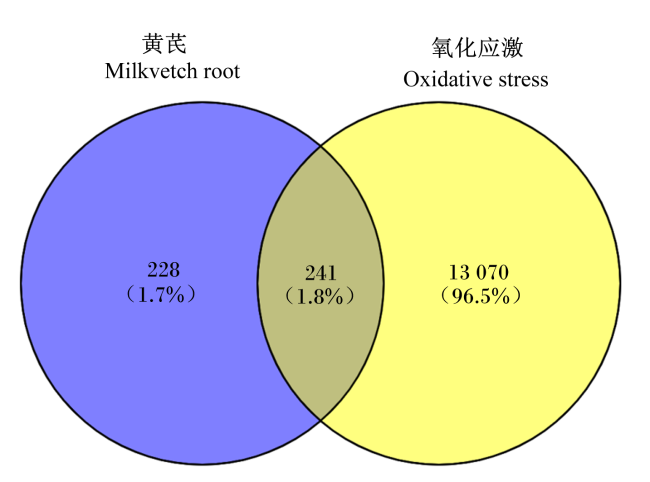
从GeneCards、OMIM和TTD数据库中获取氧化应激靶点分别为13 169、291和2个,合并数据并去除重复值得到氧化应激靶点共13 311个。将黄芪活性成分靶点和氧化应激靶点导入Venny2.1网站,获得交集靶点241个,并绘制韦恩图(图2)。
图2 家兔氧化应激靶点与黄芪活性成分靶点交集

Fig.2 Intersection of rabbit oxidative stress targets and milkvetch root active ingredient targets

2.3 PPI网络构建

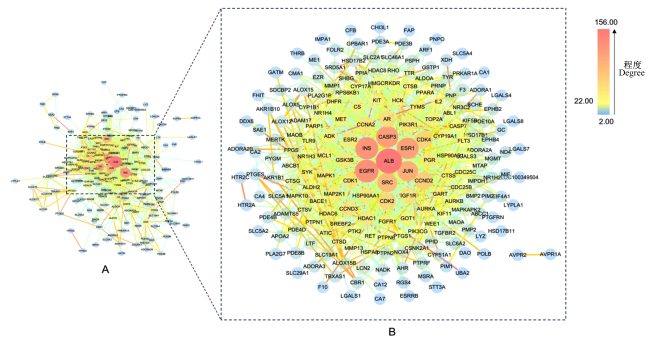
将241个交集靶点导入STRING数据库,获得黄芪作用于家兔氧化应激PPI的网络,隐藏游离节点后得到217个节点,1 039条边,平均节点度值为9.58,表明靶点编码蛋白质有复杂的相互作用。为更直观分析黄芪与家兔氧化应激的关系,导入Cytoscape 3.8.2软件进行可视化处理并分析,结果见图3
图3 黄芪作用于家兔氧化应激靶点的PPI网络图

A:PPI网络图;B:PPI网络图可视化。

Fig.3 PPI network diagram of milkvetch root acting on oxidative stress targets in rabbits

A: PPI network diagram; B: PPI network diagram visualization.

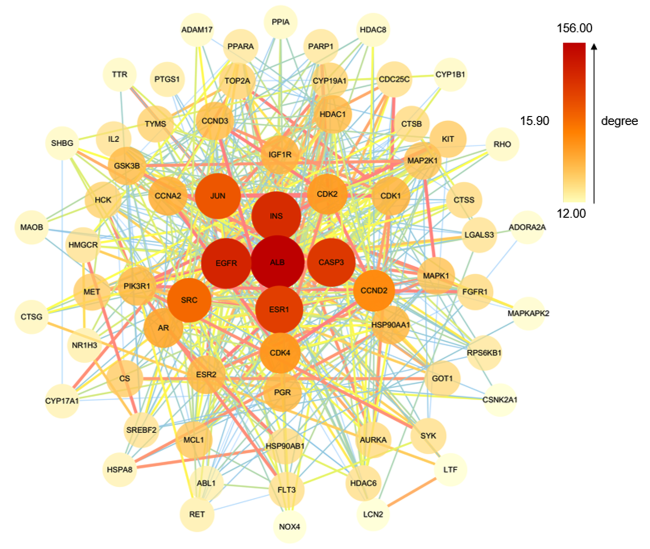
分析可知,靶点中度值排名前10的靶点为白蛋白(ALB)、表皮生长因子受体(EGFR)、胰岛素(INS)、半胱氨酸天冬氨酸蛋白酶-3(CASP3)、雌激素受体1(ESR1)、原癌基因(JUN)、原癌酪氨酸蛋白激酶(SRC)、细胞周期素D2(CCND2)、细胞周期蛋白依赖激酶4(CDK4)和细胞周期蛋白依赖激酶2(CDK2),推测这些靶点在家兔应对氧化应激中起到关键作用。使用Cytoscape 3.8.2软件中Centiscape 2.2插件对得到的PPI网络进行拓扑分析,计算得到介数中心度为0.001 409,紧密中心性为0.369 565,度值阈值为12,筛选PPI网络中相应参数同时大于介数中心度、紧密中心性和度值阈值的靶点,共得到69个,即为黄芪抑制家兔氧化应激作用的核心靶点,结果见图4
图4 黄芪抑制家兔氧化应激核心靶点图

Fig.4 Diagram of core targets of milkvetch root for inhibition of oxidative stress in rabbits

2.4 黄芪-氧化应激-靶点网络构建

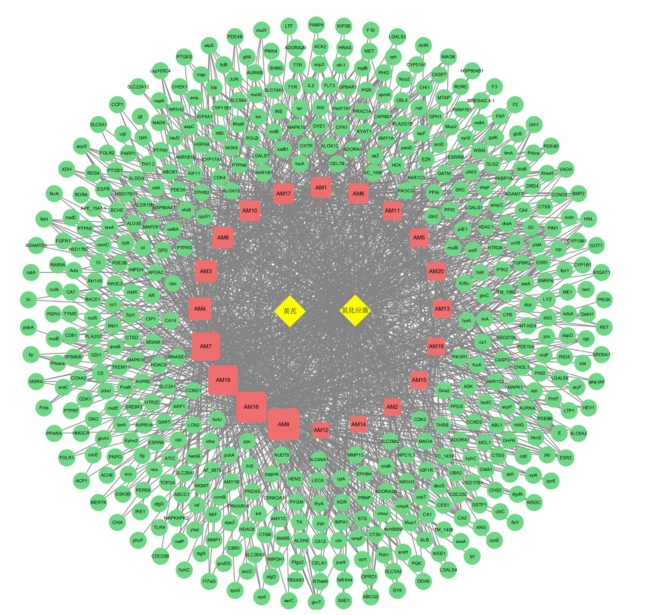
图5可知,共得到492个节点(470个黄芪潜在靶点、20个黄芪活性成分),黄芪成分度值越大,图标越大。其中9,10-二甲氧基紫檀-3-O-β-D-葡萄糖苷(度值150)、叶酸(度值142)度值较高,结合2.2,9,10-二甲氧基紫檀-3-O-β-D-葡萄糖苷、山奈酚和黄芪紫檀烷为黄芪抑制家兔氧化应激作用的主要成分。
图5 黄芪-氧化应激-靶点网络图

圆圈代表对应靶点,正方形对应黄芪活性成分。

Fig.5 Network diagram of milkvetch root-oxidative stress-targets

Circles represent the corresponding targets, and square represent the active ingredients of milkvetch root.

2.5 GO功能注释分析

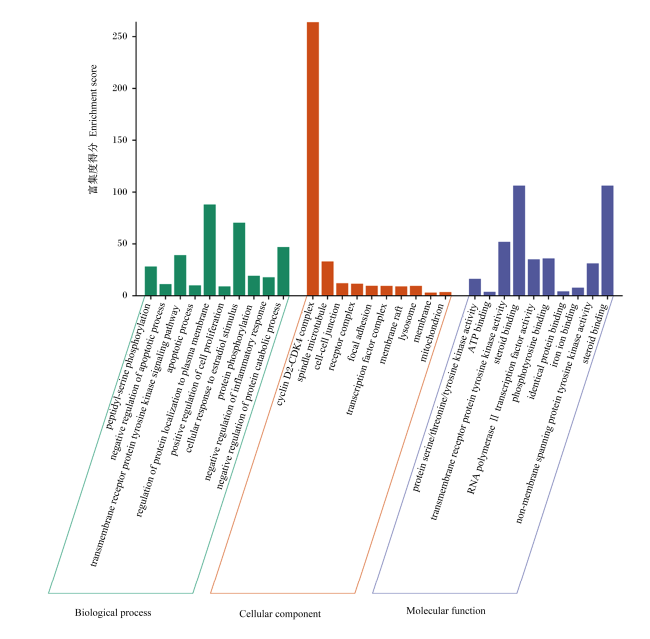
通过DAVID对关键靶点进行功能注释,以P<0.05筛选,得到生物过程(biological process,BP)相关62条,细胞组分(cellular component,CC)相关15条,分子功能(molecular function,MF)相关39条。P值从小到大排列,选择BP、CC、MF中前10条进行可视化,结果见图6。其中BP相关多条与细胞凋亡过程相关,主要包括肽基丝氨酸磷酸化(peptidyl-serine phosphorylation)、凋亡过程的负调控(negative regulation of apoptotic process)、跨膜受体蛋白酪氨酸激酶信号通路(transmembrane receptor protein tyrosine kinase signaling pathway)、凋亡过程(apoptotic process)、质膜蛋白定位调节(regulation of protein localization to plasma membrane)和细胞增殖的正向调节(positive regulation of cell proliferation)等。与CC相关主要为细胞周期蛋白D2-CDK4复合物(cyclin D2-CDK4 complex)、纺锤体微管(spindle microtubule)、细胞-细胞接头(cell-cell junction)、受体复合物(receptor complex)、病灶黏附(focal adhesion)和转录因子复合物(transcription factor complex)等。与MF相关包括蛋白丝氨酸/苏氨酸/酪氨酸激酶活性(protein serine/threonine/tyrosine kinase activity)、ATP结合(ATP binding)、跨膜受体蛋白酪氨酸激酶活性(transmembrane receptor protein tyrosine kinase activity)、类固醇结合(steroid binding)、RNA聚合酶Ⅱ转录因子活性(RNA polymerase Ⅱ transcription factor activity)和磷酸酪氨酸结合(phosphotyrosine binding)等。
图6 核心靶点的GO功能分析

Biological process:生物过程;peptidyl-serine phosphorylation:肽基丝氨酸磷酸化;negative regulation of apoptotic process:凋亡过程的负调控;transmembrane receptor protein tyrosine kinase signaling pathway:跨膜受体蛋白酪氨酸激酶信号通路;apoptotic process:凋亡过程;regulation of protein localization to plasma membrane:质膜蛋白定位调节;positive regulation of cell proliferation:细胞增殖的正向调节;cellular response to estradiol stimulus:细胞对雌二醇刺激的反应;protein phosphorylation:蛋白质磷酸化;negative regulation of inflammatory response:对炎症反应的负向调节;negative regulation of protein catabolic process:蛋白质分解过程的负向调节:Cellular component:细胞组分;cyclin D2-CDK4 complex:细胞周期蛋白D2-CDK4复合物;spindle microtubule:纺锤体微管;cell-cell junction:细胞-细胞接头;receptor complex:受体复合物;focal adhesion:病灶黏附;transcription factor complex:转录因子复合物;membrane raft:膜筏;lysosome:溶酶体;membrane:膜;mitochondrion:线粒体;Molecular function:分子功能;protein serine/threonine/tyrosine kinase activity:蛋白丝氨酸/苏氨酸/酪氨酸激酶活性;ATP binding:ATP结合;transmembrane receptor protein tyrosine kinase activity:跨膜受体蛋白酪氨酸激酶活性;steroid binding:类固醇结合;RNA polymerase Ⅱ transcription factor activity:RNA聚合酶Ⅱ转录因子活性;phosphotyrosine binding:磷酸酪氨酸结合;identical protein binding:相同蛋白结合;iron ion binding:铁离子结合;non-membrane spanning protein tyrosine kinase activity:非跨膜蛋白酪氨酸激酶活性;steroid binding:类固醇结合。

Fig.6 GO functional analysis of core targets

2.6 KEGG通路富集分析

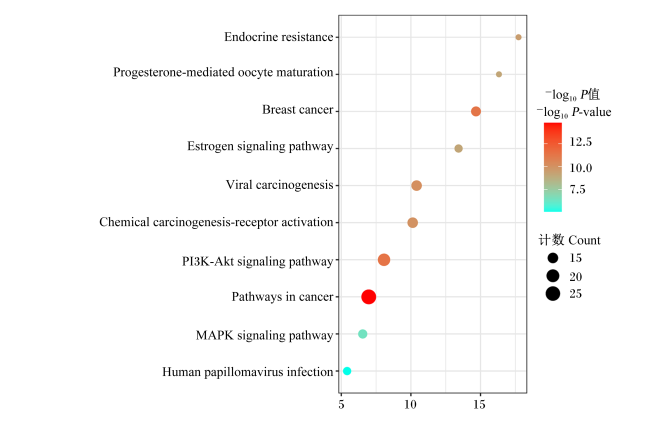
通过DAVID对关键靶点通路富集进行分析,以P<0.05筛选,富集到102条信号通路,将P值从小到大排列,选择前10条可视化,结果见图7。由图可知,主要富集通路与细胞凋亡,分子信号转导,病毒感染有关,包含癌症通路(pathways in cancer)、磷脂酰肌醇3激酶-蛋白激酶B信号通路(PI3K-Akt signaling pathway)、病毒致癌通路(viral carcinogenesis)、化学致癌-受体激活(chemical carcinogenesis-receptor activation)、丝裂原激活蛋白激酶信号通路(MAPK signaling pathway)、雌激素信号通路(estrogen signaling pathway)等。
图7 核心靶点的KEGG通路富集分析

Pathways in cancer:癌症通路;PI3K-Akt signaling pathway:磷脂酰肌醇3激酶-蛋白激酶B信号通路;Viral carcinogenesis:病毒致癌通路;Chemical carcinogenesis-receptor activation:化学致癌-受体激活;Breast cancer:乳腺癌;MAPK signaling pathway:丝裂原激活蛋白激酶信号通路;Estrogen signaling pathway:雌激素信号通路;Human papillomavirus infection:人类乳头瘤病毒感染;Endocrine resistance:内分泌抵抗;Progesterone-mediated oocyte maturation:孕激素介导的卵母细胞成熟。

Fig.7 KEGG pathway enrichment analysis of core targets

2.7 分子对接验证

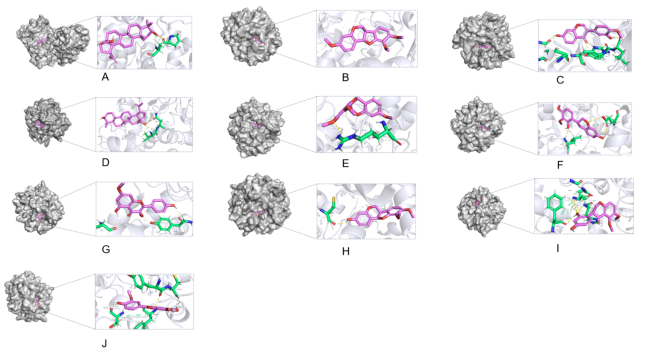
将PPI网络中度值前3的靶点与相应的黄芪成分对接验证,共28组,结合能均<0 kJ/mol,表示受体配体之间均能自发结合,对接结果见表2。靶点与化合物对接结合能较小的结果分别为:INS-白桦脂酸、INS-毛蕊异黄酮和ALB-白桦脂酸。其中白桦脂酸与INS蛋白位点的丙氨酸(Ala)-116、脯氨酸(Pro)-114氨基酸残基形成2条氢键相互作用,与ALB蛋白位点的天冬酰胺(Asn)-3、缬氨酸(Val)-2氨基酸残基形成2条氢键相互作用。毛蕊异黄酮与INS蛋白位点的亮氨酸(Leu)-17、组氨酸(His)-5和酪氨酸(Tyr)-16形成3条氢键相互作用。选择结合能最小的前10组受体配体可视化,结果见图8。该结果进一步验证了网络药理学预测分析结果的可靠性。
表2 核心靶点与相应成分分子对接结果

Table 2 Results of molecular docking of core targets and corresponding components

对接靶点
Docking targets
PDB数据库蛋白质
PDB database protein
编号
No.
结合能
Binding energy/(kJ/mol)

白蛋白
ALB

8BSG
AM1 -29.6
AM3 -21.6
AM4 -18.4
AM6 -22.0
AM9 -14.0
AM10 -18.4
AM17 -16.6
AM19 -19.2

表皮生长因子受体
EGFR

8A27
AM5 -21.2
AM7 -4.5
AM9 -16.8
AM11 -17.4
AM15 -21.3
AM16 -14.6
AM18 -14.0
AM20 -20.2

胰岛素
INS

4AJX
AM1 -28.6
AM2 -23.8
AM5 -24.9
AM6 -27.1
AM7 -11.0
AM8 -25.0
AM9 -21.3
AM10 -25.1
AM11 -20.8
AM13 -25.8
AM14 -29.4
AM17 -26.9
图8 靶点与化合物分子对接模式图

A:ALB-白桦脂酸;B:INS-3,9-二-O-甲基尼森香豌豆紫檀酚;C:INS-毛蕊异黄酮;D:INS-白桦脂酸;E:INS-7-O-甲基异微凸剑叶莎醇;F:INS-黄芪紫檀烷;G:INS-华良姜素;H:INS-(6aR,11aR)-9,10-二甲氧基-6a,11a-二氢-6H-苯并吡喃[2-c]-3-醇;I:INS-二氢异黄酮;J:INS-异鼠李素。

Fig.8 Molecular docking pattern diagram of targets and ingredients

A: ALB-mairin; B: INS-3,9-di-O-methylnissolin; C: INS-calycosin; D: INS-mairin; E: INS-7-O-methylisomucronulatol; F: INS-astraisoflavan-7-O-β-d-glucoside; G: INS-jaranol; H: INS-(6aR,11aR)-9,10-dimethoxy-6a,11a-dihydro-6H-benzofurano[2-c]chromen-3-ol; I: INS-isoflavanone; J: INS-isorhamnetin.

3 讨论

目前已有基于网络药理学的研究分析了紫锥菊乙醇、通脉养心丸、蒲公英(Taraxacum)[24-26]等抑制动物氧化应激的成分与通路。与其他抗氧化植物或复方相比,黄芪具有应用时间悠久、种质资源丰富、品质稳定等优点,为后续开发研究提供了客观条件。对比发现,黄芪与其他植物都可以通过山奈酚发挥抗氧化应激作用,证明了山奈酚在抗氧化过程的重要作用,为继续探索山奈酚作用提供了参考。此外,在金银花(Lonicera japonica)、桑叶(Mori folium)、蒲公英[27-28]中槲皮素都被视为最重要的抗氧化成分,黄芪中含有槲皮素却未被筛选为关键成分,推测原因如下:首先,黄芪中含有较多该中药特有活性成分,如9,10-二甲氧基紫檀-3-O-β-D-葡萄糖苷,这些成分表现出更强的抗氧化活性;其次,经筛选PharmMapper和SwissTargetPredicion数据库中异微凸剑叶莎醇-7,2'-二-O-葡糖苷共有252个靶点,而在槲皮素仅有67个靶点,可能与相关靶点较少有关,影响了数据分析。同时,与本文结果一致,ALB、CASP3、INS靶点和丝裂原活化蛋白激酶(MAPK)联级反应在鸡、牛中也表现为核心作用机制,证明了本研究结果的可靠性。然而,前人研究未重视磷脂酰肌醇3激酶(PI3K)/蛋白激酶B(Akt)通路抗动物氧化应激的重要性,本文为了解作用机制呈现了新视角。

3.1 黄芪关键活性成分

根据成分-靶点网络及黄芪-氧化应激-靶点网络,筛选出黄芪抗家兔氧化应激的主要成分有:山奈酚、9,10-二甲氧基紫檀-3-O-β-D-葡萄糖苷、黄芪紫檀烷。有研究发现,9,10-二甲氧基紫檀-3-O-β-D-葡萄糖苷通过核因子E2相关因子2(Nrf2)/血红素氧合酶-1(HO-1)和部分PI3K/Akt途径保护细胞免受氧化损伤,即诱导Nrf2、HO-1和醌氧化还原酶1(NQO1)的表达,加速Nrf2向细胞核的转位,并增强Akt的磷酸化,从而减少ROS的产生[29]。9,10-二甲氧基紫檀-3-O-β-D-葡萄糖苷特殊的抗氧化途径可解释PI3K/Akt通路重要的原因。黄芪紫檀烷和山奈酚都为黄酮类成分,具有抗炎、抗氧化、抗衰老、免疫调节、保护心血管等作用[30-33]。Kong等[34]以山奈酚治疗高胆固醇饮食的动脉粥样硬化家兔模型,发现与对照组相比,血清肿瘤坏死因子-α(TNF-α)、白细胞介素-1β(IL-1β)和丙二醛(MDA)含量显著上升,超氧化物歧化酶(SOD)活性升高;He等[35]研究发现,山奈酚可以通过Nrf2/HO-1信号通路保护血管内皮免受氧化应激和炎症诱导损伤,证明山奈酚对提高家兔抗氧化应激有积极作用。

3.2 黄芪活性成分作用靶点

通过PPI网络的构建与分析,从黄芪潜在靶点中筛选出ALB、EGFR、INS、CASP3、ESR1、JUN、SRC、CCND2、CDK4、CDK2是作用于家兔氧化应激的核心靶点,ALB是血浆中重要的运输蛋白,在小分子运输及维持血液的胶体渗透压方面发挥着决定性作用,同时也是重要的内源性抗氧化剂,其蛋白质结构中胱氨酸(Cys)34位点在ALB抗氧化功能发挥重要作用[36-38]。EGFR属于跨膜受体酪氨酸激酶家族,是原癌基因EGFR的表达产物,广泛分布于细胞表面,在生长、自我修复中发挥重要作用,当其与配体结合后激活并形成二聚体,可以激活多种下游信号通路,改善氧化应激导致的内皮功能障碍,包括有丝裂原Ras-MAPK级联反应和PI3K/Akt通路,后者可以抑制细胞凋亡、促进细胞增殖和细胞存活[39-40]。研究发现,活化的EGFR可参与肿瘤细胞的增殖、侵袭、转移等生物学行为[41]。CASP3在肝脏、心脏和肾脏等器官中与氧化应激导致细胞凋亡关系紧密,是线粒体超氧化物增加的上游产物[42]。CASP3增加线粒体ROS产生的机制主要有2种:其一是通过裂解线粒体复合物Ⅰ中的p75亚基,导致电子传输链中断,还原氧气(O2);另一种机制是破坏线粒体复合物Ⅲ,即在D106位点切割细胞色素C1,导致细胞色素C与C1无法结合,细胞色素C释放,破坏正常的线粒体膜电位[43-46]。黄芪作用于上述靶点,推测通过调控细胞增长、分化、凋亡、迁移等生物学途径,在抑制家兔氧化应激中发挥作用。

3.3 黄芪抗氧化潜在机制

根据KEGG分析,黄芪抑制氧化应激的通路主要有癌症通路、PI3K-Akt信号通路、病毒致癌通路、化学致癌-受体激活、MAPK信号通路等。以上通路与关键靶点作用通路密切相关,验证了筛选结果的可靠性。多个癌症相关通路富集说明癌症与氧化应激可能有共同靶点,因此,本文选择与氧化应激密切相关通路进行分析。结果显示,PI3K-Akt信号通路和MAPK信号通路与氧化应激密切相关。PI3K-Akt信号通路广泛调节细胞增值、分化、凋亡等生物学过程[47-49]。PI3K/Akt主要通过下游转录因子核因子-κB(NF-κB)调控细胞凋亡过程,Jeon等[50]发现抑制小鼠结肠炎中的NF-κB通路激活,可显著降低促炎细胞因子水平。MAPK信号通路涉及包括细胞增殖、分化、迁移等多种细胞功能,氧化应激可激活p38 MAPK磷酸化并作为上游信号调控细胞凋亡[51-52]
本研究通过网络药理学分析及分子对接技术分析了黄芪提高家兔抗氧化应激的物质基础和作用机制。网络药理学分析较为依赖通过收集前沿文献及研究热点获得信息的数据库,然而目前关于中草药天然成分抑制氧化应激研究多关注猪、禽类及反刍动物,因此可供分析的家兔氧化应激靶点、PPI网络及富集数据较少,使得本研究具有一定局限性。黄芪是否通过以上通路及关键靶点调节家兔抗氧化应激作用,有待进一步验证。

4 结论

本研究通过网络药理学及分子对接技术分析了黄芪提高家兔抗氧化应激能力的主要成分、作用靶点和调控通路的作用机制,结果表明黄芪通过多成分、多通路影响生理过程,为开发黄芪作为天然抗氧化剂应用于家兔生产奠定了理论基础。
[1]
CULLERE M, DALLE ZOTTE A. Rabbit meat production and consumption:state of knowledge and future perspectives[J]. Meat Science, 2018, 143:137-146.

[2]
张璐, 窦萌萌, 王新芳, 等. 多种天然霉菌毒素污染日粮对肉兔生产性能及肝脏功能的影响[J]. 中国兽医学报, 2023, 43(8):1739-1745.

ZHANG L, DOU M M, WANG X F, et al. Effects of natural mycotoxins contaminated diets on growth performance and liver function of meat rabbits[J]. Chinese Journal of Veterinary Science, 2023, 43(8):1739-1745. (in Chinese)

[3]
LIU T, SUN L, ZHANG Y B, et al. Imbalanced GSH/ROS and sequential cell death[J]. Journal of Biochemical and Molecular Toxicology, 2022, 36(1):e22942.

[4]
MUTWEDU V B, NYONGESA A W, ODUMA J A, et al. Thermal stress causes oxidative stress and physiological changes in female rabbits[J]. Journal of Thermal Biology, 2021, 95:102780.

[5]
LIANG Z L, CHEN F, PARK S, et al. Impacts of heat stress on rabbit immune function,endocrine,blood biochemical changes,antioxidant capacity and production performance,and the potential mitigation strategies of nutritional intervention[J]. Frontiers in Veterinary Science, 2022, 9:906084.

[6]
黄权, 苏琳. 动物体内氧化应激与抗氧化剂应用研究进展[J]. 中国兽药杂志, 2013, 47(5):66-69.

HUANG Q, SU L. Progress of applied research on oxidative stress and antioxidants in animals[J]. Chinese Journal of Veterinary Drug, 2013, 47(5):66-69. (in Chinese)

[7]
JIMOH O A, OYEYEMI B F, OYEYEMI W A, et al. Herbal inclusions ameliorate effect of heat stress on haematology,proinflammatory cytokines,adipokines and oxidative stress of weaned rabbit does in humid tropics[J]. Journal of Animal Physiology and Animal Nutrition, 2024, 108(1):55-63.

[8]
王硕, 吴华, 李金铭, 等. 天然提取物在影响动物氧化应激中的研究进展[J]. 饲料研究, 2023, 46(18):145-149.

WANG S, WU H, LI J M, et al. Research progress on effect of natural extracts on oxidative stress in animals[J]. Feed Research, 2023, 46(18):145-149. (in Chinese)

[9]
SAXENA P, SELVARAJ K, KHARE S K, et al. Superoxide dismutase as multipotent therapeutic antioxidant enzyme:role in human diseases[J]. Biotechnology Letters, 2022, 44(1):1-22.

[10]
江远玲, 冯楠, 邵欣宇, 等. 黄芪的现代药理作用研究进展[J]. 西南医科大学学报, 2023, 46(5):456-460.

JIANG Y L, FENG N, SHAO X Y, et al. Research progress of modern pharmacological function of Astragalus membranaceus[J]. Journal of Luzhou Medical College, 2023, 46(5):456-460. (in Chinese)

[11]
FU J, WANG Z H, HUANG L F, et al. Review of the botanical characteristics,phytochemistry,and pharmacology of Astragalus membranaceus (Huangqi)[J]. Phytotherapy Research, 2014, 28(9):1275-1283.

[12]
邵长鑫, 林欢欢, 靳晓杰, 等. 黄芪的炮制历史沿革及现代研究进展[J]. 中草药, 2023, 54(15):5057-5074.

SHAO C X, LIN H H, JIN X J, et al. Historical evolution and modern research progress of Astragali radix processing[J]. Chinese Traditional and Herbal Drugs, 2023, 54(15):5057-5074. (in Chinese)

[13]
谷海媛, 刘杰, 马双成, 等. 黄芪的研究进展及其质量标志物的预测分析[J]. 中国药事, 2023, 37(10):1180-1192.

GU H Y, LIU J, MA S C, et al. Research progress of Astragali radix and prediction analysis of its quality markers[J]. Chinese Pharmaceutical Affairs, 2023, 37(10):1180-1192. (in Chinese)

[14]
SHEIK A, KIM K, VARAPRASAD G L, et al. The anti-cancerous activity of adaptogenic herb Astragalus membranaceus[J]. Phytomedicine, 2021, 91:153698.

[15]
王祯, 张俊令, 焦宏基, 等. 黄芪有效成分的药理作用与质量控制研究进展[J]. 药物评价研究, 2023, 46(4):917-924.

WANG Z, ZHANG J L, JIAO H J, et al. Research progress on pharmacological action and quality control of effective components of Astragali radix[J]. Drug Evaluation Research, 2023, 46(4):917-924. (in Chinese)

[16]
夏明明. 黄芪多糖对断奶仔兔生长性能,抗氧化及肠道健康的影响[D].硕士学位论文. 秦皇岛: 河北科技师范学院, 2023.

XIA M M. Effects of Astragalus polysaccharide on growth performance,antioxidant and intestinal health of weaned rabbits[D].Master’s Thesis. Qinhuangdao: Hebei Normal University of Science & Technology, 2023. (in Chinese)

[17]
王梦迪, 李慧英, 赵天章. 日粮添加黄芪多糖对獭兔常规肉品质指标及肌肉脂肪酸组成的影响[J]. 黑龙江畜牧兽医, 2019(17):150-153.

WANG M D, LI H Y, ZHAO T Z. Effects of dietary addition of Astragalus polysaccharide on conventional meat quality indexes and muscle fatty acid composition of otter rabbits[J]. Heilongjiang Animal Science and Veterinary Medicine, 2019(17):150-153. (in Chinese)

[18]
LUO Z G, ZHONG L, HAN X F, et al. Astragalus membranaceus prevents daunorubicin-induced apoptosis of cultured neonatal cardiomyocytes:role of free radical effect of Astragalus membranaceus on daunorubicin cardiotoxicity[J]. Phytotherapy Research, 2009, 23(6):761-767.

[19]
LUO T T, LU Y, YAN S K, et al. Network pharmacology in research of Chinese medicine formula: methodology,application and prospective[J]. Chinese Journal of Integrative Medicine, 2020, 26(1):72-80.

[20]
JIAO X Y, JIN X, MA Y Y, et al. A comprehensive application:molecular docking and network pharmacology for the prediction of bioactive constituents and elucidation of mechanisms of action in component-based Chinese medicine[J]. Computational Biology and Chemistry, 2021, 90:107402.

[21]
张旭梅, 魏玉荣, 许丞惠, 等. 基于网络药理学和试验验证分析小檗碱治疗鸡沙门菌感染的作用机制[J]. 畜牧兽医学报, 2023, 54(8):3557-3570.

ZHANG X M, WEI Y R, XU C H, et al. To analyze the mechanism of berberine in the treatment of Salmonella gallinarum infection based on network pharmacology and experimental verification[J]. Acta Veterinaria et Zootechnica Sinica, 2023, 54(8):3557-3570. (in Chinese)

[22]
彭明蔚, 赵华鑫, 舒福, 等. 基于网络药理学和肠道菌群探讨香连丸改善高脂饮食诱导肥胖小鼠脂代谢紊乱的机制[J]. 中国中药杂志, 2023, 48(23):6442-6456.

PENG M W, ZHAO H X, SHU F, et al. Mechanism of Xianglian pills in improving dyslipidemia in obese mice induced by high-fat diet based on network pharmacology and intestinal flora[J]. China Journal of Chinese Materia Medica, 2023, 48(23):6442-6456. (in Chinese)

[23]
宁娱, 李振凯, 王银洁, 等. 基于网络药理学和分子对接技术的银柴胡解热作用机制探讨[J]. 中国现代中药, 2023, 25(5):1056-1063.

NING Y, LI Z K, WANG Y J, et al. Mechanism of heat-clearing effect of Stellariae radix based on network pharmacology and molecular docking[J]. Modern Chinese Medicine, 2023, 25(5):1056-1063. (in Chinese)

[24]
ZHU Y L, ZHANG J J, WANG C, et al Ameliorative effect of ethanolic Echinacea purpurea against hyperthyroidism-induced oxidative stress via AMRK and PPAR signal pathway using transcriptomics and network pharmacology analysis[J]. International Journal of Molecular Sciences, 2022, 24(1):187.

[25]
CUI Y M, LI C H, ZENG C, et al. Tongmai Yangxin pills anti-oxidative stress alleviates cisplatin-induced cardiotoxicity:network pharmacology analysis and experimental evidence[J]. Biomedicine & Pharmacotherapy, 2018, 108:1081-1089.

[26]
杨子辉, 董朕, 伍蕙岚, 等. 基于网络药理学分析蒲公英抗氧化功能的物质基础与作用机制[J]. 畜牧兽医学报, 2023, 54(5):2170-2185.

YANG Z H, DONG Z, WU H L, et al. Analysis of the material basis and mechanism of action of antioxidant function of Taraxacum mongolicum based on network pharmacology[J]. Acta Veterinaria et Zootechnica Sinica, 2023, 54(5):2170-2185. (in Chinese)

[27]
刘魏魏, 张宇欣, 李秀梅, 等. 基于网络药理学分析桑叶增强鸡抗氧化功能的作用机制[J]. 畜牧兽医学报, 2022, 53(6):1958-1970.

LIU W W, ZHANG Y X, LI X M, et al. Mechanism of Mori folium in improving antioxidative function of chicken based on network pharmacology[J]. Acta Veterinaria et Zootechnica Sinica, 2022, 53(6):1958-1970. (in Chinese)

[28]
刘魏魏, 张宇欣, 周炜炜, 等. 基于网络药理学和分子对接分析金银花缓解牛氧化应激的分子机制[J]. 中国畜牧兽医, 2023, 50(8):3391-3402.

DOI

LIU W W, ZHANG Y X, ZHOU W W, et al. Mechanism of Lonicerae Japonicae Flos alleviating oxidative stress in cattle based on network pharmacology and molecular docking[J]. China Animal Husbandry & Veterinary Medicine, 2023, 50(8):3391-3402. (in Chinese)

[29]
WU X H, XU J, CAI Y S, et al. Cytoprotection against oxidative stress by methylnissolin-3-O-β-D-glucopyranoside from Astragalus membranaceus mainly via the activation of the Nrf2/HO-1 pathway[J]. Molecules, 2021, 26(13):3852.

[30]
YAO H, SUN J Y, WEI J, et al. Kaempferol protects blood vessels from damage induced by oxidative stress and inflammation in association with the Nrf2/HO-1 signaling pathway[J]. Frontiers in Pharmacology, 2020, 11:1118.

DOI PMID

[31]
DIAS M C, PINTO D C G A, SILVA A M S. Plant flavonoids:chemical characteristics and biological activity[J]. Molecules, 2021, 26(17):5377.

[32]
DE LIMA CHERUBIM D J, BUZANELLO MARTINS C V, OLIVEIRA FARIÑA L, et al. Polyphenols as natural antioxidants in cosmetics applications[J]. Journal of Cosmetic Dermatology, 2020, 19(1):33-37.

DOI PMID

[33]
YOSHIMURA M. Structure elucidation of antioxidative polyphenols and their biological properties[J]. Journal of the Pharmaceutical Society of Japan, 2014, 134(9):957-964.

[34]
KONG L X, LUO C, LI X Y, et al. The anti-inflammatory effect of kaempferol on early atherosclerosis in high cholesterol fed rabbits[J]. Lipids in Health and Disease, 2013, 12:115.

DOI PMID

[35]
HE J Z, LI X, YANG S P, et al. Protective effect of Astragalus membranaceus and its bioactive compounds against the intestinal inflammation in Drosophila[J]. Frontiers in Pharmacology, 2022, 13:1019594.

[36]
BELINSKAIA D A, VORONINA P A, SHMURAK V I, et al. Serum albumin in health and disease:esterase,antioxidant,transporting and signaling properties[J]. International Journal of Molecular Sciences, 2021, 22(19):10318.

[37]
MORIMOTO M, HASHIMOTO T, TSUDA Y, et al. Study on oxidative stress and inflammatory/antioxidant substance levels in autism spectrum disorder[J]. Journal of the Chinese Medical Association, 2023, 86(5):489-493.

DOI PMID

[38]
PAN H Y, LI X B, CHENG X W, et al. Evidence of calycosin-7-O-β-d-glucoside’s role as a major antioxidant molecule of Astragalus membranaceus Bge. var. mongholicus (Bge.) Hsiao plants under freezing stress[J]. Environmental and Experimental Botany, 2015, 109:1-11.

[39]
CHEN W W, SCHOEBERL B, JASPER P J, et al. Input-output behavior of ErbB signaling pathways as revealed by a mass action model trained against dynamic data[J]. Molecular Systems Biology, 2009, 5:239.

DOI PMID

[40]
CHEN Z, CUI N, ZHAO J S, et al. Expressions of ZNF436,β-catenin,EGFR,and CMTM5 in breast cancer and their clinical significances[J]. European Journal of Histochemistry, 2021, 65(1):3173.

[41]
MORITA M, IIZUKA-OHASHI M, WATANABE M, et al. Oxidative stress induces EGFR inhibition-related skin cell death[J]. Journal of Clinical Biochemistry and Nutrition, 2021, 68(3):235-242.

[42]
PATEL M Y, STOVALL K, FRANKLIN J L. The intrinsic apoptotic pathway lies upstream of oxidative stress in multiple organs[J]. Free Radical Biology & Medicine, 2020, 158:13-19.

[43]
ZHU Y S, LI M, WANG X H, et al. Caspase cleavage of cytochrome c1 disrupts mitochondrial function and enhances cytochrome c release[J]. Cell Research, 2012, 22(1):127-141.

DOI PMID

[44]
PANINA S B, GUTSENKO O I, MILYUTINA N P, et al. SkQ1 controls CASP3 gene expression and caspase-3-like activity in the brain of rats under oxidative stress[J]. Biochemistry (Moscow), 2018, 83(10):1245-1254.

[45]
YU H T, ZHEN J, PANG B, et al. Ginsenoside Rg1 ameliorates oxidative stress and myocardial apoptosis in streptozotocin-induced diabetic rats[J]. Journal of Zhejiang University-Science B, 2015, 16(5):344-354.

[46]
ZHANG T X, YAN Z G, ZHENG X, et al. Effects of acute ammonia toxicity on oxidative stress,DNA damage and apoptosis in digestive gland and gill of Asian clam (Corbicula fluminea)[J]. Fish & Shellfish Immunology, 2020, 99:514-525.

[47]
ZHANG W J, YANG H F, ZHU L Q, et al. Role of EGFR/ErbB2 and PI3K/AKT/e-NOS in Lycium barbarum polysaccharides ameliorating endothelial dysfunction induced by oxidative stress[J]. The American Journal of Chinese Medicine, 2019, 47(7):1523-1539.

[48]
LEE K I, SU C C, FANG K M, et al. Ultrafine silicon dioxide nanoparticles cause lung epithelial cells apoptosis via oxidative stress-activated PI3K/Akt-mediated mitochondria- and endoplasmic reticulum stress-dependent signaling pathways[J]. Scientific Reports, 2020, 10(1):9928.

[49]
SHEN A L, WU M Z, ALI F, et al. Based on network pharmacology,gastrodin attenuates hypertension-induced vascular smooth muscle cell proliferation and PI3K/AKT pathway activation[J]. Scientific Reports, 2023, 13(1):12140.

[50]
JEON Y D, LEE J H, LEE Y M, et al. Puerarin inhibits inflammation and oxidative stress in dextran sulfate sodium-induced colitis mice model[J]. Biomedicine & Pharmacotherapy, 2020, 124:109847.

[51]
SHI T, VAN SOEST D M K, POLDERMAN P E, et al. DNA damage and oxidant stress activate p53 through differential upstream signaling pathways[J]. Free Radical Biology & Medicine, 2021, 172:298-311.

[52]
KIM J S, SAENGSIRISUWAN V, SLONIGER J A, et al. Oxidant stress and skeletal muscle glucose transport:roles of insulin signaling and p38 MAPK[J]. Free Radical Biology & Medicine, 2006, 41(5):818-824.

Outlines

/