RESEARCH PAPER

Study on Different Characteristics of Cecal Enterotypes and Their Association with Cecal Short-Chain Fatty Acid Contents and Slaughter Performance of Muscovy Ducks

  • XU Yini , 1, 2 ,
  • FAN Qian 1, 2 ,
  • YANG Caimei 1 ,
  • XIAO Yingping 2 ,
  • YANG Hua 2 ,
  • LYU Wentao , 2, * ,
  • WANG Jianfeng , 3, *
Expand
  • 1 College of Animal Sciences and Technology·College of Veterinary Medicine, Zhejiang A&F University, Hangzhou 311300, China
  • 2 State Key Laboratory of Hazard Factors and Risk Prevention and Control of Agricultural Product Quality and Safety, Institute of Agro-Product Safety and Nutrition, Zhejiang Academy of Agricultural Science, Hangzhou 310021, China
  • 3 Hangzhou Original Seed Farm, Hangzhou 311115, China
*assistant professor, E-mail: ;
senior engineer, E-mail:

Received date: 2024-02-11

  Online published: 2024-06-07

Abstract

The aim of this study was to explore the characteristics of different cecal enterotypes (ETs) and their relationship with cecal short-chain fatty acids (SCFAs) and slaughter performance of Muscovy ducks. Through high-throughput 16S rRNA gene sequencing, cecal enterotypes were identified by the partitioning around medoid (PAM) algorithm from 200 Muscovy ducks at 70 days of age. The growth performance, slaughtering performance and cecal SCFAs contents of Muscovy ducks with different ETs were determined. The structure and diversity of cecal microbiota of Muscovy ducks with different ETs at phylum and genus levels and the relationship between the relative abundance of differential genera and SCFAs content in cecum were also analyzed. The results showed that two ETs were identified from the cecum of Muscovy ducks: ET1 (n=165) represented by Parabacteroides and ET2 (n=35) represented by Fusobacterium, and the Shannon index of ET1 was significantly higher than that of ET2 (P<0.05). At the genus level, the relative abundances of Bacteroides (29.33%), Ruminococcaceae_uncultured (4.83%) and Parabacteroides (4.68%) were higher in ET1 than those in ET2, while the relative abundances of Bacteroides (20.71%), Fusobacterium (14.56%), and Parabacteroides (4.29%) were higher in ET2 than those in ET1. Comparative analysis by linear discriminant analysis effect size (LEfSe) revealed that the differential genera between different ETs included butyric acid-producing bacteria such as Faecalibacterium, Butyricoccus and [Eubacterium] hallii group and so on. Comparison of the SCFAs contents in the cecum of Muscovy ducks with different ETs revealed that the contents of acetate, propionate and butyrate in the cecum of ET1 were significantly higher than those of ET2 (P<0.05), whereas the contents of isobutyrate, valerate and isovalerate in the cecum did not show any significant difference between ET1 and ET2 (P>0.05). Further Spearman correlation analysis of the relative abundances of differential genera with SCFAs contents revealed significant positive correlations between Faecalibacterium and propionate, butyrate, isobutyrate, valerate and isovalerate (P<0.05). In addition, comparing the slaughtering performance of Muscovy ducks with different ETs, it was found that the abdominal fat weight and the percentage of abdominal fat of ET2 Muscovy ducks were significantly higher than those of ET1 Muscovy ducks (P<0.05), while there were no significant differences in the dressed weight, half-eviscerated weight, eviscerated weight dressed percentage, percentage of half-eviscerated yield, percentage of eviscerated yield, breast muscle weight, leg muscle weight, percentage of breast muscle and percentage of leg muscle (P>0.05). These findings indicate that the difference in cecal microbiota structure between two ETs might result in differences in SCFAs contents in the cecum of Muscovy ducks, which might further influence the slaughter performance. It may provide new insights into the interactions between intestinal microbiota and their hosts.

Cite this article

XU Yini , FAN Qian , YANG Caimei , XIAO Yingping , YANG Hua , LYU Wentao , WANG Jianfeng . Study on Different Characteristics of Cecal Enterotypes and Their Association with Cecal Short-Chain Fatty Acid Contents and Slaughter Performance of Muscovy Ducks[J]. Chinese Journal of Animal Nutrition, 2024 , 36(6) : 3680 -3692 . DOI: 10.12418/CJAN2024.316

番鸭原产于南美洲和中美洲,其肉质优良,脂肪含量低,口感好,蛋白质含量高,因此在中国、东南亚和南亚乃至全球都有巨大的番鸭消费需求[1]。中国是世界上最大的番鸭养殖国之一。据报道,2022年中国肉鸭出栏量达到了40.02亿只,总产值超过1 203亿元[2]。番鸭是中国重要的肉鸭品种之一,番鸭产业迅速发展和养殖规模不断扩大,提升其屠宰性能对番鸭产业的发展极为重要。
肠道微生物是影响鸭生长特性的重要因素之一,健康的肠道微生物群落数量众多,结构复杂,彼此相互作用和制约,处于动态平衡状态[3]。但肠道微生物在个体之间的时间和空间尺度上存在差异,这对于全面理解微生物组的复杂生物学效应造成重要障碍[4]。肠型的提出有利于解决这种障碍[5]。术语“肠型”最早是由Arumugam等[6]于2011年提出的,指的是人类肠道微生物群落的不同组成类型。人类肠道微生物群落包括拟杆菌属(Bacteroides)[肠型1(ET1)]、普雷沃氏菌属(Prevotella)[肠型2(ET2)]和瘤胃球菌属(Ruminococcus)[肠型3(ET3)]3个明显的群落类型[6]。自从这个概念被提出,肠型也在其他动物如黑猩猩[7]、小鼠[8]、鸡[9]以及大黄蜂[10]等的研究中得到应用。肠道微生物进行碳水化合物和氨基酸的代谢,合成和降解维生素[11-12],同时,肠道微生物直接或间接参与宿主的新陈代谢、营养物质的消化和吸收、维持肠道稳态和正常肠道功能,进一步影响宿主的生长和健康状况[13]。根据Yuan等[9]的研究结果,肠道微生物组的肠型聚簇与肉鸡的饲料效率和生长特性显著相关。因此,优化肠道微生物群落的结构对于改善养殖动物的肠道环境、提高屠宰性能、改善肉品质和提升市场竞争力可能有一定的积极作用。
除了肠道菌群本身与宿主的相互作用外,肠道菌群的发酵产物短链脂肪酸(short chain fatty acids,SCFAs)也在动物的生长发育过程中发挥巨大作用。SCFAs也称为挥发性脂肪酸,是由1~6个碳原子组成的有机脂肪酸,主要包括乙酸、丙酸、丁酸,这三者占肠道中SCFAs的95%以上[14]。基于不同的代谢产物,肠道微生物分为不同的功能组,如产乙酸菌、产丙酸菌、产丁酸菌等[15-16]。SCFAs可以为宿主肠黏膜细胞提供能量,促进细胞代谢和生长,并且能够降低肠道的pH,抑制有害菌生长,从而预防肠道功能障碍[17]。此外,研究表明,SCFAs作为一种饲料添加剂可以对家禽的生长性能产生积极影响[18-19]。其中,丁酸是厚壁菌门所属细菌的主要代谢产物,可以被结肠上皮细胞和盲肠上皮细胞吸收和利用,是结肠上皮细胞和盲肠上皮细胞的主要能量来源,同时,丁酸可以促进肠上皮细胞的增殖和分化,维持肠道的物理和化学屏障[3,20-21]。因此,提高鸭肠道内短链脂肪酸含量可能有益于鸭的健康和生产力的提高[22]
目前,还未有水禽肠型分型的相关研究,而肠型与鸭生长性能、胴体特征之间的关系仍不清楚。因此,本研究通过对200只番鸭盲肠内容物样品进行16S rRNA基因测序,并基于属层级样本间Jensen-Shannon(JSD)距离对番鸭盲肠菌群进行聚类分型,研究番鸭盲肠不同肠型与盲肠中SCFAs含量和屠宰性能之间的关系,以期扩展肠型概念在水禽中的适用性,并为肠道微生物与宿主之间的互作提供新的见解。

1 材料与方法

1.1 试验动物及饲养管理

动物试验经浙江省农业科学院实验动物福利和伦理委员会批准(许可证号: 2019ZAASLA95)。
试验所用番鸭由浙江省兰溪市禾旺禽业专业合作社提供。选取200只同批次、遗传背景一致、孵化体重[(49.87±0.53) g]相近的母鸭。试验鸭采用自然采光结合人工光照,1~7日龄雏鸭利用红外线灯加热保温,温度控制在31~33 ℃,8~14日龄时逐渐降低温度至25 ℃,15日龄后逐日降至室温。试验鸭在1~14日龄和15~70日龄分别饲喂相应饲养阶段的基础饲粮,基础饲粮参考Lyu等[23]的饲料配方并结合NRC(1994)营养标准配制,其组成及营养水平见表1。试验动物均按照标准化条件喂养,自由采食和饮水,保持圈舍环境卫生、干燥、通风。所有番鸭饲养至70日龄进行屠宰并采集样品。
表1 基础饲粮组成及营养水平(风干基础)

Table 1 Composition and nutrient levels of basal diets (air-dry basis)%

项目
Items
含量 Content
1~14日龄
1 to 14
days of
age
15~70日龄
15 to 70
days of
age
原料 Ingredients
玉米 Corn 58.90 56.50
豆粕 Soybean meal 28.00 20.00
小麦麸 Wheat bran 7.26 18.00
豆油 Soybean oil 2.04 1.85
碳酸钠 NaCO3 1.13 1.16
磷酸氢钙 CaHPO4 0.67 0.64
赖氨酸 Lys 0.28 0.31
蛋氨酸 Met 0.26 0.24
氯化钠 NaCl 0.40 0.24
氯化胆碱 Choline chloride 0.06 0.06
预混料 Premix1) 1.00 1.00
合计 Total 100.00 100.00
营养水平 Nutrient levels2)
代谢能 ME/(MJ/kg) 12.12 11.58
粗蛋白质 CP 20.50 16.50
钙 Ca 0.86 0.95
总磷 TP 0.53 0.52
赖氨酸 Lys 0.89 0.92
蛋氨酸 Met 0.51 0.49
蛋氨酸+胱氨酸 Met+Cys 0.83 0.75

1)预混料为每千克饲粮提供The premix provided the following per kg of diets:VA 10 000 IU,VD3 2 100 IU,VE 15 IU,VK3 1 mg,VB1 2 mg,VB2 4 mg,VB6 3 mg,VB12 0.005 mg,烟酸 nicotinic acid 40 mg,泛酸 pantothenic acid 10 mg,叶酸 folic acid 1 mg,生物素 biotin 0.3 mg,Fe 120 mg,Cu 5 mg,Mn 60 mg,Zn 25 mg,I 0.3 mg,Se 0.2 mg。

2)代谢能为计算值,其他均为实测值。ME was a calculated value, while the others were measured values.

1.2 样品采集与指标测定

1.2.1 样品采集

将200只70日龄番鸭称重后屠宰,采集左右两侧胸肌、腿肌并称重,同时采集盲肠内容物于液氮中速冻后于-80 ℃保存。

1.2.2 营养成分测定

饲粮的代谢能依据NRC(1994)计算得出,粗蛋白质、钙、总磷和氨基酸含量分别参照《饲料中粗蛋白的测定 凯氏定氮法》(GB/T 6432—2018)、《饲料中钙的测定》(GB/T 6436—2018)、《饲料中总磷的测定分光光度法》(GB/T 6437—2018)和《饲料中氨基酸的测定》(GB/T 18246—2000)进行测定。

1.2.3 生长性能测定

于试验第1天和第70天分别记录番鸭初始体重(IBW)和终末体重(FBW),测定前禁食6 h,计算平均日增重(ADG)。记录每日采食量,并计算平均日采食量(ADFI)和料重比(F/G)。计算公式如下:

平均日增重=(终末体重-初始体重)/试验天数;

平均日采食量=阶段总耗料量/(试验天数×番鸭只数);

料重比=平均日采食量/平均日增重。

1.2.4 屠宰性能测定

根据国家标准《家禽生产性能名词术语和度量计算方法》(NY/T 823—2020)[24]规定的方法测定屠体重、全净膛重、半净膛重、胸肌重、腿肌重和腹脂重,并计算屠宰率、全净膛率、半净膛率、胸肌率、腿肌率和腹脂率。相关计算公式如下:

屠宰率(%)=(屠体重/宰前活重)×100;

全净膛率(%)=(全净膛重/宰前活重)×100;

半净膛率(%)=(半净膛重/宰前活重)×100;

胸肌率(%)=(胸肌重/全净膛重)×100;

腿肌率(%)=(腿肌重/全净膛重)×100;

腹脂率(%)=[腹脂重/(全净膛重+腹脂重)]×100。

1.2.5 DNA提取和16S rRNA基因测序

使用QIAamp DNA Stool Mini Kit(Qiagen)从盲肠内容物中提取基因组DNA。通过NanoDrop ND-1000(Thermo Fisher Science)测定DNA的浓度和纯度[25]。采用通用引物515F(5’-GTGCCAGCMGCCGCGGTAA-3’)和907R(5’-CCGTCAATTCMTTRAGTTT-3’)扩增细菌16S rRNA基因的V4~V5区域。使用2%琼脂糖凝胶回收PCR产物,利用GeneJET Gel Extraction Kit(Thermo Scientific)进行纯化。使用Illumina TruSeq DNA PCR-Free Library Preparation Kit(Illumina)生成测序文库。利用Agilent Bioanalyzer 2100 System和Qubit 2.0 Fluorometer(Thermo Scientific)对文库进行质检。由明科生物技术有限公司(杭州)在Illumina NovaSeq平台上进行测序。使用QIIME2进行测序数据分析[26]。基于分类学信息,分别在门和属水平上进行番鸭盲肠内容物的菌群结构和多样性分析。

1.2.6 肠型分型

基于属层级样本间JSD距离,通过R软件“CLUSTER”包利用围绕中心点的划分(PAM)算法进行聚类,通过预测强度(PS)和轮廓指数(SI)确定最佳聚类数[27-28]。通过QIIME2计算的各肠型的操作分类单元(OTU)数目和α多样性。在门和属水平上分析不同肠型的盲肠菌群结构[29]

1.2.7 盲肠内容物中SCFAs含量测定

称取0.1 g盲肠内容物样品,并用1 mL磷酸盐缓冲液(PBS)溶解,样品以800×g离心10 min。之后,将0.5 mL上清液转移到新的离心管中,与25%(质量体积比)的偏磷酸盐和巴豆酸(内标)混合,存放在-20 ℃下过夜,提前1 h解冻样品,然后以1 500×g离心10 min。取上清液通过0.22 μm膜过滤,用GC-2010plus气相色谱仪(Shimadzu Kyoto)进行检测[30]

1.3 统计分析

采用Origin 21.0、GraphPad Prism 9.3、Gephi 0.9.2和联川生物云平台(https://www.omicstudio.cn)进行数据统计、分析和可视化。结果表示为平均值±标准误。采用Kruskal-Wallis检验比较分析组间微生物α多样性。采用Student’s t-test比较分析组间SCFAs含量、生长性能和屠宰性能。采用Spearman相关系数描述菌属的共存模式以及差异菌属的相对丰度与SCFAs含量之间的关系。P<0.05代表差异显著。

2 结果与分析

2.1 番鸭盲肠肠型及其菌群结构分析

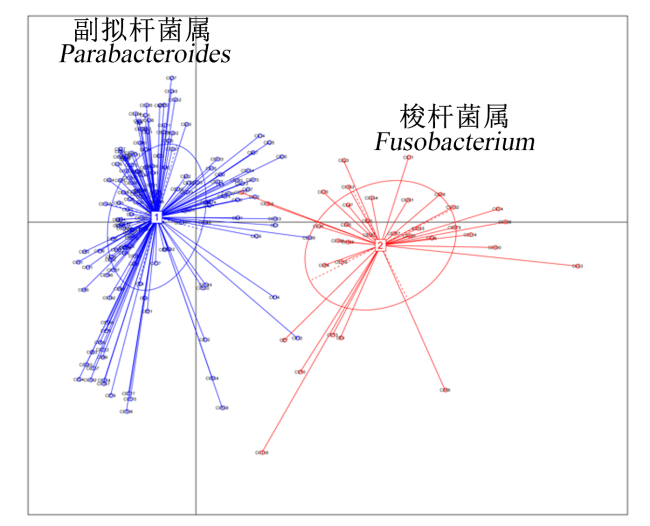
根据PS和SI确定最佳聚类数为2,将番鸭分为2种肠型:以副拟杆菌属(Parabacteroides)为代表的ET1(n=165)和以梭杆菌属(Fusobacterium)为代表的ET2(n=35)(图1)。
图1 200只番鸭盲肠菌群分型

Fig.1 Enterotypes of cecal microbiota cecum of 200 Muscovy ducks

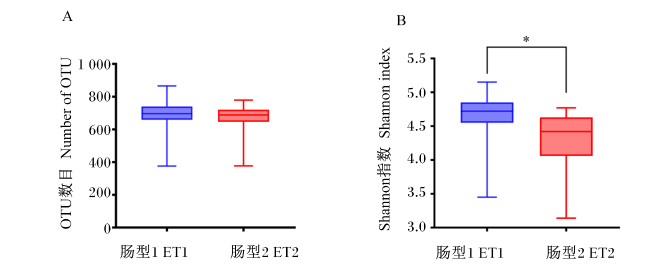
进一步分析2种肠型番鸭盲肠菌群的α多样性发现,ET1番鸭的OTU数目略高于ET2番鸭,但是差异不显著(P>0.05),而ET1番鸭的Shannon指数显著高于ET2番鸭(P<0.05),表明ET1番鸭的盲肠菌群多样性高于ET2番鸭(图2)。
图2 不同肠型番鸭盲肠菌群α多样性

图A为不同肠型番鸭盲肠菌群的OTU数目,图B为不同肠型番鸭盲肠菌群的Shannon指数。“*”表示2种肠型之间差异显著(P<0.05)。

Fig.2 α diversity of cecal microbiota of Muscovy ducks with different enterotypes

Figure A shows the number of OTU of cecal microbiota of Muscovy ducks with different enterotypes, and figure B shows the Shannon index of cecal microbiota of Muscovy ducks with different enterotypes. “*” indicates a significant difference between two enterotypes (P<0.05).

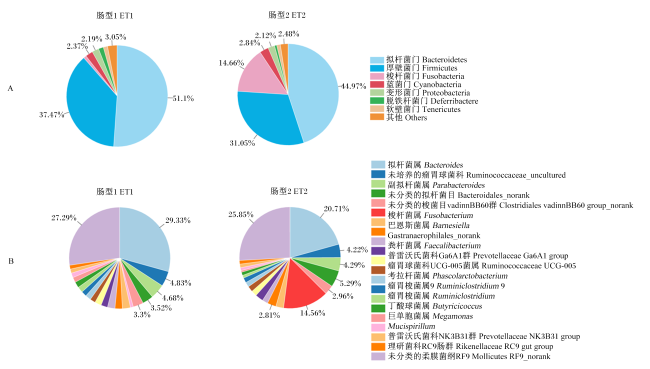
对2种肠型番鸭盲肠菌群结构进行分析发现,在门水平上,拟杆菌门(Bacteroidetes)、厚壁菌门(Firmicutes)、梭杆菌门(Fusobacteria)、蓝菌门(Cyanobacteria)、变形菌门(Proteobacteria)、脱铁杆菌门(Deferribacteres)和无壁菌门(Tenericutes)是番鸭盲肠中的优势菌门,总相对丰度达到97.23%,但它们在2种肠型番鸭盲肠中的相对丰度略有不同(图3)。拟杆菌门和厚壁菌门是2种肠型番鸭盲肠中最丰富的菌群,这2个菌门在ET1番鸭盲肠中的相对丰度(88.57%)高于ET2番鸭(76.02%)且差异显著(P<0.05);此外,ET2番鸭盲肠中中梭杆菌门的相对丰度(14.66%)高于ET1番鸭(0.90%)且差异显著(P<0.05)。在属水平上,番鸭盲肠的优势菌属包括拟杆菌属、未培养的瘤胃球菌科(Ruminococcaceae_uncultured)、副拟杆菌属(Parabacteroides)、未分类的拟杆菌目(Bacteroidales_norank)、梭杆菌属(Fusobacterium),总相对丰度达到47.52%,但它们的相对丰度在不同肠型番鸭盲肠中中有很大不同。ET1番鸭盲肠中拟杆菌属(29.33%)、未培养的瘤胃球菌科(4.83%)和副拟杆菌属(4.68%)的相对丰度较高;ET2番鸭盲肠中拟杆菌属(20.71%)、梭杆菌属(14.56%)和副拟杆菌属(4.29%)的相对丰度较高(图3)。
图3 不同肠型番鸭盲肠菌群组成

图中数据为各组相应菌门或菌属的相对丰度平均值。A:门水平物种组成;B:属水平物种组成(前20)。

Fig.3 Composition of cecal microbiota of Muscovy ducks with different enterotypes

The data in the figure are the average relative abundance of the corresponding phylum or genus in each group A: species composition at phylum level; B: species composition at genus level (top 20).

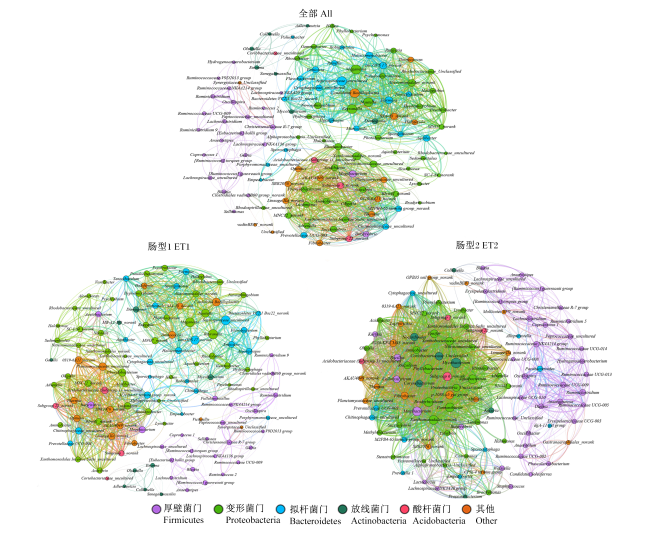
进一步对番鸭盲肠菌群进行Spearman相关性分析(|r|>0.6,P<0.01)发现,200个样本共有116个节点,1 264条边,ET1相关性网络图由118个节点和1 192条边组成,ET2相关性网络图由106个节点和1 962条边组成(图4)。从网络图聚集情况来看,ET1中,拟杆菌门和变形菌门的菌属分别与其他菌属形成了广泛的共生网络,厚壁菌门的菌属和其他菌属形成了几个小而稳定的共生网络。例如,瘤胃梭菌属(Ruminiclostridium)和颤螺旋菌属(Oscillospira)相互关联,形成了简单的共现网络。在ET2中,主要由变形菌门和厚壁菌门的菌属与其他菌属形成了紧密的共生模式,此外,还有大部分的变形菌门与厚壁菌门的菌属与其他菌属形成小而稳定的共生网络。与ET1相比,ET2中菌群间的互作关系更为紧密。
图4 不同肠型番鸭盲肠微生物互作网络分析

Fig.4 Microbial interaction network analysis of Muscovy ducks with different enterotypes

2.2 不同肠型番鸭盲肠差异菌属分析

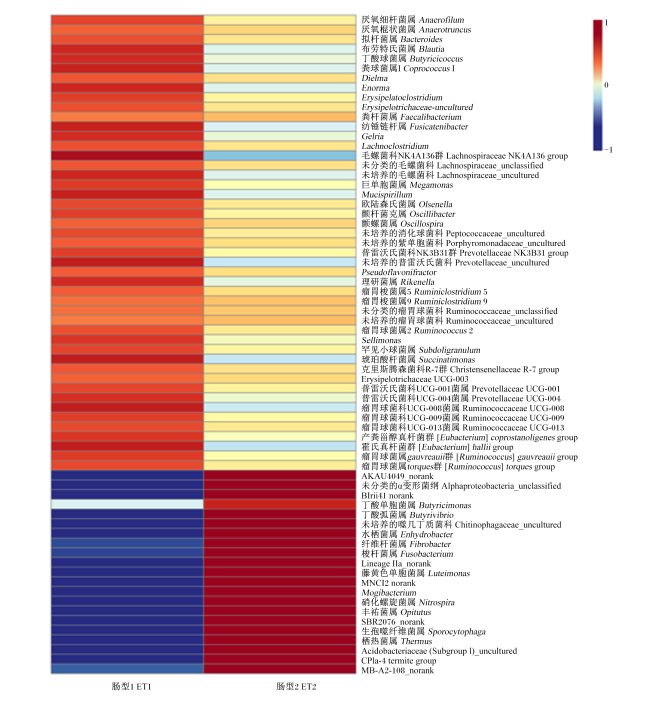
利用属水平相对丰度,根据线性判别分析效应大小(LEfSe)共筛选出68个差异菌属[线性判别分析(LDA)>2,P<0.05,图5],其中有47个菌属在ET1中的相对丰度显著高于ET2,包括毛螺菌科NK4A136群(Lachnospiraceae NK4A136 group)、未培养的普雷沃氏菌科(Prevotellaceae_uncultured)、布劳特氏菌属(Blautia)、瘤胃球菌科UCG-008菌属(Ruminococcaceae UCG-008)、霍氏真杆菌属([Eubacterium] hallii group)、粪杆菌属(Faecalibacterium)、Succinatimonas、丁酸球菌属(Butyricicoccus)和拟杆菌属等;而ET2中,有21个菌属的相对丰度显著高于ET1,包括梭杆菌属、丁酸单胞菌属(Butyricimonas)和丁酸弧菌属(Butyrivibrio)等(图5)。
图5 不同肠型番鸭盲肠差异菌属的相对丰度聚类热图

色阶代表差异菌属的相对丰度。红色越深代表相对丰度越高,蓝色越深代表相对丰度越低。

Fig.5 Relative abundance clustering heatmap of differential genera in cecal microbiota of Muscovy ducks with different enterotypes

Color gradients represent the relative abundances of differential genera. The darker the red, the higher the relative abundance, and the darker the blue, the lower the relative abundance.

2.3 不同肠型番鸭盲肠中SCFAs含量分析

表2所示,检测分析2种肠型番鸭盲肠内容物样本中的SCFAs(包括乙酸、丙酸、丁酸、戊酸、异丁酸和异戊酸)含量发现,ET1中乙酸、丙酸和丁酸含量显著高于ET2(P<0.05),戊酸、异丁酸和异戊酸含量也高于ET2,但差异不显著(P>0.05)。
表2 不同肠型番鸭盲肠中短链脂肪酸含量

Table 2 SCFAs contents in cecum of Muscovy ducks with different enterotypesmg/g

项目 Items 肠型1 ET1 肠型2 ET2 PP-value
乙酸 Acetate 5.73±0.08b 5.13±0.21a 0.002
丙酸 Propionate 2.07±0.07b 1.73±0.11a 0.031
丁酸 Butyrate 1.25±0.04b 1.05±0.07a 0.033
异丁酸 Isobutyrate 0.36±0.02 0.31±0.05 0.269
戊酸 Valerate 0.46±0.06 0.55±0.19 0.550
异戊酸 Isovalerate 0.37±0.02 0.34±0.04 0.532

同行数据肩标无字母表示差异不显著(P>0.05),不同小写字母表示差异显著(P<0.05)。下表同。

In the same row, values with no letter superscripts mean no significant difference (P>0.05), while with different small letter superscripts mean significant difference (P<0.05). The same as below.

2.4 不同肠型番鸭盲肠差异菌属相对丰度与SCFAs含量的相关性分析

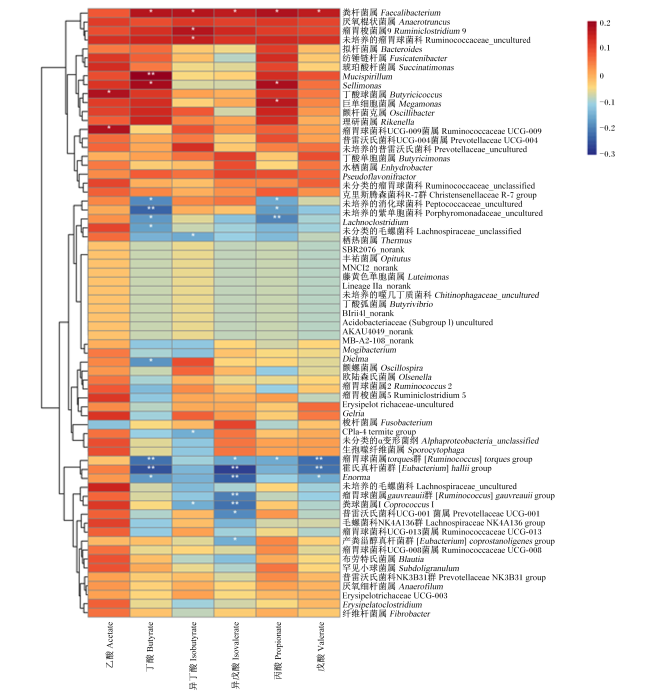
为分析不同肠型番鸭盲肠差异菌属与SCFAs含量的关系,利用Spearman相关性分析对不同肠型番鸭盲肠差异菌属与SCFAs含量进行相关性分析,结果(图6)显示,粪杆菌属相对丰度与丙酸、丁酸、异丁酸、戊酸、异戊酸含量均呈显著正相关(P<0.05),丁酸球菌属、瘤胃球菌科UCG-009菌属(Ruminococcaceae UCG-009)相对丰度与乙酸含量呈显著正相关(P<0.05),巨单胞菌属(Megamonas)、Sellimonas相对丰度与丙酸含量呈显著正相关(P<0.05),Mucispirilum(P<0.01)、Sellimonas(P<0.05)相对丰度与丁酸含量分别呈极显著和显著正相关,瘤胃梭菌属9(Ruminiclostridium 9)、未培养的瘤胃球菌科相对丰度与异丁酸含量呈显著正相关(P<0.05);而有14个菌属的相对丰度与SCFAs含量呈显著或极显著负相关(P<0.05或P<0.01),其中包括霍氏真杆菌群相对丰度与丁酸、异戊酸、戊酸含量呈极显著负相关(P<0.01),瘤胃球菌属torques群([Ruminococcus] torques group)相对丰度与丙酸(P<0.05)、异戊酸(P<0.05)、丁酸(P<0.01)、戊酸(P<0.01)含量呈显著或极显著负相关,克里斯滕森菌科R-7群(Christensenellaceae R-7 group)相对丰度与丙酸、丁酸含量呈显著负相关(P<0.05),未培养的消化球菌科(Peptococcaceae_uncultured)相对丰度与丙酸(P<0.05)、丁酸(P<0.01)含量分别呈显著和极显著负相关,未培养的紫单胞菌科(Porphyromonadaceae_uncultured)与丙酸(P<0.01)、丁酸含量(P<0.05)分别呈极显著和显著负相关。
图6 不同肠型番鸭盲肠差异菌属相对丰度与短链脂肪酸含量的相关性分析

“*”:显著相关(P<0.05);“**” :极显著相关(P<0.01)。

Fig.6 Correlation analysis between cecal differential genera relative abundances and SCFAs contentsof Muscovy ducks with different enterotypes

“*”: significant correlation (P<0.05); “**”: extremely significant correlation (P<0.01).

2.5 不同肠型番鸭的生长性能和屠宰性能分析

表3所示,对不同肠型番鸭的生长性能指标进行分析后发现,在初始体重差异不显著(P>0.05)的情况下,2种肠型番鸭的终末体重、平均日增重、平均日采食量和料重比均无显著差异(P>0.05)。
表3 不同肠型番鸭的生长性能分析

Table 3 Analysis on growth performance of Muscovy ducks with different enterotypes

项目 Items 日龄 Days of age 肠型1 ET1 肠型2 ET2 PP-value
初始体重 IBW/g 1 49.74±0.54 49.92±0.38 0.903
终末体重 FBW/g 70 2 858±22 2 811±40 0.370
平均日增重 ADG/g 1~70 40.16±10.83 39.46±12.17 0.743
平均日采食量 ADFI/g 1~70 131.82±8.47 132.18±9.14 0.844
料重比 F/G 1~70 3.28±0.21 3.34±0.24 0.473
由于肠道微生物能影响宿主的屠宰性能,我们对不同肠型番鸭的屠宰性能进行了分析,结果(表4)显示,2种肠型番鸭的屠体重、全净膛重、半净膛重、屠宰率、全净膛率、半净膛率、胸肌重、腿肌重、胸肌率和腿肌率差异均不显著(P>0.05),而ET1的腹脂重和腹脂率显著低于ET2(P<0.05)。
表4 不同肠型番鸭的屠宰性能分析

Table 4 Analysis on slaughter performance of Muscovy ducks with different enterotypes

项目 Items 肠型1 ET1 肠型2 ET2 PP-value
屠体重 Dressed weight/g 2 519.14±19.85 2 487.36±36.03 0.507
屠宰率 Dressed percentage/% 88.43±0.18 88.91±0.33 0.285
半净膛重 Half-eviscerated weight/g 2 350.58±18.33 2 305.27±32.53 0.313
半净膛率 Percentage of half-eviscerated yield/% 82.12±0.21 82.11±0.40 0.983
全净膛重 Eviscerated weight/g 2 130.51±16.36 2 085.62±30.50 0.262
全净膛率 Percentage of eviscerated yield/% 74.51±0.20 74.27±0.42 0.628
胸肌重 Breast muscle weight/g 376.60±3.48 375.90±8.38 0.935
胸肌率 Percentage of breast muscle/% 18.08±0.10 18.04±0.26 0.885
腿肌重 Leg muscle weight/g 227.10±3.15 224.00±7.02 0.689
腿肌率 Percentage of leg muscle/% 11.01±0.17 10.76±0.35 0.540
腹脂重 Abdominal fat weight/g 68.93±1.81a 79.28±4.21b 0.021
腹脂率 Percentage of abdominal fat/% 3.21±0.07a 3.57±0.16b 0.034

3 讨论

肠道菌群是一个庞大的生态系统,它在维护动物健康、促进各种营养物质的消化和吸收中起重要作用,影响宿主的生长和发育[31]。已有研究显示,盲肠中的微生物丰富,绍兴鸭、北京鸭和番鸭盲肠内最丰富的菌门是拟杆菌门和厚壁菌门[32-33],本试验结果与此一致。肠型最初是用于分类人类肠道微生物组的,后来在动物研究中不断得到应用。根据不同的聚类方法、距离计算,最终可能鉴定出不同的肠型[34-35]。Yuan等[9]的研究将206只肉鸡的十二指肠菌群分类为3种肠型:拟杆菌属(ET1)、苍白杆菌属(Ochrobactrum)(ET2)和芽孢杆菌属(Bacillus)(ET3)。但是鲜有研究涉及水禽肠型分型,因此,本试验将肠型分型方法应用到番鸭盲肠菌群中,基于属层级样本间JSD距离将200只番鸭盲肠菌群进行聚类,分成以副拟杆菌属为代表的ET1和以梭杆菌属为代表的ET2;α多样性分析结果表明,2个肠型之间的Shannon指数具有显著差异,说明ET1番鸭盲肠菌群丰富度比ET2番鸭更高。
产丁酸菌主要在动物盲肠中通过发酵饲粮中的不可消化碳水化合物产生SCFAs[36],为肠道细胞提供能量,从而促进肠道发育、维持肠道健康稳态、改善动物生长性能和胴体性状[37]。本试验通过LEfSe分析ET1和ET2番鸭盲肠差异菌属发现,ET1富集了多种产丁酸菌属,包括毛螺菌属、普雷沃氏菌属、布劳特氏菌属、瘤胃球菌属、霍氏真杆菌属、粪杆菌属、丁酸球菌属和拟杆菌属等,同时ET2也富集了一些产丁酸菌属,如梭杆菌属、丁酸单胞菌属和丁酸弧菌属,2种肠型的番鸭盲肠中产丁酸菌相对丰度存在差异(图5);进一步测定番鸭盲肠中SCFAs含量发现,ET1番鸭盲肠中乙酸、丙酸和丁酸含量均显著高于ET2番鸭(表2),结合ET1和ET2番鸭盲肠差异菌属相对丰度与SCFAs含量的相关性分析揭示,不同肠型番鸭盲肠中SCFAs含量差异可能是由其中差异产丁酸菌造成的。此外,相关性分析发现,以粪杆菌属[38]、丁酸球菌属[39]和瘤胃球菌科UCG-009菌属[40]为代表的产丁酸菌在番鸭盲肠SCFAs生成中起积极作用,而瘤胃球菌属torques群、霍氏真杆菌群(霍氏真杆菌群)和瘤胃球菌属gauvreauii群([Ruminococcus] gauvreauii group )等产丁酸菌在SCFAs生成过程中则可能存在负反馈机制[41](图6)。
产丁酸菌及其代谢产物SCFAs可以对家禽的生长性能和屠宰性能产生积极影响[19],其中的机制可能是SCFAs含量增加能够改善肠道菌群结构,提高厚壁菌门和拟杆菌门相对丰度[42-43],进而促进饲粮中不可消化碳水化合物的消化和吸收[44],提高番鸭对营养物质的消化吸收以及对饲粮的利用率,从而提高番鸭的生长性能和屠宰性能。此外,本试验发现,ET1番鸭的腹脂重和腹脂率显著低于ET2番鸭,该结果可能是由于ET1番鸭盲肠富集了布劳特氏菌属、颤螺旋菌属和丁酸球菌属等产丁酸菌(图5),从而提高了ET1番鸭盲肠中SCFAs含量。研究表明,饲粮中添加产丁酸菌能显著降低番鸭的腹脂重和腹脂率[45],产丁酸菌的代谢产物SCFAs能结合G蛋白偶联受体(GPCRs)[46],并能提高宿主体内过氧化物酶体增殖物激活受体α(PPARα)和肉毒碱棕榈酰基转移酶-1α(CPT-1α)表达水平,从而抑制脂肪合成、促进脂肪β氧化[24]。因此,产丁酸菌具有改善番鸭肠道健康、提高屠宰性能的重要作用,但其中的作用机制仍待进一步研究。

4 结论

对70日龄的200只番鸭盲肠菌群进行肠型分型,鉴定出副拟杆菌属(ET1)和梭杆菌属(ET2)2种肠型。ET1和ET2番鸭盲肠菌群结构不同,其差异菌属包括粪杆菌属、丁酸球菌属、瘤胃球菌科UCG-009菌属、瘤胃球菌属torques群、瘤胃球菌属gauvreauii群和霍氏真杆菌群等。ET1番鸭盲肠中乙酸、丙酸和丁酸含量显著高于ET2番鸭,且ET1番鸭的腹脂重和腹脂率显著低于ET2番鸭,这可能是ET1和ET2番鸭盲肠菌群结构差异造成的。
[1]
KOKOSZYÑSKI D, WILKANOWSKA A, ARPÁŠOVÁ H, et al. Comparison of some meat quality and liver characteristics in muscovy and mule ducks[J]. Arch Anim Breed, 2020, 63(1):137-144.

DOI PMID

[2]
侯水生, 刘灵芝. 2022年水禽产业现状、未来发展趋势与建议[J]. 中国畜牧杂志, 2023, 59(3):274-280.

HOU S S, LIU L Z. Current status,future development trends,and suggestions for the waterbird industry in 2022[J]. Chinese Journal of Animal Science, 2023, 59(3):274-280. (in Chinese)

[3]
FLINT H J, SCOTT K P, LOUIS P, et al. The role of the gut microbiota in nutrition and health[J]. Nature Reviews Gastroenterology & Hepatology, 2012, 9(10):577-589.

[4]
YATSUNENKO T, REY F E, MANARY M J, et al. Human gut microbiome viewed across age and geography[J]. Nature, 2012, 486(7402):222-227.

[5]
LE SCIELLOUR M, RENAUDEAU D, ZEMB O. Longitudinal analysis of the microbiota composition and enterotypes of pigs from post-weaning to finishing[J]. Microorganisms, 2019, 7(12):622.

[6]
ARUMUGAM M, RAES J, PELLETIER E, et al. Enterotypes of the human gut microbiome[J]. Nature, 2011, 473(7346):174-180.

[7]
MOELLER A H, DEGNAN P H, PUSEY A E, et al. Chimpanzees and humans harbour compositionally similar gut enterotypes[J]. Nature Communications, 2012, 3(1):1179.

[8]
FANG W J, XUE H L, CHEN X, et al. Supplementation with sodium butyrate modulates the composition of the gut microbiota and ameliorates high-fat diet-induced obesity in mice[J]. Journal of Nutrition, 2019, 149(5):747-754.

DOI PMID

[9]
YUAN Z, YAN W, WEN C, et al. Enterotype identification and its influence on regulating the duodenum metabolism in chickens[J]. Poultry Science, 2020, 99(3):1515-1527.

DOI PMID

[10]
LI J L, POWELL J E, GUO J, et al. Two gut community enterotypes recur in diverse bumblebee species[J]. Current Biology, 2015, 25(15):R652-R653.

[11]
RICKE S C, ROTHROCK M J J. Gastrointestinal microbiomes of broilers and layer hens in alternative production systems[J]. Poultry Science, 2020, 99(2):660-669.

DOI PMID

[12]
MACFARLANE S, MACFARLANE G T. Regulation of short-chain fatty acid production[J]. The Proceedings of the Nutrition Society, 2003, 62(1):67-72.

[13]
YADAV S, JHA R. Strategies to modulate the intestinal microbiota and their effects on nutrient utilization,performance,and health of poultry[J]. Journal of Animal Science and Biotechnology, 2019, 10(1):2.

[14]
DUNCAN S H, HOLTROP G, LOBLEY G E, et al. Contribution of acetate to butyrate formation by human faecal bacteria[J]. British Journal of Nutrition, 2004, 91(6):915-923.

DOI PMID

[15]
BOWRING B G, JENKINS S N, COLLINS A M. Scouring weaner pigs have a lower abundance of butyrate-producing bacteria[J]. Animal Production Science, 2015, 55(12):1448.

[16]
MACHIELS K, JOOSSENS M, SABINO J, et al. A decrease of the butyrate-producing species Roseburia hominis and Faecalibacterium prausnitzii defines dysbiosis in patients with ulcerative colitis[J]. Gut, 2014, 63(8):1275-1283.

[17]
SELLIN J H, DE SOIGNIE R. Short-chain fatty acids have polarized effects on sodium transport and intracellular pH in rabbit proximal colon[J]. Gastroenterology, 1998, 114(4):737-747.

PMID

[18]
LEESON S, NAMKUNG H, ANTONGIOVANNI M, et al. Effect of butyric acid on the performance and carcass yield of broiler chickens[J]. Poultry Science, 2005, 84(9):1418-1422.

PMID

[19]
YANG H, LYU W, LU L Z, et al. Biogeography of microbiome and short-chain fatty acids in the gastrointestinal tract of duck[J]. Poultry Science, 2020, 99(8):4016-4027.

DOI PMID

[20]
蒙丹丽, 梁列新, 宋怀宇. 短链脂肪酸在肠道中的生理作用[J]. 中国临床新医学, 2018, 11(2):198-202.

MENG D L, LIANG L X, SONG H Y. Physiological function of short-chain fatty acids in the intestine[J]. Chinese Journal of New Clinical Medicine, 2018, 11(2):198-202.

[21]
SCHROEDER B O, BIRCHENOUGH G M H, STÅHLMAN M, et al. Bifidobacteria or fiber protects against diet-induced microbiota-mediated colonic mucus deterioration[J]. Cell Host & Microbe, 2018, 23(1):27-40.e7.

[22]
LEVINE U Y, LOOFT T, ALLEN H K, et al. Butyrate-producing bacteria,including mucin degraders,from the swine intestinal tract[J]. Applied and Environmental Microbiology, 2013, 79(12):3879-3881.

[23]
LYU W, LIU X T, LU L Z, et al. Cecal microbiota modulates fat deposition in Muscovy ducks[J]. Frontiers in Veterinary Science, 2021,8:609348.

[24]
中华人民共和国农业农村部. 家禽生产性能名词术语和度量计算方法:NY/T 823—2020[S]. 北京: 中国农业出版社, 2020.

Ministry of Agriculture and Rural Affairs of the People’s Republic of China. Performance terminology and measurements for poultry:NY/T 823—2020[S]. Beijing: China Agricultural Publishing House, 2020.

[25]
XIAO Y P, KONG F L, XIANG Y, et al. Comparative biogeography of the gut microbiome between Jinhua and Landrace pigs[J]. Scientific Reports, 2018, 8(1):5985.

[26]
GUERRINI C J, BOTKIN J R, MCGUIRE A L. Clarify the HIPAA right of access to individuals’ research data[J]. Nature Biotechnology, 2019, 37(8):850-852.

[27]
MA L Y, TAO S Y, SONG T X, et al. Clostridium butyricum and carbohydrate active enzymes contribute to the reduced fat deposition in pigs[J]. iMeta, 2024, 3(1):e160.

[28]
XU E, YANG H, REN M M, et al. Identification of enterotype and its effects on intestinal butyrate production in pigs[J]. Animals, 2021, 11(3):730.

[29]
GIHRING T M, GREEN S J, SCHADT C W. Massively parallel rRNA gene sequencing exacerbates the potential for biased community diversity comparisons due to variable library sizes[J]. Environmental Microbiology, 2012, 14(2):285-290.

DOI PMID

[30]
XIAO Y P, LI K F, XIANG Y, et al. The fecal microbiota composition of boar Duroc, Yorkshire,Landrace and Hampshire pigs[J]. Asian-Australasian Journal of Animal Sciences, 2017, 30(10):1456-1463.

[31]
TAKIISHI T, FENERO C I M, CÂMARA N O S. Intestinal barrier and gut microbiota:shaping our immune responses throughout life[J]. Tissue Barriers, 2017, 5(4):e1373208.

[32]
WANG S M, CHEN L, HE M Z, et al. Different rearing conditions alter gut microbiota composition and host physiology in Shaoxing ducks[J]. Scientific reports, 2018, 8(1):7387.

[33]
VASAÏ F, BRUGIRARD RICAUD K, BERNADET M D, et al. Overfeeding and genetics affect the composition of intestinal microbiota in Anas platyrhynchos (Pekin) and Cairina moschata (Muscovy) ducks[J]. FEMS Microbiology Ecology, 2014, 87(1):204-216.

DOI PMID

[34]
COSTEA P I, HILDEBRAND F, ARUMUGAM M, et al. Enterotypes in the landscape of gut microbial community composition[J]. Nat Microbiol, 2018, 3(1):8-16.

DOI PMID

[35]
KOREN O, KNIGHTS D, GONZALEZ A, et al. A guide to enterotypes across the human body:meta-analysis of microbial community structures in human microbiome datasets[J]. PLoS Computational Biology, 2013, 9(1):e1002863.

[36]
MCCOY E, FRED E B, PETERSON W H, et al. A cultural study of certain anaerobic butyric-acid-forming bacteria[J]. The Journal of Infectious Diseases, 1930, 46(2):118-137.

[37]
PRYDE S E, DUNCAN S H, HOLD G L, et al. The microbiology of butyrate formation in the human colon[J]. FEMS Microbiology Letters, 2002, 217(2):133-139.

DOI PMID

[38]
ZHU LA A L T, LI D P, CHENG Z Q, et al. Enzymatically prepared neoagarooligosaccharides improve gut health and function through promoting the production of spermidine by Faecalibacterium in chickens[J]. Science of the Total Environment, 2024,912:169057.

[39]
赵广民, 刘秀婷, 代兵, 等. 金华猪和长白猪肠道产丁酸菌相对丰度与丁酸代谢的相关性分析[J]. 动物营养学报, 2021, 33(5):2595-2604.

DOI

ZHAO G M, LIU X T, DAI B, et al. Correlation analysis between relative abundance of butyrate producing bacteria and butyrate metabolism in intestine of Jinhua and landrace pigs[J]. Chinese Journal of Animal Nutrition, 2021, 33(5):2595-2604. (in Chinese)

[40]
PAN L L, REN Z N, YANG J, et al. Gut microbiota controls the development of chronic pancreatitis:A critical role of short-chain fatty acids-producing Gram-positive bacteria[J]. Acta Pharmaceutica Sinica B, 2023, 13(10):4202-4216.

[41]
COYTE K Z, SCHLUTER J, FOSTER K R. The ecology of the microbiome:networks,competition,and stability[J]. Science, 2015, 350(6261):663-666.

[42]
PANDIT R J, HINSU A T, PATEL N V, et al. Microbial diversity and community composition of caecal microbiota in commercial and indigenous Indian chickens determined using 16S rDNA amplicon sequencing[J]. Microbiome, 2018, 6(1):115.

DOI PMID

[43]
DEN BESTEN G, VAN EUNEN K, GROEN A K, et al. The role of short-chain fatty acids in the interplay between diet,gut microbiota,and host energy metabolism[J]. Journal of Lipid Research, 2013, 54(9):2325-2340.

[44]
PAN D, YU Z T. Intestinal microbiome of poultry and its interaction with host and diet[J]. Gut Microbes, 5(1):108-119.

[45]
付子贤, 肖英平, 杨彩梅, 等. 育雏期饲喂丁酸梭菌对育肥期番鸭生长性能、屠宰性能、肉品质和肌肉中氨基酸含量的影响[J]. 动物营养学报, 2023, 35(11):7174-7182.

DOI

FU Z X, XIAO Y P, YANG C M, et al. Effects of feeding Clostridium butyricum in brooding period on growth performance,slaughter performance,meat quality and muscle amino acid contents of muscovy ducks in fattening period[J]. Chinese Journal of Animal Nutrition, 2023, 35(11):7174-7182. (in Chinese)

[46]
徐进, 王劼, 舒鼎铭, 等. 丁酸对脂肪代谢的调节及其作用机制[J]. 动物营养学报, 2022, 34(6):3495-3502.

DOI

XU J, WANG J, SHU D M, et al. Regulation and mechanism of butyric acid on fat metabolism[J]. Chinese Journal of Animal Nutrition, 2022, 34(6):3495-3502. (in Chinese)

DOI

Outlines

/