RESEARCH PAPER

Effects of Isomaltooligosaccharide Synbiotics on Intestinal Permeability, Fecal Microbiota and Short Chain Fatty Acid Concentrations of Holstein Calves

  • PENG Hongmei , 1 ,
  • WEI Yue 1 ,
  • GUO Yaya 1 ,
  • HEI Mengqin 1 ,
  • ZHANG Peng 1 ,
  • LUO Ruiqing 2 ,
  • LI Yuanyuan , 1, * ,
  • ZHANG Wenju , 1, *
Expand
  • 1 School of Animal Science and Technology, Shihezi University, Shihezi 832000, China
  • 2 Xinjiang Tianshan Military Reclamation and Animal Husbandry Limited Liability Company, Shihezi 832000, China
*lecturer, E-mail: ;
professor, E-mail:

Received date: 2023-12-25

  Online published: 2024-06-07

Abstract

The aim of this study was to explore the effects of isomaltooligosaccharide synbiotics (composed of isomaltooligosaccharide, Lactobacillus reuteri and Lactobacillus johnsonii) on intestinal permeability, fecal microbiota and short chain fatty acid concentrations of Holstein calves. Selected 40 healthy Holstein calves and divide them into 4 groups according to the similar body weight and days of age, and each group had 10 calves. The calves in the 4 groups were supplemented with 0 (Con group), 2.5 (LC group), 5.0 (MC group) and 10.0 g/(head·d) (HC group) isomaltooligosaccharide synbiotics, respectively. The pre-experimental period lasted for 5 days, and the experimental period lasted for 42 days. The results showed as follows: 1) on day 21 of the experiment, the serum endotoxin (ET) content of the LC group was significantly lower than that of Con group (P<0.05); on day 42 of the experiment, the serum D-lactic acid (D-LA) content of the LG and HG groups was significantly decreased (P<0.05), and the serum D-LA content and diamine oxidase (DAO) activity of the MG group were significantly decreased compared with the Con group (P<0.05). On day 21 of the experiment, the concentration of propionic acid in feces of the MG and HG groups was significantly higher than that of the Con group (P<0.05); on day 42 of the experiment, the concentration of propionic acid in feces of the MG group was significantly increased, and the concentrations of propionic acid and isovaleric acid in feces of the LG group were significantly increased compared with the Con group (P<0.05). At the phylum level, the dominant bacteria phyla in all groups were Firmicutes, Bacteroidota, Actinobacteriota. On day 24 of the experiment, the fecal Actinobacteriota relative abundance of HG group was significantly higher than that of the Con group(P<0.05); On day 42 of the experiment, the fecal Firmicutes relative abundance of MG group was significantly higher than that of Con group (P<0.05). At the genus level, the dominant bacteria genera in all groups were Blautia and Lactobacillus. And the fecal relative abundance of Lactobacillus of the three trial groups was higher than that of the Con group. The correlation analysis fecal microbiota and intestinal permeability indexes and fecal short chain fatty acids showed that the Lachnoclostridium relative abundance was extremely significant positively correlated with the D-LA content (P<0.01) and the DAO activity (P<0.001). The norank_f_Erysipelotrichaceae relative abundance was significant positively correlated with the ET content (P<0.05). The Holdemanella relative abundance was significant negatively correlated with the DAO activity (P<0.05). The Lactobacillus relative abundance was significant positively correlated with the concentrations of butyric acid, isobutyric acid and isovaleric acid (P<0.05). The Parabacteroides relative abundance was significant negatively correlated with the concentrations of propionic acid, butyric acid, isobutyric acid and isovaleric acid (P<0.05). The Bacteroides relative abundance was extremely significant positively correlated with the butyric acid concentration (P<0.001). In summary, isomaltooligosaccharide synbiotics can improve the intestinal permeability of Holstein calves, increase the concentrations of short chain fatty acids in the intestine, change the structure of the intestinal microbiota, and its optimal supplementary dosage is 5 g/(head·d).

Cite this article

PENG Hongmei , WEI Yue , GUO Yaya , HEI Mengqin , ZHANG Peng , LUO Ruiqing , LI Yuanyuan , ZHANG Wenju . Effects of Isomaltooligosaccharide Synbiotics on Intestinal Permeability, Fecal Microbiota and Short Chain Fatty Acid Concentrations of Holstein Calves[J]. Chinese Journal of Animal Nutrition, 2024 , 36(6) : 3756 -3771 . DOI: 10.12418/CJAN2024.322

犊牛作为养牛业的后备力量,其早期发育程度和存活率决定了经济效益的高低。犊牛在哺乳期经历了巨大的生理变化,即从母体胎盘提供营养到体外依靠自身消化道吸收营养,再加上此时消化道尚未发育成熟,机体免疫力和抗病力较低,所以极易发生胃肠道疾病[1-2]。抗生素在各种疾病的预防和治疗中占有重要地位,但其大量使用及滥用所带来的安全问题也日益突出,因此,寻找绿色、安全的抗生素替代品已经引起畜牧业领域的广泛关注[2]
低聚异麦芽糖是一种能够调节肠道菌群、增加免疫力和促进消化道发育的功能性寡糖。益生菌可以通过占位效应、分泌代谢物、影响免疫细胞等抑制致病菌生长。由益生菌和益生元组成的合生元可以通过协同作用促进宿主健康[3-5]。薛晨曦[6]研究表明,在饲粮中添加黄芪多糖合生元能够降低犊牛腹泻,促进肠道发育,改善犊牛生长性能。Sharma等[7]报道,饲粮中补充合生元制剂能够适当增加犊牛肠道中短链脂肪酸含量和肠道中有益菌群数量,抑制病原菌生长。Singh等[8]研究发现,补充合生元可以改善犊牛腹泻情况,显著降低肠道中致病菌的数量。肠道微生物能够通过影响胃肠道的内外条件,在维持动物健康和抑制疾病发展方面起着关键作用。短链脂肪酸作为肠道微生物产生的非直接营养物质,在保护肠黏膜屏障、促进营养物质吸收、抑制有害菌生长等方面发挥着重要作用。本课题组前期研究发现,低聚异麦芽糖与罗伊氏乳杆菌、约氏乳杆菌组成的低聚异麦芽糖合生元的添加量为5 g/(头·d)时,在降低犊牛腹泻、提高犊牛生长性能及免疫性能方面有较好的作用[9],但其对犊牛肠道菌群、短链脂肪酸是否发挥调控作用,如何发挥调控作用,能否通过改善肠道菌群结构、调节短链脂肪酸浓度改善肠道健康却不得而知。因此,本试验拟研究低聚麦芽糖合生元对犊牛肠道通透性、粪便菌群和短链脂肪酸浓度的影响,以期为低聚异麦芽糖合生元作为抗生素替代品在犊牛生产中的应用提供参考依据。

1 材料与方法

1.1 试验材料

低聚异麦芽糖合生元由60%的低聚异麦芽糖、21%的罗伊氏乳杆菌、9%的约氏乳杆菌和10%的保护剂组成。低聚异麦芽糖纯度≥90%;罗伊氏乳杆菌和约氏乳杆菌有效活菌数为1.58×10⁹ CFU/g,由石河子大学动物科技学院自行分离得到。

1.2 试验动物与试验设计

选取(10±2)日龄、健康、体重相近的中国荷斯坦犊牛40头,随机分为4组,1个对照组(Con组)和3个试验组,每组10头。在统一饲喂液体饲料和开食料的基础上,4组组犊牛每日分别补饲0(Con组)、2.5(LG组)、5.0(MG组)和10.0 g/头(HG组)的低聚异麦芽糖合生元。低聚异麦芽糖合生元先溶于少量液体饲料,确保全部饮用后再饲喂剩余液体饲料。预试期5 d,正试期42 d。

1.3 饲养管理

试验期内,犊牛在犊牛岛中单笼饲养,每天定时(06:30和17:30)饲喂2次液体饲料(代乳粉与水按照1∶7的比例配制的液态奶,代乳粉由和豫有限公司生产,主要成分为浓缩乳清蛋白和全脂奶粉,其营养水平如表1所示),每头犊牛液体饲料的饲喂量为6~8 L/d。犊牛7日龄起补饲开食料,开食料组成及营养水平见表2。犊牛21日龄起自由采食燕麦草。试验期内犊牛自由饮水。
表1 代乳粉的营养水平(风干基础)

Table 1 Nutrient levels of milk replacer (air-dry basis)%

营养水平 Nutrient levels 含量 Content
干物质 DM 95.0
粗蛋白质 CP ≥22.0
粗脂肪 EE ≥16.0
粗灰分 Ash ≤8.0
粗纤维 CF ≤0.3
钙 Ca 0.7~1.2
磷 P ≥0.6
表2 开食料组成及营养水平(风干基础)

Table 2 Composition and nutrient levels of the starter (air-dry basis)%

原料
Ingredients
第1~14天
Days 1 to 14
第15~42天
Days 15 to 42
营养水平
Nutrient levels2)
第1~14天
Days 1 to 14
第15~42天
Days 15 to 42
玉米 Corn 56.70 57.50 代谢能ME/(MJ/kg) 13.04 13.26
豆粕 Soybean meal 16.50 17.50 干物质 DM 90.14 91.14
玉米蛋白粉 Corn gluten meal 11.50 10.20 粗蛋白质 CP 19.89 20.63
麸皮 Wheat bran 12.00 11.50 粗脂肪 EE 10.72 11.36
石粉 Limestone 1.90 1.80 粗灰分 Ash 6.21 5.47
氯化钠 NaCl 0.40 0.50 中性洗涤纤维 NDF 16.48 34.01
预混料 Premix1) 1.00 1.00 酸性洗涤纤维 ADF 6.13 16.06
合计 Total 100.00 100.00 钙 Ca 1.12 1.47
磷 P 0.51 1.32

1)预混料为每千克开食料提供The premix provided the following per kg of the starter:VA 15 000 IU,VD 5 000 IU,VE 50 mg,Fe 90 mg,Cu 12.5 mg,Mn 30 mg,Zn 90 mg,Se 0.3 mg,I 1.0 mg,Co 0.5 mg。

2)代谢能为参考NRC(2001)所得计算值,其余为实测值。ME was a calculated value with reference to NRC (2001), while the others were measured values.

1.4 样品采集

试验第21天和第42天晨饲前,每组随机选取5头犊牛采用颈静脉采血法采集10 mL血液于真空采血管中,静置30 min后,2 650×g离心10 min,取出上清,保存于-20 ℃冰箱中备用。采集犊牛血液后,分别收集犊牛直肠粪便1 g于2 mL冻存管中,迅速置于液氮中冻存,运输至实验室后于-80 ℃保存备用。

1.5 指标测定

1.5.1 常规营养成分含量

试验期间收集犊牛开食料,于-20 ℃冰箱保存待测。开食料中干物质、粗蛋白质、粗脂肪、粗灰分、中性洗涤纤维、酸性洗涤纤维、钙、磷含量分别参照GB/T 6435—2014、GB/T 6432—2018、GB/T 6433—2006、GB/T 6438—2007、GB/T 20806—2022、NY/T 1459—2022、GB/T 6436—2018、GB/T 6437—2018测定。

1.5.2 肠道通透性指标测定

本试验所测肠道通透性指标包括血清D-乳酸(D-LA)、内毒素(ET)含量与二胺氧化酶(DAO)活性,以上指标均采用酶联免疫吸附测定(ELISA)试剂盒进行检测,检测试剂盒均采购自上海酶联生物科技有限公司,严格按照试剂盒操作说明进行操作。

1.5.3 粪便短链脂肪酸浓度测定

参照Sharma等[7]的方法,使用气相色谱仪(Agilent-7890B)进行粪便中短链脂肪酸浓度的测定。样品处理:粪便样品解冻后,取1 g于10 mL无菌离心管,按1∶5的体积比加入5 mL的超纯水,涡旋振荡后离心,转移4.5 mL上清液于新的离心管中,加入25%偏磷酸溶液,涡旋振荡后固定3 h以上,离心,45 μm微孔滤膜过滤加入进样瓶中,使用顶空气相色谱-质谱(GC-MS)法进行分析。

1.5.4 粪便菌群分析

使用DNA提取试剂盒(由上海美吉生物有限公司生产)提取粪便总DNA,用1%的琼脂糖凝胶电泳检测所提取的DNA的浓度和纯度,将样品浓度稀释至1 ng/μL,备用。使用特异性引物序列(F:5'-ACTCCTACGGGAGGCAGCAG-3'和R:5'-GGACTACHVGGGTWTCTAAT-3')扩增细菌16S rRNA可变区V3~V4。通过Quant-iTTM PicoGreen® dsDNA Assay Kit构建文库,将建好的文库经过Qubit定量和PCR检测合格后,使用Illumina MiSeq平台测序。

1.6 数据处理和统计分析

数据经Excel 2010处理后,使用SPSS 19.0软件进行单因素方差分析(one-way ANOVA),使用Tukey氏法对粪便菌群进行组间多重比较,使用Duncan氏法对肠道通透性指标和短链脂肪酸浓度进行组间多重比较,以P<0.05为差异显著标准。结果以“平均值±标准差”表示。

2 结果与分析

2.1 低聚异麦芽糖合生元对犊牛肠道通透性指标的影响

表3可知,试验第21天时,与Con组相比较,LG组血清中ET含量显著降低(P<0.05)。第42天时,3个试验组(LG组、MG组和HG组)血清中D-LA含量均显著低于Con组(P<0.05);此外,与Con组相比较,MG组血清中DAO活性显著降低(P<0.05)。
表3 低聚异麦芽糖合生元对犊牛肠道通透性指标的影响

Table 3 Effects of isomaltooligosaccharide synbiotics on intestinal permeability indexes of calves

项目
Items
组别 Groups P
P-value
Con LG MG HG
第21天 Day 21
D-乳酸 D-LA/(μmol/L) 58.02±8.04 44.89±4.73 45.24±12.67 41.26±1.51 0.239
二胺氧化酶 DAO/(U/mL) 12.47±1.73 12.44±0.81 11.10±4.47 12.30±0.41 0.497
内毒素 ET/(EU/mL) 10.89±0.49a 9.16±0.74b 9.64±3.85ab 10.25±0.07ab 0.023
第42天 Day 42
D-乳酸 D-LA/(μmol/L) 48.47±2.16a 37.74±0.72b 34.26±0.94b 39.72±6.24b 0.015
二胺氧化酶 DAO/(U/L) 17.73±0.86a 14.68±1.63ab 13.76±0.94b 16.46±1.22ab 0.042
内毒素 ET/(EU/mL) 17.06±0.27 15.85±0.52 15.66±0.38 16.92±1.89 0.436

同行数据肩标不同小写字母表示差异显著(P<0.05),相同或无字母表示差异不显著(P>0.05)。下表同。

In the same row, values with different small letter superscripts mean significant difference (P<0.05), while with the same or no letter superscripts mean no significant difference (P>0.05). The same as below.

2.2 低聚异麦芽糖合生元对犊牛粪便短链脂肪酸浓度的影响

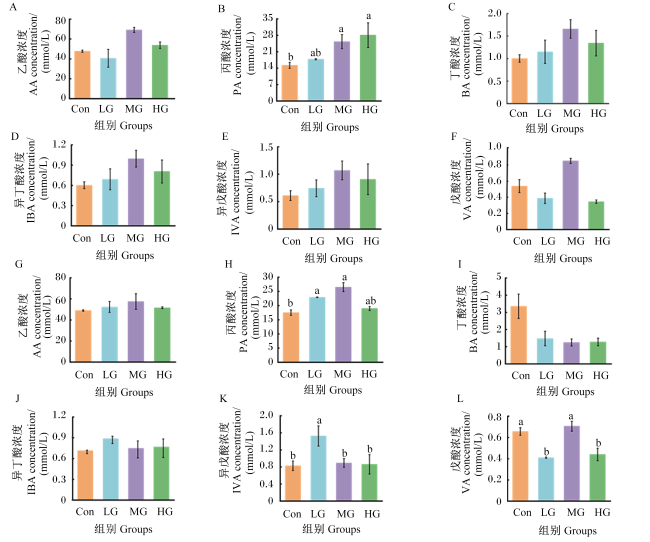
图1可知,试验第21天时,MG组和HG组粪便中丙酸浓度较Con组显著增加(P<0.05)。试验第42天时,LG组和MG组粪便中丙酸浓度较Con组显著升高(P<0.05);Con组和MG组粪便中戊酸浓度较LG组和HG组显著升高(P<0.05),其中以MG组浓度最高;LG组粪便中异戊酸浓度显著高于Con组、MG组和HG组(P<0.05),其中以Con组浓度最低。
图1 低聚异麦芽糖合生元对犊牛粪便中短链脂肪酸浓度的影响

A~F:试验第21天犊牛粪便中短链脂肪酸浓度;G~K:试验第42天犊牛粪便中短链脂肪酸浓度。数据柱标注不同小写字母表示差异显著(P<0.05),相同或无字母表示差异不显著(P>0.05)。下图同。

Fig.1 Effects of isomaltooligosaccharide synbiotics on SCFAs concentrations in feces of calves

A to F: the concentrations of SCFAs in the feces of calves on day 21 of the experiment; G to K: the concentrations of SCFAs in the feces of calves on day 42 of experiment. Value columns with different small letters mean significant difference (P<0.05), while with the same or no letters mean no significant difference (P>0.05). The same as below.

2.3 低聚异麦芽糖合生元对犊牛粪便菌群的影响

2.3.1 粪便样品测序质量评估及操作分类单元(OTUs)
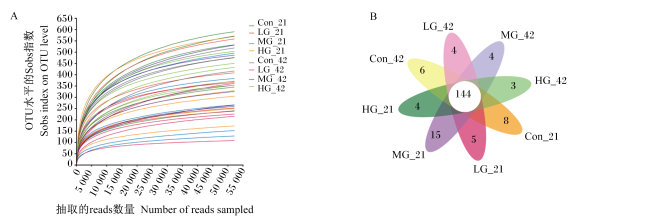
图2-A可知,各组的稀释曲线随着测序深度的加深而逐渐稳定,表明测序数据中包含能够满足测序要求的绝大部分微生物群落。基于粪便菌群OTUs的韦恩图(图2-B)表明,4组共同拥有144个OTUs;试验第21天时Con组特有8个OTUs,LG组特有5个OTUs,MG组特有15个OTUs,HG组特有4个OTUs;试验第42天时,Con组特有6个OTUs,LG组特有4个OTUs,MG组特有4个OTUs,HG组特有3个OTUs。
图2 测序质量评估及粪便菌群OTUs

A:稀释曲线;B:基于粪便菌群OTUs的韦恩图。Con_21:Con组第21天;LG_21:LG组第21天;MG_21:MG组第21天;HG_21:HG组第21天;Con_42:Con组第42天;LG_42:LG组第42天;MG_42:MG组第42天;HG_42:HG组第42天。下图同。

Fig.2 Sequencing quality assessment and fecal microbiota OTUs

A: dilution curve; B: Venn map based on OTUs of fecal microbiota.Con_21: Con group on day 21; LG_21: LG group on day 21; MG_21: MG group on day 21; HG_21: HG group on day 21; Con_42: Con group on day 42; LG_42: LG group on day 42; MG_42: MG group on day 42; HG_42: HG group on day 42. The same as below.

2.3.2 低聚异麦芽糖合生元对犊牛粪便菌群多样性的影响

低聚异麦芽糖合生元对犊牛粪便菌群Alpha多样性的影响见表4。试验第21天时,各组犊牛粪便菌群的Ace指数、Chao1指数、Shannon指数、Simpson指数均无显著差异(P>0.05),但LG组的Shannon指数较Con组、MG组和HG组要高。试验第42天时,Ace指数、Chao1指数、Shannon指数随着低聚异麦芽糖合生元补饲剂量的增加呈先降后升的趋势,LG组Ace指数较其他组显著降低(P<0.05),其Chao1指数较Con组和HG组显著降低(P<0.05),Shannon指数和Simpson指数在各组间表现为差异不显著(P>0.05)。
表4 低聚异麦芽糖合生元对犊牛粪便菌群Alpha多样性的影响

Table 4 Effects of isomaltooligosaccharide synbiotics on Alpha diversity of fecal microbiota of calve

项目
Items
组别 Groups P
P-value
Con LG MG HG
第21天 Day 21
Ace指数 Ace index 524.64±145.62 412.16±128.32 342.01±146.90 386.91±138.10 0.330
Chao1指数 Chao1 index 517.63±135.61 406.18±127.17 338.46±158.23 378.24±143.82 0.349
Shannon指数 Shannon index 3.48±0.49 3.62±0.46 3.08±0.69 3.38±0.60 0.601
Simpson指数 Simpson index 0.09±0.04 0.07±0.03 0.11±0.05 0.08±0.03 0.607
第42天 Day 42
Ace指数 Ace index 514.95±63.27a 304.63±117.02b 450.10±115.21a 480.83±60.05a 0.027
Chao1指数 Chao1 index 504.95±63.84a 296.68±110.49b 432.49±126.27ab 473.39±61.09a 0.033
Shannon指数 Shannon index 3.26±1.09 2.94±0.56 3.41±0.51 3.82±0.24 0.348
Simpson指数 Simpson index 0.21±0.23 0.12±0.06 0.08±0.03 0.05±0.01 0.249
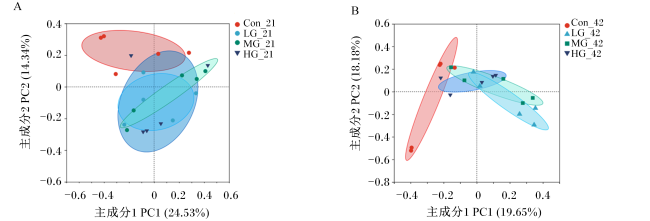
主坐标分析(PCoA)图中,样本间距离就越近,说明样本群落结构越相似。由图3可知,试验第21天时,Con组与3个试验组样本距离较远,可以很好地分离,每个试验组样本都有很好的聚类效果,这表明低聚麦芽糖合生元的补饲使犊牛粪便菌群Beta多样性发生了改变;试验第42天时,3个试验组样本出现分离,表明随着低聚麦芽糖合生元补饲时间的延长,各组样本菌群组成出现差异。
图3 低聚麦芽糖合生元对犊牛粪便菌群Beta多样性的影响

Fig.3 Effects of isomaltooligosaccharide synbiotics on Beta diversity of fecal microbiota of calves

2.3.3 低聚异麦芽糖合生元对犊牛粪便菌群结构的影响

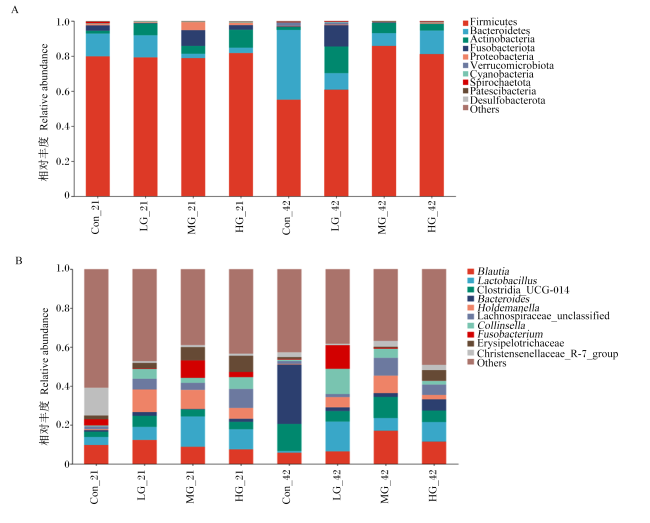
图4-A可知,在门水平上,各组的优势菌门均为厚壁菌门(Firmicutes)、拟杆菌门(Bacteroidota)、放线菌门(Actinobacteriota)和梭杆菌门(Fusobacteriota),其中厚壁菌门是相对丰度最高的。由表5可知,试验第21天时,HG组粪便中放线菌门的相对丰度显著高于Con组(P<0.05);试验第42天时,MG组粪便中厚壁菌门的相对丰度显著高于Con组(P<0.05)。
图4 低聚异麦芽糖合生元对犊牛粪便菌群组成的影响

Firmicutes:厚壁菌门;Bacteroidetes:拟杆菌门;Actinobacteria:放线菌门Fusobacteriota:梭杆菌门;Proteobacteria:变形菌门;Verrucomicrobiota:疣微菌门;Cyanobacteria:蓝藻菌门;Spirochaetota:螺旋体菌门;Patescibacteria:髌骨菌门;Desulfobacterota:脱硫杆菌门;Blautia:经黏液真杆菌属;Lactobacillus:乳杆菌属;Clostridia_UCG-014:梭菌纲UCG-014;Bacteroides:拟杆菌属;Holdemanella:霍尔德曼氏菌属;Lachnospiraceae_unclassified:毛螺菌科未分类属;Collinsella:柯林斯菌属;Fusobacterium:梭杆菌属;Erysipelotrichaceae:丹毒丝菌科;Christensenellaceae_R-7_group:克里斯滕森菌科R-7群;Others:其他。

Fig.4 Effects of isomaltooligosaccharide synbiotics on composition of fecal microbiota of calves

表5 低聚异麦芽糖合生元对犊牛粪便菌群优势菌门相对丰度的影响

Table 5 Effects of isomaltooligosaccharide synbiotics on relative abundances of dominant bacteria phyla in fecal microbiota of calves%

项目
Items
组别 Groups P
P-value
Con LG MG HG
第21天 Day 21
厚壁菌门 Firmicutes 79.86±5.54 79.26±9.10 78.83±20.64 81.74±6.45 0.966
拟杆菌门 Bacteroidota 12.98±6.97 12.60±9.25 2.49±2.77 3.04±1.46 0.074
放线菌门 Actinobacteriota 1.64±0.99b 6.72±4.02ab 4.48±2.12ab 10.25±7.87a 0.049
梭杆菌门 Fusobacteriota 3.06±6.11 0.28±0.29 8.99±13.56 2.63±3.46 0.383
其他 Other 2.46±1.56 1.14±0.75 5.21±7.93 2.34±0.87 0.559
第42天 Day 42
厚壁菌门 Firmicutes 55.13±26.63b 60.82±12.22ab 85.79±5.37a 81.13±10.36ab 0.029
拟杆菌门 Bacteroidota 39.82±28.10 9.42±9.59 7.47±6.08 13.42±11.21 0.262
放线菌门 Actinobacteriota 1.68±1.14 15.21±13.59 5.65±5.22 3.84±2.80 0.177
梭杆菌门 Fusobacteriota 0.36±0.40 12.09±15.56 0.34±0.57 0.11±0.13 0.369
其他 Other 3.00±2.29 2.46±2.67 0.75±0.43 1.51±1.04 0.352
图4-B可知,在属水平上,各组的优势菌属均为经黏液真杆菌属(Blautia)、乳杆菌属(Lactobacillus)和梭菌纲UCG-014(Clostridia_UCG-014)。试验第21天时,3个试验组粪便中乳杆菌属的相对丰度比Con组高,且MG组比其他试验组高;试验第42天时,3个试验组乳杆菌属的相对丰度也比Con组高,但Con组中梭菌纲UCG-014和拟杆菌属(Bacteroides)的相对丰度比3个试验组均高。
表4 低聚异麦芽糖合生元对犊牛粪便菌群优势菌门相对丰度的影响

Table 4 Effects of isomaltooligosaccharide synbiotics on relative abundances of dominant bacteria phyla in fecal microbiota of calves%

项目
Items
组别 Groups P
P-value
Con LG MG HG
第21天 Day 21
厚壁菌门 Firmicutes 79.86±5.54 79.26±9.10 78.83±20.64 81.74±6.45 0.966
拟杆菌门 Bacteroidota 12.98±6.97 12.60±9.25 2.49±2.77 3.04±1.46 0.074
放线菌门 Actinobacteriota 1.64±0.99b 6.72±4.02ab 4.48±2.12ab 10.25±7.87a 0.049
梭杆菌门 Fusobacteriota 3.06±6.11 0.28±0.29 8.99±13.56 2.63±3.46 0.383
其他 Others 2.46±1.56 1.14±0.75 5.21±7.93 2.34±0.87 0.559
第42天 Day 42
厚壁菌门 Firmicutes 55.13±26.63b 60.82±12.22ab 85.79±5.37a 81.13±10.36ab 0.029
拟杆菌门 Bacteroidota 39.82±28.10 9.42±9.59 7.47±6.08 13.42±11.21 0.262
放线菌门 Actinobacteriota 1.68±1.14 15.21±13.59 5.65±5.22 3.84±2.80 0.177
梭杆菌门 Fusobacteriota 0.36±0.40 12.09±15.56 0.34±0.57 0.11±0.13 0.369
其他 Others 3.00±2.29 2.46±2.67 0.75±0.43 1.51±1.04 0.352

2.3.4 低聚异麦芽糖合生元对犊牛粪便菌群差异物种的影响

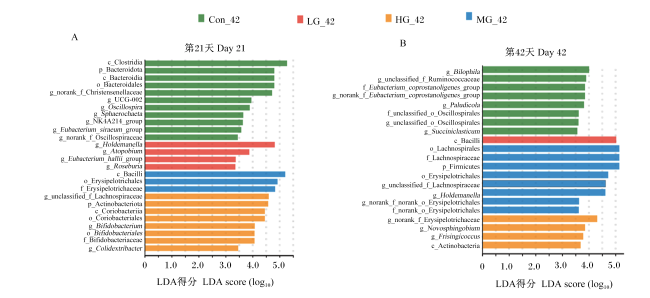
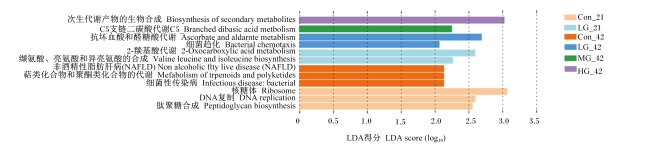
图5的犊牛粪便菌群LEfSe分析可知,补饲不同剂量的低聚异麦芽糖合生元使得犊牛粪便菌群组成发生了变化。试验第21天时,梭状芽孢杆菌纲、拟杆菌门、拟杆菌纲和拟杆菌目富集于Con组,霍尔德曼氏菌属(Holdemanella)富集于LG组,芽孢杆菌纲、丹毒丝菌目富集于MG组,毛螺菌科未分类属、放线菌门、科氏菌门和科氏菌目富集于HG组;试验第42天时,嗜胆菌属、瘤胃球菌科未分类属、产粪甾醇真杆菌科和产粪甾醇真杆菌科未明确属富集于Con组,芽孢杆菌纲富集于LG组;毛螺菌目、毛螺菌科和厚壁菌门等富集于MG组,丹毒丝菌目未分类属、新鞘氨醇杆菌属、弗赖辛球杆菌属、放线菌纲富集于HG组。
图5 犊牛粪便菌群LEfSe分析

c_Clostridia:梭菌纲;p_Bacteroidota:拟杆菌门;c_Bacteroidia:拟杆菌纲;o_Bacteroidales:拟杆菌目;g_norank_f_Christensenellaceae: 克里斯滕森菌科未明确属;g_UCG-002:UCG-002属;g_Oscillospira:颤螺旋菌属;g_Sphaerochaeta:鞘翅属;g_NK4A214_group:NK4A214群;g_Eubacterium_siraeum_group:惰性真杆菌群;g_norank_f_Oscillospiraceae:颤螺菌科未明确属;g_Holdemanella:霍尔德曼氏菌属;g_Atopobium:阿托波氏菌属;g_Eubacterium_hallii_group:哈氏真杆菌群;g_Roseburia:罗氏菌属;c_Bacilli:芽孢杆菌纲;o_Erysipelotrichales:丹毒丝菌目;f_Erysipelotrichaceae:丹毒丝菌科;g_unclassified_f_Lachnospiraceae:毛螺菌科未分类属;p_Actinobacteriota:放线菌门;c_Coriobacteriia:科氏菌门;o_Coriobacteriales:科氏菌目;g_Bifidobacterium:双歧杆菌属;o_Bifidobacteriales:双歧杆菌目;f_Bifidobacteriaceae:双歧杆菌科;g_Colidextribacter:科里氏异质菌属;g_Bilophila:嗜胆菌属;g_unclassified_f_Ruminococcaceae:瘤胃球菌科未分类属;f_Eubacterium_coprostanoligenes_group:产粪甾醇真杆菌科;g_norank_f_Eubacterium_coprostanoligenes_group:产粪甾醇真杆菌科未明确属;g_Paludicola:湿地真菌属;f_unclassified_o_Oscillospirales:颤螺菌目未分类科;g_unclassified_o_Oscillospirales:颤螺菌目未分类属;g_Succiniclasticum:解琥珀酸菌属;c_Bacilli:杆菌纲;o_Lachnospirales:毛螺菌目;f_Lachnospiraceae:毛螺菌科;p_Firmicutes:厚壁菌门;g_Holdemanella:霍尔德曼氏菌属;g_norank_f_norank_o_Erysipelotrichales:丹毒丝菌目未明确科未明确属;f_norank_o_Erysipelotrichales:丹毒丝菌目未明确科;g_norank_f_Erysipelotrichaceae:丹毒丝菌科未明确属;g_Novosphingobium:新鞘氨醇杆菌属;g_Frisingicoccus:弗赖辛球杆菌属;c_Actinobacteria:放线菌纲。

LDA判别图中不同的颜色代表不同的组别,纵坐标表示多组中具有显著差异的微生物,横坐标(LDA分值)表示物种丰度。The different colors in the LDA discrimination chart represent different groups, the vertical axis represents microorganisms with significant differences among multiple groups, and the horizontal axis (LDA score) represents species abundance.

Fig.5 LEfSe analysis of fecal microbiota of calves

2.3.5 犊牛粪便菌群功能预测

基于KEGG数据库,使用PICRUSt2对犊牛粪便菌群功能进行预测,结果如图6所示。在KEGG通路2级和3级水平上,试验第21天时,Con组核糖体、DNA复制、肽聚糖合成等3条通路上调,LG组2-羰基酸代谢与缬氨酸、亮氨酸和异亮氨酸的合成等2条通路上调;试验第42天时,Con组有3条通路上调,包括非酒精性脂肪肝病(NAFLD)、萜类化合物和聚酮类化合物的代谢以及细菌性传染病,LG组有2条通路上调,包括抗坏血酸与醛糖酸代谢和细菌趋化,MG组仅C5支链二碳酸代谢通路上调,HG组仅次生代谢物的生物合成通路上调。
图6 不同日龄犊牛粪便菌群功能预测分析(KEGG通路2级和3级水平)

Fig.6 Prediction analysis of function of fecal microbiota of calves at different ages (level 2 and level 3 of KEGG pathway)

2.4 肠道通透性指标、粪便短链脂肪酸与粪便菌群的相关性分析

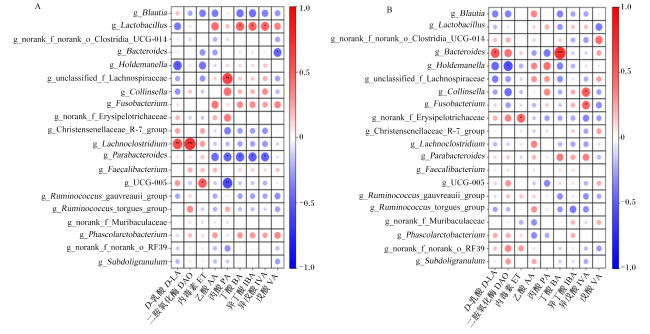
图7可知,试验第21天时,拉克氏梭状芽孢杆菌属(Lachnoclostridium)相对丰度与D-LA含量(P<0.01)和DAO活性(P<0.001)呈极显著正相关;毛螺菌科未分类属(unclassified_f_Lachnospiraceae)相对丰度与丙酸浓度呈极显著正相关(P<0.01);UCG-005属相对丰度与ET含量呈显著正相关(P<0.05),与丙酸浓度呈显著负相关(P<0.05);霍尔德曼氏菌属相对丰度与D-LA含量呈显著负相关(P<0.05);副拟杆菌属(Parabacteroides)相对丰度与丙酸、丁酸、异丁酸和异戊酸浓度呈显著负相关(P<0.05);乳杆菌属相对丰度与丁酸、异丁酸和异戊酸浓度呈显著正相关(P<0.05);拟杆菌属相对丰度与戊酸浓度呈显著负相关(P<0.05)。试验第42天时,霍尔德曼氏菌属与DAO活性呈显著负相关(P<0.05);丹毒丝菌科未明确属(norank_f_Erysipelotrichaceae)相对丰度与ET含量呈显著正相关(P<0.05);拟杆菌属相对丰度与丁酸浓度呈极显著正相关(P<0.001);柯林斯菌属(Collinsella)和梭杆菌属(Fusobacterium)与异戊酸浓度呈显著正相关(P<0.05)。
图7 犊牛肠道通透性指标、粪便短链脂肪酸与粪便菌群(相对丰度排名前20的菌属)相关性分析热图

g_Blautia:经黏液真杆菌属;g_Lactobacillus:乳杆菌属;g_norank_f_norank_o_Clostridia_UCG-014:梭菌纲UCG-014未明确科未明确属;g_Bacteroides:拟杆菌属;g_Holdemanella:霍尔德曼氏菌属;g_unclassified_f_Lachnospiraceae:毛螺菌科未分类属;g_Collinsella:柯林斯菌属;g_Fusobacterium:梭杆菌属;g_norank_f_Erysipelotrichaceae:丹毒丝菌科未明确属;g_Christensenellaceae_R-7_group:克里斯滕森菌科R-7群; g_Lachnoclostridium:拉克氏梭状芽孢杆菌属;g_Parabacteroides:副拟杆菌属;g_Faecalibacterium:粪杆菌属;g_UCG-005:UCG-005属;g_norank_Ruminococcus_gauvreauii_group:瘤胃球菌gauvreauii组未明确属;g_norank_Ruminococcus_torgues_group:瘤胃球菌torgues组未明确属;g_norank_f_Muribaculaceae:穆氏杆菌科未明确属;g_Phascolarctobacterium:考拉杆菌属;g_norank_f_norank_o_RF39:RF39目未明确科目未明确属;g_Subdoligranulum:罕见小球菌属。

A:试验第21天相关性分析热图;B:试验第42天相关性分析热图。图中颜色深浅表示粪便菌群与肠道通透性指标、粪便短链脂肪酸相关性大小,其中红色表示正相关,蓝色表示负相关。*:P<0.05;**:P<0.01;***:P<0.001。A: correlation analysis heat map on day 21 of the experiment; B: correlation analysis heatmap on day 42 of the experiment. The color depth in the figure indicated the correlation size between intestinal permeability indexes, fecal SCFAs and fecal microbiota, red indicated positive correlation, and blue indicated negative correlation. *: P<0.05; **: P<0.01; ***: P<0.001.

Fig.7 Heat map of correlation analysis between intestinal permeability indexes, fecal SCFAs, and fecal microbiota (relative abundance ranking of the top 20 bacterial genera) of calves

3 讨论

3.1 低聚异麦芽糖合生元对犊牛肠道通透性的影响

肠黏膜屏障可以阻止肠腔内未消化的大分子物质、代谢废物或毒素等进入血液循环危害机体健康。肠道通透性是反映肠道健康的重要指标。正常情况下,由肠腔进入血液中的D-LA、ET含量很低,血液中DAO活性也较低。Singh等[10-11]研究发现,小鼠补饲低聚异麦芽糖可以改善肠道通透性,维持肠道菌群平衡。Ahrne等[12]研究发现,罗伊氏乳杆菌可以降低大鼠结肠炎造成的肠道通透性。
Zhang等[13]研究表明,约氏乳杆菌能够降低非酒精性脂肪肝大鼠肠道通透性,修复破损的肠道细胞。在犊牛生长过程中,环境压力、气候变化、饲养管理不当均会导致犊牛肠道受到损伤,在肠道受损时血清中的D-LA和ET含量就会升高,DAO活性也会增加[14]。ET是肠道中革兰氏阴性细菌外膜的主要糖脂成分,当肠道屏障受损时,ET通过受损的肠上皮进入血液,导致机体发生急性炎症反应。本试验结果表明,补饲5 g/(头·d)低聚异麦芽糖合生元显著降低了试验第21天时犊牛血清中ET含量,表明其对提高犊牛肠道屏障功能,减少肠道中病原菌的数量发挥着积极作用;MG组和HG组血清中ET含量也均有不同程度降低,但高于LG组,推测低聚异麦芽糖合生元的过量补充会破坏动物肠道菌群平衡,导致一些有害的繁殖和生长,进而导致血液中ET含量增加。本研究发现,试验第42天时,各组犊牛血清中D-LA含量均低于试验第21天时,推测这与随着犊牛日龄的增加肠道屏障功能不断完善有关;此外,LG组、MG组和HG组血清中D-LA含量均显著低于Con组,表明补饲低聚异麦芽糖合生元可使犊牛肠道屏障功能更加完善。本研究还发现,试验第42天时HG组犊牛血清中D-LA含量高于LG组和MG组,这可能与低聚异麦芽糖合生元经微生物代谢产生了较多有害气体,并且内源微生物对低聚异麦芽糖发酵过快对肠黏膜产生负面影响有关[15]

3.2 低聚异麦芽糖合生元对犊牛粪便短链脂肪酸浓度的影响

短链脂肪酸是由特定肠道菌群分解膳食纤维和非淀粉多糖产生的一类饱和脂肪酸[16],可刺激肠道细胞增殖发育和促进营养物质的吸收,还可为机体提供部分能量,在保持肠道稳态和健康方面也发挥着重要作用[16-19]。He等[20]对犊牛粪便中菌群组成、功能和短链脂肪酸浓度进行了分析,发现致病性大肠杆菌可通过引起犊牛肠道菌群失衡、降低短链脂肪酸浓度诱导犊牛腹泻。司文瑾[21]对补充乙酸钠犊牛试验组粪便中菌群结构及短链脂肪酸浓度进行了测定,推测补充乙酸钠增加了产乙酸、丙酸有益菌的相对丰度,调节了肠道免疫反应,进而缓解了犊牛腹泻。Sharma等[22]研究发现,低聚异麦芽糖合生元可以增加小鼠盲肠中短链脂肪酸浓度,预防肠道炎症的发生。本试验结果表明,补饲一定剂量的低聚异麦芽糖合生元后犊牛粪便中丙酸、戊酸浓度显著提高。丙酸能通过影响肝脏和胆固醇代谢,促进上皮细胞生长[19],戊酸能够促进肠道黏膜细胞生长和受损细胞的修复,改善肠道屏障功能[23-24]。本课题组前期研究发现,低聚异麦芽糖合生元可以改善犊牛腹泻,提高免疫性能,推测该合生元可通过增加肠道短链脂肪酸浓度改善肠道屏障功能进而缓解腹泻。同时,本研究发现试验第42天时LG组异戊酸浓度过高,可能是由于个体消化道差异造成浓度偏高[25]

3.3 低聚异麦芽糖合生元对犊牛粪便菌群的影响

肠道是重要的消化代谢器官,肠腔内生存有许多复杂的微生物群落。稳定的肠道菌群在保持宿主健康方面发挥着重要作用[26]。研究表明,与单独添加益生菌或者寡糖相比,添加合生元在调节动物肠道菌群、促进肠道发育方面具有更好的益生效果[26-28]。陈玉龙[29]在繁殖母猪上的研究表明,饲粮中添加低聚异麦芽糖合生元可以显著改善母猪的体况,提高奶的营养水平,提高母猪及子代的免疫水平,优化肠道菌群。谷雪玲[30]在围产期母猪上进一步证明,饲粮中添加低聚异麦芽糖合生元可以显著改善仔猪平均初生重和平均窝增重,增加母猪粪便中短链脂肪酸的浓度,提高肠道菌群的丰富度。Khan等[31]研究发现,合生元可以降低小鼠肠道菌群的多样性,增加有益菌群的数量。本研究发现,随着饲喂时间的延长,低聚异麦芽糖合生元降低了LG组Ace指数和Chao1指数,MG组和HG组粪便菌群丰富度也有不同程度的降低,这可能是由于添加低聚异麦芽糖合生元后增加了肠道有益菌群的数量和种类,减少了致病菌的定植和生长,这与Vu等[32]的研究结果一致。
本试验中,厚壁菌门、拟杆菌门和放线菌门是犊牛粪便中的主要优势菌门。厚壁菌门是反刍动物肠道中最主要的优势菌门之一,其所属的大部分细菌能够分泌胞外多糖降解酶,主要与膳食纤维的降解有关[33-35]。李旭廷等[35]研究发现,便秘母猪肠道中厚壁菌门相对丰度降低,表明厚壁菌门与动物肠道蠕动和消化有关。试验第42天时,厚壁菌门在MG组显著富集,通过LEfSe分析发现,补饲低聚异麦芽糖合生元的试验组富集的物种多为厚壁菌门,且犊牛肠道中厚壁菌门的相对丰度随着饲喂时间的延长不断提高,推测犊牛对碳水化合物尤其是对饲粮中的纤维消化能力得到提高。放线菌门能够降解各种碳水化合物,为动物本身生命活动提供所需的能量。管晓轩[36]研究发现,在饲粮中添加复合微生态制剂能显著增加粪便中放线菌门的相对丰度,明显改善犊牛的消化能力。试验第21天时,HG组放线菌门的相对丰度显著增加,表明犊牛补饲低聚异麦芽糖合生元能够增强其对各种碳水化合物的消化能力。
犊牛粪便中主要优势菌属为经黏液真杆菌属和乳杆菌属,低聚异麦芽糖合生元的补饲使乳杆菌属在犊牛肠道中富集,这也与属水平上观察到的乳杆菌属和拟杆菌属的结果一致。拟杆菌能够产生黏蛋白降解物质,诱发肠道炎症,而乳杆菌则能通过产生有机酸等代谢物抑制其生长[37]。以上结果表明,低聚异麦芽糖合生元可通过提高肠道有益菌群丰度来改善动物机体健康状况。
通过PICRUSt功能预测,基于KEGG数据库对组间粪便菌群差异通路进行分析,结果表明,低聚异麦芽糖合生元可以改变犊牛肠道菌群代谢通路,主要包括核苷酸代谢、氨基酸代谢、糖代谢以及脂肪代谢。Hu等[38]研究发现,猪体内罗伊氏乳杆菌和约氏乳杆菌减少会引起短链脂肪酸浓度的降低,这与核苷酸代谢相关。低聚异麦芽糖与乳酸菌组合会促使有益菌氨基酸代谢基因上调[39]。罗伊氏乳杆菌可以通过改变胆汁酸组成,提高脂肪酸合成酶活性,促进有益菌的生长,减少肝脏中甘油三酯在肝脏中的累积,使血清胆固醇含量降低[40-41]。这些结果表明,补饲低聚异麦芽糖合生元能够增强犊牛肠道菌群的功能,包括氨基酸代谢、糖代谢以及脂肪代谢等,但目前尚不清楚不同菌群与通路之间具体作用机制,还需进一步研究。

3.4 犊牛肠道通透性、粪便短链脂肪酸与粪便菌群相关性分析

肠道黏膜屏障的完整性与通透性是动物健康的基础,肠道菌群通过分解膳食纤维和非淀粉多糖产生短链脂肪酸,一方面为机体提供能量,另一方面调节肠道上皮细胞通透性,维持肠道健康[17-18]。Efremova等[42]研究发现,在肝硬化患者体内霍尔德曼氏菌属与肠道功能障碍呈负相关,这与本研究的发现一致,即霍尔德曼氏菌属相对丰度与肠道通透性呈负相关。Yang等[43]研究发现,拉克氏梭状芽孢杆菌属可诱导促炎因子发生,与肥胖和肠道疾病有关。本研究中发现,犊牛粪便中拉克氏梭状芽孢杆菌属相对丰度与血清中D-LA含量和DAO活性呈极显著正相关,可增加肠道通透性,但具体机制有待进一步探究。厚壁菌门和拟杆菌门是短链脂肪酸的主要产生者[44-45]。本研究发现,与短链脂肪酸浓度显著正相关的毛螺菌科未分类属和乳杆菌属都属于厚壁菌门,这些结果表明低聚异麦芽糖合生元通过调节肠道中不同菌群的相对丰度,调整肠道短链脂肪酸浓度,维持肠道屏障功能。

4 结论

综上所述,补饲低聚异麦芽糖合生元可以降低犊牛肠道通透性,提高肠道中短链脂肪酸浓度,改善肠道中有益菌的相对丰度,且补饲量为5 g/(头·d)时对肠道屏障功能的改善效果较优。
[1]
DIAO Q Y, ZHANG R, FU T. Review of strategies to promote rumen development in calves[J]. Animals, 2019, 9(8):490.

[2]
刘洋. 载锌凹凸棒石对断奶仔猪养分表观消化率、抗氧化性能及肠道锌转运蛋白基因表达的影响[D]. 硕士学位论文. 南京: 南京农业大学, 2020.

LIU Y. Effects of zinc-bearing palygorskite on apparent nutrient digestibility,antioxidant capacity and expression of zinc transporter protein gene of intestine in weaned piglets[D]. Master’s Thesis. Nanjing: Nanjing Agricultural University, 2020. (in Chinese)

[3]
阿热爱·巴合提, 武瑞赟, 肖梦圆, 等. 益生菌的生理功能及作用机理研究进展[J]. 食品与发酵工业, 2020, 46(22):270-275.

DOI

AREAI B, WU R Y, XIAO M Y, et al. Research progress in physiological function and mechanism of probiotics[J]. Food and Fermentation Industries, 2020, 46(22):270-275. (in Chinese)

DOI

[4]
梁金逢, 贾银海, 熊敏芬, 等. 复合益生菌配合功能性寡糖在早期断奶犊牛上的应用效果[J]. 饲料工业, 2023, 44(18):47-50.

LIANG J F, JIA Y H, XIONG M F, et al. Effects of compound probiotics and functional oligosaccharides on early weaned calves[J]. Feed Industry, 2023, 44(18):47-50. (in Chinese)

[5]
刘肃然, 李政, 吴柯, 等. 复合益生菌对哺乳期腹泻犊牛粪便评分的影响[J]. 中国奶牛, 2023(2):15-18.

LIU S R, LI Z, WU K, et al. The effect of compound probiotics on fecal score of per-ruminant calves with diarrhea[J]. China Dairy Cattle, 2023(2):15-18. (in Chinese)

[6]
薛晨曦. 黄芪多糖合生元的制备与临床初步应用[D]. 硕士学位论文. 长春: 吉林大学, 2023.

XUE C X. Preparation and preliminary clinical application of astragalus polysaccharide synbiotics[D]. Master’s Thesis. Changchun: Jilin University, 2023. (in Chinese)

[7]
SHARMA A N, CHAUDHARY P, KUMAR S, et al. Effect of synbiotics on growth performance,gut health,and immunity status in pre-ruminant buffalo calves[J]. Scientific Reports, 2023, 13(1):10184.

[8]
SINGH M, KUMAR S, BANAKAR P S, et al. Synbiotic formulation of Cichorium intybus root powder with Lactobacillus acidophilus NCDC15 and Lactobacillus reuteri BFE7 improves growth performance in Murrah Buffalo calves via altering selective gut health indices[J]. Tropical Animal Health and Production, 2021, 53(2):291.

[9]
卫玥. 合生元制剂对早期哺乳犊牛的应用效果[D]. 硕士学位论文. 石河子: 石河子大学, 2023.

WEI Y. Effect of synbiotics preparation on early lactating calves[D]. Master’s Thesis. Shihezi: Shihezi University, 2023. (in Chinese)

[10]
SINGH D P, SINGH J, BOPARAI R K, et al. Isomalto-oligosaccharides, a prebiotic, functionally augment green tea effects against high fat diet-induced metabolic alterations via preventing gut dysbacteriosis in mice[J]. Pharmacological Research, 2017,123:103-113.

[11]
SINGH D P, SINGH S, BIJALWAN V, et al. Co-supplementation of isomalto-oligosaccharides potentiates metabolic health benefits of polyphenol-rich cranberry extract in high fat diet-fed mice via enhanced gut butyrate production[J]. European Journal of Nutrition, 2018, 57(8):2897-2911.

DOI PMID

[12]
AHRNE S, HAGSLATT M L J. Effect of lactobacilli on paracellular permeability in the gut[J]. Nutrients, 2011, 3(1):104-117.

DOI PMID

[13]
ZHANG W, LI H A, ZHAO N, et al. Lactobacillus johnsonii BS15 combined with abdominal massage on intestinal permeability in rats with nonalcoholic fatty liver and cell biofilm repair[J]. Bioengineered, 2021, 12(1):6354-6363.

[14]
陈治徽, 陈林, 张力莉, 等. 犊牛断奶前后血液生化指标和肠道通透性的变化规律研究[J]. 中国畜牧杂志, 2022, 58(10):206-210.

CHEN Z W, CHEN L, ZHANG L L, et al. Research on the law of change in blood biochemical indexes and intestinal permeability of calves before and after weaning[J]. Chinese Journal of Animal Science, 2022, 58(10):206-210. (in Chinese)

[15]
周建民. 低聚木糖对产蛋鸡生产性能和肠道屏障的作用[D]. 硕士学位论文. 北京: 中国农业科学院, 2019.

ZHOU J M. Effect of dietary xylooligosaccharide supplementation on performance and intestinal barrier of laying Hens[D]. Master’s Thesis. Beijing: Chinese Academy of Agricultural Sciences, 2019. (in Chinese)

[16]
CARRETTA M D, QUIROGA J, LÓPEZ R, et al. Participation of Short-Chain fatty acids and their receptors in gut inflammation and colon cancer[J]. Frontiers in Physiology, 2021,12:662739.

[17]
尚智援, 李海花, 窦彩霞, 等. 丁酸梭菌调节畜禽肠道菌群机制的研究进展[J]. 中国饲料, 2020(13):1-5.

SHANG Z Y, LI H H, DOU C X, et al. Research progress in the regulatory mechanisms of Clostridium butyricum on livestock and poultry intestinal flora[J]. China Feed, 2020(13):1-5. (in Chinese)

[18]
CHAMBERS E S, MORRISON D J, FROST G. Control of appetite and energy intake by SCFA:what are the potential underlying mechanisms?[J]. The Proceedings of the Nutrition Society, 2015, 74(3):328-336.

[19]
李马成, 李杰, 刘全新, 等. 代谢有机酸对高温季节母猪采食量、血液指标及子代生长性能的影响[J]. 中国畜牧杂志, 2016, 52(7):51-55.

LI M C, LI J, LIU Q X, et al. Effects of metabolism organic acid on feed intake,blood parameters of sows and progeny growth performance under high temperature season[J]. Chinese Journal of Animal Science, 2016, 52(7):51-55. (in Chinese)

[20]
HE L N, WANG C J, SIMUJIDE H S, et al. Effects of pathogenic Escherichia coli infection on the flora composition,function,and content of short-chain fatty acids in calf feces[J]. Animals, 2022, 12(8):959.

[21]
司文瑾. 乙酸钠对新生犊牛腹泻的影响[D]. 硕士学位论文. 武汉: 华中农业大学, 2023.

SI W J. Effects of sodium acetate on diarrhea in newborn calves[D]. Master’s Thesis. Wuhan: Huazhong Agricultural University, 2023. (in Chinese)

[22]
SHARMA S, BHATIA R, DEVI K, et al. A synbiotic combination of Bifidobacterium longum Bif10 and Bifidobacterium breve Bif11,isomaltooligosaccharides and finger millet arabinoxylan prevents dextran sodium sulphate induced ulcerative colitis in mice[J]. International Journal of Biological Macromolecules, 2023,231:123326.

[23]
张振威. 异戊酸对犊牛小肠消化酶活性、黏膜组织形态及其功能基因表达的影响[D]. 硕士学位论文. 晋中: 山西农业大学, 2015.

ZHANG Z W. Effects of isovalerate acid on digestive enzymes activities,mucosal histomorphology and function gene expression of small intestine in dairy calves[D]. Master’s Thesis. Puzhong: Shanxi Agricultural University, 2015. (in Chinese)

[24]
GAO G Z, ZHOU J R, WANG H Q, et al. Effects of valerate on intestinal barrier function in cultured Caco-2 epithelial cell monolayers[J]. Molecular Biology Reports, 2022, 49(3):1817-1825.

[25]
AGYEKUM A K, REGASSA A, KIARIE E, et al. Nutrient digestibility,digesta volatile fatty acids, and intestinal bacterial profile in growing pigs fed a distillers dried grains with solubles containing diet supplemented with a multi-enzyme cocktail[J]. Animal Feed Science and Technology, 2016,212:70-80.

[26]
MARKOWIAK P, ŚLIŻEWSKA K. The role of probiotics,prebiotics and synbiotics in animal nutrition[J]. Gut Pathogens, 2018,10(1):21.

[27]
池永宽, 刘旭光, 陈浒, 等. 微生态制剂的作用机制及其在动物生产中的应用[J]. 微生物学杂志, 2022, 42(3):100-109.

CHI Y K, LIU X G, CHEN H, et al. Action mechanism of micro-ecological preparations and their application in animal production[J]. Journal of Microbiology, 2022, 42(3):100-109. (in Chinese)

[28]
许佳, 张文府, 罗雨. 益生菌、益生元和合生元作为仔猪饲料添加剂的应用研究进展[J]. 畜牧兽医科技信息, 2021(1):28-31.

XU J, ZHANG W F, LUO Y. Research progress on the application of probiotics,prebiotics,and synbiotics as feed additives for piglets[J]. Chinese Journal of Animal Husbandry and Veterinary Medicine, 2021(1):28-31. (in Chinese)

[29]
陈玉龙. 低聚异麦芽糖和复合益生菌制剂对繁殖母猪生产性能的影响[D]. 硕士学位论文. 南宁: 广西大学, 2016.

CHEN Y L. The effects of dietary IMO and CBM on sows production performance[D]. Master’s Thesis. Nanning: Guangxi University, 2016. (in Chinese)

[30]
谷雪玲. 饲粮添加低聚异麦芽糖和芽孢杆菌对围产期母猪繁殖性能、血清生化指标和肠道菌群的影响[D]. 硕士学位论文. 长沙: 湖南农业大学, 2020.

GU X L. Effects of dietary supplementation with isomaltooligosaccharide and bacillus on reproductive performance,serum biochemical indices and gut microbiota of perinatal sows[D]. Master’s Thesis. Changsha: Hunan Agricultural University, 2020. (in Chinese)

[31]
KHAN S, CHOUSALKAR K K. Short-term feeding of probiotics and synbiotics modulates caecal microbiota during Salmonella typhimurium infection but does not reduce shedding and invasion in chickens[J]. Applied Microbiology and Biotechnology, 2020, 104(1):319-334.

[32]
VU V, MUTHURAMALINGAM K, SINGH V, et al. Effects of β-glucan,probiotics,and synbiotics on obesity-associated colitis and hepatic manifestations in C57BL/6J mice[J]. European Journal of Nutrition, 2022, 61(2):793-807.

[33]
IVARSSON E, ROOS S, LIU H Y, et al. Fermentable non-starch polysaccharides increases the abundance of Bacteroides-Prevotella-Porphyromonas in ileal microbial community of growing pigs[J]. Animal, 2014, 8(11):1777-1787.

[34]
李佳豪, 李倩, 陈晖, 等. 断奶马驹小肠菌群多样性分析[J]. 动物营养学报, 2023, 35(9):5860-5869.

DOI

LI J H, LI Q, CHEN H, et al. Analysis of small intestinal microflora diversity of weaned foals[J]. Chinese Journal of Animal Nutrition, 2023, 35(9):5860-5869. (in Chinese)

DOI

[35]
李旭廷, 王斌, 李思聪, 等. 小承气散对便秘母猪肠道菌群的影响[J]. 中国畜牧兽医, 2023, 50(4):1675-1683.

DOI

LI X T, WANG B, LI S C, et al. Effect of xiaochengqi powder on intestinal microbial community in constipation sow[J]. China Animal Husbandry & Veterinary Medicine, 2023, 50(4):1675-1683. (in Chinese)

[36]
管晓轩. 复合微生态制剂对断奶前犊牛生长性能、血液指标及粪便微生物的影响[D]. 硕士学位论文. 哈尔滨: 东北农业大学, 2022.

GUAN X X. Effects of Compound probiotics on growth performance,blood parameters and fecal microorganisms of pre-weaning calves[D]. Master’s Thesis. Harbin: Northeast Agricultural University, 2022. (in Chinese)

[37]
HU Y F, ZHAO M N, LU Z X, et al. L. johnsonii, L. plantarum, and L. rhamnosus alleviated enterohaemorrhagic Escherichia coli-induced diarrhoea in mice by regulating gut microbiota[J]. Microbial Pathogenesis, 2021,154:104856.

[38]
HU C Y, NIU X T, CHEN S W, et al. A comprehensive analysis of the colonic flora diversity,short chain fatty acid metabolism,transcripts,and biochemical indexes in heat-stressed pigs[J]. Frontiers in Immunology, 2021,12:717723.

[39]
LIN Q R, LIU M W, NI H, et al. High-degree polymerizate IMOs of dextranase hydrolysates enhance Lactobacillus acid metabolism:based on growth,and metabolomic and transcriptomic analyses[J]. LWT, 2023,187:115345.

[40]
ZHANG C X, FANG R X, LU X R, et al. Lactobacillus reuteri J1 prevents obesity by altering the gut microbiota and regulating bile acid metabolism in obese mice[J]. Food & Function, 2022, 13(12):6688-6701.

[41]
ZHOU Z Q, XU X Y, LUO D M, et al. Effect of dietary supplementation of Lactiplantibacillus plantarum N-1 and its synergies with oligomeric isomaltose on the growth performance and meat quality in Hu sheep[J]. Foods, 2023, 12(9):1858.

[42]
EFREMOVA I, MASLENNIKOV R, POLUEKTOVA E, et al. Gut dysbiosis and hemodynamic changes as links of the pathogenesis of complications of cirrhosis[J]. Microorganisms, 2023, 11(9):2202.

[43]
YANG X, ZHU A R, LI X C, et al. Effects of extracted oil of fermented Tartary buckwheat on lipid-lowering,inflammation modulation,and gut microbial regulation in mice[J]. Food & Function, 2023, 14(24):10814-10828.

[44]
FANG Q, LAI Y, ZHANG D, et al. Correction to: gut microbiota regulation and prebiotic properties of polysaccharides from oudemansiella raphanipes mushroom[J]. World Journal of Microbiology and Biotechnology, 2023, 39(10):263.

[45]
CHENG J B, HU J L, GENG F, et al. Bacteroides utilization for dietary polysaccharides and their beneficial effects on gut health[J]. Food Science and Human Wellness, 2022, 11(5):1101-1110.

Outlines

/