RESEARCH PAPER

Effects of Human-Animal Interaction on Growth Performance and Serum Immune, Stress and Biochemical Indices of Newborn Calves

  • FANG Tingting ,
  • SUN Fuyu ,
  • CHEN Xiaoyang ,
  • LI Chenyang ,
  • GU Xianhong , *
Expand
  • State Key Laboratory of Animal Nutrition, Institute of Animal Science, Chinese Academy of Agricultural Sciences, Beijing 100193, China
*professor, E-mail:

Received date: 2023-09-28

  Online published: 2024-06-07

Abstract

The purpose of this experiment was to study the effects of human-animal interaction on growth performance and serum immune, stress and biochemical indices of newborn calves. Thirty-two healthy newborn Holstein female calves with similar birth weight were randomly divided into 4 groups with 8 replicates per group and 1 calf per replicate. In the massage group (HM group), calves were continuously massaged by the experimenter on the lower part of their necks (60 times/min); in the brushing group (HB group), calves were continuously brushed on the lower part of their necks using a small body brush by the experimenter (60 times/min); in the simple interaction group (HI group), calves were approached by the experimenter for 10 intermittent contacts on the back while they were standing (5 times/min); in the control group (CON group), calves did not receive any human-animal interaction. The testing period lasted for 14 days, with two times of human-animal interaction per day (10:00 and 16:00) for 2 minutes in each time. During the test, the growth performance of calves was measured, and collected the blood samples on day 1 and day 14 to measure the serum immune, stress and biochemical indices. The results showed as follows: 1) there was no significant difference in the growth performance of calves among all groups (P>0.05). 2) The serum immunoglobulin A (IgA) content of the brushing group was significantly higher than that of the control group (P<0.05). 3) Compared to 1 day of age, after 14 days of human-animal interaction, the increase extent of serum IgA content of brushing group, massage group and control group was significantly higher than that of the simple interaction group (P<0.05), the increase extent of serum interleukin-10 content of brushing group and massage group was significantly higher than that of the simple interaction group (P<0.05), and the decrease extent of serum cortisol content of brushing group, massage group and simple interaction group was significantly higher than that of the control group (P<0.05). In conclusion, the body brush swabbing can enhance the immunity and reduce the stress levels of newborn calves, suggesting that body brush swabbing may represent an effective interaction to improve newborn calves’ health and welfare.

Cite this article

FANG Tingting , SUN Fuyu , CHEN Xiaoyang , LI Chenyang , GU Xianhong . Effects of Human-Animal Interaction on Growth Performance and Serum Immune, Stress and Biochemical Indices of Newborn Calves[J]. Chinese Journal of Animal Nutrition, 2024 , 36(6) : 3781 -3788 . DOI: 10.12418/CJAN2024.324

在集约化生产的背景下,饲喂和清洁等工作趋向于自动化,人工操作减少,人与动物沟通减弱,导致生产中动物对人类往往存在恐惧。人对动物的态度影响动物的行为,人表现出攻击性和恶劣态度会加深动物对人的恐惧程度,进而影响牧场对动物的饲养管理、畜禽生长性能和福利水平。
人畜互动广义上指的是人与农场动物之间任何形式的关系或互动[1]。人畜互动对动物的生长性能和生理健康有着重要的影响,尤其是对新生犊牛而言,人畜互动可以提高犊牛的动物福利,例如模拟母牛舔舐可以增加犊牛的活力,使其更愿意采食开食料[2]。Lürzel等[3]研究发现,早期饲养过程中的人畜互动类型会影响动物对人类的反应,提示在日常管理中以积极和温和的人畜互动进行处理的重要性。
人与动物可以通过视觉、嗅觉、触觉和听觉途径进行互动[1]。其中,触觉互动是牛社会生活的重要组成部分[4]。有证据表明,人类提供的触觉刺激能对牛产生积极影响[5-7],但这种感觉受到被抚摸的身体区域的影响[5,8]。在以前的一些研究中[9-10],与抚摸肩部或胸部相比,抚摸牛的颈部,牛会表现出更积极的反应[5],且有效地改善动物与人类的关系[8]。有研究发现,通过类似按摩的操作来模拟母牛舔舐可以增加犊牛的活力,减少犊牛对环境的恐惧感,并与饲养员有更高的亲和力[2]。自我梳理行为可能与犊牛福利的提高有关,提供体毛刷刷拭增加了犊牛自我梳理的总时间,一定程度上增加了犊牛的梳理行为,进而提高了动物福利[11]
尽管已有诸多基于触觉接触互动类型的研究,但人畜互动类型之间互相比较的研究较少,且大多是对育成牛或成年牛进行研究。因此,本研究比较了不同类型人畜互动对新生犊牛的生长性能及血清免疫、应激和生化指标的影响,以期为人畜互动在奶牛饲养管理中的应用提供数据支持。

1 材料与方法

1.1 试验设计

试验选取32头新生荷斯坦母犊牛作为试验对象,随机分为4组,每组8个重复,每个重复1头牛。各组犊牛初生重及1日龄体尺无显著差异(P>0.05)。按摩组(HM组)由试验人员用手持续按摩犊牛下颈部,按摩频率为60次/min;刷拭组(HB组)由试验人员使用小型体毛刷(刷体长:14.5 cm;刷体宽:6.3 cm;刷毛长:2 cm)持续刷拭犊牛颈下部,刷拭频率为60次/min;简单互动组(HI组)由试验人员靠近犊牛站立,间歇触碰犊牛背部共10次,触碰频率为5次/min;对照组(CON组)不进行人畜互动,按照牛场常规饲养管理方式进行饲喂和兽医护理。每头犊牛从出生当天开始,连续处理14 d,每天2次(10:00和16:00)人畜互动,每次2 min。在正式实施前利用非试验犊牛进行了预试验,确定了合适的刷拭和按摩力度。

1.2 饲养管理

犊牛出生后,立刻将犊牛从母牛身边移走,并转入犊牛暖房,出生1 h内使用奶瓶给犊牛饲喂新鲜初乳4 L,使用5%碘酊对犊牛脐带进行消毒处理,在犊牛颈部悬挂塑料耳标,随后将犊牛运输到犊牛岛饲养区,并单独放置在1.5 m×2.0 m的犊牛笼中,犊牛笼中铺垫厚度为15 cm的稻草。犊牛2~7日龄期间,由饲养人员使用奶桶于每日07:00、16:50各喂食2 L常乳;犊牛8~14日龄期间,每次喂食的常乳量增加至2.5 L。犊牛5日龄开始采食开食料(山东银香伟业集团有限公司),其营养水平达到NRC(2001)的要求。每天供应开食料和水,犊牛自由采食和饮水。整个试验期从第1头新生犊牛进入试验到最后1头新生犊牛进入试验用时13 d,试验时间跨度共计27 d。试验期间日最高温湿指数、日平均温湿指数、日最低温湿指数分别在77.39~89.31、76.14~83.08、71.01~80.94。其中,全期日最高温湿指数和日平均温湿指数超过72的天数比例均为100%。试验期间,牛场专职兽医每天都会检查所有试验犊牛的健康情况,发现简单互动组和刷拭组分别有2头和1头犊牛发生了腹泻脱水,因此数据统计时排除了这3头出现健康问题的犊牛。

1.3 样品采集与指标检测

1.3.1 温湿指数

试验开始时,在犊牛饲养区安装2个Kestrel 5 000热应力跟踪仪(Nielsen-Kellerman公司,美国),安装高度离地面2 m,并设置为每20 min记录1次环境温度和相对湿度,直到试验结束。因犊牛入组时间有先后,实际采样跨度为27 d。每天记录72组数据,根据NRC(1971)[12]标准计算温湿指数。

1.3.2 生长性能

1和14日龄试验犊牛采血后,立即用磅秤(型号XK3 190-A12+E,上海耀华称重系统有限公司)测量犊牛体重,并用卷尺测量犊牛体高(鬓甲的最高处距离水平地面的垂直高度)、体直长(从肩端到坐骨结节的直线距离)、体斜长(从肩胛骨前缘到坐骨结节后缘的距离)、胸围(从肩胛骨后部胸部的圆周长度)[13]。于犊牛5~14日龄,对前1天剩余开食料称重,第2天同一时刻称重剩余开食料,计算犊牛平均日增重、平均日开食料采食量和开食料采食量/增重。

1.3.3 血清免疫、应激和生化指标

在犊牛1(出生后约1 h)和14日龄(最后1次人畜互动后)分别进行1次颈静脉采血,放入含有肝素的采血管中,随后4 ℃、3 000 r/min下离心15 min,吸出上清至2 mL冻存管中液氮保存。采用多管放射免疫测定仪(型号BFM-96,广州众成机电技术有限公司)检测血清皮质醇(COR)、生长激素(GH)、四碘甲腺原氨酸(T4)、三碘甲腺原氨酸(T3)含量;采用全自动生化分析仪(型号GF-D200,山东彩虹分析仪器有限公司)检测血清一氧化氮(NO)、总蛋白(TP)、白蛋白(ALB)、甘油三酯(TG)、尿素氮(UN)、总胆固醇(TC)、乳酸(LD)含量;采用酶联免疫吸附试验(ELISA)检测血清γ-氨基丁酸(GABA)、肾上腺素(E)、去甲肾上腺素(NE)、多巴胺(DA)、5-羟色胺(5-HT)、肿瘤坏死因子-α(TNF-α)、白细胞介素-10(IL-10)、白细胞介素-6(IL-6)、谷胱甘肽(GSH)、免疫球蛋白A(IgA)、免疫球蛋白G(IgG)、免疫球蛋白M(IgM)含量,试剂盒由北京莱博泰瑞科技发展有限公司提供,检测操作严格按照说明书的步骤进行。

1.4 数据统计与分析

采用SPSS 26.0软件对数据进行统计分析,依次进行正态性检验和方差齐性检验,数据均符合正态分布且方差齐性。采用one-way ANOVA程序对14日龄生长性能、14日龄血清指标、14日龄血清指标相比1日龄血清指标的变化值(增加幅度或下降幅度)进行单因素方差分析和LSD多重比较检验。分析14日龄生长性能时将1日龄对应的生长性能作为协变量,分析14日龄血清指标时将1日龄对应的血清指标作为协变量。结果以“平均值±标准误”表示,P<0.05为差异显著。

2 结果

2.1 人畜互动对犊牛生长性能的影响

表1可知,各组之间14日龄体重、平均日增重、平均日开食料采食量和开食料采食量/增重均无显著差异(P>0.05)。
表1 人畜互动对14日龄犊牛体重和开食料采食量的影响

Table 1 Effects of human-animal interaction on body weight and starter intake of 14-day-old calves

项目
Items
按摩组
HM group
刷拭组
HB group
简单互动组
HI group
对照组
CON group
P
P-value
样本量 n 8 7 6 8
14日龄体重 Body weight at 14 days of age/kg 42.86±0.82 42.16±0.87 39.56±0.94 40.65±0.82 0.064
平均日增重 ADG/(g/d) 304.90±40.95 269.86±43.42 140.04±46.91 194.57±40.97 0.064
平均日开食料采食量 ADSI/(g/d) 79.86±15.97 65.05±16.93 40.87±18.30 63.82±15.98 0.480
开食料采食量/增重 Starter intake/gain 0.27±0.12 0.31±0.13 0.50±0.14 0.35±0.12 0.632

同行数据肩标不同小写字母表示差异显著(P<0.05),相同或无字母表示差异不显著(P>0.05)。下表同。

In the same row, values with different small letter superscripts mean significant difference (P<0.05), while with the same or no letter superscripts mean no significant difference (P>0.05). The same as below.

表2可知,各组之间体高、体直长、体斜长和胸围均无显著差异(P>0.05)。
表2 人畜互动对14日龄犊牛体尺指标的影响

Table 2 Effects of human-animal interaction on body size indices of 14-day-old calvescm

项目
Items
按摩组
HM group
刷拭组
HB group
简单互动组
HI group
对照组
CON group
P
P-value
样本量 n 8 7 6 8
体高 Body height 80.62±0.85 79.61±0.81 78.78±0.88 79.15±0.77 0.485
体直长 Body straight length 63.91±0.67 62.65±0.72 61.97±0.79 62.66±0.67 0.296
体斜长 Body oblique length 75.43±0.59 75.56±0.64 73.64±0.68 75.74±0.60 0.113
胸围 Heart girth 83.11±0.74 83.43±0.78 81.28±0.84 83.49±0.75 0.201

2.2 人畜互动对犊牛血清免疫、应激和生化指标的影响

2.2.1 人畜互动对犊牛血清免疫指标的影响

表3可知,刷拭组血清IgA含量显著高于对照组(P<0.05)。各组之间血清IgG、IgM、GSH、NO、TNF-α、IL-10和IL-6含量均无显著差异(P>0.05)。
表3 人畜互动对14日龄犊牛血清免疫指标的影响

Table 3 Effects of human-animal interaction on serum immune indices of 14-day-old calves

项目
Items
按摩组
HM group
刷拭组
HB group
简单互动组
HI group
对照组
CON group
P
P-value
样本量 n 8 7 6 8
免疫球蛋白A IgA/(μg/mL) 480.44±21.02ab 531.38±23.08a 471.76±31.77ab 442.73±22.98b 0.049
免疫球蛋白G IgG/(mg/mL) 15.33±1.50 15.82±1.60 15.22±1.76 13.87±1.52 0.830
免疫球蛋白M IgM/(mg/mL) 4.14±0.33 4.27±0.25 4.41±0.26 3.79±0.22 0.480
谷胱甘肽 GSH/(μmol/L) 11.10±0.45 12.04±0.48 10.78±0.52 11.13±0.45 0.317
一氧化氮 NO/(μmol/L) 55.27±3.73 58.10±3.92 56.36±4.32 57.94±3.67 0.942
肿瘤坏死因子-α TNF-α/(ng/L) 217.97±6.14 219.46±6.59 208.14±7.39 220.58±6.25 0.614
白细胞介素-10 IL-10/(pg/mL) 18.71±1.62 19.39±1.75 17.32±2.13 16.92±1.61 0.722
白细胞介素-6 IL-6/(ng/L) 360.39±18.57 385.52±19.88 367.23±21.69 354.97±18.72 0.715
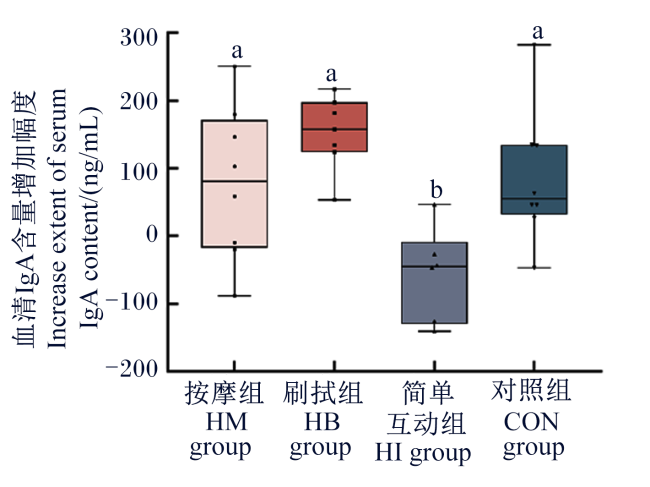
图1可知,相比1日龄,经过14 d人畜互动后,刷拭组、按摩组和对照组犊牛血清IgA含量增加幅度显著高于简单互动组(P<0.05)。
图1 经过14 d人畜互动后犊牛血清免疫球蛋白A含量变化

数据柱标相同小写字母表示差异不显著(P>0.05),不同小写字母表示差异显著(P<0.05)。下图同。

Fig.1 Change of serum IgA content of calves after 14 days of human-animal interaction

Value columns with the same small letter mean no significant difference (P>0.05), while with different small letters mean significant difference (P<0.05). The same as below.

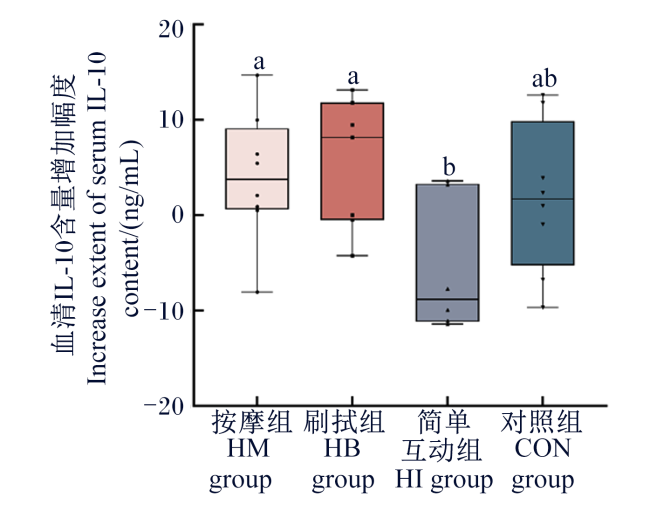
图2可知,相比1日龄,经过14 d人畜互动后,刷拭组和按摩组犊牛血清IL-10含量增加幅度显著高于简单互动组(P<0.05)。
图2 经过14 d人畜互动后犊牛血清白细胞介素-10含量变化

Fig.2 Change of serum IL-10 content of calves after 14 days of human-animal interaction

2.2.2 人畜互动对新生犊牛血清应激指标的影响

表4可知,各组之间血清COR、GABA、EPI、DA、5-HT和NE含量均无显著差异(P>0.05)。
表4 人畜互动对14日龄犊牛血清应激指标的影响

Table 4 Effects of human-animal interaction on serum stress indices of 14-day-old calves

项目
Items
按摩组
HM group
刷拭组
HB group
简单互动组
HI group
对照组
CON group
P
P-value
样本量 n 8 7 6 8
皮质醇 COR/(ng/mL) 21.37±2.93 18.11±2.93 22.35±3.25 23.40±2.80 0.615
γ-羟基丁酸 GABA/(μmol/L) 0.95±0.06 1.00±0.06 0.91±0.07 0.92±0.06 0.739
肾上腺素 EPI/(ng/mL) 2.43±0.19 2.24±0.20 2.11±0.23 2.09±0.19 0.589
多巴胺 DA/(nmol/L) 10.94±1.15 11.48±1.22 11.08±1.32 10.84±1.16 0.982
5-羟色胺 5-HT/(pg/mL) 256.19±16.15 256.08±17.21 276.58±18.61 251.62±16.18 0.765
去甲肾上腺素 NE/(ng/mL) 10.94±1.15 11.48±1.22 11.08±1.32 10.84±1.16 0.982
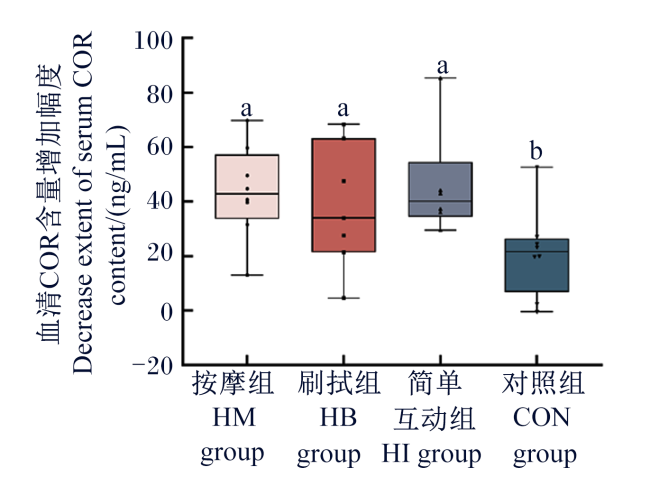
图3可知,相比1日龄,经过14 d人畜互动后,刷拭组、按摩组和简单互动组犊牛血清COR含量下降幅度显著高于对照组(P<0.05)。
图3 经过14 d人畜互动后犊牛血清皮质醇含量变化

Fig.3 Change of serum COR content of calves after 14 days of human-animal interaction

2.2.3 人畜互动对新生犊牛血清生化指标的影响

表5可知,各组之间血清GH、T3、T4、LD、GLU、UN、TG、TC、TP和ALB含量均无显著差异(P>0.05)。
表5 人畜互动对14日龄犊牛血清生化指标的影响

Table 5 Effects of human-animal interaction on serum biochemical indices of 14-day-old calves

项目
Items
按摩组
HM group
刷拭组
HB group
简单互动组
HI group
对照组
CON group
P
P-value
样本量 n 8 7 6 8
生长激素 GH/(ng/mL) 1.05±0.12 1.18±0.13 1.23±0.14 1.06±0.12 0.694
三碘甲腺原氨酸 T3/(ng/mL) 2.56±0.12 2.66±0.13 2.83±0.14 2.60±0.12 0.502
四碘甲腺原氨酸 T4/(ng/mL) 140.99±11.71 133.72±12.49 143.30±13.43 127.02±11.65 0.781
乳酸 LD/(mmol/L) 2.23±0.17 1.99±0.18 2.32±0.19 2.14±0.17 0.615
葡萄糖 GLU/(mmol/L) 4.07±0.37 4.41±0.41 4.34±0.42 4.57±0.37 0.813
尿素氮 UN/(mmol/L) 3.16±0.25 3.34±0.27 3.51±0.28 3.22±0.24 0.798
甘油三酯 TG/(mmol/L) 0.49±0.07 0.52±0.07 0.42±0.08 0.34±0.07 0.276
总胆固醇 TC/(mmol/L) 2.51±0.17 2.44±0.18 2.33±0.19 2.37±0.17 0.901
总蛋白 TP/(g/L) 57.50±0.81 56.37±0.89 57.09±0.94 57.99±0.83 0.610
白蛋白 ALB/(g/L) 24.41±0.53 24.90±0.57 24.85±0.63 24.64±0.54 0.918

3 讨论

试验期间,温湿指数绝大多数时间大于72(热应激阈值[14]),并观察到部分犊牛出现了呼吸频率过快和食欲下降等热应激症状,这种试验环境可能会影响到犊牛的采食和生长发育。
试验犊牛1~14日龄,处于哺乳阶段,以牛奶为主要营养和能量来源,而每天的牛奶饲喂量是固定的,因此采食开食料较少,采食时间也较短,可能是导致各组之间生长性能没有显著差异的主要原因。
大量的试验和相关研究已经证实了情感与免疫功能之间的关联[15-17]。情感能够通过交感神经纤维直接作用于免疫系统,从而影响白细胞的分布和功能[17]。近年来,IgA在人类和试验动物的研究中被用作生理应激的生物标志物[18]。IgA在免疫系统对病原体的防御中起着关键作用,其含量可以用来反映机体的体液免疫状态,并与生理健康和心理健康有关[19]。研究发现,与动物进行积极交互对动物是一种积极的心理刺激[7]。积极刺激可能会导致血清IgA含量急剧上升[20-21]。接受过抚摸治疗的猫粪便中有着更高的IgA含量,并且情绪更加稳定[22-23]。Guzmán-Mejía等[24]发现,压力引起的急性应激会引起小鼠体内IgA含量降低。本研究发现,刷拭组14日龄犊牛血清IgA含量显著高于对照组,且其增加幅度显著高于简单互动组,表明使用体毛刷刷拭对新生犊牛的免疫功能产生了积极的效果,而按摩组、简单互动组产生的效果不明显。
细胞因子是一类小分子蛋白质,它们由免疫细胞或某些非免疫性细胞在受到抗原刺激后合成与分泌,具有调节免疫应答和参与炎症反应等生物学功能[16]。IL-10是一种抗炎性细胞因子,主要用于抑制免疫细胞的活性,减轻炎症反应,以维护免疫平衡和防止过度炎症反应[25]。有大量证据表明,IL-10含量的降低与行为的变化有关[25-26]。Labaka等[26]发现,表现出抑郁焦虑行为的雌性小鼠海马区IL-10含量降低。本研究中,相比1日龄,经过14 d人畜互动后,刷拭组14日龄犊牛血清IL-10含量增加幅度显著高于简单互动组,且3种人畜互动类型中刷拭组血清IL-10含量增加幅度最大,再次表明使用体毛刷刷拭对于新生犊牛是一种更积极的刺激,对新生犊牛的免疫功能产生了积极的效果。
COR作为下丘脑-垂体-肾上腺(HPA)轴的主要活动激素,可调控HPA轴活动[27]。COR可以穿越血脑屏障影响大脑情感区域的调节,故其含量的变化被广泛用作急性应激指标[28]。此外,COR在调节葡萄糖代谢方面发挥关键作用。然而,COR含量的升高会导致免疫抑制和炎症[29]。新生犊牛经过母牛的产道娩出后直接暴露在完全不同于母体子宫的外部环境中,其出生过程及外部环境对新生犊牛均为突发的剧烈刺激,而且这个阶段犊牛生理机能尚未完全发育成熟,因此适应外部环境的能力有限,容易受到应激的影响,并危害健康。本研究发现,相比1日龄,经过14 d人畜互动后,刷拭组、按摩组和简单互动组的血清COR含量下降幅度均显著高于对照组,且刷拭组14日龄血清COR含量在4组中最低。这进一步表明体毛刷刷拭对新生犊牛来说是一种更积极的刺激,可以缓解新生犊牛应激。

4 结论

尽管3种人畜互动类型均对新生犊牛生长性能无显著影响,但体毛刷刷拭能够增强新生犊牛免疫力,降低新生犊牛的应激水平,其效果好于按摩和简单互动,提示体毛刷刷拭可能是一种能改善新生犊牛健康和福利的互动方式。
致谢: 感谢中国农业科学院农业信息研究所舒航博士对试验实施提出的宝贵建议。
[1]
LANGE A, FRANZMAYR S, WISENÖCKER V, et al. Effects of different stroking styles on behaviour and cardiac parameters in heifers[J]. Animals, 2020, 10(3):426.

[2]
LI C C, WANG J, JIN S, et al. Artificial grooming during early life could boost the activity and human affinity of Holstein female calves[J]. Animals, 2020, 10(2):302.

[3]
LÜRZEL S, WINDSCHNURER I, FUTSCHIK A, et al. Gentle interactions decrease the fear of humans in dairy heifers independently of early experience of stroking[J]. Applied Animal Behaviour Science, 2016,178:16-22.

[4]
REINHARDT C, REINHARDT A, REINHARDT V. Social behaviour and reproductive performance in semi-wild Scottish Highland cattle[J]. Applied Animal Behaviour Science, 1986, 15(2):125-136.

[5]
SCHMIED C, WAIBLINGER S, SCHARL T, et al. Stroking of different body regions by a human:effects on behaviour and heart rate of dairy cows[J]. Applied Animal Behaviour Science, 2008, 109(1):25-38.

[6]
BERTENSHAW C E, ROWLINSON P. Exploring heifers’ perception of ‘positive’ treatment through their motivation to pursue a retreated human[J]. Animal Welfare, 2008, 17(3):313-319.

[7]
WESTERATH H S, GYGAX L, HILLMANN E. Are special feed and being brushed judged as positive by calves?[J]. Applied Animal Behaviour Science, 2014,156:12-21.

[8]
SCHMIED C, BOIVIN X, WAIBLINGER S. Stroking different body regions of dairy cows:effects on avoidance and approach behavior toward humans[J]. Journal of Dairy Science, 2008, 91(2):596-605.

[9]
LÜRZEL S, MÜNSCH C, WINDSCHNURER I, et al. The influence of gentle interactions on avoidance distance towards humans,weight gain and physiological parameters in group-housed dairy calves[J]. Applied Animal Behaviour Science, 2015,172:9-16.

[10]
WINDSCHNURER I, BARTH K, WAIBLINGER S. Can stroking during milking decrease avoidance distances of cows towards humans?[J]. Animal Welfare, 2009, 18(4):507-513.

[11]
HORVATH K C, MILLER-CUSHON E K. Characterizing grooming behavior patterns and the influence of brush access on the behavior of group-housed dairy calves[J]. Journal of Dairy Science, 2019, 102(4):3421-3430.

DOI PMID

[12]
NRC. A guide to environmental research on animals[S]. Washington,D.C.: National Academy of Sciences,1971.

[13]
PIAZZA M, GIANNUZZI D, TESSARI R, et al. Associations between ultrasound hepatic measurements,body measures,and milk production traits in Holstein cows[J]. Journal of Dairy Science, 2022, 105(8):7111-7124.

[14]
M’HAMDI N, DAREJ C, ATTIA K, et al. Modelling THI effects on milk production and lactation curve parameters of Holstein dairy cows[J]. Journal of Thermal Biology, 2021,99:102917.

[15]
LV J, LI J H, WANG C, et al. Positive or negative emotion induced by feeding success or failure can affect behaviors,heart rate and immunity of suckling calves[J]. Physiology & Behavior, 2018,196:185-189.

[16]
STELLAR J E, JOHN-HENDERSON N, ANDERSON C L, et al. Positive affect and markers of inflammation:discrete positive emotions predict lower levels of inflammatory cytokines[J]. Emotion, 2015, 15(2):129-133.

[17]
BROD S, RATTAZZI L, PIRAS G, et al. ‘As above,so below’ examining the interplay between emotion and the immune system[J]. Immunology, 2014, 143(3):311-318.

[18]
WHITHAM J C, HALL K, LAUDERDALE L K, et al. Integrating reference intervals into chimpanzee welfare research[J]. Animals, 2023, 13(4):639.

[19]
STALEY M, CONNERS M G, HALL K, et al. Linking stress and immunity:immunoglobulin A as a non-invasive physiological biomarker in animal welfare studies[J]. Hormones and Behavior, 2018,102:55-68.

[20]
PRESSMAN S D, COHEN S. Does positive affect influence health?[J]. Psychological Bulletin, 2005, 131(6):925-971.

DOI PMID

[21]
WATANUKI S, KIM Y K. Physiological responses induced by pleasant stimuli[J]. Journal of Physiological Anthropology and Applied Human Science, 2005, 24(1):135-138.

PMID

[22]
GOURKOW N, HAMON S C, PHILLIPS C J C. Effect of gentle stroking and vocalization on behaviour,mucosal immunity and upper respiratory disease in anxious Shelter cats[J]. Preventive Veterinary Medicine, 2014, 117(1):266-275.

[23]
GOURKOW N, PHILLIPS C J C. Effect of interactions with humans on behaviour,mucosal immunity and upper respiratory disease of shelter cats rated as contented on arrival[J]. Preventive Veterinary Medicine, 2015, 121(3/4):288-296.

[24]
GUZMÁN-MEJÍA F, GODÍNEZ-VICTORIA M, VEGA-BAUTISTA A, et al. Intestinal homeostasis under stress siege[J]. International Journal of Molecular Sciences, 2021, 22(10):5095.

[25]
YANG L, LIU C, LI W Y, et al. Depression-like behavior associated with E/I imbalance of mPFC and amygdala without TRPC channels in mice of knockout IL-10 from microglia[J]. Brain,Behavior,and Immunity, 2021,97:68-78.

[26]
LABAKA A, GÓMEZ-LÁZARO E, VEGAS O, et al. Reduced hippocampal IL-10 expression,altered monoaminergic activity and anxiety and depressive-like behavior in female mice subjected to chronic social instability stress[J]. Behavioural Brain Research, 2017,335:8-18.

[27]
LIGHTMAN S L, BIRNIE M T, CONWAY-CAMPBELL B L. Dynamics of ACTH and cortisol secretion and implications for disease[J]. Endocrine Reviews, 2020, 41(3):bnaa002.

[28]
JOËLS M, KARST H, KRUGERS H J, et al. Chronic stress:implications for neuronal morphology,function and neurogenesis[J]. Frontiers in Neuroendocrinology, 2007, 28(2/3):72-96.

[29]
TALLET C, SY K, PRUNIER A, et al. Behavioural and physiological reactions of piglets to gentle tactile interactions vary according to their previous experience with humans[J]. Livestock Science, 2014,167:331-341.

Outlines

/