RESEARCH PAPER

Effects of Soybean Oil and Cottonseed Oil Diets on Growth Performance and Lipid and Energy Metabolism of Spotted Seabass (Lateolabrax maculatus)

  • HOU Anhui , 1, 2 ,
  • XUE Min 1, 3 ,
  • LIANG Xiaofang 1 ,
  • WU Xiufeng 1 ,
  • ZHENG Yinhua 1 ,
  • WANG Hao 1 ,
  • WU Lixin 2 ,
  • WANG Jie , 1, 3, *
Expand
  • 1 National Aquatic Feed Safety Evaluation Center, Feed Research Institute, Chinese Academy of Agricultural Sciences, Beijing 100081, China
  • 2 College of Fisheries and Life, Dalian Ocean University, Dalian 116023, China
  • 3 Feed Processing and Quality and Safety Innovation Team, Feed Research Institute, Chinese Academy of Agricultural Sciences, Beijing 100081, China
*associate professor, E-mail:

Received date: 2024-01-05

  Online published: 2024-06-07

Abstract

The aim of this experiment was to study the effects of soybean oil and cottonseed oil on the growth performance and lipid and energy metabolism of spotted seabass, with a view to developing an alternative oil source to soybean oil. Two hundred healthy spotted seabass with an initial body weight of (62.40±0.01) g were selected and randomly divided into 2 groups with 4 replicates per group and 25 fish per replicate. Two groups were fed isonitrogenous and isoenergetic diets of different oil sources based on practical basal feed formulation, namely soybean oil group (SO group) and cottonseed oil group (CO group) diets. The experiment lasted for 10 weeks. The results showed as follows: 1) the feed conversion ratio of CO group was significantly lower than that of SO group (P<0.05). There were no significant differences in morphometric parameters, whole-body nutritional composition, nutrient conversion rates and economic benefits between two groups (P>0.05). 2) The liver cyclic adenosine monophosphate (cAMP) content of CO group was significantly lower than that of SO group (P<0.05), and the mRNA relative expression levels of basal metabolism related genes cyclic adenosine monophosphate-response element binding protein (CREB) and adenosine monophosphate-activated protein kinase (AMPK) in liver were significantly lower than those of SO group (P<0.05). There were no significant differences in the histopathological sections in liver and hindgut and the liver inflammatory cytokines and plasma immune factor contents between two groups (P>0.05). 3) The plasma alanine aminotransferase (ALT) and alkaline phosphatase (AKP) activities and total bile acids (TBA) and total cholesterol (TC) contents of CO group were significantly higher than those of SO group (P<0.05), but the liver TC and triglyceride (TG) contents were significantly lower than SO group (P<0.05). 4) The mRNA relative expression levels of lipogenesis [acetyl-CoA carboxylase 1 (ACC1) and fatty acid synthase (FASN)], lipolysis [monoacylglycerol lipase (MAGL) and adipose triglyceride lipase (ATGL)], fatty acid β-oxidation [peroxisome proliferator-activated receptor α (PPARα)], adipocyte differentiation [peroxisome proliferator-activated receptor γ (PPARγ) and CCAAT/enhancer binding protein α (C/EBPα)], cholesterol metabolism [apolipoprotein Bα (APOBα)], adipocyte stasis [fatty acid-binding protein 1 (FABP1) and monoacylglycerol acyltransferase 2α (MGAT2α)], adipocyte conversion [lipid droplet-encapsulated protein 2 (PLIN2)] and bile acid metabolism related genes [cholesterol 7α-hydroxylase (CYP7A1)] in liver of CO group were significantly lower than those of SO group (P<0.05). 5) The liver stearic acid (C18∶0) content of CO group was significantly higher than that of SO group (P<0.05), the contents of oleic acid (C18∶1n-9), palmitoleic acid (C16∶1), gadoleic acid (C20∶1), neuronic acid (C24∶1), linolenic acid (C18∶3n-3), octadecatrienoic acid (C18∶3n-6) and eichlerianic acid (C20∶3n-6) contents were significantly lower than those of SO group (P<0.05). In conclusion, compared with the soybean oil diet, feeding cottonseed oil diet can reduce the body basal energy and lipolysis metabolism of spotted seabass, thus reduce the feed coefficient and improve the growth performance. The cottonseed oil can effectively replace the use of soybean oil in the feed formulation of spotted seabass and reduce the feed cost.

Cite this article

HOU Anhui , XUE Min , LIANG Xiaofang , WU Xiufeng , ZHENG Yinhua , WANG Hao , WU Lixin , WANG Jie . Effects of Soybean Oil and Cottonseed Oil Diets on Growth Performance and Lipid and Energy Metabolism of Spotted Seabass (Lateolabrax maculatus)[J]. Chinese Journal of Animal Nutrition, 2024 , 36(6) : 3903 -3919 . DOI: 10.12418/CJAN2024.334

全球水产养殖业快速发展,鱼油需求量不断增加。但是鱼油资源短缺,产量受气候变化和日本核污水排放等影响,价格持续攀升。因此寻求适宜的鱼油替代品对水产养殖业的可持续发展十分必要。植物油产量巨大,价格便宜,已成为水产养殖饲料中主要的鱼油替代源,其中大豆油使用较为广泛。研究表明,大豆油部分或全部取代鱼油不会对养殖鱼类的生长性能及饲料转化效率产生影响,如团头鲂(Megalobrama amblycephala)幼鱼(替代比例20%)[1]、大黄鱼(Larmichthys crocea)(替代比例50%)[2]、黄斑蓝子鱼(Siganus canaliculatus)(替代比例67%)[3]、军曹鱼(Rachycentron canadum)(替代比例60%~80%)[4]、赤点石斑鱼(Epinephelus akaara)(替代比例75%)[5]、黑鲷(Acanthopagrus schlegeli)(替代比例60%~80%)[6]、哲罗鱼(Hucho taimen)稚鱼(替代比例100%)[7]。但我国大豆主要依靠进口,2022年大豆进口量9 108.1万t,进口依赖度高达80%以上,因此寻求新的适宜油脂替代大豆油是保障我国水产养殖业可持续发展的重要措施之一。
棉籽油属于非刚性需求性油,具有高产量、低价格的优势,2022年国内棉籽油产量约为148.4万t。棉籽油含有大量必需脂肪酸,不饱和脂肪酸含量接近80%,主要由棕榈酸、硬脂酸、油酸和亚油酸的甘油酯组成,其中亚油酸含量最高(44.0%~55.0%)[8-10]。前期研究发现,棉籽油替代部分或全部鱼油对鱼类生长和健康无负面影响,例如虹鳟(Oncorhynchus mykiss)(替代比例50%)[11-12]、金头鲷(Sparus aurata)幼鱼(替代比例60%)[13]、黑鲷(Sparus aurata)(替代比例60%)[14]、欧洲鲈鱼(Dicentrarchus labrax)(饲粮中含有鱼粉,替代比例100%)[15]
花鲈(Lateolabrax maculatus)是广温广盐的肉食性鱼类,具有肉质鲜美、营养丰富等特性,在我国广泛养殖,其在2022年产量高达218 053 t,对比2021年上涨9.53%[16],关于棉籽油和大豆油在水产生物应用上比较的研究目前鲜见报道,棉籽油是否可以完全替代花鲈饲料中的大豆油有待进一步探究。因此,本研究分别以大豆油和棉籽油为主要油源,探究其对花鲈生长性能、形体指标、血浆生化指标、脂质代谢能力、能量代谢及健康状况影响的差异,分析棉籽油对花鲈肝脏脂质代谢及能量代谢的影响,为棉籽油在花鲈等肉食性鱼类配合饲料中的应用提供科学参考。

1 材料与方法

1.1 试验设计和饲料

试验选取200条初始体重为(62.40±0.01) g的健康花鲈,随机分为2个组,每组4个重复,每个重复25尾鱼。2组分别饲喂基于实用基础饲料配制的不同油源的等氮等能饲料,即大豆油组(SO组)和棉籽油组(CO组)饲料。试验期10周。
试验饲料组成、营养水平及饲料成本见表1。大豆油与棉籽油脂肪酸组成及2组饲料脂肪酸组成见表2。2组饲料中均添加34%的鱼粉及4%的鱼油,其中n-3长链不饱和脂肪酸(LC-PUFA)包含二十碳五烯酸(EPA)和二十二碳六烯酸(DHA)的含量分别达2.207%(SO组)与2.195%(CO组),均满足生长需求量。
表1 试验饲料组成、营养水平(风干基础)及饲料成本

Table 1 Composition and nutrient levels of experimental diets (air-dry basis) and feed cost%

项目 Items 大豆油组 SO group 棉籽油组 CO group
原料 Ingredients
鱼粉 Fish meal 34 34
棉籽浓缩蛋白 Cottonseed protein concentration 24 24
小麦粉 Wheat flour 22 22
微晶纤维素 Microcrystalline cellulose 8 8
鱼油 Fish oil 4 4
大豆油 Soybean oil 4
棉籽油 Cottonseed oil 4
磷脂油 Lecithin 2 2
预混料 Premix1) 1 1
磷酸二氢钙 Ca(H2PO4)2 1 1
合计 Total 100 100
营养水平 Nutrient levels2)
粗蛋白质 Crude protein 41.89 41.89
粗脂肪 Crude lipid 12.21 12.21
水分 Moisture 6.11 5.88
总能 Gross energy/(MJ/kg) 20.33 20.37
饲料成本 Feed cost/(RMB/kg) 12.79 12.57

1)预混料为每千克饲料提供 Premix provided the following per kilogram of diets: VA 20 mg,VB1 10 mg,VB2 15 mg,VB6 15 mg,VB12 8 mg,VC酯 VC ester 1 000 mg,VD3 10 mg,VE 400 mg,VK3 20 mg,泛酸钙 calcium pantothenate 40 mg,烟酸胺 nicotinamide 100 mg,肌醇 inositol 200 mg,生物素 biotin 2 mg,叶酸 folic acid 10 mg,玉米蛋白粉 corn protein powder 150 mg,FeSO4·H2O 300 mg,ZnSO4·H2O 200 mg,MnSO4·H2O 100 mg,CuSO4·5H2O 10 mg,KI 80 mg,CoCl2·6H2O 5 mg,Na2SeO3 5 mg, NaCl 100 mg,沸石 zeolite 695 mg。

2)营养水平为实测值。Nutrient levels were measured values.

表2 大豆油和棉籽油脂肪酸组成及2组饲料脂肪酸组成

Table 2 Fatty acid composition of soybean oil and cottonseed oil and fatty acid composition of two groups of diets%

项目
Items
大豆油
Soybean oil
棉籽油
Cottonseed oil
大豆油组饲料
SO group diet
棉籽油组饲料
CO group diet
肉豆蔻酸 C14∶0 0.07 0.61 0.37 0.40
棕榈酸 C16∶0 9.44 18.10 1.86 2.26
硬脂酸 C18∶0 3.50 1.76 0.44 0.36
二十一碳酸 C21∶0 0.14 0.14
总饱和脂肪酸 ∑SFA 14.30 20.99 3.06 3.39
棕榈油酸 C16∶1 0.08 0.49 0.48 0.49
顺-10-十七碳一烯酸 C17∶1 0.08 0.08
油酸 C18∶1n-9 24.60 14.50 1.86 1.65
鳕鱼酸 C20∶1 0.46 0.24 0.24
神经酸 C24∶1 0.07 0.07
总单不饱和脂肪酸 ∑MUFA 25.14 14.99 2.81 2.63
亚麻酸 C18∶3n-3 5.37 0.14 0.51 0.23
二十碳五烯酸 C20∶5 (EPA) 1.16 1.15
二十二碳六烯酸 C22∶6 (DHA) 1.05 1.04
总n-3多不饱和脂肪酸 ∑n-3PUFA 5.37 0.14 2.72 2.43
亚油酸 C18∶2n-6 49.60 59.10 3.77 3.92
花生四烯酸 C20∶4n-6 0.36 0.36
总n-6多不饱和脂肪酸 ∑n-6PUFA 49.60 59.10 4.16 4.32
总脂肪酸 ∑FA 94.41 95.22 12.74 12.76

表中数据均为实测值。部分脂肪酸(C4∶0、C12∶0、C13∶0、C15∶0、C17∶0、C20∶0、C22∶0、C23∶0、C24∶0、C14∶1、C15∶1、C22∶1、C18∶3n-6和C20∶2)含量较低(<0.05%),表格中未列出它们的数据。

All data in the table were measured values. Some fatty acids (C4∶0, C12∶0, C13∶0, C15∶0, C17∶0, C20∶0, C22∶0, C23∶0, C24∶0, C14∶1, C15∶1, C22∶1, C18∶3n-6 and C20∶2) contents were lower (<0.05%), and the data of them were not listed in the table.

1.2 饲养管理

试验在北京市昌平区南口镇国家水产饲料安全评价基地室内循环水系统中进行。试验前花鲈于养殖系统中暂养2周以适应养殖环境,所用水为曝气井水。暂养料为普通商业饲料,油源由5%鱼油和5%大豆油组成,蛋白质源为35%鱼粉、14%棉籽浓缩蛋白和10%豆粕;其中粗蛋白质含量为43.01%,粗脂肪含量为12.56%。挑选个体大小均匀且健康的花鲈幼鱼,初始体重为(62.40±0.01) g,消毒后随机分配到8个容量积为280 L的圆锥形养殖桶中,每个养殖桶放养25尾,每组4个重复,进行10周养殖。在养殖试验期间,每天进行2次(08:00和16:00)表观饱食投喂。记录死鱼数并进行称重,每天对投喂料盒进行称重,捞出残饵进行计数,计算饲料消耗量,记录总摄食量。试验过程中,水温为24~26 ℃,pH为7.3~7.6,总氨氮浓度为0.2~0.4 mg/L,亚硝酸盐浓度为0.3 mg/L,溶解氧浓度为7 mg/L。

1.3 样品采集

在试验开始前,随机选取6尾饥饿24 h的花鲈作为初始鱼样品用于后续分析。10周养殖试验结束后,每桶鱼饥饿24 h后称重。从每个养殖桶中随机选取3尾鱼作为终末全鱼样品,进行全鱼样品水分、粗灰分、粗蛋白质、粗脂肪含量分析。每桶随机选取3尾鱼,使用浓度为300 mg/mL的三氯叔丁醇将鱼麻醉后分别测量其体长(自吻端至椎骨末端的长度)和体重,并进行采血,使用被抗凝剂(2%氟化钠+4%草酸钠)润洗过的1.5 mL一次性注射器从鱼的尾静脉取血,使用离心机在4 ℃、4 000 r/min的条件下离心10 min,分离出上层血浆,储存于-80 ℃冰箱中用于后续指标的测定。将取血后的鱼进行解剖,对内脏团、肝脏、腹腔脂肪进行称重,剪出胴体称重。
在肝脏靠近胆管附近取2块大小为0.5 cm×0.5 cm×0.5 cm的组织,用4%多聚甲醛进行固定,并用于后续组织病理学分析;取靠近肛门处的后肠组织,用甲醇醋酸固定液(60%甲醇+10%醋酸)进行固定,并用于后续的组织病理学分析;收集剩余的肝脏、肠道样品,置于无RNA酶的冻存管中,在液氮中速冻后存于-80 ℃冰箱,用于后续分析试验。

1.4 组织匀浆液制备

肝脏组织匀浆液使用生理盐水法制备,即取适量肝脏组织(50 mg左右)于离心管中,按照组织重量(mg)∶体积(μL)=1∶9的比例加入9倍体积生理盐水,用组织匀浆机将其完全破碎混匀,并在4 ℃、3 500 r/min条件下离心10 min,吸取上清液,用考马斯亮蓝试剂(南京建成生物工程研究所)测定组织蛋白浓度,在-80 ℃条件下保存,用于后续指标测定。

1.5 指标检测

1.5.1 生长指标、形体指标及经济效益

生长指标和形体指标计算公式如下:

存活率(survival rate,SR,%)=(试验结束时鱼尾数/试验开始鱼尾数)×100;

特定生长率(specific growth rate,SGR,%/d)=[(ln鱼体末重-ln鱼体初重)/饲喂天数]×100;

饲料系数(feed conversion ratio,FCR)=摄食量/(末鱼体重+死亡鱼重-初始鱼体重);

摄食率(feeding rate,FR,%/d)={饲料总摄取量/[(末鱼体重+初始鱼体重)/2]/饲喂天数}×100;

蛋白质效率(protein efficiency ratio,PER)=[(末鱼体重-初始鱼体重)/(总摄入量-蛋白总摄入量)]×100;

蛋白质沉积率(protein retention,PR,%)=[(末鱼体蛋白质重量-初始鱼体蛋白质重量)/(蛋白质总摄入量)]×100;

脂肪沉积率(lipid retention,LR,%)=(末鱼体脂肪重量-初始鱼体脂肪重量)/(脂肪总摄入量)×100;

肥满度(condition factor,CF,g/cm3)=鱼体重/鱼体长3;

肝体比(hepatosomatic index,HSI,%)=(肝脏重/全鱼重)×100;

脏体比(viscera somatic index,VSI,%)=(内脏重/全鱼重)×100;

腹脂率(visceral adipose index,VAI,%)=(腹脂重/全鱼重)×100;

胴体比(carcass ratio,CR,%)=(鱼胴体重/全鱼重)×100。

经济效益计算公式如下:

养殖成本(feeding cost,FC,RMB/kg)=饲料系数×饲料成本;

经济利润指数(economic profit index,EPI,

RMB/kg)=(终末体重×鱼售价)-(养殖成本×鱼增重)。

计算公式参考Martínez-Llorens等[17]和Sánchez Lozano等[18]的报道,饲料成本均以各原料购买时销售价格计算。

1.5.2 营养水平及脂肪酸含量

全鱼及试验饲料营养水平分析均参照国标方法,分别采用105 ℃常压干燥法(GB/T 6435—2006)、凯氏定氮法(GB/T 6432—1994)、550 ℃灼烧法(GB/T 6438—2007)、酸水解全脂肪测定法(GB/T 6433—2006)测定全鱼和饲料样品的水分、粗蛋白质、粗灰分、粗脂肪含量。全鱼与饲料样品的总能使用IKA-C2000氧弹量热仪(IKA,德国)进行测定。
肝脏样品真空低温冻干后研磨成粉末进行脂肪酸含量测定。肝脏及试验饲料脂肪酸含量检测参照国标方法《食品安全国家标准食品中脂肪酸的测定》(GB 5009.168—2016)中的水解法提取样品中脂肪酸。称取1 g左右的冻干样品,装入10 mL容量瓶中,分别加2.5 mL石油醚和苯,振荡混匀后静置2 h后加入0.5 mL浓度为2 mol/L的氢氧化钾甲醇溶液,再次静置0.5 h,加入饱和氯化钠溶液至距离磨砂口1 cm处,静置直至上清液出现澄清的状态,将溶液过0.22 μm有机滤膜,最后采用气相色谱仪上机检测,采用绝对值内标法对脂肪酸含量进行分析。

1.5.3 血浆和肝脏匀浆生化指标

血浆总蛋白(total protein,TP)、葡萄糖(glucose,GLU)、总胆固醇(total cholesterol,TC)、甘油三酯(triglycerides,TG)、高密度脂蛋白胆固醇(high density lipoprotein-cholesterol,HDL-C)、低密度脂蛋白胆固醇(low density lipoprotein-cholesterol,LDL-C)、总胆汁酸(total bile acid,TBA)、三碘甲状腺原氨酸(triiodothyronine,T3)、甲状腺素(thyroxine,T4)含量以及碱性磷酸酶(alkaline phosphatase,AKP)、谷丙转氨酶(alanine aminotransferase,ALT)、谷草转氨酶(aspartate aminotransferase,AST)活性均采用南京建成生物工程研究所的试剂盒进行测定,血浆免疫球蛋白M(immunoglobulin M,IgM)、补体3(complement 3,C3)含量使用酶联免疫试剂盒(江苏酶免实业有限公司),在多功能酶标仪(TECAN SPARK,奥地利)上测定。
肝脏匀浆总胆固醇、甘油三酯含量采用南京建成生物工程研究所的试剂盒,环磷酸腺苷(cyclic AMP,cAMP)、肿瘤坏死因子-α(tumor necrosis factor-α,TNF-α)、白细胞介素-10(interleukin-10,IL-10)、白细胞介素-1β(interleukin-1β,IL-1β)含量使用酶联免疫试剂盒(江苏酶免实业有限公司),在多功能酶标仪(TECAN SPARK,奥地利)上测定。

1.5.4 肝脏基因表达量检测

每组取10尾鱼进行肝脏组织基因表达量检测,取50~100 mg肝脏组织样品,在液氮中研磨成粉末,并用从TaKaRa公司购入的RNAiso Plus(D9108A,大连TaKaRa公司)试剂提取总RNA,在1%琼脂糖凝胶上电泳,以确保RNA的完整性。用NanoDrop 2000(Thermo公司,美国)分光光度仪测定吸光度(OD)260/280值,并记录RNA浓度。同时用反转录试剂盒(KR118,天根生化科技有限公司)反转录为cDNA。以延伸因子-1α(EF-1α)作为花鲈的内参基因,从GenBank中获得(No. JQ995144)其序列,本试验所用的目标序列参考Wu等[14]及张颖[19]。实时荧光定量PCR结果通过2-△△Ct方法计算。

1.5.5 组织切片制备

将浸泡固定液24 h后的肝脏组织取出,进行脱水,石蜡包埋处理后用切片机切出厚度约6 μm的组织切片,经脱蜡操作后进行苏木精-伊红(hematoxylin-eosin,HE)染色。另一块肝脏组织从固定液中取出后使用刀片切至适宜大小,用磷酸盐缓冲液(PBS)润洗后使用梯度浓度的蔗糖溶液进行脱水操作,用OTC包埋,切片10 μm,进行油红O(oil red O,OR)脂肪染色。
将固定24 h的后肠组织取出,经脱水、包埋、切片、脱蜡处理后分别进行HE染色与阿尔星蓝(alcian blue,AB)染色。组织切片均使用Tissue FAXS(Tissue Gnostics,奥地利)进行扫描观察。

1.6 数据统计与分析

试验结果用平均值±标准误表示。数据先使用GraphPad Prism 9.00先分别进行标准QQ plot与Shapiro-Wilk检验其正态分布,对不符合正态分布的数据进行转换,再进行独立样本t检验(t test),以P<0.05为显著性标准。数据图均用GraphPad Prism 9.00绘制。

2 结果与分析

2.1 大豆油与棉籽油饲料对花鲈生长性能、形体指标、全鱼营养组分、营养转化率及经济效益的影响

表3所示,2组之间存活率、增重率、特定生长率和摄食率均无显著差异(P>0.05),CO组饲料系数显著低于SO组(P<0.05)。2组之间形体指标(肥满度、脏体比、肝体比、胴体比和腹脂率)、全鱼营养组分(水分、粗灰分、粗蛋白质、粗脂肪含量及总能)、营养转化率(蛋白质效率、蛋白质沉积率和脂肪沉积率)和经济效益(养殖成本和经济利润指数)均无显著差异(P>0.05)。
表3 大豆油与棉籽油饲料对花鲈生长性能、形体指标、全鱼营养组分、营养转化率及经济效益的影响

Table 3 Effects of soybean oil and cottonseed oil diets on growth performance, morphometric parameters, whole-body nutritional components, nutrient conversion rates and economic benefits of spotted seabass

项目
Items
大豆油组
SO group
棉籽油组
CO group
P
P-value
生长性能 Growth performance
存活率 SR/% 98.00±1.15 100.00±0.00 0.13
增重率 WG/% 183.80±6.03 188.75±6.74 0.11
特定生长率 SGR/(%/d) 1.49±0.03 1.52±0.03 0.34
摄食率 FR/(%/d) 1.61±0.03 1.57±0.03 0.11
饲料系数 FCR 1.17±0.02 1.13±0.02 0.02
形体指标 Morphometric parameters
肥满度 CF/(g/cm3) 1.33±0.02 1.29±0.03 0.45
脏体比 VR/% 10.63±0.28 10.09±0.32 0.18
肝体比 HSI/% 0.88±0.05 0.94±0.06 0.24
胴体比 CR/% 73.16±0.42 73.24±0.46 0.40
腹脂率 VAI/% 6.27±0.31 5.85±0.34 0.30
全鱼营养组分 Whole-body nutritional components
水分 Moisture/% 68.10±0.38 67.74±0.36 0.54
粗灰分 Ash/% 13.08±0.38 12.78±0.14 0.83
粗蛋白质 Crude protein/% 16.90±0.13 16.63±0.19 0.30
粗脂肪 Crude lipid/% 10.58±0.34 11.35±0.28 0.13
总能 Gross energy/(MJ/kg) 8.35±0.19 8.54±0.12 0.43
营养转化率 Nutrient conversion rates
蛋白质沉积率 PR/% 35.11±1.19 35.72±0.41 0.65
蛋白质效率 PER 2.02±0.05 2.11±0.03 0.20
脂肪沉积率 LR/% 84.57±5.08 97.40±6.06 0.07
经济效益 Economic benefits
养殖成本 FC/(RMB/kg) 15.11±0.42 14.20±0.18 0.09
经济利润指数 EPI/(RMB/kg) 4.95±0.09 5.18±0.11 0.17

2.2 大豆油与棉籽油饲料对花鲈能量代谢的影响

表4所示,CO组血浆T3、T4含量略低于SO组,但2组之间无显著差异(P>0.05)。
表4 大豆油与棉籽油饲料对花鲈血浆能量代谢指标的影响

Table 4 Effects of soybean oil and cottonseed oil diets on plasma energy metabolism indices of spotted seabasspmol/L

项目 Items 大豆油组 SO group 棉籽油组 CO group PP-value
三碘甲状腺原氨酸 T3 262.74±9.40 241.12±11.23 0.24
甲状腺素 T4 4.41±0.20 4.09±0.18 0.15
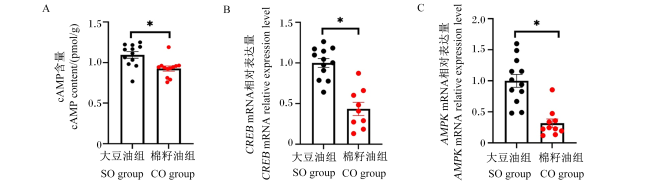
图1可知,CO组肝脏cAMP含量显著低于SO组(P<0.05),同时肝脏内基础代谢相关的基因环磷腺苷效应元件结合蛋白(CREB)和腺苷酸活化蛋白激酶(AMPK)的mRNA相对表达量显著低于SO组(P<0.05),表明CO组花鲈能量代谢速率降低。
图1 大豆油与棉籽油饲料对花鲈肝脏cAMP含量(A)及能量代谢相关基因CREB(B)和AMPK(C)表达的影响

*:差异显著(P<0.05)。下图同。

Fig.1 Effects of soybean oil and cottonseed oil diets on cAMP content (A) and expression of energy metabolism-related genes CREB (B) and AMPK (C) in liver of spotted seabass

*: significant difference (P<0.05). The same as below.

2.3 大豆油与棉籽油饲料对花鲈肝肠组织病理学及免疫的影响

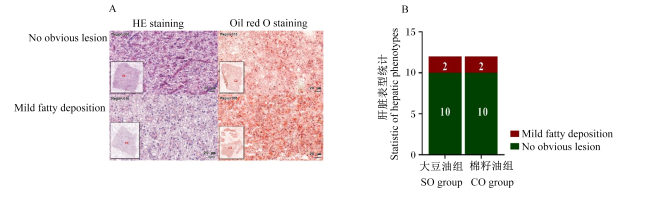
图2可知,肝脏的苏木精-伊红与油红O染色结果显示,肝脏呈现正常与轻微脂肪沉积2种表型,SO组和CO组内10个肝脏表型为无明显异常,2个肝脏表型为轻微的脂肪沉积,即17%。
图2 花鲈肝脏组织切片(A)及肝脏组织表型统计(B)

HE staining:苏木精-伊红染色;Oil red O staining:油红O染色;No obvious lesion:无明显损伤;Mild fatty deposition:轻微脂肪沉积。

Fig.2 Statistics of liver tissue sections (A) and liver tissue phenotypes (B) of spotted seabass

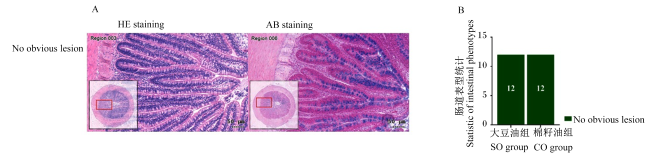
图3可知,后肠的苏木精-伊红与阿尔星蓝染色结果显示,后肠皱襞组织排列紧密,且皱襞内细胞分布均匀,无明显的炎症异常现象。
图3 花鲈肠道组织切片(A)及肠道组织表型统计(B)

HE staining:苏木精-伊红染色;AB staining:阿尔星蓝染色。No obvious lesion:无明显损伤。

Fig.3 Intestinal tissue sections(A) and intestinal tissue phenotypic statistics(B) of spotted seabass

表5所示,2组之间血浆肝脏促炎性因子TNF-α和IL-1β含量以及抑炎因子IL-10含量均无显著差异(P>0.05);此外,2组之间血浆IgM和C3含量均无显著差异(P>0.05)。
表5 大豆油与棉籽油饲料对花鲈肝脏炎性因子和血浆免疫因子指标的影响

Table 5 Effects of soybean oil and cottonseed oil diets on liver inflammatory factor and plasma immune factor indices of spotted seabass

项目
Items
大豆油组
SO group
棉籽油组
CO group
P
P-value
血浆免疫因子指标 Plasma immune factor indices
补体3 C3/(μg/L) 2.10±0.15 2.33±0.09 0.20
免疫球蛋白M IgM/(μg/mL) 0.30±0.02 0.34±0.02 0.14
肝脏炎性因子指标 Liver inflammatory factor indices/(μg/g prot)
白细胞介素-10 IL-10 0.46±0.06 0.44±0.06 0.41
白细胞介素-1β IL-1β 0.11±0.01 0.09±0.01 0.80
肿瘤坏死因子-α TNF-α 1.53±0.29 1.22±0.21 0.40

2.4 大豆油与棉籽油饲料对花鲈血浆肝功能和脂质代谢指标的影响

表6所示,CO组血浆AKP、ALT活性显著高于SO组(P<0.05),2组之间血浆AST活性无显著差异(P>0.05)。CO组血浆TC、TBA含量显著高于SO组(P<0.05),2组之间血浆TG、HDL-C和LDL-C含量无显著差异(P>0.05)。
表6 大豆油与棉籽油饲料对花鲈血浆肝功能和脂质代谢指标的影响

Table 6 Effects of soybean oil and cottonseed oil diets on plasma liver function and lipid metabolism indices of spotted seabass

项目
Items
大豆油组
SO group
棉籽油组
CO group
P
P-value
血浆肝功能指标 Plasma liver function indices
碱性磷酸酶 AKP/(U/mL) 42.52±2.67 51.73±2.75 0.01
谷草转氨酶 AST/(U/L) 4.90±0.89 9.17±2.00 0.08
谷丙转氨酶 ALT/(U/L) 3.13±0.64 6.20±0.87 0.01
血浆脂质代谢指标 Plasma lipid metabolism indices
总胆固醇 TC/(mmol/L) 3.00±0.17 4.14±0.36 0.01
甘油三酯 TG/(mmol/L) 2.08±0.15 3.00±0.22 0.07
低密度脂蛋白胆固醇 LDL-C/(mmol/L) 0.75±0.05 0.76±0.07 0.56
高密度脂蛋白胆固醇 HDL-C/(mmol/L) 0.84±0.04 0.73±0.04 0.06
总胆汁酸 TBA/(μmol/L) 2.50±0.07 13.77±0.24 0.01

2.5 大豆油与棉籽油饲料对花鲈肝脏脂代谢指标和胆汁酸代谢途径及相关基因表达的影响

表7所示,CO组肝脏TG和TC含量显著低于SO组(P<0.05)。
表7 大豆油与棉籽油饲料对花鲈肝脏脂质代谢指标的影响

Table 7 Effects of soybean oil and cottonseed oil diets on liver lipid metabolism indices of spotted seabassmmol/g prot

项目 Items 大豆油组 SO group 棉籽油组 CO group PP-value
总胆固醇 TC 0.75±0.08 0.60±0.06 0.02
甘油三酯 TG 8.36±1.42 3.77±0.54 0.02
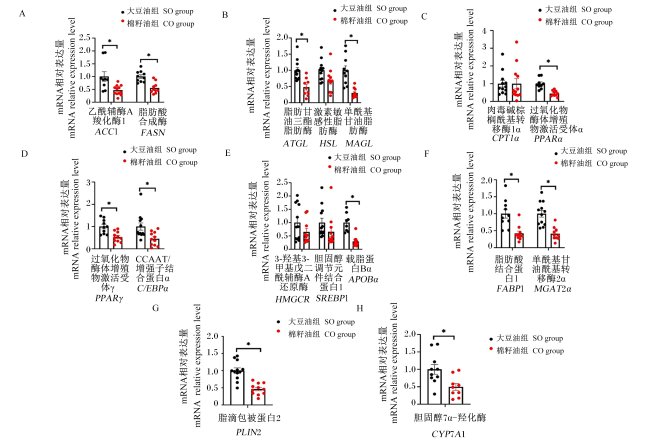
图4可知,CO组肝脏脂肪生成[乙酰辅酶A羧化酶1(ACC1)、脂肪酸合成酶(FASN)]、脂肪分解[单酰基甘油脂肪酶(MAGL)、脂肪甘油三酯脂肪酶(ATGL)]、脂肪酸β氧化[过氧化物酶体增殖物激活受体α(PPARα)]、脂肪细胞分化[过氧化物酶体增殖物激活受体γ(PPARγ)、CCAAT/增强子结合蛋白α(C/EBPα)]、胆固醇代谢[载脂蛋白Bα(APOBα)]、脂肪淤积[脂肪酸结合蛋白1(FABP1)、单酰基甘油酰基转移酶2α(MGAT2α)]、脂肪细胞转化[脂滴包被蛋白2(PLIN2)]和胆汁酸代谢相关基因[胆固醇7α-羟化酶(CYP7A1)]mRNA相对表达水平均显著低于SO组(P<0.05)。
图4 大豆油与棉籽油饲料对花鲈肝脏脂肪代谢相关基因表达的影响

A:脂肪生成;B:脂肪分解;C:脂肪酸β氧化;D:脂肪细胞分化;E:胆固醇代谢;F:脂肪淤积;G:脂肪细胞转化;H:胆汁酸代谢。

Fig.4 Effects of soybean oil and cottonseed oil diets on expression of genes related to fat metabolism in liver of spotted seabass

A: lipogenesis; B: lipolysis; C: fatty acid β-oxidation; D: adipocyte differentiation; E: cholesterol metabolism; F: adipocyte stasis; G: adipocyte conversion; H: bile acid metabolism.

2.6 摄食豆油与棉籽油饲料对花鲈肝脏脂肪酸组成的影响

表8所示,CO组肝脏总饱和脂肪酸含量高于SO组(P>0.05),其中硬脂酸(C18∶0)含量显著高于SO组(P<0.05);CO组肝脏总单不饱和脂肪酸显著低于SO组(P<0.05),其中油酸(C18∶1n-9)、棕榈油酸(C16∶1)、鳕鱼酸(C20∶1)和神经酸(C24∶1)含量均显著低于SO组(P<0.05);CO组肝脏总n-3多不饱和脂肪酸含量显著低于SO组(P<0.05),其中亚麻酸(C18∶3n-3)含量显著低于SO组(P<0.05);CO组肝脏总n-6多不饱和脂肪酸含量低于SO组(P>0.05),其中十八碳三烯酸(C18∶3n-6)和二十碳三烯酸(C20∶3n-6)含量显著低于SO组(P<0.05);2组之间肝脏总脂肪酸含量无显著差异(P>0.05)。
表8 花鲈肝脏脂肪酸组成

Table 8 Liver fatty acid composition of spotted seabass%

项目
Items
大豆油组
SO group
棉籽油组
CO group
P
P-value
肉豆蔻酸 C14∶0 0.65±0.05 0.64±0.06 0.92
棕榈酸 C16∶0 5.41±0.46 5.19±0.36 0.73
十七碳酸 C17∶0 0.14±0.01 0.12±0.03 0.40
硬脂酸 C18∶0 1.62±0.08 2.78±0.22 <0.01
二十一碳酸 C21∶0 0.12±0.01 0.09±0.02 0.11
二十三碳酸 C23∶0 0.10±0.01 0.07±0.01 0.55
总饱和脂肪酸 ∑SFA 8.18±0.61 9.05±0.59 0.34
棕榈油酸 C16∶1 1.50±0.17 0.58±0.09 <0.01
十七碳一烯酸 C17∶1 0.10±0.01 0.08±0.01 0.24
油酸 C18∶1n-9 5.54±0.51 2.88±0.23 <0.01
鳕鱼酸 C20∶1 0.36±0.02 0.26±0.02 0.03
神经酸 C24∶1 0.18±0.00 0.15±0.01 0.04
总单不饱和脂肪酸 ∑MUFA 7.80±0.70 3.94±0.36 <0.01
亚麻酸 C18∶3n-3 0.36±0.03 0.18±0.03 0.01
二十碳五烯酸 C20∶5 (EPA) 1.36±0.07 1.19±0.07 0.16
二十二碳六烯酸 C22∶6 (DHA) 2.63±0.14 2.19±0.10 0.39
总n-3多不饱和脂肪酸 ∑n-3PUFA 4.36±0.24 3.57±0.17 0.04
亚油酸 C18∶2 3.70±0.30 3.79±0.58 0.91
十八碳三烯酸 C18∶3n-6 0.34±0.05 0.16±0.01 0.04
二十碳二烯酸 C20∶2 0.08±0.01 0.07±0.01 0.30
二十碳三烯酸 C20∶3n-6 0.08±0.01 0.05±0.00 0.01
花生四烯酸 C20∶4 0.35±0.01 0.32±0.02 0.13
总n-6多不饱和脂肪酸 ∑n6-PUFA 4.56±0.34 4.38±0.59 0.81
总脂肪酸 ∑FA 24.90±1.56 20.94±1.38 0.11

表中数据均为实测值。部分脂肪酸(C4∶0、C6∶0、C12∶0、 C13∶0、 C15∶0、 C20∶0、C24∶0、C14∶1、 C15∶1、 C22∶1和C20∶3n-3)含量较低(<0.05%),表格中未列出它们的数据。

All date in the table were measured values. Some fatty acids (C4∶0, C6∶0, C12∶0, C13∶0, C15∶0, C20∶0, C24∶0, C14∶1, C15∶1, C22∶1 and C20∶3n-3) contents were lower (<0.05%), and the date of them were not listed in the table.

3 讨论

不同植物油源脂肪酸组成的差异巨大。比较大豆油与棉籽油的脂肪酸组成发现,亚油酸均是其主要脂肪酸,分别占比49.60%和59.10%。饲料中亚油酸含量对广盐性鱼类生长起重要作用,如马苏大马哈鱼(Oncorhynchus.masou)[20]和银大马哈鱼(Oncorhynchus kisutch)[21]。亚油酸可通过调节肝脏脂肪代谢能力,促进血液中低密度脂蛋白的清除,降低血液总胆固醇含量[22]。但是,摄食高水平富含n-6 PUFA的植物油会改变肝脏脂肪含量,导致肝脏组织发生变化[23-27]。在本研究中,虽然棉籽油和大豆油亚油酸占比差异明显,但2组饲料亚油酸含量差异不大,同时肝脏亚油酸组成也未见显著变化。
亚麻酸是合成EPA与DHA的前体物质,具有抗炎及调节机体稳态的作用[28]。亚麻酸在大豆油和棉籽油的占比分别是5.37%和0.14%,其含量对生长和健康均具有重要意义。在前期研究中,摄食植物油造成鱼类负面影响的主要原因是饲料的脂肪酸不平衡[29-31]。相比鱼油,植物油缺乏鱼类必需脂肪酸LC-PUFA(EPA与DHA),海水鱼类合成LC-PUFA的能力较弱,所以必须通过食物中获取满足其生理需求的LC-PUFA[32-35]。不同鱼类对EPA和DHA的最适需求量不同,如尖吻鲈(Lates calcarifer)19 g/kg DHA和11.5 g/kg EPA[36],欧洲黑鲈(Dicentrarchus)5 g/kg DHA和2 g/kg EPA[37],石斑鱼(Epinephelus sp.)2 g/kg DHA和2 g/kg EPA[38],大西洋鲑(Salmo salar)5 g/kg DHA和5 g/kg EPA[39],金头鲷5 g/kg DHA和5 g/kg EPA[40]。本试验饲料配方中添加了4 %的鱼油与34 %的鱼粉,EPA与DHA含量在2组饲料脂肪酸实测值中分别为22.07 g/kg(SO组)与21.95 g/kg(CO组)。Xu等[41]发现,在饲料中脂肪含量12.2%、EPA和DHA含量19.6 g/kg(干物质基础)时花鲈生长性能最佳;Xue等[42]研究发现,在饲料中脂肪含量10%、EPA和DHA含量21 g/kg(湿重基础)时对花鲈生长性能无负面影响;徐后国[43]研究发现,饲料中粗脂肪含量12%左右、EPA和DHA含量19.8 g/kg时促进了鲈鱼的生长。上述研究均表明本研究中2组饲料的DHA和EPA含量完全满足花鲈的生长需求。此外,本研究发现欧洲鲈鱼摄食高水平鱼粉[15],棉籽油可100%替代饲料中的鱼油(EPA和DHA含量占饲料总脂肪酸含量的4.8%);在饲料配方中含有适宜水平的脂肪酸即n-3 LC-PUFA(干物质基础超过2.5%)[44],EPA和DHA(0.9% DM)可以保证金头鲷幼鱼的正常生长和发育[45];黑鲷饲料中含有适当EPA和DHA含量(占总脂肪酸含量的1%或1.34%~1.80%)可维持或促进其生长[6,46]。这都表明在满足n-3 PUFA的需求下,高水平植物油甚至全植物油也不会对肉食性海水鱼类的生长和健康产生不利影响,更多的是起到供能作用。所以本试验中生长表型的差异可能并不是常见的鱼类必需脂肪酸LC-PUFA组成不同导致的。
关于棉籽油和大豆油对水产生物生长和健康影响的比较研究较少[47]。但是在畜禽上,Yang等[48]研究发现,与饲喂全大豆油组相比,50%棉籽油替代大豆油组的肉鸡在育成期(第4~6周)饲料系数也有所改善。De Sousa Lima等[49]也报告了相似的结果,发现肉鸡的增重随棉籽油添加量的增加而增加。生长结果的改善可能与棉籽油的代谢能水平较高有关[50]。本研究中,CO组饲料系数显著低于SO组,且增重率有升高趋势,验证了前期肉鸡研究中的发现。由于生活环境不同,水生动物无法准确计算代谢能,但有研究表明油脂的脂肪酸组成会影响其消化率进而对生长产生影响[51]。本研究中,2组饲料脂肪酸组成较为平衡,但并未对2组饲料的消化率进行检测,但消化率可能是影响花鲈生长差异性的原因,其中的关联性还有待进一步研究。
油源中含有的动物必需脂肪酸可作为能源物质通过氧化代谢为动物细胞供能[52],AMPK是一类重要的蛋白激酶,在细胞能量代谢过程起重要作用。cAMP作为细胞内第二信使可以激活CREB,调节线粒体生成参与能量代谢[53]。甲状腺激素T3、T4可作为产生cAMP的启动子[54]。本研究中,CO组AMPKCREB的mRNA相对表达量及cAMP含量均显著低于SO组;与SO组相比,CO组血浆甲状腺激素T3和T4含量从数值上具有下降的趋势。相关结果均表明,CO组基础代谢速率相比SO组降低,这可能是本研究中饲料系数降低、增重率有升高趋势的主要原因。导致CO组基础代谢速率低于SO组的潜在的原因可能是棉籽油含有天然抗氧化剂生育酚,有助于提高饲料产品的稳定性,延长其的保质期。其在使用过程中不容易氧化,更容易提供能量。
基础代谢率和炎症反应关系密切[55],代谢紊乱会引起炎症反应,进而诱导脂肪肝[56]。但是本研究中花鲈摄食4%棉籽油和豆油并未导致鱼体出现严重的肝脏损伤,肝脏石蜡切片苏木精-伊红染色和冰冻切片油红O染色结果均发现,大豆油和棉籽油导致17%的花鲈出现轻微的脂肪蓄积,CO组花鲈血浆肝功相关指标AKP、ALT活性较高,但单一指标无法确定其肝脏是否出现损伤,结合肝脏炎症因子TNF-α、IL-10与IL-1β及血浆免疫指标IgM、C3结果,表明花鲈肝脏并未出现炎症反应。2组的花鲈肠道均呈现健康状态。
此外,AMPK还参与调控脂质合成,Tanaka等[57]研究发现,激活AMPK途径可以抑制脂质积累,抑制肝细胞凋亡和巨噬细胞介导的炎症反应;Yang等[58]表示通过激活高脂饮食喂养的小鼠的AMPK途径可以减轻脂质积累;Zhang等[59]研究发现,通过激活AMPK/沉默调节蛋白1(SIRT1)信号通路可抑制脂肪组织巨噬细胞浸润和白细胞介素-6(IL-6)和单核细胞趋化蛋白-1(MCP-1)的释放,从而抵抗高脂饮食后的机体脂肪组织肥大。AMPK/乙酰CoA羧化酶(ACC)通路在机体能量代谢、脂肪合成和氧化等方面发挥着重要作用,其被抑制将会促使脂肪代谢紊乱[60]。在本研究中发现,CO组花鲈肝脏脂肪生成(ACC1、FASN)、脂肪分解(MAGLATGL)、胆固醇代谢(APOBα)、胆汁酸代谢(CYP7A1)相关基因表达下调,肝脏中TG、TC含量较低,而血浆TC和TBA含量较高,这可能与CO组AMPK mRNA相对表达量较低密切相关。同时cAMP/CREB信号通路可以促进脂肪酸的β-氧化用以调控机体的能量代谢过程[61]。本试验中,CO组肝脏CREB mRNA相对表达量较低,肝脏cAMP含量也低于大豆油组,肝脏TG水解及脂肪酸β氧化相关基因mRNA相对表达量均下调。脂质代谢相关基因全部下调,但CO组腹脂率低于SO组,表明其并没有造成鱼体内脂肪沉积,可能受CO组整体基础代谢速率降低影响,从而降低了花鲈整体脂肪合成分解速率。
饲料支出是鱼类养殖过程中最重要的支出,占总生产支出的50%~60%[62]。养殖的最终目的是获得较好的经济收益,经济利润指数综合了生长、饲料转化率、存活率、养殖品种的市场价格及饲料成本等变量因素,是评估饲料经济效益的重要参数[17],使用养殖成本和经济利润指数可检验水产养殖过程中的盈利情况[63]。本研究中,2组饲料成本差值约为0.22 RMB/kg;CO组养殖成本略低于SO组,并且可以获得较高利润,说明在商业配方中大批量使用棉籽油饲料替代豆油不仅可以降低成本,还可以增加经济收益。

4 结论

① 与大豆油饲料相比,花鲈摄食棉籽油饲料可降低饲料系数。
② 花鲈摄食棉籽油与大豆油饲料后存活率、形体指标、全鱼营养组分、肝脏炎症因子和免疫因子含量均无显著差异。
③ 与大豆油饲料相比,花鲈摄食棉籽油饲料后肝脏cAMP含量显著降低,且基础代谢相关基因(CREBAMPK)表达下调。
④ 棉籽油完全替代花鲈饲料中的大豆油会通过降低花鲈机体基础能量和脂肪分解代谢,从而提高饲料代谢能、降低饲料系数,最终提高生长性能和经济效益。
[1]
LI Y, LIANG X, ZHANG Y, et al. Effects of different dietary soybean oil levels on growth,lipid deposition,tissues fatty acid composition and hepatic lipid metabolism related gene expressions in blunt snout bream (Megalobrama amblycephala) juvenile[J]. Aquaculture, 2016,451:16-23.

[2]
DUAN Q Y, MAI K S, SHENTU J K, et al. Replacement of dietary fish oil with vegetable oils improves the growth and flesh quality of large yellow croaker (Larmichthys crocea)[J]. Journal of Ocean University of China, 2014, 13(3):445-452.

[3]
XU S D, WANG S Q, ZHANG L, et al. Effects of replacement of dietary fish oil with soybean oil on growth performance and tissue fatty acid composition in marine herbivorous teleost Siganus canaliculatus[J]. Aquaculture Research, 2012, 43(9):1276-1286.

[4]
林华锋. 3种植物油替代鱼油对军曹鱼幼鱼生长、血清生化指标和脂肪酸组成的影响[D]. 硕士学位论文. 湛江: 广东海洋大学, 2012.

LIN H F. Effects of replacement of dietary fish oil by vegetable oils on growth,serum biochemical parameters and fatty acid profiles of juvenile cobia,(Rachycentron canadum)[D]. Master’s Thesis. Zhenjiang: Guangdong Ocean University, 2012. (in Chinese)

[5]
王骥腾, 姜宇栋, 杨云霞, 等. 豆油替代鱼油对赤点石斑鱼(Epinephelus akaara)生长、体组成及体脂肪酸组成的影响[J]. 海洋与湖沼, 2016, 47(3):640-646.

WANG J T, JIANG Y D, YANG Y X, et al. Effects of dietary fish oil replacement by soybean oil on growth performance,body composition and body fatty acid composition of red spotted grouper Epinephelus akaara[J]. Oceanologia et Limnologia Sinica, 2016, 47(3):640-646. (in Chinese)

[6]
PENG S M, CHEN L Q, QIN J G, et al. Effects of replacement of dietary fish oil by soybean oil on growth performance and liver biochemical composition in juvenile black seabream,Acanthopagrus schlegeli[J]. Aquaculture, 2008, 276(1/2/3/4):154-161.

[7]
王炳谦, 徐奇友, 徐连伟, 等. 豆油代替鱼油对哲罗鱼稚鱼生长和体成分的影响[J]. 中国水产科学, 2006, 13(6):1023-1027.

WANG B Q, XU Q Y, XU L W, et al. Effects of soybean oil as replacement of fish oil in diet on growth performance and body composition of juvenile Hucho taimen[J]. Journal of Fishery Sciences of China, 2006, 13(6):1023-1027. (in Chinese)

[8]
印南日, 李培武, 周海燕, 等. 我国食用棉籽油质量安全[J]. 中国农业科技导报, 2013, 15(4):20-24.

YIN N R, LI P W, ZHOU H Y, et al. Quality and safety of edible cottonseed oil in China[J]. Journal of Agricultural Science and Technology, 2013, 15(4):20-24. (in Chinese)

DOI

[9]
付晓华, 张岩, 张薇, 等. 棉籽油中DNA不同提取方法的比较研究[J]. 中国粮油学报, 2014, 29(3):42-46.

FU X H, ZHANG Y, ZHANG W, et al. A comparative study of different methods of DNA extraction of cottonseed oil[J]. Journal of the Chinese Cereals and Oils Association, 2014, 29(3):42-46. (in Chinese)

[10]
巫淼鑫, 邬国英, 韩瑛, 等. 6种食用植物油及其生物柴油中脂肪酸成分的比较研究[J]. 中国油脂, 2003, 28(12):65-67.

WU M X, WU G Y, HAN Y, et al. Fatty acid composition of six edible vegetable oils and their biodiesel-fuels[J]. China Oils and Fats, 2003, 28(12):65-67. (in Chinese)

[11]
GÜLER M, YILDIZ M. effects of dietary fish oil replacement by cottonseed oil on growth performance and fatty acid composition of rainbow trout (Oncorhynchus mykiss)[J]. Turkish Journal of Veterinary & Animal Sciences, 2011, 35(3):157-167.

[12]
YILDIZ M, EROLDOĞAN O T, ENGIN K, et al. Effects of dietary cottonseed and/or canola oil inclusion on the growth performance,FA composition and organ histology of the juvenile rainbow trout,Oncorhynchus mykiss[J]. Turkish Journal of Fisheries & Aquatic Sciences, 2013, 13(3):453-464.

[13]
WASSEF E A, SHALABY S H, SALEH N E. Cottonseed oil as a complementary lipid source in diets for gilthead seabream Sparus aurata juveniles[J]. Aquaculture Research, 2015, 46(10):2469-2480.

[14]
WU Z X, SHEN Y D, BAO Y G, et al. Evaluation of cottonseed oil as a substitute for dietary fish oil of juvenile black seabream (Acanthopagrus schlegelii):based on growth,lipid metabolism,antioxidant capacity and pi3k/akt pathway[J]. Aquaculture Reports, 2022,27:101411.

[15]
EROLDOĞAN T, TURCHINI G M, YILMAZ A H, et al. Potential of cottonseed oil as fish oil replacer in European sea bass feed formulation[J]. Turkish Journal of Fisheries and Aquatic Sciences, 2012,12(4):787-797.

[16]
农业农村部渔业渔政管理局, 全国水产技术推广总站, 中国水产学会. 中国渔业统计年鉴-2022[M]. 北京: 中国农业出版社, 2022.

Fisheries and Fisheries Administration Bureau of the Ministry of Agriculture and Rural Affairs, National Fisheries Technology Extension Center, China Society of Fisheries. China fishery statistical yearbook-2022[M]. Beijing: China Agriculture Press, 2022. (in Chinese)

[17]
MARTÍNEZ-LLORENS S, MOÑINO A V, TOMÁS VIDAL A, et al. Soybean meal as a protein source in gilthead sea bream (Sparus aurata L.) diets:effects on growth and nutrient utilization[J]. Aquaculture Research, 2007, 38(1):82-90.

[18]
SÁNCHEZ LOZANO N B, TOMÁS VIDAL A, MARTÍNEZ-LLORENS S, et al. Growth and economic profit of gilthead sea bream (Sparus aurata,L.) fed sunflower meal[J]. Aquaculture, 2007, 272(1/2/3/4):528-534.

[19]
张颖. 植物蛋白替代饲料鱼粉对花鲈营养代谢和肝脏健康的影响[D]. 硕士学位论文. 哈尔滨: 东北农业大学, 2019.

ZHANG Y. Effects of replacing dietary fishmeal with plant protein on nutritional metabolism and liver health of Japanese seabass, Lateolabrax japonicas[D]. Master’s Thesis.Harbin:Northeast Agricultural University, 2019. (in Chinese)

[20]
ROBBINS K R, NORTON H W, BAKER D H. Estimation of nutrient requirements from growth data[J]. The Journal of Nutrition, 1979, 109(10):1710-1714.

[21]
YU T C, SINNHUBER R O. Effect of dietary ω3 and ω6 fatty acids on growth and feed conversion efficiency of coho salmon (Oncorhynchus kisutch)[J]. Aquaculture, 1979, 16(1):31-38.

[22]
CABALLERO M J, IZQUIERDO M S, KJØRSVIK E, et al. Histological alterations in the liver of sea bream,Sparus aurata L.,caused by short- or long-term feeding with vegetable oils.Recovery of normal morphology after feeding fish oil as the sole lipid source[J]. Journal of Fish Diseases, 2004, 27(9):531-541.

[23]
BENEDITO-PALOS L, NAVARRO J C, BERMEJO-NOGALES A, et al. The time course of fish oil wash-out follows a simple dilution model in gilthead sea bream (Sparus aurata L.) fed graded levels of vegetable oils[J]. Aquaculture, 2009, 288(1/2):98-105.

[24]
LEAVER M J, VILLENEUVE L A, OBACH A, et al. Functional genomics reveals increases in cholesterol biosynthetic genes and highly unsaturated fatty acid biosynthesis after dietary substitution of fish oil with vegetable oils in Atlantic salmon (Salmo salar)[J]. BMC Genomics, 2008,9:299.

[25]
PIEDECAUSA M A, MAZÓN M J, GARCÍA GARCÍA B, et al. Effects of total replacement of fish oil by vegetable oils in the diets of sharpsnout seabream (Diplodus puntazzo)[J]. Aquaculture, 2007, 263(1/2/3/4):211-219.

[26]
WASSEF E A, WAHBY O M, SAKR E M. Effect of dietary vegetable oils on health and liver histology of gilthead seabream (Sparus aurata) growers[J]. Aquaculture Research, 2007, 38(8):852-861.

[27]
PARK J S, CHOI J W, HWANG S H, et al. Cottonseed oil protects against intestinal inflammation in dextran sodium sulfate-induced inflammatory bowel disease[J]. Journal of Medicinal Food, 2019, 22(7):672-679.

[28]
张雪莹, 秦环龙. 肠道菌群影响肿瘤免疫治疗的机制及临床应用研究进展[J]. 肿瘤代谢与营养电子杂志, 2020, 7(2):145-150.

ZHANG X Y, QIN H L. Progress on the mechanism and clinical application of gut microbiota in tumor immunotherapy[J]. Electronic Journal of Metabolism and Nutrition of Cancer, 2020, 7(2):145-150. (in Chinese)

[29]
BRANSDEN M P, BATTAGLENE S C, MOREHEAD D T, et al. Effect of dietary 22∶6n-3 on growth, survival and tissue fatty acid profile of striped trumpeter (Latris lineata) larvae fed enriched Artemia[J]. Aquaculture, 2005, 243(1/2/3/4):331-344.

[30]
李经奇, 李学山, 姬仁磊, 等. 亚麻籽油和豆油替代鱼油对大黄鱼肝脏和肌肉脂肪酸组成及Δ6Fad基因表达的影响[J]. 水生生物学报, 2018, 42(2):232-239.

LI J Q, LI X S, JI R L, et al. The effects of linseed oil and soybean oil on fatty acid composition and Δ6Fad gene expression in liver and muscle of large yellow croaker (Larimichthys crocea)[J]. Acta Hydrobiologica Sinica, 2018, 42(2):232-239. (in Chinese)

[31]
彭墨, 徐玮, 麦康森, 等. 菜籽油替代鱼油对大菱鲆幼鱼生长、脂肪酸组成及脂肪沉积的影响[J]. 动物营养学报, 2015, 27(3):756-765.

PENG M, XU W, MAI K S, et al. Growth,fatty acid composition and lipid deposition of juvenile turbot (Scophthalmus maximus L.) fed diets with fish oil replacement by rapeseed oil[J]. Chinese Journal of Animal Nutrition, 2015, 27(3):756-765. (in Chinese)

[32]
IZQUIERDO M S, WATANABE T, TAKEUCHI T, et al. Requirement of larval red seabream Pagrus major for essential fatty acids[J]. Nippon Suisan Gakkaishi, 1989, 55(5):859-867.

[33]
LEE S M, CHO S H. Influences of dietary fatty acid profile on growth,body composition and blood chemistry in juvenile fat cod (Hexagrammos otakii Jordan et Starks)[J]. Aquaculture Nutrition, 2009, 15(1):19-28.

[34]
KANAZAWA A, TESHIMA S, ONO K. Relationship between essential fatty acid requirements of aquatic animals and the capacity for bioconversion of linolenic acid to highly unsaturated fatty acids[J]. Comparative Biochemistry and Physiology Part B: Comparative Biochemistry, 1979, 63(3):295-298.

PMID

[35]
TOCHER D R, BELL J G, MCGHEE F, et al. Effects of dietary lipid level and vegetable oil on fatty acid metabolism in Atlantic salmon (Salmo salar L.) over the whole production cycle[J]. Fish Physiology and Biochemistry, 2003, 29(3):193-209.

[36]
WILLIAMS K C, BARLOW C G, RODGERS L, et al. Dietary composition manipulation to enhance the performance of juvenile barramundi (Lates calcarifer Bloch) reared in cool water[J]. Aquaculture Research, 2006, 37(9):914-927.

[37]
SKALLI A, ROBIN J H. Requirement of n-3 long chain polyunsaturated fatty acids for European sea bass (Dicentrarchus labrax) juveniles:growth and fatty acid composition[J]. Aquaculture, 2004, 240(1/2/3/4):399-415.

[38]
LIN Y H, SHIAU S Y. Effects of dietary blend of fish oil with corn oil on growth and non-specific immune responses of grouper,Epinephelus malabaricus[J]. Aquaculture Nutrition, 2007, 13(2):137-144.

[39]
RUYTER B, RØSJØ C, EINEN O, et al. Essential fatty acids in Atlantic salmon:time course of changes in fatty acid composition of liver,blood and carcass induced by a diet deficient in n-3 and n-6 fatty acids[J]. Aquaculture Nutrition, 2000, 6(2):109-117.

[40]
IBEAS C, CEJAS J, GÓMEZ T, et al. Influence of dietary n-3 highly unsaturated fatty acids levels on juvenile gilthead seabream (Sparus aurata) growth and tissue fatty acid composition[J]. Aquaculture, 1996, 142(3/4):221-235.

[41]
XU J H, QIN J, YAN B L, et al. Effects of dietary lipid levels on growth performance,feed utilization and fatty acid composition of juvenile Japanese seabass (Lateolabrax japonicus) reared in seawater[J]. Aquaculture International, 2011, 19(1):79-89.

[42]
XUE M, LUO L, WU X F, et al. Effects of six alternative lipid sources on growth and tissue fatty acid composition in Japanese sea bass (Lateolabrax japonicus)[J]. Aquaculture, 2006, 260(1/2/3/4):206-214.

[43]
徐后国. 饲料脂肪酸对鲈鱼幼鱼生长、健康及脂肪和脂肪酸累积的影响[D]. 博士学位论文. 青岛: 中国海洋大学, 2013.

XU H G. Effects of dietary fatty acids on growth performance,health and accumulation of lipids and fatty acids in juvenile Japanese seabass (Lateolabrax japonicus)[D].Ph.D.Thesis. Qingdao: Ocean University of China, 2013. (in Chinese)

[44]
IZQUIERDO M. Essential fatty acid requirements in Mediterranean fish species[J]. Cahiers Options Mediterraneénes, 2005,63:91-102.

[45]
KALOGEROPOULOS N, ALEXIS M N, HENDERSON R J. Effects of dietary soybean and cod-liver oil levels on growth and body composition of gilthead bream (Sparus aurata)[J]. Aquaculture, 1992, 104(3/4):293-308.

[46]
JIN M, MONROIG Ó, NAVARRO J C, et al. Molecular and functional characterisation of two elovl4 elongases involved in the biosynthesis of very long-chain (>C24) polyunsaturated fatty acids in black seabream Acanthopagrus schlegelii[J]. Comparative Biochemistry and Physiology Part B:Biochemistry and Molecular Biology, 2017,212:41-50.

[47]
殷永风, 叶元土, 张宝彤, 等. 棉籽油对斑点叉尾鮰生长性能和脂肪酸组成的影响[J]. 饲料工业, 2013, 34(12):20-23.

YIN Y F, YE Y T, ZHANG B T, et al. Effect of cottonseed oil on growth performance and fatty acid composition of catfish[J]. Feed Industry, 2013, 34(12):20-23. (in Chinese)

[48]
YANG A, QI M, WANG X, et al. Refined cottonseed oil as a replacement for soybean oil in broiler diet[J]. Food Science & Nutrition, 2019, 7(3):1027-1034.

[49]
DE SOUSA LIMA V B, DOURADO L R B, MACHADO L P, et al. Cottonseed oil in diets for broilers in the pre-starter and starter phases[J]. PLoS One, 2016, 11(1):e0147695.

[50]
ROSTAGNO H S, ALBINO L F T, DONZELE J L, et al. Tabelas brasileiras para aves e suínos:composição de alimentos e exigências nutricionais[M]. 2nd ed. Viçosa:UFV,Departa-mento de Zootecnia, 2005.

[51]
STAHLY T S. Use of fats in diets for growing pigs[M]//WISEMAN J.Fats in animal nutrition. London:Butterworth-Heinemann,1984:313-331.

[52]
ROQUE-JIMÉNEZ J A, ROSA-VELÁZQUEZ M, PINOS-RODRÍGUEZ J M, et al. Role of long chain fatty acids in developmental programming in ruminants[J]. Animals, 2021, 11(3):762.

[53]
CHENG I S, HUANG S W, LU H C, et al. Oral hydroxycitrate supplementation enhances glycogen synthesis in exercised human skeletal muscle[J]. British Journal of Nutrition, 2012, 107(7):1048-1055.

[54]
WANG H, ZHAO M Y, SUD N, et al. Glucagon regulates hepatic lipid metabolism via cAMP and insig-2 signaling:implication for the pathogenesis of hypertriglyceridemia and hepatic steatosis[J]. Scientific Reports, 2016,6:32246.

[55]
KIM P K, DEUTSCHMAN C S. Inflammatory responses and mediators[J]. The Surgical Clinics of North America, 2000, 80(3):885-894.

[56]
ZHANG Y, CHEN P, LIANG X F, et al. Metabolic disorder induces fatty liver in Japanese seabass,Lateolabrax japonicas fed a full plant protein diet and regulated by cAMP-JNK/NF-κB-caspase signal pathway[J]. Fish & Shellfish Immunology, 2019,90:223-234.

[57]
TANAKA M, SATO A, KISHIMOTO Y, et al. Gallic acid inhibits lipid accumulation via AMPK pathway and suppresses apoptosis and macrophage-mediated inflammation in hepatocytes[J]. Nutrients, 2020, 12(5):1479.

[58]
YANG L C, ZHAO Y, PAN Y F, et al. Dietary supplement of Smilax china L. ethanol extract alleviates the lipid accumulation by activating AMPK pathways in high-fat diet fed mice[J]. Nutrition & Metabolism, 2019,16:6.

[59]
ZHANG S Y, XU M Y, ZHANG W X, et al. Natural polyphenols in metabolic syndrome:protective mechanisms and clinical applications[J]. International Journal of Molecular Sciences, 2021, 22(11):6110.

[60]
刘梦, 刘舒庭, 卢曦, 等. 基于AMPK/ACC信号通路研究雷公菌活性成分对羟基苯甲醛对大鼠非酒精性脂肪肝的保护作用[J]. 中国现代应用药学, 2022, 39(19):2429-2436.

LIU M, LIU S T, LU X, et al. Protective effect of p-hydroxybenzaldehyde,an active ingredient of Nostoc commune on non-alcoholic fatty liver in rats based on AMPK/ACC signaling pathway[J]. Chinese Journal of Modern Applied Pharmacy, 2022, 39(19):2429-2436. (in Chinese)

[61]
KEMP B E, MITCHELHILL K I, STAPLETON D, et al. Dealing with energy demand: the AMP-activated protein kinase[J]. Trends in Biochemical Sciences, 1999, 24(1):22-25.

DOI PMID

[62]
KOUSOULAKI K, SÆTHER B S, ALBREKTSEN S, et al. Review on European sea bass (Dicentrarchus labrax,Linnaeus,1758) nutrition and feed management:a practical guide for optimizing feed formulation and farming protocols[J]. Aquaculture Nutrition, 2015, 21(2):129-151.

[63]
KANKAINEN M, BERRILL I K, NOBLE C, et al. Modeling the economic impact of welfare interventions in fish farming—a case study from the U.K. rainbow trout industry[J]. Aquaculture Economics & Management, 2012, 16(4):315-340.

Outlines

/