RESEARCH PAPER

Analysis of Biological Characteristics of Mulberry Leaf Fermentation Strains and Quality of Fermented Mulberry Leaves

  • LI Jinzhuan , 1 ,
  • LI Guiming 2 ,
  • ZHANG Haosen 1 ,
  • YANG Tiantian 1 ,
  • JIANG Xiaohan 1 ,
  • ZHANG Rijun 1 ,
  • SI Dayong , 1, *
Expand
  • 1 State Key Laboratory of Animal Nutrition and Feeding, College of Animal Science and Technology, China Agricultural University, Beijing 100193, China
  • 2 Poultry Institute, Shandong Academy of Agricultural Sciences, Ji’nan 250100, China
*associate professor, E-mail:

Received date: 2023-11-20

  Online published: 2024-06-07

Abstract

This study aimed to analyze the biological characteristics of mulberry leaf fermentation strains and quality of fermented mulberry leaves, with the goal of obtaining excellent fermentation strains and promoting the widespread application of fermented mulberry leaves as substitutes for protein feeds such as soybean meal in livestock and poultry production. Excellent strains for mulberry leaf fermentation were selected based on the analysis of their biological characteristics, and the nutritional characteristics of the fermented mulberry leaves were thoroughly analyzed. The results indicated that the candidate strains, such as Pediococcus lactis (PA), Pediococcus pentose (PP) and Lactobacillus agile (LA), exhibited broad-spectrum antibacterial effects against pathogens like Escherichia coli. Furthermore, 4 strains of Bacillus demonstrated strong cellulase and protease production capabilities, while 11 strains exhibited tolerance to acid, temperature, bile salts and artificial gastrointestinal fluids. Additionally, the crude protein content of mulberry leaves fermented by PA, PP, Lactobacillus salivarius (LS), Lactobacillus gasseri (LG), and Bacillus subtilis 1 (BS1) was significantly higher than that of unfermented mulberry leaves (P<0.05). The crude fiber content of mulberry leaves fermented by Bacillus coagulans (BC) and Bacillus subtilis 2 (BS2) was significantly lower than that of the unfermented mulberry leaves and PP and LS fermentation groups (P<0.05). Notably, the pH of mulberry leaves fermented by PA and PP was significantly lower than that in the other groups (P<0.05), and the lactic acid number was significantly higher than that in other groups (P<0.05). In conclusion, the better strains of PA, PP, LS, LA, LR9, BS1 and BL are selected as the mulberry leaf fermentation strains by comprehensively analyzing the biological characteristics of the strains and the quality of fermented mulberry leaves.

Cite this article

LI Jinzhuan , LI Guiming , ZHANG Haosen , YANG Tiantian , JIANG Xiaohan , ZHANG Rijun , SI Dayong . Analysis of Biological Characteristics of Mulberry Leaf Fermentation Strains and Quality of Fermented Mulberry Leaves[J]. Chinese Journal of Animal Nutrition, 2024 , 36(6) : 4070 -4080 . DOI: 10.12418/CJAN2024.349

桑树属于桑科(Moraceae)、桑属(Morus),是一种多年生木本植物,可以适应各种复杂环境,在大多数温带、热带和亚热带地区均可生长,遍布世界各地[1-3]。桑叶是桑树的主要产出物,5 000多年来桑叶主要被用来养蚕纺丝。我国桑树种植面积已超过106 hm2,每年鲜桑叶产量可达25~ 30 t / h m 2 [4]。桑叶营养成分全面而均衡,其中的粗蛋白质(CP)(15%~35%)、粗脂肪(EE)(3.5%~5.57%)、维生素、矿物质(2.42%~4.71%钙、0.23%~0.97%磷)以及氨基酸等营养成分含量均优于紫花苜蓿(13.0%~28.0% CP、1.3%~3.0% EE)[5-7]。此外,许多研究表明,桑叶中含有黄酮类、生物碱、多糖及多酚等天然活性物质,具有降血糖、降脂、抗菌、抗氧化和抗炎作用[8-10]。因此,桑叶可作为一种新型畜禽蛋白质饲料应用于动物生产中。然而,桑叶具有较高的水分和蛋白质含量,不适合长期储存,且成熟桑叶中粗纤维含量较高,这限制了桑叶在畜禽生产中的应用[11-12]。益生菌在畜禽健康养殖中已被广泛应用,微生物发酵桑叶后,可将蛋白质等大分子物质降解为多肽和氨基酸等易被动物消化吸收的小分子物质,同时还能提高CP含量[13]。研究发现,添加干酪乳杆菌可提高发酵桑叶真蛋白质和乳酸含量以及抗氧化能力[2];用植物乳杆菌发酵桑叶可提高其乳酸菌数量和CP含量[14]。然而,大多数研究都侧重于乳酸菌发酵桑叶,而对于发酵乳酸菌的生物学特性以及芽孢杆菌发酵桑叶的研究报道相对较少。因此,本研究通过对7株乳酸菌和4株芽孢杆菌的生长曲线、pH变化曲线、抑菌能力、产酶能力和抗逆性等生物学特性分析,然后利用其发酵桑叶后,对发酵桑叶CP、粗纤维、乳酸、乙酸含量和pH以及乳酸菌数量进行分析,综合各候选菌株的生物学特性,得到发酵效果较好的菌株,以期推动发酵桑叶在绿色安全畜禽养殖中的广泛应用。

1 材料与方法

1.1 试验材料

1.1.1 候选菌株

试验所用乳酸片球菌(Pediococcus acidilactici,PA)、戊糖片球菌(Pediococcus pentosaceus,PP)、唾液乳杆菌(Lactobacillus salivarius,LS)、加氏乳杆菌(Lactobacillus gasseri,LG)、敏捷乳杆菌(Lactobacillus agilis,LA)、罗伊氏乳杆菌4(Lactobacillus reuteri 4,LR4)、罗伊氏乳杆菌9(Lactobacillus reuteri 9,LR9)、枯草芽孢杆菌1(Bacillus subtilis 1,BS1)、地衣芽孢杆菌(Bacillus licheniformi,BL)、凝结芽孢杆菌(Bacillus coagulans,BC)和枯草芽孢杆菌2(Bacillus subtilis 2,BS2)均由本实验室保存。

1.1.2 指示菌株

大肠杆菌(EHEC O157∶H7、K88、K99)、沙门氏菌(CVCC519、CICC10467、ATCC14028)、金黄色葡萄球菌(ATCC43300、ATCC6538、ATCC25923)和单核细胞增生李斯特氏菌(ATCC19115)均来源于本实验室保存。

1.1.3 主要培养基

MRS培养基(用于乳酸菌的培养):大豆蛋白胨10 g,酵母浸出物5 g,牛肉膏10 g,柠檬酸三铵2 g,乙酸钠5 g,葡萄糖20 g,磷酸氢二钾2 g,吐温80 1.0 mL,盐溶液5.0 mL,加去离子水定容至1 000 mL,琼脂15~20 g(固体培养基),121 ℃灭菌20 min。
盐溶液:七水合硫酸镁11.5 g,一水合硫酸锰2.8 g,加去离子水定容至100 mL。
LB培养基(用于指示菌的培养):胰蛋白胨10 g,酵母浸出物5 g,氯化钠10 g,加去离子水定容至1 000 mL,琼脂15~20 g(固体培养基),121 ℃灭菌20 min。
BPY培养基(用于芽孢杆菌的培养):牛肉膏5 g,胰蛋白胨10 g,酵母浸出物5 g,氯化钠5 g,葡萄糖5 g,加去离子水定容至1 000 mL,琼脂15~20 g(固体培养基),121 ℃灭菌 20 min。

1.1.4 发酵材料

桑叶(强桑)采购自浙江省缙云县胡镇桑叶种植园。

1.2 试验方法

1.2.1 菌株活化

将-80 ℃条件下保存的候选菌株在固体培养基平板上划线,37 ℃恒温箱中培养24~48 h,挑取单一菌落到液体培养基,37 ℃、180 r/min培养12~24 h,活化2代后备用。

1.2.2 生长曲线

将已活化的菌株按2%(体积分数)接种量接种到100 mL相应液体培养基中,在37 ℃、180 r/min条件下,7株乳酸菌培养48 h,4株芽孢杆菌培养36 h,每隔2 h取样,测定菌液600 nm吸光度(OD600),以时间为横坐标、OD600为纵坐标,绘制生长曲线。

1.2.3 pH变化曲线

将活化好的菌株以2%(体积分数)接种量接种到100 mL相应液体培养基中,在37 ℃、180 r/min的条件下,7株乳酸菌培养48 h,4株芽孢杆菌培养36 h,,每隔2 h取样,测定菌液pH,以时间为横坐标、pH为纵坐标,绘制pH变化曲线。

1.2.4 抑菌能力

1.2.4.1 指示菌株活化

用接种环挑取指示菌株,分别在LB固体培养基上划线,37 ℃倒置培养24~48 h,挑取单菌落接种于LB液体培养基中,37 ℃、180 r/min培养5~12 h,指示菌悬液调整菌体浓度为1×10⁷ CFU/mL。

1.2.4.2 菌株上清液的制备

将种子液中的菌液以3%(体积分数)的接种量接种于相应液体培养基中,37 ℃、180 r/min培养12~24 h,收集菌液于4 ℃、7 104×g离心20 min得到菌体上清液,经过0.45 μm滤膜过滤后,于4 ℃保存备用。

1.2.4.3 牛津杯法测定菌株的抑菌能力

向培养皿中倾注10 mL左右的营养琼脂培养基后,水平放置,待其凝固,接种100 μL的指示菌悬液,用无菌棉签涂布均匀,然后在培养基表面垂直放置牛津杯,将200 μL菌株上清液加入至牛津杯,以空白培养基作对照,每组设3个重复,室温放置2 h 后,于37 ℃培养24 h,测定抑菌圈直径,根据抑菌圈直径大小判断菌株抑菌能力,抑菌的判定依据为抑菌圈直径>7 mm时,即认定为有抑菌作用[15]

1.2.5 产酶能力

1.2.5.1 纤维素酶活性的测定

纤维素酶活性的测定参照《饲料添加剂纤维素酶活力的测定 分光光度法》(NY/T 912—2020),采用3,5-二硝基水杨酸(DNS)显色法测定[16-17]

1.2.5.2 蛋白酶活性的测定

蛋白酶活性的测定参照《酶制剂质量要求 第1部分:蛋白酶制剂》(GB/T 23527.1—2023)及陈茏[18]测定菌株蛋白酶活性的方法。

1.2.6 抗逆性

1.2.6.1 耐酸能力测定

采用1 mol/L盐酸(HCl)调节液体培养基的pH分别至2.5、3.5、4.5、5.5、6.5和7.0,将活化好的菌株发酵液以2%(体积分数)的接种量接种至不同pH的对应菌株液体培养基中,于37 ℃、180 r/min培养24 h,测定菌液的OD600,以空白培养基作为对照[15,19]

1.2.6.2 温度耐受性

将活化的菌株以2%(体积分数)的接种量接种至对应菌株液体培养基中,分别于30、37、40、45 ℃,180 r/min培养24 h,测定菌液的O D 600 [15,20]

1.2.6.3 胆盐耐受性

将活化的菌株按2%(体积分数)接种量分别接种于胆盐终浓度为0.1%、0.3%、0.5%和1.0%的对应液体培养基中,于37 ℃、180 r/min培养24 h,以空白培养基作为对照,测定菌液的 OD 600 [15,20]

1.2.6.4 模拟胃肠液耐受性

人工胃液的配制:用体积分数为9.5%~10.5%的盐酸调节无菌水溶液pH为2.0后,加入2.5 g/L胃蛋白酶,充分溶解后,用0.22 μm无菌滤膜过滤除菌。
人工肠液的配制:取3.4 g磷酸二氢钾溶于250 mL无菌水溶液中,用0.4%的氢氧化钠溶液调pH至6.8,每100 mL液体中加入1 g胰蛋白酶,混匀后,用0.22 μm无菌滤膜过滤除菌。
将活化的500 μL菌液与4.5 mL人工胃液在5 mL摇菌管中混合,在37 ℃、180 r/min条件下培养4 h,对各菌株进行活菌计数;然后取500 μL培养4 h的混合胃液接入4.5 mL人工肠液中,在37 ℃、180 r/min条件下培养4 h,对各菌株进行活菌计数,计算存活率[20]。计算公式为:

存活率(%)=100×(胃液或肠液培养4 h活菌数/0 h活菌数)。

1.3 候选菌株发酵桑叶

1.3.1 桑叶发酵处理

将新鲜桑叶切至1~2 cm,加入10%麸皮(以新鲜物质为基础)和8%(大于108 CFU/g)制备好的种子液(以新鲜物质为基础),新鲜桑叶量为180 g,混合充分后,将200 g左右的样品装入饲料发酵袋(23 cm×30 cm)中,每个处理3个重复,用封口机密封,置于37 ℃恒温培养箱静置发酵7 d,发酵结束后检测相关指标。

1.3.2 检测指标

CP含量采用凯氏定氮法,参考《饲料中粗蛋白的测定 凯氏定氮法》(GB/T 6432—2018)测定;粗纤维含量参考《饲料中粗纤维的含量测定》(GB/T 6434—2022)测定;pH使用pH酸度计测定;采用高效液相色谱(HPLC)法测定乳酸含量,采用气相色谱(GC)法测定乙酸含量;乳酸菌数量采用稀释涂布平板法进行计数。

1.4 数据统计分析

采用SPSS 26.0对检验数据进行ANOVA分析,并采用Tukey’s和Duncan氏法进行多重比较,采用GraphPad 8.0软件进行绘图。结果数据以平均值和标准差表示,P<0.05表示差异显著,P>0.05表示无显著差异。

2 结果与分析

2.1 生长曲线

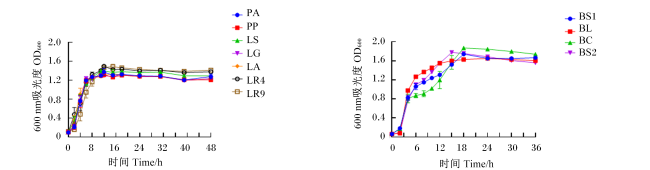
图1可知,7株乳酸菌培养2 h后进入对数期,其中菌株PA、PP、LS和LR4培养12 h后进入稳定期;菌株LA和LR9培养15 h后进入稳定期;菌株LG存在较长的生长周期,对数期为2~18 h。4株芽孢杆菌也是培养2 h后进入对数期,其中菌株BS2培养15 h后进入稳定期;菌株BS1、BL和BC培养18 h后进入稳定期。
图1 11株菌的生长曲线

PA:乳酸片球菌 Pediococcus acidilactici;PP:戊糖片球菌 Pediococcus pentosaceus;LS:唾液乳杆菌 Lactobacillus salivarius;LG:加氏乳杆菌 Lactobacillus gasseri;LA:敏捷乳杆菌 Lactobacillus agilis;LR4:罗伊氏乳杆菌4 Lactobacillus reuteri 4;LR9:罗伊氏乳杆菌9 Lactobacillus reuteri 9;BS1:枯草芽孢杆菌1 Bacillus subtilis 1;BL:地衣芽孢杆菌 Bacillus licheniformi;BC:凝结芽孢杆菌 Bacillus coagulans;BS2:枯草芽孢杆菌2 Bacillus subtilis 2。下图同 the same as below.

Fig.1 Growth curves of 11 strains

2.2 pH变化曲线

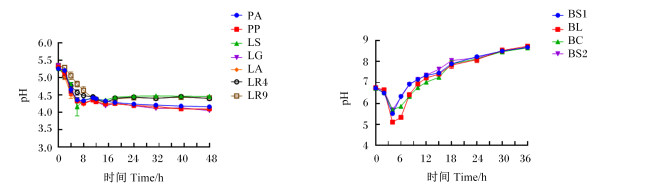
图2可知,菌株PA、PP、LG和LA在2~8 h内pH快速下降,菌株LS在2~6 h内pH快速下降,菌株LR4和LR9在2~15 h内pH快速下降,这与菌株进入对数生长期有关,其生长代谢速度加快,产生大量酸性物质。4株芽孢杆菌在4 h时pH降到最低,4 h后一直保持上升趋势。
图2 11株菌的pH变化曲线

Fig.2 pH change curves of 11 strains

2.3 抑菌能力

表1可知,菌株PA、PP和LA对所有指示菌的抑菌圈直径均大于12 mm,对大肠杆菌、沙门氏菌、金黄色葡萄球菌和李斯特氏菌均具有广谱抑菌效果;其他乳酸菌的抑菌圈直径均大于7 mm,也表现出一定的抑菌能力。而芽孢杆菌BC对个别病原菌的抑菌圈直径大于7 mm,表现出一定的抑菌作用,其他芽孢杆菌则没有明显的抑菌效果。
表1 发酵菌株的抑菌圈直径

Table 1 Antibacterial circle diameters of fermentation strains

菌株
Strains
革兰氏阴性菌 Gram-negative bacterium 革兰氏阳性菌 Gram-positive bacterium
大肠杆菌 Escherichia coli 沙门氏菌 Salmonella 金黄色葡萄球菌 Staphylococcus aureus 李斯特氏菌 Listeria
K99 K88 EHEC O157∶H7 CVCC519 ATCC14028 CICC10467 ATCC43300 ATCC6538 ATCC25923 ATCC19115
PA +++ ++ +++ ++ +++ ++++ ++++ ++++ ++ +++
PP ++ ++ +++ ++ ++ +++ +++ +++ ++ ++
LS ++ + +++ ++ +++ +++ +++ +++ + ++
LG ++ + +++ ++ +++ +++ ++ +++ + +++
LA ++ ++ +++ ++ +++ +++ +++ ++++ ++ ++
LR4 ++ + +++ ++ +++ +++ ++ ++++ + +++
LR9 ++ + +++ ++ +++ +++ ++ ++++ + +++
BS1 - - - - - - - - - -
BL - - - - - - - - - -
BC + + - - + - + + - +
BS2 - - - - - - - - - -

PA:乳酸片球菌 Pediococcus acidilactici;PP:戊糖片球菌 Pediococcus pentosaceus;LS:唾液乳杆菌 Lactobacillus salivarius;LG:加氏乳杆菌 Lactobacillus gasseri;LA:敏捷乳杆菌 Lactobacillus agilis;LR4:罗伊氏乳杆菌4 Lactobacillus reuteri 4;LR9:罗伊氏乳杆菌9 Lactobacillus reuteri 9;BS1:枯草芽孢杆菌1 Bacillus subtilis 1;BL:地衣芽孢杆菌 Bacillus licheniformi;BC:凝结芽孢杆菌 Bacillus coagulans;BS2:枯草芽孢杆菌2 Bacillus subtilis 2。

“-”“+”“++”“+++”和“++++”分别表示抑菌圈直径<7 mm(无抑菌活性)、8~12 mm、12~16 mm、16~20 mm以及>20 mm;牛津杯直径为7 mm。“-”“+”“++”“+++” and “++++” mean the antibacterial circle diameter was <7 mm (no antibacterial activity), 8 to 12 mm, 12 to 16 mm, 16 to 20 mm and >20 mm, respectively. The Oxford cup was 7 mm in diameter.

2.4 产酶能力

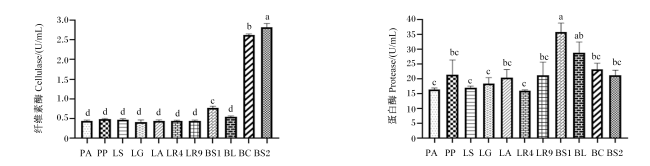
图3可知,菌株BS2和BC产纤维素酶能力显著高于其他菌株(P<0.05),而菌株BS1产纤维素酶能力显著高于芽孢杆菌BL和7株乳酸菌(P<0.05)。菌株BS1产蛋白酶能力显著高于其他菌株(不包括BL)(P<0.05),BL产蛋白酶能力显著高于菌株PA、LS、LG和LR4(P<0.05)。
图3 11株菌产纤维素酶和蛋白酶能力

Fig.3 Cellulase and protease production capacity of 11 strains

2.5 抗逆性

2.5.1 耐酸能力

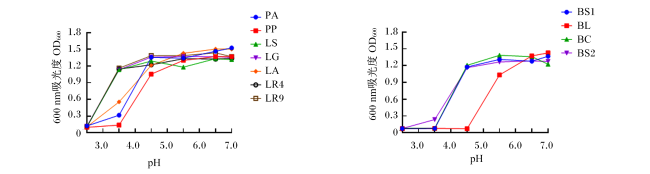
图4可知,在pH小于3.5时,菌株PA、PP和LA生长受到抑制,而其他4株乳酸菌均可以生长;在pH为3.5~7.0范围内,随着pH的升高,7株乳酸菌的生长能力逐渐增强。在pH小于3.5时,4株芽孢杆菌的生长均被抑制,菌株BL在pH小于4.5时,生长仍受到抑制,在pH为5.5~7.0范围内,4株芽孢杆菌生长情况都较好。
图4 11株菌对不同pH的耐受力

Fig.4 Tolerance of 11 strains to different pH

2.5.2 温度耐受性

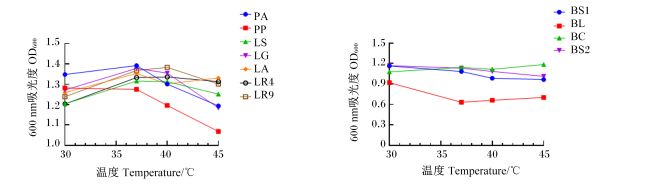
图5可知,当温度大于37 ℃时,7株乳酸菌的OD600逐渐降低,生长受到抑制;当温度大于30 ℃时,菌株BS1、BL和BS2的OD600呈下降趋势,但不影响其生长,而菌株BC在温度30~45 ℃范围内都可以较好生长。
图5 11株菌对不同温度的耐受力

Fig.5 Tolerance of 11 strains to different temperatures

2.5.3 胆盐耐受性

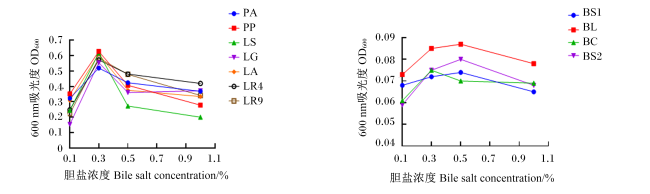
图6可知,当胆盐浓度为0.3%时,7株乳酸菌的生长情况最好,过低和过高的胆盐浓度,对其生长都有抑制作用;芽孢杆菌BC在胆盐浓度大于0.3%时,生长受到抑制,而其他3株芽孢杆菌在胆盐浓度大于0.5%时,生长受到抑制。
图6 11株菌对不同胆盐浓度的耐受力

Fig.6 Tolerance of 11 strains to different bile salt concentrations

2.5.4 人工胃肠液耐受性

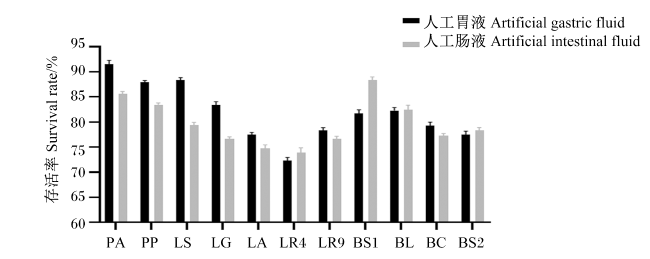
图7可知,11株菌经人工胃肠液处理后,菌株PA、PP、BS1和BL的存活率均可达到80%以上,其他菌株存活率均达到70%以上。
图7 11株菌在人工胃肠液下的存活率

Fig.7 Survival rates of 11 strains under artificial gastroenteric fluid

2.6 不同候选菌株对发酵桑叶CP、粗纤维、乳酸、乙酸含量和pH以及乳酸菌数量的影响
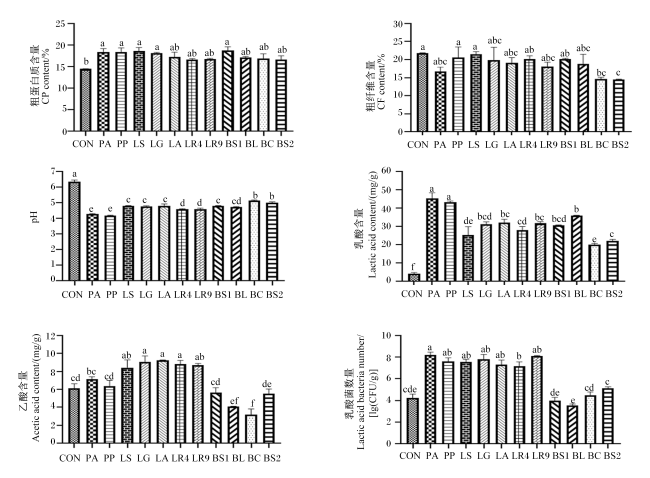
图8可知,菌株PA、PP、LS、LG和BS1发酵桑叶后CP含量显著高于对照组(P<0.05);芽孢杆菌BC和BS2发酵桑叶后粗纤维含量显著低于对照组以及菌株PP和LS(P<0.05);乳酸菌PA、PP发酵桑叶后的pH显著低于其他处理(P<0.05),而它们的乳酸含量显著高于其他处理(P<0.05)。此外,芽孢杆菌BL发酵桑叶后的乳酸含量显著高于菌株LS、LR4、BC和BS2(P<0.05);乳酸菌LG、LA和LR4发酵桑叶后的乙酸含量显著高于对照组和乳酸菌PA、PP以及其他4株芽孢杆菌(P<0.05);乳酸菌发酵桑叶后的乳酸菌数量显著高于CON组和芽孢杆菌(P<0.05)。
图8 不同候选菌株对发酵桑叶CP、粗纤维、乳酸、乙酸含量和pH以及乳酸菌数量的影响

数据柱标注不同字母表示差异显著(P<0.05)。

Fig.8 Effects of different candidate strains on contents of CP, crude fiber, lactic acid and acetic acid as well as pH and lactic acid bacteria number of fermented mulberry leaves

Data columns marked with different letters indicated significant difference (P<0.05).

3 讨论

3.1 生长曲线和pH变化曲线

生长曲线反映的是微生物在适宜生长条件下生长繁殖到衰老死亡的全动态过程,包括迟缓期、对数期、稳定期和衰亡期[19],其中对数期和稳定期具有重要的应用价值。对数期微生物细胞数量呈指数递增,菌体大量增殖;稳定期许多重要的发酵代谢产物大量积累。因此,本研究选择对7株乳酸菌种子液培养至12 h左右后进行接种发酵;对4株芽孢杆菌种子液培养15 h后进行发酵。由于菌株在生长过程中消耗糖等营养物质产生酸,而酸的产生会影响菌株的生长[12,21]。本研究中,7株乳酸菌在2~18 h内pH快速下降,之后保持稳定,这是因为乳酸菌的生长速率与发酵液pH的降低呈正相关。4株芽孢杆菌在4 h内导致pH下降至最低点,主要是由于消耗培养基中的葡萄糖产生有机酸;随后pH呈上升趋势,因为葡萄糖被完全消耗。而4株芽孢杆菌在4 h时pH降至最低点,之后呈上升趋势。

3.2 抑菌能力

抑制病原体生长有助于益生菌维持肠道菌群的平衡和稳定[22]。由于桑叶表面会附着大量微生物,其中包含有害菌。乳酸菌和一些芽孢杆菌在生长繁殖过程会产生有机酸和细菌素,后者是由细菌核糖体合成的小分子抗菌肽,可以有效抑制病原菌的生长和增殖[13,22-23]。本研究以大肠杆菌、沙门氏菌和金黄色葡萄球菌等为指示菌,研究11株候选菌株的抑菌能力,其中7株乳酸菌对选取的致病菌均具有一定的抑菌效果,除芽孢杆菌BC对个别病原菌有一定抑菌效果外,其他芽孢杆菌均无抑菌效果。

3.3 产酶能力

纤维素酶是纤维二糖水解酶、内切葡聚糖酶或羧甲基纤维素酶和β葡聚糖酶的总称,它们通过协同作用将纤维素、半纤维素等复合碳水化合物转化为对动物胃肠道消化吸收有利的小分子物质,从而提高饲料的转化率[17]。蛋白酶是能够水解蛋白质肽链的一类酶的总称,而枯草芽孢杆菌产生的内切蛋白酶可以从内部水解桑叶蛋白的肽链,形成易被动物消化吸收的多肽等小分子物质[18,24]。本研究中的芽孢杆菌具有较好的产纤维素酶和蛋白酶能力。

3.4 抗逆性

益生菌应具备一定的耐受胃酸和胆汁的能力,以确保其在宿主肠道中定植[22]。菌株需要先经受胃酸消化,然后在小肠定植后才能产生益生效果[25]。动物胃肠道的pH在3.2~6.6,胆盐浓度为0.03%~0.30%[26]。本研究中pH为3.5~7.0,7株乳酸菌都能够较好地生长;而pH为5.5~7.0,4株芽孢杆菌的生长情况也较好。而过高的胆盐浓度会抑制菌株生长。另外,乳酸菌和芽孢杆菌对温度、胆盐和人工胃肠液都具有耐受能力。

3.5 不同候选菌株对发酵桑叶CP、粗纤维、乳酸、乙酸含量和pH以及乳酸菌数量的影响

本研究中乳酸菌PA、PP、LS、LG、LR9及芽孢杆菌BS1发酵桑叶后CP含量增加。一方面,因为微生物经呼吸作用会消耗桑叶中的部分有机物,使得产物总量减少,导致碳矿化(二氧化碳)出现蛋白质的“浓缩效应”;另外,蛋白质来源包括细菌接种物和培养基中的氨[2,27]。芽孢杆菌BC和BS2发酵桑叶后粗纤维含量低于对照组以及菌株PP和LS,这与Chi等[28]的研究结果一致。这一结果归因于芽孢杆菌产生的纤维素酶能够将纤维素等复合物降解为碳水化合物[29-30]。有研究证明,添加纤维素酶和干酪乳杆菌发酵桑叶,中性洗涤纤维、半纤维素和纤维素含量降低[2]。崔艺燕等[31]研究发现,添加酒窖片球菌和地衣芽孢杆菌发酵桑叶,中性洗涤纤维含量降低。本研究中,乳酸菌PA、PP发酵桑叶后pH低于其他菌株,而乳酸含量则相反。发酵饲料的pH对其品质的好坏起着至关重要的作用,pH为4.2通常被认为是发酵良好的基准,特别是对于高水分发酵饲料,并且较低的pH能够确保充分的发酵和长期保存[32]。在发酵过程中,pH下降是由于有机酸的累积造成的。同型乳酸发酵通过快速发酵碳水化合物产生乳酸,从而使pH迅速下降,加速早期发酵过程,提高发酵饲料质量;而异型乳酸发酵则产生大量乙酸,防止发酵过程中的有氧劣化[33]。此外,乳酸的酸度[酸度系数(pKa)为3.86]比其他主要有机酸强10~12倍(乙酸pKa为4.75,丙酸pKa为4.87)[34-36]。本研究中,乳酸菌PA和PP可能进行了同型乳酸发酵,因此利用葡萄糖发酵产生的有机酸主要是乳酸;而乳酸菌LG、LA和LR4发酵组中乙酸含量较高,这可能是因为这些乳酸菌作为异型乳酸菌进行了发酵,导致产生的有机酸主要是乙酸[37]。在本研究中,各乳酸菌发酵组的乳酸菌数量高于其他组。这样大量的乳酸菌可以迅速降低pH,抑制腐败微生物的繁殖,提高发酵桑叶的发酵质量,降低损失[38-39]

4 结论

综合菌株生物学特性和发酵桑叶后CP、粗纤维、乳酸、乙酸含量和pH以及乳酸菌数量,建议选取优良菌株乳酸菌PA、PP、LS、LA、LR9和芽孢杆菌BS1、BL进行桑叶发酵。
[1]
CAI M, MU L, WANG Z L, et al. Assessment of mulberry leaf as a potential feed supplement for animal feeding in P.R.China[J]. Asian-Australasian Journal of Animal Sciences, 2019, 32(8):1145-1152.

[2]
HE L W, ZHOU W, WANG C, et al. Effect of cellulase and Lactobacillus casei on ensiling characteristics,chemical composition,antioxidant activity,and digestibility of mulberry leaf silage[J]. Journal of Dairy Science, 2019, 102(11):9919-9931.

[3]
KANDYLIS K, HADJIGEORGIOU I, HARIZANIS P. The nutritive value of mulberry leaves (Morus alba) as a feed supplement for sheep[J]. Tropical Animal Health and Production, 2009, 41(1):17-24.

DOI PMID

[4]
WANG Y, CHEN X Y, WANG C, et al. The bacterial community and fermentation quality of mulberry (Morus alba) leaf silage with or without Lactobacillus casei and sucrose[J]. Bioresource Technology, 2019,293:122059.

[5]
AL-KIRSHI R, ALIMON A R, ZULKIFLI I, et al. Utilization of mulberry leaf meal (Morus alba) as protein supplement in diets for laying hens[J]. Italian Journal of Animal Science, 2010, 9(3):e51.

[6]
OUYANG J L, WANG M Z, HOU Q R, et al. Effects of dietary mulberry leaf powder in concentrate on the rumen fermentation and ruminal epithelium in fattening Hu sheep[J]. Animals, 2019, 9(5):218.

[7]
WANG Y Y, SHEN Q M, ZHONG S, et al. Comparison of rumen microbiota and serum biochemical indices in white cashmere goats fed ensiled or sun-dried mulberry leaves[J]. Microorganisms, 2020, 8(7):981.

[8]
CHEN C, MOHAMAD RAZALI U H, SAIKIM F H, et al. Morus alba L.plant:bioactive compounds and potential as a functional food ingredient[J]. Foods, 2021, 10(3):689.

[9]
KATSUBE T, IMAWAKA N, KAWANO Y, et al. Antioxidant flavonol glycosides in mulberry (Morus alba L.) leaves isolated based on LDL antioxidant activity[J]. Food Chemistry, 2006, 97(1):25-31.

[10]
THABTI I, ELFALLEH W, TLILI N, et al. Phenols,flavonoids,and antioxidant and antibacterial activity of leaves and stem bark of Morus species[J]. International Journal of Food Properties, 2014, 17(4):842-854.

[11]
李金转, 阳田恬, 蒋晓晗, 等. 发酵桑叶的营养价值及其在畜禽生产上的应用[J]. 饲料工业, 2022, 43(19):14-17.

LI J Z, YANG T T, JIANG X H, et al. Nutritional value of fermented mulberry leaves and its application in livestock and poultry production[J]. Feed Industry, 2022, 43(19):14-17. (in Chinese)

[12]
ZHANG Y C, LI D X, WANG X K, et al. Fermentation quality and aerobic stability of mulberry silage prepared with lactic acid bacteria and propionic acid[J]. Animal Science Journal, 2019, 90(4):513-522.

[13]
蒋小碟, 谢谦, 宋泽和, 等. 发酵桑叶的营养价值及其在动物生产上的应用[J]. 动物营养学报, 2020, 32(1):54-61.

DOI

JIANG X D, XIE Q, SONG Z H, et al. Nutritional value of fermented mulberry leaves and its application in animal production[J]. Chinese Journal of Animal Nutrition, 2020, 32(1):54-61. (in Chinese)

[14]
CHENG Q M, LI M Y, FAN X Y, et al. Effects of epiphytic and exogenous lactic acid bacteria on fermentation quality and microbial community compositions of paper mulberry silage[J]. Frontiers in Microbiology, 2022,13:973500.

[15]
杨园园. 贵州泡菜中乳酸菌的筛选鉴定及其在红枣泥中的应用[D]. 硕士学位论文. 邯郸: 河北工程大学, 2020.

YANG Y Y. Screening and identification of lactic acid bacteria in Guizhou pickles and its application in red jujube puree[D]. Master’s Thesis. Handan: Hebei University of Engineering, 2020. (in Chinese)

[16]
刘霄. 高效降解玉米秸秆复合菌群的构建及其降解效果研究[D]. 硕士学位论文. 哈尔滨: 东北农业大学, 2019.

LIU X. Corn straw degradation efficient complex microbial system for construction and effectiveness of a high[D]. Master’s Thesis. Harbin: Northeast Agricultural University, 2019. (in Chinese)

[17]
PRASANNA H N, RAMANJANEYULU G, RAJASEKHAR REDDY B. Optimization of cellulase production by Penicillium sp.[J]. 3 Biotech, 2016, 6(2):162.

[18]
陈茏. 产蛋白酶菌株的筛选及酶学性质的研究[D]. 硕士学位论文. 南昌: 南昌大学, 2020.

CHEN L. Screening of proteinase-producing strains and study on their enzymatic properties[D]. Master’s Thesis. Nanchang: Nanchang University, 2020. (in Chinese)

[19]
王馨. 用于发酵工程的乳酸菌筛选及复配菌剂研究[D]. 硕士学位论文. 哈尔滨: 哈尔滨工业大学, 2021.

WANG X. Screening of lactic acid bacteriaused in fermentation engineering andengineering and research oncompound bacteria[D]. Master’s Thesis. Harbin: Harbin Institute of Technology, 2021. (in Chinese)

[20]
QURESHI N, GU Q, LI P. Whole genome sequence analysis and in vitro probiotic characteristics of a Lactobacillus strain Lactobacillus paracasei ZFM54[J]. Journal of Applied Microbiology, 2020, 129(2):422-433.

[21]
ZHENG J S, DU M, JIANG W, et al. In vitro probiotic characteristics and whole genome sequence analysis of Lactobacillus strains isolated from cattle-yak milk[J]. Biology, 2021, 11(1):44.

[22]
LIU X L, LV X P, SUN Y, et al. Probiotic properties of Lacticaseibacillus rhamnosus grx10 revolved with complete genome[J]. Food Bioscience, 2023,51:102219.

[23]
兰宝锋. 益生解淀粉芽孢杆菌的筛选及其抑菌产物特性的研究[D]. 硕士学位论文. 南宁: 广西大学, 2022.

LAN B F. Screening of Bacillus amylus probiotics and characterization of antibacterial products[D]. Master’s Thesis. Nanning: Guangxi University, 2022. (in Chinese)

[24]
HE L W, LV H J, CHEN N, et al. Improving fermentation,protein preservation and antioxidant activity of Moringa oleifera leaves silage with gallic acid and tannin acid[J]. Bioresource Technology, 2020,297:122390.

[25]
罗建. 不同宠物用益生菌产品中乳酸菌的益生特性评价[D]. 硕士学位论文. 武汉: 华中农业大学, 2022.

LUO J. Comparative studies on the probiotic effects of lactic acid bacteria from probiotic products for pets[D]. Master’s Thesis. Wuhan: Huazhong Agricultural University, 2022. (in Chinese)

[26]
HUANG Y, ADAMS M C. In vitro assessment of the upper gastrointestinal tolerance of potential probiotic dairy propionibacteria[J]. International Journal of Food Microbiology, 2004, 91(3):253-260.

[27]
OPAZO R, ORTÚZAR F, NAVARRETE P, et al. Reduction of soybean meal non-starch polysaccharides and α-galactosides by solid-state fermentation using cellulolytic bacteria obtained from different environments[J]. PLoS One, 2012, 7(9):e44783.

[28]
CHI Z, DENG M, TIAN H, et al. Effects of mulberry leaves and Pennisetum hybrid mix-silage on fermentation parameters and bacterial community[J]. Fermentation, 2022, 8(5):197.

[29]
JAIN J, KUMAR A, SINGH D, et al. Purification and kinetics of a protease-resistant,neutral,and thermostable phytase from Bacillus subtilis subsp.subtilis JJBS250 ameliorating food nutrition[J]. Preparative Biochemistry & Biotechnology, 2018, 48(8):718-724.

[30]
DONG Z H, WANG S R, ZHAO J, et al. Effects of additives on the fermentation quality,in vitro digestibility and aerobic stability of mulberry (Morus alba L.) leaves silage[J]. Asian-Australasian Journal of Animal Sciences, 2020, 33(8):1292-1300.

[31]
崔艺燕, 王超普, 彭苏, 等. 桑叶发酵工艺优化及营养价值评价[J]. 动物营养学报, 2022, 34(9):6110-6120.

DOI

CUI Y Y, WANG C P, PENG S, et al. Optimization of technology and evaluation of nutritional value on fermented mulberry leaves[J]. Chinese Journal of Animal Nutrition, 2022, 34(9):6110-6120. (in Chinese)

DOI

[32]
CUI X P, YANG Y X, ZHANG M J, et al. Optimized ensiling conditions and microbial community in mulberry leaves silage with inoculants[J]. Frontiers in Microbiology, 2022,13:813363.

[33]
OKOYE C O, WU Y F, WANG Y L, et al. Fermentation profile,aerobic stability,and microbial community dynamics of corn straw ensiled with Lactobacillus buchneri PC-C1 and Lactobacillus plantarum PC1-1[J]. Microbiological Research, 2023,270:127329.

[34]
NI K K, WANG F F, ZHU B G, et al. Effects of lactic acid bacteria and molasses additives on the microbial community and fermentation quality of soybean silage[J]. Bioresource Technology, 2017,238:706-715.

[35]
KUNG L Jr, SHAVER R D, GRANT R J, et al. Silage review:interpretation of chemical,microbial,and organoleptic components of silages[J]. Journal of Dairy Science, 2018, 101(5):4020-4033.

[36]
ZHENG M L, NIU D Z, JIANG D, et al. Dynamics of microbial community during ensiling direct-cut alfalfa with and without LAB inoculant and sugar[J]. Journal of Applied Microbiology, 2017, 122(6):1456-1470.

DOI PMID

[37]
WANG C, ZHENG M Y, WU S, et al. Effects of gallic acid on fermentation parameters,protein fraction,and bacterial community of whole plant soybean silage[J]. Frontiers in Microbiology, 2021,12:662966.

[38]
HE L W, WANG C, XING Y Q, et al. Dynamics of proteolysis,protease activity and bacterial community of Neolamarckia cadamba leaves silage and the effects of formic acid and Lactobacillus farciminis[J]. Bioresource Technology, 2019,294:122127.

[39]
CAI Y, BENNO Y, OGAWA M, et al. Influence of Lactobacillus spp.from an inoculant and of weissella and leuconostoc spp.from forage crops on silage fermentation[J]. Applied and Environmental Microbiology, 1998, 64(8):2982-2987.

Outlines

/