REVIEW

Nanoencapsulation of Plant Essential Oils and Their Application in Livestock and Poultry Production

  • LIU Mengzhe ,
  • ZHANG Yan ,
  • OU Niantao ,
  • LI Yanling , *
Expand
  • College of Animal Science and Technology, Beijing University of Agricultural, Beijing 102206, China
*E-mail:

Received date: 2024-02-04

  Online published: 2024-07-09

Abstract

Essential oil is a natural, volatile and water-insoluble secondary metabolite extracted from plant tissues by distillation and supercritical fluid. Encapsulation of essential oils can overcome the limitations of essential oils such as strong volatilization and easy degradation, as well as enhance their bioactivity, in order to improve animal performance and health in livestock and poultry production. This paper mainly reviews the methods of preparing nano-capsules of essential oils, their biological activity and application in livestock production, which provides a theoretical basis for the future preparation of essential oil capsules and their application in livestock production.

Cite this article

LIU Mengzhe , ZHANG Yan , OU Niantao , LI Yanling . Nanoencapsulation of Plant Essential Oils and Their Application in Livestock and Poultry Production[J]. Chinese Journal of Animal Nutrition, 2024 , 36(7) : 4191 -4200 . DOI: 10.12418/CJAN2024.361

植物精油是从植物不同部位通过水蒸馏、超临界流体萃取等方法提取得到的次生代谢产物混合物;其主要成分有萜烯类化合物、芳香族化合物、脂肪族化合物以及含氮含硫类化合物等[1]。植物精油已被证明具有抗炎、抗菌、抗氧化及驱虫等生物活性,且在动物生产中具有良好效果[2]。但植物精油的疏水性、易挥发降解性和其散发出的特殊气味使其在动物生产应用中存在一定局限性。
胶囊化处理是使用特殊聚合物包被活性物质的技术,其中用于包被的聚合物材料称为载体剂或壁材,被包被的物质称为芯材。最常用的壁材有多糖(β-环糊精、环糊精、甲基纤维素、海藻酸钠等)、脂类(卵磷脂、棕榈油、硬脂酸等)和蛋白质(乳清蛋白、明胶、玉米醇溶蛋白等)[3]。胶囊化可以保护植物精油,减少植物精油活性成分的挥发,延长储存时间、掩盖其特殊气味,还具有改善植物精油不易溶于水的特性以及控制生物活性分子释放等优点,从而最大程度地提高其利用率[3]
胶囊化得到的粒径在1~1 000 μm的微粒称为微米级胶囊化(微胶囊化),粒径在1~1 000 nm称为纳米级胶囊化(纳米胶囊化)。其中纳米胶囊化可以进一步增加植物精油中生物活性物质在细胞中的吸收,还可以进一步提高植物精油的包封率、靶向性和稳定性,更易于储藏和运输,而且对植物精油控制释放和持续释放起着至关重要的作用[4-5]。本文重点综述了植物精油的纳米胶囊化方法及其生物活性和在畜禽生产中的应用。

1 植物精油的纳米胶囊化方法

1.1 乳化法

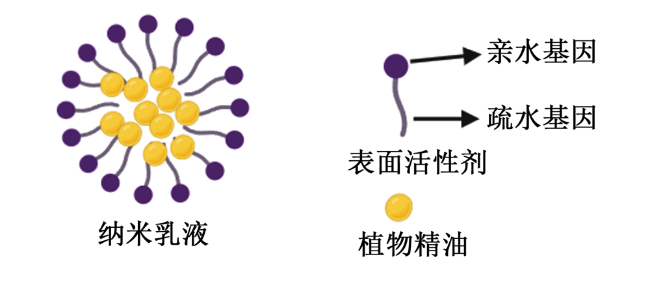
植物精油采用乳化法得到的是植物精油纳米乳液,由于其具有稳定、透明、高表面积和可调的流变性等独特性质,在近几十年来得到了广泛研究。纳米乳液是油和水的胶体纳米分散体,通过表面活性剂或助表面活性剂的界面层增加热稳定性。纳米乳液的体系分为水包油(O/W)和油包水(W/O)等类型,因为植物精油为亲脂性物质,所以常采用O/W的形式。表面活性剂的疏水基团与植物精油结合,而亲水基团与水相结合,以增加植物精油的水溶性(图1)。植物精油纳米乳液在制备时常有低能法和高能法。低能法操作简单且无需外部能量,但对表面活性剂浓度有着较高的要求,而且需把控体系的亲水亲脂平衡(hydrophilic lipophilic balance,HLB)。高能法主要有高压均质法、超声乳化法、微流化等方法,其需要使用专用设备如高压均质机、微流控器和超声波机等。这些设备通过高能量输入将较大的液滴分解成较小的液滴,可以提高植物精油的稳定性和生物活性。纳米乳液的制备方法、粒径尺寸及作用效果见表1。纳米乳液微粒的直径一般在200 nm以内[6],但随着液滴尺寸减小,它会受到奥斯特瓦尔德熟化(Ostwald ripening)的影响而趋于不稳定[7]。因此,合理设计纳米乳液体系,以确保其在小尺寸下具有良好的物理稳定性是至关重要的。
表1 纳米乳液的制备方法、粒径尺寸及作用效果

Table 1 Preparation method, particle size and action effect of nanoemulsion

项目
Item
粒径尺寸
Particle
size/nm
精油种类
Essential oil
type
作用效果
Action effect
参考文献
Reference
乳化法
Emulsification method

高压均质法
High pressure
homogenization method
62.52~127.60 百里香精油 较强的抗真菌活性 [8]
110.9 亚麻籽油 长时间储存后仍具有较好的稳定性 [9]

微流化
Microfluidization
8 茴香精油 提高植物精油的稳定性 [10]
192 柑橘精油 提高植物精油的稳定性 [11]


超声破碎法
Ultrasonic crushing method
<32 百里香 提高植物精油的抑菌活性 [12]
138.9 姜黄素 在肠道中释放精油的量增加,
提高其生物利用率
[13]

自乳化
Self emulsification
21 酸橙精油 室温下储存1个月后仍保持
良好的抑菌活性
[14]
50 薄荷精油 提高植物精油热稳定性 [15]

相转化
Phase transformation
137.6 牛至和肉桂复合精油 有较强的自由基
清除活性和抑菌活性
[16]
17.9 黑胡椒精油 1个月后仍保持良好的稳定性 [17]
图1 纳米乳液微粒结构

Fig.1 Nanoemulsion microparticle structure

1.2 纳米脂质体

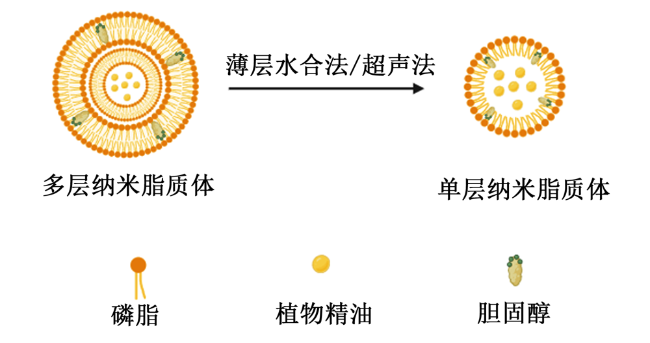
当磷脂溶解于有机溶剂并在脂质转变温度下,会自排列成磷脂双分子层并形成球形结构,即纳米脂质体[18]。因其用于包被植物精油可提高其稳定性、保护其不被降解等特性,而被广泛使用。目前常用的制备方法有薄膜水合法、超声法等。纳米脂质体制备方法、粒径尺寸及作用效果见表2。为进一步增加纳米脂质体的性能和稳定性,可加入胆固醇、壳聚糖、淀粉等聚合物与纳米脂质体发生共价或非共价相互反应来增强其空间稳定性[19]。当前,传统方法得到的纳米脂质体通常是多分散和多层的。在经过超声或薄层水合法处理后可将尺寸降至200 nm以下,且可进一步增加其稳定性,保持良好的生物活性(图2)。
表2 纳米脂质体制备方法、粒径尺寸及作用效果

Table 2 Preparation method, particle size and action effect of nanoliposome

项目
Item
粒径尺寸
Particle
size/nm
精油种类
Essential oil
type
作用效果
Action effect
参考文献
Reference
纳米脂质体
Nanoliposome

薄层水合法
Thin layer
hydration method
<200 丁香精油 提升植物精油的抑菌活性,
并具有良好的控释效果
[20]
99.9 多花扎他菜精油 提高植物精油的抑菌活性 [21]

超声法Ultrasound method
<150 豆蔻精油 提高植物精油的抗菌和抗氧化能力 [22]
100.2 D-柠檬烯 提高植物精油的抑菌活性 [23]
图2 纳米脂质体结构

Fig.2 Nanoliposome structure

1.3 沉淀法

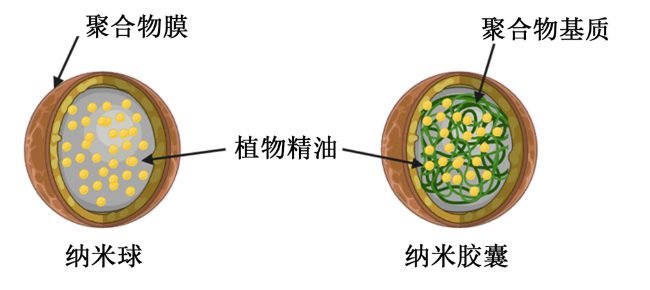
沉淀法是基于马兰戈尼效应(Marangoni effect)原理开发的用来包被天然化合物的一种简单、快捷和低能耗的方法。这种方法被用于包裹亲水或疏水化合物,得到的颗粒被称为纳米球或纳米胶囊。纳米球存在内核结构,即基质,其中植物精油被包在颗粒内或吸附在其表面上;纳米胶囊是一种囊泡系统,其中植物精油被包在聚合物膜组成的空腔中(图3)。沉淀法常需要2种可混溶溶剂,其中壁材和植物精油溶于其中一种溶剂组成有机相(organic phase),另一种溶剂作为水相(aqueous phase),随后将含有植物精油的有机相加入水相并进行搅拌,在经过过饱和、成核、生长和凝固并进行蒸发和离心后得到植物精油的纳米颗粒[24]。沉淀法得到的微粒尺寸可达到200 nm以下,同时具有良好的稳定性和生物活性。沉淀法制备得到的粒径尺寸及作用效果见表3。制备过程中纳米颗粒的尺寸常受到搅拌速度、有机相的流速、有机相与水相的比例、表面活性剂和聚合物浓度的影响,通过调控这些因素可有效增加植物精油的包封效率[25]
表3 沉淀法制备得到的粒径尺寸及作用效果

Table 3 Particle size and action effect obtained by precipitation method

项目
Item
粒径尺寸
Particle size/nm
精油种类
Essential oil type
作用效果
Action effect
参考文献
Reference
沉淀法
Precipitation method
145 风毛菊精油 抑制炎性细胞因子基因表达,具有良好的抗炎活性 [26]
230~260 黑种草精油 具有较好的稳定性,具有抗炎镇痛的作用 [27]
207.8 香茅精油 具有良好的稳定性和清除自由基的活性 [28]
10~75 薰衣草精油 具有良好的抗菌活性 [29]
图3 沉淀法制备得到的不同类型纳米颗粒

Fig.3 Different types of nanoparticles prepared by precipitation method

2 纳米胶囊化植物精油的生物活性

2.1 抗菌活性

植物精油可以通过细胞壁、细胞膜进入到微生物细胞内,破坏细胞膜结构,导致细菌细胞壁疏松,细胞膜密度降低、溶解、破溃;并进一步干扰细胞内能量代谢,影响细菌DNA、RNA、蛋白质和肽聚糖的生物合成等发挥抗菌作用[30]。通过包被不仅可以更好地保护植物精油的活性成分,并且能增强植物精油的抗菌活性。Rashidipour等[31]制备了Satureja khuzistanica jamzad(SKJ)精油的纳米胶囊,并对比了SKJ精油及其纳米胶囊对金黄色葡萄球菌、表皮葡萄球菌、粪肠球菌等5种革兰氏阳性菌和大肠杆菌、单核增生李斯特氏菌、伤寒沙门氏菌等5种革兰氏阴性菌的抗菌活性,发现SKJ精油纳米胶囊的抑菌活性比SKJ精油提高了8~16倍。Shetta等[32]发现绿茶精油的纳米胶囊对金黄色葡萄球菌的抗菌活性比纯绿茶精油提高了约9.4倍,对大肠杆菌的抗菌活性比纯绿茶精油提高了约4.7倍。
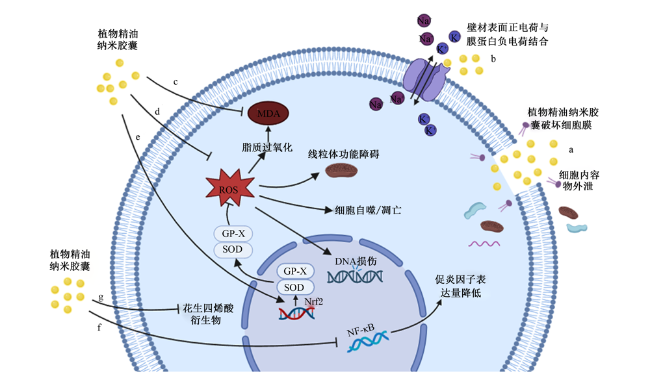
纳米胶囊化植物精油可以通过诱导细胞壁、细胞膜和线粒体膜发生转化,改变细菌细胞膜通透性,导致细胞内容物渗漏造成细菌细胞死亡。Liang等[33]发现,使用肉桂精油纳米乳液对金黄色葡萄球菌、枯草芽孢杆菌、鼠伤寒沙门氏菌3种革兰氏阳性菌和铜绿假单胞菌、大肠杆菌、表皮葡萄球菌3种革兰氏阴性菌进行处理后,细菌细胞壁表面微观结构从光滑完整变得模糊,出现不规则的皱褶及不同程度的损伤,且细菌出现黏附和聚集。研究发现,用于包被植物精油的壁材表面携带的正电荷基团可与微生物带负电荷的膜成分相互作用,从而诱导破坏细菌细胞膜功能,并使细菌细胞内物质发生泄漏[34](图4-A)。纳米胶囊化植物精油表面负电荷与细菌阳离子表面相互作用有效作用于细胞膜(图4-B),是改变细菌通透性的根本原因[35];而使用包被植物精油得到的纳米微粒可以增加植物精油与微生物带负电荷的膜成分相互作用,进一步增强植物精油的抗菌活性[36]
图4 纳米胶囊化植物精油发挥生物活性的作用机制

MDA:丙二醛 malondialdehyde;ROS:活性氧 reactive oxygen species;GP-X:谷胱甘肽过氧化酶 glutathione peroxidase;SOD:超氧化物歧化酶 superoxide dismutase;Nrf2:核转录因子E2相关因子2 nuclear factor E2-related factor 2;NF-κB:核因子-κB nuclear factor kappa-B。
a:纳米胶囊化植物精油破坏细胞膜导致细胞内容物外泄 nanoencapsulated plant essential oils damage cell membranes and cause leakage of cell contents;b:纳米胶囊化植物精油表面正电荷与膜蛋白负电荷结合导致细胞膜通透性增加the combination of surface positive charge and membrane protein negative charge of nanoencapsulated plant essential oils lead to an increase in cell membrane permeability;c:纳米胶囊化植物精油抑制MDA含量 nanoencapsulated plant essential oils inhibit MDA content;d:纳米胶囊化植物精油降低ROS含量 nanoencapsulated plant essential oils reduce ROS content;e:纳米胶囊化植物精油促进Nrf2通路激活 nanoencapsulated plant essential oils promote Nrf2 pathway activation;f:纳米胶囊化植物精油抑制NF-κB通路 nanoencapsulated plant essential oils inhibit NF-κB pathway;g:纳米胶囊化植物精油抑制花生四烯酸衍生物的产生 nanoencapsulated plant essential oils inhibit the production of arachidonic acid derivatives。

Fig.4 Mechanism of action of nanoencapsulated plant essential oils in exerting biological activity[34-35,40-41,44-47]

2.2 抗氧化活性

在畜禽生产中,外界环境的改变或饮食条件的变化等不良刺激往往会诱导动物机体产生过量活性氧(reactive oxygen species,ROS),从而导致机体抗氧化系统失衡,进一步干扰DNA等生物大分子的结构和功能,引起细胞氧化损伤或死亡,即氧化应激[37]。在畜禽生产过程中,氧化应激的发生会诱导机体产生炎症,从而导致畜禽免疫力下降、生长性能降低,造成经济损失;而植物精油中的萜类、酚类、酮类等活性成分可以通过清除自由基,金属离子和抑制脂质过氧化来发挥抗氧化活性[38]。植物精油的纳米胶囊化可提高其抗氧化活性。Attallah等[39]使用果胶/壳聚糖做为壁材制备了粒径为468.5~698.3 nm的茉莉精油纳米胶囊,发现茉莉精油纳米胶囊对2,2-二苯基-1-苦基肼基(2,2-diphenyl-1-picrylhydrazyl radical,DPPH)自由基的半抑制浓度(IC50)为0.01 mg/mL,与纯植物精油的IC50(0.269 mg/mL)相比,其抗氧化能力提高了96.28%。Shetta等[32]研究发现,纳米胶囊化处理后薄荷油和绿色茶油清除DPPH自由基的能力分别提高了约2.0倍和2.4倍。
纳米胶囊化植物精油可通过提高机体抗氧化酶基因表达和抑制脂质过氧化来降低机体的氧化物水平(图4-C~图4-E)。Salman等[40]研究发现,使用麦芽糖糊精为壁材制备的肉桂精油纳米胶囊,可清除机体产生的ROS,降低肝脏、肾脏2个器官中的丙二醛(malondialdehyde,MDA)和一氧化氮(nitric oxide,NO)含量,从而减轻氧化钛纳米颗粒(TiO2NP)诱导的雄性小鼠氧化应激。Shafaei等[41]研究发现,0.25和0.50 mg/L的莳萝子油纳米乳液可通过降低MDA含量、减少机体脂质过氧化和上调小鼠肝脏、肾脏和脑组织中谷胱甘肽过氧化物酶(glutathione peroxidase,GP-X)基因的表达来减轻小鼠体内由重金属镉(Cd)引起的氧化应激,并且效果呈现浓度依赖性。此外,胶囊化材料中一些多糖类聚合物,如壳聚糖、麦芽多糖、海藻多糖等本身具有清除活性氧、调节机体抗氧化系统和减轻氧化应激的功能;而这些材料会与植物精油发生协同作用,提高植物精油的抗氧化活性[42]

2.3 抗炎活性

炎症是由组织损伤、应激或病菌感染诱导产生的一种适应性生理状态。如果不及时解决会引发炎症部位吞噬细胞大量浸润,毛细血管炎症渗出和炎症介质大量产生[43],导致动物机体肠壁增厚、肠道内容物黏稠、食欲下降、饲料利用率下降等现象。植物精油中的1,8-桉树脑、樟脑和α-蒎烯及一些酚类化合物等活性物质,可通过抑制核因子-κB(nuclear factor kappa-B,NF-κB)通路下游炎症细胞因子等不同路径发挥其抗炎作用[44]。植物精油包被后能够提高其抗炎活性。Pinto等[45]研究发现,200 mg/kg的苦配巴精油纳米胶囊可以显著降低小鼠的炎症水平和机体中促炎细胞因子含量,其中降低肿瘤坏死因子-α(tumor necrosis factor-α,TNF-α)分泌量的效果是纯精油的3倍。研究发现,纳米胶囊化植物精油可通过抑制炎性通路的激活来缓解机体的炎症(图4-F)。Abdelhameed等[46]研究发现,南洋杉芽精油的纳米乳液可以通过降低NF-κβ p65蛋白标志物的免疫表达水平来缓解机体炎症;另外,也有研究发现纳米胶囊化植物精油可以通过抑制花生四烯酸衍生物,如前列腺素E2(prostaglandin E2,PGE2)的产生缓解机体炎症(图4-G)[46-47]。纳米胶囊化植物精油也可通过抑制炎性因子和减少机体活性氧的含量减少炎症的发生,但少有纳米胶囊化植物精油对分子层面影响的研究。

3 纳米胶囊化植物精油在畜禽生产中的应用

3.1 单胃动物

纳米胶囊化植物精油有更高的胞内摄取、特异性、载药能力和生物利用率等优势。将其用于动物生产中可更好地发挥植物精油对动物机体的积极作用。将纳米胶囊化植物精油应用于猪生产中,可改善肠道形态,稳定肠道微生物菌群,减少炎症的发生,从而改善机体的健康状态。研究发现,在饲粮中添加2 g/kg复合植物精油(百里酚、香草醛和丁香酚)纳米胶囊可降低育肥猪机体中TNF-α、白细胞介素-6(interleukin-6,IL-6)和白细胞介素-10(interleukin-10,IL-10)等促炎因子的含量,增加平均日增重(ADG),提高生长性能[48]。Liu等[49]将复合精油纳米胶囊饲喂仔猪后可激活核转录因子E2相关因子2(nuclear factor erythroid2-related factor 2,Nrf2)信号通路,升高血清中超氧化物歧化酶(superoxide dismutase,SOD)和GP-X活性;并抑制NF-κB信号通路,增加血清中的IL-10、免疫球蛋白(immunoglobulin,Ig)含量,缓解机体氧化应激,改善机体免疫力,降低仔猪腹泻率并改善仔猪肠道健康状态。
纳米胶囊化植物精油在家禽中的研究多集中在提高生长性能以及改善肠道健康等方面。Hafeez等[50]研究发现,饲粮中添加100 mg/kg的香芹酚、百里香酚和柠檬烯混合物纳米胶囊可改善肉鸡采食量和饲料转化率(feed conversion ratio,FCR),并增加肉鸡回肠表观消化率。研究发现,饲粮中添加300 mg/kg的纳米胶囊化植物精油可维持蛋鸡肠道形态,改善肠道屏障功能,并促进消化吸收能力,明显提高蛋鸡生长性能和蛋品质[51]。此外,Meligy等[52]研究发现,饲喂400 mg/kg的牛至、肉桂和丁香精油的复合精油纳米胶囊可提高黏蛋白-2(mucoprotein-2,MUC-2)、连接黏附分子-2(junctional adhesion molecule-2,JAM-2)和闭锁蛋白(Occludin)等肠道屏障基因的表达,改善肠道屏障功能,并通过提高胰蛋白酶、淀粉酶等消化酶活性来提高FCR,增加肉鸡终末体重。Moharreri等[53]研究发现,饲粮中添加100 mg/kg的百里香、夏味、薄荷和黑胡椒籽的混合精油纳米胶囊能够调节回肠组织中抗氧化基因和炎症基因的表达,上调OccludinSOD基因的表达,改善机体抗氧化状态、回肠形态结构、肠道微生物数量,从而提高肉鸡的总采食量、FCR和终末体重。

3.2 反刍动物

植物精油经纳米胶囊化处理,可通过传递植物精油和壁材的生物活性来提高动物的生长性能。纳米胶囊化植物精油应用于肉牛生产中,可提高其生长性能,改善氧化状态、肠道菌群结构和肉品质。有研究发现,在饲粮中添加150 mg/kg的混合精油纳米胶囊可提高肉牛ADG和FCR[54]。Asghari等[55]研究发现,4种药用植物(麝香草、薰衣草、鼠尾草和毛羊藿)复合精油的纳米乳液不仅可增加犊牛的ADG,降低丙氨酸转氨酶(alanine aminotransferase,ALT)活性和MDA含量,还可以减少粪便中大肠杆菌数量,改善犊牛健康状况。此外,饲喂纳米胶囊化植物精油还可改善屠宰后牛肉品质。De Oliveira Monteschio等[56]在73日龄母牛的饲粮中添加4 g/d的纳米胶囊化植物精油混合物(丁香酚、麝香草酚以及香草醛),可减少胸最长肌(longissimus thoracis,LT)亮度值和MDA含量,从而改善肉品质。另有研究发现,纳米胶囊化植物精油混合物还可增加肉牛背长肌肌节长度和肌肉中可溶性胶原蛋白含量,降低肌肉中Ⅲ型胶原蛋白含量,增加肉质嫩度[57]
将纳米胶囊化植物精油应用于羊的生产中可调节其瘤胃发酵功能。如Soltan等[58]在绵羊饲粮中添加200 mg/kg植物精油混合物纳米胶囊,发现瘤胃中总挥发性脂肪酸含量升高,原虫数量减少,甲烷(CH4)排放量减少,机体氮的存留增加,微生物蛋白含量增加,说明胶囊化的植物精油混合物可有效调节绵羊瘤胃发酵。另外,纳米胶囊化植物精油还有利于提高公羊的精子质量。Benberkane等[59]使用羟丙基-β-环糊精包被枸杞提取物得到纳米胶囊,研究其对公羊精子的影响,发现其可以更好地保持4 ℃下精子活力,并可使精子保持更低的氧化应激,降低公羊精子在低温下的损伤。

4 小结与展望

植物精油的纳米胶囊化主要有乳化法、纳米脂质体、沉淀法等方法。纳米胶囊化可改善植物精油的高挥发性和水不溶性等局限性,并进一步加强植物精油的抗菌、抗氧化及抗炎等生物活性。将植物精油的纳米胶囊应用于畜禽生产,可进一步提高动物的生长性能、机体免疫力和健康水平。未来纳米胶囊化植物精油在畜禽生产上的应用仍有许多有待研究的问题,如纳米胶囊化不同包被壁材对植物精油特定生物活性的影响,纳米胶囊植物精油在动物消化道不同部位的释放速度及最佳效果的研究,以及其调节畜禽肠道微生物区系的作用效果及机制等,都需要进一步深入的研究,以便更好地应用于畜禽生产中。
[1]
HARO-GONZÁLEZ J N, CASTILLO-HERRERA G A, MARTÍNEZ-VELÁZQUEZ M, et al. Clove essential oil (Syzygium aromaticum L. Myrtaceae):extraction,chemical composition,food applications,and essential bioactivity for human health[J]. Molecules, 2021, 26(21):6387.

[2]
张岩, 欧念涛, 刘孟哲, 等. 植物精油的抗氧化活性及其在畜禽生产中的应用[J]. 动物营养学报, 2023, 35(11):6936-6945.

DOI

ZHANG Y, OU N T, LIU M Z, et al. Antioxidant activity and application in livestock and poultry production of essential oils[J]. Chinese Journal of Animal Nutrition, 2023, 35(11):6936-6945. (in Chinese)

DOI

[3]
VIJETH S, HEGGANNAVAR G B, KARIDURAGANAVAR M Y. Encapsulating wall materials for micro-/nanocapsules[M]//SALAÜN F.Microencapsulation-processes,technologies and industrial applications. London:IntechOpen, 2019:1-19.

[4]
WEISANY W, YOUSEFI S, TAHIR N A R, et al. Targeted delivery and controlled released of essential oils using nanoencapsulation:a review[J]. Advances in Colloid and Interface Science, 2022, 303:102655.

[5]
EL ASBAHANI A, MILADI K, BADRI W, et al. Essential oils:from extraction to encapsulation[J]. International Journal of Pharmaceutics, 2015, 483(1/2):220-243.

[6]
JAISWAL M, DUDHE R, SHARMA P K. Nanoemulsion:an advanced mode of drug delivery system[J]. 3 Biotech, 2015, 5(2):123-127.

[7]
MCCLEMENTS D J, RAO J J. Food-grade nanoemulsions:formulation,fabrication,properties,performance,biological fate,and potential toxicity[J]. Critical Reviews in Food Science and Nutrition, 2011, 51(4):285-330.

[8]
MOAZENI M, DAVARI A, SHABANZADEH S, et al. In vitro antifungal activity of Thymus vulgaris essential oil nanoemulsion[J]. Journal of Herbal Medicine, 2021, 28:100452.

[9]
SADEGHIAN S F, MAJDINASAB M, NEJADMANSOURI M, et al. Effects of natural antioxidants and high-energy fabrication methods on physical properties and oxidative stability of flaxseed oil-in-water nanoemulsions[J]. Ultrasonics Sonochemistry, 2023, 92:106277.

[10]
LLINARES R, RAMÍREZ P, CARMONA J A, et al. Assessment of fennel oil microfluidized nanoemulsions stabilization by advanced performance xanthan gum[J]. Foods, 2021, 10(4):693.

[11]
SANTOS J, CALERO N, TRUJILLO-CAYADO L A, et al. Processing and formulation optimization of mandarin essential oil-loaded emulsions developed by microfluidization[J]. Materials, 2020, 13(16):3486.

[12]
张莲娇. 超声与百里香油纳米乳液协同杀菌机制及其初步应用研究[D]. 硕士学位论文. 杭州: 浙江大学, 2021.

ZHANG L J. Synergistic antibacterial mechanism of ultrasonication with thyme essential oil nanoemulsion and their application[D]. Master's Thesis. Hangzhou: Zhejiang University, 2021. (in Chinese)

[13]
SHARMA N, KAUR G, KHATKAR S K. Optimization of emulsification conditions for designing ultrasound assisted curcumin loaded nanoemulsion:characterization,antioxidant assay and release kinetics[J]. LWT, 2021, 141:110962.

[14]
LIEW S N, UTRA U, ALIAS A K, et al. Physical,morphological and antibacterial properties of lime essential oil nanoemulsions prepared via spontaneous emulsification method[J]. LWT, 2020, 128:109388.

[15]
BARZEGAR H, MEHRNIA M A, NASEHI B, et al. Fabrication of peppermint essential oil nanoemulsions by spontaneous method:effect of preparing conditions on droplet size[J]. Flavour and Fragrance Journal, 2018, 33(5):351-356.

[16]
HU J J, ZHU H X, FENG Y W, et al. Emulsions containing composite (clove,oregano,and cinnamon) essential oils:phase inversion preparation,physicochemical properties and antibacterial mechanism[J]. Food Chemistry, 2023, 421:136201.

[17]
VINH T D T, HIEN L T M, DAO D T A. Formulation of black pepper (Piper nigrum L.) essential oil nano-emulsion via phase inversion temperature method[J]. Food Science & Nutrition, 2020, 8(4):1741-1752.

[18]
POPOVSKA O, SIMONOVSKA J, KAVRAKOVSKI Z, et al. An overview:methods for preparation and characterization of liposomes as drug delivery systems[J]. International Journal of Pharmaceutical and Phytopharmacological Research, 2013, 3(3):182-189.

[19]
WOODLE M C. Sterically stabilized liposome therapeutics[J]. Advanced Drug Delivery Reviews, 1995, 16(2/3):249-265.

[20]
杨洪英. 丁香精油抗体脂质体的制备及其对空肠弯曲菌的抑制和应用研究[D]. 硕士学位论文. 镇江: 江苏大学, 2021.

YANG H Y. Preparation of CEO/antibody liposome and its study on the inhibition to C. jejuni and application[D]. Master's Thesis. Zhenjiang: Jiangsu University, 2021. (in Chinese)

[21]
KHATIBI S A, MISAGHI A, MOOSAVY M H, et al. Effect of nanoliposomes containing Zataria multiflora Boiss. essential oil on gene expression of Shiga toxin 2 in Escherichia coli O157:H7[J]. Journal of Applied Microbiology, 2018, 124(2):389-397.

[22]
AALA J, AHMADI M, GOLESTAN L, et al. Effect of multifactorial free and liposome-coated of bay laurel (Laurus nobilis) and rosemary (Salvia rosmarinus) extracts on the behavior of Listeria monocytogenes and Vibrio parahaemolyticus in silver carp (Hypophthalmichthys molitrix) stored at 4 ℃[J]. Environmental Research, 2023, 216(Pt 2):114478.

[23]
UMAGILIYAGE A L, BECERRA-MORA N, KOHLI P, et al. Antimicrobial efficacy of liposomes containing D-limonene and its effect on the storage life of blueberries[J]. Postharvest Biology and Technology, 2017, 128:130-137.

[24]
JOYE I J, MCCLEMENTS D J. Production of nanoparticles by anti-solvent precipitation for use in food systems[J]. Trends in Food Science & Technology, 2013, 34(2):109-123.

[25]
MARTÍNEZ RIVAS C J, TARHINI M, BADRI W, et al. Nanoprecipitation process:from encapsulation to drug delivery[J]. International Journal of Pharmaceutics, 2017, 532(1):66-81.

[26]
LAMMARI N, DEMAUTIS T, LOUAER O, et al. Nanocapsules containing Saussurea lappa essential oil:formulation,characterization,antidiabetic,anti-cholinesterase and anti-inflammatory potentials[J]. International Journal of Pharmaceutics, 2021, 593:120138.

[27]
BADRI W, EL ASBAHANI A, MILADI K, et al. Poly (ε-caprolactone) nanoparticles loaded with indomethacin and Nigella sativa L. essential oil for the topical treatment of inflammation[J]. Journal of Drug Delivery Science and Technology, 2018, 46:234-242.

[28]
JUMMES B, SGANZERLA W G, DA ROSA C G, et al. Antioxidant and antimicrobial poly-ε-caprolactone nanoparticles loaded with Cymbopogon martinii essential oil[J]. Biocatalysis and Agricultural Biotechnology, 2020, 23:101499.

[29]
POPIOLSKI T M, OTSUKA I, HALILA S, et al. Preparation of polymeric micelles of poly (ethylene oxide-b-lactic acid) and their encapsulation with lavender oil[J]. Materials Research, 2016, 19(6):1356-1365.

[30]
林楠. 阿魏植物精油杀虫抑菌活性的初步研究[D]. 硕士学位论文. 石河子: 石河子大学, 2008.

LIN N. Insecticidal and antifungal activities of volatile oil from Ferula ferulaeoidis[D]. Master's Thesis. Shihezi: Shihezi University, 2008. (in Chinese)

[31]
RASHIDIPOUR M, ASHRAFI B, NIKBAKHT M R, et al. Encapsulation of Satureja khuzistanica jamzad essential oil in chitosan nanoparticles with enhanced antibacterial and anticancer activities[J]. Preparative Biochemistry & Biotechnology, 2021, 51(10):971-978.

[32]
SHETTA A, KEGERE J, MAMDOUH W. Comparative study of encapsulated peppermint and green tea essential oils in chitosan nanoparticles:encapsulation,thermal stability,in-vitro release,antioxidant and antibacterial activities[J]. International Journal of Biological Macromolecules, 2019, 126:731-742.

[33]
LIANG D Y, FENG B J, LI N, et al.Preparation,characterization, and biological activity of Cinnamomum cassia essential oil nano-emulsion[J]. Ultrasonics Sonochemistry, 2022, 86:106009.

[34]
PAN C L, QIAN J Q, ZHAO C Y, et al. Study on the relationship between crosslinking degree and properties of TPP crosslinked chitosan nanoparticles[J]. Carbohydrate Polymers, 2020, 241:116349.

[35]
NEGI A, KESARI K K. Chitosan nanoparticle encapsulation of antibacterial essential oils[J]. Micromachines, 2022, 13(8):1265.

[36]
LINH N T, QUI N H, TRIATMOJO A. The effect of nano-encapsulated herbal essential oils on poultry's health[J]. Archives of Razi Institute, 2022, 77(6):2013-2021.

[37]
ZAHRA K F, LEFTER R, ALI A, et al. The involvement of the oxidative stress status in cancer pathology:a double view on the role of the antioxidants[J]. Oxidative Medicine and Cellular Longevity, 2021, 2021:9965916.

[38]
KHODAEI N, NGUYEN M M, MDIMAGH A, et al. Compositional diversity and antioxidant properties of essential oils:predictive models[J]. LWT, 2021, 138:110684.

[39]
ATTALLAH O A, SHETTA A, ELSHISHINY F, et al. Essential oil loaded pectin/chitosan nanoparticles preparation and optimization via Box-Behnken design against MCF-7 breast cancer cell lines[J]. RSC Advances, 2020, 10(15):8703-8708.

[40]
SALMAN A S, AL-SHAIKH T M, HAMZA Z K, et al. Matlodextrin-cinnamon essential oil nanoformulation as a potent protective against titanium nanoparticles-induced oxidative stress,genotoxicity,and reproductive disturbances in male mice[J]. Environmental Science and Pollution Research, 2021, 28(29):39035-39051.

[41]
SHAFAEI N, BARKHORDAR S M A, RAHMANI F, et al. Protective effects of Anethum graveolens seed's oil nanoemulsion against cadmium-induced oxidative stress in mice[J]. Biological Trace Element Research, 2020, 198(2):583-591.

[42]
ZHONG Q W, WEI B, WANG S J, et al. The antioxidant activity of polysaccharides derived from marine organisms:an overview[J]. Marine Drugs, 2019, 17(12):674.

[43]
ASHLEY N T, WEIL Z M, NELSON R J. Inflammation:mechanisms,costs,and natural variation[J]. Annual Review of Ecology,Evolution,and Systematics, 2012, 43(1):385-406.

[44]
DE SANTANA SOUZA M T, GUEDES DA SILVA ALMEIDA J R, DE SOUZA ARAUJO A A, et al. Structure-activity relationship of terpenes with anti-inflammatory profile—a systematic review[J]. Basic & Clinical Pharmacology & Toxicology, 2014, 115(3):244-256.

[45]
PINTO E P, DA COSTA S O A M, D'HAESE C, et al. Poly-ε-caprolactone nanocapsules loaded with copaiba essential oil reduce inflammation and pain in mice[J]. International Journal of Pharmaceutics, 2023, 642:123147.

[46]
ABDELHAMEED M F, ASAAD G F, RAGAB T I M, et al. Oral and topical anti-inflammatory and antipyretic potentialities of Araucaria bidiwillii shoot essential oil and its nanoemulsion in relation to chemical composition[J]. Molecules, 2021, 26(19):5833.

[47]
BORGES R S, KEITA H, ORTIZ B L S, et al. Anti-inflammatory activity of nanoemulsions of essential oil from Rosmarinus officinalis L.:in vitro and in zebrafish studies[J]. Inflammopharmacology, 2018, 26(4):1057-1080.

[48]
XU Y T, LAHAYE L, HE Z X, et al. Micro-encapsulated essential oils and organic acids combination improves intestinal barrier function,inflammatory responses and microbiota of weaned piglets challenged with enterotoxigenic Escherichia coli F4 (K88+)[J]. Animal Nutrition, 2020, 6(3):269-277.

[49]
LIU A D, LI Z, JIN X, et al. An encapsulated organic acid and essential oil mixture improves the intestinal health of weaned piglets by altering intestinal inflammation and antioxidative capacity[J]. Animals, 2022, 12(18):2426.

[50]
HAFEEZ A, MÄNNER K, SCHIEDER C, et al. Effect of supplementation of phytogenic feed additives (powdered vs. encapsulated) on performance and nutrient digestibility in broiler chickens[J]. Poultry Science, 2016, 95(3):622-629.

DOI PMID

[51]
WANG H, LIANG S S, LI X Y, et al. Effects of encapsulated essential oils and organic acids on laying performance,egg quality,intestinal morphology,barrier function,and microflora count of hens during the early laying period[J]. Poultry Science, 2019, 98(12):6751-6760.

[52]
MELIGY A M A, EL-HAMID M I A, YONIS A E, et al. Liposomal encapsulated oregano,cinnamon,and clove oils enhanced the performance,bacterial metabolites antioxidant potential,and intestinal microbiota of broiler chickens[J]. Poultry Science, 2023, 102(6):102683.

[53]
MOHARRERI M, VAKILI R, OSKOUEIAN E, et al. Effects of microencapsulated essential oils on growth performance and biomarkers of inflammation in broiler chickens challenged with Salmonella enteritidis[J]. Journal of the Saudi Society of Agricultural Sciences, 2022, 21(5):349-357.

[54]
MARTINS L, FERNANDES J, DROUILLARD J, et al. A microencapsulated blend of essential oils and dead yeast culture on the performance of nellore bulls finished in feedlot[J]. Journal of Animal Science, 2018, 96(Suppl_3):397-398.

[55]
ASGHARI M, ABDI-BENEMAR H, MAHERI-SIS N, et al. Effects of emulsified essential oils blend on performance,blood metabolites,oxidative status and intestinal microflora of suckling calves[J]. Animal Feed Science and Technology, 2021, 277:114954.

[56]
DE OLIVEIRA MONTESCHIO J, DE SOUZA K A, VITAL A C P, et al. Clove and rosemary essential oils and encapsuled active principles (eugenol,thymol and vanillin blend) on meat quality of feedlot-finished heifers[J]. Meat Science, 2017, 130:50-57.

[57]
MONTESCHIO J O, VARGAS-JUNIOR F M, ALMEIDA F L A, et al. The effect of encapsulated active principles (eugenol,thymol and vanillin) and clove and rosemary essential oils on the structure,collagen content,chemical composition and fatty acid profile of Nellore heifers muscle[J]. Meat Science, 2019, 155:27-35.

[58]
SOLTAN Y A, NATEL A S, ARAUJO R C, et al. Progressive adaptation of sheep to a microencapsulated blend of essential oils:ruminal fermentation,methane emission,nutrient digestibility,and microbial protein synthesis[J]. Animal Feed Science and Technology, 2018, 237:8-18.

[59]
BENBERKANE A, KHELLOUF A, BENHENIA K, et al. Rosmarinus officinalis essential oil preloaded in β-cyclodextrin:effect on ram spermatozoa motility,membrane integrity and oxidative status during 4 ℃ storage[J]. Cryo Letters, 2019, 40(4):219-225.

Outlines

/