RESEARCH PAPER

Effects of Fermented Feed and Wet Mixed Feed on Growth Performance, Antioxidant Capacity and Intestinal Microflora of Weaned Piglets

  • GUO Zhenxing , 1 ,
  • WEI Liangkai 1 ,
  • XIE Renjie 1 ,
  • LIU Yang 2 ,
  • GAN Haiqing 1 ,
  • LI Hongkun 1 ,
  • YAO Hanxing 1 ,
  • WANG Xiaoming 3 ,
  • LUO Guosheng 4 ,
  • DENG Dun , 3, * ,
  • HUANG Xingguo , 1, *
Expand
  • 1 College of Animal Science and Technology, Hunan Agricultural University, Changsha 410125, China
  • 2 Animal Nutrition Laboratory, Hunan Institute of Animal Science and Veterinary Medicine, Changsha 410131, China
  • 3 Tangrenshen Group Co., Ltd., Zhuzhou 412000, China
  • 4 Hunan Perfly Biotech Co., Ltd., Changsha 410005, China
*DENG Dun, senior engineer, E-mail: ;
HUANG Xingguo, professor, E-mail:

Received date: 2024-01-16

  Online published: 2024-07-09

Abstract

This experiment was conducted to study the effects of fermented feed and wet mixed feed on the growth performance, antioxidant capacity and intestinal microflora of weaned piglets. One hundred and forty-four 21-day-old three-way crossbred (Duroc×Landrace×Yorkshire) weaned piglets with an average body weight of (5.21±0.11) kg, they were randomly divided into 3 groups [control group (CON group), fermented feed group (FLF group) and wet mixed feed group (WF group)], with 6 replicates per group and 8 pigs per replicate. The experiment period was 28 days. The 1st stage (from days 1 to 14), the CON group was fed a basal diet Ⅰ, the FLF group was fed the mixture of basal diet Ⅰ+liquid fermented feed (the ratio of them was 3∶1) with the water content of 23%, and the WF group was fed the basal diet Ⅰ with a certain amount of water after stirring (the water content of the experimental diet in WF group was consistent with that in FLF group); the 2nd stage (from days 15 to 28), each group was fed a basal diet Ⅱ. The results showed as follows: 1) from days 1 to 14 of the experiment, the average daily gain (ADG) and average daily feed intake (ADFI) in FLF group were significantly lower than those in CON group (P<0.05), and the ratio of feed to gain (F/G) in FLF group was significantly higher than that in CON group (P<0.05). From days 15 to 28 of the experiment, the ADFI and ADG in FLF group were extremely significantly higher than those in CON group and WF group (P<0.01), the F/G in FLF group was extremely significantly lower than that in CON group (P<0.01), and the diarrhea rate in FLF group was extremely significantly lower than that in CON group (P<0.01). From days 1 to 28 of the experiment, the ADG in FLF group was extremely significantly higher than that in CON group and WF group (P<0.01), and the F/G was extremely significantly lower than that in CON group and WF group (P<0.01); compared with the CON group, the ADG and ADFI in WF group were extremely significantly decreased (P<0.01), and the diarrhea rate in FLF group and WF group was significantly decreased (P<0.05). 2) On day 14, compared with the CON group and WF group, the serum total antioxidant capacity (T-AOC) in FLF group was significantly increased (P<0.05); on day 28, compared with the CON group, the contents of serum malondialdehyde (MDA) and triglyceride (TG) were extremely significantly decreased (P<0.01), and the serum total protein (TP) content and catalase (CAT) activity were significantly increased in FLF group (P<0.05). The serum T-AOC and CAT activity in WF group were extremely significantly higher than those in CON group (P<0.01). 3) The Simpson index in FLF group was extremely significantly higher than that in CON group (P<0.01), and Ace, Shannon and Chao indexes in FLF group were extremely significantly lower than those in CON group and WF group (P<0.01). The Simpson index in WF group was extremely significantly higher than that in CON group (P<0.01), and the Ace and Chao indexes were extremely significantly lower than those in CON group (P<0.01). 4) At the phylum level, Firmicutes and Proteobacteria were the dominant phyla in FLF group. At the genus level, Clostridium_sensu_stricto_1 and Actinobacillus were the main dominant genera in FLF group. In conclusion, on days 1 to 14 of the experiment, compared with the CON group, feeding wet mixed feed and fermented feed can regulate the structure of intestinal microflora, improve the intestinal health, and reduce the diarrhea rate of weaned piglets; on days 15 to 28 of the experiment, compared with the CON group, the diarrhea rate of weaned piglets in the FLF group is significantly reduced, the growth performance and antioxidant capacity of weaned piglets are improved.

Cite this article

GUO Zhenxing , WEI Liangkai , XIE Renjie , LIU Yang , GAN Haiqing , LI Hongkun , YAO Hanxing , WANG Xiaoming , LUO Guosheng , DENG Dun , HUANG Xingguo . Effects of Fermented Feed and Wet Mixed Feed on Growth Performance, Antioxidant Capacity and Intestinal Microflora of Weaned Piglets[J]. Chinese Journal of Animal Nutrition, 2024 , 36(7) : 4258 -4270 . DOI: 10.12418/CJAN2024.367

随着生猪养殖集约化发展,为了改善母猪年生产力,提高猪场经济效益,猪场常常推行早期断奶。在实际生产应用中,尽管仔猪早期断奶具有增加母猪年产仔窝数、缩短母猪产仔间隔、提高饲料利用效率等优点,但是仔猪早期断奶更易受到母猪分离、饲粮组成和饲养环境变化等因素影响,引起肠道屏障受损、腹泻率增加、生长迟缓等的不良后果,降低猪场经济效益等[1-2]。抗生素是缓解仔猪早期断奶应激有效手段,但抗生素的滥用会造成细菌耐药性、畜产品药物残留、污染环境等问题[3]。因此,我国相关部门已正式出台文件,全面禁止在饲料中添加抗生素。禁抗后,如何保障动物健康是急需解决的问题。益生菌因具有改善肠道健康、促进消化吸收、提高生长性能等功效受到了广泛关注[4]。生产中,使用益生菌发酵饲料可以调节肠道微生态平衡、提高有益代谢产物含量、提升营养物质的消化吸收、增强机体抗氧化与免疫水平,最终提高动物的生长性能。
液体发酵饲料是根据动物营养需要将水与饲料原料或全价料以恒定的比例混合后,经益生菌接种进行液体发酵后所制成的新型液体饲料[5-6]。有研究数据统计,在荷兰和法国,大约1/3的生长肥育猪饲喂液体饲料,但液体饲料在我国的应用较少[7]。Canibe等[8]研究发现,饲喂液体饲料对生长育肥猪的生长性能有改善作用。刘春雪等[9]研究表明,液态饲喂可提高育肥猪的采食量和养猪的经济效益。当前,液体发酵饲料的研究多集中于育肥猪上,在断奶仔猪上的研究较少。在实际生产应用中发现,单纯饲喂液体发酵饲料或液体饲料易造成浪费,饲喂效果不佳,经济效益较低。本试验旨在研究饲喂发酵饲料和湿拌料对断奶仔猪生长性能、抗氧化能力及肠道菌群的影响,为发酵饲料及湿态饲喂在断奶仔猪养殖应用中提供参考。

1 材料与方法

1.1 试验材料

试验所用液体发酵饲料产品的原料主要为玉米、豆粕等,经过植物乳杆菌等乳酸菌多级液体发酵而成(活菌数1.0×10¹⁰ CFU/g),干物质含量为35.00%,根据国家相关测定标准经实验室检测其营养成分(干物质基础)如下:猪消化能15.07 MJ/kg、粗蛋白质含量18.91%、粗纤维含量1.42%、粗脂肪含量6.82%。

1.2 试验设计

选取144头21日龄、平均体重为(5.21±0.11) kg的三元杂交(杜×长×大)断奶仔猪,将其随机分为3组,即对照组(CON组)、发酵饲料组(FLF组)和湿拌料组(WF组),每组6个重复(栏),每个重复8头猪。试验期28 d,分2个阶段饲喂。第1阶段(第1~14天),CON组饲喂基础饲粮Ⅰ,FLF组将基础饲粮Ⅰ和液体发酵饲料以3∶1比例搅拌后饲喂,WF组将基础饲粮Ⅰ与一定量的水搅拌后(使WF组与FLF组试验饲粮的含水量保持一致,含水量为23%)饲喂;第2阶段(第15~28天),各组均饲喂基础饲粮Ⅱ。本试验所用基础饲粮Ⅰ、Ⅱ参照NRC(2012)配制,其组成及营养水平见表1。各组试验饲粮的营养水平见表2
表1 基础饲粮组成及营养水平(干物质基础)

Table 1 Composition and nutrient levels of basal diets (DM basis)%

项目 Items 基础饲粮Ⅰ Basal diet Ⅰ 基础饲粮Ⅱ Basal diet Ⅱ
原料 Ingredients
玉米 Corn 26.00 36.00
碎米 Broken rice 17.00 24.00
小麦 Wheat 6.00
发酵豆粕 Fermented soybean meal 8.00 4.00
大豆浓缩蛋白 Soybean concentrated protein 8.00
膨化大豆 Extruded soybean 5.00 3.00
五粮肽 Pentapeptide 6.00 3.00
麦麸 Wheat bran 5.00 5.00
豆粕 Soybean meal 15.00
酶解豆粕 Enzymatic hydrolysis of soybean meal 2.50
乳清粉 Whey powder 10.00
豆油 Soybean oil 2.00
酵母提取物 Yeast extract 1.20
磷酸氢钙 CaHPO4 1.30
磷酸二氢钙 Ca(H2PO4)2 1.10
甲酸钙 Calcium formate 0.60 0.50
赖氨酸 Lysine 0.60 0.50
蛋氨酸 Methionine 0.20 0.15
苏氨酸 Threonine 0.30 0.25
氯化钠 NaCl 0.30 0.30
蒙脱石 Montmorillonite 0.50 0.30
葡萄糖 Glucose 1.20
椰子油 Coconut oil 0.50
酸化剂 Acidifier 0.50 0.20
预混料 Premix 2.001) 2.002)
合计 Total 100.00 100.00
营养水平 Nutrient levels3)
消化能 DE/(MJ/kg) 14.52 14.40
粗蛋白质 CP 19.00 17.40
钙 Ca 0.60 0.64
总磷 TP 0.68 0.60
有效磷 AP 0.56 0.47
赖氨酸 Lysine 1.50 1.25
蛋氨酸 Methionine 0.48 0.43
苏氨酸 Threonine 1.00 0.87

1)预混料为每千克基础饲粮Ⅰ提供 Premix provided the following per kg of the basal diet Ⅰ:Cu 6.00 mg,I 0.14 mg,Fe 100.00 mg,Mn 4.00 mg,Se 0.30 mg,Zn 100.00 mg,VA 2 200.00 IU,VD 220.00 IU,VE 16.00 IU,VK 0.50 mg,生物素 biotin 0.05 mg,胆碱 choline 0.50 mg,叶酸 folic acid 0.30 mg,烟酸 niacin 30.00 mg,泛酸 pantothenic acid 10.00 mg,核黄素 riboflavin 3.50 mg,硫胺素 thiamine 1.00 mg,VB6 7.00 mg,VB12 17.50 μg。

2)预混料为每千克基础饲粮Ⅱ提供 Premix provided the following per kg of the basal diet Ⅱ:Cu 5.00 mg,I 0.14 mg,Fe 100.00 mg,Mn 3.00 mg,Se 0.25 mg,Zn 80 mg,VA 1 750.00 IU,VD 200.00 IU,VE 11.00 IU,VK 0.50 mg,生物素 biotin 0.05 mg,胆碱 choline 0.40 mg,叶酸 folic acid 0.30 mg,烟酸 niacin 30.00 mg,泛酸 pantothenic acid 9.00 mg,核黄素 riboflavin 3.00 mg,硫胺素 thiamine 1.00 mg,VB6 3.00 mg,VB12 15.00 μg。

3)消化能、有效磷和氨基酸为计算值,其他为实测值。表2同。DE, AP and amino acids were calculate values, while the others were measured. The same as Table 2.

表2 第1阶段各组饲粮的营养水平(干物质基础)

Table 2 Nutrient levels of diets for each group during phase 1 (DM basis)%

项目 Items 对照组 CON group 发酵饲料组 FLF group 湿拌料组 WF group
消化能 DE/(MJ/kg) 14.52 12.34 12.31
粗蛋白质 CP 19.00 16.15 16.10
钙 Ca 0.60 0.51 0.51
总磷 TP 0.68 0.58 0.58
有效磷 AP 0.56 0.48 0.47
赖氨酸 Lysine 1.50 1.28 1.27
蛋氨酸 Methionine 0.48 0.41 0.41
苏氨酸 Threonine 1.00 0.85 0.85

1.3 饲养管理

饲养试验于唐人神集团股份有限公司株洲试验基地群丰猪场进行。本试验中仔猪采用全封闭式饲养,根据试验设计饲喂对应试验饲粮,每日07:00、09:00、11:30、14:30、16:30、19:30各喂料1次,自由采食和饮水。保持猪舍室温在28 ℃左右,定期清洁猪圈,检查栏舍通风情况,消毒、驱虫、免疫等程序按猪场正常规程进行。

1.4 指标测定及测定方法

1.4.1 营养成分

饲粮中水分、粗蛋白质、钙、总磷含量的测定分别参考GB/T 6435—2014、GB/T 6432—2018、GB/T 6436—2018和GB/T 6437—2018。

1.4.2 生长性能

对各栏仔猪于试验第1、14、28天分别进行空腹称重,记录试验期间各栏仔猪的供料量和剩余料量。试验结束后计算各栏仔猪的平均日采食量(ADFI)(干物质基础)、平均日增重(ADG)和料重比(F/G),相关计算公式如下:
ADG=[(试验末重-试验初重)/头数]/试验天数;
ADFI=[(试验期内供料量-试验期内剩余料量)/头数]/试验天数;
F/G=ADFI/ADG。

1.4.3 腹泻率

于试验开始后每天观察猪舍各栏内是否存在稀粪以及仔猪肛门的红肿情况,从而判断仔猪腹泻情况并做好详细记录。腹泻率计算公式如下:
腹泻率=[腹泻猪头次总数/(试验猪头总数×试验天数)]×100。

1.4.4 血清生化和抗氧化指标

分别在试验2个阶段的最后1天于每栏中选取1头体重接近平均体重的仔猪进行前腔静脉采血,每只采血10~15 mL,室温静置30 min后669.419×g离心10 min分离血清,将血清样品迅速放入液氮中进行冷冻处理,之后再置于-20 ℃冰箱中保存待测。血清生化指标采用全自动血清生化分析仪(Excellence-450,上海科华实验系统有限公司)测定;采用南京建成生物工程研究所生产的试剂盒对血清抗氧化指标进行检测,严格按照其说明书进行操作。

1.4.5 肠道菌群

在试验第1阶段的最后1天,于每栏中选取1头仔猪进行屠宰,取回肠食糜放入冻存管,之后冷冻保存于-80 ℃冰箱。将回肠食糜送往北京百迈克生物科技有限公司进行细菌DNA提取与16S rRNA扩增,分析菌群多样性和组成。

1.5 统计分析

使用SPSS 27.0统计软件中的ANOVA程序进行方差分析,结果以平均值±标准误(mean±SE)表示,P<0.05表示差异显著,P<0.01表示差异极显著;回肠菌群相对丰度采用非参数检验分析。

2 结果与分析

2.1 发酵饲料和湿拌料对断奶仔猪生长性能及腹泻率的影响

表3可知,在试验第1~14天,与CON组相比,FLF组和WF组的F/G显著提高(P<0.05),ADFI和ADG显著降低(P<0.05);在试验第15~28天,FLF组的ADG和ADFI极显著高于CON组和WF组(P<0.01),F/G极显著低于CON组和WF组(P<0.01),腹泻率极显著低于CON组(P<0.01);在试验第1~28天,FLF组的ADG极显著高于CON组和WF组(P<0.01),F/G极显著低于CON组和WF组(P<0.01),此外,WF组的ADG和ADFI极显著低于CON组(P<0.01),FLF组和WF组的腹泻率显著低于CON组(P<0.05)。
表3 发酵饲料和湿拌料对断奶仔猪生长性能及腹泻率的影响

Table 3 Effects of fermented feed and wet mixed feed on growth performance and diarrhea rate of weaned piglets

项目
Items
对照组
CON group
发酵饲料组
FLF group
湿拌料组
WF group
P
P-value
体重 BW/kg
第1天 Day 1 5.23±0.17 5.31±0.18 5.07±0.22 0.677
第14天 Day 14 8.95±0.32 8.11±0.30 8.11±0.39 0.168
第28天 Day 28 14.82±0.47 15.61±0.32 13.92±0.57 0.086
第1~14天 Days 1 to 14
平均日增重 ADG/(g/d) 266.16±10.79b 210.31±14.42a 202.28±3.92a 0.020
平均日采食量 ADFI/(g/d) 309.22±17.01b 265.89±14.34a 256.63±4.67a 0.036
料重比 F/G 1.15±0.03a 1.25±0.03b 1.27±0.02b 0.018
腹泻率 Diarrhea rate/% 5.63±1.44 2.76±0.68 3.93±0.62 0.153
第15~28天 Days 15 to 28
平均日增重 ADG/(g/d) 412.44±13.44Aa 532.72±9.75Bb 403.97±4.44Aa <0.001
平均日采食量 ADFI/(g/d) 626.70±5.00B 683.80±8.89C 578.23±3.60A <0.001
料重比 F/G 1.50±0.03Bb 1.29±0.02Aa 1.45±0.03Bb <0.001
腹泻率 Diarrhea rate/% 7.68±1.62Bb 1.21±0.41Aa 2.92±0.57Aa 0.002
第1~28天 Days 1 to 28
平均日增重 ADG/(g/d) 342.43±11.44B 373.27±9.18C 302.45±4.05A <0.001
平均日采食量 ADFI/(g/d) 463.95±11.39Bb 474.85±11.25Bb 417.43±2.45Aa 0.003
料重比 F/G 1.36±0.02Bb 1.28±0.02Aa 1.38±0.01Bb 0.001
腹泻率 Diarrhea rate/% 7.17±1.55b 2.30±0.52a 4.07±0.70a 0.014

同行数据肩标无字母或相同字母表示差异不显著(P>0.05),不同小写字母表示差异显著(P<0.05),不同大写字母表示差异极显著(P<0.01)。下表同。

In the same row, values with no letter or the same letter superscripts mean no significant difference (P>0.05), while with different small letter superscripts mean significant difference (P<0.05), and with different capital letter superscripts mean extremely significant difference (P<0.01). The same as below.

2.2 发酵饲料和湿拌料对断奶仔猪血清生化指标的影响

表4可知,在试验第14天,与CON组相比,FLF组仔猪血清中TG含量降低但差异不显著(P>0.05);在试验第28天,FLF组仔猪血清中TP含量极显著高于CON组(P<0.01),WF组仔猪血清中TG和TP含量极显著高于CON组(P<0.01),FLF组仔猪血清中TG含量极显著低于CON组和WF组(P<0.01)。
表4 发酵饲料和湿拌料对断奶仔猪血清生化指标的影响

Table 4 Effects of fermented feed and wet mixed feed on serum biochemical indices of weaned piglets

项目
Items
对照组
CON group
发酵饲料组
FLF group
湿拌料组
WF group
P
P-value
第14天 Day 14
总蛋白 TP/(g/L) 44.09±0.59 43.97±0.87 43.89±0.99 0.984
白蛋白 ALB/(g/L) 21.69±0.45 24.93±1.64 23.18±0.23 0.135
球蛋白 GLB/(g/L) 22.50±0.89 20.25±0.25 23.67±2.58 0.462
白球比 A/G 0.93±0.38 1.27±0.14 1.04±0.15 0.190
尿素氮 UN/(mmol/L) 2.76±0.29 2.77±0.18 2.75±0.21 0.998
总胆固醇 TC/(mmol/L) 2.33±0.19 2.35±0.19 1.98±0.84 0.239
甘油三酯 TG/(mmol/L) 2.39±0.74 0.56±0.03 1.69±0.39 0.080
第28天 Day 28
总蛋白 TP/(g/L) 50.23±0.56Aa 54.75±1.20Bb 55.80±0.60Bb 0.006
白蛋白 ALB/(g/L) 28.05±2.06 26.62±2.13 25.01±1.97 0.591
球蛋白 GLB/(g/L) 23.17±1.85 28.17±1.78 30.67±3.29 0.115
白球比 A/G 1.27±0.18 0.98±0.13 0.88±0.13 0.184
尿素氮 UN/(mmol/L) 2.03±0.18 2.05±0.23 2.49±0.20 0.272
总胆固醇 TC/(mmol/L) 2.66±0.13 2.77±0.18 2.61±0.24 0.831
甘油三酯 TG/(mmol/L) 2.86±0.41B 0.84±0.01A 5.47±0.92C <0.001

2.3 发酵饲料和湿拌料对断奶仔猪血清抗氧化指标的影响

表5可知,在试验第14天,与CON组和WF组相比,FLF组血清T-AOC显著提高(P<0.05);在试验第28天,FLF组和WF组血清CAT活性显著高于CON组(P<0.05),WF组和FLF组血清MDA含量极显著低于CON组(P<0.01),WF组血清T-AOC极显著高于FLF组和CON组(P<0.01)。
表5 发酵饲料和湿拌料对断奶仔猪血清抗氧化指标的影响

Table 5 Effects of fermented feed and wet mixed feed on serum antioxidant indices of weaned piglets

项目
Items
对照组
CON group
发酵饲料组
FLF group
湿拌料组
WF group
P
P-value
第14天 Day 14
过氧化氢酶 CAT/(U/mL) 5.20±0.74 5.50±1.47 6.65±1.29 0.699
谷胱甘肽过氧化物酶GSH-Px/(μmol/L) 376.05±8.51 387.08±9.41 388.29±10.65 0.647
丙二醛 MDA/(nmol/mL) 5.86±0.37 4.44±0.43 5.43±0.43 0.075
总抗氧化能力 T-AOC/(U/mL) 1.01±0.00a 1.09±0.01b 1.01±0.02a 0.010
总超氧化物歧化酶 T-SOD/(U/mL) 83.11±1.81 86.66±2.09 82.87±0.57 0.248
第28天 Day 28
过氧化氢酶 CAT/(U/mL) 3.83±1.17a 10.65±1.79b 7.93±1.89b 0.033
谷胱甘肽过氧化物酶GSH-Px/(μmol/L) 470.52±26.32 457.94±5.58 505.26±15.07 0.206
丙二醛 MDA/(nmol/mL) 7.55±0.69Bb 4.75±0.32Aa 5.07±0.06Aa 0.003
总抗氧化能力 T-AOC/(U/mL) 1.04±0.00Aa 1.05±0.01Aa 1.12±0.02Bb 0.004
总超氧化物歧化酶 T-SOD/(U/mL) 89.15±0.23 84.05±3.50 83.23±1.59 0.161

2.4 发酵饲料和湿拌料对断奶仔猪肠道菌群的影响

2.4.1 断奶仔猪肠道菌群的聚类分析
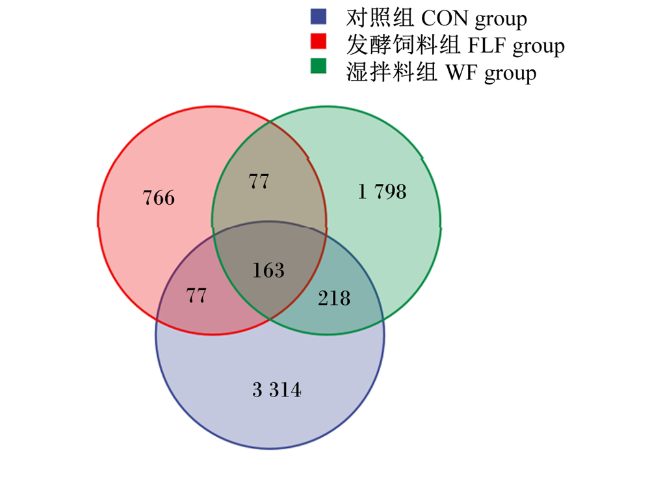
从第14天回肠食糜样本中共获得1 146 594个优质序列。根据97%的序列相似性,对菌群的所有序列进行操作分类单元(OTU)的聚类,共鉴定出6 413个OTU。根据样本中的OTU绘制了Venn图。由图1可知,CON组独有的OTU为3 314个,WF组独有的OTU为1 798个,FLF组独有的OTU为766个,3组共同拥有的OTU为163个。
图1 基于OTU的Venn图

Fig.1 Venn diagram based on OTU

2.4.2 断奶仔猪肠道菌群α多样性指数分析

表6可知,与CON组相比,FLF组的Ace指数、Shannon指数、Chao指数极显著降低(P<0.01),Simpson指数极显著提高(P<0.01);与CON组相比,WF组的Ace指数和Chao指数极显著降低(P<0.01),Simpson指数极显著提高(P<0.01);FLF组的Shannon指数、Simpson指数、Ace指数、Chao指数均极显著低于WF组(P<0.01)。
表6 发酵饲料和湿拌料对断奶仔猪肠道菌群α多样性指数的影响

Table 6 Effects of fermented feed and wet mixed feed on intestinal microflora α diversity indexes of weaned piglets

项目
Items
对照组
CON group
发酵饲料组
FLF group
湿拌料组
WF group
P
P-value
Shannon指数 Shannon index 5.33±0.12Bb 4.62±0.00Aa 5.59±0.08Bb <0.001
Simpson指数 Simpson index 0.91±0.00A 0.93±0.00B 0.95±0.00C <0.001
Ace指数 Ace index 788.28±65.49C 274.60±5.45A 487.57±25.34B <0.001
Chao指数 Chao index 787.24±65.45C 274.06±5.47A 486.85±25.21B <0.001

2.4.3 断奶仔猪肠道菌群组成分析

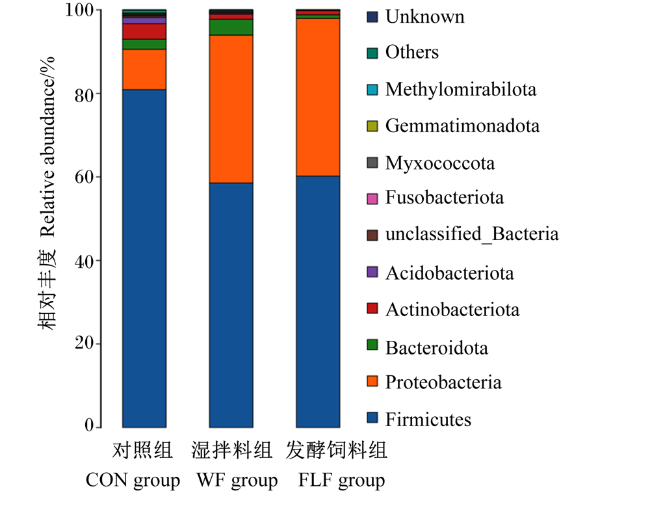
图2可知,在门水平上,肠道菌群中厚壁菌门(Firmicutes)、变形菌门(Proteobacteria)、拟杆菌门(Bacteroidota)、放线菌门(Actinobacteriota)、酸杆菌门(Acidobacteriota)、未分类菌门(unclassified-Bacteria)、梭杆菌门(Fusobacteriota)、黏球菌门(Myxococcota)、芽单胞菌门(Gemmatimonadota)、甲基肌酐菌门(Methylomirabilota)是主要优势菌门。与CON组相比,WF组和FLF组厚壁菌门的相对丰度降低,变形菌门的相对丰度提高。
图2 门水平肠道菌群组成分析

Firmicutes:厚壁菌门;Proteobacteria:变形菌门;Bacteroidota:拟杆菌门;Actinobacteriota:放线菌门;Acidobacteriota:酸杆菌门;unclassified_Bacteria:未分类菌门;Fusobacteriota:梭杆菌门;Myxococcota:黏球菌门;Gemmatimonadota:单芽胞菌门;Methylomirabilota:甲基肌酐菌门;Others:其他;Unknown:未知。

Fig.2 Analysis of intestinal microflora composition at phylum level

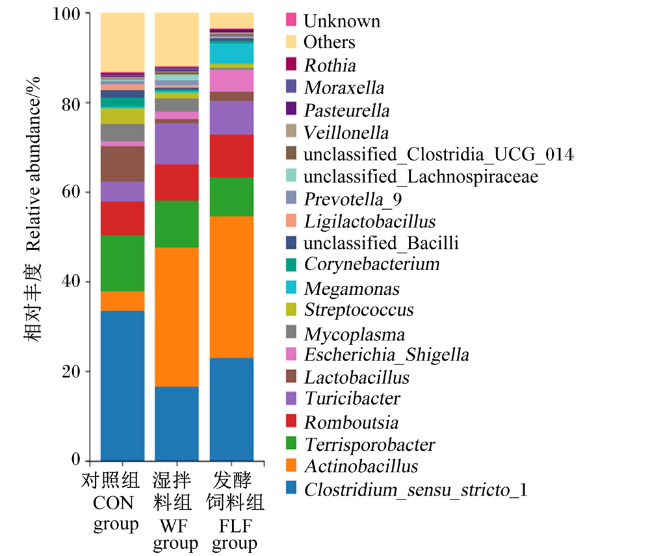
图3可知,在属水平上,肠道菌群中优势菌属主要是狭义梭菌属1(Clostridium_sensu_stricto_1)、放线杆菌属(Actinobacillus)、肠杆菌属(Terrisporobacter)、罗姆布茨菌属(Romboutsia)、苏黎世杆菌属(Turicibacter)、乳杆菌属(Lactobacillus)、埃希氏菌-志贺氏菌属(Escherichia_Shigella)、支原体菌属(Mycoplasma)、链球菌属(Streptococcus)、巨单胞菌属(Megamonas)等。与CON组相比较,WF组和FLF组狭义梭菌属1的相对丰度降低。
图3 属水平肠道菌群组成分析

Clostridium_sensu_stricto_1:狭义梭菌属1;Actinobacillus:放线杆菌属;Terrisporobacter:肠杆菌属;Romboutsia:罗姆布茨菌属;Turicibacter:苏黎世杆菌属;Lactobacillus:乳杆菌属;Escherichia_Shigella:埃希氏菌-志贺氏菌属;Mycoplasma:支原体菌属;Streptococcus:链球菌属;Megamonas:巨单胞菌属;Corynebacterium:棒状杆菌属;unclassified_Bacilli:杆菌纲未分类菌属;Ligilactobacillus:唾液乳杆菌属;Prevotella_9:普雷沃氏菌属9;unclassified_Lachnospiraceae:毛螺旋菌科未分类菌属;unclassified_Clostridia_UCG_014:梭菌纲UCG_014未分类菌属;Veillonella:韦荣氏球菌属;Pasteurella:巴氏杆菌属;Moraxella:卡他莫拉菌属;Rothia:罗氏菌属;Others:其他;Unknown:未知。

Fig.3 Analysis of intestinal microflora composition at genus level

3 讨论

3.1 发酵饲料和湿拌料对断奶仔猪生长性能及腹泻率的影响

仔猪断奶后常因营养、饲养环境等因素变化引发应激,造成仔猪生长发育受阻[10]。Xin等[11]研究显示,使用液体发酵饲料饲喂断奶仔猪可通过调节胃肠激素的分泌提高断奶仔猪的ADG和ADFI。Yang等[12]研究发现,饲粮中添加10%植物乳杆菌和乳酸片球菌联合发酵饲料能够提高保育猪的生长性能。Thu等[13]研究表明,植物乳杆菌产生的代谢物可以促进断奶仔猪的生长发育。Fu等[14]研究表明,饲粮中添加凝结芽孢杆菌和酵母水解物均可提高断奶仔猪的ADG,降低空肠黏膜中白细胞介素-1β浓度和肿瘤坏死因子-α mRNA表达量,改善肠道屏障功能,从而提高其生长性能。Liu等[15]研究发现,联用植物乳杆菌和枯草芽孢杆菌可通过改善肠道完整性来提高断奶仔猪的生长性能。
本试验中,FLF组和WF组断奶仔猪在第1~14天的生长速度较CON组慢,可能是因为断奶仔猪摄入的试验饲粮含有较高的水分,其干物质采食量少而影响其生长,而第1~28天FLF组的断奶仔猪生长性能极显著提高,WF组的断奶仔猪生长性能则无显著变化,这可能与第1~14天期间FLF组在饲粮中添加液体发酵饲料混合饲喂有关,液体发酵饲料中含有益生菌及其代谢产物,能够改善肠道健康,从而提高断奶仔猪的生长性能。在试验前期对仔猪饲喂发酵饲料其生长性能无显著效果,试验后期未添加液体发酵饲料饲喂后FLF组断奶仔猪生长性能却得到极显著提高,这表明液体发酵饲料对提高断奶仔猪生长性能方面具有一定时效性,其应用效果可能与液体发酵饲料对断奶仔猪饲喂时长和发挥作用时间等因素有关,研究结果侧面印证了液体发酵饲料对断奶仔猪后续的生长发育起着潜在影响。前人研究发现饲喂发酵液体饲料可降低断奶仔猪的F/G和腹泻率[16]。本试验中,FLF组和WF组断奶仔猪第1~14天的腹泻率有降低的趋势,第15~28天的腹泻率极显著降低。这可能是由于仔猪断奶后采食方式由母乳向固体饲料的转变易引起仔猪肠道应激,从而导致腹泻,而湿拌料和发酵饲料均有较高的含水量,与干料相比对肠道的刺激较小,使得仔猪肠道对其变化有一定适应性,从而使得仔猪腹泻率得到一定程度的降低。

3.2 发酵饲料和湿拌料对断奶仔猪血清生化与抗氧化指标的影响

仔猪血清生化指标能够反映动物机体营养物质的代谢、机体健康状况以及内环境稳态平衡。张秀江等[17]报道,在饲粮中添加10%的使用植物乳杆菌发酵制成的液体发酵饲料可使育肥猪的血清TP含量显著提高;朱坤等[18]研究发现,发酵饲料可以显著提高育肥猪血清中TP和UN含量,TG含量变化不显著;黄杏秀等[19]和Dong等[20]研究显示,发酵饲料可显著提高断奶仔猪血清中TP含量,对血清生化指标有一定的改善作用;Vadopalas等[21]报道,发酵饲料可以显著提高仔猪血清中TG含量。血清TP含量变化反映了机体对蛋白质的吸收与代谢能力,在正常范围内,血清中TP含量越高,机体对蛋白质吸收和代谢的能力越强。本试验发现,饲喂发酵饲料的断奶仔猪血清中TP含量得到显著提高,TG含量得到显著降低,与上述研究结果不完全一致。本试验结果表明,发酵饲料有助于促进断奶仔猪体内蛋白质的合成和代谢。在此前的研究中,Joysowal等[22]发现,通过在生长肥育猪饲粮中添加嗜酸乳杆菌,可以降低血清TG含量。血液中TG和TC的含量是衡量血脂代谢的重要指标,反映脂肪组织的发育和脂肪沉积水平[23]。本试验中,TG含量的降低可能意味着补充液体发酵饲料可以减轻肝脏蛋白质合成的负担并调节脂肪沉积。此外,本研究结果还显示,WF组断奶仔猪第28天血清中TG含量显著提高,这可能是试验前期饲喂湿拌料后对断奶仔猪后期TG吸收代谢有一定的促进作用。有研究表明,益生菌可分泌胆盐水解酶,其通过催化胃肠道中胆盐解偶联,从而调节肝脏中胆固醇的代谢[24]。饲粮中添加液体发酵饲料显著降低了第28天断奶仔猪血清中TG含量,这可能与肠道中胆盐水解酶的活性有关,胆盐水解酶影响胆盐的浓度,而胆盐可与脂质形成胆盐-脂质复合物,从而引起血清中TG含量的变化。这表明液体发酵饲料中的益生菌或其代谢产物调节了肠道中胆盐水解酶活性,从而降低了血清中TG的含量。因此,液体发酵饲料在蛋白质合成代谢和降低血清脂质方面有一定的促进作用,同时试验证实了液体发酵饲料对断奶仔猪后续生长和生化调节上有着潜在影响。
仔猪断奶后易引起氧化应激,破坏体内自由基的代谢,从而对动物机体造成难以修复的氧化损伤,影响动物整体机能。CAT、GSH-Px、T-AOC和SOD等抗氧化酶是动物体内抗氧化系统的重要组成部分,它们催化着与活性氧相关的各种化学反应[25]。血清中MDA含量反映了机体脂质过氧化程度和细胞损伤的程度;CAT和GSH-Px活性的强弱反映了机体抗氧化能力的强弱;T-AOC反映了动物体内活性物质的总体抗氧化水平。Zhang等[26]研究表明,植物乳杆菌C88多糖可以抑制动物机体产生MDA,并提高T-AOC和SOD活性。Xu等[27]研究发现,植物乳杆菌胞外多糖对动物体内抗氧化活性有显著作用,对体内部分氧自由基能起到有效清除作用,进而保护DNA免受损伤。Chen等[28]在仔猪上的试验发现,德氏乳杆菌可以显著提高仔猪肠道中T-AOCCAT的mRNA表达量。本试验发现,WF组断奶仔猪在第28天血清CAT活性显著增加,MDA含量极显著降低,这可能是饲喂湿拌料在一定程度上能够缓解仔猪肠道刺激,从而减少仔猪氧化应激的产生;FLF组断奶仔猪在第14天血清T-AOC显著提高,在第28天血清MDA含量极显著降低、CAT活性显著增加,这表明发酵饲料中的益生菌及代谢产物等对仔猪抗氧化能力的影响较湿拌料更显著,并对仔猪后续生长有改善作用。综上所述,饲喂湿拌料能够对断奶仔猪血清部分抗氧化指标有一定的改善作用,在饲粮中添加液体发酵饲料则能够显著改善断奶仔猪的抗氧化能力,然而液体发酵饲料对断奶仔猪抗氧化能力的生理机制尚不清楚,后续还需进一步探索研究。

3.3 发酵饲料和湿拌料对断奶仔猪肠道菌群的影响

肠道菌群是调节宿主健康的关键因素之一,它的存在为机体创造了良好的肠道微生态环境,肠道菌群与机体相互协调[29]。稳定的肠道菌群不仅能阻止大肠杆菌、鼠伤寒沙门氏菌等腹泻致病菌的定植,还能调控动物机体健康,如营养物质消化、免疫应答、内分泌等多种生理活动[30]。最近的研究表明,益生菌在肠道中发挥着重要作用,可以抑制病原菌在肠道的定植,帮助宿主建立健康的肠黏膜保护层,促进宿主的肠道健康[31]。本研究表明,饲粮中添加液体发酵饲料显著降低了肠道菌群OTU数目和特有OTU数目;与CON组相比,FLF组Shannon指数、Ace指数和Chao指数降低,Simpson指数提高,Shannon指数和Simpson指数分别与物种多样性呈正相关和负相关,这表明在饲粮添加液体发酵饲料对断奶仔猪肠道原始菌群生长有一定的抑制作用,这可能与仔猪断奶后适应力弱,饲粮含水量高以及液体发酵饲料中益生菌在肠道定植时间有关。肠道菌群组成常受饲粮和环境等因素影响,相关研究表明,猪肠道菌群中,在门水平上相对丰度较高的主要是厚壁菌门、拟杆菌门和变形菌门等[32]。本试验结果表明,在门水平上相对丰度最高的是厚壁菌门,其次是变形菌门;与CON组相比,FLF组断奶仔猪肠道菌群中厚壁菌门的相对丰度降低,变形菌门的相对丰度提高,这表明发酵饲料在一定程度上调节了肠道菌群在门水平上的组成结构。本试验还发现,与CON组相比,WF组仔猪肠道菌群在门水平上的组成结构也发生了一定的变化,这可能与湿拌料能够缓解肠道刺激、改善肠道环境有关。有研究发现,狭义梭菌属是一种肠道有害菌属,它的代谢产物中存在有害物质,易对动物机体产生一定程度的危害[33]。本试验中FLF组断奶仔猪肠道菌群中狭义梭菌属1的相对丰度降低,这表明发酵饲料能有效抑制有害菌在肠道定植,调节肠道菌群平衡,从而改善仔猪肠道健康,而FLF组仔猪试验后期的生长性能提高、腹泻率降低的原因可能与狭义梭菌属1相对丰度降低有一定关联。综上所述,饲喂湿拌料在一定程度上调节了仔猪肠道菌群结构,而饲粮中添加液体发酵饲料则能够调节断奶仔猪肠道菌群组成结构,抑制有害菌在肠道定植,改善仔猪肠道健康。

4 结论

① 试验第1~14天,与CON组相比,饲喂湿拌料和发酵饲料能够调节断奶仔猪肠道菌群结构,改善肠道健康,并有降低腹泻率的趋势,但可能因湿拌料和发酵饲料含水量高导致断奶仔猪摄入的干物质量较低,从而影响了其生长性能。
② 试验第15~28天,与CON组相比,FLF组断奶仔猪腹泻率显著降低,生长性能得到改善,抗氧化能力得到提高。
[1]
FARDISI M, THELEN K, GROENENDAL A, et al. Early weaning and biological sex shape long-term immune and metabolic responses in pigs[J]. Scientific Reports, 2023, 13(1):15907.

[2]
TANG X P, XIONG K N, FANG R J, et al. Weaning stress and intestinal health of piglets:a review[J]. Frontiers in Immunology, 2022, 13:1042778.

[3]
MENZ J, OLSSON O, KÜMMERER K. Antibiotic residues in livestock manure:does the EU risk assessment sufficiently protect against microbial toxicity and selection of resistant bacteria in the environment?[J]. Journal of Hazardous Materials, 2019, 379:120807.

[4]
HATHI Z, METTU S, PRIYA A, et al. Methodological advances and challenges in probiotic bacteria production:ongoing strategies and future perspectives[J]. Biochemical Engineering Journal, 2021, 176:108199.

[5]
SUGIHARTO S, RANJITKAR S. Recent advances in fermented feeds towards improved broiler chicken performance,gastrointestinal tract microecology and immune responses:a review[J]. Animal Nutrition, 2019, 5(1):1-10.

[6]
MISSOTTEN J A, MICHIELS J, DEGROOTE J, et al. Fermented liquid feed for pigs:an ancient technique for the future[J]. Journal of Animal Science and Biotechnology, 2015, 6(1):4.

[7]
CULLEN J T, LAWLOR P G, CORMICAN P, et al. Microbial quality of liquid feed for pigs and its impact on the porcine gut microbiome[J]. Animals, 2021, 11(10):2983.

[8]
CANIBE N, JENSEN B B. Fermented and nonfermented liquid feed to growing pigs:effect on aspects of gastrointestinal ecology and growth performance[J]. Journal of Animal Science, 2003, 81(8):2019-2031.

[9]
刘春雪, 王改琴, 沈波, 等. 液态饲喂在育肥猪上的使用效果[J]. 饲料工业, 2020, 41(4):19-23.

LIU C X, WANG G Q, SHEN B, et al. Effects of liquid feeding on growth performance of finishing pigs[J]. Feed Industry, 2020, 41(4):19-23. (in Chinese)

[10]
CHEN J L, LI Y, YU B, et al. Dietary chlorogenic acid improves growth performance of weaned pigs through maintaining antioxidant capacity and intestinal digestion and absorption function[J]. Journal of Animal Science, 2018, 96(3):1108-1118.

DOI PMID

[11]
XIN H L, WANG M Y, XIA Z, et al. Fermented diet liquid feeding improves growth performance and intestinal function of pigs[J]. Animals, 2021, 11(5):1452.

[12]
YANG Y Z, YAN G H, MENG X H, et al. Effects of Lactobacillus plantarum and Pediococcus acidilactici co-fermented feed on growth performance and gut microbiota of nursery pigs[J]. Frontiers in Veterinary Science, 2022, 9:1076906.

[13]
THU T V, LOH T C, FOO H L, et al. Effects of liquid metabolite combinations produced by Lactobacillus plantarum on growth performance,faeces characteristics,intestinal morphology and diarrhoea incidence in postweaning piglets[J]. Tropical Animal Health and Production, 2011, 43(1):69-75.

[14]
FU R Q, LIANG C, CHEN D W, et al. Effects of dietary Bacillus coagulans and yeast hydrolysate supplementation on growth performance,immune response and intestinal barrier function in weaned piglets[J]. Journal of Animal Physiology and Animal Nutrition, 2021, 105(5):898-907.

[15]
LIU Y S, GU W, LIU X Y, et al. Joint application of Lactobacillus plantarum and Bacillus subtilis improves growth performance,immune function and intestinal integrity in weaned piglets[J]. Veterinary Sciences, 2022, 9(12):668.

[16]
马雪锋. 发酵液体饲料对断奶仔猪生长性能、腹泻率和粪便微生物的影响[J]. 中国饲料, 2023(12):85-88.

MA X F. Effects of fermented liquid feed on growth performance,diarrhea rate,and fecal microbiota of weaned piglets[J]. China Feed, 2023(12):85-88. (in Chinese)

[17]
张秀江, 胡虹, 王秋菊, 等. 乳酸菌液体发酵饲料对育肥猪养分表观消化率、粪样菌群、血液生化指标和生产性能的影响[J]. 饲料工业, 2019, 40(20):28-33.

ZHANG X J, HU H, WANG Q J, et al. Effects of Lactobacillus liquid fermented feed on apparent nutrient digestibility,fecal microflora,blood biochemical indexes and production performance of fattening pigs[J]. Feed Industry, 2019, 40(20):28-33. (in Chinese)

[18]
朱坤, 毛胜勇, 朱崇淼, 等. 发酵饲料对育肥猪生长性能、胴体性状、肉品质、血清生化指标和代谢产物的影响[J]. 动物营养学报, 2018, 30(10):4244-4250.

ZHU K, MAO S Y, ZHU C M, et al. Effects of fermented feed on growth performance,carcass traits, meat quality,serum biochemical indicators and metabolites of finishing pigs[J]. Chinese Journal of Animal Nutrition, 2018, 30(10):4244-4250. (in Chinese)

[19]
黄杏秀, 黄丽萍, 郭勇军, 等. 微生物发酵饲料对断奶仔猪生长性能、血液生化指标及免疫力的影响[J]. 饲料研究, 2020, 43(12):34-37.

HUANG X X, HUANG L P, GUO Y J, et al. Effect of microbial fermentation feed on growth performance,blood biochemical indexes and immunity of weaned piglets[J]. Feed Research, 2020, 43(12):34-37. (in Chinese)

[20]
DONG X L, ZHANG N F, ZHOU M, et al. Effects of dietary probiotics on growth performance,faecal microbiota and serum profiles in weaned piglets[J]. Animal Production Science, 2014, 54(5):616-621.

[21]
VADOPALAS L, RUZAUSKAS M, LELE V, et al. Combination of antimicrobial starters for feed fermentation:influence on piglet feces microbiota and health and growth performance,including mycotoxin biotransformation in vivo[J]. Frontiers in Veterinary Science, 2020, 7:528990.

[22]
JOYSOWAL M, SAIKIA B N, DOWARAH R, et al. Effect of probiotic Pediococcus acidilactici FT28 on growth performance,nutrient digestibility,health status,meat quality,and intestinal morphology in growing pigs[J]. Veterinary World, 2018, 11(12):1669-1676.

[23]
LIU Z, HE H, DAI Y Z, et al. Comparison of the diagnostic value between triglyceride-glucose index and triglyceride to high-density lipoprotein cholesterol ratio in metabolic-associated fatty liver disease patients:a retrospective cross-sectional study[J]. Lipids in Health and Disease, 2022, 21(1):55.

[24]
ADEBOLA O O, CORCORAN O, MORGAN W A. Prebiotics may alter bile salt hydrolase activity:possible implications for cholesterol metabolism[J]. PharmaNutrition, 2020, 12:100182.

[25]
ZHAN X A, WANG M, XU Z R, et al. Effects of fluoride on hepatic antioxidant system and transcription of Cu/Zn SOD gene in young pigs[J]. Journal of Trace Elements in Medicine and Biology, 2006, 20(2):83-87.

[26]
ZHANG L, LIU C H, LI D, et al. Antioxidant activity of an exopolysaccharide isolated from Lactobacillus plantarum C88[J]. International Journal of Biological Macromolecules, 2013, 54:270-275.

[27]
XU Y M, CUI Y L, WANG X, et al. Purification,characterization and bioactivity of exopolysaccharides produced by Lactobacillus plantarum KX041[J]. International Journal of Biological Macromolecules, 2019, 128:480-492.

[28]
F M, WANG H J, CHEN J Y, et al. Lactobacillus delbrueckii ameliorates intestinal integrity and antioxidant ability in weaned piglets after a lipopolysaccharide challenge[J]. Oxidative Medicine and Cellular Longevity, 2020, 2020:6028606.

[29]
DE VOS W M, TILG H, VAN HUL M, et al. Gut microbiome and health:mechanistic insights[J]. Gut, 2022, 71(5):1020-1032.

[30]
WANG X Z, ZHANG P, ZHANG X. Probiotics regulate gut microbiota:an effective method to improve immunity[J]. Molecules, 2021, 26(19):6076.

[31]
SZLISZKA E, CZUBA Z P, DOMINO M, et al. Ethanolic extract of propolis (EEP) enhances the apoptosis- inducing potential of TRAIL in cancer cells[J]. Molecules, 2009, 14(2):738-754.

DOI PMID

[32]
KIM H B, BOREWICZ K, WHITE B A, et al. Longitudinal investigation of the age-related bacterial diversity in the feces of commercial pigs[J]. Veterinary Microbiology, 2011, 153(1/2):124-133.

[33]
王诗琦, 陈雪娇, 梁丽萍, 等. 饲粮添加酶解蛋白肽对断奶仔猪生长性能、血清免疫指标和肠道菌群的影响[J]. 动物营养学报, 2022, 34(2):839-851.

DOI

WANG S Q, CHEN X J, LIANG L P, et al. Effects of dietary enzymatic protein peptide on growth performance,serum immune indices and intestinal flora of weaned piglets[J]. Chinese Journal of Animal Nutrition, 2022, 34(2):839-851. (in Chinese)

Outlines

/