RESEARCH PAPER

Effects of Early Supplementary Feeding on Growth Performance and Intestinal Health of Barn-Feeding Beef Calves

  • LI Qi ,
  • XU Junzhao ,
  • MA Jianfei ,
  • BAO Junjie ,
  • NIU Huaxin , *
Expand
  • College of Animal Science and Technology, Inner Mongolia Minzu University, Tongliao 028000, China

Received date: 2023-12-29

  Online published: 2024-07-09

Abstract

This experiment was conducted to investigate the effects of early supplementary feeding on growth performance, diarrhea rate, intestinal microflora and function of barn-feeding beef calves. Thirty healthy newborn calves (16 female calves and 14 male calves) with birth weight of (42.38±0.89) kg were randomly divided into 2 groups (control group and early supplementary feeding group), with 15 calves (8 female calves and 7 male calves) in each group. Beef cows and calves (mother and calf together) are fed in single pens. In the control group, calves suckled with their mothers and were not fed any feed before weaning; in the early supplementary feeding group, calves were suckled by their mothers, supplemented with granulated starter and high-quality oat hay at appropriate time and with increasing age. The experiment lasted for 42 days. The results showed as follows: 1) the body weight of calves in early supplementary feeding group at 42 days of age was extremely significantly higher than that in control group (P<0.01), but there was no significant difference in body weight at other days of age between control group and early supplementary feeding group (P>0.05); the average daily gain of calves in early supplementary feeding group was extremely significantly higher than that in control group at each day of age (P<0.01). In terms of body size indexes, the chest circumference index in early supplementary feeding group was significantly higher than that in control group at 42 days of age (P<0.05), and there were no significant differences in other body size indexes at each day of age (P>0.05). 3) The diarrhea rate of calves in early supplementary feeding group was significantly lower than that in control group (P<0.05), and there was no significant difference in fecal score between control group and early supplementary feeding group (P>0.05). 4) Compared with the control group, Simpson index and Chao1 index of intestinal flora of calves in early supplementary feeding group were significantly increased (P<0.05) and significantly decreased (P<0.05), respectively; the relative abundance of Faecalibacterium in the intestinal flora in early supplementary feeding group was significantly higher than that in control group (P<0.05), and the relative abundance of Akkermansia was extremely significantly higher than that in control group (P<0.01). In addition, a small number of Prevotella and Butyrivibrio was found in early supplementary feeding group. 5) Functional prediction of intestinal flora showed that, in the function of intestinal flora of calves, the abundances of pyrimidine nucleoside residues superpathway, guanosine ribonucleotide de novo biosynthesis and uridylate monophosphate biosynthesis in early supplementary feeding group were extremely significantly higher than those in control group (P<0.01). In conclusion, early supplementary feeding can improve the growth and development, improve the intestinal flora structure, promote the metabolisms of amino acid and energy, reduce the diarrhea rate of barn-feeding beef calves, and facilitate the implementation of early weaning.

Cite this article

LI Qi , XU Junzhao , MA Jianfei , BAO Junjie , NIU Huaxin . Effects of Early Supplementary Feeding on Growth Performance and Intestinal Health of Barn-Feeding Beef Calves[J]. Chinese Journal of Animal Nutrition, 2024 , 36(7) : 4413 -4427 . DOI: 10.12418/CJAN2024.380

肉用母牛-犊牛生产是肉牛养殖的核心和基础,其生产水平直接决定犊牛和育肥牛的生产效益。在农作物种植区,肉用犊牛常采取舍饲随母哺乳的传统养殖方式,且养殖模式较为粗放,肉用母牛饲粮主要以农作物秸秆、低质牧草等粗饲料为主。哺乳期犊牛常与母牛混养至6月龄,哺乳周期较长且不单独补饲,不仅延长了母牛的繁殖周期,还限制了犊牛营养物质的摄入,导致其生长发育缓慢、断奶体重低。犊牛免疫系统与部分组织器官发育不健全,易受到病原微生物的侵袭而引起胃肠功能紊乱和腹泻,严重时甚至导致犊牛死亡,最终影响养殖效益[1-3]。提高肉用犊牛的早期培育质量,是其成年发挥高产的重要保证。研究表明,在犊牛哺乳期适时提早饲喂开食料的同时补饲优质干草,可以降低犊牛饲粮类型转变所产生的应激,并有效改善犊牛的生长性能、饲料转化率、胃肠道发育状况,利于实现早期断奶[4-5]。Du等[6]研究发现,固体饲料的摄入会加快瘤胃发育速度,对幼龄反刍动物肠道微生物组成有显著而持久的影响。Fischer等[7]研究发现,饲喂单一母乳会延缓肠道微生物定植过程,减缓犊牛生长发育速度。Van Niekerk等[8]指出,从液体牛乳过渡到固体饲料的采食方式对早期犊牛的发育至关重要。付瑶等[9]探究发现,补饲苜蓿干草使蒙贝利亚×荷斯坦杂交牛后代犊牛的生长性能得到了明显改善。郭文杰等[10]研究表明,采用代乳粉饲喂并进行精料和苜蓿干草补饲的饲喂方式更利于犊牛早期断奶,提高生长性能,促进胃肠道组织发育。目前营养调控研究主要集中在集约化管理的奶犊牛或羔羊[11-13],关于舍饲随母哺乳的肉用犊牛早期补饲对生长性能、胃肠道发育情况的相关研究较少。
本研究在舍饲肉用母牛-犊牛生产系统中,适时适量补饲颗粒开食料与优质饲草,探索早期补饲对哺乳期犊牛生长性能的影响,并进一步解析犊牛肠道菌群及功能,为舍饲肉用母牛-犊牛生产系统中犊牛适时早期断奶和提高其生长发育提供一定参考。

1 材料与方法

1.1 试验动物与试验设计

本试验于2022年9—11月在内蒙古自治区通辽市进行,选用健康的同一批次头胎肉用母牛(中国西门塔尔牛,草原类群)同期发情初产的犊牛(肉用中国西门塔尔牛)30头。其中公犊牛14头[平均初生重为(42.43±0.84) kg],母犊牛16头[平均初生重为(42.32±0.66) kg]。将试验牛分为2组,即对照组与早期补饲组,每组15头(公犊牛7头、母犊牛8头),肉用母牛-犊牛(母子一体)单栏饲喂,试验期共42 d。对照组采取随母哺乳的传统饲喂方式,试验期间不补充任何饲料;早期补饲组采取随母哺乳的饲喂方式,7日龄开始补充犊牛颗粒开食料,14日龄开始补充燕麦干草,并逐步诱导犊牛自主采食。补饲方案:7日龄起,按照犊牛体重的0.2%补充颗粒开食料,随日龄增加逐步增加;14、21与42日龄起,分别按照犊牛体重的0.2%(50%颗粒开食料和50%燕麦干草)、0.4%(50%颗粒开食料和50%燕麦干草)、1.2%(50%颗粒开食料和50%燕麦干草)补饲颗粒开食料和燕麦干草。试验期间2组犊牛均自由饮水。本试验所用颗粒开食料的组成及颗粒开食料与燕麦干草的营养水平见表1。燕麦草铡切至2 cm后晒干饲喂。参照《肉牛饲养标准》(NY/T 815—2004)[14]配制肉用母牛全混合日粮(TMR,精粗比25∶75),30头母牛饲喂相同的TMR,该TMR营养成分含量(干物质基础)如下:粗蛋白质(CP)9.8%、粗灰分(Ash)6.1%、中性洗涤纤维(NDF)71.5%、酸性洗涤纤维(ADF)43.2%、粗脂肪(EE)2.8%、钙(Ca)0.8%、磷(P)0.5%。
表1 颗粒开食料的组成及开食料与燕麦干草的营养水平(干物质基础)

Table 1 Composition of granular starter and nutrient levels of granular starter and oat hay (DM basis)%

项目
Items
颗粒开食料
Granular
starter
燕麦干草
Oat hay
原料 Ingredients
玉米 Corn 60.00
豆粕 Soybean meal 28.00
麸皮 Wheat bran 8.00
石粉 Limestone 2.00
磷酸氢钙 CaHPO4 0.70
食盐 NaCl 0.30
预混料 Premix1) 1.00
合计 Total 100.00
营养水平 Nutrient levels2)
粗蛋白质 CP 19.53 16.53
粗灰分 Ash 6.69 6.43
中性洗涤纤维 NDF 14.53 58.52
酸性洗涤纤维 ADF 6.26 36.68
粗脂肪 EE 3.84 1.62
钙 Ca 0.95 0.45
磷 P 0.58 0.17

1)预混料为每千克饲粮提供 The premix provided the following per kg of the diet:Fe 90.0 mg,Mn 30.0 mg,Cu 12.5 mg,Zn 60.0 mg,Se 0.3 mg,I 1.0 mg,Co 0.5 mg,VA 15 000 IU,VD 5 000 IU,VE 50 mg。

2)营养水平均为实测值。Nutrient levels were measured values.

1.2 测定指标与方法

1.2.1 饲粮样品采集与营养成分测定

试验开始后,在试验的第2周、第4周、第6周采用四分法采集饲料样品,将采集好的饲料样品混合均匀后,放置于-20 ℃冰箱保存,用于测定营养成分含量。粗灰分(Ash)含量的测定参考AOAC(2005)中方法,粗蛋白质(CP)含量参考GB/T 6432—2018采用KDN-B凯氏定氮仪测定,中性洗涤纤维(NDF)和酸性洗涤纤维(ADF)含量分别参考GB/T 20806—2022和NY/T 1452—2022采用ANKOM A2000i(滤袋技术)全自动纤维仪测定,粗脂肪含量采用索氏抽提法(GB/T 6433—2006)测定,钙(Ca)含量采用高锰酸钾法(GB/T 6436—2018)测定,磷(P)含量采用钒钼酸铵比色法(GB/T 6437—2018)测定。

1.2.2 犊牛生长性能测定

在犊牛出生当天(试验第1天,1日龄)及21和42日龄晨饲前称取犊牛的空腹体重,并计算犊牛各阶段的平均日增重(ADG)。
平均日增重=(终末体重-初始体重)/试验天数。
在犊牛出生当天及21、42日龄晨饲前测量犊牛相关体尺指标,包括体高、体斜长、胸围及管围。体高指由髻甲最高点垂直到地面的距离,通过测杖进行测量;体斜长指由肱骨突起最前端到坐骨结节之间的距离,通过测杖进行测量;胸围指肩胛骨后缘处体躯的水平周径,利用卷尺测量;管围指前肢掌骨上1/3处的周径,利用卷尺测量。根据记录的测量结果,通过公式计算体长指数、体躯指数、胸围指数和管围指数[15]
体长指数=100×体斜长/体高;
体躯指数=100×胸围/体斜长;
胸围指数=100×胸围/体高;
管围指数=100×管围/体高。

1.2.3 犊牛粪便评分与腹泻率计算

从犊牛出生采食初乳开始直至试验结束,每天观察犊牛粪便形态、颜色等。按照表2中粪便评分标准[16]进行评分,3分(含)以上记为腹泻并计算腹泻率:
腹泻率= [(腹泻头数×腹泻天数)/(总头数×记录天数)]×100。
表2 粪便评分标准

Table 2 Fecal scoring criteria

外形 Appearance 流动性 Liquidity 评分 Score/分
正常 Normal 稳固但不坚硬,扔在地面或沉积后外形稍有变化 1
松软 Soft 不能保持外形,成堆但稍有松软 2
软膏 Paste 薄饼状,易扩散到6 mm厚 3
水状 Aqueous 液状,像橙汁,粪水有分离现象 4

1.2.4 犊牛肠道菌群分析

于42日龄晨饲前,2组分别选取3头健康的犊牛,带无菌手套刮取犊牛直肠末端粪便样品约5 g,装于无菌冻存管中,液氮保存带回实验室后放于-80 ℃冰箱保存。使用E.Z.N.A.®土壤DNA试剂盒(Omega Bio-Tek,美国)按照试剂盒说明提取犊牛粪便中细菌总DNA,选择细菌通用引物27F(5'-AGRGTTYGATYMTGGCTCAG-3')和1492R(5'-RGYTACCTTGTTACGACTT-3')扩增16S rRNA基因。使用2%琼脂糖凝胶评估扩增产物质量,从中获取扩增产物,并进行电泳检查。将纯化后的扩增产物等比例混合,按照试剂盒说明,使用SMRTbell® Express Prep Kit 2.0(Pacific Biosciences,美国)构建DNA文库。在上海美吉生物医药科技有限公司的PacBio-Based SMRT测序平台上测序。

1.3 数据统计与分析

试验数据使用Excel 2019进行初步整理,然后对除微生物指标外的其他指标采用SPSS 20.0软件中的一般线性模型对组别(G)、性别(S)效应以及二者的交互效应进行分析,微生物指标进行独立样本t检验。数据以平均值和均值标准误(SEM)表示,P<0.05时认为差异具有统计学意义。

2 结果

2.1 早期补饲对犊牛生长性能的影响

表3可知,42日龄时早期补饲组犊牛体重极显著高于对照组(P<0.01),其他日龄时对照组与早期补饲组犊牛体重无显著差异(P>0.05);1~21日龄、22~42日龄与1~42日龄阶段,早期补饲组犊牛平均日增重均极显著高于对照组(P<0.01);整个试验期间,公犊牛与母犊牛的体重、平均日增重无显著差异(P>0.05),且组别与性别的交互效应对犊牛的体重及平均日增重均无显著影响(P>0.05)。
表3 早期补饲对犊牛体重和平均日增重的影响

Table 3 Effects of early supplementary feeding on BW and ADG of calves

项目
Items
日龄
Days of age
性别
Sex
组别 Groups 均值
标准误
SEM
PP-value
对照
Control
早期补饲
Early supplementary
feeding
G S G×S


体重 BW/kg

1
公 Male 42.56 42.30
0.31

0.738

0.730

0.642
母 Female 42.30 42.34

21
公 Male 53.30 53.89
0.54

0.066

0.845

0.813
母 Female 53.16 53.90

42
公 Male 65.32A 67.32B
0.82

<0.001

0.792

0.895
母 Female 65.19A 67.28B


平均日增重
ADG/g

1~21
公 Male 511.27A 552.06B
12.15

<0.001

0.160

0.782
母 Female 507.62A 550.63B

22~42
公 Male 572.38A 639.68B
13.68

<0.001

0.081

0.320
母 Female 568.10A 638.98B

1~42
公 Male 541.82A 595.87B
14.20

<0.001

0.102

0.368
母 Female 538.33A 593.81B

G:组别;S:性别;G×S:组别×性别。同行数据肩标相同或无字母表示差异不显著(P>0.05),不同小写字母表示差异显著(P<0.05),不同大写字母表示差异极显著(P<0.01),下表同。

G: group; S: sex; G×S: group×sex. In the same row, values with no letter or the same letter superscripts mean no significant difference (P>0.05), while with different small letter superscripts mean significant difference (P<0.05), and with different capital letter superscripts mean extremely significant difference (P<0.01). The same as below.

表4可知,42日龄时早期补饲组犊牛的胸围指数显著高于对照组(P<0.05),其他日龄犊牛胸围指数对照组与早期补饲组之间没有显著差异(P>0.05);整个试验期间,体长指数、体躯指数、管围指数对照组与早期补饲组之间均无显著差异(P>0.05),但在42日龄时早期补饲组犊牛的体长指数(P=0.083)、体躯指数(P=0.097)均有升高趋势,而管围指数(P=0.051)有下降的趋势;整个试验期间,公犊牛与母犊牛的体长指数、体躯指数、胸围指数与管围指数均无显著差异(P>0.05),且组别与性别的交互效应对犊牛的体长指数、体躯指数、胸围指数与管围指数均无显著影响(P>0.05)。
表4 早期补饲对犊牛体尺指数的影响

Table 4 Effects of early supplementary feeding on body size index of calves

项目
Items
日龄
Day of age
性别
Sex
组别 Groups 均值
标准误
SEM
PP-value
对照
Control
早期补饲
Early supplementary
feeding
G S G×S


体长指数
Body length
index

1
公 Male 92.69 92.82
0.22

0.215

0.366

0.778
母 Female 92.77 92.67

21
公 Male 93.48 93.58
0.09

0.643

0.656

0.949
母 Female 93.41 93.49

42
公 Male 93.77 93.91
0.15

0.083

0.321

0.488
母 Female 93.76 93.82


体躯指数
Somatic index

1
公 Male 123.83 123.99
0.20

0.700

0.674

0.840
母 Female 123.77 123.82

21
公 Male 125.33 125.44
0.18

0.319

0.732

0.961
母 Female 125.31 125.41

42
公 Male 126.97 127.03
0.16

0.097

0.178

0.790
母 Female 126.87 126.99


胸围指数
Chest
circumference
index

1
公 Male 115.49 115.51
0.08

0.704

0.790

0.303
母 Female 115.38 115.37

21
公 Male 117.25 117.40
0.15

0.347

0.438

0.947
母 Female 117.14 117.27

42
公 Male 118.50a 118.83b
0.33

0.048

0.441

0.842
母 Female 118.34a 118.72b


管围指数
Pipe
circumference
index

1
公 Male 16.56 16.60
0.05

0.562

0.169

0.961
母 Female 16.51 16.53

21
公 Male 16.44 16.49
0.08

0.296

0.064

0.868
母 Female 16.36 16.40

42
公 Male 16.23 16.29
0.07

0.051

0.128

0.569
母 Female 16.19 16.21

2.2 早期补饲对犊牛粪便评分与腹泻率的影响

表5可知,整个试验期间,对照组与早期补饲组犊牛的粪便评分均无显著差异(P>0.05),且公犊牛与母犊牛的粪便评分也均无显著差异(P>0.05);1~21日龄、22~42日龄与1~42日龄阶段,早期补饲组犊牛腹泻率均显著低于对照组(P<0.05),但公犊牛与母犊牛的腹泻率无显著差异(P>0.05),且组别与性别的交互效应对犊牛的粪便评分与腹泻率均无显著影响(P>0.05)。
表5 早期补饲对犊牛粪便评分与腹泻率的影响

Table 5 Effects of early supplementary feeding on fecal score and diarrhea rate of calves

项目
Items
日龄
Days of age
性别
Sex
组别 Groups 均值
标准误
SEM
PP-value
对照
Control
早期补饲
Early supplementary
feeding
G S G×S


粪便评分
Fecal
score/分

1
公 Male 1.4 1.8
0.32

0.781

0.781

0.409
母 Female 1.8 1.6

21
公 Male 2.6 2.0
0.31

0.078

0.600

0.887
母 Female 2.1 2.4

42
公 Male 2.2 2.0
0.41

0.275

0.579

0.586
母 Female 2.4 2.0


腹泻率
Diarrhea rate/%

1~21
公 Male 26.83b 24.32a
1.24

0.045

0.660

0.382
母 Female 25.48b 23.62a

22~42
公 Male 24.62b 21.63a
1.56

0.038

0.221

0.780
母 Female 25.87b 20.81a

1~42
公 Male 24.37b 22.25a
2.18

0.039

0.702

0.328
母 Female 23.98b 22.69a

2.3 早期补饲对犊牛肠道菌群与功能的影响

本试验共获得11 203条reads,平均每头牛获得(1 881.1±291.8)条reads,所有样品的物种覆盖率均大于99.5%。42日龄时2组犊牛肠道菌群α-多样性指数如表6所示,与对照组相比,早期补饲组犊牛肠道菌群的Simpson指数显著增加(P<0.05),Chao1指数显著降低(P<0.05)。
表6 42日龄时犊牛肠道菌群α-多样性指数

Table 6 Intestinal flora α-diversity indexes of calves at 42 days of age

项目
Items
组别 Groups 均值
标准误
SEM
P
P-value
对照
Control
早期补饲
Early supplementary feeding
操作分类单元数 OTUs number/个 2 170.83 1 853.35 19.54 0.087
覆盖率 Coverage/% 99.92 99.89 0.02 0.872
Chao1指数 Chao1 index 1 475.63b 1 295.83a 18.63 0.038
ACE指数 ACE index 1 022.09 992.60 6.81 0.066
Shannon指数 Shannon index 5.98 6.18 0.62 0.192
Simpson指数 Simpson index 0.88a 0.93b 0.04 0.045
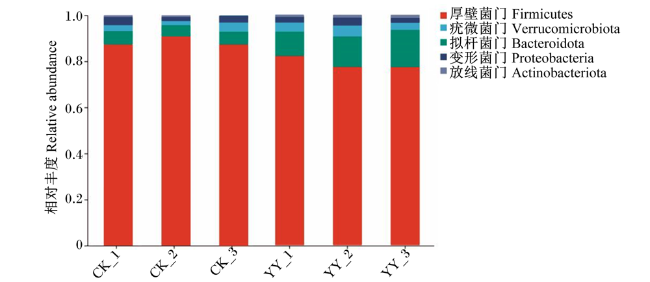
从门水平来看,在42日龄时,对照组和早期补饲组犊牛肠道菌群的优势菌门均为厚壁菌门(Firmicutes)、拟杆菌门( Bacteroidota)、变形菌门(Proteobacteria)、疣微菌门(Verrucomicrobiota)和放线菌门(Actinobacteriota),42日龄时2组犊牛肠道菌群门水平上的特征见图1。由表7可知,对照组厚壁菌门的相对丰度显著高于早期补饲组(P<0.05);早期补饲组疣微菌门的相对丰度显著高于早期补饲组(P<0.05),拟杆菌门的相对丰度极显著高于对照组(P<0.01)。
图1 42日龄时2组犊牛肠道菌群门水平上的特征

CK_1、CK_2、CK_3代表对照组的3个样品,YY_1、YY_2、YY_3代表早期补饲组的3个样品。下图同。

Fig.1 Characteristics at phylum level of intestinal flora of calves in 2 groups at 42 days of age

CK_1, CK_2 and CK_3 represented the three samples from the control group, and YY_1, YY_2 and YY_3 represented the three samples from the early supplementary feeding group. The same as below.

表7 42日龄时2组犊牛肠道菌群中优势菌门的相对丰度

Table 7 Relative abundances of dominant bacterial phyla in intestinal flora of calves in 2 groups at 42 days of age%

项目
Items
组别 Groups 均值
标准误
SEM
P
P-value
对照
Control
早期补饲
Early supplementary feeding
厚壁菌门 Firmicutes 85.89b 79.32a 2.64 0.033
疣微菌门 Verrucomicrobiota 2.61a 4.12b 0.70 0.048
拟杆菌门 Bacteroidota 4.86A 12.23B 1.75 0.006
变形菌门 Proteobacteria 2.87 2.15 0.47 0.312
放线菌门 Actinobacteriota 0.22 0.46 0.08 0.090
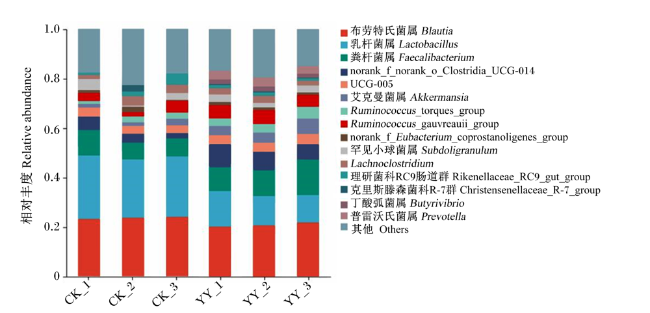
对相对丰度排名前15的菌属进行分析,从属水平来看,在42日龄时,对照组和早期补饲组犊牛肠道细菌群中的优势菌属有布劳特氏菌属(Blautia)、乳杆菌属(Lactobacillus)、粪杆菌属(Faecalibacterium)、norank_f_norank_o_Clostridia_UCG-014、UCG-005、艾克曼菌属(Akkermansia)、Ruminococcus_torques_group、Ruminococcus_gauvreauii_group、norank_f_Eubacterium_coprostanoligenes_group、罕见小球菌属(Subdoligranulum)、Lachnoclostridium、克里斯滕森菌科R-7群(Christensenellaceae_R-7_group)、理研菌科RC9肠道群(Rikenellaceae_RC9_gut_group)等,且早期补饲组了出现少量的丁酸弧菌属(Butyrivibrio)与普雷沃氏菌属(Prevotella),42日龄时2组犊牛肠道菌群属水平上的特征见图2。由表8可知,对照组乳杆菌属的相对丰度极显著高于早期补饲组(P<0.01);早期补饲组粪杆菌属的相对丰度显著高于对照组(P<0.05),艾克曼菌属的相对丰度极显著高于对照组(P<0.01)。
图2 42日龄时2组犊牛肠道菌群属水平上的特征

Fig.2 Characteristics at genus level of intestinal flora of calves in 2 groups at 42 days of age

表8 42日龄时2组犊牛肠道菌群中优势菌属的相对丰度

Table 8 Relative abundances of dominant bacterial genera in intestinal flora of calves in 2 groups at 42 days of age

项目
Items
组别 Groups 均值
标准误
SEM
P
P-value
对照
Control
早期补饲
Early supplementary
feeding
布劳特氏菌属 Blautia 23.48 20.65 1.97 0.065
乳杆菌属 Lactobacillus 28.08B 15.82A 2.34 <0.001
粪杆菌属 Faecalibacterium 6.78a 9.75b 1.78 0.012
norank_f_norank_o_Clostridia_UCG-014 3.92 5.62 1.18 0.062
UCG-005 4.17 4.76 0.63 0.227
艾克曼菌属 Akkermansia 1.31A 6.24B 1.31 <0.001
Ruminococcus_torques_group 3.26 4.21 0.52 0.107
Ruminococcus_gauvreauii_group 2.62 4.35 0.93 0.053
norank_f_Eubacterium_coprostanoligenes_group 1.07 0.89 0.16 0.293
罕见小球菌属 Subdoligranulum 2.05 1.96 0.11 0.407
Lachnoclostridium 1.84 1.69 0.16 0.522
理研菌科RC9肠道群 Rikenellaceae_RC9_gut_group 1.26 1.47 0.17 0.106
克里斯滕森菌科R-7群 Christensenellaceae_R-7_group 0.61 0.36 0.21 0.152
丁酸弧菌属 Butyrivibrio 1.63
普雷沃氏菌属 Prevotella 2.16
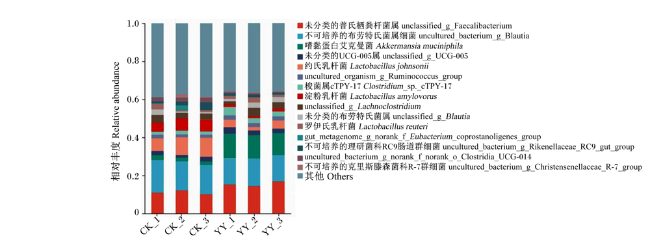
对相对丰度排名前15的菌种进行分析,从种水平来看,在42日龄时,对照组和早期补饲组犊牛肠道菌群中的优势菌种有未分类的粪杆菌属(unclassified_g_Faecalibacterium)、不可培养的布劳特氏菌属细菌(uncultured_bacterium_g_Blautia)、嗜黏蛋白艾克曼菌(Akkermansia muciniphila)、未分类的UCG-005属(unclassified_g_UCG-005)、约氏乳杆菌(Lactobacillus johnsonii)、梭菌属cTPY-17(Clostridium_sp._cTPY-17)、淀粉乳杆菌(Lactobacillus amylovorus)及一系列未定义的菌种,42日龄时2组犊牛肠道菌群种水平上的特征见图3。由表9可知,对照组淀粉乳杆菌的相对丰度显著高于早期补饲组(P<0.05),约氏乳杆菌的相对丰度极显著高于早期补饲组(P<0.01);早期补饲组未分类的粪杆菌属的相对丰度显著高于对照组(P<0.05),嗜黏蛋白艾克曼菌的相对丰度极显著高于对照组(P<0.01)。
图3 42日龄时2组犊牛肠道菌群种水平上的特征

Fig.3 Characteristics at species level of intestinal flora of calves in 2 groups at 42 days of age

表9 42日龄时2组犊牛肠道菌群中优势菌种的相对丰度

Table 9 Relative abundances of dominant bacterial strains in intestinal flora of calves in 2 groups at 42 days of age

项目
Items
组别 Groups 均值
标准误
SEM
P
P-value
对照
Control
早期补饲
Early supplementary
feeding
未分类的粪杆菌属
unclassified_g_Faecalibacterium
10.26a 15.82b 2.36 0.016
不可培养的布劳特氏菌属细菌
uncultured_bacterium_g_Blautia
20.02 17.37 1.77 0.061
嗜黏蛋白艾克曼菌 Akkermansia muciniphila 1.63A 8.85B 0.85 <0.001
未分类的UCG-005属 unclassified_g_UCG-005 2.76 3.04 0.38 0.266
约氏乳杆菌 Lactobacillus johnsonii 10.74B 3.21A 2.11 <0.001
uncultured_organism_g_Ruminococcus_group 1.13 2.53 0.71 0.072
梭菌属cTPY-17 Clostridium_sp._cTPY-17 2.54 3.87 0.58 0.133
淀粉乳杆菌 Lactobacillus amylovorus 5.42b 1.16a 1.21 0.010
unclassified_g_Lachnoclostridium 2.17 1.96 0.35 0.403
未分类的布劳特氏菌属 unclassified_g_Blautia 1.67 2.08 0.19 0.198
罗伊氏乳杆菌 Lactobacillus reuteri 0.87 1.67 0.21 0.071
gut_metagenome_g_norank_f_Eubacterium_
coprostanoligenes_group
0.73 0.61 0.12 0.255
不可培养的理研菌科RC9肠道群细菌
uncultured_bacterium_g_Rikenellaceae_RC9_gut_group
1.18 1.34 0.17 0.310
uncultured_bacterium_g_norank_f_norank_o_
Clostridia_UCG-014
0.43 0.62 0.17 0.218
不可培养的克里斯滕森菌科R-7群细菌
uncultured_bacterium_g_Christensenellaceae_R-7_group
0.64 0.37 0.11 0.151
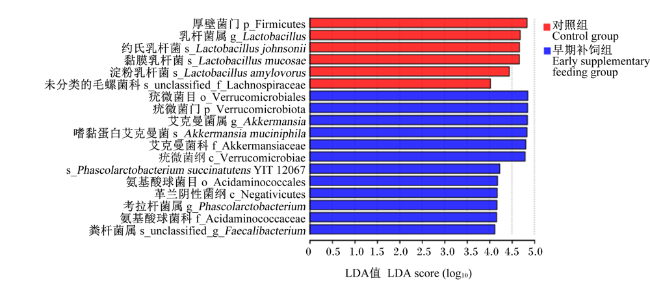
线性判别分析(LDA)值分布柱状图(图4)体现了对照组与早期补饲组之间具有显著差异物种(LDA值>4),可以看出,对照组中主要影响菌群组成的差异物种为厚壁菌门与乳杆菌属,早期补饲组中主要影响菌群组成的物种为疣微菌门和艾克曼菌属。
图4 线性判别分析值分布柱状图

Fig.4 Histogram of LDA score distribution

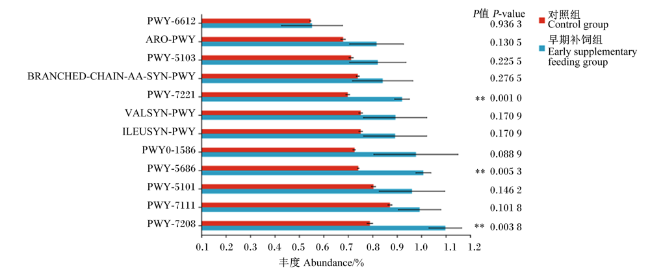
图5表10可知,在预测的对照组与早期补饲组肠道菌群功能中,丰度占总丰度2%以上的代谢通路中大多与细胞组成结构、能量代谢与调控、氨基酸合成等途径相关。早期补饲组犊牛肠道菌群功能中,嘧啶核苷残基超途径、鸟苷核糖核苷酸从头生物合成、尿嘧啶核苷酸生物合成的丰度极显著高于对照组(P<0.01)。
图5 犊牛肠道菌群部分代谢通路丰度图

“**”表示早期补饲组与对照组间存在极显著差异(P<0.01)。

Fig.5 Abundance diagram of some metabolic pathways of intestinal flora of calves

“**” indicated that there was an extremely significant difference between the early supplementary feeding group and the control group (P<0.01).

表10 犊牛肠道菌群部分代谢通路描述

Table 10 Description of some metabolic pathways of intestinal flora of calves

通路 Pathways 描述 Description
PWY-6612 四氢叶酸生物合成超途径 Superpathway of tetrahydrofolate biosynthesis
ARO-PWY 分支酸生物合成Ⅰ Chorismate biosynthesis Ⅰ
BRANCEED-CHAIN-AA-SYN-PWY 支链氨基酸生物合成超途径 Superpathway of branded amino acid biosynthesis
VALSYN-PWY L-缬氨酸生物合成 L-valine biosynthesis
ILEUSYN-PWY L-异亮氨酸生物合成Ⅰ L-isoleucine biosynthesisⅠ
PWY0-1586 肽聚糖成熟 Peptidoglycan maturation
PWY-5101 L-异亮氨酸生物合成Ⅱ L-isoleucine biosynthesis Ⅱ
PWY-7111 丙酮酸发酵生成异丁醇 Pyruvate fermentation to isobutanol
PWY-7208 嘧啶核苷残基超途径 Superpathway of pyrimidine nucleobases salvage
PWY-5686 尿嘧啶核苷酸生物合成 UMP biosynthesis
PWY-7221 鸟苷核糖核苷酸从头生物合成 Guanosine ribonucleotides de novo biosynthesis

3 讨论

3.1 早期补饲对犊牛生长性能的影响

幼龄期是反刍动物机体生长发育的重要阶段,直接影响成年后的生长性能表现。哺乳期犊牛胃肠道发育不完善,对粗纤维饲料的利用能力较差,适时适当补饲颗粒开食料可使犊牛提前适应固体饲料,减少犊牛由液体饲料向固体饲料转化过渡阶段产生的应激,提高犊牛采食量,从而促进其生长发育,充分发挥其快速生长的潜力,进而利于实现早期断奶[17]。本试验在犊牛7日龄时开始补饲颗粒开食料,在14日龄时进一步补饲燕麦干草,随日龄增加,固体饲料的补饲量增加,进而提高了早期补饲组对固体饲料的采食量,显著提高了犊牛的平均日增重。已有研究表明,补饲颗粒料是犊牛饲料类型转化过程中的重要手段,较早采食固体饲料有利于瘤胃发育,并显著提高犊牛的采食量和生长性能[18]。Toledo等[19]研究发现,固体粗饲料的提前摄入可以刺激瘤胃上皮组织的发育、增加瘤胃容积和维持表皮的完整性,利于提高牦牛犊牛的生长性能。Wang等[5]采用不同喂养方式饲喂荷斯坦犊牛,发现补饲精料+干草的饲喂方式可以显著提高荷斯坦犊牛的生长性能。Wu等[20]研究表明,采用全乳、苜蓿干草和精料组合搭配饲喂牦牛犊牛,可以促进犊牛肠道对营养物质的吸收,利于增重,与本研究结果一致。Berends等[21]研究表明,犊牛早期体重、日增重与机体能量供给与代谢密切相关,哺乳期适量提高固体颗粒料饲喂量可以提高犊牛的日增重。
体尺指数是监测犊牛生长发育情况的重要指数,主要包括体长指数、体躯指数、胸围指数和管围指数。其中,体高指数、体斜长指数、管围指数可以表明犊牛的骨骼发育情况,胸围指数可以体现犊牛的体重增长与脂肪堆积的情况[22-23]。本试验中,随日龄增加,犊牛体长指数、体躯指数与胸围指数均呈现出上升趋势,而管围指数呈现出下降趋势,可以推测本试验中犊牛生长发育状况良好,骨骼发育较为完善。在42日龄时,早期补饲组犊牛胸围指数显著高于对照组,表明早期补饲组所补饲的颗粒开食料与燕麦干草利于犊牛增重。王鸿泽[24]研究发现,舍饲条件下牦牛各项体尺指标随饲粮能量水平的升高而升高,与本研究结果一致。王丹等[25]研究表明,在犊牛早期补饲颗粒开食料有助于犊牛体况的发育,利于脂肪的堆积。但杨雪馨[26]研究发现,哺乳期犊牛体高、体斜长、胸围等体尺指标会随着日龄增加而增加,而补饲苜蓿干草或燕麦干草并不会影响犊牛的体尺指标。He等[27]研究发现,在代乳粉中添加酵母菌并没有提高犊牛体尺指标,对犊牛的体况与健康没有显著影响。

3.2 早期补饲对犊牛粪便评分与腹泻率的影响

我国1月龄犊牛腹泻发病率在9.6%~50.0%[28]。致病菌、寄生虫、环境因素等均会导致新生犊牛腹泻,严重时甚至会导致死亡[29]。早期补饲组在7日龄补饲颗粒开食料,在14日龄补饲颗粒开食料+燕麦干草,犊牛的饲粮成分发生改变,由液体饲料向固体饲料转化过渡阶段的初期犊牛产生了饲料应激,之后逐步适应固体饲料后会腹泻率显著降低。蔡小芳等[30]研究表明,随着日龄增加,提早补饲精料可提高固体饲料采食量,益于肠道有益菌群的繁殖。肠道菌群可以发酵碳水化合物形成短链脂肪酸、氨基酸等物质,为犊牛提供营养,促进肠道发育,维持肠道稳态,降低腹泻率。朴泯宇[31]研究表明,给肉用犊牛补饲固体饲料可有效减少肠道内大肠杆菌的数量,降低腹泻率。杨斌[32]通过在湖羊羔羊饲粮中以不同形式添加颗粒开食料与优质苜蓿草,羔羊的腹泻率降低,与本试验结果相同。由于我国目前肉用母牛-犊牛的养殖模式和饲喂方式较为粗放,哺乳期母牛和犊牛的营养供给不精准,致使犊牛胃肠道发育不完全。本试验中,2组犊牛均出现轻微腹泻的情况。郭文杰[33]研究发现,补饲精料组牦牛犊牛的腹泻频率和发病频率均显著低于未补饲组,饲喂苜蓿干草与精料可促进肠道对营养物质的消化吸收,产生较多的短链脂肪酸,改善肠道黏膜的免疫功能,降低腹泻率。李文娟等[34]研究发现,肉用犊牛随母哺乳时间较长时,肉用母牛和犊牛均营养摄入不足,不利于犊牛对营养物质的消化吸收,减缓胃肠道的发育,易造成腹泻。

3.3 早期补饲对犊牛肠道菌群及功能的影响

犊牛在7月龄时肠道内会形成一个由厚壁菌门(65%~80%)、拟杆菌门(8%~25%)、变形菌门(4%~10%)、梭杆菌门(1%~6%)和放线菌门(1%~2%)构成的稳定的群落[36]。本试验中,42日龄时,对照组的Chao1指数显著高于早期补饲组,Simpson指数显著低于早期补饲组。周力等[35]对藏羊补饲精料发现,对照组ACE指数和Chao1指数显著高于试验组,与本研究结果相似。其原因可能是补饲精料后非结构性碳水化合物会增加,在肠道细菌的作用下会产生较多的短链脂肪酸,短链脂肪酸抑制酸敏感菌的活性。此外,早期补饲组犊牛肠道菌群中拟杆菌门的相对丰度极显著高于对照组,这是因为早期补饲组犊牛提前接触固体饲料,蛋白质、脂肪等营养物质摄入较多,导致拟杆菌门的相对丰度提高,并且,早期补饲组肠道菌群中粪杆菌属、艾克曼菌属的相对丰度也显著或极显著提升,还出现丁酸弧菌属与普雷沃氏菌属,推测早期补饲颗粒开食料与燕麦干草有助于犊牛胃肠道的发育。对照组犊牛肠道菌群中乳杆菌属的相对丰度显著高于早期补饲组,可能是因为对照组试验期间均随母哺乳,未补充任何饲料,长期吸乳所致。艾克曼菌属属于疣微菌门,其代谢产物丙酸通过G蛋白偶联参与机体免疫调节。王晨等[36]研究发现,补饲可以增加犊牛肠道中微生物多样性,增加瘤胃球菌属和艾克曼菌属等有益菌的相对丰度,减少大肠杆菌等致病菌的相对丰度。Zhang等[37]研究发现,肠道中拟杆菌门参与宿主肠上皮关键糖酵解的诱导与碳水化合物发酵等关键代谢活动,利于肠道发育。Dias等[38]研究指出,固体饲料的添加提高了犊牛肠道中降解碳水化合物细菌群落的多样性,促进降解碳水化合物菌Methanosphaera sp. A4的定植。本研究中,随燕麦干草摄入量的增加,降解纤维素的肠道细菌如普雷沃氏菌属的数量逐步增加,可推测犊牛生命早期补饲燕麦干草可以加快纤维降解菌的定植,促进肠道微生物发育。有研究表明,克里斯滕森菌科R-7群的相对丰度与体重呈现出负相关[39]。本研究中,早期补饲组犊牛肠道菌群中克里斯滕森菌科R-7群的相对丰度较低,表明补饲更利于犊牛的生长。在幼龄反刍动物断奶前补饲颗粒开食料与饲草会改善一些厌氧细菌的浓度,会加速瘤胃微生物的定植,进而影响肠道的消化吸收[40]。通过对2组犊牛肠道菌群进行初步的功能预测,发现42日龄时早期补饲组犊牛肠道菌群功能中嘧啶核苷残基超途径、鸟苷核糖核苷酸从头生物合成、尿嘧啶核苷酸生物合成的丰度极显著高于对照组。叶倩文等[41]研究发现,随日龄增加,羔羊肠道菌群的氨基酸代谢、能量代谢功能升高,而羔羊从1月龄至断奶,肠道菌群的碳水化合物功能呈下降趋势,碳水化合物主要被瘤胃微生物所发酵,表明瘤胃正逐步发育完全。

4 结论

① 早期补饲可以显著提高舍饲肉用犊牛42日龄时的体重、42日龄内的平均日增重,促进骨骼发育,并能降低腹泻率。
② 早期补饲可以显著提高42日龄舍饲肉用犊牛肠道菌群中疣微菌门、拟杆菌门、粪杆菌属、艾克曼菌属的相对丰度,并使肠道菌群中出现少量丁酸弧菌属与普雷沃氏菌属,肠道菌群功能预测显示早期补饲促进了氨基酸、能量代谢途径,表明早期补饲可以提高舍饲肉用犊牛胃肠道发育速度,改善肠道健康。
[1]
鲍宇红, 宋天增, 冯柯, 等. 不同蛋白质水平代乳粉对牦犊牛体重及血清生化指标的影响[J]. 中国农业大学学报, 2020, 25(5):78-85.

BAO Y H, SONG T Z, FENG K, et al. Effects of different protein levels of milk replacer on the body weight and serum biochemical indexes of yak calves[J]. Journal of China Agricultural University, 2020, 25(5):78-85. (in Chinese)

[2]
张立新. 不同饲喂方案对哺乳期犊牛生长发育的影响[D]. 硕士学位论文. 呼和浩特: 内蒙古农业大学, 2021:1-8.

ZHANG L X. Effects of different feeding schemes on growth and development of sucking calves[D]. Master's Thesis. Hohhot: Inner Mongolia Agricultural University, 2021:1-8. (in Chinese)

[3]
李科南, 杜海东, 娜仁花. 干草对羔羊瘤胃发育影响及其机制的研究进展[J]. 中国农业大学学报, 2023, 28(2):126-134.

LI K N, DU H D, NA R H. Research progress on the effects of hay on the rumen development of lambs and its mechanism[J]. Journal of China Agricultural University, 2023, 28(2):126-134. (in Chinese)

[4]
IMANI M, MIRZAEI M, BAGHBANZADEH-NOBARI B, et al. Effects of forage provision to dairy calves on growth performance and rumen fermentation:a Meta-analysis and Meta-regression[J]. Journal of Dairy Science, 2017, 100(2):1136-1150.

[5]
WANG J, ZHAO K S, LI M Y, et al. A preliminary study of the potential molecular mechanisms of individual growth and rumen development in calves with different feeding patterns[J]. Microorganisms, 2023, 11(10):2423.

[6]
DU Y F, GAO Y, HU M Y, et al. Colonization and development of the gut microbiome in calves[J]. Journal of Animal Science and Biotechnology, 2023, 14(1):46.

DOI PMID

[7]
FISCHER A J, SONG Y, HE Z, et al. Effect of delaying colostrum feeding on passive transfer and intestinal bacterial colonization in neonatal male Holstein calves[J]. Journal of Dairy Science, 2018, 101(4):3099-3109.

DOI PMID

[8]
VAN NIEKERK J K, FISCHER-TLUSTOS A J, WILMS J N, et al. ADSA foundation scholar award:new frontiers in calf and heifer nutrition-from conception to puberty[J]. Journal of Dairy Science, 2021, 104(8):8341-8362.

[9]
付瑶, 郭江鹏, 王俊, 等. 补饲苜蓿干草对蒙贝利亚×荷斯坦杂交犊牛瘤胃内环境和胃肠道发育的影响[J]. 动物营养学报, 2023, 35(8):5182-5190.

DOI

FU Y, GUO J P, WANG J, et al. Effects of alfalfa hay supplementation on rumen internal environment and gastrointestinal development of Montbeliard×Holstein crossed calves[J]. Chinese Journal of Animal Nutrition, 2023, 35(8):5182-5190. (in Chinese)

DOI

[10]
郭文杰, 刘书杰, 冯宇哲, 等. 哺乳期补饲开食料对牦牛犊牛生长性能、腹泻频率和发病频率的影响[J]. 动物营养学报, 2022, 34(1):422-431.

DOI

GUO W J, LIU S J, FENG Y Z, et al. Effects of starter feed on growth performance,diarrhea frequency and incidence frequency of yak calves during lactation[J]. Chinese Journal of Animal Nutrition, 2022, 34(1):422-431. (in Chinese)

[11]
霍子韩, 李岩, 徐宏建, 等. 开食料中添加不同诱食剂对荷斯坦犊牛采食偏好、生长性能和血液指标的影响[J]. 动物营养学报, 2023, 35(9):5775-5786.

DOI

HUO Z H, LI Y, XU H J, et al. Effects of starter supplemented with different feeding attractants on feeding preference,growth performance and blood indexes of Holstein calves[J]. Chinese Journal of Animal Nutrition, 2023, 35(9):5775-5786. (in Chinese)

[12]
LV X K, CHAI J M, DIAO Q Y, et al. The signature microbiota drive rumen function shifts in goat kids introduced to solid diet regimes[J]. Microorganisms, 2019, 7(11):516.

[13]
BI Y L, ZENG S Q, ZHANG R, et al. Effects of dietary energy levels on rumen bacterial community composition in Holstein heifers under the same forage to concentrate ratio condition[J]. BMC Microbiology, 2018, 18(1):69.

DOI PMID

[14]
中华人民共和国农业部.肉牛饲养标准:NY/T 815—2004[S]. 北京: 中国农业出版社, 2004.

Ministry of Agriculture of the PRC.Feeding standard of beef cattle:NY/T 815—2004[S]. Beijing: China Agriculture Press, 2004. (in Chinese)

[15]
NA S W, GUAN L L. Understanding the role of rumen epithelial host-microbe interactions in cattle feed efficiency[J]. Animal Nutrition, 2022, 10:41-53.

DOI PMID

[16]
孙大明, 殷雨洋, 吴建良, 等. 早期补饲粉状精料和颗粒料对羔羊生长性能及胃肠道发育的影响[J]. 草业学报, 2020, 29(7):184-192.

DOI

SUN D M, YIN Y Y, WU J L, et al. Effect of early mashed and pelleted concentrate starter supplementation on animal performance and development of the gastrointestinal tract in lambs[J]. Acta Prataculturae Sinica, 2020, 29(7):184-192. (in Chinese)

[17]
CUI Z H, WU S R, LI J L, et al. Effect of alfalfa hay and starter feeding intervention on gastrointestinal microbial community,growth and immune performance of yak calves[J]. Frontiers in Microbiology, 2020, 11:994.

[18]
CUI Z H, WU S R, LIU S J, et al. From maternal grazing to barn feeding during pre-weaning period:altered gastrointestinal microbiota contributes to change the development and function of the rumen and intestine of yak calves[J]. Frontiers in Microbiology, 2020, 11:485.

[19]
TOLEDO A F, DONDÉ S C, SILVA A P, et al. Whole-plant flint corn silage inclusion in total mixed rations for pre- and postweaning dairy calves[J]. Journal of Dairy Science, 2023, 106(9):6185-6197.

DOI PMID

[20]
WU S R, CHEN X D, LI J L, et al. Effect of alfalfa hay and starter feed supplementation on caecal microbiota and fermentation,growth,and health of yak calves[J]. Animal, 2021, 15(3):100019.

[21]
BERENDS H, VAN DEN BORNE J J G C, MOLLENHORST H, et al. Utilization of roughages and concentrates relative to that of milk replacer increases strongly with age in veal calves[J]. Journal of Dairy Science, 2014, 97(10):6475-6484.

DOI PMID

[22]
WANG Y X, GUAN L L. Translational multi-omics microbiome research for strategies to improve cattle production and health[J]. Emerging Topics in Life Sciences, 2022, 6(2):201-213.

[23]
VAN DE STROET D L, et al.CALDERÓN DÍAZ J A,STALDER K J, Association of calf growth traits with production characteristics in dairy cattle[J]. Journal of Dairy Science, 2016, 99(10):8347-8355.

DOI PMID

[24]
王鸿泽. 日粮能量水平对舍饲育肥牦牛生产性能、瘤胃发酵及肌内脂肪代谢的影响[D]. 硕士学位论文. 雅安: 四川农业大学, 2015:6-10.

WANG H Z. Effects of dietary energy concentration on performance,rumen fermentation and intramuscular fat metabolism in yaks fed indoors[D]. Master's Thesis. Ya'an: Sichuan Agricultural University, 2015:6-10. (in Chinese)

[25]
王丹, 范守民, 耿娟, 等. 新疆褐牛体尺典型相关分析与体重估计公式制定[J]. 中国畜牧杂志, 2021, 57(8):82-86.

WANG D, FAN S M, GENG J, et al. Body size canonical correlation analysis and body weight estimation formula formulation of Xinjiang brown cattle[J]. Chinese Journal of Animal Science, 2021, 57(8):82-86. (in Chinese)

[26]
杨雪馨. 补饲粗饲料对哺乳期犊牛生长性能、瘤胃发酵与胃肠道微生物的影响[D]. 硕士学位论文. 杨凌: 西北农林科技大学, 2022.

YANG X X. Effects of supplementary forage on growth performance,rumen fermentation and gastrointestinal tract microorganisms of pre-weaning calves[D]. Master's Thesis. Yangling: Northwest A & F University, 2022. (in Chinese)

[27]
HE Z X, FERLISI B, ECKERT E, et al. Supplementing a yeast probiotic to pre-weaning Holstein calves:feed intake,growth and fecal biomarkers of gut health[J]. Animal Feed Science and Technology, 2017, 226:81-87.

[28]
JANG J Y, KIM S, KWON M S, et al. Rotavirus-mediated alteration of gut microbiota and its correlation with physiological characteristics in neonatal calves[J]. Journal of Microbiology, 2019, 57(2):113-121.

[29]
KIM H S, WHON T W, SUNG H, et al. Longitudinal evaluation of fecal microbiota transplantation for ameliorating calf diarrhea and improving growth performance[J]. Nature Communications, 2021, 12(1):161.

DOI PMID

[30]
蔡小芳, 张成新, 李勇, 等. 口感化及颗粒化开食料对早期断奶羔羊生长和胃肠道发育的影响[J]. 草业科学, 2021, 38(8):1596-1604.

CAI X F, ZHANG C X, LI Y, et al. Effect of texturized and pelleted starter on growth and gastrointestinal development of early weaning lambs[J]. Pratacultural Science, 2021, 38(8):1596-1604. (in Chinese)

[31]
朴泯宇. 肉牛犊牛早期断奶和育肥期日粮淀粉结构研究与应用[D]. 博士学位论文. 北京: 中国农业科学院, 2021:12-23.

PIAO M Y. Study on early weaning of beef calves and starch structure in fattening diet and its application in beef cattle[D]. Ph.D.Thesis. Beijing: Chinese Academy of Agricultural Sciences, 2021:12-23. (in Chinese)

[32]
杨斌. 早期补饲苜蓿调节幼龄湖羊生长和瘤胃发育的机制研究[D]. 博士学位论文. 杭州: 浙江大学, 2017:10-25.

YANG B. Mechanism in growth and rumen development alteration by early alfalfa supplementation in Hu lambs[D]. Ph.D.Thesis. Hangzhou: Zhejiang University, 2017:10-25. (in Chinese)

[33]
郭文杰. 哺乳期补饲精料对牦牛犊牛肠道发育和微生物区系的影响[D]. 硕士学位论文. 西宁: 青海大学, 2022.

GUO W J. Effect of concentrate supplementation on intestinal development and microbiota of yak calves in suckling stage[D]. Master's Thesis. Xining: Qinghai University, 2022. (in Chinese)

[34]
李文娟, 聂德超, 陶慧, 等. 代乳粉蛋白质含量对肉用犊牛生长性能的影响[J]. 中国畜牧杂志, 2021, 57(6):187-191,197.

LI W J, NIE D C, TAO H, et al. Effects of protein levels of milk replacer on growth performance of beef calves[J]. Chinese Journal of Animal Science, 2021, 57(6):187-191,197. (in Chinese)

[35]
周力, 马博妍, 高占红, 等. 精料补充料补饲对藏羔羊生长发育及瘤胃菌群组成的影响[J]. 四川农业大学学报, 2021, 39(1):101-107.

ZHOU L, MA B Y, GAO Z H, et al. Effects of concentrate supplement on growth performance and rumen bacteria composition of Tibetan lambs[J]. Journal of Sichuan Agricultural University, 2021, 39(1):101-107. (in Chinese)

[36]
王晨. 犊牛补饲对肠道微生物多样性及生长性能,血液指标的影响[D]. 硕士学位论文. 呼和浩特: 内蒙古农业大学, 2020.

WANG C. Effects of calf supplementation on intestinal microbial diversity,growth performance and blood index[D]. Master's Thesis. Hohhot: Inner Mongolia Agricultural University, 2020. (in Chinese)

[37]
ZHANG Y J, WANG Z X, DONG Y L, et al. Blue light alters the composition of the jejunal microbiota and promotes the development of the small intestine by reducing oxidative stress[J]. Antioxidants, 2022, 11(2):274.

[38]
DIAS J, MARCONDES M I, NORONHA M F, et al. Effect of pre-weaning diet on the ruminal archaeal,bacterial,and fungal communities of dairy calves[J]. Frontiers in Microbiology, 2017, 8:1553.

[39]
WATERS J L, LEY R E. The human gut bacteria Christensenellaceae are widespread,heritable,and associated with health[J]. BMC Biology, 2019, 17(1):83.

[40]
张剑搏, 丁考仁青, 梁泽毅, 等. 早期营养干预对幼龄反刍动物瘤胃微生物区系发育的影响[J]. 草业学报, 2021, 30(2):199-211.

DOI

ZHANG J B, DINGKAO R Q, LIANG Z Y, et al. Effect of early nutrition intervention on rumen microflora development in young ruminants[J]. Acta Prataculturae Sinica, 2021, 30(2):199-211. (in Chinese)

[41]
叶倩文, 陈卓, 李鑫, 等. 一月龄吮乳羔羊肠道菌群组成及其预测物质代谢功能的动态变化研究[J]. 畜牧兽医学报, 2023, 54(3):1095-1108.

DOI

YE Q W, CHEN Z, LI X, et al. Dynamic changes of gut microbiota composition and its predicted metabolism function in one-month-old sucking lambs[J]. Acta Veterinaria et Zootechnica Sinica, 2023, 54(3):1095-1108. (in Chinese)

DOI

Outlines

/