RESEARCH PAPER

Effects of Oxidized Fish Oil and Curcumin on Growth Performance, Serum and Liver Indexes, Body Colour and Muscle Texture Characteristics of Pelteobagrus fulvidraco

  • CHEN Yanxuan , 1, 2 ,
  • WANG Guoxia 1 ,
  • LIU Yan 3 ,
  • HAN Yongquan 3 ,
  • QIU Jianqiang 1, 4 ,
  • SHI Hequn 3 ,
  • PENG Kai , 1, **
Expand
  • 1 Guangdong Provincial Key Laboratory of Animal Breeding and Nutrition, Key Laboratory of Animal Nutrition and Feed Science in South China of Ministry of Agriculture and Rural Affairs, Collaborative Innovation Center of Aquatic Sciences, Institute of Animal Science, Guangdong Academy of Agricultural Sciences, Guangzhou 510640, China
  • 2 College of Animal Science and Technology, Zhongkai University of Agriculture and Engineering, Guangzhou 510225, China
  • 3 Guangzhou Cohoo Biotechnology Co., Ltd., Guangzhou 510145, China
  • 4 College of Fisheries, Huazhong Agricultural University, Wuhan 430070, China

* Contributed equally

Received date: 2024-01-08

  Online published: 2024-07-09

Abstract

This experiment was conducted to investigate the effects of oxidized fish oil and curcumin on growth performance, serum and liver indexes, body colour and muscle texture characteristics of Pelteobagrus fulvidraco. A total of 720 Pelteobagrus fulvidraco were randomly distributed into six groups with four replicates per group and 30 fish per replicate. The fish in the six groups were fed isonitrogenous and isolipidic diets, they were fresh fish oil diet (T1 group), oxidized fish oil diet (T2 group), oxidized fish oil+0.02% curcumin diet (T3 group), oxidized fish oil+0.04% curcumin diet (T4 group), oxidized fish oil+0.06% curcumin diet (T5 group), and oxidized fish oil+0.08% curcumin diet (T6 group). The feeding trial was lasted for 56 days. At the end of the experiment, growth performance was counted, blood was collected to determine serum biochemical, antioxidant and immune indexes, liver was collected to determine antioxidant indexes, and body colour and muscle texture characteristics were analyzed. The results showed as follows: compared with the T1 group, feed intake was significantly increased in the T5 group (P<0.05), serum triglyceride content, catalase and lysozyme activities as well as liver total antioxidant capacity and catalase activity were significantly decreased in the T2 group (P<0.05), yellow-blue (b*) value of the fishtail skin in the T5 group was significantly decreased (P<0.05), muscle hardness was significantly increased in the T6 group (P<0.05), and muscle springiness and adhesiveness were significantly decreased in the T6 group (P<0.05). Compared with the T2 group, serum catalase activity was significantly increased in the T3, T4, T5 and T6 groups (P<0.05), serum lysozyme activity was significantly increased in the T4, T5 and T6 groups (P<0.05); liver total antioxidant capacity and catalase activity were significantly increased in T3, T4, T5 and T6 groups (P<0.05), red-green (a*) value of fishtail skin was significantly decreased in the T4 and T6 groups (P<0.05), muscle hardness was significantly increased in the T6 group (P<0.05), and the springiness, adhesiveness and chewiness were significantly decreased in the T6 group (P<0.05). In conclusion, dietary supplementation of 3% oxidized fish oil did not affect the growth performance of Pelteobagrus pelteobagrus, but reduce serum triglyceride content, antioxidant capacity and non-specific immunity, and make the body color degradation. Adding curcumin to the diet with 3% oxidized fish oil can improve the antioxidant capacity and immunity of Pelteobagrus pelteobagrus, and repair the degradation of body color caused by oxidized fish oil to a certain extent, increase the hardness and decrease the springiness, adhesiveness and chewiness of muscle.

Cite this article

CHEN Yanxuan , WANG Guoxia , LIU Yan , HAN Yongquan , QIU Jianqiang , SHI Hequn , PENG Kai . Effects of Oxidized Fish Oil and Curcumin on Growth Performance, Serum and Liver Indexes, Body Colour and Muscle Texture Characteristics of Pelteobagrus fulvidraco[J]. Chinese Journal of Animal Nutrition, 2024 , 36(7) : 4610 -4622 . DOI: 10.12418/CJAN2024.395

黄颡鱼(Pelteobagrus fulvidraco)是我国特色淡水养殖鱼类之一。据统计,2022年我国黄颡鱼养殖产量近60万t,主产区位于湖北、浙江、广东、江西、四川等地[1]。黄颡鱼肉质细嫩、营养丰富、无磷少刺、老少皆宜,具有极高的经济价值。集约化养殖模式下,黄颡鱼的养殖密度增加,氧化应激问题加重,体色和肉品质下降,备受行业和消费者关心。应用饲料营养调控方法是解决上述问题的主要途径之一。
鱼油含有高不饱和脂肪酸,是水产饲料重要的脂肪源,但其在加工和储存过程中容易发生氧化,氧化变质后的鱼油称为氧化鱼油[2]。已有研究表明,氧化鱼油容易造成水产动物生长性能下降[3-5]、脂肪代谢紊乱[6-10]、抗氧化能力下降[6,9-13]、肠道组织受损[14]。氧化鱼油可诱导黄颡鱼发生氧化应激并对其生长和抗氧化能力产生不利影响[11,15-16],但氧化鱼油对黄颡鱼体色和肉品质的影响研究较少。此外,如何通过营养调控途径缓解氧化鱼油诱导的氧化应激,改善黄颡鱼的体色和肌肉品质,是产业迫切需要解决的问题。目前,仅有少量研究报道,精氨酸[11]和硒[15-16]可缓解氧化鱼油对黄颡鱼生长和抗氧化能力造成的不利影响。
姜黄素是一种天然多酚类化合物[17],具有显著的抗氧化、抗炎、抗菌、降脂和护肠活性,也被用来改善鱼类的体色和肉品质[18-21]。研究表明,饲料中添加适量的姜黄素可提高肠道消化酶活性、优化肠道菌群结构,提高动物的生长性能[22-25]。姜黄素的酚醛基和甲氧基结构能够高效清除活性氧自由基,提高血清和肝脏的抗氧化能力[20,26-28]以及机体的非特异性免疫力[29-30],但有关姜黄素对提高黄颡鱼抗氧化能力的研究较少。姜黄素还能改善大黄鱼(Larimichthys crocea)[18]、美洲鳗鲡(Anguilla rostrata)[19]等水产动物的体色以及中华鳖(Pelodiscus sinensis)[20]、吉富罗非鱼(Oreochromis niloticus)[21]的肌肉品质,但姜黄素对黄颡鱼体色与肌肉品质影响的研究鲜有报道。本试验通过在黄颡鱼饲料中添加氧化鱼油和不同水平的姜黄素,研究其对黄颡鱼生长性能、血清和肝脏指标、体色及肌肉质构特性的影响,旨为姜黄素在黄颡鱼饲料中的应用提供参考。

1 材料与方法

1.1 试验材料

姜黄素:姜黄素总量≥大于95%,包括姜黄素、去甲氧基姜黄素和双去甲氧基姜黄素。氧化鱼油由本实验室自制,其制备方法参考卓丽欣等[11]。鱼油的过氧化值和丙二醛含量分别依据农业行业标准《饲料原料过氧化值的测定》(NY/T 4424—2023)和国家标准《饲料中丙二醛的测定 高效液相色谱法》(GB/T 28717—2012)进行测定。

1.2 试验饲料

配制6种等氮等脂的试验饲料,其组成及营养水平见表1。T1组为含新鲜鱼油且不添加姜黄素基础饲料,T2组是在基础饲料中将新鲜鱼油(过氧化值23.24 meq/kg、丙二醛含量3.33 mg/kg)等比例替换成氧化鱼油(过氧化值45.2 meq/kg、丙二醛含量15.5 mg/kg),T3、T4、T5、T6组分别在T2组饲料的基础上添加0.02%、0.04%、0.06%和0.08%的姜黄素替代等量的微晶纤维素粉。全部饲料原料粉碎后过60目标准筛,混匀后通过SLX-80型双螺杆挤压机制成的颗粒饲料(直径为2 mm),经55 ℃烘干冷却后装入塑料密封袋,存放于-20 ℃冰箱中备用。
表1 试验饲料组成及营养水平(干物质基础)

Table 1 Composition and nutrient levels of experimental diets (DM basis)%

项目
Items
组别 Groups
T1 T2 T3 T4 T5 T6
原料 Ingredients
鱼粉 Fish meal 25.00 25.00 25.00 25.00 25.00 25.00
豆粕 Soybean meal 30.00 30.00 30.00 30.00 30.00 30.00
菜籽粕 Rapeseed meal 9.00 9.00 9.00 9.00 9.00 9.00
玉米蛋白粉 Corn gluten meal 6.00 6.00 6.00 6.00 6.00 6.00
面粉 Flour 22.50 22.50 22.50 22.50 22.50 22.50
碳酸二氢钙 Ca(HCO3)2 1.30 1.30 1.30 1.30 1.30 1.30
维生素C酯 Vitamin C ester 0.10 0.10 0.10 0.10 0.10 0.10
氯化胆碱 Choline chloride 0.30 0.30 0.30 0.30 0.30 0.30
豆油 Soybean oil 2.00 2.00 2.00 2.00 2.00 2.00
新鲜鱼油 Fresh fish oil 3.00
氧化鱼油 Oxidized fish oil 3.00 3.00 3.00 3.00 3.00
维生素预混料 Vitamin premix1) 0.10 0.10 0.10 0.10 0.10 0.10
矿物质预混料 Mineral premix2) 0.50 0.50 0.50 0.50 0.50 0.50
姜黄素 Curcumin 0.02 0.04 0.06 0.08
微晶纤维素粉 Microcrystalline cellulose powder 0.20 0.20 0.18 0.16 0.14 0.12
合计 Total 100.00 100.00 100.00 100.00 100.00 100.00
营养水平 Nutrient levels3)
粗蛋白质 Crude protein 43.4 43.8 43.3 44.0 43.5 43.8
粗脂肪 Crude lipid 7.9 7.3 7.5 7.8 7.3 7.4
粗灰分 Ash 8.2 8.3 8.4 8.4 8.2 8.4

1)每千克维生素预混料含有 One kilogram of vitamin premix contained the following:VA 230 000 IU,VD3 600 000 IU,VE 16 g,VK 4 g,VB1 4 g,VB2 8 g,VB6 4.8 g,VB12 0.016 g,烟酸 nicotinic acid 28 g,泛酸钙 calcium pantothenate 16 g,生物素 biotin 0.064 g,叶酸 folic acid 1.285 g,肌醇 inositol 40 g。

2)每千克矿物质预混料含有 One kilogram of mineral premix contained the following:Ca 230 g,K 36 g,Mg 9 g,Fe 10 g,Zn 8 g,Mn 1.9 g,Cu 1.5 g,Co 0.25 g,I 0.032 g,Se 0.05 g。

3)营养水平为实测值 Nutrition levels were measured values。

1.3 试验设计与养殖管理

本试验在广东省农业科学院水产研究所室内循环水养殖系统中进行,养殖系统由24个圆柱形玻璃纤维桶(直径80 cm、高70 cm)组成。黄颡鱼鱼苗购回后先于室外水泥池中暂养1周,每天饱食投喂基础饲料。正式试验开始时,选取健康的黄颡鱼720尾[初始体重为(19.6±0.3) g],随机分配到24个纤维桶中,每桶放养30尾鱼。将24个纤维桶随机分为6组,每组4个纤维桶,每组的4桶试验鱼饲喂同一种试验饲料。试验鱼每日饱食投喂2次(09:00和18:00),每日记录饲料投喂量和鱼死亡情况,每3 d换水1次,养殖周期为56 d。试验期间采取自然光照,水温维持在(27±2) ℃,pH为7.5~8.0,氨氮和亚硝酸盐含量分别不高于0.02和0.01 mg/L,溶氧含量大于5.0 mg/L。

1.4 样品采集与指标测定

1.4.1 饲料营养成分分析

饲料中水分含量采用105 ℃常压干燥法(参照GB/T 6435—2014)测定,粗蛋白质含量采用凯氏定氮法(参照GB/T 6432—2018)测定,粗脂肪含量采用乙醚抽提法(参照GB/T 6432—2006)测定,粗灰分含量采用550 ℃灼烧法(参照GB/T 6438—1992)测定。

1.4.2 生长性能测定

试验结束前24 h时禁食,采样前使用40 mg/L间氨基苯甲酸乙酯甲磺酸盐(MS-222)对黄颡鱼进行麻醉。对每个桶中试验鱼的总数量和总重量进行统计,计算存活率(SR)、终末体重(FBW)、增重率(WGR)、特定生长率(SGR)、摄食量(FI)和饲料系数(FC)。在每个桶中随机选取6尾试验鱼,测量体重和体长,以计算肥满度(CF),随后对这些试验鱼进行解剖,并将内脏团和肝脏剥离出来进行称重,以计算脏体比(VSI)和肝体比(HSI)。
上述生长性能指标的计算公式如下:
存活率(%)=100×终末尾数/初始尾数;
增重率(%)=100×[终末体重(g)-初始体重(g)]/初始体重(g);
特定生长率(%/d)=100×[ln终末体重(g)-ln初始体重(g)]/饲养天数;
摄食量(g/尾)=摄食饲料总量(g)/[(初始尾数+终末尾数)/2];
饲料系数=摄食饲料总量(g)/[终末体重(g)-初始体重(g)];
肥满度(g/cm3)=100×体重(g)/体长3(cm);
脏体比(%)=100×内脏重(g)/体重(g);
肝体比(%)=100×肝脏重(g)/体重(g)。

1.4.3 血清生化、抗氧化与免疫指标

每桶随机取12尾鱼,用1 mL注射器于尾静脉处采血,每桶鱼的血液汇集到1个抗凝管中,血液样品于室温下静置2 h,随后在2 500×g的转速下离心10 min,分离出上层血清,于-80 ℃冰箱中保存[31]。采用日立7600全自动生化分析仪测定血清白蛋白(ALB)、球蛋白(GLB)、葡萄糖(GLU)、总胆固醇(TC)、甘油三酯(TG)、低密度脂蛋白胆固醇(LDL-C)、高密度脂蛋白胆固醇(HDL-C)、尿素(UN)含量与谷丙转氨酶(ALT)、谷草转氨酶(AST)活性。采用南京建成生物工程研究所生产的试剂盒测定血清超氧化物歧化酶(SOD)、过氧化氢酶(CAT)、碱性磷酸酶(AKP)、溶菌酶(LZM)活性及总抗氧化能力(T-AOC)、丙二醛(MDA)含量。

1.4.4 肝脏抗氧化指标

每桶随机取3尾鱼,解剖并分离肝脏,将肝脏样品置于冻存管,于-80 ℃保存,用于肝脏抗氧化指标的测定。采用南京建成生物工程研究所生产的试剂盒测定肝脏SOD、CAT活性及MDA含量、T-AOC。

1.4.5 体色与肌肉质构特性

每组随机取3尾鱼,排列整齐,先用Canon EOS M50数码相机进行拍照,然后用Konica CM-700D型便携式色差仪依次检测鱼体前部(A)、中部(B)、尾部(C)、腹部(D)皮肤的明暗度(L*)、红绿色(a*)、黄蓝色(b*)值。
每桶随机取3尾鱼,分别在鱼体中部位置分割出1 cm×1 cm×1 cm大小的肌肉切块,采用TA.XT. plus型质构仪检测肌肉的硬度(hardness)、弹性(springiness)、黏结性(cohesiveness)、胶着性(gumminess)、咀嚼性(chewiness)和回复性(resilience)。质构仪运行参数设置为:圆柱状不锈钢探头,直径5 mm,测试前、中、后速度分别为1、2、5 mm/s,应变模式下压距离为样品厚度的75%,每个样品下压2次,时间间隔为5 s,触发模式为自动,触发力为5 g[32]

1.5 数据统计分析

采用SPSS 22.0统计软件中的单因素方差分析(one-way ANOVA)和Duncan氏多重比较法对试验结果的差异显著性进行分析。若不满足方差齐性,则采用Dunnett-T3检验法进行多重比较。试验数据以“平均值±标准误”表示,显著性水平为P<0.05。

2 结果

2.1 生长性能

表2可知,存活率、终末体重、增重率、特定生长率、饲料系数、肥满度、脏体比和肝体比各组之间均无显著差异(P>0.05)。与T1组相比,T2、T3、T4和T6组的摄食量均增加,但差异不显著(P>0.05),T5组的摄食量显著增加(P<0.05)。
表2 氧化鱼油和姜黄素对黄颡鱼生长性能的影响

Table 2 Effects of oxidized fish oil and curcumin on growth performance of Pelteobagrus fulvidraco

项目
Items
组别 Groups
T1 T2 T3 T4 T5 T6
存活率 SR/% 100.00±0.00 100.00±0.00 100.00±0.00 100.00±0.00 100.00±0.00 100.00±0.00
终末体重 FBW/g 54.62±1.78 53.10±3.45 58.52±2.62 56.45±1.06 56.93±1.93 57.69±1.50
增重率 WGR/% 177.73±3.87 175.91±3.52 196.98±8.29 189.63±5.19 191.39±4.93 201.17±4.76
特定生长率 SGR/(%/d) 1.82±0.02 1.78±0.04 1.91±0.05 1.90±0.03 1.90±0.08 1.96±0.09
摄食量 FI/(g/尾) 69.65±0.83b 72.12±0.37ab 71.12±1.14ab 72.52±0.33ab 73.34±0.74a 71.58±1.67ab
饲料系数 FC 1.28±0.03 1.37±0.09 1.22±0.05 1.28±0.02 1.29±0.04 1.24±0.06
肥满度 CF/(g/cm3) 1.66±0.02 1.64±0.03 1.59±0.02 1.57±0.01 1.62±0.04 1.72±0.02
脏体比 VSI/% 7.13±0.58 7.03±0.49 7.31±0.22 7.25±0.17 7.42±0.42 7.19±0.24
肝体比 HSI/% 1.69±0.08 1.63±0.14 1.74±0.06 1.77±0.05 1.70±0.05 1.72±0.06

同行数据肩标不同字母表示组间存在显著性差异(P<0.05)。下表同。

In the same row, values with different letter superscripts indicated significant difference between groups (P<0.05). The same as below.

2.2 血清生化指标

表3可知,血清白蛋白、球蛋白、葡萄糖、总胆固醇、低密度脂蛋白胆固醇、高密度脂蛋白胆固醇、尿素含量及谷丙转氨酶、谷草转氨酶活性各组之间均无显著差异(P>0.05)。与T1组相比,T2组血清甘油三酯含量显著下降(P<0.05)。
表3 氧化鱼油和姜黄素对黄颡鱼血清生化指标的影响

Table 3 Effects of oxidized fish oil and curcumin on serum biochemical indexes of Pelteobagrus fulvidraco

项目
Items
组别 Groups
T1 T2 T3 T4 T5 T6
白蛋白 ALB/(g/L) 13.15±0.27 13.62±0.76 13.62±0.18 14.40±0.27 13.80±0.47 14.10±0.40
球蛋白 GLB/(g/L) 24.20±0.86 24.78±0.86 25.64±1.10 25.30±0.28 25.82±1.67 25.00±0.61
谷丙转氨酶
ALT/(U/L)
20.00±3.08 22.25±3.33 19.00±2.00 18.90±2.42 21.50±1.44 20.50±2.14
谷草转氨酶
AST/(U/L)
260.00±37.56 233.00±28.19 209.25±18.98 239.50±20.11 258.50±19.30 246.00±20.71
葡萄糖 GLU/(mmol/L) 6.52±0.44 6.10±0.18 5.97±0.23 5.80±0.67 6.54±0.80 5.54±0.67
总胆固醇 TC/(mmol/L) 5.51±0.33 5.26±0.33 5.45±0.16 5.86±0.23 5.64±0.20 5.55±0.26
甘油三酯 TG/(mmol/L) 12.70±1.17a 9.15±1.13b 11.33±1.05ab 12.36±0.92ab 11.78±1.23ab 11.08±0.33ab
低密度脂蛋白胆固醇
LDL-C/(mmol/L)
0.25±0.02 0.32±0.02 0.27±0.03 0.26±0.04 0.26±0.04 0.25±0.01
高密度脂蛋白胆固醇
HDL-C/(mmol/L)
0.12±0.02 0.19±0.02 0.16±0.02 0.16±0.01 0.15±0.02 0.18±0.02
尿素 UN/(mmol/L) 0.83±0.08 0.68±0.06 0.83±0.08 0.88±0.08 0.78±0.08 0.78±0.08

2.3 血清抗氧化与免疫指标

表4可知,血清总抗氧化能力、丙二醛含量及超氧化物歧化酶、碱性磷酸酶活性各组之间均无显著差异(P>0.05)。与T1组相比,T2组血清过氧化氢酶活性显著下降(P<0.05),T4、T5和T6组血清过氧化氢酶活性显著升高(P<0.05);T2和T3组血清溶菌酶活性显著下降(P<0.05)。与T2组相比,T3、T4、T5和T6组血清过氧化氢酶活性显著升高(P<0.05),T4、T5和T6组血清溶菌酶活性显著升高(P<0.05)。
表4 氧化鱼油和姜黄素对黄颡鱼血清抗氧化与免疫指标的影响

Table 4 Effects of oxidized fish oil and curcumin on serum antioxidant and immune indexes of Pelteobagrus fulvidraco

项目
Items
组别 Groups
T1 T2 T3 T4 T5 T6
总抗氧化能力
T-AOC/(U/mL)
0.20±0.04 0.22±0.05 0.22±0.05 0.21±0.05 0.24±0.09 0.20±0.05
过氧化氢酶
CAT/(U/mL)
112.81±12.85b 94.89±11.22c 132.13±15.82b 188.92±13.26a 190.09±13.42a 172.83±9.03a
超氧化物歧化酶
SOD/(U/mL)
10.39±2.33 8.00±1.77 9.43±2.01 8.76±1.60 10.42±1.08 8.51±0.73
丙二醛
MDA/(nmol/mL)
8.76±0.24 8.56±0.42 8.04±0.82 9.07±1.35 9.42±0.56 7.40±0.74
溶菌酶
LZM/(U/mL)
8.75±0.82a 5.76±0.32b 6.59±0.91b 9.71±0.84a 9.46±0.69a 8.54±0.80a
碱性磷酸酶
AKP/(U/mL)
3.18±0.36 1.89±0.25 2.58±0.52 2.49±0.42 2.63±0.43 2.42±0.17

2.4 肝脏抗氧化指标

表5可知,肝脏超氧化物歧化酶活性和丙二醛含量各组之间均无显著差异(P>0.05)。与T1组相比,T2组肝脏总抗氧化能力和过氧化氢酶活性均显著下降(P<0.05),T4、T5和T6组肝脏过氧化氢酶活性显著升高(P<0.05)。与T2组相比,T3、T4、T5和T6组肝脏总抗氧化能力和过氧化氢酶活性均显著升高(P<0.05)。
表5 氧化鱼油和姜黄素对黄颡鱼肝脏抗氧化指标的影响

Table 5 Effects of oxidized fish oil and curcumin on liver antioxidant indexes of Pelteobagrus fulvidraco

项目
Items
组别 Groups
T1 T2 T3 T4 T5 T6
总抗氧化能力
T-AOC/(U/mg prot)
0.77±0.12a 0.31±0.05b 0.71±0.11a 0.80±0.13a 0.63±0.07a 0.81±0.19a
过氧化氢酶
CAT/(U/mg prot)
386.29±13.59b 320.47±10.99c 367.07±19.38b 400.18±15.77a 421.37±8.61a 418.05±17.95a
超氧化物歧化酶
SOD/(U/mg prot)
113.60±4.38 141.76±7.15 115.28±2.42 110.05±6.89 154.62±6.84 124.89±2.92
丙二醛
MDA/(nmol/mg prot)
0.56±0.11 0.67±0.03 0.54±0.04 0.56±0.02 0.58±0.06 0.51±0.04

2.5 体色

图1表6可知,鱼体前部、中部、腹部的体色各组之间均无显著差异(P>0.05),鱼体尾部皮肤的L*值各组之间也无显著差异(P>0.05)。与T1组相比,T2组鱼体尾部皮肤的b*值降低,a*值增加,但差异不显著(P>0.05);T5组鱼尾部皮肤的b*值显著降低(P<0.05)。与T2组相比,T4和T6组鱼体尾部皮肤的a*值显著降低(P<0.05),T6组鱼体尾部皮肤的b*值升高,但差异不显著(P>0.05)。
图1 各组黄颡鱼的体色(A:前部;B:中部;C:尾部;D:腹部)

Fig.1 Body colour of Pelteobagrus fulvidraco in each group (A: anterior; B: middle; C: caudal; D: abdomen)

表6 氧化鱼油和姜黄素对黄颡鱼体色的影响

Table 6 Effects of oxidized fish oil and curcumin on body colour of Pelteobagrus fulvidraco

部位
Parts
指标
Indices
组别 Groups
T1 T2 T3 T4 T5 T6


前部
Anterior
明暗度 L* 27.62±0.47 30.96±0.70 30.15±0.35 29.02±0.77 30.55±0.87 29.80±0.53
红绿色 a* -1.75±0.25 -2.18±0.30 -2.38±0.27 -1.99±0.32 -1.87±0.62 -2.07±0.37
黄蓝色 b* 5.05±0.90 5.33±1.13 6.53±0.26 5.51±0.53 5.21±0.98 5.29±0.58


中部
Middle
明暗度 L* 33.89±2.88 36.93±2.66 35.56±3.73 36.56±2.96 36.29±2.61 36.15±2.39
红绿色 a* -1.82±0.09 -2.04±0.44 -3.09±0.37 -2.85±0.32 -2.27±0.46 -2.42±0.58
黄蓝色 b* 6.80±0.81 8.80±0.81 8.37±0.86 10.50±0.81 8.13±0.89 7.65±0.96


尾部
Caudal
明暗度 L* 35.01±2.18 35.16±1.12 32.07±1.02 31.80±1.52 32.29±1.24 36.74±1.28
红绿色 a* -1.54±0.33ab -0.86±0.22a -1.76±0.12ab -1.92±0.33b -1.42±0.39ab -1.86±0.19b
黄蓝色 b* 8.32±0.39a 6.52±0.67ab 6.63±0.70ab 6.18±1.09ab 5.52±0.60b 7.98±0.98ab


腹部
Abdomen
明暗度 L* 77.28±1.75 78.71±0.94 79.15±1.40 77.56±0.64 79.59±0.40 79.49±1.63
红绿色 a* -3.78±0.39 -3.05±0.32 -3.65±0.67 -5.22±0.65 -2.46±0.35 -2.58±0.20
黄蓝色 b* 29.47±3.82 24.36±2.36 25.09±2.54 31.00±2.27 26.60±1.69 23.73±2.81

2.6 肌肉质构特性

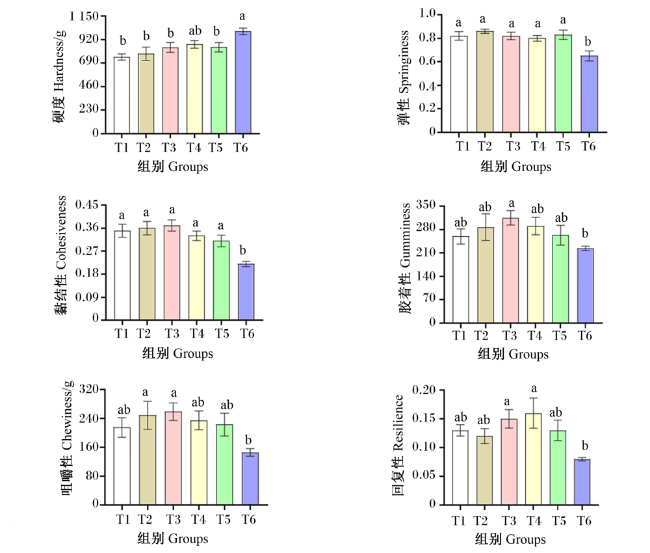
图2可知,与T1组相比,T2组肌肉的硬度、弹性、黏结性、胶着性、咀嚼性和回复性无显著差异(P>0.05);T6组肌肉的硬度显著增加(P<0.05),弹性和黏结性显著降低(P<0.05)。与T2组相比,T6组肌肉的硬度显著增加(P<0.05),弹性、黏结性和咀嚼性显著降低(P<0.05)。
图2 氧化鱼油和姜黄素对黄颡鱼肌肉质构特性的影响

数据柱标注不同小写字母表示组间存在显著性差异(P<0.05)。

Fig.2 Effects of oxidized fish oil and curcumin on muscle texture characteristics of Pelteobagrus fulvidraco

Data columns with different small letters indicated significant difference between groups (P<0.05).

3 讨论

3.1 氧化鱼油和姜黄素对黄颡鱼生长性能的影响

生长性能是评估鱼类生长和饲料利用情况的重要依据。本试验条件下,与添加3%的新鲜鱼油相比,饲料中添加3%的氧化鱼油对黄颡鱼的生长性能无显著影响,表明氧化鱼油不影响黄颡鱼的正常生长,这与Yu等[33]在史氏鲟(Acipenser schrencki)、Zhang等[9]在鳝鱼(Monopterus albus)、Rahimnejad等[10]在虹鳟(Oncorhynchus mykiss)上的研究结果相似。然而,卓丽欣等[11]发现,饲料中添加2%的氧化鱼油抑制了黄颡鱼的生长,这可能与氧化鱼油添加量的不同有关。氧化鱼油通常会降低饲料品质、营养物质消化率[7,34]及饲料摄食量[3-5]。然而,本试验结果表明,3%的氧化鱼油使黄颡鱼的摄食量增加,这与卓丽欣等[11]在黄颡鱼和Yu等[33]在史氏鲟上的研究结果相同。不同研究所得结果不同可能与动物品种、氧化鱼油添加量及试验条件的不同有关。
本试验结果表明,在含3%氧化鱼油的饲料中添加0.02%~0.08%的姜黄素对黄颡鱼的生长性能无显著影响,姜黄素虽然能提高黄颡鱼的增重率,但效果不显著,该结果与杨雨生等[35]在黄颡鱼上的研究结果相似,但与张滕闲等[22]在黄颡鱼、Li等[23]在黑鱼(Channa argus)、Ashry等[24]在金头鲷(Sparus aurata)、Abdel-Ghany等[25]在尼罗罗非鱼(Oreochromis niloticus)上的研究结果不一致。以上研究表明,姜黄素能提高动物的生长性能,这可能与姜黄素提高消化酶活性[22]、增强抗氧化与免疫能力[23]、调节肠道菌群[24]有关。然而,Li等[23]认为高剂量姜黄素会引发鱼类的氧化应激,从而抑制其生长。本试验条件下,在含3%氧化鱼油的饲料中添加0.02%~0.08%的姜黄素不影响黄颡鱼的生长性能,这可能与氧化鱼油干扰姜黄素对黄颡鱼的促生长作用有关。

3.2 氧化鱼油和姜黄素对黄颡鱼血清生化、抗氧化与免疫指标的影响

血清中的甘油三酯主要来源于肠道吸收和肝脏合成,正常情况下甘油三酯的含量能够保持动态稳定。本试验结果表明,饲料中添加3%的氧化鱼油显著降低了黄颡鱼血清中甘油三酯的含量,这与Hasanpour等[6]在杂交鲟鱼(Huso huso ♂×Acipenser ruthenus♀)、Dong等[7]在斑点叉尾鮰(Lctalurus punctatus)上的研究结果相似,这可能与氧化鱼油抑制了鱼类肝脏中脂肪酶的活性有关[6]。然而,Zhang等[9]在鳝鱼、Liu等[8]在点带石斑鱼(Epinephelus coioides)、Rahimnejad等[10]在虹鳟上的研究发现,氧化鱼油导致血清甘油三酯含量显著增加,但卓丽欣等[11]报道2%氧化鱼油对黄颡鱼血清甘油三酯含量无显著影响。上述研究结论不同的原因可能与鱼类品种和氧化鱼油添加量不同有关。
过氧化氢酶是机体抗氧化系统中的重要组成酶,可抑制活性氧的产生[10]。总抗氧化能力是反映动物体内总抗氧化水平的重要指标。本试验结果表明,饲料中添加3%的氧化鱼油可显著降低黄颡鱼血清过氧化氢酶活性,但对总抗氧化能力无显著影响,这与Rahimnejad等[10]在虹鳟上的研究结果相似。然而,本试验与卓丽欣等[11]在黄颡鱼、Hasanpour等[6]在杂交鲟鱼上的研究结果不同。卓丽欣等[11]发现,饲料中添加2%的氧化鱼油对黄颡鱼血清过氧化氢酶活性无显著影响,但能显著降低总抗氧化能力。Hasanpour等[6]报道,饲料中氧化鱼油替代50%新鲜鱼油时,杂交鲟鱼血清过氧化氢酶活性显著降低,而替代100%新鲜鱼油时,血清过氧化氢酶活性显著增加。溶菌酶是体液先天免疫的关键成分,可防止鱼类病原体入侵[36]。本试验结果表明,饲料中添加3%的氧化鱼油显著降低了黄颡鱼血清溶菌酶活性,说明氧化鱼油可能诱发了机体炎症反应,使黄颡鱼的非特异性免疫力降低,这与Rahimnejad等[10]在虹鳟、Zhang等[9]在鳝鱼上的研究结果相似。
本试验结果表明,在含3%氧化鱼油的饲料中添加姜黄素能提高黄颡鱼血清中甘油三酯的含量,原因可能是姜黄素抵消了氧化鱼油对脂质代谢的影响。随着饲料中姜黄素添加量的增加,黄颡鱼血清过氧化氢酶活性增加,这可能归因于姜黄素的抗氧化活性,与Ji等[26]在大黄鱼、Zou等[27]在皱纹盘鲍(Haliotis discus hannai)上的研究结果相似。随着饲料中姜黄素添加量的增加,黄颡鱼血清溶菌酶活性增加,表明姜黄素能够提高黄颡鱼的非特异性免疫力,这与Mahmoud等[29]在尼罗罗非鱼、Yonar等[30]在虹鳟上的研究结果一致。

3.3 氧化鱼油和姜黄素对黄颡鱼肝脏抗氧化指标的影响

肝脏的抗氧化能力间接反映了肝脏的健康程度和机体的抗氧化水平。本试验结果表明,饲料中添加3%的氧化鱼油显著降低了黄颡鱼肝脏的总抗氧化能力和过氧化氢酶活性,表明氧化鱼油可导致黄颡鱼肝脏的抗氧化能力下降,这与梁高杨等[12]在斑点叉尾鮰和Zhang等[9]在鳝鱼上的研究结果一致。然而,卓丽欣等[11]研究表明,饲料中添加2%的氧化鱼油对黄颡鱼肝脏的总抗氧化能力和过氧化氢酶活性无显著影响,这可能与氧化鱼油添加量的不同有关。Chen等[13]发现,氧化鱼油对拉氏鱥(Rhynchocypris lagowski)肝脏抗氧化能力的影响随时间的变化而变化,饲喂4周后肝脏的总抗氧化能力和过氧化氢酶活性显著增加,而饲喂8周后肝脏的总抗氧化能力和过氧化氢酶活性显著降低,作者认为氧化鱼油干预了肝脏的抗氧化信号通路,从而影响了肝脏的抗氧化能力。
本试验条件下,饲料中添加0.02%~0.08%的姜黄素显著增加了黄颡鱼肝脏的总抗氧化能力和过氧化氢酶的活性,这与Zou等[27]在皱纹盘鲍、El Basuini等[28]在尼罗罗非鱼、Jiang等[20]在中华鳖上的研究结果相似,说明姜黄素能提高肝脏的抗氧化能力。姜黄素的抗氧化活性可能与其结构特性有关,姜黄素具有酚醛基和甲氧基,这2个基团的互作可清除活性氧自由基,抑制脂质过氧化,从而提高机体的抗氧化能力[20]

3.4 氧化鱼油和姜黄素对黄颡鱼体色的影响

体色是黄颡鱼的重要经济指标,其背部通常为黑色,腹部为黄色,尾部以浅黄色为底色。虽然有关黄颡鱼体色的研究较多,但氧化鱼油对黄颡鱼体色影响的报道较少。薛继鹏[37]发现,饲料中添加氧化鱼油降低了瓦氏黄颡鱼腹部皮肤的b*值。本试验结果表明,饲料中添加3%的氧化鱼油降低了黄颡鱼尾部皮肤的b*值,增加了尾部皮肤的a*值,说明黄颡鱼尾部体色出现退化。
本试验结果显示,在含3%氧化鱼油的饲料中添加0.04%和0.08%姜黄素显著降低了黄颡鱼尾部皮肤的a*值,且添加0.08%姜黄素时黄颡鱼尾部皮肤的b*值升高,表明姜黄素在一定程度上修复了氧化鱼油所导致的黄颡鱼体色的退化。朱怀宁等[19]研究发现,饲料中添加100~300 mg/kg的姜黄素可显著增加美洲鳗鲡幼鱼腹部皮肤的b*值,且b*值随姜黄素添加量的增加呈现先增加后降低的趋势,认为姜黄素对体色的影响与其添加量有关,可能是姜黄素在皮肤和肌肉中沉积所导致的。

3.5 氧化鱼油和姜黄素对黄颡鱼肌肉质构特性的影响

肌肉的质构特性如硬度、弹性、黏结性、胶着性、咀嚼性、回复性等是评价水产品品质的重要非营养学考量指标之一。本试验结果表明,饲料中添加3%的氧化鱼油对黄颡鱼肌肉的硬度、弹性、黏结性、胶着性、咀嚼性和回复性均无显著影响,说明饲料中添加3%的氧化鱼油不影响黄颡鱼的肌肉质构特性。
本试验条件下,在含3%氧化鱼油的饲料中添加0.08%姜黄素可显著增加黄颡鱼肌肉的硬度,降低弹性、黏结性和咀嚼性,这与Jiang等[20]在中华鳖和Li等[21]在吉富罗非鱼上的研究结论果相似。Jiang等[20]认为姜黄素是通过增加肌肉粗蛋白质含量,降低粗脂肪含量,从而调节肌肉微观结构,最终导致肌肉的硬度和胶着性增加。Li等[21]则认为姜黄素是通过增加肌原纤维密度和小尺寸肌纤维比例,减少肌纤维间隙,从而增加肌肉硬度和咀嚼性。

4 结论

本试验条件下,饲料中添加3%的氧化鱼油显著降低了黄颡鱼血清甘油三酯含量、过氧化氢酶活性、肝脏总抗氧化能力和过氧化氢酶活性,并导致尾部皮肤颜色退化;在含3%氧化鱼油的饲料中添加0.02%~0.08%的姜黄素显著增加了黄颡鱼血清过氧化氢酶和溶菌酶活性以及肝脏总抗氧化能力和过氧化氢酶活性,一定程度上修复了氧化鱼油所导致的体色退化,增加了肌肉硬度并降低了肌肉弹性、黏结性和咀嚼性。
[1]
农业农村部渔业渔政管理局, 全国水产技术推广总站,中国水产学会.中国渔业统计年鉴-2023[M]. 北京: 中国农业出版社, 2023.

Fisheries and Fisheries Administration Bureau of the Ministry of Agriculture and Rural Affairs,National Fisheries Technology Extension Center,China Society of Fisheries. 2023 China fishery statistics yearbook[M]. Beijing: China Agriculture Press,2023. (in Chinese)

[2]
陈秀梅, 王秋举, 郭志欣, 等. 氧化鱼油对鱼类健康的危害及其作用机制的研究进展[J]. 中国畜牧杂志, 2019, 55(9):22-27.

CHEN X M, WANG Q J, GUO Z X, et al. Research progress on detrimental effects of oxidized fish oil on health status of fish[J]. Chinese Journal of Animal Science, 2019, 55(9):22-27. (in Chinese)

[3]
黄凯, 阮栋俭, 战歌, 等. 氧化油脂对奥尼罗非鱼生长和抗氧化性能的影响[J]. 淡水渔业, 2006, 36(6):21-24.

HUANG K, RUAN D J, ZHAN G, et al. Effects of oxidized oils on the growth and antioxidant activities of juvenile tilapia[J]. Freshwater Fisheries, 2006, 36(6):21-24. (in Chinese)

[4]
GAO J, KOSHIO S, ISHIKAWA M, et al. Effects of dietary palm oil supplements with oxidized and non-oxidized fish oil on growth performances and fatty acid compositions of juvenile Japanese sea bass,Lateolabrax japonicus[J]. Aquaculture, 2012, 324/325:97-103.

[5]
SUTTON J, BALFRY S, HIGGS D, et al. Impact of iron-catalyzed dietary lipid peroxidation on growth performance,general health and flesh proximate and fatty acid composition of Atlantic salmon (Salmo salar L.) reared in seawater[J]. Aquaculture, 2006, 257(1/4):534-557.

[6]
HASANPOUR S, SALATI A P, FALAHATKAR B, et al. Effects of dietary green tea (Camellia sinensis L.) supplementation on growth performance,lipid metabolism,and antioxidant status in a sturgeon hybrid of Sterlet (Huso huso ♂×Acipenser ruthenus ♀) fed oxidized fish oil[J]. Fish Physiology and Biochemistry, 2017, 43(5):1315-1323.

[7]
DONG G F, ZHU X M, REN H X, et al. Effects of oxidized fish oil intake on tissue lipid metabolism and fatty acid composition of channel catfish (Ictalurus punctatus)[J]. Aquaculture Research, 2014, 45(11):1867-1880.

[8]
LIU D, CHI S Y, TAN B P, et al. Effects of fish oil with difference oxidation degree on growth performance and expression abundance of antioxidant and fat metabolism genes in orange spotted grouper,Epinephelus coioides[J]. Aquaculture Research, 2019, 50(1):188-197.

[9]
ZHANG J Z, CHE C B, CAI M L, et al. Taurine improves health of juvenile rice field eel (Monopterus albus) fed with oxidized fish oil:involvement of lipid metabolism,antioxidant capacity,inflammatory response[J]. Aquaculture Reports, 2022, 27:101388.

[10]
RAHIMNEJAD S, DABROWSKI K, IZQUIERDO M, et al. Effects of vitamin C and E supplementation on growth, fatty acid composition,innate immunity,and antioxidant capacity of rainbow trout (Oncorhynchus mykiss) fed oxidized fish oil[J]. Frontiers in Marine Science, 2021, 8:760587.

[11]
卓丽欣, 赵红霞, 黄燕华, 等. 氧化鱼油对黄颡鱼生长性能和抗氧化指标的影响及精氨酸的干预作用[J]. 动物营养学报, 2017, 29(1):147-157.

DOI

ZHUO L X, ZHAO H X, HUANG Y H, et al. Influences of oxidized fish oil on growth performance and antioxidant indexes of yellow catfish (Pelteobagrus fulvidraco) and the use of arginine as an intervention measure[J]. Chinese Journal of Animal Nutrition, 2017, 29(1):147-157. (in Chinese)

[12]
梁高杨, 李小勤, 高启平, 等. 氧化油脂对斑点叉尾鮰生长、体色和抗氧化能力的影响[J]. 水生生物学报, 2019, 43(1):60-68.

LIANG G Y, LI X Q, GAO Q P, et al. Effect of oxidized oils on growth,body color and antioxidant capacity of channel catfish,Ictalurus punctatus[J]. Acta Hydrobiologica Sinica, 2019, 43(1):60-68. (in Chinese)

[13]
CHEN X M, WANG Q J, GUO Z X, et al. Effects of dietary oxidized fish oil on growth performance and antioxidant defense mechanism of juvenile Rhynchocypris lagowski Dybowski[J]. Aquaculture, 2019, 512:734368.

[14]
卓丽欣, 赵红霞, 黄燕华, 等. 氧化鱼油对黄颡鱼幼鱼肠道健康的影响及精氨酸的干预作用[J]. 水产学报, 2018, 42(1):100-111.

ZHUO L X, ZHAO H X, HUANG Y H, et al. Influence of oxidized fish oil on the intestinal health of juvenile yellow catfish (Pelteobagrus fulvidraco) and the use of arginine as an intervention measure[J]. Journal of Fisheries of China, 2018, 42(1):100-111. (in Chinese)

[15]
LIU G H, ZHANG D G, LEI X J, et al. Effects of dietary selenium and oxidized fish oils on intestinal lipid metabolism and antioxidant responses of yellow catfish Pelteobagrus fulvidraco[J]. Antioxidants, 2022, 11(10):1904.

[16]
LEI X J, ZHANG D G, TAN X Y, et al. Interactive influences of dietary selenium and oxidized fish oil on growth,nutritional composition,muscle development,antioxidant responses and selenoprotein expression in the muscle of yellow catfish Pelteobagrus fulvidraco[J]. Aquaculture, 2023, 576:739865.

[17]
徐兴昱, 陈永芳, 刘壮, 等. 姜黄素在畜禽养殖中的应用研究进展[J]. 中国畜牧杂志, 2023, 59(4):17-23.

XU X Y, CHEN Y F, LIU Z, et al. Research progress on the application of curcumin in livestock and poultry production[J]. Chinese Journal of Animal Science, 2023, 59(4):17-23. (in Chinese)

[18]
王进波, 吴天星. 姜黄素在大黄鱼饲料中的应用效果研究[J]. 水利渔业, 2007, 27(6):105-106.

WANG J B, WU T X. Application of curcumin in the feed for Pseudosciaena crocea[J]. Journal of Hydroecology, 2007, 27(6):105-106. (in Chinese)

[19]
朱怀宁, 杨欢, 翟少伟. 饲料中添加姜黄素对美洲鳗鲡幼鱼肝脏健康及体色的影响[J]. 饲料研究, 2020, 43(9):46-49.

ZHU H N, YANG H, ZHAI S W. Effect of dietary curcumin supplementation on the liver health and body color of juvenile American eel (Anguilla rostrata)[J]. Feed Research, 2020, 43(9):46-49. (in Chinese)

[20]
JIANG J Y, WEN H, JIANG M, et al. Dietary curcumin supplementation could improve muscle quality,antioxidant enzyme activities and the gut microbiota structure of Pelodiscus sinensis[J]. Animals, 2023, 13(16):2626.

[21]
LI X Y, WU L F, DUAN L, et al. Effects of dietary curcumin on growth and flesh quality in juvenile genetically improved farmed tilapia (GIFT,Oreochromis niloticus[J]. Aquaculture Research, 2023, 2023:6013669.

[22]
张滕闲, 陈钱, 张宝龙, 等. 姜黄素对黄颡鱼 (Pelteobagrus fulvidraco) 生长、消化与抗氧化能力的影响[J]. 渔业科学进展, 2017, 38(6):56-63.

ZHANG T X, CHEN Q, ZHANG B L, et al. The effects of curcumin on the growth,digestion and antioxidant ability of yellow catfish (Pelteobagrus fulvidraco)[J]. Progress in Fishery Sciences, 2017, 38(6):56-63. (in Chinese)

[23]
LI M, KONG Y D, WU X Q, et al. Effects of dietary curcumin on growth performance,lipopolysaccharide-induced immune responses,oxidative stress and cell apoptosis in snakehead fish (Channa argus)[J]. Aquaculture Reports, 2022, 22:100981.

[24]
ASHRY A M, HASSAN A M, HABIBA M M, et al. The impact of dietary curcumin on the growth performance,intestinal antibacterial capacity,and haemato-biochemical parameters of gilthead seabream (Sparus aurata)[J]. Animals, 2021, 11(6):1779.

[25]
ABDEL-GHANY H M, EL-SISY D M, SALEM M E S. A comparative study of effects of curcumin and its nanoparticles on the growth,immunity and heat stress resistance of Nile tilapia (Oreochromis niloticus)[J]. Scientific Reports, 2023, 13(1):2523.

[26]
JI R L, XIANG X J, LI X S, et al. Effects of dietary curcumin on growth,antioxidant capacity,fatty acid composition and expression of lipid metabolism-related genes of large yellow croaker fed a high-fat diet[J]. British Journal of Nutrition, 2021, 126(3):345-354.

[27]
ZOU W G, MA Y B, AI C X, et al. Dietary curcumin influence on growth, antioxidant status, immunity,gut flora and resistance to Vibrio harveyi AP37 in Haliotis discus hannai[J]. Aquaculture Reports, 2022, 26:101336.

[28]
EL BASUINI M F, ZAKI M A A, EL-HAIS A M, et al. Microbial,immune and antioxidant responses of Nile tilapia with dietary nano-curcumin supplements under chronic low temperatures[J]. Aquaculture and Fisheries, 2024, 9(1):57-65.

[29]
MAHMOUD H K, AL-SAGHEER A A, REDA F M, et al. Dietary curcumin supplement influence on growth,immunity,antioxidant status,and resistance to Aeromonas hydrophila in Oreochromis niloticus[J]. Aquaculture, 2017, 475:16-23.

[30]
YONAR M E, MIŞE YONAR S, ĪSPIR Ü, et al. Effects of curcumin on haematological values,immunity,antioxidant status and resistance of rainbow trout (Oncorhynchus mykiss) against Aeromonas salmonicida subsp. achromogenes[J]. Fish & Shellfish Immunology, 2019, 89:83-90.

[31]
彭凯, 邱建强, 徐友良, 等. 短期饲喂缩合单宁对大规格大口黑鲈生长性能和肝脏健康的影响[J]. 广东农业科学, 2023, 50(8):1-9.

PENG K, QIU J Q, XU Y L, et al. Effects of short-term feeding condensed tannins on growth performance and liver health of large-sized Micropterus salmoides[J]. Guangdong Agricultural Sciences, 2023, 50(8):1-9. (in Chinese)

[32]
符兵, 彭凯, 陈冰, 等. 蚕豆及其活性物质对罗非鱼生长性能、血液指标、肌肉抗氧化能力及肌肉品质的影响[J]. 动物营养学报, 2023, 35(10):6574-6586.

DOI

FU B, PENG K, CHEN B, et al. Effects of Faba bean and its active substances on growth performance,blood indexes,muscle antioxidant capacity and muscle quality of tilapia (Oreochromis niloticus)[J]. Chinese Journal of Animal Nutrition, 2023, 35(10):6574-6586. (in Chinese)

[33]
YU H H, REN Y Y, WEI H C, et al. Dietary oxidized fish oil negatively affected the feed utilization,health status and fillet quality of juvenile Amur sturgeon,A. schrenckii[J]. Aquaculture, 2022, 546:737290.

[34]
CHEN Y J, LIU Y J, YANG H J, et al. Effect of dietary oxidized fish oil on growth performance,body composition,antioxidant defence mechanism and liver histology of juvenile largemouth bass Micropterus salmoides[J]. Aquaculture Nutrition, 2012, 18(3):321-331.

[35]
杨雨生, 王洋, 曾祥茜, 等. 四种添加剂对黄颡鱼生长、消化与抗氧化能力的影响[J]. 饲料工业, 2018, 39(18):17-24.

YANG Y S, WANG Y, ZENG X Q, et al. Effects of four kinds of additives on growth performance,digestion and antioxidant ability of yellow catfish (Pelteobagrus fulvidraco)[J]. Feed Industry, 2018, 39(18):17-24. (in Chinese)

[36]
REN T J, KOSHIO S, ISHIKAWA M, et al. Influence of dietary vitamin C and bovine lactoferrin on blood chemistry and non-specific immune responses of Japanese eel,Anguilla japonica[J]. Aquaculture, 2007, 267(1/2/3/4):31-37.

[37]
薛继鹏. 三聚氰胺、 氧化鱼油和脂肪对瓦氏黄颡鱼生长和体色的影响[D]. 博士学位论文. 青岛: 中国海洋大学, 2011.

XUE J P. Effects of melamine,oxidized fish oil and lipid on growth and skin colour of darkbarbel catfish[D]. Ph.D.Thesis. Qingdao: Ocean University of China, 2011. (in Chinese)

Outlines

/