RESEARCH PAPER

Effects of Alkaline Hydrogen Peroxide Treatment of Rice Straw Fiber on Ruminal Fermentation Characteristics and Microbial Diversity in Vitro

  • GUO Mengjiao , 1 ,
  • GAO Jian 1 ,
  • SUN Zhanying 1 ,
  • YANG Chengjian 2 ,
  • CHENG Yanfen , 1, *
Expand
  • 1 National Center for International Research on Animal Gut Nutrition, Nanjing Agricultural University, Nanjing 210095, China
  • 2 Buffalo Research Institute, Chinese Academy of Agricultural Sciences and Guangxi Zhuang Nationality Autonomous Region, Nanning 530001, China

Received date: 2024-01-08

  Online published: 2024-07-09

Abstract

The aim of this experiment was to evaluate the rumen degradation rate of rice straw fiber treated with alkaline hydrogen peroxide and its effects on rumen fermentation parameters and microbial diversity in vitro. Taking the normal rice straw as control, the rice straw fiber treated with alkaline hydrogen peroxide was fermented for 72 h in vitro and the gas production was measured at 4, 8, 12, 18, 24, 36, 48 and 72 h, respectively. At 0.5, 4, 12, 24, 48 and 72 h, six fermentation bottles were collected from each group to determine the contents of volatile fatty acid (VFA), ammonia nitrogen (NH3-N) and microbial protein (MCP), and the remaining substrate was collected for the determination of fiber degradation rate. The fermentation substrate was collected at 72 h and stored at -80 ℃ for subsequent DNA extraction and high-throughput analysis. The results showed as follows: 1) the dry matter degradation rate of rice straw fiber was 1.64 times that of rice straw at 72 h of fermentation (P<0.05), and the degradation rates of neutral detergent fiber, acid detergent fiber, cellulose and hemicellulose were significantly higher than those of rice straw (P<0.05). The dry matter degradation time of rice straw fiber was shorter than that of rice straw. Rice straw fiber degradation occurred at 4 h and rice straw degradation occurred at 12 h. 2) The scanning electron microscope results showed that compared with the rice straw, the fiber structure of rice straw was more loose, the number of microbial adhesion was more, and the digestion was more complete after 72 h of fermentation. 3) The total gas production, total volatile fatty acid content and contents of propionate and isovalerate in rice straw fiber were extremely significantly higher than those in rice straw (P<0.01), and the ratio of methane production to total gas production, the contents of butyrate, isobutyrate and valerate, and the ratio of acetate to propionate were significantly or extremely significantly lower than those in rice straw (P<0.05 or P<0.01). At 72 h of fermentation, the total bacteria number and MCP content in rice straw fiber were extremely significantly higher than those in rice straw (P<0.01), and the NH3-N content was extremely significantly lower than that in rice straw (P<0.01). 4) The α diversity results showed that the microflora diversity in rice straw fiber was significantly higher than that in rice straw (P<0.05). At the phylum level, the results of microbial difference analysis showed that there was no significant difference in phyla with relative abundance greater than 1% between rice straw fiber and rice straw (P>0.05). At the genus level, the relative abundances of Ruminococcus, Saccharofermentans and Prevotellaceae_UCG-001 in rice straw fiber were significantly lower than those in rice stalk (P<0.05), while the relative abundances of unculured_Lachnospiraceae, Probable_genus_10, Bacteroidales_F082 and Lachnospiraceae_UCG-009 were significantly higher than those in rice straw (P<0.05). In summary, the rice straw fiber is more easily degraded by microorganisms than rice straw and can generate more energy substances such as VFA, which can be used as a potential product in ruminant production.

Cite this article

GUO Mengjiao , GAO Jian , SUN Zhanying , YANG Chengjian , CHENG Yanfen . Effects of Alkaline Hydrogen Peroxide Treatment of Rice Straw Fiber on Ruminal Fermentation Characteristics and Microbial Diversity in Vitro[J]. Chinese Journal of Animal Nutrition, 2024 , 36(7) : 4739 -4750 . DOI: 10.12418/CJAN2024.406

近年来,粗纤维在畜禽饲粮中的营养以及非营养作用受到越来越多的重视。一方面,纤维能够增强肠道蠕动促进肠道生长发育和消化吸收,调控采食量;另一方面,畜禽消化道的微生物能降解粗纤维产生挥发性脂肪酸(VFA)等营养物质,为畜禽提供能量[1]。粗纤维由纤维素(35%~50%)、半纤维素(20%~35%)、木质素(5%~30%)等多种复杂多糖组成[2],其在饲粮中的含量和降解特性与饲料原料类型和处理方法有关。例如,秸秆类纤维含量大于谷实类和牧草类;粗饲料经过物理、化学和生物处理等,其纤维组成和结构会发生改变[3]
目前,在我国高投入和高产出的养殖生产模式中,饲粮中的粗纤维具有相当重要的作用,必须在饲粮中维持一定比例的粗纤维才能有利于畜禽胃肠道发育和健康,保证其生产性能。然而,粗纤维中复杂且致密的木质纤维素结构阻碍了其被畜禽胃肠道微生物降解[4],从而导致资源浪费。研究表明,饲粮成分中粗纤维含量越高,可供畜禽消化吸收的营养物质含量就越低,饲粮消化率也越低[5]。因此,有必要对秸秆类高纤维粗饲料进行有效和适当的处理来影响纤维素、半纤维素、木质素含量以及纤维的结构组成,从而改善畜禽消化道微生物的降解和营养物质的生成。
在工业性木质纤维素生物质处理中,碱性过氧化氢处理是使用最广泛的预处理方法之一,其具有反应条件温和、生产成本低以及酶消化率高等优点[6]。这类处理方法可以从木质纤维素材料中分离木质素和纤维素,并提高酶水解的效率和乙醇产量[7]。因此,本研究中从水稻秸秆经过氢氧化钠和过氧化氢处理后获得了一种高纤维含量的生物质,简称稻秸纤维。为了探究该稻秸纤维的营养价值以及降解过程,本研究采用体外产气法比较稻秸纤维与稻秸的动态降解过程及体外发酵参数,同时从微生物角度分析原因,为开发高纤维饲草资源提供新的见解。

1 材料与方法

1.1 试验材料与处理

试验所选水稻秸秆样品为去除籽实以及叶片后的秸秆。稻秸纤维生产工艺流程为:稻秸经过0.2 mol/L的氢氧化钠处理5 h后在50 ℃条件下以40 mg/g(过氧化氢/稻秸)的过氧化氢处理7 h,固液比为1∶10,洗涤至中性,65 ℃烘干[8]。稻秸和稻秸纤维营养成分含量分别为:中性洗涤纤维(NDF)71.18%和88.62%,酸性洗涤纤维(ADF)41.69%和57.64%,纤维素33.19%和51.52%,半纤维素29.50%和31.00%,木质素4.46%和4.87%。

1.2 体外发酵

试验选用6头体重和年龄相近、体况良好并装有永久性瘤胃瘘管的成年水牛,晨饲前采集瘤胃液,混匀,经4层纱布过滤,滤液与人工唾液按1∶4(体积比)混合,人工唾液参照Menke等[9]的方法配制,制成混合人工瘤胃培养液。准确称取0.6 g发酵底物于180 mL发酵瓶中,向每个发酵瓶中加入上述混合人工瘤胃培养液60 mL,立即盖严瓶塞,并置于39 ℃培养箱中进行体外发酵培养。

1.3 体外发酵产气量测定

参照Theodorou等[10]的方法,使用气压转换仪和50 mL注射器分别测定4、8、12、18、24、36、48、72 h时的产气量。参照Jin等[11]的方法,使用高效气相色谱仪7890B测定甲烷和氢气产量。

1.4 体外发酵参数测定

分别在0.5、4、12、24、48和72 h时,每组取6个发酵瓶(共12个),置于冰中终止发酵。发酵液经300目尼龙布过滤,待测定pH后,将样品分装冻存在-20 ℃,用于测定VFA、乳酸、氨态氮(NH3-N)和菌体蛋白(MCP)含量;用于瘤胃细菌16S rRNA基因测序分析的样品则置于-80 ℃保存。采用GC7890B型气相色谱仪(安捷伦)测定发酵液中VFA含量,方法参照Jin等[11]的气相色谱法;参照Broderick等[12]的方法测定发酵液中NH3-N含量;根据考马斯亮蓝染色方法测定发酵液中MCP含量;乳酸含量采用南京建成生物工程研究所乳酸检测试剂盒测定。尼龙布上的残渣在65 ℃烘箱中烘干,用于测定干物质(DM)降解率以及纤维成分降解率。DM含量采用烘箱干燥法测定,NDF、ADF、纤维素和半纤维素含量参照Van Soest等[13]的方法测定。

1.5 扫描电镜观察

分别选取在0、12、72 h发酵后的稻秸和稻秸纤维,先经过2.5%戊二醛溶液固定,再用浓度为30%、50%、70%、85%、95%和100%乙醇脱水处理后,固定,镀金膜,然后使用Hitachi Regulus 8100扫描电镜在500倍放大条件下进行观察,寻找相同的部位并拍摄图像。

1.6 发酵液细菌高通量测序

微生物总DNA采用Tiangen DNA试剂盒[天根生化科技(北京)有限公司]进行提取,采用分光光度法检测基因组DNA的浓度和纯度。合格的DNA样本送往华大基因进行16S rRNA扩增子测序。16S rRNA基因测序以V3~V4为目标区域进行引物设计,引物信息如下:341F,5'-ACTCCTACGGGAGGCAGCAG-3';806R,5'-GGACTACHVGGGTWTCTAAT-3'[14]。取质量合格的基因组DNA进行PCR扩增,使用Agencourt AMPure XP磁珠对PCR扩增产物进行纯化,使用Agilent 2100 Bioanalyzer对文库的片段范围及浓度进行检测。检测合格的文库根据插入片段大小进行测序。使用CutAdap v2.6软件去除引物序列和条形码,然后使用QIIME2进行质量过滤,双端剪接和去嵌合[15]。以99%的相似性和分类注释进行操作分类单元(OTU)聚类和α多样性分析。通过对线性判别分析效应大小(LEfSe)的分析,比较细菌门和属水平的差异[线性判别分析(LDA)>2,P<0.05]。使用R软件对发酵参数和微生物区系进行Pearson相关性分析。
根据Ørskov等[16]描述的公式模型,采用非线性回归拟合各预处理的产气量。模型如下:
GPt=a+b×e-ct
式中:GPt为时间点t的累积产气量(mL);a为初始时间点产气量(mL);b为理论最大产气量(mL);c为产气速率。

1.7 数据统计分析

试验数据均用Excel 2021进行初步处理,然后应用SPSS 25软件中的独立样本t检验进行分析。结果以“平均值±标准差(SD)”表示,P<0.01为差异极显著,P<0.05为差异显著。

2 结果与分析

2.1 体外发酵纤维降解过程

图1所示,在发酵72 h时,稻秸纤维的DM降解率显著高于稻秸(P<0.05);稻秸纤维在发酵4 h后出现快速降解,而稻秸在发酵12 h后出现降解;DM降解率、NDF降解率、ADF降解率、纤维素降解率和半纤维素降解率之间随时间变化趋势相同。
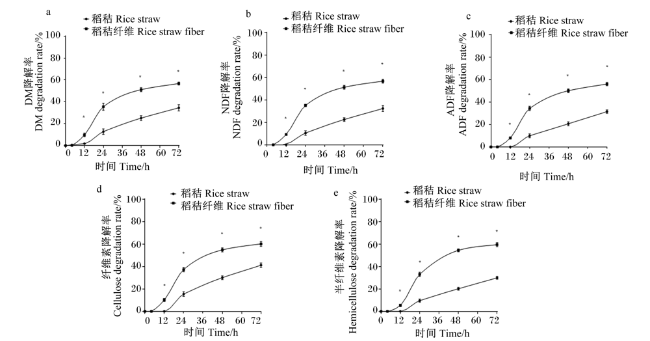
图1 体外发酵降解率的动态变化

*表示差异显著(P<0.05),图3同。

Fig.1 Dynamic changes of degradation rate in vitro fermentation

* mean significant difference (P<0.05), the same as Fig.3.

2.2 体外发酵过程稻秸纤维微观结构变化

图2所示,稻秸表面光滑整齐,稻秸纤维表面粗糙不平;在发酵12 h时,稻秸纤维表面微生物黏附数量多于稻秸且观察到纤维降解更严重;在发酵72 h时,稻秸纤维比稻秸降解更完全。
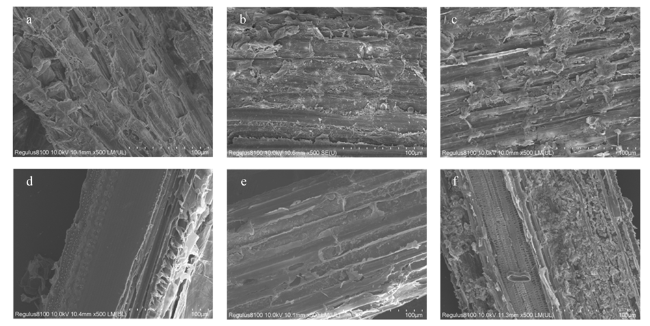
图2 体外发酵过程表面形貌变化扫描电镜图

a:稻秸纤维 rice straw fiber;b:发酵12 h稻秸纤维 rice straw fiber fermented for 12 h;c:发酵72 h稻秸纤维 rice straw fiber fermented for 72 h;d:稻秸 rice straw;e:发酵12 h稻秸 rice straw fermentation for 12 h;f:发酵72 h稻秸 rice straw fermentation for 72 h。

Fig.2 Scanning electron microscope images of surface morphology changes during in vitro fermentation (500×)

2.3 体外发酵产气参数

表1可知,与稻秸相比,稻秸纤维的总产气量和理论最大产气量极显著提高(P<0.01),分别提高了83.42%和42.66%;稻秸纤维的产气速率提高了85.71%(P<0.01);稻秸纤维的甲烷产量、氢气产量以及氢气产量/总产气量比例极显著提高(P<0.01),甲烷产量/总产气量比例显著降低(P<0.05)。
表1 稻秸纤维对体外发酵72 h产气量的影响

Table 1 Effects of rice straw fiber on gas production for 72 h in vitro fermentation

项目
Items
总产气量
Total gas production
甲烷
Methane
氢气
Hydrogen
产气量
Gas
production/
mL
理论最大
产气量
Theoretical
maximum gas
production
(b)/mL
产气速率
gas
production
rate (c)
产量
Production/
mL
产量/
总产气量
Production/
total gas
production/
%
产量
Production/
mL
产量/
总产气量
Production/
total gas
production/
%
稻秸纤维
Rice straw fiber
128.08
±3.10
159.01
±4.27
0.026
±0.001
14.77
±0.63
11.54
±0.58
2.97
±0.20
2.32
±0.18
稻秸
Rice straw
69.83
±3.47
111.46
±4.44
0.014
±0.001
8.94
±0.85
12.78
±0.76
1.00
±0.11
1.44
±0.12
PP-value <0.001 <0.001 <0.001 <0.001 0.016 <0.001 <0.001

2.4 体外发酵特性

表2可知,在体外发酵72 h时,稻秸纤维发酵液的总挥发性脂肪酸含量极显著高于稻秸发酵液(P<0.01),提高了43.27%;与稻秸发酵液相比,稻秸纤维发酵液的丙酸和异戊酸含量(摩尔百分比)极显著提高(P<0.01),丁酸、异丁酸和戊酸含量极显著降低(P<0.01),乙酸/丙酸比例极显著降低(P<0.01)。
表2 稻秸纤维对体外发酵VFA组成的影响

Table 2 Effects of rice straw fiber on VFA composition in vitro fermentation

项目
Items
总挥发性
脂肪酸
Total VFA/
(mmol/L)
VFA摩尔百分比 VFA molar percentage/% 乙酸/丙酸
Acetate/
propionate
乙酸
Acetate
丙酸
Propionate
丁酸
Butyrate
异丁酸
Isobutyrate
戊酸
Valerate
异戊酸
Isovalerate
稻秸纤维
Rice straw fiber
84.80
±2.57
72.30
±0.63
21.28
±0.49
4.58
±0.12
0.52
±0.01
0.64
±0.03
0.62
±0.02
3.40
±0.12
稻秸
Rice straw
59.19
±3.02
73.26
±0.76
19.35
±0.56
5.51
±0.23
0.56
±0.02
0.74
±0.02
0.58
±0.01
3.79
±0.16
PP-value <0.001 0.068 <0.001 <0.001 0.001 <0.001 0.008 0.001
表3可知,在体外发酵72 h时,与稻秸发酵液相比,稻秸纤维发酵液的pH极显著降低(P<0.01),乳酸含量没有显著差异(P>0.05),MCP含量提高了71.46%(P<0.01),NH3-N含量降低了12.35%(P<0.01);此外,稻秸纤维发酵液的细菌总数是稻秸发酵液的2.50倍(P<0.01)。
表3 稻秸纤维对体外发酵特性的影响

Table 3 Effects of rice straw fiber on fermentation characteristics in vitro

项目
Items
pH 乳酸
Lactate/
(mg/dL)
细菌总数
Number of total bacteria/
(×1011拷贝数/g)
菌体蛋白
MCP/
(mg/dL)
氨态氮
NH3-N/
(mg/dL)
稻秸纤维 Rice straw fiber 6.53±0.00 0.47±0.03 3.53±0.32 7.51±0.50 9.37±0.06
稻秸 Rice straw 6.64±0.00 0.45±0.02 1.41±0.28 4.38±0.65 10.69±0.05
PP-value <0.001 0.600 <0.001 <0.001 <0.001

2.5 微生物多样性

2.5.1 稻秸纤维对体外发酵细菌α多样性的影响

图3所示,在体外发酵72 h时,稻秸纤维观测物种(Observed_species)数(直接观察到的OTU数量)、Shannon指数、均匀度和Faith_PD指数均显著高于稻秸(P<0.05)
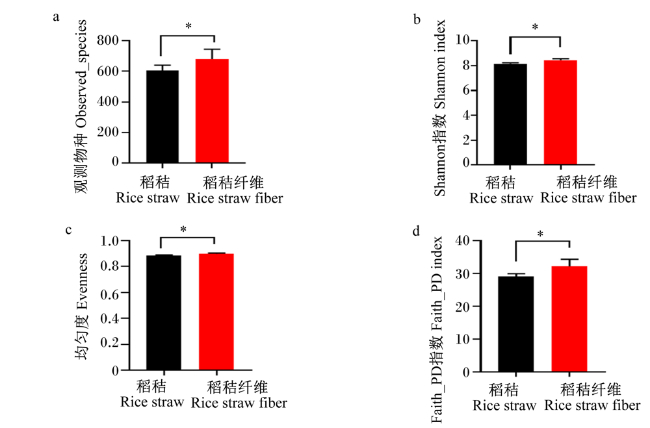
图3 稻秸纤维对体外发酵细菌α多样性的影响

Fig.3 Effects of rice straw fiber on α diversity of bacteria in vitro fermentation

2.5.2 稻秸纤维对体外发酵细菌门和属水平的影响

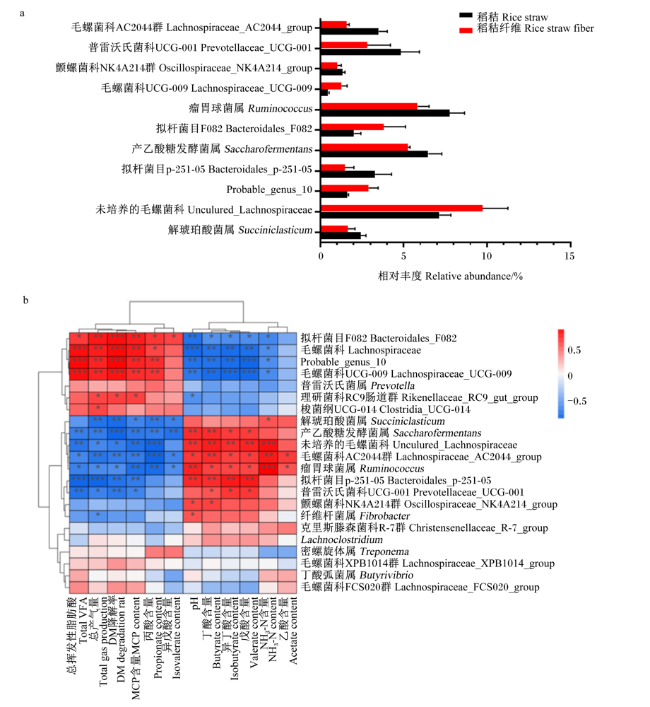
细菌门水平相对丰度排名前10的结果如图4-A所示,稻秸和稻秸纤维细菌相对丰度大于1%的菌门无显著差异(P>0.05);在属水平上(图4-B图5-A),稻秸和稻秸纤维之间解琥珀酸菌属(Succiniclasticum)、未培养的毛螺菌科(unculured_Lachnospiraceae)、Probable_genus_10、拟杆菌目p-251-05(Bacteroidales_p-251-05)、产乙酸糖发酵菌属(Saccharofermentans)、拟杆菌目F082(Bacteroidales_F082)、瘤胃球菌属(Ruminococcus)、毛螺菌科UCG-009(Lachnospiraceae_UCG-009)、颤螺菌科NK4A214群(Oscillospiraceae_NK4A214_group)、普雷沃氏菌科UCG-001(Prevotellaceae_UCG-001)和毛螺菌科AC2044群(Lachnospiraceae_AC2044_group)相对丰度差异显著(P<0.05);其中,稻秸纤维未培养的毛螺菌科、Probable_genus_10、拟杆菌目F082和毛螺菌科UCG-009相对丰度显著高于稻秸(P<0.05),其余菌属相对丰度显著低于稻秸(P<0.05)。结合基于发酵参数和菌属相对丰度(大于1%)对应的关系矩阵绘制顶部和左侧的层次聚类分析结果表明(图5-B),稻秸纤维中相对丰度与DM降解率、总产气量、MCP含量、总发挥性脂肪酸含量、丙酸含量和异戊酸含量呈显著正相关的菌属有理研菌科RC9肠道群(Rikenellaceae_RC9_gut_group)、毛螺菌科(Lachnospiraceae)、Probable_genus_10、拟杆菌目F082和毛螺菌科UCG-009(P<0.05)。
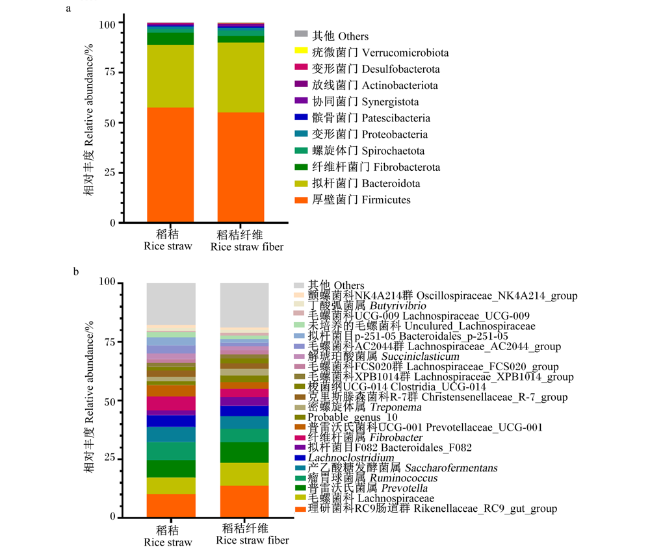
图4 稻秸纤维对体外发酵细菌在门(a)和属(b)水平上组成的影响

Fig.4 Effects of rice straw fiber on bacteria composition at phylum (a) and genus (b) levels in vitro fermentation

图5 微生物差异(a)和相关性(b)分析

红色代表正相关,蓝色代表负相关;*表示P<0.05,**表示P<0.01,***表示P<0.001。

Fig.5 Analysis of microbial difference (a) and correlation (b)

Red represented for positive correlation and blue represented for negative correlation; * mean P<0.05, ** mean P<0.01, and *** mean P<0.001.

3 讨论

3.1 稻秸纤维对瘤胃体外发酵降解率的影响

本试验中,稻秸DM在发酵12 h时开始降解,在12~24 h时降解速率最快,这与汪营[17]的研究结果一致。然而,稻秸纤维DM在发酵4 h时开始降解,在4~24 h时处于快速降解阶段;且在发酵72 h时,稻秸纤维DM降解率达到56.68%,显著高于稻秸,这意味着稻秸纤维比稻秸能够更快且更容易被瘤胃微生物降解。在发酵4 h时,稻秸纤维NDF、ADF、纤维素和半纤维素开始降解,这是稻秸纤维DM降解的主要成分。根据扫描电镜结果可以发现,稻秸表面光滑,结构紧凑;而稻秸纤维表面粗糙多孔,结构更松散。Vahidi等[18]研究发现,结构松散、比表面积大的饲草更易于微生物的定植。在微生物定植的初始阶段,只有极少量的纤维物质被降解,纤维的大量降解出现在定植阶段的后期[19]。因此,与稻秸相比,稻秸纤维缩短了微生物的定植时间,提高了DM降解速率。Zhao等[20]利用气爆处理玉米秸秆,处理后秸秆结构更加松散,提高了微生物定植以及纤维素和半纤维素的降解率。在发酵12 h时,稻秸纤维表面黏附的微生物数量大于稻秸;在发酵72 h时,稻秸纤维被降解更完全,剩余相对完整的难降解的结构,而稻秸仍有大量未降解的碎片。Yang等[21]研究发现,碱氧预处理会破坏秸秆纤维内部的共价键,暴露由木质素包裹的内部纤维素,从而提高酶解效率。稻秸纤维经过化学处理和提取,其抗性结构被破坏,内部纤维暴露,比表面积增加[22],这意味着其能提供更多的微生物黏附位点,使得酶对纤维的可及性增加。苗林平等[23]用碱性过氧化氢处理小麦秸秆酶解效率达94.18%;Liu等[24]用碱性过氧化氢处理稻秸提高了黑蝇对稻秸的利用效率。因此,稻秸纤维更有利于微生物的定植和酶解,从而提高降解速率和降解率。

3.2 稻秸纤维对瘤胃体外发酵参数的影响

本试验中,在发酵72 h时,稻秸纤维的总产气量、理论最大产气量和产气速率均极显著高于稻秸。研究表明,气体的产量和产气速率越大,代表饲草可发酵碳水化合物含量越大,微生物活性越强[25]。稻秸纤维更有利于微生物定植和酶解,因此可以使微生物能更高效地分解纤维等生物质并在此过程生成二氧化碳、氢气和甲烷等气体。马占霞[26]用氧化钙处理玉米秸秆显著提高了体外发酵的产气量。不过,与稻秸相比,尽管稻秸纤维甲烷产量增加,但甲烷产量/总产气量比例降低,这意味在稻秸和稻秸纤维为动物机体提供相同能量的情况下,稻秸纤维的甲烷产量更低。瘤胃中的VFA是反刍动物机体重要的能量来源[27]。在发酵72 h时,稻秸纤维发酵产生的总挥发性脂肪酸含量极显著高于稻秸。Ma等[28]氨化处理稻秸、梁晓伟等[29]用6%的氢氧化钙处理花棒、Wanapat等[30]用尿素和氧化钙联合处理稻秸均显著提高体外发酵总挥发性脂肪酸含量,上述研究结果与本试验结果基本一致,说明碱性过氧化氢处理的稻秸纤维能够为动物机体提供更多的能量。此外,VFA组成成分中,与稻秸相比,稻秸纤维丙酸含量提高,乙酸/丙酸比例降低,这表明瘤胃氢代谢更多的朝生成VFA方向进行,而不是生成甲烷[31],这一结论在本研究中甲烷产量/总产气量比例降低的结果中也得到初步验证。更多的VFA产生导致了发酵液中更低的pH,但始终维持在6.2~6.8的正常水平[32]。NH3-N含量与碳水化合物的利用效率有关,较高的碳水化合物利用效率导致较低的NH3-N含量[33],并且瘤胃细菌能将NH3-N整合到用于MCP合成的氨基酸中,有助于瘤胃微生物生长和繁殖,促进MCP的合成[34-35]。因此,发酵后稻秸纤维发酵液的NH3-N含量降低,MCP含量提高,并且细菌总数增加。

3.3 稻秸纤维瘤胃体外发酵微生物区系的影响

本研究中,稻秸纤维和稻秸之间的组成与结构不同,从而导致微生物多样性的不同。与稻秸相比,稻秸纤维经过72 h发酵后,发酵液中微生物物种OTU数量增加,多样性发生改变,这与李蒋伟等[36]和李希等[37]探究不同纤维比例对反刍动物瘤胃微生物多样性影响的结果一致。在门水平上,稻秸纤维和稻秸细菌菌门相对丰度无显著差异,可知与稻秸相比,稻秸纤维经过发酵后对细菌菌门组成没有影响。相对丰度大于1%的优势菌门有5个,分别为拟杆菌门、厚壁菌门、纤维杆菌门、螺旋体门和变形菌门。其中,拟杆菌门和厚壁菌门的相对丰度最高,在稻秸纤维和稻秸中分别占89.96%和88.96%,且其中的大部分细菌都与纤维降解有关[38]。在属水平上,稻秸纤维中理研菌科RC9肠道群、毛螺菌科和普雷沃氏菌属(Prevotella)是相对丰度较高的优势菌属且相对丰度高于稻秸组,但不属于差异菌属。本试验发现,与稻秸相比,稻秸纤维中与纤维生物质降解有关的普雷沃氏菌科UCG-001、瘤胃球菌属、产乙酸糖发酵菌属和拟杆菌目p-251-05等相对丰度显著降低。这与李娜[39]的研究结果一致,或许是因为稻秸纤维比稻秸更容易被降解,因此纤维分解菌的相对丰度降低。此外,聚类分析结果表明,瘤胃球菌属、产乙酸糖发酵菌属、普雷沃氏菌科UCG_001相对丰度与乙酸和丁酸含量呈正相关。
研究表明,纤维分解菌能够产乙酸、丁酸等同时伴随着氢气生成,甲烷菌可以利用氢生成甲烷[40]。因此,与纤维降解相关的菌属相对丰度降低或许是稻秸纤维中乙酸含量降低、丙酸含量提高和甲烷产量/总产气量比例降低的重要原因。稻秸纤维中未培养的毛螺菌科、Probable_genus_10、拟杆菌目F082和毛螺菌科UCG-009相对丰度显著高于稻秸。毛螺菌科可以利用果糖、纤维二糖等多种碳水化合物生产丙酸、丁酸等VFA[41]。饲粮中提高纤维含量可以提高瘤胃毛螺菌科的相对丰度[42]。因此,毛螺菌科相对丰度提高是VFA等能量物质产量提高的重要原因。微生物分析结果表明,稻秸纤维体外发酵后纤维降解菌相对丰度降低从而导致乙酸含量降低、丙酸含量提高以及甲烷产量/总产气量比例降低,而毛螺菌科相对丰度的提高是VFA含量提高的重要原因。

4 结论

与稻秸相比,稻秸纤维结构松散,有利于微生物黏附降解,体外发酵后其降解率、VFA和MCP产量显著高于稻秸,是一种具有潜力的粗饲料资源。
[1]
牟怡晓, 林语梵, 张桂杰. 不可消化中性洗涤纤维在反刍动物生产中的应用及研究进展[J]. 动物营养学报, 2020, 32(11):5069-5074.

DOI

MU Y X, LIN Y F, ZHANG G J. Application and research progress of indigestible neutral detergent fiber in ruminant production[J]. Chinese Journal of Animal Nutrition, 2020, 32(11):5069-5074. (in Chinese)

[2]
KASSAYE S, PANT K K, JAIN S. Synergistic effect of ionic liquid and dilute sulphuric acid in the hydrolysis of microcrystalline cellulose[J]. Fuel Processing Technology, 2016, 148:289-294.

[3]
ADESOGAN A T, ARRIOLA K G, JIANG Y, et al. Symposium review:technologies for improving fiber utilization[J]. Journal of Dairy Science, 2019, 102(6):5726-5755.

[4]
KIM J S, LEE Y Y, KIM T H. A review on alkaline pretreatment technology for bioconversion of lignocellulosic biomass[J]. Bioresource Technology, 2016, 199:42-48.

DOI PMID

[5]
WANG E D, WANG J D, LV J Y, et al. Comparison of ruminal degradability,indigestible neutral detergent fiber,and total-tract digestibility of three main crop straws with alfalfa hay and corn silage[J]. Animals, 2021, 11(11):3218.

[6]
BANERJEE G, CAR S, LIU T J, et al. Scale-up and integration of alkaline hydrogen peroxide pretreatment,enzymatic hydrolysis,and ethanolic fermentation[J]. Biotechnology and Bioengineering, 2012, 109(4):922-931.

[7]
ALVAREZ-VASCO C, ZHANG X. Alkaline hydrogen peroxide (AHP) pretreatment of softwood:enhanced enzymatic hydrolysability at low peroxide loadings[J]. Biomass and Bioenergy, 2017, 96:96-102.

[8]
YUAN Z Y, WEN Y B, LI G D. Production of bioethanol and value added compounds from wheat straw through combined alkaline/alkaline-peroxide pretreatment[J]. Bioresource Technology, 2018, 259:228-236.

DOI PMID

[9]
MENKE K H, RAAB L, SALEWSKI A, et al. The estimation of the digestibility and metabolizable energy content of ruminant feedingstuffs from the gas production when they are incubated with rumen liquor in vitro[J]. The Journal of Agricultural Science, 1979, 93(1):217-222.

[10]
THEODOROU M K, WILLIAMS B A, DHANOA M S, et al. A simple gas production method using a pressure transducer to determine the fermentation kinetics of ruminant feeds[J]. Animal Feed Science and Technology, 1994, 48(3/4):185-197.

[11]
JIN W, MENG Z X, WANG J, et al. Effect of nitrooxy compounds with different molecular structures on the rumen methanogenesis,metabolic profile,and methanogenic community[J]. Current Microbiology, 2017, 74(8):891-898.

[12]
BRODERICK G A, KANG J H. Automated simultaneous determination of ammonia and total amino acids in ruminal fluid and in vitro media[J]. Journal of Dairy Science, 1980, 63(1):64-75.

[13]
VAN SOEST P J, ROBERTSON J B, LEWIS B A. Methods for dietary fiber,neutral detergent fiber,and nonstarch polysaccharides in relation to animal nutrition[J]. Journal of Dairy Science, 1991, 74(10):3583-3597.

[14]
程心茗, 高健, 薛天涵, 等. 生物发酵稻秸对湖羊消化道上皮形态及微生物区系的影响[J]. 微生物学报, 2023, 63(4):1514-1530.

CHENG X M, GAO J, XUE T H, et al. Effects of bio-fermented rice straw on the epithelial morphology and microbiota of digestive tract of Hu sheep[J]. Acta Microbiologica Sinica, 2023, 63(4):1514-1530.. (in Chinese)

[15]
XU Y, AUNG M, SUN Z Y, et al. Ensiling of rice straw enhances the nutritive quality,improves average daily gain,reduces in vitro methane production and increases ruminal bacterial diversity in growing Hu lambs[J]. Animal Feed Science and Technology, 2023, 295:115513.

[16]
ØRSKOV E R, MCDONALD I. The estimation of protein degradability in the rumen from incubation measurements weighted according to rate of passage[J]. The Journal of Agricultural Science, 1979, 92(2):499-503.

[17]
汪营. 奶牛粗饲料瘤胃降解及微生物附着规律的研究[D]. 硕士学位论文. 南京: 南京农业大学, 2016:20-21.

WANG Y. Temporal dynamics of fibrolytic bacteria colonization and fiber degradation in the rumen[D]. Master's Thesis. Nanjing: Nanjing Agricultural University, 2016:20-21. (in Chinese)

[18]
VAHIDI M F, GHARECHAHI J, BEHMANESH M, et al. Diversity of microbes colonizing forages of varying lignocellulose properties in the sheep rumen[J]. PeerJ, 2021, 9:e10463.

[19]
HUWS S A, EDWARDS J E, CREEVEY C J, et al. Temporal dynamics of the metabolically active rumen bacteria colonizing fresh perennial ryegrass[J]. FEMS Microbiology Ecology, 2016, 92(1):fiv137.

[20]
ZHAO S G, LI G D, ZHENG N, et al. Steam explosion enhances digestibility and fermentation of corn stover by facilitating ruminal microbial colonization[J]. Bioresource Technology, 2018, 253:244-251.

DOI PMID

[21]
YANG L, RU Y, XU S, et al. Features correlated to improved enzymatic digestibility of corn stover subjected to alkaline hydrogen peroxide pretreatment[J]. Bioresource Technology, 2021, 325:124688.

[22]
WOICIECHOWSKI A L, DALMAS NETO C J, DE SOUZA VANDENBERGHE L P, et al. Lignocellulosic biomass:acid and alkaline pretreatments and their effects on biomass recalcitrance-conventional processing and recent advances[J]. Bioresource Technology, 2020, 304:122848.

[23]
苗林平, 霍丽, 徐力, 等. 碱性过氧化氢预处理小麦秸秆强化酶解产糖的研究[J]. 纤维素科学与技术, 2018, 26(4):45-51.

MIAO L P, HUO L, XU L, et al. Effects of mild alkaline hydrogen peroxide (AHP) pretreatment on enzymatic saccharification of wheat straw[J]. Cellulose Science and Technology, 2018, 26(4):45-51.. (in Chinese)

[24]
LIU C C, WANG C W, YAO H Y, et al. Pretreatment is an important method for increasing the conversion efficiency of rice straw by black soldier fly larvae based on the function of gut microorganisms[J]. The Science of the Total Environment, 2021, 762:144118.

[25]
MAYORGA O L, KINGSTON-SMITH A H, KIM E J, et al. Temporal metagenomic and metabolomic characterization of fresh perennial ryegrass degradation by rumen bacteria[J]. Frontiers in Microbiology, 2016, 7:1854.

PMID

[26]
马占霞. CaO处理玉米秸秆组合优选及对其纤维组分,分子结构和瘤胃体外模拟产气速率的影响研究[D]. 硕士学位论文. 天津: 天津农业学院, 2023:36-38.

MA Z X. Study on combination optimization of corn straw treated by CaO and its effect on fiber component,molecular structure and in vitro gas production rate in rumen[D]. Master's Thesis. Tianjin: Tianjin Agricultural University, 2023:36-38. (in Chinese)

[27]
AMBYE-JENSEN M, BALZAROTTI R, THOMSEN S T, et al. Combined ensiling and hydrothermal processing as efficient pretreatment of sugarcane bagasse for 2G bioethanol production[J]. Biotechnology for Biofuels, 2018, 11:336.

[28]
MA Y L, CHEN X, ZAHOOR KHAN M, et al. The impact of ammoniation treatment on the chemical composition and in vitro digestibility of rice straw in Chinese holsteins[J]. Animals:an Open Access Journal from MDPI, 2020, 10(10):1854.

[29]
梁晓伟, 沈严俊, 杨双鸣, 等. 化学处理花棒营养价值变化及体外瘤胃发酵特性研究[J]. 动物营养学报, 2023, 35(11):7461-7471.

DOI

LIANG X W, SHEN Y J, YANG S M, et al. Study on nutritional value change and in vitro rumen fermentation characteristics of chemically treated Hedysarum scoparium[J]. Chinese Journal of Animal Nutrition, 2023, 35(11):7461-7471.. (in Chinese)

[30]
WANAPAT M, POLYORACH S, BOONNOP K, et al. Effects of treating rice straw with urea or urea and calcium hydroxide upon intake,digestibility,rumen fermentation and milk yield of dairy cows[J]. Livestock Science, 2009, 125(2/3):238-243.

[31]
LI Q S, WANG R, MA Z Y, et al. Dietary selection of metabolically distinct microorganisms drives hydrogen metabolism in ruminants[J]. The ISME Journal, 2022, 16(11):2535-2546.

[32]
ZHANG X M, WANG M, YU Q, et al. Liquid hot water treatment of rice straw enhances anaerobic degradation and inhibits methane production during in vitro ruminal fermentation[J]. Journal of Dairy Science, 2020, 103(5):4252-4261.

[33]
张立涛, 王金文, 李艳玲, 等. 35-50 kg黑头杜泊羊×小尾寒羊F1代杂交羊饲粮中适宜NFC/NDF比例研究[J]. 中国农业科学, 2013(21):4620-4632.

DOI

ZHANG L T, WANG J W, LI Y L, et al. Research on proper dietary NFC/NDF ratio for 35-50 kg dorper×small tail Han crossbred lambs[J]. Scientia Agricultura Sinica, 2013, 46(21):4620-4623. (in Chinese)

[34]
UNGERFELD E M, AEDO M F, MUÑOZ C, et al. Inhibiting methanogenesis stimulated de novo synthesis of microbial amino acids in mixed rumen batch cultures growing on starch but not on cellulose[J]. Microorganisms, 2020, 8(6):799.

[35]
REYNOLDS C K, KRISTENSEN N B. Nitrogen recycling through the gut and the nitrogen economy of ruminants: an asynchronous symbiosis[J]. Journal of Animal Science, 2008, 86(14 Suppl.):E293-E305.

[36]
李蒋伟, 周力, 马博研, 等. 饲粮非纤维性碳水化合物/中性洗涤纤维对藏羊瘤胃发酵参数及菌群结构的影响[J]. 四川农业大学学报, 2022, 40(2):253-259.

LI J W, ZHOU L, MA B Y, et al. Effects of dietary non-fibrous carbohydrate/neutral detergent fiber on rumen fermentation parameters and microbial community structure of Tibetan sheep[J]. Journal of Sichuan Agricultural University, 2021, 40(2):253-259. (in Chinese)

[37]
李希, 毛杨毅, 罗惠娣, 等. 饲粮纤维水平对育肥羔羊瘤胃微生物组成及多样性的影响[J]. 中国畜牧兽医, 2021, 48(4):1251-1263.

DOI

LI X, MAO Y Y, LUO H D, et al. Effects of dietary fiber level on rumen microbial composition and diversity of finishing lambs[J]. Chinese Animal Husbandry and Veterinary Medicine, 2021, 48(4):1251-1263. (in Chinese)

[38]
METZLER-ZEBELI B U, SCHMITZ-ESSER S, KLEVENHUSEN F, et al. Grain-rich diets differently alter ruminal and colonic abundance of microbial populations and lipopolysaccharide in goats[J]. Anaerobe, 2013, 20:65-73.

[39]
李娜. 体外法研究不同粗饲料来源纤维组分对瘤胃发酵及菌群结构的影响[D]. 硕士学位论文. 银川: 宁夏大学, 2020:37-39.

LI N. Effects of Different crude feed fiber sources on rumen fermentation and microbial community structure in vitro[D]. Master's Thesis. Yinchuan: Ningxia University, 2020:37-39. (in Chinese)

[40]
WANG M, SUN X Z, JANSSEN P H, et al. Responses of methane production and fermentation pathways to the increased dissolved hydrogen concentration generated by eight substrates in in vitro ruminal cultures[J]. Animal Feed Science and Technology, 2014, 194:1-11.

[41]
LIU Y, WU H, CHEN W B, et al. Rumen microbiome and metabolome of high and low residual feed intake Angus heifers[J]. Frontiers in Veterinary Science, 2022, 9:812861.

[42]
WANG W W, WANG Y, CUI Z W, et al. Fermented wheat bran polysaccharides intervention alters rumen bacterial community and promotes rumen development and growth performance in lambs[J]. Frontiers in Veterinary Science, 2022, 9:841406.

Outlines

/