REVIEW

Research Progress on Odor Characteristics and Influencing Factors of Silage

  • CHEN Yinge , 1, 2 ,
  • ZHANG Yuanqing 2 ,
  • ZHENG Nan 1 ,
  • ZHANG Yangdong , 1, *
Expand
  • 1 Key Laboratory of Quality and Safety Control of Milk and Dairy Products, Ministry of Agriculture and Rural Affairs, Institute of Animal Sciences, Chinese Academy of Agricultural Sciences, Beijing 100193, China
  • 2 College of Animal Science, Shanxi Agricultural University, Jinzhong 030108, China
*professor, E-mail:

Received date: 2024-02-26

  Online published: 2024-08-12

Abstract

The high nutritional characteristics and economic value of silage in ruminant roughage enhance the demand for improving the process to improve the quality of silage, but the unique odor produced by silage seriously restricts the intake of animals, affects the feeding preference of animals, and reduces the performance of animals. The characteristic odor of silage fermentation is a mixture of a variety of volatile compounds such as acids, alcohols, aldehydes and esters, which are metabolites of the anaerobic activities of the microbial communities involved in each stage, however, the information on the health effects of these volatile metabolites on ruminants is still lacking. Therefore, silage odor characteristics and their influencing factors need to be evaluated in order to produce nutritionally stable, high-quality feeds that guarantee a continuous nutritional supply for ruminants. In this paper, the volatile compounds in the odor of silage were analyzed, and the effects of silage raw materials, microbial effects, additives and environmental conditions on the formation of silage were reviewed, so as to provide a reference for better improving the silage odor and clarifying the relevant sources of compounds.

Cite this article

CHEN Yinge , ZHANG Yuanqing , ZHENG Nan , ZHANG Yangdong . Research Progress on Odor Characteristics and Influencing Factors of Silage[J]. Chinese Journal of Animal Nutrition, 2024 , 36(8) : 4835 -4846 . DOI: 10.12418/CJAN2024.414

玉米青贮饲料是世界范围内最受欢迎的反刍动物饲料[1],在实际养殖中占奶牛总饲粮的40%以上[2],是我国反刍动物饲粮中应用最广泛的成分之一[3]。由于青贮饲料作为奶牛饲料的依赖程度越来越高,因此保障优质青贮的可持续补充对于快速增长的乳制品行业来说至关重要。
玉米青贮含有丰富的营养价值,确保了反刍动物持续的营养供应,是一种理想的青贮饲料[4]。然而,与饲草相比,青贮饲料总是不太受动物的喜爱[5],这是因为挥发性化合物是向动物提供青贮饲料时最先被感知(通过气味或味道)的化合物,它们会使动物对青贮饲料的偏好或厌恶产生影响。研究发现,反刍动物对饲料的选择行为与其气味或味道密切相关[6],它们通常喜欢甜味饲料而避免苦味的物质[7]。青贮饲料的异常(非典型)气味会通过影响饲料的感官特性及采食摄入后的反馈,对动物采食量产生负面影响[8-9],甚至导致生乳品质下降[10]。资料显示,青贮饲料中的挥发性化合物已被认为是奶牛场空气质量变差的一个重要原因[11];青贮产生的一氧化碳、乙酯和羰基化合物等挥发性化合物可与氮氧化物形成臭氧[12]。未来,青贮发酵产生的挥发性化合物将会成为不容忽视的环境问题[13]。虽然青贮每个阶段因质量损失引起的气味变化是不可避免的,但良好的管理实践可以减少异味发生率,最大限度地保障青贮质量。本文综述了青贮饲料的气味特征及其影响因素,为提高青贮饲料的品质和缓解青贮异味的产生提供参考,对促进奶牛养殖业健康发展具有重要意义。

1 青贮中挥发性化合物的气味特征

过去几十年,大多数研究都集中在青贮饲料的营养价值上[14-15],因此缺乏青贮饲料气味的信息,特别是关于挥发性化合物的信息。据报道,玉米青贮中挥发性化合物最早被发现于60多年前[16],它们大多被认为是青贮作物与相关微生物反应的代谢产物。青贮饲料的气味在近几年受到广泛关注,这是由于饲料中某些挥发性化合物对青贮品质、饲料摄入量及动物生产性能产生负面影响。青贮饲料厌氧过程中强烈的微生物活动会导致产生多种挥发性化合物,主要包括有机酸(乙酸、丙酸和丁酸)、醇类(甲醇、乙醇和1-丙醇)、醛类(乙醛、戊醛和己醛)、酯类(乙酸甲酯、乳酸乙酯和乙酸乙酯)等。

1.1 有机酸

青贮饲料中的有机酸通常用于评估青贮的发酵质量、好氧稳定性,它们是基于青贮过程中微生物作用下常见的发酵产物。乙酸、丙酸和丁酸是由异型发酵乳酸菌、肠杆菌或梭菌产生的。大多数青贮饲料呈现醋味,这是由于较高的乙酸浓度,通常为1%~3%干物质(DM)。在优质青贮中常检测不到丙酸或浓度很低(<0.1% DM),高浓度丙酸(0.3%~0.5% DM)的出现常见于梭菌发酵中,很可能是丙酸梭菌的产物。丁酸的出现直接意味着梭菌代谢的进行,它是梭菌及其他不良微生物分解原料糖产生的,因而会降低青贮饲料的乳酸浓度并生成少量丙酸、丁酸。丁酸会产生强烈腐臭气味而减少反刍动物青贮饲料的摄入量,同时伴随能量的损失和蛋白质的降解,其生成的胺或氨会使青贮饲料具有恶臭气味。除这些常见的有机酸外,在接种植物乳杆菌的全株玉米青贮饲料中也检测到其他具有功能特性的有机酸,如具有抗菌活性的3-苯乳酸,它是苯甲酸和乳酸的混合产物,最新研究发现其在青贮后浓度增加了22倍以上[17]。此外,研究还发现由乳酸菌产生的3-羟基癸酸、3-羟基十四烷酸、4-羟基苯甲酸、4-羟基-3-甲氧基苯甲酸(香草酸)等,它们也是一些具有抗真菌能力的代谢物[18]

1.2 醇类

醇类是青贮饲料中最主要和最丰富的挥发性化合物[19],特别是乙醇[20],它是玉米青贮中除乙酸外浓度最高的化合物,并有助于乙酯、乙醛的生成。乙醇的形成代谢是饲料发酵过程中干物质损失的最主要来源[21],在发酵初期乙醇便快速形成,发酵第3天时浓度达到>5 g/kg DM,发酵第142天时达到最大值32.3 g/kg DM[22],这是由于青贮饲料中至少存在4类可产生乙醇的微生物群[23],包括乳酸菌、肠杆菌、梭菌和酵母菌。丙醇也是饲料发酵过程中产生较多的醇类,它们是异发酵酵母菌和酵母代谢途径的最终产物。1,2-丙二醇是青贮过程中布氏乳杆菌代谢乳酸的结果,可被奶牛吸收并转化为肝脏中的葡萄糖及瘤胃中的丙酸。此外,在青贮中发现的挥发性化合物还包括甲醇、丙醇等,但青贮中甲醇和丙醇的存在并不会对奶牛的干物质采食量和产奶量造成影响。研究发现,与未青贮的新鲜全株玉米相比,接种植物乳杆菌的全株玉米青贮饲料中1-丙醇、3-戊醇和2-辛烯-1-醇等醇类物质的浓度显著提高,酯、醛、酮和有机酸等化合物的浓度在青贮后数倍增加,甚至高达142倍[17]。这表明植物乳杆菌可调节发酵过程中形成的醇类代谢产物,使其在青贮前后存在明显差异。

1.3 酯类

挥发性化合物可由不同种群微生物间相互作用形成,也可通过非生物化学合成,如酯类、醛类、酮类。酯类是一种气味剂,严格厌氧条件下青贮饲料中酯类和乙醇浓度最高。玉米青贮中的主要酯类是乳酸乙酯和乙酸乙酯,它们与乙醇、乳酸的浓度密切相关[15],在低pH条件下,酯类通常由醇和羧酸的酯化反应形成,并且酯化反应强度受青贮pH的影响。研究发现,接种植物乳杆菌的玉米青贮饲料中乙酸和乙醇浓度较低,但仍含有大量乙酸乙酯[15],这可能是存在的一些酵母菌促进了酯类合成的生化过程。不仅在玉米青贮中[24],草类、豆类、全谷类和高粱的青贮过程同样检测到酯类化合物浓度的升高[25],即便是打开筒仓数天后的有氧条件下仍可检测到酯类[26]。除此之外,酯也是红三叶草青贮饲料中最丰富的挥发性化合物[27]。总之,酯类不仅是总挥发性化合物的主要成分,也是多类青贮饲料中的重要挥发性化合物。乙醇、乳酸与酯类合成之间存在较强的相关性,任何减少乙醇的措施都可能限制酯类的浓度。

1.4 醛类和酮类

醛类和酮类被认为是发酵产物中的芳香族化合物[28],它们是由植物中的脂质在脂氧合酶的作用下进一步氧化而成[29]。植物脂氧合酶最常见的底物是植物体内含量丰富的亚麻酸和亚油酸,这些游离脂肪酸在脂氧合酶的作用下进一步氧化分解[30],生成醛类和酮类,从而因这些挥发性化合物的气味影响动物的饲料偏好及采食量[8]。一般来说,微分子醛类通常具有较低的感官阈值,对整体香气的贡献很大。在青贮中醛类的形成可能是醇氧化的结果[31],它通常被认为是酵母合成醇的中间体。酮类具有独特的香气,如黄油味、果味、霉味和奶酪味,它是一种重要的气味贡献者[32]。全株玉米青贮饲料的特点是醛类(如苯乙醛)和酮类(如1-辛烯-3-酮)的浓度较高。总之,这些具有芳香活性的发酵产物被认为可能具有改善青贮饲料适口性和动物采食量的潜力,但关于芳香醛类和酮类对青贮饲料质量、适口性和反刍动物采食量具有影响的信息仍然有限,值得未来进一步研究。

1.5 其他化合物

除常见化合物外,青贮饲料中蛋白质及氨基酸的分解导致相关代谢产物与气味联系起来。二甲基硫化物是一种常见的风味化合物,在青贮饲料中具有相当数量且通常少量存在于牛奶中,它们是由微生物对蛋氨酸进行厌氧或有氧代谢形成的[27]。生物胺同样会对青贮饲料气味产生影响,它来自氨基酸的脱羧作用,是基于各种乳酸菌、梭菌、芽孢杆菌的植物酶或微生物酶的作用产生的[33]。在一项关于生物胺对干物质摄入量影响的研究发现,气味不太受反刍动物喜爱的青贮饲料中含有较高浓度的生物胺(组胺、酪胺、色胺和苯乙胺)和醛(甲醛、乙醛、丙醛和丁醛),当甲酸、组胺与甲醛一起添加到饲粮中时,饲粮会被反刍动物完全剔除[34]。此外,萜类化合物多数具有较强香气,它是植物的次生代谢物,多出现在红三叶草中。相比新鲜红三叶草[27],青贮后红三叶草萜烯比例有所下降,这可能是由发酵过程中微生物引起的。目前,萜烯可用作追踪牧草成分或生乳风味来源非常有效的标志物,如分子质量较小的单萜和倍半萜。综上所述,青贮饲料中重要挥发性化合物及其气味特征见表1
表1 青贮饲料中重要挥发性化合物及其气味特征

Table 1 Important volatile compounds in silage and their odor characteristics

挥发性化合物
Volatile compounds
分类
Category
来源
Source
气味特征描述
Odor description
乙酸Acetic acid 有机酸 碳水化合物代谢 醋、辣椒、果香、花香、酸味
丁酸Butyric acid 有机酸 碳水化合物代谢 汗、黄油、奶酪、粪便、腐臭味
乙醇Ethanol 碳水化合物代谢 酒精味
丙醇1-propanol 碳水化合物代谢 果、酒精、木质味
乙酸乙酯Ethyl acetate 醇和羧酸酯化反应形成 呈苹果香、刺激感、白酒清香感
己醛Hexanal 脂质氧化(油酸和亚油酸) 类似纸板、金属味
丙醛Propionaldehyde 脂质氧化(亚麻酸和二十二碳六烯酸) 辛辣味
戊醛Valeraldehyde 脂质氧化(花生四烯酸和亚油酸) 类似纸板、金属味
3-甲基丁醛3-methyl-butanal 氨基酸代谢(亮氨酸) 麦芽、奶酪、巧克力、可可甜味
苯乙醛Phenylacetaldehyde 木质素代谢、氨基酸代谢(苯丙氨酸) 蜂蜜、玫瑰、风信子味
苯甲醛Benzaldehyde 氨基酸代谢(苯丙氨酸) 苦杏仁味
1-辛烯-3-酮1-octen-3-one 脂质氧化(亚油酸和1-辛烯-3-醇) 金属、蘑菇味
3-辛烯-2-酮3-octen-2-one 脂质氧化(花生四烯酸和亚油酸) 蘑菇味
二甲基砜Dimethyl sulfone 硫化物 二甲基硫化物的氧化 硫磺、热牛奶、烧焦味
甲苯Toluene 类胡萝卜素代谢(β-胡萝卜素) 坚果、杏仁、苦、塑料味
柠檬烯Limonene 植物的次生代谢物 柑橘气味
α-蒎烯Alpha-pinene 植物的次生代谢物 类似松树的草本味
组胺Histamine 生物胺 氨基酸脱羧 臭、恶臭味

2 影响青贮饲料气味的因素

青贮饲料生产过程包括几个步骤,从田间种植草料开始,收获和切碎、运输和包装、密封和打开以及投喂,所有步骤都同样重要,因为期间有充足的机会污染并干扰发酵。饲料作物、环境条件(温度和湿度)和氧气的可用性等因素与青贮饲料气味密切相关。然而,青贮饲料的发酵是一个动态过程,饲料的气味特征取决于青贮原料中存在的微生物群以及微生物群生长或被抑制的环境条件。青贮发酵过程中的微生物群落通常由饲料作物的天然附生群落、污染物和可添加的接种剂组成。青贮发酵过程中常见的微生物见表2。微生物群会根据饲料作物的特性和所使用的青贮技术而改变,并随着环境条件的变化而决定所生产青贮饲料的质量。因此,青贮饲料的气味取决于青贮生产的每个阶段及其微生物群的代谢产物。
表2 青贮发酵过程中常见的微生物

Table 2 Common microorganisms in fermentation process of silage

微生物
Microorganisms
类型
Type
发酵特征
Fermentation characteristics
来源
Source
参考文献
References
乳酸菌
Lactic acid
bacteria
厌氧型 同源发酵乳酸菌几乎只产生乳酸,专性异发
酵乳酸菌能产生其他化合物,如乙酸、二氧
化碳和乙醇,除此外,乳酸菌还可合成多
种化合物,如乙妥英、2,3-丁二醇、二乙
酰基、1,3-丙二醇、1,2-丙二醇、
3-羟基丙醛(罗伊氏素)等
苜蓿、大麦、豆类、
水稻、甘蔗、
全株玉米等
[35-36]
丙酸菌
Propionibacterium
厌氧或兼
性厌氧菌
丙酸菌可利用碳水化合物、多元醇和有机
酸发酵,包括乳酸和葡萄糖。底物可通过糖酵
解或磷酸戊糖途径氧化为丙酮酸,再通过伍德-
沃克曼(Wood-Werkman)循环被还原为丙酸或
氧化为乙酸盐和二氧化碳,主要发酵产物是
丙酸、乙酸、琥珀酸及二氧化碳
全株玉米、苜蓿、
甘蔗等
[37-38]
肠杆菌
Enterobacteriaceae
兼性厌氧菌 肠杆菌属可降解蛋白质,产生氨和生物
胺,对青贮饲料是不利的。肠杆菌的
代谢产物有乳酸、乙酸、琥珀酸、乙醇、
2,3-丁二醇、二氧化碳和水,这些酸中
一些对青贮饲料有积极作用,但不足以保存
牧草,且其生长与乳酸菌存在竞争关系
常发现于保存
不良的青贮饲料中
[39-41]
芽孢
Spore
梭状芽孢杆菌是严格
厌氧型,芽孢杆菌是
需氧或兼性厌氧型
芽孢会在青贮饲料发酵过程中存活
下来,当动物食用青贮饲料时,在肠道
中存活,通过粪便污染牛奶,牛奶中存
在的芽孢在巴氏杀菌过程中仍能
存活,给乳制品行业带来问题
梭状芽孢杆菌常通过土
壤或粪便污染,非作
物附生微生物群
[42-44]
李斯特菌
Listeria
monocytogenes
兼性厌氧菌 李斯特菌能在酸性和高温环境中生存,
氧气对其生长很重要,需微需氧条件,
可利用葡萄糖产酸并不产生气体
青贮饲料是牛奶中李斯特
菌污染的主要来源且与
乳腺炎相关
[45-48]
醋酸菌
Acetobacter
需氧型 醋酸菌对酸性条件具有很高的耐受性,
可利用碳水化合物分解成醋酸,
是醋酸的主要生产菌
主要发生于
青贮好氧阶段
[49]
酵母菌
Yeast
兼性厌氧型 酵母菌在酸性环境、有氧、无氧条件下
都能存活,可将糖发酵成乙醇和二氧化碳
大麦、高水分
玉米、甘蔗等
[50-51]
霉菌
Mold
好氧型 霉菌毒素是霉菌次生代谢产物,它们的
产生与霉菌特有的不利条件(营养物质、
pH、水分、温度、其他微生物的存在)有
关。霉菌毒素会给动物造成严重损害,
如中毒和亚临床症状,包括免疫系统抑制、
饲料转化率下降,霉菌毒素还可转移到
牛奶和肉类中
任何青贮饲料都可能
存在霉菌,如大麦、
全株玉米
[52-54]

2.1 原料作物特性

饲料作物的营养成分(干物质、蛋白质、脂肪、纤维等)含量不同,同一种类的不同栽培品种(四倍体与二倍体,早熟与晚熟)的营养成分含量亦不同。玉米青贮较牧草中亚油酸含量高,这是由于其中有30%~40%的玉米籽实,籽实中所含的亚油酸约占总量的60%[55]。研究表明,饲喂青贮玉米能提高牛乳中挥发性脂肪酸浓度,如短链脂肪酸(C6~C12)、棕榈油酸(C16∶1)和亚油酸(C18∶2)[56]。王贺[57]研究发现,收割时间对全株玉米青贮的营养指标和发酵品质具有影响,随收割时间延后,全株玉米青贮的pH呈升高趋势,乳酸浓度下降,这可能是由于收割后期青贮玉米DM含量增多,制作时压实度降低,厌氧微生物不能被更好的抑制,导致pH升高、乳酸浓度减少的现象发生,从而降低了全株玉米青贮的发酵品质。总之,植物中挥发性化合物十分复杂,同品种间亦或有所差异[58],挥发性化合物分布可能受植物激素[59]和不同成熟阶段[60]等因素的影响。用于青贮制作的原料作物具有不同特性,从而使发酵过程多样化。

2.2 青贮环境条件

一般来说,青贮环境对饲料质量及气味形成的影响,主要表现在青贮过程中pH、温度、湿度、空气渗入等外界因素对微生物的作用。开窖后,表面积与空气接触的外围面附近的青贮饲料更容易发生腐败变质[61],这是由于密封的塑料薄膜逐渐被切掉,青贮饲料逐渐被取出,导致外围的青贮饲料直接暴露在空气中,促使好氧耐酸微生物的生长和青贮饲料中发酵产物的氧化[62],如肠杆菌和梭菌消耗糖分,导致生成的乳酸、乙酸和乙醇浓度增加。当酸被微生物持续降解,青贮pH升高,包括芽孢杆菌和耐酸酵母在内的微生物大量繁殖,从而导致酸进一步降解,霉菌数量也逐渐增加,最终导致青贮出现刺鼻霉变气味[63]
温度、湿度、降水和海拔高度等许多区域因素也会影响微生物组及青贮饲料的发酵质量[64]。研究发现,高温对发酵及青贮质量具有不利影响[65],高温条件不仅会使玉米青贮饲料中微生物从同型发酵菌群向异型发酵菌群转化,还会降低青贮乳酸浓度和好氧稳定性[66],长期高于40 ℃易导致蛋白质损伤(变性),影响豆科植物和牧草饲料氨基酸的可用性[67]。乳酸菌生长速率也受温度等参数的影响[68],这对青贮发酵初期至关重要,其在27~38 ℃的温度下生长最快。Zi等[69]研究发现,湿度和降水可通过微生物组成的变化影响青贮饲料的发酵质量,湿度和温度对新鲜全株玉米中乳酸菌和魏氏菌的相对丰度有显著影响。Huang等[70]研究不同地区青贮中微生物群落变化时发现,海拔高度和降水量对青贮饲料特定微生物具有影响,但对青贮饲料中的主要细菌没有影响。

2.3 微生物作用

如前所述,无法控制的气候条件会影响微生物组成及青贮发酵。然而,附生细菌群落的组成同样是发酵环境中青贮饲料质量和微生物群落变化的重要因素[71]。Cai等[72]研究同一地点玉米、高粱、紫花苜蓿和意大利黑麦草表面附着的微生物时发现,高粱和黑麦草表面的片球菌数量很少,紫花苜蓿表面的乳酸菌数量很少。此外,附生细菌群落也会受到原料作物地理位置、气候因素影响[73]。玉米原料中附生细菌群落已被证明受降雨和湿度干扰,青贮过程中微生物群落主要受温度影响[74]。Bernardes等[64]研究发现,海拔高度与寡养单胞菌属(Stenotrophomonas)、金黄杆菌属(Chryseobacterium)和马赛菌属(Massilia)这些细菌相对丰度呈正相关,与降水量呈负相关。
除附生细菌群落外,青贮质量及挥发性化合物组成同样取决于发酵中微生物群落的组成和相对丰度[75]。一般来说,微生物组成在青贮前后存在明显变化[76],青贮厌氧条件下的微生物作用会产生大量挥发性化合物,从而决定气味的生成[77-78]。目前,微生物挥发性化合物数据库(DOVE-MO)已记录了近800种挥发性化合物[79],由约300种细菌和真菌产生,其中671种挥发性化合物由212种细菌产生,335种挥发性化合物由96种真菌产生。许多细菌产生的挥发性化合物在促进植物生长[80]和控制植物病原体方面[81]具有巨大潜力。除促生长活性外,细菌和真菌可通过产生看不见的挥发性化合物来诱导植物系统产生抗性,从而对生物和非生物因素产生耐受性或抑制其他致病菌的生长[82],如枯草芽孢杆菌GB03、解淀粉芽孢杆菌IN937a、巨芽孢杆菌XTBG34、荧光假单胞菌ss101等。由枯草芽孢杆菌GB03和解淀粉芽孢杆菌IN937a产生的2,3-丁二醇能诱导拟南芥植物对胡萝卜乳杆菌产生抗性[83-84];芽孢杆菌产生苯甲醛、1,2-苯并异噻唑-3(2H)-酮和1,3-丁二烯等挥发性化合物,对细菌性枯萎病病原体具有很强的抑制活性[85]

2.4 添加剂

自然发酵条件下,青贮饲料可能因温度、湿度、含水量过高及有害微生物活动剧烈等负面因素导致营养物质损失,甚至霉变、腐烂产生异味。因此,通过广泛使用添加剂以提高青贮质量和好氧稳定性,减少发酵损失[86],并有效降低挥发性化合物浓度[87-88]。青贮添加剂可通过抑制细菌或酵母的活性来减少挥发性化合物的产生[23],例如对乙醇浓度的影响。据报道,添加鲜重0.1%的山梨酸钾可使玉米青贮饲料中乙醇浓度减少至少70%,并显著减少乙酸甲酯和乙酸乙酯的产生[89]。苯甲酸钠、山梨酸钾等防腐添加剂可显著降低玉米、豆类、高粱青贮中乙酯浓度并持续对酯类物质的形成造成影响[90]。另外,苯甲酸钠和山梨酸钾的混合添加剂(21.9%苯甲酸钠和13.2%山梨酸钾,以2.0%施用)可以减少玉米青贮饲料中70%的乙醇[91],同时使2种酯(乳酸乙酯和乙酸乙酯)浓度减少了至少45%,这是由于苯甲酸钠、山梨酸钾是防腐抑菌剂中具有特定抗真菌特性的活性成分,对酵母、肠杆菌及霉菌产生了抑制作用。全株玉米青贮饲料中添加布氏乳杆菌和植物乳杆菌等微生物添加剂可将乳酸降解为具有抗真菌特性的乙酸,增加有机酸浓度,降低pH[92],减少酵母菌数量,抑制有害微生物增殖[93],对改善青贮饲料有氧稳定性和提高青贮发酵品质具有积极作用。同时,微生物添加剂也是改善青贮饲料适口性、增加营养物质含量、减少青贮饲料损失的重要途径。谢文斌等[94]研究发现,添加布氏乳杆菌的玉米秸秆青贮具有清新果香气,与对照组相比丁酸味减弱,颜色呈优质果绿色,其粗蛋白质、粗脂肪、纤维素等体外消化率显著提高,酵母菌、霉菌数量显著降低。孙向丽等[95]利用布氏乳杆菌处理全株玉米青贮和高粱青贮,结果显示中性洗涤纤维和酸性洗涤纤维含量均显著降低。
综上所述,总结了影响青贮饲料气味的因素(图1)。未来,挥发性化合物对动物采食量及空气质量产生的负面影响或将通过广泛使用青贮添加剂来解决,但青贮添加剂虽然可以减少玉米青贮饲料中挥发性化合物的产生,但并非所有添加剂都是等效的,需评估不同添加剂在不同条件和剂量下的有效性,从而使添加剂的调控起到关键作用。
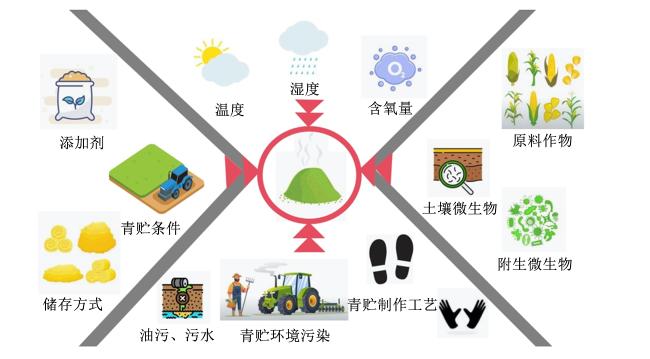
图1 影响青贮饲料气味的因素

Fig.1 Factors influencing silage odor

3 小结与展望

鉴于青贮饲料原料组成、批次、饲料制备工艺、存储条件以及牧场管理制度等因素差异,并非所有青贮饲料均具有统一的营养价值、发酵品质和应用效果。目前,青贮饲料在反刍动物饲料中的应用研究大多是关于营养价值、动物生长性能及其他非常规饲料替代传统青贮饲料经济价值等方面,而关于气味差异及对动物采食喜好等方面的研究较少。但实际畜牧养殖中时常有青贮饲料异常发酵的情况出现,其中有以下因素对影响青贮饲料气味是最重要的,包括原料特性、青贮环境条件、微生物作用及添加剂。因此,评估不同条件下挥发性化合物及理想情况下代谢物的产生,这些影响因素就显得尤为关键,特别是关于可能改变青贮气味的条件。总之,青贮饲料应谨慎遵照指导标准,使用有效的检测设备,安全清除污染物,改进不危害环境又可持续的密封方法,推动饲料资源化利用在畜牧养殖业更好地发展。
[1]
ZHANG C X, JIANG J, LI J F, et al. Long transportation duration affects nutrient composition,mycotoxins and microbial community in whole-plant corn silage[J]. Frontiers in Veterinary Science, 2023,10:1189358.

[2]
许冬梅. 不同气候区及乳酸菌影响玉米青贮发酵的微生物组与代谢组学机制研究[D]. 硕士学位论文. 兰州: 兰州大学,2021:183.

XU D M. Mechanisms of microbial and metabolome on fermentation of corn silage effected by climate zones and inoculations[D]. Master’s Thesis. Lanzhou: Lanzhou University,2021:183. (in Chinese)

[3]
AKDEMIR EVRENDILEK G, BULUT N, ATMACA B, et al. Prediction of Aspergillus parasiticus inhibition and aflatoxin mitigation in red pepper flakes treated by pulsed electric field treatment using machine learning and neural networks[J]. Food Research International, 2022, 162(Part A):111954.

[4]
GUO X S, XU D M, LI F H, et al. Current approaches on the roles of lactic acid bacteria in crop silage[J]. Microbial Biotechnology, 2023, 16(1):67-87.

[5]
HASELMANN A, WENTER M, FUERST-WALTL B, et al. Comparing the effects of silage and hay from similar parent grass forages on organic dairy cows’ feeding behavior, feed intake and performance[J]. Animal Feed Science and Technology, 2020,267:114560.

[6]
SCHERER R, GERLACH K, SÜDEKUM K H. Decision-making of goats when exposed to choice feeding: triggered by taste or smell?[J]. Applied Animal Behavior Science, 2019,210:46-51.

[7]
PROVENZA F D. Postingestive feedback as an elementary determinant of food preference and intake in ruminants[J]. Journal of Range Management, 1995, 48(1):2-17.

[8]
KRIZSAN S J, WESTAD F, ADNØY T, et al. Effect of volatile compounds in grass silage on voluntary intake by growing cattle[J]. Animal, 2007, 1(2):283-292.

DOI PMID

[9]
GERLACH K, ROSS F, WEISS K, et al. Changes in maize silage fermentation products during aerobic deterioration and effects on dry matter intake by goats[J]. Agricultural and Food Science, 2013, 22(1):168-181.

[10]
MANZOCCHI E, HENGARTNER W, KREUZER M, et al. Effect of feeding hay vs. silages of various types to dairy cows on feed intake, milk composition and coagulation properties[J]. Journal of Dairy Research, 2020, 87(3):334-340.

DOI PMID

[11]
HOWARD C J, KUMAR A, MALKINA I, et al. Reactive organic gas emissions from livestock feed contribute significantly to ozone production in central California[J]. Environmental Science & Technology, 2010, 44(7):2309-2314.

[12]
CHUNG M Y, BEENE M, ASHKAN S, et al. Evaluation of non-enteric sources of non-methane volatile organic compound (NMVOC) emissions from dairies[J]. Atmospheric Environment, 2010, 44(6):786-794.

[13]
SCHMITHAUSEN A J, TRIMBORN M, BÜSCHER W. Sources of nitrous oxide and other climate relevant gases on surface area in a dairy free stall barn with solid floor and outside slurry storage[J]. Atmospheric Environment, 2018,178:41-48.

[14]
HAFNER S D, WINDLE M, MERRILL C, et al. Effects of potassium sorbate and Lactobacillus plantarum MTD1 on production of ethanol and other volatile organic compounds in corn silage[J]. Animal Feed Science and Technology, 2015,208:79-85.

[15]
WEISS K, KROSCHEWSKI B, AUERBACH H. Effects of air exposure,temperature and additives on fermentation characteristics,yeast count,aerobic stability and volatile organic compounds in corn silage[J]. Journal of Dairy Science, 2016, 99(10):8053-8069.

[16]
MORGAN M E, PEREIRA R L. Volatile constituents of grass and corn silage.Ⅱ.Gas-entrained aroma1[J]. Journal of Dairy Science, 1962, 45(4):467-471.

[17]
SU R N, KE W C, BAI J, et al. Comprehensive profiling of the metabolome in corn silage inoculated with or without Lactiplantibacillus plantarum using different untargeted metabolomics analyses[J]. Archives of Animal Nutrition, 2023, 77(5):323-341.

[18]
XU D M, DING W R, KE W C, et al. Modulation of metabolome and bacterial community in whole crop corn silage by inoculating homofermentative Lactobacillus plantarum and heterofermentative Lactobacillus buchneri[J]. Frontiers in Microbiology, 2018,9:3299.

[19]
ELMORE J S, WARREN H E, MOTTRAM D S, et al. A comparison of the aroma volatiles and fatty acid compositions of grilled beef muscle from Aberdeen Angus and Holstein-Friesian steers fed diets based on silage or concentrates[J]. Meat Science, 2004, 68(1):27-33.

DOI PMID

[20]
HAFNER S D, MONTES F, ROTZ C A, et al. Ethanol emission from loose corn silage and exposed silage particles[J]. Atmospheric Environment, 2010, 44(34):4172-4180.

[21]
HAFNER S D, FRANCO R B, KUNG L J, et al. Potassium sorbate reduces production of ethanol and 2 esters in corn silage[J]. Journal of Dairy Science, 2014, 97(12):7870-7878.

DOI PMID

[22]
MONTES F, HAFNER S D, ROTZ C A, et al. Temperature and air velocity effects on ethanol emission from corn silage with the characteristics of an exposed silo face[J]. Atmospheric Environment, 2010, 44(16):1987-1995.

[23]
HAFNER S D, HOWARD C, MUCK R E, et al. Emission of volatile organic compounds from silage:compounds,sources,and implications[J]. Atmospheric Environment, 2013,77:827-839.

[24]
DANIEL J L P, WEIBK, CUSTÓDIO L, et al. Occurrence of volatile organic compounds in sugarcane silages[J]. Animal Feed Science and Technology, 2013, 185(1/2):101-105.

[25]
WEIB K, KALZENDORF C. Effect of wilting and silage additives on silage quality of lucerne,red clover and legume-grass mixtures[J]. Journal of Dairy and Veterinary Sciences, 2017, 1(5):55574.

[26]
WEISS K. Volatile organic compounds (VOC) in silages-effects of management factors their formation:a review[J]. Slovak Journal of Animal Science Forage Conservation, 2017, 50(1):1-61.

[27]
FIGUEIREDO R, RODRIGUES A I, DO CÉU COSTA M. Volatile composition of red clover (Trifolium pratense L.) forages in Portugal: the influence of ripening stage and ensilage[J]. Food Chemistry, 2007, 104(4):1445-1453.

[28]
BOESWETTER A R, SCHERF K A, SCHIEBERLE P, et al. Identification of the key aroma compounds in gluten-free rice bread[J]. Journal of Agricultural and Food Chemistry, 2019, 67(10):2963-2972.

DOI PMID

[29]
NOCI F, MONAHAN F J, SCOLLAN N D, et al. The fatty acid composition of muscle and adipose tissue of steers offered unwilted or wilted grass silage supplemented with sunflower oil and fish oil[J]. The British Journal of Nutrition, 2007, 97(3):502-513.

[30]
HAN L, ZHOU H. Effects of ensiling processes and antioxidants on fatty acid concentrations and compositions in corn silages[J]. Journal of Animal Science and Biotechnology, 2013, 4(1):48.

DOI PMID

[31]
GOUDA M, MA M H, SHENG L, et al. SPME-GC-MS&metal oxide E-nose 18 sensors to validate the possible interactions between bio-active terpenes and egg yolk volatiles[J]. Food Research International, 2019,120:108611.

[32]
CUFFIA F, BERGAMINI C V, WOLF I V, et al. Characterization of volatile compounds produced by Lactobacillus helveticus strains in a hard cheese model[J]. Food Science and Technology International, 2018, 24(1):67-77.

[33]
KRIZEK M. The determination of biogenic amines in silage[J]. Archives of Animal Nutrition, 1991, 41(1):97-104.

[34]
SCHERER R, GERLACH K, SÜDEKUM K H. Biogenic amines and gamma-amino butyric acid in silages:formation,occurrence and influence on dry matter intake and ruminant production[J]. Animal Feed Science and Technology, 2015,210:1-16.

[35]
ZHAO G Q, WU H, LI Y Y, et al. Fermentation characteristics and microbial community composition of wet brewer’s grains and corn stover mixed silage prepared with cellulase and lactic acid bacteria supplementation[J]. Animal Bioscience, 2024, 37(1):84-94.

[36]
KESHRI J, CHEN Y, PINTO R, et al. Microbiome dynamics during ensiling of corn with and without Lactobacillus plantarum inoculant[J]. Applied Microbiology and Biotechnology, 2018, 102(9):4025-4037.

[37]
THIERRY A, DEUTSCH S M, FALENTIN H, et al. New insights into physiology and metabolism of Propionibacterium freudenreichii[J]. International Journal of Food Microbiology, 2011, 149(1):19-27.

[38]
FENG Q X, ZHANG J, LING W Q, et al. Ensiling hybrid Pennisetum with lactic acid bacteria or organic acids improved the fermentation quality and bacterial community[J]. Frontiers in Microbiology, 2023,14:1216722.

[39]
OGUNADE I M, JIANG Y, PECH CERVANTES A A, et al. Bacterial diversity and composition of alfalfa silage as analyzed by Illumina MiSeq sequencing:effects of Escherichia coli O157:H7 and silage additives[J]. Journal of Dairy Science, 2018, 101(3):2048-2059.

[40]
QUEIROZ O C M, OGUNADE I M, WEINBERG Z, et al. Silage review: foodborne pathogens in silage and their mitigation by silage additives[J]. Journal of Dairy Science, 2018, 101(5):4132-4142.

DOI PMID

[41]
OUAMBA A J K, GAGNON M, VARIN T, et al. Phylogenetic variation in raw cow milk microbiota and the impact of forage combinations and use of silage inoculants[J]. Frontiers in Microbiology, 2023,14:1175663.

[42]
DOYLE C J, GLEESON D, JORDAN K, et al. Anaerobic sporeformers and their significance with respect to milk and dairy products[J]. International Journal of Food Microbiology, 2015,197:77-87.

[43]
KENNANG A, GAGNON M, LAPOINTE G, et al. Graduate student literature review:farm management practices:potential microbial sources that determine the microbiota of raw bovine milk[J]. Journal of Dairy Science, 2022, 105(9):7276-7287.

[44]
SUN Y, SUN Q L, TANG Y M, et al. Integrated microbiology and metabolomic analysis reveal the improvement of rice straw silage quality by inoculation of Lactobacillus brevis[J]. Biotechnology for Biofuels and Bioproducts, 2023, 16(1):184.

[45]
ABBAS B A, JABER G M. Occurrence of listeria monocytogens in raw milk of ruminants[J]. Iraqi Journal of Veterinary Sciences, 2012,26:47-51.

[46]
SCHODER D, PELZ A, PAULSEN P. Transmission scenarios of listeria monocytogenes on small ruminant on-farm dairies[J]. Foods, 2023, 12(2):265.

[47]
RODRIGUEZ C, TAMINIAU B, GARCÍA-FUENTES E, et al. Listeria monocytogenes dissemination in farming and primary production: sources,shedding and control measures[J]. Food Control, 2021,120:107540.

[48]
NUCERA D M, GRASSI M A, MORRA P, et al. Detection,identification,and typing of listeria species from baled silages fed to dairy cows[J]. Journal of Dairy Science, 2016, 99(8):6121-6133.

[49]
OUDE ELFERINCK S J, DRIEHUIS F, BECKER P M, et al. The presence of Acetobacter sp. in ensiled forage crops and ensiled industrial byproducts[J]. Mededelingen (Rijksuniversiteit te Gent. Fakulteit van de Landbouwkundige en Toegepaste Biologische Wetenschappen), 2001, 66(3b):427-430.

[50]
CARVALHO B F, ÁVILA C L S, BERNARDES T F, et al. Fermentation profile and identification of lactic acid bacteria and yeasts of rehydrated corn kernel silage[J]. Journal of Applied Microbiology, 2017, 122(3):589-600.

DOI PMID

[51]
AGARUSSI M C N, PEREIRA O G, PIMENTEL F E, et al. Microbiome of rehydrated corn and sorghum grain silages treated with microbial inoculants in different fermentation periods[J]. Scientific Reports, 2022, 12(1):16864.

DOI PMID

[52]
WAMBACQ E, VANHOUTTE I, AUDENAERT K, et al. Occurrence, prevention and remediation of toxigenic fungi and mycotoxins in silage:a review[J]. Journal of the Science of Food and Agriculture, 2016, 96(7):2284-2302.

[53]
ABDEL-NASSER A, HATHOUT A S, BADR A N, et al. Extraction and characterization of bioactive secondary metabolites from lactic acid bacteria and evaluating their antifungal and antiaflatoxigenic activity[J]. Biotechnology Reports (Amsterdam,Netherlands), 2023,38:e00799.

[54]
OGUNADE I M, MARTINEZ-TUPPIA C, QUEIROZ O C M, et al. Silage review:mycotoxins in silage:occurrence,effects,prevention,and mitigation[J]. Journal of Dairy Science, 2018, 101(5):4034-4059.

[55]
白萨茹拉. 不同粗饲料组合对泌乳奶牛消化道内与乳中脂肪酸组成的影响[D]. 博士学位论文. 北京: 中国农业大学, 2018.

BAI S R L. The effeets of different dietary forage combination on fatty acid profile in digestive tract and milk of lactating cows[D]. Ph.D.Thesis. Beijing: China Agricultural University, 2018. (in Chinese)

[56]
CHILLIARD Y, FERLAY A, DOREAU M. Effect of different types of forages,animal fat or marine oils in cow’s diet on milk fat secretion and composition,especially conjugated linoleic acid (CLA) and polyunsaturated fatty acids[J]. Livestock Production Science, 2001, 70(1/2):31-48.

[57]
王贺. 收割时间及留茬高度对东北地区全株玉米青贮品质的影响[D]. 硕士学位论文. 长春: 吉林农业大学, 2023.

WANG H. The influence of harvesting time and stubble height on the quality of whole plant corn silage in northeast China[D]. Master’s Thesis. Changchun: Jilin Agricultural University, 2023. (in Chinese)

[58]
BARBEY C R, HOGSHEAD M H, HARRISON B, et al. Genetic analysis of methyl anthranilate,mesifurane,linalool,and other flavor compounds in cultivated strawberry (Fragaria×ananassa)[J]. Frontiers in Plant Science, 2021,12:615749.

[59]
HAN T Y, WU W L, LI W L. Transcriptome analysis revealed the mechanism by which exogenous ABA increases anthocyanins in blueberry fruit during veraison[J]. Frontiers in Plant Science, 2021,12:758215.

[60]
GONG C S, DIAO W N, ZHU H J, et al. Metabolome and transcriptome integration reveals insights into flavor formation of ‘crimson’ watermelon flesh during fruit development[J]. Frontiers in Plant Science, 2021,12:629361.

[61]
ROBINSON P H, SWANEPOEL N. Impacts of a polyethylene silage pile underlay plastic with or without enhanced oxygen barrier (EOB) characteristics on preservation of whole crop maize silage, as well as a short investigation of peripheral deterioration on exposed silage faces[J]. Animal Feed Science and Technology, 2016,215:13-24.

[62]
DANNER H, HOLZER M, MAYRHUBER E, et al. Acetic acid increases stability of silage under aerobic conditions[J]. Applied and Environment Microbiology, 2003, 69(1):562-567.

[63]
GHELLER L S, GHIZZI L G, TAKIYA C S, et al. Different organic acid preparations on fermentation and microbiological profile,chemical composition,and aerobic stability of whole-plant corn silage[J]. Animal Feed Science and Technology, 2021,281:115083.

[64]
BERNARDES T F, DANIEL J L P, ADESOGAN A T, et al. Silage review:unique challenges of silages made in hot and cold regions[J]. Journal of Dairy Science, 2018, 101(5):4001-4019.

[65]
KIM S C, ADESOGAN A T. Influence of ensiling temperature,simulated rainfall, and delayed sealing on fermentation characteristics and aerobic stability of corn silage[J]. Journal of Dairy Science, 2006, 89(8):3122-3132.

[66]
GUAN H, SHUAI Y, YAN Y H, et al. Microbial community and fermentation dynamics of corn silage prepared with heat-resistant lactic acid bacteria in a hot environment[J]. Microorganisms, 2020, 8(5):719.

[67]
BORREANI G, TABACCO E, SCHMIDT R J, et al. Silage review:factors affecting dry matter and quality losses in silages[J]. Journal of Dairy Science, 2018, 101(5):3952-3979.

[68]
FENG T, WANG J. Oxidative stress tolerance and antioxidant capacity of lactic acid bacteria as probiotic: a systematic review[J]. Gut Microbes, 2020, 12(1):1801944.

[69]
ZI X J, LI M, YU D G, et al. Natural fermentation quality and bacterial community of 12 pennisetum sinese varieties in southern China[J]. Frontiers in Microbiology, 2021,12:627820.

[70]
HUANG Y, LIANG L F, DAI S, et al. Effect of different regions and ensiling periods on fermentation quality and the bacterial community of whole-plant maize silage[J]. Frontiers in Microbiology, 2021,12:743695.

[71]
GHARECHAHI J, KHARAZIAN Z A, SARIKHAN S, et al. The dynamics of the bacterial communities developed in maize silage[J]. Microbial Biotechnology, 2017, 10(6):1663-1676.

DOI PMID

[72]
CAI Y, KUMAI S, OGAWA M, et al. Characterization and identification of pediococcus species isolated from forage crops and their application for silage preparation[J]. Applied and Environment Microbiology, 1999, 65(7):2901-2906.

[73]
YANG L L, YUAN X J, LI J F, et al. Dynamics of microbial community and fermentation quality during ensiling of sterile and nonsterile alfalfa with or without Lactobacillus plantarum inoculant[J]. Bioresource Technology, 2019,275:280-287.

[74]
GUAN H, YAN Y H, LI X L, et al. Microbial communities and natural fermentation of corn silages prepared with farm bunker-silo in southwest China[J]. Bioresource Technology, 2018,265:282-290.

[75]
ZI X J, LI M, CHEN Y Y, et al. Effects of citric acid and Lactobacillus plantarum on silage quality and bacterial diversity of king grass silage[J]. Frontiers in Microbiology, 2021,12:631096.

[76]
SEPEHRI A, SARRAFZADEH M H. Activity enhancement of ammonia-oxidizing bacteria and nitrite-oxidizing bacteria in activated sludge process:metabolite reduction and CO2 mitigation intensification process[J]. Applied Water Science, 2019, 9(5):131.

[77]
RAZA W, LING N, LIU D Y, et al. Volatile organic compounds produced by Pseudomonas fluorescens WR-1 restrict the growth and virulence traits of Ralstonia solanacearum[J]. Microbiological Research, 2016,192:103-113.

[78]
RAJER F U, WU H J, XIE Y L, et al. Volatile organic compounds produced by a soil-isolate,Bacillus subtilis FA26 induce adverse ultra-structural changes to the cells of Clavibacter michiganensis ssp.sepedonicus, the causal agent of bacterial ring rot of potato[J]. Microbiology (Reading,England), 2017, 163(4):523-530.

[79]
EFFMERT U, KALDERÁS J, WARNKE R, et al. Volatile mediated interactions between bacteria and fungi in the soil[J]. Journal of Chemical Ecology, 2012, 38(6):665-703.

DOI PMID

[80]
QIAO J Q, WU H J, HUO R, et al. Stimulation of plant growth and biocontrol by Bacillus amyloliquefaciens subsp.plantarum FZB42 engineered for improved action[J]. Chemical and Biological Technologies in Agriculture, 2014, 1(1):12.

[81]
ZOU C S, LI Z F, YU D Q. Bacillus megaterium strain XTBG34 promotes plant growth by producing 2-pentylfuran[J]. Journal of Microbiology, 2010, 48(4):460-466.

[82]
ALMEIDA O A C, DE ARAUJO N O, MULATO A T N, et al. Bacterial volatile organic compounds (VOCs) promote growth and induce metabolic changes in rice[J]. Frontiers in Plant Science, 2022,13:1056082.

[83]
FINCHEIRA P, ESPINOZA J, VERA J, et al. The impact of 2-ketones released from solid lipid nanoparticles on growth modulation and antioxidant system of Lactuca sativa[J]. Plants (Basel,Swizerland), 2023, 12(17):3094.

[84]
RYU C M, FARAG M A, HU C H, et al. Bacterial volatiles promote growth in Arabidopsis[J]. Proceedings of the National Academy of Sciences of the United States of America, 2003, 100(8):4927-4932.

[85]
TAHIR H A S, GU Q, WU H J, et al. Bacillus volatiles adversely affect the physiology and ultra-structure of Ralstonia solanacearum and induce systemic resistance in tobacco against bacterial wilt[J]. Scientific Reports, 2017,7:40481.

[86]
DUNIÈRE L, SINDOU J, CHAUCHEYRAS-DURAND F, et al. Silage processing and strategies to prevent persistence of undesirable microorganisms[J]. Animal Feed Science and Technology, 2013, 182(1/4):1-15.

[87]
CARDOSO L L, RIBEIRO K G, MARCONDES M I, et al. Chemical composition and production of ethanol and other volatile organic compounds in sugarcane silage treated with chemical and microbial additives[J]. Animal Production Science, 2019, 59(4):721-728.

[88]
GOMES A L M, JACOVACI F A, BOLSON D C, et al. Effects of light wilting and heterolactic inoculant on the formation of volatile organic compounds,fermentative losses and aerobic stability of oat silage[J]. Animal Feed Science and Technology, 2019,247:194-198.

[89]
TELLER R S, SCHMIDT R J, WHITLOW L W, et al. Effect of physical damage to ears of corn before harvest and treatment with various additives on the concentration of mycotoxins,silage fermentation,and aerobic stability of corn silage[J]. Journal of Dairy Science, 2012, 95(3):1428-1436.

[90]
WEISS K. Volatile organic compounds in silages-effects of management factors on their formation:a review[J]. Slovak Journal of Animal Science, 2017, 50(1):55-67.

[91]
WEIB K, AUERBACH H. The effect of different types of chemical silages additives on dry matter losses,fermentation pattern,volatile organic compounds (VOC)and aerobic stability on maize silage[C]// Proceedings of the ⅩⅥ International Silage Conference.Hämeenlinna, Finland: MTT Agrifood Research Finland.2012:360-361.

[92]
马淑敏, 焦婷, 师尚礼, 等. 混合型乳酸菌制剂对不同品种青饲玉米青贮品质的影响[J]. 草地学报, 2022, 30(6):1558-1568.

DOI

MA S M, JIAO T, SHI S L, et al. Effects of mixed lactic acid bacteria preparation on silage quality of different green corns[J]. Acta Agrestia Sinica, 2022, 30(6):1558-1568. (in Chinese)

[93]
杨双双, 李彦飞, 段新慧, 等. 同/异质型乳酸菌配比对全株玉米青贮品质的影响[J]. 云南农业大学学报, 2023, 38(5):840-845.

YANG S S, LI Y F, DUAN X H, et al. effects of ratios of homo-/hetero-lactic acid bacteria on silage quality of whole plant corn[J]. Journal of Yunnan Agricultural University, 2023, 38(5):840-845. (in Chinese)

[94]
谢文斌, 陈娟娟, 田斌, 等. 布氏乳杆菌对玉米秸秆青贮品质和体外消化率的影响[J]. 饲料研究, 2022, 45(21):122-126.

XIE W B, CHEN J J, TIAN B, et al. Effect of Lactobacillus brucelli on quality and in vitro digestibility of corn straw silage[J]. Feed Research, 2022, 45(21):122-126. (in Chinese)

[95]
孙向丽, 菅复春, 许来鹏, 等. 布氏乳杆菌和植物乳杆菌对高粱青贮品质的影响[J]. 中国畜牧杂志, 2021, 57(9):159-163.

SUN X L, JIAN F C, XU L P, et al. Effects of Lactobacillus buchneri and Lactobacillus plantarum on the quality of silage sorghum[J]. Chinese Journal of Animal Science, 2021, 57(9):159-163. (in Chinese)

Outlines

/