RESEARCH PAPER

Effects of Dietary Addition of Tiger Nut or Tiger Nut Meal on Reproductive Performance, Serum Immune Indexes and Fecal Microbial Composition of Sows in Late Pregnancy

  • LIU Xule , 1 ,
  • HU Mingyang 1 ,
  • JING Kunpeng 1 ,
  • JIAO Xilan 2 ,
  • HU Menglin 1 ,
  • ZHU Xiaoyan 1, 3, 4 ,
  • SHI Yinghua 1, 3, 4 ,
  • LI Zhentian , 1, 3, 4, *
Expand
  • 1 College of Animal Science and Technology, Henan Agricultural University, Zhengzhou 450002, China
  • 2 College of Animal Medicine, Henan Agricultural University, Zhengzhou 450002, China
  • 3 Key Laboratory of Innovation and Utilization of Grassland Resources in Henan Province, Zhengzhou 450002, China
  • 4 Henan Engineering Research Center for Forage, Zhengzhou 450002,China
*associate professor, E-mail:

Received date: 2024-01-22

  Online published: 2024-08-12

Abstract

The aim of this experiment was to investigate the effects of dietary addition of tiger nut or tiger nut meal on reproductive performance, serum immune indexes, placental activity factors, fecal short-chain fatty acid contents and fecal microbial composition of sows in late gestation. In this experiment, 70 primiparous gestating sows with the same litter size, body condition and gestation period were selected and randomly divided into 7 groups, which were control group (CK group), 5% tiger nut addition group (5%TN group), 10% tiger nut addition group (10%TN group), 15% tiger nut addition group (15%TN group), 10% tiger nut meal addition group (10%TNM group), 15% tiger nut meal addition group (15%TNM group), and 20% tiger nut meal addition group (20%TNM group), with 10 replicates of 1 pig per group. The experiment was conducted from the 70th day of gestation to the end of farrowing. The results showed as follows: 1) compared with the control group, the length of labor was significantly shorter in the 5%TN group and 20%TNM group (P<0.05); the healthy litter rate was significantly higher in both the 10%TN group and 10%TNM group (P<0.05). 2) Compared with the control group, serum interleukin-6 (IL-6) content was significantly lower in the 10%TN group, 15%TN group, and 10% NM group (P<0.05); serum interleukin-10 (IL-10) content in the tiger nut added group, 10%TNM group and 15%TNM group was significantly higher (P<0.05); serum tumor necrosis factor-alpha (TNF-α) and exdotoxin contents were significantly lower in both tiger nut and tiger nut meal added groups (P<0.05); and serum zonulin content was significantly lower in tiger nut added groups (P<0.05). nitric oxide (NO), vascular endothelial generating factor (VEGF) contents and endothelial nitric oxide synthase (eNOS) activity were significantly elevated in the placental tissues of the tiger nut added groups (P<0.05). 3) Compared with the control group, propionic acid content in the feces of the tiger nut added group and tiger nut meal added groups (P<0.05); butyric acid content was found to be a significant component in both the 10%TN group and 10%TNM group (P<0.05). Isobutyric acid and isovaleric acid contents were significantly higher in the 10%TNM group and 20%TNM group (P<0.05). 4) At the genus level of fecal microbial composition, compared with the control group, 10% TN group of Lachnospiraceae_NK4A136_group, Parabacteroides, Megasphaera, Lachnoclostridium, and Prevotellaceae_UCG-004 group in the 10%TN group compared with the control group (P<0.05), and g_Lachnoclostridium and Prevotellaceae_UCG-004 group in the 10%TNM group (P<0.05). In conclusion, the addition of 10% tiger nut or 10% tiger nut meal to the diet can significantly improve the healthy litter rate and serum immune indexes of sows in the late gestation period; the addition of tiger nut to the diet can significantly enhance the content or activity of placental activating factor in sows; the addition of 10% of tiger nut or 10% of tiger nut meal to the diet can significantly regulate the intestinal microbial composition of sows and increase the contents of short-chain fatty acids in the intestine.

Cite this article

LIU Xule , HU Mingyang , JING Kunpeng , JIAO Xilan , HU Menglin , ZHU Xiaoyan , SHI Yinghua , LI Zhentian . Effects of Dietary Addition of Tiger Nut or Tiger Nut Meal on Reproductive Performance, Serum Immune Indexes and Fecal Microbial Composition of Sows in Late Pregnancy[J]. Chinese Journal of Animal Nutrition, 2024 , 36(8) : 4896 -4909 . DOI: 10.12418/CJAN2024.419

中国拥有世界上7%的耕地面积,生活着世界22%的人口,此外,中国的畜禽养殖量位居世界前列,畜禽养殖就意味着不仅要供给足够的粮食给人类,还要供养大量的畜禽,这便为人畜争粮埋下伏笔。伴随着养殖业的不断发展,人畜争粮的矛盾将逐渐激化,开发非粮型饲料资源有助于缓解这一矛盾。用非粮型饲料原料代替部分常规饲料原料,可补充动物所需营养素和功能成分,降低饲料成本,具有广阔的发展前景[1]。因此,研究油莎豆及其加工副产物作为生猪养殖饲料来源具有重要意义。油莎豆是一年生的莎草科植物,也叫油莎草、虎坚果等,享有地下核桃之美称[2]。油莎豆中富含油脂、蛋白质、淀粉等多种营养物质,其中油脂含量高达25%[3]。油莎豆还具有丰富的植物化学成分,比如类黄酮、有机酸、生物碱、糖苷等[4]。由于含有类黄酮,油莎豆具有出色的抗氧化特性,可用作对抗自由基的天然抗氧化剂[5]。此外,油莎豆还富含酚、钾、钙、镁、维生素C和维生素E[6]。有关于油莎豆粕的研究指出,在猪34.0~60.3 kg育肥阶段,油莎豆粕可以部分替代玉米作为能量饲料,最佳替代量为10%[7]。在猪22~60 kg育肥阶段,饲粮中添加12%和48%油莎豆粕组猪有较好的生长性能和胴体价值[8]。油莎豆满足用做优质饲料来源的条件,目前对油莎豆和油莎豆粕在妊娠猪方面应用的研究较为缺乏,为此本试验旨在探讨在妊娠猪饲粮中添加油莎豆或油莎豆粕对妊娠猪的繁殖性能、血清免疫指标、胎盘活性因子及粪便微生物组成的影响,为油莎豆和油莎豆粕在妊娠猪生产方面的应用提供参考。

1 材料与方法

1.1 试验材料

油莎豆粕为油莎豆通过冷轧工艺榨油后的副产物,油莎豆和油莎豆粕均为粉碎过3 mm筛后加入试验饲粮。油莎豆和油莎豆粕营养物质含量见表1
表1 油莎豆和油莎豆粕营养物质含量(干物质基础)

Table 1 Nutrient contents of tiger nut and tiger nut meal (DM basis) %

项目
Items
油莎豆
Tiger nut
油莎豆粕
Tiger nut meal
粗蛋白质CP 5.58 6.85
粗脂肪EE 27.23 0.91
淀粉Starch 27.20 38.20
粗纤维CF 6.56 7.34
粗灰分Ash 3.12 6.48
钙Ca 0.26 0.40
磷P 0.23 0.40
精氨酸Arg 0.89 1.64
脯氨酸Pro 0.17 0.17
亮氨酸Leu 0.26 0.26
赖氨酸Lys 0.31 0.28
蛋氨酸Met 0.04 0.05
苏氨酸Thr 0.20 0.19
色氨酸Typ 0.02 0.02

1.2 试验动物及试验设计

本试验采用单因素试验设计,试验猪品种为“长白×大白”二元初产母猪。选择胎次、体况、妊娠期一致,背膘相近的妊娠母猪70头,随机分为7组,分别为对照组(CK组)、5%油莎豆添加组(5%TN组)、10%油莎豆添加组(10%TN组)、15%油莎豆添加组(15%TN组)、10%油莎豆粕添加组(10%TNM组)、15%油莎豆粕添加组(15%TNM组)、20%油莎豆粕添加组(20%TNM组),每组10个重复,每个重复1头猪。预试期7 d,为妊娠第63~69天,正试期45 d,为妊娠第70天至分娩。基础饲粮参照猪NRC(2012)饲养标准配制,试验饲粮组成及营养水平见表2。母猪妊娠期饲养方式为单栏限饲,日给料2次,分别为每天08:00、14:30,日给料2.5 kg左右,自由饮水。
表2 试验饲粮组成及营养水平(风干基础)

Table 2 Composition and nutrient levels of experimental diets (air-dry basis) %

项目
Items
组别Groups
对照
CK
5%
TN
10%
TN
15%
TN
10%
TNM
15%
TNM
20%
TNM
原料Ingredients
玉米Corn 65.51 57.32 49.49 41.01 54.51 48.86 43.15
豆粕Soybean meal 8.70 8.48 8.43 8.10 9.12 9.33 9.48
麸皮Wheat bran 21.70 25.20 28.12 31.99 22.44 22.96 23.60
油莎豆Tiger nut 5.00 10.00 15.00
油莎豆粕Tiger nut meal 10.00 15.00 20.00
磷酸氢钙CaHPO4 1.00 0.90 0.84 0.80 0.90 0.83 0.80
食盐NaCl 0.45 0.45 0.45 0.45 0.45 0.45 0.45
石粉Limestone 1.30 1.31 1.32 1.30 1.25 1.24 1.20
赖氨酸Lys 0.18 0.17 0.16 0.15 0.15 0.15 0.14
蛋氨酸Met 0.03 0.04 0.05 0.06 0.05 0.05 0.05
苏氨酸Thr 0.13 0.13 0.14 0.14 0.13 0.13 0.13
预混料Premix1) 1.00 1.00 1.00 1.00 1.00 1.00 1.00
合计Total 100.00 100.00 100.00 100.00 100.00 100.00 100.00
营养水平Nutrient levels2)
消化能DE/(MJ/kg) 12.70 12.70 12.70 12.70 12.70 12.70 12.70
粗脂肪EE 3.67 7.13 7.88 9.92 6.60 6.08 5.62
粗蛋白质CP 13.04 13.02 13.05 13.07 13.03 13.13 13.15
粗纤维CF 4.30 4.73 5.02 5.27 5.05 5.23 5.64
中性洗涤纤维NDF 17.93 18.43 19.25 19.70 17.19 17.54 17.88
酸性洗涤纤维ADF 3.27 3.72 3.99 3.58 3.87 3.83 3.90
钙Ca 0.76 0.78 0.79 0.80 0.80 0.82 0.84
磷P 0.62 0.64 0.64 0.64 0.66 0.66 0.68
赖氨酸Lys 0.60 0.61 0.63 0.64 0.61 0.63 0.64
蛋氨酸Met 0.22 0.21 0.21 0.20 0.21 0.20 0.20
苏氨酸Thr 0.48 0.47 0.48 0.48 0.47 0.48 0.47

1)预混料为每千克饲粮提供 The premix provided the following per kg of diets:VA 11 150 IU,VB2 8.0 mg,VB120.03 mg,VD3 2 210 IU,VE 65 mg,VK 1.42 mg,生物素 biotin 0.44mg,D-泛酸 D-pantothenic acid 23.6 mg,叶酸 folic acid 1.59 mg,烟酸 niacin 44.1 mg,胆碱 choline 350 mg,Cu 20 mg,Fe 145 mg,Zn 145 mg,Mn 60.2 mg,Se 0.35 mg,I 1.26 mg。

2)消化能根据《中国饲料成分及营养价值表(2020年第31版)》计算而得,其余为实测值。DE calculated according to China Feed Composition and Nutritional Value Tables (31st Edition, 2020), while the others were measured values.

1.3 样品采集

血清样品:妊娠第107天晨饲前对所有试验猪进行耳缘静脉采血10 mL,采血管常温竖直静置1 h,4 ℃,1 006×g离心15 min,抽取上层血清分装于5 mL EP管,随即转入-80 ℃冰箱保存待用。
粪便微生物样品:妊娠第107天从每个组随机挑选4头试验猪,采集其新鲜无污染的粪便,分装于5 mL EP管内,立即放入液氮罐中暂时保存,随后转入-80 ℃冰箱保存待用。
胎盘样品:在试验母猪排出胎盘后立即采集胎盘样品,胎盘组织样本均取自距脐带1.5 cm处(避免大血管部位的胎盘),用生理盐水冲洗后立即采集约1 cm×1 cm大小组织样品,尽量保证每次采集的样品为同一位点,后分装于5 mL EP管内,立即放入液氮罐中暂时保存,随后转入-80 ℃冰箱保存待用。

1.4 测定指标及方法

1.4.1 油莎豆、油莎豆粕及饲粮营养成分

油莎豆、油莎豆粕、饲粮中粗脂肪(EE)(GB/T 6435—2006)、粗蛋白质(CP)(GB/T 6432—2008)、粗纤维(CF)(GB/T 6434—2006)、钙(Ca)(GB/T 6436—2018)、磷(P)(GB/T 6437—2018)、中性洗涤纤维(NDF)(GB/T 20806—2006)、酸性洗涤纤维(ADF)(NY/T 1459—2022)、氨基酸(AA)(GB/T 18246—2019)含量均按照国标进行测定。油莎豆、油莎豆粕中粗灰分(GB/T 6438-2007)、淀粉(GB/T 42491—2023)含量按照国标进行测定。

1.4.2 背膘厚度

分别于妊娠第70、85和110天用超声波(PIGLOG105,SFAK-Technology,A型扫描仪,丹麦)测量母猪P2点背膘厚度。

1.4.3 母猪繁殖性能

以重复为单位,在母猪分娩完成后统计窝总产仔数、窝产活仔数、窝产健仔数、窝产死胎数、仔猪出生个体重、仔猪出生窝重,并记录母猪产程(从第1头仔猪出生到胎衣完全排出的总时长)、胎盘重(母猪分娩结束后排出全部胎盘的总质量)。健仔率、死胎率计算公式如下:
健仔率(%)=100×窝产健仔数(出生重≥1 kg)/窝总产仔数;
死胎率(%)=100×产死胎数/窝总产仔数。

1.4.4 血清免疫指标和胎盘活性因子

血清免疫指标:白细胞介素-1β(IL-1β)、白细胞介素-2(IL-2)、白细胞介素-6(IL-6)、白细胞介素-10(IL-10)、肿瘤坏死因子-α(TNF-α)、连蛋白和内毒素。以上指标的含量均使用上海酶联生物科技有限公司试剂盒进行检测,具体步骤按照试剂盒说明书进行。
胎盘活性因子:首先切割分解胎盘样本,取样称重,加入一定量磷酸盐缓冲液(PBS),用液氮迅速冷冻保存;标本融化后保持2~8 ℃,加入一定量PBS,用匀浆器将标本匀浆充分;1 000×g匀浆离心20 min,收集上清,进行蛋白质定量检测。上清中一氧化氮(NO)、胰岛素样生长因子-1(IGF-1)、内皮型一氧化氮合酶(eNOS)、血管内皮生成因子(VEGF)的含量或活性均使用上海酶联生物科技有限公司试剂盒进行检测,具体步骤按照试剂盒说明书进行。

1.4.5 粪便短链脂肪酸(SCFAs)含量

采用气相色谱-质谱联用仪(GC-MS)测定母猪粪便中SCFAs含量。

1.4.6 粪便微生物测序流程及数据分析

基于Illumina MiSeq平台,对采集的粪便样品16S rRNA的V3~V4区域进行高通量测序。通过对所得原始测序序列进行过滤、双端拼接,得到优化序列,再将其进行聚类,划分操作分类单元(OTU),利用美吉生物云平台进行物种Alpha多样性和微生物组成分析。

1.5 数据处理及统计分析

试验数据用Excel 2019记录整理,分析前对所有数据进行正态性和同质性测试。通过SPSS 26.0统计软件对各项指标进行单因素方差分析(one-way ANOVA),Duncan氏法进行多重比较,显著水平为P<0.05,试验结果均用“平均值±标准差”表示。

2 结果

2.1 饲粮中添加油莎豆或油莎豆粕对妊娠后期母猪背膘厚度的影响

表3可知,通过在试验猪妊娠第70、85和100天的时候测定猪的背膘厚度发现妊娠后期母猪饲粮中添加油莎豆或油莎豆粕对母猪背膘厚度并无显著影响(P>0.05)。
表3 饲粮中添加油莎豆或油莎豆粕对妊娠后期母猪背膘厚度的影响

Table 3 Effects of adding tiger nut or tiger nut meal to diets on backfat thickness in late pregnancy sows mm

项目
Items
组别Groups
对照
CK
5%
TN
10%
TN
15%
TN
10%
TNM
15%
TNM
20%
TNM
妊娠第70天
Day 70 in gestation
21.8±3.0 21.6±2.5 21.4±2.1 22.0±3.7 21.4±4.0 21.4±2.6 21.6±2.1
妊娠第85天
Day 85 in gestation
18.4±1.5 20.4±0.5 19.6±1.5 20.2±3.6 19.2±3.1 19.2±1.9 18.4±1.1
妊娠第100天
Day 100 in gestation
18.6±1.3 18.6±2.1 19.8±1.9 19.2±2.6 19.4±1.9 19.8±1.8 18.8±1.3

同行数据肩标不同小写字母表示差异显著(P<0.05),相同或无字母表示差异不显著(P>0.05)。下表同。

In the same row, values with different small letter superscripts mean significant difference(P<0.05), while with the same or no letter superscripts mean no significant difference(P>0.05). The same as below.

2.2 饲粮中添加油莎豆或油莎豆粕对妊娠后期母猪繁殖性能的影响

表4可知,与对照组相比,5%TN组和20%TNM组的产程显著缩短(P<0.05);10%TN组的窝产健仔数和健仔率显著提高(P<0.05);10%TNM组的健仔率显著提高(P<0.05)。
表4 饲粮中添加油莎豆或油莎豆粕对妊娠后期母猪繁殖性能的影响

Table 4 Effects of adding tiger nut or tiger nut meal to diets on reproductive performance in late pregnancy sows

项目
Items
组别Groups
对照
CK
5%
TN
10%
TN
15%
TN
10%
TNM
15%
TNM
20%
TNM
窝总产仔数
Total litter size/头
16.33
±1.53
16.57
±1.53
16.62
±1.53
16.67
±2.08
16.40
±2.56
16.35
±1.00
15.67
±2.08
窝产活仔数
Number of live litter born/头
15.33
±2.31
16.03
±1.53
16.10
±1.73
16.00
±2.00
15.43
±2.31
15.33
±1.53
14.33
±1.53
窝产健仔数
Healthy litter size/头
12.33
±1.53a
14.33
±1.00ab
15.01
±1.00b
13.02
±1.00a
14.67
±2.08ab
13.67
±0.58ab
12.40
±1.00a
仔猪平均出生重
Average piglet birth weight/kg
1.33
±0.17
1.34
±0.08
1.38
±0.17
1.35
±0.06
1.36
±0.04
1.34
±0.15
1.33
±0.07
健仔率
Healthy litter rate/%
75.16
±7.42a
86.21
±12.14ab
93.54
±6.36b
78.92
±4.25ab
92.14
±2.68b
87.47
±10.01ab
83.62
±8.33ab
死胎率
Stillbirth rate/%
7.51
±0.71
3.20
±0.34
2.61
±0.33
4.20
±0.42
6.03
±0.40
5.10
±0.36
7.02
±0.46
胎盘重
Placental weight/kg
3.42
±1.53
4.03
±1.08
4.90
±0.98
3.57
±0.75
3.62
±1.22
3.57
±1.32
2.77
±0.49
产程
Length of labor/min
230.0
±36.1b
163.3
±42.9a
183.7
±31.0ab
190.7
±23.0ab
200.0
±18.7ab
185.7
±14.4ab
154.7
±43.0a

2.3 饲粮中添加油莎豆或油莎豆粕对妊娠后期母猪血清免疫指标的影响

表5可知,与对照组相比,10%TN组和20%TNM组血清IL-1β含量显著降低(P<0.05);10%TN组、15%TN组和10%TNM组的血清IL-6含量显著降低(P<0.05);5%TN组、10%TN组、15%TN组、10%TNM组和15%TNM组的血清IL-10含量显著升高(P<0.05);5%TN组、10%TN组、15%TN组、10%TNM组、15%TNM组和20%TNM组血清TNF-α和内毒素含量均显著降低(P<0.05);5%TN组、10%TN组和15%TN组的血清连蛋白含量显著降低(P<0.05)。
表5 饲粮中添加油莎豆或油莎豆粕对妊娠后期母猪血清免疫指标的影响

Table 5 Effects of adding tiger nut or tiger nut meal to diets on serum immune indexes in late pregnancy sows

项目
Items
组别Groups
对照
CK
5%
TN
10%
TN
15%
TN
10%
TNM
15%
TNM
20%
TNM
白细胞介素-1β
IL-1β/(pg/mL)
519.9
±26.2c
475.8
±36.2bc
446.2
±84.0ab
478.7
±31.5bc
506.5
±44.9bc
507.6
±25.3bc
411.7
±35.9a
白细胞介素-2
IL-2/(pg/mL)
220.9
±44.0ab
241.4
±40.7b
241.4
±40.7b
227.1
±16.8ab
227.1
±16.8b
225.7
±35.2ab
167.6
±40.1a
白细胞介素-6
IL-6/(pg/mL)
462.9
±64.8d
404.6
±21.7abcd
357.9
±23.5ab
386.4
±45.6abc
332.9
±23.1a
426.6
±54.5bcd
446.0
±62.2cd
白细胞介素-10
IL-10/(pg/mL)
84.2
±6.6a
102.3
±13.1bc
118.3
±8.5c
140.4
±9.3d
104.2
±12.3c
144.4
±10.8d
87.2
±16.1ab
肿瘤坏死因子-α
TNF-α/(pg/mL)
167.2
±13.2f
120.2
±9.5de
111.5
±4.2cd
103.8
±9.2bc
133.1
±6.2e
84.1
±11.1a
93.1
±12.2ab
连蛋白
Zonulin/(ng/mL)
113.2
±10.9cd
79.8
±17.6ab
88.7
±4.4ab
67.2
±6.5a
100.6
±22.1bc
120.7
±21.5d
114.3
±16.5cd
内毒素
Exdotoxin/(EU/mL)
56.4
±6.2d
28.6
±3.3a
28.9
±4.4a
38.1
±5.2b
42.3
±6.6bc
45.8
±4.1c
47.5
±5.5c

2.4 饲粮中添加油莎豆或油莎豆粕对妊娠后期母猪胎盘活性因子的影响

表6可知,与对照组相比,5%TN组、10%TN组和15%TN组的胎盘NO、VEGF含量和eNOS活性均显著提升(P<0.05);10%TN组和15%TN组的胎盘IGF-1含量显著升高(P<0.05)。
表6 饲粮中添加油莎豆或油莎豆粕对妊娠后期母猪胎盘活性因子的影响

Table 6 Effects of adding tiger nut or tiger nut meal to diets on placental activity factors in late pregnancy sows

项目
Items
组别Groups
对照
CK
5%
TN
10%
TN
15%
TN
10%
TNM
15%
TNM
20%
TNM
一氧化氮
NO/(μmol/L)
112.6
±14.0a
166.6
±12.1b
161.9
±14.0b
154.9
±16.7b
123.9
±14.8a
129.9
±8.2a
109.2
±17.0a
血管内皮生成因子
VEGF/(pg/mL)
165.6
±16.2ab
203.9
±14.5c
219.3
±18.9c
248.1
±12.5d
172.8
±22.4b
151.4
±13.6ab
157.1
±8.9ab
胰岛素样生长因子-1
IGF-1/(ng/mL)
154.3
±9.4ab
162.7
±11.8b
204.8
±16.8c
193.1
±13.1c
150.6
±14.4ab
144.6
±9.9ab
154.7
±18.2ab
内皮型一氧化氮合酶
eNOS/(U/mL)
32.7
±4.0ab
42.9
±7.0c
49.9
±2.7c
42.9
±5.4c
34.9
±4.5b
28.3
±4.6ab
27.8
±2.7ab

2.5 饲粮中添加油莎豆或油莎豆粕对妊娠后期母猪粪便SCFAs含量的影响

表7可知,与对照组相比,10%TN组粪便中的乙酸含量显著升高(P<0.05);油莎豆添加组或油莎豆粕添加组粪便中的丙酸含量显著升高(P<0.05);10%TN组和10%TNM组粪便中的丁酸含量显著升高(P<0.05);5%TN组、10%TN组、10%TNM组和20%TNM组粪便中的异丁酸含量显著升高(P<0.05);10%TNM组和20%TNM组粪便中的异戊酸含量显著升高(P<0.05)。
表7 饲粮中添加油莎豆或油莎豆粕对妊娠后期母猪粪便短链脂肪酸含量的影响

Table 7 Effects of adding tiger nut or tiger nut meal to diets on fecal short-chain fatty acids contents in late pregnancy sows mg/kg

项目
Items
组别Groups
对照
CK
5%
TN
10%
TN
15%
TN
10%
TNM
15%
TNM
20%
TNM
乙酸Acetic acid 2 744.5
±553.6a
3 379.2
±310.0ab
3 737.3
±305.1b
2 700.1
±385.0a
3 257.1
±619.0ab
2 540.8
±229.1a
3 239.0
±591.4ab
丙酸Propionic acid 782.1
±166.3a
1 787.3
±244.8d
2 091.2
±137.0d
1 313.9
±241.3b
1 743.1
±353.1d
1 573.4
±251.0cd
1 681.7
±158.7cd
丁酸Butyric acid 548.8
±123.1a
816.0
±167.0ab
1 304.1
±202.9c
626.3
±195.5a
1 036.6
±180.6bc
684.0
±135.4a
795.6
±125.5ab
戊酸Valeric acid 192.9
±22.5
171.2
±29.1
183.9
±63.4
146.2
±4.4
205.7
±72.9
144.0
±31.0
205.0
±52.9
异丁酸Isobutyric acid 121.2
±3.9a
184.1
±14.6bc
189.9
±30.4bc
167.0
±37.9ab
221.4
±35.0c
161.7
±14.0ab
220.4
±37.0c
异戊酸Isovaleric acid 139.4
±5.9a
226.7
±45.9abc
229.8
±48.7abc
198.1
±32.1ab
263.3
±19.8bc
215.5
±15.3abc
295.9
±55.3c

2.6 饲粮中添加油莎豆或油莎豆粕对妊娠后期母猪肠道微生物组成的影响

2.6.1 肠道微生物Alpha多样性

表8可知,与对照组相比,10%TN组和10%TNM组的Ace指数、Chao指数和Sobs指数均显著升高(P<0.05);10%TN组的Shannon指数显著升高(P<0.05)。
表8 肠道微生物Alpha多样性

Table 8 Alpha diversity of gut microbe

项目
Items
组别Groups
对照CK 10%TN 10%TNM
Ace指数Ace index 1 239.41±61.06a 1 639.12±164.26c 1 458.50±98.33b
Chao指数Chao index 1 206.63±52.28a 1 550.17±162.70c 1 387.11±96.51b
香农指数Shannon index 4.68±0.09a 4.94±0.17b 4.78±0.13ab
辛普森指数Simpson index 0.026±0.002 0.036±0.015 0.025±0.003
Sobs指数Sobs index 1 005.75±51.51a 1 317.60±58.02c 1 170.20±61.82b
覆盖度Coverage 0.993 9±0.002 3 0.991 9±0.000 6 0.992 2±0.002 0

2.6.2 肠道微生物Beta多样性

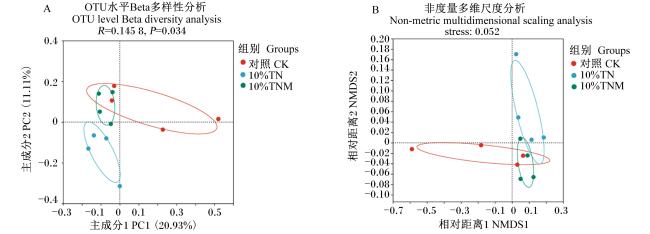
图1-A所示,在主成分1贡献率为20.93%、主成分2贡献率为11.11%时,3组样本之间分布较远,R=0.145 8>0,P=0.034,说明对照组、10%TN组和10%TNM组间存在显著差异(P<0.05)。如图1-B所示,对对照组、10%TN组和10%TNM组样本进行非度量多维尺度分析(NMDS),得出stress=0.052<0.1,说明此次Beta多样性分析具有一定可靠性和代表性。
图1 肠道微生物Beta多样性

Fig.1 Beta diversity of gut microbe

2.6.3 门水平上微生物组成

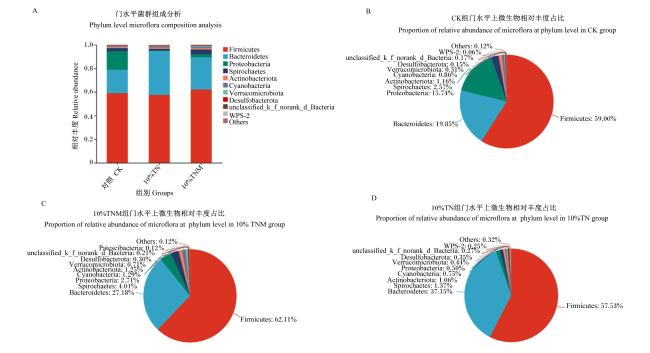
图2所示,对照组样本中门水平微生物相对丰度由大到小依次为厚壁菌门(59.00%)、拟杆菌门(19.85%)、变形菌门(15.74%)和螺旋菌门(2.57%);10%TN组样本中门水平微生物相对丰度由大到小依次为厚壁菌门(57.53%)、拟杆菌门(37.15%)、螺旋菌门(1.37%)和放线菌门(1.06%);10%TNM组样本中门水平微生物相对丰度由大到小依次为厚壁菌门(62.11%)、拟杆菌门(27.18%)、螺旋菌门(4.01%)和变形菌门(2.71%)。与对照组相比,10%TN组和10%TNM组在门水平上微生物组成无显著差异(P>0.05)。
图2 门水平微生物组成

Firmicutes:厚壁菌门;Bacteroidetes:拟杆菌门;Spirochaetes:螺旋菌门;Cyanobacteria:蓝藻门;Proteobacteria:变形菌门;Actinobacteriota:放线菌门;Verrucomicrobiota:疣微菌门;Desulfobacterota:脱硫杆菌门;unclassified_k_f_norank_d_Bacteria:未分类细菌门;Others:其他。

Fig.2 Composition of microflora at phylum level

2.6.4 属水平上微生物组成

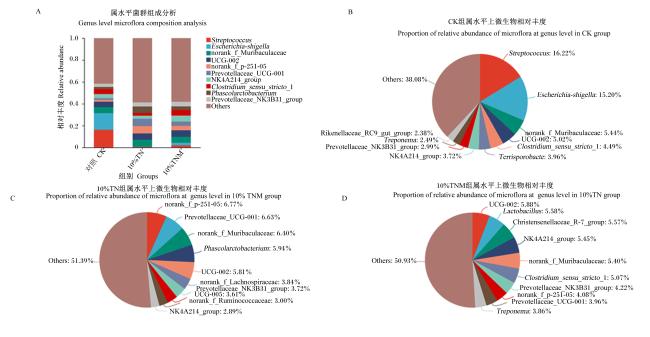
图3所示,在属水平上,CK组相对丰度占比前5位的菌属分别为链球菌属(Streptococcus)(16.22%)、埃希氏-志贺氏菌属(Escherichia-shigella)(15.20%)、norank_f_Muribaculaceae(5.44%)、UCG-002(5.02%)、狭义梭菌属1(Clostridium_sensu_stricto_1)(4.49%);10%TN组相对丰度占比前5位的菌属分别为norank_f_p-251-05(6.77%)、普雷沃氏菌科UCG-001(Prevotellaceae_UCG-001)(6.63%)、norank_f_Muribaculaceae(6.40%)、考拉杆菌属(Phascolarctobacterium)(5.94%)、UCG-002(5.81%);10%TNM组相对丰度占比前5位的菌属分别为UCG-002(5.88%)、乳杆菌属(Lactobacillus)(5.58%)、克里斯滕森菌科R-7群(Christensenellaceae_R-7_group)(5.57%)、NK4A214群(NK4A214_group)(5.45%)、norank_f_Muribaculaceae(5.40%)。
图3 属水平微生物组成

Streptococcus:链球菌属; Escherichia-shigella:埃希氏-志贺氏菌属;Clostridium_sensu_stricto_1:狭义梭菌属1; Terrisporobacte:土孢杆菌属; Prevotellaceae_NK3B31_group:普雷沃氏菌科NK3B31群;Treponema:密螺旋体菌属;Rikenellaceae_RC9_gut_group:理研菌科RC9肠道群;Prevotellaceae_UCG-001:普雷沃氏菌科UCG-001;Phascolarctobacterium:考拉杆菌属;norank_f_Lachnospiraceae:未分类毛螺菌科;norank_f_Ruminococcaceae:未分类瘤胃球菌科;Lactobacillus:乳杆菌属;Christensenellaceae_R-7_group:克里斯滕森菌科R-7群;Prevotellaceae_NK3B31_group: 普雷沃氏菌科NK3B31群;Others:其他。

Fig.3 Composition of microflora at genus level

2.6.5 属水平差异微生物分析

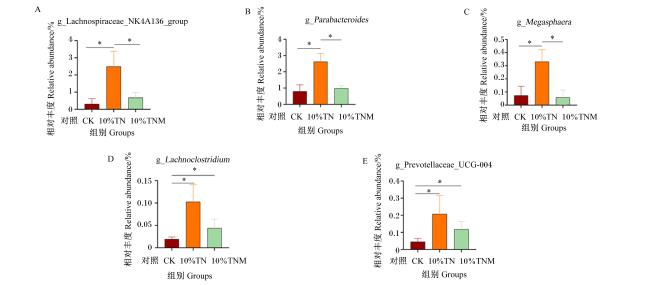
图4所示,与对照组相比,10%TN组毛螺菌科NK4A136群、狄氏副拟杆菌属、巨球型菌属、g_Lachnoclostridium、普雷沃氏菌科UCG-004相对丰度显著升高(P<0.05);10%TNM组g_Lachnoclostridium、普雷沃氏菌科UCG-004相对丰度显著升高(P<0.05)。
图4 属水平差异微生物

g_Lachnospiraceae_NK4A136_group:毛螺菌科NK4A136群;g_Parabacteroides:狄氏副拟杆菌属;g_Megasphaera:巨球型菌属;g_Prevotellaceae_UCG-004:普雷沃氏菌科UCG-004属。

*表示两组间差异显著(P<0.05)。* indicated significant difference between the two groups (P<0.05).

Fig.4 Differential microflora at genus level

3 讨论

3.1 饲粮中添加油莎豆或油莎豆粕对妊娠后期母猪繁殖性能的影响

影响母猪繁殖性能的营养因素有蛋白质、氨基酸、维生素、粗纤维、矿物质、添加剂等。现代母猪在产奶过程中需要大量的代谢营养素来满足高窝产仔数的需求[9],因此营养素摄入不足将导致其泌乳期身体储备的调动[10]。低出生体重是哺乳动物胚胎/胎儿或其器官在怀孕期间生长发育受损的现象[11]。油莎豆中富含精氨酸、脯氨酸、苏氨酸、亮氨酸等氨基酸。L-精氨酸具有特殊意义,因为除了蛋白质合成代谢外,它还是一氧化氮(NO)的主要前体,NO是一种非肾上腺素能和非胆碱能神经递质,具有强大的血管扩张作用[12]。脯氨酸不仅是蛋白质的组成部分,还是动物内源合成精氨酸、谷氨酸和多胺的含氮底物,同时具有促进血管生成的作用[13]。Liu等[14]的研究表明,脯氨酸可以通过增强胎盘营养转运、血管生成和蛋白质合成在一定程度上改善胎盘发育和提高胎儿存活率。亮氨酸具有调节蛋白质合成和促进生长的作用。在母猪妊娠后期,饲粮中添加0.80%亮氨酸可以提高仔猪的出生体重[15]。研究还发现,母猪在怀孕后期对苏氨酸的需求量是怀孕前期的2倍[16]。在本研究中,10%TN组的窝产健仔数和健仔率显著提高;10%TNM组的健仔率显著提高,可能与油莎豆中富含的精氨酸、脯氨酸、苏氨酸与亮氨酸有关,从而提高了妊娠母猪的健仔数与健仔率。过去几年实现的母猪高繁殖性能也增加了分娩时长和难产的发生率[17-18],长时间分娩还会增加胎儿缺氧导致死产和低活力新生仔猪的风险[19-20]。王剑锌[21]通过在母猪饲粮中添加参麦渣,提高母猪的抗氧化能力,从而缩短母猪的产程。丁亚南等[22]的研究发现,在怀孕母猪的饲粮中添加γ-氨基丁酸可以提高母猪的抗氧化能力,确保怀孕和分娩过程正常进行。在本试验中,由于油莎豆含有类黄酮成分,因此具有出色的抗氧化特性,可用作对抗自由基的天然抗氧化剂[5],因此,5%TN组和20%TNM组的母猪产程显著缩短可能与母猪的机体抗氧化性能有所改善有关。

3.2 饲粮中添加油莎豆或油莎豆粕对妊娠后期母猪血清免疫指标的影响

Yadav等[23]研究指出,豆甾醇降低了瑞士白化小鼠大脑皮层的TNF-α水平。油莎豆水乙醇提取物对醋酸铅诱导的睾丸毒性具有抗炎和抗凋亡作用[24]。黄酮类化合物可以通过调节Th1/Th2细胞来抑制过敏性疾病[25]。许多植物来源的生物活性化合物,主要是类黄酮,可以通过降低几种细胞因子(IL-6、IL-1β和TNF-α)的水平或以其他方式抑制其关键介质(如前列腺素、同工酶和活性氧)来抑制炎症[26]。在本研究中,油莎豆添加组和油莎豆粕添加组母猪血清IL-1β、IL-6、TNF-α、内毒素、连蛋白含量均出现了不同程度的降低,而IL-10含量均出现了不同程度的升高,这表明妊娠后期母猪饲粮中添加油莎豆或油莎豆粕可以显著提升妊娠猪的免疫性能,提升妊娠猪的机体健康程度。

3.3 饲粮中添加油莎豆或油莎豆粕对妊娠后期母猪胎盘活性因子的影响

胎盘必须有效地将氧气和营养物质从母体转移到胎儿,以维持正常的胎儿生长,胎盘中的血管在母胎物质交换中起着重要作用[27],Hu等[28]的研究揭示了低出生体重胎盘的血管生成异常,这意味着改善胎盘中的血管生成可能会减少宫内生长受限(IUGR)的发生。VEGF是参与许多组织血管发育的重要成分,在妊娠第80和105天时观察到VEGF与胎儿体重呈正相关[29]。IGF-1是与胰岛素原具有结构同源性的多肽,在调节胎儿和胎盘生长中十分重要[30]。在猪生产上,用猪生长激素治疗会增加母体IGF-1含量,并且似乎主要作用在弱小仔猪生长上,因此IGF-1对弱小仔猪似乎具有“挽救”作用,因为它会选择性地增加那些有风险的弱小仔猪的存活机会[31]。Ahmed等[32]的研究表明,VEGF、IGF-1和eNOS的相互作用诱导分支血管生成。在本研究中,与对照组相比,5%TN组、10%TN组和15%TN组的胎盘NO、VEGF含量和eNOS活性均显著提升;10%TN组和15%TN组的胎盘IGF-1含量显著升高。这说明妊娠母猪饲粮中添加油莎豆有益于胎盘活性因子的产生和仔猪的生长发育。

3.4 饲粮中添加油莎豆或油莎豆粕对妊娠后期母猪粪便SCFAs含量的影响

微生物群的一个重要功能是将膳食纤维降解为SCFAs,这些SCFAs影响宿主的肠道微生物生态学、生理学和整体健康[33]。除了为结肠提供能量外,SCFAs还可以降低pH并抑制有害细菌的过度生长[34]。此外,SCFAs可以通过抑制组蛋白脱乙酰酶(HDAC)的活性和激活G蛋白偶联受体41(GPR41)和G蛋白偶联受体43(GPR43)等来调节炎症过程。同时,某些细胞因子的产生,如IL-12、IL-6和IL-10、TNF-α在SCFAs的作用下减少[35]。在本研究中,油莎豆添加组和油莎豆粕添加组粪便SCFAs含量均出现了不同程度的提高,这可能与肠道中有益菌毛螺菌科NK4A136群、狄氏副拟杆菌属、g_Lachnoclostridium、普沃氏菌科UCG-004等SCFAs产生菌的显著富集有关,同时也说明在妊娠后期母猪饲粮中添加油莎豆和油莎豆粕可以显著提高其肠道中的SCFAs含量。

3.5 饲粮中添加油莎豆或油莎豆粕对妊娠后期母猪肠道微生物组成的影响

肠道菌群组成受发育阶段、动物生理状态以及各种环境因素的影响,如营养成分、病原体感染、抗生素应用等[36]。有研究指出,妊娠猪肠道微生物群在怀孕和哺乳期间发生了显著的变化[37-38],可能分别通过胎盘或母乳传递给发育中的胎儿或新生仔猪[39-40]。Alpha多样性分析主要通过多个多样性指数来评估环境样本中微生物的丰富度和多样性等信息,并通过组间差异检验探究如对照组和处理组Alpha多样性指数的差异性。在本研究中,10%TN组和10%TNM组的Ace指数、Chao指数和Sobs指数均显著升高;10%TN组的香农指数显著升高。这说明饲粮中添加10%油莎豆和10%油莎豆粕可以显著提升妊娠猪肠道微生物的丰富度和多样性。
毛螺菌科NK4A136群是一种潜在的益生菌,可能与增强肠道屏障的完整性有关,也是一种有效的产生丁酸盐的细菌[41]。Chen等[42]研究指出,毛螺菌科NK4A136群可以改善人类和动物的肠道炎症,还是SCFAs的主要产生者。狄氏副拟杆菌属的主要产物是有益的乙酸和琥珀酸,它们参与改善肥胖、代谢功能障碍、癌症和神经病变疾病[43-44],出于这个原因,狄氏副拟杆菌属被接受为有益细菌。在Anguita等[45]的研究中,埃氏巨球型菌属(Megasphaera elsdenii)利用L-和D-乳酸并产生SCFAs。Lachnoclostridium与结直肠癌(CRC)风险降低显著相关[46],Lachnoclostridium是产生SCFAs的属,它为有益菌的生长维持有利和稳定的结肠环境,同时抑制肠道中有害细菌的生长[47-48]。普雷沃氏菌科UCG-004可以发酵碳水化合物并产生包括乙酸盐和丁酸盐在内的SCFAs。丁酸盐代谢过程与“戊糖和葡萄糖醛酸”的相互转化以及通过脱氢酶的“抗坏血酸和醛酸代谢”有关[49-50]。Ye等[51]的研究指出,阿勒泰羊空肠与结肠中的普雷沃氏菌科UCG-004相对丰度与IL-10含量存在显著的正相关关系,表明肠道微生物和宿主免疫系统之间存在潜在的相互作用。在本研究中,与对照组相比,10%TN组毛螺菌科NK4A136群、狄氏副拟杆菌属、巨球型菌属、g_Lachnoclostridium、普雷沃氏菌科UCG-004等有益菌相对丰度的显著升高;10%TNM组g_Lachnoclostridium和普雷沃氏菌科UCG-004相对丰度显著升高,表明饲粮中添加10%油莎豆或10%油莎豆粕可以显著调控妊娠猪肠道微生物组成,增加肠道中SCFAs含量。

4 结论

① 饲粮中添加10%油莎豆或10%油莎豆粕可以显著提升妊娠后期母猪的健仔率和血清免疫指标。
② 饲粮中添加油莎豆可以显著提升母猪胎盘活性因子的含量或活性。
③ 饲粮中添加10%油莎豆或10%油莎豆粕可以调控母猪肠道微生物组成,增加肠道中SCFAs含量。
[1]
孙德林, 王凤来, 王泽程. 猪用非粮型饲料原料的开发与利用[J]. 猪业科学, 2019, 36(7):6.

SUN D L, WANG F L, WANG Z C. Development and utilization of non grain feed materials for pigs development and utilization of non grain feed materials for pigs[J]. Swine Industry Science, 2019, 36(7):6. (in Chinese)

[2]
王瑞元, 王晓松, 相海. 一种多用途的新兴油料作物——油莎豆[J]. 中国油脂, 2019, 44(1):1-4.

WANG R Y, WANG X S, XIANG H. A multi-purpose novel oil crop-Cyperus beans[J]. China Oils and Fats, 2019, 44(1):1-4. (in Chinese)

[3]
杨帆, 朱文学. 油莎豆研究现状及展望[J]. 粮食与油脂, 2020, 33(7):4-6.

YANG F, ZHU W X. Research status and prospect of Cyperus esculentus[J]. Cereals & Oils, 2020, 33(7):4-6. (in Chinese)

[4]
METSÄMUURONEN S, SIRÉN H. Bioactive phenolic compounds,metabolism and properties:a review on valuable chemical compounds in Scots pine and Norway spruce[J]. Phytochemistry Reviews, 2019, 18(3):623-664.

[5]
SAMUEL P O, EDO G I, EMAKPOR O L, et al. Lifestyle modifications for preventing and managing cardiovascular diseases[J]. Sport Sciences for Health, 2024, 20(1):23-36.

[6]
EDO G I, ONOHARIGHO F O, JIKAH A N, et al. Cyperus esculentus (tiger nut):an insight into its bioactive compounds,biological activities,nutritional and health benefits[J]. Food Chemistry Advances, 2023,3:100511.

[7]
师煌伟, 王力, 王璐, 等. 油莎豆粕的营养价值及其替代部分玉米对生长猪的饲喂效果研究[J]. 中国畜牧杂志, 2022, 58(1):178-182.

SHI H W, WANG L, WANG L, et al. Nutritional value of Cyperus esculentus meal and the effect of its different replacement levels with corn on growing pigs[J]. Chinese Journal of Animal Science, 2022, 58(1):178-182. (in Chinese)

[8]
UKPABI U H, MBACHU C L, IGBOEGWU C M. Growth performance, carcass and organ characteristics of grower pigs fed varying levels of tigernut (Cyperus esculentus) seed meal[J]. Nigerian Journal of Animal Science, 2019, 21(1):214-221.

[9]
ZHOU P, NUNTAPAITOON M, PEDERSEN T F, et al. Effects of mono-component xylanase supplementation on nutrient digestibility and performance of lactating sows fed a coarsely ground diet[J]. Journal of Animal Science, 2018, 96(1):181-193.

DOI PMID

[10]
KIM S W, BRANDHERM M, FREELAND M, et al. Effects of yeast culture supplementation to gestation and lactation diets on growth of nursing piglets[J]. Asian-Australasian Journal of Animal Sciences, 2008, 21(7):1011-1014.

[11]
WU G, BAZER F W, WALLACE J M, et al. Board-invited review:intrauterine growth retardation:implications for the animal sciences[J]. Journal of Animal Science, 2006, 84(9):2316-2337.

[12]
AKPOGHELIE P O, EDO G I, AKHAYERE E. Proximate and nutritional composition of beer produced from malted sorghum blended with yellow cassava[J]. Biocatalysis and Agricultural Biotechnology, 2022,45:102535.

[13]
WEBB A J, PATEL N, LOUKOGEORGAKIS S, et al. Acute blood pressure lowering,vasoprotective,and antiplatelet properties of dietary nitrate via bioconversion to nitrite[J]. Hypertension, 2008, 51(3):784-790.

[14]
LIU N, DAI Z L, ZHANG Y C, et al. Maternal L-proline supplementation enhances fetal survival,placental development,and nutrient transport in mice[J]. Biology of Reproduction, 2019, 100(4):1073-1081.

[15]
王超先. 亮氨酸对妊娠后期胎猪蛋白质沉积的影响及机理研究[D]. 博士学位论文. 广州: 华南农业大学,2018:57.

WANG C X. Studies on the effects of dietary leucine on protein deposition in fetal pigs at late gestation and its mechanism[D]. Ph.D.Thesis. Guangzhou: South China Agricultural University,2018:57. (in Chinese)

[16]
LEVESQUE C L, MOEHN S, PENCHARZ P B, et al. The threonine requirement of sows increases in late gestation[J]. Journal of Animal Science, 2011, 89(1):93-102.

DOI PMID

[17]
BJÖRKMAN S, GRAHOFER A. Tools and protocols for managing hyperprolific sows at parturition:optimizing piglet survival and sows’ reproductive health[M]//ARAL F,PAYAN-CARREIRA R,QUARESMAM. Animal reproduction in veterinary medicine. Rijeka:IntechOpen,2020:91337.

[18]
OLIVIERO C, JUNNIKKALA S, PELTONIEMI O. The challenge of large litters on the immune system of the sow and the piglets[J]. Reproduction in Domestic Animals, 2019,54 (Suppl.3):12-21.

[19]
PELTONIEMI O, OLIVIERO C, YUN J, et al. Management practices to optimize the parturition process in the hyperprolific sow[J]. Journal of Animal Science, 2020, 98(Suppl.1):S96-S106.

[20]
BORGES V F, BERNARDI M L, BORTOLOZZO F P, et al. Risk factors for stillbirth and foetal mummification in four Brazilian swine herds[J]. Preventive Veterinary Medicine, 2005, 70(3/4):165-176.

[21]
王剑锌. 参麦渣对围产期母猪及哺乳仔猪的保健作用[D]. 硕士学位论文. 福州: 福建农林大学, 2017.

WANG J X. The health functions of dregs of red ginseng and radio optogonis in permanent soils and sinking pigs[D]. Master’s Thesis. Fuzhou: Fujian Agriculture and Forestry University, 2017. (in Chinese)

[22]
丁亚南, 张光磊, 肖勇, 等. γ-氨基丁酸对妊娠母猪繁殖性能、氧化状态和免疫水平的影响[J]. 养猪, 2017(2):37-40.

DING Y N, ZHANG G L, XIAO Y, et al. Effect of γ-aminobutyric acid for pregnant sow reproductive performance,oxidation state and immunity levels[J]. Swine Production, 2017(2):37-40. (in Chinese)

[23]
YADAV M, PARLE M, JINDAL D K, et al. Protective effects of stigmasterol against ketamine-induced psychotic symptoms:possible behavioral,biochemical and histopathological changes in mice[J]. Pharmacological Reports, 2018, 70(3):591-599.

[24]
UDEFA A L, AMAMA E A, ARCHIBONG E A, et al. Antioxidant,anti-inflammatory and anti-apoptotic effects of hydro-ethanolic extract of Cyperus esculentus L. (tigernut) on lead acetate-induced testicular dysfunction in Wistar rats[J]. Biomedicine & Pharmacotherapy, 2020,129:110491.

[25]
RAKHA A, UMAR N, RABAIL R, et al. Anti-inflammatory and anti-allergic potential of dietary flavonoids:a review[J]. Biomedicine & Pharmacotherapy, 2022,156:113945.

[26]
GINWALA R, BHAVSAR R, CHIGBU D I, et al. Potential role of flavonoids in treating chronic inflammatory diseases with a special focus on the anti-inflammatory activity of apigenin[J]. ANTIOXIDANTS, 2019, 8(2):35.

[27]
REYNOLDS L P, CATON J S, REDMER D A, et al. Evidence for altered placental blood flow and vascularity in compromised pregnancies[J]. The Journal of Physiology, 2006, 572(1):51-58.

[28]
HU C J, WU Z F, HUANG Z H, et al. Nox2 impairs VEGF-A-induced angiogenesis in placenta via mitochondrial ROS-STAT3 pathway[J]. Redox Biology, 2021,45:102051.

[29]
GUIMARÃES G C, ALVES L A, BETARELLI R P, et al. Expression of vascular endothelial growth factor (VEGF) and factor VIII in the gilt placenta and its relation to fetal development[J]. Theriogenology, 2017,92:63-68.

[30]
TANG Z R, YIN Y L, NYACHOTI C M, et al. Effect of dietary supplementation of chitosan and galacto-mannan-oligosaccharide on serum parameters and the insulin-like growth factor-I mRNA expression in early-weaned piglets[J]. Domestic Animal Endocrinology, 2005, 28(4):430-441.

[31]
REHFELDT C, KUHN G, NÜRNBERG G, et al. Effects of exogenous somatotropin during early gestation on maternal performance,fetal growth,and compositional traits in pigs[J]. Journal of Animal Science, 2001, 79(7):1789-1799.

[32]
AHMED A, DUNK C, AHMAD S, et al. Regulation of placental vascular endothelial growth factor (VEGF) and placenta growth factor (PIGF) and soluble Flt-1 by oxygen—a review[J]. Placenta,2000,21 Suppl A:S16-S24.

[33]
RÍOS-COVIÁN D, RUAS-MADIEDO P, MARGOLLES A, et al. Intestinal short chain fatty acids and their link with diet and human health[J]. Frontiers in Microbiology, 2016,7:185.

[34]
ROY C C, KIEN C L, BOUTHILLIER L, et al. Short-chain fatty acids:ready for prime time?[J]. Nutrition in Clinical Practice Nutrition, 2006, 21(4):351-366.

[35]
NOGAL A, VALDES A M, MENNI C. The role of short-chain fatty acids in the interplay between gut microbiota and diet in cardio-metabolic health[J]. Gut Microbes, 2021, 13(1):1-24.

[36]
JI Y J, KONG X F, LI H W, et al. Effects of dietary nutrient levels on microbial community composition and diversity in the ileal contents of pregnant Huanjiang mini-pigs[J]. PLoS One, 2017, 12(2):e0172086.

[37]
SANTACRUZ A, COLLADO M C, GARCÍA-VALDÉS L, et al. Gut microbiota composition is associated with body weight,weight gain and biochemical parameters in pregnant women[J]. British Journal of Nutrition, 2010, 104(1):83-92.

[38]
KOREN O, GOODRICH J K, CULLENDER T C, et al. Host remodeling of the gut microbiome and metabolic changes during pregnancy[J]. Cell, 2012, 150(3):470-480.

DOI PMID

[39]
EVERAERT N, VAN CRUCHTEN S, WESTRÖM B, et al. A review on early gut maturation and colonization in pigs,including biological and dietary factors affecting gut homeostasis[J]. Animal Feed Science and Technology, 2017,233:89-103.

[40]
MACPHERSON A J, DE AGÜERO M G, GANAL-VONARBURG S C. How nutrition and the maternal microbiota shape the neonatal immune system[J]. Nature Reviews Immunology, 2017, 17(8):508-517.

DOI PMID

[41]
MA L Y, NI Y H, WANG Z, et al. Spermidine improves gut barrier integrity and gut microbiota function in diet-induced obese mice[J]. Gut Microbes, 2020, 12(1):1-19.

[42]
CHEN H R, SUN Y, ZHAO H D, et al. α-lactalbumin peptide Asp-Gln-Trp alleviates hepatic insulin resistance and modulates gut microbiota dysbiosis in high-fat diet-induced NAFLD mice[J]. Food & Function, 2022, 13(19):9878-9892.

[43]
WANG K, LIAO M F, ZHOU N, et al. Parabacteroides distasonis alleviates obesity and metabolic dysfunctions via production of succinate and secondary bile acids[J]. Cell Reports, 2019, 26(1):222-235.

DOI PMID

[44]
WU T R, LIN C S, CHANG C J, et al. Gut commensal Parabacteroides goldsteinii plays a predominant role in the anti-obesity effects of polysaccharides isolated from Hirsutella sinensis[J]. Gut, 2019, 68(2):248-262.

[45]
ANGUITA M, CANIBE N, PÉREZ J F, et al. Influence of the amount of dietary fiber on the available energy from hindgut fermentation in growing pigs:use of cannulated pigs and in vitro fermentation[J]. Journal of Animal Science, 2006, 84(10):2766-2778.

[46]
YU A I, ZHAO L L, EATON K A, et al. Gut microbiota modulate CD8 T cell responses to influence colitis-associated tumorigenesis[J]. Cell Reports, 2020, 31(1):107471.

[47]
CHEN L L, ZHOU X Y, WANG Y W, et al. Propionate and butyrate produced by gut microbiota after probiotic supplementation attenuate lung metastasis of melanoma cells in mice[J]. Molecular Nutrition & Food Research, 2021, 65(15):e2100096.

[48]
SERINO M. SCFAs—the thin microbial metabolic line between good and bad[J]. Nature Reviews.Endocrinology, 2019, 15(6):318-319.

[49]
HEINRITZ S N, WEISS E, EKLUND M, et al. Intestinal microbiota and microbial metabolites are changed in a pig model fed a high-fat/low-fiber or a low-fat/high-fiber diet[J]. PLoS One, 2016, 11(4):e0154329.

[50]
SHI B C, LUX R, KLOKKEVOLD P, et al. The subgingival microbiome associated with periodontitis in type 2 diabetes mellitus[J]. The ISME Journal, 2020, 14(2):519-530.

[51]
YE M J, HOU M, PENG Q M, et al. The microbiota and cytokines correlation between the jejunum and colon in Altay sheep[J]. Animals : an Open Access Journal From MDPI, 2022, 12(12):1564.

Outlines

/