RESEARCH PAPER

Effects of Intestinal Health Degree on Growth Performance, Nutrient Apparent Digestibility, Body Composition and Intestinal Microbiota of Weaned Piglets

  • XU Xiaoming , 1, 2 ,
  • QIU Yueqin 2 ,
  • ZHANG Beibei 2 ,
  • LIU Shilong 2 ,
  • WU Shansen 2 ,
  • GU Fang 1, 2 ,
  • JIN Zhenhao 2 ,
  • LU Qi 2 ,
  • WANG Li 2 ,
  • YI Hongbo 2 ,
  • YANG Xuefen , 2, * ,
  • JIANG Zongyong 2
Expand
  • 1 College of Animal Science and Technology, Zhongkai University of Agriculture and Engineering, Guangzhou 510225, China
  • 2 Maoming Branch, Guangdong Provincial Laboratory of Lingnan Modern Agricultural Science and Technology, Guangdong Key Laboratory of Animal Breeding and Nutrition, Key Laboratory of Animal Nutrition and Feed in South China, Ministry of Agriculture and Rural Affairs, State Key Laboratory of Swine and Poultry Breeding Industry, Institute of Animal Science, Guangdong Academy of Agricultural Sciences, Guangzhou 510640, China
*professor, E-mail:

Received date: 2023-12-25

  Online published: 2024-08-12

Abstract

This experiment was conducted to investigate the effects of different intestinal health degrees on growth performance, nutrient apparent digestibility, body composition and intestinal microbiota of weaned piglets from 21 to 28 days of age. In experiment 1, a total of 180 healthy “Duroc×Landrace×Yorkshire” weaned piglets of 21-day-old with an average body weight of (6.03±0.04) kg were randomly assigned to 60 pens (half male and half female), and further divided into T1-T2 group (diarrhea rate was less than 15%, total 31 pens) and T3-T4 group (diarrhea rate was greater than 15%, total 29 pens) according to the diarrhea rate of 7-day experiment, then continued feeding until the average body weight of piglets reached 25 kg, and growth performance and serum immune indices were measured. In experiment 2, using comparative slaughter method, a total of 72 healthy “Duroc×Landrace×Yorkshire” weaned piglets of 21-day-old with an average body weight of (6.13±0.04) kg were selected. Among them, 12 piglets (half male and half female) were selected as the initial slaughter group to determine the initial body composition content. The remaining 60 piglets were randomly divided into 20 pens (half male and half female). According to the diarrhea rate of 7-day experiment, 6 pens (half male and half female) with diarrhea rate less than 15% (T1-T2 group) and 6 pens (half male and half female) with diarrhea rate greater than 15% (T3-T4 group) were randomly selected, and on this basis, 1 pig in each pen was selected for slaughter to determine the body composition content, and growth performance, nutrient apparent digestibility, short-chain fatty acid contents in colon content and colon microbiota were measured. The pigs in experiment 1 and experiment 2 were fed the same basal diet. The results showed as follows: 1) compared with T1-T2 group, the final body weight and average daily gain of weaned piglets from 21 to 28 days of age in T3-T4 group were significantly decreased (P<0.05), and the diarrhea rate was significantly increased (P<0.05); there were no significant differences in apparent digestibility of nutrients in T3-T4 groups (P>0.05). 2) Compared with T1-T2 group, the empty body ether extract content, ether extract deposition rate and total energy of weaned piglets in T3-T4 group were significantly decreased (P<0.05). 3) Compared with T1-T2 group, the serum immunoglobulin G content of weaned piglets in T3-T4 group was significantly decreased (P<0.05), and the serum interleukin-6 (P=0.075) and tumor necrosis factor-α (P=0.092) contents were tented to be increased. 4) Compared with T1-T2 group, the valeric acid content in colon content of weaned piglets in T3-T4 group was significantly increased (P<0.05), and the isovaleric acid content had an increasing trend (P=0.071); the relative abundances of Actinobacteriota and Subdoligranulum in colon of weaned piglets in T3-T4 group was significantly increased (P<0.05). 5) There was no significant difference in growth performance between T1-T2 group and T3-T4 group from 29 days of age to 25 kg (P>0.05). In conclusion, based on the intestinal health grading system of this study, compared with piglets with diarrhea rate greater than 15%, piglets with diarrhea rate less than 15% have significantly higher average daily gain, significantly higher empty body ether extract content and ether extract deposition rate, higher immune function and lower inflammatory response within 1 week after weaning at 21 days of age; at the same time, the relative abundances of harmful bacteria in colon were significantly decreased. In addition, the intestinal health degree during the weaning transition does not affect the growth performance of piglets growing up to 25 kg.

Cite this article

XU Xiaoming , QIU Yueqin , ZHANG Beibei , LIU Shilong , WU Shansen , GU Fang , JIN Zhenhao , LU Qi , WANG Li , YI Hongbo , YANG Xuefen , JIANG Zongyong . Effects of Intestinal Health Degree on Growth Performance, Nutrient Apparent Digestibility, Body Composition and Intestinal Microbiota of Weaned Piglets[J]. Chinese Journal of Animal Nutrition, 2024 , 36(8) : 4910 -4924 . DOI: 10.12418/CJAN2024.420

肠道是仔猪营养物质消化吸收的主要场所,肠道的健康情况影响着仔猪的养分消化和沉积,从而影响仔猪的生长,因此在制订动态营养需要的时候应充分考虑不同肠道健康情况下仔猪的生长规律[1]。在全面禁抗以及氧化锌和硫酸铜限量使用的背景下,断奶仔猪肠道健康问题更是成为关注热点。此外,肠道还是机体抵御病原菌入侵,维持机体内环境稳态的第一道重要屏障。仔猪早期断奶极易造成仔猪的肠道上皮屏障功能受损和通透性增加,进而引发肠道炎症,导致腹泻、采食量下降、营养物质消化吸收不足、生长停滞甚至死亡,这给养猪生产带来了极大的经济损失[2]
在实际生产过程中,仔猪肠道健康问题主要发生在断奶后的1~2周,其中断奶应激为主要因素。仔猪在断奶时,其肠道及免疫系统尚未发育成熟,同时需要经历心理、饲粮和生活环境等一系列的转变,容易发生断奶应激[3-4]。腹泻是断奶应激最为常见的症状,也是引起仔猪死亡的主要肠道疾病。本团队前期根据数十个断奶仔猪试验结果数据将肠道健康程度等级划分为健康(T1,腹泻率<5%)、较健康(T2,腹泻率5%~15%)、较不健康(T3,腹泻率15%~25%)和不健康(T4,腹泻率>25%)4个等级[5]。研究表明,断奶应激会降低仔猪肠道仔猪肠黏膜封闭蛋白(occludin)、闭锁小带蛋白-1(ZO-1)及闭合蛋白-1(claudin-1)等紧密连接蛋白的表达水平,并会引起肠道炎症反应[6]。断奶还会提高仔猪血浆白细胞介素-1β(IL-1β)含量[7]。另有研究表明,仔猪断奶后肠道炎症因子干扰素-γ(IFN-γ)和白细胞介素-6(IL-6)的表达量提高,这可能与炎症相关信号通路核因子-κB(NF-κB)通过有关[8]。因此,肠道屏障功能受损是引发仔猪应激性腹泻的主要原因。此外,断奶应激还对仔猪肠道原来的微生物区系造成破坏,这可能是断奶仔猪发生腹泻的主要原因之一[9]。然而,肠道健康程度是否与肠道炎症和微生物群落及其代谢物的变化有直接的关系仍需进一步研究。
近年来,大部分研究集中关注断奶仔猪养分吸收和沉积与仔猪生长性能之间的关系[10],但关于肠道健康程度对仔猪养分表观消化率、体成分沉积速率及体组成的影响尚未见报道。因此,为制订仔猪动态精准营养模型,本研究通过实施饲养试验并采用比较屠宰法,比较断奶仔猪在不同肠道健康程度(以腹泻率作为评判依据)下生长性能、养分表观消化率、体组成和体成分沉积规律的差异,同时观察在不同肠道健康程度下仔猪免疫反应和肠道菌群的变化,以期为建立断奶仔猪的动态营养需要模型提供数据和理论支持。

1 材料与方法

1.1 试验设计

试验1:选取180头平均体重为(6.03±0.04) kg的21日龄健康“杜×长×大”断奶仔猪,随机分配到60个栏舍中(30栏阉公猪,30栏小母猪,每栏3头猪),观察并记录每天的腹泻情况和采食。所有仔猪在试验的第8天进行空腹12 h逐头称重,并根据试验期间每天记录的仔猪腹泻情况,以每栏为1个统计单位计算腹泻率,并随机挑取8栏腹泻率小于15%的仔猪(24头)和8栏腹泻率大于15%的仔猪(24头)进行前腔静脉采血。根据试验前7 d仔猪的腹泻率,进一步标记为T1-T2组(腹泻率小于15%,共31栏)和T3-T4组(腹泻率大于15%,共29栏),并继续每天观察及记录腹泻情况和采食。以栏为单位,当仔猪平均体重达到25 kg时结束饲养试验。
试验2:选取72头平均体重为(6.13±0.04) kg的21日龄健康“杜×长×大”断奶仔猪,其中在分栏前,随机挑取12头(公母各占1/2)平均体重相近的仔猪屠宰,作为初始屠宰组,以测定初始体成分含量;剩余60头随机分为20栏(10栏阉公猪,10栏小母猪,每栏3头猪),所有仔猪饲喂同一饲粮,试验期7 d,观察及记录每天的腹泻和采食情况。在试验的第8天08:00,空腹12 h逐头称重所有的仔猪。根据试验期间每天记录的仔猪腹泻情况,以每栏为1个统计单位计算腹泻率,随机选定6栏(3栏公猪,3栏母猪)腹泻率小于15%的仔猪(T1-T2组)和6栏(3栏公猪,3栏母猪)腹泻率大于15%的仔猪(T3-T4组),并在此基础上每栏挑选1头猪进行屠宰。
试验1和试验2基础饲粮:参考NRC(2012)猪的营养需要模型计算试验猪的营养需要量,并采用EVAPIG数据库(INRA,2021)配制玉米-豆粕型饲粮并制粒;所有饲粮未添加抗生素,无高铜高锌,同时添加0.4%的二氧化钛以测定养分表观消化率。试验1和试验2共用1种基础饲粮,其组成及营养水平见表1
表1 基础饲粮组成及营养水平(风干基础)

Table 1 Composition and nutrient levels of basal diets (air-dry basis) %

项目
Items
含量Contents
6.0~
7.5 kg
7.5~
11.0 kg
11.0~
15.0 kg
15.0~
20.0 kg
20.0~
25.0 kg
原料Ingredients
玉米Corn 11.620 21.450 42.450 45.270 46.362
膨化玉米Puffed corn 20.000 15.000
鱼粉Fish meal 4.600 3.000 2.000 2.000 2.000
乳清粉Whey powder 16.000 8.400
乳清浓缩蛋白Whey protein concentrate 5.990 3.100
膨化大豆Expanded soybean 4.800 4.800 4.800 4.200
豆粕Soybean meal 9.750 22.890 20.200 19.600
发酵豆粕Fermented soybean meal 23.200 12.000
大豆皮Soybean husk 1.500 1.560 1.760 2.000 2.400
小麦Wheat 5.800 9.900 16.000 16.000 16.080
次粉Wheat middlings 2.220 2.220 2.220 2.220 2.220
麦麸Wheat bran 1.200 1.200 1.600 2.000 2.000
大豆油Soybean oil 1.690 1.570 1.510 1.180 1.098
磷酸氢钙CaHPO4 1.090 0.920 1.330 1.050 0.830
石粉Limestone 0.440 0.460 1.000 0.880 0.880
L-赖氨酸盐酸盐L-Lys·HCl 0.100 0.220 0.380 0.370 0.356
DL-蛋氨酸DL-Met 0.130 0.140 0.140 0.120 0.118
L-苏氨酸L-Thr 0.070 0.110 0.160 0.150 0.146
L-色氨酸L-Try 0.010 0.010 0.014
L-缬氨酸L-Val 0.010 0.050 0.050 0.046
蔗糖Sucrose 2.000 2.000
食盐NaCl 0.300 0.140 0.250 0.250 0.200
碳酸氢钠NaHCO3 0.600 0.600 0.200 0.200 0.200
植酸酶Phytase 0.020 0.020 0.020 0.020 0.020
氧化锌ZnO 0.200 0.200
氯化胆碱Choline chloride (60%) 0.050 0.050 0.050 0.050 0.050
二氧化钛TiO2 0.400 0.400 0.400 0.400 0.400
预混料Premix1) 0.780 0.780 0.780 0.780 0.780
合计Total 100.000 100.000 100.000 100.000 100.000
营养水平Nutrient levels2)
净能NE/(MJ/kg) 9.39 9.79 9.02 9.60 9.86
粗蛋白质CP 23.46 21.35 18.65 18.16 17.90
粗脂肪EE 4.22 4.69 4.15 4.39 4.64
粗纤维CF 2.54 2.92 2.99 2.82 2.94
中性洗涤纤维NDF 6.66 8.30 11.25 9.01 10.53
酸性洗涤纤维ADF 3.24 4.00 5.97 4.56 5.42
淀粉Starch 27.10 31.35 40.23 38.36 38.69
钙Ca 0.68 0.60 0.72 0.64 0.65
总磷TP 0.71 0.63 0.59 0.53 0.52
可消化异亮氨酸Digestible Ile 0.89 0.82 0.70 0.69 0.66
可消化亮氨酸Digestible Leu 1.67 1.55 1.33 1.33 1.32
可消化赖氨酸Digestible Lys 1.30 1.23 1.17 1.15 1.10
可消化蛋氨酸Digestible Met 0.40 0.39 0.34 0.33 0.33
可消化蛋氨酸+可消化胱氨酸
Digestible Met+digestible Cys
0.82 0.75 0.67 0.63 0.61
可消化苏氨酸Digestible Thr 0.87 0.84 0.71 0.70 0.68
可消化色氨酸Digestible Trp 0.18 0.14 0.15 0.13 0.14
可消化缬氨酸Digestible Val 0.98 0.93 0.81 0.81 0.78

1)预混料为6.0~11.0 kg阶段每千克饲粮提供 The premix provided the following per kg of diets for 6.0 to 11.0 kg phrase:VA 9 000 IU,VD 900 IU,VE 150 mg,VB1 1.15 mg,VB2 3.48 mg,VB3 31.4 mg,VB6 5.3 mg,VB12 18 g,VB7 0.06 mg,VB5 10.4 mg,VB9 0.31 mg,Zn (as zinc sulfate) 95 mg,Fe (as ferrous sulfate) 105 mg,Cu (as copper sulfate) 5.8 mg,Mn (as manganese sulfate) 3.69 mg,I (as potassium iodide) 0.15 mg,Se (as sodium selenite) 0.29 mg。预混料为11.0~15.0 kg阶段每千克饲粮提供 The premix provided the following per kg of diets for 11.0 to 15.0 kg phrase:VA 6 000 IU,VD 600 IU,VE 150 mg,VB1 1.03 mg,VB2 3.12 mg,VB3 30.2 mg,VB6 4.0 mg,VB12 16 g,VB7 0.05 mg,VB5 9.4 mg,VB9 0.3 mg,Zn (as zinc sulfate) 85 mg,Fe (as ferrous sulfate) 101 mg,Cu (as copper sulfate) 5.3 mg,Mn (as manganese sulfate) 3.26 mg,I (as potassium iodide) 0.14 mg,Se (as sodium selenite) 0.26 mg。预混料为15.0~20.0 kg阶段每千克饲粮提供 The premix provided the following per kg of diets for 15.0 to 20.0 kg phrase:VA 5 000 IU,VD 500 IU,VE 60 mg,VB1 0.97 mg,VB2 2.95 mg,VB3 29.7 mg,VB6 3.3 mg,VB12 15 g,VB7 0.05 mg,VB5 8.9 mg,VB9 0.3 mg,Zn (as zinc sulfate) 81 mg,Fe (as ferrous sulfate) 99 mg,Cu (as copper sulfate) 5 mg,Mn (as manganese sulfate) 3.06 mg,I (as potassium iodide) 0.14 mg,Se (as sodium selenite) 0.25 mg。预混料为20.0~25.0 kg阶段每千克饲粮提供 The premix provided the following per kg of diets for 20.0 to 25.0 kg phrase: VA 5 000 IU,VD 500 IU,VE 60 mg,VB1 0.96 mg,VB2 2.93 mg,VB3 29.9 mg,VB6 3.2 mg,VB12 15 g,VB7 0.05 mg,VB5 8.9 mg,VB9 0.3 mg,Zn (as zinc sulfate) 81 mg,Fe (as ferrous sulfate) 100 mg,Cu (as copper sulfate) 5 mg,Mn (as manganese sulfate) 3.03 mg,I (as potassium iodide) 0.14 mg,Se (as sodium selenite) 0.25 mg。

2)净能参照INRA(2021)进行计算,可消化氨基酸含量参照NRC(2012)进行计算,其余为实测值。NE was calculated according to INRA (2021), and digestible amino acid contents were calculated according to NRC (2012); while the others were measured values.

试验仔猪饲养于广东省农业科学院白云试验基地仔猪舍,栏舍为全封闭漏缝地板的高床保育栏,每栏配有2个乳头式饮水器和1个料槽,并安装2个保温灯。试验期间所有猪自由采食和饮水,每日根据前1天采食情况调整投料量。

1.2 样品采集

1.2.1 饲粮和粪便样品采集

随机采集500 g饲粮用密封袋保存,置于-20 ℃保存,试验结束后取出粉碎待测。在试验2的第4~6天连续3 d收集每栏仔猪的新鲜粪便,将每天2次(10:00和15:00)收集的粪便混匀装到1个封口袋中,并将收集到的新鲜粪便称重并按每100 g样品加入10%硫酸10 mL混匀进行固氮处理,于-20 ℃保存备用,用于测定养分表观消化率。试验结束后,将每栏仔猪的所有粪便解冻并混匀后,置于烘箱65 ℃下烘干72 h,然后在室温条件下自然回潮24 h后粉碎待测。

1.2.2 血清样品采集和处理

在试验1中,所有仔猪在试验的第8天进行空腹12 h逐头称重,并根据试验期间每天记录的仔猪腹泻情况,以每栏为1个统计单位计算腹泻率,并随机挑取8栏腹泻率小于15%的仔猪(24头)和8栏腹泻率大于15%的仔猪(24头)进行前腔静脉采血10 mL,于1 400×g下离心10 min分离血清,分装于无菌离心管中,于-80 ℃保存备用。

1.2.3 比较屠宰试验样品采集

在试验2中,在分栏之前,随机挑取12头(公母各占1/2)平均体重相近的仔猪屠宰;试验第8天空腹12 h逐头称重所有的仔猪,并根据试验期间每天记录的仔猪腹泻情况,以每栏为1个统计单位计算腹泻率,然后随机选定6栏(3栏公猪,3栏母猪)腹泻率小于15%的仔猪(T1-T2组)和6栏(3栏公猪,3栏母猪)腹泻率大于15%的仔猪(T3-T4组),并在此基础上每栏挑选1头猪进行屠宰。屠宰步骤参考Jones等[11],仔猪麻醉后放血屠宰,收集每头仔猪的全部血液。将猪从胸腹处沿中线剖开,在采集部分结肠内容物后(液氮速冻,-80 ℃保存),用清水冲洗胃和肠中的内容物并擦干,同时清理膀胱和胆囊中的内容物,以获得每头仔猪清除内容物后的空体并称重(空体重);称重完毕后,将所有仔猪屠体样品保存于-20 ℃,待进一步加工处理。制样时,首先用双轴绞碎机将冷冻的屠体样品绞成小块,之后将肉块和血液充分混匀,置于普通绞碎机绞成更小块,再用骨泥磨机磨成泥状,最后将肉泥在搅拌机中充分混匀,得到体组成湿样。之后,采用四分法取湿样约60 g并铺平于培养皿,置于冻干机72 h后,室温条件下自然回潮24 h,再用高速粉碎机粉碎得到待测体组成样品。

1.3 测定指标及方法

1.3.1 生长性能测定

试验期间,每天记录仔猪健康、采食和腹泻情况,在试验第1天及试验结束时对所有试验仔猪进行禁食12 h后称重,以栏为单位计算每个饲养阶段仔猪的平均日增重(ADG)、平均日采食量(ADFI)和料重比(F/G)。生长性能和腹泻率计算公式如下:
平均日增重(g/d)=(试验终末体重-试验初始体重)/试验天数;
平均日采食量(g/d)=(每栏投料总量-每栏剩料总量)/试验天数/仔猪头数;
料重比=平均日采食量/平均日增重;
腹泻率(%)=100×(腹泻头数×腹泻天数)/(每栏仔猪头数×试验天数)。

1.3.2 饲粮和粪便样品养分测定

饲粮和粪便样品中的水分、粗蛋白质、粗脂肪、粗灰分、钙、总磷、粗纤维、中性洗涤纤维、酸性洗涤纤维、二氧化钛含量及总能分别参照GB/T 6435—2014、GB/T 6432—2018、GB/T 6433—2006、GB/T 6438—2007、GB/T 6436—2018、GB/T 6437—2018、GB/T 6434—2022、GB/T 20806—2022、NY/T 1459—2022、GB 5009.246—2016和ISO 9831:1998方法进行测定。
养分表观消化率的计算公式如下:
某养分表观消化率(%)=[1-(饲粮中二氧化钛含量/粪便中二氧化钛含量)×(粪便中该养分含量/饲粮中该养分含量)]×100。

1.3.3 体组成测定

整个空体的粗蛋白质、粗脂肪、粗灰分、钙、总磷含量及总能测定同1.3.2。
体成分沉积速率计算公式如下:
体成分沉积速率(g/d)=(试验末期空体体成分总量-试验初期空体体成分总量)/试验天数。

1.3.4 血清免疫指标测定

采用多功能酶标仪(Spectra Max M-5,Molecular Devices,美国)测定血清免疫球蛋白A(IgA)、免疫球蛋白G(IgG)和免疫球蛋白M(IgM)含量,以上指标测定所用试剂盒均由南京建成生物工程研究所生产,具体检测和计算方法按照说明书进行。采用酶联免疫吸附试验(ELISA)法测定血清细胞炎症因子IL-6、白细胞介素-10(IL-10)、肿瘤坏死因子-α(TNF-α)和转化生长因子-β(TGF-β)含量,检测试剂盒由北京方程生物科技有限公司提供,具体检测和计算方法根据说明书进行。

1.3.5 结肠内容物短链脂肪酸含量测定

称取约0.5 g的结肠内容物样品于2 mL离心管中,按样品∶纯水以1∶3的比例混合,漩涡振荡1 min,放入离心机,以2 800×g离心30 min;取上清液1 mL加入2 mL的离心管,加入200 μL 42 mmol/L的巴豆酸水溶液和200 μL 10%的偏磷酸水溶液,振荡30 s;离心管放入4 ℃冰箱浸取过夜后取出,于4 ℃下11 000×g离心10 min后取上清液;用乙醚(提前放-20 ℃过夜)按1∶1混合萃取样品及标准品溶液,置冰上静置5 min,取乙醚层;用1 mL的注射器吸取乙醚层经0.22 μm有机膜过滤,最后注入棕色进样瓶。采用Agilent 7890B气相色谱仪配备毛细吸管柱(30 m×0.32 mm×0.25 μm)、火焰离子化检测仪(FID)和Agilent 7693自动进样系统测定短链脂肪酸含量。

1.3.6 结肠菌群多样性分析

仔猪结肠微生物多样性采用细菌16S r DNA高通量测序,其中Phusion® High-Fidelity PCR Master Mix with GC Buffel购于New England Biolabs公司,Tru Seq® DNA PCR-Free Sample Preparation Kit购于Illumina公司。样品测序引物是341F/806R,引物序列为:341F,5'-CCTAYGGGRBGCASCAG-3';806R,5'-GGACTACHVGGGTWTCTAAT-3'。扩增区域为V3~V4区,测序平台为Illumina Nova Seq6000 PE250,建库和测序工作由北京诺禾致源生物信息科技有限公司完成。

1.4 数据统计分析

试验数据使用SPSS 24.0软件进行独立样本t检验,结果数据用平均值和均值标准误(SEM)表示,P<0.05视为差异显著,0.05≤P<0.10视为差异趋于显著。

2 结果与分析

2.1 肠道健康程度对21~28日龄断奶仔猪生长性能的影响

表2可知,与T1-T2组相比,T3-T4组断奶仔猪终末体重和平均日增重显著降低(P<0.05),腹泻率显著提高(P<0.05);T3-T4组断奶仔猪平均日采食量和料重比均无显著差异(P>0.05)。
表2 肠道健康程度对21~28日龄断奶仔猪生长性能的影响

Table 2 Effects of intestinal health degree on growth performance of weaned piglets from 21 to 28 days of age

项目Items T1-T2组T1-T2 group T3-T4组T3-T4 group PP-value
初始体重Initial body weight/kg 6.14±0.05 6.12±0.06 0.77
终末体重Final body weight/kg 7.38±0.06 7.07±0.04 <0.01
平均日增重ADG/(g/d) 176.47±13.54 136.11±10.06 <0.01
平均日采食量ADFI/(g/d) 281.17±8.96 267.52±9.00 0.32
料重比F/G 1.70±0.11 1.90±0.20 0.38
腹泻率Diarrhea rate/% 9.18±3.00 20.00±3.50 0.04

2.2 肠道健康程度对21~28日龄断奶仔猪养分表观消化率的影响

表3可知,与T1-T2组相比,T3-T4组断奶仔猪干物质、粗脂肪、粗蛋白质、粗灰分、有机物、粗纤维、中性洗涤纤维、酸性洗涤纤维和总能表观消化率均无显著差异(P>0.05)。
表3 肠道健康程度对21~28日龄断奶仔猪养分表观消化率的影响

Table 3 Effects of intestinal health degree on nutrient apparent digestibility of weaned piglets from 21 to 28 days of age %

项目Items T1-T2组T1-T2 group T3-T4组T3-T4 group PP-value
干物质DM 83.22±1.34 81.95±0.99 0.49
粗脂肪EE 78.88±0.88 78.49±1.36 0.81
粗蛋白质CP 75.46±0.51 75.66±2.30 0.92
粗灰分Ash 55.39±0.47 53.32±2.41 0.34
有机物OM 85.53±1.47 84.24±0.86 0.51
粗纤维CF 18.07±4.10 25.04±5.68 0.33
中性洗涤纤维NDF 37.23±2.84 39.30±3.83 0.66
酸性洗涤纤维ADF 33.27±4.57 35.25±5.81 0.79
总能GE 82.65±0.34 82.58±1.07 0.95

2.3 肠道健康程度对21~28日龄断奶仔猪体组成的影响

表4可知,与T1-T2组相比,T3-T4组断奶仔猪空体粗脂肪含量、粗脂肪沉积速率和总能均显著降低(P<0.05),空体重、空体粗蛋白质含量和粗蛋白质沉积速率、粗灰分含量和粗灰分沉积速率、钙含量和钙沉积速率以及总磷含量和总磷沉积速率均无显著差异(P>0.05)。
表4 肠道健康程度对21~28日龄断奶仔猪体组成的影响

Table 4 Effects of intestinal health degree on body composition of weaned piglets from 21 to 28 days of age

项目Items T1-T2组T1-T2 group T3-T4组T3-T4 group PP-value
空体重Empty BW/kg 6.91±0.19 6.76±0.08 0.15
粗脂肪含量EE content/% 10.34±0.49 8.14±0.51 <0.01
粗脂肪沉积速率EE deposition rate/(g/d) 15.13±5.06 -7.50±5.24 <0.01
粗蛋白质含量CP content/% 14.98±0.35 14.82±0.38 0.51
粗蛋白质沉积速率CP deposition rate/(g/d) 34.00±3.60 32.41±3.87 0.51
粗灰分含量Ash content/% 3.02±0.20 3.05±0.30 0.87
粗灰分沉积速率Ash deposition rate/(g/d) 8.23±2.05 8.48±3.09 0.88
钙含量Ca content/% 0.64±0.09 0.63±0.04 0.74
钙沉积速率Ca deposition rate/(g/d) 1.05±0.91 0.90±0.47 0.77
总磷含量TP content/% 0.45±0.04 0.46±0.03 0.57
总磷沉积速率TP deposition rate/(g/d) 0.66±0.38 0.81±0.32 0.54
总能Gross energy/(MJ/kg) 7.15±0.10 6.36±0.16 <0.01

2.4 肠道健康程度对21~28日龄断奶仔猪血清免疫指标的影响

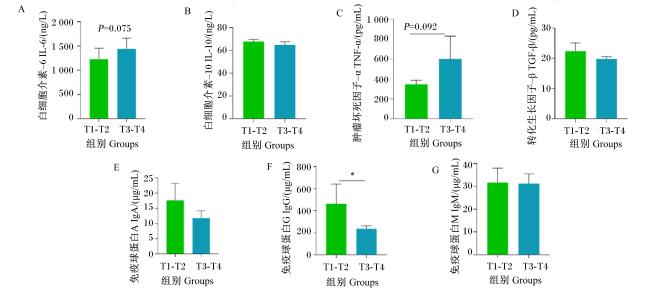
图1所示,与T1-T2组相比,T3-T4组断奶仔猪血清IgG含量显著降低(P<0.05),血清IL-6(P=0.075)和TNF-α(P=0.092)含量有升高趋势,血清IL-10、TGF-β、IgA和IgM含量均无显著差异(P>0.05)。
图1 肠道健康程度对21~28日龄断奶仔猪血清免疫指标的影响

数据柱标注*表示差异显著(P<0.05),下图同。

Fig.1 Effects of intestinal health degree on serum immune indices of weaned piglets from 21 to 28 days of age

Value columns with * mean significant difference (P<0.05), the same as below.

2.5 肠道健康程度对21~28日龄断奶仔猪结肠内容物短链脂肪酸含量的影响
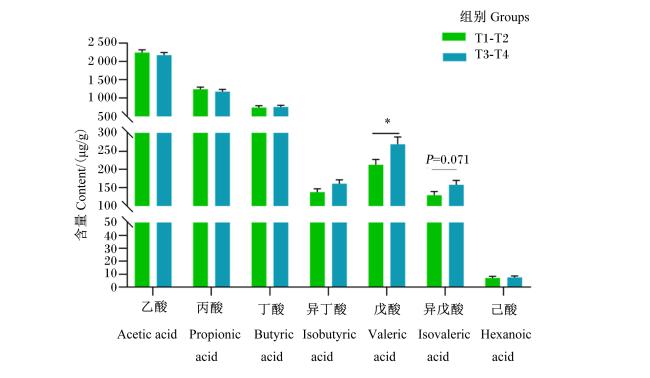
图2所示,与T1-T2组相比,T3-T4组断奶仔猪结肠内容物戊酸含量显著提高(P<0.05),异戊酸含量有提高趋势(P=0.071),乙酸、丙酸、丁酸、异丁酸和己酸含量均无显著差异(P>0.05)。
图2 肠道健康程度对21~28日龄断奶仔猪结肠内容物短链脂肪酸含量的影响

Fig.2 Effects of intestinal health degree on volatile fatty acid contents in colon content of weaned piglets from 21 to 28 days of age

2.6 肠道健康程度对21~28日龄断奶仔猪结肠菌群的影响

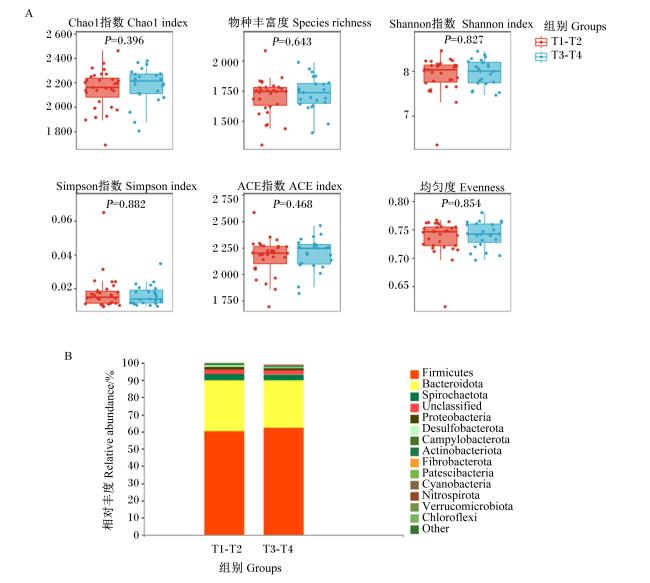
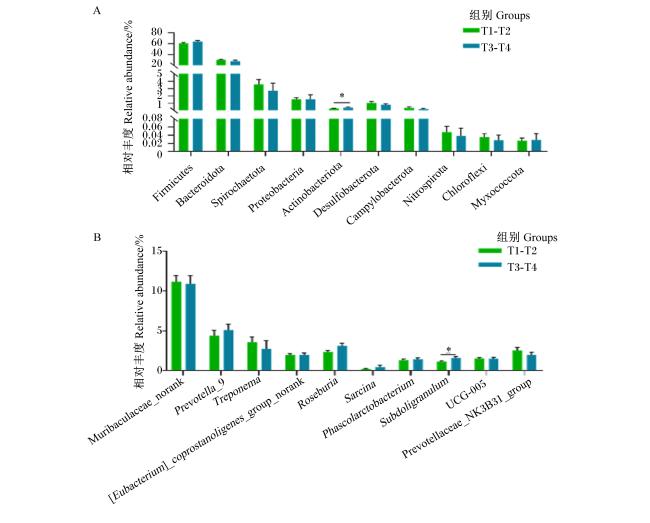
图3所示,T1-T2组和T3-T4组断奶仔猪结肠菌群多样性指标无显著差异(P>0.05),厚壁菌门(Firmicutes)、拟杆菌门(Bacteroidota)、螺旋体门(Spirochaetota)和变形菌门(Proteobacteria)均是2组的优势菌门。如图4所示,在门水平,与T1-T2组相比,T3-T4组断奶仔猪结肠放线菌门(Actinobacteriota)相对丰度显著提高(P<0.05);在属水平,与T1-T2组相比,T3-T4组结肠罕见小球菌属(Subdoligranulum)相对丰度显著提高(P<0.05);2组间结肠其他菌群相对丰度无显著差异(P>0.05)。
图3 肠道健康程度对21~28日龄断奶仔猪结肠菌群多样性(A)和门水平组成(B)的影响

Firmicutes:厚壁菌门;Bacteroidota:拟杆菌门;Spirochaetota:螺旋体门;Unclassified:未分类;Proteobacteria:变形菌门;Desulfobacterota:脱硫菌门;Campylobacterota:弯曲菌门;Actinobacteriota:放线菌门;Fibrobacterota:纤维杆菌门;Patescibacteria:髌骨菌门;Cyanobacteria:蓝细菌门;Nitrospirota:硝化螺旋菌门;Verrucomicrobiota:疣微菌门;Chloroflexi:绿弯菌门;Other:其他;。图4同 the same as Fig.4

Fig.3 Effects of intestinal health degree on diversity (A) and composition at phylum level (B) in colon microbiota of weaned piglets from 21 to 28 days of age

图4 肠道健康程度对21~28日龄断奶仔猪结肠菌群门水平(A)和属水平(B)相对丰度的影响

Myxococcota:黏菌门;Prevotella_9:普雷沃氏菌属9;Treponema:密螺旋体属;[Eubacterium]_coprostanoligenes_group_norank:未定级产粪甾醇真细菌属;Roseburia:罗氏菌属;Sarcina:八叠球菌属;Phascolarctobacterium:考拉杆菌属;Subdoligranulum:罕见小球菌属;Prevotellaceae_NK3B31_group:普雷沃氏菌科NK3B31群。

Fig.4 Effects of intestinal health degree on relative abundance of microbiota at phylum (A) and genus (B) levels in colon of weaned piglets from 21 to 28 days of age

2.7 肠道健康程度对29日龄至25 kg仔猪生长性能的影响

表5可知,在仔猪29日龄至25 kg阶段,T1-T2组和T3-T4组间仔猪腹泻率、平均日增重、平均日采食量和料重比均无显著差异(P>0.05)。
表5 肠道健康程度对29日龄至25 kg仔猪生长性能的影响

Table 5 Effects of intestinal health degree on growth performance of piglets from 29 days of age to 25 kg

项目Items T1-T2组T1-T2 group T3-T4组T3-T4 group PP-value
腹泻率Diarrhea rate/% 9.66±2.74 8.32±1.73 0.68
平均日增重ADG/(g/d) 462.15±16.17 445.45±19.04 0.51
平均日采食量ADFI/(g/d) 754.42±12.10 747.83±11.58 0.70
料重比F/G 1.66±0.07 1.71±0.06 0.62

3 讨论

3.1 肠道健康程度对断奶初期仔猪生长性能的影响

仔猪的肠道健康与仔猪的生长性能密切相关,是影响仔猪健康和成活率的关键因素[12-13]。李虹瑾等[14]、杜丽欣等[15]、Xiang等[16]和Huang等[17]研究发现,腹泻率显著降低时,仔猪的平均日增重显著提高。与上述结果一致,本研究结果发现,21~28日龄,与T3-T4组相比,T1-T2组断奶仔猪平均日增重显著提高;然而,在29日龄至25 kg阶段,本研究发现,肠道健康程度对仔猪生长性能无显著影响。其中的原因可能是随着日龄的增长,仔猪已逐渐适应了饲粮形态和环境的变化,并且其肠道发育进一步成熟,如消化酶分泌增多、屏障功能增强、结肠乳酸菌增多;肠道免疫功能也趋于成熟,肠道结构和功能日益接近成年猪水平,使其能够充分消化吸收饲粮中的营养物质,断奶前期引起的肠道功能紊乱对保育期仔猪生长性能的影响逐渐减弱甚至消失[18]

3.2 肠道健康程度对断奶初期仔猪养分表观消化率的影响

养分表观消化率在一定程度上可反映动物对饲粮中营养物质的消化和吸收能力,动物的消化吸收能力越强,则越有利于动物的生长。21~28日龄,断奶仔猪的消化系统处于发育期间,胃肠道未发育成熟,肠道中的消化酶、胆汁酸等分泌不足,导致饲粮中的营养物质无法被完全消化和吸收[19-20]。断奶仔猪对养分的消化吸收利用能力表现于对饲粮养分的消化率[21]。Heo等[22]研究发现,28日龄,当仔猪腹泻率显著提高时,其干物质、能量和粗蛋白质表观消化率无显著变化。与上述结果相似,本研究结果表明,在断奶1周内,不同肠道健康程度仔猪的表观养分消化率无显著差异。而李龙显等[23]、陈圣蕾等[24]研究表明,与对照组相比(腹泻率大于15%)相比,试验组(腹泻率小于15%)仔猪干物质、粗蛋白质、粗脂肪、粗灰分、粗纤维、中性洗涤纤维、酸性洗涤纤维和总能表观消化率均显著提高。导致上述试验结果不一致的原因可能是由于不同研究使用的试验仔猪断奶日龄不一样,并且用于评估养分消化率的仔猪日龄也不一致。研究发现,约95%的仔猪在断奶后50 h才开始采食,直至断奶后第8~14天摄入的能量才恢复到断奶前的水平[25]。此外,虽然断奶越早,仔猪肠道功能包括肠道消化能力损伤就越严重,且受损程度取决于肠道健康程度,但其相差的程度不足以对养分表观消化率造成显著影响[25]。因此,21日龄断奶仔猪在断奶后的1周内,不同肠道健康程度仔猪的表观养分消化率无显著差异。

3.3 肠道健康程度对断奶初期仔猪体组成的影响

研究表明,仔猪空体营养成分沉积受品种、性别、体重、年龄和饲粮等因素的影响[26],但目前暂未发现有关于肠道健康程度分级对仔猪空体养分沉积影响的研究报告。本研究发现,在仔猪断奶后的1周(21~28日龄),腹泻率高的仔猪的空体粗脂肪含量和粗脂肪沉积速率均显著降低。其原因可能是在断奶早期,仔猪饲粮形态发生转变、在断奶初期消化道发育还不够完善以及胆汁酸、消化酶分泌不足等因素导致采食量降低所致[27]。相比于腹泻率低的断奶仔猪,腹泻率高的断奶仔猪采食量下降会引起小肠绒毛萎缩、隐窝增生,这会进一步缩小小肠营养物质消化吸收的表面积,导致小肠不能有效消化吸收饲粮中的营养物质,仔猪无法从饲粮中摄取足够的能量来满足机体的生长需求,从而导致分解机体部分脂肪提供能值[28]

3.4 肠道健康程度对断奶初期仔猪血清免疫指标的影响

断奶换料容易导致仔猪产生免疫应激,引起仔猪肠道屏障功能障碍,进而导致肠道通透性增加,加剧肠道炎症[29];免疫应激还会引起促炎性细胞因子含量提高,进而将用于维持生长的养分转变为维持免疫应答,影响仔猪的生长与健康[30]。本试验发现,腹泻率高的仔猪血清促炎因子IL-6和TNF-α含量高于腹泻率低的猪。通常,断奶后仔猪肠道中促炎细胞因子如IL-6和TNF-α的水平上调,会对肠上皮造成损伤并引起肠道炎症[6]。动物血清免疫球蛋白含量能反映出机体的免疫水平,维持较高水平是保障仔猪健康断奶的重要基础[31]。IgG是机体主动免疫后产生的主要抗体,具有抗菌、抗病毒和免疫调节的功能;IgM是机体最早产生的抗体,同样具有抗菌和抗病毒等功能;IgA对机体的消化道等局部黏膜免疫起着重要作用。仔猪血清IgG、IgM和IgA含量提高,可以在一定程度上反映仔猪的免疫力增强[31]。本试验结果发现,T1-T2组(腹泻率小于15%)断奶仔猪血清IgG、IgM和IgA含量均高于T3-T4组(腹泻率大于15%),且血清IgG含量差异显著,说明健康的肠道可以增强机体的免疫功能。上述结果表明,肠道健康断奶仔猪具有更强的免疫功能及较低的炎症反应。

3.5 肠道健康程度对断奶初期仔猪结肠内容物短链脂肪酸含量的影响

短链脂肪酸主要包括乙酸、丙酸和丁酸等,由肠道微生物发酵碳水化合物、膳食纤维等产生,具有杀菌和抑菌的效果,能维持仔猪肠道内稳态和促进肠道健康。本试验结果发现,T3-T4组断奶仔猪结肠戊酸和异戊酸含量高于T1-T2组,而Wang等[32]研究发现,当腹泻率显著降低时,结肠戊酸含量显著升高,导致这种差异原因可能与饲粮类型、采食时间以及猪只状态等因素相关。不过,相比研究比较透彻的乙酸、丙酸和丁酸,戊酸和异戊酸在调节肠道抗炎/促炎功能中的作用还有待进一步研究。

3.6 肠道健康程度对断奶初期仔猪结肠菌群的影响

肠道菌群在调节仔猪消化吸收能力、免疫功能和肠道健康等方面发挥着重要的作用[33-34],而断奶应激容易破坏肠道菌群稳态,导致菌群比例失调,引发仔猪腹泻。本试验结果发现,断奶初期仔猪结肠的优势菌群都是厚壁菌门和拟杆菌门,且在门水平上,与T1-T2组相比,T3-T4组结肠放线菌门相对丰度显著提高。研究表明,在小鼠及相关组织培养模型中发现,放线菌可诱导炎症反应,导致继发性骨质流失[35-36]。在属水平上,与T1-T2组,T3-T4组结肠罕见小球菌属相对丰度显著提高。研究表明,罕见小球菌属相对丰度与低体重出生猪肠道炎症反应呈正相关[37]。因此,以上结果表明,T3-T4组断奶仔猪肠道菌群有害菌的相对丰度提高,不利于维持肠道稳态,从而导致腹泻。

4 结论

基于本研究的肠道健康程度等级划分体系,在21日龄仔猪断奶后的1周内,与腹泻率大于15%的仔猪相比,腹泻率小于15%的仔猪平均日增重显著提高,空体粗脂肪含量和粗脂肪沉积速率显著提高;免疫功能有所提高,炎症反应有所降低;同时,结肠放线菌门和罕见小球菌属等有害菌相对丰度显著降低。此外,断奶过渡期的肠道健康程度不会影响仔猪生长至25 kg的生长性能。
[1]
杨雪芬, 蒋宗勇. 商品猪精准营养技术研究进展[J]. 动物营养学报, 2022, 34(10):6121-6131.

DOI

YANG X F, JIANG Z Y. Research progress on precision nutrition technology of commercial pigs[J]. Chinese Journal of Animal Nutrition, 2022, 34(10):6121-6131. (in Chinese)

DOI

[2]
PIÉ S, LALLÈS J P, BLAZY F, et al. Weaning is associated with an upregulation of expression of inflammatory cytokines in the intestine of piglets[J]. Journal of Nutrition, 2004, 134(3):641-647.

DOI PMID

[3]
LALLÈS J P, BOSI P, SMIDT H, et al. Nutritional management of gut health in pigs around weaning[J]. Proceedings of the Nutrition Society, 2007, 66(2):260-268.

[4]
CAMPBELL J M, CRENSHAW J D, POLO J. The biological stress of early weaned piglets[J]. Journal of Animal Science and Biotechnology, 2013, 4(1):19.

DOI PMID

[5]
易宏波, 唐青松, 侯磊, 等. 断奶仔猪肠道健康分级及其无抗营养策略[J]. 动物营养学报, 2020, 32(10):4501-4517.

DOI

YI H B, TANG Q S, HOU L, et al. Antibiotic-free nutritional strategies based on intestinal health grade classification of weaned piglets[J]. Chinese Journal of Animal Nutrition, 2020, 32(10):4501-4517. (in Chinese)

[6]
HU C H, XIAO K, LUAN Z S, et al. Early weaning increases intestinal permeability,alters expression of cytokine and tight junction proteins,and activates mitogen-activated protein kinases in pigs[J]. Journal of Animal Science, 2013, 91(3):1094-1101.

[7]
MENGHERI E, CIAPPONI L, VIGNOLINI F, et al. Cytokine gene expression in intestine of rat during the postnatal developmental period:increased IL-1 expression at weaning[J]. Life Sciences, 1996, 59(15):1227-1236.

[8]
YI H B, JIANG D H, ZHANG L, et al. Developmental expression of STATs,nuclear factor-κB and inflammatory genes in the jejunum of piglets during weaning[J]. International Immunopharmacology, 2016,36:199-204.

[9]
CHEN L M, XU Y S, CHEN X Y, et al. The maturing development of gut microbiota in commercial piglets during the weaning transition[J]. Frontiers in Microbiology, 2017,8:1688.

[10]
HOU L, WANG L, QIU Y Q, et al. Effects of protein restriction and subsequent realimentation on body composition,gut microbiota and metabolite profiles in weaned piglets[J]. Animals, 2021, 11(3):686.

[11]
JONES C K, GABLER N K, MAIN R G, et al. Characterizing growth and carcass composition differences in pigs with varying weaning weights and postweaning performance[J]. Journal of Animal Science, 2012, 90(11):4072-4080.

DOI PMID

[12]
XIONG X, TAN B, SONG M, et al. Nutritional intervention for the intestinal development and health of weaned pigs[J]. Frontiers in Veterinary Science, 2019,6:46.

[13]
LIU S S, MA C, LIU L, et al. β-xylosidase and β-mannosidase in combination improved growth performance and altered microbial profiles in weanling pigs fed a corn-soybean meal-based diet[J]. Asian-Australasian Journal of Animal Sciences, 2019, 32(11):1734-1744.

DOI PMID

[14]
李虹瑾, 沙万里, 尹柏双, 等. 包膜丁酸钠对断奶仔猪肠道菌群及生长性能的影响[J]. 家畜生态学报, 2017, 38(9):30-34.

LI H J, SHA W L, YIN B S, et al. Effects of coated sodium butyrate on intestinal health and growth performance of weaned piglets[J]. Acta Ecologae Animalis Domastici, 2017, 38(9):30-34. (in Chinese)

[15]
杜丽欣, 张峰瑞, 邹雪, 等. 复合乳酸菌制剂对预防断奶仔猪细菌性腹泻及生长性能的影响[J]. 天津农学院学报, 2023, 30(4):46-52.

DOI

DU L X, ZHANG F R, ZOU X, et al. Effect of compound lactic acid bacteria on prevention of bacterial diarrhea and growth performance of weaned piglets[J]. Journal of Tianjin Agricultural College, 2023, 30(4):46-52. (in Chinese)

DOI

[16]
XIANG Q H, WU X Y, PAN Y, et al. Early intervention using fecal microbiota transplantation combined with probiotics influence the growth performance,diarrhea,and intestinal barrier function of piglets[J]. Applied Sciences, 2020, 10(2):568.

[17]
HUANG L L, REN P P, OUYANG Z C, et al. Effect of fermented feed on growth performance,holistic metabolism and fecal microbiota in weanling piglets[J]. Animal Feed Science and Technology, 2020,266:114505.

[18]
BOUDRY G, PÉRON V, LE HUËROU-LURON I, et al. Weaning induces both transient and long-lasting modifications of absorptive,secretory,and barrier properties of piglet intestine[J]. The Journal of Nutrition, 2004, 134(9):2256-2262.

[19]
JAYARAMAN B, NYACHOTI C M. Husbandry practices and gut health outcomes in weaned piglets:a review[J]. Animal Nutrition, 2017, 3(3):205-211.

[20]
杨奉弛. 预防早期断奶仔猪腹泻,提高养猪效益[J]. 中国畜禽种业, 2021, 17(1):104-105.

YANG F C. Prevent early weaning piglet diarrhea and improve pig farming efficiency[J]. The Chinese Livestock and Poultry Breeding, 2021, 17(1):104-105. (in Chinese)

[21]
邓培华, 王娟, 洼桑措. 中草药添加剂对断奶仔猪生长性能、养分表观消化率、血清生化指标和免疫指标的影响[J]. 饲料研究, 2021, 44(10):17-21.

DENG P H, WANG J, WA S C. Effect of Chinese herbal medicine additives on growth performance,nutrient apparent digestibility,serum biochemical index and immune index of weaned piglets[J]. Feed Research, 2021, 44(10):17-21. (in Chinese)

[22]
HEO J M, KIM J C, HANSEN C F, et al. Effects of feeding low protein diets to piglets on plasma urea nitrogen,faecal ammonia nitrogen,the incidence of diarrhoea and performance after weaning[J]. Archives of Animal Nutrition, 2008, 62(5):343-358.

[23]
李龙显, 王华凯, 张楠, 等. 不同粒径的α-月桂酸单甘油酯对断奶仔猪生长性能、营养物质表观消化率和血清抗氧化和炎症指标的影响[J]. 动物营养学报, 2022, 34(4):2249-2259.

DOI

LI L X, WANG H K, ZHANG N, et al. Effects of different particle sizes of α-glycerol monolaurate on growth performance,nutrient apparent digestibility and serum antioxidant and inflammatory indexes of weaned piglets[J]. Chinese Journal of Animal Nutrition, 2022, 34(4):2249-2259. (in Chinese)

[24]
陈圣蕾, 林爱莲, 闫晓曦, 等. 补饲发酵酸奶对断奶仔猪生长性能、养分消化和粪便菌群的影响[J]. 动物营养学报, 2022, 34(8):4904-4918.

DOI

CHEN S L, LIN A L, YAN X X, et al. Effects of supplementing fermented yoghurt on growth performance,nutrient digestion and fecal flora of weaned piglets[J]. Chinese Journal of Animal Nutrition, 2022, 34(8):4904-4918. (in Chinese)

[25]
BRUININX E M, VAN DER PEET-SCHWERING C M, SCHRAMA J W, et al. Individually measured feed intake characteristics and growth performance of group-housed weanling pigs: effects of sex,initial body weight,and body weight distribution within groups[J]. Journal of Animal Science, 2001, 79(2):301-308.

[26]
SKIBA G. Physiological aspects of compensatory growth in pigs[J]. Journal of Animal and Feed Sciences, 2005,14 (Suppl.1):191-203.

[27]
张珈榕, 范觉鑫, 张颖, 等. 浅谈断奶仔猪腹泻的原因及应对措施[J]. 广东畜牧兽医科技, 2018, 43(6):14-16.

ZHANG J R, FAN J X, ZHANG Y, et al. Discussion on the causes and countermeasures of diarrhea in weaned piglets[J]. Guangdong Journal of Animal and Veterinary Science, 2018, 43(6):14-16. (in Chinese)

[28]
PLUSKE J R, HAMPSON D J, WILLIAMS I H. Factors influencing the structure and function of the small intestine in the weaned pig:a review[J]. Livestock Production Science, 1997, 51(1/2/3):215-236.

[29]
VAN DER SLUIS M, DE KONING B A E, DE BRUIJN A C J M, et al. Muc2-deficient mice spontaneously develop colitis,indicating that MUC2 is critical for colonic protection[J]. Gastroenterology, 2006, 131(1):117-129.

[30]
KICK A R, TOMPKINS M B, FLOWERS W L, et al. Effects of stress associated with weaning on the adaptive immune system in pigs[J]. Journal of Animal Science, 2012, 90(2):649-656.

DOI PMID

[31]
孙耀贵, 程佳. 柴术抗激颗粒对早期断奶仔猪血清生化和免疫指标的影响[J]. 饲料研究, 2013(1):58-62.

SUN Y G, CHENG J. The effect of Chaishu Kangji granules on serum biochemical and immune indicators in early weaned piglets[J]. Feed Research, 2013(1):58-62. (in Chinese)

[32]
WANG Q B, ZHAO Y, GUO L, et al. Xylo-oligosaccharides improve the adverse effects of plant-based proteins on weaned piglet health by maintaining the intestinal barrier and inhibiting harmful bacterial growth[J]. Frontiers in Microbiology, 2023,14:1189434.

[33]
BEAUMONT M, CAUQUIL L, BERTIDE A, et al. Gut microbiota-derived metabolite signature in suckling and weaned piglets[J]. Journal of Proteome Research, 2021, 20(1):982-994.

DOI PMID

[34]
WANG T W, TENG K L, LIU Y Y, et al. Lactobacillus plantarum PFM 105 promotes intestinal development through modulation of gut microbiota in weaning piglets[J]. Frontiers in Microbiology, 2019,10:90.

[35]
SATO T, WATANABE K, KUMADA H, et al. Peptidoglycan of actinomyces naeslundii induces inflammatory cytokine production and stimulates osteoclastogenesis in alveolar bone resorption[J]. Archives of Oral Biology, 2012, 57(11):1522-1528.

DOI PMID

[36]
SHIMADA E, KATAOKA H, MIYAZAWA Y, et al. Lipoproteins of actinomyces viscosus induce inflammatory responses through TLR2 in human gingival epithelial cells and macrophages[J]. Microbes and Infection, 2012, 14(11):916-921.

DOI PMID

[37]
HUANG S M, WU Z H, LI T T, et al. Perturbation of the lipid metabolism and intestinal inflammation in growing pigs with low birth weight is associated with the alterations of gut microbiota[J]. Science of the Total Environment, 2020,719:137382.

Outlines

/