RESEARCH PAPER

Effects of Dietary Clostridium butyricum and Sodium Butyrate on Performance, Egg Quality and Intestinal Health of Laying Hens

  • LIU Yating ,
  • ZHENG Mengli ,
  • YANG Zhikang ,
  • ZHANG Guanfeng ,
  • XU Weiwei ,
  • JIANG Huiqiong ,
  • PENG Jie ,
  • CHEN Qinghua , *
Expand
  • College of Animal Science and Technology, Hunan Agricultural University, Changsha 410128, China
*professor, E-mail:

Received date: 2024-02-08

  Online published: 2024-08-12

Abstract

This experiment was conducted to investigate the effects of dietary Clostridium butyricum and sodium butyrate on performance, egg quality and intestinal health of Hy-Line grey laying hens aged from 42 to 50 weeks. A total of 720 healthy Hy-Line grey laying hens of 42-week-old with similar body weight and normal feeding were randomly divided into 4 groups with 6 replicates per group and 30 hens per replicate. Hens in group A (control group) were fed a basal diet; those in group B were fed the basal diet supplemented with 250 g/t Clostridium butyricum (viable bacteria number was 1×10¹⁰ CFU/g); those in group C were fed the basal diet supplemented with 500 g/t sodium butyrate (purity≥90%); those in group D were fed the basal diet supplemented with 250 g/t Clostridium butyricum+500 g/t sodium butyrate. The pre-trial period lasted for 5 days and the experimental period lasted for 56 days. The results showed as follows: 1) compared with group A, the average daily feed intake and feed to egg ratio of laying hens in group B were significantly decreased (P<0.05), the feed to egg ratio in group C had a decreasing trend (P>0.05), and there was no significant difference in performance in group D (P>0.05). 2) Compared with group A, the eggshell ratio in group B was significantly increased (P<0.05), the egg yolk ratio in group D was significantly increased (P<0.05), and there was no significant difference in egg quality in group C (P>0.05). 3) Compared with group A, the villus height in duodenum and jejunum of laying hens in groups B, C and D was significantly increased (P<0.05), and the ratio of villus height to crypt depth in duodenum, jejunum and ileum was significantly increased (P<0.05). 4) At the phylum level, the relative abundance of unclassified_k_norank_d_bacteria in cecum of laying hens in group B was significantly lower than that in group A (P<0.05), the relative abundance of Verrucomicrobiota in cecum in group B was significantly higher than that in group C (P<0.05), and the relative abundance of Fusobacteriota in cecum in group D was significantly higher than that in group C (P<0.05). At the genus level, compared with group A, the relative abundances of Parabacteroides, Eubacterium_brachy_group and Faecalitalea in cecum of laying hens in group B were significantly increased (P<0.05), and the relative abundance of unclassified_k_norank_d_bacteria in cecum was significantly decreased (P<0.05); the relative abundances of Streptococcus and Pediococcus in cecum in group C were significantly decreased (P<0.05), and the relative abundance of Ruminiclostridium in cecum was significantly increased (P<0.05); the relative abundance of Lactococcus in cecum in group D was significantly decreased (P<0.05). Compared with group B, the relative abundance of Phascolarctobacterium in cecum in group C was significantly increased (P<0.05), and the relative abundance of Eubacterium_brachy_group in cecum was significantly decreased (P<0.05); the relative abundances of unclassified_f_Prevotellaceae, Desulfovibrio and CHKCI002 in cecum in group D were significantly decreased (P<0.05). Compared with group C, the relative abundances of Fusobacterium and Parasutterella in cecum in group D were significantly increased (P<0.05), and the relative abundance of Ruminiclostridium in cecum was significantly decreased (P<0.05). In conclusion, dietary Clostridium butyricum can improve the performance and increase the eggshell ratio; dietary combination of Clostridium butyricum and sodium butyrate can significantly increase egg yolk ratio; dietary Clostridium butyricum and sodium butyrate alone or in combination can improve small intestine morphology, increase the relative abundances of beneficial bacteria in cecum, decrease the relative abundances of harmful bacteria in cecum, and maintain intestinal health of Hy-Line grey laying hens. Under the conditions of this experiment, dietary 250 mg/kg Clostridium butyricum (live bacteria number is 2.5×10⁹ CFU/kg) has a good effect.

Cite this article

LIU Yating , ZHENG Mengli , YANG Zhikang , ZHANG Guanfeng , XU Weiwei , JIANG Huiqiong , PENG Jie , CHEN Qinghua . Effects of Dietary Clostridium butyricum and Sodium Butyrate on Performance, Egg Quality and Intestinal Health of Laying Hens[J]. Chinese Journal of Animal Nutrition, 2024 , 36(8) : 4957 -4970 . DOI: 10.12418/CJAN2024.423

丁酸梭菌(Clostridium butyricum)和丁酸钠均可改善畜禽肠道健康,提高其生产性能,且在畜禽生产中应用广泛。丁酸梭菌是一种革兰氏阳性专性厌氧杆菌,能够促进肠道有益菌的增殖发育[1],抑制有害菌和病原菌的生长、繁殖[2],其在肠道中可降解未消化的膳食纤维以产生短链脂肪酸[3],如丁酸,直接为肠上皮细胞供能,促进肠绒毛生长,进而促进肠道对饲粮中营养物质的消化、吸收和利用,从而提高畜禽的生产性能[4]。丁酸钠的有效成分是丁酸,丁酸能够为肠道上皮细胞提供能量[5],修复肠道屏障的完整性[6],改善肠道健康[7],提高动物的生产性能[8]。目前,丁酸梭菌和丁酸钠在畜禽生产上的应用研究广泛,但二者作用效果的比较报道较少。因此,本试验旨在探究和比较单独或联合添加丁酸梭菌和丁酸钠对海兰灰蛋鸡生产性能、蛋品质及肠道健康的影响,为丁酸梭菌和丁酸钠在蛋鸡生产中的应用提供依据。

1 材料与方法

1.1 试验材料

丁酸梭菌采购于河南某公司,其中活菌数为1.0×10¹⁰ CFU/g;丁酸钠采购于湖北某公司,其含量≥90%。试验中的海兰灰蛋鸡由试验蛋鸡场提供。

1.2 试验设计

选取42周龄体重相近、健康的海兰灰蛋鸡720羽,随机分为4组(A组、B组、C组和D组),每组6个重复,每个重复30羽。A组为对照组,饲喂基础饲粮;B组饲喂基础饲粮+250 g/t丁酸梭菌;C组饲喂基础饲粮+500 g/t丁酸钠;D组饲喂基础饲粮+250 g/t丁酸梭菌+500 g/t丁酸钠。预试期5 d,正试期56 d。蛋鸡在预试期饲喂基础饲粮,同时记录各个重复的产蛋率、蛋重及采食量,并依据数据进行调整,以达到各重复差异不显著(P>0.05)为准[9]。基础饲粮参考《鸡饲养标准》(NT/T 33—2004)配制,其组成及营养水平见表1。饲粮中粗蛋白质、粗脂肪、钙和总磷含量分别参照GB/T 6432—2018、GB/T 6433—2006、GB/T 6436—2018和GB/T 6437—2018方法进行测定。
表1 基础饲粮组成及营养水平(风干基础)

Table 1 Composition and nutrient levels of the basal diet (air-dry basis) %

项目Items 含量Content
原料Ingredients
玉米Corn 59.21
豆粕Soybean meal 26.00
麦麸Wheat bran 3.00
大豆油Soybean oil 1.80
石粉Limestone 8.20
磷酸氢钙CaHPO4 0.90
蛋氨酸Met 0.12
氯化钠NaCl 0.25
氯化胆碱Choline chloride 0.10
抗氧化剂Antioxidant 0.02
预混料Premix1) 0.40
合计Total 100.00
营养水平Nutrient levels2)
代谢能ME/(MJ/kg) 11.43
粗蛋白质CP 16.99
粗脂肪EE 4.52
赖氨酸Lys 0.86
蛋氨酸Met 0.39
苏氨酸Thr 0.64
钙Ca 3.35
总磷TP 0.53
有效磷AP 0.29

1)预混料为每千克饲粮提供 The premix provided the following per kg of diets:VA 8 000 IU,VD3 2 000 IU,VE 20.00 mg,VK3 2.15 mg,VB1 1.80 mg,VB2 7.50 mg,VB6 4.50 mg,VB12 0.25 mg,泛酸 pantothenic acid 12.00 mg,烟酸 niacin 30.00 mg,生物素 biotin 0.15 mg,叶酸 folic acid 0.70 mg,Fe 65 mg,Cu 10 mg,I 0.40 mg,Zn 90 mg,Mn 65 mg,Se 0.30 mg。

2)代谢能、氨基酸和有效磷为计算值,参照NT/T 33—2004计算;粗蛋白质、粗脂肪、钙和总磷为实测值。ME, amino acids and AP were calculated values referred to NT/T 33—2004, while CP, EE, Ca and TP were measured values.

1.3 饲养管理

试验期间,蛋鸡自由采食和饮水,每日14:00准时收集当天所产鸡蛋,并于每日07:00和17:00各饲喂1次饲粮,光照时间保证16 h。按照常规饲养和正常免疫程序进行管理,每2 d清1次粪,保证鸡舍内环境和卫生,记录每天温度和相对湿度,每天观察并记录鸡只健康状况。

1.4 样品采集及处理

试验结束时,从每个重复随机选取5枚鸡蛋,每个组合计30枚鸡蛋进行蛋品质检测;每个重复随机抽取1只接近平均体重的蛋鸡称重并记录,之后进行颈静脉采血10 mL,静置1 h后于4 ℃下1 360×g离心15 min,分离血清,分装于EP管中,于-20 ℃冰箱中保存备测[10]。试验鸡采血后屠宰,取一部分肝脏样品,置于锡箔纸中,做好标记,存放于-20 ℃冰箱中保存备测;取十二指肠、空肠和回肠肠段约1 cm,用4%多聚甲醛固定,用于后续苏木精-伊红(HE)染色切片制作;取部分盲肠食糜于冻存管中,于-80 ℃冰箱中保存,用于微生物多样性检测。

1.5 测定指标及方法

1.5.1 生产性能测定

正试期间,以重复为单位记录当日产蛋个数、蛋重、不合格蛋数(包括软壳蛋、破壳蛋和畸形蛋)及采食量等,并以重复为单位计算产蛋率、平均蛋重、不合格蛋率、平均日采食量和料蛋比。计算公式如下:
产蛋率(%)=100×产蛋总数/每个重复蛋鸡数量;
平均蛋重(g)=蛋总重/产蛋数;
不合格蛋率(%)=100×不合格蛋总数/蛋总数;
平均日采食量(g)=(饲喂料总量-剩余料总量)/每个重复蛋鸡数量;
料蛋比=总饲粮消耗量/总产蛋重量。

1.5.2 蛋品质测定

蛋品质主要测定蛋重、蛋形指数、蛋壳颜色、蛋壳强度、蛋壳厚度、蛋黄颜色、哈氏单位、蛋白高度、蛋壳比例和蛋黄比例。使用到的实验仪器有分析天平、电子数显卡尺(5610-150,苏州英示测量科技有限公司)、Egg Analyzer(Orka,以色列)、厚度测定仪(ES-1-001型,南京德测贸易有限公式)及蛋壳强度仪(TY-DKQDJCY,山东天研仪器有限公司)。部分蛋品质指标计算公式如下:
蛋壳比例(%)=100×蛋壳重量/蛋重;
蛋黄比例(%)=100×蛋黄重量/蛋重;
蛋形指数=纵径/横径。

1.5.3 肠道形态测定

蛋鸡肠道组织经4%多聚甲醛中固定24 h后,依次进行脱水、透明和浸蜡包埋处理,随后制备石蜡组织切片并进行HE染色。待切片水化后浸入苏木精染色10 min,经蒸馏水速洗后,用0.1%盐酸乙醇分色,浸入1%伊红中染色2 min,再用盐酸乙醇分色,经95%乙醇与无水乙醇脱水、二甲苯透明、中性树胶封片后[11],使用光学显微镜在40×下利用Image Analysis软件测量肠道形态,每个样品随机选取6~8根绒毛,测量绒毛高度及其对应的隐窝深度,取平均值作为该样品的绒毛高度和隐窝深度,并计算其绒隐比(绒毛高度/隐窝深度)。

1.5.4 盲肠微生物区系测定

将盲肠内容物送至上海美吉生物医药科技有限公司进行16S rDNA测序分析。经环境样品DNA抽提、设计合成引物接头、PCR扩增与产物纯化、PCR产物定量与均一化、构建PE文库及Illumina测序等步骤得到原始数据,将原始数据进行拼接质控,优化数据后,进行操作分类单元(OTU)聚类分析、物种分类学分析与信息挖掘。

1.6 数据统计分析

试验数据先使用Excel 2019进行初步整理,再使用SPSS 20.0软件进行单因素方差分析(one-way ANOVA),并采用Duncan氏法进行多重比较检验;然后,进行一般线性模型的双因素方差分析(two-way ANOVA);盲肠内容物中差异菌群使用QIIME 2进行分析。结果数据采用平均值和均值标准误(SEM)表示,P<0.05表示差异显著。

2 结果与分析

2.1 饲粮中添加丁酸梭菌和丁酸钠对蛋鸡生产性能的影响

表2可知,与对照组(A组)相比,饲粮中添加250 g/t丁酸梭菌(B组)可显著降低蛋鸡平均日采食量和料蛋比(P<0.05);饲粮中添加500 g/t丁酸钠(C组)对蛋鸡生产性能指标无显著影响(P>0.05);饲粮中添加250 g/t丁酸梭菌+500 g/t丁酸钠(D组)对蛋鸡生产性能指标无显著影响(P>0.05)。丁酸梭菌与丁酸钠对蛋鸡平均日采食量和料蛋比有显著交互作用(P<0.05)。
表2 饲粮中添加丁酸梭菌和丁酸钠对蛋鸡生产性能的影响

Table 2 Effects of dietary Clostridium butyricum and sodium butyrate on performance of laying hens

项目
Items
组别Groups 均值
标准误
SEM
PP-value
A B C D Treatment CB SB CB×SB
产蛋率Laying rate/% 95.87 95.21 96.10 95.90 0.84 0.888 0.616 0.592 0.788
平均蛋重Average egg weight/g 60.58 60.11 60.46 60.26 0.22 0.451 0.139 0.946 0.549
平均日采食量ADFI/(g/d) 103.93a 99.39b 102.14ab 105.95a 1.60 0.023 0.823 0.152 0.017
料蛋比F/E 1.79a 1.74b 1.76ab 1.83a 0.03 0.025 0.726 0.278 0.044
不合格蛋率Defective egg rate/% 0.36 0.29 0.24 0.20 0.07 0.425 0.430 0.150 0.859

Treatment:单因素方差分析;CB:丁酸梭菌;SB:丁酸钠;CB×SB:丁酸梭菌×丁酸钠。同行数据肩标不同小写字母表示差异显著(P<0.05),相同字母或无字母表示差异不显著(P>0.05)。下表同。

Treatment: one-way ANOVA; CB: Clostridium butyricum; SB: sodium butyrate; CB×SB: Clostridium butyricum×sodium butyrate. In the same row, values with different small letter superscripts mean significant difference (P<0.05), while with the same letter or no letter superscripts mean no significant difference (P>0.05). The same as below.

2.2 饲粮中添加丁酸梭菌和丁酸钠对蛋鸡蛋品质的影响

表3可知,与对照组相比,饲粮中添加250 g/t丁酸梭菌可显著提高蛋壳比例(P<0.05);饲粮中添加500 g/t丁酸钠对蛋鸡蛋品质指标无显著影响(P>0.05);饲粮中添加250 g/t丁酸梭菌+500 g/t丁酸钠可显著提高蛋黄比例(P<0.05)。丁酸梭菌与丁酸钠对蛋黄颜色有显著交互作用(P<0.05)。
表3 饲粮中添加丁酸梭菌和丁酸钠对蛋鸡蛋品质的影响

Table 3 Effects of dietary Clostridium butyricum and sodium butyrate on egg quality of laying hens

项目
Items
组别Groups 均值
标准误
SEM
PP-value
A B C D Treatment CB SB CB×SB
蛋重Egg weight/g 63.00 62.76 62.83 61.47 0.80 0.520 0.329 0.370 0.492
蛋形指数Egg shape index 1.32 1.34 1.32 1.33 0.01 0.413 0.158 0.452 0.613
蛋壳颜色Eggshell color 2.13 1.83 2.00 2.08 0.14 0.467 0.457 0.654 0.187
蛋壳强度
Eggshell strength/(kg/cm2)
3.88 3.75 3.77 3.58 0.13 0.444 0.225 0.292 0.821
蛋壳厚度Eggshell thickness/mm 0.35 0.36 0.36 0.35 0.01 0.230 0.462 0.503 0.071
蛋壳比例Eggshell ratio/% 10.39b 10.65a 10.42ab 10.29b 0.11 0.049 0.531 0.148 0.090
蛋黄比例Egg yolk ratio/% 28.58b 29.00ab 29.26ab 29.60a 0.45 0.035 0.411 0.174 0.931
蛋黄颜色Egg yolk color 3.75 4.17 4.08 3.71 0.17 0.169 0.904 0.717 0.031
蛋白高度Albumen height/mm 6.08 6.09 5.55 6.11 0.31 0.519 0.365 0.422 0.379
哈氏单位Haugh unit 75.74 75.96 73.39 76.89 2.48 0.783 0.463 0.779 0.516

2.3 饲粮中添加丁酸梭菌和丁酸钠对蛋鸡肠道形态的影响

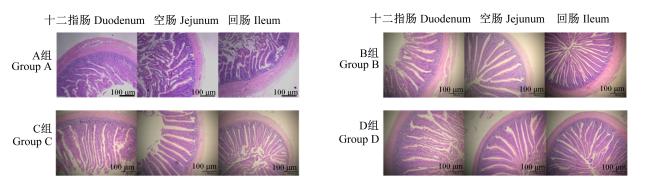
表4图1可知,与对照组相比,饲粮中添加250 g/t丁酸梭菌、500 g/t丁酸钠和250 g/t丁酸梭菌+500 g/t丁酸钠均可显著提高十二指肠和空肠绒毛高度(P<0.05),并显著提高十二指肠、空肠和回肠绒隐比(P<0.05)。丁酸梭菌与丁酸钠对蛋鸡十二指肠和空肠绒毛高度和绒隐比有显著交互作用(P<0.05)。
表4 饲粮中添加丁酸梭菌和丁酸钠对蛋鸡肠道形态的影响

Table 4 Effects of dietary Clostridium butyricum and sodium butyrate on intestinal morphology of laying hens

项目
Items
组别Groups 均值
标准误
SEM
PP-value
A B C D Treatment CB SB CB×SB
十二指肠Duodenum
绒毛高度Villus height/μm 175.77b 280.75a 263.90a 262.45a 15.55 <0.001 0.003 0.036 0.003
隐窝深度Crypt depth/μm 40.25 36.55 37.81 38.94 2.54 0.764 0.619 0.993 0.353
绒隐比V/C 4.52b 7.95a 7.07a 6.90a 0.69 0.014 0.028 0.290 0.017
空肠Jejunum
绒毛高度Villus height/μm 150.61b 236.61a 230.00a 254.35a 13.70 <0.001 0.001 0.002 0.036
隐窝深度Crypt depth/μm 30.90 26.91 30.36 27.63 1.91 0.242 0.032 0.628 0.395
绒隐比V/C 4.92c 8.81ab 7.57b 9.29a 0.44 <0.001 <0.001 0.002 0.023
回肠Ileum
绒毛高度Villus height/μm 123.29 155.09 149.70 145.35 14.05 0.383 0.340 0.560 0.213
隐窝深度Crypt depth/μm 25.50 24.41 22.06 22.40 1.13 0.133 0.741 0.026 0.536
绒隐比V/C 4.82b 6.32a 6.83a 6.46a 0.50 0.049 0.278 0.046 0.077
图1 饲粮中添加丁酸梭菌和丁酸钠对蛋鸡肠道形态的影响

Fig.1 Effects of dietary Clostridium butyricum and sodium butyrate on intestinal morphology of laying hens

2.4 饲粮中添加丁酸梭菌和丁酸钠对蛋鸡盲肠微生物区系的影响

2.4.1 蛋鸡盲肠微生物多样性分析

表5可知,与对照组相比,饲粮中添加250 g/t丁酸梭菌、500 g/t丁酸钠和250 g/t丁酸梭菌+500 g/t丁酸钠对蛋鸡盲肠微生物α多样性指数均无显著影响(P>0.05)。丁酸梭菌与丁酸钠对蛋鸡盲肠微生物α多样性指数均无显著交互作用(P>0.05)。
表5 饲粮中添加丁酸梭菌和丁酸钠对蛋鸡盲肠微生物α多样性的影响

Table 5 Effects of dietary Clostridium butyricum and sodium butyrate on α diversity of cecal microbiota of laying hens

项目
Items
组别Groups 均值
标准误
SEM
PP-value
A B C D Treatment CB SB CB×SB
Ace指数Ace index 854.17 813.34 852.04 815.17 26.84 0.561 0.163 0.995 0.941
Chao1指数Chao1 index 844.33 799.00 822.50 807.17 25.43 0.610 0.247 0.791 0.562
覆盖度Coverage 0.99 0.99 0.99 0.99 0.01 0.340 0.078 0.821 0.802
Shannon指数Shannon index 4.52 4.65 4.57 4.58 0.10 0.809 0.471 0.914 0.527
Simpson指数Simpson index 0.03 0.02 0.03 0.03 0.01 0.517 0.806 0.369 0.243
Sobs指数Sobs index 667.67 643.83 656.83 634.33 22.49 0.739 0.315 0.656 0.977
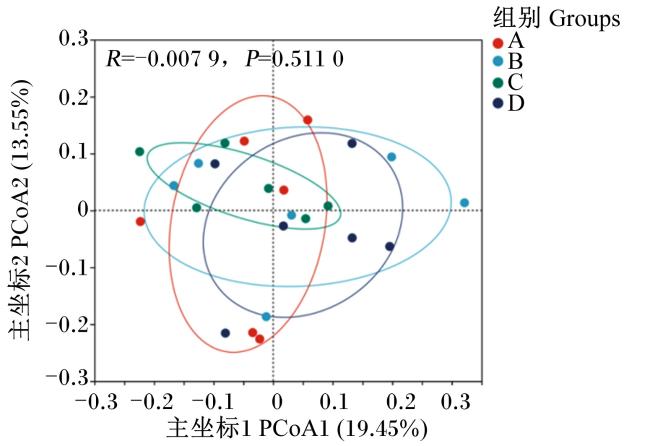
图2所示,饲粮中添加丁酸梭菌和丁酸钠改变了蛋鸡盲肠微生物的β多样性,其中B组与A组盲肠微生物组成差异较大。
图2 饲粮中添加丁酸梭菌和丁酸钠对蛋鸡盲肠微生物β多样性的影响

Fig.2 Effects of dietary Clostridium butyricum and sodium butyrate on β diversity of cecal microbiota of laying hens

2.4.2 蛋鸡盲肠微生物群落结构和组成差异分析

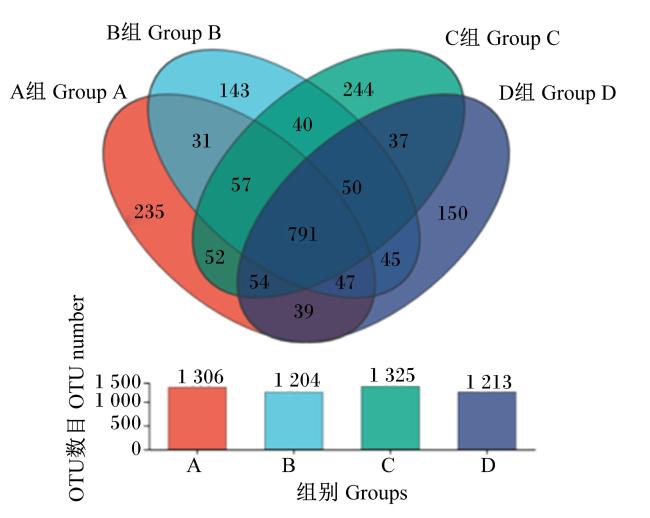
韦恩(Venn)图可体现各组间微生物共有和特有的OTU数目,可以直观地体现各组间蛋鸡盲肠微生物组成情况。如图3所示,A组、B组、C组和D组蛋鸡盲肠食糜中微生物OTU数目分别为1 306、1 204、1 325和1 213个,其中共有的OTU数目为791个,A组、B组、C组和D组特有的OTU数目分别为235、143、244和150个。
图3 蛋鸡盲肠微生物韦恩图

Fig.3 Venn diagram of cecal microbiota of laying hens

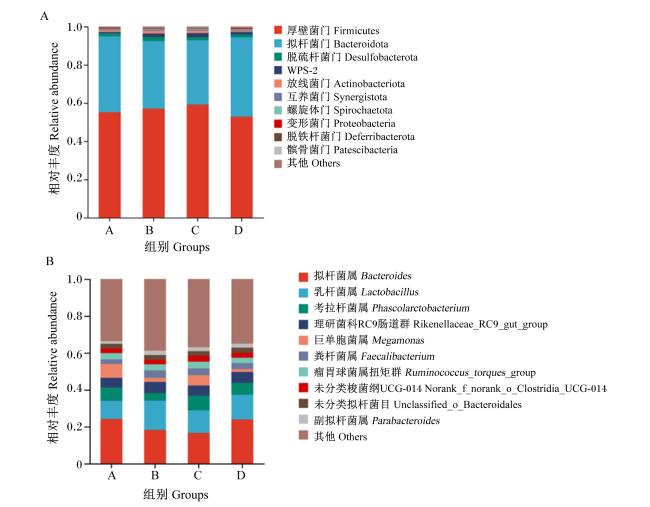
图4-A所示,各组蛋鸡盲肠微生物在门水平上排名前5的优势菌门为厚壁菌门(Firmicutes)、拟杆菌门(Bacteroidota)、脱硫杆菌门(Desulfobacterota)、WPS-2和放线菌门(Actinobacteriota)。如图4-B所示,各组蛋鸡盲肠微生物在属水平上排名前5的优势菌属为拟杆菌属(Bacteroides)、乳杆菌属(Lactobacillus)、考拉杆菌属(Phascolarctobacterium)、理研菌科RC9肠道群(Rikenellaceae_RC9_gut_group)、巨单胞菌属(Megamonas)和粪杆菌属(Faecalibacterium)。
图4 饲粮中添加丁酸梭菌和丁酸钠对蛋鸡盲肠微生物在门水平(A)和属水平(B)上组成的影响

Fig.4 Effects of dietary Clostridium butyricum and sodium butyrate on composition of cecal microbiota at phylum level (A) and genus level (B) of laying hens

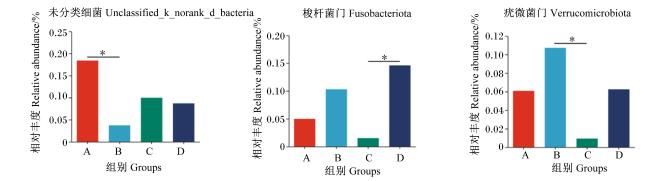
图5可知,在门水平上,与对照组相比,饲粮中添加250 g/t丁酸梭菌显著降低蛋鸡盲肠未分类细菌(unclassified_k_norank_d_bacteria)相对丰度(P<0.05);与饲粮中添加500 g/t丁酸钠相比,饲粮中添加250 g/t丁酸梭菌+500 g/t丁酸钠显著提高盲肠梭杆菌门(Fusobacteriota)相对丰度(P<0.05),饲粮中添加250 g/t丁酸梭菌显著提高盲肠疣微菌门(Verrucomicrobiota)相对丰度(P<0.05)。
图5 饲粮中添加丁酸梭菌和丁酸钠对蛋鸡盲肠微生物在门水平上相对丰度的影响

*表示差异显著(P<0.05),下图同。

Fig.5 Effects of dietary Clostridium butyricum and sodium butyrate on relative abundance of cecal microbiota at phylum level of laying hens

* indicated significant difference (P<0.05), the same as below.

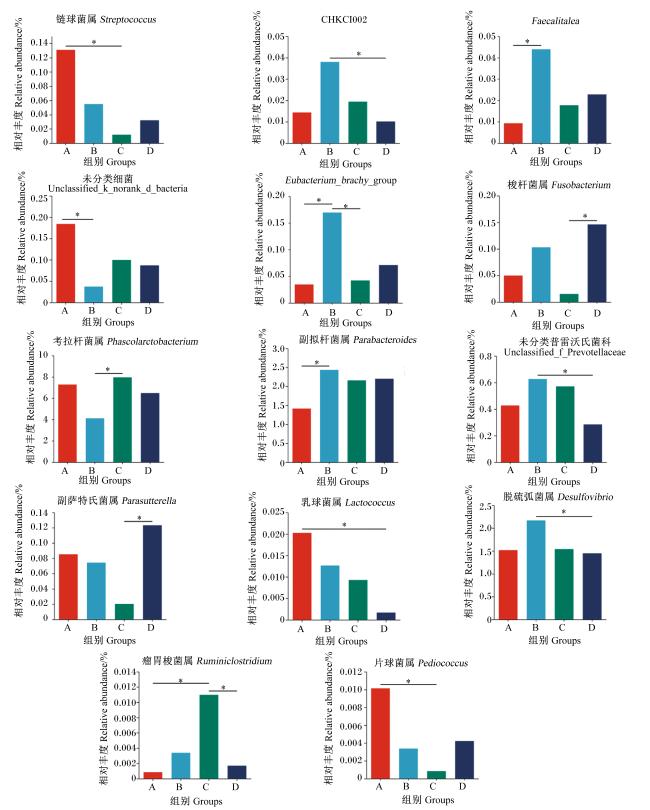
图6所示,在属水平上,与对照组相比,饲粮中添加250 g/t丁酸梭菌显著提高蛋鸡盲肠副拟杆菌属(Parabacteroides)、Eubacterium_brachy_group和Faecalitalea相对丰度(P<0.05),显著降低未分类细菌相对丰度(P<0.05);饲粮中添加500 g/t丁酸钠显著降低盲肠链球菌属(Streptococcus)和片球菌属(Pediococcus)相对丰度(P<0.05),显著提高盲肠瘤胃梭菌属(Ruminiclostridium)相对丰度(P<0.05);饲粮中添加250 g/t丁酸梭菌+500 g/t丁酸钠显著降低盲肠乳球菌属(Lactococcus)相对丰度(P<0.05)。与饲粮中添加250 g/t丁酸梭菌相比,饲粮中添加500 g/t丁酸钠显著提高蛋鸡盲肠考拉杆菌属(Phascolarctobacterium)相对丰度(P<0.05),显著降低盲肠Eubacterium_brachy_group相对丰度(P<0.05);饲粮中添加250 g/t丁酸梭菌+500 g/t丁酸钠显著降低盲肠未分类普雷沃氏菌科(unclassified_f_Prevotellaceae)、脱硫弧菌属(Desulfovibrio)和CHKCI002相对丰度(P<0.05)。与饲粮中添加500 g/t丁酸钠相比,饲粮中添加250 g/t丁酸梭菌+500g/t丁酸钠显著提高蛋鸡盲肠梭杆菌属(Fusobacterium)和副萨特氏菌属(Parasutterella)相对丰度(P<0.05),显著降低盲肠瘤胃梭菌属相对丰度(P<0.05)。
图6 饲粮中添加丁酸梭菌和丁酸钠对蛋鸡盲肠微生物在属水平上相对丰度的影响

Fig.6 Effects of dietary Clostridium butyricum and sodium butyrate on relative abundance of cecal microbiota at genus level of laying hens

3 讨论

3.1 饲粮中添加丁酸梭菌和丁酸钠对蛋鸡生产性能的影响

以往研究表明,丁酸梭菌和丁酸钠对畜禽生产性能有一定的促进作用,可在畜禽饲粮中添加使用。Liao等[12]研究发现,饲粮中添加5×10⁸ CFU/kg丁酸梭菌可显著提高1~42日龄肉鸡平均日增重。Wang等[13]通过对仔猪饲喂6×109 CFU/kg丁酸梭菌后发现,仔猪末重、平均日增重和平均日采食量均显著高于基础饲粮组,料重比显著低于基础饲粮组。Lan等[14]研究表明,饲粮中添加300或600 mg/kg丁酸钠可显著提高热应激条件下肉鸡末重、平均日增重和平均日采食量。Sun等[15]研究发现,饲粮中添加0.2%丁酸钠可显著提高育肥猪末重、平均日增重和平均日采食量。Zhan等[16]研究发现,饲粮中添加丁酸梭菌可显著提高蛋鸡产蛋率和蛋重,且呈二次提高,其中,饲粮中添加5×104 CFU/g丁酸梭菌效果最好。然而,高晗[17]研究发现,饲粮中添加1×109 CFU/kg丁酸梭菌降低了绿壳蛋鸡的采食量。本研究发现,饲粮中添加250 g/t丁酸梭菌可降低海兰灰蛋鸡平均日采食量,与高晗[17]研究结果类似,这可能与丁酸梭菌添加量的不同有关;饲粮种添加250 g/t丁酸梭菌或500 g/t丁酸钠可降低蛋鸡料蛋比,这说明添加丁酸梭菌或者丁酸钠可能改善了蛋鸡肠道内环境,维持了肠道菌群稳定,提高了蛋鸡对饲粮的消化利用率,从而使蛋鸡的生产性能得到改善。

3.2 饲粮中添加丁酸梭菌和丁酸钠对蛋鸡蛋品质的影响

蛋鸡的肠道健康决定了机体的健康状况和产蛋效率[18]。丁酸梭菌和丁酸钠均可促进肠道健康[19-20]。Zhan等[16]研究表明,饲粮中添加5×10⁴ CFU/g丁酸梭菌可显著提高京红1号蛋鸡蛋壳强度。Zhang等[21]研究发现,饲粮中添加300、500或800 mg/kg丁酸钠可显著提高罗曼蛋鸡蛋黄颜色。庞孟瑶[22]研究表明,饲粮中添加200、500或1 000 mg/kg丁酸梭菌(活菌数为2×109 CFU/g)可显著提高海兰褐蛋鸡哈氏单位。李安东等[23]研究发现,饲粮中添加100 g/t丁酸梭菌(活菌数为1×109 CFU/g)可显著提高海兰褐蛋鸡蛋黄颜色和蛋壳厚度。黄曼曼[24]研究表明,蛋鸭饲粮中添加包膜丁酸钠的各试验组蛋重均显著高于对照组。本研究发现,饲粮中添加250 g/t丁酸梭菌(活菌数为1.0×107 CFU/kg)可显著提高海兰灰蛋鸡蛋壳比例,饲粮中添加250 g/t丁酸梭菌+500 g/t丁酸钠可显著提高蛋黄比例,这说明饲粮中添加250 g/t丁酸梭菌可能有利于蛋鸡对钙的吸收;蛋黄沉积比蛋白沉积需要更多的能量,说明饲粮中添加 250 g/t丁酸梭菌+500 g/t丁酸钠可能有助于蛋鸡对饲粮营养物质的消化吸收。本试验中,饲粮中添加丁酸梭菌和丁酸钠对蛋鸡哈氏单位、蛋壳强度、蛋壳厚度和蛋黄颜色等均无显著影响,这可能是由于蛋鸡品种不同以及饲养环境不同导致,因为蛋品质易受遗传因素及外界环境因素影响。

3.3 饲粮中添加丁酸梭菌和丁酸钠对蛋鸡肠道形态的影响

肠道是畜禽消化吸收营养物质的重要场所,肠道形态是评价畜禽肠道健康的重要指标,绒毛高度、隐窝深度及绒隐比的高低反映了畜禽肠道的消化吸收能力[25]。王思梦等[26]研究表明,饲粮中添加0.5%丁酸梭菌(活菌数为2.88×10⁹ CFU/g)可以显著提高肉鸡十二指肠绒毛高度,显著降低回肠隐窝深度,显著或极显著提高回肠和十二指肠绒隐比。Casas等[27]研究发现,饲粮中添加1 250×108 CFU/kg有提高仔猪绒毛高度和隐窝深度的趋势。崔锦等[28]研究表明,与对照组相比,饲粮中添加15、30、60 g/t丁酸梭菌(活菌数为3×109 CFU/g)可显著提高仔猪断奶第15和35天盲肠绒毛高度。Ji等[29]研究发现,在14~35日龄北京鸭饲粮中添加包被丁酸钠可使回肠和盲肠绒毛高度和绒隐比呈线性或二次提高,隐窝深度随包被丁酸钠添加水平的提高而线性降低。孙寒雪等[30]研究表明,饲粮中添加275 mg/kg包被丁酸钠可显著提高种鸽十二指肠绒毛高度和绒隐比以及回肠绒隐比。本研究发现,饲粮中添加250 g/t丁酸梭菌、500 g/t丁酸钠和250 g/t丁酸梭菌+500 g/t丁酸钠均可显著提高蛋鸡十二指肠和空肠绒毛高度,显著提高十二指肠、空肠和回肠绒隐比。小肠是蛋鸡消化吸收的主要场所,本试验结果表明蛋鸡饲粮中添加丁酸梭菌和丁酸钠可改善小肠肠道形态,这可能是由于丁酸梭菌的代谢物和丁酸钠能为肠道细胞提供能量,促进肠道上皮细胞生长,提高小肠绒毛高度,从而提高蛋鸡肠道对营养物质的消化吸收能力。

3.4 饲粮中添加丁酸梭菌和丁酸钠对蛋鸡肠道菌群的影响

盲肠是微生物定植的主要场所,对家禽的健康起着关键性作用。研究表明,盲肠微生物的相对丰度与生产性能相关[31]。α多样性和β多样性可以反映微生物群落的丰富度和多样性[32]。Zeng等[33]研究发现,饲粮中添加250 g/t丁酸钠可显著提高蛋鸭盲肠Chao1、Shannon和Pielou-e指数,显著降低拟杆菌门相对丰度,显著提高厚壁菌门和放线菌门相对丰度。Fu等[34]研究发现,饲粮中添加1×108 CFU/kg丁酸梭菌可以提高断奶仔猪肠道营养物质的消化率,维持倡导上皮屏障的完整性,促进肠道功能的改善。Yang等[35]研究表明,饲粮中添加2×107 CFU/kg丁酸梭菌可抑制大肠杆菌、沙门氏菌及产气梭菌等盲肠病原菌的生长,促进乳酸菌和双歧杆菌的生长。韦晓芳等[36]研究发现,饲粮中添加500 g/t丁酸梭菌(活菌数≥1×109 CFU/g)可提高广西黄鸡盲肠内梭菌属和瘤胃球菌属相对丰度。Xiao等[37]研究表明,饲粮中添加1 000 mg/kg丁酸钠可显著提高罗斯308肉种鸡盲肠毛螺菌科和瘤胃球菌科相对丰度,从而改善肉种鸡肠道健康。
本试验结果表明,饲粮中添加丁酸梭菌和丁酸钠改变了蛋鸡盲肠微生物区系的组成,其中在门水平上的主要差异菌群有梭杆菌门、疣微菌门等。梭杆菌门可以产生对机体有益的代谢产物,如丁酸等,参与肠道菌群的稳态维持和代谢;疣微菌门不仅可以产生短链脂肪酸,还可以分解多糖类物质,对肠道健康和免疫系统的调节具有重要作用。在属水平上,饲粮中添加丁酸梭菌和丁酸钠可以降低有害菌的相对丰度,如脱硫弧菌属、链球菌属、乳球菌属、CHKCI002等,提高肠道有益菌的相对丰度,如副拟杆菌属、Eubacterium_brachy_group、Faecalitalea、瘤胃梭菌属、考拉杆菌属、副萨特氏菌属等。普雷沃氏菌属在半纤维素的消化中起着关键作用,并参与山羊瘤胃中的淀粉、纤维素、半纤维素和果胶的消化过程[38];副拟杆菌属参与脂质代谢,是缓解肥胖的关键因素[39],且副拟杆菌可提高紧密连接蛋白的表达,有利于肠道上皮屏障功能的增强[40];脱硫弧菌属属变形菌门,可以吸收硫酸盐,产生硫化氢,因此被认为会对肠道上皮产生毒性,导致胃肠道疾病,属于肠道致病菌[41]。综上所述,饲粮中添加丁酸梭菌和丁酸钠可以提高蛋鸡盲肠有益菌的相对丰度,降低有害菌的相对丰度,维持肠道屏障稳定,从而促进肠道健康。

4 结论

① 饲粮中单独添加丁酸梭菌或丁酸钠可以降低海兰灰蛋鸡料蛋比,饲粮中单独添加丁酸梭菌、丁酸钠或二者联合添加可以提高小肠绒毛高度和绒隐比,改善肠道形态。
② 饲粮中单独添加丁酸梭菌或丁酸梭菌与丁酸钠联合添加可以提高蛋壳比例或蛋黄比例,提高蛋品质。
③ 饲粮中添加丁酸梭菌和丁酸钠对盲肠微生物群落结构无显著影响,但可提高有益菌相对丰度,降低有害菌相对丰度,维持肠道健康。
④ 在本试验条件下,饲粮中添加250 g/t丁酸梭菌效果较好。
[1]
PU W, ZHANG H, ZHANG T, et al. Inhibitory effects of Clostridium butyricum culture and supernatant on inflammatory colorectal cancer in mice[J]. Frontiers in Immunology, 2023,14:1004756.

[2]
ZHANG X S, SONG M Z, LV P H, et al. Effects of Clostridium butyricum on intestinal environment and gut microbiome under Salmonella infection[J]. Poultry Science, 2022, 101(11):102077.

[3]
ZHAO M, XIE X Q, XU B, et al. Paeonol alleviates ulcerative colitis in mice by increasing short-chain fatty acids derived from Clostridium butyricum[J]. Phytomedicine, 2023,120:155056.

[4]
王宗伟, 付建中, 李洪涛, 等. 丁酸梭菌对肠道屏障的影响机制及其在畜禽养殖中应用的研究进展[J]. 动物营养学报, 2022, 34(6):3519-3528.

DOI

WANG Z W, FU J Z, LI H T, et al. Research progress on mechanism of Clostridium butyricum affecting intestinal barrier and its application in livestock and poultry breeding[J]. Chinese Journal of Animal Nutrition, 2022, 34(6):3519-3528. (in Chinese)

[5]
HUANG Y H, WANG Z J, YE B, et al. Sodium butyrate ameliorates diabetic retinopathy in mice via the regulation of gut microbiota and related short-chain fatty acids[J]. Journal of Translational Medicine, 2023, 21(1):451.

DOI PMID

[6]
XUE D F, CHENG Y T, PANG T T, et al. Sodium butyrate alleviates deoxynivalenol-induced porcine intestinal barrier disruption by promoting mitochondrial homeostasis via PCK2 signaling[J]. Journal of Hazardous Materials, 2023,459:132013.

[7]
LIU H, WANG J, HE T, et al. Butyrate:a double-edged sword for health?[J]. Advances in Nutrition, 2018, 9(1):21-29.

[8]
王元, 朱秋凤, 武艳慧. 丁酸钠在畜禽生产中应用的研究进展[J]. 饲料工业, 2024, 45(1):34-38.

WANG Y, ZHU Q F, WU Y H. Research progress on the application of sodium butyrate in animal production[J]. Feed Industry, 2024, 45(1):34-38. (in Chinese)

[9]
杨泰. 姜黄素对蛋鸡蛋品质、抗氧化与免疫功能及肠道形态的影响[D]. 硕士学位论文. 长沙: 湖南农业大学, 2018.

YANG T. Effect of curcumin on egg quality,antioxidant,immune function and intestinal morphology of layer hens[D]. Master’s Thesis. Changsha: Hunan Agricultural University, 2018. (in Chinese)

[10]
贾聪慧, 杨彩梅, 曾新福, 等. 丁酸梭菌对肉鸡生长性能、抗氧化能力、免疫功能和血清生化指标的影响[J]. 动物营养学报, 2016, 28(3):908-915.

JIA C H, YANG C M, ZENG X F, et al. Effects of Clostridium butyricum on growth performance,antioxidant capacity,immune function and serum biochemical parameters of broilers[J]. Chinese Journal of Animal Nutrition, 2016, 28(3):908-915. (in Chinese)

[11]
付兵, 郁二蒙, 王广军, 等. 投喂蚕豆对草鱼肝脏脂肪蓄积及脂肪代谢的影响[J]. 上海海洋大学学报, 2020, 29(1):45-54.

FU B, YU E M, WANG G J, et al. Effects of feeding broad bean on fat accumulation and metabolism in grass carp (Ctenopharyngodon idellus) liver[J]. Journal of Shanghai Ocean University, 2020, 29(1):45-54. (in Chinese)

[12]
LIAO X D, MA G, CAI J, et al. Effects of Clostridium butyricum on growth performance,antioxidation,and immune function of broilers[J]. Poultry Science, 2015, 94(4):662-667.

[13]
WANG K L, CHEN G Y, CAO G T, et al. Effects of Clostridium butyricum and Enterococcus faecalis on growth performance,intestinal structure,and inflammation in lipopolysaccharide-challenged weaned piglets[J]. Journal of Animal Science, 2019, 97(10):4140-4151.

[14]
LAN R X, ZHAO Z H, LI S Q, et al. Sodium butyrate as an effective feed additive to improve performance,liver function,and meat quality in broilers under hot climatic conditions[J]. Poultry Science, 2020, 99(11):5491-5500.

[15]
SUN W, SUN J, LI M, et al. The effects of dietary sodium butyrate supplementation on the growth performance,carcass traits and intestinal microbiota of growing-finishing pigs[J]. Journal of Applied Microbiology, 2020, 128(6):1613-1623.

[16]
ZHAN H Q, DONG X Y, LI L L, et al. Effects of dietary supplementation with Clostridium butyricum on laying performance,egg quality,serum parameters,and cecal microflora of laying hens in the late phase of production[J]. Poultry Science, 2019, 98(2):896-903.

[17]
高晗. 丁酸梭菌对绿壳蛋鸡生产性能及抗沙门氏菌能力的研究[D]. 硕士学位论文. 泰安: 山东农业大学, 2021.

GAO H. Influence analysis of Clostridium butyricum on growth performance and salmonella resistance of green shell laying hens[D]. Master’s Thesis. Tai’an: Shandong Agricultural University, 2021. (in Chinese)

[18]
刘文峰, 韩威, 叶小其, 等. 饲粮中添加丁酸梭菌和丁酸钠对产蛋鸡生产性能和蛋品质的影响[J]. 中国畜牧兽医, 2021, 48(3):893-900.

DOI

LIU W F, HAN W, YE X Q, et al. Effect of dietary supplementation of Clostridium butyricum and sodium butyrate on production performance and egg quality of laying hens[J]. China Animal Husbandry & Veterinary Medicine, 2021, 48(3):893-900. (in Chinese)

[19]
楚云开, 李建涛, 韩淑敏. 丁酸梭菌在改善畜禽肠道健康方面的研究进展[J]. 饲料研究, 2023, 46(11):176-178.

CHU Y K, LI J T, HAN S M. Research progress of Clostridium butyricum in improving intestinal health of livestock and poultry[J]. Feed Research, 2023, 46(11):176-178. (in Chinese)

[20]
ZHOU D, PAN Q, XIN F Z, et al. Sodium butyrate attenuates high-fat diet-induced steatohepatitis in mice by improving gut microbiota and gastrointestinal barrier[J]. World Journal of Gastroenterology, 2017, 23(1):60-75.

DOI PMID

[21]
ZHANG Q, ZHANG K Y, WANG J P, et al. Effects of coated sodium butyrate on performance,egg quality,nutrient digestibility,and intestinal health of laying hens[J]. Poultry Science, 2022, 101(9):102020.

[22]
庞孟瑶. 日粮中添加丁酸梭菌对蛋鸡生产性能、血清生化指标及经济效益的影响[J]. 饲料研究, 2023, 46(5):46-50.

PANG M Y. Effect of Clostridium butyricum supplementation in diets on production performance,serum biochemical indexes and economic benefits of laying hens[J]. Feed Research, 2023, 46(5):46-50. (in Chinese)

[23]
李安东, 徐亮, 张麦收, 等. 枯草芽孢杆菌与丁酸梭菌对蛋鸡生产性能、蛋品质、血清生化和免疫指标的影响[J]. 饲料研究, 2022, 45(22):53-56.

LI A D, XU L, ZHANG M S, et al. Effect of Bacillus subtilis and Clostridium butyricum on production performance,egg quality,serum biochemical and immune indexes of laying hens[J]. Feed Research, 2022, 45(22):53-56. (in Chinese)

[24]
黄曼曼. 不同剂型丁酸钠对蛋鸭生产性能及肠道健康的影响[D]. 硕士学位论文. 乌鲁木齐: 新疆农业大学, 2021.

HUANG M M. Effects of different dosage forms of sodium butyrate on production performance and intestinal health of laying ducks[D]. Master’s Thesis. Urumqi: Xinjiang Agricultural University, 2021. (in Chinese)

[25]
赵敏孟, 单昊书, 沈永华, 等. 丁酸梭菌在畜禽生产中的应用研究进展[J]. 动物营养学报, 2018, 30(7):2467-2472.

ZHAO M M, SHAN H S, SHEN Y H, et al. Research progress on application of Clostridium butyricum in livestock and poultry production[J]. Chinese Journal of Animal Nutrition, 2018, 30(7):2467-2472. (in Chinese)

[26]
王思梦, 聂存喜, 姬琳堡, 等. 丁酸梭菌对爱拔益加肉鸡生长性能、肠道健康和抗氧化能力的影响[J]. 动物营养学报, 2024, 36(2):897-907.

DOI

WANG S M, NIE C X, JI L B, et al. Effects of Clostridium butyricum on growth performance,intestine health and antioxidant capacity of arbor acres broilers[J]. Chinese Journal of Animal Nutrition, 2024, 36(2):897-907. (in Chinese)

[27]
CASAS G A, BLAVI L, CROSS T W L, et al. Inclusion of the direct-fed microbial Clostridium butyricum in diets for weanling pigs increases growth performance and tends to increase villus height and crypt depth,but does not change intestinal microbial abundance[J]. Journal of Animal Science, 2020, 98(1):skz372.

[28]
崔锦, 杨倩茹, 朱宽佑, 等. 丁酸梭菌对断奶仔猪生长性能、血清免疫功能、抗氧化能力和肠道形态的影响[J]. 饲料研究, 2023, 46(2):40-45.

CUI J, YANG Q R, ZHU K Y, et al. Effect of Clostridium butyricum on growth performance,immune function,antioxidant capacity and intestinal morphology of weaned piglets[J]. Feed Research, 2023, 46(2):40-45. (in Chinese)

[29]
JI Z Q, HAO Y S, WANG Y T, et al. Effects of coated sodium butyrate on growth performance,intestinal morphology,and caecal short-chain fatty acids of growing Pekin ducks[J]. British Poultry Science, 2023, 64(4):1-5.

[30]
孙寒雪, 刘雅丽, 曾涛, 等. 包被丁酸钠或蝉花多糖对种鸽哺育期减重、血清免疫球蛋白含量、肠道组织形态及回肠菌群的影响[J]. 动物营养学报, 2021, 33(10):5955-5964.

DOI

SUN H X, LIU Y L, ZENG T, et al. Effects of coated sodium butyrate or Cordyceps cicadae polysaccharide on weight loss during lactation,serum immunoglobulin contents,intestinal morphology and ileal microflora of breeding pigeons[J]. Chinese Journal of Animal Nutrition, 2021, 33(10):5955-5964. (in Chinese)

[31]
赵旭, 庄佳荣, 李洪涛, 等. 丁酸梭菌和枯草芽孢杆菌配伍对肉鸡生长性能、血清生化指标及盲肠微生物区系的影响[J]. 动物营养学报, 2023, 35(2):845-854.

DOI

ZHAO X, ZHUANG J R, LI H T, et al. Effects of compatibility of Clostridium butyricum and Bacillus subtilis on growth performance,serum biochemical indices and cecal microflora of broilers[J]. Chinese Journal of Animal Nutrition, 2023, 35(2):845-854. (in Chinese)

DOI

[32]
CAO M, LI Y, WU Q J, et al. Effects of dietary Clostridium butyricum addition to sows in late gestation and lactation on reproductive performance and intestinal microbiota1[J]. Journal of Animal Science, 2019, 97(8):3426-3439.

[33]
ZENG T, SUN H X, HUANG M M, et al. Dietary supplementation of coated sodium butyrate improves growth performance of laying ducks by regulating intestinal health and immunological performance[J]. Frontiers in Immunology, 2023,14:1142915.

[34]
FU J, WANG T H, XIAO X, et al. Clostridium butyricum ZJU-F1 benefits the intestinal barrier function and immune response associated with its modulation of gut microbiota in weaned piglets[J]. Cells, 2021, 10(3):527.

[35]
YANG C M, CAO G T, FERKET P R, et al. Effects of probiotic,Clostridium butyricum,on growth performance,immune function,and cecal microflora in broiler chickens[J]. Poultry Science, 2012, 91(9):2121-2129.

[36]
韦晓芳, 沈水宝, 吴克宁, 等. 不同养殖方式下饲粮中添加丁酸梭菌对广西黄鸡生长性能、肠道形态与盲肠微生物区系的影响[J]. 动物营养学报, 2021, 33(7):3842-3852.

DOI

WEI X F, SHEN S B, WU K N, et al. Effects of adding Clostridium butyricum to diet under different raising modes on growth performance,intestinal morphology and cecal microflora of Guangxi yellow chickens[J]. Chinese Journal of Animal Nutrition, 2021, 33(7):3842-3852. (in Chinese)

[37]
XIAO C P, ZHANG L, ZHANG B, et al. Dietary sodium butyrate improves female broiler breeder performance and offspring immune function by enhancing maternal intestinal barrier and microbiota[J]. Poultry Science, 2023, 102(6):102658.

[38]
DAO T K, DO T H, LE N G, et al. Understanding the role of Prevotella genus in the digestion of lignocellulose and other substrates in Vietnamese native goats’ rumen by metagenomic deep sequencing[J]. Animals, 2021, 11(11):3257.

[39]
WU T R, LIN C S, CHANG C J, et al. Gut commensal Parabacteroides goldsteinii plays a predominant role in the anti-obesity effects of polysaccharides isolated from Hirsutella sinensis[J]. Gut, 2019, 68(2):248-262.

[40]
KOH G Y, KANE A V, WU X, et al. Parabacteroides distasonis attenuates tumorigenesis, modulates inflammatory markers and promotes intestinal barrier integrity in azoxymethane-treated A/J mice[J]. Carcinogenesis, 2020, 41(7):909-917.

[41]
邹函峪, 王宝维, 张名爱, 等. 凝结芽孢杆菌和丁酸梭菌对肉鸭生长性能、屠宰性能、血清生化指标及肠道健康的影响[J]. 动物营养学报, 2023, 35(5):3025-3040.

DOI

ZOU H Y, WANG B W, ZHANG M A, et al. Effects of Bacillus coagulans and Clostridium butyricum on growth performance,slaughter performance,serum biochemical indexes and intestinal health of meat ducks[J]. Chinese Journal of Animal Nutrition, 2023, 35(5):3025-3040. (in Chinese)

Outlines

/