RESEARCH PAPER

Effects of Thiamine on Rumen Fermentation Parameters and Branched-Chain Fatty Acid Synthesis in Vitro

  • GUO Xin , 1, 2 ,
  • YAO Ruifen 1 ,
  • TAN Yongqi 1 ,
  • SHEN Yifan 1 ,
  • ZHAN Tengfei 1 ,
  • WEN Wan 3 ,
  • XIN Guosheng 2 ,
  • BU Dengpan , 1, *
Expand
  • 1 State Key Laboratory of Animal Nutrition and Feeding, Institute of Animal Science, Chinese Academy of Agricultural Sciences, Beijing 100193, China
  • 2 College of Life Sciences, Ningxia University, Yinchuan 750021, China
  • 3 Animal Husbandry Workstation of Ningxia Hui Autonomous Region, Yinchuan 750021, China
*professor, E-mail:

Received date: 2024-01-31

  Online published: 2024-08-12

Abstract

This experiment was conducted to evaluate the effects of thiamine on rumen fermentation parameters and branched-chain fatty acid (BCFA) synthesis by in vitro method. The experiment was divided into 6 groups with 5 replicates per group, and two batches of fermentation were performed. The 5 groups were used 0.5 g total mixed ration (TMR) as the fermentation substrate, and supplemented with 15 (control), 30, 60, 120 and 240 mg/kg DM thiamine, respectively. The fermentation broth was collected after 24 h incubation at 39 ℃ for the determination of rumen fermentation parameters, fatty acid content and branched-chain α-keto acid dehydrogenase (BCKD) activity. The results showed as follows: 1) the fermentation broth total volatile fatty acid content of 30 mg/kg DM thiamine group was significantly lower than that of control group and 120, 240 mg/kg DM thiamine groups (P<0.05), the fermentation broth total branched volatile fatty acid content of 15 and 30 mg/kg DM thiamine groups was significantly lower than that of control group and 120, 240 mg/kg DM thiamine groups (P<0.05), and the fermentation broth microbial protein content of 15, 30 and 60 mg/kg DM thiamine groups was significantly higher than that of control group and 120, 240 mg/kg DM thiamine groups (P<0.05). 2) The fermentation broth saturated fatty acid content of 60 mg/kg DM thiamine group was significantly higher than that of control group and 15, 120, 240 mg/kg DM thiamine groups (P<0.05), the contents of unsaturated fatty acid and monounsaturated fatty acid in fermentation broth of 120 and 240 mg/kg DM thiamine groups were significantly higher than those of 30 and 60 mg/kg DM thiamine groups (P<0.05), and the fermentation broth total fatty acid content of 60 mg/kg DM thiamine group was significantly higher than that of control group and 15 mg/kg DM thiamine groups (P<0.05). 3) The contents of isomeric branched chain fatty acid (Iso), trans isomeric branched chain fatty acid (Anteiso) and BCFA in fermentation broth of 30 and 60 mg/kg DM thiamine groups were significantly higher than those of the control group (P<0.05). 4) The fermentation broth BCKD activity of 15, 30, 60 and 120 mg/kg DM thiamine groups was significantly higher than that of 240 mg/kg DM thiamine group (P<0.05). 5) The correlation analysis results showed that the contents of acetate (r=-0.59), butyrate (r=-0.61), isovalerate (r=-0.54) and total volatile fatty acid (r=-0.57) in fermentation broth had a moderate negative correlation with BCFA content (P<0.05). In conclusion, under in vitro conditions, the thiamine can affect the rumen fermentation characteristics and fatty acid synthesis, and volatile fatty acid content is correlated with BCFA content. The best synthesis effect of BCFA is obtained when the thiamine supplemental level is 60 mg/kg DM.

Cite this article

GUO Xin , YAO Ruifen , TAN Yongqi , SHEN Yifan , ZHAN Tengfei , WEN Wan , XIN Guosheng , BU Dengpan . Effects of Thiamine on Rumen Fermentation Parameters and Branched-Chain Fatty Acid Synthesis in Vitro[J]. Chinese Journal of Animal Nutrition, 2024 , 36(8) : 5141 -5151 . DOI: 10.12418/CJAN2024.438

支链脂肪酸(branched-chain fatty acid,BCFA)是牛奶中重要的活性因子,具有抗炎、抗癌、预防代谢疾病的功能[1-2]。BCFA主要由瘤胃微生物合成,存在于细菌膜上,占细菌膜脂肪酸的50%,有利于细胞膜的流动性和细胞生长[3]。瘤胃微生物降解饲料产生的丙酸、戊酸主要用于合成奇数直链脂肪酸,而异丁酸、异戊酸、二甲基丁酸以及支链氨基酸(亮氨酸、缬氨酸、异亮氨酸)可被用于合成BCFA[4]
细菌在支链氨基酸合成BCFA的代谢途径中,需经支链氨基酸氨基转移酶、支链α酮酸脱氢酶(branched-chain α-keto acid dehydrogenase,BCKD)等关键酶的催化[5]。研究发现,硫胺素作为BCKD的辅助因子,具有保护和稳定BCKD的作用[6]。目前,关于硫胺素在奶牛上的应用研究较多。Shaver等[7]研究发现,在饲粮中补充硫胺素能提高奶牛产奶量以及乳脂和乳蛋白含量。此外,硫胺素还可以通过调节c-Jun氨基末端激酶(c-Jun N-terminal kinase,JNK)信号通路和降低炎症因子水平,缓解亚急性瘤胃酸中毒[8]。Zhao等[9]研究发现,给荷兰斯坦奶牛补充180 mg/kg DM硫胺素,显著提高了纤维素、半纤维素和淀粉降解酶的基因丰度,促进了丙酮酸向乙酰辅酶A和乙酸的转化,降低了琥珀酸和乳酸的合成。Ma等[10]研究发现,高精料饲粮下补充硫胺素,肉牛瘤胃液中乙酸、丙酸、丁酸等挥发性脂肪酸含量增加,乳酸含量降低。BCKD由支链α酮酸脱氢酶E1(BCKDE1)、二氢硫辛酸转乙酰基酶E2、二氢硫辛酰胺脱氢酶E3组成,它可以促进支链氨基酸到BCFA合成路径中,促进中间产物支链α酮酸的生成[11]。目前,硫胺素被用于缓解反刍动物瘤胃酸中毒的功能已经被证实,但其作为BCKD的辅酶调控瘤胃代谢合成BCFA的相关研究较少,且关于反刍动物硫胺素的推荐摄入量尚不明晰。因此,本试验利用体外发酵技术,探究奶牛饲粮中添加不同水平的硫胺素对瘤胃发酵参数、BCFA合成及BCKD活性的影响,从而确定硫胺素在饲粮中的适宜添加水平,为硫胺素用于调控BCFA合成提供理论依据。

1 材料与方法

1.1 试验材料

试验所用硫胺素纯度>99%。体外发酵底物为全混合日粮(TMR),风干后粉碎过2 mm筛,待用。TMR组成及营养水平见表1
表1 TMR组成及营养水平(风干基础)

Table 1 Composition and nutrient levels of the TMR (air-dry basis) %

项目Items 含量Content
原料Ingredients
苜蓿Alfalfa hay 9.57
豆粕Soybean meal 13.90
糖蜜Molasses 1.43
蒸汽压片玉米Steam flaked corn 15.96
玉米青贮Corn silage 29.16
苜蓿青贮Alfalfa silage 1.76
磨碎玉米粒Ground corn grain 11.01
大豆皮Soybean hull 3.97
玉米蛋白粉Corn gluten meal 2.42
棉籽Cottonseed 5.96
脂肪粉Fat powder 1.31
酵母培养物Yeast culture 0.10
小苏打NaHCO3 0.66
预混料Premix1) 2.79
合计Total 100.00
营养水平Nutrient levels2)
泌乳净能NEL/(MJ/kg) 7.21
粗蛋白质CP 17.60
中性洗涤纤维NDF 24.34
酸性洗涤纤维ADF 17.34
钙Ca 0.70
磷P 0.40

1)每千克预混料含 One kg of the premix contained the following:VA 250 000 IU,VD 65 000 IU,Fe 400 mg,Cu 540 mg,Zn 2 100 mg,Mn 560 mg,Se 135 mg,Co 68 mg,Ca 99 g。

2)泌乳净能为计算值,由NASEM Dairy 8软件计算得到,其他为测定值。NEL was a calculated value, which was calculated by NASEM Dairy 8 software, while the others were measured values.

1.2 供体动物管理与发酵前准备

在中国农业科学院北京畜牧兽医研究所昌平动物试验基地选取3头健康、体况相近、装有永久性瘤胃瘘管的荷斯坦奶牛,作为体外发酵试验瘤胃液的供体牛。每日07:00和19:00各饲喂1次,自由饮水。
试验当天晨饲前1 h采集瘤胃液并混匀,在39 ℃水浴锅中4层纱布过滤瘤胃液。参照Menke[12]的方法配制人工瘤胃缓冲液,持续通入二氧化碳(CO2)以确保厌氧环境。

1.3 试验设计与样品采集

硫胺素的添加水平依据Shaver等[7]和Xue等[13]试验结果确定。采用单因素试验设计,硫胺素体外发酵试验设6个组,每组5个重复,共发酵2批。各组均以0.5 g TMR作为发酵底物,并分别添加0(对照)、15、30、60、120、240 mg/kg DM硫胺素。每个小瓶装有75 mL的发酵液,瘤胃液与缓冲液配比为1∶2,39 ℃恒温发酵24 h时终止发酵。收集发酵液及剩余发酵底物用以测定pH、干物质降解率(DMD),氨态氮(NH3-N)、微生物蛋白(MCP)、挥发性脂肪酸(VFA)、脂肪酸含量和BCKD活性。

1.4 指标测定

1.4.1 饲粮营养水平的测定

粗蛋白质含量参考GB/T 6432—2018测定,中性洗涤纤维(NDF)含量参考GB/T 20806—2006测定,酸性洗涤纤维(ADF)含量参考NY/T1459—2007测定,钙含量参考GB/T 13885—2017测定,磷含量参考GB/T 6437—2002测定。

1.4.2 pH和DMD的测定

发酵结束后,立即测定发酵液pH;收集尼龙袋过滤后残渣于65 ℃烘48 h,测定DMD。

1.4.3 NH3-N含量的测定

采用靛酚比色法测定发酵液中NH3-N含量[14]

1.4.4 MCP含量的测定

发酵液在4 ℃条件下500×g离心15 min,取3 mL上清液加入1 mL 77.6%三氯乙酸溶液后,涡旋混匀分为2份,经冰浴静置45 min和27 000×g离心15 min处理。利用考马斯亮蓝法,使用多功能酶标仪(Tecan Infinite 200Pro,Tecan公司,瑞士)在波长595 nm处测定。

1.4.5 VFA含量的测定

将收集的发酵液在4 ℃条件下1 000×g离心10 min,取上清液1 mL至离心管中,加入0.1 mL 25%偏磷酸,冰浴静置30 min,然后在4 ℃条件下1 000×g离心15 min,取上清液使用气相色谱仪(6890N,安捷伦公司,美国)测定乙酸、丙酸、丁酸、异丁酸、戊酸、异戊酸含量。

1.4.6 脂肪酸含量与BCKD活性的测定

发酵液中脂肪酸含量测定的操作步骤如下:配制正己烷与异丙醇混合液(V/V=3∶2)、2%氢氧化钠甲醇(2 g氢氧化钠定容至100 mL,现配现用)、10%盐酸甲醇溶液(10 mL氯乙酰缓慢注入100 mL无水甲醇溶液中,现配现用)、66.7 g/L硫酸钠(6.67 g无水硫酸钠定容至100 mL)。取3 mL瘤胃液于15 mL离心管中,加入5 mL正己烷和异丙醇混合液,充分涡旋振荡2 min。加入2 mL硫酸钠溶液,涡旋振荡2 min,于4 ℃条件下2 500×g离心10 min。吸取上清液于耐高温的玻璃试管中,4 ℃保存。再分别将乳化层和下层溶液按上述步骤提取,合并3份上清液后,氮气吹干。加入0.5 mL正己烷、1 mL甲醇、2 mL氢氧化钠甲醇,涡旋振荡2 min,于50 ℃水浴皂化30 min。冷却至室温,加入2 mL盐酸甲醇,于90 ℃水浴酯化2 h。冷却至室温,加入3 mL水和5 mL正己烷,涡旋振荡2 min,静置分层。取上层液体于试管中,氮气吹干,加入0.5 mL正己烷和0.1 g无水硫酸钠,涡旋振荡30 s,用0.22 μm有机滤膜过滤至上机小瓶中,于-20 ℃条件下保存待测。使用气相色谱仪(6890N,安捷伦公司,美国)测定脂肪酸含量,仪器测定的条件与程序参考Zhan等[15]方法进行。
发酵液中BCKD活性采用酶联免疫吸附测定(ELISA)试剂盒(上海酶联生物科技有限公司)检测。

1.5 统计分析

所有数据均使用R语言4.3.1中nlme(3.1-157)包的线性混合模型进行分析,模型以试验处理为固定因素,发酵批次为随机因素。结果用平均值和均值标准误(SEM)表示,以P<0.05为差异显著,0.05<P<0.10为具有显著的趋势。使用R软件中的psych包进行相关性分析,并用Pearson方法进行检验,P<0.05表示显著相关,P<0.01表示极显著相关。相关强度的判断标准:相关系数(r)≥0.7为强相关,0.7>r≥0.4为中等程度相关,r<0.4为弱相关或无相关。

2 结果

2.1 硫胺素添加水平对体外瘤胃发酵参数的影响

表2可知,随着硫胺素添加水平的增加,发酵液中总挥发性脂肪酸、总支链挥发性脂肪酸、乙酸、丙酸、丁酸、戊酸、异丁酸、异戊酸和MCP含量呈显著线性变化(P<0.05)。30 mg/kg DM硫胺素组的发酵液中戊酸、异丁酸、异戊酸含量显著低于对照组和120、240 mg/kg DM硫胺素组(P<0.05),乙酸、丙酸、丁酸含量显著低于120和240 mg/kg DM硫胺素组(P<0.05)。30 mg/kg DM硫胺素组发酵液中总挥发性脂肪酸含量显著低于对照组和120、240 mg/kg DM硫胺素组(P<0.05),其他各组之间无显著差异(P>0.05)。15、30 mg/kg DM硫胺素组发酵液中总支链挥发性脂肪酸含量显著低于对照组和120、240 mg/kg DM硫胺素组(P<0.05),与60 mg/kg DM组硫胺素无显著差异(P>0.05)。15、30和60 mg/kg DM硫胺素组发酵液中MCP含量显著高于对照组和120、240 mg/kg DM硫胺素组(P<0.05)。各组之间发酵液中干物质降解率、NH3-N含量、pH、乙丙比无显著差异(P>0.05)。
表2 硫胺素添加水平对体外瘤胃发酵参数的影响

Table 2 Effects of thiamine supplemental level on rumen fermentation parameters in vitro

项目
Items
硫胺素添加水平Thiamine supplemental level/(mg/kg DM) SEM PP-value
0(对照
Control)
15 30 60 120 240 处理
Treatment
线性
Linear
二次
Quadratic
pH 6.71 6.70 6.68 6.71 6.70 6.71 0.07 0.35 0.21 0.83
干物质降解率
DMD/%
64.55 64.17 62.66 64.96 62.68 64.81 4.20 0.47 0.75 0.28
乙酸
Acetate/(mmol/L)
45.22ab 44.80ab 39.94b 43.41ab 46.13a 47.90a 4.45 <0.01 <0.01 0.33
丙酸
Propionate/(mmol/L)
15.27ab 15.10ab 13.72b 15.12ab 15.83a 16.56a 0.73 <0.01 <0.01 0.59
丁酸
Butyrate/(mmol/L)
9.01ab 8.72ab 8.07b 8.92ab 9.52a 9.65a 1.09 <0.01 <0.01 0.79
戊酸
Valerate/(mmol/L)
1.48a 0.91b 0.84b 0.98b 1.55a 1.55a 0.21 <0.01 <0.01 0.07
异丁酸
Isobutyrate/(mmol/L)
0.95a 0.64b 0.59b 0.68b 0.99a 0.99a 0.14 <0.01 <0.01 0.14
异戊酸
Isovalerate/(mmol/L)
1.90ab 1.66bc 1.57c 1.79abc 2.07a 2.01a 0.34 <0.01 <0.01 0.39
乙丙比A/P 2.95 2.97 2.90 2.87 2.90 2.89 0.17 0.27 0.16 0.21
总挥发性脂肪酸
TVFA/(mmol/L)
73.82a 71.82ab 64.73b 70.90ab 76.09a 78.66a 6.91 <0.01 <0.01 0.47
总支链挥发性脂肪酸
TBCVFA/(mmol/L)
2.85ab 2.30c 2.16c 2.46bc 3.60a 3.00a 0.48 <0.01 <0.01 0.86
微生物蛋白
MCP/(g/L)
0.29b 0.38a 0.40a 0.39a 0.23b 0.28b 0.04 <0.01 <0.01 0.40
氨态氮
NH3-N/(mg/dL)
24.30 24.09 23.73 23.87 23.91 23.68 3.22 0.92 0.44 0.75

总挥发性脂肪酸=乙酸+丙酸+丁酸+戊酸+异丁酸+异戊酸,总支链挥发性脂肪酸=异丁酸+异戊酸。

TVFA=acetate+propionate+butyrate+valerate+isobutyrate+isovalerate, TBVFA=isobutyrate+isovalerate.

2.2 硫胺素添加水平对体外瘤胃发酵脂肪酸含量的影响

表3可知,随着硫胺素添加水平的增加,发酵液中饱和脂肪酸和总脂肪酸含量呈显著二次曲线变化(P<0.05),总脂肪酸、不饱和脂肪酸、单不饱和脂肪酸、C10∶0、C11∶0、C12∶0、C14∶0、C15∶1、c9,c12,c15-C18∶3、C20∶1含量呈显著线性变化(P<0.05)。与对照组相比,60 mg/kg DM硫胺素组发酵液中饱和脂肪酸中C6∶0、C10∶0、C12∶0、C13∶0、C14∶0、C15∶0、C16∶0、C18∶0含量显著提高(P<0.05);单不饱和脂肪酸中C14∶1和C15∶1含量显著提高(P<0.05),c9-C18∶1、C20∶1含量显著降低(P<0.05);多不饱和脂肪酸中c9,c12-C18∶2、c6,c9,c12-C18∶3、c9,c12,c15-C18∶3含量有降低趋势(0.05<P<0.10),C20∶4含量显著升高(P<0.05)。60 mg/kg DM硫胺素组发酵液中饱和脂肪酸含量显著高于对照组和15、120、240 mg/kg DM硫胺素组(P<0.05),与30 mg/kg DM硫胺素组无显著差异(P>0.05)。120和240 mg/kg DM硫胺素组发酵液中不饱和脂肪酸、单不饱和脂肪酸含量显著高于30和60 mg/kg DM硫胺素组(P<0.05),与对照组无显著差异(P>0.05)。60 mg/kg DM硫胺素组发酵液中总脂肪酸含量显著高于对照组和15 mg/kg DM硫胺素组(P<0.05),与30、120、240 mg/kg DM硫胺素组无显著差异(P>0.05)。
表3 硫胺素添加水平对体外瘤胃发酵脂肪酸含量的影响

Table 3 Effects of thiamine supplemental level on rumen fermentation fatty acid contents in vitro μg/mL

项目
Items
硫胺素添加水平Thiamine supplemental level/(mg/kg DM) SEM PP-value
0(对照
Control)
15 30 60 120 240 处理
Treatment
线性
Linear
二次
Quadratic
C4∶0 2.69 2.11 2.56 2.72 2.84 2.86 0.38 0.50 0.21 0.62
C6∶0 1.39b 1.27b 2.14ab 3.39a 4.43a 2.27ab 0.65 <0.01 0.06 <0.01
C8∶0 2.64 2.85 2.32 2.51 5.05 3.13 0.90 0.11 0.21 0.08
C10∶0 2.15b 2.08b 2.56ab 2.91a 2.72a 2.69a 0.12 <0.01 <0.01 <0.01
C11∶0 0.92 0.98 0.99 1.02 1.12 1.16 0.07 0.05 <0.01 0.32
C12∶0 2.97b 2.89b 4.08a 4.00a 4.04a 4.03a 0.40 <0.01 <0.01 <0.01
C13∶0 0.75c 1.03abc 1.08ab 1.13a 0.97abc 0.81bc 0.10 <0.01 0.18 <0.01
C14∶0 1.66cd 1.91abc 2.01ab 2.14a 1.79bcd 1.58d 0.10 <0.01 <0.01 <0.01
C14∶1 7.62cd 7.45d 9.21ab 9.82a 8.21bcd 8.67abc 0.78 <0.01 0.11 <0.01
C15∶0 1.16c 1.27bc 1.46ab 1.53a 1.27bc 1.15c 0.09 <0.01 0.05 <0.01
C15∶1 1.42b 1.43b 1.86a 1.82ab 2.01a 2.02a 0.21 <0.01 <0.01 <0.01
C16∶0 33.70c 37.10bc 43.50ab 44.90a 35.30c 34.20c 4.00 0.01 0.20 0.09
C17∶0 3.44b 3.35b 3.88ab 4.20a 3.75ab 3.85ab 0.45 <0.01 0.06 0.01
C18∶0 212.21b 206.45b 234.52ab 254.93a 227.45ab 232.19ab 38.15 <0.01 0.11 0.01
c9-C18∶1 26.94a 24.83a 12.57b 14.21b 26.46a 25.98a 8.27 <0.01 0.05 0.03
t9-C18∶1 15.30 16.09 16.24 18.26 17.12 17.68 2.80 <0.01 0.05 0.13
c9,c12-C18∶2 10.80a 10.79ab 9.06b 9.57ab 10.64ab 10.95a 0.87 0.01 0.15 0.11
c6,c9,c12-C18∶3 4.15 3.90 4.01 4.26 4.30 4.24 0.60 0.07 0.06 0.18
c9,c12,c15-C18∶3 2.46ab 2.47ab 2.22b 2.38ab 2.72a 2.70a 0.11 0.01 0.01 0.73
C20∶0 1.23b 2.04a 1.93ab 1.88ab 1.42ab 1.56ab 0.39 0.01 0.35 0.58
C20∶1 2.66a 2.35ab 1.85b 1.97b 2.87a 2.84a 0.42 <0.01 <0.01 0.30
C20∶4 3.26bc 2.67c 4.11ab 4.64a 2.94c 3.05bc 0.65 <0.01 0.17 0.06
C21∶0 1.86 1.69 1.93 1.97 1.73 1.70 0.08 0.08 0.13 0.50
C22∶6 1.72 1.71 1.80 1.74 1.77 1.79 0.08 0.96 0.58 0.80
C24∶0 3.76 3.67 3.74 4.09 3.95 3.97 0.25 0.08 0.07 0.12
饱和脂肪酸
SFA
272.50c 270.63c 308.73ab 333.31a 297.81bc 297.20bc 32.73 <0.01 0.11 <0.01
不饱和脂肪酸
UFA
76.34a 73.68ab 62.92c 68.68bc 79.05a 79.92a 8.72 <0.01 0.01 0.38
单不饱和脂肪酸
MUFA
53.94ab 52.14ab 41.72c 46.08bc 56.68a 57.19a 6.64 <0.01 <0.01 0.29
多不饱和脂肪酸
PUFA
22.40 21.54 21.20 22.60 22.37 22.72 2.13 0.49 0.24 0.93
总脂肪酸
TFA
348.84b 344.31b 371.66ab 402.00a 376.87ab 377.12ab 41.11 <0.01 0.02 <0.01

饱和脂肪酸=C4∶0~C24∶0之和,不饱和脂肪酸=C14∶1~C22∶6之和,单不饱和脂肪酸=C14∶1~C20∶1之和,多不饱和脂肪酸=c9,c12-C18∶2~C22∶6之和。

SFA=sum of C4∶0 to C24∶0, UFA=sum of C14∶1 to C22∶6,∑MUFA=sum of C14∶1 to C20∶1,and PUFA=sum of c9,c12-C18∶2 to C22∶6。

表4可知,随着硫胺素添加水平的增加,发酵液中iso-C14∶0、iso-C15∶0、iso-C17∶0、anteiso-C13∶0、异构支链脂肪酸(Iso)、反式异构支链脂肪酸(Anteiso)和BCFA含量呈显著二次曲线变化(P<0.05),iso-C15∶0含量呈显著线性变化(P<0.05)。60 mg/kg DM硫胺素组发酵液中BCFA含量最高,显著高于对照组和240 mg/kg DM硫胺素组(P<0.05)。与对照组相比,30和60 mg/kg DM硫胺素组发酵液中iso-C15∶0、iso-C17∶0、anteiso-C13∶0、Iso、Anteiso和BCFA含量显著升高(P<0.05)。各组之间发酵液中iso-C13∶0、iso-C16∶0、anteiso-C17∶0含量无显著差异(P>0.05)。
表4 硫胺素添加水平对体外瘤胃发酵BCFA含量的影响

Table 4 Effects of thiamine supplemental level on rumen fermentation BCFA contents in vitro μg/mL

项目
Items
硫胺素添加水平Thiamine supplemental level/(mg/kg DM) SEM PP-value
0(对照
Control)
15 30 60 120 240 处理
Treatment
线性
Linear
二次
Quadratic
iso-C13∶0 0.24 0.26 0.28 0.29 0.26 0.26 0.03 0.44 0.79 0.27
iso-C14∶0 0.44b 0.48b 0.46b 0.63a 0.47b 0.41b 0.05 <0.01 0.13 <0.01
iso-C15∶0 2.36b 2.91a 3.08a 3.09a 2.67ab 2.40b 0.16 <0.01 <0.01 <0.01
iso-C16∶0 0.91 0.98 1.03 1.10 0.96 0.91 0.17 0.84 0.65 0.40
iso-C17∶0 0.72c 0.81bc 0.97ab 1.02a 0.82abc 0.79bc 0.07 <0.01 0.54 <0.01
anteiso-C13∶0 0.55c 0.86ab 0.88ab 1.08a 0.90ab 0.70bc 0.08 <0.01 0.66 <0.01
anteiso-C15∶0 2.03 2.16 2.48 2.58 2.13 2.00 0.21 0.02 0.17 0.05
anteiso-C17∶0 0.98 1.03 1.15 1.24 1.02 1.01 0.13 0.27 0.65 0.21
异构支链脂肪酸Iso 4.67c 5.43abc 5.82ab 6.14a 5.19abc 4.77bc 0.37 <0.01 0.09 <0.01
反式异构支链脂肪酸
Anteiso
3.55c 4.04bc 4.51ab 4.90a 4.06abc 3.71bc 0.30 <0.01 0.21 <0.01
支链脂肪酸BCFA 8.23c 9.47abc 10.30ab 11.00a 9.25abc 8.49bc 0.67 <0.01 0.13 <0.01

异构支链脂肪酸=iso-C13∶0+iso-C14∶0+iso-C15∶0+iso-C16∶0+iso-C17∶0,反式异构支链脂肪酸=anteiso-C13∶0+anteiso-C15∶0+anteiso-C17∶0,支链脂肪酸=iso-C13∶0+iso-C14∶0+iso-C15∶0+iso-C16∶0+iso-C17∶0+anteiso-C13∶0+anteiso-C15∶0+anteiso-C17∶0。

Iso=iso-C13∶0+iso-C14∶0+iso-C15∶0+iso-C16∶0+iso-C17∶0, Anteiso=anteiso-C13∶0+anteiso-C15∶0+anteiso-C17∶0, and BCFA=iso-C13∶0+iso-C14∶0+iso-C15∶0+iso-C16∶0+iso-C17∶0+anteiso-C13∶0+anteiso-C15∶0+anteiso-C17∶0.

2.3 发酵液中VFA含量与BCFA含量的相关性

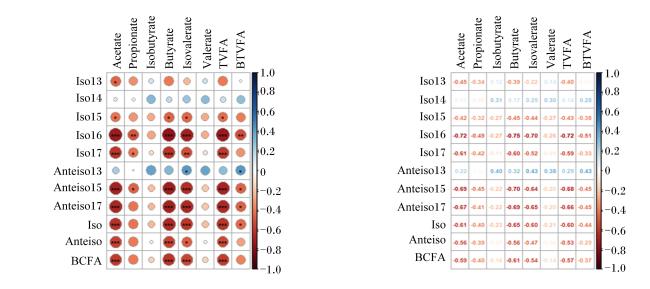
图1可知,发酵液中iso-C15∶0含量与乙酸(r=-0.42)、丁酸(r=-0.45)、异戊酸(r=-0.44)、总挥发性脂肪酸(r=-0.43)含量呈显著负相关(P<0.05),iso-C13∶0含量只与乙酸(r=-0.45)含量呈显著负相关(P<0.05),丙酸含量与iso-C17∶0(r=-0.42)、anteiso-C15∶0(r=-0.45)含量呈显著负相关(P<0.05),anteiso-C13∶0含量与异戊酸(r=-0.43)、总支链挥发性脂肪酸(r=-0.43)含量呈显著正相关(P<0.05),总支链挥发性脂肪酸含量与iso-C16∶0(r=-0.51)、anteiso-C15∶0(r=-0.45)、anteiso-C17∶0(r=-0.45)、Iso(r=-0.44)含量呈显著负相关(P<0.05)。
图1 发酵液中VFA含量与BCFA含量的相关性

Iso13:iso-C13∶0;Iso14:iso-C14∶0;Iso15:iso-C15∶0;Iso16:iso-C16∶0;Iso17:iso-C17∶0;Iso:异构支链脂肪酸 isomeric branched-chain fatty acid;Anteiso:反式异构支链脂肪酸;trans isomeric branched-chain fatty acid;BCFA:支链脂肪酸 branched-chain fatty acid;Acetate:乙酸;Propionate:丙酸;Isobutyrate:异丁酸;Butyrate:丁酸;Isovalerate:异戊酸;Valerate:戊酸;TVFA:总挥发性脂肪酸 total volatile fatty acid;TBCVFA:总支链挥发性脂肪酸 total branched volatile fatty acid。
*、**、***表示显著相关(P<0.05)。*, ** and *** mean significant correlation (P<0.05).

Fig.1 Correlation between VFA content and BCFA content in rumen fermentation broth

2.4 硫胺素添加水平对体外瘤胃发酵BCKD活性的影响

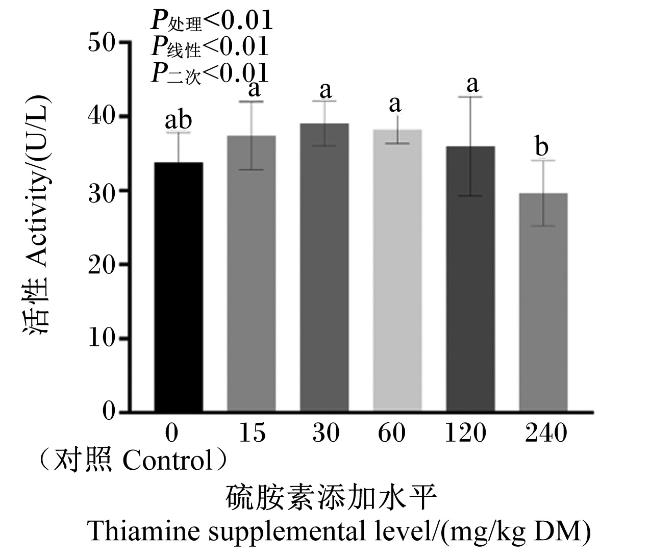
图2可知,随着硫胺素添加水平的增加,发酵液中BCKD活性呈显著线性和二次曲线变化(P<0.05)。15、30、60、120 mg/kg DM硫胺素组发酵液中BCKD活性显著高于240 mg/kg DM硫胺素组(P<0.05)。
图2 硫胺素添加水平对体外瘤胃发酵BCKD活性的影响

数据柱标相同小写字母表示差异不显著(P>0.05),不同小写字母表示差异显著(P<0.05)。

Fig.2 Effects of thiamine supplemental level on rumen fermentation BCKD activity in vitro

Value columns with the same small letter mean no significant difference (P>0.05), while with different small letters mean significant difference (P<0.05).

3 讨论

3.1 硫胺素添加水平对体外瘤胃发酵参数的影响

硫胺素是奶牛机体代谢所必需的一类营养素,主要在反刍动物的瘤胃中合成与利用[16-17]。Ma等[10]在高精料饲粮基础上给奶牛饲喂180 mg/kg DM硫胺素,发现硫胺素可缓解由高精料引起瘤胃发酵和生产性能异常的现象,具有缓解亚急性瘤胃酸中毒的功能。引起瘤胃酸中毒的主要原因是高精料导致瘤胃内丙酮酸累积,过量的丙酮酸在乳酸脱氢酶的作用下生成乳酸,乳酸含量的升高会使瘤胃液pH降低[18]。添加硫胺素可降低乳酸含量与乳酸脱氢酶活性。Pan等[19]在诱导瘤胃酸中毒的研究基础上添加硫胺素,发现瘤胃液中的硫胺素含量与pH和乙酸含量呈正相关关系。本研究结果显示,硫胺素的添加水平并不影响pH与乙丙比。Tafaj等[20]通过给奶牛饲喂不同精粗比的饲粮发现,瘤胃中硫胺素含量与pH呈负相关。这些研究结果表明,相比于硫胺素,饲粮是影响瘤胃pH的主要因素,硫胺素可能只是通过影响瘤胃发酵来稳定pH[21]。本研究发现,添加30 mg/kg DM硫胺素会使乙酸、丙酸、总挥发性脂肪酸含量降低,可能是因为硫胺素能提高BCKD、丙酮酸脱氢酶等多种酶的活性,促使挥发性脂肪酸向脂肪酸的合成[22]。Breves等[23]研究发现,奶牛微生物氮流量随硫胺素添加水平的增加而增加,这与本研究结果一致。饲料被微生物降解为氨基酸、多肽等非蛋白氮后,氨基酸向MCP或NH3-N的转化,取决于饲粮中碳水化合物的供给。当机体葡萄糖充足时,氨基酸多偏向于MCP的合成。当能量缺少时,会导致NH3-N含量增加,降低氮的利用效率。这说明MCP不能利用的氮素,会以NH3-N的形式流失[24]。本试验中,添加硫胺素使MCP含量增加,并未显著降低NH3-N含量。Apajalahti等[25]观察瘤胃内支链氨基酸向支链挥发性脂肪酸的转化率发现,支链氨基酸氧化脱氨生成支链挥发性脂肪酸的过程中,会促使瘤胃微生物氨的释放,而BCFA的高效合成加快了引物支链挥发性脂肪酸的代谢,导致氨的富集,这可能是造成差异结果的原因。

3.2 硫胺素添加水平对体外瘤胃发酵脂肪酸合成的影响

研究发现,奶牛每天饲喂150 mg硫胺素能提高产奶量,以及牛奶中的乳脂和乳蛋白含量[7]。Ma等[26]在山羊高精料饲粮基础上添加200 mg/kg DM硫胺素,发现瘤胃中亚油酸等脂肪酸含量显著提高。本试验发现,硫胺素添加水平在60 mg/kg DM时,发酵液中BCFA含量最高。其原因可能是硫胺素能促进瘤胃中亮氨酸和缬氨酸的合成,而瘤胃液中支链氨基酸、挥发性脂肪酸含量与牛奶中的BCFA含量存在相关性[27]。在支链氨基酸向BCFA的代谢途径中,BCKD是BCFA合成途径中的限速酶。有研究发现,硫胺素和辛酸可从辅酶和辅基2方面来提高BCKD活性,促进支链α酮酸向BCFA的转化[28-29]。这说明硫胺素不仅能提高底物支链氨基酸的合成,还能促进支链氨基酸向BCFA的转化,因此硫胺素对支链氨基酸的作用,可能是调控BCFA合成的潜在途径。Zhao等[9]研究发现,硫胺素通过纤维及淀粉降解酶来提高丙酮酸利用率,促进丙酮酸向乙酰辅酶A的转化。Zhan等[15]模拟瘤胃体外发酵添加生物素和亮氨酸,发现乙酰辅酶A羧化酶活性显著提高,乙酰辅酶A与丙二酰辅酶A的合成增加,促使BCFA的生成。因此,硫胺素促进丙酮酸向乙酰辅酶A的代谢,为BCFA合成提供二碳单位,也是调控BCFA合成的有效途径。
Mitchell等[30]通过给奶牛饲喂支链挥发性脂肪酸(异丁酸、异戊酸、二甲基丁酸),发现牛奶中脂肪酸含量相比于对照组增加了20%~30%。本研究结果表明,体外条件下添加硫胺素,异戊酸是最多被用于BCFA合成的支链挥发性脂肪酸,与BCFA含量存在相关性。Zhang等[31]通过给奶牛饲喂硫胺素,发现乳脂产量、牛奶饱和脂肪酸含量增加,不饱和脂肪酸含量降低,这与本研究结果一致,其主要原因可能是瘤胃内的不饱和脂肪酸对微生物具有毒性,易被生物氢化成饱和脂肪酸,而富集的BCFA提高微生物活性,促进了氢化过程[5,32]。饱和脂肪酸含量的提高与脂肪酸的从头合成有关,研究表明瘤胃微生物降解饲料,合成的乙酸被瘤胃上皮和瘤胃微生物所吸收,在乙酰辅酶A合成酶、羧化酶等作用下,生成丙二酰辅酶A,用于脂肪酸碳链的延长[33-34]。Liu等[35]和Matamoros等[36]给泌乳奶牛饲喂乙酸盐发现,乙酸能显著提高乳脂产量,乙酸含量与奇链BCFA含量存在相关性,与牛奶中的C16∶0含量呈正相关。这说明乙酸对于牛奶脂肪酸的合成具有重要意义,但Urrutia等[37]通过饲粮补充等量的乙酸与丁酸发现,相比于对照组与丁酸组,乙酸并不能提高乳脂中BCFA含量。本研究结果显示,乙酸、丁酸含量与BCFA含量存在很强的相关性,在瘤胃中乙酸与丁酸转化率高于其他挥发性脂肪酸之间的转化率,因此研究可能高估了乙酸对瘤胃微生物BCFA合成的调控[38]。综上所述,硫胺素主要从支链氨基酸、挥发性脂肪酸、丙酮酸3条途径促进BCFA的合成。

4 结论

体外条件下,硫胺素会影响瘤胃发酵特性和脂肪酸的合成,且VFA含量与BCFA含量存在相关性。当硫胺素添加水平为60 mg/kg DM时,BCFA的合成效果最好。
[1]
VAHMANI P, SALAZAR V, ROLLAND D C, et al. Iso-but not anteiso-branched chain fatty acids exert growth-inhibiting and apoptosis-inducing effects in MCF-7 cells[J]. Journal of Agricultural and Food Chemistry, 2019, 67(36):10042-10047.

[2]
PRANGER I G, MUSKIET F A J, KEMA I P, et al. Potential biomarkers for fat from dairy and fish and their association with cardiovascular risk factors:cross-sectional data from the LifeLines biobank and cohort study[J]. Nutrients, 2019, 11(5):1099.

[3]
SINGH V K, SIROBHUSHANAM S, RING R P, et al. Roles of pyruvate dehydrogenase and branched-chain α-keto acid dehydrogenase in branched-chain membrane fatty acid levels and associated functions in Staphylococcus aureus[J]. Journal of Medical Microbiology, 2018, 67(4):570-578.

[4]
ABDOUL-AZIZ S K A, ZHANG Y D, WANG J Q. Milk odd and branched chain fatty acids in dairy cows:a review on dietary factors and its consequences on human health[J]. Animals, 2021, 11(11):3210.

[5]
KANEDA T. Iso- and anteiso-fatty acids in bacteria:biosynthesis,function,and taxonomic significance[J]. Microbiological Reviews, 1991, 55(2):288-302.

[6]
HEFFELFINGER S C, SEWELL E T, ELSAS L J, et al. Direct physical evidence for stabilization of branched-chain alpha-ketoacid dehydrogenase by thiamin pyrophosphate[J]. American Journal of Human Genetics, 1984, 36(4):802-807.

PMID

[7]
SHAVER R D, BAL M A. Effect of dietary thiamin supplementation on milk production by dairy cows[J]. Journal of Dairy Science, 2000, 83(10):2335-2340.

PMID

[8]
ZHANG H, PENG A L, ZHAO F F, et al. Thiamine ameliorates inflammation of the ruminal epithelium of Saanen goats suffering from subacute ruminal acidosis[J]. Journal of Dairy Science, 2020, 103(2):1931-1943.

DOI PMID

[9]
ZHAO Y G, XUE F G, HUA D K, et al. Metagenomic insights into effects of thiamine supplementation on carbohydrate-active enzymes’ profile in dairy cows fed high-concentrate diets[J]. Animals, 2020, 10(2):304.

[10]
MA P, SUN C Q, LIU M Z, et al. Metagenomic insights into the rumen epithelial integrity responses to the vitamin B1 supplement under high-concentrate diets treatments[J]. Frontiers in Microbiology, 2022,13:1008373.

[11]
WU Q, ZHI Y, XU Y. Systematically engineering the biosynthesis of a green biosurfactant surfactin by Bacillus subtilis 168[J]. Metabolic Engineering, 2019,52:87-97.

[12]
MENKE K H. Estimation of the energetic feed value obtained from chemical analysis and in vitro gas production using rumen fluid[J]. Animal Research Development, 1988,28:7-55.

[13]
XUE F G, NAN X M, SUN F Y, et al. Metagenome sequencing to analyze the impacts of thiamine supplementation on ruminal fungi in dairy cows fed high-concentrate diets[J]. AMB Express, 2018, 8(1):159.

DOI PMID

[14]
BRODERICK G A, KANG J H. Automated simultaneous determination of ammonia and total amino acids in ruminal fluid and in vitro media[J]. Journal of Dairy Science, 1980, 63(1):64-75.

[15]
ZHAN T F, GUO X, MA L, et al. Biotin and leucine alone or in combination promoted the synthesis of odd- and branched-chain fatty acids in the rumen in vitro[J]. Agriculture, 2023, 13(1):145.

[16]
GIRARD C L, GRAULET B. Methods and approaches to estimate B vitamin status in dairy cows:knowledge,gaps and advances[J]. Methods, 2021,186:52-58.

[17]
SANTSCHI D E, BERTHIAUME R, MATTE J J, et al. Fate of supplementary B-vitamins in the gastrointestinal tract of dairy cows[J]. Journal of Dairy Science, 2005, 88(6):2043-2054.

PMID

[18]
DABAK M, GUL Y. Thiamine deficiency in sheep with chronic rumen acidosis[J]. The Veterinary Record, 2004, 154(2):58-59.

[19]
PAN X H, YANG L, XUE F G, et al. Relationship between thiamine and subacute ruminal acidosis induced by a high-grain diet in dairy cows[J]. Journal of Dairy Science, 2016, 99(11):8790-8801.

DOI PMID

[20]
TAFAJ M, SCHOLLENBERGER M, FEOFILOWA J, et al. Relationship between thiamine concentration and fermentation patterns in the rumen fluid of dairy cows fed with graded concentrate levels[J]. Journal of Animal Physiology and Animal Nutrition, 2006, 90(7/8):335-343.

[21]
PAN X H, NAN X M, YANG L, et al. Thiamine status,metabolism and application in dairy cows:a review[J]. British Journal of Nutrition, 2018, 120(5):491-499.

[22]
LIU H, RAN T, ZHANG C F, et al. Comparison of rumen bacterial communities between yaks (Bos grunniens) and Qaidam cattle (Bos taurus) fed a low protein diet with different energy levels[J]. Frontiers in Microbiology, 2022,13:982338.

[23]
BREVES G, BRANDT M, HOELLER H, et al. Flow of thiamin to the duodenum in dairy cows fed different rations[J]. The Journal of Agricultural Science, 1981, 96(3):587-591.

[24]
SILVA L G, BENEDETI P D B, PAULA E M, et al. Effects of carbohydrate and nitrogen supplementation on fermentation of cheatgrass (Bromus tectorum) in a dual-flow continuous culture system[J]. Journal of Animal Science, 2017, 95(3):1335-1344.

[25]
APAJALAHTI J, VIENOLA K, RAATIKAINEN K, et al. Conversion of branched-chain amino acids to corresponding isoacids—an in vitro tool for estimating ruminal protein degradability[J]. Frontiers in Veterinary Science, 2019,6:311.

[26]
MA Y, WANG C, ZHANG H, et al. Illumina sequencing and metabolomics analysis reveal thiamine modulation of ruminal microbiota and metabolome characteristics in goats fed a high-concentrate diet[J]. Frontiers in Microbiology, 2021,12:653283.

[27]
孙玲玲, 高胜涛, 马露, 等. 瘤胃液、血浆及牛奶中奇链支链脂肪酸含量与其前体物含量的相关性[J]. 动物营养学报, 2022, 34(6):3645-3656.

DOI

SUN L L, GAO S T, MA L, et al. Correlation between content of odd-and branched-chain fatty acids in rumen fluid,plasma and milk and their precursors content[J]. Chinese Journal of Animal Nutrition, 2022, 34(6):3645-3656. (in Chinese)

[28]
KADOTA Y, TOYODA T, HAYASHI-KATO M, et al. Octanoic acid promotes branched-chain amino acid catabolisms via the inhibition of hepatic branched-chain alpha-keto acid dehydrogenase kinase in rats[J]. Metabolism, 2015, 64(9):1157-1164.

[29]
DANNER D J, LEMMON S K, BESHARSE J C, et al. Purification and characterization of branched chain alpha-ketoacid dehydrogenase from bovine liver mitochondria[J]. The Journal of Biological Chemistry, 1979, 254(12):5522-5526.

[30]
MITCHELL K E, SOCHA M T, KLEINSCHMIT D H, et al. Assessing milk response to different combinations of branched-chain volatile fatty acids and valerate in Jersey cows[J]. Journal of Dairy Science, 2023, 106(6):4018-4029.

DOI PMID

[31]
ZHANG J, LIU Y P, BU L J, et al. Milk yields and milk fat composition promoted by pantothenate and thiamine via stimulating nutrient digestion and fatty acid synthesis in dairy cows[J]. Animals, 2023, 13(15):2526.

[32]
SILVA L G, BUNKERS J, PAULA E M, et al. Effects of flaxseed and chia seed on ruminal fermentation,nutrient digestibility,and long-chain fatty acid flow in a dual-flow continuous culture system[J]. Journal of Animal Science, 2016, 94(4):1600-1609.

[33]
MA L, CORL B A. Transcriptional regulation of lipid synthesis in bovine mammary epithelial cells by sterol regulatory element binding protein-1[J]. Journal of Dairy Science, 2012, 95(7):3743-3755.

DOI PMID

[34]
ZHAO Y L, GUO X Y, YAN S M, et al. Acetate regulates milk fat synthesis through the mammalian target of rapamycin/eukaryotic initiation factor 4E signaling pathway in bovine mammary epithelial cells[J]. Journal of Dairy Science, 2021, 104(1):337-345.

DOI PMID

[35]
LIU K Y, LI Y, LUO G B, et al. Relations of ruminal fermentation parameters and microbial matters to odd- and branched-chain fatty acids in rumen fluid of dairy cows at different milk stages[J]. Animals, 2019, 9(12):1019.

[36]
MATAMOROS C, DECHOW C D, HARVATINE K J. Interaction of DGAT1 polymorphism,parity,and acetate supplementation on feeding behavior,milk synthesis,and plasma metabolites[J]. Journal of Dairy Science, 2023, 106(11):7613-7629.

[37]
URRUTIA N, BOMBERGER R, MATAMOROS C, et al. Effect of dietary supplementation of sodium acetate and calcium butyrate on milk fat synthesis in lactating dairy cows[J]. Journal of Dairy Science, 2019, 102(6):5172-5181.

DOI PMID

[38]
LI M M, GHIMIRE S, WENNER B A, et al. Effects of acetate,propionate,and pH on volatile fatty acid thermodynamics in continuous cultures of ruminal contents[J]. Journal of Dairy Science, 2022, 105(11):8879-8897.

Outlines

/