RESEARCH PAPER

Effects of Pediococcus pentosaceus on Growth Performance, Antioxidant Capacity, Intestinal Microbes and Their Metabolites of Juvenile Larimichthys crocea

  • TAO Chenzhi , 1 ,
  • QIU Haoyu 1 ,
  • WANG Hanying 2 ,
  • HUANG Ling 1 ,
  • RAN Zhiqiang 1 ,
  • XU Jiahang 1 ,
  • WANG Ping , 1, *
Expand
  • 1 College of Marine Science and Technology, Zhejiang Ocean University, Zhoushan 316000, China
  • 2 Zhejiang Provincial Key Laboratory of Marine Aquaculture Equipment and Engineering Technology, Zhoushan 316000, China
*professor, E-mail:

Received date: 2024-02-06

  Online published: 2024-08-12

Abstract

This study was conducted to investigate the effects of Pediococcus pentosaceus on growth performance, antioxidant capacity, intestinal microbes and their metabolites of juvenile Larimichthys crocea, and to provide reference for the utilization of green feed additives for juvenile Larimichthys crocea. A total of 270 large yellow croaker with an initial body weight of (9.53±0.54) g were randomly divided into 3 groups with 3 cages (replicates) in each group and 30 fish in each cage. The concentrations of Pediococcus pentosaceus in diets of the three groups were 0 (PP0 group), 107 (PP7 group) and 108 CFU/g (PP8 group), respectively, and the culture cycle was 56 days. The results showed as follows: 1) compared with the PP0 group, the weight gain rate and specific growth rate in PP7 and PP8 groups were increased (P>0.05), and the viscerosomatic index was significantly increased (P<0.05); 2) compared with the PP0 group, the moisture content of muscle in PP7 and PP8 groups was significantly increased (P<0.05), and the crude lipid content of muscle was significantly decreased (P<0.05); 3) compared with the PP0 group, the intestinal crypt depth in PP7 and PP8 groups was significantly decreased (P<0.05), and the ratio of villus length/crypt depth was significantly increased (P<0.05); 4) compared with the PP0 group, the liver catalase (CAT) activity in PP7 group was significantly increased (P<0.05), the liver alkaline phosphatase (AKP) activity in PP8 group was significantly increased (P<0.05), the serum AKP activity in PP7 and PP8 groups was significantly increased (P<0.05), and the serum lysozyme (LZM) activity in PP7 group was significantly increased (P<0.05); 5) compared with the PP0 group, the PD_whole_tree index in PP7 group was significantly increased (P<0.05), the relative abundance of beneficial bacteria Bdellovibrio was significantly increased (P<0.05), and the relative abundance of harmful bacteria Nocardioides was significantly decreased (P<0.05); 6) compared with the PP0 group, the concentrations of asparagine-lysine (Asn-Lys) and temsirolimus in PP7 group were significantly increased (P<0.05), while the concentrations of urocortisol and galantamine were significantly decreased (P<0.05). In summary, Pediococcus pentosaceus has the ability to regulate the metabolism of intestinal microbes, optimize the intestinal microecology by improving the structure of intestinal microbial community structure and intestinal microstructure, improve the digestive and absorption function of juvenile Larimichthys crocea, and enhance its antioxidant capacity and immunity.

Cite this article

TAO Chenzhi , QIU Haoyu , WANG Hanying , HUANG Ling , RAN Zhiqiang , XU Jiahang , WANG Ping . Effects of Pediococcus pentosaceus on Growth Performance, Antioxidant Capacity, Intestinal Microbes and Their Metabolites of Juvenile Larimichthys crocea[J]. Chinese Journal of Animal Nutrition, 2024 , 36(8) : 5283 -5296 . DOI: 10.12418/CJAN2024.449

大黄鱼(Larimichthys crocea)属鲈形目(Perciformes),石首鱼科(Sciaenidae),黄鱼属(Larimichthys),是我国重要的经济水产养殖物种。20世纪90年代我国各地陆续实现了大黄鱼规模化的网箱养殖模式,进入21世纪,大黄鱼养殖产业得到进一步发展,产业技术支撑体系和标准化日益成熟完善,养殖大黄鱼产量逐年稳步攀升,常年保持海水养殖鱼类产量的首位[1]。近年来,近海大黄鱼网箱养殖正逐渐趋向于高密度养殖模式,而养殖户在面对病害爆发时,往往倾向于水体添加抗生素进行控制,为耐药性病原菌的滋生提供了有利条件,同时也对海洋生态环境造成不良影响。因此,对于水产养殖业而言,寻找具有抗菌功能且对环境友好的绿色饲料添加剂,是其发展的重要方向[2]
乳酸菌是一种重要的益生菌,是世界各国公认的健康食品微生物。戊糖片球菌(Pediococcus pentosaceus)隶属于链球菌科片球菌属,为革兰氏阳性菌,因能发酵葡萄糖产生乳酸而属于乳酸菌的一种。其具有多种益生功效,如提高营养物质的合成和代谢[3-4]、增强机体抗氧化能力[5]、降低胆固醇[6-7]、提高机体免疫力[8]等。目前,戊糖片球菌作为饲料添加剂已在尼罗罗非鱼(Oreochromis niloticus)[9]、草鱼(Ctenopharyngodon idella)[10]、斑马鱼(Danio rerio)[11]、红鲷(Pagrus major)[12]、凡纳滨对虾(Litopenaeus vannamei)[13]等水产动物中进行了养殖试验,试验结果表明戊糖片球菌可显著改善尼罗罗非鱼的肠道组织结构并提高其生长性能,可显著增强草鱼与红鲷的免疫能力并显著提高其生长性能,可显著提高斑马鱼肠道微生物多样性并显著提高其生长性能,可显著增强凡纳滨对虾的免疫能力与消化能力并显著提高其生长性能。以上结果表明,戊糖片球菌作为饲料添加剂具有提高动物生长性能和免疫力的能力。然而,戊糖片球菌在水产养殖动物中的养殖试验鲜少有对代谢物的种类和数量进行分析的,因此,利用代谢组学来深入探讨戊糖片球菌对水产养殖动物的影响是一个新的分析切入点。
动物的消化道内存在大量微生物,这些微生物不仅参与动物对营养物质的消化和吸收过程,还对宿主的生长发育和免疫功能具有重要的调节作用。近年来,高通量测序及其他组学技术手段的发展使人们对养殖动物消化道微生物群体的结构、功能及其与宿主的互作关系有了更加深入的认识,并充分意识到养殖动物消化道微生物及其代谢产物在维持宿主生理代谢、营养物质消化吸收及机体生长发育中的重要作用[14]。代谢组学作为生物样本中小分子代谢物定性、定量研究的有力工具,已经成为注释基因功能、揭示细胞受外源性刺激后产生的各种内源性生理、生化反应的主要手段,并广泛用于各个研究领域[15]。本试验利用微生物组学和代谢组学联合分析戊糖片球菌对大黄鱼肠道微生态的影响,进一步探索肠道微生态的变化是如何影响大黄鱼的生长性能、抗氧化和免疫能力,以期为戊糖片球菌的应用以及扩充大黄鱼绿色饲料添加剂提供理论依据。

1 材料与方法

1.1 试验设计与试验饲料

本试验所用基础饲料为福建天马科技集团生产的大黄鱼配合饲料,型号为1号浮料,粒径(2.4±0.2) mm,主要营养成分含量如下:水分≤11.0%,粗蛋白质≥47.0%,粗脂肪≥5.0%,粗纤维≤2.0%,粗灰分≤16%,钙≥5.0%,总磷≥1.2%。本试验所用戊糖片球菌为市售饲料添加剂,活菌数>108 CFU/mL。试验设定饲料中戊糖片球菌的浓度分别为0(PP0组,作为对照组)、107(PP7组)和108 CFU/g(PP8组)。按照设计的剂量将戊糖片球菌制成菌液,将质量为饲料干量20%的菌液喷洒在基础饲料表面,外面包裹质量为饲料干量3%的海藻酸钠,搅拌均匀,以使海藻酸钠充分包裹在饲料表面。为确保饲料中戊糖片球菌的活性,试验饲料每3 d配制1次,配制好的饲料于4 ℃冰箱保存。

1.2 试验用鱼和饲养管理

养殖试验在舟山市半岛水产养殖有限公司鱼排进行,大黄鱼幼鱼于正式试验前暂养2周,暂养期间用对照组饲料进行投喂,使之适应试验饲料和进食时间。暂养结束后,挑选体格健壮、大小均匀的大黄鱼幼鱼270尾,平均体重为(9.53±0.54) g、平均体长为(12.68±2.09) cm,随机分配到9个网箱(1 m×1 m×1 m)中,每组3个网箱(重复),每个网箱30尾,每天分2次(05:00和17:00)投喂饲料,投喂量为鱼体重的4%左右。养殖周期为56 d。试验前对网箱进行了清理与晒网,试验期间进行抬网,以清除螃蟹和死鱼。养殖期间海水温度为17.8~25.8 ℃,盐度为26‰~30‰,溶解氧浓度为6.2~7.5 mg/L,氨氮浓度<0.05 g/mL。

1.3 样品采集

养殖结束后,对大黄鱼幼鱼饥饿24 h,然后每个网箱中取10尾鱼,用丁香酚(1∶1 000)麻醉并进行体长、体高和体重的测量;用一次性无菌注射器抽取尾部静脉血,血液在4 ℃条件下静置4 h后离心(900×g,4 ℃)10 min,取血清后置于-80 ℃冰箱中保存以备后续测定血清生化指标;取3尾鱼用于测量体成分,对余下的7尾鱼进行解剖以获取肝脏和内脏团并对它们分别进行称重,然后将肝脏保存至-80 ℃冰箱,用以测定抗氧化指标;无菌条件下取肠道,每组取3个肠道浸入10 mL的4%多聚甲醛溶液中进行固定,用于后续肠道形态观察,每组另取3个肠道用于肠道菌群分析,每组再另取3个肠道进行肠道代谢组学分析。

1.4 指标测定

1.4.1 生长性能计算

存活率(survival ratio,SR,%)=100×Nt/N0;
增重率(weight gain rate,WGR,%)=100×(Wt-W0)/W0;
特定生长率(specific growth rate,SGR,%/d)=100×(lnWt-lnW0)/t;
肝体比(hepatosomatic index,HSI,%)=100×Wh/Wt;
脏体比(viscerosomatic index,VSI,%)=100×Wv/Wt;
肥满度(condition factor,CF,%)=100×(Wt/L3)。
式中:N0Nt分别代表养殖试验开始时和结束时网箱中大黄鱼幼鱼的尾数;W0Wt分别代表试验鱼的初始体重(g)和终末体重(g);Wh代表肝脏重量(g);Wv代表内脏团重量(g);t代表试验天数(d);L代表体长(cm)。

1.4.2 常规营养成分分析

常规营养成分的测定采用AOAC(1993)法。测量肌肉指标前对将肌肉进行研磨处理,测量全鱼指标前将整条鱼切碎后并进行研磨处理。水分含量在105 ℃恒温烘箱中烘至恒重后测量,采用半微量凯氏定氮法(总氮×6.25)进行粗蛋白质含量的测量,采用索氏抽提法来测量粗脂肪含量,将样品炭化后再放入马弗炉中550 ℃灼烧3 h以测定粗灰分含量。每组取3个样本,每个样本重复测量3次。

1.4.3 肠道组织结构观察

肠道固定后进行修剪、脱水、包埋、切片和封片,使用EclipseCi-L拍照显微镜选取组织目的区域进行成像并拍照。肠道切片使用Image-Pro Plus软件测量绒毛长度、隐窝深度、黏膜厚度、肌层厚度,计算绒隐比(绒毛长度/隐窝深度)。每组取3个样本,每个样本重复测量5次。

1.4.4 肝脏抗氧化指标和血清免疫指标测定

超氧化物歧化酶(SOD)、过氧化氢酶(CAT)、酸性磷酸酶(ACP)、碱性磷酸酶(AKP)和溶菌酶(LZM)活性均使用试剂盒测定,其中肝脏测定指标包括SOD、CAT、ACP和AKP活性,血清测定指标包括ACP、AKP和LZM活性。所用试剂盒均购自南京建成生物工程研究所,严格按照试剂盒说明书步骤测定。每组取3个样本,每个样本重复测定3次。

1.5 肠道微生物组学和代谢组学分析

将PP0与PP7组全肠肠道样品送至北京百迈客生物科技有限公司进行微生物组学和非靶向代谢组学分析。
肠道微生物组学分析流程具体如下:首先,基于Illumina NovaSeq测序平台,利用双末端(paired-end)测序的方法,构建小片段文库进行测序;其次,使用Trimmomatic v0.33软件和cutadapt v1.9.1软件进行去引物质量过滤;接着,使用Usearch v10软件,通过overlap对每个样品的去引物序列进行拼接和长度过滤;最后,使用QIIME2软件中的dada方法去噪并去除嵌合体序列,进行物种注释及丰度分析。
非靶向代谢组学分析流程具体如下:首先进行代谢物提取,加入适量体积提取液和磁珠进行研磨、超声处理,静置离心后取上清液进行真空干燥处理,随后加入适量提取液进行复溶并上机检测;接着进行上机检测,检测平台为Waters Acquity Ⅰ-Class PLUS超高效液相色谱串联Waters Xevo G2-XS QTOF高分辨质谱仪;最后进行代谢物定性定量,使用MassLynx V4.2采集的原始数据通过Progenesis QI软件做峰提取、峰对齐等数据处理操作,基于Progenesis QI软件在线METLIN数据库、公共数据库以及百迈客自建库进行鉴定,同时进行理论碎片识别,母离子质量数偏差100 ppm、碎片离子质量数偏差50 ppm以内。

1.6 统计分析

试验数据用SPSS 26.0软件进行单因素方差分析(one-way ANOVA),差异显著时采用Duncan氏法进行多重比较,显著性水平设为P<0.05。试验结果以“平均值±标准差”表示。

2 结果

2.1 戊糖片球菌对大黄鱼幼鱼生长性能的影响

表1可知,与PP0组相比,PP7和PP8组VSI显著提高(P<0.05);各组之间终末体重、SR、WGR、HSI和CF无显著性差异(P>0.05)。
表1 戊糖片球菌对大黄鱼幼鱼生长性能的影响

Table 1 Effects of Pediococcus pentosaceus on growth performance of juvenile large yellow croaker

项目
Items
组别Groups P
P-value
PP0 PP7 PP8
初始体重IBW/g 9.56±0.54 9.50±0.59 9.57±0.50 0.904
终末体重FBW/g 19.61±4.21 21.25±4.59 20.80±4.90 0.363
存活率SR/% 94.54±2.10 93.22±1.10 90.06±2.26 0.065
增重率WGR/% 96.10±42.05 112.47±45.91 107.97±51.90 0.363
特定生长率SGR/(%/d) 1.16±0.36 1.31±0.36 1.26±0.30 0.317
肝体比HSI/% 0.91±0.58 0.85±0.48 1.16±0.64 0.130
脏体比VSI/% 6.15±1.82b 8.05±3.03a 8.44±2.75a 0.003
肥满度CF/% 1.03±0.15 1.01±0.79 1.10±0.17 0.066

同行数据肩标无字母或相同字母表示差异不显著(P>0.05),不同小写字母表示差异显著(P<0.05)。下表同。

In the same row, values with no letter or the same letter superscripts mean no significant difference (P>0.05), while with different small letter superscripts mean significant difference (P<0.05). The same as below.

2.2 戊糖片球菌大黄鱼幼鱼体成分的影响

表2可知,与PP0组相比,PP7和PP8组肌肉水分含量显著提高(P<0.05),肌肉粗脂肪含量显著降低(P<0.05)。与PP8组相比,PP0和PP7组全鱼水分含量显著提高(P<0.05)。
表2 戊糖片球菌对大黄鱼幼鱼体成分的影响

Table 2 Effects of Pediococcus pentosaceus on body composition of juvenile large yellow croaker %

项目
Items
组别Groups P
P-value
PP0 PP7 PP8
肌肉Muscle
水分Moisture 73.82±1.53b 76.84±0.54a 76.21±0.29a 0.018
粗脂肪Crude lipid 7.91±0.46a 5.18±0.29b 6.25±0.30b 0.002
粗蛋白质Crude protein 16.84±1.02 17.65±0.24 18.08±0.20 0.116
粗灰分Ash 0.97±0.08 1.06±0.11 0.91±0.26 0.568
全鱼Whole fish
水分Moisture 77.81±0.50a 78.32±0.41a 75.85±0.18b 0.001
粗脂肪Crude lipid 5.95±0.40 5.89±2.52 8.43±0.43 0.138
粗蛋白质Crude protein 15.44±0.53 15.46±0.15 15.51±0.43 0.978
粗灰分Ash 2.75±0.95 3.18±0.14 3.41±0.83 0.568

2.3 戊糖片球菌对大黄鱼幼鱼肠道组织结构的影响

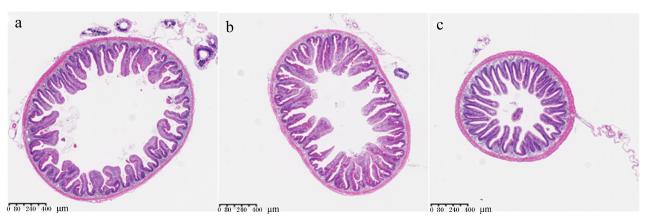
各组肠道组织切片见图1。由表3可知,PP8组肌层厚度显著高于PP0和PP7组(P<0.05);与PP0组相比,PP7和PP8组隐窝深度显著降低(P<0.05),而绒隐比显著提高(P<0.05);各组之间绒毛长度和黏膜厚度无显著性差异(P>0.05)。
图1 肠道组织切片

a:PP0组肠道组织切片 intestinal tissue section of PP0 group (4×);b:PP7组肠道组织切片 intestinal tissue section of PP7 group (4×);c:PP8组肠道组织切片 intestinal tissue section of PP8 group (4×)。

Fig.1 Intestinal tissue section

表3 戊糖片球菌对大黄鱼幼鱼肠道组织结构的影响

Table 3 Effects of Pediococcus pentosaceus on intestinal tissue structure of juvenile large yellow croaker

项目
Items
组别Groups P
P-value
PP0 PP7 PP8
绒毛长度Villus length/μm 391.73±16.47 373.76±20.72 409.13±32.62 0.278
隐窝深度Crypt depth/μm 51.50±11.95a 28.93±3.21b 27.40±4.07b 0.013
黏膜厚度Mucosal thickness/μm 15.33±4.15 13.13±3.01 15.93±1.88 0.553
肌层厚度Muscular thickness/μm 26.30±1.31b 19.36±3.58b 42.92±5.02a 0.001
绒隐比Villus length/crypt depth ratio 7.90±2.06b 13.07±2.15a 15.23±3.03a 0.026

2.4 戊糖片球菌对大黄鱼幼鱼肝脏抗氧化指标和血清免疫指标的影响

表4可知,PP7组肝脏CAT活性显著高于PP0与PP8组(P<0.05);PP8组肝脏AKP活性显著高于PP0组(P<0.05);PP7和PP8组血清AKP活性显著高于PP0组(P<0.05);PP7组血清LZM活性显著高于PP0和PP8组(P<0.05);各组之间肝脏SOD、ACP活性和血清ACP活性无显著性差异(P>0.05)。
表4 戊糖片球菌对大黄鱼幼鱼肝脏抗氧化指标和血清免疫指标的影响

Table 4 Effects of Pediococcus pentosaceus on liver antioxidant indexes and serum immune indexes of juvenile large yellow croaker

项目
Items
组别Groups P
P-value
PP0 PP7 PP8
肝脏Liver
超氧化物歧化酶SOD/(U/mg prot) 144.53±42.19 154.18±46.35 125.60±38.00 0.508
过氧化氢酶CAT/(nmol/mg prot) 150.33±15.12b 193.36±3.23a 153.58±9.60b 0.004
酸性磷酸酶ACP/(U/g prot) 80.51±11.79 93.01±4.57 85.22±7.30 0.263
碱性磷酸酶AKP/(U/g prot) 35.82±2.76b 55.47±2.93ab 60.30±16.72a 0.049
血清Serum
酸性磷酸酶ACP/(U/dL) 21.31±0.57 20.64±0.10 21.34±1.73 0.670
碱性磷酸酶AKP/(U/dL) 13.58±0.62b 16.04±0.37a 15.65±0.43a 0.002
溶菌酶LZM/(μg/mL) 0.17±0.05b 0.63±0.20a 0.35±0.14b 0.001

2.5 戊糖片球菌对大黄鱼幼鱼肠道微生物的影响

表5可知,PP7组PD_whole_tree指数显著高于PP0组(P<0.05);各组之间Chao1指数、Simpson指数和Shannon指数无显著性差异(P>0.05)。
表5 戊糖片球菌对大黄鱼幼鱼肠道微生物Alpha多样性的影响

Table 5 Effects of Pediococcus pentosaceus on Alpha diversity of intestinal microbes of juvenile large yellow croaker

项目
Items
组别Groups P
P-value
PP0 PP7
Chao1指数Chao1 index 774.83±86.01 862.66±14.29 0.156
Simpson指数Simpson index 99.74±0.02 99.76±0.00 0.411
Shannon指数Shannon index 9.11±0.14 9.24±0.03 0.195
PD_whole_tree指数PD_whole_tree index 74.44±2.63b 79.77±1.19a 0.033
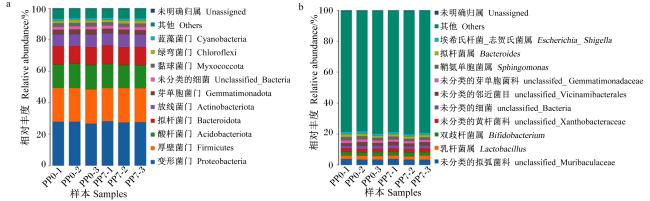
PP0和PP7组大黄鱼幼鱼肠道微生物在门水平上相对丰度排名前10的菌群分别是变形菌门(Proteobacteria)、厚壁菌门(Firmicutes)、酸杆菌门(Acidobacteriota)、拟杆菌门(Bacteroidota)、放线菌门(Actinobacteriota)、芽单胞菌门(Gemmatimonadota)、未分类的细菌(unclassified_Bacteria)、黏球菌门(Myxococcota)、绿弯菌门(Chloroflexi)、蓝藻菌门(Cyanobacteria)(图2-a)。在属水平上相对丰度排名前10的菌群分别是未分类的拟弧菌科(unclassified_Muribaculaceae)、乳杆菌属(Lactobacillus)、双歧杆菌属(Bifidobacterium)、未分类的黄杆菌科(unclassified_Xanthobacteraceae)、unclassified_Bacteria、未分类的邻近菌目(unclassified_Vicinamibacterales)、未分类的芽单胞菌科(unclassified_Gemmatimonadaceae)、鞘氨单胞菌属(Sphingomonas)、拟杆菌属(Bacteroides)和埃希氏杆菌_志贺氏菌属(Escherichia_Shigella)(图2-b)。
图2 PP0和PP7组大黄鱼幼鱼肠道微生物在门和属水平上排名前10的物种组成

a:门水平 phylum level;b:属水平 genus level。

Fig.2 Composition of species (top 10) at phylum and genus levels in intestinal microbes of juvenile large yellow croaker in PP0 and PP7 groups

表6可知,在门水平上,与PP0组相比,PP7组Gemmatimonadota和疣微菌门(Verrucomicrobiota)的相对丰度显著降低(P<0.05),而互养菌门(Synergistota)的相对丰度显著提高(P<0.05);与PP0组相比,PP7组粪厌氧菌属(Anaerostipes)、厌氧棍状菌属(Anaerotruncus)、蛭弧菌属(Bdellovibrio)、博斯氏菌属(Bosea)、乳球菌属(Lactococcus)、巨单胞菌属(Megamonas)和平螺纹丝菌属(Planifilum)的相对丰度显著提高(P<0.05),诺卡氏菌属(Nocardioides)、不黏柄菌属(Asticcacaulis)和艾琳6067菌属(Ellin6067)的相对丰度显著降低(P<0.05)。
表6 PP0和PP7组大黄鱼幼鱼肠道微生物中相对丰度差异显著的菌门和菌属

Table 6 Relative abundances of bacterial phyla and bacterial genera with significant difference in intestinal microbes of juvenile large yellow croaker in PP0 and PP7 groups %

项目
Items
组别Groups P
P-value
PP0 PP7
门水平Phylum level
芽单胞菌门Gemmatimonadota 3.059 7±0.050 0a 2.827 1±0.010 6b 0.010
疣微菌门Verrucomicrobiota 0.616 5±0.017 7a 0.525 6±0.026 9b 0.048
互养菌门Synergistota 0.084 3±0.006 0b 0.153 0±0.019 8a 0.029
属水平Genus level
粪厌氧菌属Anaerostipes 0.016 9±0.016 9b 0.092 7±0.008 9a 0.017
厌氧棍状菌属Anaerotruncus 0.033 2±0.017 4b 0.082 5±0.002 9a 0.049
蛭弧菌属Bdellovibrio 0.019 5±0.019 5b 0.081 8±0.010 7a 0.049
博斯氏菌属Bosea 0.000 0±0.000 0b 0.065 2±0.005 4a <0.001
乳球菌属Lactococcus 0.028 8±0.006 8b 0.060 5±0.006 6a 0.029
巨单胞菌属Megamonas 0.332 0±0.011 2b 0.397 1±0.014 7a 0.024
平螺纹丝菌属Planifilum 0.000 0±0.000 0b 0.040 4±0.009 3a 0.012
诺卡氏菌属Nocardioides 0.213 3±0.031 0a 0.033 1±0.017 8b 0.007
不黏柄菌属Asticcacaulis 0.062 9±0.005 0a 0.010 9±0.010 9b 0.012
艾琳6067菌属Ellin6067 0.537 2±0.013 2a 0.448 4±0.023 6b 0.030

2.6 戊糖片球菌对大黄鱼幼鱼肠道微生物代谢物的影响

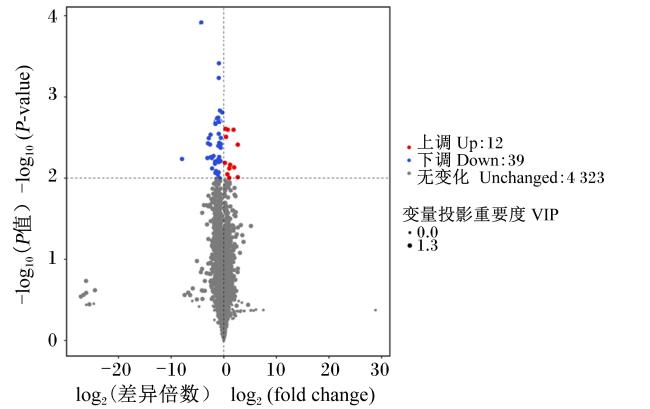
图3可知,PP0与PP7组之间共计有51个差异代谢物,其中上调的为12个,下调的为39个。
图3 差异代谢物倍数火山图

Fig.3 Differential metabolite multiple volcano map

表7可知,与PP0组相比,PP7组天冬酰胺-赖氨酸(Asn-Lys)、替西罗莫司(temsirolimus)和硝酸甘油(nitroglycerin)浓度显著提高(P<0.05),尿皮质醇(urocortisol)、加兰他敏(galantamine)、鹅肌肽(anserine)、环索奈德(cielesonide)、内吗啡肽-2(endomorphin-2)、喹那普利(quinapril)和硫酸盐(sulfate)浓度显著降低(P<0.05)。
表7 戊糖片球菌对大黄鱼幼鱼肠道微生物代谢物的影响

Table 7 Effects of Pediococcus pentosaceus on metabolites of intestinal microbes of juvenile large yellow croaker

项目
Items
组别Groups P
P-value
PP0 PP7
天冬酰胺-赖氨酸Asn-Lys 464.27±35.92b 742.28±70.18a 0.004
替西罗莫司Temsirolimus 311.16±133.47b 1 127.76±156.00a 0.002
硝酸甘油Nitroglycerin 57.82±2.22b 72.37±2.77a 0.002
尿皮质醇Urocortisol 116.82±4.68a 61.83±6.21b <0.001
加兰他敏Galantamine 18.36±3.66a 2.13±3.68b 0.006
鹅肌肽Anserine 53.52±3.53a 27.72±5.02b 0.002
环索奈德Cielesonide 119.49±10.51a 65.70±6.02b 0.002
内吗啡肽-2 Endomorphin-2 52.63±7.16a 8.60±9.48b 0.003
喹那普利Quinapril 84.71±12.58a 38.72±10.62b 0.008
硫酸盐Sulfate 86.61±8.70a 45.96±9.70b 0.006
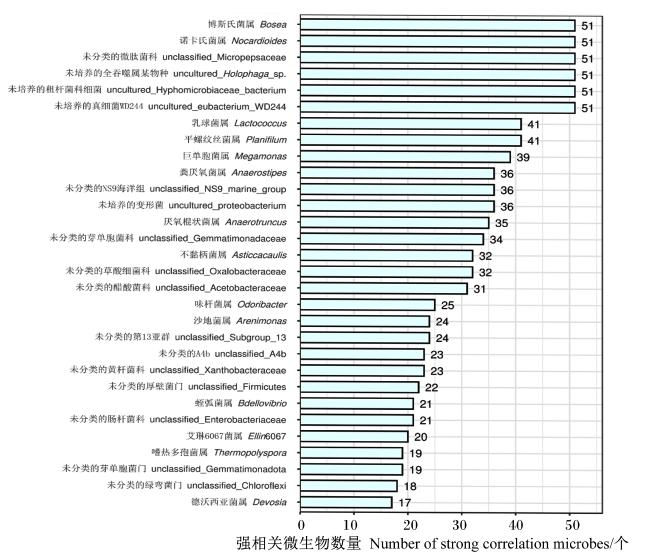
图4可知,与差异代谢物强相关的差异微生物有BoseaNocardioidesLactococcusPlanifilumMegamonas等,其中BoseaNocardioides与检测到的所有51个差异代谢物均有强相关关系。
图4 与差异代谢物强相关的差异微生物

Fig.4 Differential microbes strongly associated with differential metabolites

3 讨论

3.1 戊糖片球菌对大黄鱼幼鱼生长性能的影响

本试验结果表明,在饲料中添加戊糖片球菌可以提高大黄鱼幼鱼的WGR和SGR,但各组之间无显著性差异。鱼类内脏器官的生长发育情况不仅反映其生长健康状况,也直接影响着生长性能及各生长指标的变化情况[16]。本试验中,戊糖片球菌的添加并未影响大黄鱼幼鱼的HSI,这与Ai等[17]、柯巧珍等[18]分别在大黄鱼饲料中添加枯草芽孢杆菌和胜肽所产生的结果相似。PP0组大黄鱼幼鱼的VSI显著低于PP7与PP8组,推测是由PP0组脏器增长速率低于体重增长速率所导致。CF在各组之间无显著性差异,这与Dawood等[12]将灭活戊糖片球菌添加到饲料中对红鲷产生的影响相似。

3.2 戊糖片球菌对大黄鱼幼鱼体成分的影响

本试验结果表明,在饲料中添加戊糖片球菌可以显著提高大黄鱼幼鱼的肌肉水分含量,同时显著降低肌肉粗脂肪含量。研究发现,大黄鱼粗脂肪含量与水分含量呈反比例关系[19],本试验得出相似结果。吴琼等[20]筛选获得具有较强降胆固醇能力的肠道微生物戊糖片球菌P4能够抑制高脂饮食诱导的小鼠血清中胆固醇、甘油三酯与低密度脂蛋白胆固醇含量的升高,同时降低肝脏中胆固醇含量,从而达到降血脂的目的。本试验中,推测肌肉粗脂肪含量显著降低与戊糖片球菌对胆固醇的同化作用有关[7],这一过程降低了胆固醇的含量。此外,戊糖片球菌还具有胆盐水解酶活性,能将胆盐解共轭,产生游离胆酸并排出体外。为了弥补这种损失,胆固醇会转化为胆酸,从而降低胆固醇的吸收率。本试验中,肌肉粗蛋白质含量和全鱼粗蛋白质含量均无显著性差异。Le等[21]将戊糖片球菌AB01添加到凡纳滨对虾的饲料中,发现109 CFU/g组全虾粗蛋白质含量显著高于对照组。Huang等[22]将嗜盐芽孢杆菌添加至大黄鱼饲料后发现,108和1012 CFU/mL组全鱼粗蛋白质含量显著提高,而本试验中大黄鱼幼鱼肌肉和全鱼粗蛋白质含量未出现显著变化的原因可能是戊糖片球菌浓度不足。

3.3 戊糖片球菌对大黄鱼幼鱼肠道组织结构的影响

肠道为鱼类重要的消化器官,承担着营养物质消化吸收的核心任务。肠道由肠黏膜、黏膜下层、肌层和浆膜层4部分组成,黏膜厚度、绒毛长度、隐窝深度、肌层厚度和绒隐比均可反映出肠道消化吸收能力[23]。一般而言,隐窝深度越小,绒毛长度、肌层厚度、黏膜厚度和绒隐比越高,肠道消化吸收能力越强[24]。路广金等[9]在给尼罗罗非鱼投喂添加107 CFU/g戊糖片球菌饲料后发现,其绒毛长度、隐窝深度、肌层厚度和绒隐比均得到了显著提高;Gong等[10]在草鱼饲料中添加戊糖片球菌后发现,草鱼肠绒毛高度和杯状细胞数得到了显著提高;Won等[25]研究发现,在凡纳滨对虾饲料中添加戊糖片球菌能够显著提高肠道绒毛长度和肌层厚度;刘公言等[26]的研究表明,在伊拉肉兔饲粮中添加戊糖片球菌能够显著提高肠道绒毛长度。本试验结果与上述研究结果类似。本试验中PP8组大黄鱼幼鱼肌层厚度显著提高,此外,投喂添加107或108 CFU/g戊糖片球菌的饲料还可显著降低大黄鱼幼鱼隐窝深度并显著提高绒隐比,提高肠道的消化吸收能力,从而有利于大黄鱼幼鱼生长性能的提高。

3.4 戊糖片球菌对大黄鱼幼鱼抗氧化和免疫能力的影响

应激是机体的一种防御机制,适当的应激源刺激有助于机体快速适应环境变化,而过度的刺激则会造成机体疾病发展并恶化。当机体内的氧自由基突然激增后,机体内原先的平衡便会被打破,于是机体内的酶促系统和非酶促系统便会通过不同的方式使得机体重新回到平衡状态。其中,SOD和CAT在清除自由基方面发挥着重要作用,对机体细胞具有很强的防御功能。已有研究表明,在饲料中添加戊糖片球菌能够显著提高凡纳滨对虾的血清SOD活性[21]、泥蟹(Scylla paramamosain)的血清总超氧化物歧化酶(T-SOD)活性[27]与水貂(Neovison vison)的血清总抗氧化能力(T-AOC)[28],表明戊糖片球菌能够增强机体的抗氧化能力。本试验中,PP7组肝脏SOD活性高于对照组,与已有研究结果相似,而PP7组肝脏CAT活性显著高于另外2组,推测戊糖片球菌能够影响大黄鱼幼鱼机体更多的通过将过氧化氢转化为其他物质来达到清除氧自由基的目的,以增强机体抗氧化能力。
路广金等[9]研究发现,添加适宜浓度的戊糖片球菌PP-23可显著提升尼罗罗非鱼血清中AKP活性;Gong等[10]在草鱼饲料中添加戊糖片球菌后发现,草鱼血清AKP活性显著高于对照组,而对ACP活性未产生显著性影响。在本试验中,PP8组肝脏AKP活性显著高于PP0组,PP7和PP8组血清AKP活性显著高于PP0组,与上述研究结果相似。鱼体血清中含有一些抵御病原菌的分子,血清的抗菌能力是鱼体免疫机能强弱最直接的一种表现。LZM是鱼类先天免疫系统中的一种重要防御分子,具有溶解细菌的作用,是检测鱼体免疫能力的重要指标[29]。已有研究表明,在凡纳滨对虾饲料中添加戊糖片球菌可显著提高血清LZM活性[13,30]。在红鲷[12]、泥蟹[27]和草鱼[31]饲料中添加戊糖片球菌后同样发现血清LZM活性均得到了显著提高,本试验结果与上述结果相似。

3.5 戊糖片球菌对大黄鱼幼鱼肠道微生物的影响

肠道微生物对机体具有提供屏障、促进营养吸收、增强免疫力等作用,与机体健康密切相关。动物肠道中的微生物经过长期的演化过程在宿主体内具有高度适应性,这些微生物不仅扩展了宿主从食物中获取营养的能力,还能提供宿主必需的非营养因子并参与免疫系统[32],宿主、微生物和免疫系统三者之间相互作用以保障鱼类健康生长[33]
变形菌门和厚壁菌门为大黄鱼肠道优势菌门[34]。本试验中,戊糖片球菌的添加并未改变大黄鱼幼鱼肠道优势菌门的相对丰度,但显著降低了Gemmatimonadota和Verrucomicrobiota的相对丰度,并显著提高了Synergistota的相对丰度。Gemmatimonadota是一类在多种栖息地中普遍存在的细菌,但目前只有6种被培养和描述的物种,这些细菌在土壤中特别丰富,并且经常与植物和根际土壤相关联[35];Verrucomicrobiota的部分细菌具有甲烷氧化并利用复杂碳水化合物的能力[36];Synergistota能通过分解长链脂肪酸产生甲烷[37]。然而,这3类菌门在鱼类肠道中的主要作用还并未得到充分解释,因此,要探讨这3类菌门相对丰度的改变对机体所产生的影响还需要更多研究结果来阐明。
Anaerostipes在促进宿主健康方面具有潜在的有益作用[38],其中庞大厌氧杆菌(Anaerostipes hadrus)对低聚果糖(FOSs)具有胞外降解活性,并为其他微生物提供其降解物[39],而Anaerostipes具有产丁酸的特性,具有较强的抗逆性[40],丁酸是结肠细胞“燃料”和肠道稳态“守护者”[41]。研究发现,丁酸和短链脂肪酸受体可以对宿主多项生理活动产生有益影响,例如抑制肠道病原菌增殖、改善肠道炎症和促进生长等[42],推测本试验PP7组肠道结构优于PP0组与Anaerostipes相对丰度的升高有关。Bosea具有预防氧化损伤和应激相关疾病的潜力,可作为补充剂与常规药物联合使用,用于治疗癌症类疾病[43],推测PP7组抗氧化能力优于PP0组与Bosea相对丰度的升高有关。单形巨单胞菌(Megamonas funiformis)与肝脏脂肪变性相关参数呈负相关,可增加肠道丙酸浓度,其作用归功于抑制脂肪酸从头合成和促进β-氧化[44],推测PP7组肌肉粗脂肪含量显著低于PP0组与Megamonas funiformis相对丰度的升高有关。噬菌蛭弧菌(Bdellovibrio bacteriovorus)是一类寄生于其他细菌并能导致其裂解的革兰氏阴性细菌,具有类似于噬菌体的噬菌作用,能够裂解许多致病菌,在面对日益增长的多药耐药感染时,其能作为一种潜在的替代抗生素的治疗方法,具有重要的研究价值和应用潜力[45]。水生动物细菌性疾病的病原菌以气单胞菌属、假单胞菌属、弧菌属为主,这3个属的细菌均为革兰氏阴性菌,均能被蛭弧菌裂解[46]Nocardioides属于革兰氏阳性菌,是水产动物中的一种主要致病原,可感染多种海水鱼和淡水鱼,其中就包括经济水产物种大黄鱼,自从1969年第1例在日本报道以来,已经严重危害到很多地区特别是亚洲的水产养殖业[47],而在本试验中,戊糖片球菌的添加能够显著降低肠道中有害菌Nocardioides的相对丰度。
综上所述,推测Megamonas相对丰度的升高有助于改善大黄鱼幼鱼的体成分结构,降低粗脂肪含量;Anaerostipes具有产丁酸特性,能够保持肠道的稳定,有助于改善大黄鱼幼鱼的肠道结构,提升肠道消化吸收能力;Bosea相对丰度的升高有助于提升大黄鱼幼鱼的抗氧化能力;有益菌Bdellovibrio相对丰度的升高和有害菌Nocardioides相对丰度的降低则有助于提高大黄鱼幼鱼的免疫力,其中以降低有害菌Nocardioides的相对丰度为主,以提高有益菌Bdellovibrio的相对丰度为补充。

3.6 戊糖片球菌对大黄鱼幼鱼肠道微生物代谢物的影响

小分子代谢物是细胞调控过程的终产物,它们的种类和数量的变化被视为生命体对基因或环境变化的最终响应,对这些化合物进行全面的定性定量分析,即为代谢组学研究。代谢组学研究是目前系统生物学研究的一个重要组成部分,其能够通过揭示生物体在特定时间、特定环境下代谢网络的整体状态,深入解析生命活动规律的内在机制[48]
本试验中,差异代谢物对氨基酸合成通路与次级代谢物合成通路有较大影响,对衰老、能量代谢和脂质代谢等通路均有产生影响。Asn-Lys是由天冬酰胺和赖氨酸组成的二肽,其中赖氨酸(Lys)是多数鱼类的第一限制性氨基酸,鱼体自身不能合成,必须从食物中摄取。生长期的鱼类生长速度快,对Lys的需求量大,因此Lys又称为“生长性氨基酸”,其对维持水生动物的正常生长发育和神经系统的机能都发挥着重要作用[49],推测本试验PP7组大黄鱼幼鱼生长性能高于PP0组与Lys浓度的升高有关。而天冬酰胺(Asn)不但可以增加有氧条件下的新陈代谢,增加产能,还可以刺激肠黏膜细胞增殖,并且在机体免疫功能方面扮演着重要角色[50],推测本试验中PP7组大黄鱼幼鱼肠道组织结构优于PP0组与Lys浓度的升高有关。此外,在本试验中,PP7组替西罗莫司浓度显著高于PP0组,替西罗莫司可抑制各种肿瘤细胞的生长,通过抑制T细胞的增殖,其还能阻断与自身免疫相关的炎性反应[51],推测本试验中PP7组血清LZM活性显著提高与替西罗莫司浓度的升高有关。本试验中,PP7组尿皮质醇浓度显著低于PP0组,尿皮质醇可影响胆固醇合成代谢通路,推测本试验PP7组肌肉粗脂肪含量显著低于PP0组与尿皮质醇浓度的显著降低有关。加兰他敏多用于治疗阿尔兹海默症,其通过抑制胆碱酯酶的活性增加大脑中的乙酰胆碱水平,从而改善认知功能和记忆[52],但其如何影响鱼类神经还需要更多研究结果来阐明。此外,本试验除了检测到具有重要生物学意义的代谢物,同时也检测到其他生物学意义相对较小或功能未被具体阐明的代谢物,而这些代谢物如何影响鱼类的机体还有待进一步考察。
综上所述,推测Asn-Lys浓度的增加可以改善大黄鱼幼鱼的生长与肠道组织结构,而尿皮质醇浓度的降低则可能有助于肌肉粗脂肪含量的降低,替西罗莫司浓度的升高则可能是使得血清LZM活性升高的重要因素。

4 结论

戊糖片球菌具有调节肠道微生物代谢的能力,能够通过改善肠道菌群结构与肠道显微结构优化肠道微生态,并提升大黄鱼幼鱼的消化吸收功能,增强其抗氧化和免疫能力。
[1]
徐鹏, 柯巧珍, 苏永全, 等. 大黄鱼种质资源保护与利用现状及建议[J]. 水产学报, 2022, 46(4):674-682.

XU P, KE Q Z, SU Y Q, et al. Protection and utilization status and prospect of large yellow croaker (Larimichthys crocea) germplasm resources[J]. Journal of Fisheries of China, 2022, 46(4):674-682. (in Chinese)

[2]
包樱钰, 李菲菲, 温东辉. 我国海水养殖业的抗生素污染现状[J]. 海洋环境科学, 2021, 40(2):294-302.

BAO Y Y, LI F F, WEN D H. Antibiotic contamination in mariculture in China[J]. Marine Environmental Science, 2021, 40(2):294-302. (in Chinese)

[3]
XING C F, HU H H, HUANG J B, et al. Diet supplementation of Pediococcus pentosaceus in cobia (Rachycentron canadum) enhances growth rate,respiratory burst and resistance against photobacteriosis[J]. Fish & Shellfish Immunology, 2013, 35(4):1122-1128.

[4]
HUANG J B, WU Y C, CHI S C. Dietary supplementation of Pediococcus pentosaceus enhances innate immunity,physiological health and resistance to Vibrio anguillarum in orange-spotted grouper (Epinephelus coioides)[J]. Fish & Shellfish Immunology, 2014, 39(2):196-205.

[5]
LIN X N, XIA Y J, WANG G Q, et al. Lactic acid bacteria with antioxidant activities alleviating oxidized oil induced hepatic injury in mice[J]. Frontiers in Microbiology, 2018,9:2684.

[6]
DAMODHARAN K, LEE Y S, PALANIYANDI S A, et al. Preliminary probiotic and technological characterization of Pediococcus pentosaceus strain KID7 and in vivo assessment of its cholesterol-lowering activity[J]. Frontiers in Microbiology, 2015,6:768.

[7]
KUMAR M, NAGPAL R, KUMAR R, et al. Cholesterol-lowering probiotics as potential biotherapeutics for metabolic diseases[J]. Experimental Diabetes Research, 2012,2012:902917.

[8]
DE SOUZA DE AZEVEDO P O, MENDONÇA C M N, MORENO A C R, et al. Antibacterial and antifungal activity of crude and freeze-dried bacteriocin-like inhibitory substance produced by Pediococcus pentosaceus[J]. Scientific Reports, 2020, 10(1):12291.

[9]
路广金, 张冲, 周建平, 等. 两种乳酸菌对尼罗罗非鱼生长及免疫性能的影响[J]. 中国水产科学, 2023, 30(8):989-999.

LU G J, ZHANG C, ZHOU J P, et al. Effects of two Lactobacillus on the growth and immune performance of Nile tilapia (Oreochromis niloticus)[J]. Journal of Fishery Sciences of China, 2023, 30(8):989-999. (in Chinese)

[10]
GONG L, HE H C, LI D J, et al. A new isolate of Pediococcus pentosaceus (SL001) with antibacterial activity against fish pathogens and potency in facilitating the immunity and growth performance of grass carps[J]. Frontiers in Microbiology, 2019,10:1384.

[11]
LIU Y, ZHU D X, LIU J W, et al. Pediococcus pentosaceus PR-1 modulates high-fat-died-induced alterations in gut microbiota,inflammation,and lipid metabolism in zebrafish[J]. Frontiers in Nutrition, 2023,10:1087703.

[12]
DAWOOD M A O, KOSHIO S, ISHIKAWA M, et al. Effects of dietary inactivated Pediococcus pentosaceus on growth performance,feed utilization and blood characteristics of Red Sea bream,Pagrus major juvenile[J]. Aquaculture Nutrition, 2016, 22(4):923-932.

[13]
ADEL M, YEGANEH S, DAWOOD M A O, et al. Effects of Pediococcus pentosaceus supplementation on growth performance,intestinal microflora and disease resistance of white shrimp,Litopenaeus vannamei[J]. Aquaculture Nutrition, 2017, 23(6):1401-1409.

[14]
阿拉腾珠拉, 胡永飞. 组学视角下养殖动物消化道微生物组结构与功能研究进展[J]. 微生物学报, 2023, 63(5):1850-1862.

, ALATENGZHULA, HU Y F. Research advances in livestock digestive tract microbiome[J]. Acta Microbiologica Sinica, 2023, 63(5):1850-1862. (in Chinese)

[15]
田鹤, 税光厚. 基于质谱技术的代谢组学分析方法研究进展[J]. 生物技术通报, 2021, 37(1):24-31.

DOI

TIAN H, SHUI G H. Advances in analysis methods of mass spectrometry-based metabolomics[J]. Biotechnology Bulletin, 2021, 37(1):24-31. (in Chinese)

DOI

[16]
陈俊蔚, 刘洋, 谢仰杰, 等. 大黄鱼体重和内脏指标的相关性分析[J]. 集美大学学报(自然科学版), 2016, 21(2):87-93.

CHEN J W, LIU Y, XIE Y J, et al. Correlation of visceral index and body weight in the large yellow croaker (Larimichthys crocea)[J]. Journal of Jimei University (Natural Science Edition), 2016, 21(2):87-93. (in Chinese)

[17]
AI Q H, XU H G, MAI K S, et al. Effects of dietary supplementation of Bacillus subtilis and fructooligosaccharide on growth performance,survival,non-specific immune response and disease resistance of juvenile large yellow croaker,Larimichthys crocea[J]. Aquaculture, 2011, 317(1/2/3/4):155-161.

[18]
柯巧珍, 余训凯, 张永兴, 等. 饲料中添加胜肽和益生菌对大黄鱼生长性能和体组成的影响[J]. 应用海洋学学报, 2018, 37(1):141-145.

KE Q Z, YU X K, ZHANG Y X, et al. Effects of Sheng peptides and probiotics supplementation on the growth performance and body composition of large yellow croaker[J]. Journal of Applied Oceanography, 2018, 37(1):141-145. (in Chinese)

[19]
张农, 刘海新, 李庐峰, 等. 养殖大黄鱼和天然大黄鱼的理化指标比较[J]. 渔业现代化, 2007, 34(6):26-30.

ZHANG N, LIU H X, LI L F, et al. Comparative study of physichemical parameters of cultured and wild yellow croaker[J]. Fishery Modernization, 2007, 34(6):26-30. (in Chinese)

[20]
吴琼, 赵昕, 杜立欣, 等. 戊糖片球菌改善高脂饮食小鼠肠道菌群机制研究[J]. 天津科技大学学报, 2023, 38(2):28-34,69.

WU Q, ZHAO X, DU L X, et al. Mechanism of Pediococcus pentosaceus improving intestinal flora in mice with high-fat diet[J]. Journal of Tianjin University of Science & Technology, 2023, 38(2):28-34,69. (in Chinese)

[21]
LE B, KIM D G, PHUOC N N, et al. Dietary supplementation with Pediococcus pentosaceus enhances the innate immune response in and promotes growth of Litopenaeus vannamei shrimp[J]. Journal of Fish Diseases, 2022, 45(9):1343-1354.

[22]
HUANG L, SHUI X M, WANG H Y, et al. Effects of Bacillus halophilus on growth,intestinal flora and metabolism of Larimichthys crocea[J]. Biochemistry and Biophysics Reports, 2023,35:101546.

[23]
罗辉, 周剑, 叶华. 微生态制剂对鱼类肠道结构和消化酶活性的影响[J]. 水产科学, 2006, 25(2):105-108.

LUO H, ZHOU J, YE H. Effects of probiotics on structure and activity of digestive enzymes in intestine tracts in fish[J]. Fisheries Science, 2006, 25(2):105-108. (in Chinese)

[24]
欧红霞, 王广军, 李志斐, 等. 不同饲料对大口黑鲈肠道组织结构的影响[J]. 水产科学, 2020, 39(6):902-907.

OU H X, WANG G J, LI Z F, et al. Influence of different diets on intestinal histological morphologic structure of largemouth bass Micropterus salmoides[J]. Fisheries Science, 2020, 39(6):902-907. (in Chinese)

[25]
WON S, HAMIDOGHLI A, CHOI W, et al. Evaluation of potential probiotics Bacillus subtilis WB60,Pediococcus pentosaceus,and Lactococcus lactis on growth performance,immune response,gut histology and immune-related genes in whiteleg shrimp,Litopenaeus vannamei[J]. Microorganisms, 2020, 8(2):281.

[26]
刘公言, 高淑霞, 白莉雅, 等. 饲粮中添加不同益生菌对肉兔生长性能、屠宰性能、回肠黏膜免疫指标和盲肠发酵指标的影响[J]. 动物营养学报, 2023, 35(1):527-535.

DOI

LIU G Y, GAO S X, BAI L Y, et al. Effects of dietary adding different probiotics on growth performance,slaughter performance,ileum mucosal immune indexes and cecal fermentation indexes of meat rabbits[J]. Chinese Journal of Animal Nutrition, 2023, 35(1):527-535. (in Chinese)

[27]
YANG Q H, Y L, ZHANG M, et al. Lactic acid bacteria,Enterococcus faecalis Y17 and Pediococcus pentosaceus G11,improved growth performance,and immunity of mud crab (Scylla paramamosain)[J]. Fish & Shellfish Immunology, 2019,93:135-143.

[28]
隗晗, 刘可园, 谭展清, 等. 饲粮中添加戊糖片球菌对育成期水貂生长性能、营养物质表观消化率以及血清生化、抗氧化和免疫指标的影响[J]. 动物营养学报, 2023, 35(10):6665-6675.

DOI

WEI H, LIU K Y, TAN Z Q, et al. Effects of dietary Pediococcus pentosaceus on growth performance,nutrient apparent digestibility,serum biochemical,antioxidant and immune indices of minks during growing period[J]. Chinese Journal of Animal Nutrition, 2023, 35(10):6665-6675. (in Chinese)

DOI

[29]
SAURABH S, SAHOO P K. Lysozyme:an important defence molecule of fish innate immune system[J]. Aquaculture Research, 2008, 39(3):223-239.

[30]
BALLANTYNE R, LEE J W, WANG S T, et al. Dietary administration of a postbiotic,heat-killed Pediococcus pentosaceus PP4012 enhances growth performance,immune response and modulates intestinal microbiota of white shrimp,Penaeus vannamei[J]. Fish & Shellfish Immunology, 2023,139:108882.

[31]
AHMADIFAR E, SADEGH T H, DAWOOD M A O, et al. The effects of dietary Pediococcus pentosaceus on growth performance,hemato-immunological parameters and digestive enzyme activities of common carp (Cyprinus carpio)[J]. Aquaculture, 2020,516:734656.

[32]
MAYNARD C L, ELSON C O, HATTON R D, et al. Reciprocal interactions of the intestinal microbiota and immune system[J]. Nature, 2012, 489(7415):231-241.

[33]
LÓPEZ NADAL A, IKEDA-OHTSUBO W, SIPKEMA D, et al., Feed,microbiota,and gut immunity:using the zebrafish model to understand fish health[J]. Frontiers in Immunology, 2020,11:114.

[34]
李英英, 陈曦, 宋铁英. 不同生长速度的大黄鱼肠道菌群结构的差异[J]. 大连海洋大学学报, 2017, 32(5):509-513.

LI Y Y, CHEN X, SONG T Y. Differences in intestinal flora of cultured large yellow croaker Pseudosciaena crocea with different growth rates[J]. Journal of Dalian Fisheries University, 2017, 32(5):509-513. (in Chinese)

[35]
MUJAKIĆ I, PIWOSZ K, KOBLÍŽEK M. Phylum gemmatimonadota and its role in the environment[J]. Microorganisms, 2022, 10(1):151.

[36]
冯希. 海洋疣微菌的分离、鉴定及疣微菌门分类体系整理[D]. 硕士学位论文. 济南: 山东大学, 2021.

FENG X. Isolation, polyphasic taxonomy of marine strains of Verrucomicrobia and updation the classification system of Verrucomicrobia[D]. Master’s Thesis. Jinan: Shandong University, 2021. (in Chinese)

[37]
USMAN M, ZHAO S, JEON B H, et al. Microbial β-oxidation of synthetic long-chain fatty acids to improve lipid biomethanation[J]. Water Research, 2022,213:118164.

[38]
BUI T P N, MANNERÅS-HOLM L, PUSCHMANN R, et al. Conversion of dietary inositol into propionate and acetate by commensal Anaerostipes associates with host health[J]. Nature Communications, 2021, 12(1):4798.

[39]
ENDO A, TANNO H, KADOWAKI R, et al. Extracellular fructooligosaccharide degradation in Anaerostipes hadrus for co-metabolism with non-fructooligosaccharide utilizers[J]. Biochemical and Biophysical Research Communications, 2022,613:81-86.

[40]
KADOWAKI R, TANNO H, MAENO S, et al. Spore-forming properties and enhanced oxygen tolerance of butyrate-producing Anaerostipes spp.[J]. Anaerobe, 2023,82:102752.

[41]
GUILLOTEAU P, MARTIN L, EECKHAUT V, et al. From the gut to the peripheral tissues:the multiple effects of butyrate[J]. Nutrition Research Reviews, 2010, 23(2):366-384.

[42]
BEDFORD A, GONG J. Implications of butyrate and its derivatives for gut health and animal production[J]. Animal Nutrition, 2018, 4(2):151-159.

DOI PMID

[43]
HASSAN S, AHMAD B, SHAH J, et al. Protective role of Monotheca buxifolia and Bosea amherstiana against H2O2 -induced DNA damage in human lymphocytes and its effect on oxidative enzymes[J]. Pakistan Journal of Pharmaceutical Sciences, 2019, 32(2):601-606.

[44]
YANG X Y, ZHANG M H, LIU Y, et al. Inulin-enriched Megamonas funiformis ameliorates metabolic dysfunction-associated fatty liver disease by producing propionic acid[J]. NPJ Biofilms and Microbiomes, 2023, 9(1):84.

[45]
NEGUS D, MOORE C, BAKER M, et al. Predator versus pathogen:how does predatory Bdellovibrio bacteriovorus interface with the challenges of killing gram-negative pathogens in a host setting?[J]. Annual Review of Microbiology, 2017,71:441-457.

[46]
刘朝阳, 罗海中. 噬菌蛭弧菌及其在大菱鲆养殖中的应用探讨[J]. 水产科技情报, 2007, 34(6):271-274.

LIU C Y, LUO H Z. Bdellovibrio bacteriovorus and its application to the culture of turbot Scophthalmus maximus[J]. Fisheries Science & Technology Information, 2007, 34(6):271-274. (in Chinese)

[47]
WANG G L, YUAN S P, JIN S. Nocardiosis in large yellow croaker,Larimichthys crocea (Richardson)[J]. Journal of Fish Diseases, 2005, 28(6):339-345.

[48]
张凤霞, 王国栋. 现代代谢组学平台建设及相关技术应用[J]. 遗传, 2019, 41(9):883-892.

ZHANG F X, WANG G D. Current metabolomics platforms:technical composition and applications[J]. Hereditas, 2019, 41(9):883-892. (in Chinese)

[49]
高娅俊, 张曦, 邓君明. 鱼类赖氨酸营养生理研究进展[J]. 饲料工业, 2015, 36(24):35-39.

GAO Y J, ZHANG X, DENG J M. Research progress in lysine requirement for fish[J]. Feed Industry, 2015, 36(24):35-39. (in Chinese)

[50]
王嘉凡, 陈松, 高向东. 阿尔兹海默症靶点及相关药物研究进展[J]. 药物生物技术, 2021, 28(3):323-330.

WANG J F, CHEN S, GAOX D, et al. Research progress of alzheimer’s disease targets and related drugs[J]. Chinese Journal of Pharmaceutical Biotechnology, 2021, 28(3):323-330. (in Chinese)

Outlines

/