RESEARCH PAPER

Curcumin Improves Adverse Effects of Oxidized Fish Oil on Intestine of Pelteobagrus fulvidraco

  • CHEN Yanxuan , 1, 2 ,
  • WANG Guoxia 1 ,
  • QIU Jianqiang 1, 3 ,
  • LIU Yan 4 ,
  • SHI Hequn 4 ,
  • DONG Ruiqi 1, 5 ,
  • PENG Kai , 1, *
Expand
  • 1 Guangdong Provincial Key Laboratory of Animal Breeding and Nutrition, Ministry of Agriculture and Rural Affairs, Key Laboratory of Animal Nutrition and Feed Science in South China, Institute of Animal Science, Guangdong Academy of Agricultural Sciences, Guangzhou 510640, China
  • 2 College of Animal Science and Technology, Zhongkai University of Agriculture and Engineering, Guangzhou 510225, China
  • 3 College of Fisheries, Huazhong Agricultural University, Wuhan 430070, China
  • 4 Guangzhou Cohoo Biotechnology Co., Ltd., Guangzhou 510145, China
  • 5 College of Fisheries and Life Sciences, Shanghai Ocean University, Shanghai 201306, China
*professor, E-mail:

Received date: 2024-01-31

  Online published: 2024-08-12

Abstract

This study was conducted to investigate the effects of curcumin on the intestinal digestive enzyme activities, tissue morphology and microflora structure of Pelteobagrus fulvidraco fed diets containing oxidized fish oil. Six isoproteic and isolipidic diets were prepared which contained 30% fresh fish oil (T1 group), 30% oxidised fish oil (T2 group), 30% oxidized fish oil+0.02% curcumin (T3 group), 30% oxidized fish oil+0.04% curcumin (T4 group), 30% oxidized fish oil+0.06% curcumin (T5 group) and 30% oxidized fish oil+0.08% curcumin (T6 group). A total of 720 healthy Pelteobagrus fulvidraco with an initial body weight of (19.6±0.3) g were randomly distributed into six groups (four replicates in each group and 30 fish in each replicate), which were fed with each of the 6 experimental diets. The feeding trial was lasted for 56 days. The results showed as follows: compared with the T1 group, there was no significant difference in intestinal digestive enzyme activities in the T2 group (P>0.05), but the length of intestinal villi was significantly reduced (P<0.05); at the genus level, the relative abundances of Pseudomonas and Ralstonia were significantly decreased (P<0.05), and the relative abundance of Cetobacterium was significantly increased in the T2 group (P<0.05). Compared with the T2 group, the intestinal trypsin activity, villus width, goblet cell number were significantly increased in the T6 group (P<0.05), the intestinal lipase activity was significantly increased in the T4 to T6 groups (P<0.05), the intestinal villus length was significantly increased in the T3 to T6 groups (P<0.05), and the intestinal muscular thickness was significantly increased in the T3 and T6 groups (P<0.05); at the genus level, the relative abundances of Clostridium and Candidatus_Arthromitus were significantly increased in the T4 group (P<0.05), the relative abundance of Pseudomonas was significantly increased (P<0.05) and the relative abundance of Cetobacterium was significantly decreased (P<0.05) in the T4 to T6 groups, the relative abundance of Ralstonia was significantly increased in the T5 and T6 groups (P<0.05). As dietary curcumin supplemental levels increasing, the intestinal lipase activity showed a linear effect (P=0.001), the villi length showed a quadratic effect (P<0.001), the villi width showed a linear effect (P=0.001) and a quadratic effect (P<0.001), and the goblet cell number showed a linear effect (P=0.030) and a quadratic effect (P=0.007); at genus level, the relative abundance of Pseudomonas showed a linear effect (P<0.001) and a quadratic effect (P<0.001), the relative abundance of Cetobacterium showed a linear effect (P=0.001) and a quadratic effect (P=0.001), and the relative abundance of Ralstonia showed a quadratic effect (P<0.001). In conclusion, adding 3% oxidized fish oil in the Pelteobagrus fulvidraco diet induces intestinal tissue structure damage, and adding 0.04% to 0.08% of curcumin can increase the intestinal trypsin and lipase activities as well as the relative abundances of beneficial bacteria Pseudomonas and Candidatus_Arthromitus, and repair the structural damage to intestinal villius of Pelteobagrus fulvidraco induced by oxidized fish oil.

Cite this article

CHEN Yanxuan , WANG Guoxia , QIU Jianqiang , LIU Yan , SHI Hequn , DONG Ruiqi , PENG Kai . Curcumin Improves Adverse Effects of Oxidized Fish Oil on Intestine of Pelteobagrus fulvidraco[J]. Chinese Journal of Animal Nutrition, 2024 , 36(8) : 5297 -5307 . DOI: 10.12418/CJAN2024.450

黄颡鱼(Pelteobagrus fulvidraco)无鳞、无肌间刺,肉质嫩滑,营养丰富,味道鲜美,是我国优质的淡水养殖品种。《2024中国渔业统计年鉴》数据显示,2023年我国黄颡鱼养殖产量达到62.3万t,并呈逐年增长趋势[1]。在如今高度集约化养殖模式下,黄颡鱼的健康养殖一直备受人们关注,其中肠道健康是研究热点之一。肠道作为鱼类重要的消化和免疫器官,是营养物质消化吸收的场所,也是防止细菌等有害物质入侵的屏障,但其易受饲料等因素的影响[2]。鱼油是水产饲料主要的脂肪源,但鱼油在加工和储存过程中容易氧化变质,产生醛、酮等有害化合物,危害动物健康[3]。已有研究表明,氧化鱼油会导致黄颡鱼的生长性能和抗氧化能力下降[4]、肠绒毛受损[5],使水产动物肠道消化酶活性下降[6-9]、肠道结构损伤[5,8,10-13]、肠道有害菌丰度增加[13-14],从而诱发肠炎并危害肠道健康。
姜黄素是一种具有抗氧化、抗炎、抗菌等生物活性的天然多酚类化合物[15]。相关研究表明,姜黄素能提高水产动物的肠道消化酶活性[16-18]、改善肠道组织结构[16,19-22]、调节肠道菌群平衡[16,23-24],促进肠道健康。适量姜黄素能够提高黄颡鱼的生长性能、肠道消化功能及抗氧化能力[25-26],还可以缓解氨氮胁迫导致的黄颡鱼巨噬细胞炎症反应、氧化应激以及细胞凋亡,诱导巨噬细胞M2型极化[27]。然而,有关姜黄素改善氧化鱼油对黄颡鱼不利影响的报道较少。本实验室已研究了氧化鱼油及姜黄素对黄颡鱼生长性能、血清和肝脏指标、体色、肌肉质构特性的影响,表明适量添加姜黄素不影响黄颡鱼的生长性能,并可以提高鱼体的抗氧化和免疫力,修复氧化鱼油所导致的体色退化,改变肌肉的质构特性[28]。在此基础上,本试验进一步研究研究姜黄素对饲喂氧化鱼油黄颡鱼肠道消化酶活性、肠道组织结构、肠道菌群结构的影响,旨为姜黄素在黄颡鱼饲料中的应用提供参考依据。

1 材料与方法

1.1 试验饲料

首先制备含3%新鲜鱼油(过氧化值为23.2 meq/kg、丙二醛含量为3.3 mg/kg)的基础饲料(T1组),然后将基础饲料中的新鲜鱼油等量替换为氧化鱼油(过氧化值为45.2 meq/kg,丙二醛含量为15.5 mg/kg),配制成氧化鱼油饲料(T2组),再在氧化鱼油饲料中分别添加0.02%(T3组)、0.04%(T4组)、0.06%(T5组)和0.08%(T6组)的姜黄素,共配制出6种试验饲料,其组成及营养水平参见本实验室相关研究[28]。氧化鱼油由本实验室自制,其制备方法为:将500 g新鲜鱼油装入1 L广口烧瓶中,在50 ℃恒温水浴的条件下连续充入空气进行氧化,每隔2 d取少量鱼油测定过氧化值,当过氧化值达到预期值时停止充气,将制备好的氧化鱼油于-20 ℃冰箱中保存备用。鱼油的过氧化值和丙二醛含量分别依据《饲料原料过氧化值的测定》(NY/T 4424—2023)和国家标准《饲料中丙二醛的测定 高效液相色谱法》(GB/T 28717—2012)进行测定。全部饲料原料粉碎后过60目筛,维生素和矿物质预混料等微量组分采用逐级扩大法混匀,所有原料经V型混合机充分混匀后,用SLX-80型双螺杆挤压机制成直径为2 mm的颗粒饲料,55 ℃烘干后自然冷却至室温,装入塑料密封袋,于-20 ℃冰箱中保存。

1.2 试验设计与养殖管理

养殖试验在广东省农业科学院水产研究所室内循环水养殖系统中进行,养殖系统由24个圆柱形玻璃纤维桶(直径80 cm,高70 cm)组成。黄颡鱼购于广州市某鱼苗孵化场,先于室外水泥池中暂养1周,每天饱食投喂基础饲料。暂养结束后,选取初始体重为(19.6±0.3) g的健康黄颡鱼720尾,随机分配到24个纤维桶中,每桶放养30尾。将24桶黄颡鱼随机分为6组,每组分配4桶,对应饲喂1种试验饲料。试验鱼每日饱食投喂2次(09:00和18:00),并记录饲料投喂量和鱼死亡情况,养殖周期为56 d。试验期间维持水体pH在7.5~8.0,水温在(27.0±2.4) ℃,氨氮和亚硝酸盐含量分别不高于0.02和0.01 mg/L,溶氧含量大于5.0 mg/L。

1.3 采样与分析

1.3.1 肠道消化酶活性

每桶随机取4尾鱼,解剖并分离肠道,用生理盐水润洗后将肠道置于冰盘上,在前肠部位用剪刀取约2 cm长的肠段,并转移到2 mL冻存管中(每桶鱼的肠道样品转移到同一个冻存管中),立刻置于液氮中保存。随后在肠道样品中加入适量生理盐水,使用匀浆机匀浆,离心(2 000×g,10 min)后取上清液(上清液的制备方法参考邱建强等[29])。采用南京建成生物工程研究所生产的试剂盒并参照说明书步骤测定肠道胰蛋白酶、脂肪酶及淀粉酶活性。

1.3.2 肠道组织形态

每桶随机取4尾鱼,解剖并分离肠道,在中肠部位用剪刀取约1 cm长的肠段,完全浸没于4%多聚甲醛中,固定24 h,随后制作石蜡组织切片(切片制作方法参考符兵等[30]),分别采用苏木精-伊红染色法(HE染色法)和高碘酸-无色品红染色法(PAS染色法)进行切片染色。将染色后的组织切片置于Nikon(Eclipse Ci-L)显微镜下进行成像拍照,随后使用Image-Pro Plus 6.0分析软件进行统计分析,测定肠道的绒毛长度、绒毛宽度、肌层厚度和杯状细胞数。

1.3.3 肠道菌群结构

每桶随机取4尾鱼,在无菌工作台中解剖,取肠道内容物,提取DNA并对16S rDNA “V3+V4”区进行PCR扩增,引物序列及PCR扩增条件参考符兵等[30]。将纯化的扩增产物进行等量混合,连接测序接头,构建测序文库,使用Illumina PE250平台上机测序。对获得的物种特征序列进行质控、拼接、过滤,区分样本后进行操作分类单元(OTU)聚类分析和物种分类学分析,基于OTU和分类学信息对肠道菌群进行物种组成分析及多样性分析(α多样性和β多样性)。

1.4 数据统计分析

使用SPSS 22.0软件进行统计分析,试验结果先进行单因素方差分析(one-way ANOVA),然后采用Duncan氏法进行组间多重比较,若不满足方差齐性,则采用Dunnett-T3检验法进行组间多重比较。采用多项式比较分析平均值的线性和二次效应。P<0.05表示差异显著,0.05≤P<0.10表示具有显著性趋势。

2 结果

2.1 肠道消化酶活性

表1可知,与T1组相比,T2组肠道胰蛋白酶和脂肪酶活性差异不显著(P>0.05)。与T1和T2组相比,T6组肠道胰蛋白酶活性显著增加(P<0.05);T4~T6组肠道脂肪酶活性较T1~T3组显著增加(P<0.05)。随着饲料中姜黄素添加量的增加,肠道脂肪酶活性呈线性效应(P=0.001)。肠道淀粉酶活性各组之间差异不显著(P>0.05)。
表1 姜黄素对饲喂含氧化鱼油饲料的黄颡鱼肠道消化酶活性的影响

Table 1 Effects of curcumin on intestinal digestive enzyme activities of Pelteobagrus fulvidraco fed diets containing oxidized fish oil U/mg prot

项目
Items
组别Groups SEM PP-value
T1 T2 T3 T4 T5 T6 方差
分析
ANOVA
线性效应
Linear
effect
二次效应
Quadratic
effect
胰蛋白酶Trypsin 392.62c 405.34bc 490.61ab 464.04abc 453.08abc 501.63a 36.84 0.011 0.603 0.872
脂肪酶Lipase 29.95b 30.65b 25.86b 41.15a 45.06a 44.00a 2.61 0.003 0.001 0.308
淀粉酶Amylase 5.51 5.40 5.75 4.44 5.15 4.21 0.73 0.438 0.108 0.770

同行数据肩标不同字母表示组间存在显著差异(P<0.05)。下表同。

In the same row, values with different letter superscripts are significantly different between groups (P<0.05). The same as below.

2.2 肠道组织形态

图1可知,T1组肠道组织结构完整,肠绒毛形态正常、排列整齐;T2和T3组肠绒毛排列紊乱,部分绒毛脱落;T4和T5组肠绒毛排列整齐,但多数绒毛萎缩;T6组肠绒毛形态正常、排列整齐。
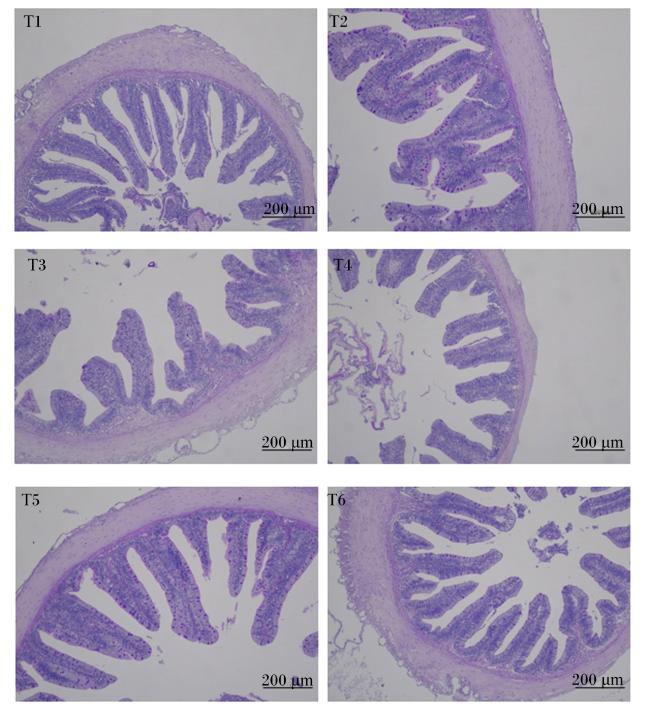
图1 姜黄素对饲喂含氧化鱼油饲料的黄颡鱼肠道组织形态的影响

T1:T1组 T1 group;T2:T2组 T2 group;T3:T3组 T3 group;T4:T4组 T4 group;T5:T5组 T5 group;T6:T6组 T6 group。下图同 the same as below。

Fig.1 Effects of curcumin on intestinal tissue morphology of Pelteobagrus fulvidraco fed diets containing oxidized fish oil

表2可知,与T1组相比,T2~T5组肠道绒毛长度显著降低(P<0.05),但绒毛宽度、肌层厚度和杯状细胞数均无显著差异(P>0.05);T6组肠绒毛宽度和杯状细胞数显著增加(P<0.05)。与T2组相比,T3~T6组肠绒毛长度显著增加(P>0.05);T3和T6组肌层厚度显著增加(P<0.05);T6组肠绒毛宽度和杯状细胞数显著增加(P<0.05)。随着饲料中姜黄素添加量的增加,绒毛长度呈二次效应(P<0.001),绒毛宽度呈线性(P=0.001)和二次效应(P<0.001),杯状细胞数亦呈线性(P=0.030)和二次效应(P=0.007)。
表2 姜黄素对饲喂含氧化鱼油饲料的黄颡鱼肠道绒毛结构的影响

Table 2 Effects of curcumin on intestinal villus structure of Pelteobagrus fulvidraco fed diets containing oxidized fish oil

项目
Items
组别Groups SEM PP-value
T1 T2 T3 T4 T5 T6 方差
分析
ANOVA
线性效应
Linear
effect
二次效应
Quadratic
effect
绒毛长度
Villus length/mm
0.53a 0.32c 0.43b 0.42b 0.42b 0.55a 0.04 <0.001 0.148 <0.001
绒毛宽度
Villus width/mm
0.10b 0.09b 0.11ab 0.11ab 0.11ab 0.13a 0.01 0.008 0.001 <0.001
肌层厚度
Muscular
thickness/mm
0.14ab 0.09b 0.16a 0.12ab 0.14ab 0.15a 0.02 0.017 0.676 0.966
杯状细胞数
Goblet cell count/
(个/绒毛)
20.11b 19.65b 22.00b 19.73b 25.18ab 30.79a 3.48 0.004 0.030 0.007

2.3 肠道菌群结构

2.3.1 门水平下肠道菌群的组成及相对丰度

在门水平下,黄颡鱼肠道菌群主要由变形菌门(Proteobacteria)、梭杆菌门(Fusobacteria)、厚壁菌门(Firmicutes)、放线菌门(Actinobacteria)、拟杆菌门(Bacteroidetes)、互养菌门(Synergistetes)、螺旋体门(Spirochaetes)、热袍菌门(Thermotogae)、芽单胞菌门(Gemmatimonadetes)、蓝菌门(Cyanobacteria)组成。相对丰度排名前5的优势菌门为Proteobacteria、Fusobacteria、Firmicutes、Actinobacteria和Bacteroidetes。
表3可知,各组之间Actinobacteria和Bacteroidetes的相对丰度均无显著差异(P>0.05)。与T1组相比,T2组Proteobacteria和Firmicutes的相对丰度均无显著差异(P>0.05),Fusobacteria的相对丰度显著增加(P<0.05);T3组Proteobacteria的相对丰度显著下降(P<0.05),Fusobacteria的相对丰度显著增加(P<0.05);T4组Firmicutes的相对丰度显著增加(P<0.05)。与T2组相比,T3组Proteobacteria的相对丰度显著下降(P<0.05),Fusobacteria的相对丰度显著增加(P<0.05);T4组Firmicutes的相对丰度显著增加(P<0.05);T4~T6组Fusobacteria的相对丰度显著下降(P<0.05);T5和T6组Proteobacteria的相对丰度显著增加(P<0.05)。
表3 门水平下黄颡鱼肠道的优势菌群(相对丰度排名前5)

Table 3 Intestinal dominant microflora at phylum level (top 5 in relative abundance) %

项目
Items
组别Groups SEM PP-value
T1 T2 T3 T4 T5 T6 方差
分析
ANOVA
线性效应
Linear
effect
二次效应
Quadratic
effect
变形菌门
Proteobacteria
78.13ab 64.88b 27.51c 66.55b 89.30a 92.13a 8.55 <0.001 0.001 <0.001
梭杆菌门
Fusobacteria
7.74c 22.95b 57.64a 0.77c 2.18c 2.05c 7.89 <0.001 0.001 <0.001
厚壁菌门
Firmicutes
7.81b 7.64b 8.11b 27.47a 5.09b 4.08b 1.67 0.008 0.830 0.017
放线菌门
Actinobacteria
0.32 0.47 2.44 0.60 0.35 0.43 0.15 0.535 0.828 0.280
拟杆菌门
Bacteroidetes
0.01 0.86 0.95 1.38 0.69 0.07 0.01 0.283 0.955 0.253

2.3.2 属水平下肠道菌群的组成及相对丰度

在属水平下,黄颡鱼肠道菌群主要由假单胞菌属(Pseudomonas)、鲸杆菌属(Cetobacterium)、罗尔斯通氏菌属(Ralstonia)、梭状芽孢杆菌属(Clostridium)、分节丝状菌属(Candidatus_Arthromitus)、脱硫微菌属(Desulfomicrobium)、厌氧棒菌属(Anaerobaculum)、不动杆菌属(Acinetobacter)、泰氏菌属(Tissierella_Soehngenia)和棒杆菌属(Corynebacterium)组成。相对丰度排名前5的优势菌属为PseudomonasCetobacteriumRalstoniaClostridium和Candidatus_Arthromitus
表4可知,与T1组相比,T2组Clostridium和Candidatus_Arthromitus的相对丰度无显著差异(P>0.05);T2和T3组Pseudomonas的相对丰度显著下降(P<0.05),Cetobacterium的相对丰度显著增加(P<0.05);T2~T6组Ralstonia的相对丰度显著下降(P<0.05);T4组Clostridium的相对丰度显著增加(P<0.05);T5~T6组Pseudomonas的相对丰度显著增加(P<0.05)。与T2组相比,T4组Clostridium和Candidatus_Arthromitus的相对丰度显著增加(P<0.05);T4~T6组Pseudomonas的相对丰度显著增加(P<0.05),Cetobacterium的相对丰度显著降低(P<0.05);T5和T6组Ralstonia的相对丰度显著增加(P<0.05)。随着饲料中姜黄素添加量的增加,Pseudomonas的相对丰度呈线性(P<0.001)和二次效应(P<0.001),Cetobacterium的相对丰度亦呈线性(P=0.001)和二次效应(P=0.001),Ralstonia的相对丰度呈二次效应(P<0.001)。
表4 属水平下黄颡鱼肠道的优势菌群(相对丰度排名前5)

Table 4 Intestinal dominant microflora at genus level (top 5 in relative abundance) %

项目
Items
组别Groups SEM PP-value
T1 T2 T3 T4 T5 T6 方差
分析
ANOVA
线性效应
Linear
effect
二次效应
Quadratic
effect
假单胞菌属
Pseudomonas
55.75b 29.36c 16.39c 57.11b 74.35a 78.19a 2.66 <0.001 <0.001 <0.001
鲸杆菌属
Cetobacterium
7.74b 43.51a 57.46a 0.77b 2.18b 2.05b 0.27 <0.001 0.001 0.001
罗尔斯通氏菌属
Ralstonia
20.23a 5.76c 4.88c 6.62c 13.28b 12.33b 2.36 <0.001 0.211 <0.001
梭状芽孢杆菌属
Clostridium
0.33b 0.29b 0.40b 19.57a 1.68b 0.26b 0.09 0.013 0.458 0.033
分节丝状菌属
Candidatus_
Arthromitus
0.71ab 0.17b 0.07b 5.66a 1.70ab 2.78ab 0.04 0.015 0.130 0.606

2.3.3 肠道菌群的α多样性

图2可知,各组之间黄颡鱼肠道菌群(属水平)的α多样性指数如Shannon(P=0.560)、Simpson(P=0.321)、Chao1(P=0.955)、Ace指数(P=0.943)均无显著差异。
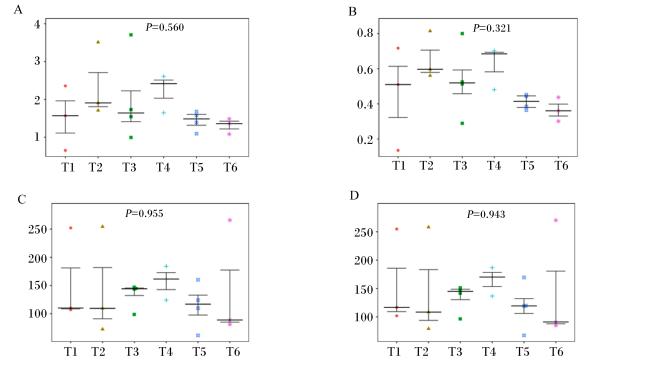
图2 属水平下黄颡鱼肠道菌群的α多样性

A:Shannon指数 Shannon index;B:Simpson指数Simpson index;C:Chao1指数Chao1 index;D:Ace指数 Ace index。

Fig.2 α diversity of intestinal flora of Pelteobagrus fulvidraco at genus level

2.3.4 肠道菌群的β多样性

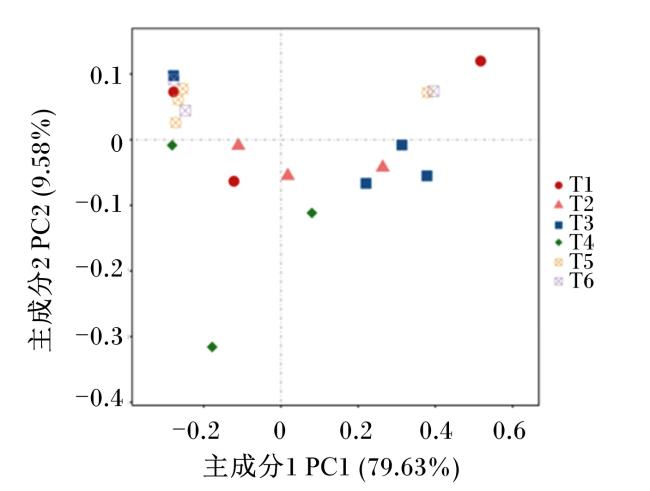
主坐标分析(PCoA)图(图3)显示样本间聚集、区分不明显,表明各组之间肠道菌群的β多样性相似。
图3 属水平下黄颡鱼肠道菌群的β多样性(PCoA图)

Fig.3 β diversity of intestinal flora of Pelteobagrus fulvidraco at genus level (PCoA graph)

3 讨论

3.1 姜黄素对饲喂含氧化鱼油饲料的黄颡鱼肠道消化酶活性的影响

肠道消化酶的活性通常反映肠道的消化能力。本试验结果表明,3%氧化鱼油(过氧化值为45.2 meq/kg)不影响黄颡鱼肠道的胰蛋白酶、脂肪酶和淀粉酶活性,说明3%氧化鱼油不影响黄颡鱼的消化能力,这与李敏[9]在中间球海胆(Strongylocentrotus intermedius)、龙水生[7]和李之好[8]在珍珠龙胆石斑鱼(♀Epinephelus fuscoguttatus ×♂Epinephelus lanceolatus)上的研究结果不同,这可能与氧化鱼油的添加量以及鱼油的氧化程度(过氧化值等指标)有关。如李敏[9]研究表明,随着饲料中氧化鱼油过氧化值的增加,中间球海胆消化道的胃蛋白酶和淀粉酶活性先降低后升高。龙水生[7]报道,9%氧化鱼油(过氧化值为231 mmol/kg)显著增加了珍珠龙胆石斑鱼肠道蛋白酶、脂肪酶和淀粉酶的活性。而李之好[8]研究表明,9%氧化鱼油(过氧化值为122 mmol/kg)显著降低了珍珠龙胆石斑鱼肠道脂肪酶活性。
本试验结果表明,饲料中添加0.08%姜黄素显著增加了黄颡鱼肠道胰蛋白酶活性,添加0.04%~0.08%姜黄素显著增加了肠道脂肪酶活性,说明姜黄素提高了黄颡鱼对蛋白质和脂肪的消化能力,这与Moghadam等[16]在南美白对虾(Litopenaeus vannamei)、Jiang等[17]在鲫鱼(Carassius auratus)、Midhun等[18]在莫桑比克罗非鱼(Oreochromis mossambicus)上的研究结果一致。

3.2 姜黄素对饲喂含氧化鱼油饲料的黄颡鱼肠道组织形态的影响

肠绒毛形态与结构是衡量肠道健康程度的重要判定指标[16,22]。本试验结果表明,3%氧化鱼油显著降低了黄颡鱼的肠道绒毛长度,说明氧化鱼油降低了黄颡鱼的消化吸收能力,这与李之好[8]在珍珠龙胆石斑鱼、Shi等[10]和Zhang等[11]在斑点叉尾鮰(Ictalurus punctatus)、陈科全等[12]在草鱼(Ctenopharyngodon idellus)、Yu等[13]在尼罗罗非鱼(Oreochromis niloticus)及卓丽欣等[5]在黄颡鱼上的研究结果相似。
本试验结果表明,饲料中添加0.02%~0.08%姜黄素显著增加了肠道绒毛长度,添加0.02%和0.08%姜黄素显著增加了肌层厚度,添加0.08%姜黄素显著增加了绒毛宽度,表明姜黄素可促进黄颡鱼的肠道健康,这与Moghadam等[16]在南美白对虾、曾延清[21]在黄姑鱼(Nibea albiflora)、朱怀宁[22]在美洲鳗鲡(Anguilla rostrata)、Amer等[19]和Abdel-Tawwab等[20]在尼罗罗非鱼上的研究结果一致。杯状细胞在对外来抗原的免疫反应中起着重要作用[10]。本试验中,饲料中添加0.08%姜黄素显著增加了黄颡鱼肠道的杯状细胞数,说明姜黄素能够增加黄颡鱼肠道的免疫力,这与Akpolat等[31]在白化大鼠上的研究结果一致。由此可见,姜黄素改善肠道组织结构可能与其抗炎活性有关,姜黄素能够通过其多酚类结构发挥抗炎作用,减少肠道炎症的发生,从而维护肠道健康[16,20]

3.3 姜黄素对饲喂含氧化鱼油饲料的黄颡鱼肠道菌群结构的影响

本试验结果表明,在门水平下,黄颡鱼肠道的优势菌门为Proteobacteria、Fusobacteria和Firmicutes,这与Liu等[32]和Wang等[33]在黄颡鱼上的研究结果一致。在属水平下,黄颡鱼肠道的优势菌属为PseudomonasCetobacteriumRalstonia。Liu等[32]报道,黄颡鱼肠道的优势菌属为Cetobacterium、邻单胞菌属(Plesiomonas)、消化链球菌属(Peptostreptococcus)和Candidatus_Arthromitus。Wang等[33]报道,黄颡鱼肠道的优势菌属为CetobacteriumPlesiomonas。Xue等[34]研究发现,黄颡鱼肠道的优势菌属为PlesiomonasCetobacterium和罗姆布茨菌属(Romboutsia)。
肠道微生物在宿主的消化、营养代谢和免疫系统功能中起着关键作用[35]。本试验结果表明,3%氧化鱼油不影响黄颡鱼肠道菌群的多样性,这与Yu等[13]在尼罗罗非鱼上的研究结果相同。本试验中,T2组与T1组相比,在门水平下,Fusobacteria的相对丰度显著增加;在属水平下,PseudomonasRalstonia的相对丰度显著下降,Cetobacterium的相对丰度显著增加。研究表明,Pseudomonas是主要的蛋白酶分泌菌[23],本试验中3%氧化鱼油降低了Pseudomonas的相对丰度,说明氧化鱼油能影响黄颡鱼对蛋白质的消化。Cetobacterium隶属于Fusobacteria,本试验中Cetobacterium是黄颡鱼的优势菌属,说明Fusobacteria相对丰度的增加可能归因于Cetobacterium相对丰度的增加。Ralstonia隶属于Proteobacteria,在水产动物肠道中的研究较少。Yu等[13]发现,80 g/kg氧化鱼油增加了尼罗罗非鱼肠道Proteobacteria的相对丰度,认为Proteobacteria相对丰度的增加与肠道炎症的发生有关。Peng等[14]研究表明,3%氧化鱼油降低了血鳝肠道Firmicutes的相对丰度,增加了Fusobacteria和Proteobacteria的相对丰度,认为氧化鱼油提高了肠道菌群合成脂多糖的能力,从而诱发肠道炎症。上述研究结果的差异可能是由于物种及氧化鱼油添加量的不同造成的。
姜黄素对水产动物肠道菌群的影响在南美白对虾[16]、中华鳖(Pelodiscus sinensis)[23]、皱纹盘鲍(Haliotis discus hannai)[24]上均有报道,但在黄颡鱼上的研究较少。本试验结果表明,饲料中添加姜黄素不影响黄颡鱼肠道菌群的多样性,而Zou等[24]报道姜黄素能降低皱纹盘鲍肠道菌群的α多样性,Jiang等[23]报道姜黄素能提高中华鳖肠道菌群的α多样性。这可能与姜黄素添加量以及物种的不同有关。据报道,Firmicutes与Bacteroidetes的丰度比例与宿主的免疫力呈正相关[24]。本试验中,0.04%姜黄素显著增加了Firmicutes的相对丰度而不改变Bacteroidetes的相对丰度,即Firmicutes与Bacteroidetes的丰度比例增加,说明姜黄素有利于增强黄颡鱼的免疫力。Pseudomonas是主要的蛋白酶分泌菌[23],在本试验中Pseudomonas为黄颡鱼肠道优势菌属,0.04%~0.08%姜黄素增加了Pseudomonas的相对丰度,说明姜黄素促进了黄颡鱼对蛋白质的消化,这与肠道消化酶活性的结果保持一致。Candidatus_Arthromitus在肠道先天免疫系统中发挥着重要作用[36],本试验中0.04%姜黄素显著增加了Candidatus_Arthromitus的相对丰度,说明姜黄素对提高黄颡鱼肠道免疫力有促进作用。由此可见,姜黄素通过调节肠道菌群结构,使黄颡鱼的消化能力和肠道免疫力得到提高。

4 结论

综上所述,本试验条件下,饲料中添加3%氧化鱼油诱导了黄颡鱼肠道组织结构损伤,而添加0.04%~0.08%姜黄素能够提高黄颡鱼肠道胰蛋白酶和脂肪酶活性以及有益菌Pseudomonas和Candidatus_Arthromitus的相对丰度,修复氧化鱼油诱导的肠绒毛结构损伤。
[1]
农业农村部渔业渔政管理局, 全国水产技术推广总站,中国水产学会.2024中国渔业统计年鉴[M]. 北京: 中国农业出版社, 2024.

Fisheries and Fisheries Administration Bureau of the Ministry of Agriculture and Rural Affairs,National Fisheries Technology Extension Center,China Society of Fisheries. 2024 China fishery statistics yearbook[M]. Beijing: China Agriculture Press,2024. (in Chinese)

[2]
李旭男, 陈秀梅, 彭思博, 等. 鱼类肠黏膜屏障功能、损伤机制及其营养调控的研究进展[J]. 饲料研究, 2023, 46(19):126-129.

LI X N, CHEN X M, PENG S B, et al. Research progress on intestinal mucosal barrier function,injury mechanism and nutritional regulation of fish[J]. Feed Research, 2023, 46(19):126-129. (in Chinese)

[3]
陈秀梅, 王秋举, 郭志欣, 等. 氧化鱼油对鱼类健康的危害及其作用机制的研究进展[J]. 中国畜牧杂志, 2019, 55(9):22-27.

CHEN X M, WANG Q J, GUO Z X, et al. Research progress on detrimental effects of oxidized fish oil on health status of fish[J]. Chinese Journal of Animal Science, 2019, 55(9):22-27. (in Chinese)

[4]
卓丽欣, 赵红霞, 黄燕华, 等. 氧化鱼油对黄颡鱼生长性能和抗氧化指标的影响及精氨酸的干预作用[J]. 动物营养学报, 2017, 29(1):147-157.

DOI

ZHUO L X, ZHAO H X, HUANG Y H, et al. Influences of oxidized fish oil on growth performance and antioxidant indexes of yellow catfish (Pelteobagrus fulvidraco) and the use of arginine as an intervention measure[J]. Chinese Journal of Animal Nutrition, 2017, 29(1):147-157. (in Chinese)

[5]
卓丽欣, 赵红霞, 黄燕华, 等. 氧化鱼油对黄颡鱼幼鱼肠道健康的影响及精氨酸的干预作用[J]. 水产学报, 2018, 42(1):100-111.

ZHUO L X, ZHAO H X, HUANG Y H, et al. Influence of oxidized fish oil on the intestinal health of juvenile yellow catfish (Pelteobagrus fulvidraco) and the use of arginine as an intervention measure[J]. Journal of Fisheries of China, 2018, 42(1):100-111. (in Chinese)

[6]
GAO Q, LIU B, SHAN F, et al. Effects of oxidized fish oil on digestive enzyme activity and antioxidant system in Macrobrachium rosenbergii post-larvae[J]. Aquaculture Reports, 2022,23:101062.

[7]
龙水生. 氧化鱼油对珍珠龙胆石斑鱼(♀ Epinephelus fuscoguttatus×♂Epinephelus lanceolatus) 生理稳态的影响[D]. 博士学位论文. 湛江: 广东海洋大学, 2022.

LONG S S. Effects of oxidized fish oil on the physiological homeostasis of pearl gentian grouper (♀ Epinephelus fuscoguttatus×♂ Epinephelus lanceolatus)[D].Ph.D.Thesis. Zhanjiang: Guangdong Ocean University, 2022. (in Chinese)

[8]
李之好. 戊糖乳杆菌添加水平及投喂方式对摄食氧化鱼油饲料的珍珠龙胆石斑鱼 (♀Epinephelus fuscoguttatus×♂ Epinephelus lanceolatus) 生长、抗氧化能力及肠道健康的影响[D]. 硕士学位论文. 湛江: 广东海洋大学, 2022.

LI Z H. Effects of Lactobacillus pentosus supplementation level and feeding method on growth,antioxidant capacity and intestinal health of hybrid grouper (♀ Epinephelus fuscoguttatus×♂ Epinephelus lanceolatus) fed with oxidized fish oil diet[D]. Master’s Thesis. Zhanjiang: Guangdong Ocean University, 2022. (in Chinese)

[9]
李敏. 氧化鱼油和维生素E对中间球海胆生长、免疫及消化道菌群影响的研究[D]. 硕士学位论文. 大连: 大连海洋大学, 2019.

LI M. Effects of oxidized fish oil and vitamin E on the growth,immune and flora in the digestive tract of the sea urchin (Strongylocentrotus intermedius)[D]. Master’s Thesis. Dalian: Dalian Ocean University, 2019. (in Chinese)

[10]
SHI Y, HU Y, WANG Z Q, et al. The protective effect of taurine on oxidized fish-oil-induced liver oxidative stress and intestinal barrier-function impairment in juvenile Ictalurus punctatus[J]. Antioxidants, 2021, 10(11):1690.

[11]
ZHANG J Z, WANG Z Q, SHI Y, et al. Protective effects of chlorogenic acid on growth,intestinal inflammation,hepatic antioxidant capacity,muscle development and skin color in channel catfish Ictalurus punctatus fed an oxidized fish oil diet[J]. Fish & Shellfish Immunology, 2023,134:108511.

[12]
陈科全, 叶元土, 蔡春芳, 等. 饲料氧化鱼油引起草鱼肠道结构损伤、通透性增加[J]. 水生生物学报, 2016, 40(4):804-813.

CHEN K Q, YE Y T, CAI C F, et al. Effects of dietary oxidized fish oil on the intestinal structure and permeability of grass carp (Ctenopharyngodon idellus)[J]. Acta Hydrobiologica Sinica, 2016, 40(4):804-813. (in Chinese)

[13]
YU L J, WEN H, JIANG M, et al. Effects of ferulic acid on intestinal enzyme activities,morphology,microbiome composition of genetically improved farmed tilapia (Oreochromis niloticus) fed oxidized fish oil[J]. Aquaculture, 2020,528:735543.

[14]
PENG M, LUO H J, KUMAR V, et al. Dysbiosis of intestinal microbiota induced by dietary oxidized fish oil and recovery of diet-induced dysbiosis via taurine supplementation in rice field eel (Monopterus albus)[J]. Aquaculture, 2019,512:734288.

[15]
徐兴昱, 陈永芳, 刘壮, 等. 姜黄素在畜禽养殖中的应用研究进展[J]. 中国畜牧杂志, 2023, 59(4):17-23.

XU X Y, CHEN Y F, LIU Z, et al. Research progress on the application of curcumin in livestock and poultry production[J]. Chinese Journal of Animal Science, 2023, 59(4):17-23. (in Chinese)

[16]
MOGHADAM H, SOURINEJAD I, JOHARI S A. Digestive enzyme activities, intestinal histology,and gut microbiota of Pacific white shrimp Litopenaeus vannamei fed with turmeric,curcumin,and nanomicelle curcumin[J]. Aquaculture International, 2023, 31(1):15-30.

[17]
JIANG J, WU X Y, ZHOU X Q, et al. Effects of dietary curcumin supplementation on growth performance,intestinal digestive enzyme activities and antioxidant capacity of crucian carp Carassius auratus[J]. Aquaculture, 2016,463:174-180.

[18]
MIDHUN S J, ARUN M, EDATT L, et al. Modulation of digestive enzymes,GH,IGF-1 and IGF-2 genes in the teleost,tilapia (Oreochromis mossambicus) by dietary curcumin[J]. Aquaculture International, 2016, 24(5):1277-1286.

[19]
AMER S A, EL-ARABY D A, TARTOR H, et al. Long-term feeding with curcumin affects the growth,antioxidant capacity,immune status,tissue histoarchitecture,immune expression of proinflammatory cytokines,and apoptosis indicators in Nile tilapia,Oreochromis niloticus[J]. Antioxidants, 2022, 11(5):937.

[20]
ABDEL-TAWWAB M, EISSA E S H, TAWFIK W A, et al. Dietary curcumin nanoparticles promoted the performance,antioxidant activity,and humoral immunity,and modulated the hepatic and intestinal histology of Nile tilapia fingerlings[J]. Fish Physiology and Biochemistry, 2022, 48(3):585-601.

[21]
曾延清. 低鱼粉饲料中添加姜黄素对黄姑鱼生长性能、饲料利用及肠道健康的影响研究[D]. 硕士学位论文. 舟山: 浙江海洋大学, 2022.

ZENG Y Q. Effects of curcumin supplementation in low-fish meal diet on growth performance,feed utilization and intestinal health of yellow drum (Nibea albiflora)[D]. Master’s Thesis. Zhoushan: Zhejiang Ocean University, 2022. (in Chinese)

[22]
朱怀宁. 姜黄素对美洲鳗鲡幼鱼生长及肝肠健康的影响[D]. 硕士学位论文. 厦门: 集美大学, 2021.

ZHU H N. Effects of dietary curcumin supplementation on growth,intestinal and liver health of juvenile American eel (Anguilla rostrata)[D]. Master’s Thesis. Xiamen: Jimei University, 2021. (in Chinese)

[23]
JIANG J Y, WEN H, JIANG M, et al. Dietary curcumin supplementation could improve muscle quality,antioxidant enzyme activities and the gut microbiota structure of Pelodiscus sinensis[J]. Animals, 2023, 13(16):2626.

[24]
ZOU W G, MA Y B, AI C X, et al. Dietary curcumin influence on growth,antioxidant status,immunity,gut flora and resistance to Vibrio harveyi AP37 in Haliotis discus hannai[J]. Aquaculture Reports, 2022,26:101336.

[25]
张滕闲, 陈钱, 张宝龙, 等. 姜黄素对黄颡鱼 (Pelteobagrus fulvidraco) 生长、消化与抗氧化能力的影响[J]. 渔业科学进展, 2017, 38(6):56-63.

ZHANG T X, CHEN Q, ZHANG B L, et al. The effects of curcumin on the growth,digestion and antioxidant ability of yellow catfish (Pelteobagrus fulvidraco)[J]. Progress in Fishery Sciences, 2017, 38(6):56-63. (in Chinese)

[26]
杨雨生, 王洋, 曾祥茜, 等. 四种添加剂对黄颡鱼生长、消化与抗氧化能力的影响[J]. 饲料工业, 2018, 39(18):17-24.

YANG Y S, WANG Y, ZENG X X, et al. Effects of four kinds of additives on growth performance,digestion and antioxidant ability of yellow catfish (Pelteobagrus fulvidraco)[J]. Feed Industry, 2018, 39(18):17-24. (in Chinese)

[27]
罗学评. 绿原酸、 姜黄素调控氨氮诱导黄颡鱼巨噬细胞炎症反应的研究[D]. 硕士学位论文. 贵阳: 贵州大学, 2021.

LUO X P. Chlorogenic acid and curcumin modulate ammonia nitrogen-induced macrophage inflammatory response in Pelteobagrus fulvidraco[D]. Master’s Thesis. Guiyang: Guizhou University, 2021. (in Chinese)

[28]
陈严轩, 王国霞, 刘燕, 等. 氧化鱼油和姜黄素对黄颡鱼生长性能、血清和肝脏指标、体及肌肉质构特性的影响[J]. 动物营养学报, 2024, 36(7):4610-4622.

DOI

CHEN Y X, WANG G X, LIU Y, et al. Effects of oxidized fish oil and curcumin on growth performance, serum and liver indexes, body colour and muscle texture characteristics of Pelteobagrus fulvidraco[J]. Chinese Journal of Animal Nutrition, 2024, 36(7):4610-4622. (in Chinese)

[29]
邱建强, 黄文, 赵红霞, 等. 单宁对南美白对虾生长性能、体成分、消化酶活性及抗氧化性能的影响[J]. 中国畜牧兽医, 2023, 50(8):3073-3083.

DOI

QIU J Q, HUANG W, ZHAO H X, et al. Effects of hydrolysable and condensed tannins on growth performance,body composition,digestive enzyme activities and antioxidant indexes of Litopenaeus vannamei[J]. China Animal Husbandry & Veterinary Medicine, 2023, 50(8):3073-3083. (in Chinese)

[30]
符兵, 彭凯, 陈冰, 等. 饲料中添加蚕豆对罗非鱼生长性能、肠道消化酶活性、肠道形态和肠道菌群的影响[J]. 动物营养学报, 2023, 35(1):494-504.

DOI

FU B, PENG K, CHEN B, et al. Effects of Faba bean supplementation on growth performance,intestinal digestive enzyme activities,intestinal morphology and intestinal flora of tilapia (Oreochromis niloticus)[J]. Chinese Journal of Animal Nutrition, 2023, 35(1):494-504. (in Chinese)

[31]
AKPOLAT M, KANTER M, UZAL M C. Protective effects of curcumin against gamma radiation-induced ileal mucosal damage[J]. Archives of Toxicology, 2009, 83(6):609-617.

DOI PMID

[32]
LIU A P, LU X, JI Z H, et al. Preliminary study to assess the impact of dietary rutin on growth,antioxidant capacity,and intestinal health of yellow catfish,Pelteobagrus fulvidraco[J]. Animals, 2023, 13(21):3386.

[33]
WANG L, GAO C, YANG L Q, et al. The growth-promoting and lipid-lowering effects of berberine are associated with the regulation of intestinal bacteria and bile acid profiles in yellow catfish (Pelteobagrus fulvidraco)[J]. Aquaculture Reports, 2023,33:101848.

[34]
XUE M Y, WU Y Y, HONG Y Z, et al. Effects of dietary Bacillus amyloliquefaciens on the growth, immune responses,intestinal microbiota composition and disease resistance of yellow catfish,Pelteobagrus fulvidraco[J]. Frontiers in Cellular and Infection Microbiology, 2022,12:1047351.

[35]
DANCKERT N P, WILSON N, PHAN-THIEN K Y, et al. The intestinal microbiome of Australian abalone,Haliotis laevigata and Haliotis laevigata×Haliotis rubra,over a 1-year period in aquaculture[J]. Aquaculture, 2021,534:736245.

[36]
LI X, WANG S D, ZHANG M Z, et al. Sodium butyrate improves the growth performance,intestinal immunity,and ammonia tolerance of yellow catfish Pelteobagrus fulvidraco by increasing the relative abundance of Candidatus_Arthromitus[J]. Aquaculture, 2024, 580(Part 2):740359.

Outlines

/