RESEARCH PAPER

Serum Free Amino Acid Profiles and Their Correlation with Intestinal Microbiota in Early Weaned Diarrhea Piglets

  • XU Jing , 1, 2 ,
  • SUN Yue 1, 2 ,
  • LI Yang 3 ,
  • TAO Shiyu 1 ,
  • LOU Fangfang 4 ,
  • XIAO Yingping 2 ,
  • ZHANG Xiaojun , 4, *
Expand
  • 1 College of Animal Science and Technology, Huazhong Agricultural University, Wuhan 430070, China
  • 2 State Key Laboratory for Managing Biotic and Chemical Threats to the Quality and Safety of Agro-Products, Institute of Agro-Product Safety and Nutrition, Zhejiang Academy of Agricultural Sciences, Hangzhou 310021, China
  • 3 Zhejiang Meibao Long Biotechnology Company, Jinhua 321000, China
  • 4 Institute of Animal Husbandry and Veterinary Medicine, Jinhua Academy of Agricultural Sciences, Jinhua 321017, China
* livestock specialist, E-mail:

Received date: 2024-01-12

  Online published: 2024-09-08

Abstract

This experiment was conducted to explore the serum free amino acid profiles and their correlation with intestinal microbiota in early weaned diarrhea piglets. Twenty eight-day-old weaned Jinhua piglets were selected, and each five healthy piglets (healthy group) and five diarrhea piglets (diarrhea group) were selected 7 days after weaning. Then the serum and colon contents of piglets were collected for serum free amino acid content determination and 16S rRNA sequencing analysis. The results showed as follows: 1) compared with healthy piglets, the contents of threonine, tryptophan, alanine, proline, serine, tyrosine and glutamine in serum free amino acids of diarrhea piglets were significantly decreased (P<0.05); among serum amino acid derivatives and metabolites, the contents of taurine, citrulline, ornithine, β-aminoisobutyric acid, carnosine, hydroxyproline, argininosuccinic acid and β-alanine were significantly decreased (P<0.05), while the 1-methylhistidine content was significantly increased (P<0.05). 2) Compared with healthy piglets, the amplicon sequence variant (ASV) number, Chao1 index and Shannon index of colonic microbiota of diarrhea piglets significantly decreased (P<0.05), while the Simpson index was significantly increased (P<0.05). Principal coordinate analysis (PCoA) showed that the colonic microbiota had different clustering in two groups. Compared with healthy piglets, at the phylum level, the Firmicutes relative abundance in colon of diarrhea piglets was significantly decreased (P<0.05); at the genus level, the relative abundances of Clostridium_sensu_stricto_1, Lachnoclostridium and Terrisporobacter in colon of diarrhea piglets were significantly decreased (P<0.05), while the Fusobacterium relative abundance in colon was significantly increased (P<0.05). Linear discriminant analysis effect size (LEfSe) analysis showed that Lachnoclostridium, Terrisporobacter, Ruminococcus, Fusobacterium and Bacteroidetes were differential genera between two groups. 3) Spearman correlation analysis found that the abundances of Lachnoclostridium and Terrisporobacter in colon were significantly positively correlated with the contents of β-alanine, serine and proline in serum (P<0.05), and the abundances of Ruminococcus and Anaerotruncus in colon were significantly positively correlated with the contents of serine, proline, citrulline, hydroxyproline and β-aminoisobutyric acid in serum (P<0.05); while the Fusobacterium relative abundance in colon was significantly negatively correlated the contents of serine, citrulline, hydroxyproline and β-aminoisobutyric acid in serum (P<0.05), and the Bacteroides relative abundance in colon was significantly negatively correlated with the contents of tryptophan and tyrosine in serum (P<0.05). In conclusion, there are differences in serum free amino acid profiles and intestinal microbiota between early weaned healthy and diarrhea piglets, and there is a certain correlation between them.

Cite this article

XU Jing , SUN Yue , LI Yang , TAO Shiyu , LOU Fangfang , XIAO Yingping , ZHANG Xiaojun . Serum Free Amino Acid Profiles and Their Correlation with Intestinal Microbiota in Early Weaned Diarrhea Piglets[J]. Chinese Journal of Animal Nutrition, 2024 , 36(9) : 5617 -5629 . DOI: 10.12418/CJAN2024.479

随着现代集约化养殖技术的推进,通常对21~35日龄仔猪进行早期断奶[1]。然而,早期断奶会对仔猪心理、营养和免疫产生负面影响,引发应激反应,导致采食量和营养物质吸收能力下降、消化代谢紊乱,进而引发仔猪腹泻[2]。氨基酸作为蛋白质的代谢底物和其他物质的代谢产物,与动物的生长代谢和健康密切相关[3]。王宇等[4]基于液相色谱-质谱联用技术对腹泻患者的血浆进行代谢组学分析,在特征差异代谢物的筛选中,发现4个代谢物属于氨基酸、肽及其类似物,表明腹泻对宿主体内氨基酸代谢产生了显著影响。张玉莹等[5]基于16S rRNA测序技术对腹泻牦牛犊牛粪便进行菌群结构功能分析发现,腹泻耗牛犊牛粪便菌群的氨基酸代谢通路显著降低。这些研究表明腹泻的发生会影响氨基酸代谢。同时,仔猪腹泻与肠道菌群变化密切相关[6]。断奶引起的仔猪腹泻表现为肠道菌群结构的异常,包括微生物多样性降低、致病菌相对丰度提高以及共生菌相对丰度降低[7]。Hermann-Bank等[8]研究证明,与新生健康仔猪相比,新生腹泻仔猪肠道中放线菌门(Actinobacteria)和厚壁菌门(Firmicutes)数量减少,肠球菌和大肠杆菌等有害菌的数量增加。
血清中由各种氨基酸含量及其组成的氨基酸谱,即氨基酸模式,是反映机体代谢和功能状态的重要生物化学信息[9]。而肠道微生物则与宿主的健康状态密切相关,其种类和数量的变化可能导致肠道菌群失衡,进而引发腹泻等消化系统疾病[10]。血清游离氨基酸谱和肠道微生物成为当前备受关注的2个研究方向[11-12]。然而,早期断奶腹泻仔猪的血清游离氨基酸谱变化目前仍不清楚,且其与肠道微生物的相关性有待阐明。因此,本文选择早期断奶健康和腹泻仔猪进行血清游离氨基酸含量测定和16S rRNA基因测序,旨在探究血清游离氨基酸谱与肠道微生物群落之间的相关性,为早期断奶腹泻仔猪的综合管理策略提供科学依据。

1 材料与方法

1.1 试验设计和样品采集

本试验在浙江省金华地区一猪场进行,选择96头金华猪仔猪,于28日龄进行断奶处理,分别饲养于5个不同的栏中,在断奶后7 d,从不同栏中选择1头接近平均体重的健康仔猪(健康组)以及1头腹泻仔猪(腹泻组)进行取样,腹泻仔猪的选择参照Wen等[13]的标准。采集健康和腹泻仔猪的血清样品以及结肠内容物。

1.2 血清游离氨基酸含量测定

血清游离氨基酸含量参照文献[14-15]方法测定。取1 mL血清置于室温解冻后涡旋15 s,加入7.5%的三氯乙酸2.5 mL,漩涡混匀,离心机在4 ℃下以12 700×g离心15 min,取上清液用离子交换氨基酸分析仪(Hitachi L-8900 Auto-Analyzer,日本)作氨基酸分析。每个样本进样20 μL,分析周期为150 min。柱平衡时间为35 min,检测波长为570 nm,其中脯氨酸的检测波长为440 nm[2]

1.3 粪便DNA提取、PCR扩增及高通量测序分析

使用QIAamp Fast DNA Stool Mini Kit(QIAGEN,美国)提取总基因组DNA,在1%琼脂糖凝胶上监测DNA浓度和纯度。使用上游引物515F(5'-GTGCCAGCMGCCGCGG-3')和下游引物907R(5'-CCGTCAATTCMTTTRAGTTT-3')对细菌16S rRNA基因V4~V5区进行PCR扩增。
使用NEB Next® UltraTM DNA文库制备试剂盒(NEB,美国)生成测序文库,并添加索引代码。在Qubit® 2.0 Fluorometer(Thermo Scientific,美国)和Agilent 2100 Bioanalyzer System(Agilent,美国)上评估文库质量。构建文库合格后,采用Illumina MiSeq平台对文库进行测序。按照QIIME2(https://qiime2.org)的方法进行质量控制,对各样品数据去除Barcode和引物序列后,使用FLASH(http://ccb.jhu.edu/software/FLASH)软件进行拼接。根据Usearch软件和Gold数据库,去除嵌合体。使用UPARSE软件和UCLUST软件[16]根据100%相似性的序列聚类为扩增子序列变体(amplicon sequence variant,ASV),比对Silva数据库(http://www.arb-silva.de),对每ASV代表性序列进行分类分析,并计算分析alpha(样本内)和beta(样本间)多样性。

1.4 统计分析

采用SPSS 26.0软件对数据进行独立样本t检验,数据以“平均值±标准误(mean±SE)”形式表示,P<0.05为差异显著性水平。使用GraphPad Prism 9.5软件来绘制相关的图表。多元统计分析采用SIMCA-P[2]分析游离氨基酸数据,采用正交偏最小二乘法判别分析(orthogonal partial least-square discriminant analysis,OPLS-DA)对筛选出的重要差异变量进行验证,并计算变量投影重要性(variable importance in projection,VIP)值。使用线性判别分析(linear discriminant analysis,LDA)效应大小(linear discriminant analysis effect size,LEfSe)算法[17](LDA>3.2)进行差异分析,找出早期断奶健康与腹泻仔猪的差异菌属。使用Gephi软件[18]根据差异菌属的相对丰度和差异菌属之间Spearman相关系数(|r|>0.7,P<0.01)绘制共现网络。采用PICRUSt2进行肠道微生物的功能预测分析,与京都基因与基因组百科全书(Kyoto Encyclopedia of Genes and Genomes,KEGG)数据库进行比对,并使用STAMP软件绘制差异通路。

2 结果与分析

2.1 早期断奶腹泻仔猪血清游离氨基酸谱变化

表1可知,与健康仔猪相比,在必需氨基酸中,腹泻仔猪血清苏氨酸和色氨酸含量分别显著降低了41.83%和31.06%(P<0.03);在非必需氨基酸中,腹泻仔猪血清丙氨酸、脯氨酸、丝氨酸、酪氨酸和谷氨酰胺含量显著降低(P<0.05),分别降低了29.70%、24.90%、27.60%、33.38%和57.58%。
表1 健康和腹泻仔猪血清游离氨基酸含量

Table 1 Free amino acid contents in serum of healthy and diarrhea pigletsμmol/L

项目Items 健康组Healthy group 腹泻组Diarrhea group PP-value
必需氨基酸Essential AA
精氨酸Arg 102.37±11.38 117.68±18.60 0.50
组氨酸His 52.29±4.72 52.78±6.13 0.95
异亮氨酸Ile 129.60±10.48 136.11±20.35 0.78
亮氨酸Leu 175.98±12.06 185.96±29.51 0.76
赖氨酸Lys 167.04±9.92 150.79±19.63 0.48
蛋氨酸Met 42.30±3.80 31.62±5.74 0.16
苯丙氨酸Phe 79.48±5.49 78.88±8.43 0.95
苏氨酸Thr 236.81±16.32a 137.75±9.32b <0.01
缬氨酸Val 269.74±16.53 285.68±43.35 0.74
色氨酸Trp 48.58±2.08a 33.49±5.21b 0.03
非必需氨基酸Non-essential AA
丙氨酸Ala 472.85±26.06a 332.41±45.10b 0.03
天冬氨酸Asp 64.16±7.11 73.89±14.53 0.56
谷氨酸Glu 520.39±48.37 466.15±70.82 0.54
甘氨酸Gly 618.11±37.06 537.76±74.98 0.37
脯氨酸Pro 206.82±10.36a 155.32±16.58b 0.03
丝氨酸Ser 173.08±9.68a 125.31±11.74b 0.01
胱氨酸Cys 185.08±15.11 155.92±16.30 0.23
酪氨酸Tyr 68.87±3.70a 45.88±6.85b 0.02
天冬酰胺Asn 25.75±3.64 27.44±3.88 0.76
谷氨酰胺Gln 119.15±19.19a 50.54±7.52b 0.01

同行数据肩标不同小写字母表示差异显著(P<0.05)。下表同。

In the same row, values with different small letter superscripts mean significant difference (P<0.05). The same as below.

表2可知,在氨基酸衍生物和代谢产物中,与健康仔猪相比,腹泻仔猪血清牛磺酸、瓜氨酸、鸟氨酸、β-氨基异丁酸、肌肽、羟脯氨酸、精氨基琥珀酸和β-丙氨酸含量分析显著降低了35.71%、43.96%、45.70%、64.52%、53.31%、61.21%、25.00%和40.71%(P<0.05),血清1-甲基组氨酸含量显著提高了46.93%(P<0.02)。
表2 健康和腹泻仔猪血清游离氨基酸衍生物和代谢产物含量

Table 2 Contents of free amino acid derivatives and metabolites in serum of healthy and diarrhea pigletsμmol/L

项目Items 健康组Healthy group 腹泻组Diarrhea group PP-value
神经内分泌新陈代谢衍生物Neuroendocrine metabolism derivatives
γ-氨基正丁酸GABA 1.27±0.12 2.30±0.52 0.12
牛磺酸Tau 263.48±29.77a 169.39±25.06b 0.04
氨能量新陈代谢衍生物Ammonia energy metabolism derivatives
α-氨基己二酸α-Ad 51.09±7.38 34.34±6.25 0.12
瓜氨酸Cit 56.51±4.80a 31.67±5.04b 0.01
鸟氨酸Orn 107.43±7.65a 58.33±10.64b 0.01
硫新陈代谢衍生物Sulfur metabolism derivatives
胱硫醚Cth 1.32±0.27 0.72±0.17 0.10
其他代谢产物Other metabolites
1-甲基组氨酸1-MHis 6.84±0.31b 10.05±1.05a 0.02
3-甲基组氨酸3-MHis 4.73±0.48 7.84±1.26 0.07
α-氨基正丁酸α-Abu 30.10±2.84 27.09±5.70 0.65
鹅肌肽Ans 0.21±0.04 0.12±0.02 0.10
β-氨基异丁酸β-Aib 0.31±0.04a 0.11±0.03b <0.01
肌肽Car 16.90±2.40a 7.89±0.76b 0.01
乙醇胺Etn 20.11±1.21 12.54±3.33 0.07
羟赖氨酸Hylys 1.79±0.16 1.63±0.32 0.69
羟脯氨酸Hyp 71.10±3.51a 27.58±2.80b <0.01
精氨基琥珀酸Asa 0.48±0.03a 0.36±0.03b 0.02
β-丙氨酸β-Ala 16.58±0.72a 9.83±1.01b <0.01
高瓜氨酸Hcit 0.71±0.04 1.03±0.14 0.09
犬尿酸Kyn 0.86±0.04 0.70±0.10 0.18
肌氨酸Sar 4.14±1.35 2.25±0.76 0.26
总同型胱氨酸tHcy 24.04±3.85 16.77±1.65 0.14
磷酸乙醇胺PEtn 1.52±0.35 2.69±0.69 0.17
磷酸丝氨酸PSer 0.18±0.01 0.17±0.02 0.68
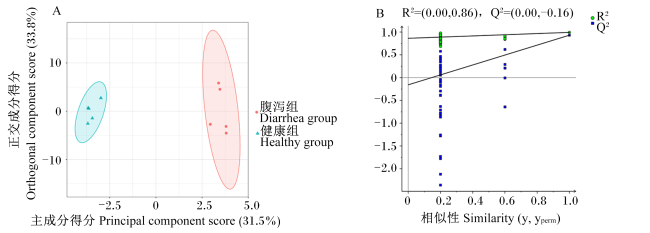
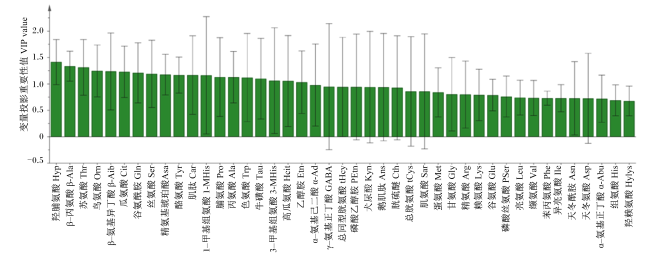
OPLS-DA结果发现,健康组和腹泻组仔猪血清游离氨基酸谱存在显著不同的聚类(图-1A)。为更加充分地验证模型的可靠性,进行置换检验以验证OPLS-DA模型,置换检验(n=200)结果表明,R2和Q2分别交于y轴的0.86和-0.16位置,右侧的R2和Q2均高于左侧,且Q2与y轴交于负半轴,说明该模型可靠且不存在过拟合现象(图1-B)。VIP值可以反映对模型分类的贡献程度,将VIP>1作为筛选差异氨基酸的标准。各氨基酸的VIP值结果如图2所示,共有19种氨基酸的VIP>1,分别是羟脯氨酸、β-丙氨酸、苏氨酸、鸟氨酸、β-氨基异丁酸、瓜氨酸、谷氨酰胺、丝氨酸、精氨基琥珀酸、酪氨酸、肌肽、1-甲基组氨酸、脯氨酸、丙氨酸、色氨酸、牛磺酸、3-甲基组氨酸、高瓜氨酸和乙醇胺。
图1 健康和腹泻仔猪血清氨基酸谱OPLS-DA得分图和置换检验图

Fig.1 OPLS-DA score plot and permutation test plot of serum amino acid profiles of healthy and diarrhea piglets

图2 各氨基酸的VIP值

Fig.2 VIP value of each amino acid

2.2 早期断奶腹泻仔猪结肠微生物群落变化

2.2.1 测序数据信息

通过对样品进行高通量测序分析生成38 977条有效序列,将有效序列聚类,共得到2 042个ASV。其中,健康组独有的ASV数量为1 159个,腹泻组独有的ASV数量为551个,2组共有的ASV数量为332个。通过注释分析,在2组中共注释到15个门、26个纲、41个目、63个科和203个属。

2.2.2 alpha多样性分析

健康和腹泻仔猪结肠微生物群落alpha多样性结果见表3,与健康组相比,腹泻组仔猪结肠微生物群落ASV数量、Chao1指数和Shannon指数显著降低(P<0.05),Simpson指数显著提高(P<0.05)。
表3 健康和腹泻仔猪结肠微生物alpha多样性

Table 3 Alpha diversity of colonic microbiota of healthy and diarrhea piglets

项目Items 健康组Healthy group 腹泻组Diarrhea group PP-value
ASV数量ASV number 568.20±33.26a 290.20±39.11b <0.01
Shannon指数Shannon index 4.77±0.13a 4.04±0.13b <0.01
Simpson指数Simpson index 0.02±0.00b 0.04±0.00a 0.01
Chao1指数Chao1 index 572.02±34.59a 290.95±39.29b <0.01

2.2.3 beta多样性分析

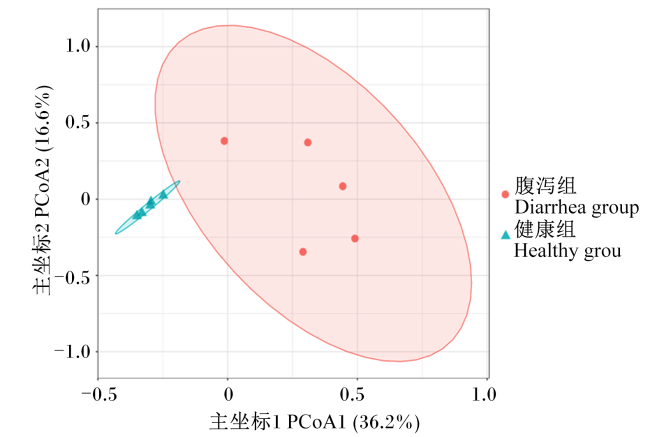
基于Bray-Curtis距离进行主坐标分析(PCoA)(图3)发现,健康组和腹泻组仔猪结肠微生物群落呈现出不同的聚集,表明2组的菌群结构存在差异。
图3 健康和腹泻仔猪结肠微生物群落PCoA

Fig.3 PCoA of colonic microbiota of healthy and diarrhea piglets

2.2.4 门水平和属水平物种组成分析

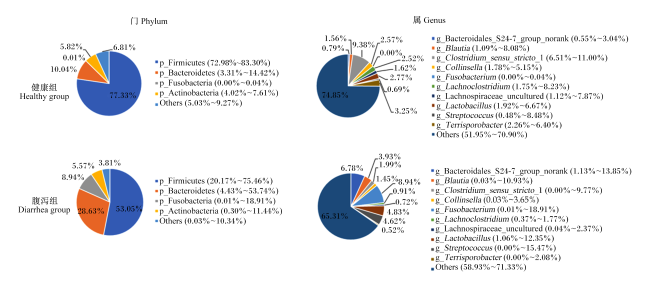
图4所示,在门水平上,厚壁菌门、拟杆菌门(Bacteroidetes)、梭杆菌门(Fusobacteria)和放线菌门是各组仔猪结肠中的主要优势菌门。与健康组相比,腹泻组仔猪结肠厚壁菌门相对丰度显著降低(P<0.05),结肠梭杆菌门相对丰度显著提高(P<0.05)。
图4 健康和腹泻仔猪结肠微生物在门水平和属水平的组成

Firmicutes:厚壁菌门;Bacteroidetes:拟杆菌门;Fusobacteria:梭杆菌门;Actinobacteria:放线菌门;Clostridium_sensu_stricto_1:狭义梭菌属1;Lactobacillus:乳杆菌属;Fusobacterium:梭杆菌属;Bacteroidales_S24-7_group_norank:拟杆菌目S24-7群未定级;Streptococcus:链球菌属;Blautia:经黏液真杆菌属;Collinsella:柯林斯菌属;Terrisporobacter:土孢杆菌属;Lachnospiraceae_uncultured:毛螺菌科未培养属;Others:其他。

Fig.4 Colonic microbiota composition of healthy and diarrhea piglets at phylum and genus levels

在属水平上,各组仔猪结肠优势菌属为狭义梭菌属1(Clostridium_sensu_stricto_1)、乳杆菌属(Lactobacillus)、梭杆菌属(Fusobacterium)、拟杆菌目S24-7群未定级(Bacteroidales_S24-7_group_norank)和链球菌属(Streptococcus)等。与健康组相比,腹泻组仔猪结肠狭义梭菌属1、Lachnoclostridium和土孢杆菌属(Terrisporobacter)相对丰度显著降低(P<0.05),结肠梭杆菌属相对丰度显著提高(P<0.05)。

2.2.5 差异微生物热图分析

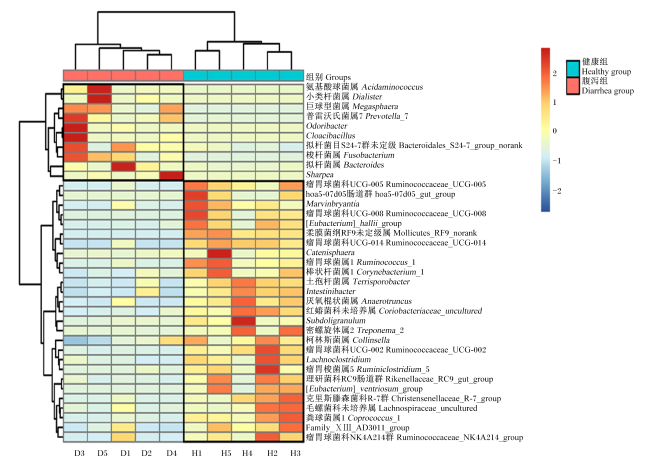
采用LEfSe分析鉴定健康和腹泻仔猪的差异菌属(图5)发现,2组共有37个差异菌属。其中,健康组仔猪结肠主要富集Lachnoclostridium、土孢杆菌属和瘤胃球菌属(Ruminococcus)等,而腹泻组仔猪结肠主要富集梭杆菌属和拟杆菌属(Bacteroides)等。
图5 健康和腹泻仔猪结肠差异菌属热图

D1~D5表示腹泻组样本,H1~H5表示健康组样本。

Fig.5 Heatmap of differential genera in colon of healthy and diarrhea piglets

D1 to D5 represented samples in diarrhea group, and H1 to H5 represented samples in healthy group.

2.2.6 属水平互作网络分析

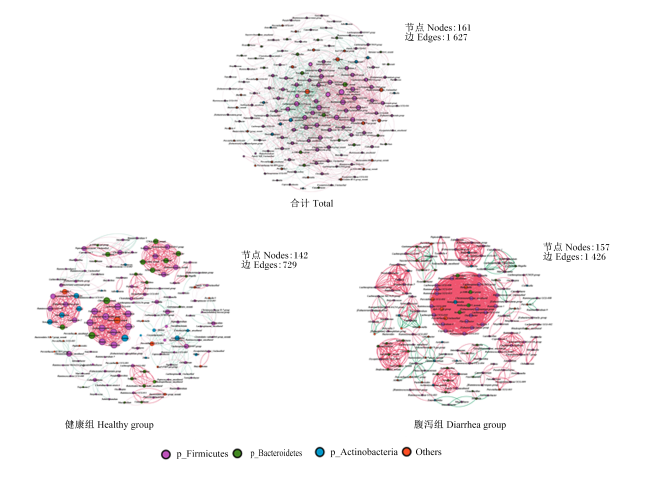
为了在属水平上更清楚地分析结肠微生物群落之间的相互作用,基于Spearman相关系数(|r|>0.7,P<0.01)分别对健康和腹泻仔猪结肠细菌进行网络互作分析,结果如图6所示,其中腹泻组仔猪结肠微生物群落复杂度高,由157个节点和1 426条边组成。
图6 健康和腹泻仔猪结肠微生物群落间网络互作分析

节点代表不同的菌属,节点颜色代表不同的门;边代表相关性,边的颜色代表正负相关性(红色代表正相关,绿色代表负相关),边的粗细代表相关关系强弱,边越粗代表相关系数绝对值越大。

Firmicutes:厚壁菌门;Bacteroidetes:拟杆菌门;Actinobacteria:放线菌门;Others:其他。

Fig.6 Analysis of network interaction of colonic microbiota of healthy and diarrhea piglets

Nodes represented different genus of bacteria, and their color represented different phyla; edges represented correlation, edge color represented positive or negative correlation (red represented positive correlation, and green represented negative correlation), edge thickness represented correlation strength, and the thicker the edge, the greater the absolute value of correlation coefficient.

2.2.7 微生物功能预测分析

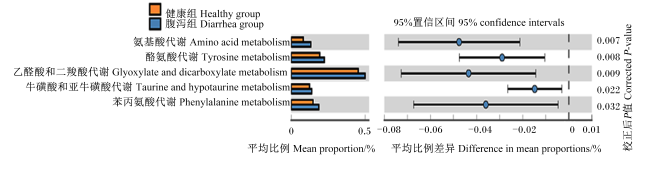
使用PICRUSt2对微生物进行功能预测,发现健康组和腹泻组仔猪结肠微生物存在显著差异的代谢途径,其中腹泻组仔猪结肠微生物主要参与氨基酸代谢、酪氨酸代谢和苯丙氨酸代谢等代谢途径(图7)。
图7 健康和腹泻仔猪结肠微生物在KEGG第3层级通路中的功能预测差异分析

Fig.7 Differential analysis of function prediction in the third level KEGG pathway of colonic microbiota of healthy and diarrhea piglets

2.3 早期断奶腹泻仔猪血清差异氨基酸与结肠差异菌属相关性分析

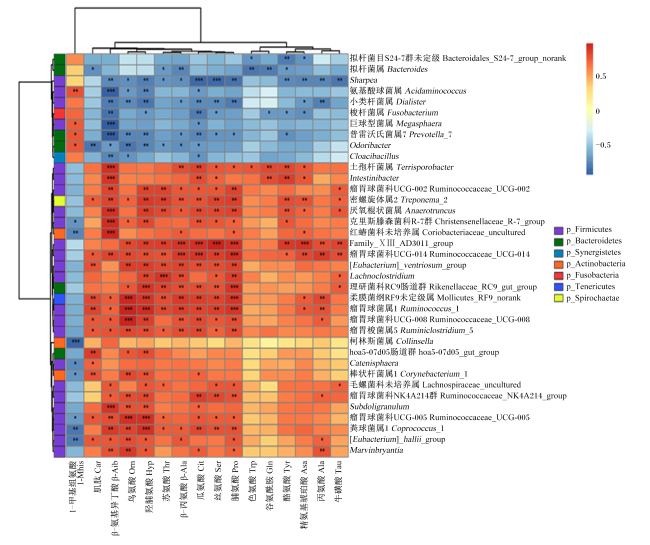
采用Spearman相关系数,选取P<0.05、VIP>1的血清差异氨基酸与LEfSe分析中的37个结肠差异菌属进行相关性分析(图8)。结果显示,结肠Lachnoclostridium和土孢杆菌属相对丰度均与血清β-丙氨酸、丝氨酸和脯氨酸含量呈显著正相关(P<0.05),结肠瘤胃球菌属[包括瘤胃球菌科UCG-002(Ruminococcaceae_UCG-002)、瘤胃球菌科UCG-005(Ruminococcaceae_UCG-005)、瘤胃球菌科UCG-008(Ruminococcaceae_UCG-008)、瘤胃球菌科UCG-014(Ruminococcaceae_UCG-014)、瘤胃球菌科NK4A214(Ruminococcaceae_NK4A214_group)和瘤胃球菌属1(Ruminococcus_1)]和厌氧棍状菌属(Anaerotruncus)相对丰度均与血清丝氨酸、脯氨酸、瓜氨酸、羟脯氨酸和β-氨基异丁酸含量呈显著正相关(P<0.05);而结肠梭杆菌属相对丰度与血清丝氨酸、瓜氨酸、羟脯氨酸和β-氨基异丁酸含量氨基酸含量呈显著负相关(P<0.05),结肠拟杆菌属和拟杆菌目S24-7群未定级相对丰度均与血清色氨酸和酪氨酸含量呈显著负相关(P<0.05)。
图8 健康和腹泻仔猪血清差异氨基酸与结肠差异相关性分析

Firmicutes:厚壁菌门;Bacteroidetes:拟杆菌门;Synergistetes:互养菌门;Actinobacteria:放线菌门;Fusobacteria:梭杆菌门;Tenericutes:软壁菌门;Spirochaetae:螺旋体门。

*表示显著相关(P<0.05),** and ***表示极显著相关(P<0.01和P<0.001)。

Fig.8 Correlation analysis between differential amino acids in serum and differential genera in colon of healthy and diarrhea piglets

* indicated significant correlation (P<0.05), and ** and *** indicated extremely significant correlation (P<0.01 and P<0.001).

3 讨论

早期断奶应激会破坏仔猪肠道形态结构,促进炎症因子分泌,激活免疫系统,破坏肠道屏障功能,导致仔猪采食量降低、生长速度减慢以及仔猪腹泻发病率增加[2]。血清中游离氨基酸通常用作机体内氨基酸储备,用于研究机体蛋白质代谢状态和估计动物的氨基酸需求,对于仔猪等幼龄动物的生长和免疫系统至关重要[19]。在本研究中,与健康仔猪相比,腹泻仔猪血清中苏氨酸、色氨酸、丙氨酸、脯氨酸、丝氨酸、酪氨酸、谷氨酰胺、牛磺酸、瓜氨酸、鸟氨酸、β-氨基异丁酸、肌肽、羟脯氨酸、精氨基琥珀酸和β-丙氨酸含量均显著降低,血清1-甲基组氨酸含量显著提高。苏氨酸和色氨酸作为猪的必需氨基酸,缺乏时会影响猪的生长性能和免疫系统发育[20]。苏氨酸不仅用于体内蛋白质合成,还与肠道中黏蛋白的合成有关,因此是肠道形态和免疫的主要组成成分[21]。色氨酸可增强肠道蛋白质合成并调节紧密连接蛋白和肠道转运蛋白的表达,有利于人类和动物的肠黏膜屏障功能[22]。β-丙氨酸也具有促进肠上皮细胞间紧密连接的形成,阻止有害物质的进入,增强肠道防御屏障的功能[22]。因此腹泻仔猪的肠道受到损伤后,对于这些氨基酸的需求增加,从血液中吸收氨基酸用于改善肠道稳态。1-甲基组氨酸是由组氨酸甲基化而成,一旦被释放便不能再利用,因此导致断奶仔猪血清中1-甲基组氨酸含量升高。肌肽由β-丙氨酸和组氨酸组成,组氨酸和β-丙氨酸含量降低,导致肌肽合成减少[23]。肌肽合成减少可能影响肠道黏膜的健康,导致肠道屏障功能减弱,增加对有害微生物的敏感性,从而加剧腹泻的病理过程[24]。Duan等[25]研究显示,在氧化应激条件下,仔猪血浆丝氨酸含量降低,这与本试验研究结果一致。丝氨酸有利于维持仔猪肠道绒毛的完整性,促进肠道紧密连接蛋白的表达和抑制肠上皮细胞凋亡,且丝氨酸可能通过抑制炎症和氧化应激反应来缓解断奶应激[26]。Yokoyama等[27]研究表明,在肠道菌群中的氨基酸合成酶活性丧失,可导致血浆中鸟氨酸、瓜氨酸和精氨酸含量降低,从而阻碍尿素循环。谷氨酰胺通过代谢作用可生成瓜氨酸、鸟氨酸和脯氨酸,其中鸟氨酸和瓜氨酸是精氨酸的前体[14]。脯氨酸在机体内可通过脯氨酸氧化酶、鸟氨酸转氨酶和鸟氨酸脱羧酶转化为多胺。初生仔猪肠道上皮细胞中上述酶的活性较高,在脯氨酸代谢中,产生的多胺对于促进初生仔猪的肠道发育和成熟至关重要[28]。因此,早期断奶应激导致血液中的氨基酸含量降低,可能是仔猪断奶应激状态下,肠道中吸收的氨基酸含量减少从而进入血液中的氨基酸含量也降低;也可能是更多的氨基酸用于肠道组织的修复等原因[29]。除此之外,采食量的降低也会导致机体摄入的氨基酸量减少,从而影响血清中氨基酸的含量[30]。但在采食量发生变化或者是腹泻状态下,微生物结构会受到影响,微生物结构的变化与机体代谢也有一定的关系[31]
汪群[32]研究发现,腹泻仔猪的粪便菌群多样性较健康仔猪低,这与本研究结果一致。本试验发现,与健康仔猪相比,早期断奶腹泻仔猪结肠厚壁菌门相对丰度显著降低,结肠梭杆菌门相对丰度显著提高,与王一冰等[33]的研究结果一致。在属水平上,与健康组相比,腹泻组仔猪结肠狭义梭菌属1、Lachnoclostridium和土孢杆菌属相对丰度显著降低,结肠梭杆菌属相对丰度显著提高。研究显示,梭杆菌属是导致新生仔猪肠道从健康到腹泻转变的关键微生物,并在健康组和腹泻组中的相对丰度差异显著[34],这表明梭杆菌属可能是早期断奶仔猪腹泻发生的潜在致病菌,为下一步研究与腹泻相关的菌群及微生物学机制提供一定的基础。Lachnoclostridium是肠道微生物群落中的重要成员,能够发酵多糖类物质产生短链脂肪酸(SCFAs),如丁酸和乙酸等。这些物质对肠道上皮细胞的生长和肠道屏障功能的增强具有积极作用,同时也具有抗炎作用[35]。另外,狭义梭菌属1[36]Lachnoclostridium和土孢杆菌属[37]参与碳水化合物等营养物质的代谢过程,并维持肠道正常的生理功能。这些有益菌的相对丰度显著降低,会导致肠道对碳水化合物的消化吸收和代谢能力的减弱,与腹泻相关[30]。瘤胃球菌科是一类具有产生丁酸盐能力的微生物,这些微生物对结肠上皮细胞具有促进营养的作用,有助于降低肠道炎症和促进动物的生长发育[38]。研究表明,结肠微生物能够利用结肠中的氨基酸,包括赖氨酸、精氨酸、甘氨酸、亮氨酸、缬氨酸和异亮氨酸,产生复杂的混合代谢产物,如SCFAs,为仔猪提供能量需要。
肠道微生物及其代谢产物能够影响机体的氨基酸代谢、脂质代谢等营养代谢途径[39-41]。本试验结果表明,仔猪结肠厚壁菌门14个菌属和拟杆菌门2个菌属的相对丰度与血清16种差异氨基酸含量呈正相关,表明厚壁菌门和拟杆菌门与氨基酸代谢存在一定的联系,这与前人的研究结果[42]一致。本研究通过KEGG功能预测分析发现,断奶腹泻仔猪结肠微生物在参与氨基酸代谢途径方面显著增强,这表明微生物可能利用更多的氨基酸,使得通过肠道上皮细胞进入血液的氨基酸含量减少,导致血清中游离氨基酸含量降低。本研究揭示了早期断奶腹泻仔猪肠道微生物的变化规律,可以为腹泻的诊断和治疗提供更准确的标志物和靶点。通过探究血清游离氨基酸谱的变化及其与腹泻的关系,可以深入理解微生物与宿主代谢之间的相互作用,为腹泻的营养干预提供新的思路和策略。

4 结论

① 早期断奶腹泻仔猪血清中苏氨酸、色氨酸、丙氨酸、脯氨酸、丝氨酸和酪氨酸等游离氨基酸含量显著降低;血清中牛磺酸、瓜氨酸、鸟氨酸、β-氨基异丁酸、肌肽、羟脯氨酸、精氨基琥珀酸和β-丙氨酸等氨基酸衍生物和代谢产物含量显著降低,血清中1-甲基组氨酸含量显著提高。
② 早期断奶腹泻仔猪结肠中厚壁菌门相对丰度显著降低;结肠狭义梭菌属1、Lachnoclostridium和土孢杆菌等菌属相对丰度显著降低,结肠梭杆菌属相对丰度显著提高。
③ 断奶仔猪结肠Lachnoclostridium和土孢杆菌属相对丰度均与血清β-丙氨酸、丝氨酸和脯氨酸含量呈显著正相关,结肠瘤胃球菌属和厌氧棍状菌属相对丰度均与血清丝氨酸、脯氨酸、瓜氨酸、羟脯氨酸和β-氨基异丁酸含量呈显著正相关;而结肠梭杆菌属相对丰度与血清丝氨酸、瓜氨酸、羟脯氨酸和β-氨基异丁酸含量呈显著负相关,结肠拟杆菌属和拟杆菌目S24-7未定级相对丰度均与血清色氨酸和酪氨酸含量呈显著负相关。
[1]
TANG W J, LIU J L, MA Y F, et al. Impairment of intestinal barrier function induced by early weaning via autophagy and apoptosis associated with gut microbiome and metabolites[J]. Frontiers in Immunology, 2021, 12:804870.

[2]
肖英平. 早期断奶仔猪血清代谢组学研究及谷氨酰胺对日粮消化吸收和代谢的影响[D]. 博士学位论文. 杭州: 浙江大学, 2012.

XIAO Y P. Metabolomic study of serum in early weaned piglets and effects of L-glutamine on nutrient digestibility and metabolism[D]. Ph.D. Thesis. Hangzhou: Zhejiang University, 2012. (in Chinese)

[3]
WU G Y. Amino acids:metabolism,functions,and nutrition[J]. Amino Acids, 2009, 37(1):1-17.

[4]
王宇, 窦丹波. 基于液相色谱-质谱联用技术的功能性腹泻患者血浆代谢组学研究[J]. 中国中西医结合消化杂志, 2019, 27(11):824-829.

WANG Y, DOU D B. Plasma metabolomics in patients with functional diarrhea using liquid chromatography-mass spectrometry[J]. Chinese Journal of Integrated Traditional and Western Medicine on Digestion, 2019, 27(11):824-829. (in Chinese)

[5]
张玉莹, 刘书杰, 冯宇哲, 等. 基于16S rRNA测序分析正常与腹泻牦牛犊牛粪便细菌区系组成[J]. 中国畜牧兽医, 2021, 48(9):3293-3302.

DOI

ZHANG Y Y, LIU S J, FENG Y Z, et al. Bacterial flora composition of normal and diarrhea yak calves based on 16S rRNA sequencing[J]. China Animal Husbandry & Veterinary Medicine, 2021, 48(9):3293-3302. (in Chinese)

[6]
TAO S Y, ZOU H C, LI J J, et al. Landscapes of enteric virome signatures in early-weaned piglets[J]. Microbiology Spectrum, 2022, 10(4):e0169822.

[7]
王文文, 王园, 安晓萍, 等. 断奶仔猪肠道菌群结构特征及其调控研究进展[J]. 动物营养学报, 2020, 32(11):4998-5005.

DOI

WANG W W, WANG Y, AN X P, et al. Research advances on structural characteristics and modulation of gut microbiota of weaned piglets[J]. Chinese Journal of Animal Nutrition, 2020, 32(11):4998-5005. (in Chinese)

[8]
HERMANN-BANK M L, SKOVGAARD K, STOCKMARR A, et al. Characterization of the bacterial gut microbiota of piglets suffering from new neonatal porcine diarrhoea[J]. BMC Veterinary Research, 2015, 11:139.

[9]
GRESSE R, CHAUCHEYRAS-DURAND F, FLEURY M A, et al. Gut microbiota dysbiosis in postweaning piglets:understanding the keys to health[J]. Trends in Microbiology, 2017, 25(10):851-873.

[10]
LALLÈS J P, BOSI P, SMIDT H, et al. Nutritional management of gut health in pigs around weaning[J]. Proceedings of the Nutrition Society, 2007, 66(2):260-268.

[11]
LI Y, GUO Y, WEN Z S, et al. Weaning stress perturbs gut microbiome and its metabolic profile in piglets[J]. Scientific Reports, 2018, 8(1):18068.

DOI PMID

[12]
XIAO Y P, WU T X, SUN J M, et al. Response to dietary L-glutamine supplementation in weaned piglets:a serum metabolomic comparison and hepatic metabolic regulation analysis[J]. Journal of Animal Science, 2012, 90(12):4421-4430.

[13]
WEN X L, LI W, ZHENG C T, et al. Fecal scores and microbial metabolites in weaned piglets fed different protein sources and levels[J]. Animal Nutrition, 2018, 4(1):31-36.

DOI PMID

[14]
赵广民, 刘秀婷, 代兵, 等. 早期断奶及谷氨酰胺添加对仔猪血清游离氨基酸及其代谢产物的影响[J]. 浙江农业学报, 2020, 32(10):1764-1771.

DOI

ZHAO G M, LIU X T, DAI B, et al. Effects of early weaning and dietary glutamine addition on serum free amino acids and their metabolites in piglets[J]. Acta Agriculturae Zhejiangensis, 2020, 32(10):1764-1771. (in Chinese)

DOI

[15]
王龙生, 杨华, 代兵, 等. 早期断奶对仔猪血清、肌肉及肝脏氨基酸代谢的影响[J]. 中国畜牧杂志, 2016, 52(21):65-71.

WANG L S, YANG H, DAI B, et al. Effect of early weaning on metabolism of amino acids in the piglets’ serum,muscle and liver[J]. Chinese Journal of Animal Science, 2016, 52(21):65-71. (in Chinese)

[16]
MA L Y, TAO S Y, SONG T X, et al. Clostridium butyricum and carbohydrate active enzymes contribute to the reduced fat deposition in pigs[J]. iMeta, 2024, 3(1):e160.

[17]
申宇, 杨华, 樊倩, 等. 番鸭盲肠真菌菌群结构及其发育性变化研究[J]. 动物营养学报, 2022, 34(8):5072-5083.

DOI

SHEN Y, YANG H, FAN Q, et al. Cecal mycobiome structure and its developmental changes of muscovy ducks[J]. Chinese Journal of Animal Nutrition, 2022, 34(8):5072-5083. (in Chinese)

DOI

[18]
CHEN Q, ZHANG X J, SHI W L, et al. Longitudinal investigation of enteric virome signatures from parental-generation to offspring pigs[J]. Microbiology Spectrum, 2023, 11(3):e0002323.

[19]
MOU Q, YANG H S, YIN Y L, et al. Amino acids influencing intestinal development and health of the piglets[J]. Animals, 2019, 9(6):302.

[20]
ENGELSMANN M N, NIELSEN T S, HEDEMANN M S, et al. Effects of dietary tryptophan and threonine supplementation above nutritional recommendations on performance,diarrhoea,and intestinal health parameters in weaned piglets[J]. Livestock Science, 2023, 269:105186.

[21]
李耀杰, 王丽, 蒋宗勇, 等. 苏氨酸在仔猪生产上的应用研究进展[J]. 动物营养学报, 2022, 34(12):7518-7528.

DOI

LI Y J, WANG L, JIANG Z Y, et al. Research progress on application of threonine in piglet production[J]. Chinese Journal of Animal Nutrition, 2022, 34(12):7518-7528. (in Chinese)

DOI

[22]
GAO J, XU K, LIU H N, et al. Impact of the gut microbiota on intestinal immunity mediated by tryptophan metabolism[J]. Frontiers in Cellular and Infection Microbiology, 2018, 8:13.

DOI PMID

[23]
CHEN L L, ZHONG Y, OUYANG X Q, et al. Effects of β-alanine on intestinal development and immune performance of weaned piglets[J]. Animal Nutrition, 2023, 12:398-408.

DOI PMID

[24]
李栋, 朱传忠, 叶继丹. 肌肽生理功能及其在动物养殖中的应用[J]. 中国饲料, 2023(19):1-9.

LI D, ZHU C Z, YE J D. Physiological function of carnosine and its application in animal breeding[J]. China Feed, 2023(19):1-9. (in Chinese)

[25]
DUAN J L, YIN J, REN W K, et al. Dietary supplementation with L-glutamate and L-aspartate alleviates oxidative stress in weaned piglets challenged with hydrogen peroxide[J]. Amino Acids, 2016, 48(1):53-64.

[26]
ZHOU X H, ZHANG Y M, WU X, et al. Effects of dietary serine supplementation on intestinal integrity,inflammation and oxidative status in early-weaned piglets[J]. Cellular Physiology and Biochemistry:International Journal of Experimental Cellular Physiology,Biochemistry,and Pharmacology, 2018, 48(3):993-1002.

[27]
YOKOYAMA K, OGURA Y, KAWABATA M, et al. Hyperammonemia in a patient with short bowel syndrome and chronic renal failure[J]. Nephron, 1996, 72(4):693-695.

DOI PMID

[28]
WU G, BAZER F W, DATTA S, et al. Proline metabolism in the conceptus:implications for fetal growth and development[J]. Amino Acids, 2008, 35(4):691-702.

[29]
PIÉ S, LALLÈS J P, BLAZY F, et al. Weaning is associated with an upregulation of expression of inflammatory cytokines in the intestine of piglets[J]. Journal of Nutrition, 2004, 134(3):641-647.

DOI PMID

[30]
ZIMMERMAN R A, SCOTT H M. Interrelationship of plasma amino acid levels and weight gain in the chick as influenced by suboptimal and superoptimal dietary concentrations of single amino acids[J]. Journal of Nutrition, 1965, 87(1):13-18.

PMID

[31]
DE VOS W M, TILG H, VAN HUL M, et al. Gut microbiome and health:mechanistic insights[J]. Gut, 2022, 71(5):1020-1032.

[32]
汪群. 腹泻与健康仔猪粪便菌群的比较及致病菌的分离与耐药性研究[D]. 硕士学位论文. 广州: 华南理工大学, 2019.

WANG Q. Comparison of fecal microbiota between diarrheal and healthy piglets and study of the antibiotic resistance of pathogens[D]. Master’s Thesis. Guangzhou: South China University of Technology, 2019. (in Chinese)

[33]
王一冰, 张小平, 黄怡, 等. 运用454焦磷酸测序技术对断奶前后仔猪肠道菌群的分析[J]. 动物营养学报, 2013, 25(10):2440-2446.

DOI

WANG Y B, ZHANG X P, HUANG Y, et al. Intestinal microflora analysis of pre- and post-weaning piglets using by 454 pyrosequencing technology[J]. Chinese Journal of Animal Nutrition, 2013, 25(10):2440-2446. (in Chinese)

[34]
徐怡亮. 腹泻仔猪肠道微生物结构及粪便代谢组学研究[D]. 硕士学位论文. 合肥: 安徽农业大学, 2020.

XU Y L. Study on intestinal microbial structure and fecal metabolomics in diarrheic piglets[D]. Master’s Thesis. Hefei: Anhui Agricultural University, 2020. (in Chinese)

[35]
詹扬, 万建华, 李颖萌, 等. 乳酸菌素片对抗生素相关性腹泻小鼠肠道菌群的影响[J]. 中国乳品工业, 2021, 49(8):4-9,36.

ZHAN Y, WAN J H, LI Y M, et al. Effects of Lactobacillus tablets on gut microbiota in antibiotic-associated diarrhea model mice[J]. China Dairy Industry, 2021, 49(8):4-9,36. (in Chinese)

[36]
YANG G, WANG J L. Changes in microbial community structure during dark fermentative hydrogen production[J]. International Journal of Hydrogen Energy, 2019, 44(47):25542-25550.

[37]
DETMAN A, LAUBITZ D, CHOJNACKA A, et al. Dynamics of dark fermentation microbial communities in the light of lactate and butyrate production[J]. Microbiome, 2021, 9(1):158.

DOI PMID

[38]
LEE A, LE BON M, CONNERTON I F, et al. Common colonic community indicators of the suckling pig microbiota where diversity and abundance correlate with performance[J]. FEMS Microbiology Ecology, 2022, 98(5):fiac048.

[39]
DAI Z L, WU G Y, ZHU W Y. Amino acid metabolism in intestinal bacteria:links between gut ecology and host health[J]. Frontiers in Bioscience (Landmark Edition), 2011, 16(5):1768-1786.

[40]
KIM D J, YANG J, SEO H, et al. Colorectal cancer diagnostic model utilizing metagenomic and metabolomic data of stool microbial extracellular vesicles[J]. Scientific Reports, 2020, 10(1):2860.

DOI PMID

[41]
SCHOELER M, CAESAR R. Dietary lipids,gut microbiota and lipid metabolism[J]. Reviews in Endocrine & Metabolic Disorders, 2019, 20(4):461-472.

[42]
WU J Y, WANG K, WANG X M, et al. The role of the gut microbiome and its metabolites in metabolic diseases[J]. Protein & Cell, 2021, 12(5):360-373.

Outlines

/