REVIEW

Role of Gastrointestinal Microbiota in Nitrate Metabolism and Its Physiological Functions

  • ZHENG Wentao , 1, 2 ,
  • QI Lili , 2, * ,
  • WANG Jinbo 2 ,
  • WU Yuqin 3
Expand
  • 1 College of Life Sciences and Medicine, Zhejiang Sci-Tech University, Hangzhou 310018, China
  • 2 School of Biological and Chemical Engineering, NingboTech University, Ningbo 315100, China
  • 3 The Xin Hua Hospital of Zhejiang Province, Hangzhou 310005, China
*associate professor, E-mail:

Received date: 2024-04-16

  Online published: 2024-10-14

Abstract

Nitrates are naturally present in green plants and drinking water, playing roles in inhibiting the proliferation of harmful bacteria in the digestive tract, participating in inflammation regulation, and reducing methane production in ruminants. However, excessive nitrates can be converted into nitrites, and subsequently into nitrosamines, which pose acute and chronic toxicological effects on animals and present potential carcinogenic risks to humans. The gut microbiota metabolizes nitrates via the “nitrate-nitrite-nitric oxide” pathway, producing small molecules such as nitric oxide, nitrogen gas, nitrite, and ammonia, which regulate various physiological functions in animals. Therefore, understanding the nitrate metabolism mechanisms of the gut microbiota is crucial for comprehensively recognizing the metabolic processes and physiological roles of nitrates in animals and humans. Based on this understanding, it is possible to regulate dietary intake and gut microbiota to optimize nitrate metabolism, thereby maximizing its physiological benefits and enhancing animal health.

Cite this article

ZHENG Wentao , QI Lili , WANG Jinbo , WU Yuqin . Role of Gastrointestinal Microbiota in Nitrate Metabolism and Its Physiological Functions[J]. Chinese Journal of Animal Nutrition, 2024 , 36(10) : 6248 -6255 . DOI: 10.12418/CJAN2024.532

硝酸盐天然存在于蔬菜等绿色植物性食物和饮用水中,青绿饲料是动物亚硝酸盐的主要来源。硝酸盐也常作为人类的食品添加剂,大量存在于香肠、培根和午餐肉等加工肉制品中。硝酸盐在体内可还原成亚硝酸盐,后者与某些氨基酸或蛋白质消化产生的肽形成亚硝胺类化合物,亚硝胺类化合物具有较强的毒性,严重影响动物和人的健康。因此,长期以来食物中的硝酸盐被认为是有害成分。近年来的研究发现,硝酸盐可增强肌肉血流,提高氧的代谢效率,降低人体血压水平,抑制血小板聚集和防止缺血再灌注损伤等[1-2]。此外,硝酸盐还可以促进胰岛素的分泌,逆转代谢综合征,改善胰岛功能,增强线粒体功能,抑制炎症因子的表达[3]。这些研究表明,食物来源的硝酸盐在动物和人体内发挥重要的生理功能。
消化道菌群对动物和人的健康具有重要意义,在营养物质代谢、免疫机能调节、神经功能维持等方面发挥不可或缺的作用。食物来源的硝酸盐主要通过消化道菌群“硝酸盐-亚硝酸盐-一氧化氮”途径代谢,进而发挥其生理功能。哺乳动物体内不存在硝酸盐还原酶,食物来源的硝酸盐经由消化道共生菌体内的多种硝酸盐还原酶代谢,还原成为亚硝酸盐、一氧化氮、氮气及其他含氮分子,发挥生理活性作用[4-6]。因此,深入研究消化道菌群的硝酸盐代谢机制,并探究其生理作用,具有重要意义。

1 口腔菌群在硝酸盐代谢过程中的作用

哺乳动物的口腔中约有700多种细菌,数量有50亿至100亿。位于舌头后部隐窝的兼性厌氧菌中,存在多种硝酸盐还原酶,这些酶通过“硝酸盐-亚硝酸盐-一氧化氮”通路,将食物来源的硝酸盐代谢成为亚硝酸盐、一氧化氮、一氧化二氮(N2O)和氮气等。口腔菌群中的韦荣氏球菌属、普雷沃氏菌属、放线菌属、嗜血杆菌属、奈瑟菌属、罗斯氏菌属等是参与硝酸盐代谢的主要微生物[7-8]。细菌中负责将硝酸盐还原成为亚硝酸盐的还原酶(NAR)主要有3种:细胞质同化型硝酸盐还原酶(NAS)、膜结合型细胞质硝酸盐还原酶(NarG、NarZ)和细胞周质硝酸盐还原酶(NAP)[9-11]。亚硝酸盐可被口腔中需氧菌还原酶进一步还原成为一氧化氮、氮气等小分子;还可经硝酸盐异化还原到铵途径(DNRA)还原成为铵根,亚硝酸盐还原酶K、S、BD(NirK、NirS、NirBD)、氢醌依赖性一氧化氮还原酶(qnorB)、核因子红细胞2型相关因子(Nrf)和一氧化氮还原酶Z(nosZ)参与这一过程[12-13]。Hyde等[14]研究认为,龋齿放线菌和殊异韦荣菌是口腔中主要的硝酸盐还原菌,其对口腔硝酸盐还原的贡献度超过80%。Burleigh等[15]、Vanhatalo等[16]研究认为,普雷沃氏菌属和韦荣氏球菌属细菌是主要的口腔硝酸盐还原菌。
食物来源的硝酸盐能够影响口腔菌群的丰度和多样性。膳食补充硝酸钠可使口腔健康相关的奈瑟菌属和罗斯氏菌属细菌的丰度分别提高3.1和2.9倍,显著降低牙周炎和龋齿相关的链球菌属、韦荣氏球菌属、颤杆菌克属、卟啉单胞菌属、梭杆菌属、纤毛菌属、普雷沃氏菌属和拟普雷沃氏菌属等的丰度[17]。连续摄入富含硝酸盐的甜菜根汁,浅黄奈瑟球菌、黏液罗氏菌等硝酸盐还原菌的丰度显著上升[18]。Bahadoran等[19]的研究也发现,饲粮补充硝酸盐能够显著提升奈瑟菌属、罗斯氏菌属等的丰度,降低普雷沃氏菌属等条件性致病菌的丰度。
总体而言,舌隐窝低氧环境中的兼性厌氧细菌在其呼吸代谢中以硝酸盐作为最终电子受体。藉由该途径,哺乳动物可将硝酸盐阴离子转化为亚硝酸盐,后者可进一步代谢产生一氧化氮及其他活性含氮化合物。如果缺少口腔共生菌,“硝酸盐-亚硝酸盐-一氧化氮”途径将无法发挥作用。另外,硝酸盐也可调节口腔菌群落组成和及其活性,这对宿主健康有益,硝酸盐可能是一种维护机体口腔健康的潜在益生元。

2 胃肠道菌群在硝酸盐代谢过程中的作用

相较于口腔,胃肠道菌群中细菌的种类更多、丰度更高、也更具多样性。硝酸盐影响胃肠道菌群组成与结构,亦可被其中的一些细菌代谢,进而发挥相关生理调节功能。Eriksson等[20]的试验证明,猪体内硝酸盐转化为亚硝酸盐的过程很可能与口腔细菌无关,而是在硝酸盐进入到小肠中后,被肠道细菌转化为亚硝酸盐,然后,亚硝酸盐被吸收并通过门静脉运输到肝脏,在那里被转化为一氧化氮和其他生物活性氮氧化物。
目前,有关胃肠道菌群与硝酸盐代谢的关系研究还比较少,机制尚不十分明确。肠道菌群在硝酸盐代谢过程中发挥多方面作用,硝酸钠可作为营养成分促进菌体增殖,亦可参与菌体氧化还原反应,还可参与调节菌体挥发性脂肪酸等小分子化合物的合成,进而与肠黏膜上皮细胞的受体分子互作,通过调控Toll样受体(TLRs)等信号通路,发挥其生理活性作用[21-23]。某些肠道细菌体内的亚硝酸盐还原酶(NiRs)可将亚硝酸盐还原成为具有亲电性的硝基脂肪酸(NO2-FA)信号分子,包括硝基亚油酸(N2-CLA)、S-亚硝基硫醇等,这些信号分子不仅能够启动一氧化氮信号反应,而且参与蛋白质翻译后的修饰,改变相关基因的表达调控模式[24-25]。硝酸盐也可影响肠道菌群的组成、丰度及功能。Rocha等[26]的研究发现,饲粮补充硝酸钠能够抑制广谱抗生素导致的大鼠体重减轻,有助于恢复抗生素导致的肠道菌群丰度和多样性改变,这提示硝酸盐能够影响肠道菌群组成。Petrick等[2]连续8周给肥胖模型小鼠饮水给予4 mmol/L硝酸钠,能够改善高脂饮食导致的肠道菌群失调,降低其血压,减少线粒体活性氧自由基的产生,减轻肠道炎症反应。Ma等[27]以小鼠为模型进行的研究发现,高脂饮食小鼠连续饮水给予2 mmol/L硝酸钠,其肠道拟杆S24-7和另枝菌属等细菌的丰度显著提高。Hu等[28]对葡聚糖硫酸钠(DSS)诱导的溃疡性结肠炎模型小鼠的研究进一步发现,硝酸钠可以提高DSS模型小鼠肠道中乳杆菌、瘤胃球菌科UCG-014(Ruminococcaceae UCG-014)和普雷沃氏菌科UCG-001(Prevotellaceae UCG-001)等的丰度,从而减轻肠道炎症。

3 消化道菌群“硝酸盐-亚硝酸盐-一氧化氮”代谢通路

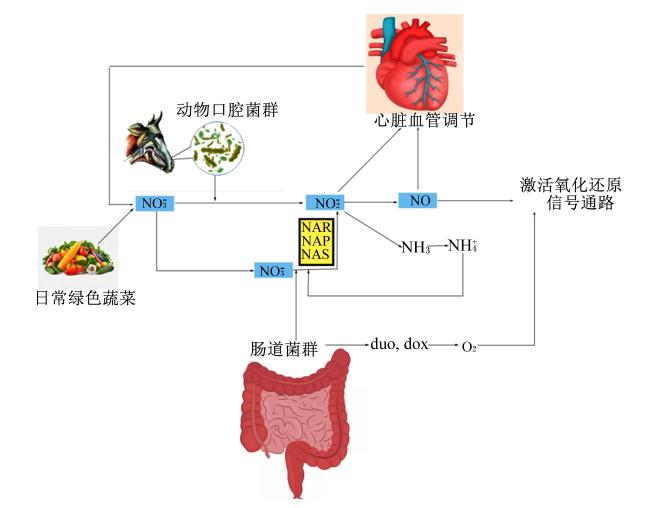
摄入体内的硝酸盐经“肠道-唾液循环”代谢成为亚硝酸盐。食物来源的硝酸盐首先被吸收进入循环系统,进入体内循环的硝酸盐约有75%经肾脏以尿液形式排出体外;其余25%左右的硝酸盐随着循环进入唾液腺中,再以唾液形式分泌进入口腔,唾液中硝酸盐的浓度可达1 500 μmol/L;约20%唾液硝酸盐被口腔中的硝酸盐还原菌代谢成为亚硝酸盐;还原产生的亚硝酸盐和未被代谢的硝酸盐随着吞咽进入胃肠道;再进入下一轮“肠道-唾液循环”[29-32]。硝酸盐、亚硝酸盐进入胃肠道后,在不同的微环境条件下,可转化成为具有不同的氮氧化合物(图1)[33]。在胃的酸性条件下经次黄嘌呤氧化酶、细胞色素c氧化酶、硝酸盐还原酶等的共同作用下,进一步代谢成为一氧化氮等氮氧化合物。一氧化氮在保护血管和胃肠道黏膜、调节心肌细胞和神经信号传导功能等方面发挥重要生理功能[34]。在肠道中,硝酸盐、亚硝酸盐可在NAR、NAP、NAS等硝酸盐还原酶的作用下,代谢成为ATP、氨气(NH3)和铵离子(N H 4 +)等含氮物质,进而合成谷氨酰胺等氨基酸,作为肠道细菌的营养物质。肠道菌群还可利用双氧化酶2(duox2)、NADPH氧化还原酶1(Nox1)等,激活氧化还原反应体系,将硝酸盐和亚硝酸代谢成为一氧化氮自由基,该自由基具有舒张血管、增加血流、降低血压等生理功能[35-37]
图1 硝酸盐-亚硝酸盐-一氧化氮代谢通路

NAR:硝酸盐还原酶 nitrate reductase; NAP:周质硝酸盐还原酶 periplasmic nitrate reductase; NAS:同化硝酸盐还原酶 assimilating nitrate reductase; duo:双氧化酶 dioxidase;dox:阿霉素 doxorubicin;N O 3 -:硝酸根 nitrate;N O 2 -:亚硝酸根 nitrite; NO:一氧化氮 nitric oxide。

Fig.1 Nitrate-nitrite-NO metabolic pathway

口腔微生物在硝酸盐的还原过程中发挥关键作用(图1)。食物来源的硝酸盐经口摄入后,一部分会被口腔细菌还原成为亚硝酸盐,亚硝酸盐可在系列酶的作用下还原成为一氧化氮、氮气(N2)、ATP等活性分子;大部分未被降解的硝酸盐会被胃肠道吸收进入血液,最终经由肾脏排出体外,少部分未被肾脏排出的硝酸盐再经血液循环进入口腔,又被口腔中的细菌还原成为亚硝酸盐,再次循环利用。
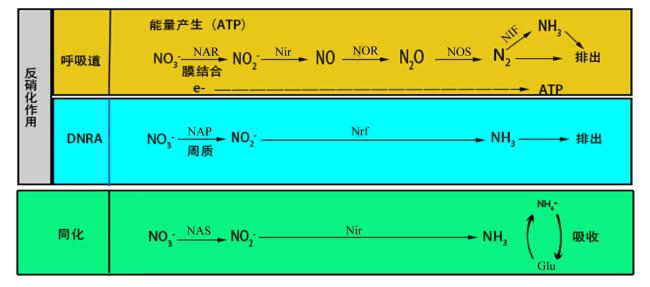
消化道菌群还原硝酸盐的通路主要有3条(图2):1)呼吸反硝化作用。该过程由NAR或NAP催化,在缺氧条件下,细菌主要依赖该路径电化学呼吸作用代谢产生ATP,为自身生命活动提供能量;在该路径中,亚硝酸盐被亚硝酸盐还原酶、一氧化氮还原酶和氧化亚氮还原酶等还原酶代谢成为气态一氧化氮和氧化亚氮,这些小分子氮氧化合物或者直接进入宿主的血液循环系统,发挥生理作用,或者在固氮酶的作用下成为氨氮类化合物被细菌利用[38-39];2)硝态氮异化还原成铵(DNRA)。该过程由NAP催化,该路径是含氮化合物的主要脱毒、分泌通路,亚硝酸盐可由该通路转化成铵类化合物,此外,该路径也可与甲酸盐氧化过程相耦合,间接地参与ATP的合成[40];3)同化型硝酸盐还原作用。该过程在肠道菌群由NAS催化,在该通路中,亚硝酸盐进一步被还原成为铵类化合物,铵类可作为细菌合成谷氨酰胺等氨基酸的原料,后者作为细菌生长、增殖的营养成分,增加菌体生物量[41]。由图2可以看出,硝酸盐还原的3条途径有共同的中间产物亚硝酸根,生成亚硝酸根后,再经不同酶的作用,进一步合成一氧化氮、N2O、N2、NH3 NH 4 +、谷氨酰胺和ATP等含氮分子,发挥其生理功能。
图2 细菌硝酸盐还原的主要途径

NAR:异化型硝酸盐还原酶 allotropic nitrate reductase; NIR:亚硝酸盐还原酶 nitrite reductase; NOR:一氧化氮还原酶 nitric oxide reductase; nos:氧化亚氮还原酶 nitrous oxide reductase; nif:固氮还原酶 nitrogen-fixing reductase; DNRA:异化还原反应 dissimilation-reduction reaction; NAP:周质硝酸盐还原酶 periplasmic nitrate reductase; Nrf:核转录因子 nuclear transcription factor; NAS:同化硝酸盐还原酶 assimilating nitrate reductase; Glu:葡萄糖 glucose;N O 3 -:硝酸根 nitrate;N O 2 -:亚硝酸根 nitrite; NO:一氧化氮 nitric oxide; N2:氮气nitrogen;NH3:氨气 ammonia gas; N H 4 +:铵离子 ammonium ion。

Fig.2 Main pathways of bacterial nitrate reduction

消化道菌群还原硝酸盐的过程主要受双组分系统(TCS)调控[42-46]。DNRA通路主要受硝酸盐还原酶(NarQ-NarP、NarX-NarL 2对转录因子)的调控,感应到环境中的硝酸盐后,NarQ、NarX分别诱导NarP、NarL磷酸化,磷酸化后的NarP、NarL分子构象发生改变,可识别硝酸盐还原酶启动子上游区域,进而激活其RNA聚合酶的转录,诱导硝酸盐还原酶表达[46-47]。对大肠杆菌硝酸盐代谢路径的研究还发现,RprA等miRNAs在菌体硝酸盐代谢调控过程中发挥着关键性作用[48]
从上述研究可以看出,食物来源的硝酸盐可由口腔微生物还原成为亚硝酸;亚硝酸盐进入胃肠道后,可在机体及共生菌体内相关酶的作用下,进一步生成一氧化氮、N2O、N2、NH3、N H 4 +和ATP等含氮小分子化合物,这些含氮小分子化合物对动物体具有丰富多样的生理功能。一氧化氮是一种具有多种生理活性的小分子,其可以舒张血管平滑肌、增强免疫细胞活力、调节神经系统兴奋性、作为信号转导的媒介分子,具有十分多样的生理活性作用。NH3、N H 4 +可作为氨基酸合成的原料,合成谷氨酰胺等氨基酸,在维持肠道正常功能、避免肠道损伤等过程中具有重要生理作用。ATP则是重要的能量物质,是动物体内诸多生化反应的主要能量来源。总之,食物来源的硝酸盐可经消化道微生物代谢,产生具有生理活性的小分子物质,这对维持机体正常生理功能具有重要意义。

4 硝酸盐对动物健康的影响

在动物体内,硝酸盐不仅会被消化道菌群代谢成为有生理调节功能的氮氧化物,还可作为肠道微生物的有效非蛋白质氮源,减少反刍动物消化道甲烷的产生。作为一种瘤胃甲烷抑制剂,硝酸盐可以通过2种方式影响瘤胃菌群组成:1)亚硝酸盐对细菌的抑制作用;2)氢的竞争。产甲烷菌需要消耗瘤胃发酵产生的氢。研究表明,硝酸盐、亚硝酸盐在还原过程中与甲烷在瘤胃中争夺氢,硝酸盐是减少瘤胃甲烷产生的替代氢汇[49-50]。瘤胃液中添加5~10 mmol/L硝酸钠,可以浓度依赖方式减少甲烷的排放[51]。在绵羊体内,硝酸盐、亚硝酸盐能够快速通过瘤胃壁吸收进入血液循环中,血液中的硝酸盐可以进入消化道,并在瘤胃或后肠中被微生物还原,然后被吸收,在肝脏中转化为尿素,最终通过尿液排出或通过唾液循环重新进入消化道[52]。Zhao等[53]研究了硝酸盐对体外瘤胃甲烷产量、产甲烷菌丰度和组成的影响,结果表明,硝酸盐在体外瘤胃中还原成亚硝酸盐后,显著降低了牛体内甲烷菌、甲烷杆菌和甲烷短杆菌的丰度。
适量的硝酸盐还会提高动物的生产性能。Van Den Bosch等[54]的研究发现,母猪的饲粮中适量添加硝酸盐,不仅不会对母猪产生负面影响,反而有助于增强仔猪的活力。泌乳母猪饲粮中添加1.2 g/L硝酸钙能够显著提高仔猪血红蛋白运输氧的能力,这对改善仔猪健康具有重要意义[55]。当给奶牛饲喂低蛋白质饲粮时,用硝酸盐代替尿素可以提高氨转化为微生物蛋白的效率,并刺激发酵过程中产生的电子转移到丙酸生产,进一步刺激牛奶的生产[56]。添加硝酸盐还能够帮助动物抵御致病性肠杆菌的侵袭,还原产生的亚硝酸盐对抵御沙门氏菌、耶尔森氏菌等食源性肠道病原菌的感染非常有效[57]
虽然,适量硝酸盐对动物健康有诸多益处,但长期大量接触硝酸盐会带来明显的副作用。长期摄入过量的硝酸盐会导致仔猪口腔微生物群落的丰度降低,从而使口腔的硝酸盐还原能力受损[58]。Benu等[59]的研究表明,当牛摄入过量的硝酸盐,瘤胃中亚硝酸盐不能快速转化为氨,亚硝酸盐就会被吸收进入血液,亚硝酸盐可将血红蛋白中的亚铁氧化成铁形式,从而诱发牛的高铁血红蛋白血症。有研究表明,包被的硝酸盐可以降低绵羊亚硝酸盐中毒的风险,且并不会对硝酸盐抑制甲烷的能力产生影响[60]。将具有亚硝酸盐代谢能力的微生物作为益生菌直接饲喂,可以避免硝酸盐过量造成的危害。从牛瘤胃中分离出1种名为Paenibacillus 79R4的反硝化细菌,能够有效还原亚硝酸盐,且在体外对革兰氏阴性病原体表现出有效的抗菌活性[61]
由上述研究的结果可以看出,饲粮中的硝酸盐可以抑制反刍动物瘤胃中产甲烷菌的活性或者通过竞争性利用氢,减少甲烷等温室气体的排放,这对推进畜牧业绿色可持续发展具有重要意义。硝酸盐还可通过产生一氧化氮等活性分子,改善母猪繁殖能力,增强仔猪血液运输氧的能力,提高初生仔猪活力。作为一种抑菌剂,硝酸盐还可抑制肠道中沙门氏菌等有害菌的生长、增殖,改善动物肠道健康。过量的硝酸盐对禽类、猪等动物具有明显的毒副作用,甚至引起动物死亡。需综合考虑动物种类、生长阶段、生产目标和饲粮组成等多重因素,深入研究硝酸盐在动物生产中的应用前景及意义。

5 总结和展望

哺乳动物体内缺少硝酸盐还原酶,消化道菌群在硝酸盐代谢过程中扮演着至关重要的角色。青绿饲料中硝酸盐通过消化道菌群的代谢作用,能够转化为具有生理功能的化合物,如亚硝酸盐、一氧化氮等。口腔菌群和胃肠道菌群都在这一过程中均发挥重要作用,可通过复杂的代谢途径,影响硝酸盐在体内的转化和利用。尽管关于口腔、胃肠道菌群在硝酸盐代谢过程中机制已有相关研究,但关于消化道菌群与机体协同吸收、代谢、利用硝酸盐、亚硝酸盐及一氧化氮等小分子代谢物的机制尚不明确,需要深入研究。揭示消化道菌群代谢硝酸盐的机制,阐明硝酸盐及其代谢物在调控动物生理功能中的作用,可为提高动物健康水平、提升养殖业经济效益提供新思路和新方法。
[1]
OHTAKE K, KOGA M, UCHIDA H, et al. Oral nitrite ameliorates dextran sulfate sodium-induced acute experimental colitis in mice[J]. Nitric Oxide, 2010, 23(1):65-73.

DOI PMID

[2]
PETRICK H L, OGILVIE L M, BRUNETTA H S, et al. Dietary nitrate and corresponding gut microbiota prevent cardiac dysfunction in obese mice[J]. Diabetes, 2023, 72(7):844-856.

DOI PMID

[3]
LUNDBERG J O, CARLSTRÖM M, WEITZBERG E. Metabolic effects of dietary nitrate in health and disease[J]. Cell Metabolism, 2018, 28(1):9-22.

DOI PMID

[4]
ALZAHRANI H S, JACKSON K G, HOBBS D A, et al. The role of dietary nitrate and the oral microbiome on blood pressure and vascular tone[J]. Nutrition Research Reviews, 2021, 34(2):222-239.

DOI PMID

[5]
ROSIER B T, MOYA-GONZALVEZ E M, CORELL-ESCUIN P, et al. Isolation and characterization of nitrate-reducing bacteria as potential probiotics for oral and systemic health[J]. Frontiers in Microbiology, 2020,11:555465.

[6]
WALKER M Y, PRATAP S, SOUTHERLAND J H, et al. Role of oral and gut microbiome in nitric oxide-mediated colon motility[J]. Nitric Oxide, 2018,73:81-88.

[7]
HYDE E R, LUK B, CRON S, et al. Characterization of the rat oral microbiome and the effects of dietary nitrate[J]. Free Radical Biology & Medicine, 2014,77:249-257.

[8]
PIGNATELLI P, FABIETTI G, RICCI A, et al. How periodontal disease and presence of nitric oxide reducing oral bacteria can affect blood pressure[J]. International Journal of Molecular Sciences, 2020, 21(20):7538.

[9]
DOEL J J, BENJAMIN N, HECTOR M P, et al. Evaluation of bacterial nitrate reduction in the human oral cavity[J]. European Journal of Oral Sciences, 2005, 113(1):14-19.

DOI PMID

[10]
LUNDBERG J O, WEITZBERG E, COLE J A, et al. Nitrate,bacteria and human health[J]. Nature Reviews.Microbiology, 2004, 2(7):593-602.

[11]
ROSIER B T, JOHNSTON W, CARDA-DIÉGUEZ M, et al. Nitrate reduction capacity of the oral microbiota is impaired in periodontitis:potential implications for systemic nitric oxide availability[J]. International Journal of Oral Science, 2024, 16(1):1.

[12]
SCHREIBER F, STIEF P, GIESEKE A, et al. Denitrification in human dental plaque[J]. BMC Biology, 2010,8:24.

[13]
TRIBBLE G D, ANGELOV N, WELTMAN R, et al. Frequency of tongue cleaning impacts the human tongue microbiome composition and enterosalivary circulation of nitrate[J]. Frontiers in Cellular and Infection Microbiology, 2019,9:39.

[14]
HYDE E R, ANDRADE F, VAKSMAN Z, et al. Metagenomic analysis of nitrate-reducing bacteria in the oral cavity:implications for nitric oxide homeostasis[J]. PLoS One, 2014, 9(3):e88645.

[15]
BURLEIGH M C, LIDDLE L, MONAGHAN C, et al. Salivary nitrite production is elevated in individuals with a higher abundance of oral nitrate-reducing bacteria[J]. Free Radical Biology & Medicine, 2018,120:80-88.

[16]
VANHATALO A, BLACKWELL J R, L’HEUREUX J E, et al. Nitrate-responsive oral microbiome modulates nitric oxide homeostasis and blood pressure in humans[J]. Free Radical Biology & Medicine, 2018,124:21-30.

[17]
ROSIER B T, BUETAS E, MOYA-GONZALVEZ E M, et al. Nitrate as a potential prebiotic for the oral microbiome[J]. Scientific Reports, 2020, 10(1):12895.

DOI PMID

[18]
VELMURUGAN S, GAN J M, RATHOD K S, et al. Dietary nitrate improves vascular function in patients with hypercholesterolemia:a randomized,double-blind,placebo-controlled study[J]. American Journal of Clinical Nutrition, 2016, 103(1):25-38.

[19]
BAHADORAN Z, MIRMIRAN P, CARLSTRÖM M, et al. Inorganic nitrate:a potential prebiotic for oral microbiota dysbiosis associated with type 2 diabetes[J]. Nitric Oxide, 2021,116:38-46.

[20]
ERIKSSON K E, YANG T, CARLSTRÖM M, et al. Organ uptake and release of inorganic nitrate and nitrite in the pig[J]. Nitric Oxide, 2018,75:16-26.

[21]
LIU H Y, HUANG Y S, HUANG M S, et al. From nitrate to NO:potential effects of nitrate-reducing bacteria on systemic health and disease[J]. European Journal of Medical Research, 2023, 28(1):425.

[22]
ROCHA B S, LARANJINHA J. Nitrate from diet might fuel gut microbiota metabolism:minding the gap between redox signaling and inter-kingdom communication[J]. Free Radical Biology & Medicine, 2020,149:37-43.

[23]
ZHANG S H, WU Z Y, WANG J, et al. Nitrate and nitrite pathways and dynamic changes in bacterial communities during beet sugar processing[J]. Journal of the Science of Food and Agriculture, 2022, 102(1):147-155.

[24]
DELMASTRO-GREENWOOD M, HUGHAN K S, VITTURI D A, et al. Nitrite and nitrate-dependent generation of anti-inflammatory fatty acid nitroalkenes[J]. Free Radical Biology & Medicine, 2015,89:333-341.

[25]
LUNDBERG J O, WEITZBERG E. Biology of nitrogen oxides in the gastrointestinal tract[J]. Gut, 2013, 62(4):616-629.

DOI PMID

[26]
ROCHA B S, CORREIA M G, PEREIRA A, et al. Inorganic nitrate prevents the loss of tight junction proteins and modulates inflammatory events induced by broad-spectrum antibiotics:a role for intestinal microbiota?[J]. Nitric Oxide, 2019,88:27-34.

[27]
MA L S, HU L, JIN L Y, et al. Rebalancing glucolipid metabolism and gut microbiome dysbiosis by nitrate-dependent alleviation of high-fat diet-induced obesity[J]. BMJ Open Diabetes Research & Care, 2020, 8(1):e001255.

[28]
HU L, JIN L Y, XIA D S, et al. Nitrate ameliorates dextran sodium sulfate-induced colitis by regulating the homeostasis of the intestinal microbiota[J]. Free Radical Biology & Medicine, 2020,152:609-621.

[29]
KARWOWSKA M, KONONIUK A. Nitrates/nitrites in food-risk for nitrosative stress and benefits[J]. Antioxidants, 2020, 9(3):241.

[30]
MA L S, HU L, FENG X Y, et al. Nitrate and nitrite in health and disease[J]. Aging and Disease, 2018, 9(5):938-945.

DOI

[31]
GRANT M M, JÖNSSON D. Next generation sequencing discoveries of the nitrate-responsive oral microbiome and its effect on vascular responses[J]. Journal of Clinical Medicine, 2019, 8(8):1110.

[32]
VASCO E, DIAS M G, OLIVEIRA L. The first harmonised total diet study in Portugal:nitrate occurrence and exposure assessment[J]. Food Chemistry, 2022,392:133152.

[33]
CARLSTRÖM M, LUNDBERG J O, WEITZBERG E. Mechanisms underlying blood pressure reduction by dietary inorganic nitrate[J]. Acta Physiologica, 2018, 224(1):e13080.

[34]
KEVIL C G, KOLLURU G K, PATTILLO C B, et al. Inorganic nitrite therapy:historical perspective and future directions[J]. Free Radical Biology & Medicine, 2011, 51(3):576-593.

[35]
ROCHA B S, NUNES C, LARANJINHA J. Tuning constitutive and pathological inflammation in the gut via the interaction of dietary nitrate and polyphenols with host microbiome[J]. The International Journal of Biochemistry & Cell Biology, 2016, 81(Pt B):393-402.

[36]
LUNDBERG J O, WEITZBERG E, GLADWIN M T. The nitrate-nitrite-nitric oxide pathway in physiology and therapeutics[J]. Nature Reviews.Drug Discovery, 2008, 7(2):156-167.

[37]
LUNDBERG J O, WEITZBERG E. Nitric oxide signaling in health and disease[J]. Cell, 2022, 185(16):2853-2878.

DOI PMID

[38]
KOCH C D, GLADWIN M T, FREEMAN B A, et al. Enterosalivary nitrate metabolism and the microbiome:intersection of microbial metabolism,nitric oxide and diet in cardiac and pulmonary vascular health[J]. Free Radical Biology & Medicine, 2017,105:48-67.

[39]
MAIA L B, MOURA J J G. How biology handles nitrite[J]. Chemical Reviews, 2014, 114(10):5273-5357.

DOI PMID

[40]
MANIA D, HEYLEN K, VAN SPANNING R J M, et al. The nitrate-ammonifying and nosZ-carrying bacterium Bacillus vireti is a potent source and sink for nitric and nitrous oxide under high nitrate conditions[J]. Environmental Microbiology, 2014, 16(10):3196-3210.

[41]
TAN W, LIAO T H, WANG J, et al. A recently evolved diflavin-containing monomeric nitrate reductase is responsible for highly efficient bacterial nitrate assimilation[J]. The Journal of Biological Chemistry, 2020, 295(15):5051-5066.

[42]
CHON N L, SCHULTZ N J, ZHENG H J, et al. Anion pathways in the NarK nitrate/nitrite exchanger[J]. Journal of Chemical Information and Modeling, 2023, 63(16):5142-5152.

DOI PMID

[43]
GUSHCHIN I, ALEKSENKO V A, OREKHOV P, et al. Nitrate- and nitrite-sensing histidine kinases:function,structure,and natural diversity[J]. International Journal of Molecular Sciences, 2021, 22(11):5933.

[44]
KATSIR G, JARVIS M, PHILLIPS M, et al. The Escherichia coli NarL receiver domain regulates transcription through promoter specific functions[J]. BMC Microbiology, 2015,15:174.

[45]
DURAND S, GUILLIER M. Transcriptional and post-transcriptional control of the nitrate respiration in bacteria[J]. Frontiers in Molecular Biosciences, 2021,8:667758.

[46]
LI D Y, HAN J T, ZHANG M Y, et al. The two-component system RstA/RstB regulates expression of multiple efflux pumps and influences anaerobic nitrate respiration in Pseudomonas fluorescens[J]. mSystems, 2021, 6(6):e0091121.

[47]
KOMPANIIETS D, HE L A, WANG D, et al. Structural basis for transcription activation by the nitrate-responsive regulator NarL[J]. Nucleic Acids Research, 2024, 52(3):1471-1482.

DOI PMID

[48]
BROSSE A, BOUDRY P, WALBURGER A, et al. Synthesis of the NarP response regulator of nitrate respiration in Escherichia coli is regulated at multiple levels by Hfq and small RNAs[J]. Nucleic Acids Research, 2022, 50(12):6753-6768.

[49]
HULSHOF R B A, BERNDT A, GERRITS W J J, et al. Dietary nitrate supplementation reduces methane emission in beef cattle fed sugarcane-based diets[J]. Journal of Animal Science, 2012, 90(7):2317-2323.

DOI PMID

[50]
LENG R A. Interactions between microbial consortia in biofilms:a paradigm shift in rumen microbial ecology and enteric methane mitigation[J]. Animal Production Science, 2014, 54(5):519-543.

[51]
SAKTHIVEL P C, KAMRA D N, AGARWAL N, et al. Effect of sodium nitrate and nitrate reducing bacteria on in vitro methane production and fermentation with Buffalo rumen liquor[J]. Asian-Australasian Journal of Animal Sciences, 2012, 25(6):812-817.

[52]
VILLAR M L, GODWIN I R, HEGARTY R S, et al. Nitrate and nitrite absorption,recycling and retention in tissues of sheep[J]. Small Ruminant Research, 2021,200:106392.

[53]
ZHAO L P, MENG Q X, LI Y, et al. Nitrate decreases ruminal methane production with slight changes to ruminal methanogen composition of nitrate-adapted steers[J]. BMC Microbiology, 2018, 18(1):21.

DOI PMID

[54]
VAN DEN BOSCH M, WIJNEN J, VAN DE LINDE I B, et al. Effects of maternal dietary nitrate supplementation on farrowing and placental characteristics,level of asphyxiation at birth and piglet vitality[J]. Theriogenology, 2019,129:1-7.

[55]
VAN DE LIGT J L G, SADDORIS-CLEMONS K L, NORTON S A, et al. Impact of calcium nitrate supplementation on the oxygen-carrying capacity of lactating sows and their offspring[J]. Translational Animal Science, 2021, 5(4):txab217.

[56]
WANG R, WANG M, UNGERFELD E M, et al. Nitrate improves ammonia incorporation into rumen microbial protein in lactating dairy cows fed a low-protein diet[J]. Journal of Dairy Science, 2018, 101(11):9789-9799.

DOI PMID

[57]
BOSI P, CASINI L, TITTARELLI C, et al. Effect of dietary addition of nitrate on growth,salivary and gastric function,immune response,and excretion of Salmonella enterica serovar typhimurium,in weaning pigs challenged with this microbe strain[J]. Italian Journal of Animal Science, 2016,6:266-268.

[58]
TREVISI P, CASINI L, NISI I, et al. Effect of high oral doses of nitrate on salivary recirculation of nitrates and nitrites and on bacterial diversity in the saliva of young pigs[J]. Journal of Animal Physiology and Animal Nutrition, 2011, 95(2):206-213.

DOI PMID

[59]
BENU I, CALLAGHAN J M, TOMKINS N, et al. The effects of feeding nitrate on the development of methaemoglobinaemia in sedentary Bos indicus cattle[J]. Animal Production Science, 2021, 61(16):1680-1685.

[60]
RAPHÉLIS-SOISSAN D V, NOLAN J, GODWIN I, et al. Paraffin-wax-coated nitrate salt inhibits short-term methane production in sheep and reduces the risk of nitrite toxicity[J]. Animal Feed Science and Technology, 2017,229:57-64.

[61]
LATHAM E A, PINCHAK W E, TRACHSEL J, et al. Paenibacillus 79R4,a potential rumen probiotic to enhance nitrite detoxification and methane mitigation in nitrate-treated ruminants[J]. Science of the Total Environment, 2019,671:324-328.

Outlines

/