REVIEW

Research Progress on Anti-Inflammatory Effects of Essential Oils and Its Application in Livestock and Poultry Production

  • OU Niantao ,
  • ZHANG Yan ,
  • LIU Mengzhe ,
  • LI Yanling , *
Expand
  • College of Animal Science and Technology, Beijing University of Agriculture, Beijing 102206, China
* associate professor, E-mail:

Received date: 2024-05-17

  Online published: 2024-11-09

Abstract

In modern animal husbandry, various factors can lead to inflammatory response in animals, reduce the immunity of livestock and poultry and affect production performance. As a natural plant-based feed additive, essential oils (EOs) have good anti-inflammatory activity, which can regulate the content of cytokines and inflammatory mediators in the body by inhibiting inflammatory pathways such as Toll-like receptor 4 (TLR4), nuclear factor-κB (NF-κB) and nucleotide-binding oligomerization domain-like receptor protein 3 (NLRP3) inflammasomes, exert anti-inflammatory effects, prevent inflammation in the body, and improve the immunity of livestock and poultry. This article reviews the anti-inflammatory activity, anti-inflammatory mechanism of EOs and their application in livestock and poultry production three aspects, to lay a theoretical foundation for the application of EOs in livestock and poultry production to exert anti-inflammatory activity and improve the health level of the body.

Cite this article

OU Niantao , ZHANG Yan , LIU Mengzhe , LI Yanling . Research Progress on Anti-Inflammatory Effects of Essential Oils and Its Application in Livestock and Poultry Production[J]. Chinese Journal of Animal Nutrition, 2024 , 36(11) : 6894 -6902 . DOI: 10.12418/CJAN2024.588

在畜禽生产中,各种应激因素易导致畜禽发生炎症反应,常见的有热应激和氧化应激。此外,断奶、运输、防疫和各种病原体等引起的免疫应激也能刺激机体发生炎症反应,从而影响畜禽的免疫功能和生产性能,甚至导致疾病,造成严重的经济损失[1-2]。机体发生炎症反应主要是为消除外来刺激、促进组织修复和愈合,并在感染的情况下建立免疫反应;炎症反应会导致机体组织产生热、痛、红肿等不良反应,甚至导致组织功能丧失[3]。在现代畜禽养殖业中,抗生素由于其抗炎活性得到大量应用,但在畜产品中残留的抗生素会影响其品质;此外,微生物耐药性也是抗生素治疗的一大诟病,耐药性与多重耐药病原体的出现会对畜禽生产造成巨大损失[4]。因此,绿色天然的植物性饲料添加剂作为优良的抗生素替代品受到了广泛关注,并且由于其中的活性化合物具有抗菌、抗氧化和抗炎的生物活性,对畜禽具有改善消化和免疫调节等作用[5]。植物精油(essential oils,EOs)是植物性饲料添加剂中重要的一类植物提取物[5],是从植物的各个部分(种子、根、茎、叶和果实)通过蒸汽蒸馏或溶剂萃取等方法获得的挥发性芳香物质[6]。EOs可通过调节细胞因子、调控转录因子、抑制促炎细胞因子基因表达等发挥抗炎活性,同时也可以调节机体免疫反应,增强动物机体免疫力并减少炎症的发生[7],应用于畜禽生产中还可以降低生产成本[6]。因此,EOs在畜牧生产中具有巨大的应用潜力。本文从EOs的抗炎活性、抗炎作用机制及其在畜禽生产中的应用效果3个方面进行综述,为EOs未来在畜禽生产中的应用奠定理论基础。

1 EOs的抗炎活性

炎症反应是动物机体的一种防御机制。通常,急性炎症反应可以抵抗病原微生物、刺激性物质或组织受损带来的刺激,但炎症消退不充分或刺激持续存在,则会由急性炎症转变为慢性炎症,使免疫细胞持续激活,损害机体健康[8]。炎症反应发生时会改变机体局部微血管的渗透性,使血管中体液、蛋白质和细胞渗出,引起红肿、发热及疼痛等炎症[9]。炎症反应过程中易造成免疫细胞数量及其分泌的细胞因子、炎症介质含量的变化,从而加剧炎症反应程度[10]
EOs是一种复杂的挥发性物质,单个EOs中可包含20~60种不同的化合物,仅由其中的1~2种成分即可表现出主要的生物活性。EOs发挥抗炎作用的主要成分为萜烯类和芳香族化合物[11]。其中,萜烯类物质以单萜和倍半萜为主[6]。萜烯类物质能减少促炎细胞因子分泌及炎症介质的合成,并抑制参与炎症反应的细胞成熟,如树突状细胞、单核细胞和肥大细胞,并调节细胞在炎症反应中的功能[12]。Borges等[13]研究发现,迷迭香精油通过1,8-桉叶醇、柠檬烯、莰烯等单萜分子发挥抗炎活性,减少环氧合酶(cyclooxygenase,COX)、脂氧合酶(lipoxygenase,LOX)、细胞因子、趋化因子和炎症介质等含量,进而抑制细胞炎症。另有研究表明,主要成分为D-蒎烯的柠檬精油可降低大肠杆菌刺激后小鼠血液中肿瘤坏死因子-α(tumor necrosis factor-α,TNF-α)、白细胞介素(interleukin,IL)-6、IL-1β含量,降低胸腺和脾脏器官指数,缓解小鼠机体炎症[14]
EOs中另一类有效抗炎化合物为芳香化合物,包括肉桂醛、茴香脑、丁香酚、芹菜素、肉豆蔻素等[11]。丁香精油中主要抗炎成分丁香酚含量在50%以上,可减少细胞中COX-2的mRNA表达水平及炎症介质、细胞因子含量,其抗炎效果与非甾体类抗炎药作用相当,能有效控制动物机体炎症反应[15]。Tung等[16]研究表明,肉桂精油可抑制脂多糖(lipopolysaccharide,LPS)诱导的RAW264.7细胞中一氧化氮(nitric oxide,NO)和前列腺素E2(prostaglandin E2,PGE2)含量的升高,缓解细胞炎症,可能由其主要成分反式肉桂醛和丁香酚发挥抗炎活性。百里香酚作为百里香精油的主要成分,能降低猪小肠上皮细胞(IPEC-J2细胞)中IL-8和TNF-α的mRNA表达水平,缓解细胞炎症发生[17]。由此可见,EOs能抑制COX和LOX的活性,减少炎症介质产生,还能调节细胞因子含量,从而发挥抗炎作用[10]
此外,氧化应激与炎症发生有密切联系,氧化应激能激活核因子-κB(nuclear factor-κB,NF-κB)、p53亚基及过氧化物酶体增殖物激活受体γ(peroxisome proliferator activated receptor γ,PPARγ)等转录因子,调节细胞因子的基因表达[18]。过量的活性氧(reactive oxygen species,ROS)能引起氧化应激并导致炎症发生[19]。有研究发现,樟树皮精油处理RAW264.7细胞能抑制细胞内ROS的产生,减少TNF-α、IL-6和IL-1β含量,降低诱导型一氧化氮合酶(inducible nitric oxide synthase,iNOS)、COX-2的mRNA表达水平,抑制细胞氧化应激与炎症发生[20]。综上所述,EOs能通过抑制炎症相关酶活性,降低炎症介质分泌,调节细胞因子含量;EOs还能调控ROS含量,缓解氧化应激导致的炎症反应,发挥抗炎作用。

2 EOs的抗炎作用机制

EOs通过调控炎症相关的信号通路,进而调节细胞因子和炎症介质的含量,从而发挥抗炎活性。下文将通过Toll样受体(Toll-like receptors,TLRs)、NF-κB及核苷酸结合寡聚化结构域样受体(nucleotide-binding oligomerization domain-like receptors,NLRs)所形成的Toll样受体4(Toll-like receptor 4,TLR4)-NF-κB-核苷酸结合寡聚化结构域样受体蛋白3(nucleotide-binding oligomerization domain-like receptor protein 3,NLRP3)炎症小体信号通路轴[21],来阐述EOs发挥抗炎作用的机制。

2.1 通过TLR4信号通路抑制炎症

TLR4是哺乳动物体内第1个发现的TLRs,当TLR4通路中髓样分化因子88(myeloid differentiation primary response protein 88,MyD88)和β干扰素TIR结构域衔接蛋白(TIR domain-containing adaptor inducing interferon-β,TRIF)受到刺激后,诱导下游NF-κB和丝裂原激活蛋白激酶(mitogen-activated protein kinase,MAPK)等炎症通路激活,并促进如细胞因子、趋化因子和炎症相关酶等多种促炎细胞因子基因的表达上调[22]。此外,TLR4激活可导致树突状细胞成熟并诱导T细胞分化[23],巨噬细胞分化为M1表型,改变细胞极性,促进炎性细胞因子分泌,造成细胞炎症[24]
Cao等[25]通过网络药理学和分子对接技术研究发现,牛至精油治疗牛乳腺炎的作用靶点包含TLR4、Toll样受体2(Toll-like receptor 2,TLR2)和MyD88等,其主要成分百里酚、香芹酚还参与IL-17和NF-κB信号通路的调控,表明牛至精油能调控TLR4信号通路,并影响T细胞分化为辅助性T细胞17(T helper cell 17,Th17)产生IL-17,抑制牛乳腺炎发生。胡椒精油能激活结肠中TLR4、MAPK和NF-κB信号通路,并减少IL-1β、IL-6和TNF-α含量,缓解葡聚糖硫酸钠(dextran sulfate sodium,DSS)诱导的结肠炎[26]。此外,肉桂皮精油能降低小鼠肺脏组织中巨噬细胞M1/M2比值,并抑制TLR4、MyD88和磷酸化p65亚基(p-p65)蛋白和mRNA的表达,减少炎性细胞因子的分泌,缓解小鼠急性肺脏损伤[27]。由此可见,EOs能抑制TLR4与其下游炎性通路上蛋白表达水平,抑制信号通路激活,进而降低促炎细胞因子含量,避免细胞极性变化,缓解组织或细胞炎症发生。

2.2 通过NF-κB信号通路抑制炎症

NF-κB信号通路能调控多种基因表达与转录,调节细胞因子含量,使细胞产生免疫、炎症和凋亡等反应。当NF-κB信号通路激活后,促炎细胞因子、趋化因子等与炎症相关因子基因表达水平上调,并改善细胞极性,导致炎症反应发生[28]。NF-κB信号通路处于静息状态时,NF-κB蛋白在细胞质中,并由核因子-κB抑制蛋白(inhibitor of nuclear factor-κB,IκB)抑制其活性;当细胞内受体识别刺激物后,激活NF-κB信号通路,使核因子-κB抑制蛋白激酶(nuclear factor-κB inhibitor protein kinase,IKK)发生磷酸化,促进IκB磷酸化并降解失活,释放出NF-κB蛋白中p65二聚体亚基进入细胞核,随后上调促炎细胞因子相关基因的表达,加剧炎症反应[29]
Ho等[30]研究表明,100 μg/mL桉树精油处理RAW264.7细胞能降低LPS诱导的磷酸化IKK-α和IκB-α含量,由此抑制NF-κB活性,低细胞因子TNF-α、IL-6含量,上调iNOSCOX-2的mRNA表达水平,缓解细胞炎症。添加10 μg/mL牛至精油可以降低RAW264.7细胞核中p65二聚体数量,降低NF-κB活性,并减少IL-1βIL-6和TNF-α的mRNA表达水平,抑制LPS诱导的细胞炎症反应[31]。由此可见,EOs可以通过抑制IKK与IκB的磷酸化,并阻止p65核易位,使得NF-κB信号通路无法激活,缓解促炎细胞因子和炎症相关酶表达上调,减少细胞和组织中促炎细胞因子含量,从而发挥抗炎作用。Chen等[32]使用牛乳腺上皮细胞炎症模型模拟奶牛乳腺炎,发现0.01%的茶树精油可通过降低细胞中NF-κB、MAPK4、半胱天冬蛋白酶-3(cysteinyl aspartate specific proteinase-3,Caspase-3)的蛋白表达水平,缓解LPS诱导的细胞炎症与凋亡。Yang等[33]研究发现,0.006%茶树精油可抑制荷斯坦奶牛肝脏细胞中IκB-α磷酸化,降低p65蛋白含量,通过抑制NF-κB信号通路缓解细胞炎症。另有研究发现,使用百里香精油、茶树精油、香樟精油及桉树油处理奶牛乳腺上皮细胞,均能抑制LPS诱导的肿瘤坏死因子受体相关因子6(TNF receptor-associated factor 6,TRAF6)、Bp65、Bp50的mRNA表达水平上升,进而抑制NF-κB信号通路,缓解细胞炎症[34]

2.3 通过NLRP3炎症小体抑制炎症

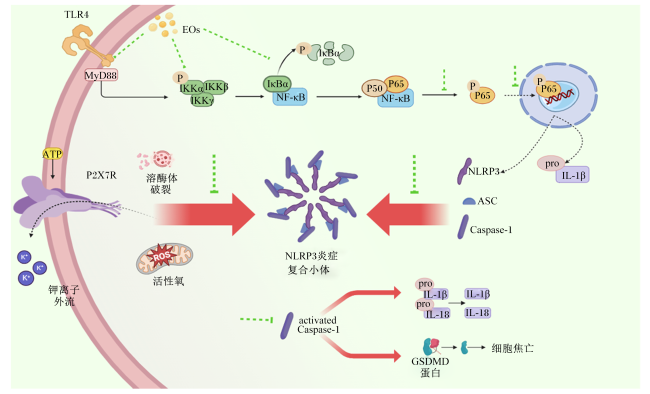
NLRP3炎症小体是目前发现最具辨识度的炎症小体,由NLRP3蛋白、凋亡相关斑点样蛋白(apoptosis-associated speck-like protein containing a CARD,ASC)和半胱天冬蛋白酶-1前体(pro-cysteinyl aspartate specific proteinase-1,pro-Caspase-1)组成[35],当NLRP3炎症小体识别到病原体等刺激物后会被激活[35]。研究表明,NLRP3炎症小体直接激活途径可分为以下3种:1)外源性ATP刺激嘌呤能2X7受体(purinergic 2X7 receptor,P2X7R),触发钾离子(K+)外排;2)细胞内溶酶体受到刺激后损伤破裂,释放溶酶体内容物;3)高含量的ROS[36]。NLRP3炎症小体的激活分为2个步骤:首先是启动信号,激活的NF-κB信号通路或其他转录因子诱导NLRP3和白细胞介素-1β前体(pro-interleukin-1β,pro-IL-1β)转录,使其表达上调;然后是激活信号,组合寡聚化的ASC蛋白、NLRP3蛋白和pro-Caspase-1,形成复合NLRP3炎症小体[37]。NLRP3炎症小体能使pro-Caspase-1变为半胱天冬蛋白酶-1(cysteinyl aspartate specific proteinase-1,Caspase-1),具有裂解细胞因子pro-IL-1β和白细胞介素-18前体(pro-interleukin-18,pro-IL-18)的功能,产生细胞因子IL-1β和IL-18,Caspase-1还能切割Dasdermin D(GSDMD)蛋白,裂解出其中具有活性的N端,导致细胞质膜鼓胀,伴随细胞膜破裂并死亡,引发的促炎细胞死亡称为细胞焦亡[35]
研究发现,肉桂精油能降低小鼠肺脏组织中P2X7R的蛋白表达水平,抑制NLRP3炎症小体激活,减少pro-IL-1β的蛋白表达水平和IL-1β含量,缓解LPS诱导的小鼠炎症[38]。Lee等[39]研究表明,灌胃13 mg/kg肉桂叶精油能降低小鼠脾脏和肠系膜淋巴结中NLRP3、ASC和Caspase-1的蛋白表达水平,减少血液中IL-1β、IL-18含量,抑制小鼠免疫器官中NLRP3炎症小体的激活,预防LPS诱导的小鼠炎症反应。采用0.05 μL/mL薰衣草精油处理小鼠原代骨髓巨噬细胞,可避免LPS诱导的pro-IL-1β含量升高,并降低IL-1β含量和GSDMD阳性细胞数量,从而缓解细胞炎症,减少细胞焦亡的发生[40]。综上所述,EOs能抑制P2X7R、ROS等含量,从而抑制NLRP3炎症小体激活;EOs还能降低NLRP3、ACS、Caspase-1含量,阻止形成活性NLRP3炎症小体,抑制活性Caspase-1产生,使pro-IL-1β和pro-IL-18无法形成有活力的促炎细胞因子,从而缓解炎症的发生并减少细胞焦亡。
EOs对TLR4-NF-κB-NLRP3炎症小体信号通路轴的抑制效果见图1
图1 EOs对TLR4-NF-κB-NLRP3炎症小体信号通路轴的影响

EOs:植物精油 essential oils;TLR4:Toll样受体4 Toll-like receptor 4;MyD88:髓样分化因子88 myeloid differentiation primary response protein 88;IKK:核因子-κB抑制蛋白激酶 nuclear factor-κB inhibitor protein kinase;IκB:核因子-κB抑制蛋白 inhibitor of nuclear factor-κB;NF-κB:核因子-κB nuclear factor-κB;P2X7R:嘌呤能2X7受体 purinergic 2X7 receptor;NLRP3:核苷酸结合寡聚化结构域样受体蛋白3 nucleotide-binding oligomerization domain-like receptor protein 3;ASC:凋亡相关斑点样蛋白 apoptosis-associated speck-like protein containing a CARD;Caspase-1:半胱天冬酶-1 cysteinyl aspartate specific proteinase-1;P:磷酸化 phosphorylation;pro:前体 prosoma;activated:活性的;GSDMD:Dasdermin D蛋白 Dasdermin D protein;IL-18:白细胞介素-18 interleukin-18;IL-1β:白细胞介素-1β interleukin-1β。

Fig.1 Effects of EOs on TLR4-NF-κB-NLRP3 inflammasome signal pathway axis

3 EOs的抗炎作用在畜禽生产中的应用

3.1 单胃动物

EOs可调节动物机体中炎症反应通路中相关蛋白的表达,进而抑制动物组织和器官中细胞因子含量,缓解动物炎症反应。Liu等[41]研究发现,肉鸡每天灌胃200 μL香芹酚精油可抑制LPS引起的肠道中促炎细胞因子分泌增多,并减少TLR4和NF-κB的mRNA表达水平,缓解肉鸡肠道炎症。另有研究表明,肉鸡饲粮中添加300 mg/kg复合EOs和胰酶,可抑制空肠组织中炎性因子含量及TLR4的mRNA表达水平,从而降低肠道炎症评分,缓解产气荚膜梭菌诱导的肠道炎症[42]。此外,饲粮中添加400 mg/kg牛至精油能降低蛋鸡回肠中IL-1βTNF-α、干扰素-γ(interferon-γ,IFN-γ)和TLR4的mRNA表达水平,抑制蛋鸡肠道炎症发生[43]。分泌型免疫球蛋白A(secretory immunoglobulin A,sIgA)能保护肠黏膜,避免肠道毒素和病原微生物入侵,减少肠道炎症发生。有研究发现,饲粮中补充200 mg/kg牛至精油后,肉鸡十二指肠和空肠中sIgA含量增加,肠道免疫力得到提高,肉鸡肠道炎症的发生减少[44]
EOs的抗炎作用在生猪上也有广泛应用。传染性胃肠炎病毒是仔猪腹泻的主要病原体之一,Wang等[45]研究发现,200 μmol/L丁香酚处理猪肠上皮细胞可减少ROS含量并抑制NLRP3炎症小体活性,抑制传染性胃肠炎病毒诱导的猪肠上皮细胞焦亡,在饲粮中添加400 mg/kg丁香酚能缓解传染性胃肠炎病毒感染的仔猪肠道损伤,减少仔猪腹泻率。有研究表明,400 mg/kg的复合EOs(香芹酚、百里酚和肉桂醛)添加至饲粮中,可改善早期断奶仔猪的肠道免疫功能,降低回肠组织中TLR4和p65的mRNA表达水平,缓解仔猪断奶引起的肠道炎症[46]。另有研究发现,饲粮中补充0.1%复合EOs(香芹酚、肉桂醛、百里酚)后,仔猪全肠道长度显著增加,十二指肠和回肠的绒毛高度/隐窝深度比值增加,结肠黏膜中IL-1β、TNF-α、IL-6含量降低,降低了仔猪腹泻率并缓解了仔猪肠道炎症[47]。此外,EOs能通过增加机体免疫蛋白和补体含量,提高动物免疫力,间接减少炎症的发生。免疫球蛋白分泌后,增强单核巨噬细胞的吞噬作用;抑制致病病毒和微生物的繁殖,免疫球蛋白含量升高,免疫力增强,炎症反应发生次数减少。研究表明,饲粮中添加400 mg/kg山苍子精油可显著降低仔猪血清中TNF-α含量,并且增加免疫球蛋白A(immunoglobulin A,lgA)和免疫球蛋白G(immunoglobulin G,lgG)含量,改善仔猪免疫力,缓解仔猪肠道炎症[48]。梁婵等[49]的研究显示,饲粮中添加200 mg/kg复合EOs(由尤加利精油、牛至精油、百里香精油、柠檬精油、大蒜精油和椰子油组成)可抑制仔猪血清和空肠黏膜中的促炎细胞因子分泌和TLR4、NF-κB的mRNA表达水平,并提高IL-4和IgA含量,抑制仔猪炎症反应。综上所述,EOs在单胃动物中通过调控炎症相关通路,调节畜禽机体内细胞因子含量,改变动物肠道形态,并对免疫系统产生一定影响,从而发挥缓解炎症反应的作用。

3.2 反刍动物

在反刍动物上的研究表明,EOs能通过抑制TLRs蛋白表达,从而抑制下游NF-κB和MAPK等信号通路,调控细胞因子含量,发挥抗炎作用,还能提升血液中免疫球蛋白含量,改善动物免疫力。研究发现,饲粮中添加40 mg/kg沙葱精油可调节肉羊血液中细胞因子和干扰素含量,抑制肉羊机体炎症发生[50]。Jia等[51]研究显示,饲粮中添加52 mg/d牛至精油可降低绵羊血清以及空肠黏膜中IL-2、肿瘤坏死因子-β(tumor necrosis factor-β,TNF-β)、IL-6含量及TLR4、p65的mRNA表达水平,通过抑制TLR4-NF-κB通路发挥其抗炎活性,缓解绵羊机体炎症。此外,研究发现,饲粮中添加0.2 mL/kg茶树精油可降低山羊血清中TNF-α含量,并抑制回肠黏膜中IL-12的mRNA表达水平,还可提高空肠和回肠黏膜中IgA含量,减少山羊肠道炎症发生[52]。另有研究发现,饲粮中添加0.05%茶树精油可显著降低山羊瘤胃上皮细胞中IL-1βIL-6、TNF-αTLR2、CXC趋化因子配体6(CXCL6)和干扰素诱导蛋白与四肽重复3(IFIT3)的mRNA表达水平,抑制山羊瘤胃上皮细胞炎症发生。以上研究表明,茶树精油能减少山羊体内细胞因子和趋化因子含量,并提高免疫球蛋白含量,缓解机体炎症反应,具有良好的抗炎活力[53]
Eos的抗炎活性在牛上也有广泛应用。产后奶牛由于干物质摄入量急剧减少,造成脂质代谢紊乱,导致动物炎症反应发生,在饲粮中添加0.05%茶树精油,能通过提高产后奶牛血清中IgG含量提高奶牛免疫力,改善奶牛对葡萄糖的代谢能力,缓解能量负平衡引起的全身炎症反应[54]。综合文献结果发现,茶树精油可通过调节NF-κB、MAPK等信号通路缓解炎症症状,改善机体免疫力,降低炎症发生频率,在反刍动物中具有良好的抗炎活性。张笑宇[55]研究发现,饲粮中添加200 g/kg的百里香精油可显著降低奶牛体细胞数量,表明百里香精油能有效预防奶牛乳腺炎发生。在犊牛生产中,犊牛可能由于断奶应激产生腹泻或肺炎等炎症反应。Liu等[56]研究表明,饲喂香芹酚为主要成分的复合EOs和益生元,可增加荷斯坦公犊血液中免疫球蛋白含量,提高犊牛的免疫力,通过改善肠道环境降低腹泻发生率,减少犊牛肚脐炎症发生。嗜碱性粒细胞和血小板能平衡动物炎症反应,并在免疫反应发育中发挥重要作用。有研究结果显示,在犊牛代乳粉中添加1 g/d从茴香、肉桂和百里香等植物中提取的混合EOs,能改善嗜碱性粒细胞和血小板数量,提高肠道免疫力,调控肠道微生物群,并调控生长因子含量,调节白细胞的趋化性,综合影响炎症反应,缓解断奶犊牛腹泻[57]。EOs在反刍动物上的抗炎作用与单胃动物相似,主要通过调节动物机体内炎症通路激活和机体免疫系统,起到缓解炎症的作用。

4 小结与展望

EOs作为天然绿色植物性饲料添加剂,具有优良的抗炎活性。EOs的主要抗炎活性成分为萜烯类物质和芳香族化合物。EOs通过抑制TLR4-NF-κB-NLRP3炎症小体信号通路轴等炎症通路,调节细胞因子和炎症介质,发挥抗炎活性,抑制机体或细胞炎症反应。在畜禽生产中使用EOs能减少机体炎症发生,提高畜禽免疫力。目前对EOs抗炎效果的应用仍有许多待研究的问题,如EOs与其主要活性成分的抗炎效果比较,EOs在反刍动物应用中主要发挥作用的部位,EOs能否通过肠道微生物发挥抗炎效果等,未来仍需开展大量的研究工作。
[1]
NIU X T, DING Y X, CHEN S W, et al. Effect of immune stress on growth performance and immune functions of livestock:mechanisms and prevention[J]. Animals, 2022, 12(7):909.

[2]
MARTÍNEZ-MIRÓ S, TECLES F, RAMÓN M, et al. Causes,consequences and biomarkers of stress in swine:an update[J]. BMC Veterinary Research, 2016, 12(1):171.

[3]
FULLERTON J N, GILROY D W. Resolution of inflammation:a new therapeutic frontier[J]. Nature Reviews.Drug Discovery, 2016, 15(8):551-567.

[4]
MA Z X, LEE S, JEONG K C. Mitigating antibiotic resistance at the livestock-environment interface:a review[J]. Journal of Microbiology and Biotechnology, 2019, 29(11):1683-1692.

DOI PMID

[5]
STEVANOVIĆ Z D, BOŠNJAK-NEUMÜLLER J, PAJIĆ-LIJAKOVIĆ I, et al. Essential oils as feed additives-future perspectives[J]. Molecules, 2018, 23(7):1717.

[6]
张嘉琦, 张会艳, 赵青余, 等. 植物精油对畜禽肠道健康、免疫调节和肉品质的研究进展[J]. 动物营养学报, 2021, 33(5):2439-2451.

DOI

ZHANG J Q, ZHANG H Y, ZHAO Q Y, et al. Research progress of plant essential oil on intestinal health,immune regulation and meat quality of livestock and poultry[J]. Chinese Journal of Animal Nutrition, 2021, 33(5):2439-2451. (in Chinese)

[7]
NEHME R, ANDRÉS S, PEREIRA R B, et al. Essential oils in livestock:from health to food quality[J]. Antioxidants, 2021, 10(2):330.

[8]
TUMER T B, YILMAZ B, OZLEYEN A, et al. GR24,a synthetic analog of strigolactones,alleviates inflammation and promotes Nrf2 cytoprotective response:in vitro and in silico evidences[J]. Computational Biology and Chemistry, 2018,76:179-190.

[9]
MEDZHITOV R. Origin and physiological roles of inflammation[J]. Nature, 2008, 454(7203):428-435.

[10]
ZHAO Q, ZHU L Y, WANG S N, et al. Molecular mechanism of the anti-inflammatory effects of plant essential oils:a systematic review[J]. Journal of Ethnopharmacology, 2023,301:115829.

[11]
BAKKALI F, AVERBECK S, AVERBECK D, et al. Biological effects of essential oils—a review[J]. Food and Chemical Toxicology, 2008, 46(2):446-475.

[12]
ARIZMENDI N, ALAM S B, AZYAT K, et al. The complexity of sesquiterpene chemistry dictates its pleiotropic biologic effects on inflammation[J]. Molecules, 2022, 27(8):2450.

[13]
BORGES R S, ORTIZ B L S, PEREIRA A C M, et al. Rosmarinus officinalis essential oil:a review of its phytochemistry,anti-inflammatory activity,and mechanisms of action involved[J]. Journal of Ethnopharmacology, 2019,229:29-45.

[14]
TANG W X, ZHANG Z, NIE D C, et al. Protective effect of Citrus medica limonum essential oil against Escherichia coli K99-induced intestinal barrier injury in mice[J]. Nutrients, 2023, 15(12):2697.

[15]
HARO-GONZÁLEZ J N, CASTILLO-HERRERA G A, MARTÍNEZ-VELÁZQUEZ M, et al. Clove essential oil (Syzygium Aromaticum L.myrtaceae):extraction,chemical composition,food applications,and essential bioactivity for human health[J]. Molecules, 2021, 26(21):6387.

[16]
TUNG Y T, CHUA M T, WANG S Y, et al. Anti-inflammation activities of essential oil and its constituents from indigenous cinnamon (Cinnamomum osmophloeum) twigs[J]. Bioresource Technology, 2008, 99(9):3908-3913.

[17]
OMONIJO F A, LIU S X, HUI Q R, et al. Thymol improves barrier function and attenuates inflammatory responses in porcine intestinal epithelial cells during lipopolysaccharide (LPS)-induced inflammation[J]. Journal of Agricultural and Food Chemistry, 2019, 67(2):615-624.

DOI PMID

[18]
REUTER S, GUPTA S C, CHATURVEDI M M, et al. Oxidative stress,inflammation,and cancer:how are they linked?[J]. Free Radical Biology & Medicine, 2010, 49(11):1603-1616.

[19]
JABS T. Reactive oxygen intermediates as mediators of programmed cell death in plants and animals[J]. Biochemical Pharmacology, 1999, 57(3):231-245.

DOI PMID

[20]
JENA S, RAY A, MOHANTA O, et al. Neocinnamomum caudatum essential oil ameliorates lipopolysaccharide-induced inflammation and oxidative stress in RAW 264.7 cells by inhibiting NF-κB activation and ROS production[J]. Molecules, 2022, 27(23):8193.

[21]
王慧, 闫晓培, 徐莉. 苦豆碱通过抑制TLR4/NF-κB/NLRP3通路改善香烟烟雾诱导的人支气管上皮细胞损伤[J]. 细胞与分子免疫学杂志, 2024, 40(5):411-418.

WANG H, YAN X P, XU L. Aloperine supresses TLR4/NF -KB/NLRP3 signaling to ameliorate cigarette smoke-induced damage to human bronchial epithelial cells[J]. Chinese Journal of Cellular and Molecular Immunology, 2024, 40(5):411-418. (in Chinese)

[22]
YU C Y, WANG D, YANG Z B, et al. Pharmacological effects of polyphenol phytochemicals on the intestinal inflammation via targeting TLR4/NF-κB signaling pathway[J]. International Journal of Molecular Sciences, 2022, 23(13):6939.

[23]
LU Y, LI X R, LIU S S, et al. Toll-like receptors and inflammatory bowel disease[J]. Frontiers in Immunology, 2018,9:72.

[24]
GOHDA J, MATSUMURA T, INOUE J. Cutting edge:TNFR-associated factor (TRAF) 6 is essential for MyD88-dependent pathway but not toll/IL-1 receptor domain-containing adaptor-inducing IFN-beta (TRIF)-dependent pathway in TLR signaling[J]. Journal of Immunology, 2004, 173(5):2913-2917.

[25]
CAO G J, LIU J, LIU H, et al. Integration of network pharmacology and molecular docking to analyse the mechanism of action of oregano essential oil in the treatment of bovine mastitis[J]. Veterinary Sciences, 2023, 10(5):350.

[26]
HU Y, HE Z, ZHANG J, et al. Effect of Piper nigrum essential oil in dextran sulfate sodium (DSS)-induced colitis and its potential mechanisms[J]. Phytomedicine, 2023,119:155024.

[27]
LIU F G, YANG Y F, DONG H R, et al. Essential oil from Cinnamomum cassia presl bark regulates macrophage polarization and ameliorates lipopolysaccharide-induced acute lung injury through TLR4/MyD88/NF-κB pathway[J]. Phytomedicine, 2024,129:155651.

[28]
LIU T, ZHANG L Y, JOO D, et al. NF-κB signaling in inflammation[J]. Signal Transduction and Targeted Therapy, 2017,2:17023.

[29]
OECKINGHAUS A, HAYDEN M S, GHOSH S. Crosstalk in NF-κB signaling pathways[J]. Nature Immunology, 2011, 12(8):695-708.

DOI PMID

[30]
HO C L, LI L H, WENG Y C, et al. Eucalyptus essential oils inhibit the lipopolysaccharide-induced inflammatory response in RAW264.7 macrophages through reducing MAPK and NF-κB pathways[J]. BMC Complementary Medicine and Therapies, 2020, 20(1):200.

[31]
CHENG C S, ZOU Y, PENG J. Oregano essential oil attenuates RAW264.7 cells from lipopolysaccharide-Induced inflammatory response through regulating NADPH oxidase activation-driven oxidative stress[J]. Molecules, 2018, 23(8):1857.

[32]
CHEN Z, ZHANG Y, ZHOU J P, et al. Tea tree oil prevents mastitis-associated inflammation in lipopolysaccharide-stimulated bovine mammary epithelial cells[J]. Frontiers in Veterinary Science, 2020,7:496.

[33]
YANG T Y, MA X Y, JIANG M C, et al. The role of tea tree oil in alleviating palmitic acid-induced lipid accumulation in bovine hepatocytes[J]. Frontiers in Veterinary Science, 2021,8:814840.

[34]
林杰. 植物精油对LPS诱导的奶牛乳腺上皮细胞损伤的保护作用研究[D]. 硕士学位论文. 北京: 中国农业科学院, 2016.

LIN J. Study of plant-derived essential oil protection injury of bovine mammary epithelial cells induced by lipopolysaccharide[D]. Master’s Thesis. Beijing: Chinese Academy of Agricultural Sciences, 2016. (in Chinese)

[35]
PANDEY A, SHEN C, FENG S Y, et al. Cell biology of inflammasome activation[J]. Trends in Cell Biology, 2021, 31(11):924-939.

DOI PMID

[36]
SCHRODER K, TSCHOPP J. The inflammasomes[J]. Cell, 2010, 140(6):821-832.

DOI PMID

[37]
MANGAN M S J, OLHAVA E J, ROUSH W R, et al. Targeting the NLRP3 inflammasome in inflammatory diseases[J]. Nature Reviews:Drug Discovery, 2018, 17(8):588-606.

[38]
RAO Z L, XU F, WEN T Q, et al. Protective effects of essential oils from rimulus cinnamon on endotoxin poisoning mice[J]. Biomedicine & Pharmacotherapy, 2018,101:304-310.

[39]
LEE S C, WANG S Y, LI C C, et al. Anti-inflammatory effect of cinnamaldehyde and linalool from the leaf essential oil of Cinnamomum osmophloeum Kanehira in endotoxin-induced mice[J]. Journal of Food and Drug Analysis, 2018, 26(1):211-220.

[40]
AO X, YAN H, HUANG M, et al. Lavender essential oil accelerates lipopolysaccharide-induced chronic wound healing by inhibiting Caspase-11-mediated macrophage pyroptosis[J]. The Kaohsiung Journal of Medical Sciences, 2023, 39(5):511-521.

DOI PMID

[41]
LIU S D, SONG M H, YUN W, et al. Effect of carvacrol essential oils on immune response and inflammation-related genes expression in broilers challenged by lipopolysaccharide[J]. Poultry Science, 2019, 98(5):2026-2033.

DOI PMID

[42]
孙宪法, 周东, 孙宪秋, 等. 植物精油和胰酶对肉鸡生长性能、消化酶活性及肠道健康的影响[J]. 饲料工业, 2022, 43(7):22-27.

SUN X F, ZHOU D, SUN X Q, et al. Effects of essential oil and pancreation on growth performance,digestive enzyme activity and intestinal health of broiler chickens[J]. Feed Industry, 2022, 43(7):22-27. (in Chinese)

[43]
FENG J, LU M Y, WANG J, et al. Dietary oregano essential oil supplementation improves intestinal functions and alters gut microbiota in late-phase laying hens[J]. Journal of Animal Science and Biotechnology, 2021, 12(1):72.

DOI PMID

[44]
ZHANG L Y, PENG Q Y, LIU Y R, et al. Effects of oregano essential oil as an antibiotic growth promoter alternative on growth performance,antioxidant status,and intestinal health of broilers[J]. Poultry Science, 2021, 100(7):101163.

[45]
WANG K, CHEN D W, YU B, et al. Eugenol alleviates TGEV-induced intestinal injury via suppressing ROS/NLRP3/GSDMD-dependent pyroptosis[J]. Journal of Agricultural and Food Chemistry, 2023, 71(3):1477-1487.

DOI PMID

[46]
SHAO Y R, PENG Q Y, WU Y L, et al. The effect of an essential oil blend on growth performance,intestinal health,and microbiota in early-weaned piglets[J]. Nutrients, 2023, 15(2):450.

[47]
ZHAO B C, WANG T H, CHEN J, et al. Effects of dietary supplementation with a carvacrol-cinnamaldehyde-thymol blend on growth performance and intestinal health of nursery pigs[J]. Porcine Health Management, 2023, 9(1):24.

[48]
YANG Z, WANG F, YIN Y X, et al. Dietary litsea cubeba essential oil supplementation improves growth performance and intestinal health of weaned piglets[J]. Animal Nutrition, 2023,13:9-18.

[49]
梁婵, 陈代文, 何军, 等. 复合纤维和植物精油联合添加对大肠杆菌攻毒仔猪生长性能、抗氧化能力和免疫功能的影响[J]. 动物营养学报, 2022, 34(4):2272-2282.

DOI

LIANG C, CHEN D W, HE J, et al. Effects of compound fiber and plant essential oil combined supplementation on growth performance,antioxidant capacity and immune function of weaned piglets challenged with Escherichia coli[J]. Chinese Journal of Animal Nutrition, 2022, 34(4):2272-2282. (in Chinese)

[50]
徐珊珊. 沙葱精油对肉羊肉品质、抗氧化性能和免疫机能的影响[D]. 硕士学位论文. 呼和浩特: 内蒙古农业大学, 2021.

XU S S. Effects of essential oil from Allium mongolicum regel on meat quality,antioxidant capacity and immune function in lamb[D]. Master’s Thesis. Hohhot: Inner Mongolia Agricultural University, 2021. (in Chinese)

[51]
JIA L, WU J P, LEI Y, et al. Oregano essential oils mediated intestinal microbiota and metabolites and improved growth performance and intestinal barrier function in sheep[J]. Frontiers in Immunology, 2022,13:908015.

[52]
LV X K, CHEN L, ZHOU C S, et al. Dietary tea tree (Melaleuca alternifolia) oil supplementation enhances the expressions of amino acid transporters in goat ileal mucosa and improves intestinal immunity[J]. Food Science & Nutrition, 2022, 10(11):3749-3758.

[53]
HU Z X, LIN M, MA X Y, et al. Effect of tea tree oil on the expression of genes involved in the innate immune system in goat rumen epithelial cells[J]. Animals, 2021, 11(8):2460.

[54]
YUAN C, MA X Y, JIANG M C, et al. Effects of tea tree oil on production performance,serum parameter indices,and immunity in postpartum dairy cows[J]. Animals:an Open Access Journal From MDPI, 2023, 13(4):682.

[55]
张笑宇. 饲粮添加百里香精油对奶牛生产性能及机体抗氧化能力的影响[D]. 硕士学位论文. 沈阳: 沈阳农业大学, 2018.

ZHANG X Y. Effect of dietary supplementation of thyme oil on production performance and antioxidant ability of dairy cows[D]. Master’s Thesis. Shenyang: Shenyang Agricultural University, 2018. (in Chinese)

[56]
LIU T, CHEN H, BAI Y, et al. Calf starter containing a blend of essential oils and prebiotics affects the growth performance of Holstein calves[J]. Journal of Dairy Science, 2020, 103(3):2315-2323.

DOI PMID

[57]
PALHARES CAMPOLINA J, GESTEIRA COELHO S, BELLI A L, et al. Effects of a blend of essential oils in milk replacer on performance,rumen fermentation,blood parameters,and health scores of dairy heifers[J]. PLoS One, 2021, 16(3):e0231068.

Outlines

/