RESEARCH PAPER

Effects of Cotton Residue Biofeed on Growth Performance, Rumen Fermentation Parameters, Blood Indices and Rumen and Rectal Flora Structure of Fattening Cattle

  • BAI Lisha , 1 ,
  • AIBIBULA Yimamu , 1, * ,
  • WANG Mengjie 1 ,
  • YU Qin 1 ,
  • MA Xiaolong 1 ,
  • ZHANG Jianxin 2 ,
  • WANG Guangwei 3
Expand
  • 1 Grassland College, Xinjiang Agricultural University, Urumqi 830000, China
  • 2 Xinjiang Xinhe Agricultural and Animal Husbandry Limited Liability Company, Maigaiti 846000, China
  • 3 Xinjiang Blade Sunshine Agricultural and Animal Husbandry Science and Technology Company Limited, Maigaiti 846000, China
* professor, E-mail:

Received date: 2024-05-15

  Online published: 2024-11-09

Abstract

The aim of this experiment was to study the effects of cotton residue biofeed on growth performance, rumen fermentation parameters, blood indices and rumen and rectal flora structure of fattening cattle. Sixty Angus beef cattle weighing (306.71±2.69) kg were selected and randomly divided into 3 groups with 20 cattle in each group. Cattle in the control group (CK group) were fed a basal diet, and others in experimental groups were fed the experimental diets which used cotton residue biofeed replacing 30% (group H) and 45% (group S) corn silage in the basal diet. The pre-experimental period lasted for 15 days, and the experimental period lasted for 60 days. The results showed as follows: 1) the average daily dry matter intake of group H was significantly higher than that of group CK and group S (P<0.05). The average daily gain of group S was significantly lower than that of group CK and group H (P<0.05), and the feed to gain ratio was significantly higher than that of group CK and group H (P<0.05). 2) The rumen pH and ammoniacal nitrogen content of group CK were significantly lower than those of group H (P<0.05). The rumen acetic acid content of group S was significantly lower than that of group CK and group H (P<0.05), and the rumen propionic acid content of group H was significantly higher than that of group CK and group S (P<0.05); the rumen acetic acid/propionic acid of group H and group S was significantly lower than that of group CK (P<0.05), and group S was significantly lower than group H (P<0.05). 3) The blood white blood cell count, aspartate transaminase activity and albumin and triglyceride contents of group CK were significantly lower than those of group S (P<0.05). The blood urea nitrogen content of group H and group S was significantly higher than that of group CK (P<0.05), and group S was significantly higher than group H (P<0.05). The blood hydroxybutyrate dehydrogenase and lactate dehydrogenase activities of group H were significantly lower than those of group S (P<0.05). The blood glucose content of group H was significantly higher than that of group CK and group S (P<0.05). 4) At the phylum level, the rumen and rectal dominant phyla of 3 groups were Firmicutes and Bacteroidota. At the genus level, the rumen dominant genera of group CK were Prevotella, Lachnospiraceae_NK3A20_group and Rikenellaceae_RC9_gut_group, the rumen dominant genera of group H were Streptococcus, Weissella and Prevotella, and the rumen dominant genera of group S were Lactococcus, Weissella and Rikenellaceae_RC9_gut_group; the rectal dominant genera of group CK were Romboutsia, Turicibacter and Clostridium_sensu_stricto_1, the rectal dominant genera of group H were Enterococcus, Clostridium_sensu_stricto_1 and Romboutsia, and the rectal dominant genera of group S were Enterococcus, Turicibacter and Romboutsia. In summary, replacing corn silage with 30% cotton residue biofeed in the diet is beneficial for growth of fattening cattle, can reduce the stress sensitivity and acidosis, and can change the rumen and rectal flora structure at the genera level.

Cite this article

BAI Lisha , AIBIBULA Yimamu , WANG Mengjie , YU Qin , MA Xiaolong , ZHANG Jianxin , WANG Guangwei . Effects of Cotton Residue Biofeed on Growth Performance, Rumen Fermentation Parameters, Blood Indices and Rumen and Rectal Flora Structure of Fattening Cattle[J]. Chinese Journal of Animal Nutrition, 2024 , 36(11) : 7097 -7107 . DOI: 10.12418/CJAN2024.605

新疆地区饲草资源短缺和利用效率低下制约着当地畜牧业的高效发展,找寻新的饲料资源是亟待解决的问题之一。新疆地区是我国最大的棉花产区,国家统计局公布数据显示,2023年全国棉花播种面积为278.81万hm2,其中新疆地区棉花播种面积为236.93万hm2,新疆地区棉花总产量为511.2万t,约占全国棉花总产量的91%[1]。棉渣是棉花加工后的副产物,是采棉机收获棉花时产生的棉叶、细枝、短绒及棉桃壳等混合物,棉渣年产量约210万t[2]。棉渣中含有丰富的蛋白质和纤维素,是新疆地区必不可少的粗饲料来源,但棉渣中含有游离棉酚,大量摄入会对反刍动物健康造成危害。
研究表明,物理或生物处理秸秆类饲料有利于反刍动物消化吸收,这些方法改变了饲料木质纤维素的微观结构和理化性质,从而增强了饲料的可酶解性,并促进了有毒物质的降解[3]。通过膨化预处理和微生物发酵技术制成新型生物饲料,使饲料原料中的纤维素、木质素、抗营养因子等大分子物质被分解或转化,微生物产生菌体蛋白、酶类、抑菌因子、维生素等发酵代谢产物,提高饲料原料的营养价值[4],并提高动物肠道健康,改善菌群平衡。刘依莎等[5]研究发现,在饲粮中添加发酵玉米芯能够提高肉牛的生长性能,改善瘤胃发酵环境,促进瘤胃菌体蛋白合成,同时影响瘤胃菌群在门水平和属水平上的组成。谢建林等[6]研究发现,饲喂安格斯牛发酵稻草能改善瘤胃发酵环境,提高平均日增重和平均日采食量,降低料重比。尹云厚等[7]试验发现,饲喂膨化玉米秸秆生物饲料的肉牛经屠宰后,经肉质鉴定发现,肉的营养成分和品质显著高于饲喂黄贮饲料。但目前缺乏对棉渣生物饲料对育肥牛肠道菌群结构的相关报道。因此,本研究利用棉渣生物饲料替代不同比例的玉米青贮,探究其对安格斯肉牛生长性能、瘤胃发酵参数、血液指标和肠道菌群结构的影响,为合理利用棉渣生物饲料及确定棉渣生物饲料在肉牛养殖中的用量提供参考依据。

1 材料与方法

1.1 试验材料

棉渣生物饲料加工制作:棉渣原料是棉厂生产加工后的副产物,添加酵母菌和纤维素酶等复合菌剂制成裹包生物饲料。棉渣生物饲料中棉酚含量为120 mg/kg,其营养水平见表1
表1 棉渣生物饲料营养水平(干物质基础)

Table 1 Nutrient levels of cotton residue biofeed (DM basis) %

项目
Items
含量
Content
粗蛋白质CP 15.82
粗灰分Ash 9.57
粗脂肪EE 2.40
中性洗涤纤维NDF 46.65
酸性洗涤纤维ADF 33.45
钙Ca 0.52
总磷TP 0.23

1.2 试验设计和饲养管理

选用60头体重(306.71±2.69) kg、状况良好的安格斯肉牛,随机分为3组,每组20头牛。对照组(CK组)饲喂基础饲粮,试验组分别饲喂用棉渣生物饲料代替基础饲粮中30%(H组)和45%(S组)玉米青贮的试验饲粮。试验饲粮组成及营养水平见表2。预试期15 d,正试期60 d。本试验于2023年7—9月在新疆刀郎阳光农牧科技股份有限公司54团养殖场进行,每天07:30、17:30各饲喂1次,自由采食和饮水。
表2 试验饲粮组成及营养水平(干物质基础)

Table 2 Composition and nutrient levels of experimental diets (DM basis) %

项目
Items
组别Groups
CK H S
原料Ingredients
玉米青贮Corn silage 45.00 15.00
棉渣生物饲料Cotton residue biofeed 30.00 45.00
油莎豆French bean 13.00 13.00 13.00
棉籽壳Cottonseed husk 12.00 12.00 12.00
玉米Corn 28.00 28.00 28.00
食盐NaCl 0.50 0.50 0.50
预混料Premix1) 1.50 1.50 1.50
合计Total 100.00 100.00 100.00
营养水平Nutrient levels2)
粗蛋白质CP 11.47 12.97 13.72
中性洗涤纤维NDF 54.79 51.67 48.10
酸性洗涤纤维ADF 39.94 40.96 40.25
钙Ca 0.50 0.73 0.84
总磷TP 0.25 0.31 0.35

1)预混料为每千克饲粮提供 The premix provided the following per kg of the diet: VA 10 000 IU,VD 6 000 IU,VE 36 IU,Fe 400 mg,Cu 450 mg,Zn 400 mg,Mn 120 mg,Se 28 mg。

2)营养水平为实测值。Nutrient levels were measured values.

1.3 样品采集

正试期开始30 d后,每组选择5头牛,采集其瘤胃液、血液和直肠粪便。晨饲后2 h进行颈静脉采血,将血液采集到采血管中,采集完毕后,送往医院进行血液检测。晨饲后2 h采用口腔插管法采集瘤胃液,丢弃初次吸取瘤胃液(避免唾液影响),-20 ℃保存待测。自由采食2 h捡拾直肠新鲜粪便,烘干、粉碎后保存待测。

1.4 测定指标及方法

1.4.1 饲粮营养成分测定

粗蛋白质(CP)、中性洗涤纤维(NDF)、酸性洗涤纤维(ADF)、钙(Ca)和总磷(TP)含量分别采用GB/T 6432—2018、GB/T 20806—2022、NY/T 1459—2022、GB/T 6436—2018和GB/T 6437—2018方法测定。

1.4.2 生长性能指标测定

试验正式开始时晨饲之前称量试验牛体重,试验结束时称量试验牛体重,记录每天投喂量、剩余量,计算平均日干物质采食量、平均日增重和料重比。

1.4.3 瘤胃发酵参数测定

使用雷磁PHS-3C pH仪测定瘤胃液pH。采用苯酚-次氯酸钠比色法测定氨态氮(NH3-N)含量。采用LC-10A型高效液相色谱仪进行挥发性脂肪酸(VFA)含量的测定,分析条件:BDS HYPERSIL C18色谱柱(3 mm×250 mm,5 μm),SPD-10Avp Plus检测器,流动相为3 mmol/L高氯酸;流速为0.9 mL/min,柱温为60 ℃;检测波长为210 nm,进样量为20 μL。

1.4.4 血液指标

采集的样品送至新疆建设兵团第三师五十四团医院检测,采用BH5380全自动血细胞分析仪测定白细胞计数及中性粒细胞、淋巴细胞、单核细胞数量;采用URIT8400全自动生化分析仪测定乳酸脱氢酶、谷丙转氨酶、谷草转氨酶、羟丁酸脱氢酶活性及白蛋白、尿素氮、甘油三酯、葡萄糖含量。

1.4.5 瘤胃和直肠菌群结构

瘤胃液和直肠粪样邮寄至上海美吉生物医药科技公司进行16S rDNA的V3~V4区域扩增、测序及数据分析。

1.5 数据统计分析

利用SPSS 26.0软件进行单因素方差分析(one-way ANOVA)和Duncan氏法多重比较,结果用平均值±标准误表示,P<0.05为差异显著,P>0.05表示差异不显著。

2 结果

2.1 棉渣生物饲料对肉牛生长性能的影响

表3可知,H组的末重显著高于S组(P<0.05)。H组的平均日干物质采食量显著高于CK组和S组(P<0.05)。S组的平均日增重显著低于CK组和H组(P<0.05),料重比显著高于CK组和H组(P<0.05)。
表3 棉渣生物饲料对肉牛生长性能的影响

Table 3 Effects of cotton residue biofeed on growth performance of beef cattle

项目
Items
组别Groups
CK H S
初重IW/kg 306.75±6.50 306.45±1.65 306.95±4.73
末重FW/kg 361.50±9.05ab 365.30±3.55a 341.35±6.19b
平均日干物质采食量ADMFI/(g/d) 11.94±0.76b 14.43±0.97a 12.16±0.91b
平均日增重ADG/(g/d) 0.91±0.08a 0.98±0.06a 0.57±0.06b
料重比F/G 14.93±1.26b 16.21±1.36b 27.38±3.11a

同行数据肩标不同小写字母表示差异显著(P<0.05),相同或无字母表示差异不显著(P>0.05)。下表同。

In the same row, values with different small letter superscripts mean significant difference (P<0.05), while with the same or no letter superscripts mean no significant difference (P>0.05). The same as below.

2.2 棉渣生物饲料对肉牛瘤胃发酵参数的影响

表4可知,CK组的瘤胃pH和氨态氮含量显著低于H组(P<0.05)。S组的瘤胃乙酸含量显著低于CK组和H组(P<0.05),H组的瘤胃丙酸含量显著高于CK组和S组(P<0.05);H组和S组的瘤胃乙酸/丙酸显著低于CK组(P<0.05),且S组显著低于H组(P<0.05)。各组之间瘤胃丁酸含量没有显著差异(P>0.05)。
表4 棉渣生物饲料对肉牛瘤胃发酵参数的影响

Table 4 Effects of cotton residue biofeed on rumen fermentation parameters of beef cattle

项目
Items
组别Groups
CK H S
pH 6.85±0.19b 7.09±0.11a 6.91±0.10ab
乙酸AA/(mmol/L) 27.49±0.01a 27.06±0.07a 15.12±0.19b
丙酸PA/(mmol/L) 9.76±0.16b 11.14±0.16a 9.86±0.43b
丁酸BA/(mmol/L) 9.62±0.89 8.31±0.98 6.48±0.36
乙酸/丙酸AA/PA 2.82±0.04a 2.43±0.04b 1.54±0.05c
氨态氮NH3-N/(mg/dL) 9.62±1.85b 12.93±2.67a 11.09±2.54ab

2.3 棉渣生物饲料对肉牛血液指标的影响

表5可知,CK组的血液白细胞计数、谷草转氨酶活性及白蛋白、甘油三酯含量与H组没有显著差异(P>0.05),但显著低于S组(P<0.05)。H组和S组的血液尿素氮含量显著高于CK组(P<0.05),且S组显著高于H组(P<0.05)。H组的血液羟丁酸脱氢酶、乳酸脱氢酶活性与CK组没有显著差异(P>0.05),但显著低于S组(P<0.05)。H组的血液葡萄糖含量显著高于CK组和S组(P<0.05)。
表5 棉渣生物饲料对肉牛血液指标的影响

Table 5 Effects of cotton residue biofeed feed on blood indices of beef cattle

项目
Items
组别Groups
CK H S
白细胞计数WBC/(×109个/L) 11.67±2.36b 12.27±5.62b 22.86±9.91a
中性粒细胞NEUT/% 4.62±1.00 4.76±1.03 11.57±3.12
淋巴细胞LYMPH/% 5.81±0.73 6.47±1.54 9.76±1.52
单核细胞MONO/% 1.16±0.22 0.93±0.07 1.38±0.23
乳酸脱氢酶LDH/(U/L) 1 296.20±64.33ab 1 111.60±79.67b 1 409.80±235.98a
谷丙转氨酶ALT/(U/L) 39.60±4.65 41.40±2.42 42.40±1.81
谷草转氨酶AST/(U/L) 90.40±8.68b 82.20±4.32b 122.80±32.29a
羟丁酸脱氢酶HBDH/(U/L) 1 485.00±38.04ab 1 294.80±113.45b 1 577.40±223.76a
白蛋白ALB/(g/L) 32.48±2.23b 33.70±0.78ab 34.66±1.05a
尿素氮UN/(mmol/L) 1.83±0.20c 2.43±0.23b 2.87±0.17a
甘油三酯TG/(mmol/L) 0.30±0.06b 0.29±0.04b 0.44±0.08a
葡萄糖GLU/(mmol/L) 1.90±1.18b 3.09±0.33a 1.23±0.77b

2.4 棉渣生物饲料对肉牛肠道菌群结构的影响

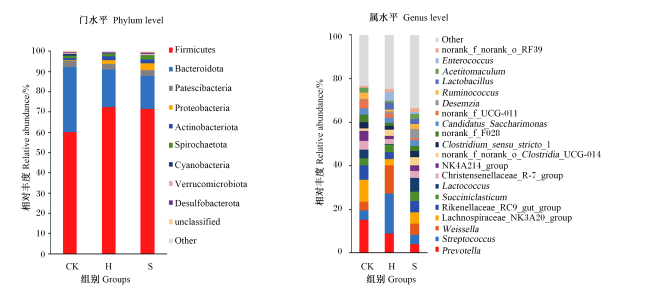
图1可知,3组的瘤胃优势菌门为厚壁菌门(Firmicutes)和拟杆菌门(Bacteroidota)。在属水平上,CK组的瘤胃优势菌属为普雷沃氏菌属(Prevotella)、毛螺菌科-NK3A20群(Lachnospiraceae_NK3A20_group)和理研菌科RC9肠道群(Rikenellaceae_RC9_gut_group),H组的瘤胃优势菌属是链球菌属(Streptococcus)、魏斯氏菌属(Weissella)和Prevotella,S组的瘤胃优势菌属是乳球菌属(Lactococcus)、魏斯氏菌属(Weissella)和Rikenellaceae_RC9_gut_group。
图1 棉渣生物饲料对肉牛瘤胃菌群结构的影响

Firmicutes:厚壁菌门;Bacteroidota:拟杆菌门;Patescibacteria:髌骨细菌门;Proteobacteria:变形菌门;Actinobacteriota:放线菌门;Spirochaetota:螺旋体门;Cyanobacteria:蓝菌门;Verrucomicrobiota:疣微菌门;Desulfobacterota:脱硫杆菌门;unclassified:未分类的;Prevotella:普雷沃氏菌属;Streptococcus:链球菌属;Weissella:魏斯氏菌属;Rikenellaceae_RC9_gut_group:理研菌科RC9肠道群;Lachnospiraceae_NK3A20_group:毛螺菌科-NK3A20群;Succiniclasticum:解琥珀酸菌属;Lactococcus:乳酸球菌属;Christensenellaceae_R-7_group:克里斯滕森菌科R-7群;NK4A214_group:NK4A214群;norank_f_norank_o_Clostridia_UCG-014:未分类梭状芽孢杆菌UCG-014;norank_f_F082:未分类F082;Candidatus_Saccharimonas:假丝酵母菌;norank_f_UCG-011:未分类UCG-011;Desemzia:德库菌属;Ruminococcus:瘤胃球菌属;Lactobacillus:乳杆菌属;Acetitomaculum:聚乙酸菌属;Enterococcus:粪肠球菌属;norank_f_norank_o_RF39:未分类RF39;Other:其他。

Fig.1 Effects of cotton residue biofeed on rumen flora structure of beef cattle

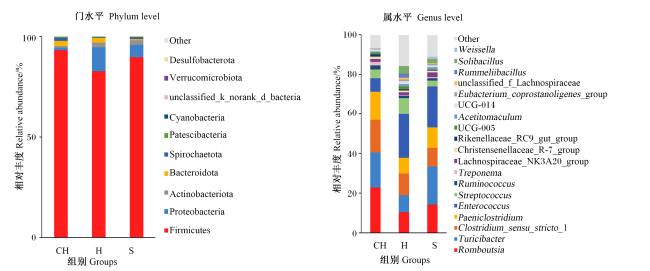
图2可知,3组的直肠优势菌门为Firmicutes和Bacteroidota。在属水平上,CK组的直肠优势菌属是罗姆布茨菌属(Romboutsia)、苏黎世杆菌属(Turicibacter)和狭义梭菌属1(Clostridium_sensu_stricto_1),H组的直肠优势菌属是肠球菌属(Enterococcus)、Clostridium_sensu_stricto_1和Romboutsia,S组的直肠优势菌属是EnterococcusTuricibacterRomboutsia
图2 棉渣生物饲料对肉牛直肠菌群结构的影响

Firmicutes:厚壁菌门;Actinobacteriota:放线菌门;Proteobacteria:变形菌门;Bacteroidota:拟杆菌门;Spirochaetota:螺旋体门;Patescibacteria:髌骨细菌门;Cyanobacteria:蓝菌门;unclassified_k_norank_d_bacteria:未分类细菌;Verrucomicrobiota:疣微菌门;Desulfobacterota:脱硫杆菌门;Romboutsia:罗姆布茨菌属;Turicibacter:苏黎世杆菌属;Clostridium_sensu_stricto_1:狭义梭菌属1;Paeniclostridium:梭状芽孢杆菌属;Enterococcus:粪肠球菌属;Streptococcus:链球菌属;Ruminococcus:瘤胃球菌属;Treponema:密螺旋体属;Lachnospiraceae_NK3A20_group:毛螺菌科-NK3A20群;Christensenellaceae_R-7_group:克里斯滕森菌科R-7群;Rikenellaceae_RC9_gut_group:理研菌科RC9肠道群;UCG-005未分类:UCG-005;Acetitomaculum:聚乙酸菌属;norank_f_norank_o_Clostridia_UCG-014:未分类梭状芽孢杆菌UCG-014;Eubacterium_coprostanoligenes_group:产粪甾醇真杆群;unclassified_f_Lachnospiraceae:未分类毛螺菌科;Rummeliibacillus:水原拉梅尔芽孢杆菌属;Weissella:魏斯氏菌属;Other:其他。

Fig.2 Effects of cotton residue biofeed on rectal flora structure of beef cattle

3 讨论

3.1 棉渣生物饲料对肉牛生长性能的影响

本试验中,棉渣生物饲料组的平均日干物质采食量高于CK组,说明育肥牛相比于青贮饲料更喜食棉渣生物饲料。棉渣纤维素含量高,但经过微生物发酵处理后,能改善适口性,提高反刍动物的采食量。冯东河等[8]研究发现,棉渣中粗蛋白质含量较高,并且相比于棉花秸秆和棉籽壳有较低的中性洗涤纤维和酸性洗涤纤维含量。柴绍芳等[9]研究发现,饲喂棉花秸秆生物饲料可以提高育肥牛日增重,并且降低了肉牛饲粮中精饲料和青干草的用量。本研究中,采用棉渣生物饲料替代基础饲粮中30%的玉米青贮,对肉牛平均日增重和料重比无显著影响;但采用棉渣生物饲料替代基础饲粮中45%的玉米青贮,肉牛平均日增重显著降低,料重比显著升高。赵修报等[10]研究发现,以玉米蛋白粉和麸皮制作的生物发酵饲料饲喂西门塔尔育肥牛,过量添加生物发酵饲料会降低瘤胃挥发性脂肪酸含量,影响饲料转化效率,最终导致生长性能下降。

3.2 棉渣生物饲料对肉牛瘤胃发酵参数的影响

pH是瘤胃发酵参数之一,pH的正常波动范围在5.5~7.5,pH过高过低都会影响瘤胃微生物活力及生长繁殖,瘤胃微生物生态系统较为稳定,瘤胃微生物发酵纤维物质的活性最高。本研究中,pH在正常范围内波动。CK组的瘤胃pH显著低于H组,可能是由于玉米青贮饲料的pH低于棉渣生物饲料的pH所致。挥发性脂肪酸经过瘤胃吸收为反刍动物提供60%~70%的能量[11]。瘤胃中纤维分解菌分解纤维物质产生乙酸和丙酸,乙酸是合成乳脂的前体,丙酸是反刍动物葡萄糖合成的前体,乙酸/丙酸与能量的利用效率有密切的关系,乙酸/丙酸比值越低,能量利用效率越高[12]。本研究中,CK组、H组和S组之间瘤胃乙酸/丙酸显著差异,CK组>H组>S组。瘤胃中氨态氮含量的高低直接反映瘤胃微生物氮的供应情况[13],瘤胃微生物可以利用氨态氮合成微生物菌体蛋白,也可以分解饲料中蛋白质合成氨态氮,在瘤胃微生物体系中,氨态氮是大部分微生物的唯一氮源[14]。牛瘤胃液中适宜氨态氮含量为6.3~27.5 mg/dL[15]。瘤胃中氨态氮含量与饲料中粗蛋白质含量和蛋白质降解速率呈正相关[16]。在本研究中,CK组的瘤胃氨态氮含量显著低于H组,说明H组的瘤胃中蛋白质含量高于CK组。

3.3 棉渣生物饲料对肉牛血液指标的影响

白细胞分为中性粒细胞、淋巴细胞和单核细胞。本研究中,S组的血液白细胞计数显著高于CK组和H组,白细胞计数的参考范围是4×10⁹~12×109个/L,中性粒细胞数的参考范围是0.7%~6.0%[17],而S组的血液中性粒细胞数为11.75%,引起中性粒细胞数增多的主要原因包括急性应激、炎症和细菌感染等[18]。乳酸脱氢酶是是糖无氧酵解及糖异生的重要酶系之一,可催化丙酮转化为乳酸,其活性强弱可反映动物机体的应激敏感性。乳酸脱氢酶活性提高会促进氨酰胺腺嘌呤二核苷酸作为还原剂,将丙酮转化为乳酸,诱发瘤胃中毒[19]。本研究中,H组的血液乳酸脱氢酶活性与CK组没有显著差异,S组则显著高于CK组,说明棉渣生物饲料替代基础饲粮中30%的玉米青贮不会引起应激敏感性和酸中毒,但是棉渣生物饲料替代基础饲粮中45%的玉米青贮对应急敏感性有轻微影响。谷丙转氨酶和谷草转氨酶是反映肝脏功能的重要指标。本研究中,各组之间血液谷丙转氨酶活性没有差异,说明棉渣生物饲料代替玉米青贮不会影响肝脏功能。
血液尿素氮含量可以反映出氮的吸收情况。本研究中,随着棉渣生物饲料替代玉米青贮比例的增加,肉牛对氮的吸收能力不断下降。血液甘油三酯含量能反映机体对脂类的消化和吸收,当摄入能量不足时,会加快体内脂类代谢,从而导致血脂水平升高,反之,则会转化为脂肪形式存储起来[20]。本研究中,S组的血液甘油三酯明含量显高于CK组和H组。心肌梗死时羟丁酸脱氢酶活性升高,且持续时间较长[21]。本研究中,血液羟丁酸脱氢酶活性表现为H组<CK<S组,说明棉渣生物饲料替代基础饲粮中30%的玉米青贮可以降低心肌梗死的概率,但是棉渣生物饲料替代基础饲粮中45%的玉米青贮可能会有心肌梗死的风险。血液中葡萄糖是机体能量的来源,主要通过小肠直接吸收和短链脂肪酸通过糖异生途径产生[22]。血液中葡萄糖含量越高,生长性能越好[11]。本试验中,H组的血液葡萄糖含量显著高于CK组,而S组与CK组无差异,说明棉渣生物饲料替代基础饲粮中30%的玉米青贮有利于肉牛生长。

3.4 棉渣生物饲料对肉牛肠道菌群结构的影响

研究肠道菌群结构有助于评估其饲料消化效率,并且菌群结构与宿主的健康与疾病显著相关[23]。纤维类物质主要由Firmicutes分解,而非纤维类物质由Bacteroidota分解。有研究表明,Bacteroidota和Firmicutes的比值越小,越利于机体脂肪沉积[24]。本研究中,CK组、H组和S组瘤胃中Bacteroidota和Firmicutes的比值分别是53.36%、25.41%和22.87%,说明棉渣生物饲料替代玉米青贮有利于脂肪沉积。陆玉敏[25]研究发现,辣椒秸秆微贮饲喂肉羊,肉羊瘤胃中的优势菌门为Bacteroidota和Firmicute,与本试验结果相同。放线菌门(Actinobacteriota)在体内产生多种酶和有机酸,从而维持肠道内稳态和提高抗病能力[26]。本研究中,添加棉渣生物饲料后,直肠中放线菌门相对丰度有增加趋势,说明棉渣生物饲料可以维持肠道内稳态,也对机体健康产生积极影响。
本研究中,3组瘤胃共有的优势菌属有Prevotella和Rikenellaceae_RC9_gut_group。Prevotella在分解半纤维素和蛋白质中起着关键作用,经过发酵后会产生乙酸、琥珀酸和丙酸[27]。Rikenellaceae_RC9_gut_group在结构性碳水化合物的降解中起重要作用[28]。本研究中,试验组瘤胃独有的优势菌属有WeissellaWeissella将青贮原料中的可溶性碳水化合物转化二氧化碳、乳酸、乙醇或乙酸,降低瘤胃pH,酸性环境可以抑制有害微生物的活动[29]。在本研究中,H组瘤胃StreptococcusWeissella相对丰度高于其余2组。Streptococcus广泛存在于自然界,除化脓性链球菌引起机体致病,其他大多为正常菌[30]Streptococcus分解纤维素,产生乳酸、抗生素等。这些作用有助于反刍动物更好地消化食物、获取能量和营养物质。有学者表明,Streptococcus可能与动物生长性能的提高有关[31]
在直肠中,Romboutsia具有广泛的代谢能力,能够发酵碳水化合物和氨基酸进行厌氧呼吸以及产生挥发性脂肪酸、次生胆汁酸等各种代谢产物[32]。有研究发现,Turicibacter可能会增加宿主脂肪组织含量[33]Clostridium_sensu_stricto_1是Firmicutes中的菌属,属于梭菌目,Clostridium_sensu_stricto_1相对丰度的增加可能对营养吸收、疾病预防以及维持宿主健康起到重要作用[34]。本研究中,CK组中的优势菌属在试验组中均出现,但是Enterococcus是试验组中的特有优势菌属。白天天[35]研究发现,Enterococcus能够提高绵羊营养物质表观消化率,并维持瘤胃微生物区系的稳定。

4 结论

① 棉渣生物饲料替代基础饲粮中30%的玉米青贮对肉牛的生长性能无负面影响,替代基础饲粮中45%的玉米青贮会降低肉牛的平均日增重,增加料重比。
② 棉渣生物饲料替代基础饲粮中30%的玉米青贮可降低肉牛的应激敏感性和酸中毒以及心肌梗死的概率,提高血液葡萄糖含量,有利于肉牛生长。
③ 棉渣生物饲料替代基础饲粮中30%和45%的玉米青贮可改变瘤胃和直肠菌群属水平结构。
[1]
佚名. 国家统计局关于2023年棉花产量的公告[N]. 中国信息报.2023-12-26(001).

Anon. Announcement of the National Bureau of Statistics on cotton production in 2023.[N]. China Information News.2023-12-26(001). (in Chinese)

[2]
路顺萍, 李龙龙, 陈雪文, 等. 棉副产品在畜禽养殖业中应用的研究进展[J]. 饲料研究, 2024, 47(3):143-148.

LU S P, LI L L, CHEN X W, et al. Research progress on application of cotton by-products in livestock and poultry industry[J]. Feed Research, 2024, 47(3):143-148. (in Chinese)

[3]
杨莉. 预处理对植物细胞壁微观结构及理化性质影响的研究[D]. 硕士学位论文. 济南: 齐鲁工业大学, 2021.

YANG L. Study on the effects of pretreatment on the microstructure and physicochemical properties of plant cell walls[D]. Master’s Thesis. Ji’nan: Qilu University of Technology, 2021. (in Chinese)

[4]
官瑞, 张俊瑜. 微生物处理对棉花秸秆发酵品质影响的研究进展[J]. 饲料研究, 2021, 44(7):146-148.

GUAN R, ZHANG J Y. Research progress on the influence of microbial treatment on the fermentation quality of cotton straw[J]. Feed Research, 2021, 44(7):146-148. (in Chinese)

[5]
刘依莎, 张巧娥, 许迟, 等. 发酵玉米芯对肉牛生长性能、瘤胃发酵参数及菌群的影响[J]. 动物营养学报, 2024, 36(2):1039-1049.

DOI

LIU Y S, ZHANG Q E, XU C, et al. Effects of fermented corn cob on growth performance,rumen fermentation parameters and microflora of beef cattle[J]. Chinese Journal of Animal Nutrition, 2024, 36(2):1039-1049. (in Chinese)

[6]
谢建林, 张巧娥, 张转弟, 等. 复合菌发酵稻草对安格斯牛生长性能、瘤胃发酵参数及菌群结构的影响[J]. 动物营养学报, 2021, 33(5):2738-2751.

DOI

XIE J L, ZHANG Q E, ZHANG Z D, et al. Effects of compound bacteria fermented rice straw on growth performance,rumen fermentation parameters and microbial structure of Angus cattle[J]. Chinese Journal of Animal Nutrition, 2021, 33(5):2738-2751. (in Chinese)

[7]
尹云厚, 崔树和, 李香子, 等. 不同处理玉米秸秆饲料对延边黄牛屠宰性能及肉品质的影响[J]. 饲料工业, 2016, 37(9):44-48.

YIN Y H, CUI S H, LI X Z, et al. Effects of different treatments on corn straw feed of fattening cattle slaughter performance and meat quality[J]. Feed Industry, 2016, 37(9):44-48. (in Chinese)

[8]
冯东河, 郭同军, 桑断疾. 棉副产品饲料化利用技术实用手册[M]. 北京: 中国农业科学技术出版社, 2021.

FENG D H, GUO T J, SANG D J. Handbook of feed utilization technology for cotton by-products[M]. Beijing: China Agricultural Science and Technology Press, 2021. (in Chinese)

[9]
柴绍芳, 郭宪. 棉秆微贮添加营养添砖饲喂育肥牛效果观察[J]. 饲料博览, 2012(3):22-24.

CHAI S F, GUO X. Effect of adding microbial-treated cotton stalk and multinutrient blocks to finished cattles[J]. Feed Review, 2012(3):22-24. (in Chinese)

[10]
赵修报, 付强, 张莎莎, 等. 微生物发酵饲料对肉牛生长、瘤胃发酵和肉品质的影响研究[J]. 中国饲料, 2023(1):148-152.

ZHAO X B, FU Q, ZHANG S S, et al. Effects of microbial fermentation feed on growth performance,rumen fermentation characteristics and meat quality of beef cattle[J]. China Feed, 2023(1):148-152. (in Chinese)

[11]
胡梦林, 赵淑敏, 王博, 等. 不同粗饲料对西门塔尔杂交牛生产性能、肉品质和瘤胃微生物的影响[J]. 中国畜牧杂志, 2024, 60(3):187-195.

HU M L, ZHAO S M, WANG B, et al. Effects of different roughages on production performance,meat quality,and rumen microbiota in Simmental hybrid cattle[J]. Chinese Journal of Animal Science, 2024, 60(3):187-195. (in Chinese)

[12]
徐倩, 张富, 吴贤锋, 等. 饲粮发酵啤酒糟水平对闽东山羊生长性能、消化代谢、血清生化指标及瘤胃发酵的影响[J]. 动物营养学报, 2024, 36(1):416-427.

DOI

XU Q, ZHANG F, WU X F, et al. Effects of dietary fermented brewer’s grains level on growth performance,digestion and metabolism,serum biochemical indices and rumen fermentation of Mindong goats[J]. Chinese Journal of Animal Nutrition, 2024, 36(1):416-427. (in Chinese)

[13]
王圆圆, 李月, 朱会霞, 等. 复合益生菌发酵玉米-豆粕型日粮对哺乳期羔羊瘤胃发酵参数及菌群结构的影响[J]. 饲料工业, 2024, 45(1):87-93.

WANG Y Y, LI Y, ZHU H X, et al. Effects of corn-soybean meal diet fermented by compound probiotics on rumen fermentation parameters and microbiota structure of lactating lambs[J]. Feed Industry, 2024, 45(1):87-93. (in Chinese)

[14]
BACH A, CALSAMIGLIA S, STERN M D. Nitrogen metabolism in the rumen[J]. Journal of Dairy Science, 2005, 88(Suppl.):E9-E21.

[15]
李岚捷, 成述儒, 刁其玉, 等. 不同NFC/NDF水平饲粮对犊牛瘤胃发酵参数和微生物区系多样性的影响[J]. 畜牧兽医学报, 2017, 48(12):2347-2357.

LI L J, CHENG S R, DIAO Q Y, et al. Effects of diets with different NFC/NDF levels on the rumen fermentation parameters and bacterial community in male calves[J]. Acta Veterinaria et Zootechnica Sinica, 2017, 48(12):2347-2357. (in Chinese)

DOI

[16]
ASSOUMANI M B, VEDEAU F, JACQUOT L, et al. Refinement of an enzymatic method for estimating the theoretical degradability of proteins in feedstuffs for ruminants[J]. Animal Feed Science and Technology, 1992, 39(3/4):357-368.

[17]
KAHN C M, LINE S. 默克兽医手册[M]. 张仲秋,丁伯良,译. 北京: 中国农业出版社, 2015.

KAHN C M, LINE S. Merck veterinary manual[M].ZHANG Z Q,DING B L,translated. Beijing: China Agricultural University Press, 2015. (in Chinese).

[18]
王斐, 何振富, 陈平, 等. 甜高粱青贮替代玉米青贮对肉羊血液生理生化及抗氧化指标的影响[J]. 草业科学, 2023, 40(9):2363-2372.

WANG F, HE Z F, CHEN P, et al. Effect of sweet sorghum silage replacing maize silage on blood physiology,serum biochemical,and serum antioxidant indexes of sheep[J]. Pratacultural Science, 2023, 40(9):2363-2372. (in Chinese)

[19]
ASANUMA N, HINO T. Effects of pH and energy supply on activity and amount of pyruvate formate-lyase in Streptococcus bovis[J]. Applied and Environmental Microbiology, 2000, 66(9):3773-3777.

[20]
李明浩, 黄新新, 陈晖, 等. 补喂不同谷物对断奶马驹血液生化指标的影响[J]. 畜牧与兽医, 2023, 55(11):25-31.

LI M H, HUANG X X, CHEN H, et al. Effects of feeding different cereals on blood biochemical indexes of weaned foals[J]. Animal Husbandry & Veterinary Medicine, 2023, 55(11):25-31. (in Chinese)

[21]
龚新宇, 陈郸曲, 周宇桥, 等. 青贮桑枝叶对湘中黑牛生长性能、养分表观消化率、瘤胃发酵参数和血清生化指标的影响[J]. 中国畜牧杂志, 2024, 60(4):241-246.

GONG X Y, CHEN D Q, ZHOU Y Q, et al. Effects of silage mulberry branch leaves on growth performance,nutrient apparent digestibility,rumen fermentation parameters,and serum biochemical indices in Xiangzhong black cattle[J]. Chinese Journal of Animal Science, 2024, 60(4):241-246. (in Chinese)

[20]
赵晓南, 胡友军, 程皇座, 等. 不同剂型苯甲酸对断奶仔猪生长性能、血清生化指标及肠道菌群数量的影响[J]. 中国畜牧兽医, 2024, 51(3):1031-1040.

DOI

ZHAO X N, HU Y J, CHENG H Z, et al. Effects of different types of benzoic acid on growth performance,serum biochemical indices and intestinal flora of weaned piglets[J]. China Animal Husbandry & Veterinary Medicine, 2024, 51(3):1031-1040. (in Chinese)

[23]
钟远宣, 尹丽萍. 奶水牛产后肝功能血液生化主要指标的动态变化研究[J]. 云南畜牧兽医, 2020(5):21-25.

ZHONG Y X, YIN L P. Dynamic changes of the main blood biochemical indicators of liver function in postpartum dairy buffalo[J]. Yunnan Journal of Animal Science and Veterinary Medicine, 2020(5):21-25. (in Chinese)

[24]
INDIANI C M D S P, RIZZARDI K F, CASTELO P M, et al. Childhood obesity and Firmicutes/Bacteroidetes ratio in the gut microbiota:a systematic review[J]. Childhood Obesity (Print), 2018, 14(8):501-509.

[25]
陆玉敏. 辣椒秸秆微贮对肉羊瘤胃发酵参数、胃肠道形态、微生物区系及代谢产物的影响[D]. 硕士学位论文. 石河子: 石河子大学, 2023.

LU Y M. Effects of pepper straw silage on rumen fermentation parameters,gastrointestinal morphology,microbial community,and metabolites in meat sheep[D]. Master’s Thesis. Shihezi: Shihezi University, 2023. (in Chinese)

[26]
许迟, 蔡坤. 葡萄籽渣对西门塔尔牛生长性能、抗氧化指标、抗炎能力及肠道微生物组成的影响[J]. 中国畜牧杂志, 2023, 59(12):301-308.

XU C, CAI K. Effects of grape seed residue on growth performance,antioxidant indices,anti-inflammatory ability,and intestinal microbial composition in Simmental cattle[J]. Chinese Journal of Animal Science, 2023, 59(12):301-308. (in Chinese)

[27]
DAO T K, DO T H, LE N G, et al. Understanding the role of Prevotella genus in the digestion of lignocellulose and other substrates in Vietnamese native goats’ rumen by metagenomic deep sequencing[J]. Animals:an Open Access Journal from MDPI, 2021, 11(11):3257.

[28]
TAO S Y, BAI Y, ZHOU X J, et al. in vitro fermentation characteristics for different ratios of soluble to insoluble dietary fiber by fresh fecal microbiota from growing pigs[J]. ACS Omega, 2019, 4(12):15158-15167.

[29]
占今舜, 杨群, 胡耀, 等. 日粮精粗比对湖羊瘤胃发酵和菌群结构的影响[J]. 草业学报, 2020, 29(7):122-130.

DOI

ZHAN J S, YANG Q, HU Y, et al. Effects of dietary concentrate-to-roughage ratio on rumen fermentation and microbial community structure in Hu sheep[J]. Acta Prataculturae Sinica, 2020, 29(7):122-130. (in Chinese)

[30]
弯梦辽, 付鑫琳, 王芳, 等. 宁乡猪不同生长阶段结肠微生物菌群特征分析[J]. 中国畜牧杂志, 2023, 59(11):224-230.

WAN M L, FU X L, WANG F, et al. Analysis of colonic microbial community characteristics in Ningxiang pigs at different growth stages[J]. Chinese Journal of Animal Science, 2023, 59(11):224-230. (in Chinese)

[31]
WANG X F, TSAI T, DENG F L, et al. Longitudinal investigation of the swine gut microbiome from birth to market reveals stage and growth performance associated bacteria[J]. Microbiome, 2019, 7(1):109.

DOI PMID

[32]
GERRISTSEN J, HORNUNG B, RITARI J, et al. A comparative and functional genomics analysis of the genus Romboutsia provides insight into adaptation to an intestinal lifestyle[J/OL].[2024-05-01]. https://www.biorxiv.org/content/10.1101/845511v1.

[33]
LYNCH J B, GONZALEZ E L, CHOY K, et al. Gut microbiota Turicibacter strains differentially modify bile acids and host lipids[J]. Nature Communications, 2023, 14(1):3669.

[34]
YANG S M, LUO J, CHEN Y Y, et al. A Buffalo rumen-derived probiotic (SN-6) could effectively increase Simmental growth performance by regulating fecal microbiota and metabolism[J]. Frontiers in Microbiology, 2022,13:935884.

[35]
白天天. 屎肠球菌筛选及其对绵羊营养物质消化、瘤胃发酵和免疫的影响[D]. 硕士学位论文. 阿拉尔: 塔里木大学, 2022.

BAI T T. Screening of Enterococcus faecium and its effects on nutrient digestion,rumen fermentation,and immunity in sheep[D]. Master’s Thesis. Alaer: Tarim University, 2022. (in Chinese)

Outlines

/