RESEARCH PAPER

Effects of Replacing Soybean Meal with Fermented Rapeseed Brown Cake on Growth Performance, Meat Quality and Intestinal Health of Common Carp (Cyprinus carpio)

  • ZHANG Aoran ,
  • ZHENG Yunfan ,
  • YIN Wang ,
  • PU Xiaoqing ,
  • ZHAO Min ,
  • LI Yong ,
  • YAN Qiubo ,
  • WANG Hongmei , *
Expand
  • Key Laboratory of Feed and Livestock and Poultry Products Quality & Safety Control, Ministry of Agriculture and Rural Affairs, Quality Control for Feed and Products of Livestock and Poultry Key Laboratory of Sichuan Province, New Hope Liuhe Feed Research Institute, Chengdu 610023, China
* assistant professor, E-mail:

Received date: 2024-05-06

  Online published: 2024-11-09

Abstract

The purpose of this experiment was conducted to investigate the effects of adding different proportions of fermented rapeseed brown cake (FRBC) replacing part of soybean meal in diets on the growth performance, nutrient deposition rates, nutritional composition of whole fish and muscle, serum biochemical indices and intestinal health of common carp. The principle of isonitrogen (42% crude protein) and isolipid (11% crude fat) was adopted. Diet containing 25% soybean meal was used as a control diet, and 8%, 18%, 27% and 36% soybean meal were replaced with FRBC, respectively. The proportions of FRBC in the corresponding diets were 0 (FRBC0 group, as control group), 3% (FRBC3 group), 6% (FRBC6 group), 9% (FRBC9 group), 12% (FRBC12 group), respectively. A total of 2 450 juvenile common carp at average body weight of (99.97±1.33) g were randomly divided into 5 groups with 7 replicates per group and 70 fish per replicate, and fed with above 5 experimental diets for 8 weeks. The results showed as follows: 1) the final body weight (FBW), weight gain rate (WGR), specific growth rate (SGR) and protein efficiency ratio (PER) were significantly increased (P<0.05), and the feed conversation ratio was significantly decreased (P<0.05) when the proportion of FRBC was higher than or equal to 9%. There were no significant differences in survival rate, body indexes including condition factor, hepatosomatic index and viscerosomatic index among all groups (P>0.05). 2) Compared with the control group, adding different proportions of FRBC into diets had no significant effects on whole fish nutritional composition, such as crude protein, ether extract, crude ash and amino acids (P>0.05), but significantly increased the content of calcium in muscle (P<0.05). 3) The deposition rates of protein, lysine and threonine were significantly increased (P<0.05), and the lipid deposition rate was significantly decreased in the FRBC3, FRBC9 and FRBC12 groups compared with the control group (P<0.05). 4) Adding 12% FRBC into the diet significantly reduced the total cholesterol (TC) content and the activities of alanine aminotransferase (ALT) and aspartate aminotransferase (AST) in serum compared with the control group (P<0.05). 5) Compared with the control group, the total antioxidant capacity (T-AOC) in intestinal mucosa in the FRBC6 group was significantly increased (P<0.05), but it was significantly decreased when the proportion of FRBC was higher than 9% (P<0.05). 6) The trypsin activity in intestinal mucosa in the FRBC12 group was significantly higher than that in the control group (P<0.05). 7) No significant differences were observed in the mRNA relative expression levels of zonula occluden-1 (ZO-1) and occlidin (Occlidin) among groups (P>0.05), but the mRNA relative expression level of claudin-1 (Claudin-1) in the FRBC9 group was significantly down-regulated compared with the control group (P<0.05). 8) There were no significant differences in intestinal villus height and intestinal wall thickness among all groups (P>0.05), and no obviously difference in intestinal tissue structure. Based on these results, in a diet containing 25% soybean meal, replacing 36% soybean meal with FRBC can promote growth performance, feed utilization rate and meat quality of common carp without adverse effects on intestinal health.

Cite this article

ZHANG Aoran , ZHENG Yunfan , YIN Wang , PU Xiaoqing , ZHAO Min , LI Yong , YAN Qiubo , WANG Hongmei . Effects of Replacing Soybean Meal with Fermented Rapeseed Brown Cake on Growth Performance, Meat Quality and Intestinal Health of Common Carp (Cyprinus carpio)[J]. Chinese Journal of Animal Nutrition, 2024 , 36(11) : 7212 -7226 . DOI: 10.12418/CJAN2024.614

蛋白质是水产动物饲料中的主要营养素之一,通常占据配方的20%~50%。然而,饲料中主要的蛋白质源,如鱼粉和豆粕,面临着资源短缺、供需紧张和价格上涨等问题,这些问题严重制约了水产养殖业的健康发展[1-2]。因此,寻找可替代豆粕的可持续性蛋白质来源已成为当前亟待解决的问题。菜籽饼粕是一种重要的植物蛋白质饲料资源,其蛋白质含量高达35%~42%[3],并且氨基酸组成相对平衡。与豆粕相比,菜籽粕含有较高的蛋氨酸(2.1% vs 1.4%)、胱氨酸(1.2% vs 0.6%),但赖氨酸(5.5% vs 6.2%)低于豆粕[4-5]。菜籽是全球重要的油料作物之一,中国的油菜籽产量约占全球产量的1/3,是世界第三大生产国[6]。在以往的研究中,研究者们曾尝试用菜籽粕替代部分豆粕,以作为饲料蛋白质源。研究表明,适量添加菜籽粕可以降低饲料成本,但过量添加可能会影响鱼类的生长性能和健康状况[7-9]。尽管菜籽粕是一种优质且价格较低的蛋白质来源,但其存在许多抗营养因子,如硫代葡萄糖甙、芥子碱、单宁和植酸等,这些物质会对鱼类的生长和健康产生不利影响,限制了菜籽粕在水产动物饲料中的使用[10-12]。因此,提高菜籽粕的营养价值和改善其抗营养因子含量至关重要。Dossou等[13]研究发现,当未发酵菜籽粕添加水平增加到50%时,会显著降低红鲷鱼的生长性能和饲料利用率;然而,添加56.23%发酵菜籽粕并不会对红鲷鱼的生长性能和健康产生任何影响。这一结果表明,经过微生物发酵处理后,菜籽饼粕中的粗纤维和抗营养因子含量得到显著降低,粗蛋白质和小肽的含量则有所提升,进而提高了菜籽粕的营养价值。此外,发酵处理还使菜籽粕的外观变得蓬松,散发出香气,口感得到显著改善,从而进一步促进了红鲷鱼对菜籽粕蛋白质的利用效率。
菜籽粕和菜籽褐饼均为油菜籽榨油过程中的副产物。其中,菜籽褐饼经过溶剂浸出工艺进一步提取剩余油脂后,剩余的残渣便是菜籽粕。相较于菜籽粕,菜籽褐饼的油脂含量更高,而其他营养成分含量则略低。此外,由于生产工艺的不同,菜籽褐饼的价格通常更具优势。发酵过程不仅可以有效去除菜籽饼粕中的硫代葡萄糖苷、芥子碱等抗营养因子,还能提高其蛋白质、氨基酸的含量和生物利用度。因此,探索发酵菜籽褐饼(fermented rapeseed brown cake,FRBC)作为可替代豆粕的新型蛋白质来源及其在水产饲料中的应用潜力,具有重要意义。目前,关于鲤鱼饲料中豆粕的替代,尤其是使用FRBC的研究报道较为匮乏。本试验以鲤鱼为研究对象,探究FRBC替代不同比例豆粕对鲤鱼生长性能、营养物质沉积率、全鱼和肌肉营养组成、肠道抗氧化能力和消化酶活性、血清生化指标以及肠道健康的影响,旨在探究FRBC作为鲤鱼饲料蛋白质源的可行性、安全性和经济效益,以期为菜籽饼粕在水产饲料中高比例替代豆粕提供理论支持。

1 材料与方法

1.1 试验材料

选用色泽均匀、无杂质、无发霉的优质菜籽褐饼原料,按照如下步骤制备FRBC(以使用1.0 t菜籽褐饼原料为例):第1步,准确称取菜籽褐饼原料200 kg(占总菜籽褐饼原料的20%),与温水(水温55~60 ℃)按1∶3.5的比例混合,将pH调至约9.0,再加入占原料总量2%(4.0 kg)的碱性蛋白酶(活性为50 000 U/g),混匀后55 ℃恒温酶解5.0 h;第2步,称取5.0 kg菌粉[主要活性成分包括枯草芽孢杆菌(≥1×10⁸ CFU/g)、酿酒酵母(≥5×106 CFU/g)和植物乳杆菌(≥2×107 CFU/g)等]与温水(水温约35 ℃)按1∶2的比例充分混匀,边搅拌边活化1.0~1.5 h;第3步,准确称取菜籽褐饼原料800 kg(占总菜籽褐饼原料的80%)加入到第1步酶解料中,同时加入第2步中配制的活化菌液,充分搅拌,整体水分含量控制在45%左右,混匀后装至发酵桶密封,厌氧发酵5 d,即得到FRBC。菜籽褐饼发酵前后营养物质和抗营养因子含量变化见表1
表1 菜籽褐饼发酵前后营养物质和抗营养因子含量变化(风干基础)

Table 1 Changes of nutrients and anti-nutrient factors in rapeseed brown cake before and after fermentation (air-dry basis) %

项目
Items
菜籽褐饼
Rapeseed
brown cake
发酵菜
籽褐饼
FRBC
干物质DM 91.50 95.40
粗蛋白质CP 37.67 39.48
酸溶蛋白TCA-N 1.65 12.80
粗脂肪EE 7.30 7.60
粗纤维CF 8.90 9.00
总能GE/(MJ/kg) 18.83 19.62
粗灰分Ash 6.60 7.60
钙Ca 0.70 0.79
总磷TP 1.05 1.20
蛋氨酸Met 0.74 0.86
苯丙氨酸Phe 1.42 1.58
精氨酸Arg 2.00 2.44
赖氨酸Lys 1.81 1.96
苏氨酸Thr 1.56 1.72
异硫氰酸酯OZT/(mg/g) 1.14 0.64

1.2 试验设计

试验饲料的主要蛋白质来源包括豆粕、鱼粉、棉籽蛋白和菜籽饼粕,高筋面粉作为主要的能量来源,大豆油则是主要的脂肪来源。采用等氮(42%粗蛋白质)等脂(11%粗脂肪)的原则,以含25%豆粕的饲料为对照饲料,分别以FRBC替代8%、18%、27%和36%的豆粕,制备5种添加不同比例FRBC的鲤鱼试验饲料。试验饲料中FRBC的添加比例分别为0(FRBC0组,作为对照组)、3%(FRBC3组)、6%(FRBC6组)、9%(FRBC9组)、12%(FRBC12组)。此外,通过添加晶体氨基酸来调整试验饲料中的赖氨酸含量,以确保基本的一致性。试验饲料组成及营养水平见表2
表2 试验饲料组成及营养水平(风干基础)

Table 2 Composition and nutrient levels of experimental diets (air-dry basis) %

项目
Items
组别Groups
FRBC0 FRBC3 FRBC6 FRBC9 FRBC12
原料Ingredients
鱼粉Fish meal 6.00 6.00 6.00 6.00 6.00
鸡肉粉Poultry powder 8.00 8.00 8.00 8.00 8.00
豆粕Soybean meal 25.00 23.10 20.50 18.30 16.00
发酵菜籽褐饼Fermented rapeseed brown cake 3.00 6.00 9.00 12.00
猪血浆蛋白粉Pig plasma protein powder 2.00 2.00 2.00 2.00 2.00
菜籽青饼Rapeseed green cake 8.00 8.00 8.00 8.00 8.00
菜籽粕Rapeseed meal 8.00 8.00 8.00 8.00 8.00
棉籽蛋白Cottonseed protein 10.00 10.00 10.00 10.00 10.00
高筋面粉Gluten flour 14.00 14.00 14.00 14.00 14.00
米糠Rice bran 5.08 3.94 3.49 2.65 1.91
玉米DDGS Corn distillers dried grains with soluble 5.00 5.00 5.00 5.00 5.00
大豆油Soybean oil 6.00 6.00 6.00 6.00 6.00
磷酸二氢钙Ca(H2PO4)2 2.00 2.00 2.00 2.00 2.00
氯化胆碱Choline chloride 0.20 0.20 0.20 0.20 0.20
维生素预混料Vitamin premix1) 0.30 0.30 0.30 0.30 0.30
矿物质预混料Mineral premix2) 0.20 0.20 0.20 0.20 0.20
晶体赖氨酸Crystal lysine 0.04 0.09 0.13 0.17
维生素C磷酸酯Vitamin C phosphate 0.02 0.02 0.02 0.02 0.02
食盐NaCl 0.20 0.20 0.20 0.20 0.20
合计Total 100.00 100.00 100.00 100.00 100.00
营养水平Nutrient levels3)
干物质DM 92.52 92.77 91.67 92.47 93.04
粗蛋白质CP 39.65 39.86 39.08 39.37 39.64
粗脂肪EE 10.80 11.00 10.60 10.40 10.67
总能GE/(MJ/kg) 17.53 17.62 17.26 17.50 17.64
粗灰分Ash 8.20 8.20 8.10 8.30 8.30
钙Ca 1.09 1.10 1.12 1.15 1.17
总磷TP 1.49 1.51 1.51 1.53 1.54
有效磷AP 0.71 0.71 0.70 0.69 0.70
赖氨酸Lys 2.03 1.97 1.87 2.02 1.94
蛋氨酸Met 0.57 0.57 0.56 0.58 0.58
苏氨酸Thr 1.47 1.41 1.34 1.45 1.37

1)维生素预混料为每千克饲料提供 The vitamin premix provided the following per kg of diets:VA 6 000 IU,VD3 2 000 IU,VB1 25 mg,VB2 40 mg,VB3 30 mg,VB6 10 mg,VB12 100 mg,VK 20 mg,VE 500 mg,VC 500 mg,肌醇 inositol 100 mg,泛酸钙 calcium pantothenate 30 mg,烟酸 niacin 30 mg,叶酸 folic acid 3 mg,生物素 biotin 0.2 mg。

2)矿物质预混料为每千克饲料提供The mineral premix provided the following per kg of diets:C6H10CaO6 900 mg,Ca3(PO4)2 800 mg,CuSO4 120 mg,FeSO4 12 mg,MnO 12 mg,CoCO3 2 mg,MgCl2 55 mg,KI 8 mg,KCl 2 mg,Na2SeO3 10 mg,ZnO 20 mg。

3)干物质、粗蛋白质、粗脂肪、总能、粗灰分、钙、总磷、有效磷、赖氨酸、蛋氨酸和苏氨酸均为实测值。DM, CP, EE, GE, Ash, Ca, TP, AP, Lys, Met and Thr were measured values.

1.3 饲养管理

养殖试验在新希望六和饲料研究院成都水产研发示范基地顺江渔场进行。选取大小均匀、体格健壮、活力好的鲤鱼幼鱼[初始平均体重为(99.97±1.33) g]共计2 450尾,随机分成5个组,每个组设有7个网箱(每个网箱70尾鱼),网箱尺寸为2.0 m×2.0 m×1.5 m,将5种不同饲料分别喂给试验鲤鱼。试验周期为56 d,每天进行4次(06:00、10:00、14:00、18:00)投料,投喂量为鱼体重的1%~3%。同时,根据天气和鲤鱼的摄食情况,适时调整饲料投喂量,并记录饲养期间的投喂量及鲤鱼的死亡情况。每隔1周,投入的饲料数量增加10%。为确保鱼池中的溶解氧浓度不低于5 mg/L,在网箱水池内设置了充氧设施,并定期启动。水温保持在27~32 ℃,pH保持在7.5~8.5,氨氮浓度不超过1.0 mg/L,亚硝酸盐浓度不超过0.05 mg/L。

1.4 样品采集

试验结束后进行禁食24 h,对每个网箱的鲤鱼进行计数和称量,并计算生长性能指标。每个网箱随机取6尾鱼作为全鱼样品,用于常规营养成分分析;另外取6尾鱼进行称重并记录,用于解剖并计算形态指数;称重后,使用MS-222麻醉,随后尾部采血,分离血清,用于血清生化指标的测定;切开腹部,采集鲤鱼前肠样本,用于肠道消化酶活性、抗氧化指标、屏障功能相关基因mRNA相对表达量的测定及形态组织切片的制备。
血液样本处理步骤如下:将采集到的血液样本放置于25 ℃恒温培养箱中5 h,然后放置于4 ℃冰箱中过夜,在4 ℃条件下以17 888×g离心10 min,取出上层血清,分装后存放于-80 ℃备用。
肠道样本处理:无菌取出鲤鱼前肠,使用生理盐水冲洗并剔除表面脂肪,将肠道等分为2份,其中一份装入含有4%中性甲醛固定液的离心管中室温保存,用于制备石蜡切片;另一份装入无菌2 mL样品管中,置于液氮中,然后存放于-80 ℃,用于分析抗氧化指标和消化酶活性。
全鱼和肌肉样本处理:采集后存放于-80 ℃保存,测定前将全鱼或肌肉样本切成小段,进行冷冻干燥处理(christ alpha 1-2 LD plus,德国)。每个网箱的6尾鱼样本粉碎后充分混匀,用于营养成分分析。

1.5 测定指标及方法

1.5.1 生长性能

鲤鱼生长性能指标计算公式如下:
增重率(weight gain rate,WGR,%)=100×(末均重-初均重)/初均重;
特定生长率(specific growth rate,SGR,%/d)=100×(ln末均重-ln初均重)/试验天数;
存活率(survival rate,SR,%)=100×初始尾数/结束尾数;
摄食率(feeding rate,FR,%/d)=100×干物质总摄入量/[试验天数×(初均重+末均重)/2];
饲料系数(feed conversion ratio,FCR)=摄入饲料量/(末均重-初均重);
蛋白质效率(protein efficiency ratio,PER)=(末均重-初均重)/(摄入饲料量×饲料粗蛋白质含量);
脏体比(viscerosomatic index,VSI,%)=100×内脏重量/鱼体重量;
肝体比(hepatosomatic index,HSI,%)=100×肝脏重量/鱼体重量;
肥满度(condition factor,CF,g/cm3)=100×鱼体重量/鱼体长3

1.5.2 常规营养成分

鱼体、肌肉以及饲料的常规营养成分均按照以下方法进行测定。参照GB/T 6435—2014的规定采用105 ℃恒重干燥法测定水分含量,根据水分含量得出干物质含量;粗蛋白质含量的测定则参照GB/T 6432—2018方法,使用全自动凯氏定氮仪(Foss 2300)进行测定;根据GB/T 6433—2006索氏抽提法测定粗脂肪含量;粗灰分含量则是根据GB/T 6438—2007方法进行测定的;利用氨基酸分析仪(Biochrom 30)测定氨基酸含量;使用IKA C6000 isoperibol氧弹式能量仪测定总能值;根据GB/T 6436—2018测定钙含量;采用仿生消化系统(单胃动物仿生消化系统,SDS-Ⅲ)测定总磷和有效磷含量。总磷和有效磷含量的测定方法:首先启动仿生消化系统程序,称取约0.5 g粒径0.30 mm的样品于玻璃模拟消化管,加入6 mL胃缓冲液(pH 2.5),4 mL胃消化液(Sigma P 7000,720 U/mL),调节仿生消化系统参数为温度37 ℃,泵转速180 r/min,消化时长3 h;然后加入6 mL小肠缓冲液(pH 6.8)和2 mL小肠液(Sigma P-1750,4%),调节仿生消化系统参数为温度37 ℃、泵转速180 r/min,消化时长16 h。仿生消化结束后将消化管内液体无损转移至100 mL容量瓶定容待测。按照GB/T 6437—2018方法,采用紫外分光光度计(美国Thermo,Evolution 200)在415 nm波长处测定仿生消化样品、样品以及空白的吸光值,根据标准工作曲线计算有效磷和总磷的含量。

1.5.3 营养物质沉积率

根据Dumas等[14]的报道,按照如下公式计算营养物质(包括蛋白质、脂肪和氨基酸)的沉积率:
NRE(%)=100×(FW×CNt-IW×CN0+Wd×CNd)/(I×CNf)。
式中:NRE代表营养物质沉积率(%);I代表每个网箱内投喂的饲料干物质重量(g);FWIW分别代表试验开始和结束时每个网箱内鱼的总重量(g);Wd代表每个网箱内死鱼的重量(g);CNtCN0分别代表试验开始和结束时全鱼中营养物质含量(%);CNd代表死鱼体中营养物质含量(%);CNf代表饲料中营养物质的含量(%)。

1.5.4 血清生化指标

使用南京建成生物工程研究所生产的试剂盒检测血清中谷草转氨酶(AST)、谷丙转氨酶(ALT)活性以及总胆固醇(TC)、甘油三酯(TG)和葡萄糖(Glu)含量。

1.5.5 肠道黏膜抗氧化指标及消化酶活性

采用南京建成生物工程研究所生产的试剂盒测定肠道黏膜中α-淀粉酶(α-AMS)、胰蛋白酶(TPS)、脂肪酶(LPS)、总超氧化物歧化酶(SOD)、过氧化氢酶(CAT)活性与总抗氧化能力(T-AOC)。

1.5.6 肠道屏障功能相关基因mRNA的相对表达量

采用MagaBio plus总RNA纯化试剂盒Ⅱ(来自杭州景杰)提取肠道黏膜样本的总RNA,并使用1.0%的琼脂糖凝胶电泳来评估RNA的质量。根据HiScript Ⅱ 1st Strand cDNA Synthesis Kit(南京诺唯赞生物科技股份有限公司)说明书,按照配制体系进行反转录。完成反转录后,将cDNA存储于-80 ℃备用。通过实时荧光定量PCR(RT-qPCR)(赛默飞的实时荧光定量PCR仪,QuantStudio3,美国)对cDNA进行检测,每个样品重复3次。RT-qPCR反应体系(20 μL)和反应程序参照SYBR qPCR Master Mix(南京诺唯赞生物科技股份有限公司)说明书进行操作。以甘油醛-3-磷酸脱氢酶(GAPDH)为内参基因,根据Livak等[15]报道的2-ΔΔCt法计算目的基因闭锁小带蛋白-1(ZO-1)、闭合蛋白(Occlidin)和封闭蛋白-1(Claudin-1)的mRNA相对表达量。 引物信息见表3
表3 引物信息

Table 3 Primer information

基因名称
Gene names
GenBank登录号
GenBank accession number
引物序列
Primer sequence (5'—3')
产物长度
Product length/bp
甘油醛-3-磷酸脱氢酶
GAPDH
AJ870982.1 F:CCAAGGCTGTGGGCAAAGT
R:ACACGGAAGGCCATACCAGTAA
64
闭锁小带蛋白-1
ZO-1
KY290394.1 F:CTACCCCAGGGCAGAGTCAGT
R:GCGGGACAGCTGGATTAGC
65
闭合蛋白
Occludin
KF975606.1 F:ATCGGTTCAGTACAATCAGG
R:GACAATGAAGCCCATAACAA
68
封闭蛋白-1
Claudin-1
XM_019120068.2 F:CTATGGCCGAGTGGAAGATGTC
R:GGCCTGCGCAGTGATGAT
59

1.5.7 肠道组织形态结构

每个组随机选取7尾试验鱼的肠道用于组织学分析。将固定后的肠道组织送至成都里来生物科技有限公司生物医学实验中心病理部进行石蜡包埋,制作切片。使用苏木精-伊红(HE)染色后,通过麦克奥迪数码三目摄像显微镜(BA210Digital)对切片进行观察。采用Nis-Elements F package version 4.6图像分析软件,对肠壁厚度和绒毛高度进行图片采集,然后将采集到的图片导入Motic Images Advanced 3.2进行测量。对于每个组,从肠道切片中选择10个特定的位点。

1.6 数据统计分析

采用SAS 9.2软件对数据进行单因素方差分析(one-way ANOVA)和多重比较(LSD法),数据结果以“平均值±标准差(mean±SD)”表示,P<0.05表示差异显著。

2 结果与分析

2.1 FRBC对鲤鱼生长性能的影响

表4可知,各组鲤鱼均保持了较高的存活率(99.59%~100.00%)。FRBC9和FRBC12组末均重、增重率、特定生长率、蛋白质效率均显著高于对照组(FRBC0组),摄食率和饲料系数均显著低于对照组(P<0.05)。各组间形体指标包括肥满度、肝体比、脏体比均无显著差异(P>0.05)。
表4 FRBC对鲤鱼生长性能的影响

Table 4 Effects of FRBC on growth performance of common carp

项目
Items
组别Groups
FRBC0 FRBC3 FRBC6 FRBC9 FRBC12
存活率SR/% 99.59±1.08 100.00±0.00 100.00±0.00 99.59±0.70 100.00±0.00
初均重IBW/g 99.86±1.63 100.20±1.45 100.43±1.27 99.65±1.24 99.69±1.25
末均重FBW/g 302.85±8.01b 308.04±4.53ab 307.18±6.19ab 310.50±4.48a 311.98±5.25a
增重率WGR/% 202.04±6.80c 207.42±2.65ab 205.87±4.78b 210.44±7.23ab 212.94±3.94a
摄食率FR/(%/d) 1.35±0.03a 1.33±0.02ab 1.31±0.02b 1.32±0.01b 1.32±0.02b
饲料系数FCR 0.73±0.03a 0.70±0.01b 0.70±0.02ab 0.70±0.02b 0.69±0.01b
特定生长率SGR/(%/d) 2.21±0.04c 2.25±0.02ba 2.24±0.03b 2.26±0.05ab 2.28±0.03a
蛋白质效率PER 3.48±0.13d 3.57±0.06cd 3.62±0.10bc 3.69±0.09ab 3.75±0.08a
肥满度CF/(g/cm3) 2.64±0.46 2.62±0.25 2.69±0.24 2.61±0.16 2.64±0.16
肝体比HSI/% 2.25±0.46 2.22±0.30 2.20±0.51 2.28±0.47 2.23±0.39
脏体比VSI/% 11.47±1.16 11.00±1.77 12.28±1.49 11.57±1.86 11.65±1.15

同行数据肩标无字母或相同字母表示差异不显著(P>0.05),不同小写字母表示差异显著(P<0.05)。下表同。

In the same row, values with no letter or the same letter superscripts mean no significant difference (P>0.05), while with different small letter superscripts mean significant difference (P<0.05). The same as below.

2.2 FRBC对鲤鱼全鱼和肌肉营养组成的影响

表5可知,饲料中添加不同比例的FRBC对全鱼营养组成如水分、粗蛋白质、粗脂肪、粗灰分及氨基酸含量均没有产生显著影响(P>0.05)。
表5 FRBC对鲤鱼全鱼营养组成的影响(鲜重基础)

Table 5 Effects of FRBC on whole-body nutritional composition of common carp (fresh weight basis) %

项目
Items
组别Groups
FRBC0 FRBC3 FRBC6 FRBC9 FRBC12
水分Moisture 73.11±0.59 73.18±1.01 73.13±0.36 73.09±0.46 73.31±0.55
粗蛋白质CP 17.74±0.23 18.06±1.15 17.52±1.16 17.89±0.68 17.64±0.09
粗脂肪EE 5.86±0.31 5.47±0.72 5.69±1.19 5.22±0.17 5.25±0.72
粗灰分Ash 1.46±0.12 1.44±0.40 1.37±0.09 1.33±0.11 1.40±0.11
总氨基酸TAA 15.54±0.16 15.84±1.06 15.75±1.20 16.14±0.54 15.87±0.18
蛋氨酸Met 0.42±0.01 0.42±0.03 0.41±0.02 0.41±0.02 0.42±0.01
赖氨酸Lys 1.27±0.02 1.29±0.13 1.28±0.09 1.31±0.05 1.29±0.01
苏氨酸Thr 0.70±0.01 0.71±0.05 0.70±0.04 0.72±0.03 0.71±0.01
苯丙氨酸Phe 0.65±0.01 0.67±0.06 0.67±0.04 0.68±0.02 0.67±0.01
精氨酸Arg 1.05±0.02 1.08±0.06 1.07±0.08 1.10±0.03 1.08±0.02
亮氨酸Leu 1.16±0.01 1.17±0.10 1.17±0.07 1.20±0.04 1.19±0.01
组氨酸His 0.48±0.03 0.50±0.05 0.48±0.04 0.50±0.02 0.50±0.01
表6可知,与对照组相比,饲料中添加不同比例FRBC均可显著提高鲤鱼肌肉中钙含量(P<0.05);FRBC9组肌肉中粗灰分含量显著提高(P<0.05),而蛋氨酸含量则显著降低(P<0.05);其余氨基酸及常规营养成分的含量各组间均没有显著差异(P>0.05)。
表6 FRBC对鲤鱼肌肉营养组成的影响(鲜重基础)

Table 6 Effects of FRBC on muscle nutritional composition of common carp (fresh weight basis) %

项目
Items
组别Groups
FRBC0 FRBC3 FRBC6 FRBC9 FRBC12
水分Moisture 75.02±0.40 74.99±0.37 74.76±0.30 74.79±0.77 74.86±0.64
粗蛋白质CP 20.83±0.43 20.88±0.56 21.29±0.38 20.38±0.33 20.98±0.41
粗脂肪EE 3.08±0.38 2.97±0.08 2.79±0.21 3.57±0.93 2.86±0.45
粗灰分Ash 1.57±0.06b 1.63±0.03ab 1.61±0.09ab 1.71±0.03a 1.68±0.11ab
钙Ca 0.08±0.01c 0.17±0.02ab 0.15±0.04b 0.22±0.02a 0.19±0.04ab
总磷TP 0.28±0.01 0.30±0.01 0.29±0.02 0.30±0.01 0.29±0.02
总氨基酸TAA 19.65±0.36 19.49±0.41 20.06±0.43 19.18±0.27 19.43±0.26
蛋氨酸Met 0.59±0.01b 0.59±0.01b 0.61±0.01a 0.57±0.01c 0.60±0.01ab
赖氨酸Lys 1.89±0.04 1.88±0.04 1.93±0.03 1.84±0.03 1.86±0.03
苏氨酸Thr 0.91±0.02 0.90±0.02 0.93±0.02 0.89±0.02 0.91±0.01
苯丙氨酸Phe 0.88±0.01 0.88±0.02 0.90±0.02 0.87±0.02 0.87±0.01
精氨酸Arg 1.23±0.02 1.21±0.02 1.25±0.03 1.21±0.02 1.23±0.02
亮氨酸Leu 1.64±0.03 1.62±0.04 1.68±0.04 1.59±0.02 1.61±0.03
组氨酸His 0.70±0.01 0.72±0.03 0.75±0.01 0.68±0.02 0.72±0.04

2.3 FRBC对鲤鱼营养物质沉积率的影响

表7可知,与对照组相比,饲料中添加不同比例FRBC均显著提高了蛋白质、赖氨酸和苏氨酸沉积率(P<0.05);FRBC3和FRBC12组蛋氨酸沉积率显著提高(P<0.05);FRBC3、FRBC9和FRBC12组脂肪沉积率显著降低(P<0.05)。
表7 FRBC对鲤鱼营养物质沉积率的影响

Table 7 Effects of FRBC on nutrient deposition rates of common carp %

项目
Items
组别Groups
FRBC0 FRBC3 FRBC6 FRBC9 FRBC12
蛋白质沉积率Protein deposition rate 61.92±2.25c 65.33±1.05ab 64.25±1.61b 66.79±1.43a 65.71±1.33ab
赖氨酸沉积率Lys deposition rate 88.50±3.17c 95.91±1.53b 100.34±2.47a 97.99±2.02ab 100.63±2.00a
蛋氨酸沉积率Met deposition rate 103.27±3.72b 107.45±1.72a 104.16±2.61b 105.57±2.25ab 107.68±2.16a
苏氨酸沉积率Thr deposition rate 66.30±2.39d 72.99±1.17c 76.43±1.90ab 74.57±1.56bc 77.25±1.55a
脂肪沉积率Lipid deposition rate 72.23±2.70a 66.81±1.10c 73.81±1.92a 69.87±1.67b 66.73±1.43c

2.4 FRBC对鲤鱼血清生化指标的影响

表8可知,与对照组相比,饲料中添加不同比例FRBC均显著降低了TC含量(P<0.05);饲料中添加12% FRBC(FRBC12组)显著降低了ALT和AST活性(P<0.05),而对Glu和TG含量没有显著影响(P>0.05)。
表8 FRBC对鲤鱼血清生化指标的影响

Table 8 Effects of FRBC on serum biochemical indices of common carp

项目
Items
组别Groups
FRBC0 FRBC3 FRBC6 FRBC9 FRBC12
谷丙转氨酶ALT/(U/L) 5.94±0.64c 7.34±0.69a 6.54±0.47b 5.51±0.47cd 5.11±0.33d
谷草转氨酶AST/(U/L) 174.54±10.63c 161.90±9.37d 189.59±8.18b 215.09±9.20a 154.10±5.18d
葡萄糖Glu/(mmol/L) 5.63±0.32b 6.39±0.41a 5.28±0.28bc 4.98±0.47c 5.51±0.43b
甘油三酯TG/(mmol/L) 1.12±0.09a 0.99±0.06b 1.07±0.09ab 1.09±0.08a 1.08±0.05ab
总胆固醇TC/(mmol/L) 4.23±0.26a 3.73±0.16b 3.75±0.25b 3.77±0.27b 3.89±0.13b

2.5 FRBC对鲤鱼肠道黏膜抗氧化指标和消化酶活性的影响

表9可知,与对照组相比,饲料中添加6% FRBC(FRBC6组)时T-AOC显著提高(P<0.05),而FRBC添加比例增加至9%~12%(FRBC9和FRBC12组)时T-AOC显著降低(P<0.05);各组间SOD和CAT活性差异不显著(P>0.05);FRBC6、FRBC9和FRBC12组TPS活性显著高于对照组(P<0.05);各组间α-AMS和LPS活性没有显著差异(P>0.05)。
表9 FRBC对鲤鱼肠道黏膜抗氧化指标和消化酶活性的影响

Table 9 Effects of FRBC on antioxidant indexes and digestive enzyme activities in intestinal mucosa of common carp

项目
Items
组别Groups
FRBC0 FRBC3 FRBC6 FRBC9 FRBC12
超氧化物歧化酶SOD/(U/mg prot) 125.22±3.11 133.14±4.39 128.46±7.67 129.99±8.00 124.77±6.26
过氧化氢酶CAT/(U/mg prot) 12.38±0.93 12.59±0.76 12.69±1.15 12.54±1.15 11.94±0.62
总抗氧化能力T-AOC/(U/mg prot) 8.23±0.68b 6.47±0.30c 12.24±0.37a 6.71±0.32c 6.29±0.43c
α-淀粉酶α-AMS/(U/mg prot) 196.21±22.68 196.92±20.30 195.00±14.41 190.74±18.43 178.23±16.19
胰蛋白酶TPS/(U/mg prot) 17.12±2.44b 18.96±2.05ab 20.33±2.12a 19.94±2.79a 21.46±2.31a
脂肪酶LPS/(U/g prot) 51.94±7.29 50.47±1.93 50.56±6.57 48.28±4.87 47.07±5.56

2.6 FRBC对鲤鱼肠道黏膜屏障功能相关基因mRNA相对表达量的影响

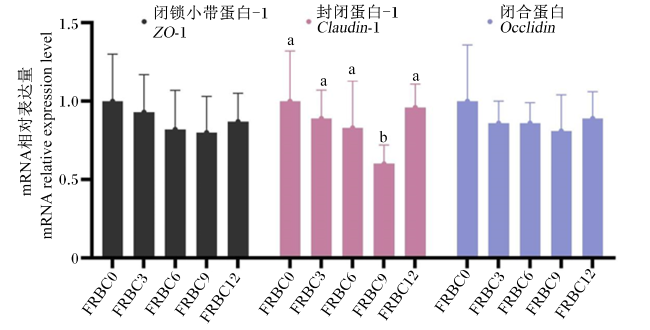
图1可知,ZO-1和Occlidin的mRNA相对表达量在各组间无显著差异(P>0.05);与对照组相比,FRBC9组Claudin-1的mRNA相对表达量显著下调(P<0.05),其余3个添加FRBC组则没有显著变化(P>0.05)。
图1 FRBC对鲤鱼肠道黏膜屏障功能相关基因mRNA相对表达量的影响

FRBC0:FRBC0组;FRBC3:FRBC3组;FRBC6:FRBC6组;FRBC9:FRBC9组;FRBC12:FRBC12组。下表同。数据柱形标注不同小写字母表示差异显著(P<0.05)。

Fig.1 Effects of FRBC on mRNA relative expression levels of barrier function related genes in intestinal mucosa of common carp

FRBC0: FRBC0 group; FRBC3: FRBC3 group; FRBC6: FRBC6 group; FRBC9: FRBC9 group; FRBC12: FRBC12 group. The same as below. Value columns with different small letters mean significant difference (P<0.05).

2.7 FRBC对鲤鱼肠道组织形态结构的影响

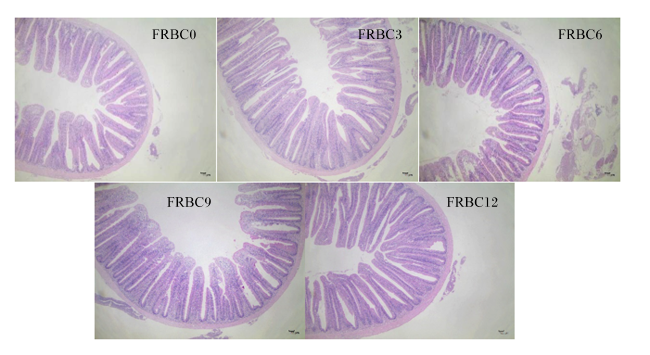
表10可知,饲料中添加不同比例的FRBC对鲤鱼肠道绒毛高度和肠壁厚度均无显著影响(P>0.05),但FRBC6和FRBC12组与对照组相比在数值上有所增加。各组肠道组织结构整体来看是正常的,主要表现为上皮细胞排列有序,浆膜、肌层、黏膜层以及黏膜下层等结构均清晰可见(图2)。
表10 FRBC对鲤鱼肠道组织形态结构的影响

Table 10 Effects of FRBC on intestinal tissue morphology and structure of common carp μm

项目
Items
组别Groups
FRBC0 FRBC3 FRBC6 FRBC9 FRBC12
绒毛高度
Villus height
1 076.92±97.62 1 062.64±102.65 1 168.66±155.10 1 178.27±111.91 1 190.28±106.94
肠壁厚度
Intestinal wall
thickness
126.79±9.98 126.63±12.44 124.25±22.01 133.32±15.31 136.74±6.87
图2 鲤鱼肠道组织切片

Fig.2 Intestinal tissue slices of common carp (40×)

3 讨论

3.1 FRBC对鲤鱼生长性能的影响

在鱼类营养领域,菜籽饼粕的应用研究日益增多,但对其效果的评估存在差异。本研究对FRBC替代豆粕对鲤鱼生长性能、营养物质沉积率、抗氧化能力、血清生化指标及肠道健康的影响进行了评估,结果表明,饲料中添加FRBC替代部分豆粕能够提高鲤鱼的生长性能和饲料利用率,最佳添加比例可达12%(相当于替代豆粕的36%)。这一结果与前人的研究结果相符,即在饲料中添加处理后的菜籽粕并不会对鱼类的生长性能和饲料利用率产生不利影响,例如在尼罗罗非鱼(以发酵菜籽粕替代50%豆粕)[16]、红鲷鱼(添加28.5%发酵菜籽粕)[13]、红鲷鱼(添加30%萃取菜籽粕)[17]和澳洲肺鱼(添加30%溶剂萃取菜粕)[18]的研究中观察到了相似的结果。生物预处理可以提高菜籽饼粕的营养价值,为水产饲料中替代豆粕提供了一种可替代原料。此外,以往的研究也表明微生物发酵粕类能够调节鱼类的生长性能、饲料利用率和消化功能[19-21]。因此,本研究中FRBC能够促进鲤鱼的生长可能是由于菌酶协同发酵处理提高了菜籽褐饼中蛋白质等营养成分的生物利用度,改善了其生物学价值。这在本研究中饲料利用率、营养物质沉积率等指标中得到了一定程度的体现。然而,Dossou等[22]的研究结果表明,在饲料中添加55.88%的发酵菜籽粕会显著降低红鲷幼鱼的生长性能。这可能是因为添加高比例的发酵菜籽粕会使饲料中含有较多的抗营养因子,甚至超过了鱼类的耐受水平,从而影响试验鱼的采食和营养物质利用率[23-24]。此外,本研究中各组的存活率相近,表明饲料中添加FRBC替代部分豆粕对鲤鱼的存活没有产生负面影响。

3.2 FRBC对鲤鱼全鱼和肌肉营养组成的影响

全鱼营养组成是评价鱼类营养和生长状况的重要指标,也是鱼类营养研究的主要内容之一。本研究发现,FRBC对全鱼水分、粗蛋白质、粗脂肪、氨基酸和粗灰分含量均没有产生显著影响,这与Dossou等[25]关于发酵菜粕应用于红鲷鱼的研究结果一致。这支持了以往的研究观点,即全鱼蛋白质和氨基酸含量主要受内源因素调节,在典型条件下相对稳定,不易受饲料的影响[8]。然而,Iqbal等[26]研究发现,菜籽粕高比例替代豆粕显著降低了罗非鱼全鱼粗蛋白质含量,并提高了粗脂肪含量。类似的情况在大口黑鲈[27]和尼罗非洲鲫鱼[16]的研究中也有描述。这些研究结果不一致可能与发酵菌种、饲料组成、水生动物种类和发育阶段等因素有关。另外,从鲤鱼肌肉营养组成分析结果来看,饲料中添加FRBC对肌肉粗蛋白质和粗脂肪含量没有产生显著影响,但提高了肌肉中钙含量,这可能是由于菜籽饼粕钙含量要高于豆粕[28],导致含FRBC饲粮的钙含量明显高于未添加FRBC的对照饲料,进而促进了鱼肉中钙的保留。

3.3 FRBC对鲤鱼营养物质沉积率的影响

营养物质沉积与全鱼营养组成有密切相关。在本研究中发现,FRBC替代36%豆粕(FRBC12组)显著提高了鲤鱼蛋白质沉积率,这可能是由于部分氨基酸沉积率得到改善,特别是赖氨酸、蛋氨酸和苏氨酸的沉积率均显著提高。然而,添加高比例(9%和12%)FRBC显著降低了鲤鱼的脂肪沉积率。这可能是因为FRBC能够促进鱼体新陈代谢,提高鱼体对脂肪的吸收和利用,从而减少脂肪的储存[29-30],然而,对于添加FRBC对鱼体脂肪酸组成的影响还需要进一步的研究。总体来看,本研究结果表明,FRBC高比例(36%)替代部分豆粕可以改善鲤鱼的肉品质,进一步证明了FRBC替代豆粕的可行性。

3.4 FRBC对鲤鱼血清生化指标的影响

鱼类血液参数被视为评估饲料对鱼类整体健康水平和生理应激状态的重要指标[31]。本研究发现,FRBC高比例(36%)替代豆粕显著降低了鲤鱼血清中AST、ALT活性和TC含量,而对Glu和TG含量没有显著影响。类似的结果在其他一些研究中也得到验证,例如,在红鲷鱼饲料中添加发酵菜籽粕降低了血清AST活性和TC含量,而对Glu和TG含量没有显著影响[16]。通过发酵菜籽粕替代豆粕的饲喂试验,在肉鸡[4,32]和生长育肥猪[33]的研究中也得出了与本研究相似的结果。然而,有一些研究结果与此并不一致,姜春艳等[34]研究表明,在肉鸡饲粮中添加12%的脱毒菜籽粕替代豆粕后,肉鸡血清中AST、ALT活性和TC含量显著提高,并引发了肉鸡毒副反应,与本研究结果相反。AST和ALT活性是衡量肝脏健康的关键指标之一,而血清中TC含量则与脂肪代谢和组织健康密切相关[35-36]。高水平的TC含量可能导致脂肪沉积,从而影响组织的正常代谢功能。在本研究中,通过菌酶协同发酵处理,可以有效地去除菜籽饼粕中的抗营养因子,降低其对鲤鱼的不利影响。即使在高添加比例下,FRBC中的抗营养因子含量也低于动物的耐受水平,因此不会对鲤鱼的血清生化指标产生负面影响。此外,发酵过程中产生的益生菌和活性物质对于细胞功能的维持和促进鱼类健康方面具有重要作用,进一步提高了鲤鱼的生长性能。综上所述,本研究结果表明,FRBC替代豆粕在鲤鱼饲料中应用是一种可行的替代方案。

3.5 FRBC对鲤鱼肠道黏膜抗氧化能力和消化酶活性的影响

活性氧是在代谢过程中氧化还原反应不平衡时产生的,过量的活性氧可引起氧化应激,导致细胞损伤,这也被认为是疾病和衰老的原因之一[37]。因此,机体形成了由CAT、SOD等一系列抗氧化酶系统组成的抗氧化防御机制,可以保护机体免受活性氧的损害[38-39]。本试验结果表明,饲料中添加6%的FRBC对鲤鱼血清SOD、CAT活性和T-AOC均无显著影响,但添加比例≥9%时会降低T-AOC,表明高水平替代会造成氧化损伤。营养物质的消化和利用主要取决于消化酶的活性,而消化酶在鱼类消化道健康中起着重要作用[40],体内消化酶的缺乏将造成饲料的不完全分解,引起消化不良和营养不足,从而导致一系列健康问题[41]。本试验结果发现,FRBC替代部分豆粕对鲤鱼肠道黏膜α-AMS和LPS活性没有显著影响,但高比例替代(FRBC12组)能够显著提高TPS活性。Santigosa等[42]研究发现,针对饲料来源和膳食营养素浓度的变化,鱼类自身可调节消化酶活性。同时,膳食营养素和抗营养因素也在消化生理中发挥重要作用,反映了酶谱及其水解、吸收和转化能力[43]。本试验中,可能最高比例替代组(FRBC12组)饲料中含有更高水平的蛋白质以及其抗营养因素低于鲤鱼耐受阈值甚至可以忽略,进而提高了胰蛋白酶活性。因此,FRBC12组全鱼蛋白质沉积率显著提高可能是由于TPS活性提高,进而促进了鲤鱼的生长。由此可见,FRBC高比例替代豆粕对鲤鱼的蛋白质吸收、利用起到了促进作用。

3.6 FRBC对鲤鱼肠道屏障功能的影响

肠紧密连接蛋白是一种重要的蛋白质复合物,由肠上皮细胞跨膜蛋白[Occludin、封闭蛋白(Claudin)、连接黏附分子(JAM)]和细胞质衔接蛋白[闭锁小带蛋白(ZO)、扣带蛋白(Cinglin)]组成。这种蛋白质复合物主要负责连接细胞空间,并保持肠道黏膜的完整性和正常通透性[44]。肠道黏膜的完整性对维持肠道屏障功能和消化吸收能力至关重要[45]。如果肠道物理屏障功能受损或减弱,就可能导致病原体进入循环系统并激活免疫系统,从而引发感染和炎症反应[46]。Claudin-1是一种多功能蛋白,有助于形成细胞旁肠屏障[47]。本研究发现,FRBC替代部分豆粕对鲤鱼肠道黏膜OccludinZO-1的表达没有产生显著影响,其中添加9%FRBC会显著下调Claudin-1的表达,表明该添加比例引起肠道屏障闭合功能受损。Zhang等[48]研究发现,在肉鸡饲粮中以菜籽粕替代70%豆粕(饲粮中菜籽粕添加比例为20%)会显著下调肠道中OccludiClaudin-1和ZO-1的表达,从而破坏肠道屏障功能,与本研究结果不一致,可能是未脱毒处理菜籽粕中抗营养因子含量较高,更容易引起肠道屏障功能损伤。此外,之前的研究已经证明活性氧所引发的氧化应激参与肠紧密连接蛋白和肠道屏障功能的调节[49],本研究的结果也支持了这个观点。在FRBC9组中,鲤鱼的抗氧化能力和肠道屏障功能受到了影响,但FRBC12组鲤鱼肠道细胞的紧密连接蛋白没有产生任何改变,表明FRBC高比例替代豆粕(替代36%的豆粕)能够保持鲤鱼肠道屏障的完整性和通透性。

3.7 FRBC对鲤鱼肠道组织结构的影响

肠道的发育与营养物质的吸收利用密切相关[50],其绒毛高度、隐窝深度以及肠壁厚度是评估肠道消化吸收的重要参考指标[51-52]。绒毛高度的提升可以增加肠道内容物的接触面积,而肠壁厚度的增加则暗示着肠道的收缩性增强。本试验结果表明,FRBC替代部分豆粕不会对鲤鱼肠道绒毛高度、肠壁厚度以及肠道细胞的形态结构造成影响。贾冰玉等[53]研究也报道,用发酵菜籽粕替代30%豆粕对黄颡鱼肠道绒毛高度和细胞结构没有造成影响。据Gan等[54]报道,菜籽饼粕中的芥子酸会引起草鱼肠道充血和肠绒毛增生,进而破坏肠道结构的完整性。因此可以推断,FRBC可能通过降解抗营养因子缓解菜籽粕对鲤鱼肠道结构的损伤,从而改善鲤鱼肠道健康。

4 结论

综上所述,FRBC是一种有潜力替代豆粕的饲料蛋白质来源,在水产养殖中具有广阔的应用前景。在饲料中添加12%的FRBC(相当于替代36%豆粕)可以促进鲤鱼的生长和提高饲料利用率,并且能在一定程度上改善肉品质,且对肠道健康没有不良影响。由此可见,在鲤鱼饲料中使用FRBC替代豆粕的比例可以达到36%。
[1]
GU X L, LI Z Q, WANG J, et al. Fermented cottonseed meal as a partial replacement for soybean meal could improve the growth performance,immunity and antioxidant properties,and nutrient digestibility by altering the gut microbiota profile of weaned piglets[J]. Frontiers in Microbiology, 2021,12:734389.

[2]
YU X J, WU Z H, GUO J S, et al. Replacement of dietary fish meal by soybean meal on growth performance,immunity,anti-oxidative capacity and mTOR pathways in juvenile abalone Haliotis discus hannai Ino[J]. Aquaculture, 2022,551:737914.

[3]
WU Z K, CHEN J, AHMED PIRZADO S, et al. The effect of fermented and raw rapeseed meal on the growth performance,immune status and intestinal morphology of broiler chickens[J]. Journal of Animal Physiology and Animal Nutrition, 2022, 106(2):296-307.

[4]
ASHAYERIZADEH A, DASTAR B, SHARGH M S, et al. Effects of feeding fermented rapeseed meal on growth performance,gastrointestinal microflora population,blood metabolites,meat quality,and lipid metabolism in broiler chickens[J]. Livestock Science, 2018,216:183-190.

[5]
LIU W C, LEE S I, HONG S T, et al. Comparison of apparent total tract and ileal digestibility in growing and finishing pigs fed soybean meal,rapeseed meal,and canola meal[J]. Journal of Applied Animal Research, 2018, 46(1):55-59.

[6]
陶安, 谌俊, 林锦山, 等. 菜籽粕的营养价值及其在猪生产中的应用研究进展[J]. 动物营养学报, 2024, 36(1):1-12.

TAO A, CHEN J, LIN J S, et al. Research progress on nutritional value of rapeseed meal and its application in swine production[J]. Chinese Journal of Animal Nutrition, 2024, 36(1):1-12.

[7]
张文鹏. 饲料中菜籽粕替代鱼粉对杂交鲟幼鱼生长和生理机能影响的研究[D]. 硕士学位论文. 哈尔滨: 东北农业大学,2023:45-61

ZHANG W P. Study on the effects of replacing fish meal with rapeseed meal in feed on growth and physiological functions of hybrid sturgeon juveniles[D]. Master’s Thesis.Harbin:Northeast Agricultural University,2023:45-61.

[8]
YAO J T, CHEN P, RINGØ E, et al. Effect of diet supplemented with rapeseed meal or hydrolysable tannins on the growth,nutrition,and intestinal microbiota in grass carp (Ctenopharyngodon idellus)[J]. Frontiers in Nutrition, 2019,6:154.

[9]
袁梦莹, 王恒志, 米海峰, 等. 不同来源菜籽粕对鲤鱼生长、消化生理、抗氧化能力和健康的影响[J]. 动物营养学报, 2023, 35(1):469-493.

DOI

YUAN M Y, WANG H Z, MI H F, et al. Effects of rapeseed meal from different sources on growth,digestive physiology,antioxidant capacity and health of common carp[J]. Chinese Journal of Animal Nutrition, 2023, 35(1):469-493.

[10]
ZHANG Y T, LU D D, CHEN J Y, et al. Effects of fermented soybean meal on carbon and nitrogen metabolisms in large intestine of piglets[J]. Animal, 2018, 12(10):2056-2064.

DOI PMID

[11]
牛俊丽, 魏莲清, 张文举, 等. 发酵棉粕对肉仔鸡生长性能屠宰性能、营养物质表观消化率和脂肪沉积的影响[J]. 中国畜牧兽医, 2020, 47(8):2385-2394.

DOI

NIU J L, WEI L Q, ZHANG W J, et al. Effects of fermented cottonseed meal on growth performance,slaughter performance,apparent digestibility of nutrients and fat deposition of broilers[J]. China Animal Husbandry&Veterinary Medicine, 2020, 47(8):2385-2394.

[12]
SALEH A A, AMBER K, EL-MAGD M A, et al. Integrative effects of feeding Aspergitlus awamori and fructooligosaccharide on growth performance and digestibility in broilers:promotion muscle protein metabolism[J]. BioMed Research Internatsonal, 2014, 2014(1):946859.

[13]
DOSSOU S, KOSHIO S, ISHIKAWA M, et al. Effects of replacing fishmeal with fermented and non-fermented rapeseed meal on the growth,immune and antioxidant responses of red sea bream (Pagrus major)[J]. Aquaculture Nutrition, 2019, 25(2):508-517.

[14]
DUMAS A, DE LANGE C F M, FRANCE J, et al. Quantitative description of body composition and rates of nutrient deposition in rainbow trout (Oncorhynchus mykiss)[J]. Aquaculture, 2007, 273(1):165-181.

[15]
LIVAK K J, SCHMITTGEN T D. Analysis of relative gene expression data using real-time quantitative PCR and the 2 (-delta delta C(T)) method[J]. Methods, 2001, 25(4):402-408.

[16]
PICHET P, AMARARATNE Y. Effect of replacing soybean meal with yeast-fermented canola meal on growth and nutrient retention of Nile tilapia,Oreochromis niloticus (Linnaeus 1758)[J]. Aquaculture Research, 2014, 45(11):1744-1753.

[17]
GLENCROSS B, HAWKINS W, CURNOW J. Nutritional assessment of Australian canola meals.Ⅱ.Evaluation of the influence of the canola oil extraction method on the protein value of canola meals fed to the red seabream (Pagrus auratus,Paulin)[J]. Aquaculture Research, 2004, 35(1):25-34.

[18]
NGO D T, WADE N M, PIROZZI I, et al. Effects of canola meal on growth,feed utilisation,plasma biochemistry,histology of digestive organs and hepatic gene expression of barramundi (Asian seabass;Lates calcarifer)[J]. Aquaculture, 2016,464:95-105.

[19]
KIM S S, PHAM M A, KIM K W, et al. Effects of microbial fermentation of soybean on growth performances,phosphorus availability,and antioxidant activity in diets for juvenile olive flounder (Paralichthys olivaceus)[J]. Food Science and Biotechnology, 2010, 19(6):1605-1610.

[20]
LEE S M, MOHAMMADI AZARM H, CHANG K H. Effects of dietary inclusion of fermented soybean meal on growth,body composition,antioxidant enzyme activity and disease resistance of rockfish (Sebastes schlegeli)[J]. Aquaculture, 2016,459:110-116.

[21]
LIM S J, PHAM M A, CHA J H, et al. Effects of fermented cottonseed and soybean meal with phytase supplementation on gossypol degradation,phosphorus availability,and growth performance of olive flounder(Paralichthys olivaceus)[J]. Fisheries and Aquatic Sciences, 2010, 13(4):284-293.

[22]
DOSSOU S, KOSHIO S, ISHIKAWA M, et al. Effect of partial replacement of fish meal by fermented rapeseed meal on growth,immune response and oxidative condition of red sea bream juvenile,Pagrus major[J]. Aquaculture, 2018,490:228-235.

[23]
CHEN Y J, ZHANG T Y, CHEN H Y, et al. An evaluation of hepatic glucose metabolism at the transcription level for the omnivorous GIFT tilapia,Oreochromis niloticus during postprandial nutritional status transition from anabolism to catabolism[J]. Aquaculture, 2017,473:375-382.

[24]
MWACHIREYA, BEAMES, HIGGS, et al. Digestibility of canola protein products derived from the physical,enzymatic and chemical processing of commercial canola meal in rainbow trout Oncorhynchus mykiss (Walbaum) held in fresh water[J]. Aquaculture Nutrition, 1999, 5(2):73-82.

[25]
DOSSOU S, KOSHIO S, ISHIKAWA M, et al. Growth performance,blood health,antioxidant status and immune response in red sea bream (Pagrus major) fed Aspergillus oryzae fermented rapeseed meal (RM-Koji)[J]. Fish & Shellfish Immunology, 2018,75:253-262.

[26]
IQBAL M, YAQUB A, AYUB M. Partial and full substitution of fish meal and soybean meal by canola meal in diets for genetically improved farmed tilapia (O. niloticus) :growth performance,carcass composition,serum biochemistry,immune response,and intestine histology[J]. Journal of Applied Aquaculture, 2021, 34(4):829-854.

[27]
高有领, 汪财生, 王伟, 等. 菜籽粕和发酵菜籽粕对大口黑鲈生长、体成分和甲状腺素的影响[C]// 第九届世界华人鱼虾营养学术研讨会. 厦门:中国水产学会动物营养与饲料专业委员会,2013:120.

GAOY L, WANGC S, WANGW, et al. Effect of rapeseed meal and fermented rapeseed meal on growth performance,body composition,and plasma T4 level in largemouth bass[C]// 9th World Chinese Symposium on Fish and Shrimp Nutrition. Xiamen: Animal Nutrition and Feed Professional Committee of China Fisheries Society,2013:120.

[28]
吴先华, 陆愈忠, 郑林强, 等. 发酵菜粕的营养特性及在畜禽生产中的应用[J]. 养猪, 2014(4): 22-24.

WU X H, LU Y Z, ZHENG L Q, et al. Nutritional characteristics of fermented rapeseed meal and its application in livestock and poultry production[J]. Swine Production, 2014(4):22-24.

[29]
WANG Y, JIA X Y, GUO Z X, et al. Effect of dietary soybean saponin Bb on the growth performance,intestinal nutrient absorption,morphology,microbiota,and immune response in juvenile Chinese soft-shelled turtle (Pelodiscus sinensis)[J]. Frontiers in Immunology, 2022,13:1093567.

[30]
MURRAY D S, HAGER H, TOCHER D R, et al. Effect of partial replacement of dietary fish meal and oil by pumpkin kernel cake and rapeseed oil on fatty acid composition and metabolism in Arctic charr (Salvelinus alpinus)[J]. Aquaculture, 2014,431:85-91.

[31]
DAWOOD M A O, EWEEDAH N M, KHALAFALLA M M, et al. Evaluation of fermented date palm seed meal with Aspergillus oryzae on the growth,digestion capacity and immune response of Nile tilapia (Oreochromis niloticus)[J]. Aquaculture Nutrition, 2020, 26(3):828-841.

[32]
吴东, 徐鑫, 杨家军, 等. 发酵菜籽粕替代豆粕对肉鸡生长性能、肉品质及血清生化指标的影响[J]. 中国畜牧兽医, 2015, 42(10):2676-2680.

DOI

WU D, XU X, YANG J J, et al. Effect of soybean meal replaced by fermented rapeseed meal on growth performance,meat quality and serum biochemical indices of broilers[J]. China Animal Husbandry&Veterinary Medicine, 2015, 42(10):2676-2680.

[33]
孙佩佩. 发酵菜籽粕的营养价值评定及其在生长育肥猪上的应用研究[D]. 硕士学位论文. 重庆: 西南大学, 2019.

SUN P P. Evaluation of nutritional value of fermented rapeseed meal and its application in growing and finishing pigs[D]. Master’s Thesis. Chongqing: Southwest University, 2019.

[34]
姜春艳, 许金红. 菜籽粕替代豆粕对肉鸡生长性能、血清生化指标及饲养经济效益的影响[J]. 中国饲料, 2023(14):86-89.

JIANG C Y, XU J H. Effects of rapeseed meal replacing soybean meal on growth performance,serum biochemical indicators,and feeding economic benefits of broilers[J]. China Feed, 2023(14):86-89.

[35]
FANG T T, LI X, WANG J T, et al. Effects of three compound attractants in plant protein diets on growth,immunity,and intestinal morphology of yellow river carp Cyprinus carpio var[J]. Aquaculture Nutrition, 2022, 2022(1):9510968.

[36]
EBRAHIMNEZHADARABI M, SAAD C R, HARMIN S A, et al. Effects of phospholipids in the diet on biochemical factors of sturgeon fish (Huso-huso) juveniles[J]. African Journal of Biotechnology, 2011, 10(42):8511-8516.

[37]
HAN R M, ZHANG J P, SKIBSTED L H. Reaction dynamics of flavonoids and carotenoids as antioxidants[J]. Molecules, 2012, 17(2):2140-2160.

[38]
YAGHOUBI M, MOZANZADEH M T, MARAMMAZI J G, et al. Dietary replacement of fish meal by soy products (soybean meal and isolated soy protein) in silvery-black porgy juveniles (Sparidentex hasta)[J]. Aquaculture, 2016,464:50-59.

[39]
WANG P, ZHU J Q, FENG J, et al. Effects of dietary soy protein concentrate meal on growth,immunity,enzyme activity and protein metabolism in relation to gene expression in large yellow croaker Larimichthys crocea[J]. Aquaculture, 2017,477:15-22.

[40]
RIMOLDI S, FINZI G, CECCOTTI C, et al. Butyrate and taurine exert a mitigating effect on the inflamed distal intestine of European sea bass fed with a high percentage of soybean meal[J]. Fisheries and Aquatic Sciences, 2016, 19(1):40.

[41]
AHMADIFAR E, SHEIKHZADEH N, ROSHANAEI K, et al. Can dietary ginger (Zingiber officinale) alter biochemical and immunological parameters and gene expression related to growth, immunity and antioxidant system in zebrafish (Danio rerio)?[J]. Aquaculture, 2019,507:341-348.

[42]
SANTIGOSA E, SÁNCHEZ J, MÉDALE F, et al. Modifications of digestive enzymes in trout (Oncorhynchus mykiss) and sea bream (Sparus aurata) in response to dietary fish meal replacement by plant protein sources[J]. Aquaculture, 2008, 282(1/4):68-74.

[43]
YU D H, GONG S Y, YUAN Y C, et al. Effects of replacing fish meal with soybean meal on growth,body composition and digestive enzyme activities of juvenile Chinese sucker,Myxocyprinus asiaticus[J]. Aquaculture Nutrition, 2013, 19(1):84-90.

[44]
ULLUWISHEWA D, ANDERSON R C, MCNABB W C, et al. Regulation of tight junction permeability by intestinal bacteria and dietary components[J]. Journal of Nutrition, 2011, 141(5):769-776.

DOI PMID

[45]
YOU C H, CHEN B J, WANG M, et al. Effects of dietary lipid sources on the intestinal microbiome and health of golden pompano (Trachinotus ovatus)[J]. Fish & Shellfish Immunology, 2019,89:187-197.

[46]
ZHAO L L, LIANG J, CHEN F K, et al. High carbohydrate diet induced endoplasmic reticulum stress and oxidative stress,promoted inflammation and apoptosis,impaired intestinal barrier of juvenile largemouth bass (Micropterus salmoides)[J]. Fish & Shellfish Immunology, 2021,119:308-317.

[47]
PATEL R M, MYERS L S, KURUNDKAR A R, et al. Probiotic bacteria induce maturation of intestinal claudin 3 expression and barrier function[J]. The American Journal of Pathology, 2012, 180(2):626-635.

[48]
ZHANG B L, LIU N, HAO M L, et al. Effects of substitution of soybean meal with rapeseed meal and glutamine supplementation on growth performance,intestinal morphology,and intestinal mucosa barrier of Qiandongnan Xiaoxiang chicken[J]. Animal Bioscience, 2022, 35(11):1711-1724.

[49]
JIANG W D, DENG Y P, ZHOU X Q, et al. Towards the modulation of oxidative damage,apoptosis and tight junction protein in response to dietary leucine deficiency:a likely cause of ROS-induced gill structural integrity impairment[J]. Fish & Shellfish Immunology, 2017,70:609-620.

[50]
HU Y N, WANG Y W, LI A K, et al. Effects of fermented rapeseed meal on antioxidant functions,serum biochemical parameters and intestinal morphology in broilers[J]. Food and Agricultural Immunology, 2016, 27(2):182-193.

[51]
HOUSHMAND M, AZHAR K, ZULKIFLI I, et al. Effects of non-antibiotic feed additives on performance,immunity and intestinal morphology of broilers fed different levels of protein[J]. South African Journal of Animal Science, 2012, 42(1):22-32.

[52]
WEI L, WU P, ZHOU X Q, et al. Dietary silymarin supplementation enhanced growth performance and improved intestinal apical junctional complex on juvenile grass carp (Ctenopharyngodon idella)[J]. Aquaculture, 2020,525:735311.

[53]
贾冰玉, 邹峰余, 徐杰杰, 等. 发酵菜籽粕对黄颡鱼表观消化率、肝脏及肠道健康的影响[J]. 水生生物学报, 2023, 48(1):34-45.

JIA B Y, ZOU F Y, XU J J, et al. Fermented rapeseed meal on apparent digestibility,liver and intestinal health of yellow catfish (Tachysurus fulvidraco)[J]. Acta Hydrobiologica Sinica, 2023, 48(1):34-45.

[54]
GAN L, WU P, FENG L, et al. Erucic acid inhibits growth performance and disrupts intestinal structural integrity of on-growing grass carp (Ctenopharyngodon idella)[J]. Aquaculture, 2019,513:734437.

Outlines

/