REVIEW

Research Progress on Physiological Functions of Vitamin E and Its Application in Ruminant Production

  • LI Jing , 1 ,
  • LIU Wenchang 1 ,
  • LI Fuqiang 2 ,
  • XIAO Dingfu , 1, *
Expand
  • 1 College of Animal Science and Technology, Hunan Agricultural University, Changsha 410128, China
  • 2 Hunan Tianhua Industrial Co., Ltd., Loudi 417000, China
*professor, E-mail:

Received date: 2024-05-27

  Online published: 2024-12-12

Abstract

As an antioxidant, vitamin E has many functions such as antioxidative stress mitigation, immune enhancement, reproductive enhancement, and improvement of meat quality. It is widely employed as a feed additive in livestock and poultry production practices. This paper summarized the existence, absorption and metabolism, physiological functions, and application of vitamin E in ruminant production, in order to provide reference for the utilization of vitamin E in ruminant production.

Cite this article

LI Jing , LIU Wenchang , LI Fuqiang , XIAO Dingfu . Research Progress on Physiological Functions of Vitamin E and Its Application in Ruminant Production[J]. Chinese Journal of Animal Nutrition, 2024 , 36(12) : 7573 -7580 . DOI: 10.12418/CJAN2024.645

维生素E是反刍动物维持正常代谢和生理活动所必需的营养物质,其微量高效,是重要的脂溶性抗氧化保护剂[1],在调控机体氧化还原系统中起着重要作用,能够提高反刍动物的抗应激能力、抗病性能、繁殖力及维持神经系统的稳定[2]。本文将对维生素E在动物体内的存在方式与吸收代谢、生理功能及其在反刍动物生产上的应用效果进行综述,为其在反刍动物饲粮中的合理利用提供参考。

1 维生素E在动物体内的存在方式与吸收代谢

1.1 存在形式
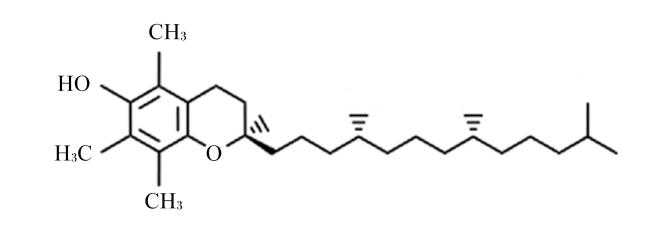
维生素E是机体内重要的脂溶性营养物质,于20世纪20年代初期在绿叶蔬菜中被发现[3],为微黄、透明的油状液体,易溶于有机溶剂,可在高温或酸性条件下保持稳定[4],广泛存在于大豆、玉米等天然植物或者动物肝脏等器官组织中[5]。维生素E有8种同分异构体,根据其苯环上侧链的饱和程度不同可分为生育酚和生育三烯酚两大类,再按照苯环上甲基的位置和数量又分为α、β、γ、δ 4种结构,其中α-生育酚分布最广泛,生物活性最高,是维生素E的主要存在形式[6],其结构如图1所示[7]。目前,人工合成或天然的α-生育酚是在反刍动物上应用较多的维生素E类型。
图1 α-生育酚的结构

Fig.1 Structure of α-tocopherol[7]

1.2 吸收代谢

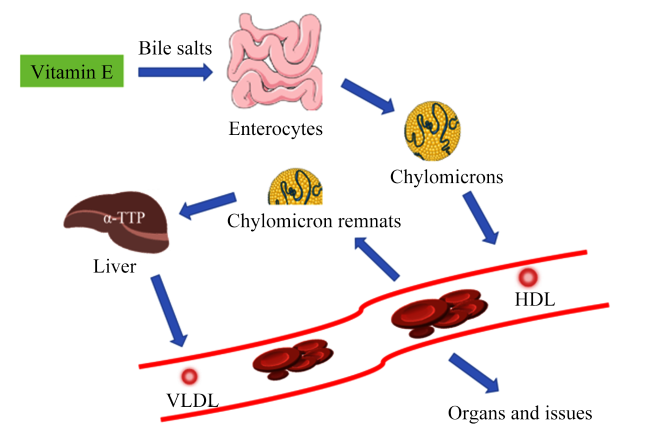
动物自身无法合成维生素E,只能通过饲粮获取[8]。肠道是维生素E的主要吸收部位,胆固醇、胆盐能够提高维生素E的吸收效率[9]。机体摄入的维生素E经消化道的非特异性酶水解后与胆盐形成胶束,并被肠道上皮细胞吸收,之后在磷脂和胆汁酸的作用下形成乳糜微粒,乳糜微粒通过淋巴管迅速流入血管,在酶的作用下,一部分维生素E被转移到高密度脂蛋白上随血液运输至各个器官,而没有被转移的维生素E仍留在残余的乳糜微粒中[10]。肝脏是维生素E存储和代谢的主要场所,肝细胞能够特异性识别α-生育酚[11]。当乳糜微粒残体到达肝脏时,在肝细胞的作用下,α-生育酚转移蛋白与α-生育酚结合,将其从乳糜微粒残体中分离,然后α-生育酚与载脂蛋白和三酰基甘油一起包装成极低密度脂蛋白,再经血液循环作用于机体内的各个器官和组织[10],部分未与蛋白结合的维生素E在参与机体代谢后随尿液排出体外[12]。维生素E的消化吸收过程如图2所示。
图2 维生素E的消化吸收过程

Vitamin E:维生素E;Bile salts:胆汁盐;Enterocytes:肠上皮细胞;Chylomicrons:乳糜微粒;Chylomicron remnats:乳糜微粒残余物;Liver:肝脏;α-TTP:α-生育酚转移蛋白 α-tocopherol transfer protein;HDL:高密度脂质蛋白 high density lipoprotein;VLDL:极低密度脂质蛋白 very low density lipoprotein;Organs and issues:器官和组织。

Fig.2 Digestion and absorption process of vitamin E[10]

2 维生素E的生理功能

2.1 抗氧化

维生素E充当机体抗氧化的第1道防线,参与组成生物体内的抗氧化系统,是机体内重要的抗氧化物质[13]。一方面,维生素E可以向自由基提供其酚类氢,部分帮助阻断自由基的链式反应,从而维持膜内长链多不饱和脂肪酸的完整性,缓解氧化应激对各种器官的损伤[1];另一方面,维生素E通过调节甘油磷脂的生物合成途径,缓解脂肪酸氧化,促进细胞膜的生物合成。甘油磷脂是细胞膜的主要组成成分,在细胞增殖、分化和凋亡过程中发挥着重要作用,若甘油磷脂被氧化破坏,将会导致活性氧(reactive oxygen species,ROS)进入细胞,并对细胞内的大分子(如DNA或蛋白质)造成氧化损伤[14]。综上可知,维生素E主要通过提高体内的抗氧化物质水平,拮抗脂质过氧化,调节相关物质的生物合成途径,保护细胞膜结构来缓解应激因子造成的氧化损伤。

2.2 保障繁殖力

维生素E又称生育酚,能够促进机体性激素的分泌,增加睾丸和附睾中生殖细胞的数量[15],提高机体抗氧化能力[6],从而保障繁殖性能的稳定。维生素E作为精子抗氧化系统的重要组成成分,可以清除精子膜中的ROS,减缓氧化应激对精子的损伤。研究报道,补充维生素E能促进谷胱甘肽过氧化物酶(glutathione peroxidase,GSH-Px)和谷胱甘肽S-转移酶(glutathione S-transferase,GST-ST)的mRNA表达,增强机体的抗氧化水平来保障繁殖力[16]。Yuan等[17]发现,添加维生素E提高了冷冻精子的活力,增加了精浆中超氧化物歧化酶(superoxide dismutase,SOD)和过氧化氢酶(catalase,CAT)的活性,降低了丙二醛(malondialdehyde,MDA)和ROS含量。此外,维生素E还具备非抗氧化性的功能来提高机体的繁殖性能。精子活力需要高能量水平的代谢表达,而丙酸代谢参与三羧酸循环并为精子提供能量,因此丙酸代谢在改善精子活力中发挥着重要作用。研究发现,补充维生素E可以调节丙酸代谢途径中4-氨基丁酸氨基转移酶(4-aminobutyrate aminotransferase,ABAT)和羟酰基辅酶A脱氢酶亚基α(hydroxyacyl-CoA dehydrogenase subunit alpha,HADHA)的基因表达,使得精子中乌头酸酶(aconitase,ACO)的分泌增加,而ACO的高表达又可以促进三羧酸循环,进一步改善精液质量和随后的胚胎发育[17-19]。也有研究报道,维生素E通过调节细丝蛋白A(filamin A,FLNA)和信号肽酶复合物亚基3(signal peptidase complex subunit 3,SPCS3)的表达来促进绵羊精子的产生[20]。维生素E还可充当调节信号,一方面促进牛卵巢颗粒细胞的增殖,改善与类固醇合成相关基因的表达[21];另一方面增加雌性激素和黄体激素的分泌,促进卵泡成熟,使黄体增大,同时抑制孕酮在体内的氧化,从而增加孕酮的效能[22]。补充维生素E可缩短母牛产犊至首次发情的间隔、降低胎衣不下的发生率并减少配种次数[23]。因此,动物机体缺乏维生素E时,其繁殖性能会受到损伤,严重时可导致无法生育。

2.3 提高免疫力

维生素E可以提高机体免疫细胞的功能与活性水平,促进免疫球蛋白的分泌,缓解氧化应激损伤,从而增强机体的免疫应答能力,发挥防治疾病的作用[24]。维生素E增强免疫能力的方式主要分为2种:1)花生四烯酸是合成前列腺素的重要物质,而维生素E通过保护花生四烯酸的合成原料免受氧化,从而增加前列腺素的释放水平,进一步提高体液免疫和细胞吞噬作用,增强机体的免疫能力[4]。2)维生素E提高T淋巴细胞活性,促进T细胞增殖,进而刺激B淋巴细胞活化[25],同时参与体内抗体合成,减少免疫抑制剂含量,增强自然杀伤(NK)细胞活力,以提高免疫应答水平[26]。此外,维生素E还可通过发挥非抗氧化作用来提高免疫力,如维生素E可以抑制蛋白激酶C(protein kinase C,PKC)活性、降低肿瘤坏死因子-α(tumor necrosis factor-α,TNF-α)的产生、细胞黏附以及促炎信号转录因子的表达,并提高α-生育酚转移蛋白及胶原酶(collagenase)基因的转录水平,从而增强机体的免疫能力[27-28]。维生素E也可直接改善炎症反应。20-羟-二十烷四烯酸(20-hydroxyeicosatetraenoic acid,20-HETE)是一类促进炎症反应的脂源性介质,多项研究表明炎症反应失调易导致奶牛在分娩前后患病,而维生素E类似物可与20-HETE竞争相关的代谢途径,从而减少奶牛临床疾病期间肾脏中20-HETE的浓度,缓解奶牛炎症反应[29]。因此,动物机体缺乏维生素E时,可能会导致机体免疫力下降,患疾病概率升高,影响畜禽生产性能。

2.4 维持生产性能稳定

维生素E缺乏是围产期奶牛产生疾病的重要诱因,通常奶牛在分娩前后其血液中维生素E的浓度会大幅下降,最低仅为1.15 μg/mL[30],远低于3 μg/mL的正常水平,这可能是由于近产期的α-生育酚摄入量下降、氧化应激和α-生育酚消耗及从血液到初乳的α-生育酚转移增加所致[31]。因此,适当补充维生素E能有效减少奶牛疾病的产生,保持其生产性能的稳定。维生素E与其他营养物质混合添加至畜禽饲粮中的应用效果较好。研究发现,共轭亚油酸和维生素E组合饲喂奶牛,可以在不影响乳品质的同时增强奶牛的抗氧化能力,提高乳脂中共轭亚油酸和维生素E的含量,对促进奶牛健康和提升乳品质产生协同作用[32]。热应激是影响反刍动物的主要应激,能够对机体的生产性能、繁殖性能及免疫力等造成严重损害[33]。有研究报道,热应激可能通过增加体温来加剧奶牛的炎症反应、恶化乳腺健康状况、扩大DNA氧化损伤,从而影响奶牛的产奶量和乳成分[34]。而添加维生素E可以缓解奶牛热应激损伤,增强奶牛血液中的抗氧化水平,降低乳腺炎发生率,保持乳房健康,从而提高产奶量[35]。维生素E的补充对肉牛的生长性能影响较小。Wei等[36]研究发现,在育肥牛的饲粮中补充300 IU/(头·d)的维生素E不影响营养物质消化率,但能显著增加肉牛的氮利用率及血浆中甘油三酯的浓度。另有研究表明,补充维生素E对安格斯牛的干物质采食量、平均日增重或料重比没有显著影响,但机体的总抗氧化能力随着维生素E添加量的增加而不断提高[37]。综上可知,维生素E的补充对反刍动物的生长性能影响较小,但可以调控体内的生理代谢反应,增强机体的抗氧化能力,从而保障反刍动物的健康生长,维持生产性能的稳定。

2.5 改善肉品质

牛肉的鲜红色外观主要来源于氧合肌红蛋白,而维生素E能直接抑制脂质氧化来间接延缓肌红蛋白的氧化,以保持牛肉颜色的稳定,发挥延迟变色并去除脂质氧化的作用[38]。此外,补充维生素E还能有效改善牛肉的品质参数,尤其是提高牛肉的嫩度和风味[39]。肉牛在屠宰前遭受应激会降低牛肉脂质的稳定性,并生成大量的MDA和ROS,导致牛肉的抗氧化能力降低[40],而在屠宰前饲喂维生素E可在一定程度上缓解该影响。Harsh等[41]研究发现,与未补充维生素E的育肥牛相比,补充1 000 IU/(头·d)的维生素E提高了牛肉大理石花纹评分和颜色稳定性,降低了最终脂质氧化和总视觉变色程度,延长了牛肉的货品上架期。

3 维生素E在反刍动物生产中的应用

目前,α-生育酚是维生素E的主要利用形式,单独或者与其他营养物质混合使用,添加到反刍动物饲粮中(或直接注射维生素E),从而提高机体的抗氧化能力、促进免疫系统的完善、缓解各类应激对机体造成的损伤、改善炎症反应、提高肉品质和产奶量,进而提高生产性能,在反刍动物养殖中取得了良好的经济效益[42-52](表1)。
表1 维生素E在反刍动物生产中的应用效果

Table 1 Application effects of vitamin E in ruminant production

指标
Indexes
动物种类
Animal species
添加方式
Adding mode
添加水平
Adding level
主要效果Main effects 参考文献
References
升高Increase 降低Decrease
生产性能
Production
performance
荷斯坦犊牛 维生素E+
脂质
147 mg/kg
DM
ADG、
粗脂肪摄入量
Lashkari等[42]
斯洛伐克
花斑牛
维生素E+硒 102 mg/kg
DM
初乳中维
生素E浓度
乳中MDA含量、
乳腺炎发病率
Vasil’等[43]
繁殖性能
Reproductive
performance
荷斯坦-
弗里斯奶牛
维生素E+硒 1 000 mg/kg
DM
受胎率 RFM、子宫内膜炎患
病率及产犊到第1
次人工授精间隔
Chen等[44]
家牛 维生素E 1 000 IU/d 卵泡中维生
素E浓度
卵泡中ROS浓度、
脂质过氧化程度
Missio等[45]
西门塔尔公牛 维生素E+
亚麻籽油
0.1 mg/mL 解冻后精子的
活力、运动参数和
膜完整性
Yuan等[46]
肉品质
Meat quality
延边牛 维生素E 700 IU/d 肌肉组织中抗
氧化酶活性、
肉质参数
和嫩度
肌肉的滴水损失、
蒸煮损失、剪切力,
肌肉中MDA和
NO含量
Luan等[47]
阿拉贡羔羊 维生素E 1 000 mg/kg
DM
羊肉的风味、氧合
肌红蛋白含量、
颜色稳定性
羊肉脂质
过氧化程度
Leal等[48]
马尔吉亚纳公牛 维生素E 2.1 g/d 牛肉抗氧化能力,
ω-3 PUFA和CLA
含量,产品保质期
牛肉中MDA、
亚铁肌红
蛋白含量
Fusaro等[49]
抗应激能力
Anti-stress capacity
安格斯×
西门塔尔阉牛
维生素E 2 000 mg/d 血液中维生素E
浓度,机体的
抗氧化水平
毛干中皮质醇浓
度,BRD患病率,
运输应激损伤
Dornbach
[50]
荷斯坦母牛 维生素E+硒 70 IU/kg
DM
血清中CAT、
GSH-Px
和SOD活性
血液中皮质醇和
非酯化脂肪酸浓度、
血浆中触珠蛋白浓度
Jung等[51]
牦牛 维生素E 40 mg/kg
DM
血液中肌酸酐含
量、血清中GSH-Px
和GSH-ST活性,
肝细胞中三羧
酸循环水平
血液中尿素
含量、血清中
MDA和丙酸含
量、血浆中柠
檬酸含量
Zhang等[52]

ADG:平均日增重 average daily gain;RFM:胎衣不下 retained fetal membranes;ROS:活性氧 reactive oxygen species;MDA:丙二醛 malondialdehyde;NO:一氧化氮 nitric oxide;ω-3 PUFA:ω-3多不饱和脂肪酸 ω-3 polyunsaturated fatty acid;CLA:共轭亚油酸 conjugated linoleic acid;BRD:牛呼吸道疾病 bovine respiratory disease;CAT:过氧化氢酶 catalase;GSH-Px:谷胱甘肽过氧化物酶 glutathione peroxidase;SOD:超氧化物歧化酶 superoxide dismutase;GSH-ST:谷胱甘肽S-转移酶 glutathione S-transferase。

4 小结

维生素E是机体内重要的营养物质,在饲粮中补充适量维生素E可以维持反刍动物的生产性能、保障繁殖能力、改善肉品质、缓解应激损伤并增强免疫功能,从而提高养殖效益。现代规模化养殖模式下,很多养殖场不重视粗饲料,青绿饲料补充少甚至长期缺乏,且不同品种、性别及阶段的反刍动物对维生素E的需求量不同,从而导致机体内维生素E供应不足,从幼年到成年的反刍动物维生素E缺乏的现象普遍存在。因此,亟需进一步研究反刍动物对维生素E的需求量,并运用代谢组学、转录组学和基因组学等新型生物技术,进一步揭示阐明维生素E的作用机制,以满足反刍动物对维生素E的需要,这将是未来研究工作的重点。

致谢

感谢湖南农业大学动物科学技术学院高骞博士对文稿所提的宝贵意见。

[1]
MIYAZAWA T, BURDEOS G C, ITAYA M, et al. Vitamin E:regulatory redox interactions[J]. IUBMB Life, 2019, 71(4):430-441.

[2]
AMEVOR F K, CUI Z F, NING Z F, et al. Dietary quercetin and vitamin E supplementation modulates the reproductive performance and antioxidant capacity of aged male breeder chickens[J]. Poultry Science, 2022, 101(6):101851.

[3]
EVANS H M, BISHOP K S. On the existence of a hitherto unrecognized dietary factor essential for reproduction[J]. Science, 1922, 56(1458):650-651.

PMID

[4]
杨雨, 王志跃, 杨海明, 等. 维生素E的生物学功能及在鸡生产中的应用[J]. 中国饲料, 2019(11):6-10.

YANG Y, WANG Z Y, YANG H M, et al. The biological function of vitamin E and its application in chicken production[J]. China Feed, 2019(11):6-10. (in Chinese)

[5]
胡梅, 李锋, 贾俊静, 等. 维生素E在蛋鸡日粮中的应用[J]. 饲料研究, 2023, 46(6):117-122.

HU M, LI F, JIA J J, et al. Research progress of vitamin E application in laying hens diet[J]. Feed Research, 2023, 46(6):117-122. (in Chinese)

[6]
王磊. 维生素E的功能[J]. 当代畜禽养殖业, 2021(6):28-29.

WANG L. The function of vitamin E[J]. Modern Livestock and Poultry Breeding Industry, 2021(6):28-29. (in Chinese)

[7]
JIANG Q. Natural forms of vitamin E:metabolism,antioxidant,and anti-inflammatory activities and their role in disease prevention and therapy[J]. Free Radical Biology & Medicine, 2014, 72:76-90.

[8]
马田, 邓子新, 刘天罡. 维生素E的“前世”和“今生”[J]. 合成生物学, 2020, 1(2):174-186.

DOI

MA T, DENG Z X, LIU T G. The past and present of vitamin E[J]. Synthetic Biology Journal, 2020, 1(2):174-186. (in Chinese)

DOI

[9]
KIYOSE C. Absorption,transportation,and distribution of vitamin E homologs[J]. Free Radical Biology and Medicine, 2021, 177:226-237.

[10]
MANOSSO L M, CAMARGO A, DAFRE A L, et al. Vitamin E for the management of major depressive disorder:possible role of the anti-inflammatory and antioxidant systems[J]. Nutritional Neuroscience, 2022, 25(6):1310-1324.

[11]
曲扬华. 维生素E对绵羊精子发生的影响及其作用机制[D].博士学位论文. 北京: 中国农业大学, 2018.

QU Y H. Effects of vitamin E supplementation on ovine spermatogenesis and its regulating mechanisms[D].Ph.D.Thesis. Beijing: China Agricultural University, 2018. (in Chinese)

[12]
姜金荣. 维生素E水平对奶牛乳腺上皮细胞氧化应激状态的影响[D].硕士学位论文. 长春: 吉林农业大学, 2022.

JIANG J R. Effects of vitamin E levels on oxidative stress in dairy cow mammary epithelial cells[D].Master's Thesis. Changchun: Jilin Agricultural University, 2022. (in Chinese)

[13]
郭彤, 于凤芝, 胡平, 等. 维生素E调节抗氧化作用的研究进展[J]. 山东畜牧兽医, 2021, 42(12):42-49,53.

GUO T, YU F Z, HU P, et al. Research progress of vitamin E regulating antioxidant effect[J]. Shandong Journal of Animal Science and Veterinary Medicine, 2021, 42(12):42-49,53. (in Chinese)

[14]
WANG X L, XU Y A, SONG X, et al. Analysis of glycerophospholipid metabolism after exposure to PCB153 in PC12 cells through targeted lipidomics by UHPLC-MS/MS[J]. Ecotoxicology and Environmental Safety, 2019, 169:120-127.

DOI PMID

[15]
QU Y H, JIAN L Y, CE L, et al. Identification of candidate genes in regulation of spermatogenesis in sheep testis following dietary vitamin E supplementation[J]. Animal Reproduction Science, 2019, 205:52-61.

[16]
XU C C, ZUO Z Y, LIU K, et al. Transcriptome analysis of the Tan sheep testes:differential expression of antioxidant enzyme-related genes and proteins in response to dietary vitamin E supplementation[J]. Gene, 2016, 579(1):47-51.

[17]
YUAN C S, ZHANG K Y, WANG Z, et al. Dietary flaxseed oil and vitamin E improve semen quality via propionic acid metabolism[J]. Frontiers in Endocrinology, 2023, 14:1139725.

[18]
HUANG R, LI Z, ZHU X, et al. Collagen type Ⅲ alpha 1 chain regulated by GATA‐binding protein 6 affects type Ⅱ IFN response and propanoate metabolism in the recurrence of lower grade glioma[J]. Journal of Cellular and Molecular Medicine, 2020, 24(18):10803-10815.

[19]
MENEZES E B, VELHO A L C, SANTOS F, et al. Uncovering sperm metabolome to discover biomarkers for bull fertility[J]. BMC Genomics, 2019, 20(1):714.

DOI PMID

[20]
GAO Y F, JIAN L Y, LU W, et al. Vitamin E can promote spermatogenesis by regulating the expression of proteins associated with the plasma membranes and protamine biosynthesis[J]. Gene, 2021, 773:145364.

[21]
WANG M M, LI Y, MOLENAAR A, et al. Vitamin E and selenium supplementation synergistically alleviate the injury induced by hydrogen peroxide in bovine granulosa cells[J]. Theriogenology, 2021, 170:91-106.

DOI PMID

[22]
SCHOLL T O, CHEN X H, SIMS M, et al. Vitamin E:maternal concentrations are associated with fetal growth[J]. The American Journal of Clinical Nutrition, 2006, 84(6):1442-1448.

[23]
MOGHIMI-KANDELOUSI M H, ALAMOUTI A A, IMANI M, et al. A Meta-analysis and Meta-regression of the effects of vitamin E supplementation on serum enrichment,udder health,milk yield,and reproductive performance of transition cows[J]. Journal of Dairy Science, 2020, 103(7):6157-6166.

[24]
陈庞, 柳巨雄. 补充维生素E和硒对围产期奶牛分娩应激和繁殖性能的影响[J]. 中国畜牧杂志, 2020, 56(5):142-146.

CHEN P, LIU J X. The Effect of supplementing vitamin E and selenium on childbirth stress and reproductive performance of perinatal cows[J]. Chinese Journal of Animal Science, 2020, 56(5):142-146. (in Chinese)

[25]
徐群, 黄华山, 王英楠, 等. 维生素在畜禽生产中应用的研究进展[J]. 山东畜牧兽医, 2020, 41(9):88-91.

XU Q, HUANG H S, WANG Y N, et al. Research progress on the application of vitamins in livestock and poultry production[J]. Shandong Journal of Animal Science and Veterinary Medicine, 2020, 41(9):88-91. (in Chinese)

[26]
LEE G Y, HAN S N. The role of vitamin E in immunity[J]. Nutrients, 2018, 10(11):1614.

[27]
CHAUHAN S S, LIU F, LEURY B J, et al. Functionality and genomics of selenium and vitamin E supplementation in ruminants[J]. Animal Production Science, 2016, 56(8):1285.

[28]
OTOMARU K, MIYAHARA T, SAITA H, et al. Effects of vitamin E supplementation on antioxidant,inflammatory biomarker,and cell viability of peripheral blood mononuclear cells from Japanese black calves with or without lipopolysaccharide stimulation[J]. Journal of Nutritional Science and Vitaminology, 2022, 68(5):470-474.

[29]
KUHN M J, SORDILLO L M. Inhibition of 20-hydroxyeicosatetraenoic acid biosynthesis by vitamin E analogs in human and bovine cytochrome P450 microsomes[J]. Journal of Animal Physiology and Animal Nutrition, 2022, 106(1):55-60.

[30]
MARY A E P, ARTAVIA MORA J I, RONDA BORZONE P A, et al. Vitamin E and beta-carotene status of dairy cows:a survey of plasma levels and supplementation practices[J]. Animal, 2021, 15(8):100303.

[31]
HAGA S, ISHIZAKI H, ROH S. The physiological roles of vitamin E and hypovitaminosis E in the transition period of high-yielding dairy cows[J]. Animals, 2021, 11(4):1088.

[32]
SCHÄFERS S, MEYER U, VON SOOSTEN D, et al. Influence of conjugated linoleic acids and vitamin E on milk fatty acid composition and concentrations of vitamin A and α-tocopherol in blood and milk of dairy cows[J]. Journal of Animal Physiology and Animal Nutrition, 2018, 102(1):e431-e441.

[33]
BELLAGI R, MARTIN B, CHASSAING C, et al. Evaluation of heat stress on tarentaise and holstein cow performance in the mediterranean climate[J]. International Journal of Biometeorology, 2017, 61(8):1371-1379.

DOI PMID

[34]
RUIZ G A, SUISSI W, BAUMGARD L H, et al. Increased dietary vitamin D3 and calcium partially alleviate heat stress symptoms and inflammation in lactating holstein cows independent of dietary concentrations of vitamin E and selenium[J]. Journal of Dairy Science, 2023, 106(6):3984-4001.

[35]
BAYRIL T, YILDIZ A S, AKDEMIR F, et al. The technical and financial effects of parenteral supplementation with selenium and vitamin E during late pregnancy and the early lactation period on the productivity of dairy cattle[J]. Asian-Australasian Journal of Animal Sciences, 2015, 28(8):1133-1139.

DOI PMID

[36]
WEI C, LIN S X, WU J L, et al. Supplementing vitamin E to the ration of beef cattle increased the utilization efficiency of dietary nitrogen[J]. Asian-Australasian Journal of Animal Sciences, 2016, 29(3):372-377.

DOI PMID

[37]
DETERS E L, HANSEN S L. Vitamin E supplementation strategies during feedlot receiving:effects on beef steer performance,antibody response to vaccination,and antioxidant defense1[J]. Journal of Animal Science, 2019, 97(10):4362-4369.

[38]
FAUSTMAN C, CHAN W K, SCHAEFER D M, et al. Beef color update:the role for vitamin E[J]. Journal of Animal Science, 1998, 76(4):1019-1026.

[39]
FERRINHO A M, NASSU R T, ALDAI N, et al. Whole cottonseed,vitamin E and finishing period affect the fatty acid profile and sensory traits of meat products from Nellore cattle[J]. Meat Science, 2018, 138:15-22.

[40]
DELOSIÈRE M, DURAND D, BOURGUET C, et al. Lipid oxidation,pre-slaughter animal stress and meat packaging:can dietary supplementation of vitamin E and plant extracts come to the rescue?[J]. Food Chemistry, 2020, 309:125668.

[41]
HARSH B N, DILGER A C, BOLER D D, et al. Effects of a multielement trace mineral injection and vitamin E supplementation on performance,carcass characteristics,and color stability of strip steaks from feedlot heifers[J]. Journal of Animal Science, 2018, 96(5):1745-1756.

[42]
LASHKARI S, JENSEN S K, FOLDAGER L, et al. A high fat to vitamin E ratio in the feed protects and improves uptake of the natural form of vitamin E in postweaning calves[J]. Journal of Animal Physiology and Animal Nutrition, 2024, 108(3):724-734.

[43]
VASIL’ M, ZIGO F, FARKAŠOVÁ Z, et al. Comparison of effect of parenteral and oral supplementation of Selenium and vitamin E on selected antioxidant parameters and udder health of dairy cows[J]. Polish Journal of Veterinary Sciences, 2022, 25(1):155-164.

DOI PMID

[44]
CHEN Y H, CHEN Y M, TU P A, et al. Effect of supplementing vitamin E,selenium,copper,zinc,and manganese during the transition period on dairy cow reproductive performance and immune function[J]. Veterinary Sciences, 2023, 10(3):225.

[45]
MISSIO D, LEIVAS F G, CIBIN F, et al. Vitamin E reduces the reactive oxygen species production in dominant follicle during the negative energy balance in cattle[J]. Reproduction in Domestic Animals, 2023, 58(12):1662-1671.

[46]
YUAN C S, WANG H T, LI X C, et al. Combined effect of flaxseed oil and vitamin E supplementation during bull semen cryopreservation on sperm characteristics[J]. Biopreservation and Biobanking, 2022, 20(6):520-528.

[47]
LUAN J M, JIN Y H, ZHANG T, et al. Effects of dietary vitamin E supplementation on growth performance,slaughter performance,antioxidant capacity and meat quality characteristics of finishing bulls[J]. Meat Science, 2023, 206:109322.

[48]
LEAL L N, BELTRÁN J A, ALONSO V, et al. Dietary vitamin E dosage and source affects meat quality parameters in light weight lambs[J]. Journal of the Science of Food and Agriculture, 2018, 98(4):1606-1614.

DOI PMID

[49]
FUSARO I, CAVALLINI D, GIAMMARCO M, et al. Oxidative status of marchigiana beef enriched in n-3 fatty acids and vitamin E,treated with a blend of oregano and rosemary essential oils[J]. Frontiers in Veterinary Science, 2021, 8:662079.

[50]
DORNBACH C W, BEENKEN-BOBB A M, SHIKE D W, et al. Effects of injectable vitamin E before or after transit on receiving phase growth performance,health,and blood parameters of beef steers[J]. Journal of Animal Science, 2023, 101:skac333.

[51]
JUNG D J S, KIM D H, BEAK S H, et al. Effects of vitamin E and selenium administration on transportation stress in pregnant dairy heifers[J]. Journal of Dairy Science, 2023, 106(12):9576-9586.

DOI PMID

[52]
ZHANG L, WANG Z Y, ZHOU P, et al. Vitamin E supplementation improves post-transportation systemic antioxidant capacity in yak[J]. PLoS One, 2022, 17(12):e0278660.

Outlines

/