RESEARCH PAPER

Difference Analysis of Slaughter Performance, Plasma Biochemical Indices and Plasma Metabolome of Tan Sheep with High and Low Feed Conversion Ratios

  • SUN Guohan , 1 ,
  • SHI An 1 ,
  • MA Jun 1 ,
  • LYU Jiangjiang 1 ,
  • YANG Chong 2 ,
  • WANG Qian 2 ,
  • LIU Zhanfa 3 ,
  • TIAN Jinyang 3 ,
  • CHEN Xin 3 ,
  • ZHANG Ju 4 ,
  • TAO Jinzhong , 1, *
Expand
  • 1 College of Animal Science and Technology, Ningxia University, Yinchuan 750021, China
  • 2 Animal Husbandry Workstation of Ningxia, Yinchuan 750021, China
  • 3 Ningxia Yanchi Tan Sheep Breeding Farm, Wuzhong 751506, China
  • 4 College of Food Science and Engineering, Northwest A&F University, Yangling 712000, China
*professor, E-mail:

Received date: 2024-06-14

  Online published: 2024-12-12

Abstract

Feed conversion ratio (FCR) measures the feed utilization efficiency in Tan sheep. This study aimed to analyze the differences in slaughter performance, plasma biochemical indices and plasma metabolome between high and low FCR Tan sheep, providing a reference for evaluating the production efficiency of Tan sheep by calculating FCR. A total of 156 three-month-old male Tan sheep with similar birth dates, good growth conditions and similar body weight were selected for uniform feeding and management. The experiment lasted 75 days, comprising a 15-day transition period, a 10-day pre-feeding period, and a 50-day normal feeding period. Based on FCR level, Tan sheep were divided into a high FCR group (FCR>mean+0.5 SD) and a low FCR group (FCR<mean-0.5 SD). Differences in slaughter performance, plasma biochemical indexes and plasma metabolome of Tan sheep between the high FCR group and low FCR group were compared and analyzed. The results showed as follows: 1) the head and hoof weights of Tan sheep in the high FCR group were extremely significantly higher than those in the low FCR group (P<0.01), and the slaughter rate, carcass weight, and heart and spleen weights of Tan sheep in the high FCR group were significantly higher than those in the low FCR group (P<0.05). 2) The plasma total antioxidant capacity (T-AOC) of Tan sheep in the high FCR group was significantly higher than that in the low FCR group (P<0.01), and the superoxide dismutase (SOD) activity, reduced glutathione (GSH) and interleukin-10 (IL-10) contents in plasma of Tan sheep in the high FCR group were significantly higher than those in the low FCR group (P≤0.05). Additionally, the contents of malondialdehyde (MDA), interleukin-2 (IL-2) and albumin (ALB) in plasma of Tan sheep in the high FCR group were extremely significantly lower than those in the lower FCR group (P<0.01), and the total cholesterol (TC) content in plasma of Tan sheep in the high FCR group was significantly lower than that in the low FCR group (P<0.05). 3) Differential metabolites with area under curve (AUC)>0.8, including 1,2-docosahexaenoic acid-sn-glycerol-3-phosphate choline, 2-chloroepoxyethane, and N-lauroyl-D-erythrophosphocholine, were upregulated in the plasma of Tan sheep in the high FCR group compared with the low FCR group; differential metabolites between the high FCR group and low FCR group were mainly enriched in oxidative phosphorylation, parathyroid hormone synthesis, secretion and action, epithelial cell signaling pathways in Helicobacter pylori infection, and sphingolipid, etc. pathways. It can be seen that the FCR of Tan sheep is closely related to energy metabolism, calcium and phosphorus metabolism, etc. Compared with low FCR Tan sheep, high FCR Tan sheep exhibit stronger antioxidant and anti-inflammatory capabilities, less fat accumulation, higher slaughter rate and carcass weight after slaughter, and larger heart and spleen weights, but relatively lower feed utilization efficiency.

Cite this article

SUN Guohan , SHI An , MA Jun , LYU Jiangjiang , YANG Chong , WANG Qian , LIU Zhanfa , TIAN Jinyang , CHEN Xin , ZHANG Ju , TAO Jinzhong . Difference Analysis of Slaughter Performance, Plasma Biochemical Indices and Plasma Metabolome of Tan Sheep with High and Low Feed Conversion Ratios[J]. Chinese Journal of Animal Nutrition, 2024 , 36(12) : 7879 -7890 . DOI: 10.12418/CJAN2024.672

滩羊作为一种适应性强、生长迅速的重要畜种,在宁夏地区具有重要的养殖价值。滩羊产业是我国动物源性食品生产的重要组成部分,随着养殖效益的提升,其产业融合发展水平不断进步,为我国加快建设农业强国贡献了重要力量。因此,保持滩羊养殖效益的稳步增长显得尤为重要[1-2]。Zhang等[3]指出,饲料转化率(FCR)是评估羊养殖效益的关键指标,直接影响饲料利用效率。国外学者认为通过深入研究羊在不同生长阶段的生理变化及FCR等指标与生产性能之间的关系,可以为优化羊在不同时期的饲养管理提供理论指导,有助于提升养殖效益[4-5]。因此,利用FCR评估滩羊的生长性能,并据此制定相应的饲养管理策略,能有效优化其生产性能和产品质量,提高养殖效益,从而实现经济效益最大化。屠宰率、胴体重等屠宰性能指标直接决定了滩羊的肉品质和市场竞争力,而血液生化指标及血浆代谢组则是评估滩羊健康状况和营养代谢状态的重要参数。本试验拟对高、低FCR滩羊的屠宰性能、血浆生化指标及血浆代谢组差异进行分析,以期通过应用FCR评估滩羊的养殖效益后,对饲料进行动态调整,有助于降低饲料成本,提高饲料利用效率,从而促进滩羊养殖业的高质量发展。

1 材料与方法

1.1 试验动物与饲喂管理

本试验方案经过宁夏大学科技伦理委员会审批(审批编号:NXU-2024-143)。试验所用滩羊羔羊来自盐池某滩羊养殖场。试验开始之前,对羊棚进行彻底地清扫和消毒处理。按照出生日期相近、生长状况良好的原则,筛选出156只体重[(31.69±3.72) kg]相近的3月龄公滩羊,并提前做好标记和防疫工作。试验开始后,将试验羊随机分为4组统一管理,每天07:00和18:00各投喂颗粒料1次(投喂前清空料槽),每次饮食时间控制在30 min,试验中为避免试验羊在进食过程中逃跑或偷食其他羊的食物,所有试验羊均采用颈夹法[6]饲喂。饲喂完毕后将颈部夹子解开,羊群自由活动。试验时间为过渡期15 d、预试期10 d、正试期50 d。
试验羊采食的基础饲粮参考《肉羊营养需要量》(NY/T 816—2021)配制,加工为颗粒饲料,制粒温度为70 ℃,颗粒直径为6 mm。基础饲粮组成及营养水平(表1)与本研究团队之前的研究[7]一致。基础饲粮中粗蛋白质、粗脂肪、中性洗涤纤维、酸性洗涤纤维、钙和总磷的含量分别参照《饲料中粗蛋白的测定 凯氏定氨法》(GB/T 6432—2018)、《饲料中粗脂肪的测定》(GB/T 6433—2006)、《饲料中中性洗涤纤维(NDF)的测定》(GB/T 20806—2022)、《饲料中酸性洗涤纤维的测定》(NY/T 1459—2007)、《饲料中钙的测定》(GB/T 6436—2018)和《饲料中总磷的测定分光光度法》(GB/T 6437—2018)进行测定。
表1 基础饲粮组成及营养水平(风干基础)

Table 1 Composition and nutrient levels of the basal diet (air-dry basis) %

项目Items 含量Content
原料Ingredients
玉米秸秆Corn straw 20.00
玉米Corn 32.00
糖蜜Molasses 4.00
豆粕Soybean meal 6.00
棉籽粕Cottonseed meal 8.00
玉米皮Corn bran 15.30
玉米胚芽粕Corn germ meal 11.00
石粉Limestone 1.20
食盐NaCl 0.50
预混料Premix1) 2.00
合计Total 100.00
营养水平Nutrient levels2)
代谢能ME/(MJ/kg) 9.93
粗蛋白质CP 13.74
粗脂肪EE 2.74
中性洗涤纤维NDF 35.99
酸性洗涤纤维ADF 20.34
钙Ca 0.71
总磷TP 0.31

1)预混料为每千克饲粮提供 Premix provided the following per of the diet:VA 250 000 IU,VE 375 IU,VD 100 000 IU,Fe 850 mg,Cu 800 mg,Zn 750 mg, Mn 750 mg,Se 25 mg,I 50 mg, Co 10 mg。

2)代谢能依据NY/T 816—2021计算,其余为实测值。ME was calculated according to NY/T 816—2021, while the others were measured values.

1.2 试验组别确定

根据正试期每隔10 d对所有试验羊进行的称重记录和每日的饲喂量与剩余量,计算得出每只试验羊的平均日干物质采食量和平均日增重。通过这些数据,进一步计算得出所有试验羊的FCR[FCR=平均日干物质采食量(kg/d)/平均日增重(kg/d)],将FCR>平均值+0.5倍标准差(mean+0.5 SD)的试验羊归入高FCR组,FCR<平均值-0.5倍标准差(mean-0.5 SD)的试验羊归入低FCR组。每组分别选择5只羊进行后续试验和进一步分析,共计10只试验羊(表2)。
表2 高、低FCR滩羊分组信息

Table 2 High and low FCR Tan sheep grouping information

项目
Items
羊号
Sheep number
平均日干物质采食量
Average daily dry matter
intake/(kg/d)
平均日增重
Average daily
gain/(g/d)
饲料转化率
FCR
高FCR组
High FCR group
091 1.58±0.08 264 5.98
315 1.66±0.12 276 6.01
401 1.71±0.10 284 6.02
469 1.57±0.10 260 6.04
199 1.58±0.07 260 6.08
低FCR组
Low FCR group
533 1.40±0.21 320 4.38
1 001 1.20±0.13 272 4.41
425 1.37±0.17 308 4.45
009 1.53±0.22 344 4.45
333 1.64±0.13 368 4.46

1.3 屠宰性能测定

正试期第50天对试验羊进行称重,称重前试验羊空腹24 h,禁水2 h,然后屠宰测定屠宰性能指标。
宰前活重:试验羊屠宰前禁食24 h,禁水2 h,所称取的重量。
胴体重:去掉皮、头、内脏及前肢膝关节和后肢趾关节以下部分,整个躯体(包括肾脏及肾脂)静置30 min后的重量。
屠宰率:屠宰率(%)=(胴体重/宰前活重)×100。
眼肌面积:第12~13根肋骨之间脊椎上眼肌的横切面积。用硫酸纸绘图后计算,眼肌面积(cm2)=眼肌高度(cm)×眼肌宽度(cm)×0.7。
GR值:用游标卡尺计算第12~13根肋骨之间距离背脊中线11 cm处组织的厚度。

1.4 血浆生化指标测定

在正试期第50天,每组羊在屠宰前经颈静脉采血1 mL,加入肝素抗凝后,以845×g离心10 min,采集上清液制备血浆,置于-80 ℃冻存。
采用酶联免疫吸附测定(ELISA)方法测定血浆生化指标,包括总蛋白(TP)、白蛋白(ALB)、球蛋白(GLB)、总胆固醇(TC)、甘油三酯(TG)、葡萄糖(GLU)、免疫球蛋白A(IgA)、免疫球蛋白G(IgG)、免疫球蛋白M(IgM)、白细胞介素-2(IL-2)、白细胞介素-6(IL-6)、白细胞介素-10(IL-10)、超氧化物歧化酶(SOD)、丙二醛(MDA)、总抗氧化能力(T-AOC)、还原型谷胱甘肽(GSH)。所用试剂盒均购自上海优选科技有限公司,使用酶标分析仪(Infinite F50)进行测定。

1.5 血浆代谢组学分析

所有制备血浆样品的预处理、上机检测、质谱检测条件以及原始数据处理由武汉迈维代谢生物科技股份有限公司完成。数据采用SIMCA-P软件进行模式识别,并采用Pareto-scaling预处理。使用多元统计分析,包括主成分分析(PCA)和正交偏最小二乘判别分析(OPLS-DA),构建表达模型。模型数据进行置换检验,并根据OPLS-DA模型得到变量投影重要程度(VIP)。进一步进行单变量统计分析,包括差异倍数(FC)等。将符合FC≥2.0或≤0.5且满足VIP>1同时P<0.05筛选标准的代谢物确定为差异代谢物,通过迈维在线分析平台进行聚类分析和通路富集分析。

1.6 数据统计与分析

试验数据用Excel 2010进行初步整理,再用SPSS 22.0统计软件进行方差分析和相关性分析。P≤0.05为差异显著,P≤0.01为差异极显著,P>0.05为差异不显著。

2 结果与分析

2.1 高、低FCR滩羊屠宰性能分析

表3可知,高FCR组滩羊头重和蹄重极显著高于低FCR组滩羊(P<0.01),屠宰率、胴体重、心脏重、脾脏重显著高于低FCR组滩羊(P<0.05);其他屠宰性能指标2组之间差异不显著(P>0.05)。
表3 高、低FCR滩羊屠宰性能分析

Table 3 Analysis of slaughter performance of high and low FCR Tan sheep

项目
Items
高FCR组
High FCR group
低FCR组
Low FCR group
P
P-value
屠宰率Dressing percentage/% 46.93±0.99a 44.61±1.21b 0.011
宰前活重Live weight before slaughter/kg 48.16±2.37 43.80±4.76 0.104
胴体重Crass weight/kg 22.60±1.20a 19.56±2.45b 0.038
头重Head weight/kg 2.78±0.14A 2.34±0.25B 0.009
蹄重Hoof weight/kg 0.90±0.03A 0.78±0.03B <0.001
皮重Tare weight/kg 4.39±0.24 4.31±0.64 0.794
尾脂重Tail fat weight/kg 1.66±0.32 1.56±0.25 0.574
眼肌面积Eye muscle area/cm2 11.21±1.65 9.96±2.59 0.392
GR值GR value/mm 12.33±1.75 11.67±1.81 0.572
背膘厚Back fat thickness/mm 3.86±2.17 3.77±1.18 0.931
睾丸重Testicle weight/kg 0.26±0.05 0.22±0.05 0.216
心脏重Heart weight/kg 0.24±0.03a 0.19±0.02b 0.025
肝脏重Liver weight/kg 0.89±0.08 0.82±0.08 0.231
脾脏重Spleen weight/kg 0.05±0.01a 0.04±0.01b 0.024
肺脏重Lung weight/kg 0.52±0.03 0.48±0.06 0.239
瘤胃脂重Rumen fat weight/kg 0.46±0.20 0.33±0.24 0.400
肾脏重Kidney weight/kg 0.13±0.02 0.12±0.02 0.380
肾周脂重Perirenal fat weight/kg 0.14±0.07 0.11±0.04 0.332

同行数据肩标无字母表示差异不显著(P>0.05),不同小写字母表示差异显著(P≤0.05),不同大写字母表示差异极显著(P≤0.01)。下表同。

In the same row, values with no letter superscript mean no significant difference (P>0.05), while with different small letter superscripts mean significant difference (P≤0.05), and with different capital letter superscripts mean extremely significant difference (P≤0.01). The same as below.

2.2 高、低FCR滩羊血浆生化指标分析

表4可知,高FCR组滩羊血浆T-AOC极显著高于低FCR组滩羊(P<0.01),SOD活性与GSH、IL-10含量显著高于低FCR组滩羊(P≤0.05),MDA、IL-2、ALB含量极显著低于低FCR组滩羊(P<0.01),TC含量显著低于低FCR组滩羊(P<0.05);其他血浆生化指标2组之间差异不显著(P>0.05)。
表4 高、低FCR滩羊血浆生化指标分析

Table 4 Analysis of plasma biochemical indices in high and low FCR Tan sheep

项目
Items
高FCR组
High FCR group
低FCR组
Low FCR group
P
P-value
总抗氧化能力T-AOC/(μmol/mL) 712.58±34.12A 572.48±51.63B 0.001
超氧化物歧化酶SOD/(U/mL) 197.44±12.95A 155.00±17.79B 0.003
还原性谷胱甘肽GSH/(μmol/L) 20.00±1.82a 16.38±3.00b 0.050
丙二醛MDA/(nmol/L) 5.76±0.87B 7.70±0.59A 0.003
免疫球蛋白A IgA/(μg/mL) 242.64±61.51 240.34±60.80 0.954
免疫球蛋白G IgG/(μg/mL) 609.40±164.67 498.56±122.13 0.261
免疫球蛋白M IgM/(μg/mL) 1 582.36±476.39 1 642.90±335.36 0.822
白细胞介素-2 IL-2/(pg/mL) 894.42±67.98B 1 028.36±54.20A 0.009
白细胞介素-6 IL-6/(pg/mL) 100.52±14.39 122.54±43.17 0.311
白细胞介素-10 IL-10/(pg/mL) 79.12±5.71a 62.96±3.46b 0.026
总蛋白TP/(μg/mL) 730.16±38.23 733.58±60.85 0.918
白蛋白ALB/(mg/mL) 57.06±3.99B 75.83±6.35A 0.001
球蛋白GLB/(g/L) 32.38±3.55 33.60±7.79 0.758
葡萄糖GLU/(ng/mL) 28.46±5.58 30.04±6.73 0.697
甘油三酯TG/(mmol/L) 5.64±0.70 6.28±0.73 0.195
总胆固醇TC/(mmol/L) 7.00±0.37b 8.10±0.70a 0.015

2.3 高、低FCR滩羊血浆代谢组学分析

2.3.1 高、低FCR滩羊血浆代谢组学多元统计分析
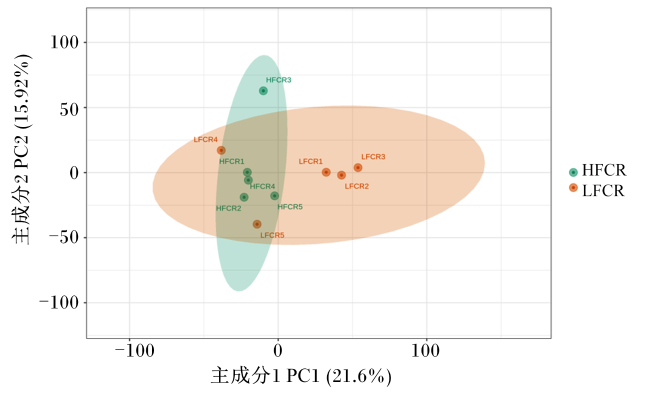
2.3.1.1 PCA

图1可知,低FCR组与高FCR组间存在交叉现象,但仍存在一定分离趋势,说明样本聚类较好,存在差异代谢物。
图1 高、低FCR滩羊血浆PCA得分图

HCFR:高饲料转化率 high FCR;LFCR:低饲料转化率 low FCR。图2同 the same as Fig.2

Fig.1 PCA score plots of high and low FCR Tan sheep plasma

2.3.1.2 OPLS-DA

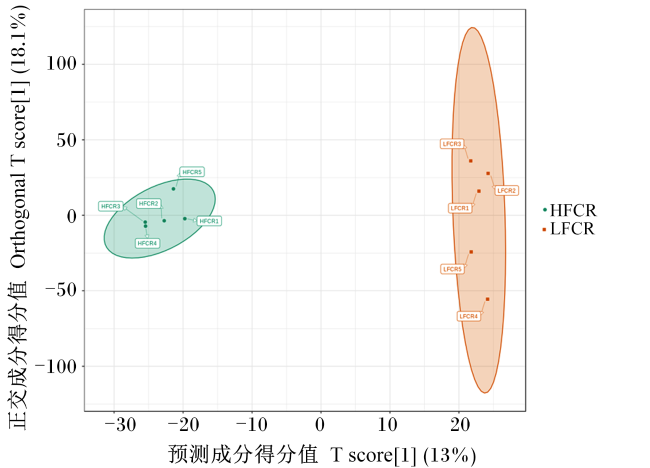
图2可知,构建的模型具有良好的稳定性和预测能力,能够有效区分高FCR组和低FCR组滩羊血浆代谢物组成。
图2 高、低FCR滩羊血浆OPLS-DA得分图

Fig.2 OPLS-DA score plots of high and low FCR Tan sheep plasma

2.3.2 高、低FCR滩羊血浆差异代谢物筛选

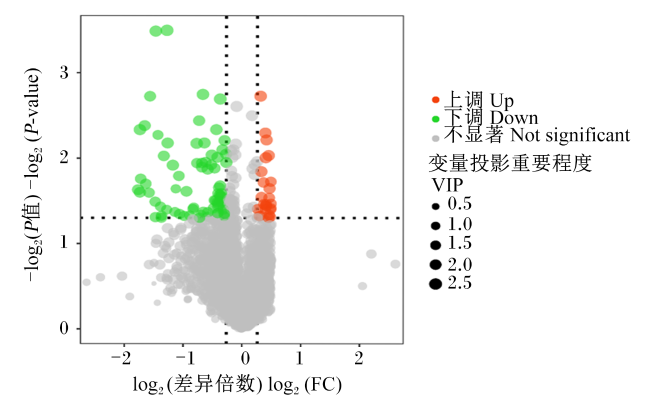
以FC≥2.0或≤0.5、VIP>1且P<0.05为标准,在高FCR组和低FCR组滩羊血浆中共筛选出146种差异代谢物,包括25种氨基酸及其代谢物、21种杂环化合物、20种苯及其衍生物、19种有机酸及其衍生物、18种甘油磷脂类以及43种其他类代谢物;146种血浆差异代谢物中,与高FCR组滩羊相比,低FCR组滩羊有112种下调,有34种上调(图3)。
图3 高、低FCR滩羊血浆差异代谢物火山图

Fig.3 Volcanic map of differential metabolites in plasma between high and low FCR Tan sheep

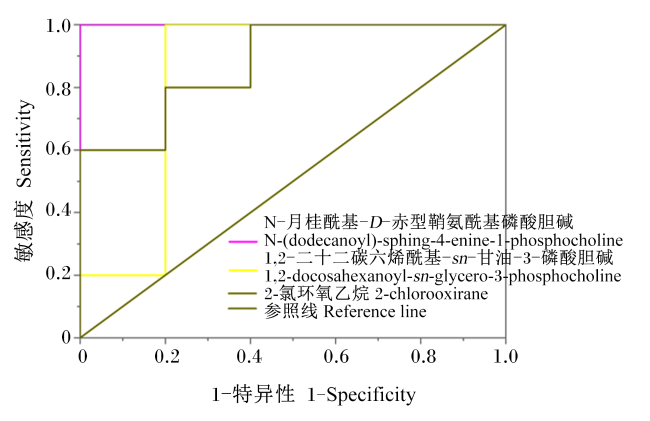
利用受试者工作特征(ROC)曲线再次对高、低FCR滩羊血浆差异代谢物进行筛选,曲线下方面积(AUC)>0.8代表该差异代谢物识别能力较强。利用ROC曲线从低FCR组和高FCR组滩羊血浆内筛选出N-月桂酰基-D-赤型鞘氨酰基磷酸胆碱[N-(dodecanoyl)-sphing-4-enine-1-phosphocholine]、1,2-二十二碳六烯酰基-sn-甘油-3-磷酸胆碱(1,2-docosahexanoyl-sn-glycero-3-phosphocholine)和2-氯环氧乙烷(2-chlorooxirane)这3种差异代谢物(图4),有效地反映出群体之间的代谢差异,这3种差异代谢物分别属于鞘脂类(sphingolipid)、甘油磷脂类(glycerophospholipids)和其他(other)(表5)。
图4 ROC曲线筛选出的高、低FCR滩羊血浆差异代谢物

Fig.4 Differential metabolites in plasma between high and low FCR Tan sheep screened by ROC curve

表5 高、低FCR滩羊血浆差异代谢物

Table 5 Differential metabolites in plasma between high and low FCR Tan sheep

差异代谢物
Differential metabolites
类别
Class
变量投影
重要程度
VIP
P
P-value
差异倍数
FC
N-月桂酰基-D-赤型鞘氨酰基磷酸胆碱
N-(dodecanoyl)-sphing-4-enine-1-phosphocholine
鞘脂类
Sphingolipid
2.05 0.009 0.40
1,2-二十二碳六烯酰基-sn-甘油-3-磷酸胆碱
1,2-docosahexanoyl-sn-glycero-3-phosphocholine
甘油磷脂类
Glycerophospholipids
1.86 0.032 0.36
2-氯环氧乙烷2-chlorooxirane 其他Other 1.90 0.049 0.36

2.3.3 高、低FCR滩羊血浆差异代谢物的KEGG通路分析

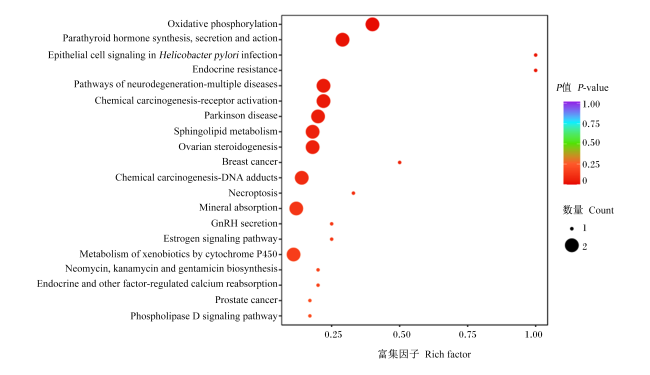
差异代谢产物KEGG通路富集分析结果(图5,根据P值由小到大排序,选择排名前20的通路展示)显示,高FCR组和低FCR组滩羊血浆内差异代谢物在氧化磷酸化,甲状旁腺激素的合成、分泌和作用,幽门螺杆菌感染中的上皮细胞信号传导,鞘脂代谢等代谢通路显著富集。
图5 高、低FCR滩羊血浆差异代谢物的代谢通路

Oxidative phosphorylation:氧化磷酸化;Parathyroid hormone synthesis, secretion and action:甲状旁腺激素的合成、分泌和作用;Epithelial cell signaling in Helicobacter pylori infection:幽门螺杆菌感染中的上皮细胞信号传导;Endocrine resistance:内分泌抵抗;Pathways of neurodegeneration-multiple diseases:神经变性的途径-多种疾病;Chemical carcinogenesis-receptor activation:化学致癌作用-受体激活;Parkinson disease:帕金森病;Sphingolipid metabolism:鞘脂代谢;Ovarian steroidogenesis:卵巢类固醇生成;Breast cancer:乳腺癌;Chemical carcinogenesis-DNA adducts:化学致癌作用-DNA加合物;Necroptosis:坏死;Mineral absorption:矿物质吸收;GnRH secretion:GnRH分泌;Estrogen signaling pathway:雌激素信号通路;Metabolism of xenobiotics by cytochrome P450:细胞色素P450对外源物质的代谢;Neomycin, kanamycin and gentamicin biosynthesis:新霉素、卡那霉素和庆大霉素的生物合成;Endocrine and other factor-regulated calcium reabsorption:内分泌和其他因素调节的钙重吸收;Prostate cancer:前列腺癌;Phospholipase D signaling pathway:磷脂酶D信号通路。

Fig.5 Metabolic pathways of differential metabolites in plasma between high and low FCR Tan sheep

3 讨论

3.1 高、低FCR对滩羊屠宰性能的影响

屠宰性能是评估家畜产肉能力和器官发育情况的重要指标,对衡量畜牧业经济效益和畜禽健康水平具有重要意义。不同FCR水平会影响羊的屠宰率、胴体重、心脏重和脾脏重等屠宰性能指标[8-9]。Chivandi等[10]研究发现,高FCR羔羊屠宰后的屠宰率高于低FCR羔羊。Wang等[11]的试验结果也表明,与低FCR羊相比,高FCR羊的胴体重更高,同时具有更优秀的屠宰性能。本试验中,高FCR组屠宰率、胴体重显著高于低FCR组滩羊,与上述研究结果一致。这表明高FCR组滩羊可能具有更好的产肉能力。Kamalzadeh等[12]研究发现,羊的头部和蹄部等非胴体部位在早期发育迅速,但随着羊体重的增长,其发育速度逐渐减缓。Jabalbarezi等[13]研究表明,在羔羊饲粮中添加7.5%的橄榄叶,会使羔羊的FCR升高,同时高FCR羔羊的头部和蹄部在整体身体中所占比例也较高。Asizua等[14]研究了9~15月龄羊的生长性能,结果显示,高FCR羊的头重和蹄重低于低FCR羊。在本试验中,高FCR组滩羊的头重和蹄重极显著高于低FCR组滩羊,可能是因为高FCR组滩羊的生长更多集中在头部及蹄部的发育,而非脂肪的积累。这种发育特征可能促使骨骼和蹄部进行更多的矿化和增厚,以支持未来的生长和负荷,这与上述前人研究结果相符。
动物的各脏器重量可以在一定种程度上反映它们的生长发育状况和身体机能。例如,羊的心脏重量与其生长速率和代谢活动密切相关。作为循环系统的核心,心脏负责将氧气和营养物质输送到全身各个组织器官,较大的心脏重量反映出更强大的心血管系统,能够满足更高的氧气和营养需求[15]。脾脏作为免疫系统的重要组成部分,参与免疫细胞的生成和免疫应答[16]。Jin等[17]研究发现,高FCR羊的心脏和脾脏等内脏在总体重中的占比高于低FCR羊。本试验结果与Jin等[17]的报道一致,高FCR组滩羊心脏重和脾脏重显著高于低FCR组滩羊。这可能是由于高FCR组滩羊的饲料利用率较低,需要消耗更多的饲料才能达到相同的体重增长。这种能量分配差异导致它们在维持基本生命活动如血液循环、免疫应答等上投入更多的能量,因此高FCR组滩羊的心脏和脾脏更大,用以支持其生命活动和代谢需求。
此外,也有研究对比发现,在不同饲料效率情况下,反刍动物在内脏重量等方面无显著差别。这种现象可能是由于饲养管理、饲粮组成、环境条件等诸多因素对反刍动物屠宰性能产生了影响,因而导致试验结果存在一定的波动[18-20]。在实际应用中,必须充分考虑饲养管理等因素是否保持一致,同时结合FCR等指标对滩羊进行科学的饲养管理和选择,才能有效提高其屠宰性能,进而提高养殖效益。

3.2 高、低FCR对滩羊血浆生化指标的影响

不同FCR水平的滩羊在血浆生化指标上表现出的差异反映了它们的生理状态、代谢活动和健康状况[21]。例如,T-AOC和SOD是评估机体抗氧化能力的重要参数,MDA是脂质过氧化的产物,其含量可以反映反刍动物机体脂质过氧化的程度。此外,GSH可以清除脂质过氧化物、减轻细胞膜不饱和脂肪酸的氧化、保护膜结构与功能完整性[22-24]。本试验中,高FCR组滩羊血浆具有较高的T-AOC、SOD活性、GSH含量和较低的MDA含量,这表明高FCR组滩羊具有更强的抗氧化能力,脂质过氧化程度较低,细胞膜完整性较好,氧化应激损伤程度较低。Zhang等[25]认为,羊在快速生长过程中需要更多的能量和营养物质,这些物质也能提高抗氧化能力,使得高FCR羊具有更好的抗氧化能力。尽管Zhang等[25]的研究整体结论与本试验结果一致,但也存在部分血液生化指标与本试验结果不同的情况,这可能是饲粮成分、饲养环境等变量的差异导致试验结果出现了一定程度的差异。
Yakubu等[26]、Chen等[27]研究均发现细胞因子可以调控免疫反应。例如,IL-10可以抑制炎症反应,IL-2和IL-6参与机体的免疫调节和炎症反应。本试验中,高FCR组滩羊显示出较为温和的免疫反应和较低的炎症水平,具体来说,高FCR组滩羊血浆IL-2含量极显著低于低FCR组,而IL-10含量显著高于低FCR组。Martin等[28]在其他反刍动物上的研究也发现FCR与免疫能力成正比。这可能是因为高FCR反刍动物将饲粮中的营养物质更多的用于免疫系统,使其体况更佳。
ALB等指标反映了动物机体的代谢和营养状况。本试验中,ALB含量的结果与王改芳[29]的研究结果一致,表明高FCR羊的ALB更多地被利用于支持生长发育。TC是一种脂质类物质,其含量通常与动物体内脂肪积累相关,且易受到饮食的影响[30]。胡常红等[31]、杨东等[32]在研究中发现,高FCR的反刍动物能够更有效地将饲料转化为肌肉而非脂肪。在本试验中,高FCR组滩羊血浆TC含量显著低于低FCR组滩羊,可能是与高FCR滩羊相比,低FCR滩羊能够更好利用饲粮中的脂肪等营养成分,导致血浆中胆固醇含量相对较高。

3.3 高、低FCR对滩羊血浆代谢组的影响

血浆是代谢组学研究中较为广泛的样本类型,可以反映出机体整体代谢状态,有助于监测营养吸收、能量利用以及健康状况。本研究发现,高、低FCR滩羊血浆代谢物中存在3种AUC>0.8的差异代谢物,分别是N-(dodecanoyl)-sphing-4-enine-1-phosphocholine、1,2-docosahexanoyl-sn-glycero-3-phosphocholine和2-chlorooxirane。1,2-docosahexanoyl-sn-glycero-3-phosphocholine是一种主要存在于细胞膜中的磷脂,在动物体内通过维持细胞膜的稳定性和调节细胞信号传导和神经保护功能来支持健康的神经系统运作和调节反刍动物瘤胃功能[33-34]。N-(dodecanoyl)-sphing-4-enine-1-phosphocholine在细胞信号传导和脂质代谢中也起着重要作用[35-36]。本研究显示,低FCR滩羊血浆中这2种胆碱的浓度均低于高FCR滩羊,可能是因为低FCR羊的饲料利用效率更高,可以更有效地利用脂质和磷脂类化合物等营养物质,导致体内这些代谢物的浓度相对较低。另外,大量的2-chlorooxirane已被证实对羊的肝脏、肾脏细胞或组织有损害作用[37]。本研究观察到,低FCR滩羊血浆中2-chlorooxirane浓度更低,这也进一步说明低FCR滩羊的饲料利用效率更高。
通过对代谢通路进行分析,可以深入理解饲料效率与动物生理状态的调控机制,有助于优化畜牧业生产效率和动物健康管理。本试验中,差异代谢物的KEGG通路富集分析结果显示,高、低FCR滩羊血浆差异代谢物在多个重要代谢通路中显著富集,包括氧化磷酸化、甲状旁腺激素的合成、分泌和作用、幽门螺杆菌感染中的上皮细胞信号传导、鞘脂代谢等代谢通路等。这些发现表明,FCR与滩羊能量代谢、钙磷代谢、胃酸分泌和消化酶的活性、细胞膜的构建和信号传递等生理过程密切相关。通过分析这些差异代谢物富集的代谢通路,能够进一步揭示高、低FCR滩羊之间代谢差异的分子机制,为改善饲料利用效率、提升畜牧业生产效率和动物健康水平提供理论依据和实践指导。

4 小结

本研究表明,FCR与能量代谢、钙磷代谢等密切相关。与低FCR滩羊相比,高FCR滩羊的抗氧化、抗炎能力更强,脂肪积累更少,屠宰后的屠宰率、胴体重更高,心脏、脾脏更重,但饲料利用效率更低。
[1]
本刊讯. 国家发展改革委、农业农村部联合印发《“十四五”现代种业提升工程建设规划》[J]. 中国种业, 2021(9):36.

This issue. National Development and Reform Commission,Ministry of Agriculture and Rural Affairs Jointly issued “14th Five-Year PlanModern Seed Industry Improvement Project Construction Plan[J]. China Seed Industry, 2021(9):36. (in Chinese)

[2]
佚名. 宁夏绿色农业走在高质量发展的大道上[N]. 宁夏日报. 2023-09-14(006).

Anon. Ningxia Green agriculture is on the road of high-quality development[N]. Ningxia Daily, 2023-09-14(006). (in Chinese)

[3]
ZHANG D Y, LI X L, LI F D, et al. Genome-wide association study identifies novel loci associated with feed efficiency traits in Hu lambs1[J]. Journal of Integrative Agriculture, 2023.https://doi.org/10.1016/j.jia.2023.10.011.

[4]
ZAMIRI M J, EILAMI B, KIANZAD M R. Effects of castration and fattening period on growth performance and carcass characteristics in Iranian goats[J]. Small Ruminant Research, 2012, 104(1/2/3):55-61.

[5]
SOLOMON M, MELAKU S, TOLERA A. Supplementation of cottonseed meal on feed intake,digestibility,live weight and carcass parameters of Sidama goats[J]. Livestock Science, 2008, 119(1/2/3):137-144.

[6]
陶金忠, 和东迁, 王俊奎, 等. 一种滩羊单栏饲喂设备:CN213603732U[P]. 2021.07.06.

TAO J Z, HE D Q, WANG J K, et al. A kind of single column feeding equipment for Tan sheep:CN213603732U[P]. 2021.07.06. (in Chinese)

[7]
陈丽尧, 和东迁, 卢童童, 等. 在不限定运动的情况下滩羊剩余采食量(RFI)的测定及与其他生长性能之间的关系[J]. 中国兽医学报, 2022, 42(1):154-159.

CHEN L Y, HE D Q, LU T T, et al. Measurement of residal feed intake (RFI) traits of Tan sheep and the relationship with other growth performance without restricting exercise[J]. Chinese Journal of Veterinary Science, 2022, 42(1):154-159. (in Chinese)

[8]
刁志成, 曲扬华, 刘策, 等. 饲用油菜混合青贮对湖羊屠宰性能及肉品质的影响[J]. 中国畜牧兽医, 2018, 45(6):1564-1570.

DOI

DIAO Z C, QU Y H, LIU C, et al. Effects of forage canola mixed silage on slaughter performance and meat quality in Hu sheep[J]. China Animal Husbandry & Veterinary Medicine, 2018, 45(6):1564-1570. (in Chinese)

[9]
赵彦光, 洪琼花, 谢萍, 等. 精料营养对云南半细毛羊屠宰性能及肉品质的影响[J]. 草业学报, 2014, 23(2):277-286.

DOI

ZHAO Y G, HONG Q H, XIE P, et al. Effects of diet nutritional on slaughter performances and meat quality of Yunnan semi-wool sheep[J]. Acta Prataculturae Sinica, 2014, 23(2):277-286. (in Chinese)

[10]
CHIVANDI E, MALEBANA I M M, NKOSI B D, et al. Effect of dietary marula (Sclerocarya birrea caffra) nut meal on the growth performance,carcass traits and meat quality of Dorper lambs[J]. Small Ruminant Research, 2023, 219:106909.

[11]
WANG C, DONG K H, LIU Q, et al. Effects of feeding salt-tolerant forages cultivated in salt-alkaline land on intake,average liveweight gain,physiological responses and slaughtering performance in lamb[J]. Livestock Science, 2011, 137(1/2/3):18-23.

[12]
KAMALZADEH A, KOOPS W J, VAN BRUCHEM J, et al. Feed quality restriction and compensatory growth in growing sheep:development of body organs[J]. Small Ruminant Research, 1998, 29(1):71-82.

[13]
JABALBAREZI H Y, FATHI N M H, RASHIDI L, et al. Effects of dietary olive leaves on performance,carcass traits,meat stability and antioxidant status of fattening Mahabadi male kids[J]. Meat Science, 2019, 153:2-8.

[14]
ASIZUA D, MPAIRWE D, KABI F, et al. Growth performance,carcass and non-carcass characteristics of Mubende and Mubende×Boer crossbred goats under different feeding regimes[J]. Livestock Science, 2014, 169:63-70.

[15]
MEYER A M, VRASPIR R A, ELLISON M J, et al. The relationship of residual feed intake and visceral organ size in growing lambs fed a concentrate- or forage-based diet[J]. Livestock Science, 2015, 176:85-90.

[16]
YANG L, WANG L Y, WU J X, et al. Changes in expression of complement components in the ovine spleen during early pregnancy[J]. Animals, 2021, 11(11):3183.

[17]
JIN C J, SU X D, WANG P Y, et al. Effects of rumen degradable starch on growth performance,carcass,rumen fermentation,and ruminal VFA absorption in growing goats[J]. Animal Feed Science and Technology, 2023, 299:115618.

[18]
梁玉生, 李发弟, 李飞. 高、低剩余采食量育肥湖羊的血液代谢参数与内脏器官的差异比较[C]// 2017年全国养羊生产与学术研讨会暨养羊学分会第七次全国会员代表大会论文集. 石家庄: 中国畜牧兽医学会养羊学分会, 2017.

LIANG Y S, LI F D, LI F. Comparison of blood metabolic parameters and internal organs of fattening lake sheep with high and low residual feed intake[C]. Proceeding of 2017 National Sheep Production and Academic Seminar and the seventh National Member Congress of Sheep Husbandry Branch. Shijiazhuang: Sheep Husbandry Branch of Chinese Society of Animal Husbandry and Veterinary Medicine, 2017. (in Chinese)

[19]
FIDELIS H A, BONILHA S F M, TEDESCHI L O, et al. Residual feed intake,carcass traits and meat quality in Nellore cattle[J]. Meat Science, 2017, 128:34-39.

[20]
ZORZI K, BONILHA S F M, QUEIROZ A C, et al. Meat quality of young Nellore bulls with low and high residual feed intake[J]. Meat Science, 2013, 93(3):593-599.

DOI PMID

[21]
TIAN W L, WEI T, LI B, et al. Pathway of programmed cell death and oxidative stress induced by β-hydroxybutyrate in dairy cow abomasum smooth muscle cells and in mouse gastric smooth muscle[J]. PLoS One, 2014, 9(5):e96775.

[22]
吕尚揆, 莘余, 樊磊, 等. 葛根多糖对犊牛血清抗氧化、免疫指标及肠道菌群的影响[J]. 动物营养学报, 2023, 35(3):1696-1704.

DOI

LYU S K, SHEN Y, FAN L, et al. Effects of pueraria polysaccharides on serum antioxidant and immune indexes and gut microbiota of calves[J]. Chinese Journal of Animal Nutrition, 2023, 35(3):1696-1704. (in Chinese)

[23]
曲扬华, 罗海玲, 刘策, 等. 饲粮中添加番茄红素对绵羊生长发育、屠宰性能和血清抗氧化指标的影响[J]. 动物营养学报, 2017, 29(4):1257-1264.

QU Y H, LUO H L, LIU C, et al. Effects of lycopene supplementation on growth development,slaughter performance and serum antioxidant indices of sheep[J]. Chinese Journal of Animal Nutrition, 2017, 29(4):1257-1264. (in Chinese)

[24]
孙晓蒙, 孙国君, 张文举, 等. 补硒对牧区育成母羊抗氧化性能的影响[J]. 家畜生态学报, 2018, 39(5):29-31.

SUN X M, SUN G J, ZHANG W J, et al. Effects of selenium supplementation on antioxidant status of growing ewes in pastoral area[J]. Acta Ecologae Animalis Domastici, 2018, 39(5):29-31. (in Chinese)

[25]
ZHANG J P, WEI Q X, LI Q L, et al. Effects of hybrid Broussonetia papyrifera silage on growth performance,visceral organs,blood biochemical indices,antioxidant indices,and carcass traits in dairy goats[J]. Animal Feed Science and Technology, 2022, 292:115435.

[26]
YAKUBU A, SALAKO A E, DONATO M D, et al. Interleukin-2 (IL-2) gene polymorphism and association with heat tolerance in Nigerian goats[J]. Small Ruminant Research, 2016, 141:127-134.

[27]
CHEN Y W, LV W T, JIA J L, et al. Evaluation of serum concentrations of tumor necrosis factor (TNF)-α,interleukin (IL)-2,IL-10,and nitric oxide (NO) during the estrous cycle,early pregnancy and abortion in goats[J]. Animal Reproduction Science, 2016, 174:73-79.

[28]
MARTIN A E, MACHADO V S, RATHMANN R J, et al. Effects of exogenous melatonin on the postweaning immune response and growth performance of crossbred beef calves[J]. Applied Animal Science, 2024, 40(5):598-607.

[29]
王改芳. 酵母菌复合微生态制剂对杜寒杂交肉羊生长性能及血液生化指标的影响[J]. 中国兽医杂志, 2020, 56(11):59-62.

WANG G F. Effects of yeast compound microecological agent on growth performance and blood biochemical index of Duhan hybrid mutton sheep[J]. Chinese Journal of Veterinary Medicine, 2020, 56(11):59-62. (in Chinese)

[30]
KARIMIAN M, RIASI A, GHASEMI E, et al. Effect of omega fatty acids sources alone or combined with essential oils on feed intake,apparent digestibility,rumen microbiome and blood metabolites during peripartum period of ewes[J]. Small Ruminant Research, 2024, 231:107201.

[31]
胡常红, 王煦, 阎向明. 对饲养不同品种牛屠宰性能的比较研究[J]. 中国畜禽种业, 2009, 5(10):141-144.

HU C H, WANG X, YAN X M. Comparative study on slaughtering performance of different breeds of cattle[J]. The Chinese Livestock and Poultry Breeding, 2009, 5(10):141-144. (in Chinese)

[32]
杨东, 刘树林, 张娟, 等. 两种复方中草药添加剂对肉羊生长性能、屠宰性能、内脏器官和消化道指数、肉品质及血清学指标的影响[J]. 饲料工业, 2024, 45(21):110-117.

YANG D, LIU S L, ZHANG J, et al. Effects of two compound Chinese herbal medicine additives on growth performance,slaughter performance,internal organs and digestive tractindexes,meat quality and serum indexes of mutton sheep[J]. Feed Industry, 2024, 45(21):110-117. (in Chinese)

[33]
ALLAHYARI-BAKE S, JAHANIAN R. Effects of dietary fat source and supplemental lysophosphatidylcholine on performance,immune responses,and ileal nutrient digestibility in broilers fed corn/soybean meal- or corn/wheat/soybean meal-based diets[J]. Poultry Science, 2017, 96(5):1149-1158.

[34]
JIA W, SHI Q Y, SHI L. Effect of irradiation treatment on the lipid composition and nutritional quality of goat meat[J]. Food Chemistry, 2021, 351:129295.

[35]
GAO F, WANG D X, ZHANG K P, et al. Characterization of the effect of Lactobacillus helveticus IMAUJBH1 on lipid profiles and volatile flavors of mutton fermented sausages in Inner Mongolia based on lipomics and GC-MS[J]. LWT, 2024, 202:116290.

[36]
MARTÍN A, GIRÁLDEZ F J, MONTERO O, et al. Dietary administration of L-carnitine during the fattening period of early feed restricted lambs modifies liver transcriptomic and plasma metabolomic profiles[J]. Animal Feed Science and Technology, 2022, 292:115426.

[37]
MÜLLER M, BELAS F J, BLAIR I A, et al. Analysis of 1,N2-ethenoguanine and 5,6,7,9-tetrahydro-7-hydroxy-9-oxoimidazo[1,2-a]purine in DNA treated with 2-chlorooxirane by high performance liquid chromatography/electrospray mass spectrometry and comparison of amounts to other DNA adducts[J]. Chemical Research in Toxicology, 1997, 10(2):242-247.

PMID

Outlines

/