RESEARCH PAPER

Effects of Cottonseed Protein on Growth Performance, Serum Biochemical Indexes, Antioxidant Enzyme Activities, and Intestinal and Liver Morphology of Micropterus salmoides

  • LI Min , 1, 2 ,
  • CHEN Bing 2, * ,
  • PENG Kai 2 ,
  • HU Junru 2 ,
  • LYU Dan 1, 2 ,
  • HUANG Wen 2, 3 ,
  • CAO Junming 4 ,
  • CAI Jia 1 ,
  • ZHAO Hongxia , 2, 3, **
Expand
  • 1 College of Fisheries, Guangdong Ocean University, Zhanjiang 524088, China
  • 2 Guangdong Provincial Key Laboratory of Animal Breeding and Nutrition Research, Key Laboratory of Animal Nutrition and Feed in South China, Ministry of Agriculture and Rural Areas, Institute of Animal Science, Guangdong Academy of Agricultural Sciences, Guangzhou 510640, China
  • 3 Guangdong Academy of Agricultural Sciences, Guangzhou 510640, China
  • 4 Guangzhou Fishtech Fisheries Science and Technology Co., Ltd., Guangzhou 510640, China
**professor, E-mail:

*Contributed equally

Received date: 2024-02-23

  Online published: 2024-12-12

Abstract

The purpose of this experiment was to study the effects of cottonseed protein supplementation in diets on the growth performance, serum biochemical indexes, antioxidant enzyme activities, intestinal and liver morphology of Micropterus salmoides. A total of 360 Micropterus salmoides with an initial mass of (3.45±0.01) g was selected as the research object. Three experimental feedings were fed 0, 20%, and 40% cottonseed protein added as a substitute for fish meal, with three replicates per group and 40 fish per replicate. The experimental period was 10 weeks. The results showed that compared with the control group, Adding 20% cottonseed protein had no significant effect on the final weight (FBW), weight gain rate (WGR), and specific growth rate (SGR) of Micropterus salmoides (P>0.05), but adding 40% cottonseed protein significantly reduced the FBW, WGR, SGR, protein efficiency (PER), and intestinal to body ratio of Micropterus salmoides (P<0.05). Compared with the control group, adding 20% cottonseed protein significantly reduced the FCR of Micropterus salmoides, while adding 40% cottonseed protein significantly increased the FCR of Micropterus salmoides (P<0.05). Compared with the control group, adding 40% cottonseed protein to the feed significantly reduced the ash content of Micropterus salmoides (P<0.05), but adding 20% or 40% cottonseed protein to the diet had no significant effect on the crude protein, crude lipid, and moisture content of Micropterus salmoides (P>0.05). Compared with the control group, Adding 20% cottonseed protein significantly reduced serum urea nitrogen content in Micropterus salmoides (P<0.05), adding 40% cottonseed protein significantly reduced intestinal trypsin activity in Micropterus salmoides (P<0.05), and adding 20% or 40% cottonseed protein significantly reduced serum cholesterol, intestinal malondialdehyde (MDA) contents in Micropterus salmoides (P<0.05). There were no significant differences in serum glutamic oxalacetic transaminase activity, glucose, triglycerides, high-density lipoprotein cholesterol, low-density lipoprotein cholesterol contents, intestinal amylase, superoxide dismutase (SOD), catalase (CAT) activity, liver SOD, CAT activity and MDA content among the experimental groups of Micropterus salmoides (P>0.05). There was no significant difference in the villus height, mucosal layer thickness, and muscular layer thickness of the foregut, midgut and hindgut of the Micropterus salmoides among the experimental groups (P>0.05). Adding 20% and 40% cottonseed protein caused liver cell degeneration, resulting in liver tissue damage. In summary, adding 20% cottonseed protein significantly reduces the FCR of Micropterus salmoides and does not have a negative impact on growth performance; adding 40% cottonseed protein significantly reduces growth performance and increases FCR by inhibiting intestinal digestive enzyme activity in Micropterus salmoides; the addition of cottonseed protein to diet has no significant effect on the intestinal morphology and structure of Micropterus salmoides, but it leads to liver tissue damage and affects the absorption and metabolism of protein and cholesterol.[Chinese Journal of Animal Nutrition, 2024, 36(12):7915-7929]

Cite this article

LI Min , CHEN Bing , PENG Kai , HU Junru , LYU Dan , HUANG Wen , CAO Junming , CAI Jia , ZHAO Hongxia . Effects of Cottonseed Protein on Growth Performance, Serum Biochemical Indexes, Antioxidant Enzyme Activities, and Intestinal and Liver Morphology of Micropterus salmoides[J]. Chinese Journal of Animal Nutrition, 2024 , 36(12) : 7915 -7929 . DOI: 10.12418/CJAN2024.675

大口黑鲈(Micropterus salmoides),又名加州鲈,是一种生长快、肉质鲜美、营养价值高的淡水肉食性鱼类,受到广泛关注。大口黑鲈对蛋白质的需求量很高,饲料蛋白质水平达到45%~50%[1]。鱼粉具有高蛋白质、高适口性、营养全面、易消化等特点,一直被广泛用于水产饲料,由于海洋环境的恶化和水产养殖的快速发展对鱼粉的需求不断增加,全球鱼粉产量逐年减少[2]。为了解决鱼粉的供需矛盾,研究人员致力于寻找资源丰富的植物性优质蛋白质,豆粕、棉籽粕和菜籽粕是水产饲料中使用的3种主要植物蛋白质源[3]。棉籽粕蛋白质含量高,但其利用受到抗营养因子含量的限制,如游离棉酚、非淀粉多糖、单宁和植酸等。棉籽蛋白是由棉籽经过剥绒、剥壳,在低温下一次性浸油、沥干后再经过脱除有毒物质后制成的高蛋白质产品。相比棉籽粕,低温处理最大程度地避免了蛋白质变性和破坏且游离棉酚含量小于400 mg/kg[4]。棉籽蛋白的蛋白质含量可以达到50%~60%,拥有较为均衡的氨基酸比例,营养价值与大豆蛋白相近[5]。研究表明,棉籽蛋白作为一种新的蛋白质来源,对水产动物的生长代谢、消化吸收、抗氧化能力、免疫和肌肉品质各方面具有不同的影响[6-7]。研究发现,棉籽蛋白替代鱼粉水平与水产动物增重率(WGR)、摄食量和饲料效率呈显著线性关系,在大口黑鲈中棉籽蛋白替代36%鱼粉后WGR和特定生长率(SGR)显著降低[8]。据报道,棉籽浓缩蛋白在大口黑鲈中的粗蛋白质消化率为79.97%,远低于鱼粉(>90%),较低的表观消化率可能与棉籽蛋白中高含量的纤维素有关,且棉籽蛋白中缺乏鱼粉中富含的牛磺酸、羟脯氨酸和未知的生长因子等[9]。棉籽蛋白中的游离棉酚会严重刺激肠黏膜,影响消化道内的多种酶,导致动物消化不良,降低肠道的营养吸收效率[10]
已有研究表明,水产动物饲料中添加一定量的棉籽蛋白可以促进动物的生长,但过量不利于动物生长[11]。研究发现,在大口黑鲈饲料中添加21%棉籽蛋白替代鱼粉比例达到35%时鱼体WGR和SGR显著降低,根据SGR分析确定棉籽蛋白替代鱼粉最适替代比例为23%[8]。研究表明,添加45%发酵棉籽蛋白会导致卵形鲳鲹(Tachysurus fulvidraco)成活率、蛋白质沉积率和脂肪沉积率显著降低[12]。研究发现,使用4种不同棉籽蛋白替代30%鱼粉,添加量分别为18.61%、17.12%、13.48%和14.27%,仅添加13.48%棉籽蛋白提高了大口黑鲈生长性能,其余棉籽蛋白对大口黑鲈生长无显著影响[13]。添加33%普通棉籽蛋白和29.55%浓缩棉籽蛋白分别替代45%鱼粉显著降低了珍珠龙胆石斑鱼(Epinephelus fuscoguttatus♀×Epinephelus lanceolatu )的WGR和SGR[14]。目前,关于棉籽蛋白在水产动物中的研究,主要集中于替代鱼粉用量以及新型加工工艺下棉籽蛋白的应用。研究表明,饲料添加16%的棉籽浓缩蛋白代替适量鱼粉提高了卵形鲳鲹的抗氧化能力[15]。与之相反,研究显示饲料添加20%的浓缩脱酚棉籽蛋白替代50%鱼粉不会对虹鳟(Oncorhynchus mykiss)的抗氧化能力造成负面影响[16]。关于棉籽蛋白对水产动物机体抗氧化能力的影响不尽相同,这可能与棉籽蛋白的加工工艺以及在饲料中的添加量有关[17]。在大口黑鲈饲料中添加35%棉籽蛋白替代60%鱼粉显著降低终末体重(FBW)和SGR,同时显著降低其抗氧化能力[8]。添加24%棉籽浓缩蛋白替代60%的鱼粉显著降低大口黑鲈WGR,饲料系数(FCR)上升,对抗氧化能力无显著影响[18]。目前,棉籽蛋白在水产动物中的研究主要集中于替代鱼粉用量上,但对饲料中棉籽蛋白添加量对大口黑鲈生长性能、抗氧化能力及肝脏和肠道形态结构影响方面的研究较少。因此,本试验在饲料中添加不同剂量棉籽蛋白,分别从生长性能、血清生化指标、抗氧化酶活性及肠道和肝脏形态结构方面综合评价棉籽蛋白在大口黑鲈饲料中的应用,为大口黑鲈高效利用植物蛋白质提供理论依据。

1 材料与方法

1.1 试验饲料

试验饲料以鱼粉、大豆浓缩蛋白、棉籽蛋白为主要蛋白质源,鱼油和豆油为主要脂肪源。配制成3种等氮等脂的饲料,分别添加0(对照组)、20%(20%组)、40%(40%组)的棉籽蛋白,大豆浓缩蛋白作为平衡蛋白质源。根据饲料配方将原料粉碎,过60目筛,而后进行称量,称量后将其逐级混匀,将鱼油和豆油加入到混匀的原料中充分混合。混合后制成粒径2 mm的颗粒饲料(SLX-80双螺杆挤出机,华南理工大学机械厂),在55 ℃下干燥6 h,将制作好的饲料放置在-20 ℃备用。饲料组成及营养水平见表1,饲料氨基酸组成见表2
表1 饲料组成及营养水平(干物质基础)

Table 1 Composition and nutrient levels of diets (DM basis) %

项目
Items
组别Groups
0 (对照Control) 20% 40%
原料Ingredients
鱼粉Fish meal 60.00 40.00 20.00
大豆浓缩蛋白Soybean protein concentrate 8.00 16.00 25.00
棉籽蛋白Cottonseed protein 20.00 40.00
面粉Flour 22.00 12.80 2.60
鱼油Fish oil 3.00 3.60 4.20
豆油Soybean oil 3.00 3.60 4.20
维生素预混料Vitamin premix1) 1.00 1.00 1.00
矿物质预混料Mineral premix2) 1.00 1.00 1.00
磷酸二氢钙Ca(H2PO4)2 1.00 1.00 1.00
氯化胆碱Choline chloride 0.20 0.20 0.20
褐藻酸钠Sodium alginate 0.80 0.80 0.80
合计Total 100.00 100.00 100.00
营养水平Nutrient levels3)
粗蛋白质CP 45.78 49.84 46.91
粗脂肪EE 10.54 11.01 9.82
粗灰分Ash 11.51 10.70 8.96

1)每千克维生素预混料含有One kilogram of vitamin premix contained:VA 4 000 000 IU,VD3 2 000 000 IU,VE 30 g,VK3 10 g,VB1 5 g,VB2 15 g,VB6 8 g,VB12 0.02 g,烟酸 nicotinic acid 40 g,泛酸钙 calcium pantothenate 25 g,叶酸 folic acid 2.5 g,肌醇 nicotinic acid 150 g,生物素 biotin 0.08 g。

2)每千克矿物质预混料含有One kilogram of mineral premix contained:MgSO4·H2O 12 g, NaCl 90 g,Cu 3 g, FeSO4·H2O 1 g,Ca(IO3)2 0.06 g, Met-Co 0.16 g, ZnSO4·H2O 10 g,NaSeO3 0.003 6 g。

3)营养水平均为实测值。Nutrient levels were all measured values.

表2 饲料氨基酸组成(干物质基础)

Table 2 Amino acid composition of diets(DM basis) %

项目
Items
组别Groups
0 (对照Control) 20% 40%
必需氨基酸Essential amino acids
赖氨酸Lys 3.35 3.21 2.73
精氨酸Arg 2.61 3.51 3.98
苏氨酸Thr 1.83 1.88 1.68
组氨酸His 1.39 1.44 1.28
蛋氨酸Met 1.01 0.79 0.51
异亮氨酸Ile 2.01 2.14 1.93
亮氨酸Leu 3.39 3.55 3.23
缬氨酸Val 2.06 2.18 1.99
苯丙氨酸Phe 2.01 2.36 2.39
非必需氨基酸Non-essential amino acids
丙氨酸Ala 2.82 2.65 2.15
酪氨酸Tyr 1.24 1.32 1.24
甘氨酸Gly 2.49 2.44 2.10
天冬氨酸Asp 4.06 4.61 4.52
谷氨酸Glu 7.18 8.34 8.46
丝氨酸Ser 1.88 2.12 2.09
总氨基酸TAA 39.33 42.54 40.27

氨基酸含量均为实测值。

Amino acid contents were all measured values.

1.2 试验设计及养殖管理

本试验于广东省农业科学院动物科学研究所室内循环水产养殖系统中进行。动物试验经广东省农业科学院动物科学研究所实验动物伦理委员会批准,批准号:SC-GDAAS-2022-019。试验所用360尾大口黑鲈幼鱼购买自广州市当地养户,在试验环境中用基础饲料暂养驯化2周,在此期间每天2次喂食基础饲料,暂养结束饥饿24 h后进行正式试验。正式试验开始前,选择360尾健康且规格[(3.45±0.01) g]接近的鱼随机分配到9个玻璃纤维缸(300 L)中。每个缸40尾鱼,进行为期10周的养殖试验。将9个玻璃纤维缸分为3组,每组3个重复,3种试验饲料被随机分配到3个组。每天在08:30和16:30分别饲喂1次,表观饱食投喂。每日称量剩余投喂饲料重量,记录每日摄食量。在70 d的饲喂试验中,水温在28~31 ℃,pH为7.3~7.7,氨氮含量≤0.02 mg/L,亚硝酸盐含量≤0.2 mg/L,溶解氧含量≥6.0 mg/L,光周期状态为12 h光照和12 h暗光。

1.3 样品采集

养殖试验结束后,对所有养殖系统中的鱼进行24 h饥饿处理后计数并称量总重,随机选取6尾鱼测量体长、体重,解剖分离内脏团,称取并记录内脏团、肠道和肝脏重量。取9尾鱼采用尾静脉抽血置于离心管中,室温静置4 h,1 369.55×g离心10 min,取上清得血清,置于-80 ℃保存备用。取出3条全肠,剔除肠道膜系和脂肪,用0.86%冷冻生理盐水冲洗内容物,存于10%福尔马林溶液中固定,用于制作肠道组织切片;取3尾鱼肝脏,10%福尔马林溶液固定,用于制作肝脏切片。随机挑选3尾鱼,并将其保存在-20 ℃冰箱以分析其体组成。取3尾鱼的肠道进行消化酶活性的测定。分别取3尾鱼的肠道和肝脏收集到5 mL冻存管中,然后保存在-80 ℃,用于测定抗氧化指标。

1.4 指标测定

1.4.1 生长性能

WGR(%)=100×(W-W)/W;
FCR=D/(W-W);
蛋白质效率(PER)=(W-WCP/(D×CP饲料);
SGR(%/d)=100×(lnW-lnW)/T;
肝体比(HSI,%)=100×W肝脏/W全鱼;
存活率(SR,%)=100×Nt/N0;
脏体比(VSI,%)=100×W内脏团/W全鱼;
肥满度(CF,g/cm3)=100×W/L3;
肠体比(ISI,%)=100×W肠道/W
式中:T为试验天数;W为鱼初始体重;W为鱼终末体重;CP为鱼体终末蛋白质含量;CP饲料为饲料蛋白质含量;D为摄入饲料总重;W肠道为肠道重量;W内脏团为内脏团重量;W全鱼为全鱼重量;Nt为终末鱼尾数;N0为初始鱼尾数;W肝脏为肝脏重量。

1.4.2 饲料营养水平及鱼体营养成分测定

试验饲料和全鱼常规营养成分的测定方法如下:水分含量采用105 ℃烘箱烘干至恒重的方法测定(GB/T 6435—2014),粗蛋白质(CP)含量利用半自动凯氏定氮仪采用凯氏定氮法(GB/T 6432—2018)测定,粗脂肪(EE)含量采用乙醚抽提的方法(GB/T 6433—2018)测定,粗灰分含量采用550 ℃灼烧至恒重的方法(GB/T 6433—2006)测定。采用GB/T 18246—2019的方法测定饲料和鱼体氨基酸含量。

1.4.3 血清生化指标的测定

血清总蛋白(TP)、白蛋白(ALB)、球蛋白(GLB)、甘油三酯(TG)、尿素氮(UN)、葡萄糖(GLU)、胆固醇(CHO)、高密度脂蛋白胆固醇(HDL-C)、低密度脂蛋白胆固醇(LDL-C)含量及谷草转氨酶(AST)活性通过日立7600全自动生化分析仪检测。

1.4.4 肠道消化酶活性和肠道及肝脏抗氧化指标测定

采用南京建成生物工程研究所生产的试剂盒测定肠道胰蛋白酶、淀粉酶(AMS)、超氧化物歧化酶(SOD)、过氧化氢酶(CAT)、谷胱甘肽过氧化物酶(GSH-Px)活性及丙二醛(MDA)含量;采用南京建成生物工程研究所生产的试剂盒测定肝脏中SOD、CAT、碱性磷酸酶(AKP)和溶菌酶(LZM)活性及MDA含量。测定方法、步骤、计算公式等见试剂盒说明书。

1.4.5 肝脏和肠道形态结构分析

试验鱼肝脏和肠道组织石蜡切片的制作在武汉塞维尔生物科技有限公司完成。组织经过脱水、透明、浸蜡和包埋,切片,苏木精-伊红(HE)染色,最后中性树胶封片。利用显微镜观察组织病理变化。将肠道切片利用Image-Pro Plus 6.0分析软件,选择组织结构清晰的区域,分别测量每张切片中5根完整肠绒毛高度,以及对应的5处黏膜层厚度,5处肌层厚度,并求出平均值。

1.5 数据统计与分析

数据采用SPSS 26.0统计软件先进行单因素方差分析(one-way ANOVA),而后采用Duncan氏法进行多重比较检验,P<0.05表示差异显著。

2 结果与分析

2.1 棉籽蛋白对大口黑鲈生长性能的影响

表3可知,与对照组相比,饲料添加20%棉籽蛋白对大口黑鲈FBW、WGR和SGR没有显著影响(P>0.05);饲料添加40%棉籽蛋白显著降低了大口黑鲈FBW、WGR和SGR(P<0.05)。与对照组相比,饲料添加40%棉籽蛋白显著降低了大口黑鲈PER(P<0.05)。与对照组相比,饲料添加20%棉籽蛋白显著降低了大口黑鲈FCR(P<0.05),饲料添加40%棉籽蛋白显著提高了大口黑鲈FCR和ISI(P<0.05)。与对照组相比,各组CF无显著差异(P>0.05)。
表3 棉籽蛋白对大口黑鲈生长性能的影响

Table 3 Effects of cottonseed protein on growth performance of Micropterus salmoides

项目
Items
组别Groups
0(对照Control) 20% 40%
初始体重IBW/g 3.45±0.01 3.45±0.01 3.45±0.01
终末体重FBW/g 60.80±3.47b 66.23±0.99b 49.12±4.13a
增重率WGR/% 1 663.21±98.23b 1 817.89±31.18b 1 321.80±121.52a
饲料系数FCR 1.22±0.02b 1.08±0.02a 1.35±0.03c
蛋白质效率PER 1.79±0.03b 1.86±0.04b 1.58±0.04a
特定生长率SGR/(%/d) 4.22±0.08b 4.34±0.02b 3.89±0.12a
肝体比HSI/% 1.31±0.17 1.41±0.08 1.40±0.10
存活率SR/% 91.67±3.63 96.67±2.20 97.50±1.44
脏体比VSI/% 6.70±0.26 7.59±0.06 6.53±0.69
肥满度CF/(g/cm3) 8.28±0.20 7.94±0.98 7.85±0.79
肠体比ISI/% 0.86±0.06a 0.78±0.02a 1.04±0.05b

同行数据肩标无字母或相同字母表示差异不显著(P>0.05),不同小写字母表示差异显著(P<0.05)。下表同。

In the same row, values with no letter or the same letter superscripts mean no significant difference (P>0.05), while with different small letter superscripts mean significant difference (P<0.05). The same as below.

2.2 棉籽蛋白对大口黑鲈体成分和氨基酸组成的影响

表4可知,与对照组相比,饲料添加40%棉籽蛋白显著降低了大口黑鲈全鱼粗灰分含量(P<0.05),饲料添加20%或40%棉籽蛋白对大口黑鲈全鱼CP、EE和水分含量无显著影响(P>0.05)。由表5可知,与对照组相比,饲料添加20%或40%棉籽蛋白显著增加了大口黑鲈鱼体组氨酸和精氨酸含量(P<0.05)。
表4 棉籽蛋白对大口黑鲈体成分的影响(湿重基础)

Table 4 Effects of cottonseed protein on body composition of Micropterus salmoides (wet weight basis) %

项目
Items
组别Groups
0 (对照Control) 20% 40%
粗蛋白质CP 17.18±0.21 17.21±0.33 17.16±0.04
粗脂肪EE 8.38±0.42 7.97±0.10 8.27±0.24
水分Moisture 69.94±0.54 70.38±0.18 70.41±0.20
粗灰分Ash 4.16±0.07b 4.00±0.02b 3.83±0.03a
表5 棉籽蛋白对大口黑鲈鱼体氨基酸组成的影响(干物质基础)

Table 5 Effects of cottonseed protein on body amino acid composition of Micropterus salmoides (DM basis) %

项目
Items
组别Groups
0 (对照Control) 20% 40%
必需氨基酸Essential amino acids
精氨酸Arg 1.02±0.02a 1.11±0.02b 1.07±0.02ab
组氨酸His 0.34±0.01a 0.35±0.00b 0.35±0.00b
苏氨酸Thr 0.69±0.01 0.71±0.01 0.69±0.01
缬氨酸Val 0.66±0.01 0.68±0.01 0.67±0.01
蛋氨酸Met 0.65±0.01 0.68±0.00 0.67±0.01
苯丙氨酸Phe 0.43±0.01 0.45±0.00 0.44±0.00
异亮氨酸Ile 0.67±0.02 0.69±0.01 0.68±0.01
亮氨酸Leu 1.11±0.02 1.14±0.01 1.11±0.02
赖氨酸Lys 1.18±0.03 1.23±0.01 1.21±0.02
非必需氨基酸Non-essential amino acids
甘氨酸Gly 1.39±0.03 1.50±0.02 1.46±0.06
天冬氨酸Asp 1.54±0.01 1.58±0.02 1.53±0.02
丙氨酸Ala 1.25±0.03 1.30±0.01 1.26±0.02
酪氨酸Tyr 0.46±0.01 0.47±0.01 0.46±0.01
谷氨酸Glu 2.41±0.05 2.51±0.03 2.50±0.01
丝氨酸Ser 0.67±0.01 0.69±0.01 0.67±0.01

2.3 棉籽蛋白对大口黑鲈血清生化指标的影响

表6可知,与对照组相比,饲料添加20%棉籽蛋白显著降低了大口黑鲈血清UN含量(P<0.05);饲料添加20%棉籽蛋白显著降低了大口黑鲈血清ALB含量(P<0.05);饲料添加20%或40%棉籽蛋白显著降低了大口黑鲈血清CHO含量(P<0.05)。与对照组相比,饲料添加20%或40%棉籽蛋白对大口黑鲈血清AST活性及GLU、TG、HDL-C和LDL-C含量无显著影响(P>0.05)。
表6 棉籽蛋白对大口黑鲈血清生化指标的影响

Table 6 Effects of cottonseed protein on serum biochemical indexes of Micropterus salmoides

项目
Items
组别Groups
0 (对照Control) 20% 40%
谷草转氨酶AST/(U/L) 16.83±4.13 18.64±1.48 35.01±7.00
尿素氮UN/(mmol/L) 7.21±0.33b 5.36±0.50a 6.59±0.14b
葡萄糖GLU/(mmol/L) 5.26±0.38 7.21±1.17 6.87±0.84
总蛋白TP/(g/L) 28.45±1.54b 22.59±1.40a 26.01±0.95ab
白蛋白ALB/(g/L) 13.17±0.74b 10.93±0.09a 12.06±0.34ab
球蛋白GLB/(g/L) 15.28±0.81b 11.66±1.48a 13.95±0.67ab
甘油三酯TG/(mmol/L) 3.60±0.03 3.06±0.54 2.77±0.22
胆固醇CHO/(mmol/L) 7.26±0.33b 5.16±0.35a 5.78±0.28a
高密度脂蛋白胆固醇HDL-C/(mmol/L) 2.61±0.25 1.93±0.08 2.47±0.07
低密度脂蛋白胆固醇LDL-C/(mmol/L) 1.03±0.34 0.39±0.24 0.37±0.05

2.4 棉籽蛋白对大口黑鲈肠道消化酶活性和抗氧化指标的影响

表7可知,与对照组相比,饲料添加棉籽蛋白对大口黑鲈肠道淀粉酶活性无显著影响(P>0.05),饲料添加40%棉籽蛋白显著降低了大口黑鲈肠道胰蛋白酶活性(P<0.05)。与对照组相比,饲料添加棉籽蛋白对大口黑鲈肠道SOD和CAT活性没有显著影响(P>0.05),饲料添加20%或40%棉籽蛋白显著降低了大口黑鲈肠道MDA含量(P<0.05)。
表7 棉籽蛋白对大口黑鲈肠道消化酶活性和抗氧化指标的影响

Table 7 Effects of cottonseed protein on digestive enzyme activities and antioxidant indexes in intestine of Micropterus salmoides

项目
Items
组别Groups
0 (对照Control) 20% 40%
淀粉酶AMS/(U/mg prot) 1.05±0.08 0.88±0.16 0.76±0.06
胰蛋白酶Trypsin/(U/mg prot) 6 413.05±809.69b 6 569.47±741.94b 2 146.95±379.00a
超氧化物歧化酶SOD/(U/mg prot) 8.45±1.15 7.99±1.54 6.88±0.12
过氧化氢酶CAT/(U/mg prot) 10.77±1.06 6.94±0.67 13.09±7.37
丙二醛MDA/(nmol/mg prot) 60.69±1.12b 17.38±3.06a 22.55±0.53a
谷胱甘肽过氧化物酶GSH-Px/(U/mg prot) 159.89±30.02 209.28±27.85 179.22±43.51

2.5 棉籽蛋白对大口黑鲈肝脏抗氧化指标的影响

表8可知,与对照组相比,饲料添加棉籽蛋白对大口黑鲈肝脏SOD、CAT、AKP和LZM活性及MDA含量均没有显著影响(P>0.05)。
表8 棉籽蛋白对大口黑鲈肝脏抗氧化指标的影响

Table 8 Effects of cottonseed protein on antioxidant indexes in liver of Micropterus salmoides

项目
Items
组别Groups
0 (对照Control) 20% 40%
超氧化物歧化酶SOD/(U/mg prot) 60.02±1.36 60.33±2.93 69.92±6.78
过氧化氢酶CAT/(U/mg prot) 141.70±26.02 133.29±20.08 202.44±13.41
丙二醛MDA/(nmol/mg prot) 1.26±0.33 2.06±0.53 2.56±0.65
碱性磷酸酶AKP/(U/mg prot) 124.80±3.48 122.11±17.12 131.51±17.81
溶菌酶LZM/(U/mg prot) 3.73±0.58 4.91±0.31 4.75±0.32

2.6 组织切片观察

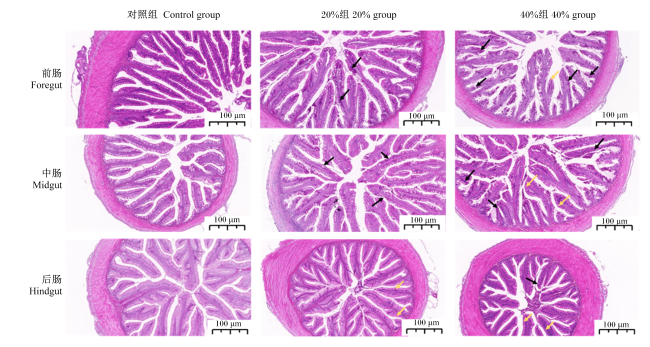
图1所示,通过组织切片HE染色后观察,未添加棉籽蛋白的对照组肠道绒毛上皮细胞排列紧密,可见较多杯状细胞,多成行排列于肠绒毛上皮细胞之间。饲料添加20%和40%棉籽蛋白组肠道组织可见少量肠绒毛上皮细胞坏死和脱落,胞核固缩深染,胞质嗜酸性增强(黑色箭头),上皮可见少量淋巴细胞散在浸润(黄色箭头)。
图1 大口黑鲈肠切片病理分析

Fig.1 Pathological analysis of intestinal sections of Micropterus salmoides

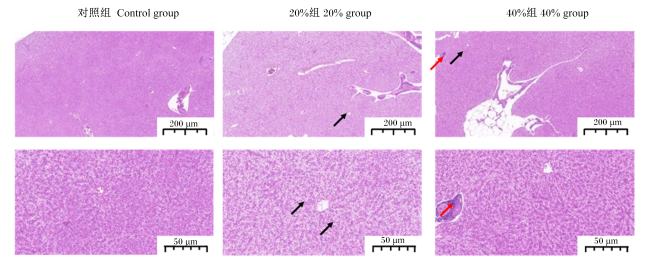
图2所示,通过组织切片HE染色后观察,未添加棉籽蛋白的对照组肝细胞双行排列成板状,肝板以中央静脉为中心呈散射状分布,肝血窦未见明显扩张,未见明显的炎性细胞浸润。饲料添加20%和40%棉籽蛋白组肝脏组织可见大量肝细胞变性,胞质疏松淡染(黑色箭头),在添加40%棉籽蛋白组血管周围偶见炎性细胞小灶性浸润(红色箭头)。
图2 大口黑鲈肝脏切片病理分析

Fig.2 Pathological analysis of liver sections of Micropterus salmoides

2.7 棉籽蛋白对大口黑鲈肠道形态结构的影响

表9可知,通过对肠道组织显微结构的测量和分析,对照组和各试验组的绒毛高度、黏膜层厚度和肌层厚度无显著差异(P>0.05)。
表9 棉籽蛋白对大口黑鲈肠道形态结构的影响

Table 9 Effects of cottonseed protein on intestinal morphology and structure of Micropterus salmoides μm

项目
Items
组别Groups
0(对照Control) 20% 40%
绒毛高度
Villus height
前肠Foregut 821.61±97.71 725.44±47.39 706.05±48.26
中肠Midgut 593.85±27.96 715.17±23.46 648.64±57.03
后肠Hindgut 563.65±45.17 577.95±53.35 458.17±35.19
黏膜层厚度
Mucosa thickness
前肠Foregut 894.63±107.47 797.52±49.53 774.15±40.79
中肠Midgut 634.19±26.12 777.40±28.74 709.55±58.33
后肠Hindgut 635.93±50.17 636.29±52.91 507.18±39.39
肌层厚度
Muscle thickness
前肠Foregut 252.63±44.24 156.44±15.52 191.45±16.05
中肠Midgut 143.80±7.55 177.52±29.26 186.65±22.56
后肠Hindgut 187.98±13.66 178.85±21.84 214.45±17.50

3 讨论

3.1 棉籽蛋白对大口黑鲈生长性能的影响

在水产动物饲料中适当添加植物蛋白质能促进养殖动物的生长。棉籽蛋白是棉籽粕的水醇提取物,具有相对较低的可溶性碳水化合物和棉酚含量,是一种具有较大潜力的新型蛋白质源[19]。关于棉籽蛋白在水产动物饲料中的研究已有报道。目前,已在大菱鲆(Scophthalmus maximus)[20]、鲫(Carassius auratus)[21]、尼罗罗非鱼(Oreochromis niloticus)[22]、斑点叉尾鮰(Ictalurus punctatus)[23]、虹鳟[24-25]、卵形鲳鲹[26-27]、黄颡鱼(Tachysurus fulvidraco)幼鱼[15]、斑节对虾(Penaeus monodon)[28]、大口黑鲈[29]、杂交石斑鱼(Epinephelus fuscoguttatus ♀×Epinephelus lanceolatus )[30]、大黄鱼(Larimichthys crocea)[31]、松浦镜鲤(Cyprinus carpio Songpu)[32]、黄鳝(Monopterus albus)[33]等多种水产动物中开展了不同棉籽蛋白替代鱼粉的研究。添加适当水平的植物蛋白质对动物生长性能产生负面影响[34]。本研究结果表明,与对照组相比,添加20%棉籽蛋白组大口黑鲈WGR有显著性差异。但在饲料转化方面,FCR显著降低,说明添加20%棉籽蛋白不会对大口黑鲈生长产生负面影响,且对饲料利用效率更高。研究表明,添加30%的棉籽浓缩蛋白替代50%的鱼粉不会对杂交石斑鱼SGR和FCR产生显著影响[35]。研究发现,与对照组相比,添加20%或40%的棉籽浓缩蛋白替代60%的鱼粉不会对卵形鲳鲹生长产生负面影响[26]。上述研究说明适宜水平的棉籽蛋白不会对养殖动物生长产生负面影响。本研究结果表明,与对照组相比,添加40%棉籽蛋白组大口黑鲈WGR和SGR显著降低,FCR显著升高。由于棉籽蛋白的过量添加,大口黑鲈生长性能下降,对营养物质的吸收利用能力下降[36]。其原因一方面可能与添加较多棉籽蛋白后,游离棉酚等抗营养因子含量增加,造成动物机体损伤,机体对营养物质的消化吸收能力下降[37];另一方面,本试验结果中,随着棉籽蛋白的添加量增加,饲料赖氨酸含量逐渐下降,精氨酸含量逐渐上升,氨基酸平衡被打破,而棉籽蛋白作为植物蛋白质,在肉食性鱼类生长发育早期,幼鱼对饲料中氨基酸组成要求较高,植物蛋白质适口性较差,且其中限制性氨基酸的存在会影响大口黑鲈生长,且游离棉酚会与赖氨酸结合影响氨基酸利用率[38]

3.2 棉籽蛋白对大口黑鲈血清生化指标的影响

尿素是动物机体蛋白质代谢的终末产物,血清尿素的含量取决于蛋白质生物分解代谢速度,血清UN含量升高表明蛋白质代谢增加[39-40]。已有研究证明,高水平水解棉籽蛋白可以影响团头鲂的蛋白质加工合成[6]。棉籽粕可以通过雷帕霉素靶激酶(TOR)、氨基酸应答(AAR)信号通路影响团头鲂的蛋白质和氨基酸代谢,进而影响生长[41]。本研究结果显示,与对照组相比,饲料添加20%棉籽蛋白大口黑鲈血清中UN含量显著降低。与对照组相比,添加40%棉籽蛋白大口黑鲈PER显著降低,说明饲料中添加棉籽蛋白显著影响大口黑鲈蛋白质代谢。血清TP包括白蛋白和球蛋白,其含量反映了机体营养状态以及免疫功能,与对照组相比,添加20%棉籽蛋白大口黑鲈血清TP、ALB和GLB含量显著降低。结果表明,添加棉籽蛋白可以影响机体免疫能力。血液中GLU和TG体现机体能量水平和脂质代谢,TG是由甘油和脂肪酸组成,储存于脂滴中,是血清脂质的主要成分[25]。HDL-C可以将血液和组织中的脂肪酸和胆固醇运输至肝脏组织经分解排出体外,相反,LDL-C在血清胆固醇转运中起负面作用。本研究发现,当饲料添加棉籽蛋白后大口黑鲈血清CHO含量显著降低,血清TG、GLU和LDL-C含量有下降趋势,但差异不显著。研究发现,植物蛋白质替代鱼粉可降低血清CHO含量,植物蛋白质中的植物甾醇可以抑制胆固醇的吸收[42-44]。这表明棉籽蛋白的摄入可能通过影响动物机体的营养吸收能力影响胆固醇代谢。AST是动物体内非常重要的转氨酶,也是肝脏受到损伤时的重要指标,当细胞受损时,转氨酶被释放到血液中,导致AST活性增加[45]。本研究结果显示,与对照组相比,随着棉籽蛋白的添加,大口黑鲈血清中AST活性呈现增加的趋势,其可能与棉籽蛋白中存在的抗营养因子及其本身较高水平的纤维含量有关。

3.3 棉籽蛋白对大口黑鲈肠道消化酶活性和肠道、肝脏抗氧化指标的影响

肠道是鱼类的重要器官,具有消化、营养吸收、免疫应答和代谢等多种生理功能,参与各种代谢反应[46]。营养物质的消化吸收依靠消化器官的机械运动和消化酶的分解作用,因此,鱼类消化酶的活性能直观反映机体对营养物质的消化吸收[47]。本研究结果表明,与对照组相比,饲料添加40%棉籽蛋白显著降低大口黑鲈肠道胰蛋白酶活性,对淀粉酶活性无显著影响。这与Liu等[25]在虹鳟中的发现相似,与鱼粉组相比,棉籽浓缩蛋白会导致幼年虹鳟肠胰蛋白酶活性减少。在大黄鱼的研究中,当棉籽浓缩蛋白替代鱼粉达到75%和100%时,肠道和肝脏的消化吸收酶活性显著降低[31]。但本研究中,添加20%棉籽蛋白组肠道消化酶活性无显著变化,说明适当的棉籽蛋白添加量不会对大口黑鲈肠道消化吸收能力产生不良影响。研究发现,在凡纳滨对虾(Litopenaeus vannamei)中,棉籽浓缩蛋白替代鱼粉45%以下时肠道消化酶活性显著提高[48]。这表明棉籽蛋白对肠道消化酶的影响受到其添加水平的影响,饲料中过量添加棉籽蛋白会改变肠道消化酶的活性,影响肠道消化功能,从而对生长性能产生负面影响。
MDA是脂质过氧化的最终产物,其含量的多少能直接反映细胞质膜过氧化水平[49]。本试验中,与对照组相比,饲料添加20%或40%棉籽蛋白能显著降低大口黑鲈肠道MDA含量,表明肠道活性氧清除能力增强,肠道负面影响减少。SOD和GSH-Px是鱼类体内重要的抗氧化酶,SOD能有效清除自由基,减少氧化产物的产生,GSH-Px能清除过氧化氢和脂质过氧化物[50-51]。CAT使过氧化氢分解为水和氧气,以避免过氧化氢对细胞的损伤[52]。本研究结果显示,饲料添加40%以下的棉籽蛋白对大口黑鲈肠道SOD活性无显著影响,CAT活性呈现先降低后升高的趋势,不产生显著变化。同样,在饲料中用浓缩脱酚棉籽蛋白替代鱼粉,对虹鳟SOD活性没有显著影响,而MDA含量低于鱼粉组[16]。本研究中,与对照组相比,饲料添加20%或40%棉籽蛋白肝脏MDA含量没有显著变化,但呈现增加趋势。造成差异的原因一方面可能与抗营养因子游离棉酚在肝脏中的积累有关,肝脏是动物最主要的解毒器官,已有研究证明游离棉酚会抑制抗氧化酶活性,造成肝脏组织损伤;另一方面,游离棉酚可以引发氧化应激,诱导机体产生过量的超氧阴离子,机体对游离棉酚的耐受程度也是游离棉酚对动物健康负面影响的因素之一[37]。另外,试验饲料中蛋氨酸含量逐渐下降,已有研究表明,蛋氨酸缺乏降低了新生仔猪的T-SOD活性,表明蛋氨酸缺乏会抑制动物机体抗氧化能力[53]。本试验结果表明,饲料添加20%或40%棉籽蛋白对大口黑鲈抗氧化能力负面影响较小。

3.4 棉籽蛋白对大口黑鲈肠道和肝脏形态结构的影响

正常的肠道形态是保证肠道功能和维持肠道内稳态的基础条件,肠道形态完整程度影响养殖动物对营养物质的吸收能力。已有研究证明,脱酚棉籽蛋白高水平替代鱼粉会引发肠道炎症,导致肠道组织结构完整性受损,黏膜层明显炎症细胞浸润,肌层厚度减少,肠绒毛变短[27,42]。同样在大口黑鲈的研究中,棉籽浓缩蛋白过量替代鱼粉后肠道微绒毛高度和密度降低,闭合蛋白(Occludin)和闭锁小带蛋白-1(ZO-1)的表达降低[43]。在本研究中,肠道组织学观察发现,相比对照组,饲料添加棉籽蛋白组肠道绒毛偶见上皮细胞坏死和脱落情况,少量淋巴细胞散在浸润,肠道测量分析表示,前肠绒毛高度和黏膜层厚度均有所降低,但统计学上无显著性差异,表明本试验条件下棉籽蛋白对肠道形态的负面影响较小。这与何明等[36]的研究结果类似。结果产生差异可能是由于不同工艺下棉籽蛋白的营养价值不同,也可能是试验条件和棉籽蛋白添加比例的不同。本研究发现,饲料中添加棉籽蛋白造成大口黑鲈肝脏损伤,饲料添加20%和40%棉籽蛋白组肝脏组织可见大量肝细胞变性,胞质疏松淡染,在添加40%棉籽蛋白组血管周围偶见炎性细胞小灶性浸润。虽然棉籽蛋白经过脱毒处理后去除了一些抗营养因子,但本身含有高水平的纤维、多糖和非脂溶性抗营养因子,这些都可能影响鱼肝脏的健康[44]

4 结论

综上所述,饲料添加20%棉籽蛋白显著降低了大口黑鲈的FCR,对生长性能没有产生负面影响;饲料添加40%棉籽蛋白显著增加了大口黑鲈的FCR并降低了肠道消化酶活性、WGR、PER;饲料添加20%和40%棉籽蛋白对大口黑鲈肠道形态组织结构无显著影响,但导致肝脏组织损伤,并影响蛋白质和胆固醇的吸收代谢。
[1]
LI L K, WANG Y, ZHANG Z, et al. Microbiomic and metabonomic analysis provide new insights into the enhanced intestinal health in large-size largemouth bass (Micropterus salmoides) when fed novel proteins:novel proteins are promising foods for future aquaculture[J]. Aquaculture, 2023, 563:739019.

[2]
NAYLOR R L, HARDY R W, BUSCHMANN A H, et al. A 20-year retrospective review of global aquaculture[J]. Nature, 2021, 591(7851):551-563.

[3]
GATLIN D M, BARROWS F T, BROWN P, et al. Expanding the utilization of sustainable plant products in aquafeeds:a review[J]. Aquaculture Research, 2007, 38(6):551-579.

[4]
FU J, REN Y, JIANG F, et al. Effects of pulsed ultrasonic treatment on the structural and functional properties of cottonseed protein isolate[J]. LWT, 2022, 172:114143.

[5]
KUMAR M, TOMAR M, PUNIA S, et al. Cottonseed:a sustainable contributor to global protein requirements[J]. Trends in Food Science & Technology, 2021, 111:100-113.

[6]
YUAN X Y, LIU M Y, CHENG H H, et al. Replacing fish meal with cottonseed meal protein hydrolysate affects amino acid metabolism via AMPK/SIRT1 and TOR signaling pathway of Megalobrama amblycephala[J]. Aquaculture, 2019, 510:225-233.

[7]
YE G L, DONG X H, YANG Q H, et al. Low-gossypol cottonseed protein concentrate used as a replacement of fish meal for juvenile hybrid grouper (Epinephelus fuscoguttatus ♀×Epinephelus lanceolatus ):effects on growth performance,immune responses and intestinal microbiota[J]. Aquaculture, 2020, 524:735309.

[8]
张学斐. 棉籽蛋白替代鱼粉对大口黑鲈生长性能及肝脏铁死亡的影响[D].硕士学位论文. 雅安: 四川农业大学, 2023.

ZHANG X F. Effects of cottonseed protein replacement of fish meal on growth performance and liver ferroptosis of largemouth bass (Micropterus salmoides)[D].Master's Thesis. Ya’an: Sichuan Agricultural University, 2023. (in Chinese)

[9]
时于惠, 祝书杰, 谭北平, 等. 大口黑鲈对六种非粮蛋白源的表观消化率[J]. 水生生物学报, 2022, 46(8):1187-1196.

SHI Y, ZHU S, TAN B, et al. Apparent digestibility of six new non-grain protein ingredients for largemouth bass (Micropterus salmoides)[J]. Acta Hydrobiologica Sinica, 2022, 46(8):1187-1196.

[10]
何涛. 脱酚棉籽蛋白对鸡蛋品质的影响及其机理[D].博士学位论文. 北京: 中国农业科学院, 2016.

HE T. Study on the application of low-gossypol cottonseed meal in laying hen diets[D].Ph.D.Thesis. Beijing: Chinese Academy of Agricultural Sciences, 2016. (in Chinese)

[11]
ANDERSON A D, ALAM M S, WATANABE W O, et al. Full replacement of menhaden fish meal protein by low-gossypol cottonseed flour protein in the diet of juvenile black sea bass Centropristis striata[J]. Aquaculture, 2016, 464:618-628.

[12]
吴光德, 兰鲲鹏, 陈旭, 等. 发酵棉籽粉替代鱼粉对卵形鲳鲹幼鱼生长、饲料利用性能及肠道菌群的影响[J]. 南方水产科学, 2023, 19(4):126-138.

WU G D, LAN K P, CHEN X, et al. Effects of replacement of fish meal by fermented cottonseed meal on growth performance,feed utilization and intestinal bacteria community of juvenile golden pompano (Trachinotus ovatus)[J]. South China Fisheries Science, 2023, 19(4):126-138. (in Chinese)

[13]
周兴梅, 何光伦, 许志城, 等. 棉籽蛋白源对大口黑鲈生长、体组成及健康的影响[J]. 水产学报, 2021, 45(10):1703-1714.

ZHOU X M, HE G L, XU Z C, et al. Effects of cottonseed protein source on growth,body composition and health of Micropterus salmoides[J]. Journal of Fisheries of China, 2021, 45(10):1703-1714. (in Chinese)

[14]
殷彬. 植物蛋白源替代鱼粉对珍珠龙胆生长性能、肠道菌群和免疫的影响[D].硕士学位论文. 湛江: 广东海洋大学, 2019.

YIN B. Effects of plant protein sources replacing fishmeal on growth performance,intestinal microflora and immunity of juvenile hybrid grouper (Epinephelus fuscoguttatus♀×E. lanceolatu )[D].Master's Thesis. Zhenjiang: Guangdong Ocean University, 2019. (in Chinese)

[15]
SHEN J F, LIU H Y, TAN B P, et al. Effects of replacement of fishmeal with cottonseed protein concentrate on the growth,intestinal microflora,haematological and antioxidant indices of juvenile golden pompano (Trachinotus ovatus)[J]. Aquaculture Nutrition, 2020, 26(4):1119-1130.

[16]
ZHAO W, LIU Z L, NIU J. Growth performance,intestinal histomorphology,body composition,hematological and antioxidant parameters of Oncorhynchus mykiss were not detrimentally affected by replacement of fish meal with concentrated dephenolization cottonseed protein[J]. Aquaculture Reports, 2021, 19:100557.

[17]
仲文龙, 朱元召, 王丽, 等. 棉籽蛋白的加工工艺与营养成分及其在猪生产中的应用研究进展[J]. 动物营养学报, 2024, 36(4):2175-2187.

DOI

WENLONG Z, YUANZHAO Z, LI W, et al. Research progress on processing technology and nutritional components of cottonseed protein and its application in pig production[J]. Chinese Journal of Animal Nutritionl, 2024, 36(4):2175-2187. (in Chinese)

[18]
许晓莹. 棉籽浓缩蛋白替代鱼粉对大口黑鲈 (Micropterus salmoides) 生长和肌肉品质的影响及营养改进策略[D].博士学位论文. 上海: 上海海洋大学, 2022.

XU X Y. Effects of replacing fishmeal with cottonseed protein concentrate on growth performance and flesh quality and its nutritional improvement strategy in largemouth bass (Micropterus salmoides)[D].Ph.D.Thesis. Shanghai: Shanghai Ocean University, 2022. (in Chinese)

[19]
赵金标, 孙志强, 刘岭. 棉籽蛋白营养价值及其在仔猪饲粮中的应用前景[J]. 动物营养学报, 2023, 35(10):6121-6128.

DOI

ZHAO J B, SUN Z Q, LIU L. Nutritional value of cottonseed protein and its application in piglets diets[J]. Chinese Journal of Animal Nutrition, 2023, 35(10):6121-6128. (in Chinese)

[20]
ZHANG X, ZHOU H, LIU C, et al. Fishmeal substitution with low-gossypol cottonseed meal in the diet for juvenile turbot (Scophthalmus maximus L.):effects on growth,nutrients utilization and haematological responses[J]. Aquaculture Reports, 2022, 24:101149.

[21]
CAI C, LI E, YE Y, et al. Effect of dietary graded levels of cottonseed meal and gossypol on growth performance,body composition and health aspects of allogynogenetic silver crucian carp,Carassius auratus gibelio♀×Cyprinus carpio [J]. Aquaculture Nutrition, 2011, 17(4):353-360.

[22]
MBAHINZIREKI G B, DABROWSKI D, LEE K J, et al. Growth,feed utilization and body composition of tilapia (Oreochromis sp.) fed with cottonseed meal-based diets in a recirculating system[J]. Aquaculture Nutrition, 2001, 7(3):189-200.

[23]
YILDIRIM M, LIM C, WAN P J, et al. Growth performance and immune response of channel catfish (Ictalurus puctatus) fed diets containing graded levels of gossypol-acetic acid[J]. Aquaculture, 2003, 219(1/2/3/4):751-768.

[24]
RINCHARD J, LEE K J, DABROWSKI K, et al. Influence of gossypol from dietary cottonseed meal on haematology, reproductive steroids and tissue gossypol enantiomer concentrations in male rainbow trout (Oncorhynchus mykiss)[J]. Aquaculture Nutrition, 2003, 9(4):275-282.

[25]
LIU Y, MA S, LV W, et al. Effects of replacing fishmeal with cottonseed protein concentrate on growth performance,blood metabolites,and the intestinal health of juvenile rainbow trout (Oncorhynchus mykiss)[J]. Frontiers in Immunology, 2022, 13:1079677.

[26]
申建飞, 陈铭灿, 刘泓宇, 等. 浓缩棉籽蛋白替代鱼粉对卵形鲳鲹幼鱼生长性能、血清生化指标、肝脏抗氧化指标及胃肠道蛋白酶活性的影响[J]. 动物营养学报, 2019, 31(2):746-756.

SHEN J F, CHEN M C, LIU H Y, et al. Effects of fish meal replacement by concentrated cottonseed protein on growth performance,serum biochemical indices,liver antioxidant indices and gastrointestinal tract protease activities of juvenile Trachinotus ovatus[J]. Chinese Journal of Animal Nutrition, 2019, 31(2):746-756. (in Chinese)

[37]
WANG Z, LIAO S, WANG J, et al. Effects of fermented cottonseed meal substitution for fish meal on intestinal enzymatic activity,inflammatory and physical-barrier-related gene expression,and intestinal microflora of juvenile golden pompano (Trachinotus ovatus)[J]. Fishes, 2023, 8(9):466.

[28]
JIANG S, CHEN Z B, ZHOU F L, et al. Study on partial replacement of fish meal with concentrated dephenolized cottonseed protein in feed of Penaeus monodon[J]. Aquaculture Research, 2021, 52(8):3871-3881.

[29]
XU X, LI X, XU Z, et al. Replacing fishmeal with cottonseed protein concentrate in practical diet of largemouth bass (Micropterus salmoides):growth,flesh quality and metabolomics[J]. Aquaculture, 2023, 579:740164.

[30]
IRM M, YE B, WU X Y, et al. Assessment of conventional and low gossypol cottonseed meal as alternative protein sources in low-fishmeal diets of hybrid grouper (Epinephelus fuscoguttatus♀×Epinephelus lanceolatus ):growth,feed utilization,gut histology,and immunity[J]. Animals: an Open Access Journal from MDPI, 2022, 12(15):1906.

[31]
TIAN S, WU Y, YUAN J, et al. Replacement of dietary fishmeal by cottonseed protein concentrate on growth performance,feed utilization and protein metabolism of large yellow croaker Larimichthys crocea[J]. Aquaculture Reports, 2022, 26:101313.

[32]
葛凯博. 棉籽浓缩蛋白替代鱼粉在松浦镜鲤幼鱼饲料中的应用研究[D].硕士学位论文. 哈尔滨: 东北农业大学, 2023.

GE K B. The Study of replacement of fish meal with cottonseed protein concentrate in feed for juvenil Songpu mirror carp (Cyprinus Carpio Songpu)[D].Master's Thesis. Harbin: Northeast Agricultural University, 2023. (in Chinese)

[33]
安雨琪, 周磊涛, 周秋白, 等. 未添加或添加复合酶制剂条件下脱酚棉籽蛋白复合物替代黄鳝饲料中鱼粉的适宜比例[J]. 动物营养学报, 2023, 35(12):7953-7968.

DOI

AN Y Q, ZHOU L T, ZHOU Q B, et al. Appropriate ratio of fish meal substituted by dephenolized cottonseed protein compound in diets of Monopterus albus under adding or non-adding complex enzyme preparation conditions[J]. Chinese Journal of Animal Nutrition, 2023, 35(12):7953-7968. (in Chinese)

[34]
周维仁, 刘福春. 日粮中脱酚棉籽蛋白替代豆粕对猪生产性能的影响[J]. 江苏农业科学, 2007(5):147-149.

ZHOU W R, LIU F C. Effect of degossypolled cottonseed meal replacing soybean meal on pig performance[J]. Jiangsu Agricultural Sciences, 2007(5):147-149. (in Chinese)

[35]
HE Y, GUO X, TAN B, et al. Replacing fishmeal with cottonseed protein concentrate in feed for pearl gentian groupers (Epinephelus fuscoguttatus♀×E. lanceolatus ):effects on growth and expressions of key genes involved in appetite and hepatic glucose and lipid metabolism[J]. Aquaculture Reports, 2021, 20:100710.

[36]
何明, 贠彪, 钱雪桥, 等. 棉籽蛋白替代鱼粉对斑点叉尾鮰生长性能、饲料利用和肠道组织结构的影响[J]. 饲料工业, 2024, 45(4):62-68.

HE M, YUAN B, QIAN X Q, et al. Effects of fish meal replaced by cottonseed protein on growth performance,feed utilization and intestinal histology of channel catfish (Ictalurus punctatus)[J]. Feed Industry, 2024, 45(4):62-68. (in Chinese)

[37]
胡波, 郑文新, 高维明, 等. 游离棉酚毒理学与脱毒技术的研究进展[J]. 草食家畜, 2020(3):1-7,38.

HU B, ZHENG W X, GAO W M, et al. Research progress of toxicology and detoxification technology of free gossypol[J]. Grass-Feeding Livestock, 2020(3):1-7,38. (in Chinese)

[38]
胡毅, 张俊智, 黄云, 等. 高棉籽粕饲料中补充赖氨酸和铁对青鱼幼鱼生长、免疫力及组织中游离棉酚含量的影响[J]. 动物营养学报, 2014, 26(11):3443-3451.

HU Y, ZHANG J Z, HUANG Y, et al. Effects of high cottonseed meal diet supplemented with lysine and iron on growth,immunity and tissue free gossypol content of juvenile black carp (Mylopharyngodon piceus)[J]. Chinese Journal of Animal Nutrition, 2014, 26(11):3443-3451. (in Chinese)

[39]
赵建飞, 李瑞, 宋泽和, 等. 浓缩脱酚棉籽蛋白生长猪消化能评定及其对仔猪生长性能、血清生化指标和养分表观消化率的影响[J]. 动物营养学报, 2021, 33(1):190-198.

DOI

ZHAO J F, LI R, SONG Z H, et al. Digestible energy evaluation of concentrated degossypolized cottonseed protein for growing pigs and its effects on growth performance,serum biochemical indexes and nutrient apparent digestibilities of piglets[J]. Chinese Journal of Animal Nutrition, 2021, 33(1):190-198. (in Chinese)

[40]
彭凯, 邱建强, 徐有良, 等. 不同单宁制剂对南美白对虾生长、血液指标及肠道消化酶活性的影响[J]. 中国畜牧兽医, 2023, 50(11):4444-4453.

DOI

PENG K, QIU J Q, XU Y L, et al. Effects of different plant tannin preparations on growth performance,blood parameters and intestinal digestive enzyme activities of Litopenaeus vannamei[J]. China Animal Husbandry & Veterinary Medicine, 2023, 50(11):4444-4453. (in Chinese)

[41]
周群兰. 棉粕和菜粕经TOR、AAR信号通路调控团头鲂生长及肠道微生态的研究[D].博士学位论文. 南京: 南京农业大学, 2016.

ZHOU Q L. Cottonseed meal and canola meal regulate growth performance via TOR and AAR pathway and affect gut microflora of blunt snout bream,megalobrama amblycephala[D].Ph.D.Thesis. Nanjing: Nanjing Agricultural University, 2016. (in Chinese)

[42]
ZHU T F, CORRAZE G, PLAGNES-JUAN E, et al. Regulation of genes related to cholesterol metabolism in rainbow trout (Oncorhynchus mykiss) fed a plant-based diet[J]. American Journal of Physiology. Regulatory,Integrative and Comparative Physiology, 2018, 314(1):R58-R70.

[43]
KORTNER T M, GU J N, KROGDAHL Å, et al. Transcriptional regulation of cholesterol and bile acid metabolism after dietary soyabean meal treatment in Atlantic salmon (Salmo salar L.)[J]. British Journal of Nutrition, 2013, 109(4):593-604.

[44]
LING W H, JONES P J. Dietary phytosterols:a review of metabolism,benefits and side effects[J]. Life Sciences, 1995, 57(3):195-206.

[45]
LIU H, ZHA X Y, DING C C, et al. AST/ALT ratio and peripheral artery disease in a Chinese hypertensive population:a cross-sectional study[J]. Angiology, 2021, 72(10):916-922.

[46]
ROBLES R, LOZANO A B, SEVILLA A, et al. Effect of partially protected butyrate used as feed additive on growth and intestinal metabolism in sea bream (Sparus aurata)[J]. Fish Physiology and Biochemistry, 2013, 39(6):1567-1580.

DOI PMID

[47]
BAKER R, BUCKLAND A, SHEAVES M. Fish gut content analysis: robust measures of diet composition[J]. Fish and Fisheries, 2014, 15(1):170-177.

[48]
WANG H M, HU X, ZHENG Y D, et al. Effects of replacing fish meal with cottonseed protein concentrate on the growth,immune responses,digestive ability and intestinal microbial flora in Litopenaeus vannamei[J]. Fish & Shellfish Immunology, 2022, 128:91-100.

[49]
BOX A, CAPÓ X, TEJADA S, et al. Perkinsus mediterraneus infection induces oxidative stress in the mollusc Mimachlamys varia[J]. Journal of Fish Diseases, 2020, 43(1):1-7.

[50]
KIRON V. Fish immune system and its nutritional modulation for preventive health care[J]. Animal Feed Science and Technology, 2012, 173(1/2):111-133.

[51]
PASTORE A, FEDERICI G, BERTINI E, et al. Analysis of glutathione:implication in redox and detoxification[J]. Clinica Chimica Acta, 2003, 333(1):19-39.

[52]
李姗姗, 王俊保, 简永慧, 等. 饲料中添加过氧化氢酶对日本沼虾生长性能、抗氧化能力、免疫性能和肠道菌群结构的影响[J]. 动物营养学报, 2024, 36(1):464-477.

DOI

LI S S, WANG J B, JIAN Y H, et al. Effects of adding catalase in diets on growth performance,antioxidant activity,immune performance and intestinal flora structure of Macrobrachium nipponense[J]. Chinese Journal of Animal Nutrition, 2024, 36(1):464-477. (in Chinese)

[53]
BAUCHART-THEVRET C, STOLL B, CHACKO S, et al. Sulfur amino acid deficiency upregulates intestinal methionine cycle activity and suppresses epithelial growth in neonatal pigs[J]. American Journal of Physiology:Endocrinology and Metabolism, 2009, 296(6):E1239-E1250.

Outlines

/