RESEARCH PAPER

Effects of Dietary Putrescine Supplementation on Intestinal Morphology, Barrier Function and Angiogenesis of Weaned Piglets

  • QIAN Jinyu , 1 ,
  • ZHOU Hanlin 2 ,
  • HU Chengjun , 2, * ,
  • LI Wang , 1, *
Expand
  • 1 College of Animal Science and Technology, Henan University of Science and Technology, Luoyang 471000, China
  • 2 Institute of Tropical Crop Variety Resources, Chinese Academy of Tropical Agricultural Sciences, Haikou 571101, China
* HU Chengjun, associate professor, E-mail: ;
LI Wang, professor, E-mail:

Received date: 2024-06-14

  Online published: 2025-01-10

Abstract

This study aimed to explore the effects of dietary putrescine supplementation on intestinal morphology, barrier function and angiogenesis of weaned piglets. Fourteen weaned piglets (Tunchang black piglets) at the age of 28 days were randomly allocated into control group (CON group) and putrescine group, with seven piglets in each group. The CON group received a basal diet, whereas the putrescine group received the basal diet supplemented with 0.1% putrescine. The piglets were sacrificed for assessment of jejunal morphology, barrier function and angiogenesis indices after 28 days treatment. The results were as follows: compared with the CON group, dietary supplementation with 0.1% putrescine significantly augmented the jejunal villus height (P<0.05), and significantly upregulated the protein relative expression levels of zonula occluden 1 (ZO1) and occludin (Occludin) in the jejunum (P<0.05). Compared with the CON group, the content of glutathione (GSH) content, and the activities of glutathione peroxidase (GSH-Px) and total superoxide dismutase (T-SOD) in the jejunum in the putrescine group were significantly increased (P<0.05), and the protein relative expression levels of Kelch-like ECH-associated protein 1 (Keap1) and heme oxygenase-1 (HO-1) in the jejunum were significantly elevated in the putrescine group (P<0.05). Furthermore, the protein relative expression levels of angiogenesis marker-platelet endothelial cell adhesion molecule 1 (CD31) and angiogenesis related factor-matrix metalloproteinase 9 (MMP9) in the putrescine group were significantly higher than those in the CON group (P<0.05). The results of in vitro angiogenesis test showed that 10 μmol/L putrescine significantly promoted the proliferation ability, cell migrated distance and tube formation length of pig vascular endothelial cells (PVECs) (P<0.05). In summary, adding 0.1% putrescine to the diet can promote the development of jejunal villus, enhance the barrier function, and improve the antioxidant capacity and angiogenesis of jejunum of weaned piglets.

Cite this article

QIAN Jinyu , ZHOU Hanlin , HU Chengjun , LI Wang . Effects of Dietary Putrescine Supplementation on Intestinal Morphology, Barrier Function and Angiogenesis of Weaned Piglets[J]. Chinese Journal of Animal Nutrition, 2025 , 37(1) : 217 -225 . DOI: 10.12418/CJAN2025.019

断奶应激可造成仔猪肠黏膜损伤,导致仔猪消化吸收能力降低、营养物质摄取不足,影响仔猪后期生长发育[1]。因此,提高断奶仔猪肠道发育,不仅能够有效促进仔猪生长,而且还可提高养殖效益。腐胺是动物生长的必备物质,在细胞增殖、蛋白质的合成、细胞凋亡等方面具有重要作用[2],也是小肠发育所必需的物质[2]。肠道血管负责运输营养物质,是保证肠道吸收功能正常发挥的关键,其生成受阻降低肠道对营养物质的吸收能力和动物的生长速度[3]。以往的结果表明腐胺可缓解断奶仔猪的黏膜萎缩[4]。本课题组前期研究结果表明,饲粮中添加0.1%腐胺不影响断奶仔猪的生长性能,但可通过提高基质金属蛋白酶9(MMP9)的表达促进肌肉血管生成[5]。然而,腐胺对断奶仔猪肠道血管生成的影响还尚不明确。因此,本试验研究腐胺对断奶仔猪肠道形态、屏障功能及血管生成的影响,旨在为提高断奶仔猪肠道发育提供理论依据和应用指导。

1 材料与方法

1.1 试验设计

本研究所有试验程序和动物保护方案均经中国热带农业科学院试验动物伦理委员会批准(CATAS-2022060712)。选取28日龄的断奶屯昌黑猪仔猪14头,按照体重一致原则随机分为2组[对照组初体重:(3.37±0.17) kg;腐胺组初体重:(3.38±0.17) kg],每组7头猪,单栏饲喂。对照组饲喂基础饲粮,腐胺组饲喂添加0.1%腐胺(Sigma公司,纯度≥98%)的基础饲粮。基础饲粮营养水平参考《猪营养需要量》(GB/T 39235—2020)中脂肪型仔猪营养需要进行设计,其组成及营养水平见表1。基础饲粮中粗蛋白质、粗脂肪、粗纤维、粗灰分、钙、总磷和氨基酸含量分别按照GB/T 6432—2018、GB/T 6433—2006、GB/T 6434—2022、GB/T 6438—2007、GB/T 6436—2018、GB/T 6437—2018和GB/T 18246—2019进行测定。根据猪场管理要求,试验猪正常进行免疫、驱虫、消毒等程序。整个试验期为28 d,试验期间自由采食和饮水。试验结束时,2组试验猪末重无显著差异[对照组末体重:(7.00±0.50) kg;腐胺组末体重:(7.29±0.40) kg;P>0.05]。
表1 基础饲粮组成及营养水平(风干基础)

Table 1 Composition and nutrient levels of the basal diet (air-dry basis) %

原料
Ingredients
含量
Content
营养水平
Nutrient levels2)
含量
Content
玉米Corn 58.00 粗蛋白质CP 18.30
豆粕Soybean meal 25.40 消化能DE/(MJ/kg) 14.10
乳清粉Dried whey 3.00 粗纤维CF 3.20
鱼粉Fish meal 5.00 粗脂肪EE 5.80
豆油Soybean oil 3.00 粗灰分Ash 3.50
石粉Limestone 0.50 钙Ca 1.10
磷酸氢钙CaPHO4 0.90 总磷TP 0.70
食盐NaCl 0.20 赖氨酸Lys 1.20
预混料Premix1) 4.00 蛋氨酸+胱氨酸Met+Cys 0.60
合计Total 100.00 色氨酸Trp 0.20
苏氨酸Thr 0.80

1)预混料为每千克饲粮提供 The premix provided the following per kg of the diet:VA 8 500 IU,VB6 10 mg,VB12 0.04 mg,VD3 2 500 IU,VE 35 IU,VK3 3.5 mg,生物素 biotin 0.1 mg,叶酸 folic acid 0.4 mg,D-泛酸 D-pantothenic acid 25 mg,氯化胆碱 choline chloride 650 mg,Cu (as copper sulfate) 4 mg,Fe (as ferrous sulfate) 110 mg,Mn (as manganese sulfate) 25 mg,Zn (as zinc sulfate) 100 mg,I (as potassium iodide) 0.30 mg,Se (as sodium selenite) 0.40 mg。

2)消化能根据《猪营养需要量》(GB/T 39235—2020)进行计算,其余为实测值。DE was calculated by reference to Nutritional Requirements of Pigs (GB/T 39235—2020), while the others were measured values.

1.2 样品收集

饲养试验结束后,将所有仔猪全部处死,分离空肠,一部分保存于4%多聚甲醛中,用于研究组织形态学,一部分保存于液氮中,用于检测分子生物学指标。

1.3 指标测定

1.3.1 实时荧光定量PCR

利用TRIzol试剂提取空肠总RNA,测定总RNA浓度。按照TaKaRa反转录试剂盒操作说明合成cDNA;根据基因序列采用Primer 5.0软件设计对应目的基因引物,引物序列信息见表2。配制实时荧光定量PCR反应体系,根据内参基因(18S rRNA)和目的基因的阈值循环,采用2-ΔΔCt法计算目的基因mRNA相对表达量。
表2 引物序列信息

Table 2 Primer sequence information

基因名称
Gene names
引物序列
Primer sequences (5'—3')
18S rRNA F:ATTCCGATAACGAACGAGACT
R:GGACATCTAAGGGCATCACAG
Ki67 F:AAACCCAGATCCGAGCATATT
R:GATTCAAACTCCACAAAGCCAT
基质金属蛋白酶1 MMP1 F:TCTCACCCTTGACCTTCACC
R:GAGCAGCCACACGATACAAG
基质金属蛋白酶2 MMP2 F:ACTCCCACTTTGACGACGAT
R:CGTACTTGCCATCCTTGTCG
基质金属蛋白酶3 MMP3 F:CTTGTTGCTGCCCATGAACT
R:AAAGCAGGATCACATGTGGC
基质金属蛋白酶9 MMP9 F:GGTGGACTATGTGGGCTACG
R:AGTGCTGAAGCAGGACGAG
基质金属蛋白酶14 MMP14 F:AGTCACTCTCAGCTGCCATT
R:AGCGCTTCCTTCGAACATTG
血管内皮生长因子-A VEGF-A F:CCTCGGAGCGGAGAAAGCAT
R:TGTCACATCTGCAAGTACGTTCG
白细胞介素-6 IL-6 F:CCCTGAGGCAAAAGGGAAAGA
R:AGGAAATCCTCAAGGCTGCG
碱性成纤维细胞生长因子b-FGF F:TCAAAGGAGTGTGTGCGAAC
R:CAGGGCCACATACCAACTG
成纤维细胞生长因子受体1 FGFR1 F:CGACAAAGAGATGGAGGTGCT
R:CGCGTCCTCAAAGGAGACAT
成纤维细胞生长因子受体2 FGFR2 F:AGTCGCTAGAGTTGCGCTGC
R:TTAGTCCAACTGATCACGGCG
白细胞介素-8 IL-8 F:GCTCTCTGTGAGGCTGCAGTTC
R:AAGGTGTGGAATGCGTATTTATGC
转化生长因子-1β TGF-1β F:CAAGGTCCTGGCTCTGTACA
R:CAGGAACGCACGATCATGTT

1.3.2 Western Blotting

利用RIPA裂解液提取空肠组织的总蛋白质,并采用BCA蛋白质测定试剂盒测定蛋白质浓度;变性后,通过十二烷基硫酸钠-聚丙烯酰胺凝胶电泳(SDS-PAGE)将蛋白质分离到聚偏二氟乙烯(PVDF)膜上。使用5%脱脂牛奶室温封闭2 h,4 ℃一抗孵育过夜;第2天用TBST洗膜3次,每次5 min,然后用羊抗兔抗体室温孵育2 h,之后将膜转至在凝胶成像照相仪上成像,曝光拍照,最后用Image J分析目的蛋白的相对表达量。

1.3.3 肠道形态学观察

将固定于4%多聚甲醛的空肠组织进行石蜡包埋,随后制成5 μm切片,并进行苏木精-伊红(HE)染色。将染色好的切片放于显微镜下拍照,每张切片随机选取5个视野拍照,并利用Image J软件统计绒毛高度及隐窝深度,并计算绒毛高度与隐窝深度的比值。

1.3.4 氧化应激指标检测

空肠组织中、谷胱甘肽过氧化物酶(GSH-Px)、总超氧化物歧化酶(T-SOD)活性以及谷胱甘肽(GSH)、丙二醛(MDA)含量和总抗氧化能力(T-AOC)使用南京建成生物工程研究所研制的试剂盒按照说明书进行检测。最终结果采用空肠组织总蛋白含量进行校正。

1.3.5 细胞培养

猪血管内皮细胞(PVECs)和猪肠道上皮细胞(IPEC-J2)来自于中国科学院细胞库。将冻存管置于37 ℃水浴锅中快速解冻,并将解冻后的细胞离心、重悬,放置于37 ℃、5% CO2培养箱中培养。待细胞长到70%以上,进行细胞传代并继续培养,用于开展后续试验。

1.3.6 PVECs增殖

将PVECs接种于100 mm2培养皿,待细胞长满后,用0.25 %胰蛋白酶消化液消化,制成细胞悬液。经计数后将细胞密度调至2×10³个/孔接种到96孔板,每孔加入100 μL。细胞贴壁后加入不同浓度(0、5、10、20、50、100、200 μmol/L)的腐胺处理48 h后,每孔加入10 μL的CCK-8,孵育2 h后,酶标仪450 nm处检测吸光度。

1.3.7 条件培养基收集

将IPEC-J2接种于6孔板,待细胞生长到70%,10 μmol/L腐胺处理细胞24 h。24 h后更换无血清的培养基,继续培养24 h后,收集培养基,8 000×g离心收集培养基,制成条件培养基。

1.3.8 细胞划痕与成管

将PVECs接种到6孔板内,待细胞生长到70%,用枪头在培养基底划“十”字痕,洗去划下来的细胞,用条件培养基培养PVECs。在显微镜下拍照培养0和24 h的视野。采用Image J软件统计细胞的迁移距离。
提前将遇冷的Matrigel基质胶解冻并加到96孔板内,待其凝固后,将PVECs接种于基质胶上,用条件培养基培养PVECs 4~6 h后,显微镜下拍照,用Image J软件统计细胞的管腔形成长度。

1.4 数据统计与分析

试验数据采用“平均值±标准差”表示,利用Student’s t检验进行组间差异分析,P<0.05为差异显著,0.05≤P<0.10表示有变化趋势。

2 结果与分析

2.1 腐胺对断奶仔猪空肠形态及屏障功能的影响

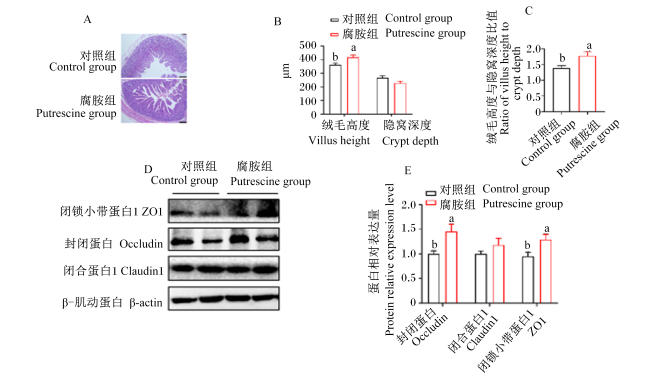
图1所示,与对照组相比,腐胺组空肠绒毛高度以及绒毛高度与隐窝深度的比值显著升高(P<0.05),隐窝深度无显著变化(P>0.05)。与对照组相比,腐胺组空肠中封闭蛋白(Occludin)、闭锁小带蛋白1(ZO1)的蛋白相对表达量显著升高(P<0.05),但闭合蛋白1(Claudin1)的蛋白相对表达量无显著变化(P>0.05)。
图1 腐胺对断奶仔猪空肠形态和屏障功能的影响

A:空肠HE染色形态;B、C:空肠绒毛高度、隐窝深度及绒毛高度与隐窝深度的比值;D、E:空肠中Occludin、Claudin1和ZO1蛋白相对表达量。

数据柱标注不同小写字母表示差异显著(P<0.05)。下图同。

Fig.1 Effects of putrescine on jejunal morphology and barrier function of weaned piglets

A: the HE staining morphology of the jejunum; B, C: the villus height, crypt depth, and the ratio of villus height to crypt depth of the jejunum; D, E: the protein relative expression levels of Occludin, Claudin1 and ZO1 in the jejunum.

Data columns with different letters mean significant difference (P<0.05). The same as below.

2.2 腐胺对断奶仔猪空肠氧化应激的影响

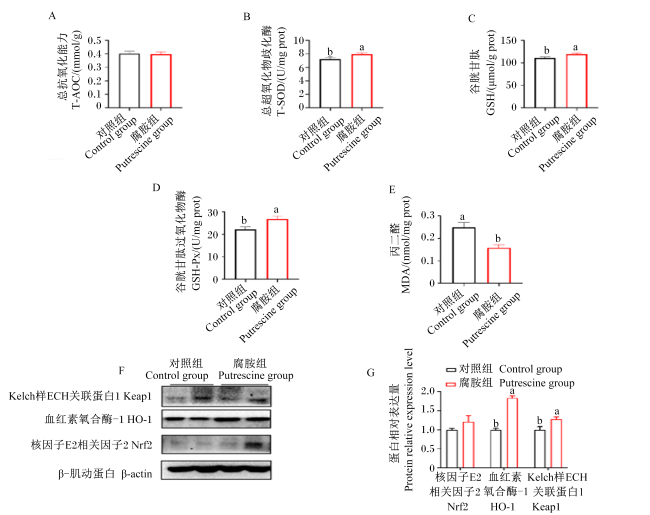
图2所示,与对照组相比,腐胺组空肠中T-AOC无显著变化(P>0.05),但GSH含量、GSH-Px和T-SOD活性显著增加(P<0.05),MDA含量显著降低(P<0.05)。相对于对照组,腐胺组空肠中核因子E2相关因子2(Nrf2)的蛋白相对表达量无显著变化(P>0.05),但Kelch样ECH关联蛋白1(Keap1)和血红素氧合酶-1(HO-1)的蛋白相对表达量显著增加(P<0.05)。
图2 腐胺对断奶仔猪空肠氧化应激的影响

A~E:空肠总抗氧化能力、总超氧化物歧化酶活性、谷胱甘肽含量、谷胱甘肽过氧化物酶活性及丙二醛含量;F、G:空肠Nrf2、HO-1和Keap1蛋白相对表达量。

Fig.2 Effects of putrescine on jejunal oxidative stress of weaned piglets

A to E: T-AOC, T-SOD activity, GSH content, GSH-Px activity, and MDA content in the jejunum; F, G: the protein relative expression levels of Keap1, HO-1 and Nrf2 in the jejunum.

2.3 腐胺对断奶仔猪空肠血管生成的影响

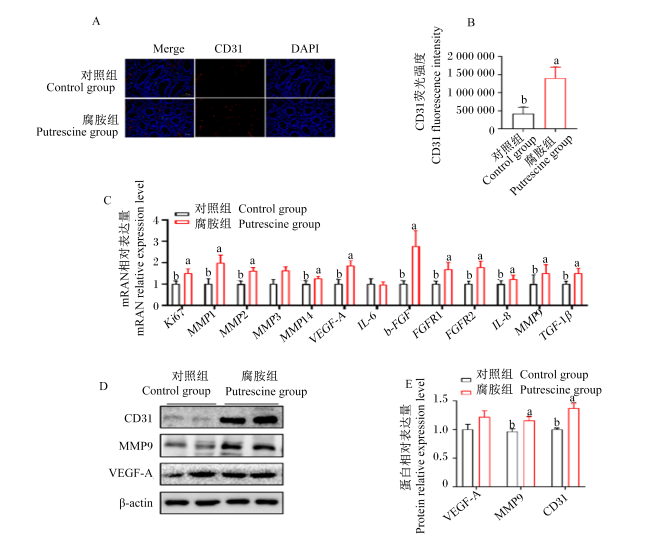
与对照组相比,腐胺组空肠中血管生成标志物血小板内皮细胞黏附分子1(CD31)的荧光强度和蛋白相对表达量显著提高(P<0.05)(图3-A、B、E),血管生成相关因子基质金属蛋白酶1(MMP1)、基质金属蛋白酶2(MMP2)、基质金属蛋白酶3(MMP3)、基质金属蛋白酶14(MMP14)、MMP9、血管内皮生长因子-A(VEGF-A)、碱性成纤维细胞生长因子(b-FGF)、成纤维细胞生长因子受体1(FGFR1)、成纤维细胞生长因子受体(FGFR2)、白细胞介素-8(IL-8)、转化生长因子-1β(TGF-1β)的mRNA相对表达量均显著升高(P<0.05)(图3-C),并且MMP9的蛋白相对表达量显著升高(P<0.05),但VEGF-A的蛋白相对表达量无显著变化(P>0.05)(图3-D、E)。
图3 腐胺对断奶仔猪空肠血管生成的影响

A、B:空肠中CD31免疫荧光图和荧光强度;C:空肠中血管生成相关因子mRNA相对表达量;D、E:空肠中CD31、MMP9和VEGF-A的蛋白相对表达量。A, B: immunofluorescence images and fluorescence intensity of CD31 in the jejunum; C: the mRNA relative expression levels of angiogenesis related factors in the jejunum; D, E: the protein expression levels of CD31, MMP9 and VEGF-A in the jejunum.

Merge:合并;CD31:血小板内皮细胞黏附分子1 platelet endothelial cell adhesion molecule-1;DAPI:4',6-二脒基-2-苯基吲哚 4',6-diamidino-2-phenylindole;MMP:金属基质蛋白酶 matrix metalloproteinases;VEGF-A:血管内皮生长因子-A vascular endothelial growth factor-A;IL:白细胞介素 interleukin;b-FGF:碱性成纤维细胞生长因子 basic fibroblast growth factor;FGFR:成纤维细胞生长因子受体 fibroblast growth factor receptors;TGF-1β :转化生长因子-1β transforming growth factor-1β; β-actin:β-肌动蛋白。

Fig.3 Effects of putrescine on angiogenesis in jejunum of weaned piglets

2.4 腐胺对PVECs血管生成的影响

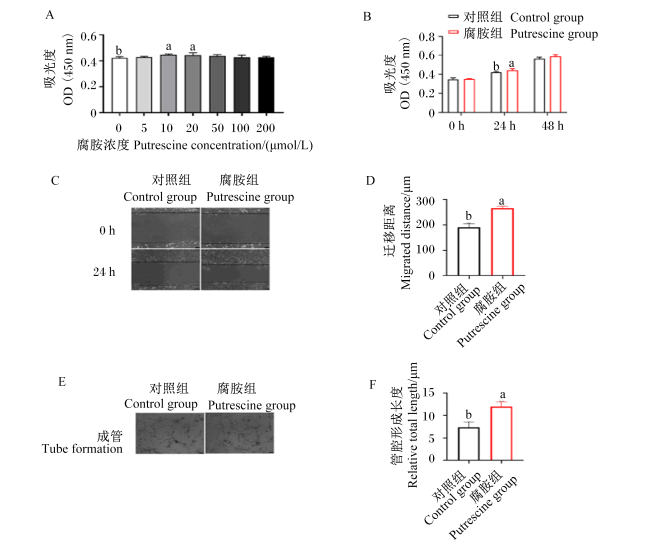
与空白对照(0 μmol/L腐胺)相比,10 μmol/L的腐胺可显著提高PVECs的增殖能力(P<0.05)(图4-A、B)、细胞迁移距离(图4-C、D)和管腔形成长度(图4-E、F),表明腐胺可促进PVECs体外血管生成。
图4 腐胺对PVECs增殖、迁移和成管的影响

A:不同浓度腐胺处理PVECs 48 h后的增殖情况;B:10 μmol/L腐胺处理不同时间后PVECs的增殖情况;C、D: 10 μmol/L腐胺处理24 h后PVECs的迁移距离;E、F:10 μmol/L腐胺处理24 h后PVECs的管腔形成长度。

Fig.4 Effects of putrescine on proliferation, migration and tube formation of PVECs

A. The proliferation of PVECs treated with different concentrations of putrescine for 48 h; B: the proliferation of PVECs s treated with 10 μmol/L putrescine for different time; C, D: the migration distance of PVECs treated with 10 μmol/L putrescine for 24 h; E, F: the tube formation length of PVECs treated with 10 μmol/L putrescine for 24 h.

3 讨论

3.1 腐胺对断奶仔猪空肠形态及屏障功能的影响

断奶可对仔猪肠黏膜造成损伤,表现为绒毛变短、隐窝增生、消化吸收能力下降以及腹泻[1]。因此,维持断奶仔猪肠道正常发育对提高断奶仔猪生长至关重要。腐胺具有促进肠道细胞增殖及蛋白质合成的作用。有研究表明,断奶仔猪饲粮中添加腐胺后,仔猪的空肠绒毛高度显著升高[6]。在本试验中,饲粮添加0.1%的腐胺可使断奶仔猪空肠内绒毛高度显著升高,隐窝深度下降,这与上述前人研究结果一致。小肠绒毛是反映肠道健康状况的指标,绒毛越高,消化吸收能力就越强,而隐窝越浅,表明肠道上皮细胞越成熟,肠细胞分泌功能越强[7-8]。以上研究结果表明,饲粮中添加0.1%的腐胺可提高断奶仔猪肠道绒毛发育,从而提高营养物质吸收能力。紧密连接蛋白如Occludin、Claudin1及ZO1等,对维持肠道上皮屏障至关重要[9]。为进一步探究腐胺对肠道屏障功能的影响,我们检测了空肠中紧密连接蛋白的表达情况,结果发现,腐胺组空肠ZO1和Claudin1的蛋白相对表达量显著高于对照组。综上所述,0.1%的腐胺可促进断奶仔猪的空肠绒毛发育和增强屏障功能。

3.2 腐胺对断奶仔猪空肠氧化应激的影响

仔猪在断奶过程中面临食物改变、环境变化、致病菌增多等应激源的侵扰,这些应激源会破坏自由基产生与清除的平衡,造成机体出现氧化应激状态,从而导致肠道损伤、免疫抑制、代谢性疾病等,影响仔猪的生长发育[1]。本试验结果表明,饲粮中添加0.1%腐胺后,断奶仔猪空肠内GSH含量、GSH-Px和T-SOD活性显著增加,MDA含量显著降低,表明腐胺可缓解断奶仔猪肠道氧化应激。在机体氧化应激防御系统中,Nrf2是一种重要调节因子,而Keap1是一种应激传感器蛋白,可帮助Nrf2快速降解[10]。当细胞处于氧化应激状态时,Nrf2在Keap1的协助下与细胞核内的抗氧化反应元件结合,启动下游HO-1等抗氧化酶基因的转录,从而提高细胞的抗氧化能力[11]。此外,HO-1作为热休克蛋白家族的成员,其自身也与细胞抗氧化防御和抗凋亡有关。有研究表明HO-1蛋白表达水平的上调可以激活抗氧化反应,减少活性氧的产生和减弱应激诱导的损伤[12]。本研究结果表明,腐胺组断奶仔猪空肠内Keap1和HO-1的蛋白相对表达量较对照组显著增加,表明腐胺可通过调控Keap1和HO-1的表达缓解肠道氧化应激。以往的研究结果还表明,腐胺可以通过改善脂肪酸的氧化降低氧化应激水平,从而达到促进猪卵母细胞的成熟[13]。Dasdelen等[14]研究表明,补充腐胺可通过抗炎和抗氧化作用来减轻大鼠的肝脏损伤。以上研究结果表明,饲粮中添加0.1%的腐胺有助于断奶仔猪在氧化应激状态下抗氧化反应元件的结合和抗氧化酶基因的转录,从而缓解仔猪肠道氧化应激。

3.3 腐胺对断奶仔猪空肠血管生成的影响

肠道营养物质吸收是一个复杂的过程,肠道内血管的充盈度是直接影响肠道吸收能力的重要原因之一。肠道内毛细血管越丰富,肠道的吸收能力越强。以往的研究表明,增加肠道内血管生成可以改善肠道的吸收能力[15]。血管生成除了与血管细胞的生长有关,还受到血管生成相关因子的严密调控。此外,CD31参与血管形成等多个生理过程,且抗原在血管细胞上广泛分布,也是判断机体血管生成的重要指标[16-17]。本试验结果显示,腐胺组断奶仔猪空肠内MMP9和CD31的蛋白相对表达量显著升高。体外PVECs血管生成试验结果也表明,10 μmol/L的腐胺可促进血管内皮细胞体外血管生成。Hu等[5]研究表明,腐胺可通过促进MMP9的表达促进肌肉血管生成。由此可见,断奶仔猪饲粮中添加0.1%的腐胺可显著提高空肠血管生成能力。以上研究结果可为研究腐胺促进断奶仔猪肠道吸收提供新的理论依据。

4 结论

饲粮中添加0.1%的腐胺可促进断奶仔猪空肠绒毛发育、增强屏障功能,并能提高其空肠抗氧化能力和促进血管生成。
[1]
TAN B H, XIAO D F, WANG J, et al. The roles of polyamines in intestinal development and function in piglets[J]. Animals, 2024, 14(8):1228.

[2]
LIU G M, MO W W, CAO W, et al. Effects of spermine on ileal physical barrier,antioxidant capacity,metabolic profile and large intestinal bacteria in piglets[J]. RSC Advances, 2020, 10(45):26709-26716.

[3]
DIAZ-MIRON J, SUN R, CHOI P, et al. The effect of impaired angiogenesis on intestinal function following massive small bowel resection[J]. Journal of Pediatric Surgery, 2015, 50(6):948-953.

[4]
LIU B M, JIANG X R, CAI L, et al. Putrescine mitigates intestinal atrophy through suppressing inflammatory response in weanling piglets[J]. Journal of Animal Science and Biotechnology, 2019,10:69.

[5]
HU C J, JI F J, LV R L, et al. Putrescine promotes MMP9-induced angiogenesis in skeletal muscle through hydrogen peroxide/METTL3 pathway[J]. Free Radical Biology & Medicine, 2024,212:433-447.

[6]
LIU G M, MO W W, XU X M, et al. Effects of putrescine on gene expression in relation to physical barriers and antioxidant capacity in organs of weaning piglets[J]. RSC Advances, 2019, 9(34):19584-19595.

[7]
VODOLAZSKA D, HEDEMANN M S, LAURIDSEN C. Impact of liquid diet supplementation while suckling and weaning age on nutritional status,intestinal health,and immunity of piglets pre- and post-weaning[J]. Journal of Animal Science, 2023,101:skad231.

[8]
BEAUMONT M, LENCINA C, PAINTEAUX L, et al. A mix of functional amino acids and grape polyphenols promotes the growth of piglets, modulates the gut microbiota in vivo and regulates epithelial homeostasis in intestinal organoids[J]. Amino Acids, 2022, 54(10):1357-1369.

[9]
BEAUMONT M, CAUQUIL L, BERTIDE A, et al. Gut microbiota-derived metabolite signature in suckling and weaned piglets[J]. Journal of Proteome Research, 2021, 20(1):982-994.

DOI PMID

[10]
WANG J, XIAO Y X, LI J J, et al. Serum biochemical parameters and amino acids metabolism are altered in piglets by early-weaning and proline and putrescine supplementations[J]. Animal Nutrition, 2021, 7(2):334-345..

DOI PMID

[11]
YU C, XIAO J H. The Keap1-Nrf2 system:a mediator between oxidative stress and aging[J]. Oxidative Medicine and Cellular Longevity, 2021,2021:6635460.

[12]
ZHI S M, FANG G X, XIE X M, et al. Melatonin reduces OGD/R-induced neuron injury by regulating redox/inflammation/apoptosis signaling[J]. European Review for Medical and Pharmacological Sciences, 2020, 24(3):1524-1536.

DOI PMID

[13]
JIA H Y, TANG H Y, WU W, et al. Putrescine alleviates the oxidative damage of cumulus-oocyte complex via improving fatty acid oxidation[J]. Biochemical and Biophysical Research Communications, 2023,684:149127.

[14]
DASDELEN D, CETIN N, MENEVSE E, et al. Effects of putrescine on oxidative stress,spermidine/spermine-N(1)-acetyltransferase,inflammation and energy levels in liver and serum in rats with brain ischemia-reperfusion[J]. Physiology International, 2023, 110(1):34-45.

[15]
ZOU D B, YANG Y, JI F J, et al. DUOX2-induced oxidative stress inhibits intestinal angiogenesis through MMP3 in a low-birth-weight piglet model[J]. Antioxidants, 2023, 12(10):1800.

[16]
ZHAO Y Q, YU B, WANG Y X, et al. Ang-1 and VEGF:central regulators of angiogenesis[J/OL]. Molecular and Cellular Biochemistry[2024-06-01]. https://link.springer.com/article/10.1007/s11010-024-05010-3#citeas.

[17]
FRANCO P I R, PEREIRA J X, FERREIRA H H, et al. Low-grade mammary gland tumors in dogs have greater VEGF-A and BMP2 immunostaining and higher CD31 blood vessel density[J]. Topics in Companion Animal Medicine, 2023,53/54:100778.

Outlines

/