RESEARCH PAPER

Comparison of Net Energy Efficiency and Amino Acid Standardized Ileal Digestibility between Conventional Diet and Low-Protein Diet in Broilers

  • BAN Zhibin , 1, 2 ,
  • CHEN Simiao 2, * ,
  • XU Ying 2 ,
  • YAN Xiaogang 2 ,
  • LIU Yongfa 1 ,
  • LI Lijia 2 ,
  • LI Baihao 2 ,
  • ZHANG Qiyu 2 ,
  • GUO Yuming , 1, **
Expand
  • 1 State Key Laboratory of Animal Nutrition, College of Animal Science and Technology, China Agricultural University, Beijing 100193, China
  • 2 Institute of Animal Nutrition and Feed, Jilin Academy of Agricultural Sciences, Gongzhuling 136100, China
** professor, E-mail:

* Contributed equally

Received date: 2024-05-31

  Online published: 2025-01-10

Abstract

The aim of this experiment was to compare the differences in dietary net energy utilization efficiency and amino acid standardized ileal digestibility between conventional diet and low-protein diet in broilers of different days of age. The experiment was divided into two tests. In test 1, 48 Arbor Acres (AA) broilers at 7 days of age, 48 AA broilers at 17 days of age and 24 AA broilers at 30 days of age were selected and divided into two groups at each day-age stage with 6 replicates per group and 4 or 2 chickens per replicate, and fed a conventional diet with 23% crude protein level and a low-protein diet with 21% crude protein level, respectively. Each trial lasted for 7 days, including 4 days of pre-trial period and 3 days of trial period. The respiratory data of broilers from 11 to 14 days of age, 21 to 24 days of age and 35 to 38 days of age were measured by an open-circuit respiratory calorimetry instrument with 12 chambers in parallel for poultry. In test 2, each 108 AA broilers of 7, 17 and 30 days of age were selected, and each day-age stage was divided into 3 groups with 6 replicates per group and 6 chickens per replicate, respectively. Broilers in the three groups were fed the conventional diet, low-protein diet and nitrogen-free diet, respectively, and slaughter trial was conducted at 10, 20 and 33 days of age, respectively, to determine the amino acid standardized ileal digestibility. The results showed as follows: 1) compared with the conventional diet, the low-protein diet had no significant effects on growth performance of broilers at 3 day-age stages (P>0.05), and significantly decreased the oxygen consumption of broilers from 21 to 24 days of age (P<0.05). 2) Compared with the conventional diet, the low-protein diet significantly increased the metabolic energy to gross energy ratio of broilers from 11 to 14 days of age (P<0.05); significantly decreased the total heat production, heat increment and retain energy as protein from 21 to 24 days of age (P<0.05), and significantly increased the net energy to metabolic energy ratio (P<0.05); significantly increased the net energy from 35 to 38 days of age (P<0.05). 3) Compared with the conventional diet, the low-protein diet significantly decreased the standardized ileal digestibility of alanine and tyrosine of broilers from 7 to 10 days of age (P<0.05), and significantly increased the histidine standardized ileal digestibility (P<0.05); significantly increased the standardized ileal digestibility of glycine, cystine, tyrosine, serine, threonine, aspartate and valine from 17 to 20 days of age (P<0.05); had no significant effects on amino acid standardized ileal digestibility from 30 to 33 days of age (P>0.05). In conclusion, compared with the conventional diet, the low-protein diet can significantly reduce the heat production and increase the net energy utilization rate of broilers after 21 days of age; the net energy system can more effectively judge the effects of dietary protein levels on broilers, and is conducive to accurately determine the energy metabolism parameters of low-protein diets in broilers and analyze the direction of energy regulation in vivo; after intestinal development was complete, the amino acid standardized ileal digestibility of low-protein diets in broilers was lower than that of conventional diets.

Cite this article

BAN Zhibin , CHEN Simiao , XU Ying , YAN Xiaogang , LIU Yongfa , LI Lijia , LI Baihao , ZHANG Qiyu , GUO Yuming . Comparison of Net Energy Efficiency and Amino Acid Standardized Ileal Digestibility between Conventional Diet and Low-Protein Diet in Broilers[J]. Chinese Journal of Animal Nutrition, 2025 , 37(1) : 296 -306 . DOI: 10.12418/CJAN2025.026

随着畜牧业的快速发展,饲用蛋白质原料紧缺、环境污染等逐渐成为抑制肉鸡产业可持续发展的重要问题。2020年9月,国务院办公厅印发《关于促进畜牧业高质量发展的意见》,明确提出“建立健全饲料原料营养价值数据库,全面推广饲料精准配方和精细加工技术”“调整优化饲料配方结构,促进玉米、豆粕减量替代”等要求,这进一步推动了低蛋白质饲粮的应用。低蛋白质饲粮净能利用效率和氨基酸标准回肠消化率(SID)的评定有利于精准优化饲粮配方,以更高效地推动低蛋白质饲粮的应用。
低蛋白质饲粮是指在降低饲粮中蛋白质水平的同时,通过添加工业合成的氨基酸来平衡饲粮中的重要氨基酸,以此减少蛋白质原料使用量,并满足动物对氨基酸需求的饲粮[1]。低蛋白质饲粮技术应用的前提在于保证氨基酸平衡[2],以实现理想蛋白质模式。Lemme等[3]于2004年将收粪法测定全肠道氨基酸消化率的方法改进为回肠末端食糜法,此方法考虑了内源氨基酸损失,更真实反映了动物对氨基酸的消化吸收情况,有利于低蛋白质饲粮配方的实施。此外,准确评定低蛋白质饲粮能量转化效率,也有利于精准描述其在动物体内用于维持、生长或生产的效率。能量在畜禽体内是依次流动、逐级递减的[4],分为总能、代谢能和净能等。代谢能体系会高估饲粮中粗蛋白质和粗纤维类成分的能量利用率,而低估粗脂肪和淀粉类成分的能量利用率[5]。净能体系相较于代谢能体系,考虑了动物采食和消化过程中产生的热增耗(HI),能更准确反映动物对能量的真实需要量。随着净能体系的发展,饲粮能量营养参数与需要量的对接更加精准。目前,关于能量和氨基酸标准回肠消化率的研究主要集中在代谢能水平及单一原料氨基酸标准回肠消化率,关于不同日龄的低蛋白质饲粮净能和氨基酸标准回肠消化率比较研究较少。因此,本研究旨在探究肉鸡常规与低蛋白质饲粮净能利用效率和氨基酸标准回肠消化率差异,以期为家禽精准营养供给提供理论依据,为低蛋白质饲粮的应用及产业节本增效发挥积极作用。

1 材料与方法

1.1 动物伦理声明

本试验所有程序均按照吉林省农业科学院(中国农业科技东北创新中心)科技伦理(审查)委员会批准的方案进行,批准文号为JNK20230311-1。

1.2 试验设计

1.2.1 试验动物及饲粮

试验分别选择7日龄爱拔益加(AA)肉鸡156只(其中,48只用于代谢试验,另108只用于氨基酸消化率试验)、17日龄AA肉鸡156只(其中,48只用于代谢试验,另108只用于氨基酸消化率试验)和30日龄AA肉鸡132只(其中,24只用于代谢试验,另108只用于氨基酸消化率试验),每个日龄肉鸡均分别饲喂常规饲粮(饲粮粗蛋白质水平为23%)、低蛋白质饲粮(饲粮粗蛋白质水平为21%)或无氮饲粮。常规饲粮和低蛋白质饲粮组成及营养水平见表1,低蛋白质饲粮粗蛋白质水平根据《爱拔益加(AA)肉鸡饲养管理手册(2019)》在常规饲粮的基础上降低2个百分点。无氮饲粮组成见表2
表1 常规饲粮和低蛋白质饲粮组成及营养水平(干物质基础)

Table 1 Composition and nutrient levels of conventional diet and low-protein diet (DM basis) %

项目
Items
11~14日龄
11 to 14 days of age
21~24日龄
21 to 24 days of age
35~38日龄
35 to 38 days of age
常规饲粮
Conventional
diet
低蛋白质
饲粮
Low-protein
diet
常规饲粮
Conventional
diet
低蛋白质
饲粮
Low-protein
diet
常规饲粮
Conventional
diet
低蛋白质
饲粮
Low-protein
diet
原料Ingredients
玉米Corn 50.07 58.10 57.52 64.15 61.66 66.99
豆粕Soybean meal 35.29 26.90 29.31 22.94 22.01 18.03
玉米蛋白粉Corn protein meal 5.00 5.00 5.00 4.50 8.00 6.00
磷酸氢钙CaHPO4 1.58 1.63 1.36 1.40 1.22 1.26
大豆油Soybean oil 5.20 4.32 3.96 3.30 4.28 4.13
石粉Limestone 1.34 1.37 1.24 1.26 1.19 1.19
氯化钠NaCl 0.35 0.28 0.30 0.24 0.27 0.23
氯化胆碱Choline chloride (50%) 0.20 0.24 0.20 0.23 0.20 0.21
DL-蛋氨酸DL-Met 0.14 0.18 0.13 0.16 0.06 0.10
L-赖氨酸盐酸盐L-Lys·HCl 0.09 0.33 0.14 0.32 0.22 0.34
胱氨酸Cys 0.03 0.05 0.07
L-苏氨酸L-Thr 0.05 0.07 0.06
L-精氨酸L-Arg 0.24 0.03 0.09
L-异亮氨酸L-Ile 0.03 0.04
L-色氨酸L-Trp 0.04 0.02
L-缬氨酸L-Val 0.04 0.04 0.04
L-苯丙氨酸L-Phe 0.10
甘氨酸Gly 0.20 0.19 0.04
植酸酶Phytase 0.02 0.02 0.02 0.02 0.02 0.02
碳酸钾K2CO3 0.21 0.16 0.11
碳酸氢钠NaHCO3 0.10 0.10 0.19 0.15 0.21
预混料Premix1) 0.22 0.22 0.22 0.22 0.22 0.22
二氧化钛TiO2 0.50 0.50 0.50 0.50 0.50 0.50
合计Total 100.00 100.00 100.00 100.00 100.00 100.00
营养水平Nutrient levels2)
代谢能ME/(MJ/kg) 14.74 15.46 14.42 14.44 15.69 15.92
总能GE/(MJ/kg) 17.88 17.29 17.00 16.83 17.23 17.38
粗蛋白质CP 22.92 21.41 21.15 18.57 18.35 17.27
干物质(风干基础)
DM (air-dry basis)
90.40 89.90 87.90 88.00 87.80 89.00

1)预混料为每千克饲粮提供 The premix provided the following per kg of diets:VA 12 500 U,VB1 0.01 mg,VB2 8.00 mg,VB6 4.5 mg,VB12 0.02 mg,VD3 3 500 IU,VE 20 IU,VK3 3 mg,生物素 biotin 0.2 mg,叶酸 folic acid 0.5 mg,D-泛酸 D-pantothenic acid 12 mg,烟酸 nicotinic acid 34 mg,Cu (as copper sulfate) 8 mg,Fe (as ferrous sulfate) 80 mg,Mn (as manganese sulfate) 80 mg,Zn (as zinc sulfate) 80 mg,I (as potassium iodide) 0.70 mg,Se (as sodium selenite) 0.3 mg。表2同 the same as Table 2

2)营养水平均为实测值。Nutrient levels were all measured values.

表2 无氮饲粮组成(饲喂基础)

Table 2 Nitrogen free diet composition (as-fed basis) %

项目Items 含量Content
淀粉Starch 59.88
蔗糖Sucrose 31.50
纤维素Cellulose 4.20
磷酸氢钙CaHPO4 1.90
碳酸钙CaCO3 1.30
食盐NaCl 0.30
预混料Premix 0.22
氯化胆碱Choline chloride (50%) 0.20
二氧化钛TiO2 0.50
合计Total 100.00

1.2.2 代谢试验

动物试验在吉林省农业科学院动物营养与饲料研究所家禽能量营养联合研究中心进行。试验分为3个日龄阶段,分别选择7日龄AA肉鸡48只、17日龄AA肉鸡48只和30日龄AA肉鸡24只,每个日龄阶段分为2组(常规饲粮组和低蛋白质饲粮组),每组6个重复,每个重复4或2只鸡。每期试验7 d,其中预试期4 d,正试期3 d。采用家禽12室联排开路式呼吸测热装置分别测定肉鸡11~14日龄、21~24日龄和35~38日龄呼吸数据。试验期间肉鸡自由采食和饮水。

1.2.3 氨基酸消化率试验

试验分为3个日龄阶段,分别选择7、17和30日龄AA肉鸡各108只,每个日龄阶段分为3组,每组6个重复,每个重复6只鸡。3组肉鸡分别饲喂常规饲粮、低蛋白质饲粮和无氮饲粮,并分别于10、20和33日龄时开展屠宰试验,测定氨基酸标准回肠消化率。

1.3 样品采集与制备

代谢试验正试期每天09:30采用全收粪法收集排泄物,将每日收集的排泄物暂存于-20 ℃冰箱中保存。每期试验结束后,将每个重复的3 d排泄物混合,置于烘箱中以65 ℃烘干72 h至恒重,取出在室温[(25±2) ℃]下回潮24 h,粉碎过40目筛并封存留样备用。
在氨基酸消化率试验中,分别于10、20和33日龄时将所有试验鸡饥饿2 h,再自由采食1 h,清除余料,再过3 h后,翅静脉注射苯巴比妥钠(>30 mg/kg BW)麻醉,屠宰分离回肠,对折后取回肠后段1/2(弃去最后2 cm),用蒸馏水将回肠食糜冲入铝盒中,每个重复肉鸡食糜装入1个铝盒或相应容器内,收集后的食糜立即放置于-20 ℃储存;将冷冻后的食糜放入冷冻干燥机中冻干,置室温下回潮24 h,各重复内所有鸡只的冻干食糜经充分混合后,粉碎备用。

1.4 测定指标及方法

按照国家标准方法测定饲粮和排泄物样品中的水分(GB/T 6435—2014)、粗蛋白质(GB/T 6432—2018)、粗脂肪(GB/T 6433—2006)、淀粉(GB/T 20194—2018)、氨基酸(GB/T 18246—2000)和二氧化钛(GB 5009.246—2016)含量;按照国际标准ISO 9831:1998推荐的方法,采用氧弹测热仪(IKA-C3000,德国)测定总能。

1.5 计算公式

能量代谢计算公式如下:
食入总能(MJ)=饲粮总能(MJ/kg)×采食量(kg);
排泄总能(MJ)=排泄物总能(MJ/kg)×排泄物量(kg);
代谢能摄入量(MJ)=食入总能(MJ)-排泄总能(MJ);
代谢能(MJ/kg)=代谢能摄入量(MJ)/采食量(kg);
氮校正代谢能(MJ/kg)=[代谢能(MJ/kg)-氮沉积(kg)×34.39]/采食量(kg);
氮沉积(g)=氮摄入(g)-氮排出(g);
净能摄入量=代谢能摄入量(MJ)-热增耗(MJ);
净能(MJ/kg)=[代谢能摄入量(MJ)-热增耗(MJ)]/采食量(kg);
总产热(THP,kJ)=16.18×氧气消耗量(L)+5.02×二氧化碳排出量(L)[6];
绝食产热(FHP,kJ)=代谢体重(BW0.70,kg)×450(kJ/BW0.70)[7];
呼吸熵(RQ)=二氧化碳排出量(L)/氧气消耗量(L);
热增耗(kJ)=总产热(kJ)-绝食产热(kJ);
沉积能(RE,kJ)=代谢能摄入量(kJ)-总产热(kJ);
蛋白质沉积能(MJ)=氮沉积(g)×6.25×23.84;
脂肪沉积能(MJ)=沉积能(MJ)-蛋白质沉积能(MJ)。
式中:氮沉积为肉鸡每采食1 kg饲粮所沉积氮量(kg);34.39表示每沉积1 kg氮用34.39 MJ进行校正;采食量、排泄物量和氮沉积均为每个重复每只鸡平均每天的量;能量与采食量和排泄物量物质基础保持一致;6.25是蛋白质与氮的转换系数,23.84是1 kg蛋白质含有的能量(MJ)。
氨基酸标准回肠消化率计算公式如下:
氨基酸表观回肠消化率(AID,%)=100-[食糜氨基酸含量(mg/kg DM)×饲粮二氧化钛
含量(mg/kg DM)]/[饲粮氨基酸含量
(mg/kg DM)×食糜二氧化钛含量
(mg/kg DM)]×100;
无氮饲粮内源性氨基酸流量(mg/kg DMI)=[食糜氨基酸含量(mg/kg DM)×饲粮二氧
化钛含量(mg/kg DM)]/食糜二氧化钛
含量(mg/kg DM);
氨基酸标准回肠消化率(%)=氨基酸表观回肠
消化率(%)+100×无氮饲粮内源性
氨基酸流量(mg/kg DMI)/饲粮
氨基酸含量(mg/kg DM)。
式中:DM和DMI分别表示干物质含量和干物质摄入量。

1.6 试验设备

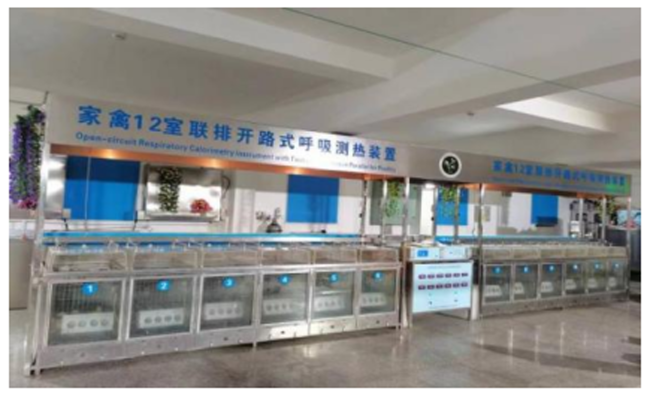
本试验净能的测定主要依靠家禽12室联排开路式呼吸测热装置(图1)进行,此设备由吉林省农业科学院动物营养与饲料研究所研制。设备主要由禽呼吸代谢舱、代谢笼、环境控制系统、气体分析仪及数据采集系统组成。试验开始前,根据动物饲养标准调整温度、湿度及光照时长,检查水线。预试验和正试期的步骤相同,将动物置于代谢笼内,关闭代谢仓,调整进气量和排气量使小室内外压力处于平衡状态并在舱盖周围加水封闭,防止漏气。利用红外线传感器测定动物的氧气消耗量和二氧化碳产生量,数据直接在电脑数据采集控制界面上显示,系统自动计算动物的氧气消耗量、二氧化碳产生量和呼吸熵,试验结束后将数据导出到Excel 2021中进行数据保存和整理。
图1 家禽12室联排开路式呼吸测热装置

Fig.1 Open-circuit respiratory calorimetry instrument with 12 chambers in parallel for poultry

1.7 数据统计分析

采用Excel 2021对原始数据进行整理,然后采用SPSS 25.0进行独立样本t检验比较相同日龄不同饲粮处理差异;先进行方差齐性检验,满足方差齐性则进行显著性比较检验,试验结果数据用“平均值±标准误”表示,P<0.05表示差异显著。

2 结果

2.1 常规饲粮和低蛋白质饲粮对不同日龄肉鸡生长性能和呼吸量的影响

表3可知,与常规饲粮相比,低蛋白质饲粮对3个日龄阶段肉鸡生长性能均无显著影响(P>0.05)。与常规饲粮相比,低蛋白质饲粮显著降低肉鸡21~24日龄氧气消耗量(P<0.05)。
表3 常规饲粮和低蛋白质饲粮对不同日龄肉鸡生长性能和呼吸量的影响

Table 3 Effects of conventional diet and low-protein diet on growth performance and respiratory volume of broilers of different days of age

项目
Items
11~14日龄
11 to 14 days of age
21~24日龄
21 to 24 days of age
35~38日龄
35 to 38 days of age
常规饲粮
Conventional
diet
低蛋白质
饲粮
Low-protein
diet
常规饲粮
Conventional
diet
低蛋白质
饲粮
Low-protein
diet
常规饲粮
Conventional
diet
低蛋白质
饲粮
Low-protein
diet
生长性能Growth performance
体重BW/g 371.78
±5.86
404.11
±4.52
1 098.50
±29.95
1 064.81
±36.25
1 979.05
±63.13
1 954.25
±67.74
采食量FI/(g/d DM) 53.38
±5.91
58.83
±3.13
104.16
±4.63
95.59
±10.32
139.43
±15.88
141.36
±11.99
体增重BW gain/(g/d) 44.45
±5.05
45.24
±1.38
92.22
±38.83
97.29
±19.62
115.10
±10.09
127.11
±17.48
料重比F/G 1.21
±0.15
1.31
±0.10
1.24
±0.40
1.00
±0.14
1.21
±0.06
1.12
±0.12
呼吸量Respiratory volume
氧气消耗量
O2 consumption/
[L/(kg BW0.70·d)]
37.16
±1.36
38.58
±1.42
37.69
±1.89a
33.55
±1.86b
37.90
±1.01
35.45
±3.52
二氧化碳产生量
CO2 production/
[L/(kg BW0.70·d)]
37.15
±0.94
38.51
±1.19
37.51
±1.56
34.22
±2.03
37.62
±1.06
35.80
±3.25
呼吸熵RQ 1.00
±0.02
1.00
±0.01
1.00
±0.01
1.02
±0.05
0.98
±0.01
1.00
±0.02

同一日龄阶段同行数据肩标不同字母表示差异显著(P<0.05)。下表同。

Values in the same row of the same days of age stage with different letter superscripts mean significant difference (P<0.05). The same as below.

2.2 常规饲粮和低蛋白质饲粮对不同日龄肉鸡能量代谢的影响

表4可知,与常规饲粮相比,低蛋白质饲粮显著提高肉鸡11~14日龄代谢能/总能值(P<0.05);低蛋白质饲粮显著降低21~24日龄总产热、热增耗和蛋白质沉积能(P<0.05),显著提高净能/代谢能值(P<0.05);低蛋白质饲粮显著提高35~38日龄净能(P<0.05)。
表4 常规饲粮和低蛋白质饲粮对不同日龄肉鸡能量代谢的影响

Table 4 Effects of conventional diet and low-protein diet on energy metabolism of broilers of different days of age

项目
Items
11~14日龄
11 to 14 days of age
21~24日龄
21 to 24 days of age
35~38日龄
35 to 38 days of age
常规饲粮
Conventional
diet
低蛋白质
饲粮
Low-protein
diet
常规饲粮
Conventional
diet
低蛋白质
饲粮
Low-protein
diet
常规饲粮
Conventional
diet
低蛋白质
饲粮
Low-protein
diet
能量平衡Energy balance/[kJ/(kg BW0.70·d)]
总产热
THP
787.78
±26.48
817.52
±28.51
798.07
±38.36a
714.59
±37.16b
802.13
±21.51
753.20
±72.83
热增耗
HI
287.78
±26.48
317.52
±28.51
348.07
±38.36a
264.59
±37.16b
352.13
±21.51
303.20
±72.83
沉积能
RE
790.23
±143.12
897.03
±108.70
607.78
±31.95
603.62
±81.93
551.47
±88.92
652.78
±69.85
蛋白质沉积能
RE as protein
453.10
±80.69
500.53
±33.57
315.64
±25.49a
267.07
±17.83b
249.99
±13.05
263.35
±10.30
脂肪沉积能量
RE as fat
337.13
±163.73
396.51
±78.15
292.14
±12.54
336.55
±65.05
301.48
±76.43
389.42
±65.02
代谢能摄入量
MEI
1 578.01
±240.71
1 714.55
±93.64
1 405.86
±11.85
1 318.21
±109.96
1 353.60
±104.53
1 405.97
±82.19
净能摄入量
NEI
1 290.23
±243.12
1 397.03
±108.70
1 057.78
±31.95
1 053.62
±81.93
1 001.47
±88.92
1 102.78
±69.85
有效能Available energy
代谢能
ME/(MJ/kg DM)
14.74
±0.77
15.46
±0.64
14.42
±0.45
14.44
±0.23
15.69
±0.27
15.92
±0.31
氮校正代谢能
MEn/(MJ/kg DM)
14.68
±0.76
15.40
±0.64
14.35
±0.45
14.37
±0.23
15.60
±0.28
15.82
±0.31
净能
NE/(MJ/kg DM)
12.01
±1.02
12.59
±0.72
10.86
±0.57
11.54
±0.13
11.60
±0.11b
12.50
±0.68a
代谢能/总能
ME/GE/%
77.09
±4.01b
82.80
±3.42a
72.96
±2.29
73.33
±1.16
79.99
±1.37
81.50
±1.60
净能/代谢能
NE/ME/%
81.39
±3.51
81.41
±2.29
75.25
±2.61b
79.97
±1.68a
73.94
±1.28
78.53
±4.66

2.3 常规饲粮和低蛋白质饲粮对不同日龄肉鸡氨基酸标准回肠消化率的影响

表5可知,与常规饲粮相比,低蛋白质饲粮显著降低肉鸡7~10日龄丙氨酸和酪氨酸标准回肠消化率(P<0.05),显著提高组氨酸标准回肠消化率(P<0.05);低蛋白质饲粮显著提高17~20日龄甘氨酸、胱氨酸、酪氨酸、丝氨酸、苏氨酸、天冬氨酸和缬氨酸标准回肠消化率(P<0.05);低蛋白质饲粮对30~33日龄氨基酸标准回肠消化率无显著影响(P>0.05)。
表5 常规饲粮和低蛋白质饲粮对不同日龄肉鸡氨基酸标准回肠消化率的影响(干物质基础)

Table 5 Effects of conventional diet and low-protein diet on amino acid standardized ileal digestibility of broilers of different days of age (DM basis) %

项目
Items
7~10日龄
7 to 10 days of age
17~20日龄
17 to 20 days of age
30~33日龄
30 to 33 days of age
常规饲粮
Conventional
diet
低蛋白质
饲粮
Low-protein
diet
常规饲粮
Conventional
diet
低蛋白质
饲粮
Low-protein
diet
常规饲粮
Conventional
diet
低蛋白质
饲粮
Low-protein
diet
苯丙氨酸Phe 91.95±1.33 89.37±0.45 94.16±0.42 96.10±0.59 92.32±0.69 91.89±1.32
丙氨酸Ala 92.59±0.95a 88.53±0.62b 93.80±0.38 95.69±0.74 92.90±0.52 90.92±1.75
蛋氨酸Met 95.84±0.91 95.02±0.40 96.35±0.81 97.02±0.76 94.79±0.10 94.03±1.12
甘氨酸Gly 87.31±1.40 86.12±0.45 89.18±0.55b 93.38±0.78a 86.07±1.69 84.64±2.50
谷氨酸Glu 93.50±1.22 90.60±0.25 94.22±0.12 95.92±0.60 93.49±0.57 92.09±1.46
胱氨酸Cys 82.16±1.80 80.50±1.82 82.83±1.24b 89.16±0.66a 85.22±5.02 85.76±1.56
精氨酸Arg 95.75±1.39 92.93±0.20 95.99±0.39 97.21±0.71 93.86±0.11 92.26±1.48
赖氨酸Lys 94.44±1.14 91.44±1.04 94.22±0.37 96.57±0.70 92.77±0.12 91.33±1.07
酪氨酸Tyr 91.57±1.05a 83.56±0.00b 89.95±0.82b 92.74±0.00a 92.64±1.13 86.65±3.51
亮氨酸Leu 93.56±0.98 90.53±0.57 95.61±0.22 97.06±0.83 93.74±0.38 92.45±1.17
脯氨酸Pro 90.44±1.11 87.27±2.69 93.56±0.34 93.75±0.71 92.10±1.16 90.50±0.39
色氨酸Trp 93.88±2.74 93.89±2.06 91.54±2.21 95.03±0.82 97.50±0.06 97.35±2.06
丝氨酸Ser 89.77±1.30 86.34±0.22 90.99±0.42b 94.00±0.81a 92.18±1.03 88.40±2.34
苏氨酸Thr 88.24±1.00 84.60±0.79 89.63±0.55b 93.67±0.87a 88.73±1.65 86.46±2.55
天冬氨酸Asp 88.74±1.44 84.89±0.37 90.89±0.23b 93.37±0.74a 89.82±1.21 86.11±2.42
缬氨酸Val 87.85±1.41 86.50±0.70 93.05±0.45b 95.62±0.50a 88.60±1.37 88.50±2.40
异亮氨酸Ile 91.52±1.39 87.32±0.57 94.72±0.52 96.90±0.75 90.05±0.59 88.86±2.09
组氨酸His 85.20±0.94b 88.74±0.44a 93.01±0.84 95.30±0.71 90.85±1.90 96.62±1.75

3 讨论

3.1 饲粮蛋白质水平对肉鸡能量代谢的影响

准确评定动物对饲粮的能量利用对于完善饲粮配方、实现精准营养至关重要。饲粮能量在家禽体内流动并逐级递减,依次可分为总能、代谢能和净能,其中净能体系相比于代谢能体系考虑了热增耗以及不同营养物质消化代谢利用的差异,能更加真实地反映动物用于维持和生产的能量需要量[4]。本试验结果表明,与常规饲粮相比,低蛋白质饲粮显著降低肉鸡21~24日龄氧气消耗量、总产热和热增耗,并显著提高净能/代谢能值,这与热增耗的影响因素相关。研究表明,不同营养成分被家禽代谢时会产生不同水平的热增耗,在三大有机营养素中,蛋白质比碳水化合物和脂肪更能影响热增耗[8],故饲粮的蛋白质水平降低后显著降低肉鸡热增耗,提高净能利用率。同时,本试验结果表明,低蛋白质饲粮存在显著降低蛋白质沉积能以及有提高脂肪沉积能的趋势,这是因为固定代谢能后降低饲粮粗蛋白质水平会导致能量与蛋白质比例上调,多余的能量则用于脂肪沉积。邱凯等[9]采用粗蛋白质水平降低2个百分点的饲粮饲喂1~42日龄AA肉公鸡,结果表明低蛋白质饲粮显著提高了肉鸡腹脂率。于耀等[10]研究也表明,饲粮粗蛋白质水平为17.5%时,肉鸡腹脂率显著高于饲粮蛋白质水平为18.5%和19.5%时。以上研究结果均与本试验结果相符,说明固定代谢能水平后,降低饲粮蛋白质水平虽未改变肉鸡的表观生长指标,但改变了肉鸡体内的能量分配。目前关于低蛋白质饲粮能量利用效率的研究较多,但大多基于代谢能体系。无论哪种体系,其本质都是探究饲粮所蕴含的能量在畜禽体内的流动方向和效率,目的是通过营养调控手段,使饲粮能量更多地流向对生产有益的方向[4]。本试验结果表明,净能体系可以更有效判断饲粮蛋白质水平对肉鸡的影响,精准测定肉鸡对低蛋白质饲粮的能量代谢参数并分析体内能量调控方向,能有效防止能量过剩和胴体脂肪过度沉积。
此外,对比不同日龄肉鸡能量代谢数据发现,降低饲粮粗蛋白质水平对21日龄后的肉鸡影响更为显著,21~24日龄时低蛋白质饲粮显著降低肉鸡氧气消耗量、总产热和热增耗,显著提高净能/代谢能值,35~38日龄时低蛋白质饲粮显著提高肉鸡净能,但类似结果在11~14日龄时未出现。Khalil等[11]指出豆粕、菜籽粕的代谢能和氮校正代谢能受肉鸡日龄影响,这可能是由肉鸡早期消化系统发育不成熟、消化酶分泌不足以及转运蛋白活性较低等造成的。Jiang等[12]在探究膨化豆粕的代谢能和净能时也得到相似的结果。这表明饲粮蛋白质水平改变对10日龄后的肉鸡影响更为显著。

3.2 饲粮蛋白质水平对肉鸡氨基酸标准回肠消化率的影响

氨基酸标准回肠消化率是由氨基酸表观回肠消化率减去回肠氨基酸损失获得的。测定回肠末端氨基酸真消化率要求必须精准评估动物的内源性氨基酸损失,而肉鸡的内源氨基酸损失受饲粮和动物日龄影响。Adedokun等[13]分别于5、15和21日龄测定肉鸡内源氨基酸损失和总氨基酸消化率发现,肉鸡5日龄时氨基酸损失是15日龄的2倍。邝贤斌等[14]探究了肉仔鸡性别与日龄对菜籽粕、棉籽粕、肉骨粉以及羽毛粉氨基酸消化率的影响,结果表明除羽毛粉外,4周龄肉仔鸡对其他3种原料的氨基酸真消化率显著高于6周龄肉仔鸡。对比本试验结果发现,同种饲粮下17~20日龄肉鸡氨基酸标准回肠消化率略高于7~10日龄,与上述研究结果相同。
本试验结果表明,肉鸡7~10日龄时对低蛋白质饲粮大多数氨基酸的标准回肠消化率低于常规饲粮,且丙氨酸和酪氨酸的标准回肠消化率存在显著差异;但17~20日龄时氨基酸标准回肠消化率结果与7~10日龄相反,其中甘氨酸、胱氨酸、酪氨酸、丝氨酸、苏氨酸、天冬氨酸和缬氨酸存在显著差异;30~33日龄时,各氨基酸标准回肠消化率均无显著差异。研究表明,饲粮高蛋白质水平会提高肉鸡肠道消化酶活性[15],导致内源氨基酸损失增加,降低肉鸡氨基酸标准回肠消化率,这与本研究中17~20日龄肉鸡氨基酸标准回肠消化率的结果相符。邱凯等[9]研究指出,低蛋白质饲粮显著提高了肉鸡对精氨酸、胱氨酸、组氨酸、异亮氨酸、赖氨酸、苏氨酸、缬氨酸、天冬氨酸和甘氨酸的表观回肠消化率。He等[16]研究表明,饲粮蛋白质水平提高会显著降低生长期和育肥期猪氨基酸标准回肠消化率,且不同饲粮蛋白质水平下,胰蛋白酶原、胰凝乳蛋白酶B以及二肽酶Ⅱ和Ⅲ mRNA表达量存在显著差异。Wang等[17]探究了饲粮蛋白质水平对北京鸭氨基酸标准回肠消化率的影响,结果表明饲粮蛋白质水平越低时,氨基酸标准回肠消化率越高。以上研究结果均与本试验中17~20日龄肉鸡氨基酸标准回肠消化率结果相符,这说明降低饲粮蛋白质水平会提高肉鸡氨基酸标准回肠消化率。而7~10日龄存在相反结果可能是由肉鸡消化器官发育不完善及其消化酶分泌程度较低造成的。肉鸡消化蛋白质需要在蛋白酶的作用下将蛋白质逐步降解为小肽、氨基酸后被吸收,但肉鸡在7~10日龄肠道发育以及酶分泌并不完善,内源性氨基酸损失不受饲粮蛋白质水平刺激发生改变,故与17~20日龄结果存在差异。肉鸡在孵化后第1周是整个肠道系统发育期,回肠是小肠的最后一段,回肠的长度与空肠大致相同,但重量要低于空肠;胰腺也于8日龄时逐渐趋于平稳发育状态[18-19]。同时,初级消化酶分泌均于7~10日龄达到峰值,其中胰淀粉酶、胰蛋白酶、糜蛋白酶和胰脂肪酶活性分别于10、7、21和10日龄达到峰值,肠道淀粉酶、胰蛋白酶、糜蛋白酶和脂肪酶活性均在10日龄达到峰值[20]。这说明氨基酸标准回肠消化率与肠道发育完善程度相关,肉鸡饲粮氨基酸标准回肠消化率的评定需要在参照肉鸡消化器官发育特点基础上进行。

4 结论

① 与常规饲粮相比,低蛋白质饲粮会显著降低肉鸡21日龄后产热量,提高净能利用率。净能体系可以更有效判断饲粮蛋白质水平对肉鸡的影响,有利于精准测定肉鸡对低蛋白质饲粮的能量代谢参数并分析体内能量调控方向。
② 肉鸡在肠道发育完善后,对低蛋白质饲粮的氨基酸标准回肠消化率低于常规饲粮,肉鸡饲粮氨基酸标准回肠消化率评定需要参照肉鸡消化器官发育特点进行。
[1]
高铭坤, 吕增鹏, 李冬立, 等. 低蛋白日粮对肉种母鸡繁殖性能的影响[J]. 中国饲料, 2023(22):153-159.

GAO M K, LV Z P, LI D L, et al. Low-protein diets and their impact on the reproductive performance of broiler breeders[J]. China Feed, 2023(22):153-159. (in Chinese)

[2]
周华金, 袁建敏. 肉鸡标准回肠氨基酸消化率测定研究进展及存在的问题[J]. 饲料工业, 2024, 45(12):59-64.

ZHOU H J, YUAN J M. Research progress and existing problems on the determination of standard ileal amino acid digestibility of broilers[J]. Feed Industry, 2024, 45(12):59-64. (in Chinese)

[3]
LEMME A, RAVINDRAN V, BRYDEN W L. Ileal digestibility of amino acids in feed ingredients for broilers[J]. World’s Poultry Science Journal, 2004, 60(4):423-438.

[4]
徐莹, 班志彬, 刘永发, 等. 不同鸡品种和不同日龄肉鸡的饲粮能量分配途径和效率比较研究[J]. 动物营养学报, 2022, 34(7):4313-4321.

DOI

XU Y, BAN Z B, LIU Y F, et al. Comparative study on approach and efficiency of energy distribution in different breeds and different ages of broilers[J]. Chinese Journal of Animal Nutrition, 2022, 34(7):4313-4321. (in Chinese)

DOI

[5]
NOBLET J, SHI X S, DUBOIS S. Effect of body weight on net energy value of feeds for growing pigs[J]. Journal of Animal Science, 1994, 72(3):648-657.

DOI PMID

[6]
BROUWER E. Report of sub-committee on constants and factors[C]// BLAXTER K L.Energy metabolism. London: Academic Press,1965:441-443.

[7]
NOBLET J, DUBOIS S, LASNIER J, et al. Fasting heat production and metabolic BW in group-housed broilers[J]. Animal, 2015, 9(7):1138-1144.

DOI PMID

[8]
NOBLET J. Recent advances in energy evaluation of feeds for pigs[J]. Recent Advances in Animal Nutrition, 2005(1):1-26.

[9]
邱凯, 张广民, 郑爱娟, 等. 低蛋白日粮添加新型毕赤酵母蛋白酶对肉鸡生长性能、胴体性状、机体免疫和氨基酸表观回肠消化率的影响[J]. 中国饲料, 2023(22):171-177.

QIU K, ZHANG G M, ZHENG A J, et al. Effects of the addition of novel Pichia protease to low-protein diets on growth performance,carcass traits,immunity and apparent ileal digestibility of amino acids in broilers[J]. China Feed, 2023(22):171-177. (in Chinese)

[10]
于耀, 吕增鹏, 呙于明, 等. 4-6周龄肉鸡日粮中粗蛋白质和代谢能水平对生长性能和造肉养分消耗的影响[J]. 中国饲料, 2023(22):262-271.

YU Y, LV Z P, GUO Y M, et al. Effect of dietary crude protein and metabolism energy levels on growth performance and nutrient consumption for meat yield of 4 to 6 weeks broiler[J]. China Feed, 2023(22):262-271. (in Chinese)

[11]
KHALIL M M, ABDOLLAHI M R, ZAEFARIAN F, et al. Broiler age influences the apparent metabolizable energy of soybean meal and canola meal[J]. Animals, 2023, 13(2):219.

[12]
JIANG Q Y, LIU Y F, BAN Z B, et al. Broiler age differently affects apparent metabolizable energy and net energy of expanded soybean meal[J]. Animals:an Open Access Journal from MDPI, 2024, 14(8):1198.

[13]
ADEDOKUN S A, PARSONS C M, LILBURN M S, et al. Endogenous amino acid flow in broiler chicks is affected by the age of birds and method of estimation[J]. Poultry Science, 2007, 86(12):2590-2597.

PMID

[14]
邝贤斌, 呙于明. 肉仔鸡对若干国产原料的氨基酸消化率[J]. 动物营养学报, 2000, 12(4):35-39.

KUANG X B, GUO Y M. The amino acids digestibility coefficients of some native feed ingredients for broiler chicken[J]. Chinese Journal of Animal Nutrition, 2000, 12(4):35-39. (in Chinese)

[15]
叶晓梦, 宋明强, 孙晓晓, 等. 饲粮粗蛋白质水平对肉鸡消化酶活性及能量、蛋白质代谢的影响[J]. 动物营养学报, 2022, 34(8):4988-4999.

DOI

YE X M, SONG M Q, SUN X X, et al. Effects of dietary crude protein level on digestive enzyme activities,metabolism of energy and protein of broilers[J]. Chinese Journal of Animal Nutrition, 2022, 34(8):4988-4999. (in Chinese)

[16]
HE L Q, WU L, XU Z Q, et al. Low-protein diets affect ileal amino acid digestibility and gene expression of digestive enzymes in growing and finishing pigs[J]. Amino Acids, 2016, 48(1):21-30.

DOI PMID

[17]
WANG Q D, ZHANG K Y, ZHANG Y, et al. Effects of dietary protein levels and protease supplementation on growth performance,carcass traits,meat quality,and standardized ileal digestibility of amino acid in Pekin ducks fed a complex diet[J]. Poultry Science, 2020, 99(7):3557-3566.

[18]
DIBNER J J, KITCHELL M L, ATWELL C A, et al. The effect of dietary ingredients and age on the microscopic structure of the gastrointestinal tract in poultry[J]. Journal of Applied Poultry Research, 1996, 5(1):70-77.

[19]
IJI P A, SAKI A, TIVEY D R. Body and intestinal growth of broiler chicks on a commercial starter diet.1.Intestinal weight and mucosal development[J]. British Poultry Science, 2001, 42(4):505-513.

[20]
安永义, 周毓平, 呙于明, 等. 0-3周龄肉仔鸡消化道酶发育规律的研究[C]// 2016北京论坛·中国畜牧饲料科技未来20年论文集. 北京: [s.n.], 2016.

AN Y Y, ZHOU Y M, GUO Y M, et al. Study on enzyme development in digestive tract of broilers aged 0 to 3 weeks[C]// 2016 Beijing Forum·Proceedings of China’s animal feed technology in the next 20 years.Beijing:[s.n.], 2016. (in Chinese)

Outlines

/