RESEARCH PAPER

Effects of Cassia Seed By-Product on Growth and Development, Serum Biochemical Indices and Histological Characteristics of Pekin Ducks

  • WANG Ning ,
  • ZHAO Zitao ,
  • WANG Qimeng ,
  • WU Yongbao ,
  • CAO Junting ,
  • WEN Zhiguo , *
Expand
  • Key Laboratory of Feed Biotechnology of Ministry of Agriculture and Rural Affairs, Institute of Feed Research, Chinese Academy of Agricultural Sciences, Beijing 100081, China
* professor, E-mail:

Received date: 2024-06-18

  Online published: 2025-01-10

Abstract

This experiment was conducted to investigate the effects of different dietary levels of cassia seed by-product on growth and development, serum biochemical indices and histological characteristics of Peking ducks from 1 to 42 days of age. A total of 240 one-day-old healthy Z5 male Pekin ducks were randomly divided into 5 groups with 6 replicates per group and 8 ducks per replicate. Ducks in the control group were fed a basal diet, and the others in the experimental groups were fed the basal diet supplemented with 2%, 4%, 6% and 8% cassia seed by-product, respectively. The experiment lasted for 42 days. The results showed as follows: 1) compared with the control group, dietary 4% to 8% cassia seed by-product extremely significantly decreased the average daily gain (ADG) and average daily feed intake from 1 to 21 days age and 22 to 42 days of age as well as the body weight at 21 and 42 days of age (P<0.01); dietary 4% cassia seed by-product extremely significantly increased ADG from 22 to 42 days of age (P<0.01); dietary 4% to 8% cassia seed by-product significantly or extremely significantly increased the feed to gain ratio (F/G) from 1 to 21 days of age (P<0.05 or P<0.01), and extremely significantly decreased F/G from 22 to 42 days of age (P<0.01); dietary 6% and 8% cassia by-product extremely significantly decreased F/G from 1 to 42 days of age (P<0.01). 2) Compared with the control group, dietary 4% to 8% cassia seed by-product significantly or extremely significantly decreased the breast muscle percentage (P<0.05 or P<0.01); dietary 6% cassia seed by-product extremely significantly increased the leg muscle percentage (P<0.01), and significantly increased the duodenum index (P<0.05); dietary 8% cassia seed by-product extremely significantly increased the leg muscle percentage, liver index, pancreas index, muscular stomach index and duodenum index (P<0.01), and extremely significantly decreased the abdominal fat percentage (P<0.01). 3) Compared with the control group, dietary 2% to 8% cassia seed by-product significantly or extremely significantly decreased the serum total cholesterol content (P<0.05 or P<0.01); dietary 8% cassia seed by-product serum extremely significantly increased the alanine transaminase activity (P<0.01); dietary 4% to 8% cassia seed by-product extremely significantly the serum total bilirubin content (P<0.01). 4) Compared with the control group, dietary 6% cassia seed by-product significantly increased the serum immunoglobulin A content (P<0.05); dietary 8% cassia seed by-product extremely significantly increased the serum glutathione reductase activity (P<0.01), and significantly increased the serum complement 3 content (P<0.05); dietary 6% and 8% cassia seed by-product significantly increased the serum interleukin-2 content (P<0.05). 5) Histological examination showed that, compared with the control group, the liver and spleen of ducks in the experimental groups had no obvious lesions, but with the increase of dietary cassia by-product supplemental level, the villus height and villus height to crypt depth ratio in duodenum showed a trend of gradual decrease, and the crypt depth in duodenum showed a trend of gradual increase. In conclusion, dietary 2% cassia seed by-product has no significant effects on growth performance, slaughter performance and organ development of Pekin ducks, while dietary 4% or more cassia seed by-product has negative effects on immune function, liver function, intestinal morphology and growth performance. It is recommended that dietary supplemental level of cassia seed by-product should not exceed 2% in meat duck production.

Cite this article

WANG Ning , ZHAO Zitao , WANG Qimeng , WU Yongbao , CAO Junting , WEN Zhiguo . Effects of Cassia Seed By-Product on Growth and Development, Serum Biochemical Indices and Histological Characteristics of Pekin Ducks[J]. Chinese Journal of Animal Nutrition, 2025 , 37(1) : 341 -354 . DOI: 10.12418/CJAN2025.030

目前我国面临着粮食短缺的现状,开发非常规饲料资源是缓解这一问题的有效途径。决明子是豆科植物,广泛分布于热带地区,是我国传统的中药,具有通肠润便、清热明目的效果。决明胶是从决明子中提取出的水溶性植物多糖,作为天然食品添加剂被广泛应用[1],其提取后产生的副产物大部分被丢弃而造成资源浪费。决明子中脂肪酸类、多糖类、氨基酸和蒽醌类等物质含量丰富[2-5]。研究表明,决明子具有降压调脂、抗炎和提高动物免疫力等功能[6]。因此,决明子逐渐被应用在动物生产中用以改善和治疗动物疾病。陈志宝等[7]研究发现,饲粮中添加1%决明子可以降低贵妃鸡血清总胆固醇(TC)和脂蛋白含量。裴旺胜[8]给病牛补充含有决明子的药物可以治疗牛角膜炎和结膜炎。
我国商品北京鸭每年出栏量超过40亿只,位居世界第一,产业发展迅速[9-10]。同时,肉鸭养殖也逐渐趋向于规模化、集约化生产,而在饲料资源短缺以及集约化养殖条件下肉鸭容易发生疫病[11],这严重制约了我国肉鸭养殖产业的发展。中药副产物成分复杂,含有多糖、微量元素、氨基酸和生物活性物质等多种营养成分,具有抗菌消炎以及改善肠道微生物平衡等功能[12]。为了避免大量的中药副产物产生资源浪费和环境污染的问题,可以将其开发为肥料、饲料原料或者添加剂使用。王惠等[13]研究发现,发酵中药提取物副产物可以提高麻鸭的产蛋水平。陈雨芹[14]研究发现,中草药副产物可以提高育肥猪的生长性能。将决明子副产物开发为肉鸭饲料原料,一方面,可以有效解决资源浪费问题,为玉米、豆粕减量替代研究奠定基础;另一方面,鉴于决明子的药理学功能,决明子副产物能否促进肉鸭生长发育,提高其免疫力,迄今为止尚未见报道。因此,本研究旨在探究饲粮中添加决明子副产物对北京鸭生长发育、血清生化指标和组织学特性的影响,以评估其在肉鸭饲粮中的潜在应用价值。

1 材料与方法

本试验所有程序均经中国农业科学院饲料研究所动物伦理委员会批准,批准编号为IFR-CAAS20230314。

1.1 试验材料

本试验所用决明子副产物由决明子采用热水浴浸提法[15]提取决明胶后的剩余残渣粉碎后获得,其营养成分见表1。本试验选用的Z5型北京鸭来自中国农业科学院北京畜牧兽医研究所国家北京鸭保种场。
表1 决明子副产物营养成分(风干基础)

Table 1 Nutrients in cassia seed by-product (air-dry basis) %

项目Items 含量Content
粗脂肪EE 2.42
粗蛋白质CP 20.06
粗灰分Ash 5.43
水分Moisture 4.91
粗纤维CF 17.26
蛋氨酸Met 0.15
苏氨酸Thr 0.71
赖氨酸Lys 1.21
苯丙氨酸Phe 1.05
缬氨酸Val 0.91
异亮氨酸Ile 0.69
亮氨酸Leu 1.38
组氨酸His 1.41
精氨酸Arg 1.38
谷氨酸Glu 3.02
丝氨酸Ser 1.01
甘氨酸Gly 1.15
半胱氨酸Cys 0.35
天门冬氨酸Asp 2.73
酪氨酸Tyr 0.59
丙氨酸Ala 0.95
脯氨酸Pro 0.86

1.2 试验设计与饲粮

试验采用单因素完全随机设计,选用240只健康1日龄Z5型雄性北京鸭,随机分为5组,每组6个重复,每个重复8只鸭。各组间肉鸭初始体重差异不显著(P>0.05)。对照组饲喂基础饲粮,试验组分别饲喂在基础饲粮中添加2%、4%、6%和8%决明子副产物的饲粮。试验期42 d,分为前期(1~21日龄)和后期(22~42日龄)2个阶段。试验饲粮参照我国《肉鸭饲养标准》(NY/T 2122—2012)配制,为颗粒料,不同阶段饲粮组成及营养水平分别见表2表3
表2 1~21日龄北京鸭饲粮组成及营养水平(风干基础)

Table 2 Composition and nutrient levels of diets for Pekin ducks from 1 to 21 days age (air-dry basis) %

项目
Items
决明子副产物添加水平Cassia seed by-product supplemental levels/%
0(对照Control) 2 4 6 8
原料Ingredients
豆粕Soybean meal 34.10 33.60 32.90 32.30 31.90
玉米Corn 59.44 57.50 55.93 54.17 52.13
磷酸氢钙CaHPO4 1.75 1.70 1.67 1.63 1.60
石粉Limestone 1.10 1.10 1.10 1.10 1.08
预混料Premix1) 1.00 1.00 1.00 1.00 1.00
食盐NaCl 0.30 0.30 0.30 0.30 0.30
大豆油Soybean oil 2.00 2.50 2.80 3.20 3.70
决明子副产物Cassia seed by-product 2.00 4.00 6.00 8.00
DL-蛋氨酸DL-Met 0.16 0.16 0.16 0.17 0.17
L-赖氨酸盐酸盐L-Lys·HCl 0.15 0.14 0.14 0.13 0.12
合计Total 100.00 100.00 100.00 100.00 100.00
营养水平Nutrient levels2)
代谢能ME/(MJ/kg) 12.18 12.18 12.18 12.18 12.18
粗蛋白质CP 20.39 20.96 20.10 20.76 20.47
钙Ca 0.96 0.97 0.98 0.98 0.95
总磷TP 0.64 0.66 0.65 0.69 0.66
蛋氨酸Met 0.48 0.47 0.47 0.48 0.47
赖氨酸Lys 1.20 1.20 1.19 1.19 1.19
苏氨酸Thr 0.83 0.83 0.83 0.83 0.83
色氨酸Trp 0.26 0.26 0.25 0.24 0.24

1)预混料为每千克饲粮提供 The premix provided the following per kg of diets:VA 10 000 IU,VD3 3 000 IU,VE 20 IU,VK3 2 mg,VB6 4 mg,VB10 0.6 mg,氯化胆碱 choline chloride 1 000 mg,硫胺素 thiamine 2 mg,核黄素 riboflavin 8 mg,D-泛酸 D-pantothenic acid 20 mg,烟酸 nicotinic acid 20 mg,叶酸 folic acid 1 mg,生物素 biotin 0.2 mg,Cu (as copper sulfate) 10 mg,Fe (as ferrous sulfate) 60 mg,Zn (as zinc sulfate) 60 mg,Mn (as manganese sulfate) 80 mg,Se (as sodium selenite) 0.2 g,I (as potassium iodide) 0.2 mg。表3同 the same as Table 3

2)粗蛋白质、钙和总磷为实测值,其余均为计算值。表3同。CP, Ca and TP were measured values, while the others were calculated values. The same as Table 3.

表3 22~42日龄北京鸭饲粮组成及营养水平(风干基础)

Table 3 Composition and nutrient levels of diets for Pekin ducks from 22 to 42 days age (air-dry basis) %

项目
Items
决明子副产物添加水平Cassia seed by-product supplemental levels/%
0(对照Control) 2 4 6 8
原料Ingredients
豆粕Soybean meal 28.50 28.00 27.30 26.70 26.30
玉米Corn 65.21 63.36 61.65 59.87 57.79
磷酸氢钙CaHPO4 1.75 1.75 1.78 1.78 1.80
石粉Limestone 1.10 1.05 1.02 1.00 0.95
预混料Premix 1.00 1.00 1.00 1.00 1.00
食盐NaCl 0.30 0.30 0.30 0.30 0.30
大豆油Soybean oil 2.00 2.40 2.80 3.20 3.70
决明子副产物Cassia seed by-product 2.00 4.00 6.00 8.00
DL-蛋氨酸DL-Met 0.14 0.14 0.15 0.15 0.16
L-赖氨酸盐酸盐L-Lys·HCl 0.15 0.14 0.14 0.13 0.12
合计Total 100.00 100.00 100.00 100.00 100.00
营养水平Nutrient levels
代谢能ME/(MJ/kg) 12.39 12.39 12.39 12.39 12.39
粗蛋白质CP 18.08 18.11 18.05 18.04 18.08
钙Ca 0.91 0.90 0.91 0.91 0.91
总磷TP 0.67 0.67 0.68 0.68 0.69
蛋氨酸Met 0.43 0.43 0.44 0.43 0.44
赖氨酸Lys 0.91 0.92 0.92 0.93 0.93
苏氨酸Thr 0.74 0.74 0.74 0.74 0.74
色氨酸Trp 0.23 0.22 0.22 0.21 0.21

1.3 饲养管理

饲养试验在中国农业科学院饲料研究所南口中试基地进行,采用单层式网上笼养,试验期间肉鸭自由采食和饮水。雏鸭1~4日龄24 h光照,之后23 h光照。控制舍内温度,1~5日龄为30~33 ℃,以后每周逐渐下降2~3 ℃,直到降至室温,并维持在该温度范围内,同时根据鸭的状态适时调节。饲养期内每周2次带鸭喷雾消毒,每天观察试验鸭的精神状态、食欲及粪便情况,记录死亡只数。按照正常免疫程序免疫。其他饲养管理参照《北京鸭饲养管理规程》进行。

1.4 检测指标及方法

1.4.1 概略养分

饲粮中粗蛋白质(GB/T 6432—2018)、钙(GB/T 6436—2018)和总磷(GB/T 6437—2018)含量均分别参照相应国标检测方法测定,饲粮中蛋氨酸、赖氨酸、苏氨酸和色氨酸含量以及代谢能依据《中国饲料成分及营养价值表(2022年第33版)》计算得出。
决明子副产物中水分(GB/T 6435—2014)、粗脂肪(GB/T 6433—2006)、粗蛋白质(GB/T 6432—2018)、粗纤维(GB/T 6434—2022)、粗灰分(GB/T 6438—2007)和氨基酸(GB/T 18246—2019)等常规营养成分含量均分别参照相应国标检测方法测定。

1.4.2 生长性能

试验期间记录采食量,并分别于1、21和42日龄以重复为单位对北京鸭进行称重,计算1~21日龄、22~42日龄和1~42日龄平均日采食量(ADFI)、平均日增重(ADG)和料重比(F/G)。

1.4.3 屠宰性能

42 日龄时,每个重复随机挑选接近平均体重的北京鸭2只,翅下采血后屠宰,采集胸肌、腿肌和腹脂并称重,计算胸肌率、腿肌率和腹脂率。

1.4.4 器官指数

采集肝脏、脾脏、胰腺、胸腺、法氏囊、肌胃、盲肠和十二指肠并称重,计算器官指数。计算公式为:
器官指数(%)=100×器官重量/鸭活体重。

1.4.5 血清生化指标

将采集到的血液置于10 mL真空采血管(内含分离胶与促凝剂)内,室温静置4 h后,设置离心力为1 369.55×g,离心10 min,制备血清,分装于1.5 mL的EP管中,-20 ℃下保存。采用日立7600全自动生化仪测定血清葡萄糖(GLU)、TC、甘油三酯(TG)、磷、钙、尿素氮(UN)、肌酐(CREA)、总胆红素(TBIL)含量以及谷丙转氨酶(ALT)、谷草转氨酶(AST)和碱性磷酸酶(ALP)活性,试剂盒由南京建成生物工程研究所提供。

1.4.6 血清抗氧化指标

血清总抗氧化能力(T-AOC),谷胱甘肽过氧化物酶(GSH-Px)、超氧化物歧化酶(SOD)、过氧化氢酶(CAT)、谷胱甘肽还原酶(GR)活性,丙二醛(MDA)和一氧化氮(NO)含量,以及抑制羟自由基能力均采用比色法在日立7600全自动生化仪上进行测定,试剂盒由南京建成生物工程研究所提供。

1.4.7 血清免疫指标

血清总蛋白(TP)、白蛋白(ALB)、球蛋白(GLB)、免疫球蛋白G(IgG)、免疫球蛋白M(IgM)、免疫球蛋白A(IgA)、补体3(C3)和补体4(C4)含量等体液免疫指标采用日立7600全自动生化仪进行测定;血清白细胞介素-2(IL-2)和肿瘤坏死因子-α(TNF-α)含量等细胞免疫指标采用酶联免疫吸附试验(ELISA)法进行测定,试剂盒由南京建成生物工程研究所提供。

1.4.8 组织学特性检测

42日龄时,从各组中随机选取4只北京鸭,分别取肝脏、脾脏和十二指肠后迅速切取小块组织,于10%福尔马林固定24 h,经浸洗、脱水、透明、浸蜡、包埋、切片及染色等步骤后制作组织切片,切片厚度为6 μm,在显微镜下观察组织学特性并拍照。

1.5 数据统计分析

试验数据采用SAS 9.4软件进行单因素方差分析(one-way ANOVA),并采用Duncan氏法进行组间多重比较,结果数据以“平均值±标准差”形式表示,以P<0.05作为差异显著性判断标准,P<0.01作为差异极显著判断标准。

2 结果与分析

2.1 决明子副产物营养价值评价

表1可知,风干决明子副产物中干物质含量为95.09%,粗灰分含量为5.43%,粗蛋白质含量为20.06%,粗纤维含量为17.26%,粗脂肪含量为2.42%,含量最高的氨基酸是组氨酸(1.41%),含量最低的氨基酸是蛋氨酸(0.15%)。

2.2 决明子副产物对北京鸭生长性能的影响

表4可知,与对照组相比,饲粮中添加2%决明子副产物对北京鸭1~42日龄各阶段ADG、ADFI和F/G均无显著影响(P>0.05);添加4%~8%决明子副产物极显著降低1~21日龄和1~42日龄ADG、ADFI以及21和42日龄体重(P<0.01);添加4%决明子副产物极显著提高22~42日龄ADG(P<0.01);添加4%~8%决明子副产物显著或极显著提高1~21日龄F/G(P<0.05或P<0.01),极显著降低22~42日龄F/G(P<0.01);添加6%和8%决明子副产物极显著降低1~42日龄F/G(P<0.01)。
表4 决明子副产物对北京鸭生长性能的影响

Table 4 Effects of cassia seed by-product on growth performance of Pekin ducks

项目
Items
决明子副产物添加水平Cassia seed by-product supplemental levels/% P
P-value
0(对照Control) 2 4 6 8
1~21日龄1 to 21 days of age
初始体重
IBW/g
55.92
±2.19
55.83
±2.14
55.96
±1.72
55.71
±1.94
55.65
±1.97
0.999
平均日增重
ADG/g
59.67
±2.11Aa
59.14
±0.91Aa
47.01
±1.08Bb
31.77
±3.08Cc
15.35
±1.04Dd
<0.001
平均日采食量
ADFI/g
102.21
±4.21Aa
103.46
±2.69Aa
86.89
±1.26Bb
63.31
±4.70Cc
40.77
±3.81Dd
<0.001
料重比
F/G
1.71
±0.03Cd
1.75
±0.05Ccd
1.85
±0.03BCc
2.00
±0.16Bb
2.66
±0.16Aa
<0.001
21日龄体重
BW at 21 days of age/g
1 308.96
±46.14Aa
1 297.71
±18.41Aa
1 043.13
±22.37Bb
722.92
±66.58Cc
377.92
±20.17Dd
<0.001
22~42日龄22 to 42 days of age
平均日增重
ADG/g
78.51
±1.95Bb
79.21
±2.37ABb
83.29
±2.38Aa
76.37
±2.97Bb
58.15
±3.10Cc
<0.001
平均日采食量
ADFI/g
255.66
±0.51Aa
254.84
±0.74Aa
241.51
±32.08Aa
183.12
±7.27Bb
128.60
±3.37Cc
<0.001
料重比
F/G
3.26
±0.09Aa
3.22
±0.09Aa
2.90
±0.40Bb
2.40
±0.09Cc
2.21
±0.09Cc
<0.001
42日龄体重
BW at 42 days of age/g
2 957.71
±62.71Aa
2 961.04
±41.59Aa
2 792.14
±52.88Bb
2 326.67
±97.29Cc
1 599.17
±66.94Dd
<0.001
1~42日龄1 to 42 days of age
平均日增重
ADG/g
69.09
±1.47Aa
69.17
±1.00Aa
65.15
±1.23Bb
54.07
±2.28Cc
36.75
±1.60Dd
<0.001
1~21日龄1 to 21 days of age
平均日采食量
ADFI/g
178.94
±2.22Aa
179.15
±1.49Aa
164.20
±15.51Bb
123.21
±5.73Cc
84.69
±2.98Dd
<0.001
料重比
F/G
2.59
±0.05Aa
2.59
±0.04Aa
2.52
±0.26Aa
2.28
±0.07Bb
2.31
±0.08Bb
<0.001

同行数据肩标不同小写字母表示差异显著(P<0.05),不同大写字母表示差异极显著(P<0.01),无字母或相同小写字母表示差异不显著(P>0.05)。下表同。

In the same row, values with different small letter superscripts mean significant difference (P<0.05), and with different capital letter superscripts mean extremely significant difference (P<0.01), while with no letter or the same small letter superscripts mean no significant difference (P>0.05). The same as below.

2.3 决明子副产物对北京鸭屠宰性能和器官指数的影响

表5可知,与对照组相比,饲粮中添加不同水平决明子副产物对北京鸭脾脏指数、胸腺指数、法氏囊指数和盲肠指数均无显著影响(P>0.05);添加4%~8%决明子副产物显著或极显著降低胸肌率(P<0.05或P<0.01);添加6%决明子副产物极显著提高腿肌率(P<0.01),显著提高十二指肠指数(P<0.05);添加8%决明子副产物极显著提高腿肌率、肝脏指数、胰腺指数、肌胃指数和十二指肠指数(P<0.01),极显著降低腹脂率(P<0.01)。
表5 决明子副产物对北京鸭屠宰性能和器官指数的影响

Table 5 Effects of cassia seed by-product on slaughter performance and organ indices of Pekin ducks %

项目
Items
决明子副产物添加水平Cassia seed by-product supplemental levels/% P
P-value
0(对照Control) 2 4 6 8
屠宰性能Slaughter performance
胸肌率
Breast muscle percentage
8.05±0.92Aa 7.20±0.60ABab 6.72±0.80ABbc 5.82±4.45Bc 3.07±0.41Cd <0.001
腿肌率
Leg muscle percentage
7.91±0.42Ccd 7.55±0.92BCd 8.93±1.32ABCbc 9.20±0.33ABab 10.22±0.61Aa <0.001
腹脂率
Abdominal fat percentage
1.54±0.29Aab 1.87±0.44Aa 1.93±0.37Aa 1.39±0.40Ab 0.63±0.29Bc <0.001
器官指数Organ indices
肝脏指数Liver index 1.78±0.15Bb 1.93±0.19Bb 1.98±0.17ABb 2.02±0.26ABb 2.54±0.23Aa <0.001
脾脏指数Spleen index 0.06±0.01 0.07±0.01 0.06±0.02 0.07±0.02 0.07±0.02 0.261
胰腺指数Pancreas index 0.28±0.04Bb 0.29±0.04Bb 0.29±0.03Bb 0.32±0.10Bb 0.58±0.15Aa <0.001
胸腺指数Thymus index 0.40±0.08 0.37±0.15 0.38±0.08 0.38±0.11 0.31±0.07 0.738
法氏囊指数
Bursal of Fabricius index
0.12±0.03 0.11±0.03 0.10±0.04 0.11±0.02 0.12±0.04 0.848
肌胃指数
Muscular stomach index
2.14±0.19Bb 2.30±0.37Bb 2.18±0.38Bb 2.64±0.56Bb 4.05±0.93Aa <0.001
盲肠指数
Cecum index
0.32±0.06 0.25±0.12 0.28±0.11 0.27±0.14 0.34±0.11 0.611
十二指肠指数
Duodenum index
0.39±0.04Bc 0.42±0.06Bc 0.46±0.15Bbc 0.57±0.07Bb 0.90±0.18Aa <0.001

2.4 决明子副产物对北京鸭血清生化指标的影响

表6可知,与对照组相比,饲粮中添加不同水平决明子副产物对北京鸭血清GLU、TG、磷、钙、UN、CREA含量以及AST、ALP活性均无显著影响(P>0.05);添加2%~8%决明子副产物显著或极显著降低血清TC含量(P<0.05或P<0.01);添加8%决明子副产物极显著提高血清ALT活性(P<0.01);添加4%~8%决明子副产物极显著提高血清TBIL含量(P<0.01)。
表6 决明子副产物对北京鸭血清生化指标的影响

Table 6 Effects of cassia seed by-product on serum biochemical indices of Pekin ducks

项目
Items
决明子副产物添加水平Cassia seed by-product supplemental levels/% P
P-value
0(对照Control) 2 4 6 8
葡萄糖
GLU/(mmol/L)
10.04
±0.79
9.45
±1.11
10.03
±1.07
10.94
±0.66
10.91
±1.06
0.053
总胆固醇
TC/(mmol/L)
3.37
±0.23Aa
2.56
±0.25Bb
2.84
±0.13ABb
2.52
±0.43Bb
2.61
±0.19Bb
0.002
甘油三酯
TG/(mmol/L)
0.52
±0.08
0.50
±0.15
0.39
±0.06
0.44
±0.06
0.43
±0.07
0.108
谷丙转氨酶
ALT/(U/L)
38.05
±3.04Bb
36.12
±5.90Bb
33.85
±3.16Bb
38.40
±2.46Bb
47.05
±3.17Aa
<0.001
谷草转氨酶
AST/(U/L)
77.57
±6.06
77.45
±11.10
78.28
±8.06
79.78
±7.59
79.77
±5.26
0.971

P/(mmol/L)
1.65
±0.13
1.67
±0.21
1.62
±0.15
1.68
±0.10
1.62
±0.12
0.933

Ca/(mmol/L)
2.91
±0.23
2.81
±0.22
2.84
±0.12
2.88
±0.36
2.82
±0.17
0.943
尿素氮
UN/(mmol/L)
0.50
±0.06
0.55
±0.10
0.50
±0.09
0.48
±0.08
0.51
±0.08
0.618
肌酐
CREA(μmol/L)
65.88
±6.23
66.37
±12.40
68.43
±7.70
66.30
±8.76
65.87
±10.17
0.988
总胆红素
TBIL/(μmol/L)
8.48
±1.61Bb
8.62
±0.68Bb
11.33
±1.31Aa
11.58
±0.97Aa
11.47
±1.09Aa
<0.001
碱性磷酸酶
ALP/(U/L)
1 570.27
±326.55
1 620.40
±319.74
1 630.45
±358.33
1 663.23
±239.30
1 707.01
±230.59
0.950

2.5 决明子副产物对北京鸭血清抗氧化和免疫指标的影响

表7可知,与对照组相比,饲粮中添加不同水平决明子副产物对北京鸭血清T-AOC,GSH-Px、SOD、CAT活性,NO、TP、ALB、GLB、IgG、C4、TNF-α含量,以及抑制羟自由基能力均无显著影响(P>0.05);添加6%决明子副产物显著提高血清IgA含量(P<0.05);添加8%决明子副产物极显著提高血清GR活性(P<0.01),显著提高血清C3含量(P<0.05);添加6%和8%决明子副产物显著提高血清IL-2含量(P<0.05)。
表7 决明子副产物对北京鸭血清抗氧化和免疫指标的影响

Table 7 Effects of cassia seed by-product on serum antioxidant and immune indices of Pekin ducks

项目
Items
决明子副产物添加水平Cassia seed by-product supplemental levels/% P
P-value
0(对照Control) 2 4 6 8
血清抗氧化指标Serum antioxidant indices
总抗氧化能力
T-AOC/(U/mL)
17.59±5.26 20.56±4.96 21.04±4.64 20.67±2.66 20.38±3.71 0.656
谷胱甘肽过氧化物酶
GSH-Px/(U/mL)
565.66±99.26 557.95±97.53 553.81±187.37 562.77±54.87 581.59±57.63 0.994
超氧化物歧化酶
SOD/(U/mL)
99.56±6.22 102.58±5.54 105.92±8.20 98.36±10.02 95.16±6.27 0.154
丙二醛
MDA/(nmol/mL)
3.31±0.77ab 2.59±0.60b 4.28±1.84a 4.50±0.21a 4.76±0.54a 0.046
过氧化氢酶
CAT/(U/mL)
9.50±0.96 9.21±0.72 9.27±0.63 9.57±0.66 9.13±1.02 0.857
一氧化氮
NO/(μmol/L)
10.52±0.41 10.69±0.79 10.35±1.35 10.69±1.08 10.29±1.57 0.954
抑制羟自由基能力
Ability to inhibit hydroxyl
radical/(U/mL)
194.30±63.45 185.73±51.00 182.75±65.04 168.98±68.58 192.60±62.02 0.958
谷胱甘肽还原酶
GR/(U/L)
7.07±0.60Bbc 6.69±0.71Bc 7.18±0.49Bbc 7.70±0.57ABb 8.69±0.15Aa 0.001
血清免疫指标Serum immune indices
总蛋白TP/(g/L) 51.42±6.82 50.75±4.38 53.12±6.60 51.35±5.70 53.47±5.91 0.911
白蛋白ALB/(g/L) 22.62±1.29 21.95±1.49 23.17±1.46 23.53±1.66 23.98±0.93 0.132
球蛋白GLB/(g/L) 28.80±6.04 28.80±4.24 29.95±6.82 27.82±5.22 29.48±5.71 0.973
免疫球蛋白M
IgM/(g/L)
0.88±0.05ab 0.79±0.04b 0.98±0.20a 0.94±0.03a 0.75±0.02b 0.013
免疫球蛋白G
IgG/(g/L)
7.47±0.43 7.22±0.27 7.15±0.19 7.42±0.34 7.17±0.32 0.302
免疫球蛋白A
IgA/(g/L)
0.93±0.03b 0.85±0.02b 0.86±0.17b 1.09±0.08a 0.97±0.08ab 0.012
补体3 C3/(g/L) 0.93±0.05bc 0.88±0.11c 0.92±0.07bc 1.18±0.28ab 1.23±0.22a 0.018
补体4 C4/(g/L) 0.37±0.15 0.35±0.07 0.38±0.09 0.37±0.12 0.35±0.18 0.986
白细胞介素-2
IL-2/(pg/mL)
69.20±1.41c 67.68±3.32bc 70.06±2.70abc 72.09±0.61ab 73.31±1.63a 0.016
肿瘤坏死因子-α
TNF-α/(pg/mL)
55.69±4.05 56.95±4.19 55.31±5.14 54.21±5.76 56.93±3.02 0.812

2.6 决明子副产物对北京鸭组织学特性的影响

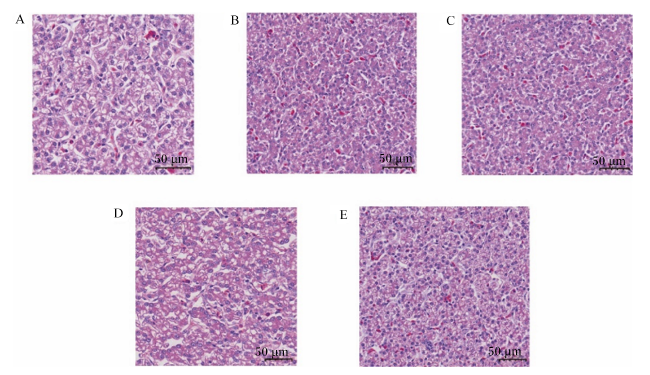
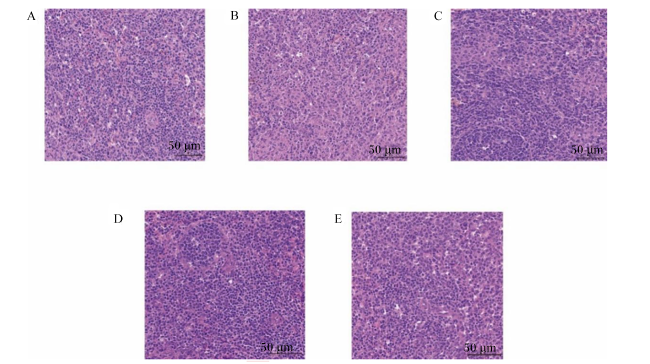
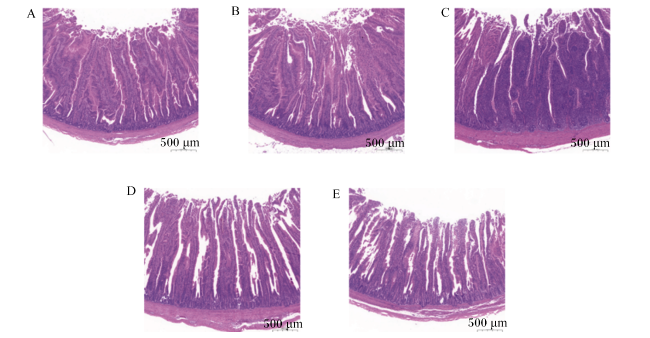
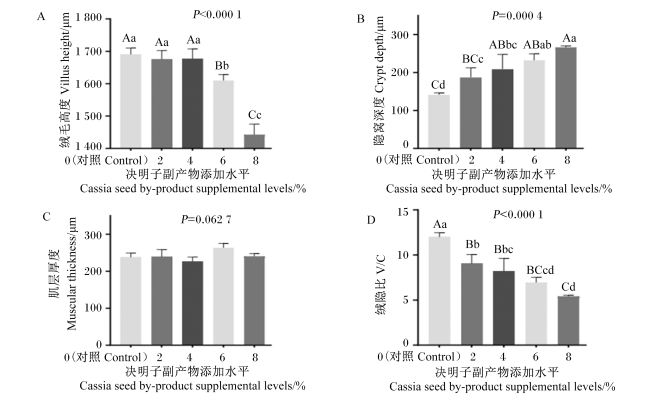
图1所示,与对照组相比,各试验组北京鸭肝细胞大小一致、形态规则,细胞核清晰可见,未见明显病理性异常。如图2所示,与对照组相比,各试验组脾脏组织红髓、白髓结构清晰,未见明显病理性异常。如图3所示,与对照组相比,各试验组十二指肠组织绒毛上皮细胞的单层柱状上皮细胞排列规则有序,杯状细胞数量丰富,隐窝结构清晰,黏膜层及黏膜下层结构均正常。如图4所示,随着饲粮中决明子副产物添加水平的提高,北京鸭十二指肠绒毛高度和绒隐比呈现逐渐降低趋势,而隐窝深度呈现逐渐升高趋势。
图1 北京鸭肝脏组织切片

A:对照组;B:2%决明子副产物添加组;C:4%决明子副产物添加组;D:6%决明子副产物添加组;E:8%决明子副产物添加组。图2图3同。

Fig.1 Liver tissue sections of Pekin ducks (400×)

A: control group; B: 2% cassia by-product supplemental group; C: 4% cassia by-product supplemental group; D: 6% cassia by-product supplemental group; E: 8% cassia by-product supplemental group. The same as Fig.2 and Fig.3.

图2 北京鸭脾脏组织切片

Fig.2 Spleen tissue sections of Pekin ducks (400×)

图3 北京鸭十二指肠组织切片

Fig.3 Duodenal tissue sections of Pekin ducks (40×)

图4 决明子副产物对北京鸭十二指肠发育的影响

数据柱标注不同小写字母表示差异显著(P<0.05),不同大写字母表示差异极显著(P<0.01),无字母或相同小写字母表示差异不显著(P>0.05)。

Fig.4 Effects of cassia seed by-product on duodenum development of Peking ducks

Value columns with different small letters mean significant difference (P<0.05), and with different capital letters mean extremely significant difference (P<0.01), while with no letter or the same small letters mean no significant difference (P>0.05).

3 讨论

3.1 决明子副产物对北京鸭生长性能、屠宰性能和器官发育的影响

本试验中,在生长性能方面,北京鸭饲粮中添加2%决明子副产物对北京鸭各阶段终末体重、ADG和ADFI均无显著影响,但添加4%~8%决明子副产物对生长性能指标产生显著影响,尤其是8%决明子副产物添加组肉鸭21日龄体重仅约为对照组1/4;随着决明子副产物添加水平的提高,1~21日龄F/G呈现逐渐升高的趋势,而22~42日龄F/G呈现逐渐降低的趋势,这可能是由于随着肉鸭日龄的增大,对决明子副产物的耐受性增强,但是由于饲粮中添加4%~8%决明子副产物极显著降低了1~42日龄ADFI,因此饲粮中决明子副产物过量添加会严重限制肉鸭生长发育。同时,在屠宰性能和器官指数方面,4%~8%决明子副产物添加组肉鸭腿肌率、肝脏指数、肌胃指数和十二指肠指数高于对照组,这可能是由于前者肉鸭整体体重较小,在生长发育前期其蹆肌、肝脏和肌胃等器官相对重量较大所导致,而对照组肉鸭生长发育平衡,以上指标处于正常范围内。决明子作为传统中药,具有保肝、降血脂和抗氧化等功能[5]。本研究选用的决明子副产物中粗蛋白质含量为20.06%,在氨基酸组成上,组氨酸、赖氨酸、精氨酸和苏氨酸含量较高,但是决明子副产物中粗纤维含量也较高,这可能影响肉鸭肠道对营养物质的消化吸收。本试验中,随着饲粮中决明子副产物添加水平的提高,北京鸭腿肌率、肝脏指数和十二指肠指数呈现逐渐提高的趋势。在生长前期,肉鸭为支撑体重的迅速增长,蹆肌发育速度快于胸肌。肝脏是合成脂肪酸的主要器官,在鸭免疫和代谢过程中起着重要作用。十二指肠是消化和吸收营养物质的重要器官,可以释放激素促进肠道蠕动,进而促进肉鸭对饲粮中营养物质的消化吸收[16]。研究表明,决明子中的活性成分蒽醌类被证明对脂肪酶活性有一定的抑制作用,可预防高脂血症及肥胖等疾病[17]。本试验中,试验组北京鸭肝脏、脾脏和十二指肠的组织学观察未发现有明显病理性异常,但高水平添加组(添加6%及以上)肠绒毛高度降低,隐窝深度提高,原因可能是高水平添加组肉鸭体重下降,其小肠发育受限,对饲粮中营养物质的吸收功能降低,导致体重下降。脾脏结合了先天免疫系统和适应性免疫系统,是机体重要的免疫器官,能够抵抗细菌和真菌的入侵[18]。综上所述,饲粮中添加2%决明子副产物对肉鸭生长性能、屠宰性能和器官发育无显著影响,而饲粮中添加4%及以上决明子副产物对肉鸭生长性能造成负面影响,这可能是决明子副产物影响肠道对营养物质的消化吸收所致。

3.2 决明子副产物对北京鸭血清生化、抗氧化和免疫指标的影响

血清生化指标可以很好地反映动物机体代谢和健康状况。胆固醇是血脂的重要组成成分之一,动物肝脏合成胆固醇并分泌至血液,其血清含量可作为脂代谢的指标[19]。血液胆固醇含量过高会导致心血管疾病,而小肠吸收的胆固醇会负反馈调节肝脏胆固醇的生成,所以血液胆固醇含量过高会抑制肝脏胆固醇的合成[20]。本试验发现,北京鸭血清TC含量随着饲粮中决明子副产物添加水平的提高呈现降低趋势,说明决明子副产物具有降低肉鸭机体胆固醇水平的作用。邓楠等[21]研究发现,决明子可以较好地调节高脂血症大鼠的血脂,从而达到良好的降脂作用。胆红素是血红蛋白的分解代谢产物,主要通过肝脏摄取代谢后经胆汁排泄,胆红素在体外可以有效地清除均相溶液或多层脂质体中产生的过氧自由基[22]。本试验中,饲粮中添加4%及以上决明子副产物极显著提高北京鸭血清TBIL含量,TBIL是评估肉鸭肝脏功能是否受损的重要指标,肝脏受损后血清TBIL含量升高[23-24]。ALT作为肝细胞内的重要酶类,其活性的变化同样与肝脏功能息息相关,当肝脏功能受到损伤时,血清ALT活性均会升高[25]
饲粮中添加8%决明子副产物极显著提高北京鸭血清ALT活性,说明饲粮中添加4%~8%决明子副产物会对肉鸭肝脏产生损伤。研究表明,决明子提取物通过改善脂质积累、肠道屏障损伤、肝脏损伤及炎症,对高脂饮食诱导的肝脏损伤具有保护作用[26];然而,Yang等[27]研究表明,高剂量决明子水提取物小鼠肝脏存在肝毒性,这与本试验结果相似。
动物体内过量的活性氧可能会损伤脂质、蛋白质等细胞组分,而抗氧化剂具有保护生物体的重要作用[28]。决明子中富含蒽醌类、萘并吡喃酮类以及多糖类等多种生物活性成分,均具有抗氧化活性,是一种天然的抗氧化剂[29]。血清T-AOC、SOD活性以及MDA含量等指标能反映机体抗氧化性能。本试验中,与对照组相比,北京鸭血清SOD活性随着决明子副产物添加水平的提高呈现先升高后降低的趋势;饲粮中添加2%决明子副产物有降低血清MDA含量的趋势;饲粮中添加8%决明子副产物极显著提高血清GR活性。罗先钦等[30]研究发现,决明子提取物中的主要成分蒽醌能够降低酒精性脂肪肝模型大鼠血清MDA含量,提高血清SOD活性,促进氧化与抗氧化机制之间保持平衡。GR是人体氧化还原体系中最为重要的酶之一,在各类肝脏疾病中都有明显的伴随性升高[31]。本研究结果表明,饲粮中添加2%决明子副产物对北京鸭血清抗氧化指标无显著影响。
本试验中,随着饲粮中决明子副产物添加水平的提高,北京鸭血清IgA、C3和IL-2含量均呈现升高的趋势。IgA通过与特异性受体和免疫介质的相互作用介导多种保护功能,是抵御病菌入侵的第一道防线[32]。C3主要由肝脏产生,病原体携带共价附着的C3进入细胞内,会触发即时的信号传导和效应反应[33]。在细胞质中感知到C3会激活线粒体抗病毒信号蛋白(MAVS)依赖的信号级联,并诱导促炎细胞因子的分泌;C3还能标记病毒以快速被蛋白酶体降解,从而防止它们的复制[34]。本试验结果表明,饲粮中添加8%决明子副产物后肉鸭体内存在炎症反应。在鸡自身免疫性甲状腺炎模型上的研究结果显示,分泌IL-2的T淋巴细胞具有促进自身免疫的作用[35]。本研究结果表明,饲粮中添加适宜水平的决明子副产物可提高北京鸭血清IgM和IgA含量,提高机体免疫性能;然而血清IL-2和C3含量提高,则说明肉鸭的肝脏受到损失,体内发生了一定的炎症反应。

4 结论

饲粮中添加2%决明子副产物对北京鸭生长性能、屠宰性能和器官发育无显著影响,而添加4%及以上的决明子副产物对免疫功能、肝脏功能、肠道形态以及生长性能均有负面影响。综上所述,建议生产过程中肉鸭饲粮中决明子副产物添加水平不宜超过2%。
[1]
丁雅婷, 肖琼, 翁惠芬, 等. 决明胶功能性质及其在食品中的应用[J]. 食品与发酵工业, 2024, 50(8):374-384.

DOI

DING Y T, XIAO Q, WENG H F, et al. Functional properties of cassia gum and its application in food[J]. Food and Fermentation Industries, 2024, 50(8):374-384. (in Chinese)

DOI

[2]
翟俊杰, 郭梦茹, 蒋倩倩, 等. 决明子本草考证[J]. 辽宁中医药大学学报, 2024, 26(6):166-171.

ZHAI J J, GUO M R, JIANG Q Q, et al. Textual research of Juemingzi (cassiae semen)[J]. Journal of Liaoning University of Traditional Chinese Medicine, 2024, 26(6):166-171. (in Chinese)

[3]
毛琳, 余黎, 许增智, 等. 决明子的药理学作用及其在食品领域应用研究进展[J]. 食品工业科技, 2024, 45(16):425-438.

MAO L, YU L, XU Z Z, et al. Research progress on the pharmacological effects and applications in the field of food of cassiae semen[J]. Science and Technology of Food Industry, 2024, 45(16):425-438. (in Chinese)

[4]
CHEN Y Y, CHEN X X, YANG X Y, et al. Cassiae semen: a comprehensive review of botany, traditional use,phytochemistry,pharmacology,toxicity,and quality control[J]. Journal of Ethnopharmacology, 2023,306:116199.

[5]
韩立强, 刘建华, 杨国宇, 等. 不同提取方法对决明子蒽醌类成分及抗氧化活性的影响[J]. 江苏农业科学, 2007(6):255-258.

HAN L Q, LIU J H, YANG G Y, et al. Effects of different extraction methods on anthraquinone content and antioxidant activities of semen cassiae[J]. Jiangsu Agricultural Sciences, 2007(6):255-258. (in Chinese)

[6]
董玉洁, 蒋沅岐, 刘毅, 等. 决明子的化学成分、药理作用及质量标志物预测分析[J]. 中草药, 2021, 52(9):2719-2732.

DONG Y J, JIANG Y Q, LIU Y, et al. Research progress on chemical composition and pharmacological effects of cassiae semen and predictive analysis on quality markers[J]. Chinese Traditional and Herbal Drugs, 2021, 52(9):2719-2732. (in Chinese)

[7]
陈志宝, 张爱忠, 姜宁. 山楂、决明子对贵妃鸡某些血液生化指标的影响[J]. 畜牧与饲料科学, 2004(3):14-15.

CHEN Z B, ZHANG A Z, JIANG N, et al. Effect of hawthorn and cassia seeds on some blood biochemical indexes of Guifei chicken[J]. Animal Husbandry and Feed Science, 2004(3):14-15. (in Chinese).

[8]
裴旺胜. 中西医结合治疗牛角膜结膜炎[J]. 甘肃畜牧兽医, 2020, 50(3):38-39.

PEI W S. Integrated traditional Chinese and western medicine for the treatment of bovine keratoconjunctivitis[J]. Gansu Animal and Veterinary Sciences, 2020, 50(3):38-39. (in Chinese)

[9]
侯水生, 刘灵芝. 2023年水禽产业与技术发展报告[J]. 中国畜牧杂志, 2024, 60(3):318-321.

HOU S S, LIU L Z. 2023 waterfowl industry and technology development report[J]. Chinese Journal of Animal Science,2024, 60(3):318-321. (in Chinese)

[10]
侯水生, 刘灵芝. 2022年水禽产业现状、未来发展趋势与建议[J]. 中国畜牧杂志, 2023, 59(3):274-280.

HOU S S, LIU L Z. 2022 waterfowl industry and technology development report[J]. Chinese Journal of Animal Science,2023, 59(3):274-280. (in Chinese)

[11]
薄会滨. 规模化肉鸭场常见多发病防控措施分析[J]. 家禽科学, 2020(11):41-42.

BO H B. Analysis on prevention and control measures of common frequently-occurring diseases in large-scale meat duck farms[J]. Poultry Science, 2020(11):41-42. (in Chinese)

[12]
陶迎泰, 郭清毅, 陈芳, 等. 中药产业化过程中固体副产物的综合利用研究进展[J]. 中国中医药信息杂志, 2024, 31(3):174-179.

TAO Y T, GUO Q Y, CHEN F, et al. Research progress in comprehensive utilization of solid by-products in the process of industrialization of Chinese materia medica[J]. Chinese Journal of Information on Traditional Chinese Medicine, 2024, 31(3):174-179. (in Chinese)

[13]
王惠, 张洋, 谢妮, 等. 添加中药副产发酵剂对麻鸭产蛋水平的影响[J]. 中国畜禽种业, 2021, 17(1):177-178.

WANG H, ZHANG Y, XIE N, et al. Effect of adding traditional Chinese medicine by-product fermentation agents on the egg production level of muscovy ducks[J]. The Chinese Livestock and Poultry Breeding, 2021, 17(1):177-178. (in Chinese)

[14]
陈雨芹. 中草药副产物的饲料化应用及对育肥猪生长性能、屠宰性能和经济效益的影响[J]. 中国饲料, 2023(16):126-129.

CHEN Y Q. The feed application of Chinese herbal by products and their effects on the growth performance,slaughtering performance,and economic benefits of fattening pigs[J]. China Feed, 2023(16):126-129. (in Chinese)

[15]
王涛. 决明子多糖提取工艺研究[J]. 轻工标准与质量, 2014(2):49-51.

WANG T. Study on extraction technology of polysaccharide from cassia seed[J]. Standard & Quality of Light Industry, 2014(02):49-51. (in Chinese)

[16]
陈枭枭, 杨舒展, 陈浩祥, 等. 白术多糖对脂多糖处理下雏鹅十二指肠肠道屏障功能的调节作用[J]. 动物营养学报, 2024, 36(2):981-994.

DOI

CHEN X X, YANG S Z, CHEN H X, et al. Regulation effects of polysaccharide of Atractylodes macrocephala koidz on intestinal barrier function in duodenum of goslings treated with lipopolysaccharide[J]. Chinese Journal of Animal Nutrition, 2024, 36(2):981-994. (in Chinese)

[17]
陈虹, 卢祎, 周梦娣, 等. 决明子蒽醌提取物对脂肪酶的抑制作用[J]. 药物生物技术, 2015, 22(6):492-495.

CHEN H, LU Y, ZHOU M D, et al. Inhibitory effect of anthraquinones derived from Cassia obtusifolia L. on lipase[J]. Chinese Journal of Pharmaceutical Biotechnology, 2015, 22(6):492-495. (in Chinese)

[18]
MEBIUS R E, KRAAL G. Structure and function of the spleen[J]. Nature Reviews:Immunology, 2005, 5(8):606-616.

[19]
CAPONIO G R, WANG D Q H, DI CIAULA A, et al. Regulation of cholesterol metabolism by bioactive components of soy proteins: novel translational evidence[J]. International Journal of Molecular Sciences, 2020, 22(1):227.

[20]
ADMIRAND W H, SMALL D M. The physicochemical basis of cholesterol gallstone formation in man[J]. The Journal of Clinical Investigation, 1968, 47(5):1043-1052.

[21]
邓楠, 余胜, 刘文, 等. 决明子调脂作用的代谢组学研究[J]. 中国现代医学杂志, 2016, 26(8):7-10.

DENG N, YU S, LIU W, et al. Metabonomic study on lipid regulative effect of cassia[J]. China Journal of Modern Medicine, 2016, 26(8):7-10. (in Chinese)

[22]
STOCKER R, YAMAMOTO Y, MCDONAGH A F, et al. Bilirubin is an antioxidant of possible physiological importance[J]. Science, 1987, 235(4792):1043-1046.

DOI PMID

[23]
JIN S J, YANG H, WANG Y J, et al. Dietary curcumin alleviated aflatoxin B1-induced acute liver damage in ducks by regulating NLRP3-Caspase-1 signaling pathways[J]. Foods, 2021, 10(12):3086.

[24]
SENIOR J R. Alanine aminotransferase:a clinical and regulatory tool for detecting liver injury-past,present,and future[J]. Clinical Pharmacology and Therapeutics, 2012, 92(3):332-339.

[25]
CHAO D T, LIM J K, AYOUB W S, et al. Systematic review with Meta-analysis:the proportion of chronic hepatitis B patients with normal alanine transaminase≤40 IU/L and significant hepatic fibrosis[J]. Alimentary Pharmacology & Therapeutics, 2014, 39(4):349-358.

[26]
LUO H Y, WU H W, WANG L X, et al. Hepatoprotective effects of cassiae semen on mice with non-alcoholic fatty liver disease based on gut microbiota[J]. Communications Biology, 2021, 4(1):1357.

DOI PMID

[27]
YANG J L, ZHU A, XIAO S, et al. Anthraquinones in the aqueous extract of cassiae semen cause liver injury in rats through lipid metabolism disorder[J]. Phytomedicine, 2019,64:153059.

[28]
QIAN Z J, RYU B M, KIM M M, et al. Free radical and reactive oxygen species scavenging activities of the extracts from seahorse,Hippocampus kuda Bleeler[J]. Biotechnology and Bioprocess Engineering, 2008, 13(6):705-715.

[29]
WU D T, LIU W, HAN Q H, et al. Extraction optimization,structural characterization,and antioxidant activities of polysaccharides from cassia seed (Cassia obtusifolia)[J]. Molecules, 2019, 24(15):2817.

[30]
罗先钦, 徐晓玉, 黄崇刚, 等. 决明子总蒽醌对酒精性脂肪肝大鼠肝组织脂质过氧化与PPAR-γ表达的影响[J]. 中国中药杂志, 2011, 36(12):1654-1659.

LUO X Q, XU X Y, HUANG C G, et al. Experiment study of total anthraquinone in cassiae semen on lipid peroxidation and PPAR-gamma expression in liver tissues of rats with alcoholic fatty liver[J]. China Journal of Chinese Materia Medica, 2011, 36(12):1654-1659. (in Chinese)

[31]
KUMATA H, WAKUI K, SUZUKI H, et al. Glutathione reductase activity in serum and liver tissue of human and rat with hepatic damage[J]. The Tohoku Journal of Experimental Medicine, 1975, 116(2):127-132.

[32]
WOOF J M, KERR M A. The function of immunoglobulin A in immunity[J]. The Journal of Pathology, 2006, 208(2):270-282.

[33]
COPENHAVER M, YU C Y, HOFFMAN R P. Complement components,C3 and C4,and the metabolic syndrome[J]. Current Diabetes Reviews, 2019, 15(1):44-48.

[34]
TAM J C H, BIDGOOD S R, MCEWAN W A, et al. Intracellular sensing of complement C3 activates cell autonomous immunity[J]. Science, 2014, 345(6201):1256070.

[35]
POL J G, CAUDANA P, PAILLET J, et al. Effects of interleukin-2 in immunostimulation and immunosuppression[J]. Journal of Experimental Medicine, 2020, 217(1):e20191247.

Outlines

/