RESEARCH PAPER

Effects of Different Sources of Functional Oligosaccharides on Rumen Fermentation Gas Production Parameters, Fermentation Parameters and Microbiota of Dairy Cows in Vitro

  • GUO Yunfang , 1, 2 ,
  • CHANG Shuaifei 1, * ,
  • CHENG Yuchen 1 ,
  • LI Caiqin 1 ,
  • LIU Xiaonv 1 ,
  • XU Xiaofeng , 1, ** ,
  • ZHANG Lili , 1, **
Expand
  • 1 College of Animal Science and Technology, Ningxia University, Yinchuan 750021, China
  • 2 Animal Husbandry and Veterinary Centre of Zhuanglang County, Pingliang 744000, China
** XU Xiaofeng, professor, E-mail: ;
ZHANG Lili, associate professor, E-mail:

* Contributed equally

Received date: 2024-06-26

  Online published: 2025-01-10

Abstract

This experiment was conducted to study the effects of different sources of functional oligosaccharides on rumen fermentation gas production parameters, fermentation parameters and microbiota of dairy cows in vitro. Using alfalfa hay as fermentation substrate, soybean oligosaccharide, chitosan oligosaccharide and mannan oligosaccharide were selected and supplemented with 0 (control), 0.5%, 1.5% and 3.0%, respectively, with 6 replicates per treatment. The results showed as follows: 1) the rapid gas production fraction of rumen fermentation at 48 h in vitro was significantly higher in the order of mannan oligosaccharide<soybean oligosaccharide<chitosan oligosaccharide (P<0.05), the slow gas production fraction and potential gas production were significantly higher in the order of chitosan oligosaccharide<mannan oligosaccharide<soybean oligosaccharide (P<0.05), and the gas production rate was significantly higher in the order of chitosan oligosaccharide<soybean oligosaccharide<mannan oligosaccharides (P<0.05). The slow gas production fraction, gas production rate and potential gas production of the three oligosaccharides were significantly higher than those of the control treatment when the addition level was 3.0% (P<0.05), while the rapid gas production fraction was significantly lower than that of the control treatment (P<0.05). 2) The addition level of the three oligosaccharides significantly affected the total volatile fatty acid (TVFA) and ammoniacal nitrogen (NH3-N) contents in rumen fermentation in vitro (P<0.05), and the TVFA content was the highest and the NH3-N content was the lowest when the addition level was 3.0%, which were significantly higher (or lower) than that of the control treatment and the 0.5% addition level treatment (P<0.05). 3) Compared with control treatment, the addition of 3.0% soybean oligosaccharide and 3.0% chitosan oligosaccharide significantly increased the Shannon index of microbiota in rumen fermentation in vitro (P<0.05); the addition of 3.0% chitosan oligosaccharide and 3.0% mannan oligosaccharide significantly increased the Firmicutes relative abundance (P<0.05), and significantly decreased the Proteobacteria relative abundance (P<0.05); the addition of 3.0% soybean oligosaccharide and 3.0% chitosan oligosaccharide significantly increased the Bacteroidetes relative abundance (P<0.05); the addition of 3.0% three oligosaccharides significantly decreased the Escherichia-Shigella relative abundance (P<0.05), the addition of 3.0% soybean oligosaccharide significantly increased the relative abundances of Streptococcus and Citrobacter (P<0.05), the addition of 3.0% chitosan oligosaccharide significantly increased the Selenomonas_1 relative abundance (P<0.05), and the addition of 3.0% mannan oligosaccharide significantly increased the relative abundances of Ruminococcus, Streptococcus and Christensenellaceae_R-7_group (P<0.05). In conclusion, under the conditions of this experiment, the addition of functional oligosaccharides from different sources has certain effects on rumen fermentation mode and volatile fatty acid production in vitro, and the rumen fermentation efficiency is increased in a dose-dependent trend. The addition of 3.0% soybean oligosaccharide, chitosan oligosaccharide and mannan oligosaccharide can increase the relative abundances of some fiber degrading bacteria and starch degrading bacteria, which is conducive to increasing the contents of acetic acid and propionic acid in fermentation broth, improving energy utilization efficiency, and decreasing the relative abundances of some harmful bacteria.

Cite this article

GUO Yunfang , CHANG Shuaifei , CHENG Yuchen , LI Caiqin , LIU Xiaonv , XU Xiaofeng , ZHANG Lili . Effects of Different Sources of Functional Oligosaccharides on Rumen Fermentation Gas Production Parameters, Fermentation Parameters and Microbiota of Dairy Cows in Vitro[J]. Chinese Journal of Animal Nutrition, 2025 , 37(1) : 426 -439 . DOI: 10.12418/CJAN2025.037

功能性寡糖包括壳寡糖(chitosan oligosaccharide,COS)、木寡糖、果寡糖、大豆寡糖(soybean oligosaccharide,SBOS)、甘露寡糖(mannan oligosaccharide,MOS)及低聚半乳糖等[1]。功能性寡糖在机体内很难被吸收,近年来,功能性寡糖在单胃动物上开展了大量研究,其有利于改善动物消化道微生态区系,增强动物免疫和抗氧化能力,降低动物发病率[2-4]。功能性寡糖对反刍动物的影响有别于单胃动物,外源寡糖在反刍动物营养研究起步较晚,从目前研究来看,功能性寡糖在调控瘤胃发酵参数和菌群以及有机物质消化方面发挥一定作用,但结果不尽相同[5-6]。相比于其他寡糖,甘露寡糖、大豆寡糖和壳寡糖具备较强的对瘤胃微生物的调节能力,是当前反刍动物营养调控中研究较多的功能性寡糖。甘露寡糖对瘤胃球菌具备较强的调节能力,徐晓锋等[7]研究表明,甘露寡糖可以显著提高低乳脂奶牛瘤胃球菌属(Ruminococcus)的相对丰度;马秀花等[8]研究表明,在荞麦秸秆饲粮中添加甘露寡糖可以显著提高滩羊瘤胃球菌属的相对丰度。棉子糖是大豆寡糖的主要成分之一,Basu等[9]研究表明,拟杆菌属(Bacteroides)编码大量参与棉子糖水解的多糖结合位点,棉子糖能够通过促进BT1871 mRNA的转录来改善拟杆菌属生长。Seankamsorn等[10]研究表明,奶牛饲粮中添加2%的壳寡糖可以提高瘤胃丙酸比例,降低甲烷产量;He等[11]研究表明,在湘西黄牛的体外瘤胃发酵过程中添加壳寡糖,可以显著提高干物质、粗蛋白质、粗脂肪和酸性洗涤纤维的消化率,并提高瘤胃球菌属和产甲烷菌属(Methanogenium)的相对丰度。以上研究结果为反刍动物的瘤胃发酵提供了理论基础,但关于3种寡糖之间的瘤胃发酵产气参数、发酵参数以及微生物区系的比较数据不足,对优化瘤胃功能的影响尚缺乏指导。因此,本研究选取上述3种功能性寡糖作为来源,通过体外瘤胃发酵,综合比较分析不同来源功能性寡糖对反刍动物瘤胃微生物发酵的影响,旨在为进一步发挥功能性寡糖在反刍动物上的应用潜力提供理论支撑。

1 材料与方法

1.1 试验材料

本试验使用的功能性寡糖分别为甘露寡糖、壳寡糖和大豆寡糖,均为食品级,有效成分含量在98%以上。缓冲液参考Menke等[12]的方法进行配制,持续通入饱和二氧化碳(CO2)使颜色变成无色透明,置于39 ℃水浴中预热备用。瘤胃液供体为3头体况[体况评分为(3.0±0.3),使用5分制[13])和年龄[(4.2±1.5)岁]相近的装有瘤胃瘘管的健康荷斯坦干奶期奶牛(动物试验伦理批准编号:NXU-2024-145;审批机构名称:宁夏大学科技伦理委员会),其饲粮组成及营养水平见表1。瘤胃液于晨饲前采集,经4层纱布过滤后装入39 ℃预热的保温瓶中,迅速带回实验室。按照1:2的比例将瘤胃液与缓冲液混合,配制发酵液。体外瘤胃培养底物为苜蓿干草,其营养成分见表2,在65 ℃环境下烘48 h,烘干后粉碎过筛,密封保存备用。
表1 饲粮组成及营养水平(干物质基础)

Table 1 Composition and nutrient levels of the diet (DM basis) %

项目Items 含量Content
原料Ingredients
玉米青贮Corn silage 45.06
苜蓿青贮Alfalfa silage 4.12
啤酒糟Brewer’s grains 1.53
蒸汽压片玉米Steam-flaked corn 22.50
苜蓿干草Alfalfa hay 10.32
浓缩料Concentrated feed1) 14.30
甜菜颗粒Beet granules 2.00
碳酸氢钠NaHCO3 0.17
合计Total 100.00
营养水平Nutrient levels
净能NE/(MJ/kg)2) 5.94
粗蛋白质CP 11.69
中性洗涤纤维NDF 47.32
酸性洗涤纤维ADF 30.74
粗脂肪EE 2.54
钙Ca 0.67
磷P 0.28

1)浓缩料的营养水平如下 The nutrient levels of concentrated feed were as follows:干物质 DM 87%,粗蛋白质 CP 29.5%,粗灰分 Ash 18%,粗纤维 CF 12%,Ca 1.5%,P 0.6%,氯化钠 NaCl 1.3%,赖氨酸 Lys 0.8%,VA 50 000 IU/kg,VD3 3 300 IU/kg,Mn 150 mg/kg,Fe 130 mg/kg,Zn 170 mg/kg,Cu 110 mg/kg,Se 4.1 mg/kg,I 4.7 mg/kg,Co 1.1 mg/kg。

2)净能参照NRC(2001)计算所得,其余为实测值。NE was calculated by reference to NRC (2001), while the others were measured values.

表2 苜蓿干草营养成分(风干基础)

Table 2 Nutrient composition of alfalfa hay (air-dry basis) %

项目
Item
干物质
DM
粗蛋白质
CP
粗脂肪
EE
粗灰分
Ash
中性洗涤纤维
NDF
酸性洗涤纤维
ADF
淀粉
Starch

Ca

P
苜蓿干草
Alfalfa hay
91.79 13.53 1.03 7.69 38.22 27.57 2.07 1.59 0.26

1.2 试验设计

采用完全随机试验设计,选取3种不同来源的功能性寡糖,每种功能性寡糖分别设不同添加水平[0(对照)、0.5%、1.5%和3.0%],每个处理设置6个重复。

1.3 测定指标及方法

1.3.1 营养成分的测定

干物质含量参考GB/T 6435—2014进行测定;粗蛋白质含量采用全自动凯氏定氮仪,参照GB/T 6432—2018进行测定;粗脂肪含量采用索氏提取法,参照GB/T 6433—2006进行测定;粗灰分、钙和磷含量分别参照GB/T 6438—2007、GB/T 6436—2018和GB/T 6437—2018进行测定;淀粉含量参照GB/T 20194—2018进行测定;中性洗涤纤维和酸性洗涤纤维含量分别参照GB/T 20806—2022和NY/T 1459—2022进行测定。

1.3.2 产气量的测定

玻璃注射器在放入恒温水浴锅之前进行读数,为0 h产气量;然后分别于3、6、9、12、24和48 h各时间点,通过玻璃注射器记录产气量。

1.3.3 产气动力学指标计算

利用CurveFitter软件,根据Ørskov等[14]的产气模型计算产气动力学指标。计算公式为:
GP=a+b(1-e-ct)。
式中:GP为产气量(mL);t为发酵时间(h);a为快速产气部分(mL);b为慢速产气部分(mL);cb的产气速度(%/h);a+b为潜在产气量(mL)。

1.3.4 发酵参数的测定

根据各时间点的产气量结果,选出最优时间节点(24 h)用于体外瘤胃发酵参数分析。在发酵结束后,立即将发酵液置于冰水中,取出5 mL样品,使用PHS-25便携式酸度计测定发酵液pH。将剩余发酵液分装后分别置于-20和-80 ℃冰箱保存,参照冯宗慈等[15]的方法采用比色法测定发酵液氨态氮(NH3-N)含量;参照王文基[16]的方法利用日本岛津GC-2030气相色谱仪测定瘤胃液挥发性脂肪酸(volatile fatty acid,VFA)含量。

1.3.5 微生物区系的测定

综合产气参数和体外发酵参数,选出最优时间节点(24 h)和最适添加量(3.0%)用于瘤胃微生物区系分析。采用南京建成生物工程研究所试剂盒提取发酵液总DNA,并采用琼脂糖凝胶电泳检测DNA样品的纯度和浓度。本试验DNA扩增目的片段为V3~V4区,引物序列为338F(5'-ACTCCTACGGGAGGCAGCA-3')和806R(5'-GGACTACHVGGGTWTCTAAT-3')。将PCR产物用浓度为2%的琼脂糖凝胶进行电泳检测;按照PCR产物浓度的结果进行等浓度混样,充分混匀后使用浓度为2%的琼脂糖凝胶进行电泳,检测PCR产物。将样品处理完成后送至广州基迪奥生物科技有限公司进行测序,采用NovaSeq 6000平台进行PE 250上机测序。

1.4 数据处理与分析

试验数据采用SPSS 26.0软件的Explore过程检验数据的正态分布和方差齐性,并采用一般线性模型(GLM)对数据进行两因素方差分析,统计模型如下:
xijk=μ+Ri+Vj+Pk+RiVj+Ri Pk+Vj Pk+Ri Vj Pkijk
式中:xijk为观测值;μ为总体平均值;Ri为批次i的影响;Vj为寡糖种类j的影响;Pk为寡糖添加水平k的影响;RiVj为批次i和寡糖种类j的交互作用;RiPk为批次i与寡糖添加水平k的交互作用;VjPk为寡糖种类j和寡糖添加水平k的交互作用;RiVjPk为批次i、寡糖种类j和寡糖添加水平k的交互作用;εijk为随机残差。
采用Tukey’s检验进行多重比较,试验结果数据以平均值和均值标准误(SEM)表示,P<0.05表示差异显著。

2 结果与分析

2.1 不同来源功能性寡糖对体外瘤胃发酵产气参数的影响

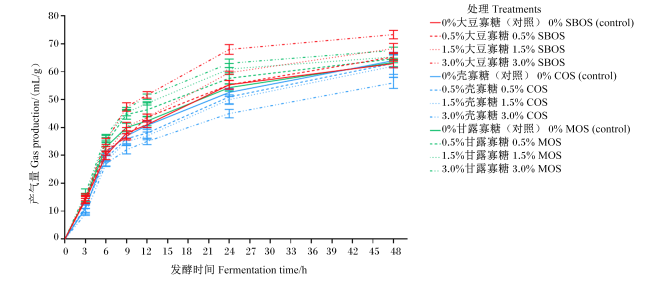
图1所示,不同种类和添加水平寡糖对体外瘤胃发酵产气量有明显影响。其中,大豆寡糖比壳寡糖和甘露寡糖表现出更高的产气量,且添加水平为3.0%时产气量最高;壳寡糖的产气量最低,且随着添加水平的提高,其24和48h累积产气量均逐渐降低。
图1 不同来源功能性寡糖对体外瘤胃发酵产气量的影响

Fig.1 Effects of different sources of functional oligosaccharides on gas production of rumen fermentation in vitro

表3可知,不同种类和添加水平寡糖对体外瘤胃发酵快速产气部分、慢速产气部分、产气速率和潜在产气量均有显著影响(P<0.05),且二者存在显著交互作用(P<0.05)。其中,快速产气部分按甘露寡糖<大豆寡糖<壳寡糖的顺序依次显著升高(P<0.05),慢速产气部分和潜在产气量按壳寡糖<甘露寡糖<大豆寡糖的顺序依次显著升高(P<0.05),产气速率按壳寡糖<大豆寡糖<甘露寡糖的顺序依次显著升高(P<0.05)。当添加水平为3.0%时,3种寡糖慢速产气部分、产气速率和潜在产气量均显著高于对照处理(P<0.05),而快速产气部分显著低于对照处理(P<0.05)。
表3 不同来源功能性寡糖对体外瘤胃发酵产气动力学指标的影响

Table 3 Effects of different sources of functional oligosaccharides on gas production kinetic indices of rumen fermentation in vitro

项目
Items
快速产气部分
a/mL
慢速产气部分
b/mL
产气速率
c/(%/h)
潜在产气量
a+b/mL
寡糖种类
Oligosaccharide types
添加水平
Addition levels/%
大豆寡糖SBOS 0 -0.39 62.69 0.10 62.30
0.5 0.08 64.46 0.10 64.54
1.5 -0.02 68.44 0.09 68.41
3.0 -1.57 75.60 0.11 74.04
壳寡糖COS 0 -0.52 63.20 0.09 62.68
0.5 0.17 61.79 0.09 61.96
1.5 0.30 60.88 0.08 61.17
3.0 -0.40 55.06 0.09 54.65
甘露寡糖MOS 0 -0.06 61.69 0.11 61.62
0.5 -0.94 64.40 0.12 63.46
1.5 -1.44 64.92 0.12 63.49
3.0 -1.26 68.67 0.13 67.41
均值标准误SEM 0.12 0.87 0.01 0.83
主效应Main effect
寡糖种类
Oligosaccharide types
大豆寡糖SBOS -0.48b 67.80a 0.10b 67.32a
壳寡糖COS -0.11a 60.23c 0.09c 60.12c
甘露寡糖MOS -0.93c 64.92b 0.12a 64.00b
SEM 0.12 0.87 0.01 0.83
添加水平
Addition levels/%
0 -0.33a 62.53c 0.09b 62.20c
0.5 -0.22a 63.54bc 0.10b 63.32bc
1.5 -0.39a 64.75ab 0.10b 64.35ab
3.0 -1.08b 66.44a 0.11a 65.57a
均值标准误SEM 0.12 0.87 0.01 0.83
PP-value
寡糖种类Oligosaccharide type <0.001 <0.001 <0.001 <0.001
添加水平Addition level <0.001 0.001 0.006 0.022
寡糖种类×添加水平Oligosaccharide type×addition level <0.001 <0.001 0.010 <0.001

同列数据肩标相同字母或无字母表示差异不显著(P>0.05),不同字母表示差异显著(P<0.05)。表4同。

In the same column, values with the same letter or no letter superscripts mean no significant difference (P>0.05), while with different letter superscripts mean significant difference (P<0.05). The same as Table 4.

2.2 不同来源功能性寡糖对体外瘤胃发酵参数的影响

表4可知,不同种类和添加水平寡糖对体外瘤胃发酵pH、乙丙比以及乙酸、丙酸和丁酸摩尔比均无显著影响(P>0.05),且二者无显著交互作用(P>0.05)。3种寡糖的添加水平显著影响体外瘤胃发酵总挥发性脂肪酸(TVFA)和NH3-N含量(P<0.05),当添加水平为3.0%时TVFA含量最高,NH3-N含量最低,显著高于(或低于)对照处理和0.5%添加水平处理(P<0.05)。
表4 不同来源功能性寡糖对体外瘤胃发酵参数(24 h)的影响

Table 4 Effects of different sources of functional oligosaccharides on rumen fermentation parameters in vitro (24 h)

项目
Items
pH 总挥发性
脂肪酸
TVFA/
(mmol/L)
占总挥发性脂肪酸的摩尔比
Molar percentage of TVFA/%
乙丙比
A/P
氨态氮
NH3-N/
(mg/dL)
乙酸
Acetic
acid
丙酸
Propionic
acid
丁酸
Butyrate
acid
寡糖种类
Oligosaccharide types
添加水平
Addition levels/%
大豆寡糖SBOS 0 6.96 84.90 69.94 23.00 7.07 3.05 14.61
0.5 7.14 90.60 68.41 22.84 8.76 3.01 14.49
1.5 7.11 90.80 68.55 23.33 8.09 2.95 14.19
3.0 7.01 101.30 67.55 24.65 7.79 2.74 14.37
壳寡糖COS 0 6.96 84.93 69.72 23.00 7.05 3.04 14.71
0.5 7.03 90.99 67.84 22.58 9.15 2.96 14.56
1.5 6.90 91.33 68.23 22.88 8.64 2.96 14.67
3.0 6.98 91.11 68.72 23.11 8.69 3.05 14.32
甘露寡糖MOS 0 7.13 78.00 68.09 24.40 7.44 2.79 14.85
0.5 7.11 88.21 69.01 24.32 6.64 2.84 14.94
1.5 7.14 91.03 68.91 24.46 7.47 2.93 14.51
3.0 7.16 93.50 68.16 22.76 9.44 3.05 14.19
均值标准误SEM 0.03 1.07 0.22 0.15 0.27 0.43 0.08
主效应Main effect
寡糖种类
Oligosaccharide
types
大豆寡糖SBOS 7.06 91.90 68.61 23.45 7.93 2.94 14.41
壳寡糖COS 6.97 89.59 68.63 22.89 8.38 3.00 14.57
甘露寡糖MOS 7.14 87.50 68.54 23.99 7.75 2.90 14.62
均值标准误SEM 0.03 1.07 0.22 0.15 0.27 0.43 0.08
添加水平
Addition levels/%
0 7.02 82.61c 69.25 23.47 7.18 2.96 14.72a
0.5 7.09 89.86b 68.42 23.25 8.18 2.94 14.67a
1.5 7.05 91.04ab 68.56 23.56 8.07 2.95 14.46ab
3.0 7.05 95.14a 68.14 23.51 8.64 2.95 14.29b
均值标准误SEM 0.03 1.07 0.22 0.15 0.27 0.43 0.08
PP-value
寡糖种类Oligosaccharide type 0.121 0.056 0.984 0.114 0.616 0.687 0.284
添加水平Addition level 0.873 <0.001 0.353 0.957 0.298 0.986 0.035
寡糖种类×添加水平
Oligosaccharide type×addition level
0.930 0.188 0.433 0.307 0.474 0.702 0.497

2.3 不同来源功能性寡糖对体外瘤胃发酵微生物区系的影响

2.3.1 α多样性分析

表5可知,各处理覆盖率均为99%,说明测序深度足够,测序结果真实可靠。与对照处理相比,添加3.0%大豆寡糖和3.0%壳寡糖显著提高Shannon指数(P<0.05),添加3.0%甘露寡糖也有提高Shannon指数的趋势,但差异不显著(P>0.05);添加3种功能性寡糖后,其他α多样性指数也有提高的趋势,但均无显著差异(P>0.05)。综合来看,壳寡糖处理体外瘤胃发酵微生物区系物种丰富度和多样性最高,其次为大豆寡糖和甘露寡糖处理,不同来源功能性寡糖对体外瘤胃发酵微生物区系的α多样性影响不同。
表5 不同来源功能性寡糖对体外瘤胃发酵微生物区系α多样性的影响

Table 5 Effects of different sources of functional oligosaccharides on microbial α diversity in rumen fermentation in vitro

项目
Items
处理Treatments 均值
标准误
SEM
P
P-value
对照
Control
3.0%
大豆寡糖
3.0% SBOS
3.0%
壳寡糖
3.0% COS
3.0%
甘露寡糖
3.0% MOS
覆盖率Coverage/% 99.00 99.00 99.00 99.00 <0.001 0.125
Ace指数Ace index 2 021.79 2 083.74 2 106.11 2 035.73 59.068 0.233
Chao1指数Chao1 index 1 877.85 1 833.86 1 964.01 1 930.98 78.378 0.050
Shannon指数Shannon index 5.66b 6.41a 6.42a 6.17ab 0.330 0.006
Simpson指数Simpson index 0.93 0.94 0.95 0.94 0.038 0.317

同行数据肩标相同字母或无字母表示差异不显著(P>0.05),不同字母表示差异显著(P<0.05)。表6表7同。

In the same row, values with the same letter or no letter superscript mean no significant difference (P>0.05), while with different letter superscripts mean significant difference (P<0.05). The same as Table 6 and Table 7.

2.3.2 β多样性分析

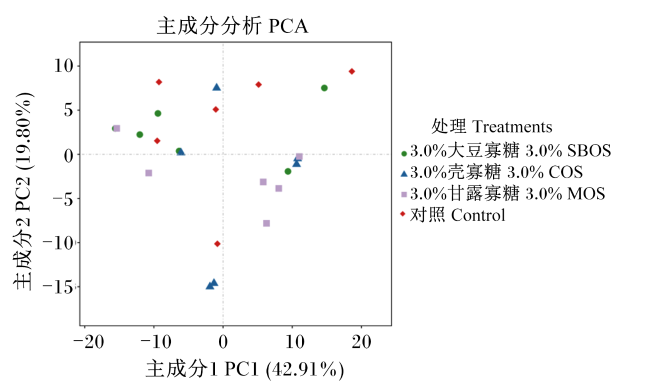
图2可知,主成分1的贡献率为42.91%,主成分2的贡献率为19.80%,各处理发酵液菌群组成相互重合,具有相似性。
图2 不同来源功能性寡糖对体外瘤胃发酵微生物区系β多样性的影响

Fig.2 Effects of different sources of functional oligosaccharides on microbial β diversity in rumen fermentation in vitro

2.3.3 不同来源功能性寡糖对体外瘤胃发酵微生物组成的影响

2.3.3.1 不同来源功能性寡糖对体外瘤胃发酵微生物在门水平上组成的影响

表6可知,与对照处理相比,添加3.0%大豆寡糖显著提高拟杆菌门(Bacteroidetes)与髌骨菌门(Patescibacteria)相对丰度(P<0.05),显著降低放线菌门(Actinobacteria)、Epsilonbacteraeota和软壁菌门(Tenericutes)相对丰度(P<0.05);添加3.0%壳寡糖显著提高厚壁菌门(Firmicutes)、拟杆菌门和髌骨菌门相对丰度(P<0.05),显著降低变形菌门(Proteobacteria)、广古菌门(Euryarchaeota)和放线菌门相对丰度(P<0.05);添加3.0%甘露寡糖显著提高厚壁菌门和髌骨菌门相对丰度(P<0.05),显著降低变形菌门和放线菌门相对丰度(P<0.05)。
表6 不同来源功能性寡糖对体外瘤胃发酵微生物在门水平上组成的影响

Table 6 Effects of different sources of functional oligosaccharides on microbiota composition of rumen fermentation in vitro at phylum level %

项目
Items
处理Treatments 均值
标准误
SEM
P
P-value
对照
Control
3.0%
大豆寡糖
3.0% SBOS
3.0%
壳寡糖
3.0% COS
3.0%
甘露寡糖
3.0% MOS
厚壁菌门Firmicutes 39.81b 41.39b 46.14a 46.53a 2.135 0.002
变形菌门Proteobacteria 28.78a 27.39a 19.41b 16.11b 2.038 0.001
拟杆菌门Bacteroidetes 17.10b 21.95a 23.78a 20.89ab 2.115 0.006
Epsilonbacteraeota 20.84a 15.50b 18.74ab 19.61ab 1.533 0.018
广古菌门Euryarchaeota 1.19a 0.90ab 0.52b 0.85ab 0.258 0.035
髌骨菌门Patescibacteria 0.80b 1.12a 1.18a 1.12a 0.220 0.040
软壁菌门Tenericutes 0.31a 0.16b 0.30a 0.26ab 0.065 0.004
放线菌门Actinobacteria 0.51a 0.20b 0.26b 0.27b 0.085 0.021

2.3.3.2 不同来源功能性寡糖对体外瘤胃发酵微生物在属水平上组成的影响

表7可知,与对照处理相比,添加3.0%大豆寡糖显著提高不动杆菌属(Acinetobacter)、链球菌属(Streptococcus)和柠檬酸杆菌属(Citrobacter)相对丰度(P<0.05),显著降低普雷沃氏菌属1(Prevotella_1)、普雷沃氏菌科UCG-003(Prevotellaceae_UCG-003)、克里斯滕森菌科R-7群(Christensenellaceae_R-7_group)、埃希氏-志贺氏菌属(Escherichia-Shigella)、库特氏菌属(Kurthia)和肠球菌属(Enterococcus)相对丰度(P<0.05);添加3.0%壳寡糖显著提高月形单胞菌属1(Selenomonas_1)和库特氏菌属相对丰度(P<0.05),显著降低埃希氏-志贺氏菌属相对丰度(P<0.05);添加3.0%甘露寡糖显著提高瘤胃球菌属、链球菌属和克里斯滕森菌科R-7群相对丰度(P<0.05),显著降低从毛单胞菌属(Comamonas)、埃希氏-志贺氏菌属、库特氏菌属、甲烷短杆菌属(Methanobrevibacter)和肠球菌属相对丰度(P<0.05)。
表7 不同来源功能性寡糖对体外瘤胃发酵微生物在属水平上组成的影响

Table 7 Effects of different sources of functional oligosaccharides on microbiota composition of rumen fermentation in vitro at genus level %

项目
Items
处理Treatments 均值
标准误
SEM
P
P-value
对照
Control
3.0%
大豆寡糖
3.0% SBOS
3.0%
壳寡糖
3.0% COS
3.0%
甘露寡糖
3.0% MOS
土壤芽孢杆菌属Solibacillus 13.56 18.55 17.86 13.56 3.123 0.427
弯曲菌属Campylobacter 16.44 19.32 16.07 16.30 3.390 0.594
普雷沃氏菌属1 Prevotella_1 10.95a 8.07b 11.31a 12.50a 1.385 0.007
普雷沃氏菌科UCG-001 Prevotellaceae_UCG-001 0.66ab 0.59b 0.53b 0.78a 0.108 0.008
普雷沃氏菌科UCG-003 Prevotellaceae_UCG-003 0.42a 0.30b 0.51a 0.42a 0.058 0.001
从毛单胞菌属Comamonas 20.00a 18.17a 14.84ab 10.15b 2.553 0.012
埃希氏-志贺氏菌属Escherichia-Shigella 10.18a 8.48b 8.05b 8.22b 0.645 0.014
赖氨酸芽孢杆菌属Lysinibacillus 10.25 9.17 11.75 8.41 3.018 0.637
解琥珀酸弧菌属Succiniclasticum 4.36ab 3.62b 5.23a 4.67ab 0.355 0.006
瘤胃球菌属Ruminococcus 2.98bc 2.72c 3.56ab 3.72a 0.130 0.009
理研菌科RC9肠道群
Rikenellaceae_RC9_gut_group
3.76 4.69 4.12 4.15 0.963 0.454
不动杆菌属Acinetobacter 1.70b 3.96a 1.52b 1.57b 0.655 0.005
链球菌属Streptococcus 3.15c 5.74b 3.81c 7.91a 0.565 <0.001
克里斯滕森菌科R-7群
Christensenellaceae_R-7_group
1.78b 0.95c 2.10ab 2.62a 0.478 0.001
月形单胞菌属1 Selenomonas_1 1.45b 1.29b 2.96a 1.44b 0.285 <0.001
库特氏菌属Kurthia 2.95b 1.60c 4.64a 1.38c 0.428 0.001
甲烷短杆菌属Methanobrevibacter 1.83a 1.70ab 1.85a 1.07b 0.415 0.012
柠檬酸杆菌属Citrobacter 0.23b 0.40a 0.21b 0.19b 0.103 0.045
脱硫弧菌属Desulfovibrio 0.30 0.30 0.42 0.43 0.115 0.251
肠球菌属Enterococcus 0.37a 0.09b 0.32a 0.09b 0.053 0.001
Proteiniclasticum 0.12 0.22 0.15 0.13 0.051 0.180

3 讨论

3.1 不同来源功能性寡糖对体外瘤胃发酵产气参数的影响

杨双鸣等[17]通过体外研究发现,不同处理的花棒体外瘤胃发酵的快速产气部分均为负值,存在产气滞后效应,其中对照处理花棒的产气最滞后。本试验中,随着3种寡糖添加水平的提高,快速产气部分呈显著降低变化,其中3.0%添加处理产气最滞后;而慢速产气部分呈显著提高变化,表明功能性寡糖需要一定的时间效应来调控微生物生长和发挥营养功能。王子平等[18]研究表明,饲粮中添加壳寡糖能够通过提高养分消化率来提高肉兔的生长性能。本试验中,大豆寡糖表现出比甘露寡糖和壳寡糖更高的累积产气量、慢速产气部分和潜在产气量。这可能与大豆寡糖的组成有关,大豆寡糖是由蔗糖、棉子糖、水苏糖组成的功能寡糖,杨航[19]研究表明,添加大豆寡糖可以显著提高肉鸡盲肠菌液的24 h体外累计产气量,且蔗糖和水苏糖的24 h累积产气量高于大豆寡糖。本试验中,添加甘露寡糖的产气速率最高,显著高于大豆寡糖和壳寡糖,表明甘露寡糖可通过提高纤维分解菌的活性和相对丰度(如瘤胃球菌)来促进瘤胃发酵。

3.2 不同来源功能性寡糖对体外瘤胃发酵参数的影响

pH是瘤胃发酵的重要参数之一,瘤胃内环境的稳定是瘤胃微生物发挥正常功能的重要前提[20]。大豆寡糖对瘤胃液pH有积极影响,侯瑞[21]研究表明一定剂量的大豆寡糖可以提高瘤胃液pH。
鞠九洲[22]研究表明,壳聚糖使肉仔鸡肠道pH呈降低趋势。酵母细胞壁中含有约30%的甘露寡糖,Garcia Diaz等[23]研究发现肉牛饲粮中添加酵母或甘露寡糖,可显著提高瘤胃液pH。马秀花等[8]研究发现,添加不同水平甘露寡糖后滩羊瘤胃液pH无显著差异。刘绘汇[24]研究表明,绵羊饲粮中添加甘露寡糖可显著提高瘤胃液pH。本试验中,随着3种寡糖添加水平的提高,体外瘤胃发酵液pH无显著变化。这可能由于:1)瘤胃微生物具有极强的多糖降解能力,可以分泌多样的糖苷水解酶参与某些糖类物质的降解,如壳寡糖;2)在体外培养液的配制过程中加入了大量缓冲液,抑制了pH的变化。
NH3-N含量能够间接反映瘤胃微生物分解饲粮蛋白质产生NH3-N和利用NH3-N合成微生物蛋白的平衡情况[25]。多数研究报道,添加大豆寡糖和甘露寡糖会降低NH3-N含量[26-27],本研究结果与上述研究结果一致,随着3种寡糖添加水平的提高,瘤胃NH3-N含量呈现显著降低变化,NH3-N含量降低之后瘤胃微生物蛋白合成效率会提高,有利于微生物蛋白的合成和氮代谢,提高氮利用率。
VFA是反刍动物瘤胃碳水化合物发酵的主要产物,提供了反刍动物吸收总能量的近2/3,VFA含量和比例之间的差异是反映瘤胃发酵和消化代谢的重要生理指标[28]。研究报道,大豆寡糖结构多样,呋喃环A和C型结构以及寡糖含量所占比例较高[29],瘤胃微生物糖苷酶作用于寡糖末端糖苷键后,能够更好地发挥寡糖的作用[30],进而提高VFA含量。Wang等[25]研究证实,添加大豆寡糖显著提高瘤胃TVFA含量。研究表明,壳寡糖能够显著提高瘤胃丙酸含量,但对TVFA含量和乙丙比影响的报道[31-33]不一致。Jana等[34]研究表明,甘露寡糖显著提高瘤胃TVFA、乙酸和丙酸含量以及乙丙比。本试验中,添加3种寡糖均显著提高了瘤胃液TVFA含量,且表现为明显剂量效应,但对各VFA摩尔比和乙丙比均未见显著影响。这可能与发酵底物有关,本试验仅使用苜蓿干草作为发酵底物,营养成分与上述试验有较大差异。

3.3 不同来源功能性寡糖对体外瘤胃发酵微生物区系的影响

厚壁菌门和拟杆菌门反刍动物瘤胃中相对丰度最高的菌门。厚壁菌门是参与瘤胃内纤维物质降解的主要菌门[35],目前对瘤胃中纤维素降解的研究主要集中在厚壁菌门中分离的少数菌株,即白色瘤胃球菌和黄色瘤胃球菌。拟杆菌门是促进碳水化合物分解的主要菌群,并且参与部分纤维物质降解[36]。Li等[37]研究表明,饲粮中添加壳寡糖可以显著提高荷斯坦犊牛瘤胃中厚壁菌门和拟杆菌门相对丰度。这与本试验结果一致,说明壳寡糖对饲粮纤维和非纤维物质利用均有积极作用。
广古菌门是瘤胃中主要的产甲烷菌[38],本研究中添加不同来源功能性寡糖均有降低广古菌门相对丰度的趋势,表明寡糖的添加有缓解甲烷排放的应用潜力。变形菌门常作为肠道微生物平衡的信号,其相对丰度提高说明肠道微生物可能存在失衡现象[39]。动物模型和体外发酵试验均表明,壳寡糖有抑制有害菌生长的益生作用[40],本试验结果进一步证实了这一观点,壳寡糖的添加可以显著降低发酵液中变形菌门相对丰度。放线菌门属于革兰氏阳性菌,其大部分属于腐生菌,也有少量寄生菌,有致病性[41]。本试验中,添加大豆寡糖、壳寡糖和甘露寡糖均显著降低了体外瘤胃发酵液放线菌门相对丰度,表明功能性寡糖可以调节肠道菌群结构,抑制有害菌增殖。普雷沃氏菌属是瘤胃内的主要淀粉降解菌,普雷沃氏菌属1是普雷沃氏菌属的主要类群[42],参与半纤维素和植物细胞壁的降解[43],普雷沃氏菌属1相对丰度的提高有利于植物纤维物质的分解和利用[44]。本试验结果表明,添加壳寡糖和甘露寡糖能够提高普雷沃氏菌属1相对丰度,有利于瘤胃淀粉和纤维物质的分解利用。解琥珀酸弧菌属(Succiniclasticum)是参与瘤胃碳水化合物代谢的重要菌属,其利用结构性碳水化合物能力强,可以高效降解纤维素或纤维二糖产生乙酸和琥珀酸等发酵产物[45-46]。郭婷婷[47]研究表明,高精料条件下给奶牛补饲甘露寡糖可显著提高解琥珀酸弧菌属相对丰度。本试验进一步证实了甘露寡糖对解琥珀酸弧菌属的积极影响,添加甘露寡糖可以提高解琥珀酸弧菌属相对丰度,有利于纤维物质降解并提高瘤胃乙酸含量。
瘤胃球菌不仅可以降解瘤胃中木质纤维素,而且在降解植物多糖,如木聚糖、淀粉等物质方面发挥着重要作用,主要发酵产物为琥珀酸和醋酸盐,还有少量甲酸盐以及微量乳酸和丙酮酸[48]。瘤胃球菌属的很多菌株(如黄色瘤胃球菌)都可以降解十分牢固的纤维素种类,如棉花纤维[49]。反刍动物瘤胃中有大量瘤胃球菌属来源于糖苷水解酶第48家族(GH48)基因序列,并且这些基因有丰富的多样性[50]。而GH48家族成员是外切葡聚糖酶的重要来源之一,可以通过和其他糖苷水解酶形成纤维小体或者自由酶体系2种方式来高效降解纤维素[51]。本试验中,添加甘露寡糖可以显著提高瘤胃球菌属相对丰度,表明甘露寡糖对瘤胃球菌属的增殖有明显的促进作用。徐晓锋等[7]和马秀花等[8]的研究证实了这一观点,在奶牛饲粮和滩羊饲粮中添加甘露寡糖均可以显著提高瘤胃球菌属相对丰度。理研菌科RC9肠道群隶属于理研菌科,主要降解淀粉和蛋白质,产生丙酸和琥珀酸[52]。本试验中,3种功能性寡糖的添加使理研菌科RC9肠道群相对丰度呈现上升趋势,这进一步证实了寡糖对提高能量利用效率的积极作用。

4 结论

在本试验条件下,添加不同来源功能性寡糖对体外瘤胃发酵模式和VFA生成均有一定影响,且呈剂量依赖趋势提高瘤胃发酵效率;添加3.0%大豆寡糖、壳寡糖和甘露寡糖能够提高部分纤维降解菌和淀粉降解菌的相对丰度,有利于提高发酵液中乙酸和丙酸含量,提高能量利用效率,同时降低部分有害菌相对丰度。
[1]
ZHAO P F, PIAO X S, ZENG Z K, et al. Effect of Forsythia suspensa extract and chito-oligosaccharide alone or in combination on performance,intestinal barrier function,antioxidant capacity and immune characteristics of weaned piglets[J]. Animal Science Journal, 2017, 88(6):854-862.

[2]
胡蝶, 阿拉腾珠拉, 程志钱, 等. 褐藻寡糖对肉鸡生长性能、免疫器官指数、血清抗氧化指标和肠道健康的影响[J]. 动物营养学报, 2024, 36(4):2331-2343.

DOI

HU D, A L T Z L, CHENG Z Q, et al. Effects of alginate oligosaccharide on growth performance,immune organ indices,serum antioxidant indices and intestinal health of broilers[J]. Chinese Journal of Animal Nutrition, 2024, 36(4):2331-2343. (in Chinese)

[3]
CHENG Y F, CHEN Y P, CHEN R, et al. Dietary mannan oligosaccharide ameliorates cyclic heat stress-induced damages on intestinal oxidative status and barrier integrity of broilers[J]. Poultry Science, 2019, 98(10):4767-4776.

DOI PMID

[4]
CHEN M, CHEN X Q, TIAN L X, et al. Beneficial impacts on growth, intestinal health, immune responses and ammonia resistance of pacific white shrimp (Litopenaeus vannamei) fed dietary synbiotic (mannan oligosaccharide and Bacillus licheniformis)[J]. Aquaculture Reports, 2020,17:100408.

[5]
李炯, 唐亚楠, 魏赜, 等. 果寡糖对哺乳羔羊营养物质表观消化率及粪便微生物菌群的影响[J]. 动物营养学报, 2024, 36(2):1096-1106.

DOI

LI J, TANG Y N, WEI Z, et al. Effects of fructooligosaccharides on apparent digestibility of nutrients and fecal microbial flora in suckling lambs[J]. Chinese Journal of Animal Nutrition, 2024, 36(2):1096-1106. (in Chinese)

DOI

[6]
张赛伟, 段春辉, 张昕妍, 等. 甘露寡糖对围产期湖羊母羊采食量、体重及血清生化指标的影响[J]. 动物营养学报, 2023, 35(3):1791-1802.

DOI

ZHANG S W, DUAN C H, ZHANG X Y, et al. Effects of mannan oligosaccharide on feed intake,body weight and serum biochemical indexes of perinatal Hu sheep ewes[J]. Chinese Journal of Animal Nutrition, 2023, 35(3):1791-1802. (in Chinese)

[7]
徐晓锋, 郭婷婷, 郭成, 等. 甘露寡糖对高精料诱导的低乳脂奶牛瘤胃细菌菌群调控的研究[J]. 动物营养学报, 2019, 31(11):5246-5256.

XU X F, GUO T T, GUO C, et al. Regulation of mannan oligosaccharides on rumen bacterial flora induced by high concentrate in low milk fat dairy cows[J]. Chinese Journal of Animal Nutrition, 2019, 31(11):5246-5256. (in Chinese)

[8]
马秀花, 桂瑞麒, 焦娜, 等. 荞麦秸秆饲粮条件下甘露寡糖对滩羊瘤胃菌群结构的影响[J]. 动物营养学报, 2021, 33(4):2365-2377.

DOI

MA X H, GUI R Q, JIAO N, et al. Effect of mannan oligosaccharides on rumen bacterial flora structure of tan sheep under buckwheat straw diet condition[J]. Chinese Journal of Animal Nutrition, 2021, 33(4):2365-2377. (in Chinese)

[9]
BASU A, ADAMS A N D, DEGNAN P H, et al. Determinants of raffinose family oligosaccharide use in Bacteroides species[J/OL]. Journal of Bacteriology:e00235-24.(2024-09-27)[2024-10-11]. https://journals.asm.org/doi/10.1128/jb.00235-24.

[10]
SEANKAMSORN A, CHERDTHONG A, WANAPAT M. Combining crude glycerin with chitosan can manipulate in vitro ruminal efficiency and inhibit methane synthesis[J]. Animals, 2019, 10(1):37.

[11]
HE J F, LI J, GAO Q, et al. In vitro evaluation of chito-oligosaccharides on disappearance rate of nutrients,rumen fermentation parameters,and micro-flora of beef cattle[J]. Animals, 2024, 14(11):1657.

[12]
MENKE K H, RAAB L, SALEWSKI A, et al. The estimation of the digestibility and metabolizable energy content of ruminant feedingstuffs from the gas production when they are incubated with rumen liquor in vitro[J]. The Journal of Agricultural Science, 1979,93:217-222.

[13]
FLORIDIA V, RUSSO N, D’ALESSANDRO E, et al. Effect of olive cake supplementation on faecal microbiota profile of Holstein and Modicana dairy cattle[J]. Microbiological Research, 2023,277:127510.

[14]
ØRSKOV E, MCDONALD I. The estimation of protein degradability in the rumen from incubation measurements weighted according to rate of passage[J]. Journal of Agricultural Sciences, 1979, 92(2):499-503.

[15]
冯宗慈, 高民. 通过比色测定瘤胃液氨氮含量方法的改进[J]. 畜牧与饲料科学, 2010(6):37.

FENG Z C, GAO M. Improvement of a colorimetric method for determination of ammonia nitrogen in rumen fluid[J]. Animal Husbandry and Feed Science, 2010(6):37. (in Chinese)

[16]
王文基. 饲粮能量水平对藏羊和小尾寒羊体外发酵特性及微生物区系的影响[D]. 硕士学位论文. 兰州: 兰州大学, 2019.

WANG W J. Effect of dietary energy level on in vitro fermentation characteristics,and microbial flora in Tibetan sheep and small-tailed Han sheep[D]. Master’s Thesis. Lanzhou: Lanzhou University, 2019. (in Chinese)

[17]
杨双鸣, 马煜斌, 田梅, 等. 体外产气法评价菌酶协同发酵对花棒瘤胃发酵特性的影响[J]. 动物营养学报, 2023, 35(11):7472-7480.

DOI

YANG S M, MA Y B, TIAN M, et al. Evaluation of effects of cooperative fermentation by bacteria and enzymes on rumen fermentation characteristics of Hedysarum scopariums by in vitro gas production method[J]. Chinese Journal of Animal Nutrition, 2023, 35(11):7472-7480. (in Chinese)

[18]
王子平, 尹达菲, 刘梅, 等. 饲粮中添加壳寡糖对肉兔生长性能、养分表观消化率、屠宰性能、血清生化指标及机体免疫功能的影响[J]. 动物营养学报, 2022, 34(12):8038-8048.

DOI

WANG ZI P, YIN D F, LIU M, et al. Effects of dietary chito oligosaccharides on growth performance,nutrient apparent digestibility,slaughter performance,serum biochemical indexes and body immune function of meat rabbits[J]. Chinese Journal of Animal Nutrition, 2022, 34(12):8038-8048. (in Chinese)

[19]
杨航. 大豆低聚糖及其功能组分对体外条件下肉仔鸡粪臭素产量及盲肠菌群组成的影响[D]. 硕士学位论文. 沈阳: 沈阳农业大学, 2017.

YANG H. In vitro effects of soybean oligosaccharide and its functional components on skatole production and cecal microbiota composition of broilers[D]. Master’s Thesis. Shenyang: Shenyang Agricultural University, 2017. (in Chinese)

[20]
张丽, 李川, 邱清华, 等. 不同pH下瘤胃微生物菌群密度及理化特性的变化[J]. 动物营养学报, 2023, 35(1):450-459.

DOI

ZHANG L, LI C, QIU Q H, et al. Changes of rumen microbiota density and physicochemical properties at different pH[J]. Chinese Journal of Animal Nutrition, 2023, 35(1):450-459. (in Chinese)

DOI

[21]
侯瑞. 菊糖和大豆寡糖对体外条件下肉仔鸡粪臭素产量及肠道菌群的影响[D]. 硕士学位论文. 沈阳: 沈阳农业大学, 2015.

HOU R. Effects of inulin and soybean oligosaccharides on faecal odourant production and intestinal flora of broiler chicks under in vitro conditions[D]. Master’s Thesis. Shenyang: Shenyang Agricultural University, 2015. (in Chinese)

[22]
鞠九洲. 应用Rusitec系统研究壳聚糖对瘤胃甲烷产生及发酵特性的影响[D]. 硕士学位论文. 兰州: 甘肃农业大学, 2013.

JU J Z. Effects of chitosan on rumen methane production and fermentation characteristics using the rumen simulation technique (Rusitec)[D]. Master’s Thesis. Lanzhou: Gansu Agricultural University, 2013. (in Chinese)

[23]
GARCIA DIAZ T, FERRIANI BRANCO A, JACOVACI F A, et al. Use of live yeast and mannan-oligosaccharides in grain-based diets for cattle:ruminal parameters,nutrient digestibility,and inflammatory response[J]. PLoS One, 2018, 13(11):e0207127.

[24]
刘绘汇. 饲粮中添加甘露寡糖对湖羊生长和屠宰性能、胃肠道组织形态及微生物区系的影响[D]. 硕士学位论文. 兰州: 甘肃农业大学, 2021.

LIU H H. Effects of adding mannan oligosaccharide on growth and slaughter performance,gastrointestinal histological morphology and microflora of Hu sheep[D]. Master’s Thesis. Lanzhou: Gansu Agricultural University, 2021. (in Chinese)

[25]
WANG L J, LIU Y, LIU S, et al. Effect of soybean peptides on in vitro ruminal fermentation and microbial population[J]. Journal of Northeast Agricultural University (English Edition), 2017, 24(4):40-52.

[26]
李朝云. 壳聚糖与纤维素酶对瘤胃发酵、甲烷产生及微生物区系的影响[D]. 博士学位论文. 杨凌: 西北农林科技大学, 2014.

LI C Y. Effects of chitosan and exogenous fibrolytic enzymes on in vitro ruminal fermentation,methane production and microorganism populations[D]. Ph.D.Thesis. Yangling: Northwest A&F University, 2014. (in Chinese)

[27]
ZHENG C, MA J J, LIU T, et al. Effects of mannan oligosaccharides on gas emission,protein and energy utilization,and fasting metabolism in sheep[J]. Animals, 2019, 9(10):741.

[28]
刘依莎, 张巧娥, 许迟, 等. 发酵玉米芯对肉牛生长性能、瘤胃发酵参数及菌群的影响[J]. 动物营养学报, 2024, 36(2):1039-1049.

DOI

LIU Y S, ZHANG Q E, XU C, et al. Effects of fermented corn cob on growth performance,rumen fermentation parameters and microflora of beef cattle[J]. Chinese Journal of Animal Nutrition, 2024, 36(2):1039-1049. (in Chinese)

[29]
徐淼, 付美业, 景寒松, 等. 不同来源大豆寡糖的形态特征、功能组分含量和分子结构的比较研究[J]. 动物营养学报, 2022, 34(8):5404-5414.

DOI

XU M, FU M Y, JING H S, et al. Comparative study on morphological characteristics,functional component content and molecular structure of soybean oligosaccharides from different sources[J]. Chinese Journal of Animal Nutrition, 2022, 34(8):5404-5414. (in Chinese)

[30]
CHEN L, LI B, REN A, et al. Effect of soybean molasses-adsorbents on in vitro ruminal fermentation characteristics,milk production performance in lactating dairy cows[J/OL]. bioRxiv:496224.(2018-12-13)[2024-05-20]https://www.biorxiv.org/content/10.1101/496224v1.

[31]
GOIRI I, GARCIA-RODRIGUEZ A, OREGUI L M. Effect of chitosan on mixed ruminal microorganism fermentation using the rumen simulation technique (Rusitec)[J]. Animal Feed Science and Technology, 2009, 152(1/2):92-102.

[32]
KARAMCHANDANI B M, DALVI S G, BAGAYATKAR M, et al. Prospective applications of chitosan and chitosan-based nanoparticles formulations in sustainable agricultural practices[J]. Biocatalysis and Agricultural Biotechnology, 2024,58:103210.

[33]
梁高沣, 张涛, 李永, 等. 不同聚合度壳聚糖对奶山羊体外瘤胃发酵参数的影响[J]. 家畜生态学报, 2020, 41(6):58-62,68.

LIANG G F, ZHANG T, LI Y, et al. Effects of different viscosity chitosan on rumen in vitro fermentation parameters of dairy goats[J]. Acta Ecologae Animalis Domastici, 2020, 41(6):58-62,68. (in Chinese)

[34]
JANA U K, KANGO N. Characteristics and bioactive properties of mannooligosaccharides derived from agro-waste mannans[J]. International Journal of Biological Macromolecules, 2020,149:931-940.

[35]
ZHANG Y H, DUAN M L, ZHOU B B, et al. Mechanism that allows manno-oligosaccharide to promote cellulose degradation by the bacterial community and the composting of cow manure with straw[J]. Environmental Science and Pollution Research International, 2022, 29(20):30265-30276.

DOI PMID

[36]
GIBSON G R, PROBERT H M, LOO J V, et al. Dietary modulation of the human colonic microbiota: updating the concept of prebiotics[J]. Nutrition Research Reviews, 2004, 17(2):259-275.

DOI PMID

[37]
LI S J, WANG C J, ZENG H F, et al. Effects of different combinations of antibacterial compound supplements in calf pellets on growth performance,health,blood parameters,and rumen microbiome of dairy calves[J]. Frontiers in Veterinary Science, 2024,11:1376758.

[38]
SPENCE C, WELLS W G, SMITH C J. Characterization of the primary starch utilization operon in the obligate anaerobe Bacteroides fragilis:regulation by carbon source and oxygen[J]. Journal of Bacteriology, 2006, 188(13):4663-4672.

[39]
李碧波. 绒山羊胃肠道微生物区系及其对日粮响应的研究[D]. 博士学位论文. 杨凌: 西北农林科技大学, 2020.

LI B B. Study on gastro-intestinal microbial flora and its response to diet in cashmere goat[D]. Ph.D. Thesis. Yangling: Northwest A&F University, 2020. (in Chinese)

[40]
SHIN N R, WHON T W, BAE J W. Proteobacteria:microbial signature of dysbiosis in gut microbiota[J]. Trends in Biotechnology, 2015, 33(9):496-503.

[41]
ZHANG C, JIAO S M, WANG Z A, et al. Exploring effects of chitosan oligosaccharides on mice gut microbiota in in vitro fermentation and animal model[J]. Frontiers in Microbiology, 2018,9:2388.

[42]
SERVIN J A, HERBOLD C W, SKOPHAMMER R G, et al. Evidence excluding the root of the tree of life from the actinobacteria[J]. Molecular Biology and Evolution, 2008, 25(1):1-4.

DOI PMID

[43]
HENDERSON G, YILMAZ P, KUMAR S, et al. Improved taxonomic assignment of rumen bacterial 16S rRNA sequences using a revised SILVA taxonomic framework[J]. PeerJ, 2019,7:e6496.

[44]
MAROUNEK M, DUŠKOVÁ D. Metabolism of pectin in rumen bacteria Butyrivibrio fibrisolvens and Prevotella ruminicola[J]. Letters in Applied Microbiology, 1999, 29(6):429-433.

[45]
SCHNORR S L, CANDELA M, RAMPELLI S, et al. Gut microbiome of the Hadza hunter-gatherers[J]. Nature Communications, 2014,5:3654.

[46]
KOIKE S, KOBAYASHI Y. Fibrolytic rumen bacteria:their ecology and functions[J]. Asian-Australasian Journal of Animal Sciences, 2009, 22(1):131-138.

[47]
郭婷婷. 甘露寡糖对高精料诱导的低乳脂奶牛瘤胃发酵及乳脂调控的研究[D]. 硕士学位论文. 银川: 宁夏大学, 2019.

GUO T T. Effects of mannan oligosaccharides on rumen fermentation and milk fat regulation of low milk fat dairy cows induced by high concentrate[D]. Master’s Thesis. Yinchuan: Ningxia University, 2019. (in Chinese)

[48]
LA REAU A J, SUEN G. The ruminococci:key symbionts of the gut ecosystem[J]. Journal of Microbiology (Seoul,Korea), 2018, 56(3):199-208.

[49]
STEWART C S, DUNCAN S H, FLINT H J. The properties of forms of Ruminococcus flavefaciens which differ in their ability to degrade cotton cellulose[J]. FEMS Microbiology Letters, 1990, 72(1/2):47-50.

[50]
李劲亭, 苏小运, 田彦, 等. 瘤胃细菌GH48家族糖苷水解酶基因多样性[J]. 微生物学报, 2014, 54(1):53-61.

LI J T, SU X Y, TIAN Y, et al. Gene diversity of the bacterial 48 family glycoside hydrolase (GH48) in rumen environment[J]. Acta Microbiologica Sinica, 2014, 54(1):53-61. (in Chinese)

[51]
OLSON D G, TRIPATHI S A, GIANNONE R J, et al. Deletion of the Cel48S cellulase from Clostridium thermocellum[J]. Proceedings of the National Academy of Sciences of the United States of America, 2010, 107(41):17727-17732.

[52]
SU X L, TIAN Q, ZHANG J, et al. Acetobacteroides hydrogenigenes gen.nov.,sp. nov.,an anaerobic hydrogen-producing bacterium in the family Rikenellaceae isolated from a reed swamp[J]. International Journal of Systematic and Evolutionary Microbiolgy, 2014, 64(9):2986-2991.

Outlines

/