RESEARCH PAPER

Effects of Different Dietary Concentrate-Roughage Ratios and Inulin and Bacillus subtilis Supplemental Levels on Rumen Fermentation Characteristics in Vitro

  • XU Ling , 1 ,
  • LU Junyan 1 ,
  • CHEN Huan 1 ,
  • DONG Jiahao 1 ,
  • LIU Zhenling 1 ,
  • JIA Haikuo 1 ,
  • WU Chunhui 1 ,
  • LI Suxia 2 ,
  • WANG Mingya , 1, * ,
  • LI Qiufeng , 1, *
Expand
  • 1 College of Animal Science and Technology, Hebei Agricultural University, Baoding 071000, China
  • 2 Chengde Animal Husbandry Workstation, Chengde 067000, China
* WANG Mingya, associate professor, E-mail: ;
LI Qiufeng, professor, E-mail:

Received date: 2024-05-27

  Online published: 2025-01-10

Abstract

This experiment was conducted to investigate the effects of different dietary concentrate-roughage ratios and inulin (IN) and Bacillus subtilis (BS) supplemental levels on rumen fermentation characteristics in vitro. The L16 (43) three-factors and four-levels orthogonal test design was used, and three-factors were dietary concentrate-to-roughage ratios, IN supplemental levels and BS supplemental levels, respectively. The concentrate-to-roughage ratios were 20:80, 40:60, 60:40 and 80:20, respectively, the IN supplemental levels were 0, 0.15%, 0.30% and 0.45%, respectively, and the BS supplemental levels were 0, 1.7×10⁹, 1.7×10¹⁰ and 1.7×10¹¹ CFU/kg, respectively. There were 16 groups with 5 replicates in each group. Using in vitro gas production method for in vitro fermentation, and the gas production at 2, 4, 6, 8, 12, 24 and 48 h, nutrient degradation rates at 48 h and rumen fermentation parameters were determined. The results showed as follows: 1) with the fermentation time increased, at 12, 24 and 48 h, the in vitro gas production of dietary concentrate-to-roughage ratio of 60:40 group was significantly higher than that of dietary concentrate-to-roughage ratios of 20:80, 40:60 and 80:20 groups (P<0.05); at 24 h, the in vitro gas production of dietary IN supplemental level of 0.30% group was significantly higher than that of dietary IN supplemental levels of 0, 0.15% and 0.45% groups (P<0.05); at 4, 6, 8 and 12 h, the in vitro gas production of dietary BS supplemental levels of 1.7×10⁹, 1.7×10¹⁰ and 1.7×10¹¹ CFU/kg groups was significantly higher than that of dietary BS supplemental level of 0 CFU/kg group (P<0.05). 2) The dry matter degradation rate (DMD) of dietary concentrate-to-roughage ratios of 60:40 and 80:20 groups was significantly higher than that of dietary concentrate-to-roughage ratios of 20:80 and 40:60 groups (P<0.05), the DMD of dietary IN supplemental level of 0.30% group was significantly higher than that of dietary IN supplemental levels of 0, 0.15% and 0.45% groups (P<0.05), the DMD of dietary BS supplemental level of 1.7×10¹¹ CFU/kg group was significantly higher than that of dietary BS supplemental level of 1.7×10¹⁰ CFU/kg group (P<0.05); the neutral detergent fiber degradation rate (NDFD) of dietary BS supplemental levels of 1.7×10¹⁰ and 1.7×10¹¹ CFU/kg groups was significantly higher than that of dietary BS supplemental levels of 0 and 1.7×10⁹ CFU/kg groups (P<0.05). 3) The pH of dietary concentrate-to-roughage ratio of 60:40 group was significantly lower than that of dietary concentrate-to-roughage ratios of 20:80 and 80:20 groups (P<0.05), the pH of dietary IN supplemental levels of 0.30% and 0.45% group was significantly lower than that of dietary IN supplemental level of 0 group (P<0.05), and the pH of dietary BS supplemental levels of 1.7×10¹⁰ and 1.7×10¹¹ CFU/kg groups was significantly lower than that of dietary BS supplemental level of 0 CFU/kg group (P<0.05). The ammoniacal nitrogen (NH3-N) content of dietary concentrate-to-roughage ratios of 40:60 and 60:40 groups was significantly lower than that of dietary concentrate-to-roughage ratio of 20:80 group (P<0.05), and the NH3-N content of dietary IN supplemental levels of 0.15% and 0.30% group was significantly lower than that of dietary IN supplemental level of 0 group (P<0.05). The total volatile fatty acids (TVFA) content of dietary concentrate-to-roughage ratio of 60:40 group was significantly higher than that of dietary concentrate-to-roughage ratios of 20:80 and 40:60 groups (P<0.05), the TVFA content of dietary IN supplemental level of 0.30% group was significantly higher than that of dietary IN supplemental levels of 0, 0.15% and 0.45% groups (P<0.05), and the acetate and TVFA contents of dietary BS supplemental level of 1.7×10¹⁰ CFU/kg group were significantly higher than those of dietary BS supplemental level of 0 and 1.7×10⁹ CFU/kg group (P<0.05). Based on the comprehensive fermentation characteristics analysis, the suitable levels of each factor are selected: the dietary concentrate-roughage ratio is 60:40, the IN supplemental level is 0.30%, and the BS supplemental level is 1.7×10¹⁰ CFU/kg.

Cite this article

XU Ling , LU Junyan , CHEN Huan , DONG Jiahao , LIU Zhenling , JIA Haikuo , WU Chunhui , LI Suxia , WANG Mingya , LI Qiufeng . Effects of Different Dietary Concentrate-Roughage Ratios and Inulin and Bacillus subtilis Supplemental Levels on Rumen Fermentation Characteristics in Vitro[J]. Chinese Journal of Animal Nutrition, 2025 , 37(1) : 496 -510 . DOI: 10.12418/CJAN2025.043

畜牧业是关系国计民生的重要产业,而当前我国饲料原料供需仍处于偏紧状态,导致其价格持续走高,养殖户生产效益降低。同时,反刍动物对植物型饲料降解不完全,导致植物型饲料养分利用率偏低,造成饲料资源浪费[1]。因此,如何提高反刍动物对饲料的利用率,促进反刍动物瘤胃微生物对植物型饲料的分解,成为畜牧业的重要研究方向。农村农业部认定的无毒、无危害的枯草芽孢杆菌(Bacillus subtilis,BS)是需氧型革兰氏阳性菌[2],其自身不仅可以分泌蛋白酶、淀粉酶、糖化酶等多种消化酶,还能够分解植物细胞壁,提高反刍动物对植物型饲料的利用率[3]。同时BS对养分并没有很高的需求,其耐酸、耐高温的特性为其在动物胃肠道中的定殖提供了有利条件。益生元可以作为发酵底物促进益生菌的增长。菊粉(inulin,IN)作为益生元,是从自然界3 000多种植物中提取出的一种果聚糖[4],由31个β-D-呋喃果糖和1~2个吡喃菊糖残基聚合而成,果糖残基之间通过β-2,1-键连接,是一种可溶于水的白色粉末。大量研究证明,IN作为益生元不仅具有促进矿物质吸收及糖类与脂肪代谢的功能[5],还可促进胃肠道中有益菌群的生长[6-7]。研究发现,在肉鸡饲粮中添加IN可显著提高盲肠微生物Chao指数[8];在湖羊饲粮中添加IN显著提高了瘤胃拟杆菌门、变形菌门相对丰度[9]。在理想状态下,BS分泌消化酶分解植物细胞壁,释放被细胞壁阻断的饲料养分;同时IN促进瘤胃中益生菌生长,加快对营养物质的吸收利用。若将IN和BS组成合生元应用在动物养殖中,其饲养效果能否达到“1+1>2”,从而降低饲料损耗,是畜牧工作者值得关注的问题。而目前有关适宜IN和BS组合和添加水平的研究较少。因此,本试验利用正交试验设计来探寻不同饲粮精粗比条件下添加IN和BS对体外瘤胃发酵特性的影响,并从中筛选出最优组合和添加水平,为后续的饲养试验提供参考。

1 材料与方法

1.1 试验材料

BS活菌数≥1×10¹¹ CFU/g,IN纯度≥90%。试验所用发酵底物取自承德国超肉牛养殖基地,参照《肉牛饲养标准》(NY/T 815—2004)[10]按照试验要求进行样品配制,样品于65 ℃烘箱中烘干48 h后室温回潮、粉碎,饲粮组成及营养水平见表1。在保定市定兴屠宰场采集瘤胃液,取刚屠宰后肉牛的瘤胃液,经4层纱布过滤后迅速装入提前预热的保温杯中,并持续通入CO2使其保持厌氧状态。
表1 饲粮组成及营养水平(干物质基础)

Table 1 Composition and nutrient levels of diets (DM basis)%

项目
Items
精粗比 Concentrate-forage ratios
20:80 40:60 60:40 80:20
原料 Ingredients
全株玉米青贮 Whole corn silage 73.66 55.25 36.81 18.42
干草 Hay 6.34 4.75 3.19 1.58
玉米 Corn 7.00 22.84 41.73 61.19
豆粕 Soybean meal 6.18 7.23 7.18 6.16
棉籽粕 Cottonseed meal 4.11 6.22 6.33 6.44
麸皮 Bran 0.50 1.50 2.55 4.00
谷糠 Chaff 0.31 0.31 0.31 0.31
乳酸钙 Calcium lactate 0.17 0.17 0.17 0.17
蒙脱石 Montmorillonite 0.12 0.12 0.12 0.12
食盐 NaCl 0.41 0.41 0.41 0.41
小苏打 NaHCO3 0.20 0.20 0.20 0.20
预混料 Premix1) 1.00 1.00 1.00 1.00
合计 Total 100.00 100.00 100.00 100.00
营养水平 Nutrient levels2)
综合净能 NEmf/(MJ/kg) 6.25 7.78 8.25 9.02
粗蛋白质 CP 10.97 11.24 11.45 11.55
中性洗涤纤维 NDF 49.62 46.27 42.41 36.85
酸性洗涤纤维 ADF 34.01 29.88 26.08 22.87

1)预混料为每千克饲粮提供 The premix provided the following per kg of diets:VA 187 500 IU,VD3 90 000 IU,VE 1 000 IU,Fe 50 mg,Cu 24 mg,Mn 170 mg,I 18 mg,Se 10 mg,Co 10 mg,Zn 35 mg。

2)综合净能为计算值,根据《肉牛饲养标准》(NY/T 815—2004)计算,其他为实测值。NEmf was a calculated value, which was calculated according to Feeding Standard of Beef Cattle (NY/T 815—2004), while the others were measured values.

1.2 试验设计

本试验采用L16(43)3因素4水平正交试验设计(表2),3个因素分别为精粗比、IN添加水平、BS添加水平,精粗比分别为20:80、40:60、60:40、80:20,IN添加水平分别为0、0.15%、0.30%、0.45%,BS添加水平分别为0、1.7×10⁹、1.7×10¹⁰、1.7×10¹¹ CFU/kg。根据正交设计特性,共设16个组,每组5个重复。
表2 L16(43)正交试验设计

Table 2 L16 (43) orthogonal experimental design

组别
Groups
因素 Factors
精粗比
Concentrate-forage ratios
IN添加水平
IN supplemental levels/%
BS添加水平
BS supplemental levels/(CFU/kg)
1 20:80 0 0
2 20:80 0.15 1.7×10⁹
3 20:80 0.30 1.7×10¹⁰
4 20:80 0.45 1.7×10¹¹
5 40:60 0 1.7×10⁹
6 40:60 0.15 1.7×10¹⁰
7 40:60 0.30 1.7×10¹¹
8 40:60 0.45 0
9 60:40 0 1.7×10¹⁰
10 60:40 0.15 1.7×10¹¹
11 60:40 0.30 0
12 60:40 0.45 1.7×10⁹
13 80:20 0 1.7×10¹¹
14 80:20 0.15 0
15 80:20 0.30 1.7×10⁹
16 80:20 0.45 1.7×10¹⁰

1.3 体外发酵

分别称取0.5 g不同精粗比饲粮为培养底物,放入准备好的ANKOM F57纤维袋中,放入对应的100 mL发酵瓶中。按照试验设计将不同水平的IN、BS添加到对应的100 mL发酵瓶里,使用39 ℃恒温摇床进行预热。参照Menke等[11]的方法配制缓冲液,将配制好的缓冲液与新鲜瘤胃液按照1:2(体积比)的比例配制成人工瘤胃液。取60 mL人工瘤胃液倒入通有二氧化碳(CO2)的发酵瓶中,并迅速盖上橡胶塞、用铝盖压紧,保证其厌氧环境。随后将发酵瓶放入转速为125 r/min、39 ℃恒温的气浴摇床中进行体外发酵。使用HT-935专业压差测量仪测量发酵瓶中2、4、6、8、12、24、48 h的压力值,并在每次测量结束后放空瓶中气体。发酵48 h后,依次测定pH,冰水浴终止发酵。取发酵瓶中发酵液,倒入离心管内,用于测定氨态氮(NH3-N)和挥发性脂肪酸(VFA)含量。同时,将纤维袋从发酵瓶中取出,冲洗至冲洗液无色,在65 ℃的烘箱烘干8 h至恒重。测定干物质(DM)、中性洗涤纤维(NDF)和酸性洗涤纤维(ADF)含量,计算干物质降解率(DMD)、中性洗涤纤维降解率(NDFD)和酸性洗涤纤维降解率(ADFD)。

1.4 测定指标及方法

1.4.1 常规营养成分含量测定

DM含量的测定参照AOAC(2000)[12]的方法;NDF、ADF含量的测定参照Van Soest等[13]的方法,使用全自动纤维测定仪(A2000i,美国ANKOM公司)测定。

1.4.2 体外产气量测定

通过空白瓶对测定好的产气量校正,并通过公式计算48 h累计产气量[14],计算公式如下:
GP=0.18+3.697Pt+0.082 44Pt2
式中:GPt时间总产气量(mL);Ptt时间压力值(psi)。

1.4.3 体外发酵指标测定

使用UB-7型酸度计测定发酵液pH。参考冯宗慈等[15]的方法,采用UV-2102 PCS型紫外光可见分光光度计测定NH3-N含量。参考曹庆云等[16]的方法,采用7890-A型气相色谱仪测定VFA含量。

1.5 数据统计分析

用Excel 2013进行数据整理,极差(R)分析法分析影响因素的水平顺序,ki值为该因素i(i=1,2,3,4)水平的平均值,ki值越大说明该水平越优,R值为该因素ki值中最大值与最小值之差,R值越大表明该因素对该指标的影响越大。用SPSS 23.0软件对数据进行单因素方差分析,其中产气量通过Graphpad Pism 9.5软件进行制图,试验结果以“平均值±标准差”表示,P<0.05为差异显著。

2 结果与分析

2.1 不同饲粮精粗比及IN和BS添加水平对体外瘤胃发酵特性的影响

对饲粮精粗比及IN和BS添加水平这3个因素4个水平的综合发酵品质进行正交试验分析。由表3可见,根据R值分析出本试验中影响体外产气量因素的主次顺序为精粗比>IN添加水平>BS添加水平。由表4可见,对于营养物质降解率,精粗比对DMD影响最大(R值为9.57),其余2因素对DMD影响差异相当;精粗比对NDFD影响最大(R值为4.55),其次是BS添加水平(R值为4.09)。综合产气量和营养物质降解率,由K值大小判断精粗比以60:40为佳,IN添加水平以0.30%为佳,BS添加水平以1.7×10¹⁰和1.7×10¹¹ CFU/kg为佳。
表3 不同饲粮精粗比及IN和BS添加水平对体外产气量的影响

Table 3 Effects of different dietary concentrate-roughage ratios and IN and BS supplemental levels on in vitro gas productionmL

项目
Items
因素 Factors 产气量 Gas production
精粗比
Concentrate-
forage ratios
IN添加水平
IN supplemental
levels/%
BS添加水平
BS supplemental
levels/(CFU/kg)
2 h 4 h 6 h 8 h 12 h 24 h 48 h
组别 Groups
1 20:80 0 0 2.7 7.4 14.3 23.5 29.1 41.0 54.39
2 20:80 0.15 1.7×10⁹ 4.2 11.2 18.2 27.6 33.5 43.8 55.4
3 20:80 0.30 1.7×10¹⁰ 3.4 9.1 17.5 27.6 35.6 50.8 64.4
4 20:80 0.45 1.7×10¹¹ 3.3 9.2 16.3 25.9 33.7 46.9 60.9
5 40:60 0 1.7×10⁹ 3.7 9.5 16.1 26.1 33.4 37.5 52.2
6 40:60 0.15 1.7×10¹⁰ 3.3 8.0 13.7 24.6 31.1 41.3 53.0
7 40:60 0.30 1.7×10¹¹ 3.0 8.8 16.6 28.1 35.8 49.2 61.2
8 40:60 0.45 0 2.7 8.1 15.6 26.0 33.0 43.6 55.4
9 60:40 0 1.7×10¹⁰ 3.6 8.0 14.0 25.4 36.6 57.9 77.3
10 60:40 0.15 1.7×10¹¹ 3.3 8.9 16.2 28.5 38.7 57.0 74.4
11 60:40 0.30 0 3.6 7.7 13.4 22.7 35.1 55.9 77.3
12 60:40 0.45 1.7×10⁹ 2.7 6.9 13.3 23.3 33.5 51.3 71.8
13 80:20 0 1.7×10¹¹ 2.5 6.7 13.3 23.4 31.4 44.9 56.6
14 80:20 0.15 0 2.2 5.4 10.9 19.0 26.4 41.3 53.1
15 80:20 0.30 1.7×10⁹ 3.0 6.8 13.5 24.4 35.2 47.5 60.5
16 80:20 0.45 1.7×10¹⁰ 3.4 7.7 14.8 25.5 34.0 45.6 58.4
2 h产气量 2 h gas production
K1 3.37 3.11 2.79
K2 3.17 3.26 3.40
K3 3.28 3.26 3.42
K4 2.80 2.99 3.02
R 0.57 0.27 0.63
4 h产气量 4 h gas production
K1 9.19 7.87 7.10
K2 8.59 8.36 8.59
K3 7.88 8.10 8.19
K4 6.62 7.95 8.39
R 2.57 0.49 1.49
6 h产气量 6 h gas production
K1 16.51 14.53 13.50
K2 15.50 14.78 15.30
K3 14.38 15.25 15.15
K4 13.16 15.00 15.61
R 3.35 0.72 2.11
8 h产气量 8 h gas production
K1 26.07 24.48 22.67
K2 26.19 24.88 25.35
K3 24.96 25.71 25.77
K4 23.05 25.19 26.48
R 3.14 1.23 3.81
12 h产气量 12 h gas production
K1 32.88 32.50 30.75
K2 33.32 32.39 33.90
K3 35.96 35.42 34.32
K4 31.75 33.55 34.88
R 4.21 5.69 4.13
24 h产气量 24 h gas production
K1 45.44 45.15 45.27
K2 42.88 45.86 45.03
K3 55.53 50.84 48.93
K4 44.85 46.85 49.47
R 12.56 5.69 4.42
48 h产气量 48 h gas production
K1 58.55 59.88 59.81
K2 55.46 58.95 59.95
K3 75.17 65.83 63.27
K4 57.11 61.63 63.26
R 19.71 6.88 3.46

K表示每种因素条件下各段时间产气量的均值,R表示K1、K2、K3、K4中最大值与最小值的差。下表同。

K represents the mean value of gas production in each period of time under each factor condition, R represents the difference between the maximum value and minimum value in K1, K2, K3 and K4. The same as below.

表4 不同饲粮精粗比及IN和BS添加水平对体外营养物质降解率的影响

Table 4 Effects of different dietary concentrate-roughage ratios and IN and BS supplemental levels on in vitro nutrient degradation rates%

项目
Items
因素 Factors 干物质
降解率
DMD
中性洗涤纤
维降解率
NDFD
酸性洗涤纤
维降解率
ADFD
精粗比
Concentrate-
forage ratios
IN添加水平
IN supplemental
levels/%
BS添加水平
BS supplemental
levels/(CFU/kg)
组别 Groups
1 20:80 0 0 52.80 39.08 33.61
2 20:80 0.15 1.7×10⁹ 52.02 39.77 34.57
3 20:80 0.30 1.7×10¹⁰ 58.63 44.15 33.39
4 20:80 0.45 1.7×10¹¹ 55.91 46.92 38.38
5 40:60 0 1.7×10⁹ 54.00 42.41 36.58
6 40:60 0.15 1.7×10¹⁰ 54.49 45.35 34.94
7 40:60 0.30 1.7×10¹¹ 60.27 48.17 36.80
8 40:60 0.45 0 53.43 43.77 31.89
9 60:40 0 1.7×10¹⁰ 61.07 49.20 33.48
10 60:40 0.15 1.7×10¹¹ 64.06 46.02 31.73
11 60:40 0.30 0 65.09 49.88 35.50
12 60:40 0.45 1.7×10⁹ 57.06 44.62 37.05
13 80:20 0 1.7×10¹¹ 64.67 44.35 36.60
14 80:20 0.15 0 61.05 40.51 33.68
15 80:20 0.30 1.7×10⁹ 64.97 42.27 36.11
16 80:20 0.45 1.7×10¹⁰ 66.96 45.80 38.32
干物质降解率 DMD
K1 54.83 58.13 58.09
K2 55.54 57.90 57.01
K3 61.82 62.24 60.28
K4 64.40 58.34 61.22
R 9.57 4.34 4.21
中性洗涤纤维降解率 NDFD
K1 42.48 43.76 43.31
K2 44.92 42.91 42.27
K3 47.03 46.12 46.13
K4 43.23 45.28 46.36
R 4.55 3.21 4.09
酸性洗涤纤维降解率 ADFD
K1 34.99 35.07 33.67
K2 35.05 33.73 36.08
K3 34.44 35.45 35.03
K4 36.18 36.41 35.88
R 1.56 2.68 2.41

2.2 不同饲粮精粗比及IN和BS添加水平对瘤胃发酵体外产气量的影响

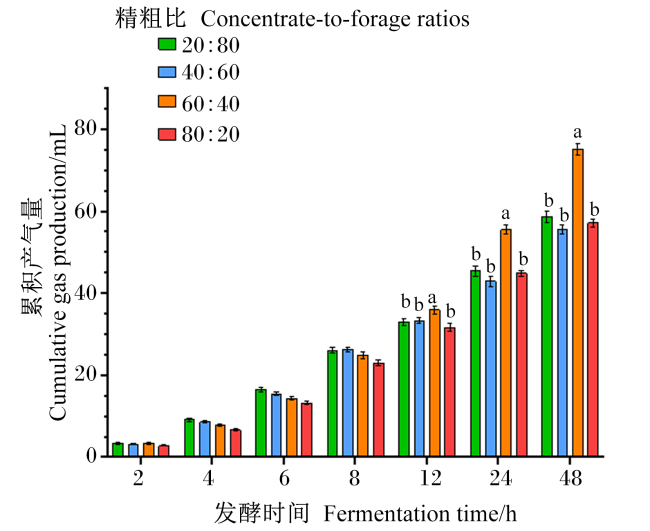
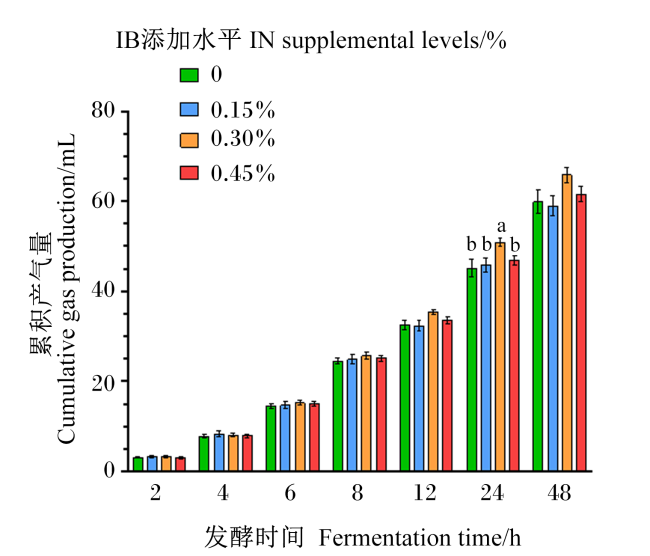
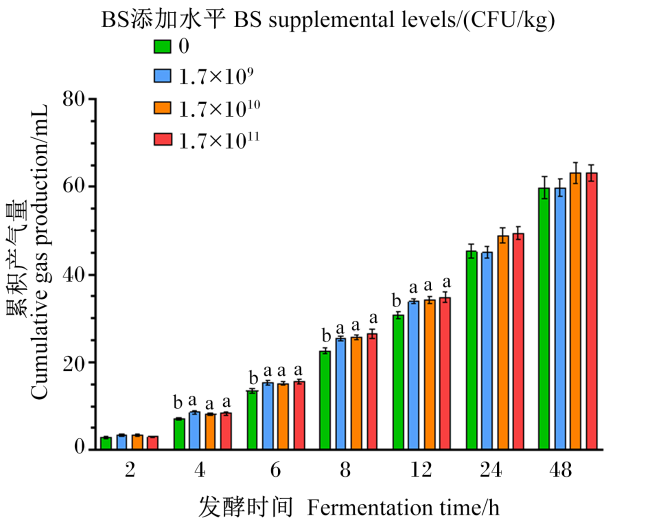
通过方差分析结果表明,随着发酵时间的增加,在12、24和48 h时,饲粮精粗比为60:40组体外产气量显著高于饲粮精粗比为20:80、40:60和80:20组(P<0.05)(图1);在24 h时,饲粮IN添加水平为0.30%组体外产气量显著高于饲粮IN添加水平为0、0.15%、0.45%组(P<0.05)(图2);在4、6、8、12 h时,饲粮BS添加水平为1.7×10⁹、1.7×10¹⁰和1.7×10¹¹ CFU/kg组体外产气量显著高于饲粮BS添加水平为0 CFU/kg组(P<0.05)(图3)。
图1 不同饲粮精粗比对瘤胃发酵体外产气量的影响

数据柱标相同小写字母表示差异不显著(P>0.05),不同小写字母表示差异显著(P<0.05)。下图同。

Fig.1 Effects of dietary different concentrate-to-forage ratios on in vitro gas production of rumen fermentation

Value columns with the same small letter mean no significant difference (P>0.05), while with different small letters mean significant difference (P<0.05). The same as below.

图2 不同饲粮IN添加水平对瘤胃发酵体外产气量的影响

Fig.2 Effects of dietary different IN supplemental levels on in vitro gas production of rumen fermentation

图3 不同饲粮BS添加水平对瘤胃发酵体外产气量的影响

Fig.3 Effects of dietary different BS supplemental levels on in vitro gas production of rumen fermentation

2.3 方差分析不同饲粮精粗比及IN和BS添加水平对体外营养物质降解率的影响

表5可见,方差分析结果表明,饲粮精粗比为60:40和80:20组DMD显著高于饲粮精粗比为20:80和40:60组(P<0.05),饲粮精粗比为60:40组NDFD显著高于饲粮精粗比为20:80、40:60和80:20组(P<0.05);饲粮IN添加水平为0.30%组DMD显著高于饲粮IN添加水平为0、0.15%、0.45%组(P<0.05);饲粮BS添加水平为1.7×10¹¹ CFU/kg组DMD显著高于饲粮BS添加水平为1.7×1010 CFU/kg组(P<0.05),饲粮BS添加水平为1.7×1010和1.7×1011 CFU/kg组NDFD显著高于饲粮BS添加水平为0、1.7×109 CFU/kg组(P<0.05)。
表5 方差分析不同饲粮精粗比及IN和BS添加水平对体外营养物质降解率的影响

Table 5 Analysis of variance of effects of different dietary concentrate-roughage ratios and IN and BS supplemental levels on in vitro nutrient degradation rates%

因素
Factors
水平
Levels
干物质降解率
DMD
中性洗涤纤维降解率
NDFD
酸性洗涤纤维降解率
ADFD
精粗比
Concentrate-forage ratios
20:80 54.83±2.98c 42.00±5.04b 34.91±3.16
40:60 55.54±3.23c 40.57±4.64b 35.14±5.16
60:40 61.82±3.94b 46.85±2.72a 34.43±3.69
80:20 64.40±2.83a 42.56±4.15b 36.13±3.26
PP-value <0.01 <0.01 0.57
IN添加水平
IN supplemental levels/%
0 58.13±5.48b 42.19±5.30 35.14±3.14
0.15 57.90±5.44b 41.52±4.27 33.79±4.13
0.30 62.24±3.15a 44.69±4.33 35.41±3.48
0.45 58.34±5.45b 43.58±4.82 36.27±4.49
PP-value 0.02 0.14 0.24
BS添加水平
BS supplemental levels/(CFU/kg)
0 58.09±5.50ab 41.57±5.63b 33.71±3.64
1.7×10⁹ 57.01±5.27b 39.33±4.17b 36.08±3.00
1.7×10¹⁰ 60.28±4.97ab 44.55±2.31a 35.00±4.51
1.7×10¹¹ 61.22±4.25a 46.52±2.88a 35.82±4.03
PP-value 0.04 <0.01 0.21

同行数据肩标不同小写字母表示差异显著(P<0.05),相同或无字母表示差异不显著(P>0.05)。下表同。

In the same row, values with different small letter superscripts mean significant difference (P<0.05), while with the same or no letter superscripts mean no significant difference (P>0.05). The same as below.

2.4 方差分析不同饲粮精粗比及IN和BS添加水平对体外瘤胃发酵参数的影响

表6可见,方差分析结果表明,饲粮精粗比为60:40组pH显著低于饲粮精粗比为20:80和80:20组(P<0.05),饲粮IN添加水平为0.30%和0.45%组pH显著低于饲粮IN添加水平为0组(P<0.05),饲粮BS添加水平为1.7×10¹⁰、1.7×10¹¹ CFU/kg组pH显著低于饲粮BS添加水平为0 CFU/kg组(P<0.05)。饲粮精粗比为40:60和60:40组NH3-N含量显著低于饲粮精粗比为20:80组(P<0.05),饲粮IN添加水平为0.15%和0.30%组NH3-N含量显著低于饲粮IN添加水平为0组(P<0.05)。饲粮精粗比为60:40组乙酸含量显著高于饲粮精粗比为20:80、40:60和80:20组(P<0.05),总挥发性脂肪酸(TVFA)含量显著高于饲粮精粗比为20:80和40:60组(P<0.05),乙酸/丙酸显著高于饲粮精粗比为40:60和80:20组(P<0.05);饲粮IN添加水平为0.30%组乙酸和丁酸含量显著高于饲粮IN添加水平为0、0.15%组(P<0.05),TVFA含量显著高于饲粮IN添加水平为0、0.15%和0.45%组(P<0.05);饲粮BS添加水平为1.7×1010 CFU/kg组乙酸和TVFA含量显著高于饲粮BS添加水平为0、1.7×109 CFU/kg组(P<0.05),饲粮BS添加水平为1.7×1010和1.7×1011 CFU/kg组丙酸和丁酸含量显著高于饲粮BS添加水平为0 CFU/kg组(P<0.05)。
表6 方差分析不同饲粮精粗比及IN和BS添加水平对体外瘤胃发酵参数的影响

Table 6 Analysis of variance of effects of different dietary concentrate-roughage ratios and IN and BS supplemental levels on in vitro rumen fermentation parameters

因素
Factors
水平
Levels
pH 氨态氮
NH3-N/
(mg/dL)
乙酸
Acetate/
(mmol/L)
丙酸
Propionate/
(mmol/L)
丁酸
Butyrate/
(mmol/L)
戊酸
Valerate/
(mmol/L)
异丁酸
Isobutyrate/
(mmol/L)
异戊酸
Isovalerate/
(mmol/L)
总挥发性
脂肪酸
TVFA/
(mmol/L)
乙酸/丙酸
Acetate/
propionate
精粗比
Concentrate-
forage ratios
20:80 6.62±0.09a 10.42±0.61a 45.78±1.90b 21.88±1.45b 10.76±1.46b 1.19±0.16 0.65±0.07 1.03±0.14 81.30±3.76bc 2.10±0.12a
40:60 6.57±0.08ab 9.85±0.79b 43.41±2.34c 22.23±1.39b 11.67±1.12a 1.20±0.18 0.64±0.05 1.05±0.16 80.22±3.73c 1.95±0.11b
60:40 6.52±0.05b 9.69±0.77b 47.63±1.47a 22.70±1.68ab 11.25±1.35ab 1.22±0.19 0.65±0.07 0.98±0.11 84.44±2.36a 2.11±0.18a
80:20 6.58±0.08a 10.00±0.76ab 44.23±1.76c 23.46±1.49a 12.04±1.50a 1.19±0.23 0.66±0.08 1.02±0.13 82.62±4.01ab 1.88±0.10b
PP-value <0.01 0.02 <0.01 0.01 0.02 0.96 0.90 0.34 <0.01 <0.01
IN添加水平
IN supplemental
levels/%
0 6.62±0.08a 10.35±0.70a 44.58±3.21b 21.70±1.46 11.25±1.44b 1.21±0.22 0.64±0.05 0.99±0.15 80.39±3.91b 2.06±0.20
0.15 6.59±0.07ab 9.75±0.70b 44.64±2.00b 22.32±1.30 10.87±1.32b 1.17±0.19 0.65±0.08 1.05±0.12 80.71±3.07b 2.00±0.14
0.30 6.53±0.08b 9.81±0.87b 46.51±1.90a 23.24±1.11 12.18±1.24a 1.23±0.14 0.67±0.05 1.02±0.12 84.86±2.01a 2.00±0.15
0.45 6.55±0.07b 10.05±0.71ab 45.32±2.20ab 23.01±1.98 11.42±1.46ab 1.20±0.19 0.64±0.08 0.99±0.14 82.61±4.23b 1.98±0.15
PP-value 0.01 0.04 0.04 0.07 0.03 0.79 0.64 0.41 <0.01 0.45
BS添加水平
BS supplemental levels/
(CFU/kg)
0 6.61±0.09a 10.03±0.68 44.47±2.68b 21.85±1.10b 10.71±1.06b 1.19±0.17 0.63±0.05 1.00±0.12 79.86±4.02c 2.02±0.12
1.7×10⁹ 6.58±0.07ab 10.13±0.81 44.64±2.69b 22.30±1.94ab 11.45±1.30ab 1.21±0.17 0.65±0.10 1.08±0.10 81.35±4.32bc 2.02±0.17
1.7×10¹⁰ 6.53±0.07b 9.89±0.65 46.46±2.27a 22.96±1.72a 11.78±1.52a 1.19±0.22 0.66±0.06 1.00±0.14 84.07±2.73a 2.04±0.22
1.7×10¹¹ 6.58±0.08b 9.91±0.94 45.48±1.74ab 23.16±1.21a 11.78±1.57a 1.21±0.20 0.66±0.05 0.98±0.15 83.29±2.52ab 1.96±0.12
PP-value 0.03 0.75 0.04 0.03 0.04 0.98 0.44 0.10 <0.01 0.48

3 讨论

3.1 不同饲粮精粗比及IN和BS添加水平对体外产气量和DMD的影响

饲粮中碳水化合物在瘤胃微生物分解下产生CO2、氢气及甲烷等气体,因此瘤胃微生物对饲粮的降解率越高,产气量越高[17]。在发酵前期,适当的精粗比有利于瘤胃真菌和纤维素降解菌建立相对稳定的关系,随着饲粮精料比增大,真菌数量逐渐降低,细菌数量逐渐上升,同时饲粮分解消化加快,进而产气量增加;但过高的饲粮精粗比会严重影响瘤胃内环境稳定。王兴岗等[18]以不同精粗比饲粮饲喂羔羊70 d后发现,饲喂高精粗比饲粮的羔羊不仅瘤胃内总菌数量显著提高,而且饲粮降解率随之显著提升。而在本试验中,饲粮精粗比为60:40组在发酵12、24、48 h的体外产气量显著高于其他精粗比水平组,表明以精粗比为60:40的饲粮作为发酵底物,会使瘤胃微生物处在相对稳定内环境,可提高对饲粮的分解和消化。
BS为需氧菌,在发酵过程中,造成发酵液低氧环境和氧化还原电势异常,从而抑制有害菌群的生长,使有益菌群(如双歧杆菌和乳酸菌等)活性增强,从而提高对饲粮的降解率[19],且DMD与体外产气量呈正相关[20]。本试验研究发现,饲粮中添加1.7×10¹⁰和1.7×10¹¹ CFU/kg的BS,体外产气量与DMD都提高,且趋势基本相同。同时IN作为益生元,在瘤胃中发挥益生元效应,为纤维素降解菌(如拟杆和厚壁菌)提供能量,加快降解菌对饲粮的分解效率[21]。Tian等[22]在肉牛的基础饲粮中添加IN,显著提高了拟杆门和厚壁菌门相对丰度;类似地,马冬梅[23]在育肥羊饲粮中添加IN,显著提高了拟杆菌门相对丰度。这说明了IN不仅能为纤维素降解菌提供能量,也能够促进菌群增殖。但部分IN会被瘤胃微生物作为发酵底物分解,不能发挥其益生元最大效应。本试验研究发现,饲粮中添加0.30%的IN提高了DMD,进一步提高了体外产气量。

3.2 不同饲粮精粗比及IN和BS添加水平对NDFD和ADFD的影响

营养物质降解率反映瘤胃微生物对饲粮消化吸收的能力,是体现体外瘤胃发酵状况的重要指标之一。其中,NDFD、ADFD主要与纤维素、半纤维素和酸性洗涤木质素(ADL)的可降解程度有关[24]。而BS自身可以合成纤维素酶[25],纤维素酶吸附到饲料植物纤维上破坏细胞壁碳水化合物(主要是NDF),释放被纤维素阻碍的营养物质(如淀粉和蛋白质等),就会使瘤胃微生物或消化酶对营养物质接触面积增大,从而提高DMD。同时,被破坏了的细胞壁中NDF是由纤维素和ADL组成。因此当NDF发生改变,纤维素和ADL也将发生变化,从而影响NDFD。在本研究中发现,饲粮中添加1.7×10¹⁰和1.7×10¹¹ CFU/kg的BS对饲粮中纤维降解更为有效,NDFD显著提高。这与苏勇华等[26]研究结果一致,即在饲粮中添加BS显著促进了羊对饲粮中NDF的降解。
有研究表明,饲粮粗料比低于30:70后,瘤胃pH降低会导致瘤胃内菌群结构改变,使NDFD和ADFD呈下降趋势[27]。当精料比例越高时,瘤胃微生物菌群变化越明显。本试验研究表明,饲粮精粗比为60:40和80:20组DMD显著提高,同时饲粮精粗比为60:40组NDFD显著提高,而且当饲粮精粗比为80:20时相较于饲粮精粗比为60:40时对NDFD表现出一定的抑制作用,说明饲粮精粗比为60:40时发酵品质较高。通过体外发酵试验得出,以60:40精粗比饲粮为发酵底物,添加1.7×10¹⁰和1.7×10¹¹ CFU/kg的BS时NDFD为佳。

3.3 不同饲粮精粗比及IN和BS添加水平对体外瘤胃发酵参数的影响

反刍动物瘤胃发酵饲料过程会产生大量的VFA,主要包括乙酸、丙酸及丁酸等为动物机体提供能量,同时瘤胃内pH的降低和TVFA含量的升高相关[28]。稳定的pH为瘤胃菌群提供适宜的生长环境,一般为6.0~7.0[29]。本试验中,各组的pH均在正常范围之内,表明各组体外发酵比较稳定,未对瘤胃内环境造成不良影响。瘤胃发酵与饲料原料组成密切相关,精料中纤维含量较低,主要是淀粉和可消化营养物质。随着精料比例升高,其碳水化合物在瘤胃中快速降解产生大量的VFA,当VFA积累达到一定程度时,导致瘤胃pH显著降低。但过高精料比例会出现代谢紊乱,增加瘤胃酸中毒的风险[30]
本试验中,瘤胃pH与精料比例呈相关,瘤胃丙酸和丁酸含量与精料比例呈正相关,这与Chaucheyras-Durand等[31]研究结果相似。瘤胃TVFA为微生物合成菌体蛋白提供能量,而NH3-N是大部分瘤胃微生物合成菌体蛋白的唯一氮源,同时NH3-N含量反映的是瘤胃微生物对发酵底物中含蛋白质类有机物分解能力[32],其正常范围在6.30~27.50 mg/dL[33]。孙光明等[34]在牦牛饲养试验中得出以精粗比为60:40饲粮饲喂组,其瘤胃NH3-N含量显著高于以精粗比40:60饲粮饲喂组,与本试验研究结果不一致。但本试验NH3-N含量均在正常范围之内,可能原因是不同品种牛的瘤胃微生物区系间存在差异,从而导致试验结果不同。
IN不仅可作为发酵底物被部分瘤胃微生利用产生短链脂肪酸(乙酸、丙酸及丁酸等),也可提高几种短链脂肪酸产生菌的相对丰度,如鼠尾菌科、醋酸菌属、丁酸弧菌属[35]。在瘤胃内环境中短链脂肪酸含量的增加可使产琥珀酸丝状杆菌和溶纤维丁酸弧菌的菌群数量增加,提高碳水化合物降解的能力[36],促进微生物对氮的利用率,为菌体蛋白的合成提供有利条件。在本研究中,饲粮中添加0.30%的IN可以显著降低发酵瘤胃液NH3-N含量,提高乙酸、丙酸和丁酸含量,这与Öztürk[37]和田可[38]的研究结果一致;而与未添加BS组相比,添加1.7×10¹⁰ CFU/kg BS组的发酵瘤胃液乙酸、丙酸、丁酸及TVFA含量均提高,这与pH的变化相符,其原因可能是BS在体外发酵过程中分泌抗菌肽和抗菌蛋白质,抑制有害菌的活性,同时也能分泌淀粉酶和蛋白酶,促进碳水化物分解产生VFA[39]。这与Qiao等[40]在饲粮中添加BS可显著提高瘤胃VFA含量的结果相似。

4 结论

在本次体外发酵试验中,影响因素的主次顺序为饲粮精粗比>BS添加水平>IN添加水平。根据对体外瘤胃发酵特性的数据分析和综合考虑,筛选出最适各因素水平为:饲粮精粗比60:40,IN添加水平0.30%,BS添加水平1.7×10¹⁰ CFU/kg。
[1]
HARSINI M, MOTAMEDI H, SARI M, et al. Optimization growth of isolated cellulolytic bacteria from gastrointestinal tract of Arabian horse and investigation of the effect of transferring to rumen fluid on wheat straw digestibility[J]. Journal of Ruminant Research, 2019, 7(2):113-128.

[2]
张福兴, 聂福旭, 唐文雅, 等. 枯草芽孢杆菌的生物学作用及在家禽生产中的应用研究进展[J]. 国外畜牧学:猪与禽, 2024, 44(1):69-72.

ZHANG F X, NIE F X, TANG W Y, et al. Research progress on biological function of Bacillus subtilis and its application in poultry production[J]. Animal Science Abroad:Pigs and Poultry, 2024, 44(1):69-72. (in Chinese)

[3]
黄玉岚, 霍小东, 姚宏明, 等. 枯草芽孢杆菌WEI-62体外益生评价及其对仔猪生长性能、肠道形态和肠道菌群的影响[J]. 中国畜牧杂志, 2020, 56(11):140-145.

HUANG Y L, HUO X D, YAO H M, et al. In vitro probiotics evaluation of Bacillus subtilis WEI-62 and its effects on growth performance,intestinal morphology and intestinal flora of piglets[J]. Chinese Journal of Animal Science, 2020, 56(11):140-145. (in Chinese)

[4]
王绪海, 陶有伦, 杨梅, 等. “替抗”时代几种饲料添加剂的比较[J]. 中国畜牧业, 2019(19):85-87.

WANG X H, TAO Y L, YANG M, et al. Comparison of several feed additives in the “substitute” era[J]. China Animal Industry, 2019(19):85-87. (in Chinese)

[5]
韩薇, 贺稚非, 谢兆华, 等. 菊粉的功能特性及其在肉制品中的应用研究进展[J]. 食品与发酵工业, 2022, 48(16):311-317.

DOI

HAN W, HE Z F, XIE Z H, et al. The functional analysis of inulin and its application in meat products[J]. Food and Fermentation Industries, 2022, 48(16):311-317. (in Chinese)

DOI

[6]
SAMOLIŃSKA W, GRELA E R. Comparative effects of inulin with different polymerization degrees on growth performance,blood trace minerals,and erythrocyte indices in growing-finishing pigs[J]. Biological Trace Element Research, 2017, 176(1):130-142.

[7]
ZHU L M, QIN S, ZHAI S X, et al. Inulin with different degrees of polymerization modulates composition of intestinal microbiota in mice[J]. FEMS Microbiology Letters, 2017, 364(10):fnx075.

[8]
何晓芳, 韩琦, 王祚杨, 等. 日粮中添加菊粉对肉鸡生长性能、肠道形态和盲肠微生物的影响[J]. 饲料研究, 2023, 46(23):33-39.

HE X F, HAN Q, WANG Z Y, et al. Effect of dietary inulin addition on growth performance,intestinal morphology and cecal microorganisms of broilers[J]. Feed Research, 2023, 46(23):33-39. (in Chinese)

[9]
王小凤, 何兆华, 梁雪, 等. 添加菊粉和单宁对湖羊瘤胃挥发性脂肪酸和微生物区系的影响[J]. 饲料工业, 2023, 44(2):30-38.

WANG X F, HE Z H, LIANG X, et al. Effects of inulin and tannin supplementation on rumen volatile fatty acids and microflora of Hu sheep[J]. Feed Industry, 2023, 44(2):30-38. (in Chinese)

[10]
中华人民共和国农业行业标准——肉牛饲养标准(NY/T 815—2004)[J]. 湖南饲料, 2006(5):14-18.

Agricultural industry standard of the people’s republic of China—beef cattle feeding standard (NY/T 815—2004)[J]. Hunan Feed, 2006(5):14-18. (in Chinese)

[11]
MENKE K H, RAAB L, SALEWSKI A, et al. The estimation of the digestibility and metabolizable energy content of ruminant feeding stuffs from the gas production when they are incubated with rumen liquor in vitro[J]. The Journal of Agricultural Science, 1979, 93(1):217-222.

[12]
HORWITZ W, LATIMER G W. Official methods of analysis of AOAC international[M]. Gaithersburg: AOAC international, 2000.

[13]
VAN SOEST P J, ROBERTSON J B, LEWIS B A. Methods for dietary fiber,neutral detergent fiber,and nonstarch polysaccharides in relation to animal nutrition[J]. Journal of Dairy Science, 1991, 74(10):3583-3597.

[14]
MAURICIO R M, MOULD F L, DHANOA M S, et al. A semi-automated in vitro gas production technique for ruminant feedstuff evaluation[J]. Animal Feed Science and Technology, 1999, 79(4):321-330.

[15]
冯宗慈, 高民. 通过比色测定瘤胃液氨氮含量方法的改进[J]. 畜牧与饲料科学, 2010(6):37.

FENG Z C, GAO M. Improvement of a colorimetric method for determination of ammonia nitrogen in rumen fluid[J]. Animal Husbandry and Feed Science, 2010(6):37. (in Chinese)

[16]
曹庆云, 周武艺, 朱贵钊, 等. 气相色谱测定羊瘤胃液中挥发性脂肪酸方法研究[J]. 中国饲料, 2006(24):26-28.

CAO Q Y, ZHOU W Y, ZHU G Z, et al. Determination of volatile fatty acids in rumen fluid of sheep by gas chromatography[J]. China Feed, 2006(24):26-28. (in Chinese)

[17]
马秀莲, 姜菲, 高彦华, 等. 不同粗饲料组合添加支链挥发性脂肪酸对牦牛体外瘤胃发酵特性的影响[J]. 动物营养学报, 2023, 35(11):7270-7283.

DOI

MA X L, JIANG F, GAO Y H, et al. Effects of different roughage combinations supplemented with branched-chain volatile fatty acids on rumen fermentation characteristics of yaks in vitro[J]. Chinese Journal of Animal Nutrition, 2023, 35(11):7270-7283. (in Chinese)

[18]
王兴岗, 郝小燕, 张暄梓, 等. 不同精粗比饲粮中添加凝结芽孢杆菌对绵羊羔羊瘤胃发酵和免疫功能的影响[J]. 动物营养学报, 2024, 36(3):1769-1781.

DOI

WANG X G, HAO X Y, ZHANG X Z, et al. Effects of adding Bacillus coagulans into diets with different concentrate to forage ratios on rumen fermentation and immune function of lambs[J]. Chinese Journal of Animal Nutrition, 2024, 36(3):1769-1781. (in Chinese)

[19]
张晓慧. 枯草芽孢杆菌对AA鸡生长性能的影响及其机理研究[D]. 硕士学位论文. 湛江: 广东海洋大学, 2013.

ZHANG X H. Effects of Bacillus subtilis on growth performance in AA broilers and its mechanism[D]. Master’s Thesis. Zhenjiang: Guangdong Ocean University, 2013. (in Chinese)

[20]
BLÜMMEL M, STEINGASS H, BECKER K. The relationship between in vitro gas production,in vitro microbial biomass yield and 15N incorporation and its implications for the prediction of voluntary feed intake of roughages[J]. British Journal of Nutrition, 1997, 77(6):911-921.

[21]
GIBSON G R, ROBERFROID M B. Dietary modulation of the human colonic microbiota:introducing the concept of prebiotics[J]. The Journal of Nutrition, 1995, 125(6):1401-1412.

[22]
TIAN K, LIU J H, SUN Y W, et al. Effects of dietary supplementation of inulin on rumen fermentation and bacterial microbiota,inflammatory response and growth performance in finishing beef steers fed high or low-concentrate diet[J]. Animal Feed Science and Technology, 2019,258:114299.

[23]
马冬梅. 菊芋多糖对育肥期绵羊生产性能、肉品质、胃肠道微生物组及代谢组的影响研究[D]. 硕士学位论文. 泰安: 山东农业大学, 2023.

MA D M. Effects of Jerusalem artichox polysaccharide on performance,meat quality,gastrointestinal microbiome and metabolome in fattening sheep[D]. Master’s Thesis. Tai’an: Shandong Agricultural University, 2023. (in Chinese)

[24]
LYNCH J P, JIN L, LARA E C, et al. The effect of exogenous fibrolytic enzymes and a ferulic acid esterase-producing inoculant on the fibre degradability,chemical composition and conservation characteristics of alfalfa silage[J]. Animal Feed Science and Technology, 2014,193:21-31.

[25]
周亚妮. 浅谈枯草杆菌的特性及其应用[J]. 黔南民族医专学报, 2010, 23(2):84,88.

ZHOU Y N. Brief discussion on the characteristics and application of Bacillus subtilis[J]. Journal of Qiannan Medical College for Nationalities, 2010, 23(2):84,88. (in Chinese)

[26]
苏勇华, 方雷, 应璐, 等. 枯草芽孢杆菌对多浪羊消化率、瘤胃发酵参数及血液指标的影响[J]. 江苏农业科学, 2018, 46(8):162-166.

SU Y H, FANG L, YING L, et al. Effects of Bacillus subtilis on digestibility,rumen fermentation parameters and blood indexes of Duolang sheep[J]. Jiangsu Agricultural Sciences, 2018, 46(8):162-166. (in Chinese)

[27]
CHIBISA G E, BEAUCHEMIN K A, PENNER G B. Relative contribution of ruminal buffering systems to pH regulation in feedlot cattle fed either low- or high-forage diets[J]. Animal, 2016, 10(7):1164-1172.

DOI PMID

[28]
DIJKSTRA J, ELLIS J L, KEBREAB E, et al. Ruminal pH regulation and nutritional consequences of low pH[J]. Animal Feed Science and Technology, 2012, 172(1/2):22-33.

[29]
郑玮才, 郝小燕, 张宏祥, 等. 饲粮添加酿酒酵母和地衣芽孢杆菌对绵羊生长性能与瘤胃发酵的影响[J]. 中国农业科学, 2020, 53(16):3385-3393.

DOI

ZHENG W C, HAO X Y, ZHANG H X, et al. Effects of Saccharomyces cerevisiae and Bacillus licheniformis on growth performance and rumen fermentation in sheep[J]. Scientia Agricultura Sinica, 2020, 53(16):3385-3393. (in Chinese)

[30]
VAN MOSEL M, VAN’T KLOOSTER A T, VAN MOSEL F, et al. Effects of reducing dietary [(Na++K+)-(Cl-+SO4=)] on the rate of calcium mobilisation by dairy cows at parturition[J]. Research in Veterinary Science, 1993, 54(1):1-9.

[31]
CHAUCHEYRAS-DURAND F, WALKER N D, BACH A. Effects of active dry yeasts on the rumen microbial ecosystem:past,present and future[J]. Animal Feed Science and Technology, 2008, 145(1/2/3/4):5-26.

[32]
ZHENG Y H, ZHAO Y Y, XUE S L, et al. Feeding value assessment of substituting cassava (Manihot esculenta) residue for concentrate of dairy cows using an in vitro gas test[J]. Animals, 2021, 11(2):307.

[33]
MURPHY J J, KENNELLY J J. Effect of protein concentration and protein source on the degradability of dry matter and protein in situ[J]. Journal of Dairy Science, 1987, 70(9):1841-1849.

[34]
孙光明, 朱彦宾, 平措占堆, 等. 不同精粗比饲粮对牦牛瘤胃内环境的影响[J]. 畜牧与兽医, 2022, 54(1):31-34.

SUN G M, ZHU Y B, PING C Z D, et al. Effects of feeds at different roughage to concentrate ratios on the rumen environment of yak[J]. Animal Husbandry & Veterinary Medicine, 2022, 54(1):31-34. (in Chinese)

[35]
WANG Y, NAN X M, ZHAO Y G, et al. Dietary supplementation with inulin improves lactation performance and serum lipids by regulating the rumen microbiome and metabolome in dairy cows[J]. Animal Nutrition, 2021, 7(4):1189-1204.

DOI PMID

[36]
KHAFIPOUR E, LI S, TUN H M, et al. Effects of grain feeding on microbiota in the digestive tract of cattle[J]. Animal Frontiers:The Review Magazine of Animal Agriculture, 2016, 6(2):13-19.

[37]
ÖZTÜRK H. Effects of chicory inulin on ruminal fermentation in vitro[J]. Ankara Universitesi Veteriner Fakultesi Dergisi, 2009,56:171-175.

[38]
田可. 日粮添加菊粉对育肥肉牛生长性能、瘤胃发酵和菌群、炎症反应的影响[D]. 硕士学位论文. 重庆: 西南大学, 2020.

TIAN K. Effects of dietary inulin supplementation on growth performance,rumen fermentation,bacterial flora and inflammatory response of fattening beef cattle[D]. Master’s Thesis. Chongqing: Southwest University, 2020. (in Chinese)

[39]
陶壮壮. 肉牛日粮添加枯草芽孢杆菌与莫能菌素的效果及其组合效应研究[D]. 硕士学位论文. 杨凌: 西北农林科技大学, 2022.

TAO Z Z. Study on the effect and combination effect of adding Bacillus subtilis and monensin to beef cattle diet[D]. Master’s Thesis. Yangling: Northwest A&F University, 2022. (in Chinese)

[40]
QIAO G H, SHAN A S, MA N, et al. Effect of supplemental Bacillus cultures on rumen fermentation and milk yield in Chinese Holstein cows[J]. Journal of Animal Physiology and Animal Nutrition, 2010, 94(4):429-436.

Outlines

/