REVIEW

Research Progress on Metabolic Pathway of Valine and Its Application in Pig Production

  • WEI Siyong , 1, 2 ,
  • WANG Li 1 ,
  • DENG Jinping 2 ,
  • XIAO Hao , 1, *
Expand
  • 1 Guangdong Key Laboratory of Animal and Poultry Breeding and Nutrition Research, Key Laboratory of Animal Nutrition and Feed in South China, Ministry of Agriculture, State Key Laboratory of Animal and Poultry Breeding, Institute of Animal Science, Guangdong Academy of Agricultural Sciences, Guangzhou 510640, China
  • 2 Guangdong Key Laboratory of Animal Nutrition and Regulation, College of Animal Science, South China Agricultural University, Guangzhou 510640, China
* associate professor, E-mail:

Received date: 2024-06-18

  Online published: 2025-01-10

Abstract

Valine is an essential branched-chain amino acid in the body, which is indispensable in pig growth and reproduction, and has biological functions such as regulating protein synthesis, glucose metabolism, antioxidant capacity and immune function. Valine plays an important role in promoting piglet growth and regulating sow lactation. This paper summarizes the research progress of transporter carriers and metabolites of valine in animal tissues, organs and subcellular organelles, the biological functions of valine, and the requirement of valine in different growth stages of pigs, aiming to provide a reference for the application in pig production and the appropriate addition amount in low-protein diet.

Cite this article

WEI Siyong , WANG Li , DENG Jinping , XIAO Hao . Research Progress on Metabolic Pathway of Valine and Its Application in Pig Production[J]. Chinese Journal of Animal Nutrition, 2025 , 37(1) : 75 -86 . DOI: 10.12418/CJAN2025.007

缬氨酸(valine,Val)是一种机体必需的支链氨基酸(branched-chain amino acids,BCAA),不能在动物体内从头合成,畜禽所需缬氨酸主要由饲粮中的蛋白质在体内降解获得,也可以直接摄取饲粮中添加的合成缬氨酸[1]。缬氨酸有多种生物学功能,如参与蛋白质的合成和葡萄糖代谢等,具有促进生长、提供能量的作用[2-3]。缬氨酸过量或缺乏可能会对动物机体产生副作用[4]。本文综述了缬氨酸在动物体内的转运载体和代谢产物、细胞中的代谢途径和生物学功能以及缬氨酸在猪不同生长阶段中的需要量和功能研究,以期为缬氨酸在猪生产中的应用尤其是低蛋白质饲粮的研究与发展提供理论依据和参考。

1 缬氨酸在动物体内的代谢

1.1 缬氨酸在组织器官中的代谢
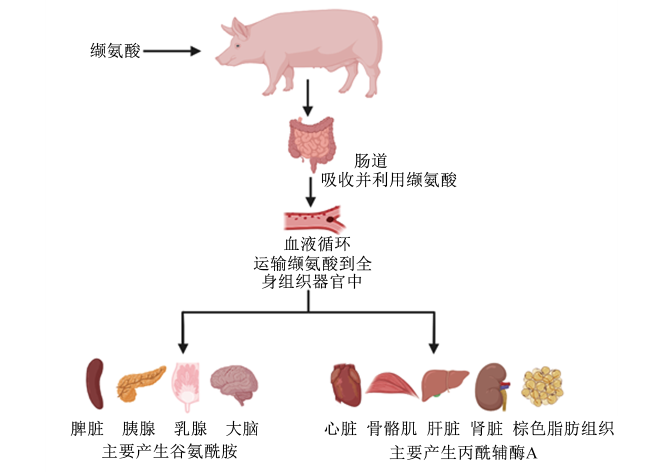
目前,动物获取缬氨酸主要通过消化饲粮中的蛋白质和饲粮中直接额外添加的合成缬氨酸。饲粮中的蛋白质在动物的胃腺区受到盐酸和胃蛋白酶的作用分解为多肽,进入小肠后被胰蛋白酶进一步分解为小肽,转运到肠上皮细胞经过肽酶作用转化为缬氨酸[5-6]。缬氨酸在肠道首过代谢中,被门静脉排流(partaldrained viscera,PDV)组织(胃、小肠、结肠、胰腺和脾脏等)截留,而截留的缬氨酸被肠道组织吸收和利用[7-8]。Stoll等[8]研究发现,在首过代谢后的门静脉血中缬氨酸占摄入量的61%,表明约有39%的缬氨酸在猪肠道中被吸收利用。肠道中的微生物也能参与缬氨酸的代谢,有研究发现,梭状芽胞杆菌属和拟杆菌属的细菌能将缬氨酸发酵成短链脂肪酸(short-chain fatty acids,SCFAs)、支链脂肪酸(branched-chain fatty acids,BCFAs)、氨和吲哚等物质。研究发现,肠道未知细菌可利用丙酮酸合成缬氨酸[9-10],但具体的微生物菌群组成尚不清楚。
缬氨酸的代谢过程及代谢产物如图1所示。缬氨酸被肠道基底膜转运后进入毛细血管,汇入门静脉和循环系统,通过血液循环被运输到肝脏、棕色脂肪组织、肾脏和骨骼肌等组织器官中进行代谢[11]。缬氨酸在各组织器官的代谢产物主要是谷氨酰胺和丙酰辅酶A[12-13]。棕色脂肪细胞中缬氨酸能被水解产生3-羟基异丁酸(3-hydroxyisobutyricacid,3-HIB)[14]。支链氨基酸转氨酶(branched chain amino acid transaminase,BCAT)具有2种同工酶,即胞质BCAT(BCAT1)和线粒体BCAT(BCAT2)。其中,BCAT1仅在少数组织中表达,包括卵巢、子宫、大脑和脊髓[15-16];而BCAT2在几乎所有组织中均有表达,但在肝脏中表达量低[15]。支链α-酮酸脱氢酶复合物(branched-chain α-ketoacid dehydrogenase complex,BCKDH)主要分布于肝脏、大脑、心脏和肾脏[17]。这使得缬氨酸在组织器官中的代谢产物含量不同,有研究表明,缬氨酸在胰腺、乳腺、脾脏和大脑等器官中主要产生谷氨酰胺,有着较高的蛋白质合成率[2,13,18];而在骨骼肌、棕色脂肪组织、肝脏、肾脏和心脏等器官中主要产生为丙酰辅酶A,氧化代谢量高[18]。多余缬氨酸会以蛋白质形式储存在哺乳动物肝脏和骨骼肌中,在机体禁食期间可被分解利用[11]
图1 缬氨酸的代谢过程及代谢产物

Fig.1 Metabolic processes and metabolites of valine

1.2 缬氨酸在细胞中的代谢

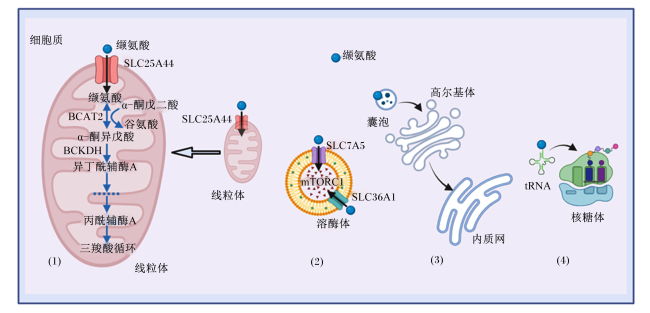
缬氨酸在细胞器中的转运与代谢途径如图2所示。线粒体是缬氨酸分解代谢的主要部位。BCAT通过将缬氨酸上的氨基转移到α-酮戊二酸(α-ketoglutaric acid,α-KG)生成谷氨酸(glutamate,Glu)和α-酮异戊酸(α-ketoisovaleric acid,KIV)[12]。在转氨反应中,BCAT需要维生素B6的辅酶磷酸吡哆醛(pyridoxal phosphate,PLP)作为氨基载体,辅酶PLP转变为磷酸吡哆胺(pyridoxamine phosphate,PMP),PMP将氨基转移到α-KG以产生谷氨酸[19]。KIV的氧化受到BCKDH的严格调控,是不可逆的,BCKDH位于线粒体内膜,由3个亚基组成,即异四聚体支链α-酮酸脱羧酶(E1亚基)、二氢硫辛酰胺支链转酰酶(E2亚基)和二氢硫辛酰胺脱氢酶(E3亚基)[13]。KIV被E1亚基脱氢产生异丁酰辅酶A(isobutyryl coenzyme A),经过一系列的反应产生丙酰辅酶A,进入三羧酸循环(tricarboxylic acid cycle,TCA)彻底氧化为三磷酸腺苷(adenosine triphosphate,ATP)[12-13]
图2 缬氨酸在细胞器中的转运与代谢途径

BCAT2:支链氨基酸转氨酶2 branched chain amino acid transaminase 2;BCKDH:支链α-酮酸脱氢酶复合物 branched-chain α-ketoacid dehydrogenase complex;SLC:溶质载体 solute carriers;mTORC1:哺乳动物雷帕霉素靶蛋白复合物1 mammalian target of rapamycin complex 1;tRNA:转运RNA transfer RNA。

(1)缬氨酸在线粒体上的代谢途径 metabolic pathway of valine in mitochondria;(2)缬氨酸在溶酶体的转运 transport of valine in lysosomes;(3)缬氨酸在内质网、高尔基体、囊泡的转运 transport of valine in endoplasmic reticulum, Golgi apparatus and vesicles;(4)tRNA携带缬氨酸在核糖体上翻译 tRNA carried valine for translation in ribosomes。

Fig.2 Translocation and metabolic pathways of valine in organelles

1.3 缬氨酸的转运载体

缬氨酸在细胞膜上的转运载体组成了不同的转运系统,由溶质载体(solute carriers,SLCs)基因编码,哺乳动物缬氨酸转运载体分类见表1。介导缬氨酸跨膜运输的转运系统有中性氨基酸转运系统和碱性氨基酸转运系统[20]。中性氨基酸转运系统包括B0型中性氨基酸转运载体(B0-type neutral amino acid transporters,B0AT)、丙氨酸-丝氨酸-半胱氨酸转运载体(alanine-serine-cysteine transporter,ASCT)、L型氨基酸转运载体(L-type amino acid transporter,LAT)和钠离子依赖的中性氨基酸转运载体(sodium-coupled neutral amino acid transporter,SNAT)等转运系统[21]。B0系统的B0AT1(SLC6A19)是肠道上皮细胞顶端膜吸收缬氨酸主要的转运载体,集中分布在十二指肠、空肠和回肠[22];B0AT2(SLC6A15)在大脑的神经元和星形胶质细胞中含量丰富[22-23]。谷氨酰胺转运系统的ASCT2(SLC1A5)与B0AT1紧密联系,广泛分布于脑、肺脏、骨骼肌、肠道和肾脏[24-25]。B0,+系统的ATB0,+(SLC6A14)主要分布于结肠、肺脏、胃、睾丸和气管[26]。LAT家族的LAT1(SLC7A5)广泛分布于脑、乳腺、胎盘、膀胱、肾脏、胆囊、脾脏和结肠[27-28];LAT2(SLC7A8)主要分布在空肠、回肠、肾脏、胎盘和脑[28];LAT3(SLC43A1)主要分布于肝脏、骨骼肌和胰腺[29];LAT4(SLC43A2)主要集中在小肠、胎盘和肾脏,在脑和心脏也有分布[28,30]。SNAT2(SLC38A2)是钠离子(Na+)依赖性转运载体,广泛分布于心脏、肺脏、脑、肾上腺、骨骼肌、胃、脊髓和结肠[31]。碱性氨基酸转运系统仅发现rBAT/b0,+AT(SLC3A1/SLC7A9)也能转运缬氨酸,主要分布在肾脏和小肠中[32]
表1 哺乳动物缬氨酸转运载体分类

Table 1 Classification of mammalian valine transporter carriers

项目
Items
编号
Number
定位
Location
离子
Ion
器官分布
Organ distribution
参考文献
Reference
中性氨基酸转运系统Neutral amino acid transport system
B0AT1 SLC6A19 顶端膜 Na+ 十二指肠、空肠、回肠 [22]
B0AT2 SLC6A15 顶端膜 Na+ 大脑神经元 [23]
ASCT2 SLC1A5 顶端膜 Na+ 脑、肺脏、骨骼肌、肠道、肾脏 [24-25]
ATB0,+ SLC6A14 顶端膜 Na+、Cl- 结肠、肺脏、胃、睾丸、气管 [26]
LAT1 SLC7A5 基底膜 脑、乳腺、胎盘、膀胱、肾脏、
胆囊、脾脏、结肠
[27-28]
LAT2 SLC7A8 基底膜 空肠、回肠、肾脏、胎盘、脑 [28]
LAT3 SLC43A1 基底膜 肝脏、骨骼肌、胰腺 [29]
LAT4 SLC43A2 基底膜 小肠、胎盘、肾脏、脑、心脏 [28,30]
SNAT2 SLC38A2 基底膜 Na+ 心脏、肺脏、脑、肾上腺、
骨骼肌、胃、脊髓、结肠
[31]
碱性氨基酸转运系统Alkaline amino acid transport system
rBAT/b0,+AT SLC3A1/SLC7A9 顶端膜 肾脏、小肠 [32]

B0AT:B0型中性氨基酸转运载体 B0-type neutral amino acid transporters;ASCT:丙氨酸-丝氨酸-半胱氨酸转运载体 alanine-serine-cysteine transporter;LAT:L型氨基酸转运载体 L-type amino acid transporter;SNAT:钠离子依赖的中性氨基酸转运载体 sodium-coupled neutral amino acid transporter;SLC:溶质载体solute carrier;Na+:钠离子 sodium ion;Cl-:氯离子 chloride ion。

亚细胞器上也存在缬氨酸转运载体[33]。线粒体上的转运载体主要是SLC25家族,研究发现SLC25A44负责将缬氨酸运输到线粒体中进行分解代谢[34]。在溶酶体上,同样存在LAT1(SLC7A5)和PAT1(SLC36A1)等氨基酸转运体,协助缬氨酸进入溶酶体,发挥对哺乳动物雷帕霉素靶蛋白(mammalian target of rapamycin,mTOR)信号通路的调节功能[28,35]。内质网和高尔基体上氨基酸的转运主要通过囊泡完成[36]。核糖体上运输缬氨酸的是对应的转运RNA(transfer RNA,tRNA),其携带缬氨酸在核糖体上进行翻译[37]。细胞器上具体的转运载体和机制尚不明确,还需进一步阐述。

1.4 缬氨酸的生物学功能

缬氨酸也是一种功能性氨基酸,对哺乳动物体内的多种信号通路具有调节作用。目前研究发现,缬氨酸的生物学功能主要包括:1)激活蛋白激酶B(protein kinase B,PKB或AKT)/mTOR信号通路,增加下游核糖体蛋白S6激酶1(S6 kinase 1,S6k1)的表达来促进蛋白质合成[38];2)增加哺乳动物雷帕霉素靶蛋白复合物1(mammalian target of rapamycin complex 1,mTORC1)活性,调节线粒体耗氧量,并改善白蛋白代谢来减少肝脏中活性氧(reactive oxygen species,ROS)的产生,提高机体抗氧化能力[39];3)调控免疫细胞和肠道免疫球蛋白(immunoglobulin,Ig)来提高机体的免疫水平[40];4)增加线粒体的转录辅激活因子过氧化物酶体增殖物激活受体γ辅激活子(peroxisome proliferator-activated receptor γ coactivator,PGC)-1αPGC-1β的表达水平来调节线粒体的生物生成和功能,从而促进ATP的产生,提供能量[41];5)其代谢产物3-HIB可刺激甘油三酯的合成,并且可能通过上调脂肪酸转运机制来促进脂肪酸转运[14]。缬氨酸通过这些生物学功能,影响不同阶段猪的生长性能及生产性能。

2 缬氨酸在猪生产中应用的研究进展

2.1 在母猪生产中的应用

缬氨酸需要量通常用标准回肠可消化缬氨酸(SID Val)和标准回肠可消化缬氨酸与赖氨酸的比例(SID Val:Lys)作为指标表示[42],本文总结了母猪缬氨酸需要量(表2)。Kim等[43]研究发现,泌乳母猪饲粮中缬氨酸可能是仅次于赖氨酸的第二限制性氨基酸。NRC(2012)[44]中推荐泌乳母猪饲粮的SID Val:Lys为0.87,而后续研究发现,缬氨酸实际需要量可能比NRC(2012)[44]中推荐的要高。车龙[45]从妊娠75 d开始饲喂母猪SID Val:Lys分别为0.73、0.83、0.93的饲粮,表明饲喂SID Val:Lys为0.93的饲粮提高了母猪血浆总蛋白、催乳素含量和仔猪断奶重,并促进了母猪乳腺发育。Wang等[46]从母猪妊娠85 d开始分别饲喂不同SID Val:Lys的饲粮,结果表明,饲喂SID Val:Lys为1.23的饲粮增加了母猪的胎盘面积,显着缩短了分娩时间,减少了死胎数。李根[47]研究表明,在妊娠85 d至泌乳21 d饲喂SID Val:Lys为0.87的饲粮,增加了母猪乳脂乳蛋白含量,并提高了仔猪断奶重。Xu等[48]在母猪妊娠107 d至泌乳28 d饲喂不同SID Val:Lys的饲粮,发现饲粮SID Val:Lys达到1.23时提高了母猪平均日采食量(average daily feed intake,ADFI)和初乳中游离氨基酸含量,降低了背膘损失。陈熠等[49]研究报道,在饲粮SID Val为1.09%、SID Val:Lys为1.17时,达到最高泌乳量和仔猪断奶窝重,并可提高乳中乳脂、乳蛋白和总固形物含量。然而,Strathe等[50]研究显示,在泌乳期间将SID Val:Lys提高到0.84以上对窝产仔生长和母猪生产性能没有影响。Devi等[51]用SID Val:Lys分别为0.80和0.85的饲粮饲喂母猪,表明饲喂SID Val:Lys为0.85的饲粮提高了母猪乳汁中精氨酸和苏氨酸含量。Gaines等[52]试验表明,饲粮SID Val:Lys达到0.86时提高了仔猪平均日增重(average daily gain,ADG)。Richert等[53]研究表明,饲喂SID Val为1.15%、SID Val:Lys为1.28的饲粮增加了母猪乳中丙氨酸、乳脂含量。李方方等[54]报道,饲粮中SID Val:Lys由0.75提高到1.20时,会升高母猪全期ADFI和哺乳仔猪ADG。王勇[55]研究显示,饲喂SID Val:Lys为1.20的饲粮降低了母猪体重损失,提高了产奶量。本文总结了许多国内外母猪缬氨酸需要量的研究,发现SID Val:Lys有很大差别,可能是因为母猪品种、年龄、饲粮蛋白质水平以及环境温度的影响。
表2 不同资料来源的母猪缬氨酸需要量

Table 2 Valine requirements of sows from different sources of information

试验时间
Experimental
time
标准回肠
可消化缬氨酸
SID Val/%
标准回肠可
消化缬氨酸与
赖氨酸的比例
SID Val:Lys
指标
Indicators
参考文献
Reference
妊娠75 d至泌乳21 d
Gestation 75 d to lactation 21 d
0.79 0.93 增加血浆总蛋白、催乳素
含量和仔猪断奶重
[45]
妊娠85 d至泌乳21 d
Gestation 85 d to lactation 21 d
1.23 1.23 增大母猪胎盘面积,减少死胎数 [46]
妊娠85 d至泌乳21 d
Gestation 85 d to lactation 21 d
1.09 0.87 增加乳脂、乳蛋白含量和
仔猪断奶重
[47]
妊娠107 d至泌乳28 d
Gestation 107 d to lactation 28 d
1.13 1.23 提高母猪ADFI [48]
妊娠107 d至泌乳21 d
Gestation 107 d to lactation 21 d
1.09 1.17 提高泌乳量和仔猪断奶窝重 [49]
妊娠108 d至泌乳25 d
Gestation 108 d to lactation 25 d
0.67 0.84 对母猪生产性能没有影响 [50]
泌乳0~21 d
Lactation 0 to 21 d
0.74 0.85 增加乳汁精氨酸和
苏氨酸含量
[51]
泌乳0~21 d
Lactation 0 to 21 d
0.75 0.86 提高仔猪ADG [52]
泌乳0~21 d
Lactation 0 to 21 d
1.15 1.28 增加乳中丙氨酸、乳脂含量 [53]
泌乳0~21 d
Lactation 0 to 21 d
1.29 1.20 提高母猪ADFI和仔猪ADG [54]
泌乳0~28 d
Lactation 0 to 28 d
1.23 1.20 降低体重损失,提高产奶量 [55]

ADFI:平均日采食量 average daily feed intake;ADG:平均日增重 average daily gain。下表同 the same as below。

车龙[45]研究表明,缬氨酸可通过激活mTOR信号通路促进猪乳腺细胞增殖和乳蛋白合成。还有研究显示,饲粮中添加缬氨酸可以使泌乳母猪血清和乳汁的胰岛素含量增加,还可以促进母猪生长激素的分泌[49]。综上所述,在饲粮中添加缬氨酸可以改善母猪生产性能,通过提高蛋白质合成从而提升乳品质,促进乳腺发育,并有利于哺乳仔猪的生长。

2.2 在仔猪生产中的应用

仔猪生长速度快,营养需求高,饲料中缬氨酸含量往往都不能满足,需要额外添加,缬氨酸在仔猪上研究主要集中在断奶仔猪阶段(表3)。Nemechek等[56]报道,饲喂SID Lys为1.30%、SID Val:Lys为0.64的饲粮提高了仔猪(6.8~11.3 kg)的ADG。Lordelo等[57]报道,在低蛋白质饲粮中添加缬氨酸(SID Val为0.86%)能降低仔猪(7~23 kg)的腹泻率和氮排泄量。Soumeh等[58]研究表明,饲粮中SID Val:Lys从0.62增加到0.78,会提高仔猪(8~14 kg)ADFI和ADG。Wiltafsky等[59]发现,饲粮SID Val:Lys为0.67时可以提高仔猪(8~22 kg)的ADG和饲料转化率,饲粮SID Val:Lys为0.65时可以提高仔猪(14~26 kg)的氮沉积。James等[60]报道,饲喂SID Val:Lys为0.58的饲粮提高了仔猪(9~17 kg)的ADG和ADFI。Gloaguen等[61]研究表明,断奶仔猪饲粮SID Val:Lys由0.60提高到0.70,会提高仔猪的ADG和饲料转化率。Barea等[62]研究了断奶仔猪(12~25 kg)的缬氨酸需求量,饲喂SID Val:Lys为0.70的饲粮增加了仔猪的ADG和饲料转化率。Gaines等[63]经过3项试验对比发现,饲喂SID Val:Lys为0.65的饲粮足以维持仔猪(13~32 kg)的生长性能。上述文献中饲粮SID Val:Lys差异较大,可能是由于不同试验仔猪的初重、末重不同以及饲养环境不同造成的。
表3 不同资料来源的仔猪缬氨酸需要量

Table 3 Valine requirements of piglets from different sources of information

始重
Initial
weight/kg
末重
Final
weight/kg
标准回肠
可消化缬氨酸
SID Val/%
标准回肠可
消化缬氨酸与
赖氨酸的比例
SID Val:Lys
指标
Indicators
参考文献
Reference
6.8 11.3 0.83 0.64 提高ADG [56]
7 23 0.86 降低腹泻率和氮排泄量 [57]
8 14 0.70 0.78 提高ADFI、ADG [58]
8 22 0.70 0.67 增加ADG和饲料转化率 [59]
9 17 0.62 0.58 提高ADG和ADFI [60]
12 22 0.77 0.72 提高ADG和饲料转化率 [61]
12 25 0.66 0.70 提高ADG和饲料转化率 [62]
13 32 0.72 0.65 维持猪的生长性能 [63]
14 26 0.64 0.65 增加氮沉积 [59]
缬氨酸与断奶仔猪免疫功能有着密切联系,可通过影响免疫球蛋白含量来参与免疫。黄红英等[64]研究表明,饲粮添加缬氨酸可以提高21日龄仔猪血清中IgG含量,增强仔猪的免疫功能,维持仔猪的机体健康。Ren等[65]研究表明,在蛋白质限制饲粮(17%粗蛋白质)中补充混合支链氨基酸(0.19%异亮氨酸、0.27%缬氨酸和0.07%亮氨酸),与蛋白质限制组相比增加了断奶仔猪肠道的分泌型免疫球蛋白A(sIgA)、IgA和IgM含量,改善了断奶仔猪的肠道免疫防御功能。Xu等[66]研究报道,增加仔猪饲粮SID Val:Lys可以改善十二指肠、回肠和空肠的绒毛高度,降低十二指肠和回肠的绒毛高度与隐窝深度比值,有利于仔猪的肠道健康。综上所述,适宜的缬氨酸水平可以提高断奶仔猪的生长性能,促进断奶仔猪的生长发育,改善断奶仔猪的免疫功能。

2.3 在生长育肥猪生产中的应用

缬氨酸在生长育肥猪肌肉蛋白质中所占的比例较高,缬氨酸能在生长育肥猪饥饿时提供能量,缬氨酸被认为是生长育肥猪玉米-豆粕型饲粮中的第五限制性氨基酸[67]。本文结合国内外研究,综述了生长育肥猪的缬氨酸需要量(表4)。Veira等[68]设置20~30 kg生长猪饲粮不同SID Val:Lys,发现SID Val:Lys为0.68时有着良好的氮平衡,但ADG无明显差异。Waguespack等[69]试验报道,在20~45 kg生长猪饲粮中添加缬氨酸,SID Val在0.56%~0.58%、SID Val:Lys在0.67~0.70时能提高ADG和饲料转化率。Kwon等[70]试验表明,29 kg生长猪饲粮的SID Val:Lys达到0.70时能增加末重和ADG。育肥猪阶段在饲粮中额外添加缬氨酸不仅可以提高育肥猪的生长性能,还能改善肉品质。Williams等[71]以39.3~100 kg猪为研究对象,发现饲喂SID Val:Lys为0.80的饲粮提高了育肥猪的ADG和ADFI,而对瘦肉率和背膘深度影响不大。Liu[72]试验表明,59.8 kg育肥猪的饲粮SID Val:Lys为0.70时就能满足其生长需要。Reeb等[73]研究表明,始重62.6 kg育肥猪的饲粮SID Val:Lys由0.70增加到0.83时,对生长性能影响不大,但是会降低料重比。Lewis等[74]研究显示,67~80 kg育肥猪饲粮中SID Val为0.38%、SID Val:Lys为0.59时有良好的ADG和料重比。王宇波等[75]试验发现,在75 kg育肥猪饲粮添加缬氨酸,SID Val达到0.65%虽然没有进一步提升生长性能,但会改善胴体性状、剪切力和大理石花纹,同时增强了胰岛素敏感性。易孟霞等[76]报道,饲喂SID Val为0.53%、SID Val:Lys为0.76的饲粮提高了80~120 kg育肥猪的ADG和饲料转化率。Huang等[77]研究报道,在育肥猪低蛋白质饲粮中,SID Val水平上升会降低血浆尿素氮含量和脂肪厚度,改善猪肉系水力和pH,并有可能增加瘦肉率。本文综述了国内外生长育肥猪缬氨酸需要量的研究,发现不同试验推荐的SID Val水平有所差别,可能是因为生长育肥猪品种和初重、末重差异以及地理环境的影响。
表4 不同资料来源的生长育肥猪缬氨酸需要量

Table 4 Valine requirements of growing-fattening pigs from different sources of information

始重
Initial
weight/kg
末重
Final
weight/kg
标准回肠
可消化缬氨酸
SID Val/%
标准回肠可
消化缬氨酸与
赖氨酸的比例
SID Val:Lys
指标
Indicators
参考文献
Reference
20 30 0.83 0.68 良好的氮平衡 [68]
20 45 0.58 0.70 提高ADG和饲料转化率 [69]
29 50 0.58 0.70 提高末重和ADG [70]
39.3 100 0.64 0.80 提高ADG和ADFI [71]
59.8 0.37 0.70 满足生长需要 [72]
62.6 100 0.66 0.83 料重比略有下降 [73]
67 80 0.38 0.59 提高ADG,降低料重比 [74]
75 100 0.65 改善胴体性状、剪切力和大理石花纹 [75]
80 120 0.53 0.76 提高ADG和饲料转化率 [76]

3 小结与展望

缬氨酸作为必需氨基酸,在猪饲粮中适宜添加可以改善母猪的繁殖性能和生长性能,还能够通过母体效应来影响哺乳仔猪的生长发育,提高窝重以及断奶时的成活率;缬氨酸还可以提高断奶仔猪的肠道免疫功能,增加小肠的绒毛高度,从而促进断奶仔猪的肠道健康;也能提高生长猪的生长性能并改善育肥猪的肉品质。目前,缬氨酸在动物机体内的代谢过程和转运载体已经有所研究,但其研究内容尚浅,还存在一些问题:1)与缬氨酸代谢有关的肠道微生物菌群的组成和代谢机制尚不明确;2)缬氨酸在组织器官中的代谢过程及代谢产物还需要进一步探索;3)缬氨酸在亚细胞器的转运载体及转运机制需要更多的研究;4)在生产实践中需要考虑不同品种猪的不同生长时期缬氨酸适宜的添加量、添加方式;5)应充分考虑缬氨酸与其他支链氨基酸之间、缬氨酸与其他营养物质之间的相互作用;6)缬氨酸调节仔猪免疫功能的作用机制有待进一步探究。因此,今后的研究可以从缬氨酸肠道微生物、缬氨酸转运载体及转运机制、缬氨酸对仔猪生长性能的作用机制着手,研究缬氨酸在低蛋白质平衡饲粮中的应用,这将为缬氨酸在猪饲粮中的合理添加提供参考,促进猪生产的发展。
[1]
CEMIN H S, TOKACH M D, WOODWORTH J C, et al. Branched-chain amino acid interactions in growing pig diets[J]. Translational Animal Science, 2019, 3(4):1246-1253.

DOI PMID

[2]
LI P, KNABE D A, KIM S W, et al. Lactating porcine mammary tissue catabolizes branched-chain amino acids for glutamine and aspartate synthesis[J]. The Journal of Nutrition, 2009, 139(8):1502-1509.

[3]
ZHANG S H, ZENG X F, REN M, et al. Novel metabolic and physiological functions of branched chain amino acids:a review[J]. Journal of Animal Science and Biotechnology, 2017,8:10.

[4]
CEMIN H S, TOKACH M D, DRITZ S S, et al. Meta-regression analysis to predict the influence of branched-chain and large neutral amino acids on growth performance of pigs[J]. Journal of Animal Science, 2019, 97(6):2505-2514.

[5]
TOMÉ D, BENOIT S, AZZOUT-MARNICHE D. Protein metabolism and related body function:mechanistic approaches and health consequences[J]. Proceedings of the Nutrition Society, 2021, 80(2):243-251.

[6]
GARDNER M L. Amino acid and peptide absorption from partial digests of proteins in isolated rat small intestine[J]. The Journal of Physiology, 1978,284:83-104.

[7]
ELANGO R, PENCHARZ P B, BALL R O. The branched-chain amino acid requirement of parenterally fed neonatal piglets is less than the enteral requirement[J]. Journal of Nutrition, 2002, 132(10):3123-3129.

DOI PMID

[8]
STOLL B, HENRY J, REEDS P J, et al. Catabolism dominates the first-pass intestinal metabolism of dietary essential amino acids in milk protein-fed piglets[J]. Journal of Nutrition, 1998, 128(3):606-614.

DOI PMID

[9]
DAVILA A M, BLACHIER F, GOTTELAND M, et al. Intestinal luminal nitrogen metabolism:role of the gut microbiota and consequences for the host[J]. Pharmacological Research, 2013, 68(1):95-107.

[10]
NØRGAARD J V, CANIBE N, SOUMEH E A, et al. Evaluation of in situ valine production by Bacillus subtilis in young pigs[J]. Animal, 2016, 10(11):1796-1802.

[11]
BRÖER S. Amino acid transport across mammalian intestinal and renal epithelia[J]. Physiological Reviews, 2008, 88(1):249-286.

DOI PMID

[12]
NEINAST M, MURASHIGE D, ARANY Z. Branched chain amino acids[J]. Annual Review of Physiology, 2019,81:139-164.

[13]
SPERRINGER J E, ADDINGTON A, HUTSON S M. Branched-chain amino acids and brain metabolism[J]. Neurochemical Research, 2017, 42(6):1697-1709.

DOI PMID

[14]
NILSEN M S, JERSIN R Å, ULVIK A, et al. 3-hydroxyisobutyrate,a strong marker of insulin resistance in type 2 diabetes and obesity that modulates white and brown adipocyte metabolism[J]. Diabetes, 2020, 69(9):1903-1916.

[15]
PATRICK M K, GU Z M, ZHANG G, et al. Metabolon formation regulates branched-chain amino acid oxidation and homeostasis[J]. Nature Metabolism, 2022, 4(12):1775-1791.

DOI PMID

[16]
GO M, SHIN E, JANG S Y, et al. BCAT1 promotes osteoclast maturation by regulating branched-chain amino acid metabolism[J]. Experimental & Molecular Medicine, 2022, 54(6):825-833.

[17]
SURYAWAN A, HAWES J W, HARRIS R A, et al. A molecular model of human branched-chain amino acid metabolism[J]. American Journal of Clinical Nutrition, 1998, 68(1):72-81.

DOI PMID

[18]
NEINAST M D, JANG C, HUI S, et al. Quantitative analysis of the whole-body metabolic fate of branched-chain amino acids[J]. Cell Metabolism, 2019, 29(2):417-429.e4.

DOI PMID

[19]
GOTO M, MIYAHARA I, HIROTSU K, et al. Structural determinants for branched-chain aminotransferase isozyme-specific inhibition by the anticonvulsant drug gabapentin[J]. Journal of Biological Chemistry, 2005, 280(44):37246-37256.

DOI PMID

[20]
GAUTHIER-COLES G, VENNITTI J, ZHANG Z D, et al. Quantitative modelling of amino acid transport and homeostasis in mammalian cells[J]. Nature Communications, 2021, 12(1):5282.

[21]
张世海. 支链氨基酸调节仔猪肠道和肌肉中氨基酸及葡萄糖转运的研究[D]. 博士学位论文. 北京: 中国农业大学, 2016.

ZHANG S H. Branched-chain amino acids modulate amino acid and glucose transport in intestine and muscle of piglets[D]. Ph.D. Thesis. Beijing: China Agricultural University, 2016. (in Chinese)

[22]
PRAMOD A B, FOSTER J, CARVELLI L, et al. SLC6 transporters:structure,function,regulation,disease association and therapeutics[J]. Molecular Aspects of Medicine, 2013, 34(2/3):197-219.

[23]
HÄGGLUND M G A, ROSHANBIN S, LÖFQVIST E, et al. B(0)AT2 (SLC6A15) is localized to neurons and astrocytes,and is involved in mediating the effect of leucine in the brain[J]. PLoS One, 2013, 8(3):e58651.

[24]
MUNCK B G, MUNCK L K. Effects of pH changes on systems ASC and B in rabbit ileum[J]. The American Journal of Physiology, 1999, 276(1):G173-G184.

[25]
FREIDMAN N, CHEN I, WU Q Y, et al. Amino acid transporters and exchangers from the SLC1A family:structure,mechanism and roles in physiology and cancer[J]. Neurochemical Research, 2020, 45(6):1268-1286.

[26]
SLOAN J L, GRUBB B R, MAGER S. Expression of the amino acid transporter ATB0+ in lung:possible role in luminal protein removal[J]. American Journal of Physiology:Lung Cellular and Molecular Physiology, 2003, 284(1):L39-L49.

[27]
PURIS E, GYNTHER M, AURIOLA S, et al. L-type amino acid transporter 1 as a target for drug delivery[J]. Pharmaceutical Research, 2020, 37(5):88.

DOI PMID

[28]
WANG Q, HOLST J. L-type amino acid transport and cancer:targeting the mTORC1 pathway to inhibit neoplasia[J]. American Journal of Cancer Research, 2015, 5(4):1281-1294.

[29]
FUKUHARA D, KANAI Y, CHAIROUNGDUA A, et al. Protein characterization of Na+-independent system L amino acid transporter 3 in mice:a potential role in supply of branched-chain amino acids under nutrient starvation[J]. The American Journal of Pathology, 2007, 170(3):888-898.

[30]
RAJENDRAN A, PONCET N, OPARIJA-ROGENMOZERE L, et al. Tissue-specific deletion of mouse basolateral uniporter LAT4 (SLC43a2) reveals its crucial role in small intestine and kidney amino acid transport[J]. The Journal of Physiology, 2020, 598(22):5109-5132.

[31]
WEIDENFELD S, CHUPIN C, LANGNER D I, et al. Sodium-coupled neutral amino acid transporter SNAT2 counteracts cardiogenic pulmonary edema by driving alveolar fluid clearance[J]. American Journal of Physiology:Lung Cellular and Molecular Physiology, 2021, 320(4):L486-L497.

[32]
BAUCH C, VERREY F. Apical heterodimeric cystine and cationic amino acid transporter expressed in MDCK cells[J]. American Journal of Physiology:Renal Physiology, 2002, 283(1):F181-F189.

[33]
SCALISE M, POCHINI L, CONSOLE L, et al. The human SLC1A5 (ASCT2) amino acid transporter:from function to structure and role in cell biology[J]. Frontiers in Cell & Developmental Biology, 2018,6:96.

[34]
YONESHIRO T, WANG Q, TAJIMA K, et al. BCAA catabolism in brown fat controls energy homeostasis through SLC25A44[J]. Nature, 2019, 572(7771):614-619.

[35]
ZHAO L L, ZHANG X X, JI X, et al. The amino acid transporter PAT1 regulates mTORC1 in a nutrient-sensitive manner that requires its transport activity[J]. Cellular Signalling, 2019,53:59-67.

[36]
KOLEN B, BORGHANS B, KORTZAK D, et al. Vesicular glutamate transporters are H+-anion exchangers that operate at variable stoichiometry[J]. Nature Communications, 2023, 14(1):2723.

[37]
THANDAPANI P, KLOETGEN A, WITKOWSKI M T, et al. Valine tRNA levels and availability regulate complex Ⅰ assembly in leukaemia[J]. Nature, 2022, 601(7893):428-433.

[38]
CHE L, XU M M, GAO K G, et al. Valine increases milk fat synthesis in mammary gland of gilts through stimulating AKT/MTOR/SREBP1 pathway[J]. Biology of Reproduction, 2019, 101(1):126-137.

[39]
IWASA M, KOBAYASHI Y, MIFUJI-MOROKA R, et al. Branched-chain amino acid supplementation reduces oxidative stress and prolongs survival in rats with advanced liver cirrhosis[J]. PLoS One, 2013, 8(7):e70309.

[40]
MA N, GUO P T, ZHANG J, et al. Nutrients mediate intestinal bacteria-mucosal immune crosstalk[J]. Frontiers in Immunology, 2018,9:5.

[41]
SHARMA S, ZHANG X M, AZHAR G, et al. Valine improves mitochondrial function and protects against oxidative stress[J]. Bioscience,Biotechnology,and Biochemistry, 2024, 88(2):168-176.

[42]
周颖, 彭首策, 钟辉, 等. 不同阶段猪对缬氨酸营养需要的研究进展[J]. 畜牧与兽医, 2018, 50(5):132-136.

ZHOU Y, PENG S C, ZHONG H, et al. Researches on the nutritional needs of valine in swine at different stages of growth[J]. Animal Husbandry & Veterinary Medicine, 2018, 50(5):132-136. (in Chinese)

[43]
KIM S W, BAKER D H, EASTER R A. Dynamic ideal protein and limiting amino acids for lactating sows:the impact of amino acid mobilization[J]. Journal of Animal Science, 2001, 79(9):2356-2366.

[44]
NRC. Nutrient requirements of swine[S]. 11th ed.Washington,D.C.:National Academies Press, 2012.

[45]
车龙. 妊娠后期饲粮缬氨酸与赖氨酸比例对母猪乳腺发育和泌乳的影响及机制研究[D]. 博士学位论文. 雅安: 四川农业大学, 2019.

CHE L. Effects of dietary valine-to-lysine ratio to giltsduring late gestation on the development of mammary gland and lactation and the underlyingmechanism[D]. Ph.D.Thesis. Ya’an: Sichuan Agricultural University, 2019. (in Chinese)

[46]
WANG K, LIU J, ZHAO L, et al. Effects of dietary valine-to-lysine ratio on placenta growth,the placental nutrient transporters,and reproductive performance in sows[J]. Animal Production Science, 2023, 63(8):742-750.

[47]
李根. 饲粮中添加缬氨酸对泌乳母猪生产性能、血浆和乳汁生化指标的影响[D]. 硕士学位论文. 广州: 华南农业大学, 2016.

LI G. Effects of dietary valine supplementation during gestation and lactation on reproductive performance,plasma and milk biochemical indexes of sows[D]. Master’s Thesis. Guangzhou: South China Agricultural University, 2016. (in Chinese)

[48]
XU Y, ZENG Z, XIAO X, et al. Effects of the standardized ileal digestible valine:lysine ratio on performance,milk composition and plasma indices of lactating sows:valine requirements of lactating sows[J]. Animal Science Journal, 2016, 88(8):1082-1092.

[49]
陈熠, 彭艺, 贺建华, 等. 添加缬氨酸对泌乳母猪血清和乳中生化免疫指标及激素水平的影响[J]. 中国饲料, 2009(17):15-20.

CHEN Y, PENG Y, HE J H, et al. Effects of valine supplementation on serum and milk biochemical and immune indices and hormone levels of lactating sows[J]. China Feed, 2009(17):15-20. (in Chinese)

[50]
STRATHE A V, BRUUN T S, ZERRAHN J E, et al. The effect of increasing the dietary valine-to-lysine ratio on sow metabolism,milk production,and litter growth[J]. Journal of Animal Science, 2016, 94(1):155-164.

[51]
DEVI S M, PARK J W, KIM I H. Effects of dietary valine:lysine ratios on lactation performance of primiparous sows nursing large litters[J]. Revista Brasileira de Zootecnia, 2015, 44(12):420-424.

[52]
GAINES A M, BOYD R D, JOHNSTON M E, et al. The dietary valine requirement for prolific lactating sows does not exceed the National Research Council estimate[J]. Journal of Animal Science, 2006, 84(6):1415-1421.

DOI PMID

[53]
RICHERT B T, GOODBAND R D, TOKACH M D, et al. Increasing valine,isoleucine,and total branched-chain amino acids for lactating sows[J]. Journal of Animal Science, 1997, 75(8):2117-2128.

[54]
李方方, 王军, 林燕, 等. 饲粮缬氨酸与赖氨酸比对初产母猪繁殖性能及血清生化指标的影响[J]. 动物营养学报, 2013, 25(4):720-728.

DOI

LI F F, WANG J, LIN Y, et al. Effects of dietary valine/lysine on reproductive performance and serum biochemical indices of gilts[J]. Chinese Journal of Animal Nutrition, 2013, 25(4):720-728. (in Chinese)

[55]
王勇. 缬氨酸对高产哺乳母猪生产性能、免疫机能及氮利用率的影响研究[D]. 硕士学位论文. 杭州: 浙江大学, 2010.

WANG Y. The effect of valine on production performance,immune function and nitrogen utilization in high-production lactation sow[D]. Master’s Thesis. Hangzhou: Zhejiang University, 2010. (in Chinese)

[56]
NEMECHEK J E, TOKACH M D, DRITZ S S, et al. Effect of increasing standardized ileal digestible valine to lysine ratio on growth performance of 15-to 25-lb nursery pigs[J]. Animal Sciences and Industry, 2010, 0(10):17-21.

[57]
LORDELO M M, GASPAR A M, LE BELLEGO L, et al. Isoleucine and valine supplementation of a low-protein corn-wheat-soybean meal-based diet for piglets:growth performance and nitrogen balance[J]. Journal of Animal Science, 2008, 86(11):2936-2941.

[58]
SOUMEH E A, VAN MILGEN J, SLOTH N M, et al. Requirement of standardized ileal digestible valine to lysine ratio for 8- to 14-kg pigs[J]. Animal, 2015, 9(8):1312-1318.

DOI PMID

[59]
WILTAFSKY M K, SCHMIDTLEIN B, ROTH F X. Estimates of the optimum dietary ratio of standardized ileal digestible valine to lysine for eight to twenty-five kilograms of body weight pigs[J]. Journal of Animal Science, 2009, 87(8):2544-2553.

DOI PMID

[60]
JAMES B W, WOODWORTH J C, GOODBAND R D, et al. The optimal ratio of apparent digestible valine to lysine to maximize growth performance of the nursery pig[J]. Kansas Agricultural Experiment Station Research Reports, 2001, 0(10):59-62.

[61]
GLOAGUEN M, LE FLOC’H N, BROSSARD L, et al. Response of piglets to the valine content in diet in combination with the supply of other branched-chain amino acids[J]. Animal :an International Journal of Animal Bioscience, 2011, 5(11):1734-1742.

[62]
BAREA R, BROSSARD L, LE FLOC’H N, et al. The standardized ileal digestible valine-to-lysine requirement ratio is at least seventy percent in post weaned piglets[J]. Journal of Animal Science, 2009, 87(3):935-947.

[63]
GAINES A M, KENDALL D C, ALLEE G L, et al. Estimation of the standardized ileal digestible valine-to-lysine ratio in 13- to 32-kilogram pigs[J]. Journal of Animal Science, 2011, 89(3):736-742.

DOI PMID

[64]
黄红英, 贺建华, 范志勇, 等. 母猪日粮中支链氨基酸水平对仔猪血液生化指标和部分免疫指标的影响[J]. 饲料工业, 2007, 28(21):24-26.

HUANG H Y, HE J H, FAN Z Y, et al. Effects of sow’s dietary branched-chain amino acids on blood biochemical and some immune index in suckling pigs[J]. Feed Industry, 2007, 28(21):24-26. (in Chinese)

[65]
REN M, ZHANG S H, ZENG X F, et al. Branched-chain amino acids are beneficial to maintain growth performance and intestinal immune-related function in weaned piglets fed protein restricted diet[J]. Asian-Australasian Journal of Animal Sciences, 2015, 28(12):1742-1750.

DOI PMID

[66]
XU Y T, MA X K, WANG C L, et al. Effects of dietary valine:lysine ratio on the performance,amino acid composition of tissues and mRNA expression of genes involved in branched-chain amino acid metabolism of weaned piglets[J]. Asian-Australasian Journal of Animal Sciences, 2018, 31(1):106-115.

[67]
FIGUEROA J L, LEWIS A J, MILLER P S, et al. Growth,carcass traits,and plasma amino acid concentrations of gilts fed low-protein diets supplemented with amino acids including histidine,isoleucine,and valine[J]. Journal of Animal Science, 2003, 81(6):1529-1537.

[68]
VEIRA A M, SANTOS L S, GOBI J P, et al. Individual responses of growing pigs to diets with valine and isoleucine to lysine ratios[J]. Animal Feed Science and Technology, 2021,279:115037.

[69]
WAGUESPACK A M, BIDNER T D, PAYNE R L, et al. Valine and isoleucine requirement of 20- to 45-kilogram pigs[J]. Journal of Animal Science, 2012, 90(7):2276-2284.

DOI PMID

[70]
KWON W B, SOTO J A, STEIN H H. Effects on nitrogen balance and metabolism of branched-chain amino acids by growing pigs of supplementing isoleucine and valine to diets with adequate or excess concentrations of dietary leucine[J]. Journal of Animal Science, 2020, 98(11):skaa346.

[71]
WILLIAMS H, TOKACH M, WOODWORTH J, et al. The effect of increasing valine,isoleucine,and tryptophan:lysine ratios on growth performance and carcass characteristics of pigs fed diets with high leucine:lysine[J]. Journal of Animal Science, 2022,100 (Suppl.2):81-82.

[72]
LIU H. Effect of reducing dietary protein and adding amino acids on performance,carcass charac teristics,and nitrogen excretion,and the valine requirement of early-finishing barrows[D].Ph. D.Thesis. Columbia Missouri: University of Missouri-Columbia ProQuest, 2000.

[73]
REEB M E, FACCIN J E, GOODBAND R D, et al. Effects of increasing soybean meal and valine:lysine and tryptophan:lysine ratios on finishing pig performance[J]. Kansas Agricultural Experiment Station Research Reports, 2022, 8(10):31.

[74]
LEWIS A J, NISHIMURA N. Valine requirement of the finishing pig[J]. Journal of Animal Science, 1995, 73(8):2315-2318.

PMID

[75]
王宇波, 许豆豆, 何鑫, 等. 低蛋白饲粮缬氨酸水平对肥育猪生长性能、胴体性状和肉品质的影响[J]. 畜牧兽医学报, 2019, 50(9):1832-1840.

WANG Y B, XU D D, HE X, et al. Effects of valine level in low protein diets on growth performance,carcass traits and meat quality of finishing pigs[J]. Acta Veterinaria et Zootechnica Sinica, 2019, 50(9):1832-1840. (in Chinese)

[76]
易孟霞, 易学武, 贺喜, 等. 饲粮标准回肠可消化缬氨酸水平对育肥猪生长性能、血浆氨基酸和尿素氮含量的影响[J]. 动物营养学报, 2015, 27(7):2027-2037.

DOI

YI M X, YI X W, HE X, et al. Effects of dietary standardized ileal digestible valine level on growth performance,plasma amino acid and urea nitrogen contents of finishing pigs[J]. Chinese Journal of Animal Nutrition, 2015, 27(7):2027-2037. (in Chinese)

[77]
HUANG Q, PANGENI D, MANU H, et al. PSVI-3 estimation of the optimal standardized ileal digestible valine to lysine ratio required for growing-finishing pigs in low crude protein diets[J]. Journal of Animal Science, 2019, 97(Suppl.2):204.

Outlines

/