RESEARCH PAPER

Influences of Marigold Flavonoids on Rumen Fermentation Parameters and Microflora of Simmental Fattening Cattle during High-Temperature Seasons

  • LIN Xiaoqian , 1 ,
  • YU Xiaomeng 1 ,
  • LU Junyan 1 ,
  • WU Chunhui 1 ,
  • ZHAO Chao 1 ,
  • ZHANG Xiujiang 2 ,
  • LI Suxia 3 ,
  • LI Qiufeng , 1, * ,
  • WANG Mingya , 1, *
Expand
  • 1 College of Animal Science and Technology, Hebei Agricultural University, Baoding 071000, China
  • 2 Baoding Agricultural and Rural Bureau, Baoding 071051, China
  • 3 Chengde Animal Husbandry Workstation, Chengde 067000, China
*LI Qiufeng, professor, E-mail: ;
WANG Mingya, associate professor, E-mail:

Received date: 2024-07-30

  Online published: 2025-02-16

Abstract

This experiment was conducted to study the influences of marigold flavonoids on rumen fermentation parameters and microflora of Simmental fattening cattle during high-temperature seasons. Sixty healthy Simmental bulls without disease were randomly divided into 4 groups with 15 bulls per group according to the principle of similar body weight [(518.32±25.59) kg]. The control group (M0 group) was fed a total mixed ration (TMR), and the experimental groups were fed the TMR supplemented with 3 (M3 group), 6 (M6 group) and 9 g/(d·head) (M9 group) marigold flavonoids, respectively. The experiment lasted for 67 days, the pre-experimental period lasted for 7 days, and the experimental period lasted for 60 days. The results showed as follows: 1) the contents of propionate and total volatile fatty acid (TVFA) in rumen of M6 group were significantly higher than those of M0 group (P<0.05). Dietary marigold flavonoids had no significant effects on other rumen fermentation parameters (P>0.05). 2) At the family level, the rumen Prevotellaceae relative abundance of M6 group was significantly higher than that of M3 group (P=0.05); at the genus level, the rumen Prevotella relative abundance of M6 group was significantly higher than that of group M3 (P<0.05), the relative abundances of Succiniclasticum and Bifidobacterium in rumen of M6 group were significantly higher than those of M0 and M9 groups (P≤0.05). In conclusion, dietary marigold flavonoids can increase the contents of propionate and TVFA in rumen, improve the rumen microflora, and the supplementation of 6 g/(d·head) marigold flavonoids has the best effect.

Cite this article

LIN Xiaoqian , YU Xiaomeng , LU Junyan , WU Chunhui , ZHAO Chao , ZHANG Xiujiang , LI Suxia , LI Qiufeng , WANG Mingya . Influences of Marigold Flavonoids on Rumen Fermentation Parameters and Microflora of Simmental Fattening Cattle during High-Temperature Seasons[J]. Chinese Journal of Animal Nutrition, 2025 , 37(2) : 1092 -1102 . DOI: 10.12418/CJAN2025.095

高温环境给畜禽带来的刺激超出机体所能承受的范围,会导致其自身的散热系统无法调节,进而产生氧化应激反应[1]。随着肉牛集约化养殖的发展,高温对肉牛的影响日益显著。在高温条件下,反刍动物体温升高会触发下丘脑-腺垂体-肾上腺轴(HPA轴)的激活,导致动物对干物质的摄入量减少,增重速度变缓,进而降低动物的生长性能[2]。前人研究发现,高温会影响肉牛瘤胃发酵参数,导致瘤胃内氨态氮(NH3-N)含量升高,挥发性脂肪酸(VFA)含量下降[3]。此外,有研究表明,高温季节会影响瘤胃功能,容易引起瘤胃微生物区系发生改变[4],瘤胃功能与营养吸收、生长性能等密切相关[5]。侯宇[6]研究发现,高温环境会降低奶牛瘤胃内普雷沃氏菌属(Prevotella)的相对丰度,降低营养物质表观消化率,进而影响其生长性能。为了缓解高温季节对畜禽的影响,通常在饲粮中添加抗生素以促进其生长,然而,过度依赖抗生素会导致一系列问题,如药物残留和产生抗药性等,严重威胁了畜禽的健康,也对人类健康和食品安全造成了一定危害。因此,选择具有抗氧化、无残留和无毒副作用的绿色饲料添加剂,成为当代畜牧养殖的新形势[7]
万寿菊(Tagetes erecta L.)为菊科一年生草本植物,凭借其强大的生命力和适应性,在我国各地广泛种植。万寿菊中富含噻吩类、萜类、叶黄素类和黄酮类等多种化合物[8]。其中,黄酮类化合物包含2-苯基色原酮结构,是植物中重要的次级代谢产物[9]。研究表明,饲粮中添加黄酮提取物可显著改善母鸡肠道菌群,提高有益菌的相对丰度[10]。包玲玲[11]研究发现,饲粮中添加沙葱黄酮能显著提高绵羊瘤胃总挥发性脂肪酸(TVFA)、乙酸和丙酸含量。白齐昌[12]研究发现,饲粮中添加沙棘黄酮能改善绵羊瘤胃发酵指标。赵慧颖等[13]研究发现,饲粮中添加沙棘黄酮能提高奶牛瘤胃乙酸含量,影响瘤胃发酵参数。此外,黄酮类化合物还具有调节反刍动物瘤胃微生物种群结构的作用,改变瘤胃微生物的多样性与丰富度,从而对瘤胃微生物发酵产生影响[14]
目前,万寿菊黄酮在单胃动物上的研究较为丰富,在促进生长性能、改善肠道健康等方面表现出良好的效果,但其在反刍动物上的应用还较为少见,尤其是在高温季节万寿菊黄酮并无推荐添加水平。因此,本试验通过探究饲粮中添加不同水平万寿菊黄酮对高温季节西门塔尔肉牛瘤胃发酵参数和微生物区系的影响,为万寿菊黄酮在反刍动物生产中的应用提供理论参考。

1 材料与方法

1.1 伦理声明

所有动物使用和试验程序均由河北农业大学动物保健委员会批准(JGL202102)。

1.2 试验时间与地点

饲养试验于2023年6—8月在保定市定兴县燕园肉牛养殖有限公司进行。

1.3 试验材料

万寿菊黄酮为黄绿色细腻粉末,均匀无杂质。其主要成分为黄酮,黄酮含量≥70%,叶黄素含量≤3%,水分含量≤7%,粗纤维含量≤15%,粗灰分含量≤5%。

1.4 试验设计

选取健康无病的西门塔尔公牛60头,按照体重[(518.32±25.59) kg]相近原则,随机分为4组,每组15头。对照组(M0组)饲喂全混合日粮(TMR),试验组在TMR基础上分别添加3(M3组)、6(M6组)和9 g/(d·头)(M9组)的万寿菊黄酮。试验期共67 d,其中预试期7 d,正试期60 d。基础饲粮组成及营养水平见表1
表1 基础饲粮组成及营养水平(风干基础)

Table 1 Composition and nutrient levels of the basal diet (air-dry basis) %

项目Items 含量Content
原料Ingredients
玉米黄贮Yellow corn silage 57.31
小麦秸Wheat stalk 7.18
压片玉米Pressed corn 2.11
玉米Corn 17.64
干酒糟及其可溶物DDGS 2.28
豆粕Soybean meal 2.28
双低菜籽粕Double low rapeseed meal 1.71
玉米胚芽粕Corn germ meal 2.05
膨化尿素Expanded urea 0.37
食盐NaCl 0.14
中酸素Acidin 0.57
氧化镁MgO 0.14
碳酸氢钠NaHCO3 4.80
预混料Premix1) 1.42
合计Total 100.00
营养水平Nutrient levels2)
综合净能NEmf/(MJ/kg) 6.32
干物质DM 90.29
粗蛋白质CP 12.80
粗脂肪EE 3.18
中性洗涤纤维NDF 41.99
酸性洗涤纤维ADF 24.08
钙Ca 0.65
磷P 0.39

1)预混料为每千克饲粮提供 Premix provided the following per kilogram of the diet:VA 7 000~13 000 IU,VD3 10 000~13 000 IU,VE 1 100~1 900 IU,VB1 690 mg,烟酰胺 nicotinamide 750 mg,Cu 0.024 g,Mn 0.17 g,I 0.33 mg,Se 0.11 mg,Co 0.28 mg。

2)综合净能、钙和磷根据《肉牛饲养标准》(NY/T 815—2004)[15]计算,其余为实测值。NEmf, Ca and P were calculated according to the Beef Cattle Feeding Standards (NY/T 815—2004)[15], while the others were measured values.

1.5 饲养管理

试验牛在相同条件下拴系饲养,每天06:00和17:00各饲喂1次,保证饮水量充足,定期清理和消毒牛舍。

1.6 样品采集与指标测定

1.6.1 饲粮样品的测定

试验期间每30 d采集饲粮样品,采用四分法每次采集500 g,于烘箱65 ℃烘干保存。饲粮中干物质含量采用烘干恒重法(GB/T 6435—2014)测定,粗蛋白质含量采用凯氏定氮法(GB/T 6432—2018)测定,粗脂肪含量采用索氏提取法(GB/T 6433—2006)测定,中性洗涤纤维含量采用范氏法(GB/T 20806—2006)测定,酸性洗涤纤维含量采用范氏法(NY/T 1459—2007)测定。

1.6.2 瘤胃发酵参数的测定

于试验开始第60天,在空腹状态下,每组随机选取6头试验牛,通过口腔收集瘤胃液样品,装入10 mL灭菌冻存管中,放入液氮罐中速冻,之后转移至-80 ℃保存,用于瘤胃微生物的测定。剩余瘤胃液用4层灭菌纱布过滤,将滤液装入10 mL离心管,-20 ℃冰箱保存,用于瘤胃发酵参数测定[16]
瘤胃液的pH使用UB-7型酸度计当天测定,NH3-H含量采用比色法[17]用分光光度计测定,VFA含量采用外标分析法[18]用Agilent7890A气相色谱仪测定。

1.6.3 瘤胃微生物的测定

瘤胃微生物由派诺森生物科技有限公司代测,测定方法如下:1)基因组DNA提取与PCR扩增。十六烷基三甲基溴化铵(CTAB)/十二烷基苯磺酸钠(SDS)法提取基因组DNA,在1%琼脂糖凝胶上检测DNA浓度和纯度,扩增出16S V4的16S rRNA基因。2)文库制备和测序。将等量的IX负载缓冲液(含SYBRTM Green)与PCR产物混合,在2%琼脂糖凝胶上进行电泳检测,生成测序文库,进行质量评价、测序。3)数据处理及分析。使用FLASH[19]软件进行序列拼接,根据QIIME[20]的质量控制程序对序列进行质控,用UCHIME算法[21]将序列与参考数据库进行比较,检测并去除嵌合体序列。用Uparse软件[22]进行序列分析。

1.7 数据统计与分析

使用Excel 2007进行数据整理,通过SPSS 23.0软件进行单因素方差分析,差异显著者采用Duncan氏法进行多重比较。试验数据以“平均值±标准差”表示,P≤0.05表示差异显著。

2 结果与分析

2.1 万寿菊黄酮对西门塔尔育肥牛瘤胃发酵参数的影响

表2所示,饲粮中添加万寿菊黄酮对瘤胃丙酸和TVFA含量具有显著影响(P<0.05),M6组的瘤胃丙酸和TVFA含量显著高于M0组(P<0.05),与M3和M9组差异不显著(P>0.05)。饲粮中添加万寿菊黄酮对瘤胃其他发酵参数均无显著影响(P>0.05)。
表2 万寿菊黄酮对西门塔尔育肥牛瘤胃发酵参数的影响

Table 2 Influences of marigold flavonoids on rumen fermentation parameters of Simmental fattening cattle

项目
Items
组别Groups P
P-value
M0 M3 M6 M9
pH 6.91±0.15 6.70±0.20 6.73±0.30 6.89±0.03 0.27
氨态氮NH3-N/(mg/dL) 13.09±0.61 13.34±0.35 12.83±0.15 12.96±0.68 0.36
乙酸Acetate/(mmol/L) 65.35±5.08 66.49±2.88 67.25±3.22 66.15±3.10 0.85
丙酸Propionate/(mmol/L) 16.81±1.09b 17.93±1.12ab 19.12±1.04a 17.51±1.80ab 0.04
丁酸Butyrate/(mmol/L) 12.77±0.98 12.28±1.24 12.59±1.35 12.77±1.14 0.91
戊酸Pentanoate/(mmol/L) 1.21±0.07 1.36±0.08 1.34±0.15 1.23±0.20 0.24
异丁酸Isobutyrate/(mmol/L) 0.87±0.07 0.81±0.07 0.78±0.04 0.85±0.07 0.11
异戊酸Isovalerate/(mmol/L) 1.81±0.12 1.91±0.09 1.84±0.07 1.77±0.11 0.21
总挥发性脂肪酸TVFA/(mmol/L) 98.82±2.48b 100.29±2.00ab 102.92±2.17a 100.27±1.83ab 0.03
乙酸/丙酸A/P 3.89±0.16 3.71±0.16 3.52±0.11 3.81±0.37 0.07

同行数据肩标无字母或相同小写字母表示差异不显著(P>0.05),不同小写字母表示差异显著(P≤0.05)。下表同。

In the same row, values with no letter or the same letter superscripts mean no significant difference (P>0.05), while with different small letter superscripts mean significant difference (P≤0.05). The same as below.

2.2 万寿菊黄酮对西门塔尔育肥牛瘤胃微生物区系的影响

2.2.1 瘤胃微生物稀释曲线
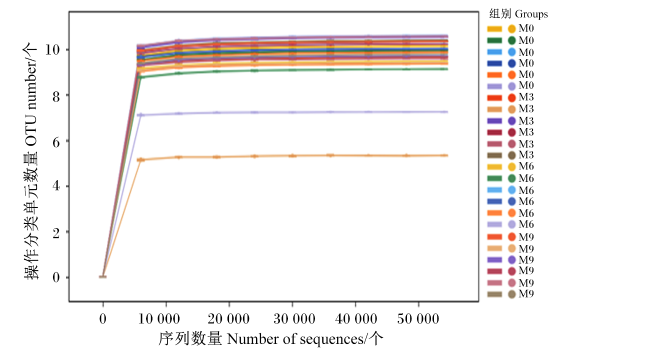
图1所示,试验第60天,瘤胃测序数量高于10 000时,稀释曲线呈现平稳趋势,表明测序的数量和深度达到了合理水平,已足够反映瘤胃样品中的微生物多样性。
图1 瘤胃微生物稀释曲线

Fig.1 Rumen microbiological dilution curve

2.2.2 瘤胃微生物操作分类单元(OTU)分析

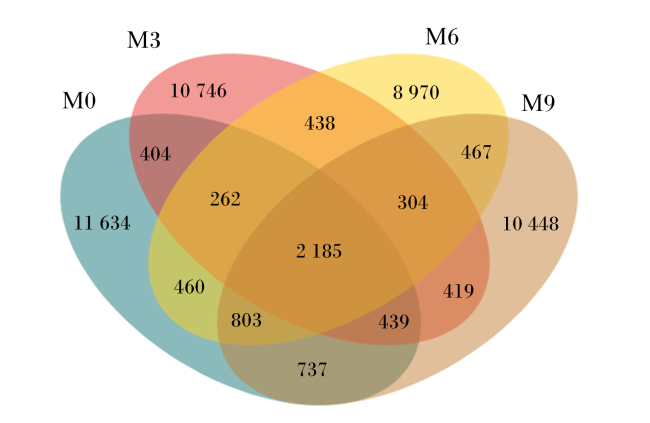
图2所示,试验第60天,对照组和试验组共有OTU数量为2 185个。其中,M0组特有OTU数量为11 634个,M3组特有OTU数量为10 746个,M6组特有OTU数量为8 970个,M9组特有OTU数量为10 448个。
图2 瘤胃微生物Venn图

M0:对照组 control group;M3:3 g/(d·头)万寿菊黄酮组 3 g/(d·head) marigold flavonoids group;M6:6 g/(d·头)万寿菊黄酮组 6 g/(d·head) marigold flavonoids group;M9:9 g/(d·头)万寿菊黄酮组9 g/(d·head) marigold flavonoids group。

Fig.2 Venn diagram of rumen microorganism

2.2.3 瘤胃微生物主坐标分析(PCoA)

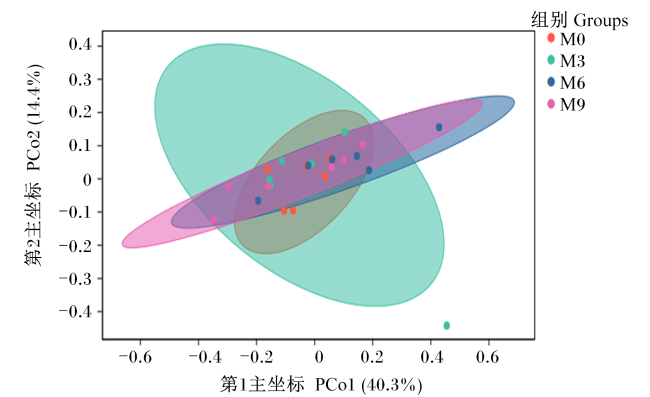
图3所示,试验第60天,瘤胃微生物经PCoA后,第1主坐标(PCo1)贡献率为40.3%,第2主坐标(PCo2)贡献率为14.4%,各组之间至少有3个样品比较集中,说明组间微生物群落组成较为相似。
图3 肉牛基于Weighted Unifrac距离的PCoA

Fig.3 PCoA of cattle based on Weighted Unifrac distance

2.2.4 万寿菊黄酮对西门塔尔育肥牛瘤胃微生物Alpha多样性的影响

表3所示,饲粮中添加万寿菊黄酮对瘤胃微生物Simpson指数具有显著影响(P=0.05),M6组的Simpson指数显著低于其他各组(P=0.05)。饲粮中添加万寿菊黄酮对瘤胃微生物Chao1、Observed_species和Shannon指数均无显著影响(P>0.05)。
表3 万寿菊黄酮对西门塔尔育肥牛瘤胃微生物Alpha多样性的影响

Table 3 Influences of marigold flavonoids on rumen microorganism Alpha diversity of Simmental fattening cattle

项目
Items
组别Groups P
P-value
M0 M3 M6 M9
Chao1指数Chao1 index 4 171.55±199.00 4 043.84±549.16 3 634.89±430.92 3 802.40±368.92 0.18
Observed_species指数
Observed_species index
4 079.04±226.38 3 989.23±534.73 3 520.10±446.42 3 717.50±373.00 0.15
Shannon指数Shannon index 10.22±0.35 10.23±0.39 9.64±0.47 10.00±0.44 0.14
Simpson指数Simpson index 1.00±0.00a 1.00±0.00a 0.99±0.00b 1.00±0.00a 0.05

2.2.5 万寿菊黄酮对西门塔尔育肥牛瘤胃微生物门水平相对丰度的影响

表4所示,在门水平上,瘤胃优势菌门为拟杆菌门(Bacteroidetes)和厚壁菌门(Firmicutes)。饲粮中添加万寿菊黄酮对瘤胃微生物门水平相对丰度无显著影响(P>0.05)。
表4 万寿菊黄酮对西门塔尔育肥牛瘤胃微生物门水平相对丰度的影响(前10)

Table 4 Influences of marigold flavonoids on rumen microorganism relative abundance at phylum level of Simmental fattening cattle (top 10) %

项目
Items
组别Groups P
P-value
M0 M3 M6 M9
拟杆菌门Bacteroidetes 57.71±3.38 53.35±5.17 55.62±6.60 56.51±2.67 0.46
厚壁菌门Firmicutes 32.75±4.22 35.69±5.10 33.85±7.87 32.43±3.06 0.74
变形菌门Proteobacteria 2.02±1.12 1.63±1.21 2.25±0.91 1.79±1.36 0.87
软壁菌门Tenericutes 1.33±0.53 1.88±0.68 1.45±0.51 1.82±0.50 0.34
螺旋菌门Spirochaetes 1.33±0.54 1.88±0.59 1.42±0.73 1.77±0.58 0.42
放线菌门Actinobacteria 0.71±0.44 1.26±0.17 1.88±1.05 1.06±0.90 0.28
TM7 1.00±0.49 1.14±0.45 0.85±0.36 1.21±0.52 0.68
纤维杆菌门Fibrobacteres 0.92±0.47 0.57±0.10 0.65±0.34 0.57±0.20 0.24
疣微菌门Verrucomicrobia 0.73±0.36 0.68±0.19 0.53±0.14 0.61±0.33 0.73
SR1 0.19±0.16 0.25±0.07 0.23±0.18 0.22±0.13 0.90

2.2.6 万寿菊黄酮对西门塔尔育肥牛瘤胃微生物科水平相对丰度的影响

表5所示,在科水平上,瘤胃优势菌科为普雷沃氏菌科(Prevotellaceae)和瘤胃球菌科(Ruminococcaceae)。饲粮中添加万寿菊黄酮对瘤胃普雷沃氏菌科相对丰度有显著影响(P=0.05),M6组的瘤胃普雷沃氏菌科相对丰度显著高于M3组(P=0.05)。饲粮中添加万寿菊黄酮对瘤胃其他菌科相对丰度均无显著影响(P>0.05)。
表5 万寿菊黄酮对西门塔尔育肥牛瘤胃微生物科水平相对丰度的影响(前10)

Table 5 Influences of marigold flavonoids on rumen microorganism relative abundance at family level of Simmental fattening cattle (top 10) %

项目
Items
组别Groups P
P-value
M0 M3 M6 M9
普雷沃氏菌科Prevotellaceae 20.11±3.45ab 17.19±2.24b 22.46±3.86a 20.42±2.05ab 0.05
瘤胃球菌科Ruminococcaceae 10.80±2.73 10.78±2.08 9.92±3.78 9.82±3.31 0.92
韦荣氏菌科Veillonellaceae 7.70±3.62 9.08±2.58 8.55±2.04 7.16±2.45 0.67
BS11 5.74±3.09 6.13±2.95 4.08±2.44 6.57±3.79 0.61
RF16 4.67±2.79 5.17±2.39 5.59±1.47 5.01±2.99 0.95
S24-7 5.41±2.45 4.47±1.53 5.03±1.86 4.71±1.74 0.87
毛螺菌科Lachnospiraceae 3.87±1.29 4.38±1.25 4.58±1.27 4.27±1.40 0.83
副萼苔科Paraprevotellaceae 3.29±0.69 3.53±0.49 2.98±0.36 3.17±0.87 0.61
丹毒丝菌科Erysipelotrichaceae 3.42±1.74 3.02±1.53 3.41±2.53 2.62±1.27 0.85
琥珀酸弧菌科Succinivibrionaceae 0.95±0.67 0.90±0.59 2.07±1.49 2.68±1.77 0.07

2.2.7 万寿菊黄酮对西门塔尔育肥牛瘤胃微生物属水平的影响

表6所示,在属水平上,瘤胃优势菌属为普雷沃氏菌属和解琥珀酸菌属(Succiniclasticum)。饲粮中添加万寿菊黄酮对普雷沃氏菌属、解琥珀酸菌属和双歧杆菌属(Bifidobacterium)相对丰度具有显著影响(P≤0.05),M6组的瘤胃普雷沃氏菌属相对丰度显著高于M3组(P<0.05),M6组的瘤胃解琥珀酸菌属和双歧杆菌属相对丰度显著高于M0和M9组(P≤0.05)。饲粮中添加万寿菊黄酮对瘤胃其他菌属相对丰度均无显著影响(P>0.05)。
表6 万寿菊黄酮对西门塔尔育肥牛瘤胃微生物属水平相对丰度的影响(前10)

Table 6 Influences of marigold flavonoids on rumen microorganism relative abundance at genus level of Simmental fattening cattle (top 10) %

项目
Items
组别Groups P
P-value
M0 M3 M6 M9
普雷沃氏菌属Prevotella 20.09±2.85ab 18.00±1.83b 23.32±2.56a 20.28±2.88ab 0.04
解琥珀酸菌属Succiniclasticum 6.48±1.63b 8.10±1.51ab 9.09±1.57a 6.37±1.92b 0.05
瘤胃球菌属Ruminococcus 2.86±0.79 4.52±2.13 5.29±3.31 3.09±0.74 0.34
夏普氏菌属Sharpea 0.74±0.64 1.54±1.07 2.37±1.76 1.07±1.04 0.18
YRC22 1.53±0.39 1.83±0.49 1.33±0.24 1.52±0.62 0.43
RFN20 1.39±0.40 1.23±0.26 1.22±0.71 1.28±0.39 0.93
密螺旋体属Treponema 0.94±0.50 1.15±0.18 1.04±0.60 1.25±0.58 0.76
双歧杆菌属Bifidobacterium 0.24±0.17b 0.85±0.68ab 1.16±0.80a 0.19±0.10b 0.02
梭菌科-梭菌属
Clostridiaceae_Clostridium
1.15±0.41 1.03±0.22 0.85±0.25 0.98±0.22 0.43
CF231 0.93±0.19 0.77±0.13 0.70±0.25 0.71±0.12 0.16

2.2.8 瘤胃微生物属水平相对丰度与瘤胃发酵参数的相关性分析

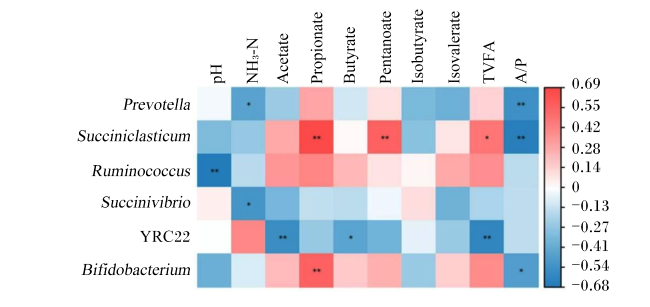
为进一步探究瘤胃微生物对瘤胃发酵功能的影响,将属水平相对丰度前10的微生物与瘤胃发酵参数进行相关性分析,如图4所示,瘤胃普雷沃氏菌属、解琥珀酸菌属、瘤胃球菌属、琥珀酸弧菌属(Succinivibrio)、YRC22和双歧杆菌属相对丰度与瘤胃发酵参数具有相关性,其中,普雷沃氏菌属相对丰度与乙酸/丙酸呈极显著负相关(P<0.01),普雷沃氏菌属和琥珀酸弧菌属相对丰度与NH3-N含量呈显著负相关(P<0.05);解琥珀酸菌属相对丰度与丙酸和戊酸含量呈极显著正相关(P<0.01),与乙酸/丙酸呈极显著负相关(P<0.01);瘤胃球菌属相对丰度与pH呈极显著负相关(P<0.01);YRC22相对丰度与乙酸和TVFA含量呈极显著负相关(P<0.01);双歧杆菌属相对丰度与丙酸含量呈极显著正相关(P<0.01)。
图4 瘤胃微生物属水平相对丰度与瘤胃发酵参数的相关性分析

Prevotella:普雷沃氏菌属;Succiniclasticum:解琥珀酸菌属;Ruminococcus:瘤胃球菌属;Succinivibrio:琥珀酸弧菌属;Bifidobacterium:双歧杆菌属;NH3-N:氨态氮 ammonia nitrogen;Acetate:乙酸;Propionate:丙酸;Butyrate:丁酸;Pentanoate:戊酸;Isobutyrate:异丁酸;Isovalerate:异戊酸;TVFA:总挥发性脂肪酸 total volatile fatty acid;A/P:乙酸/丙酸 acetate/propionate。

图中图例展示相关性系数值,红色代表两者为正相关,蓝色则代表负相关;*表示显著相关(P<0.05),**表示极显著相关(P<0.01)。The legend in the figure displayed the values of correlation coefficients, where red signified positive correlation and blue signified negative correlation; * indicated significant correlation (P<0.05), ** indicated extremely significant correlation (P<0.01).

Fig.4 Correlation analysis between rumen microorganism relative abundance at genus level and rumen fermentation parameters

3 讨论

3.1 万寿菊黄酮对西门塔尔育肥牛瘤胃发酵参数的影响

反刍动物的生长与健康在很大程度上依赖于瘤胃的发酵功能。pH作为瘤胃发酵的核心指标,受到多种因素的影响,包括唾液的分泌、瘤胃内VFA和乳酸的积累,以及饲粮的种类和营养水平等,直接影响到瘤胃微生物对底物的发酵效率[23]。研究表明,瘤胃发酵的理想pH范围为6.0~7.0[24]。本试验中,西门塔尔育肥牛瘤胃pH均稳定在正常范围内,且无显著差异,说明饲喂万寿菊黄酮并不会干扰肉牛瘤胃内部环境的稳定性,利于瘤胃微生物的发酵。NH3-N是瘤胃微生物生长与繁殖所必需的关键氮源之一,其标准含量为15~30 mg/dL[25],当NH3-N含量超出或低于这一范围,均会对瘤胃微生物的氮素利用造成不良影响。在本研究中,各组的瘤胃NH3-N含量均保持在正常范围内。VFA作为反刍动物瘤胃中碳水化合物发酵的重要产物,是获取能量的重要途径,其主要成分包括乙酸、丙酸和丁酸,三者在反刍动物瘤胃中共占据TVFA的约95%,不仅为反刍动物提供了必要的能量,而且在维护瘤胃内部环境的稳定、促进瘤胃正常发育方面发挥着至关重要的作用[26]。栗明月[27]研究表明,饲粮中添加竹叶提取物可显著提高奶牛瘤胃丙酸和TVFA含量,并降低乙酸/丙酸。在本研究中,饲粮中添加万寿菊黄酮可提高西门塔尔育肥牛瘤胃丙酸和TVFA含量,且以M6组提高效果最好,与栗明月[27]的研究结果一致。这可能是因为万寿菊黄酮的抗菌特性,极大地促进了瘤胃内丙酸生成菌的活性,进而提高了丙酸含量,其具体机制仍需进一步研究。

3.2 万寿菊黄酮对西门塔尔育肥牛瘤胃微生物区系的影响

反刍动物的瘤胃微生物群落多样且丰富,涵盖了细菌、真菌、原生动物以及古细菌等多种微生物种群,其种类和数量受动物品种、饲粮组成以及饲养环境的影响[28]。瘤胃微生物稀释曲线的平缓程度常被用来评估群落中物种的覆盖度和测序深度。在本试验中,各组样品覆盖率均超过97%,这足以证明本次测序结果能够真实精确地展现肉牛瘤胃中微生物种类及其结构的多样性。Chao1和Observed_species指数作为评估微生物丰富度的关键指标,其数值的高低直接反映了微生物群落的丰富程度;而Shannon和Simpson指数则用于评估微生物的多样性和均匀度,当这些指数的数值上升时,意味着微生物群落的多样性和均匀性也随之提升[29]。本试验发现,Chao1和Observed_species指数无显著影响,而Simpson指数却显著降低,表明在饲粮中添加万寿菊黄酮不会影响瘤胃微生物的丰富度,但降低了其多样性,与占今舜等[28]在奶牛上的研究结果相似,这可能是由于万寿菊黄酮通过发挥抑菌作用,进而导致了瘤胃中细菌种类和多样性的降低[30]
有研究指出,反刍动物瘤胃微生物中,厚壁菌门、拟杆菌门和变形菌门的数量较多[31-32],它们三者共占据了细菌总门的近90%。在本试验中,肉牛瘤胃中的优势菌门与前人研究结果相吻合,这表明饲粮中添加万寿菊黄酮并未影响肉牛瘤胃微生物的整体区系组成。在瘤胃科水平上,普雷沃氏菌科和瘤胃球菌科为优势菌科,其中,普雷沃氏菌科在分解蛋白质和碳水化合物方面发挥着关键作用[33]。本试验中,M6组的瘤胃普雷沃氏菌科相对丰度显著高于M3组,这表明万寿菊黄酮能够促进细菌的增殖。在属水平上,普雷沃氏菌属和解琥珀酸菌属在瘤胃内的相对丰度较高。已有研究证实,普雷沃氏菌属在反刍动物瘤胃中的相对丰度最高[34],本研究结果与其一致。普雷沃氏菌属在瘤胃中发挥着重要作用,它参与了除脂质外的大部分饲粮成分的降解工作。本试验中,普雷沃氏菌属的相对丰度随着饲粮中万寿菊黄酮添加水平的增加呈现先降低后升高的变化趋势,这一结果与科水平上其相对丰度的变化趋势一致,同时普雷沃氏菌属相对丰度与乙酸/丙酸呈极显著负相关,这表明普雷沃氏菌属与瘤胃VFA的代谢密切相关。解琥珀酸菌属在瘤胃中扮演着至关重要的角色,它负责将碳水化合物降解为琥珀酸,并继续参与代谢过程,最终生成丙酸[35]。本试验中,M6组瘤胃解琥珀酸菌属相对丰度较于M0组显著提高,这一结果与瘤胃发酵指标中M6组的瘤胃丙酸含量显著高于M0组相对应,同时通过相关性分析发现,瘤胃解琥珀酸菌属相对丰度与丙酸含量呈极显著正相关。本试验中,饲粮中添加万寿菊黄酮后,瘤胃双歧杆菌属相对丰度提高,通过相关性分析发现,双歧杆菌属相对丰度与丙酸含量呈极显著正相关,这可能是由于万寿菊黄酮通过其抗菌特性增强了机体免疫力,促进有益菌群的增殖,提高对营养物质的吸收利用,进而提高丙酸的产量[36]

4 结论

饲粮中添加万寿菊黄酮可以提高瘤胃丙酸和TVFA含量,改善瘤胃微生物多样性及有益菌的相对丰度,优化菌群结构,且以添加6 g/(d·头)的万寿菊黄酮效果最佳。
[1]
刘嘉莉, 窦金焕, 胡丽蓉, 等. 热应激对奶牛生理和免疫功能的影响及其机理[J]. 中国畜牧兽医, 2018, 45(1):263-270.

DOI

LIU J L, DOU J H, HU L R, et al. Effects and mechanism of heat stress on physiological and immune system in dairy cows[J]. China Animal Husbandry & Veterinary Medicine, 2018, 45(1):263-270. (in Chinese)

[2]
DOS SANTOS M M, SOUZA-JUNIOR J B F, DANTAS M R T, et al. An updated review on cattle thermoregulation:physiological responses,biophysical mechanisms,and heat stress alleviation pathways[J]. Environmental Science and Pollution Research International, 2021, 28(24):30471-30485.

[3]
杨梓曼, 尚相龙, 陈豪, 等. 热应激对肉牛血清生化指标、瘤胃发酵参数及微生物区系的影响[J]. 动物营养学报, 2022, 34(7):4487-4497.

DOI

YANG Z M, SHANG X L, CHEN H, et al. Effects of heat stress on serum biochemical indexes,rumen fermentation parameters and microflora of beef cattle[J]. Chinese Journal of Animal Nutrition, 2022, 34(7):4487-4497. (in Chinese)

[4]
张灿. 湿热应激对藏绵羊和山羊生产性能、瘤胃发酵及血液生化指标影响的比较研究[D]. 硕士学位论文. 雅安: 四川农业大学, 2016.

ZHANG C. Comparative study of performance,rumen fermentation and blood biochemical indices of Tibetan sheep (Ovis aries) and goat under moist-heat stress[D]. Master’s Thesis. Ya’an: Sichuan Agricultural University, 2016. (in Chinese)

[5]
郑洁怡, 杨舒黎, 赵开玲, 等. 热应激对反刍动物瘤胃功能及潜在耐热标志物的影响[J]. 中国畜牧兽医, 2024, 51(3):1041-1049.

DOI

ZHENG J Y, YANG S L, ZHAO K L, et al. Effects of heat stress on rumen function and potential heat tolerance markers in ruminants[J]. China Animal Husbandry & Veterinary Medicine, 2024, 51(3):1041-1049. (in Chinese)

[6]
侯宇. 不同持续时间热应激对奶牛生产性能的影响及热应激预警模型的建立[D]. 博士学位论文. 杨凌: 西北农林科技大学, 2021.

HOU Y. Effects of heat stress of different duration on the production performance of cows and the establishment of warning model of heat stress[D]. Ph.D.Thesis. Yangling: Northwest A&F University, 2021. (in Chinese)

[7]
张艳, 孙武, 李升升, 等. 浅析抗生素发展史及替抗时代下的应对措施[J]. 中国畜禽种业, 2023, 19(1):22-24.

ZHANG Y, SUN W, LI S S, et al. A brief analysis of the history of antibiotic development and countermeasures in the era of replacement resistance[J]. The Chinese Livestock and Poultry Breeding, 2023, 19(1):22-24. (in Chinese)

[8]
吕邵娃, 菅计苹, 谭美微, 等. 万寿菊的显微鉴别及5个主要成分的含量测定[J]. 中国医药导报, 2020, 17(4):4-7,198.

LV S W, JIAN J P, TAN M W, et al. The microscopical indentification and determination of the content of five main components of Tagetes erecta L.[J]. China Medical Herald, 2020, 17(4):4-7,198. (in Chinese)

[9]
FRANCO J L, POSSER T, MISSAU F, et al. Structure-activity relationship of flavonoids derived from medicinal plants in preventing methylmercury-induced mitochondrial dysfunction[J]. Environmental Toxicology and Pharmacology, 2010, 30(3):272-278.

PMID

[10]
吴志伟, 马汶君, 孙春兰, 等. 竹叶黄酮提取物和雪莲果提取物对萧山鸡母鸡的生产性能、蛋品质、血清生化以及肠道菌群的影响[J]. 中国畜牧杂志, 2023, 59(11):231-237.

WU Z W, MA M J, SUN C L, et al. Effects of bamboo leaf flavonoid extract and snow lily fruit extract on performance,egg quality,serum biochemistry and intestinal flora of Xiaoshan chickens[J]. Chinese Journal of Animal Science, 2023, 59(11):231-237. (in Chinese)

[11]
包玲玲. 沙葱黄酮类化合物对绵羊瘤胃发酵、内环境参数及纤维素降解的影响[D]. 硕士学位论文. 呼和浩特: 内蒙古农业大学, 2015.

BAO L L. The influence of allium mongilicum regel flavonoids on the rumen fermentation,rumen environment parameters and rumen cellulose degradation in sheep[D]. Master’s Thesis. Hohhot: Inner Mongolia Agricultural University, 2015. (in Chinese)

[12]
白齐昌. 沙棘黄酮对绵羊生长性能、消化代谢、瘤胃发酵及血液指标的影响[D]. 硕士学位论文. 晋中: 山西农业大学, 2020.

BAI Q C. Effects of dietary different supplement levels of seabuckthorn flavones on growth performance,digestion metabolism,rumen fermentation and blood index in sheep[D]. Master’s Thesis. Jinzhong: Shanxi Agricultural University, 2020. (in Chinese)

[13]
赵慧颖, 余诗强, 贺李莹, 等. 沙棘黄酮对泌乳中期荷斯坦奶牛瘤胃发酵参数、细菌菌群结构及代谢产物的影响[J]. 动物营养学报, 2022, 34(9):5809-5823.

DOI

ZHAO H Y, YU S Q, HE L Y, et al. Effects of sea-buckthorn flavonoids on rumen fermentation parameters,bacterial flora structure and metabolites of mid-lactation Holstein cows[J]. Chinese Journal of Animal Nutrition, 2022, 34(9):5809-5823. (in Chinese)

[14]
ZHANG Y W, LUO H L, LIU K, et al. Antioxidant effects of liquorice (Glycyrrhiza uralensis) extract during aging of longissimus thoracis muscle in Tan sheep[J]. Meat Science, 2015, 105:38-45.

[15]
中华人民共和国农业部. 肉牛饲养标准:NY/T 815—2004[S]. 北京: 中国农业出版社, 2004.

Ministry of Agriculture of the People’s Republic of China. Feeding standard of beef cattle:NY/T 815—2004[S]. Beijing: China Agriculture Press, 2004. (in Chinese)

[16]
宫斌, 檀论, 侯坤, 等. 杂交构树青贮对奶公牛生长性能、营养物质表观消化率和瘤胃发酵参数的影响[J]. 动物营养学报, 2023, 35(6):3771-3779.

DOI

GONG B, TAN L, HOU K, et al. Effects of hybrid Broussonetia papyrifera silage on growth performance,nutrient apparent digestibility and rumen fermentation parameters of fattening dairy bulls[J]. Chinese Journal of Animal Nutrition, 2023, 35(6):3771-3779. (in Chinese)

DOI

[17]
冯宗慈, 高民. 通过比色测定瘤胃液氨氮含量方法的改进[J]. 畜牧与饲料科学, 2010, 31(Z1):37.

FENG Z C, GAO M. Improvement of a colorimetric method for determination of ammonia nitrogen in rumen fluid[J]. Animal Husbandry and Feed Science, 2010, 31(Z1):37. (in Chinese)

[18]
和立文. 全株玉米青贮品质评价及其对肉牛育肥性能和牛肉品质的影响[D]. 博士学位论文. 北京: 中国农业大学, 2017.

HE L W. Quality evaluation of corn silage and its effect on the growth performance and beef quality of finishing cattle[D]. Ph.D.Thesis. Beijing: China Agricultural University, 2017. (in Chinese)

[19]
MAGOČ T, SALZBERG S L. FLASH:fast length adjustment of short reads to improve genome assemblies[J]. Bioinformatics, 2011, 27(21):2957-2963.

[20]
CAPORASO J G, KUCZYNSKI J, STOMBAUGH J, et al. QIIME allows analysis of high-throughput community sequencing data[J]. Nature Methods, 2010, 7(5):335-336.

DOI PMID

[21]
EDGAR R C, HAAS B J, CLEMENTE J C, et al. UCHIME improves sensitivity and speed of chimera detection[J]. Bioinformatics, 2011, 27(16):2194-2200.

DOI PMID

[22]
HAAS B J, GEVERS D, EARL A M, et al. Chimeric 16S rRNA sequence formation and detection in Sanger and 454-pyrosequenced PCR amplicons[J]. Genome Research, 2011, 21(3):494-504.

DOI PMID

[23]
李宏, 宋淑珍, 高良霜, 等. 饲养水平对阿勒泰羊胃肠道发育、瘤胃发酵参数及瘤胃微生物区系的影响[J]. 草业学报, 2021, 30(4):180-190.

DOI

LI H, SONG S Z, GAO L S, et al. Effects of feeding level on the gastrointestinal development,rumen fermentation and rumen microbiota in Altay sheep[J]. Acta Prataculturae Sinica, 2021, 30(4):180-190. (in Chinese)

[24]
BUSQUET M, CALSAMIGLIA S, FERRET A, et al. Screening for effects of plant extracts and active compounds of plants on dairy cattle rumen microbial fermentation in a continuous culture system[J]. Animal Feed Science and Technology, 2005, 123/124(Part 2):597-613.

[25]
鲍宏云. 过瘤胃保护维生素A对奶牛瘤胃发酵、产奶性能及免疫功能的影响[D]. 硕士学位论文. 呼和浩特: 内蒙古农业大学, 2011.

BAO H Y. Effects of rumen-protected vitamin A on rumen fermentation,milk production performance and immune function of dairy cows[D]. Master’s Thesis. Hohhot: Inner Mongolia Agricultural University, 2011. (in Chinese)

[26]
程冠文. 日粮碳水化合物类型调控瘤胃发酵乙/丙比的机制研究[D]. 硕士学位论文. 泰安: 山东农业大学, 2019.

CHENG G W. Study on the mechanism of dietary carbohydrate types regulating C2/C3 ratio in rumen fermentation[D]. Master’s Thesis. Tai’an: Shandong Agricultural University, 2019. (in Chinese)

[27]
栗明月. 竹叶提取物对奶牛瘤胃发酵、血液中抗氧化酶、免疫球蛋白及炎性因子的影响[D]. 硕士学位论文. 北京: 北京农学院, 2019.

LI M Y. Effects of bamboo leaf extract on rumen fermentation,antioxidant enzymes,immunoglobulins and inflammatory factors in the blood of dairy cows[D]. Master’s Thesis. Beijing: Beijing University of Agriculture, 2019. (in Chinese)

[28]
占今舜, 邬彩霞, 刘明美, 等. 饲粮添加苜蓿黄酮对奶牛瘤胃菌群的影响[J]. 草业学报, 2017, 26(7):82-89.

DOI

ZHAN J S, WU C X, LIU M M, et al. Effects of alfalfa flavonoids as dietary additives on bacterial flora in the rumen of dairy cows[J]. Acta Prataculturae Sinica, 2017, 26(7):82-89. (in Chinese)

[29]
GRICE E A, KONG H H, CONLAN S, et al. Topographical and temporal diversity of the human skin microbiome[J]. Science, 2009, 324(5931):1190-1192.

DOI PMID

[30]
PARK K D, CHO S J. Synthesis and antimicrobial activities of 3-O-alkyl analogues of (+)-catechin:improvement of stability and proposed action mechanism[J]. European Journal of Medicinal Chemistry, 2010, 45(3):1028-1033.

[31]
KIM M, MORRISON M, YU Z T. Status of the phylogenetic diversity census of ruminal microbiomes[J]. FEMS Microbiology Ecology, 2011, 76(1):49-63.

DOI PMID

[32]
杨卓. 断奶犊牛与育成牛瘤胃菌群多样性及血液生化指标变化研究[D]. 硕士学位论文. 银川: 宁夏大学, 2021.

YANG Z. Study on rumen flora diversity and changes of blood biochemical indexes in Holstein weaned calves and growing heifers[D]. Master’s Thesis. Yinchuan: Ningxia University, 2021. (in Chinese)

[33]
焦万洪. 瘤胃内微生物对饲料蛋白质消化的探析[J]. 养殖与饲料, 2014(12):37.

JIAO W H. Analysis of rumen microorganisms on feed protein digestion[J]. Animal Breeding and Feed, 2014(12):37. (in Chinese)

[34]
DE OLIVEIRA M N V, JEWELL K A, FREITAS F S, et al. Characterizing the microbiota across the gastrointestinal tract of a Brazilian Nelore steer[J]. Veterinary Microbiology, 2013, 164(3/4):307-314.

[35]
RIDWAN R, RUSMANA I, WIDYASTUTI Y, et al. Bacteria and methanogen community in the rumen fed different levels of grass-legume silages[J]. Biodiversitas Journal of Biological Diversity, 2019, 20(4):1055-1062.

[36]
CHUNG THE H, NGUYEN NGOC MINH C, TRAN THI HONG C, et al. Exploring the genomic diversity and antimicrobial susceptibility of Bifidobacterium pseudocatenulatum in a Vietnamese population[J]. Microbiology Spectrum, 2021, 9(2):e0052621.

Outlines

/