RESEARCH PAPER

Effects of Thyme on Growth Performance, Slaughter Performance and Rumen Microflora Structure of Tan Sheep

  • ZHAO Yuanyuan , 1 ,
  • MA Qing 2 ,
  • ZHOU Lusong 3, 4 ,
  • YANG Yuwei 2 ,
  • ZHAO Qingyu 3 ,
  • ZHOU Yuxiang , 1, *
Expand
  • 1 College of Animal Science and Technology, Ningxia University, Yinchuan 750021, China
  • 2 Institute of Animal Science, Ningxia Academy of Agriculture and Forestry Sciences, Yinchuan 750004, China
  • 3 National Key Laboratory of Livestock and Poultry Nutrition and Feeding, Beijing Institute of Animal Science, Chinese Academy of Agricultural Sciences, Beijing 100193,China
  • 4 College of Food Science and Engineering, Qingdao Agricultural University, Qingdao 266109,China
*professor, E-mail:

Received date: 2024-07-09

  Online published: 2025-02-16

Abstract

This experiment was conducted to investigate the effects of dietary thyme supplementation on growth performance, slaughter performance and rumen microflora structure of Tan sheep. Fifty-two healthy female Tan sheep weighing (28.50±0.50) kg were selected and divided into 4 groups, 13 repetitions per group, 1 repetition per group, and fed a basic diet (control group), 2% (2% group), 4% (4% group) and 8% thyme (8% group) to the basic diet. The total test was 70 days, the pre-test was 10 days, and the main test period was 60 days. The results showed as follows: 1) compared with the control group, the decrease of the ratio of feed to gain of 8% group was significant (P<0.05), and the increase of the ratio of feed to gain of 2% group was significant (P<0.05). 2) Compared with the control group, there were no significant differences in slaughter performance-related indexes (live weight before, carcass weight, dressing percentage, GR value, backfat thickness) between the 2%, 4% and 8% groups (P>0.05), but except for the GR value, the values of other slaughter performance-related indexes were higher than those in the control group. 3) The number of operational taxonomic units in the 2%, 4% and 8% groups was higher than that in the control group, and the 4% group> 2% group > 8% group >control group. Compared with the control group, there was no significant difference in the alpha diversity indexes between the 2%, 4% and 8% groups (P>0.05). 4) At the phylum level, compared with the control group, the relative abundance of the Desulfobacterota in the 4% group increased significantly (P<0.05), and the relative abundance of the Fibrobacterota in the 2% group increased significantly (P<0.05); at the genus level, compared with the control group, the relative abundance of the Rikenellaceae_RC9_ group in the 2% and 4% groups increased significantly (P<0.05), and the relative abundance of the Lachnospiraceae_NK3A20_group in the 8% group increased significantly (P<0.05). 5) In the KEGG functional analysis, compared with the control group, the relative abundance of amino acid metabolism pathways in the 4% group was significant (P<0.05). In conclusion, the addition of different proportions of thyme in the diet can change the the ratio of feed to gain and rumen microflora structure of Tan sheep, promote the reproduction of some beneficial bacteria, and improve the relative abundance of amino acid metabolism pathways. In this experiment, the appropriate supplemental proportion of thyme in diet is 4%.

Cite this article

ZHAO Yuanyuan , MA Qing , ZHOU Lusong , YANG Yuwei , ZHAO Qingyu , ZHOU Yuxiang . Effects of Thyme on Growth Performance, Slaughter Performance and Rumen Microflora Structure of Tan Sheep[J]. Chinese Journal of Animal Nutrition, 2025 , 37(2) : 1127 -1140 . DOI: 10.12418/CJAN2025.098

随着生活质量的提升,食品安全成了人们关注的重中之重,越来越多的抗生素被禁止作为生长促进剂用于动物饲粮中。因此,我国一直在寻找能够替代抗生素且促进生长、改善肉质同时提升动物健康的饲料添加剂[1]。百里香因具有抗氧化和抑菌性能,而引起了畜牧养殖者的关注。
百里香,唇形科百里香属的矮小灌木状草本,别称地椒。在中国,西北地区是百里香的主产区,且宁夏南部山区尤为聚集。百里香含有精油、类黄酮和其他化学成分[2],可用作食品调味剂。百里香酚、香芹酚、对聚伞花烃、芳樟醇都是百里香油的主成分[3],它们均具有抗氧化的特性,可以增加食欲,促进生长性能[4-6]。此外,百里香也是重要的药用植物。百里香酚在体内或体外可抵抗多种细菌、病毒、真菌和寄生虫病原体的侵害[7]。研究表明,在饲粮中添加百里香精油可以改善山羊的瘤胃发酵[8]。但是百里香对滩羊生长性能、屠宰性能及瘤胃菌群结构的影响尚不明确。因此,本试验在饲粮中添加不同比例的百里香,研究其对滩羊生长性能、屠宰性能及瘤胃菌群结构的影响,以期为百里香作为饲料添加剂的应用提供合理依据,为绿色生态养殖提供新思路。

1 材料与方法

1.1 试验设计

本试验获得了宁夏大学科技伦理审查委员会的伦理许可,并获得了宁夏大学科技伦理委员会的批准(NXU-2024-147)。试验于2023年10月至2024年1月在宁夏盐池滩羊产业集团有限公司生态牧场进行。百里香由宁夏吴忠市盐池县提供,将其地上部分全枝自然风干后磨成粉避光储存。百里香主要活性成分包括香荆芥酚(28.54%)、1-甲基-3-异丙基苯(22.77%)、百里香酚(11.45%)等,其主要化学成分含量分别为粗蛋白质7.04%,钙 2.13%,中性洗涤纤维57.2%。
试验采用单因素随机试验设计,挑选体重为(28.50±0.50) kg的雌性滩羊52只,分为4组,每组13个重复,每个重复1只。4组分别饲喂基础饲粮(对照组)以及在基础饲粮中分别添加2%、4%、8%的百里香的试验饲粮。试验期70 d,其中预试期10 d,正试期60 d。

1.2 试验饲粮

参考《肉羊饲养标准》(NY/T 816—2021)配制全混合日粮,精粗比约为7∶3。参照GB/T 6435—2014、GB/T 6432—2018、GB/T 20806—2006、GB/T 6436—2018、GB/T 6437—2018标准分别测定饲粮干物质、粗蛋白质、中性洗涤纤维、钙、磷含量。饲粮代谢能参考《肉羊饲养标准》(NY/T 816—2021)计算[9]表1为饲粮组成及营养水平。
表1 饲粮组成及营养水平(干物质基础)

Table 1 Composition and nutrient levels of diets (DM basis) %

项目
Items
对照组
Control group
2%组
2% group
4%组
4% group
8%组
8% group
原料Ingredients
玉米Corn 41.88 39.96 38.03 38.10
麸皮Wheat bran 9.80 9.80 9.80 9.80
豆粕Soybean meal 10.78 10.78 10.78 10.78
棉籽粕Cottonseed meal 7.84 7.84 7.84 7.84
玉米秸秆Corn straw 13.90 13.90 13.90 13.90
百里香Thyme 2.00 4.00 8.00
苜蓿干草Alfalfa hay 9.90 9.90 9.90 5.93
燕麦草Oat grass 3.00 3.00 3.00 3.00
磷酸氢钙CaHPO4 0.45 0.45 0.45 0.45
石粉Limestone 1.47 1.39 1.32 1.23
预混料Premix1) 0.98 0.98 0.98 0.98
合计Total 100.00 100.00 100.00 100.00
营养水平Nutrient levels2)
代谢能ME/(MJ/kg) 10.37 10.32 10.27 10.36
粗蛋白质CP 14.70 14.73 14.75 14.69
钙Ca 0.92 0.92 0.92 0.90
磷P 0.51 0.51 0.51 0.50
中性洗涤纤维NDF 19.51 20.35 21.19 21.84

1) 每千克预混料含有 One kg of premix contained the following: VA 1 600 000 IU, VD 2 100 000 IU, VE 500 mg, Mn 650 mg, Se 6 mg, Zn 2 500 mg, Fe 2 700 mg, I 13 mg, Co 9 mg。

2)代谢能为计算值,其余营养水平为实测值。ME was a calculated value, while the rest of the nutrient levels were measured values.

1.3 饲养管理

试验前,打扫、消毒羊圈,检测布病及防疫驱虫。每日08:00和18:00饲喂试验羊,保障采食和饮水自由,定时清理料槽,记录投料、剩料量。

1.4 测定指标及方法

1.4.1 生长性能

初始体重(IBW):在正试期第1天清晨,在羊群空腹状态下称重并记录;终末体重(FBW):在正式期第60天清晨,在羊群空腹状态下称重并记录,计算平均日增重(ADG)。每天晨饲前清理料槽剩料并称重记录剩料,计算平均日采食量(ADFI);根据ADFI和ADG计算料重比(F/G)。

1.4.2 屠宰性能

在正试期第60天,每组选8只羊进行屠宰,屠宰前在滩羊空腹状态下测定宰前活重,按照《绵、山羊生产性能测定技术规范》(NY/T 1236—2006)测定胴体重,计算屠宰率;GR值:游标卡尺测得第12~13肋骨之间、距背脊中线11 cm处的组织厚度;背膘厚度:用游标卡尺测量第12~13胸椎结合处的背部不含皮的皮下脂肪厚度。

1.4.3 瘤胃液的采集和处理

每只羊采集8 mL瘤胃液,于2 mL冻存管分装,保存于-80 ℃冰箱,用于后续瘤胃菌群多样性分析。
由上海美吉生物医药科技有限公司提取样品总DNA,构建文库及测序,测序在Illumina MiSeq平台上进行。质控优化原始数据后得到有效数据,然后进行物种注释分析、物种差异比较分析。

1.5 数据处理与分析

使用Excel 2010初步整理生长性能、屠宰性能数据,用SPSS 26.0统计软件进行单因素方差分析,采用Duncan氏法进行多重比较。在美吉生物云平台对微生物数据进行分析,使用非参数Kruskal Wallis秩和检验分析瘤胃液菌群多样性指数组间差异和微生物门、属水平相对丰度的变化。利用R语言工具(version 3.3.1)作图。结果均以图或表的形式列出,表中数据用平均值±均值标准误表示。P<0.05表示显著差异。

2 结果与分析

2.1 饲粮中添加百里香对滩羊生长性能的影响

表2可知,各组滩羊的IBW、FBW均无显著差异(P>0.05)。相较于对照组,4%、8%组滩羊的总增重和ADG均有所提高。4%组滩羊的总增重和ADG分别较对照组增加了1.43%和4.91%;8%组滩羊的总增重和ADG分别较对照组增加了1.44%和4.96%。4%、8%组料重比均低于对照组,且相比于对照组,8%组的料重比显著降低(P<0.05)。
表2 饲粮中添加百里香对滩羊生长性能的影响

Table 2 Effects of dietary supplementation of thyme on growth performance of Tan sheep

项目
Items
对照组
Control group
2%组
2% group
4%组
4% group
8%组
8% group
SEM P
P-value
初始体重IBW/kg 28.02±1.07 29.20±1.28 27.83±1.30 27.68±0.88 0.25 0.12
终末体重FBW/kg 41.26±3.28 41.96±2.50 41.27±1.77 41.59±2.18 0.48 0.96
总增重TG/kg 13.25±3.40 12.76±2.50 13.44±1.87 13.90±1.87 0.48 0.85
平均日增重ADG/(g/d) 220.75±56.68 212.67±41.64 223.92±31.22 231.69±31.12 8.03 0.88
平均日采食量ADFI/(g/d) 1 546.06±103.42 1 546.60±103.34 1 549.72±98.70 1 508.69±86.44 6.58 0.09
料重比F/G 7.00±0.47b 7.27±0.48c 6.92±0.44b 6.51±0.37a 0.03 <0.01

同行数据肩标不同小写字母表示差异显著(P<0.05)。下表同。

In the same row, values with different small letter superscripts mean significant difference (P<0.05). The same as below.

2.2 饲粮中添加百里香对滩羊屠宰性能的影响

表3可知,各组宰前活重、胴体重、屠宰率、GR值、背膘厚度均无显著差异(P>0.05)。相比于对照组,2%、4%、8%组宰前活重、胴体重、屠宰率、背膘厚度均有所提高。相比于对照组,2%组胴体重、屠宰率和背膘厚度分别增加了3.90%、1.70%及11.30%;4%组胴体重、屠宰率和背膘厚度分别增加了2.90%、2.60%及12.00%;8%组胴体重、屠宰率和背膘厚度分别增加了5.20%、6.10%及6.20%。2%、4%组的GR值相较与对照组分别增加16.60%及3.70%。
表3 饲粮中添加百里香对滩羊屠宰性能的影响

Table 3 Effects of dietary supplementation of thyme on slaughter performance of Tan sheep

项目
Items
对照组
Control group
2%组
2% group
4%组
4% group
8%组
8% group
SEM P
P-value
宰前活重
Live weight before slaughter/kg
42.46±3.28 43.16±2.50 42.53±1.77 42.91±2.18 0.48 0.96
胴体重
Carcass weight/kg
20.22±1.61 21.17±1.38 20.97±1.49 21.43±0.87 0.28 0.47
屠宰率
Dressing percentage/%
52.92±1.42 53.40±2.34 53.91±4.30 54.03±2.87 0.56 0.91
GR值GR value/mm 15.69±2.42 18.30±4.05 16.27±2.70 14.36±4.03 0.71 0.27
背膘厚度Backfat thickness/mm 5.67±1.87 6.31±2.30 6.35±1.10 6.02±2.33 0.37 0.93

2.3 饲粮中添加百里香对滩羊瘤胃菌群结构的影响

2.3.1 操作分类单元(OTUs)聚类分析
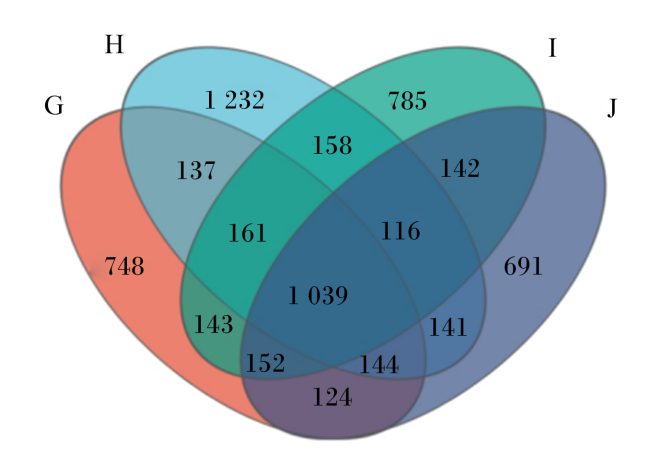
根据OTUs聚类分析结果,分析4个组样品中OTUs的分布,并制作韦恩图(图1)。由图1可知,对照组中发现2 549个OTUs,2%组中发现2 648个OTUs,4%组中发现3 554个OTUs,8%组中发现2 696个OTUs,共享了1 039个OTUs,表明添加2%、4%、8%的百里香皆会增加滩羊瘤胃液中OTUs数目,即提高细菌菌群的种类。
图1 瘤胃菌群韦恩图

G:2%组;H:4%组;I:8%组;J:对照组。下图同。

Fig.1 Venn graph of bacteria in rumen

G: 2% group; H: 4% group; I: 8% group; J: control group. The same as below.

2.3.2 Alpha多样性指数稀释曲线分析

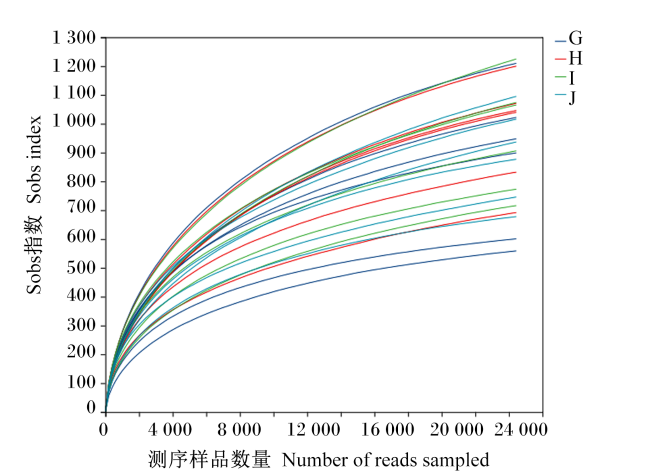
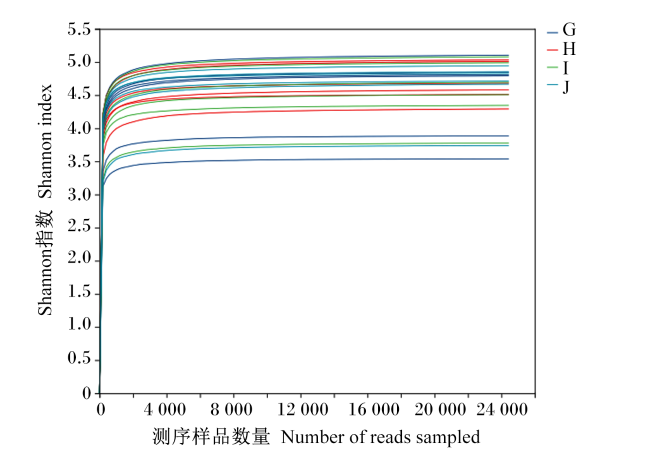
图2可知,样品的Sobs指数稀释曲线皆为先升高后平稳的趋势,表明测序数据量趋近合理,更深入的测序对滩羊瘤胃液中检测出新的OTUs贡献很小。由图3可知,各样品Shannon指数稀释曲线皆是直线上升而后趋于平稳,表明测序逐渐饱和,即测序深度已覆盖样品中绝大多数微生物种类,能够进行细菌多样性分析。
图2 样品的Sobs指数稀释曲线

Fig.2 Sobs index dilution curve of samples

图3 样品的Shannon指数稀释曲线

Fig.3 Shannon index dilution curve of samples

2.3.3 微生物群落Alpha多样性分析

表4可知,各组间Alpha多样性分析指数无显著差异(P>0.05),表明饲粮中添加2%、4%、8%的百里香对滩羊瘤胃菌群多样性和丰富度无显著影响(P>0.05)。在本试验中,各组覆盖率均在98%之上,说明样品采集足以反映滩羊瘤胃菌群情况。
表4 Alpha多样性指数

Table 4 Alpha diversity index

项目
Items
对照组
Control group
2%组
2% group
4%组
4% group
8%组
8% group
SEM P
P-value
Sobs指数Sobs index 891.50±158.71 873.17±250.86 980.17±184.11 959.83±195.79 39.24 0.75
Shannon指数Shannon index 4.62±0.44 4.50±0.63 4.68±0.29 4.57±0.48 0.09 0.91
Simpson指数Simpson index 0.04±0.04 0.05±0.04 0.04±0.02 0.05±0.04 0.01 0.85
Ace指数Ace index 1 191.19±261.87 1 082.76±324.63 1 285.17±163.02 1 296.55±301.16 54.41 0.50
Chao指数Chao index 1 147.34±226.39 1 039.03±294.09 1 196.66±159.78 1 247.12±274.21 49.17 0.51
覆盖率Coverage 0.988 8±0.003 0 0.990 6±0.003 0 0.988 3±0.002 0 0.987 0±0.003 0 0.00 0.32

2.3.4 瘤胃菌群主坐标分析(PCoA)

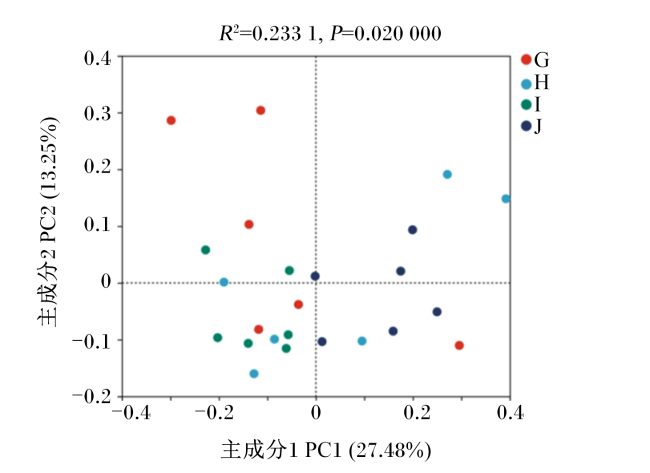
图4可知,4%组与8%组之间的相对距离较近,而2%组与4%、8%组之间的距离较远,且对照组与2%、4%、8%组之间的距离都较远,说明4%组与8%组的瘤胃菌群结构类似,而对照组与2%、4%、8%组的瘤胃菌群结构存在显著差异(P<0.05),2%组与4%、8%组的瘤胃菌群结构有显著差异(P<0.05),也进一步说明添加不同比例百里香可改变滩羊瘤胃菌群结构。
图4 主坐标分析

Fig.4 PCoA

2.3.5 细菌组成与菌群结构分析

2.3.5.1 门水平结构分析

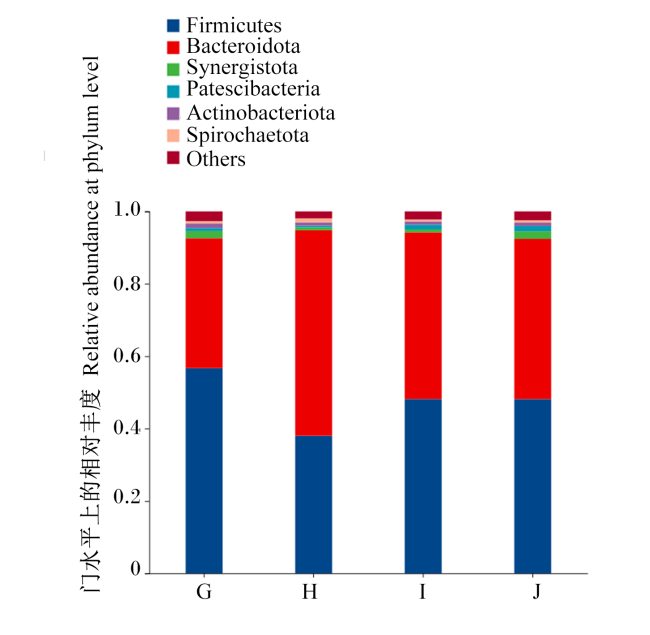
根据物种注释结果,滩羊瘤胃液细菌在门水平上的菌落组成和相对丰度见表5图5,共检测到17个菌门,其中6个菌门相对丰度高于1%。本试验得出的相对丰度排名前3的菌门分别为厚壁菌门、拟杆菌门和互养菌门,占总相对丰度的94.51%以上。与对照组、2%和8%组相比,4%组脱硫菌门的相对丰度显著升高(P<0.05);与对照组、4%和8%组相比,2%组的丝状杆菌门相对丰度显著升高(P<0.05)。
表5 饲粮中添加百里香对滩羊瘤胃菌群门水平相对丰度的影响

Table 5 Effects of dietary supplementation of thyme on relative abundance of rumen microflora at phylum level of Tan sheep %

项目
Items
对照组
Control group
2%组
2% group
4%组
4% group
8%组
8% group
SEM P
P-value
厚壁菌门Firmicutes 48.15±13.00 56.72±18.43 38.03±14.00 48.17±10.19 3.04 0.19
拟杆菌门Bacteroidota 44.28±11.43 35.88±19.34 56.77±14.12 46.05±11.30 3.15 0.13
放线菌门Actinobacteriota 0.92±0.74 1.21±0.79 0.92±0.89 0.90±0.72 0.15 0.88
互养菌门Synergistota 0.72±0.67 1.69±1.43 0.62±0.54 1.48±1.19 0.54 0.75
Patescibacteria 1.46±1.19 0.84±0.59 0.46±0.18 0.53±0.27 0.24 0.45
未分类菌门
Unclassified_k_norank_d-bacteria
0.39±0.28 0.26±0.16 0.43±0.35 0.30±0.22 0.11 0.77
螺旋菌门Spirochaetota 0.65±0.41 0.67±0.42 1.11±1.06 0.50±0.43 0.13 0.41
绿屈挠菌门Chloroflexi 0.37±0.16 0.56±0.47 0.38±0.31 0.75±0.57 0.08 0.62
变形菌门Proteobacteria 0.28±0.23 0.34±0.17 0.11±0.01 0.39±0.11 0.14 0.83
疣微菌门Verrucomicrobiota 0.51±0.29 0.48±0.29 0.34±0.28 0.41±0.34 0.06 0.76
脱硫菌门Desulfobacterota 0.16±0.12a 0.12±0.10a 0.39±0.23b 0.19±0.14a 0.04 0.04
蓝藻门Cyanobacteria 0.43±0.26 0.29±0.13 0.11±0.09 0.21±0.20 0.04 0.19
梭杆菌门Fusobacteriota 0.13±0.11 0.02±0.02 0.00±0.00 0.24±0.20 0.04 0.29
丝状杆菌门Fibrobacterota 0.01±0.01a 0.05±0.04b 0.02±0.01a 0.02±0.02a 0.01 0.03
迷踪菌门Elusimicrobiota 0.02±0.01 0.05±0.05 0.01±0.02 0.02±0.03 0.01 0.55
浮霉菌门Planctomycetota 0.06±0.05 0.01±0.00 0.00±0.00 0.01±0.01 0.01 0.10
WPS-2 0.08±0.08 0.00±0.00 0.00±0.01 0.00±0.00 0.01 0.12
图5 滩羊瘤胃菌群门水平相对丰度的柱形图

Firmicutes:厚壁菌门;Bacteroidota:拟杆菌门; Synergistota:互养菌门;Patescibacteria:髌骨菌门;Actinobacteriota:放线菌门;Spirochaetota:螺旋菌门;Others:其他。

Fig.5 Histogram of relative abundance of rumen microflora at phylum level of Tan sheep

2.3.5.2 属水平结构分析

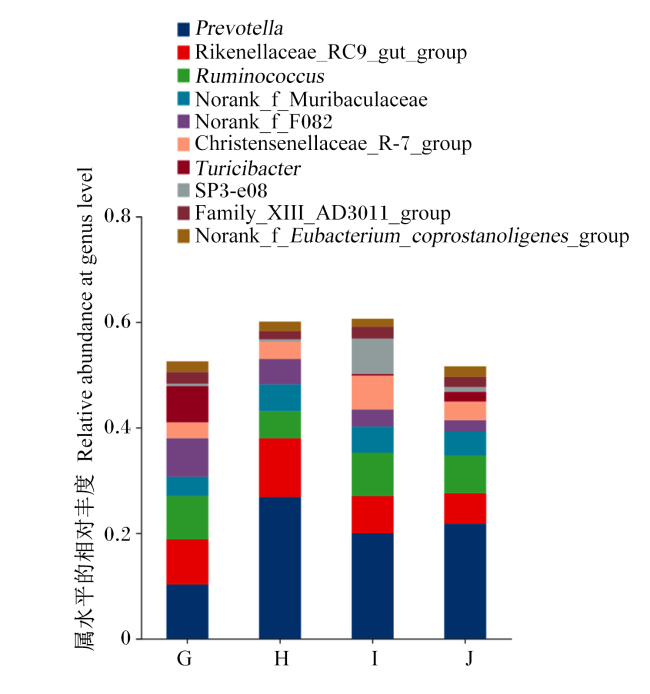
根据物种注释结果,滩羊瘤胃液细菌在属水平上的菌群组成和相对丰度见表6图6。有539个菌属被检测到,其中25个菌属相对丰度高于1%。在属水平上,普雷沃氏菌属、瘤胃球菌属和理研菌科_RC9_肠道群为优势菌属,占总相对丰度的27.30%以上。与对照组相比,2%、4%组的理研菌科_RC9_肠道群相对丰度显著升高(P<0.05);与对照组,2%、4%组相比,8%组的毛螺菌科_NK3A20群的相对丰度显著升高(P<0.05)。
表6 饲粮中添加百里香对滩羊瘤胃菌群属水平相对丰度的影响

Table 6 Effects of dietary supplementation of thyme on relative abundance of rumen microflora at genus level of Tan sheep %

项目
Items
对照组
Control group
2%组
2% group
4%组
4% group
8%组
8% group
SEM P
P-value
普雷沃氏菌属Prevotella 18.05±6.41 14.23±8.79 27.38±11.83 16.49±2.42 2.23 0.17
瘤胃球菌属Ruminococcus 4.51±1.60 4.55±3.67 1.50±0.85 5.66±1.58 0.63 0.10
克里斯滕森菌科R-7群
Christensenellaceae_R-7_group
2.61±1.23 2.52±0.42 2.63±0.91 3.73±1.34 0.27 0.34
理研菌科_RC9_肠道群
Rikenellaceae_RC9_gut_group
5.79±4.00a 8.52±8.10b 11.15±3.29b 7.11±3.26ab 0.83 0.03
Norank_f_F082 2.69±0.64 4.67±3.69 3.29±3.04 3.12±0.89 0.58 0.70
Norank_f_Muribaculaceae 3.15±1.65 2.39±1.89 3.32±2.77 3.25±2.53 0.51 0.93
依赖杆菌属Fretibacterium 0.05±0.05 0.72±0.52 0.24±0.19 0.09±0.06 0.52 0.38
未排位真杆菌群
Norank_f_Eubacterium_
coprostanoligenes_group
2.55±1.10 2.23±0.21 1.61±0.37 1.84±1.21 0.21 0.44
毛螺菌科_NK3A20_群
Lachnospiraceae_
NK3A20_group
1.66±0.56a 0.88±0.40a 0.57±0.17a 4.82±2.45b 0.53 <0.01
0.01NK4A214_group 1.22±0.70 1.60±1.26 1.11±0.32 2.69±2.21 0.26 0.08
Family_XIII_AD3011_group 1.35±0.75 1.16±0.87 1.55±0.22 1.93±1.06 0.19 0.57
奎因氏菌属Quinella 0.79±0.51 2.27±1.09 0.19±0.18 0.45±0.42 0.25 0.41
艰难杆菌属Mogibacterium 2.24±1.75 0.41±0.30 0.98±0.28 1.76±0.90 0.29 0.10
UCG-002 2.67±1.54 1.63±1.13 1.32±1.25 0.54±0.46 0.33 0.13
普雷沃氏菌科_UCG-003
Prevotellaceae_UCG-003
1.19±0.90 1.23±0.90 1.48±0.37 0.77±0.42 0.17 0.57
普雷沃氏菌科_UCG-001
Prevotellaceae_UCG-001
2.40±1.50 1.73±0.97 1.26±0.27 1.04±0.42 0.25 0.22
SP3-e08 0.27±0.20 0.26±0.19 0.62±0.53 0.54±0.32 0.09 0.35
产乙酸糖发酵菌属
Saccharofermentans
3.19±2.79 2.16±1.72 0.75±0.15 0.67±0.07 0.46 0.15
毛螺菌科_ND3007群
Lachnospiraceae_ND3007_group
0.58±0.57 0.39±0.20 0.73±0.70 1.05±0.88 0.14 0.72
聚乙酸菌属
Acetitomaculum
0.75±0.55 0.63±0.23 0.40±0.15 0.99±0.65 0.11 0.35
高氏瘤胃球菌群
Ruminococcus_gauvreauii_group
0.56±0.52 0.45±0.34 0.53±0.22 0.35±0.33 0.09 0.84
欧陆森氏菌属Olsenella 0.15±0.13 0.10±0.05 0.11±0.04 0.22±0.12 0.02 0.25
Norank_f_p-2534-18B5_
gut_group
1.41±1.01 0.11±0.11 0.52±0.49 0.55±0.53 0.19 0.07
假丝酵母菌属
Candidatus_Saccharimonas
1.21±0.51 0.99±0.58 0.50±0.21 0.64±0.18 0.12 0.11
毛螺菌科_XPB1014_群
Lachnospiraceae_XPB1014_group
0.75±0.73 0.41±0.39 0.48±0.42 0.15±0.09 0.12 0.38
未分类梭菌属
Unclassified_Clostridia
0.56±0.30 0.96±0.81 0.51±0.41 0.78±0.32 0.12 0.59
未排位瘤胃球菌科
Norank_f_Ruminococcaceae
1.40±0.93 1.10±1.09 0.33±0.19 0.78±0.78 0.21 0.34
双歧杆菌菌属
Bifidobacterium
0.03±0.03 0.01±0.01 0.01±0.01 0.00±0.00 0.00 0.12
图6 滩羊瘤胃菌群属水平相对丰度的柱形图

Prevotella:普雷沃氏菌属;Rikenellaceae_RC9_gut_group:理研菌科_RC9_肠道群;Ruminococcus:瘤胃球菌属;Christensenellaceae_R-7_group:克里斯滕森菌科R-7群;Turicibacter:苏黎世杆菌属;Norank_f_Eubacterium_coprostanoligenes_group:未排位真杆菌群。

Fig.6 Histogram of relative abundance of rumen microflora at genus level of Tan sheep

2.4 瘤胃菌群功能预测分析(PICRUSt)

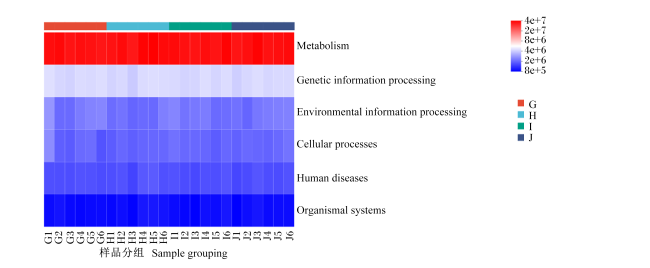
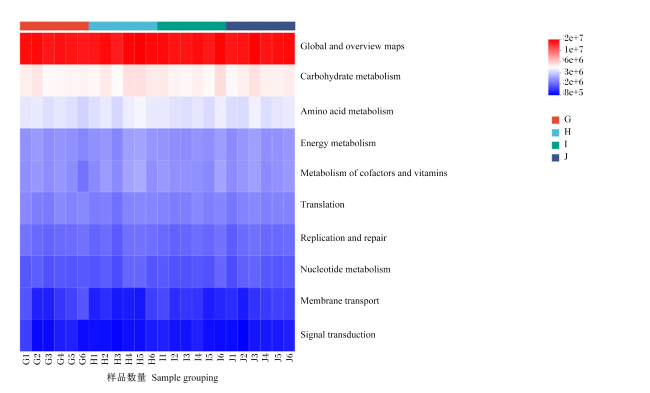
表7图7图8可知,在KEGG生物代谢一级通路水平上,各组滩羊的功能基因主要富集在新陈代谢(metabolism)、遗传信息处理(genetic information processing)和环境信息处理(environmental information processing)。在KEGG生物代谢二级通路水平上,各组瘤胃菌群功能丰度富集在前3的二级通路依次为全局地图和概览图(global and overview maps)、碳水化合物代谢(carbohydrate metabolism)、氨基酸代谢(amino acid metabolism)。相比于对照组和2%组,4%组的氨基酸代谢功能通路的相对丰度显著升高(P<0.05)。
表7 滩羊瘤胃菌群功能丰度KEGG通路分析

Table 7 KEGG pathway analysis of functional abundance of rumen microflora of Tan sheep

一级通路
Primary pathway
二级通路
Secondary
pathway
对照组
Control group
2%组
2% group
4%组
4% group
8%组
8% group
SEM P
P-value
新陈代谢
Metabolism
全局地图和概览图
Global and
overview maps
18 943 562.62
±603 242.94
19 142 808.51
±669 752.36
19 958 658.17
±1 016 196.39
19 453 720.93
±830 684.66
185 494.90 0.24
氨基酸代谢
Amino acid
metabolism
3 312 795.61
±98 258.69ab
3 454 698.48
±100 018.31a
3 640 082.66
±129 715.79c
3 507 589.93
±104 245.03bc
38 835.77 <0.01
能量代谢
Energy metabolism
2 023 667.33
±62 010.51
2 030 639.15
±60 147.22
2 120 983.77
±101 395.52
2 045 735.91
±84 065.77
18 447.47 0.23
辅因子和维生素
的代谢
Metabolism of
cofactors and
vitamins
2 015 715.05
±75 476.68
2 013 919.05
±62 905.92
2 136 851.54
±184 191.91
2 077 727.52
±115 485.08
27 104.69 0.34
核苷酸代谢
Nucleotide metabolism
1 381 460.24
±61 446.44
1 386 087.56
±40 164.25
1 436 413.37
±79 875.75
1 393 148.09
±78 727.64
14 636.69 0.56
碳水化合物代谢
Carbohydrate
metabolism
4 464 270.16
±111 338.25
4 484 069.72
±196 262.15
4 749 553.94
±295 272.81
4 605 019.08
±295 348.62
55 270.03 0.24
遗传信息处理
Genetic
information
processing
翻译
Translation
1 800 872.89
±65 323.91
1 865 712.81
±57 574.57
1 827 201.77
±48 060.07
1 833 239.44
±49 112.57
12 551.40 0.36
复制和修复
Replication and repair
1 539 606.83
±58 619.09
1 598 152.93
±47 623.63
1 594 288.18
±55 024.55
1 572 278.02
±53 809.22
12 282.51 0.33
环境信息处理
Environmental
information
processing
信号转导
Signal transduction
877 103.47
±57 070.63
956 736.81
±135 198.9
879 588.21
±32 807.76
912 818.8
±48 852.45
17 826.29 0.38
膜输送
Membrane transport
1 083 996.65
±93 951.66
1 200 723.77
±174 567.58
1 012 908.27
±107 309.54
1 103 973.93
±94 382.61
29 420.02 0.15
图7 滩羊瘤胃菌群功能丰度KEGG一级通路热图

Metabolism:新陈代谢;Genetic information processing:遗传信息处理; Environmental information processing: 环境信息处理; Cellular processes:细胞过程; Human diseases:人类疾病; Organismal systems:生物体系统。

Fig.7 Heat map of KEGG primary pathways of functional abundance of rumen microflora of Tan sheep

图8 滩羊瘤胃菌群功能丰度KEGG二级通路热图

Global and overview maps:全局地图和概览图;Carbohydrate metabolism:碳水化合物代谢;Amino acid metabolism:氨基酸代谢;Energy metabolism:能量代谢;Nucleotide metabolism:核苷酸代谢; Metabolism of cofactors and vitamins:辅助因子和维生素代谢;Translation:翻译;Replication and repair:复制和修复:Signal transduction:信号转导;Membrane transport:膜输送。

Fig.8 Heat map of KEGG secondary pathways of functional abundance of rumen microflora of Tan sheep

3 讨论

3.1 饲粮中添加百里香对滩羊生长性能、屠宰性能的影响

ADG是衡量动物生长性能的重要指标。Imbabi等[10]研究发现,大马士革羊饲粮中添加百里香和大蒜油可提高总增重、ADG,降低料重比。本试验中,4%、8%组的料重比低于对照组,4%、8%组滩羊ADG高于对照组,推测百里香中活性物质通过诱导瘤胃菌群变化、增强胃肠道的形态、改善免疫反应以及增强抗氧化活性来促进生长性能的发挥[11]。百里香对病原微生物的抗菌活性也是提高日增重的一个原因[11]。在肉兔饲粮中添加百里香酚50~100 mg/kg,可显著提高肉兔生长性能,增强动物免疫力[12]。朱晓磊等[13]研究发现,麻花鸡饲粮中添加百里香精油0.10~0.25 mg/kg,显著提高22~42日龄麻花鸡的ADG。Ahangaran等[14]研究表明,在家禽饲粮中添加0.5%和1%百里香显著提高家禽增重,并降低料重比。Anna等[15]研究表明,饲粮中添加3%百里香后显著提高了猪生长性能,可能是由于百里香提高了猪对饲粮中粗蛋白质、粗纤维、乙醚提取物的消化率。朱晓磊等[16]在饲粮中添加0.35 mg/kg的百里香精油极显著提高了42日龄麻花鸡的全净膛率。本试验中,百里香对滩羊生长、屠宰性能影响并不显著,可能是全株百里香中活性物质不同于百里香酚或百里香精油,且试验动物为反刍动物,消化吸收不同于单胃动物。在巴基羔羊饲粮中添加百里香和芹菜15 g/d可提高采食量[17]。马小明等[18]在滩羊饲粮中添加5%和10%的地椒,发现滩羊的生长性能和屠宰性能并无显著变化。饲粮中添加5%的百里香可提高滩羊总增重、屠宰率,但生长性能、屠宰性能无显著变化[19],与本试验结果一致。在本试验中,样本量不足可能是导致滩羊生长性能、屠宰性能变化不显著的原因之一。

3.2 饲粮中添加百里香对滩羊瘤胃菌群结构的影响

瘤胃由密集而多样的微生物生态系统组成。这些微生物产生淀粉酶、纤维素酶和脂肪酶等消化酶,降解并利用营养物质[20],同时维持瘤胃功能和健康[21]。拟杆菌门和厚壁菌门为滩羊的主要菌门,与之前研究结果[22]一致。大多数研究中,反刍动物瘤胃厚壁菌门的相对丰度大于拟杆菌门[23],而本试验结果中4%组则相反,推测4%的百里香促进蛋白质水解的能力要强于对照组,因此拟杆菌门的相对丰度高于厚壁菌门。拟杆菌门成员在碳水化合物降解和蛋白质水解中发挥重要作用[24],可降解和利用植物细胞壁中不可消化的营养物质[25-26];厚壁菌门可促进纤维溶解,提高纤维物质利用率[27]。Patra等[28]报道,饲喂含有百里酚的牛至油,泌乳牛拟杆菌门的相对丰度增加,厚壁菌门的相对丰度减少。饲粮中添加百里香,使滩羊摄入纤维素、半纤维素和木聚糖等多糖的含量增加,从而增加拟杆菌门的相对丰度[29]。本试验中除了2%组,4%、8%组的拟杆菌门相对丰度均大于对照组,与上述结果一致。Du等[29]得出结论,添加80 g/d风干百里香后,湖羊瘤胃优势细菌门为拟杆菌门、厚壁菌门、放线菌门、螺旋菌门和变形菌门,与本试验结果不同,猜测是添加量和试验羊品种不同。百里香可增强蛋白质的合成利用及能量代谢,并增加瘤胃益生菌的丰度[29],试验组
氨基酸代谢功能通路相对丰度高于对照组,且4%组的相对丰度显著高于对照组也印证了这一观点。Yu等[30]在山羊饲粮中添加百里香酚,得出的瘤胃优势菌门为厚壁菌门、拟杆菌门、互养菌门,与本试验结果一致。
研究证实,瘤胃代谢的重要菌门是变形菌门,有促进瘤胃分解淀粉的作用[31],本试验中,2%、8%组的变形菌门相对丰度提高,有助于滩羊瘤胃分解淀粉,从而改善生长性能。螺旋菌门可以降解纤维素[32],2%、4%组的螺旋菌门相对丰度均高于对照组,因此这2组的饲粮消化能力要强于对照组。本研究中,随着百里香添加比例的提高,互氧菌门相对丰度的降低是否影响滩羊瘤胃蛋白质利用需要进一步深入研究。
在本试验中,优势菌属为普雷沃氏菌属、瘤胃球菌属及理研菌科_RC9_肠道群。普雷沃氏菌属和理研菌科_RC9_肠道群属于拟杆菌门,瘤胃球菌属属于厚壁菌门。普雷沃氏菌属的相对丰度与微生物的健康密不可分,它降解蛋白质,同时还发酵氨基酸和糖类。4%组的普雷沃氏菌属的相对丰度高于对照组,因此4%组的蛋白质降解能力强于对照组。瘤胃球菌属可提供反刍动物能量来源、平衡瘤胃环境、促进微生物生长、调节能量代谢等[33]。2%、8%组的瘤胃球菌属的相对丰度高于对照组,这2组能量代谢功能通路的相对丰度高于对照组。4%组的理研菌科_RC9_肠道群相对丰度显著高于对照组,理研菌科_RC9_肠道群与滩羊胃肠道系统健康程度显著相关[34],能够降解来源于植物的纤维素和半纤维素,将它们转化为短链脂肪酸,故4%组滩羊胃肠道健康程度高于对照组。本试验中,8%组的毛螺菌科_NK3A20群的相对丰度显著高于对照组,毛螺菌科_NK3A20群可提高瘤胃的效率,促进消化吸收,加快动物生长发育[35],所以8%组料重比显著低于对照组。
Yang等[36]研究发现,norank_Muribaculacea的功能是降低胆固醇。在本试验中,与对照组和2%组相比,4%、8%组的norank_Muribaculaceae相对丰度上升。饲粮中添加百里香可能会改善滩羊胆固醇水平。奎因氏菌属是致病菌,发酵碳水化合物并产生乳酸、乙酸、丙酸和二氧化碳[37],可能有助于氢营养产甲烷作用。4%组的奎因氏菌属相对丰度低于对照组,因此添加4%的百里香有利于瘤胃健康。由于同一科其他成员的功能,普雷沃氏菌科_UCG-003被推测具有蛋白质水解活性,4%组的普雷沃氏菌科_UCG-003的相对丰度高于对照组,因此蛋白质水解的能力也高于对照组,氨基酸代谢功能通路相对丰度亦显著高于对照组。UCG-002的功能可能与脂质代谢相关[38]。本研究在滩羊瘤胃菌群内还检测到大量未被分类和排位鉴定的菌属,表明滩羊瘤胃中可能存在一些特定的菌群,在今后的研究中有待于进一步挖掘。

4 结论

① 饲粮中添加百里香降低了滩羊料重比,对屠宰性能无不良影响。
② 饲粮中添加百里香改变滩羊瘤胃菌群结构,提高有益菌的相对丰度,有利于瘤胃健康;提高氨基酸代谢通路的相对丰度,有利于滩羊的生长发育。
③ 结合生长性能和瘤胃菌群结构,本试验中,在饲粮中添加4%百里香的效果最佳,添加8%效果次之,而添加2%百里香的效果不太明显。
[1]
VLAICU A P, UNTEA E A, PANAITE D T, et al. Effect of basil,thyme and sage essential oils as phytogenic feed additives on production performances,meat quality and intestinal microbiota in broiler chickens[J]. Agriculture, 2023, 13(4):874-888.

[2]
STAHL-BISKUP E, VENSKUTONIS R P. Handbook of herbs and spices[M].2rd ed.ed. Cambridge: Woodhead Publishing, 2012:499-525.

[3]
LEE S J, UMANO K, SHIBAMOTO T, et al. Identification of volatile components in basil (Ocimum basilicum L.) and thyme leaves (Thymus vulgaris L.) and their antioxidant properties[J]. Food Chemistry, 2005, 91(1):131-137.

[4]
HIPPENSTIEL F, ABDEL-WARETH A, KEHRAUS S, et al. Effects of selected herbs and essential oils,and their active components on feed intake and per-formance of broilers—a review[J]. Archiv Fur Geflugelkunde, 2011, 75(4):226-234.

[5]
RAŠKOVIĆ A, PAVLOVIĆ N, KVRGIĆ M, et al. Effects of pharmaceutical formulations containing thyme on carbon tetrachloride-induced liver injury in rats[J]. BMC Complementary and Alternative Medicine, 2015, 15:442.

DOI PMID

[6]
ABDEL-WARETH A A A, KEHRAUS S, HIPPENSTIEL F, et al. Effects of thyme and oregano on growth performance of broilers from 4 to 42 days of age and on microbial counts in crop,small intestine and caecum of 42-day-old broilers[J]. Animal Feed Science and Technology, 2012, 178(3/4):198-202.

[7]
GHOLAMI-AHANGARAN M, AHMADI-DASTGERDI A, AZIZI S, et al. Thymol and carvacrol supplementation in poultry health and performance[J]. Veterinary Medicine and Science, 2022, 8(1):267-288.

[8]
EL-ESSAWY A M, ANELE U Y, ABDEL-WAHED A M, et al. Effects of anise,clove and thyme essential oils supplementation on rumen fermentation,blood metabolites,milk yield and milk composition in lactating goats[J]. Animal Feed Science and Technology, 2021, 271:114760.

[9]
张宁, 康燕, 任文义, 等. 饲粮添加琥珀酸对滩羊肉品质及肌纤维类型的影响[J]. 动物营养学报, 2023, 35(10):6538-6545.

DOI

ZHANG N, KANG Y, REN W Y, et al. Effects of dietary succinic acid on meat quality and muscle fiber type of Tan sheep[J]. Chinese Journal of Animal Nutrition, 2023, 35(10):6538-6545. (in Chinese)

DOI

[10]
IMBABI T, HASSAN T M M, OSMAN A, et al. Impacts of thyme and/or garlic oils on growth, immunity,antioxidant and net farm income in Damascus goats[J]. Scientific Reports, 2024, 14(1):13173.

[11]
KUMAR M, KUMAR SIDHU V, ROY D, et al. Application of herbal feed additives in animal nutrition—a review[J]. International Journal of Livestock Research, 2014, 4(9):1-8.

[12]
黄崇波, 郭志强, 刁慧, 等. 百里香酚对肉兔生长性能、小肠黏膜形态结构和免疫器官的影响[J]. 中国畜牧杂志, 2021, 57(3):164-168.

HUANG C B, GUO Z Q, DIAO H, et al. Effects of thymol on growth performance,intestinal morphology and immune organ of rabbits[J]. Chinese Journal of Animal Science, 2021, 57(3):164-168. (in Chinese)

[13]
朱晓磊, 刘文骁, 陈宏. 百里香精油对麻花鸡生长性能、血清蛋白和细胞因子的影响[J]. 中国畜牧兽医, 2014, 41(10):95-100.

ZHU X L, LIU W X, CHEN H. Effect of thyme essential oil on growth performance,serum protein and cytokine of mahua broilers[J]. China Animal Husbandry & Veterinary Medicine, 2014, 41(10):95-100. (in Chinese)

[14]
AHANGARAN GHOLAMI M, PEIMANI N, AHMADI-DASTGERDI A. The effect of thyme(Thymus daenensis) supplement on growth and hygienic parameters of broilers meat[J]. Iraqi Journal of Veterinary Sciences, 2019, 33(1):87-92.

[15]
ANNA C, KAMILA K, IWONA S. The effect of thyme herb in diets for fattening pigs on their growth performance and health[J]. PLoS One, 2023, 18(10):e0291054.

[16]
朱晓磊, 刘文骁, 陈宏. 百里香精油对麻花鸡生长性能和屠宰性能及经济效益的影响[J]. 中国畜牧杂志, 2013, 49(21):57-60.

ZHU X L, LIU W X, CHEN H. Effect of thyme essential oil on growth performance,slaughtering performance and economic benefits of twist chicken[J]. Chinese Journal of Animal Science, 2013, 49(21):57-60. (in Chinese)

[17]
SHAABAN M M, KHOLIF A E, TAWAB A M A E et al. Thyme and celery as potential alternatives to ionophoresuse in livestock production:their effects on feed utilization,growth performance and meat quality of Barki lambs[J]. Small Ruminant Research, 2021, 200:106400.

[18]
马小明, 吴建平, 李聚才, 等. 饲粮中添加不同比例的地椒对滩羊生长性能,屠宰性能及肉品质的影响[J]. 动物营养学报, 2021, 33(11):6223-6232.

DOI

MA X M, WU J P, LI J C, et al. Effects of different proportions of ground pepper added to diet on growth performance,slaughter performance and meat quality of Tan sheep[J]. Chinese Journal of Animal Nutrition, 2021, 33(11):6223-6232. (in Chinese)

[19]
康艳梅. 日粮中添加百里香对滩羊肉风味物质的影响[D]. 硕士学位论文, 银川: 宁夏大学, 2014.

KANG Y M. Effect of dietary added thyme on Tan sheep mutton’s flavor substances[D]. Master’s Thesis. Yinchuan: Ningxia University, 2014. (in Chinese)

[20]
PLAIZIER J, KHAFIPOUR E, LI S, et al. Subacute ruminal acidosis(SARA),endotoxins and health consequences[J]. Animal Feed Science and Technology, 2012, 172(1/2):9-21.

[21]
WU Q J, XING Z Y, LIAO J H, et al. Effects of glutamine on rumen digestive enzymes and the barrier function of the ruminal epithelium in Hu lambs fed a high-concentrate finishing diet[J]. Animals, 2022, 12(23):3418.

[22]
FAN Q S, WANAPAT M, HOU F J. Chemical composition of milk and rumen microbiome diversity of yak,impacting by herbage grown at different phenological periods on the Qinghai-Tibet plateau[J]. Animals, 2020, 10(6):1030.

[23]
SESHADRI R, LEAHY S C, ATTWOOD G T, et al. Cultivation and sequencing of rumen microbiome members from the Hungate1000 collection[J]. Nature Biotechnology, 2018, 36(4):359-367.

DOI PMID

[24]
WU G D, CHEN J, HOFFMANN C, et al. Linking long-term dietary patterns with gut microbial enterotypes[J]. Science, 2011, 334(6052):105-108.

DOI PMID

[25]
FU X D, LIU Z M, ZHU C L, et al. Nondigestible carbohydrates,butyrate,and butyrate-producing bacteria[J]. Critical Reviews in Food Science and Nutrition, 2019, 59(S1):S130-S152.

[26]
YE M, YU J P, SHI X X, et al. Polysaccharides catabolism by the human gut bacterium-Bacteroides thetaiotaomicron:advances and perspectives[J]. Critical Reviews in Food Science and Nutrition, 2020, 61(21):3569-3588.

[27]
TREMAROLI V, BÄCKHED F. Functional interactions between the gut microbiota and host metabolism[J]. Nature, 2012, 489(7415):242-249.

[28]
PATRA A K, YU Z T. Essential oils affect populations of some rumen bacteria in vitro as revealed by microarray(Rumen Bact Array) analysis[J]. Frontiers in Microbiology, 2015, 6:297.

[29]
DU X, CHENG X D, JI K X, et al. Effects of supplementary thyme on immunity responses,antioxidant indices,rumen enzymes concentrations and rumen bacteria composition in Hu sheep[J]. Animal Feed Science and Technology, 2023, 306:115828.

[30]
YU J K, CAI L Y, ZHANG J C, et al. Effects of thymol supplementation on goat rumen fermentation and rumen microbiota in vitro[J]. Microorganisms, 2020, 8(8):1160.

[31]
HOOK S E, STEELE M A, NORTHWOOD K S, et al. Impact of subacute ruminal acidosis(SARA) adaptation and recovery on the density and diversity of bacteria in the rumen of dairy cows[J]. FEMS Microbiology Ecology, 2011, 78(2):275-284.

[32]
潘城, 李海雁, 张小明, 等. 不同饲养模式对南江黄羊瘤胃菌群及酶活性的影响[J/OL]. 家畜生态学报, 2024:1-9[2024-12-07].

PAN C, LI H Y, ZHANG X M, et al. Effects of different feeding patterns on rumen microbiota and enzyme activities of Nanjiang yellow sheep[J/OL]. Chinese Journal of Animal Ecology, 2024:1-9[2024-12-07].

[33]
WANG Y P, ZHAO Y G, NAN X M, et al. Rumen-protected glucose supplementation alters fecal microbiota and its metabolic profiles in early lactation dairy cows[J]. Frontiers in Microbiology, 2022, 13:1034675.

[34]
ZHANG C T, MA T, TU Y, et al. Effects of circadian rhythm and feeding modes on rumen fermentation and microorganisms in Hu sheep[J]. Microorganisms, 2022, 10(12):2308.

[35]
李盼. 饲粮添加发酵枸杞渣对滩羊生长及血液指标和瘤胃微生物的影响[D]. 硕士学位论文. 银川: 北方民族大学, 2024.

LI P. Effect of fermented Goqi berry residue on growth and blood indexes and rumen microorganisms of Tan sheep in diet[D]. Master’s Thesis. Yinchuan: Beifang Univesity of Nationality, 2024. (in Chinese)

[36]
YANG C W, HUANG S Y, LIN Z G, et al. Polysaccharides from Enteromorpha prolifera alleviate hypercholesterolemia via modulating the gut microbiota and bile acid metabolism[J]. Food & Function, 2022, 13(23):12194-12207.

[37]
KRUMHOLZ L R, BRYANT M P, BRULLA W J, et al. Proposal of Quinella ovalis gen.nov.,sp.nov.,based on phylogenetic analysis[J]. International Journal of Systematic and Evolutionary Microbiology, 1993, 43(2):293-296.

[38]
来进成, 刘东花, 李润桦, 等. 饲粮粗蛋白质水平对育肥牦牛生产性能和瘤胃微生物多样性的影响[J]. 中国饲料, 2023(21):105-112.

LAI J C, LIU D H, LI R H, et al. Effects of dietary crude protein levels on production performance and rumen microbial diversity in fattening yaks[J]. China Feed, 2023(21):105-112. (in Chinese)

Outlines

/